Shipyard rejections due to failed fire certifications can ruin your profit margins. Understanding the IMO FTP Code prevents costly delays and ensures your marine panels meet strict safety standards.
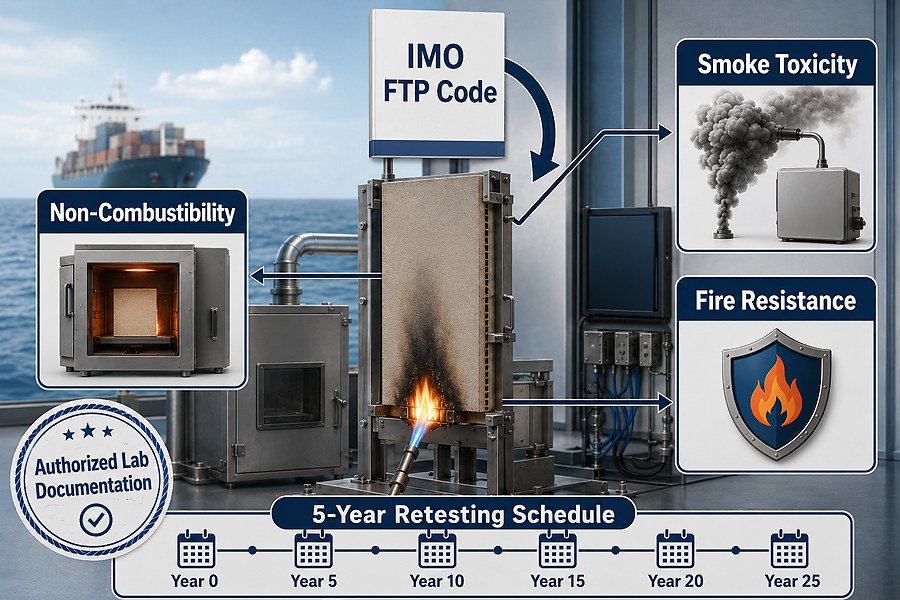
The IMO Fire Test Procedures (FTP) Code governs marine panel fire testing by mandating specific frameworks for non-combustibility, smoke toxicity, and fire resistance. It dictates precise specimen preparation, authorizes specific global testing laboratories, requires standardized documentation, and sets strict 5-year retesting schedules to ensure universal maritime safety.
Let's break down exactly how these rules impact your next panel purchase.
What testing methodology framework does the IMO FTP Code define?
Confused by different fire test standards? Using the wrong test ruins your project. The FTP Code gives a clear, strict framework for every marine panel type.
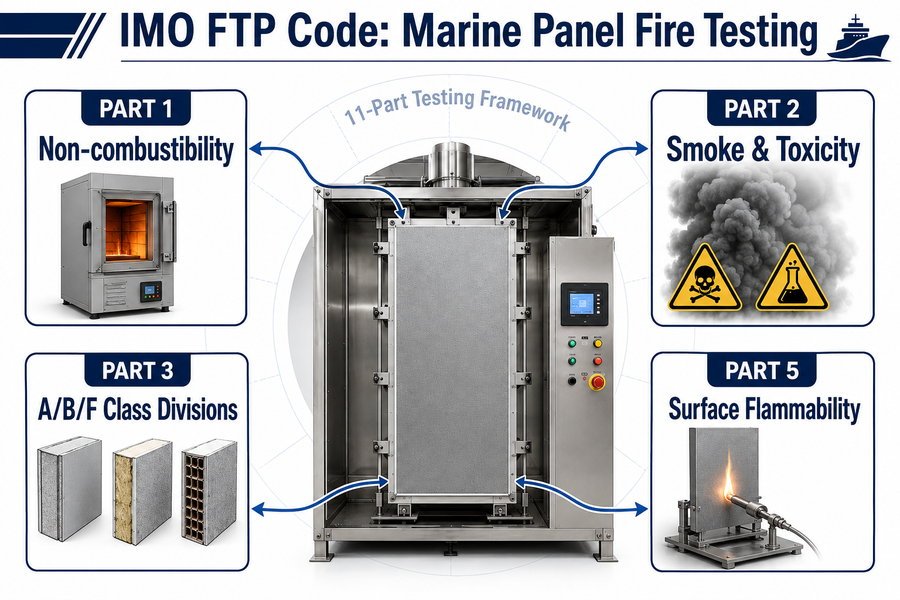
The IMO FTP Code defines a strict 11-part testing framework. For marine panels, it primarily mandates Part 1 for non-combustibility, Part 2 for smoke and toxicity, Part 3 for "A", "B", and "F" class divisions, and Part 5 for surface flammability, covering all critical fire reaction metrics.
Part 1 and Part 2 Non-Combustibility and Toxicity Testing for Marine Panels
When I worked at the marine outfitting factory, I learned that a marine panel is not just one piece of material. It is a system. The IMO FTP Code 2010 uses Part 1 to test the core materials, like rock wool, for non-combustibility. According to the ISO 1182 standard referenced in Part 1, the material is placed in a furnace heated to 750°C for 30 minutes1. The material passes only if it does not flame for more than 10 seconds and does not lose more than 50% of its mass. This is a very strict rule. Next, we have Part 2, which tests smoke and toxicity. If a fire happens, smoke can trap the crew. Part 2 measures the gases released when the surface finish burns. It checks for toxic gases like Carbon Monoxide, Hydrogen Chloride, and Hydrogen Cyanide. The rules state that the maximum allowed concentration of Carbon Monoxide is 1450 ppm (parts per million), and Hydrogen Cyanide must be below 140 ppm2.
Part 3 and Part 5 Fire Resistance and Flammability Testing for Marine Panels
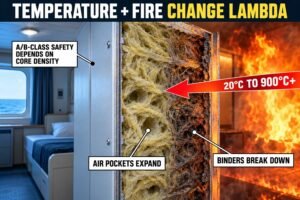
Part 3 is the most important test for the whole panel system. This part tests "A", "B", and "F" class divisions. For an A-60 marine wall panel, the panel must block fire and heat for 60 minutes3. The testing furnace follows a standard time-temperature curve. After 60 minutes, the furnace temperature reaches exactly 945°C. The unexposed side of the panel must not rise more than 140°C above the starting temperature. If it gets hotter, the test fails. Finally, Part 5 tests surface flammability. It checks how fast a flame spreads across the PVC film or metal skin on the panel. The critical heat flux at extinguishment (CFE) must be at least 20 kW/m² for bulkhead finishes4. All these parts work together to form a complete safety net.
| IMO FTP Code Part | Target Feature Tested | Key Pass Criteria (According to IMO FTP Code 2010) |
|---|---|---|
| Part 1 | Non-combustibility | Furnace at 750°C; mass loss ≤ 50%; flaming ≤ 10s |
| Part 2 | Smoke and Toxicity | CO ≤ 1450 ppm; HCN ≤ 140 ppm; SO2 ≤ 120 ppm |
| Part 3 | Fire Resistance (A/B/F Class) | A-Class: withstand up to 945°C; temp rise ≤ 140°C |
| Part 5 | Surface Flammability | CFE ≥ 20.0 kW/m² for bulkhead and ceiling finishes |
Fake certificates will get your ship arrested. Finding the right lab is hard. You must use only specifically authorized laboratories to test your marine outfitting products.
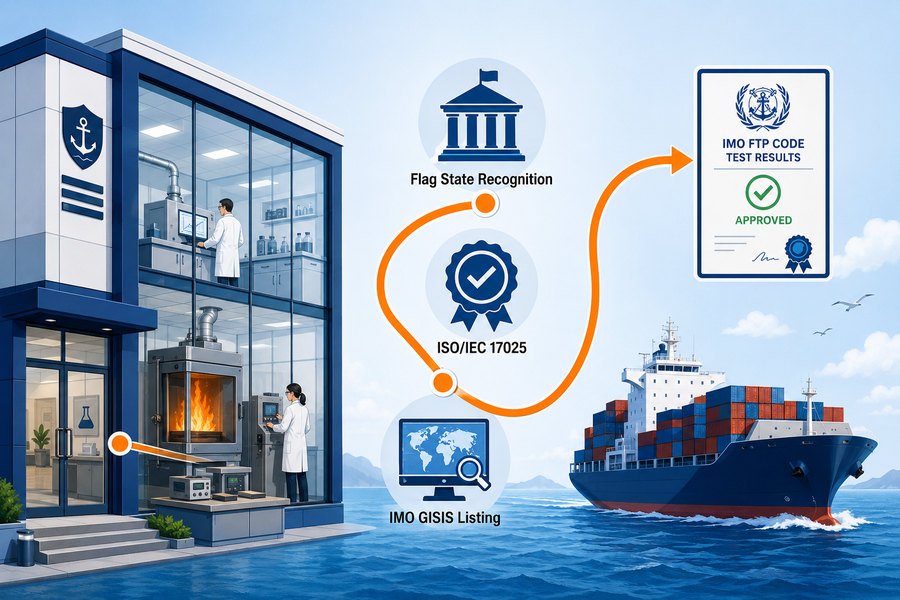
The IMO FTP Code requires testing at laboratories formally recognized by the national maritime administration of a flag State. These labs must hold ISO/IEC 17025 accreditation, undergo regular audits by classification societies like DNV or ABS, and be listed in the IMO's GISIS database.
National Maritime Administration and ISO/IEC 17025 Accreditation Requirements
You cannot just send a marine fire door to any local testing lab. The lab must meet very high global standards. First, the laboratory must be formally recognized by the national maritime administration of a flag State5. This means a government body must say the lab is legal. Second, the laboratory must hold ISO/IEC 17025 accreditation6. This is an international standard that proves the lab has the right equipment, the right calibration methods, and skilled workers. If a lab does not have ISO/IEC 17025, their test results mean nothing to a shipyard. I always ask my suppliers in Asia to show me the lab's ISO/IEC 17025 certificate before I look at the fire test report. It saves a lot of time.
Classification Society Audits and the IMO GISIS Database
Having ISO accreditation is just the start. The laboratories must also pass regular audits by major classification societies7. Organizations like DNV (Norway), ABS (USA), or Lloyd's Register (UK) send inspectors to check the lab's testing furnaces. The classification society is the group that actually reads the test report and issues the final Type Approval certificate. If they do not trust the lab, they will not issue the certificate. Finally, the ultimate proof is the IMO's Global Integrated Shipping Information System (GISIS) database8. The IMO maintains a public list of every recognized testing laboratory in the world. If a lab in China or Vietnam claims they can do IMO FTP Code testing, you must check if their name is on the GISIS database. If they are not on the list, the European and US shipyards will reject the products.
| Laboratory Requirement | Issuing / Managing Body | Purpose of the Requirement |
|---|---|---|
| Formal Recognition | National Maritime Administration | Provides legal authority to test marine equipment. |
| ISO/IEC 17025 Accreditation | National Accreditation Bodies | Proves technical competence and equipment accuracy. |
| Regular Audits | Classification Societies (DNV, ABS) | Ensures the lab maintains standards for Type Approval. |
| Database Listing | IMO (GISIS System) | Provides a global, public list to verify lab legitimacy. |
How does the IMO FTP Code regulate test specimen preparation for marine panels?
A small mistake in preparing your test sample leads to instant failure. The rules are strict. The FTP code tells you exactly how to build the test specimen.
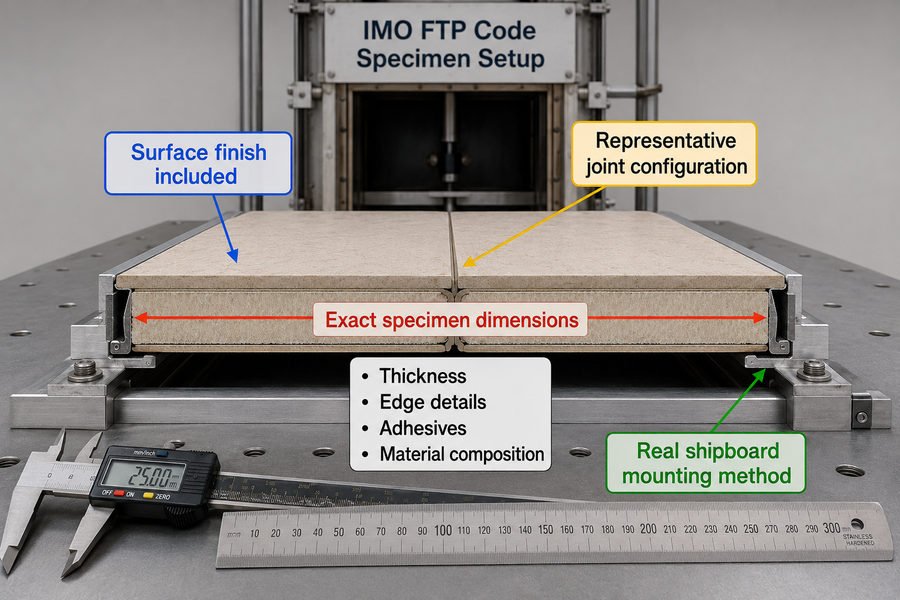
The IMO FTP Code regulates test specimen preparation by dictating exact dimensions, joint configurations, and mounting methods. Specimens must accurately represent the final product's thickness, edge details, and material composition, including all adhesives and surface finishes, ensuring the test reflects real-world shipboard installations.
Exact Dimensions and Joint Configurations for Fire Test Specimens
In my early days, a supplier tried to save money by building a small test panel. The lab rejected it immediately. The IMO FTP Code is very strict about dimensions. For Part 3 fire resistance testing of A-Class bulkheads, the test specimen must have exposed dimensions of at least 2440 mm in width and 2500 mm in height9. For ceilings, the minimum exposed area is 2440 mm by 3040 mm10. You cannot test a tiny piece of metal and claim the whole wall is safe. The code also dictates joint configurations. The test specimen must include at least one vertical joint11 and, depending on the design, a horizontal joint. This is because joints are the weakest point in a fire. The fire will always try to escape through the gaps between the marine wall panels.
Representation of Final Product Thickness, Edges, Adhesives, and Finishes
The specimen must be a perfect copy of the final product. The thickness of the steel skin, the density of the rock wool, and the edge details must be exact. The code strictly regulates the material composition, especially the adhesives and surface finishes. For example, if you use a glue to attach a PVC finish to a metal panel, you must use the exact same glue in the test. The amount of glue matters too. If the test uses 150 grams per square meter of adhesive, your factory mass production cannot use 200 grams per square meter. More glue means more fuel for the fire12. The surface finishes, like paint or PVC film, must also match the exact thickness and brand. The FTP Code ensures that the panel tested in the lab is exactly the same as the panel installed on the ship.
| Specimen Preparation Rule | Specific Value (IMO FTP Code 2010) | Reason for the Rule |
|---|---|---|
| A-Class Bulkhead Size | Minimum 2440 mm (W) x 2500 mm (H) | Simulates a full-size cabin wall section. |
| A-Class Ceiling Size | Minimum 2440 mm (W) x 3040 mm (H) | Simulates a realistic ceiling span. |
| Joint Inclusion | At least 1 vertical joint (often 1 horizontal) | Tests the weakest point where panels connect. |
| Adhesive Application | Must match production (e.g., 150 g/m²) | Controls the amount of combustible material inside. |
What documentation does the IMO FTP Code require after panel fire testing?
Missing paperwork delays shipyard payments. Collecting the right files is a headache. The Code mandates a specific set of documents to prove your panels passed.
After testing, the IMO FTP Code requires a detailed Fire Test Report, a formal Type Approval Certificate issued by a classification society, and a Declaration of Conformity. These documents must detail the testing conditions, material specifications, drawings, and explicit statements of compliance with specific FTP Code parts.
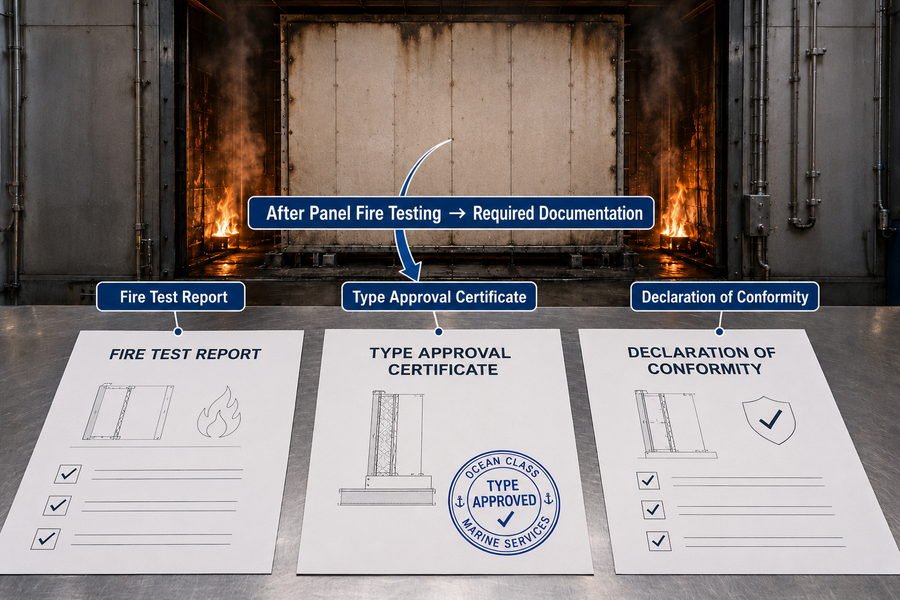
The Detailed Fire Test Report and Declaration of Conformity
When a test finishes, you do not just get a simple paper that says "Pass". You get a very thick document called the Fire Test Report. The IMO FTP Code says this report must show everything.13 It includes the date, the name of the lab, and exact graphs of the temperature curves inside the furnace. It lists the material specifications, like the exact density of the core material (for example, 120 kg/m³ rock wool). It also includes detailed assembly drawings showing how the panel was put together. Along with this report, the factory must provide a Declaration of Conformity. This is a legal paper signed by the factory manager. By signing it, the factory promises that the mass-produced panels will be made exactly like the one described in the test report. If they lie, they face heavy legal trouble.
The Formal Type Approval Certificate from Classification Societies
The Fire Test Report is mostly for engineers. The document you actually give to the shipyard buyer is the Type Approval Certificate. A classification society, like ABS or DNV, takes the Fire Test Report, checks it, and then issues this certificate. This certificate has an explicit statement of compliance, meaning it clearly states, "This product meets IMO FTP Code 2010 Part 3 for A-60 Class". If the ship is sailing in European waters, this certificate will also include the Marine Equipment Directive (MED) Wheelmark logo14. Getting this Wheelmark is the ultimate goal for sales in Europe. The Type Approval also lists all the limits. For example, it will say the certificate is only valid if the PVC film is less than 0.2 mm thick. You must read these limits carefully before you buy.
| Required Document | Issued By | Key Information Included |
|---|---|---|
| Fire Test Report | Authorized Testing Laboratory | Temperature graphs, material specs, assembly drawings. |
| Declaration of Conformity | Product Manufacturer | Legal promise that production matches the tested sample. |
| Type Approval Certificate | Classification Society (e.g., DNV, ABS) | Explicit statement of IMO FTP compliance, use limits. |
| MED Wheelmark (Europe) | Notified Body | Proof of compliance for European registered vessels. |
How often must marine wall and ceiling panels be retested under the IMO FTP Code?
Expired certificates will stop your cargo at the port. Keeping track of dates is stressful. You must know the exact retesting schedule to stay legal.
Marine wall and ceiling panels must be retested or re-certified under the IMO FTP Code every 5 years. This 5-year Type Approval renewal requires a thorough review by the classification society, and physical retesting is mandatory if the manufacturer changes the panel's materials, thickness, or production methods.
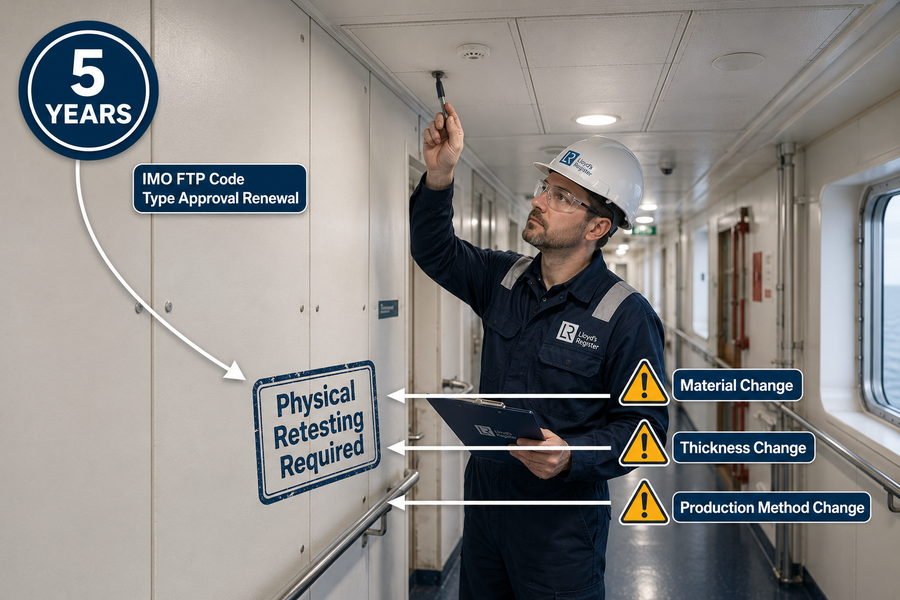
The Standard 5-Year Type Approval Renewal Cycle for Marine Panels
Marine safety certificates do not last forever. The IMO FTP Code works on a strict 5-year cycle.15 Every Type Approval Certificate has an expiration date, which is exactly 5 years from the date it was issued. Before this date hits, the manufacturer must apply for a renewal. During this 5-year Type Approval renewal, the classification society reviews the product again. They check if the IMO rules have changed in the last 5 years. If the rules are the same, and the factory has not changed the product, the classification society will issue a new certificate without requiring a new physical fire test16. This saves the factory about $5,000 to $10,000 in testing fees. However, as a buyer, you must always check the expiration date. If you buy a panel in June 2026, but the certificate expires in August 2026, the shipyard might reject the panels when the ship is inspected in 2027.
Triggers for Immediate Physical Retesting of Marine Wall and Ceiling Panels
Sometimes, a factory must do physical retesting before the 5 years are over. This happens if the manufacturer makes any changes to the product. The IMO FTP Code is very clear: if you change the recipe, you must retest17. For example, if a factory wants to change the steel skin thickness from 0.6 mm to 0.4 mm to save money, they cannot use the old certificate. They must do a new fire test. If they change the brand of the rock wool, or if they change the density of the rock wool from 140 kg/m³ to 120 kg/m³, physical retesting is mandatory. Even changing the glue or the production methods, like changing from cold pressing to hot pressing, triggers a new test. I always warn buyers to ask their suppliers, "Have you changed any materials since your last fire test?" If the answer is yes, ask for the new certificate immediately.
| Retesting Scenario | Action Required | Cost / Time Impact |
|---|---|---|
| Standard 5-Year Expiry (No product changes) | Document review and certificate renewal by Class Society. | Low cost, fast process (usually a few weeks). |
| Change in Core Density or Material | Mandatory new physical fire test required. | High cost ($5k-$10k+), takes months to book lab. |
| Change in Metal Skin Thickness | Mandatory new physical fire test required. | High cost ($5k-$10k+), takes months to book lab. |
| Change in Adhesive Brand/Amount | Mandatory new physical fire test required. | High cost ($5k-$10k+), takes months to book lab. |
How does the IMO FTP Code ensure consistency across global testing bodies?
Are test results from China valid in Europe? Buyers worry about international acceptance. The FTP code uses strict systems to keep all global labs consistent.
The IMO FTP Code ensures global consistency through standardized calibration requirements for test equipment, mandatory proficiency testing between different laboratories, uniform report formats, and the mutual recognition agreements (MRAs) between flag states, ensuring a panel tested in Asia is accepted by European and American shipyards.
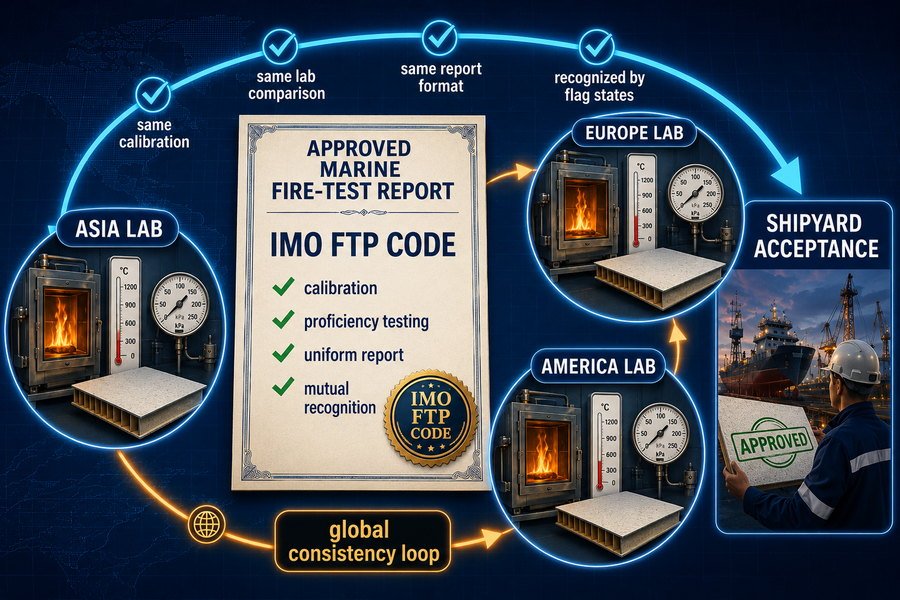
Standardized Equipment Calibration and Mandatory Inter-Laboratory Proficiency Testing
When you buy marine ceiling panels from Vietnam, you need to know the test lab there is as strict as a lab in Germany. The IMO FTP Code uses standardized calibration requirements to fix this problem. Every lab must calibrate their testing furnaces exactly the same way. For example, the thermocouples that measure heat must have a strict tolerance of +/- 1.5°C18. The pressure inside the testing furnace must also be kept at a specific level, normally between 10 to 15 Pascals at the top of the test sample. To prove their equipment works, labs must join mandatory proficiency testing19. This is often called a "Round Robin" test. An organization sends identical pieces of material to 10 different labs around the world. All 10 labs test the material. If one lab gets a completely different result, they fail and can lose their accreditation. This keeps all the labs honest and accurate.
Uniform Report Formats and Mutual Recognition Agreements (MRAs) Between Flag States
To make it easy for engineers to read results from any country, the IMO FTP Code created uniform report formats. If you look at Annex 2 of the Code20, it shows exactly how the test report must be written. A report from China looks exactly like a report from Italy. The headers, the data tables, and the graphs are all in the same place. But the most powerful tool for global consistency is the use of Mutual Recognition Agreements (MRAs). These are legal treaties between countries. The biggest MRA was signed in 2004 between the United States Coast Guard (USCG) and the European Union. This agreement means that a product tested and approved for the EU MED Wheelmark is automatically accepted by the USCG for American ships21. Because of MRAs, a high-quality marine fire door made and tested in Asia under these strict rules is legally accepted by shipyards all over the world.
| Consistency Mechanism | How it Works | Benefit to the Buyer |
|---|---|---|
| Standardized Calibration | Forces all labs to calibrate furnaces to exact tolerances (+/- 1.5°C). | Guarantees test conditions are identical worldwide. |
| Proficiency Testing | Labs test identical samples to compare results (Round Robin). | Catches errors and ensures labs remain accurate. |
| Uniform Report Formats | Mandates a specific document layout (per Annex 2). | Makes reports easy to read regardless of origin country. |
| Mutual Recognition (MRAs) | Legal agreements between states (e.g., USCG and EU). | Allows one certificate to be valid in multiple global markets. |
Conclusion
Understanding the IMO FTP Code ensures your marine panels meet strict global safety laws. By verifying lab credentials, testing methods, and document renewals, you protect your projects and secure shipyard approvals worldwide.
-
"[PDF] RESOLUTION MSC.307(88) (adopted on 3 December 2010 ...", https://wwwcdn.imo.org/localresources/en/KnowledgeCentre/IndexofIMOResolutions/MSCResolutions/MSC.307(88).pdf. The 2010 IMO FTP Code Part 1 incorporates the ISO 1182 non-combustibility method, including exposure of specimens in a furnace at approximately 750°C for a specified test duration. Evidence role: definition; source type: institution. Supports: ISO 1182 as referenced in IMO FTP Code Part 1 tests non-combustibility by placing material in a furnace heated to 750°C for 30 minutes.. Scope note: The source supports the standardized test method and conditions; it does not independently assess any specific marine panel product. ↩
-
"[PDF] RESOLUTION MSC.307(88) (adopted on 3 December 2010 ...", https://wwwcdn.imo.org/localresources/en/KnowledgeCentre/IndexofIMOResolutions/MSCResolutions/MSC.307(88).pdf. The 2010 IMO FTP Code Part 2 specifies maximum toxic gas concentration limits for smoke and toxicity testing, including limits for carbon monoxide and hydrogen cyanide measured during the prescribed test procedure. Evidence role: statistic; source type: institution. Supports: IMO FTP Code Part 2 sets maximum allowed concentrations of Carbon Monoxide at 1450 ppm and Hydrogen Cyanide below 140 ppm.. Scope note: The citation supports the regulatory threshold values in the test code; it does not establish real-fire exposure levels on ships. ↩
-
"Are Marine Fire Divisions the Same as Marine Panel Ratings?", https://magellanmarinetech.com/are-marine-fire-divisions-same-as-marine-panel-ratings/. The IMO fire test procedures classify A-class divisions by fire-resistance duration, with A-60 divisions required to satisfy integrity and insulation criteria during a 60-minute standard fire exposure. Evidence role: definition; source type: institution. Supports: An A-60 marine wall panel must maintain fire-resistance performance for 60 minutes under the relevant IMO FTP Code Part 3 test.. Scope note: The source supports the classification requirement for A-60 divisions generally; approval of a particular wall panel depends on its tested assembly and installation details. ↩
-
"[PDF] RESOLUTION MSC.307(88) (adopted on 3 December 2010 ...", https://wwwcdn.imo.org/localresources/en/KnowledgeCentre/IndexofIMOResolutions/MSCResolutions/MSC.307(88).pdf. The 2010 IMO FTP Code Part 5 surface flammability test sets acceptance criteria for bulkhead, wall, and ceiling finish materials, including a minimum critical heat flux at extinguishment value of 20 kW/m² where applicable. Evidence role: statistic; source type: institution. Supports: IMO FTP Code Part 5 requires a CFE of at least 20 kW/m² for bulkhead finishes.. Scope note: The citation supports the test criterion for qualifying surface materials; it does not indicate that every PVC film or metal skin will meet this value. ↩
-
"Fire testing laboratories - International Maritime Organization", https://www.imo.org/en/ourwork/safety/pages/firetestinglaboratories-default.aspx. The IMO Fire Test Procedures Code assigns acceptance of fire-test laboratories and related test reports to the maritime Administration, supporting the need for formal administrative recognition before test results are used for marine approvals. Evidence role: general_support; source type: institution. Supports: Marine fire-door testing laboratories must be formally recognized by the relevant national maritime administration or flag-State Administration.. Scope note: The source supports the regulatory principle; the exact recognition procedure can differ by flag State. ↩
-
"NIST Quality System - National Institute of Standards and Technology", https://www.nist.gov/nist-quality-system. ISO/IEC 17025 is the international standard specifying general requirements for the competence of testing and calibration laboratories, including requirements for impartiality, personnel, equipment, calibration, methods, and reporting. Evidence role: definition; source type: institution. Supports: ISO/IEC 17025 accreditation indicates that a testing laboratory meets internationally recognized competence requirements for testing and calibration activities.. Scope note: The standard defines competence requirements; accreditation to the standard does not by itself guarantee acceptance by every shipyard or classification society. ↩
-
"Approval of Classification Societies - Federal Register", https://www.federalregister.gov/documents/2012/08/09/2012-19376/approval-of-classification-societies. Classification-society type-approval and laboratory-recognition procedures commonly include assessment of testing facilities, witnessing or review of type tests, and surveillance activities before test results are accepted for marine equipment certification. Evidence role: mechanism; source type: institution. Supports: Testing laboratories used for marine type approval may need to undergo assessment, surveillance, or audit by classification societies before their results are accepted.. Scope note: Audit scope and frequency vary by classification society, product type, and approval route; the source would support the mechanism rather than a universal identical audit schedule. ↩
-
"https://gisis.imo.org/Public/TL/Default.aspx", https://gisis.imo.org/Public/TL/Default.aspx. IMO’s GISIS platform includes publicly accessible modules for maritime regulatory information, including Administration-submitted information relevant to recognized testing laboratories and facilities used under IMO instruments. Evidence role: case_reference; source type: institution. Supports: The IMO GISIS database can be used as an official source to verify information about recognized testing laboratories or related facilities submitted under IMO frameworks.. Scope note: GISIS can support the existence of an IMO verification database, but it may not prove that it contains every recognized laboratory worldwide or that all shipyards use it as their sole acceptance criterion. ↩
-
"[PDF] RESOLUTION MSC.307(88) (adopted on 3 December 2010 ...", https://wwwcdn.imo.org/localresources/en/KnowledgeCentre/IndexofIMOResolutions/MSCResolutions/MSC.307(88).pdf. IMO FTP Code 2010, Part 3 specifies minimum exposed dimensions for A-class bulkhead fire-resistance specimens, supporting the stated 2440 mm by 2500 mm requirement. Evidence role: case_reference; source type: institution. Supports: For Part 3 fire resistance testing of A-Class bulkheads, the test specimen must have exposed dimensions of at least 2440 mm in width and 2500 mm in height.. Scope note: This supports the regulatory test-specimen requirement, not the fire performance of any specific product. ↩
-
"[PDF] RESOLUTION MSC.307(88) (adopted on 3 December 2010 ...", https://wwwcdn.imo.org/localresources/en/KnowledgeCentre/IndexofIMOResolutions/MSCResolutions/MSC.307(88).pdf. IMO FTP Code 2010, Part 3 gives minimum exposed dimensions for A-class ceiling specimens, providing direct support for the 2440 mm by 3040 mm figure. Evidence role: case_reference; source type: institution. Supports: For ceilings, the minimum exposed area is 2440 mm by 3040 mm.. Scope note: The citation verifies the prescribed test-specimen size only; it does not establish that every ceiling installation has this span. ↩
-
"[PDF] RESOLUTION MSC.307(88) (adopted on 3 December 2010 ...", https://wwwcdn.imo.org/localresources/en/KnowledgeCentre/IndexofIMOResolutions/MSCResolutions/MSC.307(88).pdf. IMO FTP Code 2010, Part 3 describes how fire-resistance specimens should represent construction details, including joint arrangements, supporting the statement that relevant panel joints must be incorporated in the tested assembly. Evidence role: case_reference; source type: institution. Supports: The test specimen must include at least one vertical joint and, depending on the design, a horizontal joint.. Scope note: The source may frame this as representative construction rather than using the exact wording of the article for every design case. ↩
-
"Analysis of the Fire Behavior of Polymers (PP, PA 6 and PE ...", https://pmc.ncbi.nlm.nih.gov/articles/PMC7768491/. Fire-safety literature treats organic adhesives and polymeric finishes as combustible components that can add to fire load, giving mechanistic support to the statement that increased adhesive quantity can increase available fuel. Evidence role: mechanism; source type: paper. Supports: More glue means more fuel for the fire.. Scope note: This is general combustion and fire-load support; the actual effect depends on the adhesive formulation, substrate, exposure conditions, and tested assembly. ↩
-
"[PDF] RESOLUTION MSC.307(88) (adopted on 3 December 2010 ...", https://wwwcdn.imo.org/localresources/en/KnowledgeCentre/IndexofIMOResolutions/MSCResolutions/MSC.307(88).pdf. The IMO FTP Code’s reporting provisions specify that fire-test documentation should identify the test laboratory, test date, specimen construction and conditioning, instrumentation, observations, and measured temperature/time data, supporting the claim that the report is a detailed technical record rather than a simple pass/fail statement. Evidence role: definition; source type: institution. Supports: The IMO FTP Code requires a detailed fire test report containing laboratory identification, test data, material or specimen details, and related technical information.. Scope note: The Code defines required reporting categories, but the exact layout and amount of detail may vary by laboratory and test method. ↩
-
"Marine Equipment Directive enters into force in the EEA - Efta.Int", https://www.efta.int/media-resources/news/marine-equipment-directive-enters-force-eea. European Union guidance on the Marine Equipment Directive identifies the wheel mark as the conformity mark for marine equipment meeting MED requirements and intended to be placed on board EU ships, supporting the link between MED certification and the Wheelmark. Evidence role: definition; source type: government. Supports: The MED Wheelmark indicates compliance with European marine equipment conformity requirements for equipment placed on board EU ships.. Scope note: The MED is tied primarily to equipment placed on board EU-flagged ships, not simply to any ship sailing in European waters. ↩
-
"[PDF] RESOLUTION MSC.307(88) (adopted on 3 December 2010 ...", https://wwwcdn.imo.org/localresources/en/KnowledgeCentre/IndexofIMOResolutions/MSCResolutions/MSC.307(88).pdf. A regulatory or classification-society source should substantiate whether fire-safety type approvals for marine equipment are normally time-limited to five years and distinguish this administrative validity period from the IMO FTP Code’s fire-test methods. Evidence role: general_support; source type: government. Supports: The IMO FTP Code works on a strict 5-year cycle.. Scope note: The five-year validity may be imposed by flag administrations, the Marine Equipment Directive, or classification-society type approval rules rather than by the FTP Code alone. ↩
-
"[PDF] Resolution A.1120(30) Adopted on 6 December 2017 SURVEY ...", https://wwwcdn.imo.org/localresources/en/KnowledgeCentre/IndexofIMOResolutions/AssemblyDocuments/A.1120(30).pdf. A type-approval renewal guideline should support that renewal may be based on document review when the product remains unchanged and the applicable standard has not materially changed, rather than requiring a repeat physical fire test in every case. Evidence role: mechanism; source type: institution. Supports: If the rules and product are unchanged, the classification society may renew the certificate without a new physical fire test.. Scope note: This supports the renewal mechanism generally; the approving body may still require retesting case by case. ↩
-
"[PDF] RESOLUTION MSC.307(88) (adopted on 3 December 2010 ...", https://wwwcdn.imo.org/localresources/en/KnowledgeCentre/IndexofIMOResolutions/MSCResolutions/MSC.307(88).pdf. An IMO FTP Code, flag-administration, or classification-society source should show that fire-test approval applies to the tested construction and that material, design, or manufacturing changes must be notified and may require reassessment or repeat testing. Evidence role: general_support; source type: government. Supports: Material or construction changes to an approved marine panel can trigger mandatory reassessment or physical retesting.. Scope note: The source may state this as reassessment or possible retesting rather than the informal absolute wording “change the recipe, you must retest.” ↩
-
"[PDF] RESOLUTION MSC.307(88) (adopted on 3 December 2010 ...", https://wwwcdn.imo.org/localresources/en/KnowledgeCentre/IndexofIMOResolutions/MSCResolutions/MSC.307(88).pdf. The IMO 2010 FTP Code, adopted by IMO Resolution MSC.307(88), specifies instrumentation and calibration requirements for fire-test apparatus, including temperature-measurement tolerances for thermocouples used in relevant furnace tests. Evidence role: mechanism; source type: institution. Supports: Thermocouples used in FTP Code furnace testing are subject to specified calibration or tolerance requirements, including the stated +/- 1.5°C tolerance where applicable.. Scope note: The exact thermocouple tolerance should be verified against the specific FTP Code test part, because requirements can differ by test method and apparatus. ↩
-
"[PDF] Interlaboratory comparisons", https://etrp.wmo.int/pluginfile.php/97653/mod_folder/content/0/Training%20Material/10_Interlaboratory%20comparisons.pdf. ISO/IEC 17025 and ILAC policy documents describe proficiency testing and inter-laboratory comparisons as recognized means for accredited laboratories to monitor and demonstrate technical competence. Evidence role: expert_consensus; source type: institution. Supports: Accredited test laboratories are commonly expected to participate in proficiency testing or inter-laboratory comparisons to demonstrate competence.. Scope note: This supports the accreditation basis for proficiency testing generally; it does not by itself prove that the IMO FTP Code mandates a single global Round Robin program for all laboratories. ↩
-
"[PDF] RESOLUTION MSC.307(88) (adopted on 3 December 2010 ...", https://wwwcdn.imo.org/localresources/en/KnowledgeCentre/IndexofIMOResolutions/MSCResolutions/MSC.307(88).pdf. Annex 2 of the IMO 2010 FTP Code provides standardized forms and reporting requirements for fire-test results, supporting the claim that the Code prescribes how FTP Code test reports should be structured. Evidence role: definition; source type: institution. Supports: The IMO FTP Code includes an annex that standardizes fire-test report formats and required report content.. Scope note: The annex supports standardized content and report forms, but it may not prove that every national laboratory report has identical visual layout, headers, tables, and graphs in practice. ↩
-
"2004 U.S.-EU Marine Equipment Agreement - USTR", https://ustr.gov/archive/World_Regions/Europe_Middle_East/Europe/2004_US-EU_Marine_Equipment_Agreement/Section_Index.html. The Agreement between the European Community and the United States on mutual recognition of certificates of conformity for marine equipment establishes reciprocal recognition procedures for specified marine equipment approvals between the EU and the United States Coast Guard. Evidence role: historical_context; source type: government. Supports: Under the EU-US marine equipment mutual recognition framework, certain EU-approved marine equipment can be accepted by the USCG for U.S.-flag vessels.. Scope note: The agreement applies to equipment and certificates within its defined scope and conditions; it should not be read as automatic acceptance of every MED Wheelmark product in all circumstances. ↩