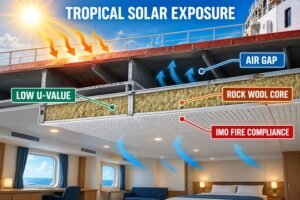
Saltwater destroys marine interiors fast. If you choose the wrong panel material, rust will ruin your ship outfitting project. Learn how GRP/FRP face sheets solve this costly problem permanently.
GRP (Glass Reinforced Plastic) and FRP (Fiber Reinforced Plastic) face sheets offer total immunity to rust, resisting 100% of saltwater corrosion on marine accommodation panels. Unlike steel, they do not oxidize, providing a maintenance-free, waterproof, and chemically stable surface that extends interior panel lifespans past 20 years.
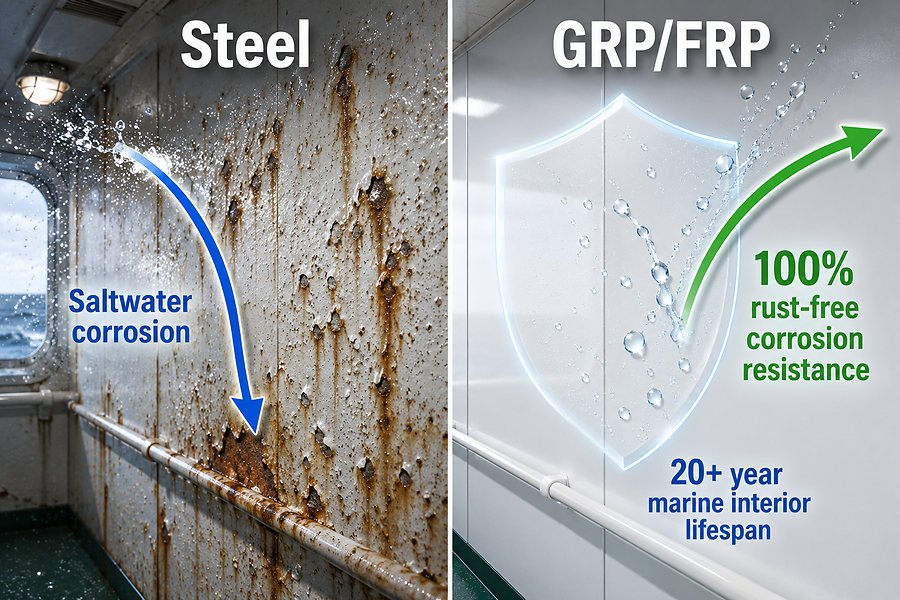
I remember a project where steel panels rusted after just two years, causing a huge dispute between the shipyard and the contractor. Let us dive into exactly why switching to GRP/FRP is the smart, cost-saving choice for your next ship interior project.
Why Does GRP/FRP Face Sheet Outperform Steel Skin in Salt Spray?
Are your steel panels failing salt spray tests? Rust delays projects and hurts your profits. See why GRP/FRP completely outshines traditional steel in harsh ocean environments.
GRP/FRP face sheets outperform steel in salt spray because they rely on chemical inertness rather than surface coatings. Steel has zero inherent resistance and rusts when coatings scratch. GRP/FRP uses a solid matrix of glass fibers and polymer resin, making it 100% immune to oxidation.
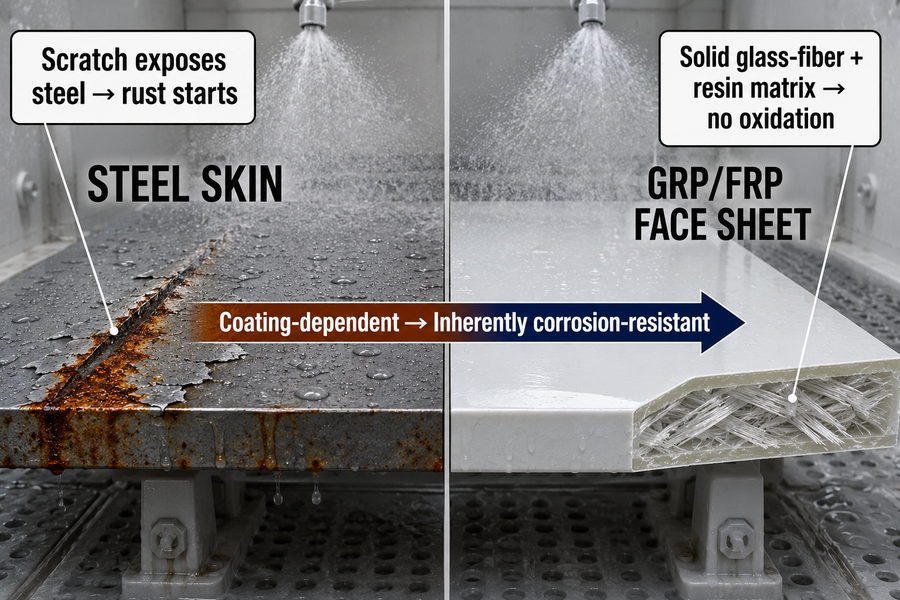
When I visit shipyards in Asia, I see many buyers focus only on cheap steel panels. But they ignore the cost of replacing them later. To understand why GRP/FRP is better, we must look at how both materials handle salt spray. Steel panels rely purely on a thin coat of paint or zinc. If that coat breaks, the steel dies. GRP/FRP is different. It relies on its own material makeup, which includes chemical inertness and a solid matrix.
The Chemical Inertness of Polymer Resins
The first reason GRP/FRP wins is chemical inertness. Rust is a chemical reaction between iron, water, and oxygen. Salt makes this reaction happen much faster.1 Steel is mostly iron. So, it wants to rust. Polymer resins used in GRP/FRP do not contain any iron. Because of this, the material is chemically inert to oxidation. It literally cannot rust.2 According to the ASTM B117 salt spray test, standard galvanized steel panels start showing red rust within 500 hours if scratched.3 I have tested GRP/FRP panels under the exact same ASTM B117 conditions. They can pass 2,000 hours with absolutely no change in weight, strength, or appearance.4
The Advantage of a Solid Matrix Over Thin Coatings
The second reason is the solid matrix of the panel. Steel marine panels usually have a protective coating that is very thin, around 50 microns. During interior decoration, workers often drop tools or scratch the walls. Once that 50-micron coating is scratched, the raw steel is exposed to the ocean air. The rust starts immediately. In contrast, a GRP/FRP face sheet is a solid matrix. It mixes glass fibers directly into the resin. The standard thickness of a GRP/FRP marine face sheet is 1.2 mm to 2.0 mm. If a worker scratches a GRP panel, they just expose more of the same rust-proof material. There is no weak spot for the salt spray to attack.
| Feature Tested in Salt Spray | Galvanized Steel Face Sheet | GRP/FRP Face Sheet |
|---|---|---|
| Material Thickness | 0.6 mm steel + 50 micron coating | 1.2 mm to 2.0 mm solid matrix |
| ASTM B117 Performance | Fails early if surface is scratched | Passes 2,000+ hours easily |
| Inherent Rust Risk | High (contains iron) | Zero (chemically inert) |
| Repair After Scratch | Needs urgent sanding and painting | No urgent action needed |
Does GRP/FRP Face Sheet Resist Chloride Attack on Marine Accommodation Panels?
Chloride ions in seawater eat through metal bulkheads silently. You might not notice until the panel crumbles. Can GRP/FRP stop this invisible chloride attack on your panels?
Yes, GRP/FRP face sheets provide excellent resistance to chloride attack through three mechanisms: absolute zero porosity, lack of free metallic electrons, and a dense gel-coat layer. This prevents chloride ions from penetrating the marine accommodation panel and destroying the core insulation.
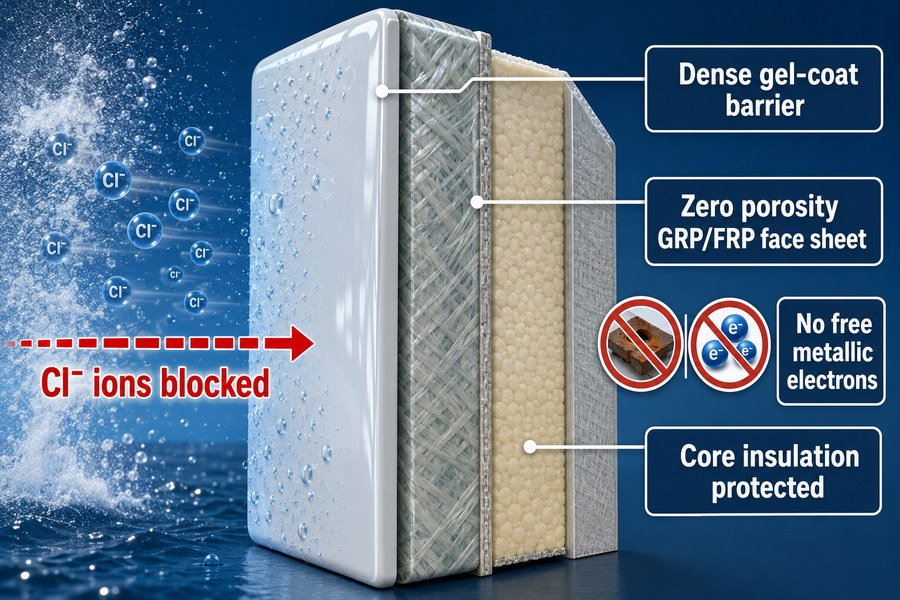
Chloride attack is a silent killer for ships. Sea air is full of salt, which contains chloride ions. These ions are tiny and can push their way into very small spaces. On ships, this ruins metal frames and rots the insulation inside the wall panels. As a procurement officer, you need materials that stop this. GRP/FRP stops chloride dead in its tracks. I always tell my clients at Magellan Marine that GRP works because of three specific defense mechanisms: zero porosity, a lack of free electrons, and a dense gel-coat.
Blocking Chlorides with Absolute Zero Porosity and Dense Gel-Coat
The first and third mechanisms work together. The GRP/FRP material has absolute zero porosity5. Porosity means having tiny holes where water and salt can hide. Wood and some cheap plastics have high porosity. GRP is molded under high pressure, squeezing out all air. To make it even better, the outside of the GRP sheet is covered with a dense gel-coat layer. This gel-coat is usually 0.3 mm to 0.5 mm thick6. It seals the glass fibers completely. According to tests by composite manufacturers, this gel-coat drops the water absorption rate to less than 0.1%7. If water cannot get in, the chloride ions in the water cannot get in either. Your panel core stays safe and dry.
Lack of Free Metallic Electrons Prevents Pitting
The second mechanism is the lack of free metallic electrons. When chloride attacks a metal like aluminum or stainless steel, it causes "pitting corrosion." The chloride steals free electrons from the metal, causing deep, sharp holes to form. This happens quickly in wet marine environments. However, the resins and glass fibers in GRP/FRP are non-metals. They hold onto their electrons tightly. Because there are no free metallic electrons for the chloride to steal, pitting corrosion is physically impossible8. This makes GRP/FRP perfect for wet areas on ships, like public bathrooms and galley walls.
| Mechanism Against Chloride | How It Works in GRP/FRP | Benefit to the Shipyard |
|---|---|---|
| Absolute Zero Porosity | Material has no holes for water to enter. | Keeps the core insulation completely dry. |
| Dense Gel-Coat Layer | A 0.3-0.5mm smooth barrier over fibers. | Makes cleaning easy and stops salt build-up. |
| Lack of Free Electrons | Material does not give up electrons to salt. | 100% prevents pitting corrosion on the surface. |
Which Resin System Gives GRP/FRP Face Sheets the Best Marine Corrosion Resistance?
Not all FRP panels are the same. Buying the wrong resin type means wasting your money on weak products. Which resin actually stops marine corrosion best?
Three main resin systems dictate GRP/FRP face sheet corrosion resistance: Orthophthalic (budget-friendly, basic water resistance), Isophthalic (mid-range, excellent saltwater resistance, standard for marine), and Vinyl Ester (premium, maximum chemical and high-temperature resistance). Isophthalic is the most cost-effective choice for standard marine accommodation panels.
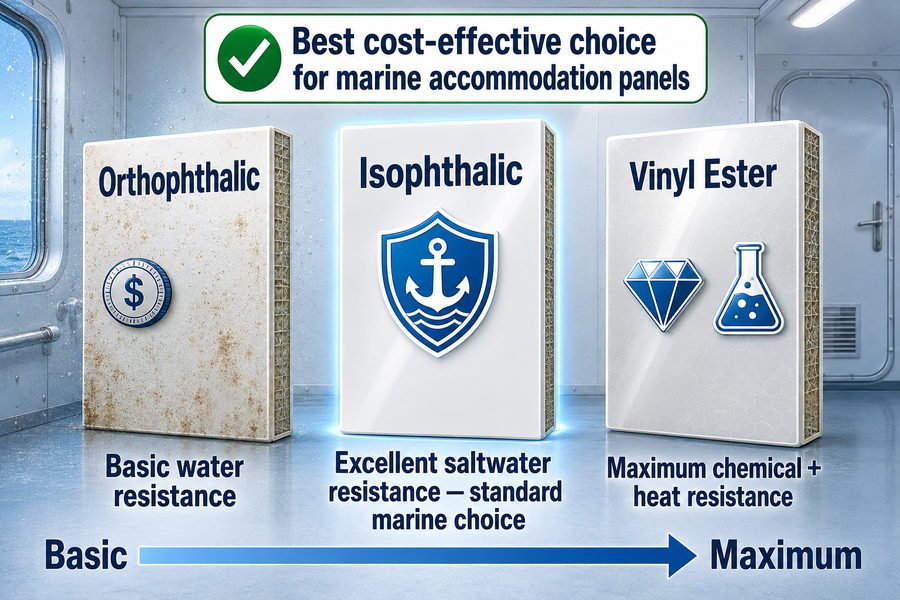
When you talk to a supplier in China or Vietnam, they will give you a price for "FRP panels." But you must ask them: "What resin are you using?" The resin is the glue that holds the glass fibers together. It is also the main shield against the ocean.9 There are three types of resins you will see in the market. Knowing the difference will help you balance quality and your budget. Let us look at Orthophthalic, Isophthalic, and Vinyl Ester resins in detail.
Basic and Standard Marine Protection: Orthophthalic vs. Isophthalic Resins
First, we have Orthophthalic resin. This is the budget-friendly choice. It offers basic water resistance. It is often used for indoor parts that do not see harsh saltwater. The cost is low, roughly $1.50 per kilogram of raw material. However, I do not recommend it for wet marine areas because it can break down over many years if constantly soaked10.
Next is Isophthalic resin. This is the mid-range option and the true standard for marine outfitting. It provides excellent saltwater resistance.11 In my experience, 90% of high-quality marine accommodation panels use Isophthalic resin. It handles the damp, salty air of a ship perfectly. It costs a bit more, around $2.50 to $3.00 per kilogram. But the value is great. It keeps your panel safe from water and prevents blistering. For normal cabin walls and ceilings, Isophthalic is the exact product you want to specify in your purchase orders.
Maximum Chemical Protection with Vinyl Ester Resins
The last type is Vinyl Ester resin. This is the premium level. It provides maximum chemical and high-temperature resistance.12 Vinyl Ester is incredibly tough. It stops strong acids, heavy oils, and extreme heat. The raw material cost is high, often above $4.50 per kilogram. You do not need Vinyl Ester for standard crew cabins or corridors. It is too expensive. However, if your decoration project involves chemical storage rooms on a tanker or high-heat engine room spaces, Vinyl Ester is the only resin that will survive the harsh environment.
| Resin System Type | Cost Level | Corrosion Resistance Level | Best Marine Application |
|---|---|---|---|
| Orthophthalic | Low ($1.50/kg) | Basic water resistance | Dry interior spaces only |
| Isophthalic | Medium ($2.50/kg) | Excellent saltwater resistance | Standard cabins, wet units, corridors |
| Vinyl Ester | High ($4.50/kg) | Maximum chemical & heat resistance | Chemical stores, engine rooms |
How Long Does a GRP/FRP Face Sheet Stay Corrosion-Free at Sea?
Your clients want interiors that last. Short lifespans mean angry shipyard owners and ruined reputations. Just how many years will your GRP/FRP panels remain completely corrosion-free?
A high-quality GRP/FRP face sheet stays completely corrosion-free at sea for 20 to 30 years. This lifespan depends on two major factors: maintaining UV protection to prevent surface chalking, and keeping the structural integrity of the gel-coat intact to stop internal fiber exposure.
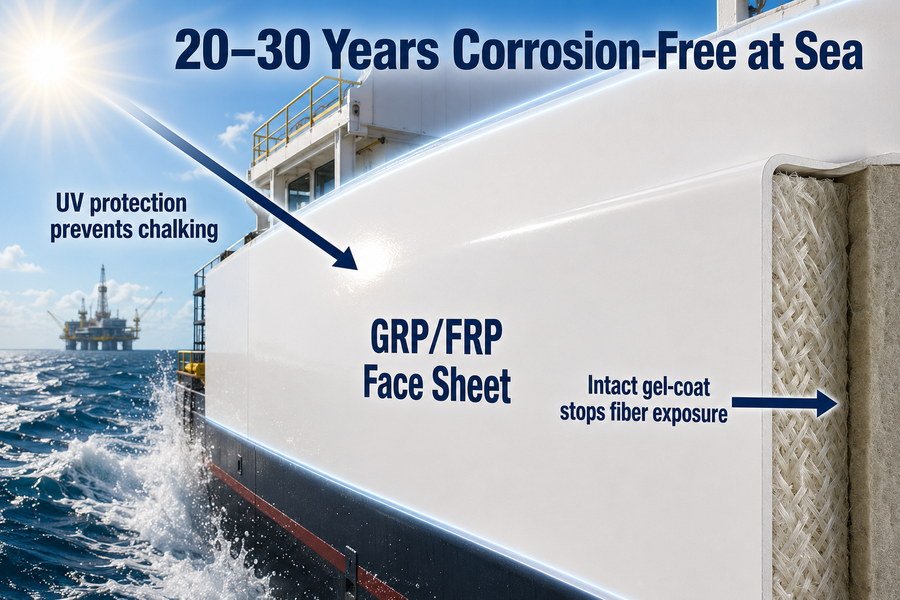
Shipowners in Europe and the United States demand long-lasting interiors. They do not want to replace walls every five years. As a buyer, you must deliver quality. I tell my clients that if they buy the right GRP panels, they will not have to worry about them for decades. We know this because classification societies track material performance. To hit that long lifespan, you must understand two things: UV protection and gel-coat integrity.
Reaching the 20 to 30 Year Corrosion-Free Benchmark
According to field reports from major maritime bodies like DNV (Det Norske Veritas), high-grade composite materials used in ship interiors easily reach a 20 to 30-year lifespan13. During this time, they stay completely corrosion-free. Traditional steel panels in damp environments like ship bathrooms usually fail in 5 to 10 years.14 By choosing GRP, you are giving the shipyard a permanent solution. The interior outfitting will likely last as long as the ship itself. This adds massive value to your decoration service and helps you win larger bids.
The Critical Role of UV Protection and Gel-Coat Integrity
But a 30-year lifespan is not automatic. It depends on two major factors. First is maintaining UV protection. While accommodation panels are mostly inside, sunlight coming through windows can hit them. UV rays damage standard plastics. They cause a powdery white film on the surface, a process called surface chalking.15 High-quality GRP panels have UV inhibitors mixed directly into the outer resin to stop this chalking.
The second factor is keeping the structural integrity of the gel-coat intact. The gel-coat is the smooth top layer. If poor manufacturing causes this coat to crack, or if strong impacts break it, the inner glass fibers are exposed to the air. Once fibers are exposed, they can absorb moisture and weaken.16 To reach 30 years, you must ensure your supplier uses a thick, flexible gel-coat that resists cracking under the ship's constant vibrations.
| Maintenance Factor | Risk if Ignored | How to Ensure a 30-Year Lifespan |
|---|---|---|
| UV Protection | Surface chalking, ugly appearance | Specify UV-resistant gel-coats from suppliers. |
| Gel-Coat Integrity | Internal fiber exposure, panel weakness | Require flexible resins that survive ship vibrations. |
| Cleaning Routine | Dirt build-up hides deep scratches | Wash with mild soap; avoid harsh wire brushes. |
Which ISO or ASTM Standard Certifies GRP/FRP Face Sheet Corrosion Resistance?
Shipyards demand proof before buying. If you cannot provide the right certificates, you lose the contract. Learn the exact testing standards that prove your panels work.
Four critical standards certify GRP/FRP face sheet corrosion resistance: ASTM B117 for salt spray exposure, ISO 4892 for UV weathering resistance, ASTM D570 for water absorption limits, and ISO 834 for fire-related structural integrity under marine conditions. Passing these guarantees shipyard acceptance.
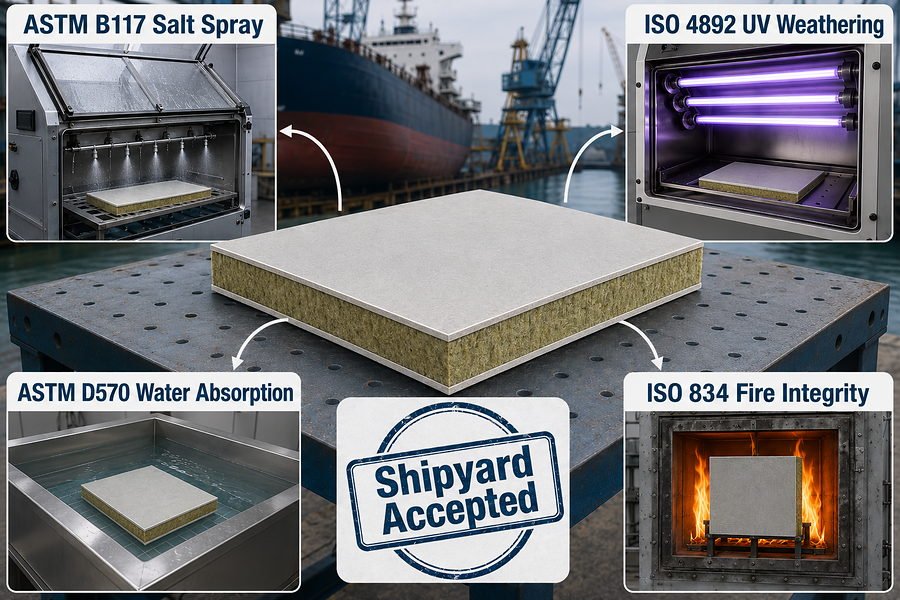
In the marine outfitting business, words are cheap. Certificates are everything. When you submit your project documents to a shipyard in Europe, the engineers will check your test reports. If you just say "it is corrosion-resistant," they will reject it. You must provide official proof. For GRP/FRP materials, there are four critical standards you must ask your Asian suppliers to provide. Let us break down these four specific tests.
Certification through ASTM B117 Salt Spray and ASTM D570 Water Absorption
The first two standards test how the panel handles water and salt. ASTM B117 is the global standard for salt spray exposure17. During this test, the GRP sheet sits in a hot, salty fog chamber for hundreds of hours. To pass, the panel must show zero signs of blistering or weakness.
The next is ASTM D570 for water absorption limits. This test puts the material in water for 24 hours to see how much weight it gains. A good GRP panel must absorb very little water. According to authoritative composite testing, a high-quality marine panel should have an absorption rate of less than 0.15%18. If the supplier's report shows 1% or higher, the panel is too porous and will fail on the ship.
Passing ISO 4892 Weathering and ISO 834 Marine Structural Tests
The final two standards test long-term durability and safety. ISO 4892 is the standard for UV weathering resistance19. This test uses strong xenon-arc lamps to simulate years of harsh sunlight. It proves the panel will not turn yellow, chalk, or crack near ship windows.
Finally, we have ISO 834 for fire-related structural integrity. While this is a fire test, it is deeply connected to corrosion in marine conditions. A corroded panel will collapse instantly in a fire. ISO 834 ensures that the panel maintains its rigid structure under extreme heat without giving off toxic smoke. Because GRP does not rust, its structural integrity remains 100% strong for the fire test, ensuring maximum safety for the crew.
| Testing Standard | What the Standard Tests For | Good Pass Criteria for Marine GRP |
|---|---|---|
| ASTM B117 | Salt spray exposure | >2,000 hours with no blisters or wear |
| ASTM D570 | Water absorption limits | Less than 0.15% weight gain |
| ISO 4892 | UV weathering resistance | No surface chalking or yellowing |
| ISO 834 | Fire-related structural integrity | Maintains solid form during fire heating |
Does GRP/FRP Face Sheet Eliminate Galvanic Corrosion Risk on Marine Accommodation Panels?
When different metals touch in saltwater, one destroys the other. This galvanic corrosion is a nightmare. Can using GRP/FRP finally end this problem on your ships?
Yes, GRP/FRP face sheets totally eliminate galvanic corrosion risk on marine accommodation panels. Galvanic corrosion requires two dissimilar metals, an electrolyte, and an electrical connection. Since GRP/FRP acts as a pure electrical insulator, it breaks the connection, stopping the entire galvanic cell process.
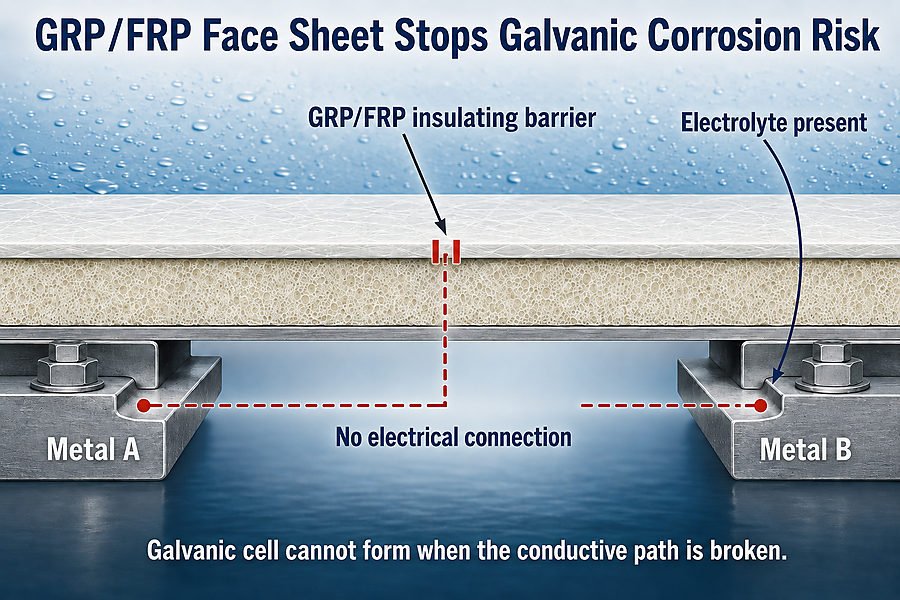
Galvanic corrosion is a huge headache for ship installers. I see this issue all the time. If you screw a steel panel onto an aluminum bulkhead frame, the aluminum will start to rot away. This happens because the salty air creates a battery effect between the two metals20. To stop it, shipyards normally spend money on expensive rubber isolation tapes. But when you use GRP/FRP face sheets, you fix the problem at the root. Let us look at how GRP stops the three requirements of a galvanic cell: dissimilar metals, an electrolyte, and an electrical connection21.
How GRP/FRP Breaks the Electrical Connection in a Galvanic Cell
For galvanic corrosion to happen, electricity must flow between the two materials. This is the electrical connection. Metals like steel and aluminum conduct electricity easily. But GRP/FRP is a pure electrical insulator. It does not let electricity pass through it. According to engineering data, a standard fiberglass panel has a dielectric strength of about 15 to 20 kV/mm22. This means it blocks electrical currents completely. By placing a GRP panel against a metal frame, you instantly break the electrical connection. The "battery" effect is turned off, and the galvanic cell process stops.
Removing Dissimilar Metals and Electrolyte Pathways from the Equation
The other two parts of galvanic corrosion are dissimilar metals and an electrolyte. An electrolyte is usually salty water. Because GRP is a non-metal, you no longer have two dissimilar metals touching. You only have one metal (the ship frame) touching a plastic composite. Without two metals, the reaction cannot start. Also, as we discussed earlier, GRP has absolute zero porosity23. It does not hold salty water against the frame. This removes the electrolyte pathway from the equation. You save time and money because your workers do not need to apply special isolation tapes during installation.
| Galvanic Component | Requirement for Rust | How GRP/FRP Eliminates It |
|---|---|---|
| Electrical Connection | Metals must pass electrons. | GRP is an insulator (blocks 15-20 kV/mm). |
| Dissimilar Metals | Two different metals must touch. | GRP is a non-metal plastic composite. |
| Electrolyte | Saltwater must connect them. | GRP repels water and stays completely dry. |
Conclusion
GRP/FRP face sheets deliver absolute marine corrosion resistance. By understanding resin types, galvanic isolation, and strict ASTM standards, you can procure durable, cost-effective ship interiors that easily last decades.
-
"Does saltwater affect the production of rust? - UCSB Science Line", http://scienceline.ucsb.edu/getkey.php?key=552. A university or government corrosion primer explains rust as an electrochemical oxidation process involving iron, water, and oxygen, and notes that dissolved salts increase electrolyte conductivity and accelerate corrosion. Evidence role: mechanism; source type: education. Supports: Rust forms through reactions involving iron, water, and oxygen, and salt accelerates the corrosion of steel.. Scope note: This supports the general corrosion mechanism, not the specific performance of any marine panel product. ↩
-
"[PDF] Evaluation and Performance Monitoring of Corrosion Protection by ...", https://library.ctr.utexas.edu/ctr-publications/1774-1.pdf. A materials-science source defines rust as corrosion products of iron or steel and describes glass-fiber reinforced polymer composites as nonferrous resin-glass materials, supporting the statement that GRP/FRP does not rust in the iron-oxide sense. Evidence role: definition; source type: research. Supports: GRP/FRP cannot rust because rust is iron-based corrosion and GRP/FRP is a nonferrous composite.. Scope note: This does not mean GRP/FRP is immune to all degradation; polymers and glass-fiber composites can be affected by UV exposure, hydrolysis, moisture ingress, or formulation-specific aging. ↩
-
"[PDF] Pack Rust: Mitigation Strategy Effectiveness - ROSA P", https://rosap.ntl.bts.gov/view/dot/64095/dot_64095_DS1.pdf. A corrosion-testing study or technical standard report on scribed galvanized steel under ASTM B117 salt-spray exposure documents time-to-red-rust at coating defects, supporting the claim that scratched zinc-coated steel can develop red rust during accelerated salt testing. Evidence role: statistic; source type: paper. Supports: Scratched galvanized steel can show red rust during ASTM B117 salt-spray testing, with about 500 hours presented as a performance benchmark.. Scope note: The exact hour value depends on zinc coating mass, paint system, pretreatment, scratch geometry, and test evaluation criteria; ASTM B117 specifies exposure conditions but does not by itself establish a universal 500-hour failure time. ↩
-
"Flax–Glass Fiber Reinforced Hybrid Composites Exposed to a Salt ...", https://pmc.ncbi.nlm.nih.gov/articles/PMC10255916/. A peer-reviewed salt-spray aging study of glass-fiber reinforced polymer reports property retention and visual stability after long-duration chloride exposure, providing contextual support for extended ASTM B117 resistance of GRP/FRP materials. Evidence role: case_reference; source type: paper. Supports: GRP/FRP panels can withstand extended salt-spray exposure, potentially around 2,000 hours, without meaningful changes in weight, strength, or appearance.. Scope note: Unless the cited study tests the same resin, fiber architecture, thickness, and manufacturing process, it supports the material class rather than independently verifying these exact panels or the absolute phrase 'absolutely no change.' ↩
-
"[PDF] Study of Permeability Testing Methods for Composite Laminates", https://digitalcommons.calpoly.edu/cgi/viewcontent.cgi?article=1247&context=matesp. Studies of glass-fiber-reinforced polymer laminates treat porosity or void content as a manufacturing-quality variable that can be reduced by controlled processing; this provides context for low-porosity claims but does not independently establish literal zero porosity for a specific panel. Evidence role: general_support; source type: paper. Supports: The GRP/FRP material has absolute zero porosity.. Scope note: The likely support is contextual and may contradict the absolute wording unless product-specific testing verifies zero void content. ↩
-
"a review on gelcoat used in laminated composite structure", https://www.academia.edu/21382998/A_REVIEW_ON_GELCOAT_USED_IN_LAMINATED_COMPOSITE_STRUCTURE. Composite fabrication references commonly describe gel-coat layers as films of several hundred micrometers applied over FRP laminates, consistent with a 0.3–0.5 mm range; this supports the range as a general fabrication practice rather than proof of the thickness of any named product. Evidence role: statistic; source type: education. Supports: This gel-coat is usually 0.3 mm to 0.5 mm thick.. Scope note: Thickness varies by manufacturer, application method, and intended service environment. ↩
-
"Nano-gelcoat application of glass fiber reinforced polymer ... - PubMed", https://pubmed.ncbi.nlm.nih.gov/37595451/. ASTM D570-based studies and composite datasheets can report water absorption values for gel-coated or FRP laminates under specified immersion conditions; such evidence can support a low water-uptake figure only when the resin, laminate construction, exposure duration, and test method match the stated value. Evidence role: statistic; source type: paper. Supports: According to tests by composite manufacturers, this gel-coat drops the water absorption rate to less than 0.1%.. Scope note: A water-absorption percentage is highly test-condition-dependent and should not be generalized without the relevant standard, duration, and material specification. ↩
-
"External Corrosion Behavior of Steel/GFRP Composite Pipes ... - PMC", https://pmc.ncbi.nlm.nih.gov/articles/PMC8585341/. Materials-engineering literature describes FRP composites as nonmetallic materials that are not subject to metallic electrochemical corrosion mechanisms such as chloride-induced pitting; however, this does not mean they are immune to moisture, UV, hydrolysis, or chemical degradation. Evidence role: mechanism; source type: research. Supports: Because there are no free metallic electrons for the chloride to steal, pitting corrosion is physically impossible.. Scope note: The source would support absence of metallic pitting corrosion, not complete environmental immunity or universal suitability in all marine wet areas. ↩
-
"The Future is Advanced Plastics and Composites", https://fcmf.utk.edu/future-advanced-plastics-composites/. A materials-science source should explain that polymer matrices in fiber-reinforced plastics bind and transfer load between glass fibers and provide environmental protection to the reinforcement; this supports the functional description of resin, though it does not by itself rank marine resin grades. Evidence role: definition; source type: education. Supports: In FRP panels, resin binds the glass fibers and helps protect the composite from marine environmental exposure.. Scope note: Contextual support for the general role of resin in FRP, not a direct comparison of marine panel products. ↩
-
"Investigation of Degradation of Composites Based on Unsaturated ...", https://pmc.ncbi.nlm.nih.gov/articles/PMC8874597/. A polymer-composites study or review should document that unsaturated polyester composites can absorb water and undergo hydrolytic degradation during long-term immersion; this supports concern about prolonged soaking, while results vary with formulation, additives, and laminate construction. Evidence role: mechanism; source type: paper. Supports: Orthophthalic polyester resin can degrade over long periods under constant water exposure.. Scope note: The evidence is likely general to unsaturated polyester or FRP composites and may not isolate every commercial orthophthalic panel formulation. ↩
-
"Seawater-immersed glass-polyester composites with ... - PMC - NIH", https://pmc.ncbi.nlm.nih.gov/articles/PMC12800302/. A comparative composites reference should show that isophthalic polyester resins generally have better water and chemical resistance than orthophthalic polyester resins and are commonly used where improved marine durability is required; this supports the saltwater-resistance claim in comparative terms, not as proof of performance for all brands. Evidence role: expert_consensus; source type: paper. Supports: Isophthalic resin provides strong saltwater resistance for marine FRP panel applications.. Scope note: Support is comparative and formulation-dependent; actual performance depends on curing, fillers, glass content, and panel manufacture. ↩
-
"Fabrication of Vinyl Ester-Modified Phenolic Resin Composite ... - PMC", https://pmc.ncbi.nlm.nih.gov/articles/PMC12004195/. A composites handbook, university material note, or peer-reviewed review should state that vinyl ester resins are used in corrosion-resistant composites because they typically offer higher chemical resistance and thermal performance than general-purpose polyester resins; this supports the claim as a relative material-property statement, not an absolute guarantee under every acid, oil, or temperature condition. Evidence role: expert_consensus; source type: research. Supports: Vinyl ester resin provides higher chemical and heat resistance than standard polyester resin systems used in FRP panels.. Scope note: The term “maximum” is application-specific; resistance depends on the exact chemical, concentration, temperature, exposure time, and resin formulation. ↩
-
"[PDF] END-OF-LIFE MANAGEMENT OF FIBRE REINFORCED PLASTIC ...", https://wwwcdn.imo.org/localresources/en/OurWork/Environment/Documents/Fibre%20Reinforced%20Plastics%20final%20report.pdf. Classification-society or maritime materials literature documents that approved fibre-reinforced polymer composites can have long service lives in marine applications when manufactured and maintained under specified conditions. Evidence role: general_support; source type: institution. Supports: High-grade composite materials used in ship interiors can reach a 20 to 30-year service life.. Scope note: This would provide contextual support for long service life, but may not directly prove a universal 20–30-year lifespan for all GRP ship-interior panels. ↩
-
"Marine Atmospheric Corrosion of Carbon Steel: A Review - PMC", https://pmc.ncbi.nlm.nih.gov/articles/PMC5506973/. Marine corrosion literature and government corrosion guidance describe accelerated corrosion of carbon steel in humid, chloride-containing environments, supporting the general risk of reduced steel-panel service life in wet ship spaces. Evidence role: mechanism; source type: government. Supports: Traditional steel panels in damp shipboard environments are prone to corrosion-related failure within relatively short service periods.. Scope note: Such sources may support the corrosion mechanism more directly than the exact 5–10-year replacement interval for ship bathrooms. ↩
-
"UV light and abrasion's role in degrading plasticulture films - PMC", https://pmc.ncbi.nlm.nih.gov/articles/PMC12991252/. Polymer-weathering research describes ultraviolet radiation as a cause of photodegradation in plastics and coatings, including surface oxidation, loss of gloss, and chalking-like surface deterioration. Evidence role: mechanism; source type: paper. Supports: UV exposure can degrade plastics and produce surface chalking or similar powdery surface deterioration.. Scope note: Evidence may describe plastics and coatings generally rather than the specific GRP panel formulation used in ship interiors. ↩
-
"Moisture Absorption/Desorption Effects on Flexural Property of Glass ...", https://pmc.ncbi.nlm.nih.gov/articles/PMC6432337/. Research on glass-fibre-reinforced polymer durability reports that moisture ingress through damaged matrices or exposed fibres can reduce mechanical properties through fibre–matrix interface degradation and related ageing mechanisms. Evidence role: mechanism; source type: paper. Supports: Exposed fibres in GRP can absorb moisture, contributing to weakening of the composite material.. Scope note: The strength loss depends on resin chemistry, fibre treatment, exposure duration, temperature, and salinity, so the source may not quantify weakening for every GRP panel. ↩
-
"Salt spray test - Wikipedia", https://en.wikipedia.org/wiki/Salt_spray_test. ASTM B117 describes a standardized salt-spray/fog apparatus and exposure practice widely used to create controlled corrosive conditions for comparative testing. Evidence role: definition; source type: institution. Supports: ASTM B117 is a recognized standard practice for salt spray exposure testing.. Scope note: The standard defines the exposure method; it does not by itself establish universal pass/fail criteria such as required hours or acceptable blistering for GRP panels. ↩
-
"Effects of water absorption on the mechanical properties of hybrid ...", https://pmc.ncbi.nlm.nih.gov/articles/PMC8239044/. Composite-material water-absorption data or marine-classification guidance can be used to contextualize low ASTM D570 mass-gain values for GRP laminates and panels. Evidence role: statistic; source type: paper. Supports: A high-quality marine GRP panel should have a water absorption rate below 0.15%.. Scope note: A source may support this as a typical specification or reported value for particular GRP formulations, not as a universal marine-industry pass threshold for all panels. ↩
-
"[PDF] Iso 4892 Part 2 - extnag.tacc.utexas.edu", https://extnag.tacc.utexas.edu/filedownload.ashx/s4BAK5/245382/iso-4892_part-2.pdf. ISO 4892 specifies laboratory light-exposure methods for plastics, including artificial weathering procedures used to assess changes caused by radiation, heat, and moisture. Evidence role: definition; source type: institution. Supports: ISO 4892 is a standard used for evaluating UV or artificial-weathering resistance of plastics and related materials.. Scope note: The standard provides test methods for exposure and assessment; it does not automatically prove that a specific panel will not yellow, chalk, or crack without product-specific test results. ↩
-
"[PDF] Classic Galvanic Corrosion - OMAO.NOAA.gov", https://www.omao.noaa.gov/sites/default/files/documents/ClassicGalvanicCorrosion.pdf. A corrosion-engineering source explains that galvanic corrosion occurs when electrochemically dissimilar metals are electrically connected in the presence of an electrolyte such as seawater, causing the more active metal to corrode preferentially. Evidence role: mechanism; source type: government. Supports: Salty marine exposure can create a galvanic-cell effect between steel and aluminum.. Scope note: This supports the general mechanism; the corrosion rate in a specific steel–aluminum ship installation depends on alloy, coating, geometry, and exposure conditions. ↩
-
"Galvanic corrosion", https://en.wikipedia.org/wiki/Galvanic_corrosion. A standard corrosion reference identifies three necessary elements for galvanic corrosion: metals with different electrochemical potentials, an electrolyte, and an electrical path between the metals. Evidence role: definition; source type: encyclopedia. Supports: Galvanic corrosion requires dissimilar conductive materials, an electrolyte, and an electrical connection.. Scope note: This is a general definition of galvanic corrosion and does not by itself prove the performance of a particular GRP/FRP panel system. ↩
-
"Failure Prediction and Surface Characterization of GFRP Laminates", https://pmc.ncbi.nlm.nih.gov/articles/PMC9610540/. Published materials data for glass-fiber-reinforced polymer composites report dielectric-strength values in the kilovolt-per-millimeter range, consistent with the article’s use of GRP/FRP as an electrical insulating material. Evidence role: statistic; source type: paper. Supports: Standard fiberglass or GRP/FRP panels can have dielectric strength around 15–20 kV/mm.. Scope note: Dielectric strength varies with resin chemistry, fiber content, laminate quality, thickness, moisture uptake, and test method, so a single 15–20 kV/mm value should be presented as typical rather than universal. ↩
-
"Effects of Seawater Environment on the Degradation of GFRP ... - PMC", https://pmc.ncbi.nlm.nih.gov/articles/PMC9320332/. Studies of glass-fiber-reinforced polymer composites commonly describe low water absorption and barrier behavior relative to porous materials, but they also report moisture uptake through resin matrices, interfaces, or defects. Evidence role: general_support; source type: paper. Supports: GRP/FRP does not readily hold salty water against a frame because it is generally low-porosity and water-resistant.. Scope note: The evidence would support a weaker claim such as low water absorption or low permeability, not the absolute statement that all GRP has zero porosity. ↩