Ship crews face extreme temperatures that ruin their rest and focus. Poor panels make cabins unlivable. I will show you how we define and achieve interior comfort targets.
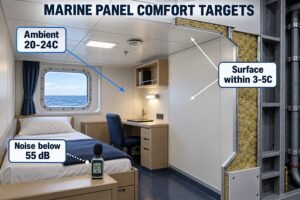
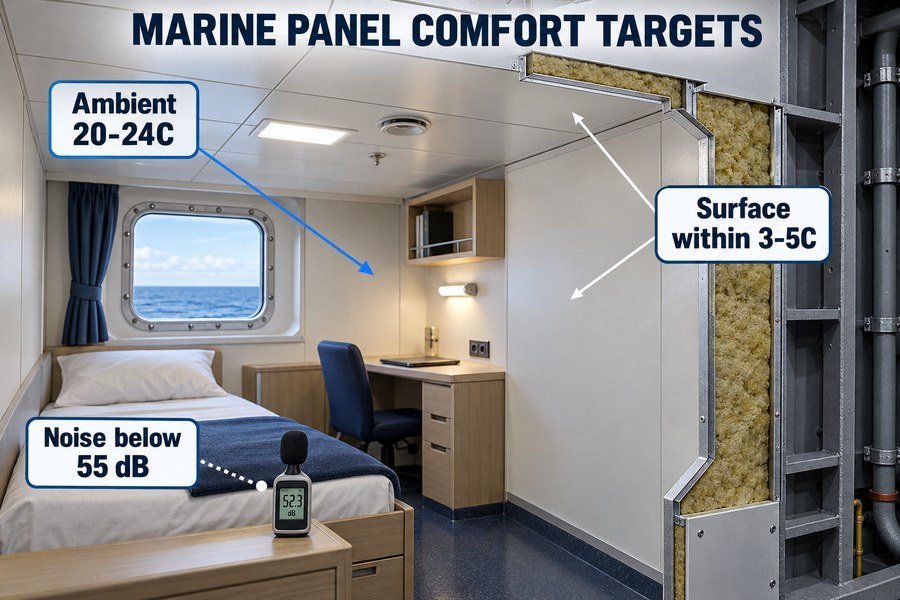
Interior comfort objectives for marine accommodation panels are defined by three primary criteria: maintaining an indoor ambient temperature of 20°C to 24°C, limiting panel surface temperature differences to within 3°C to 5°C of ambient, and keeping noise levels below 55 dB, according to ISO 7547 and DNV rules.
When you buy interior outfitting products, you want your shipyard clients in Europe or the United States to approve them without any delay. Understanding these exact numbers is the only way to avoid failed inspections. Let us break down the specific rules for different extreme climates to keep your projects profitable.
What Are the Target Surface Temperatures for Arctic Marine Lining Panels?
Arctic cold cuts through steel hulls, turning interior walls into blocks of ice. This causes condensation and sickness. We solve this by setting strict surface temperature rules for panels.
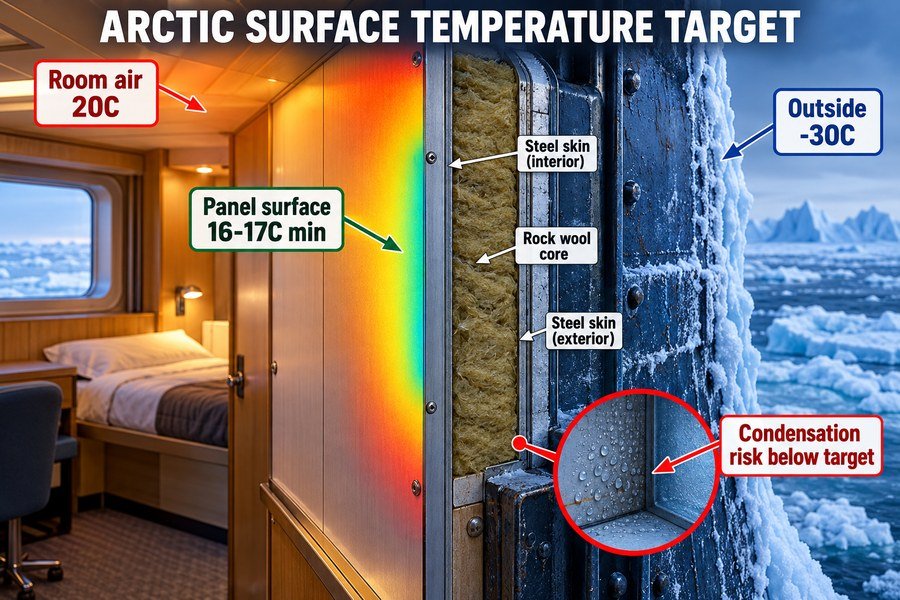
For Arctic marine lining panels, the target surface temperature must stay within 3°C to 4°C of the indoor design temperature (usually 20°C). This means the panel surface must not drop below 16°C to 17°C, even when outside temperatures reach -30°C, based on DNV Winterization and ISO 7547 standards.
The Danger of Condensation on Arctic Marine Lining Panels
You must control the wall temperature in cold weather. I learned this the hard way during my early days at the marine outfitting factory. We supplied standard panels to a ship heading to the North Sea. The outside air was -20°C. The cabin heater kept the air at 20°C. But the cheap panel surface dropped to 12°C. Moisture from the warm air hit the cold panel and turned into water.1 We call this condensation. Water ruined the cabin floors and caused mold. The shipyard rejected the entire batch. DNV Winterization rules state that the panel surface must stay within 3°C to 4°C of the room air. If the room is 20°C, the wall must be at least 16°C. You must buy panels thick enough to hold this temperature.
Achieving the 16°C Target in -30°C Outside Conditions
You achieve this strict temperature target by using the correct panel thickness and density. You cannot guess these numbers. You must look at the manufacturer test reports. When outside temperatures drop to -30°C, a standard 25mm thick panel will fail. The cold moves right through it. You need a 50mm thick panel with a high-density core to keep the inside surface at 16°C. Major shipyards in Europe will test this during sea trials. They point thermal cameras at the walls. If the wall is too cold, they will withhold your payment. Buying the right thickness upfront saves you from expensive rework.
| Outside Temperature | Required Cabin Air Temp | Minimum Panel Surface Temp | Required Panel Thickness |
|---|---|---|---|
| -10°C | 20°C | 16°C | 25mm to 30mm |
| -20°C | 20°C | 16°C | 50mm |
| -30°C | 20°C | 17°C | 50mm (High Density) |
How Do Tropical Climates Set Ambient Goals Against Marine Ceiling Panel Heat?
Baking sun heats the ship deck to 70°C, making cabins feel like ovens. Crew cannot sleep in this heat. We use strict cooling standards to fight tropical solar loads.
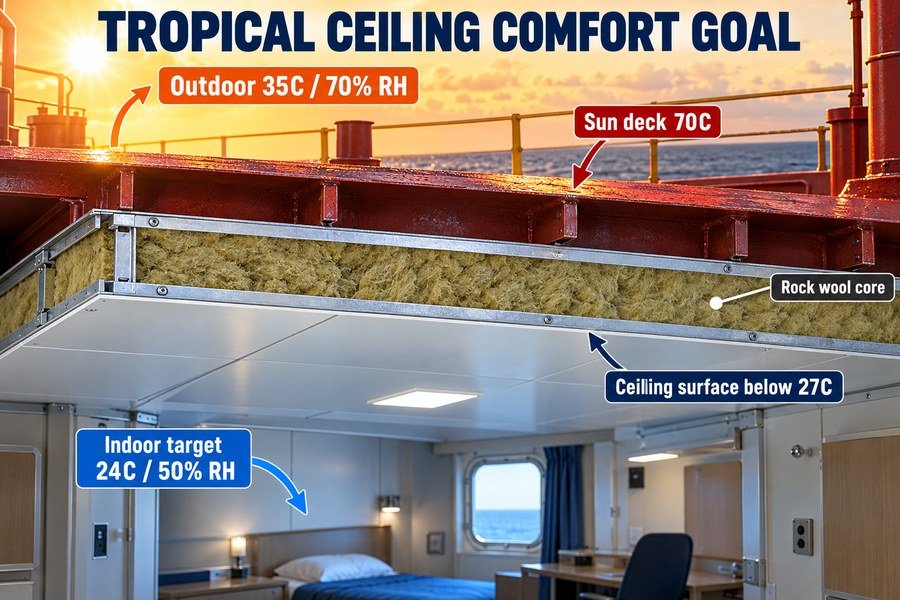
Tropical climates dictate an indoor ambient goal of 24°C with 50% relative humidity, even when outdoor temperatures hit 35°C with 70% humidity. Marine ceiling panels must block heat transfer to keep ceiling surface temperatures below 27°C, preventing radiated heat discomfort, as defined by ISO 7547 tropical guidelines.
Defining the 24°C Ambient Goal for Tropical Ship Cabins
Ship cabins in the tropics face extreme heat. ISO 7547 is the global standard for ship air conditioning. This standard sets the summer indoor goal at 24°C and 50% humidity. The standard assumes the outside air is 35°C. But the real problem is the steel deck above the cabin. The sun heats the steel deck to 70°C2. The ceiling panel is the only barrier between that 70°C steel and the 24°C room. If the ceiling panel is weak, the heat pushes down into the cabin. The air conditioner runs at full power but the room stays hot. You must buy ceiling panels that can handle this massive temperature difference.
Managing Ceiling Surface Temperatures to Prevent Radiated Heat
The room air can be 24°C, but the ceiling surface can still burn you. We call this radiated heat. The ISO standard requires the ceiling surface to stay within 3°C of the room air. This means the ceiling surface cannot go above 27°C. I helped a client last year who bought cheap ceiling panels from a bad supplier. The air conditioner was set to 22°C. But the ceiling surface was 32°C. The crew felt like they were under a heat lamp. The client had to rip out the ceilings and buy our 50mm insulated panels. The new panels kept the surface at 26°C. The crew finally felt comfortable. You must check the thermal rating of ceiling panels before you buy them for tropical projects.
| Location on Ship | Deck Steel Temp | Target Cabin Air Temp | Target Ceiling Surface Temp |
|---|---|---|---|
| Under Sun Deck | 70°C | 24°C | 27°C Max |
| Under Shaded Deck | 40°C | 24°C | 27°C Max |
| Interior Deck | 25°C | 24°C | 24°C Max |
How Does Marine Lining Panel Rock Wool Prevent Polar Cold-Wall Discomfort?
Standing next to a poorly insulated wall drains your body heat fast. It causes shivering and complaints. High-density rock wool blocks this heat loss completely.
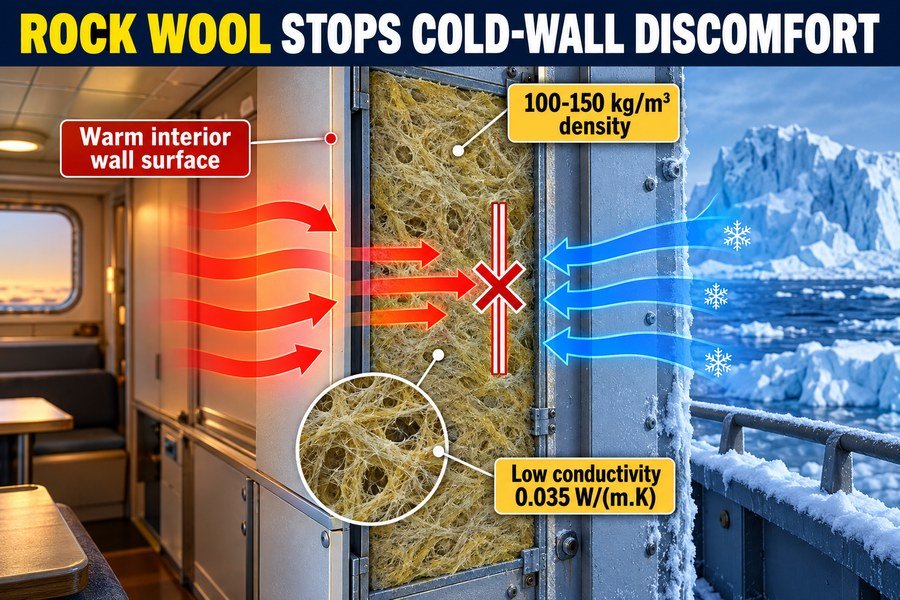
Marine lining panel rock wool prevents polar cold-wall discomfort by trapping air in its dense fiber structure (100-150 kg/m³). This reduces the thermal conductivity to roughly 0.035 W/(m·K), acting as a barrier that stops indoor heat from escaping and keeps the interior wall surface warm.
Density and Thermal Conductivity of Marine Panel Rock Wool
Rock wool is the heart of a marine panel. It does all the hard work. Normal building insulation has a density of 40 kg/m³. That is too light for ships. Marine panels need a rock wool density between 100 kg/m³ and 150 kg/m³. This high density traps millions of tiny air pockets. Air does not move heat well. This gives the rock wool a very low thermal conductivity number. A good panel has a rating of 0.035 W/(m·K).3 This low number means heat cannot travel through the panel. The cold stays outside. The warmth stays inside. You must always ask the supplier for the density and the thermal conductivity numbers. If they cannot give you these numbers, do not buy their panels.
Eliminating the Cold-Wall Effect in Polar Waters
The cold-wall effect happens when your body heat jumps to a cold surface. You can stand in a 22°C room, but if the wall next to you is 10°C, you will feel cold4. Your body radiates heat into the cold steel. Dense rock wool stops this. It holds the indoor heat on the steel skin of the panel. The panel surface stays at 18°C. Your body does not lose heat to an 18°C wall. During my time at Magellan Marine, a buyer from Europe asked me why our panels cost slightly more than a local competitor. I showed him the rock wool. The competitor used 80 kg/m³ density. We used 120 kg/m³. I explained that the cheaper panel would fail polar sea trials. He bought our panels and the ship passed inspection easily.
| Rock Wool Density | Thermal Conductivity | Suitable Climate | Cold-Wall Prevention |
|---|---|---|---|
| 60 kg/m³ | 0.045 W/(m·K) | Mild/Coastal | Poor |
| 100 kg/m³ | 0.038 W/(m·K) | Winter/Cold | Good |
| 120-150 kg/m³ | 0.035 W/(m·K) | Polar/Arctic | Excellent |
How Do Marine Ceiling Panels Block Solar Load to Prevent Hot-Ceiling Discomfort?
Solar radiation hits the steel deck relentlessly. The heat pushes right through cheap ceilings, baking the room below. Specialized ceiling panels use composite layers to stop this downward heat.
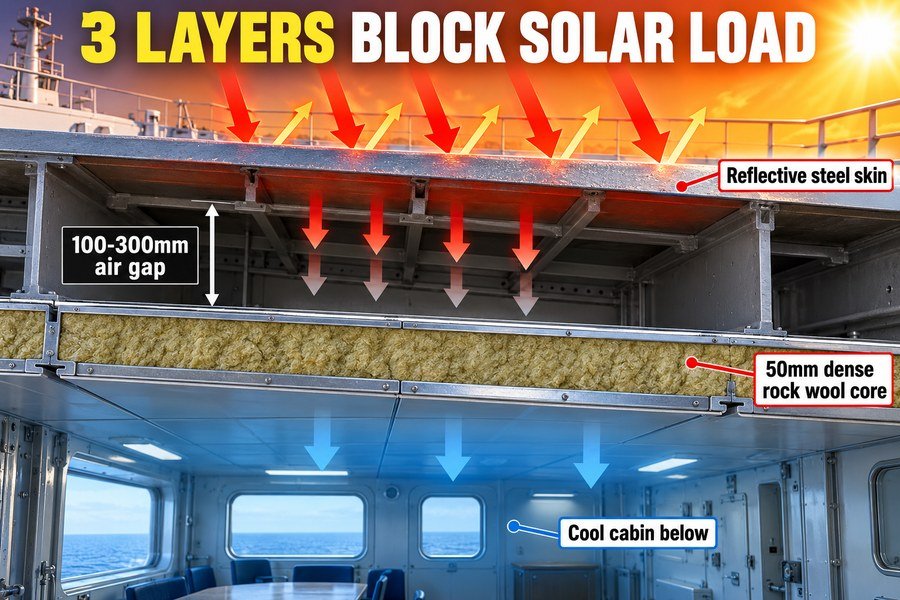
Marine ceiling panels block solar load using three methods: a reflective top steel skin to bounce radiant heat, a dense rock wool core (usually 50mm) to slow thermal conduction, and an air gap between the steel deck and panel. This combination stops hot-ceiling discomfort completely.
The Three Layers That Block Marine Solar Loads
A marine ceiling panel fights sun heat using three specific methods. First, the panel has a top steel skin. This skin faces the hot deck above. It reflects radiant heat back up. Second, the panel has a dense rock wool core. This core is usually 50mm thick. The heat that gets past the steel skin gets trapped in the rock wool fibers. The rock wool slows the heat down so it cannot reach the bottom of the panel.5 Third, there is an air gap. Installers hang the ceiling panel below the steel deck. They leave a space of 100mm to 300mm. We call this the plenum space. The air in this gap acts as another layer of insulation. You must use all three methods together. If you skip one, the heat will get through.
Sizing the Air Gap and Core for Top-Tier Shipyards
Top-tier shipyards in the United States and Europe check all three of these methods. You cannot just buy the cheapest ceiling panels. I have seen buyers try to save money by using 25mm core panels directly under the sun deck. The heat baked the room. The shipyard made the buyer replace everything. For top decks, you must use 50mm panels. You must also ensure the shipyard leaves a large air gap above the panel. The air gap allows the ship ventilation system to blow cool air over the top of the panels. This removes the trapped heat. When you buy ceiling panels, remind your installer to follow the air gap rules. This will save you from failing the heat tests.
| Solar Block Method | Function | Standard Specification |
|---|---|---|
| Reflective Steel Skin | Bounces radiant heat | 0.5mm to 0.6mm Galvanized Steel |
| Dense Rock Wool Core | Slows thermal conduction | 50mm thickness, 120 kg/m³ density |
| Air Gap (Plenum) | Provides physical space buffer | 100mm to 300mm gap above panel |
How Are Comfort Expectations Translated Into Marine Interior Panel U-Values?
Subjective feelings of comfort do not help engineers or buyers. Vague promises lead to failed tests. We must translate the feeling of comfort into strict U-value numbers.
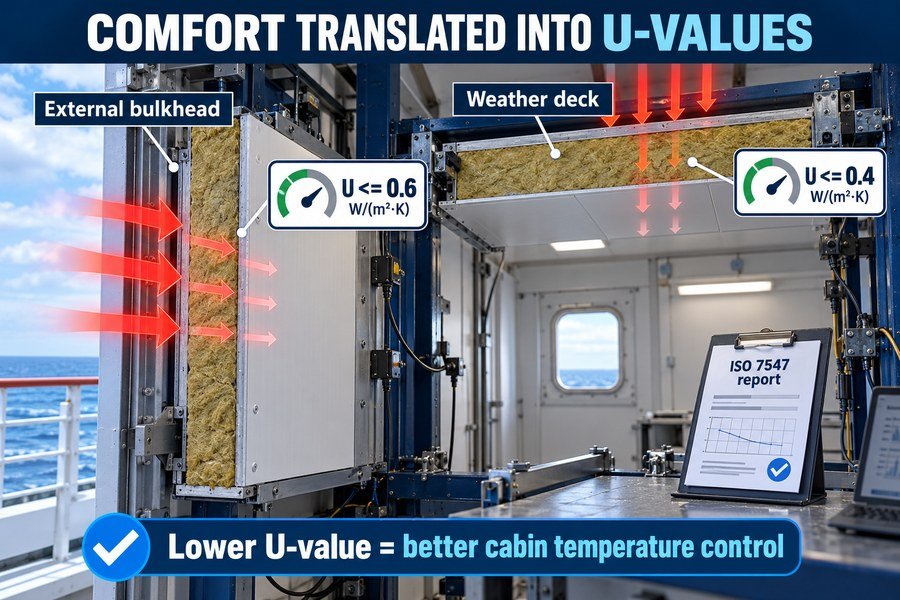
Comfort expectations are translated into marine interior panel U-values by calculating the heat transfer coefficient. A U-value of 0.6 W/(m²·K) or lower is required for external bulkheads, and 0.4 W/(m²·K) for weather decks. These precise metrics ensure the panels meet ISO 7547 standards for cabin temperature control.
Calculating Heat Transfer with Marine Panel U-Values
A U-value is a simple number that tells you how much heat passes through a panel. A low U-value is good. A high U-value is bad. If a panel has a U-value of 0.6 W/(m²·K), it means very little heat moves through it. The math is simple. It measures heat loss in watts for every square meter, per degree of temperature difference. You do not need to do the math yourself. The panel factory does the testing. For walls that face the outside ocean, the rules say the U-value must be 0.6 or lower. For ceilings right under the weather deck, the rules are stricter. They demand a U-value of 0.4 or lower. A lower number means thicker insulation and better materials.
Meeting ISO 7547 Standards to Win Major Shipyard Contracts
European and American shipyards do not care about your feelings on comfort. They only care about paper certificates. They will ask you for the U-value report based on ISO 7547. I talk to procurement officers all the time who buy panels based on price. They buy a panel with a U-value of 1.2 W/(m²·K). They try to sell it to an American shipyard. The shipyard looks at the number and throws the panel out. The air conditioning system on the ship is designed based on a 0.6 U-value. If you use a 1.2 U-value panel, the air conditioner will run all day and fail to cool the room. You must ask your Asian suppliers for the official U-value test report before you spend any money.
| Application Area | Required U-Value Target | Recommended Panel Type |
|---|---|---|
| External Bulkheads (Walls) | 0.6 W/(m²·K) | 50mm Rock Wool Lining Panel |
| Weather Decks (Ceilings) | 0.4 W/(m²·K) | 50mm + Additional Deck Insulation |
| Internal Cabin Partitions | 1.0 W/(m²·K) | 25mm to 50mm Partition Panel |
Conclusion
Meeting marine interior comfort objectives means strictly following ISO 7547 temperatures, rock wool densities, and precise U-values. Delivering these specs ensures your shipyard clients trust your outfitting products completely.
-
"condensation: dew, fog and clouds", http://cimss.ssec.wisc.edu/wxwise/class/dewfog.html. Building-science references define surface condensation as water formation when humid indoor air contacts a surface at or below its dew-point temperature, supporting the described physical mechanism. Evidence role: mechanism; source type: education. Supports: Warm cabin air can condense into liquid water when it contacts a sufficiently cold wall panel surface. Scope note: This supports the condensation mechanism generally, not the specific shipyard incident described in the article. ↩
-
"Solar heating of various surfaces", https://nvlpubs.nist.gov/nistpubs/Legacy/BMS/nbsbuildingmaterialsstructures64.pdf. Studies of solar-exposed metal or ship deck surfaces show that dark or uninsulated steel surfaces can reach temperatures far above ambient air temperature under strong solar radiation, supporting the plausibility of deck temperatures near 70°C in tropical exposure. Evidence role: general_support; source type: paper. Supports: Sun exposure can heat a ship's steel deck to around 70°C in tropical conditions. Scope note: This would support the thermal plausibility of a 70°C deck temperature, not prove that every tropical ship deck reaches that value; actual temperature depends on coating color, wind, solar angle, insulation, and deck construction. ↩
-
"Determination of Thermal Properties of Mineral Wool ... - PMC", https://pmc.ncbi.nlm.nih.gov/articles/PMC10488771/. A materials-engineering source reporting mineral or rock wool thermal conductivity values around 0.035-0.045 W/(m·K) would support that 0.035 W/(m·K) is within the low-conductivity range for this insulation material. Evidence role: statistic; source type: paper. Supports: A good marine rock wool panel can have a thermal conductivity rating of about 0.035 W/(m·K). Scope note: This would contextualize the material property, but it would not by itself establish a universal performance threshold for all marine panel assemblies. ↩
-
"Controlling radiative heat flows in interior spaces to improve ...", https://pmc.ncbi.nlm.nih.gov/articles/PMC8319807/. Thermal-comfort literature on mean radiant temperature and radiant heat exchange supports that cold surrounding surfaces can increase body heat loss and cause discomfort even when room air temperature is otherwise comfortable. Evidence role: mechanism; source type: institution. Supports: A person can feel cold near a cold wall because radiant heat exchange with the wall affects thermal comfort independently of air temperature. Scope note: The source may support the general mechanism rather than the exact 22°C room and 10°C wall example unless it includes a comparable calculation or model. ↩
-
"Determination of Thermal Properties of Mineral Wool ... - PMC", https://pmc.ncbi.nlm.nih.gov/articles/PMC10488771/. Thermal-conductivity studies and technical references on mineral wool show that rock wool reduces conductive heat transfer by trapping air within a fibrous matrix; this supports the insulation mechanism, but not the absolute claim that heat cannot reach the opposite panel face. Evidence role: mechanism; source type: paper. Supports: Rock wool in the panel core slows heat transfer through the ceiling panel. Scope note: Supports slowed heat transfer rather than complete heat blockage. ↩