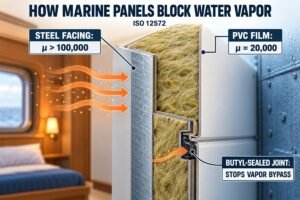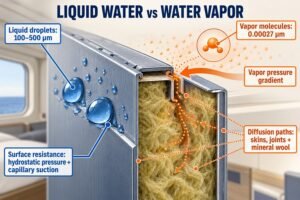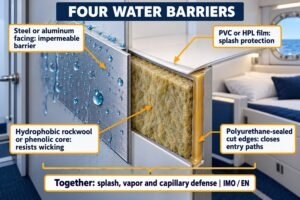
Cabin humidity often ruins ship insulation. Trapped moisture causes mold, steel hull corrosion, and failed shipyard inspections. I will show you how panel vapor resistance stops this hidden damage.
Water-vapor diffusion resistance in marine interior panels works through three mechanisms: impermeable galvanized steel facings (µ-value over 100,000) block cabin moisture, decorative PVC films (µ-value 20,000) add surface sealing, and butyl-sealed tongue-and-groove joints stop vapor bypass into the cold rockwool core, per ISO 12572 standards.
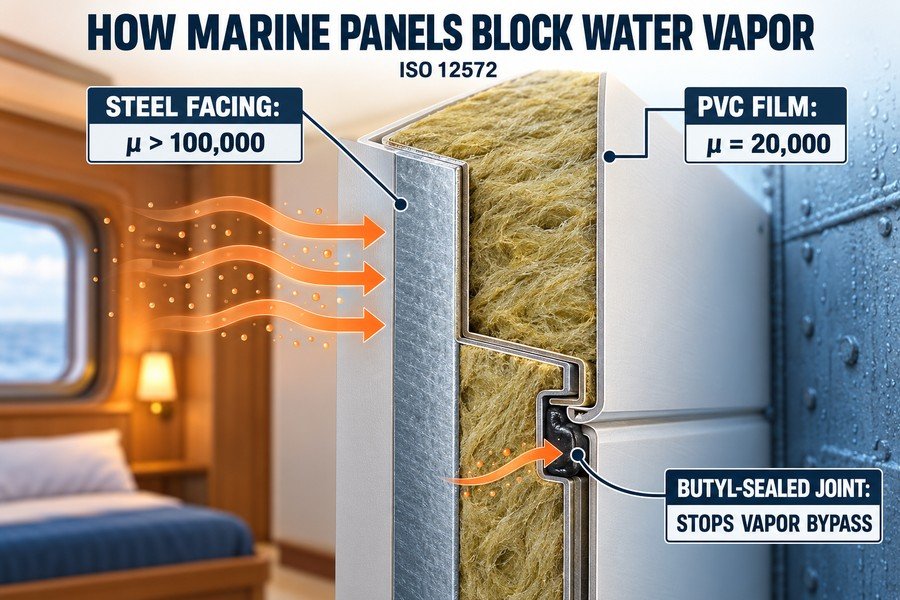
Many procurement managers only check fire certificates when they buy marine wall panels in Asia. However, European and American shipyards also check moisture performance during cabin inspections. If warm cabin moisture gets inside the insulation core, the panel weight increases and the steel bulkhead rusts. I have helped many buyers fix condensation problems before vessel delivery. In this guide, I will break down the exact numbers, test methods, and panel structures you need to know.
What Is the Water-Vapor Diffusion Resistance Factor (µ-Value) of Marine Interior Panels?
Buying panels without checking the µ-value is risky. High cabin humidity will soak your insulation and rot the bulkhead. Here are the exact resistance numbers for every panel layer.
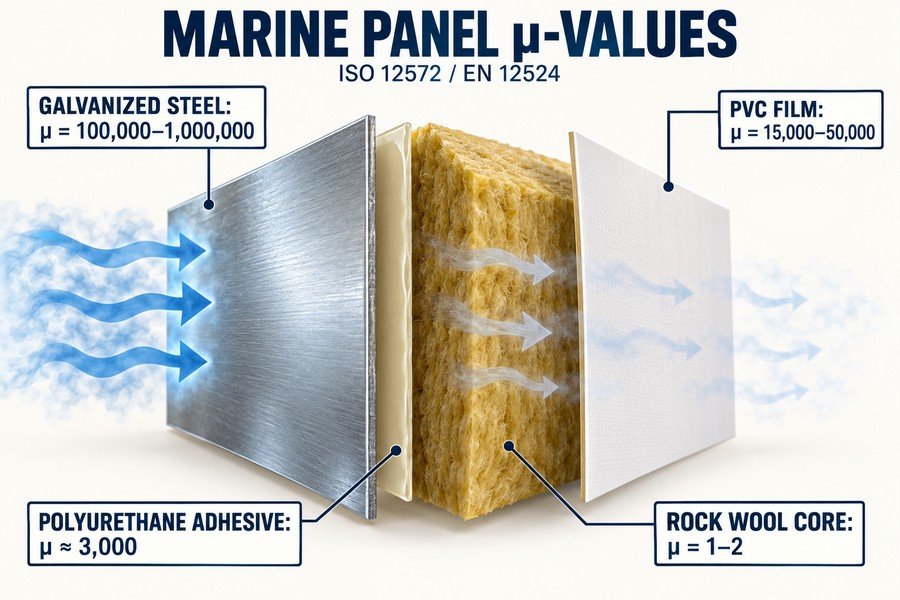
Per ISO 12572 and EN 12524 standards, the water-vapor diffusion resistance factor (µ-value) of marine interior panels includes four material layers: galvanized steel sheets (µ equal to 100,000 to 1,000,000), PVC decorative films (µ equal to 15,000 to 50,000), polyurethane adhesives (µ equal to 3,000), and rockwool cores (µ equal to 1 to 2).
Impermeable Surface Layers: Galvanized Steel Sheets and PVC Decorative Films
The water-vapor diffusion resistance factor, or µ-value, compares a material against stationary air. Under ISO 12572, stationary air has a µ-value of 1. A higher µ-value means water vapor moves through the material much slower. Last year, I worked with a buyer who sourced B-15 cabin panels from a factory in China for a European cruise ship refit. The shipyard engineer asked for the µ-value of every single component in the composite panel. The local factory sales representative could not answer the question in English. I stepped in and prepared the technical sheet using EN 12524 benchmark data.
First, the galvanized steel sheet acts as the primary vapor block. A standard 0.5 mm or 0.6 mm hot-dip galvanized steel sheet has a µ-value between 100,000 and 1,000,000 under EN 12524. Water vapor cannot pass through solid metal. Second, the decorative PVC film laminated onto the steel provides an extra moisture barrier. Standard marine PVC film is 0.15 mm thick to meet IMO FTP Code Part 5 low flame-spread rules.1 According to ISO 12572 laboratory data, this calendered PVC film has a µ-value between 15,000 and 50,000. It protects the steel zinc coating from salty cabin air and stops surface moisture absorption.
Permeable Internal Layers: Polyurethane Adhesives and Rockwool Insulation Cores
Behind the outer skin, the internal layers have much lower vapor resistance. The third layer is the two-component polyurethane adhesive that bonds the steel skin to the mineral wool core. Manufacturers apply 120 g/m² to 180 g/m² of glue across the steel back. According to EN 12524 material tables, cured polyurethane adhesive has a µ-value of around 3,000. Because the glue layer is only 0.1 mm thick and often applied in roller beads, it provides very little vapor resistance on its own.
The fourth layer is the hydrophobic rockwool core. Marine B-15 and A-60 panels use rockwool with a density of 140 kg/m³ to 160 kg/m³. Under ISO 12572 and EN 13162 standards, mineral wool has a µ-value of only 1.0 to 2.0. This means water vapor moves through unprotected rockwool almost as fast as it moves through open air. If a factory leaves the back of a lining panel open without a steel skin, cabin moisture will go straight into the wool if the front joints leak.
| Panel Component Layer | Typical Thickness | µ-Value Range (Dimensionless) | Authoritative Standard | Role in Vapor Control |
|---|---|---|---|---|
| Galvanized Steel Sheet | 0.50 mm – 0.70 mm | 100,000 – 1,000,000 | EN 12524 / ISO 10456 | Complete vapor barrier |
| Marine PVC Decorative Film | 0.12 mm – 0.18 mm | 15,000 – 50,000 | ISO 12572 / IMO FTP Code | Secondary surface seal |
| Polyurethane Adhesive | 0.08 mm – 0.12 mm | 2,500 – 3,500 | EN 12524 | Minor interfacial resistance |
| Hydrophobic Rockwool Core | 25.0 mm – 50.0 mm | 1.0 – 2.0 | EN 13162 / ISO 12572 | Zero vapor block (thermal only) |
How Does High Vapor Diffusion Resistance Prevent Condensation Behind Marine Lining Panels?
Sweating steel hulls destroy ship interiors fast. Water drips from ceiling panels and ruins expensive cabin furniture. High vapor resistance stops warm cabin air from hitting cold steel hulls.
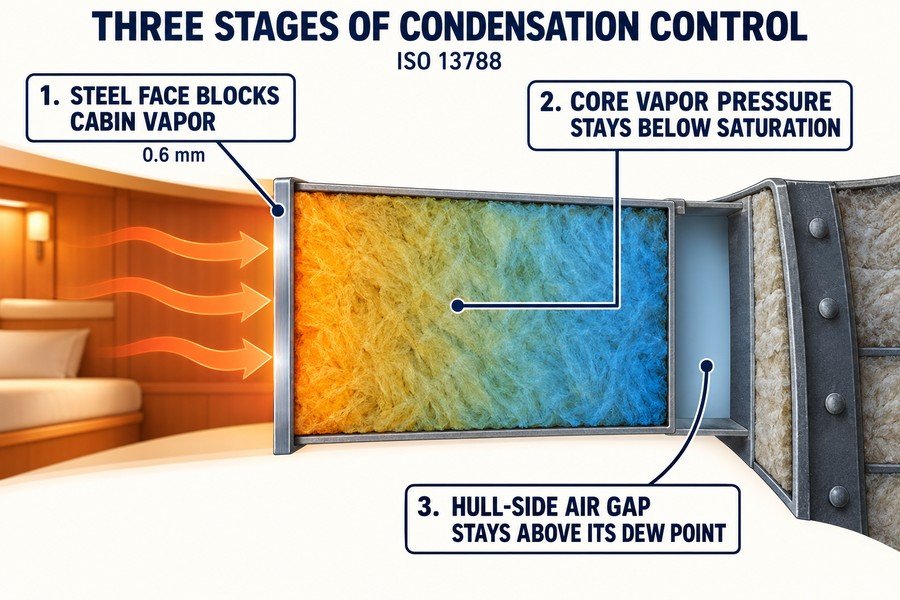
High vapor diffusion resistance prevents condensation behind marine lining panels through three physical stages under ISO 13788 rules: blocking warm cabin vapor at the 0.6 mm steel face, maintaining vapor pressure below saturation across the rockwool thermal gradient, and keeping the hull-side air gap above the dew point.
Stage 1 and Stage 2: Blocking Cabin Vapor at the Steel Face and Controlling Core Vapor Pressure
Condensation happens on ships when warm, humid indoor air touches a cold surface. According to ISO 13788 (Hygrothermal performance of building components), air holds a maximum amount of water vapor at any given temperature2. We call this the saturation vapor pressure. In a ship cabin kept at 22°C with 60% relative humidity, the partial water-vapor pressure is 1,588 Pa.3 When that ship sails in North Europe during winter, the outer steel hull temperature drops to 0°C. At 0°C, the saturation vapor pressure is only 611 Pa.4 This creates a pressure difference of 977 Pa that pushes cabin moisture toward the cold steel hull.
In the first stage, the 0.6 mm galvanized steel face on the warm cabin side acts as a vapor dam. Because the steel face has a µ-value over 100,0005, it blocks the 1,588 Pa vapor pressure right at the cabin surface. However, panels have tongue-and-groove joints every 550 mm or 600 mm. On a vessel project I handled two years ago, water pooled inside the bottom floor tracks within three weeks of sea trials. The installer used unsealed joints. We fixed the issue by applying a 3 mm butyl rubber sealant strip inside every female joint groove, which kept the face barrier continuous.
In the second stage, the panel controls vapor pressure across the rockwool thermal gradient. The 50 mm rockwool core drops the temperature gradually from 22°C on the cabin side to about 4°C on the back side. Because the front steel face stops new moisture from entering the core, the actual vapor pressure inside the rockwool stays below 400 Pa. This figure remains safely below the saturation line across the entire 50 mm thickness.
Stage 3: Keeping the Hull-Side Air Gap Above the Dew Point Temperature
In the third stage, the system protects the 20 mm to 50 mm air gap between the back of the lining panel and the hull pin-insulation. Under ISO 13788 calculations, cabin air at 22°C and 60% relative humidity has a dew point temperature of 13.9°C. If unblocked cabin air leaks behind the panel, liquid water condenses immediately on any surface colder than 13.9°C.
When the front lining panel maintains high vapor diffusion resistance, the air inside the rear cavity stays dry. Its dew point drops from 13.9°C down to -2°C. Even if the hull insulation surface sits at 2°C, no water droplets form because the cavity temperature stays above the -2°C dew point. This keeps the structural bulkhead dry and prevents hidden rust behind the accommodation linings6.
| Location Across Bulkhead Assembly | Temperature (°C) | Saturation Pressure per ISO 13788 (Pa) | Actual Vapor Pressure With Steel Barrier (Pa) | Condensation Risk Status |
|---|---|---|---|---|
| Warm Cabin Interior (60% RH) | 22.0°C | 2,645 Pa | 1,588 Pa | Dry (Dew point is 13.9°C) |
| Front 0.6 mm Steel Face (Warm Side) | 21.5°C | 2,564 Pa | Drops from 1,588 Pa to 350 Pa | Safe (Vapor blocked here) |
| Middle of 50 mm Rockwool Core | 12.0°C | 1,402 Pa | 340 Pa | Safe (Well below saturation) |
| Rear Panel Face / Hull Air Gap | 4.0°C | 813 Pa | 330 Pa | Safe (Dew point drops to -8°C) |
What Units Measure Water-Vapor Permeability in Marine Accommodation Panels?
European and US shipyards use different moisture units on drawings. Misreading these units leads to wrong material orders and failed audits. This guide explains every permeability unit clearly.
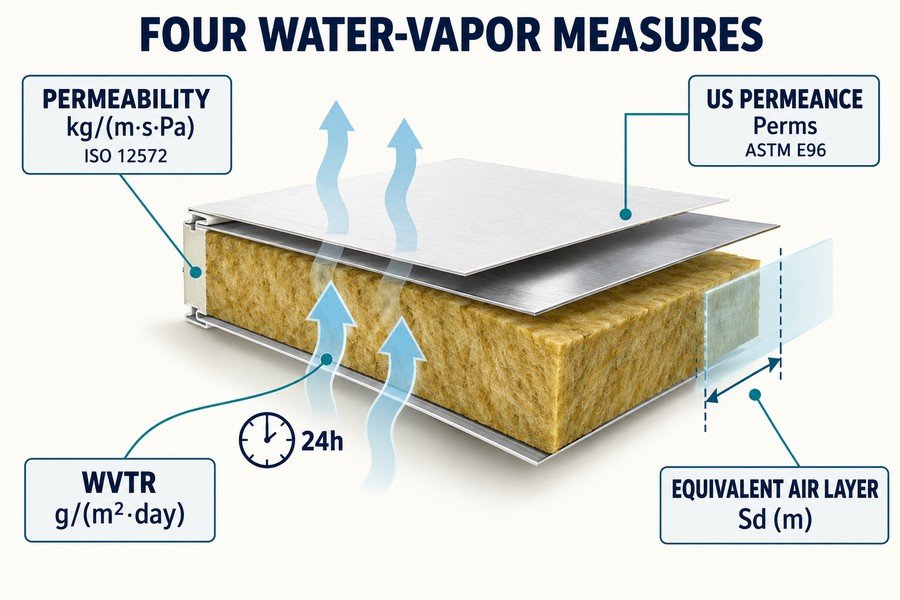
Four standard units measure water-vapor permeability in marine accommodation panels: metric vapor permeability in kg/(m·s·Pa) per ISO 12572, US permeance in Perms per ASTM E96, Water-Vapor Transmission Rate (WVTR) in g/(m²·day), and equivalent air layer thickness (Sd-value) in meters.
Comparing ISO 12572 Metric Permeability in kg/(m·s·Pa) and ASTM E96 US Perms
When you buy marine wall panels from factories in China or Vietnam for international shipyards, you will see four different measurement units on technical submittals. If you do not know how to convert them, your supplier might send you a test report that the shipyard rejects. I always translate these numbers for my clients before they sign a purchase contract.
The first unit is metric water-vapor permeability, measured in kilograms per meter, per second, per Pascal, written as kg/(m·s·Pa) or ng/(m·s·Pa). European shipyards use this unit under ISO 12572.7 It measures how much water vapor passes through a 1-meter-thick block of material every second under a 1-Pascal pressure difference. For example, stationary air has a permeability of 2.0 × 10⁻¹⁰ kg/(m·s·Pa)8. Uncoated rockwool has almost the same value at 1.5 × 10⁻¹⁰ kg/(m·s·Pa), while PVC film sits near 1.0 × 10⁻¹⁴ kg/(m·s·Pa).
The second unit is US Permeance, measured in Perms under ASTM E96. American shipyards and US Coast Guard projects require this unit. Unlike permeability, Permeance applies to a specific thickness of a finished layer. Under ASTM E96, 1 US Perm equals 1 grain of water vapor passing through 1 square foot of material per hour under a pressure difference of 1 inch of mercury9. In metric terms, 1 US Perm equals 57.2 ng/(s·m²·Pa)10. The International Building Code and US marine specs classify any facing with 0.1 Perm or less as a Class I impermeable vapor retarder. A 0.6 mm steel panel skin measures close to 0.001 Perm, so it easily passes Class I rules.
Using WVTR in g/(m²·day) and Sd-Value in Meters for Factory Quality Control
The third unit is the Water-Vapor Transmission Rate (WVTR), written as g/(m²·day) or g/(m²·24h). Film and foil suppliers in Asia love this unit because it is easy to read during factory production checks. It states how many grams of water pass through 1 square meter of sheet in 24 hours under fixed laboratory temperature and humidity. A good 0.15 mm marine PVC decorative film has a WVTR between 1.5 and 4.0 g/(m²·day) at 23°C and 85% relative humidity.
The fourth unit is the equivalent air layer thickness, or Sd-value, measured in meters (m) under ISO 12572 and DIN 4108-3. It compares a panel layer directly to a stagnant air cushion. For instance, an Sd-value of 3.0 m means the panel coating blocks moisture just like a 3-meter-thick wall of still air. German, Dutch, and Italian shipyards almost always ask for the Sd-value on cabin insulation drawings.
| Measurement Unit | Standard Symbol | Governing Standard | Typical Value for Marine Panel Layer | Primary Shipyard Market |
|---|---|---|---|---|
| Metric Vapor Permeability | kg/(m·s·Pa) | ISO 12572 / EN 12524 | 1.5 × 10⁻¹⁰ (Rockwool core) | Europe & International (IMO) |
| US Vapor Permeance | US Perm | ASTM E96 | Less than 0.01 Perm (Steel skin) | United States (USCG / ABS) |
| Water-Vapor Transmission Rate | g/(m²·day) | ISO 2528 / ASTM F1249 | 1.5 – 4.0 g/(m²·day) (PVC film) | Asian Raw Material Factories |
| Equivalent Air Layer Thickness | Sd (meters) | DIN 4108-3 / ISO 12572 | 3.0 m (PVC) / Over 1,500 m (Steel) | Germany, Netherlands, Italy |
How Does the Sd-Value Measure Water-Vapor Transmission in Marine Interior Panels?
Comparing thin PVC film to thick rockwool confuses many buyers. Raw resistance factors do not include material thickness. The Sd-value solves this problem with one simple calculation.
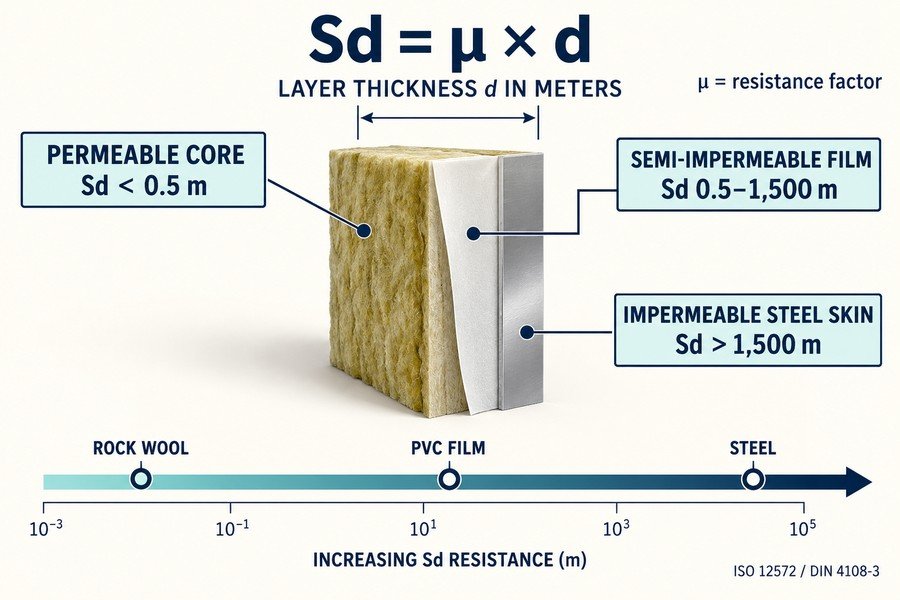
Per ISO 12572 and DIN 4108-3, the Sd-value measures water-vapor transmission by multiplying layer thickness (m) by its resistance factor (µ), sorting marine panel components into three barrier classes: permeable cores (Sd below 0.5 m), semi-impermeable films (Sd 0.5 to 1,500 m), and impermeable steel skins (Sd above 1,500 m).
Calculating Equivalent Air Layer Thickness (Sd-Value) Across Marine Panel Layers
A high µ-value does not guarantee a good vapor barrier if the material is too thin. That is why engineers use the Sd-value. Under ISO 12572, you calculate the Sd-value by multiplying the water-vapor diffusion resistance factor (µ) by the actual thickness of the layer in meters (d). The formula is Sd = µ × d. This calculation turns a complex material property into a simple number in meters that any buyer can compare at a glance.
During my factory days, a procurement officer asked me why a 50 mm thick rockwool board had worse moisture resistance than a 0.15 mm thin plastic film. I wrote out the Sd calculation for her on a whiteboard. First, take a 50 mm (0.05 m) marine rockwool core with a µ-value of 1.2. When you multiply 1.2 by 0.05 m, you get an Sd-value of 0.06 m. It offers only 6 centimeters of equivalent air resistance. Second, take a 0.15 mm (0.00015 m) marine PVC film with a µ-value of 20,000. When you multiply 20,000 by 0.00015 m, you get an Sd-value of 3.0 m. Even though the PVC film is 333 times thinner than the rockwool core, its Sd-value is 50 times higher.
Evaluating the Three DIN 4108-3 Vapor Barrier Classes in Ship Cabins
To make specification checks easy, German standard DIN 4108-3 divides materials into three strict classes based on their Sd-value. First, materials with an Sd-value below 0.5 m are diffusion-open or permeable. In a marine panel, the 25 mm or 50 mm rockwool core (Sd = 0.03 m to 0.06 m) and woven glass-cloth backings (Sd = 0.02 m) fall into this permeable class. Water vapor passes right through them.
Second, materials with an Sd-value between 0.5 m and 1,500 m are diffusion-retarding or semi-impermeable. The 0.15 mm PVC decorative film (Sd = 2.25 m to 7.5 m) and the polyurethane glue layer (Sd = 0.3 m to 0.5 m) operate here. Third, materials with an Sd-value equal to or greater than 1,500 m are diffusion-tight or completely impermeable. Under DIN 4108-3 and EN 12524, intact metal sheets like the 0.6 mm galvanized steel panel skin and 0.05 mm aluminum foil backings are rated at Sd over 1,500 m. They stop vapor transmission completely.
| DIN 4108-3 Barrier Classification | Standard Sd-Value Range | Marine Panel Component Example | Layer Thickness (m) | Typical µ-Value | Calculated Panel Sd-Value |
|---|---|---|---|---|---|
| Permeable (Diffusion-Open) | Sd less than 0.5 m | 50 mm Rockwool Core | 0.05000 m | 1.2 | 0.06 m |
| Semi-Impermeable (Retarding) | 0.5 m to 1,500 m | 0.15 mm PVC Film | 0.00015 m | 20,000 | 3.00 m |
| Impermeable (Diffusion-Tight) | Sd over 1,500 m | 0.60 mm Galvanized Steel Skin | 0.00060 m | Over 1,000,000 | Over 1,500 m |
Why Does Unequal Facing Vapor Resistance Warp Single-Sided Marine Lining Panels?
Single-sided lining panels save money, but they often bend after installation. Warped cabin walls trigger expensive shipyard rework claims. Unequal vapor resistance between the front and back causes this failure.
Unequal facing vapor resistance warps single-sided marine lining panels through three mechanisms under EN 14509 rules: moisture swelling in the open rear glass-cloth backing, differential expansion between the front 0.6 mm steel skin and damp rockwool core, and polyurethane glue hydrolysis below 0.04 MPa tensile strength.
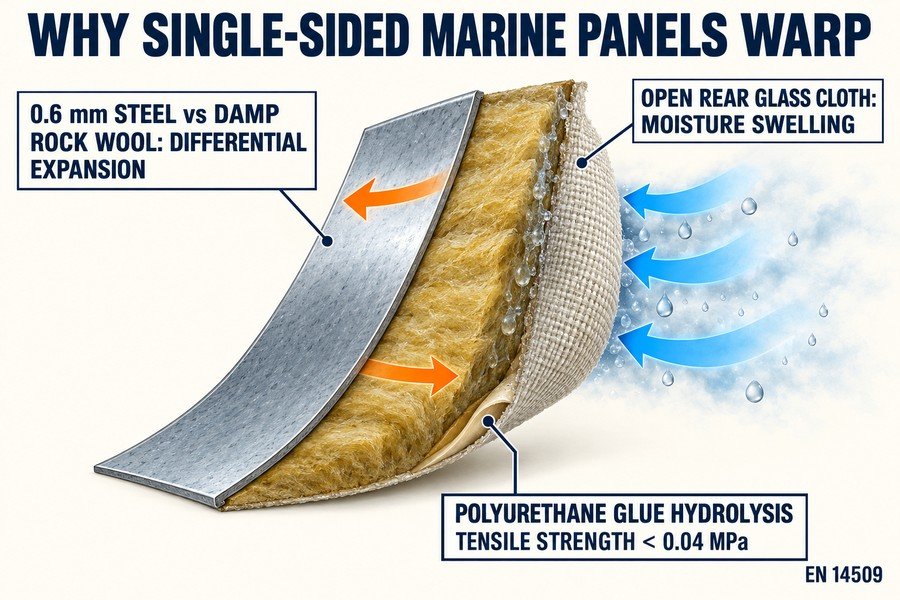
Rear Glass-Cloth Moisture Swelling and Front-to-Back Differential Expansion
Many interior contractors try to cut budget costs on hull lining panels by ordering single-sided panels. Instead of putting galvanized steel on both sides of the 25 mm rockwool core, they use a 0.6 mm PVC-coated steel sheet on the front and a cheap 0.2 mm woven glass-cloth fabric on the back. This saves about $2.50 to $3.50 per square meter in Chinese factories. However, when you ship these panels through humid Southeast Asian ports or install them on non-air-conditioned vessels during outfitting, they often bow and warp.
The first mechanism is moisture swelling in the open rear glass-cloth backing. Glass cloth has an Sd-value of only 0.02 m, while the front steel skin has an Sd-value over 1,500 m. Humid air enters the panel exclusively through the back fabric. The sizing starch and binder on the glass cloth absorb water and expand by 0.15% to 0.30%11, while the front steel sheet stays rigid.
The second mechanism is differential thermal-humidity expansion between the front 0.6 mm steel skin and the damp rockwool core. When the rear half of the rockwool core absorbs ambient moisture above 85% relative humidity, the wet mineral wool fibers lose compressive stiffness and sag under their own weight12. Under EN 14509 (Self-supporting double skin metal faced insulating panels), the maximum allowed bowing deflection is 2.0 mm per meter of panel length13. On a standard 2,400 mm tall cabin panel, unequal vapor intake easily bends the panel center outward by 6.0 mm to 10.0 mm.
Polyurethane Adhesive Hydrolysis and Backing Sheet Solutions to Prevent Panel Bowing
The third mechanism is polyurethane glue hydrolysis at the wet interface. Standard single-component or two-component polyurethane adhesives react badly to warm trapped moisture over 30°C. Water molecules break down the ester chains in the glue.14 According to EN 14509 cross-panel tensile tests, a dry marine panel must maintain a bond strength of at least 0.08 MPa to 0.10 MPa. After four weeks of humid storage in an unsealed hold, hydrolysis drops the rear glue bond strength below 0.04 MPa15. The rear backing peels loose, and the front steel sheet pulls the entire panel into a banana shape.
To solve this problem without breaking your budget, I always advise buyers to avoid bare glass cloth. If you need a 25 mm lining panel, pay an extra $1.20/m² for a 0.08 mm reinforced aluminum foil backing (Sd over 1,500 m), or pay $3.00/m² more for a 0.45 mm galvanized steel backing sheet. Balancing the vapor resistance on both faces locks out moisture and keeps panel bowing under 1.5 mm.
| Rear Backing Material Option | Rear Sd-Value (ISO 12572) | Typical Bowing on 2.4 m Panel (EN 14509) | Glue Bond Strength After 85% RH Exposure | Factory FOB Price (25 mm B-15 Panel) |
|---|---|---|---|---|
| 0.20 mm Woven Glass Cloth | 0.02 m (Open) | 6.0 mm – 10.0 mm (Fails spec) | Drops below 0.04 MPa (Delaminates) | $14.50 – $16.50 / m² |
| 0.08 mm Reinforced Alu-Foil | Over 1,500 m (Sealed) | 2.0 mm – 3.5 mm (Borderline) | Holds at 0.07 MPa | $15.80 – $17.80 / m² |
| 0.45 mm Galvanized Steel Back | Over 1,500 m (Rigid Seal) | Under 1.5 mm (Passes easily) | Holds at 0.10 MPa | $17.50 – $19.50 / m² |
How Is Water-Vapor Transmission Rate (WVTR) Tested in Marine Interior Panels?
Suppliers often claim their marine panels are 100% waterproof without proof. Fake test reports can ruin your shipyard qualification. You must verify how laboratories test panel vapor transmission.
Laboratories test Water-Vapor Transmission Rate (WVTR) in marine interior panels using three standardized methods: the ISO 12572 and ASTM E96 dry-cup method (0% to 50% RH), the wet-cup method (100% to 50% RH), and the ASTM F1249 infrared sensor method for PVC decorative films at 23°C to 38°C.
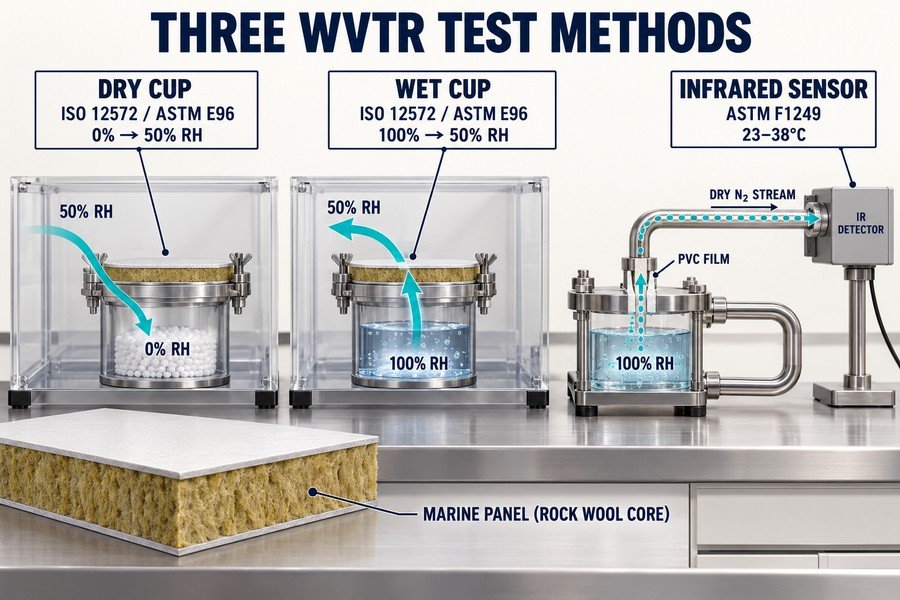
Gravimetric Testing: ISO 12572 and ASTM E96 Dry-Cup and Wet-Cup Methods
When you audit a marine outfitting factory in China or Vietnam, you should ask how they test the moisture resistance of their panel facings and cores. Certified laboratories use three standard methods to measure the Water-Vapor Transmission Rate (WVTR) and calculate the µ-value. Knowing these three methods helps you spot outdated or mismatched lab reports before you submit documents to the shipyard.
The first method is the Dry-Cup (Desiccant) Method under ISO 12572 Set A and ASTM E96 Procedure A. A lab technician cuts a circular sample of the panel layer and seals it over a metal test dish with hot wax. Inside the dish, the technician places dry calcium chloride desiccant, which keeps the internal relative humidity at 0% RH. Then, they place the dish inside a climate chamber held at 23°C and 50% RH. Water vapor from the chamber pushes through the sample into the dry dish. The technician weighs the dish every 24 hours on an analytical balance accurate to 0.001 grams until five consecutive weight gains stay within 5% of each other. This dry-cup test normally takes 7 to 14 days and simulates dry cabin conditions.
The second method is the Wet-Cup (Water) Method under ISO 12572 Set C and ASTM E96 Procedure B. Instead of desiccant, the technician fills the bottom of the test cup with distilled water or a saturated salt solution to create 93% to 100% RH inside the cup. The outside climate chamber stays at 23°C and 50% RH. Water vapor moves outward from the wet cup into the chamber, and the lab measures weight loss every 24 hours. Because high humidity swells polymer chains in PVC film and polyurethane glue, the wet-cup method consistently gives a WVTR that is 20% to 40% higher than the dry-cup method16. If a ship sails in tropical Indonesian waters, you should always check the wet-cup figures.
Instrumental Testing: ASTM F1249 Infrared Sensor Method for Marine PVC Films
The third method is the ASTM F1249 modulated infrared sensor method. Gravimetric cup tests take two weeks, which is too slow when a factory needs to check incoming batches of 0.15 mm marine PVC decorative film and foil backings to control lead times. Under ASTM F1249, the technician clamps the PVC film between a wet chamber (100% RH) and a dry chamber purged with pure nitrogen gas at 23°C or 38°C.
As water molecules diffuse through the PVC film into the dry nitrogen stream, the gas carries them to a precision infrared sensor. The sensor measures the exact infrared energy absorbed by the water vapor and calculates the WVTR in g/(m²·day) within 6 to 24 hours. When my team at Magellan Marine inspects PVC film batches before lamination, we use ASTM F1249 reports to confirm the WVTR stays below 3.5 g/(m²·day). This fast check keeps production on schedule and guarantees every panel batch passes shipyard quality audits.
| Testing Method Name | Governing Standards | Test Conditions (Temp & RH Gradient) | Test Duration | Best Application in Marine Outfitting |
|---|---|---|---|---|
| Dry-Cup (Desiccant) Method | ISO 12572 (Set A) / ASTM E96 (Proc. A) | 23°C; 0% RH inside cup vs. 50% RH chamber | 7 – 14 Days | Standard rating for rockwool cores and dry cabins |
| Wet-Cup (Water) Method | ISO 12572 (Set C) / ASTM E96 (Proc. B) | 23°C; 100% RH inside cup vs. 50% RH chamber | 7 – 14 Days | Tropical vessel conditions and glue line checks |
| Modulated Infrared Sensor | ASTM F1249 / ISO 15106-2 | 23°C or 38°C; 90%–100% RH vs. 0% RH nitrogen | 6 – 24 Hours | Fast incoming QC for 0.15 mm PVC films and foils |
Conclusion
Controlling water-vapor diffusion in marine panels prevents hull condensation and panel warping. Always verify ISO 12572 µ-values, balanced steel backings, and ASTM E96 test reports before placing your order.
-
"What Is the Purpose and Scope of the IMO FTP Code?", https://magellanmarinetech.com/what-purpose-scope-of-imo-ftp-code/. The IMO FTP Code Part 5 specifies the surface flammability test used to assess low flame-spread characteristics of marine surface materials, providing regulatory context for testing decorative films used on ship interiors. Evidence role: historical_context; source type: institution. Supports: IMO FTP Code Part 5 is the relevant low flame-spread test framework for marine interior surface materials such as decorative PVC films.. Scope note: The FTP Code supports the low-flame-spread testing requirement but does not by itself establish that 0.15 mm is the standard PVC film thickness or that this thickness is required for compliance. ↩
-
"Chapter 4: Water Vapor – Atmospheric Processes and ...", https://pressbooks-dev.oer.hawaii.edu/atmo/chapter/chapter-4-water-vapor/. A psychrometric or hygrothermal reference defines saturation vapor pressure as the maximum water-vapor pressure air can sustain at a given temperature before condensation occurs. Evidence role: definition; source type: education. Supports: Air has a temperature-dependent maximum water-vapor capacity, described by saturation vapor pressure.. ↩
-
"Water Vapor Pressure Formulations", https://www.eol.ucar.edu/data-software/conventions-and-standards/water-vapor-pressure-formulations. Standard psychrometric equations or vapor-pressure tables indicate that saturated water-vapor pressure at 22°C is about 2.64 kPa, so 60% relative humidity corresponds to an actual vapor pressure of about 1.59 kPa. Evidence role: statistic; source type: research. Supports: At 22°C and 60% relative humidity, the partial water-vapor pressure is approximately 1,588 Pa.. Scope note: The value depends slightly on the formula or table used for saturation vapor pressure. ↩
-
"Water Vapor Pressure Formulations", https://www.eol.ucar.edu/data-software/conventions-and-standards/water-vapor-pressure-formulations. Reference tables for water-vapor saturation pressure report a saturation vapor pressure near 611 Pa at 0°C, which supports the stated cold-surface comparison. Evidence role: statistic; source type: government. Supports: At 0°C, saturation vapor pressure is approximately 611 Pa.. Scope note: Some tables distinguish saturation over liquid water and over ice; the cited value is conventionally for water near 0°C. ↩
-
"story mass timber building through the use of sensors", https://repository.mines.edu/server/api/core/bitstreams/01fd54b4-4236-41dd-82fd-ea7b92147b7a/content. Hygrothermal material-data references classify metals as having extremely high water-vapor diffusion resistance, with diffusion-resistance factors commonly many orders of magnitude above porous insulation materials. Evidence role: general_support; source type: institution. Supports: A steel face can function as a very high vapor-diffusion-resistance layer, with a µ-value exceeding 100,000 or otherwise effectively vapor-tight.. Scope note: Published tables may list generic steel, sheet metal, or metal layers rather than the exact 0.6 mm galvanized panel face used in this assembly. ↩
-
"Marine Atmospheric Corrosion of Carbon Steel: A Review - PMC", https://pmc.ncbi.nlm.nih.gov/articles/PMC5506973/. Corrosion references explain that moisture and oxygen are necessary drivers of steel corrosion, so keeping concealed steel surfaces dry reduces corrosion risk in enclosed assemblies. Evidence role: mechanism; source type: government. Supports: Keeping the structural bulkhead dry helps prevent hidden rust behind accommodation linings.. Scope note: Such sources support the corrosion mechanism generally; they do not directly prove the performance of this specific ship-lining assembly without field measurements. ↩
-
"Water Vapor Permeability and Thermal Conductivity as a ...", https://web.ornl.gov/sci/buildings/conf-archive/2004%20B9%20papers/077_Valovirta.pdf. ISO 12572 specifies procedures for determining water-vapour transmission properties of building materials and uses SI-based quantities for permeability and permeance, supporting the article’s use of metric permeability terminology in this context. Evidence role: definition; source type: institution. Supports: ISO 12572 is the relevant standard for metric water-vapor permeability measurements expressed in kg/(m·s·Pa) or related SI units.. Scope note: The standard supports the measurement framework, but it does not by itself prove which shipyards require the unit. ↩
-
"Water Vapor Permeability and Thermal Conductivity as a ...", https://web.ornl.gov/sci/buildings/conf-archive/2004%20B9%20papers/077_Valovirta.pdf. Reference values for the water-vapour permeability of still air in building-physics literature are commonly near 2 × 10⁻¹⁰ kg/(m·s·Pa), supporting the order of magnitude used for comparison. Evidence role: statistic; source type: education. Supports: Stationary or still air has a water-vapor permeability of approximately 2.0 × 10⁻¹⁰ kg/(m·s·Pa).. Scope note: The exact value varies with temperature, atmospheric pressure, and the formulation used for vapour diffusion in air. ↩
-
"NIST Guide to the SI, Appendix B.8: Factors for Units Listed ...", https://www.nist.gov/pml/special-publication-811/nist-guide-si-appendix-b-conversion-factors/nist-guide-si-appendix-b8. ASTM E96/E96M defines water-vapor transmission testing and uses the inch-pound perm as a permeance unit based on grains, square feet, hours, and inches of mercury vapour-pressure difference, supporting the stated unit definition. Evidence role: definition; source type: institution. Supports: One US perm is defined as one grain of water vapor per square foot per hour per inch of mercury pressure difference.. Scope note: ASTM standards may require access through ASTM; secondary engineering references may restate the definition more accessibly. ↩
-
"NIST Guide to the SI, Appendix B: Conversion Factors", https://www.nist.gov/pml/special-publication-811/nist-guide-si-appendix-b-conversion-factors. Engineering unit-conversion references give 1 US perm as approximately 5.72 × 10⁻⁸ g/(s·m²·Pa), equivalent to 57.2 ng/(s·m²·Pa), supporting the metric conversion stated in the article. Evidence role: statistic; source type: government. Supports: One US perm is equivalent to approximately 57.2 ng/(s·m²·Pa).. Scope note: Rounding conventions may produce slight differences in the final decimal value. ↩
-
"Formulations and performance of eco-friendly raw starch ...", https://bioresources.cnr.ncsu.edu/resources/formulations-and-performance-of-eco-friendly-raw-starch-sizing-process/. Textile and composite-material studies describe starch-based sizes and polymer binders on glass fabrics as hygroscopic components that can absorb moisture and cause dimensional or interfacial changes. Evidence role: mechanism; source type: paper. Supports: Glass-cloth sizing and binders can absorb moisture and swell, contributing to dimensional change of the rear facing.. Scope note: The source is likely to support hygroscopic swelling as a mechanism, but the stated 0.15%–0.30% expansion range would need a material-specific test source. ↩
-
"The Influences of Moisture on the Mechanical, Morphological ...", https://pmc.ncbi.nlm.nih.gov/articles/PMC7288152/. Research on mineral wool insulation reports that moisture exposure can affect mechanical properties such as compression behaviour, dimensional stability, and long-term deformation. Evidence role: mechanism; source type: paper. Supports: Moisture uptake in mineral wool can reduce mechanical performance and contribute to deformation under load.. Scope note: Such studies may concern building insulation rather than marine sandwich panels, so they provide contextual support for the moisture–stiffness mechanism rather than direct proof of panel sagging. ↩
-
"CALCULATION EXAMPLE", https://publikationen.bibliothek.kit.edu/1000024871/1909852. EN 14509 specifies performance and tolerances for self-supporting double-skin metal-faced insulating panels, including dimensional tolerances relevant to bowing and flatness assessment. Evidence role: expert_consensus; source type: institution. Supports: EN 14509 is the relevant standard for bowing or dimensional tolerances of double-skin metal-faced insulating panels.. Scope note: The exact 2.0 mm per metre tolerance should be checked against the applicable edition and clause of EN 14509 because tolerances can vary by panel type and measurement condition. ↩
-
"Hydrolysis of poly(ester urethane): In-depth mechanistic ...", https://www.osti.gov/biblio/2477458. Polyurethane degradation literature explains that polyester-based polyurethane linkages are susceptible to hydrolysis, in which water cleaves ester bonds and reduces polymer integrity, especially under warm and humid conditions. Evidence role: mechanism; source type: paper. Supports: Moisture can hydrolyse ester-containing polyurethane adhesives, weakening the adhesive network.. Scope note: The mechanism applies most directly to polyester-polyurethane chemistry; it may not describe all one- or two-component polyurethane adhesive formulations equally. ↩
-
"Effect of Temperature and Humidity Coupling on the Ageing ...", https://pmc.ncbi.nlm.nih.gov/articles/PMC11013269/. Hydrothermal-aging studies of polyurethane adhesives and bonded sandwich panels report that heat and humidity can substantially reduce adhesive strength and interfacial bond performance. Evidence role: general_support; source type: paper. Supports: Humid aging and hydrolysis can reduce polyurethane adhesive bond strength enough to promote delamination.. Scope note: A neutral source may support the direction and magnitude of strength loss under humid aging, but the exact threshold below 0.04 MPa after four weeks requires a panel-specific test report. ↩
-
"Water Vapor Permeation in Plastics", https://www.pnnl.gov/main/publications/external/technical_reports/PNNL-26070.pdf. Studies comparing cup-method water-vapour transmission measurements show that measured permeability can vary with humidity gradient and sorption behaviour, giving contextual support for higher wet-cup values in moisture-sensitive polymers. Evidence role: statistic; source type: paper. Supports: Wet-cup WVTR values are often higher than dry-cup values, with the article claiming a 20%–40% increase.. Scope note: A fixed 20%–40% increase is likely material- and thickness-dependent; a source may support the direction of the effect without proving that range for every PVC film or polyurethane adhesive system. ↩