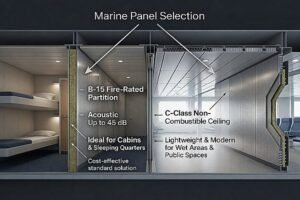
Choosing the right interior panel material is often the hardest part of marine outfitting, as it forces you to balance strict safety rules with budget constraints. You have to weigh the high fire resistance and acoustic performance of rock wool against the lightweight structural strength of aluminum honeycomb.
The selection between aluminum honeycomb and rock wool panels is determined by three critical factors: SOLAS fire rating requirements (A-Class vs. B-Class), the specific functional area of the ship (high-noise sleeping quarters vs. large-span public spaces), and the project budget. Rock wool is the industry standard for fire-rated partitions (B-15) and acoustic insulation (up to 45dB), making it essential for cabins. Aluminum honeycomb is preferred for non-combustible C-Class ceilings, wet areas, and lightweight high-speed craft interiors where weight reduction is prioritized over high acoustic damping.
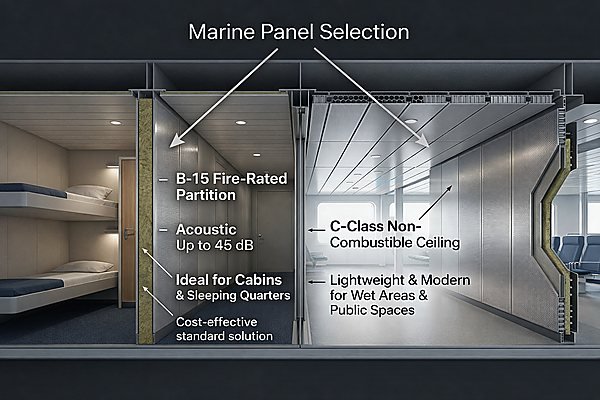
While raw material costs often drive initial procurement decisions, failing to account for the specific installation environments and regulatory limits of these materials can lead to costly compliance failures during inspection.
How Do the Weight and Structural Integrity of Aluminum Honeycomb Compare to Rock Wool Marine Panels?
Weight is a constant enemy in shipbuilding, but reducing weight cannot come at the cost of structural failure. When sourcing materials from markets like China or Vietnam, you must understand exactly how the physical composition of these panels affects the vessel's total deadweight and stability.
Aluminum honeycomb panels offer a superior strength-to-weight ratio, typically weighing between 5 to 8 kg/m², making them approximately 60% lighter than rock wool panels which range from 18 to 25 kg/m² depending on density (100-150 kg/m³). While honeycomb cores provide superior rigidity for large-span ceilings without sagging, rock wool cores provide the necessary mass and density to resist impact and dampen structural vibration in high-traffic corridors.
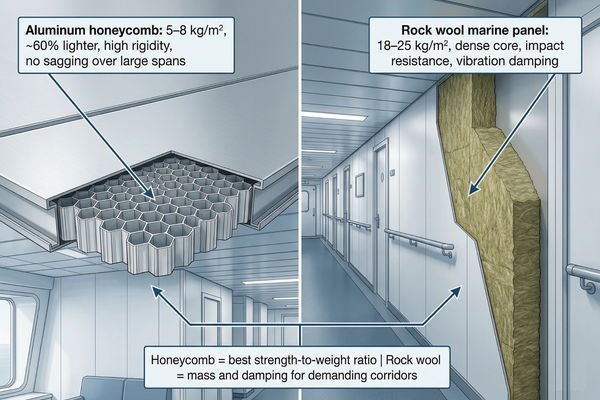
When we look deeper into the structural composition, the differences become stark. This impacts not just the ship's performance, but how your team handles the material during installation.
Analyzing the Strength-to-Weight Ratio of Aluminum Honeycomb
The aluminum honeycomb core is an engineering marvel borrowed from the aerospace industry. It consists of a hexagonal lattice structure sandwiched between two aluminum sheets. This geometry provides incredible rigidity. A standard 25mm thick honeycomb panel can span wider distances without sagging compared to a mineral wool panel. For large public rooms on a ship, such as dining halls or atriums, this rigidity allows for fewer support pillars and a cleaner aesthetic. From my experience in the factory, I have seen that honeycomb panels maintain their flatness perfectly even when manufactured in lengths up to 3000mm or more. This makes them excellent for ceiling systems where sagging is a common visual defect.
Evaluating the Density and Mass Impact of Rock Wool Cores
Rock wool, or mineral wool, relies on density for its performance. To achieve a standard B-15 fire rating, the core density usually needs to be between 120 kg/m³ and 150 kg/m³. This high density makes the panel heavy. If you are outfitting a 100-cabin accommodation block, the weight difference is massive. Using rock wool for 5,000 square meters of partitioning could add approximately 100 tons to the ship compared to honeycomb. However, this mass is not wasted. It gives the "feel" of a solid wall. When you knock on a high-density rock wool panel, it feels substantial, whereas honeycomb can sometimes sound hollow or "tinny" if not properly dampened.
| Feature | Aluminum Honeycomb Panel | Rock Wool (Mineral Wool) Panel |
|---|---|---|
| Typical Thickness | 10mm - 50mm | 25mm - 50mm |
| Core Density | ~30 - 50 kg/m³ | 120 - 150 kg/m³ |
| Approximate Weight (50mm) | 6 - 8 kg/m² | 20 - 24 kg/m² |
| Structural Rigidity | Very High (Excellent for ceilings) | Moderate (Requires steel profiles) |
| Impact Resistance | Low (Dents easily) | High (Absorbs impact) |
How Do SOLAS Fire Rating Requirements Restrict the Use of Aluminum Honeycomb and Rock Wool Panels?
Safety of Life at Sea (SOLAS) regulations are the non-negotiable bible of marine outfitting. You cannot choose a material simply because it is cheap or light; it must pass the fire test curve. Understanding how these materials react to fire determines where they can legally be installed.
Rock wool is the mandatory material for meeting strict SOLAS B-Class (B-15, B-30) and A-Class bulkhead insulation requirements because the basalt fiber core is non-combustible and withstands temperatures exceeding 1000°C. In contrast, standard aluminum honeycomb melts at approximately 660°C, limiting its use primarily to C-Class (non-fire-rated) divisions unless expensive ceramic infills or intumescent modifications are added to achieve a B-15 rating.
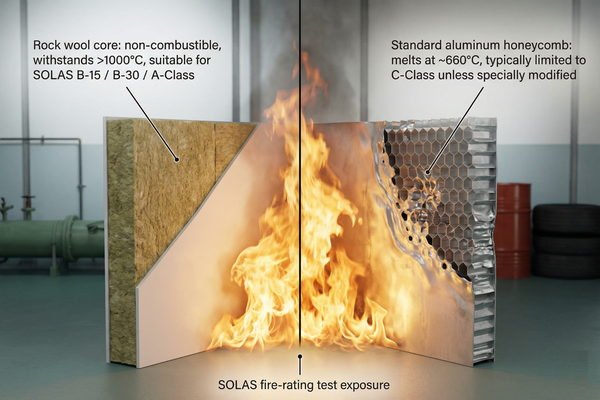
The fire rating is usually the first filter I apply when a client sends me a General Arrangement plan. If the drawing says "B-15," your options narrow immediately.
Achieving B-15 Compliance with Rock Wool Insulation
For partition walls in accommodation areas, B-15 is the standard requirement. This means the panel must prevent the passage of flame for 30 minutes and insulate against heat rise for 15 minutes. Rock wool is naturally suited for this. It is made from molten basalt rock spun into fibers. It does not burn. In my time at Magellan Marine, 90% of the partition walls we supplied were rock wool simply because certification is straightforward. Most classification societies (DNV, ABS, BV) have hundreds of approved certificates for rock wool setups. It is the safe, "no-headache" choice for meeting regulations.
Understanding the Fire Resistance Limitations of Aluminum Honeycomb
Aluminum conducts heat very quickly. In a fire test, an untreated aluminum honeycomb panel will transmit heat to the unexposed side rapidly, failing the insulation criteria of the B-Class test. Furthermore, at 660°C, aluminum melts. A standard fire test reaches 680°C in just 10 minutes. Therefore, standard honeycomb panels are typically restricted to C-Class divisions. C-Class means they are constructed of non-combustible materials but do not need to meet requirements for blocking smoke or flame or limiting temperature rise. If you absolutely need a honeycomb panel with a B-15 rating (perhaps for a luxury yacht where weight is critical), manufacturers must fill the honeycomb cells with insulation foam or ceramic fillers. This process increases the cost by 30% to 50% and makes the production lead time much longer.
| Fire Rating Class | Rock Wool Capability | Aluminum Honeycomb Capability |
|---|---|---|
| A-60 (High Risk) | Used as insulation on steel bulkheads | Not Suitable |
| B-15 (Standard Cabin) | Excellent (Standard Industry Solution) | Requires special modifications/fillers |
| B-0 (Corridor/Ceiling) | Excellent | Possible with modifications |
| C-Class (Low Risk) | Over-qualified | Ideal (Standard Application) |
| Melting Point | > 1000°C | ~ 660°C |
Why Do Specific Ship Zones Require Distinct Marine Panel Types for Acoustic and Moisture Control?
A ship is not a uniform box; it is a collection of distinct zones with different needs. A sleeping cabin has totally different requirements from a sanitary unit or a bridge deck. You must map the material properties to the human needs of that specific zone.
Rock wool panels are the mandatory choice for sleeping cabins and crew quarters due to their superior Sound Reduction Index (typically 40-45 dB), which ensures privacy and rest in noisy marine environments. Aluminum honeycomb is the superior choice for wet units, sanitary modules, and decorative public ceilings because it is impervious to moisture, will not absorb water or harbor mold, and allows for large, flat aesthetic spans without heavy suspension systems.
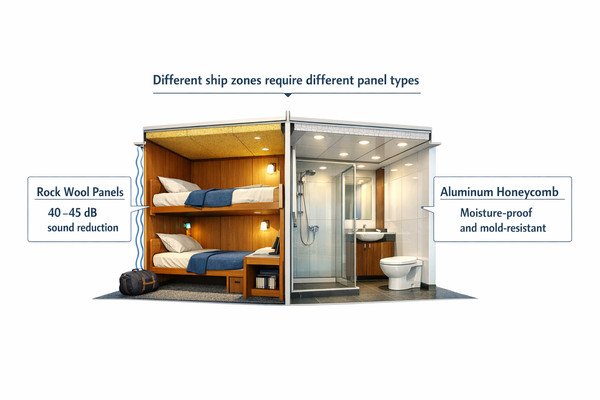
When I review a specification sheet, I look for the "Room Book." This document tells me exactly what happens in each room, which dictates the material choice.
Optimizing Acoustic Isolation in Sleeping Quarters
Noise control is a major comfort factor. The International Maritime Organization (IMO) sets limits on noise levels in cabins (usually around 55-60 dB). Rock wool is an excellent sound absorber. The fibrous structure traps sound waves. A standard 50mm rock wool sandwich panel can achieve a weighted sound reduction index (Rw)1 of 38 dB to 44 dB depending on the steel skin thickness. This is crucial for crew retention. If a crew member can hear their neighbor snoring or the engine humming through the wall, they will be fatigued. Honeycomb panels, being rigid and hollow, tend to transmit sound vibrations. A standard honeycomb panel might only achieve 28-30 dB. To fix this, you have to add heavy damping layers, which again, adds cost and weight.
Preventing Moisture Damage in Wet Units and Sanitary Modules
Water is the enemy of rock wool. If rock wool gets wet, it acts like a sponge. It loses its insulation value, becomes heavy, and can eventually cause the steel skin to rust from the inside out. I have seen projects where a pipe burst, and all the lower bulkhead panels had to be ripped out because the wool was soaked. Aluminum honeycomb is strictly mechanical; it does not absorb water. This makes it the perfect substrate for wet units (bathrooms) or galleys. Additionally, for public spaces like lobbies, honeycomb panels can be manufactured with a variety of decorative finishes—PVC laminate, stainless steel, or even wood veneer—without the risk of the surface peeling due to internal moisture buildup.
| Ship Zone | Recommended Material | Primary Reason |
|---|---|---|
| Passenger Cabins | Rock Wool | Acoustic Privacy (40+ dB) |
| Crew Cabins | Rock Wool | Acoustic Privacy & Fire Safety |
| Wet Units (WC/Shower) | Aluminum Honeycomb | Moisture Resistance2 |
| Public Ceilings | Aluminum Honeycomb | Low Weight & Large Span Rigidity |
| Wheelhouse/Bridge | Aluminum Honeycomb | Weight Saving (High Center of Gravity) |
How Do Aesthetic Finishing Options and Surface Durability Differ Between Aluminum Honeycomb and Rock Wool Panels?
In modern cruise and ferry interiors, visual appeal is just as important as technical compliance. The underlying core material dictates what kind of surface finish can be applied without risking delamination or surface rippling.
Aluminum honeycomb panels provide the superior flatness and rigidity required for high-end heavy finishes such as wood veneers, HPL (High-Pressure Laminate), and even thin stone veneers, ensuring a perfectly smooth appearance without warping. Rock wool panels, due to the compressibility of the fibrous core, are generally limited to flexible steel or PVC film finishes, as heavier rigid laminates can delaminate or show "orange peel" rippling effects if the bond is not perfectly uniform.
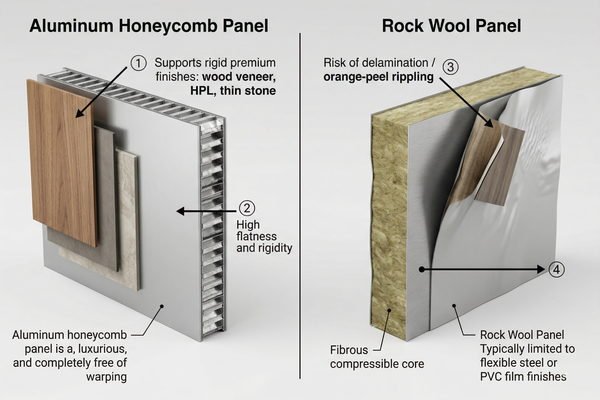
For procurement officers dealing with luxury passenger vessels, understanding this limitation is crucial to avoiding rejection during the final visual inspection by the shipowner.
Suitability for High-Pressure Laminates (HPL)3 and Veneers
When an interior designer specifies a luxury wood finish or a high-gloss HPL, the substrate must be absolutely stable. Aluminum honeycomb is chemically bonded to the skin, creating a composite that acts like a single solid plate. This allows it to carry heavy decorative layers (1.0mm to 3.0mm thick) without bowing. I have successfully used honeycomb panels as the base for marble-look ceramic veneers in VIP areas. The honeycomb structure supports the brittle veneer perfectly.
Surface Limitations of Rock Wool Panels
Rock wool is essentially packed cotton. Even at high densities (150 kg/m³), it has a slight "give." If you try to glue a rigid sheet of HPL to a rock wool core, the differential expansion between the rigid face and the soft core often leads to delamination bubbles over time, especially in humid marine environments. Therefore, rock wool panels are almost exclusively supplied with pre-coated steel sheets (PVC or PET film) or galvanized steel ready for painting. They are functional but lack the premium flatness required for high-end atriums or suites.
| Surface Requirement | Rock Wool Performance | Aluminum Honeycomb Performance |
|---|---|---|
| PVC / PET Film | Excellent (Standard) | Excellent |
| High-Pressure Laminate (HPL) | Poor (Risk of delamination) | Excellent (Standard) |
| Wood Veneer / Stone | Not Recommended | Excellent (Rigid support) |
| Surface Flatness | Good (Minor rippling possible) | Superior (Perfectly flat) |
| Impact Recovery | Good (Core absorbs shock) | Poor (Surface dents remain) |
What Are the Comparative Costs and Long-Term Value Implications of Sourcing Aluminum Honeycomb vs. Rock Wool Panels?
For a procurement officer, the unit price is important, but the "landed cost" and "installed cost" are what really matter. Sourcing from Asia offers savings, but the logistics of heavy materials can eat up your margin. You need to calculate the total cost of ownership.
Rock wool panels are the most cost-effective option in terms of raw material price, generally costing 30% to 50% less per square meter than aluminum honeycomb panels ($25-$45/m² vs. $50-$90/m²). However, for distant projects (e.g., shipping from China to Europe), the high weight of rock wool increases shipping costs and installation labor, whereas honeycomb's lightweight nature reduces freight bills and simplifies manual handling on board.

I often help clients run this calculation. Sometimes the cheaper panel is more expensive by the time it is installed on the ship.
Analyzing Material Unit Price and Manufacturing Costs
Production of rock wool panels is highly automated. A factory in Jiangsu, China, can churn out thousands of meters a day. The raw materials (steel coil and mineral wool) are abundant and cheap. You can expect to pay between $25 and $45 per square meter for a standard PVC-laminated rock wool panel. Aluminum honeycomb is more labor-intensive. The aluminum skins must be bonded to the honeycomb core with high-grade adhesives under heat and pressure. The aluminum itself is a globally traded commodity that is more expensive than steel. Consequently, honeycomb panels generally start at $50 per square meter and can go up to $90 or more for high-end finishes.
Calculating Logistics Efficiency and Installation Labor
Shipping is where the math gets interesting. A 40-foot container has a weight limit (usually around 26 tons). Rock wool is heavy. You might "weigh out" a container before you "cube out" (fill the space). This means you are shipping empty air but paying for a full container because you hit the weight limit. With honeycomb, the panels are so light that you will always fill the volume of the container completely. This reduces the shipping cost per square meter. Furthermore, on the shipyard site, two workers can easily carry a large honeycomb panel. A rock wool panel of the same size might require four workers or a mechanical lift. This speed in handling reduces the installation man-hours significantly.
| Cost Component | Rock Wool Panel | Aluminum Honeycomb Panel |
|---|---|---|
| Ex-Works Price (Est.) | $25 - $45 / m² (Low) | $50 - $90+ / m² (High) |
| Shipping Efficiency | Low (Limited by weight) | High (Limited by volume) |
| Handling Labor | High (Heavy, 20kg+/m²) | Low (Light, <8kg/m²) |
| Durability (Moisture) | Low (Risk of replacement) | High (Long lifespan) |
Conclusion
To select the correct marine panel, you must prioritize regulations first, then function, and finally cost. Use Rock Wool for sleeping cabins and fire-rated B-15 bulkheads where acoustics and safety are paramount. Use Aluminum Honeycomb for ceilings, wet areas, and weight-sensitive zones where moisture resistance and rigidity justify the higher price.
-
Learn what Rw ratings mean in practice and how 38–44 dB impacts noise transmission between cabins. ↩
-
Discover tested materials and methods to prevent water damage, rust, and delamination in sanitary modules. ↩
-
Find a technical guide with approved adhesives, surface-prep and installation tips to prevent HPL delamination in humid/marine settings. ↩