A stuck or slamming fire door during a port state control inspection causes immediate delays and creates tension with the shipyard. Proper maintenance of the self-closing device prevents these costly interruptions and ensures the safety of the crew on board.
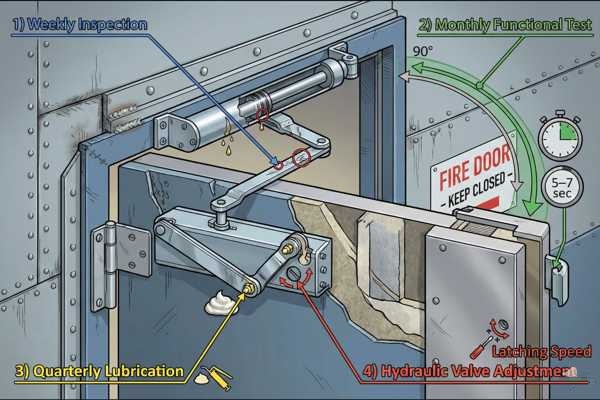
Maintenance of self-closing devices on marine fire doors involves a comprehensive regimen of weekly visual inspections for oil leaks and arm damage, monthly functional testing to ensure a 5 to 7-second closing time from 90 degrees, quarterly lubrication of arm linkages with lithium grease, and precise hydraulic valve adjustments to manage latching speed and overcome seal resistance.
Many people think a fire door is maintenance-free until it fails. I have seen new ships delayed because a $40 door closer failed to latch during the final sea trial. This small component controls the entire function of the fire barrier. If it does not close, the fire rating of the bulkhead means nothing. Regular care keeps the door compliant and saves money on expensive replacements.
What are the inspection schedules for marine fire door closers?
Ignoring regular checks leads to sudden mechanical failure and non-compliance with SOLAS regulations. A strict schedule catches small issues before they become safety hazards.
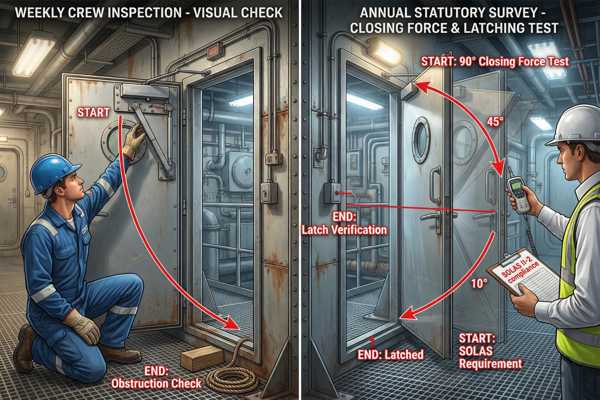
Inspection schedules for marine fire door closers are divided into weekly crew inspections for obvious physical damage or obstruction, and annual statutory surveys that test the full closing force and latching capability against SOLAS Chapter II-2 requirements to ensure the door closes from any angle.
Weekly visual checks for self-closing devices
Consistent monitoring is the first line of defense. I always advise ship crews to perform a "walk-by" check every week. You do not need tools for this. You just need eyes and a stopwatch. The crew must check if the arm is bent or if there is oil dripping from the main body. A bent arm changes the geometry of the force. This means the door will not close all the way.
Oil leakage is a major red flag. If you see oil on the door leaf or the floor, the internal seals are broken. The pressure will drop, and the door will slam. Check the hinge screws as well. Vibration from the ship engine loosens these screws over time. A loose body cannot transfer force to the door.
Annual statutory testing requirements for fire doors
Once a year, a deeper check is mandatory. This usually coincides with safety equipment surveys. During this test, you must open the door to fully 90 degrees and release it. The door must close completely and the latch bolt must engage the strike plate. It is not enough for the door to just touch the frame. It must latch.
You also need to test it from a small opening angle, like 15 degrees. Some closers work fine from wide open but fail to latch when opened slightly. This is a common failure point in inspections. If the door stops before latching, the closing force is too weak or the rubber seal is too stiff.
| Inspection Type | Frequency | Action Items | Success Criteria |
|---|---|---|---|
| Routine Check | Weekly | Visual check of arm, body, and oil leaks. | No physical damage, no oil on floor. |
| Functional Test | Monthly | Release door from 90°. | Closes in 5-10 seconds, latches fully. |
| Statutory Survey | Annual | Full range testing (90° and 15°). | Door overcomes seal resistance and latches every time. |
How to perform adjustment procedures for closing speed and latching action?
Incorrect speed settings cause the door to slam dangerously or fail to overcome the air pressure in the cabin. Adjusting the valves ensures safe and effective operation.
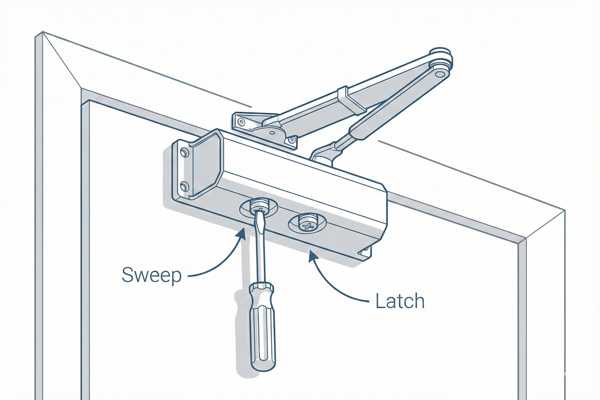
Adjustment procedures for closing speed and latching action require using a flathead screwdriver to turn the hydraulic valves; turning the 'Sweep' valve clockwise slows the main closing arc, while adjusting the 'Latch' valve controls the final 10 degrees of force to snap the latch bolt into the frame.
Adjusting the closing sweep speed valve
Most marine door closers have two main adjustment valves. They are usually marked "1" and "2" or "S" (Sweep) and "L" (Latch). The sweep valve controls the speed of the door from fully open down to about 10 or 15 degrees from closing. I recommend setting this so the door takes about 5 to 7 seconds to move from 90 degrees to the latching position.
If the door moves too fast, it can hurt a crew member during rough seas. To slow it down, turn the valve clockwise. Do this in small steps. I usually turn it 1/8 of a turn at a time. Then I test the door. If you turn it too much, the door will stop moving entirely. If the door is too slow, fire cannot be contained quickly. Turn it counter-clockwise to speed it up.
Setting the latching action for seal compression
The last few inches of travel are the hardest. The door must push against the rubber fire seal and the latch spring. The Latch valve controls this final "snap." This speed should be slightly faster than the sweep speed to give the door momentum.
If the door hits the frame and bounces back without latching, the speed is too high. If it stops just touching the seal, the speed is too low. You need to find the balance. On A-60 doors, the door leaf is heavy. It carries a lot of kinetic energy. You do not need much speed to latch it. For lighter B-15 cabin doors, you might need a stronger latching action to overcome the air pressure in the small room.
| Valve Name | Range of Motion | Function | Adjustment Direction (Clockwise) |
|---|---|---|---|
| Sweep (Speed) | 90° to 15° | Controls main closing time. | Slows down the door movement. |
| Latch (Snap) | 15° to 0° | Overcomes seal resistance. | Slows down the final snap. |
| Backcheck (Optional) | 70° to 90° | Prevents door from opening too fast. | Increases resistance to opening. |
What are the lubrication requirements and cleaning methods?
Salt air and humidity corrode the moving parts, causing friction that prevents the door from closing. Proper lubrication protects the mechanism and ensures smooth movement.
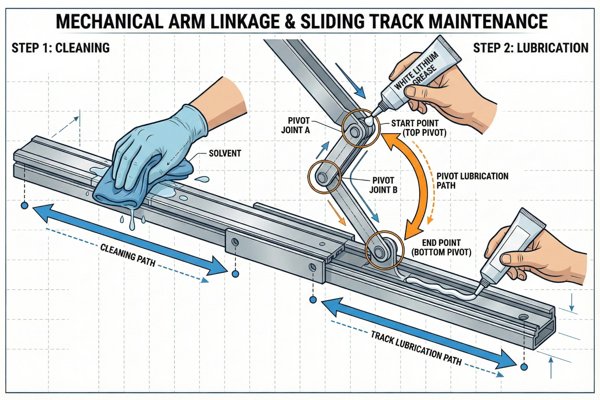
Lubrication requirements and cleaning methods involve wiping down the arm linkage and sliding track with a solvent to remove old grit, followed by applying white lithium grease or silicone lubricant to the pivot points and track every three months to prevent rust and friction.
Selecting the correct lubricant for marine environments
You cannot use just any oil on a ship. Standard WD-40 is good for cleaning, but it evaporates quickly. It does not provide long-term lubrication. For marine door closers, I always use White Lithium Grease or a thick silicone-based lubricant. These stay in place even when the temperature changes.
In the accommodation area, you also care about aesthetics. Black graphite grease looks dirty if it drips on a white marine panel. White lithium grease is clean and effective. It resists water and salt. You should apply a small amount to the hinge of the arm and the point where the arm connects to the body. If you have a slide-rail closer, apply a thin layer inside the track.
Cleaning arm linkages and sliding tracks
Dirt and dust stick to the old grease. Over time, this turns into a sticky paste that slows the door down. Before you add new grease, you must clean the old mess. I use a simple rag and a degreaser. Wipe the arm completely clean.
Pay attention to the slide track. If there is debris inside the track, the slider block will catch. This causes the door to "stutter" as it closes. I have seen many claims of "broken closers" that were just dirty tracks. A 5-minute cleaning job saves the cost of a new unit. Check for rust spots during cleaning. If you see rust, sand it off lightly before greasing.
| Lubricant Type | Best Use Case | Pros | Cons |
|---|---|---|---|
| White Lithium Grease | Pivot points, Arms | Water-resistant, visible, long-lasting. | Can attract dust over time. |
| Silicone Spray | Slide Tracks | Clean, non-sticky, dries dry. | Needs frequent re-application. |
| WD-40 (Standard) | Cleaning only | Removes rust and old grease. | Not a lubricant; evaporates too fast. |
How to troubleshoot common self-closing device failures?
When a door fails to operate, identifying the root cause quickly prevents safety violations. Logical troubleshooting isolates whether the issue is the hydraulic unit, the installation, or the environment.
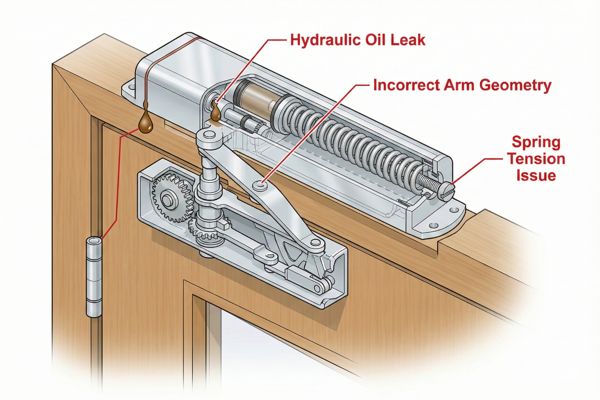
Troubleshooting common self-closing device failures involves checking for hydraulic oil leaks which indicate seal failure, verifying the arm geometry if the door has low power, and adjusting the spring tension if the door fails to latch against positive air pressure.
Diagnosing oil leakage in hydraulic door closers
The most common death of a door closer is a blown seal. You will see an oily stain running down the door or a puddle on the floor. Once the oil leaks out, the hydraulic control is gone. The door will slam shut like a mousetrap.
There is no fix for this on board. You cannot refill these units easily, and the seals are not replaceable spare parts. If you see oil, the unit is dead. You must replace it. The cause is often forcing the door shut manually. If a crew member forces the door closed faster than the fluid can move, the pressure blows the seal.
Fixing doors that slam shut or close too slowly
If the door slams but there is no oil leak, the valves are out of adjustment. Usually, the "Sweep" valve is too loose. Tighten it clockwise. If the door closes but then "bounces" at the end, the "Latch" valve is too tight or the arm is installed wrong.
Sometimes the door closes too slowly even with the valve fully open. This means the internal spring has lost tension. Some heavy-duty closers have a "Spring Power" nut at the end of the body. You can turn this to tighten the spring. If that does not work, the unit is worn out. Also, check the air pressure. If the AC system is pumping too much air into the cabin, the door cannot close against the wind. Open a window and test again.
| Symptom | Probable Cause | Recommended Fix |
|---|---|---|
| Door Slams | Leaking oil / Valve loose. | Check for leaks (replace if yes). Tighten Sweep valve. |
| Door Won't Latch | Low speed / Air pressure / Dirty track. | Increase Latch speed. Clean track. Check AC pressure. |
| Door Stiff to Open | Spring too tight / Backcheck active. | Loosen spring power. Adjust Backcheck valve. |
What are the criteria for replacing worn self-closing units?
Repair is not always possible or cost-effective. Knowing exactly when to discard a unit ensures you do not waste time on broken equipment and maintains compliance with safety standards.
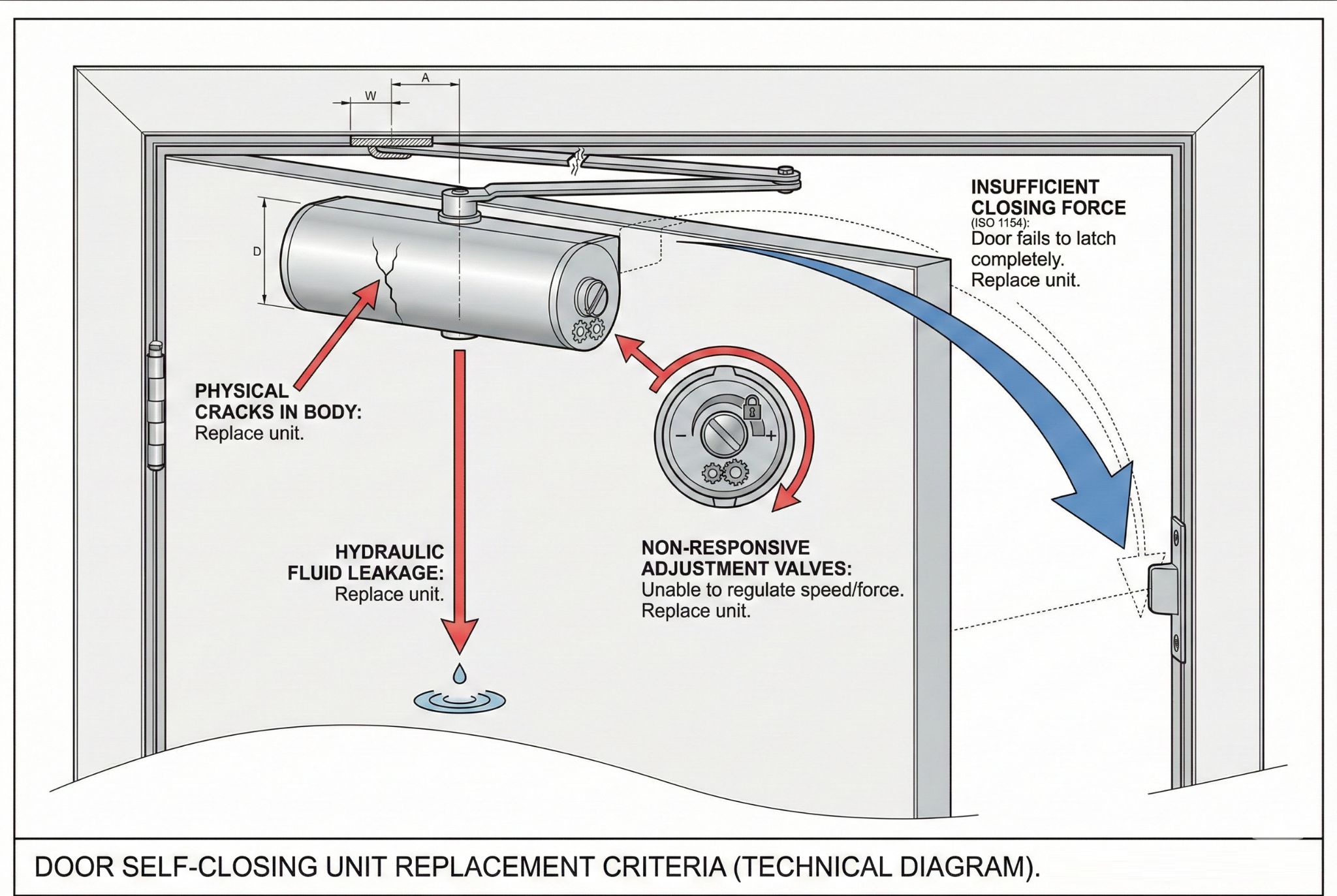
Criteria for replacing worn self-closing units include any visible hydraulic fluid leakage, physical cracks in the body or arm, inability to meet the minimum closing force of ISO 1154 standards (usually closing from 2 degrees), or when adjustment valves no longer alter the door's speed.
Identifying physical damage requiring immediate replacement
You must replace the unit immediately if the body is cracked. This happens in heavy seas if the door swings violently. Also, look at the pinion (the square part where the arm attaches). If the teeth are stripped, the arm will slip.
If the adjustment valves spin freely without stopping, the internal threads are stripped. You can no longer control the door. This unit is scrap. The cost of a standard marine door closer is between $30 and $80 USD depending on the brand. It is not worth risking a $500 fine or a detention for a cheap part. I always suggest keeping 5% spare stock on the ship.
Measuring opening force limits per ISO standards
According to ISO 11541 and fire safety codes, a fire door must be usable by everyone. The force required to open the door should not exceed certain limits, usually around 80N to 130N at the handle. If the closer is old, the internal friction increases.
You can test this with a simple force gauge. If you have to pull with both hands to open a cabin door, the closer is seized. This is a safety risk during an evacuation. Even if it closes the door, if it traps people inside because it is too hard to open, it fails the test.
| Condition | Repairable? | Estimated Cost (USD) | Decision |
|---|---|---|---|
| Oil Leak | No | $30 - $80 | Replace immediately. |
| Bent Arm | Yes | $10 - $15 | Replace arm only. |
| Loose Screws | Yes | $0 | Tighten and use Threadlocker. |
| Seized Spring | No | $30 - $80 | Replace immediately. |
Conclusion
Maintaining marine fire door closers requires weekly visual checks, quarterly lubrication with lithium grease, and precise valve adjustments. Promptly replacing leaking or seized units ensures SOLAS compliance, prevents inspection delays, and guarantees crew safety during fire emergencies.
-
Exploring ISO 1154 will provide insights into safety standards for fire doors, essential for ensuring accessibility and safety in emergencies. ↩