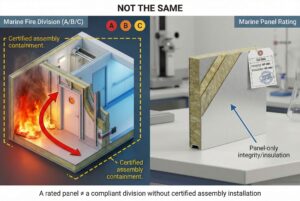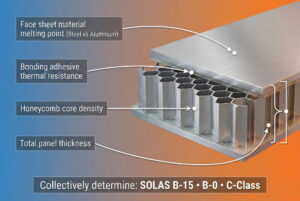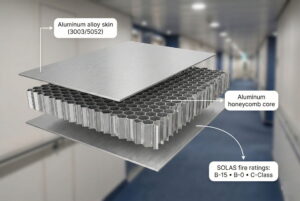
Choosing the wrong marine fire door can compromise safety, fail inspections, and cost you thousands in retrofitting. The consequences of mismatched specifications in critical bulkheads are severe.
Marine fire doors are selected based on three primary factors: fire integrity rating (A-Class: A-60, A-30, A-15, A-0 for high-risk zones like engine rooms and main vertical zones; B-Class: B-15, B-0 for accommodation areas; C-Class: for non-combustible areas), compartment location per SOLAS requirements (machinery spaces require A-60, galley boundaries need A-0 or B-15, cabins use B-0), and operational environment (watertight zones need combined fire/watertight doors, weather-exposed areas require marine-grade corrosion protection). Each ship zone has mandatory minimum ratings dictated by classification societies (DNV, ABS, LR, BV, CCS) and flag state regulations.
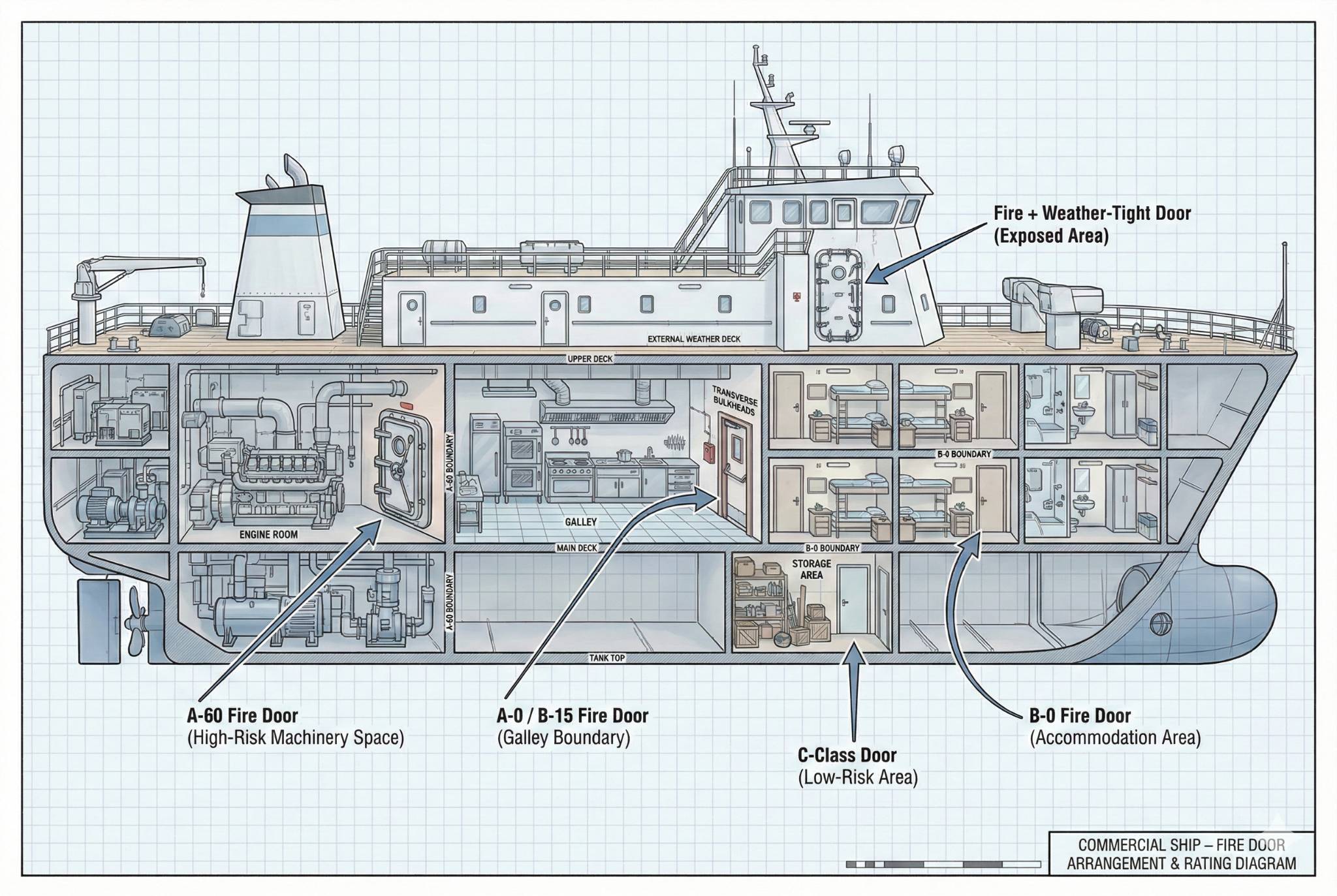
Now, let me walk you through the exact process I use when helping clients specify marine fire doors. This isn't theoretical—these are the decisions that determine whether your ship passes PSC inspections or faces costly delays.
What are the mandatory fire integrity classifications for marine fire doors?
Understanding fire door classifications feels overwhelming when you first look at SOLAS Chapter II-2. The alphabet soup of ratings seems designed to confuse rather than clarify.
Marine fire doors under SOLAS are classified into A-Class doors (A-60, A-30, A-15, A-0) providing full insulation and integrity for 60, 30, 15, or 0 minutes respectively, used in high-risk boundaries, and B-Class doors (B-15, B-0) offering integrity without full insulation for 15 or 0 minutes, used in lower-risk accommodation divisions. A-Class doors prevent both flame passage and heat transfer to ignition levels, while B-Class doors prevent only flame and smoke passage, allowing heat transmission.
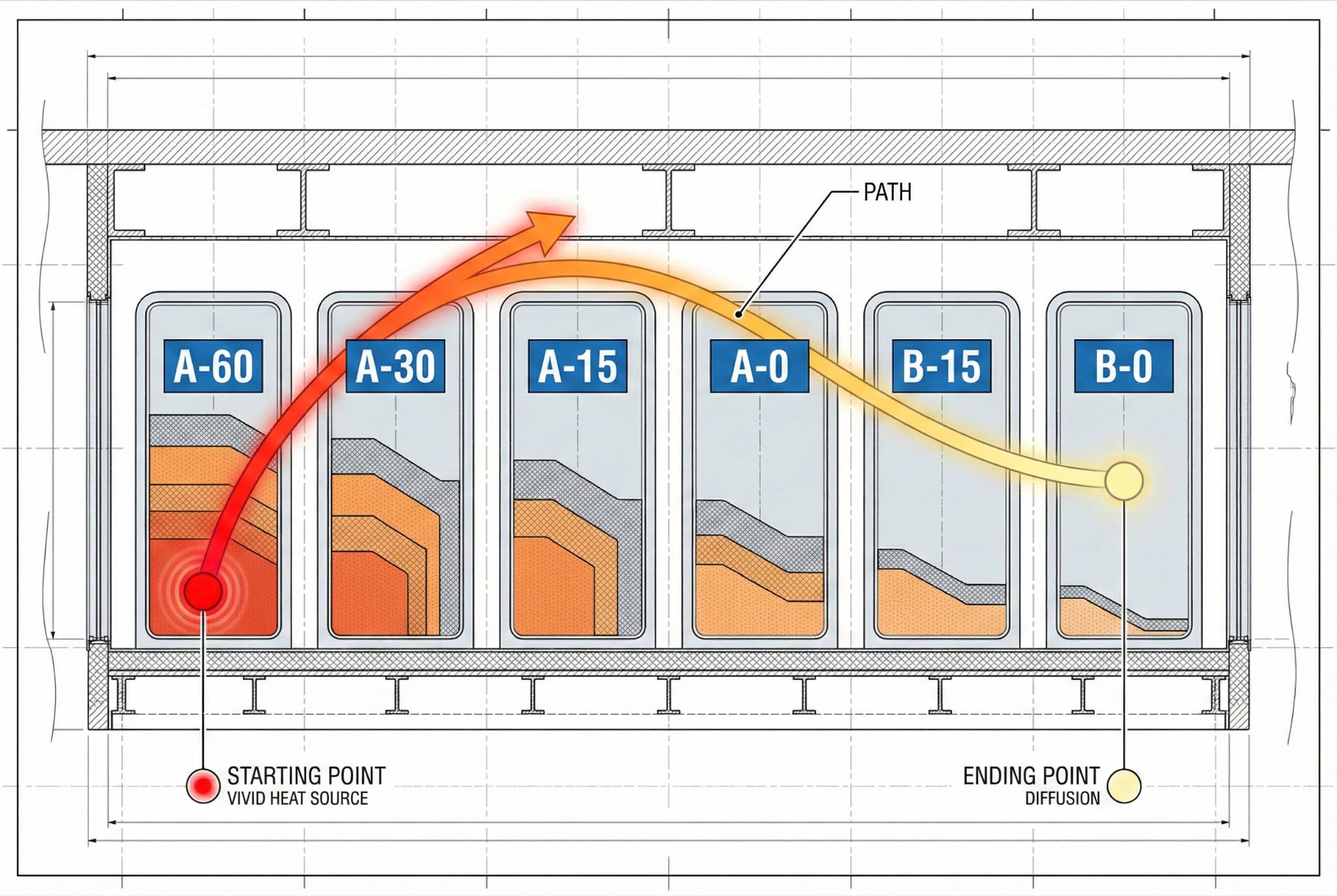
A-Class Fire Doors: Full Integrity and Insulation Requirements
A-Class doors represent the highest fire protection standard. According to IMO Resolution MSC.307(88), an A-60 door must withstand the standard fire test curve while maintaining average unexposed surface temperature below 140°C above ambient and any single point below 180°C above ambient for the full 60-minute period.
The construction typically involves:
- Steel frame and leaf: minimum 3mm thickness per SOLAS requirements
- Core insulation: ceramic fiber blanket (1260°C rated) or rockwool (minimum 120 kg/m³ density)
- Intumescent seals: expanding 10-15 times original size at 150-200°C
- Fire-rated glass (if present): wire mesh or ceramic glass rated to match door classification
During my time at the shipyard, I witnessed an A-30 door failure during testing. The manufacturer had used insufficient insulation density (80 kg/m³ instead of 120 kg/m³), and the unexposed surface exceeded temperature limits at 23 minutes. The entire batch—34 doors—had to be scrapped. That mistake cost the supplier approximately $68,000 in materials alone, not counting the 6-week delivery delay.
| A-Class Rating | Fire Integrity Duration | Insulation Requirement | Typical Applications | Approximate Price Range (FOB China) |
|---|---|---|---|---|
| A-60 | 60 minutes | Full (temperature-limited) | Main vertical zone boundaries, machinery space boundaries | $800-1,500 per door |
| A-30 | 30 minutes | Full (temperature-limited) | Control station boundaries, service space boundaries | $600-1,100 per door |
| A-15 | 15 minutes | Full (temperature-limited) | Corridors in accommodation, lesser machinery boundaries | $500-900 per door |
| A-0 | Continuous | Full (temperature-limited) | Galley boundaries, stairway enclosures | $450-800 per door |
B-Class Fire Doors: Integrity Without Full Insulation
B-Class doors provide flame and smoke barrier without the stringent temperature rise limitations. According to SOLAS regulations, B-Class doors must prevent flame passage and maintain structural integrity, but the unexposed surface can reach temperatures significantly higher than A-Class limits.
The construction differs significantly:
- Thinner steel construction: often 2mm frame and leaf
- Minimal or no core insulation: some manufacturers use honeycomb steel or lightweight mineral wool
- Basic smoke seals: non-intumescent rubber or neoprene
- Standard toughened glass allowed: 6mm minimum thickness
B-15 doors must maintain integrity for 15 minutes under standard fire test, while B-0 doors must be constructed of non-combustible materials but have no time-rating requirement. I've seen procurement officers mistakenly specify B-15 doors where B-0 was sufficient, unnecessarily increasing costs by 30-40%.
| B-Class Rating | Fire Integrity Duration | Insulation Requirement | Typical Applications | Approximate Price Range (FOB China) |
|---|---|---|---|---|
| B-15 | 15 minutes | None (integrity only) | Cabin to cabin boundaries in accommodation | $300-550 per door |
| B-0 | Continuous | None (non-combustible construction) | Cabin to corridor boundaries, internal cabin divisions | $250-450 per door |
Key Certification Bodies and Their Testing Standards
Every marine fire door requires type approval from recognized classification societies. The testing methodologies vary slightly, but all reference ISO 834-1 fire curve and IMO Resolution A.754(18) for test procedures.
Major classification societies include:
- DNV (Det Norske Veritas): Primarily serves Norwegian and European fleets, requires testing per EN 1634-1 plus SOLAS overlay
- ABS (American Bureau of Shipping): Dominates US-flagged vessels, references ASTM E152 plus IMO requirements
- Lloyd's Register (LR): Traditional British standard, often specifies BS 476 Part 22 equivalence
- Bureau Veritas (BV): French classification, common in African and Middle Eastern markets
- CCS (China Classification Society): Required for Chinese-flagged vessels, follows GB/T standards harmonized with IMO
I recommend always asking suppliers for their complete portfolio of approvals. A manufacturer with only one society's approval limits your flexibility. Quality suppliers maintain certifications from at least three major societies, though this comes at a cost—certification testing ranges from $15,000-30,000 per door design per society.
How does ship compartment location determine fire door requirements?
SOLAS Chapter II-2 divides ships into fire zones with specific separation requirements. Misunderstanding these zones causes 60% of the specification errors I see from new procurement officers.
Fire door requirements are dictated by SOLAS compartment classifications: machinery spaces (Category A) require A-60 boundaries to accommodation and control stations; main vertical zones must be separated by A-60 or A-30 divisions; accommodation spaces need B-15 between cabins and B-0 to corridors; galley boundaries require minimum A-0 to accommodation; stairway enclosures need A-0 boundaries throughout; and cargo holds require A-60 separation from accommodation and machinery spaces. These requirements are mandatory minimums—flag states and owners may impose stricter standards.
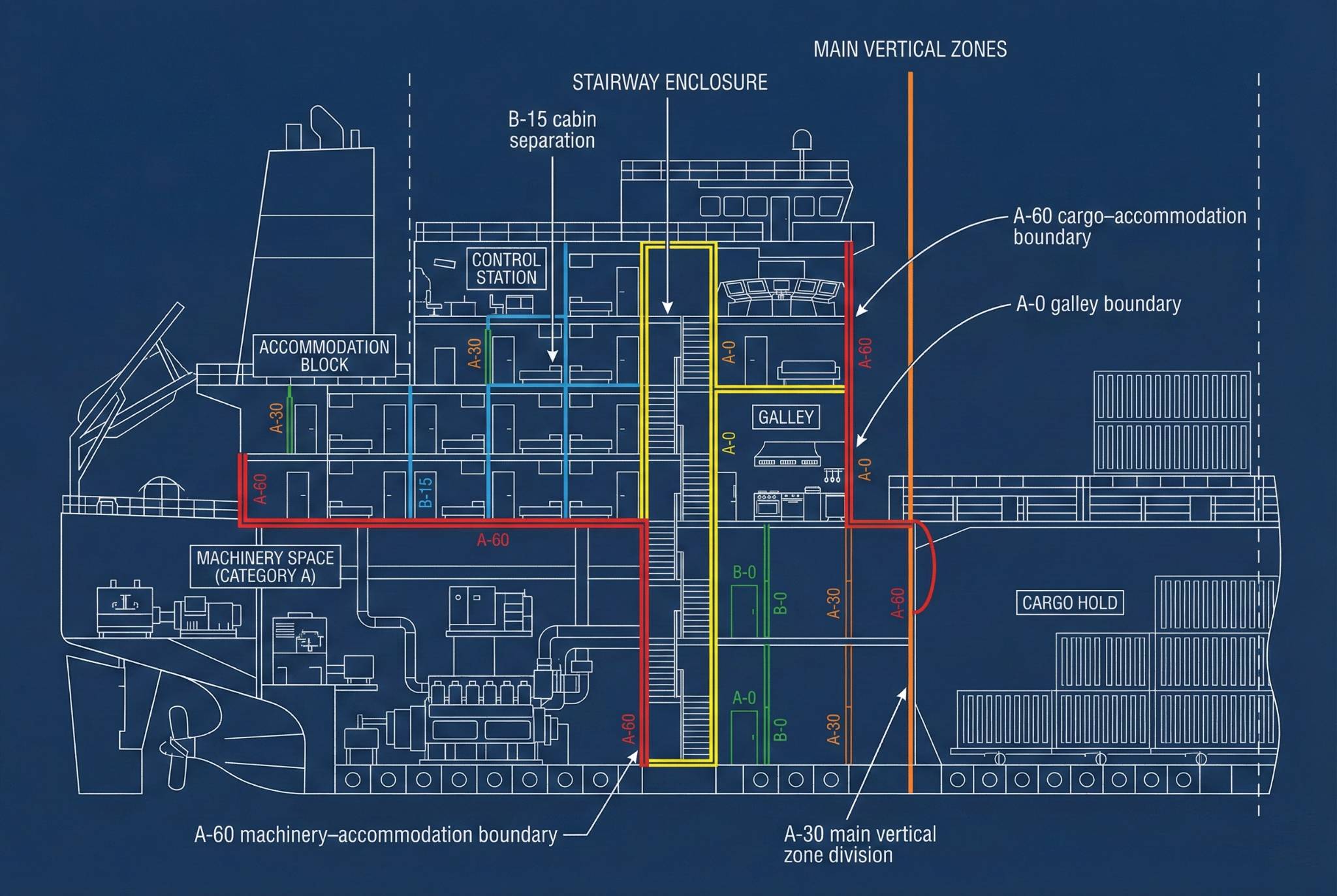
Machinery Space Boundaries: The Highest Risk Category
Machinery spaces containing oil-fired boilers, oil fuel units, diesel engines, or gas turbines are classified as Category A machinery spaces. These represent the highest fire risk aboard any vessel due to fuel, high temperatures, and ignition sources.
SOLAS mandates A-60 fire doors for all boundaries between Category A machinery spaces and:
- Accommodation spaces
- Service spaces
- Control stations
- Main vertical zone divisions
During a project for a 12,000 DWT cargo vessel, the shipyard initially specified A-30 doors for the engine room to workshop boundary. I had to escalate this to the technical director—the workshop contained welding equipment and fuel storage, making it a service space requiring A-60 separation per SOLAS II-2/Regulation 91. The specification change added $8,400 to the door package (12 doors × $700 difference), but prevented certain PSC detention.
For watertight boundaries in machinery spaces, you need combined fire/watertight doors. These integrate:
- Fire rating per location requirements (typically A-60)
- Watertight integrity per SOLAS Chapter II-1 (typically WT30 or WT50)
- Hydraulic or manual quick-acting closure mechanisms
- Remote closure capability from bridge (per SOLAS requirement)
| Machinery Boundary Type | Required Fire Rating | Additional Requirements | Typical Door Cost (Combined Rating) |
|---|---|---|---|
| Engine room to accommodation | A-60 | Self-closing, normally closed | $850-1,600 |
| Engine room to main deck (WT boundary) | A-60 + Watertight | Quick-acting closure, remote operation | $2,800-4,500 |
| Engine room to workshop/stores | A-60 | Self-closing, hold-back with auto-release | $950-1,700 |
| Boiler room to fuel oil tank space | A-60 | Gastight seals, pressure-rated | $1,200-2,000 |
Main Vertical Zone Separations: Containment Strategy
Ships over certain sizes must be divided into main vertical zones by A-Class divisions that extend from deck to deck and to shell or other boundaries. These zones limit fire spread horizontally through the vessel.
The fire doors in main vertical zone boundaries require:
- Minimum A-60 or A-30 rating (depends on ship size and passenger certificate)
- Self-closing devices with hold-back and automatic release
- Remote closure from bridge for certain locations
- Smoke-tight construction throughout
I worked with a ferry operator who faced a devastating specification error. Their newbuild had main vertical zone doors specified as A-30, but their passenger certificate required A-60 per SOLAS II-2/Regulation 9.2.2.3. The classification society caught this during final survey. Replacing 18 doors cost €48,000 and delayed delivery by four weeks. The penalty clauses exceeded €120,000.
Accommodation Area Internal Boundaries: Balancing Safety and Cost
Accommodation spaces have tiered requirements based on corridor relationships and cabin adjacency:
Cabin to cabin boundaries: Require B-15 divisions and doors minimum per SOLAS II-2/Regulation 9.2.2. However, many classification societies and flag states interpret continuous B-Class bulkheads as requiring B-15 doors only where required fire integrity needs to be maintained through the door opening.
Cabin to corridor boundaries: Require B-0 doors minimum, though many owners specify B-15 for enhanced protection. The cost difference is typically $50-100 per door—worthwhile for passenger vessels, often excessive for cargo ship accommodation.
Special accommodation spaces: Spaces like cinemas, casinos, medical facilities, and large public rooms often trigger A-Class requirements even within accommodation zones.
| Accommodation Boundary Type | SOLAS Minimum Requirement | Common Upgraded Specification | Cost Impact of Upgrade |
|---|---|---|---|
| Cabin to cabin | B-15 | B-15 (no upgrade common) | N/A |
| Cabin to corridor | B-0 | B-15 | +$50-100 per door |
| Public space to corridor | A-0 | A-15 | +$200-300 per door |
| Medical facility boundary | A-0 | A-15 or A-30 | +$200-500 per door |
Galley and Service Space Boundaries: Hidden Complexity
Galleys present unique challenges because they combine high fire risk (cooking equipment, fat fires) with constant personnel traffic. SOLAS requirements vary based on galley size and cooking equipment fuel:
- Gas-fired galleys: Require A-0 boundaries to accommodation and B-15 to corridors minimum
- Electric galleys: Often permitted B-15 boundaries, though many owners specify A-0
- Large galleys (over 4kW cooking equipment): Typically require A-0 regardless of fuel type
Service spaces containing combustible stores, workshops, or flammable liquid stores require A-60 boundaries to accommodation per SOLAS II-2/Regulation 9.2.4.2. I've seen procurement teams specify A-0 doors for paint lockers based on the "service space" label without checking the flammability provisions—this creates a serious non-compliance.
Storage spaces for non-combustible stores (dry provision stores, linen stores without excess packing material) can typically use A-0 boundaries, though the authority having jurisdiction often requires case-by-case evaluation.
Stairway and Lift Trunk Enclosures: Vertical Fire Spread Prevention
Vertical fire spread through stairways and lift trunks is one of the most dangerous scenarios aboard ships. SOLAS mandates complete enclosure of stairways and lift trunks with A-Class divisions.
Stairway doors require:
- Minimum A-0 rating throughout the stairway enclosure
- Self-closing devices (no hold-back mechanisms allowed)
- Opening in direction of escape at critical locations
- Vision panels with A-rated fire glass
For passenger ships with more than 36 passengers, stairways within main vertical zones require A-60 or A-30 protection per SOLAS II-2/Regulation 9.2.2.5. The doors accessing these protected stairways must match the enclosure rating.
During a survey inspection I attended, the inspector rejected 6 stairway doors that had been fitted with electromagnetic hold-back devices. SOLAS prohibits hold-open devices on stairway enclosure doors due to the critical escape function. The ship was detained for 32 hours while mechanical self-closers were installed.
What environmental factors affect marine fire door selection?
Fire rating addresses only one aspect of marine door performance. The harsh marine environment imposes additional requirements that many land-based fire door manufacturers fail to understand.
Environmental factors for marine fire door selection include corrosion exposure (weather deck doors need marine-grade 316L stainless steel or hot-dip galvanized steel with 80+ micron coating; internal accommodation uses mild steel with 60-80 micron powder coating), watertight requirements (combined fire/watertight doors for areas below subdivision loadline or weather-exposed locations need WT30/WT50 pressure ratings tested per IMO Resolution MSC.380(94)), humidity and temperature extremes (engine room doors must function at 45-50°C ambient with 90%+ humidity; refrigerated space boundaries need thermal break construction), blast resistance (LNG carriers and offshore platforms require blast-rated doors tested per ISO 13702), and operational frequency (high-traffic doors need heavy-duty hinges rated for 100,000+ cycles and hold-back devices with automatic release).
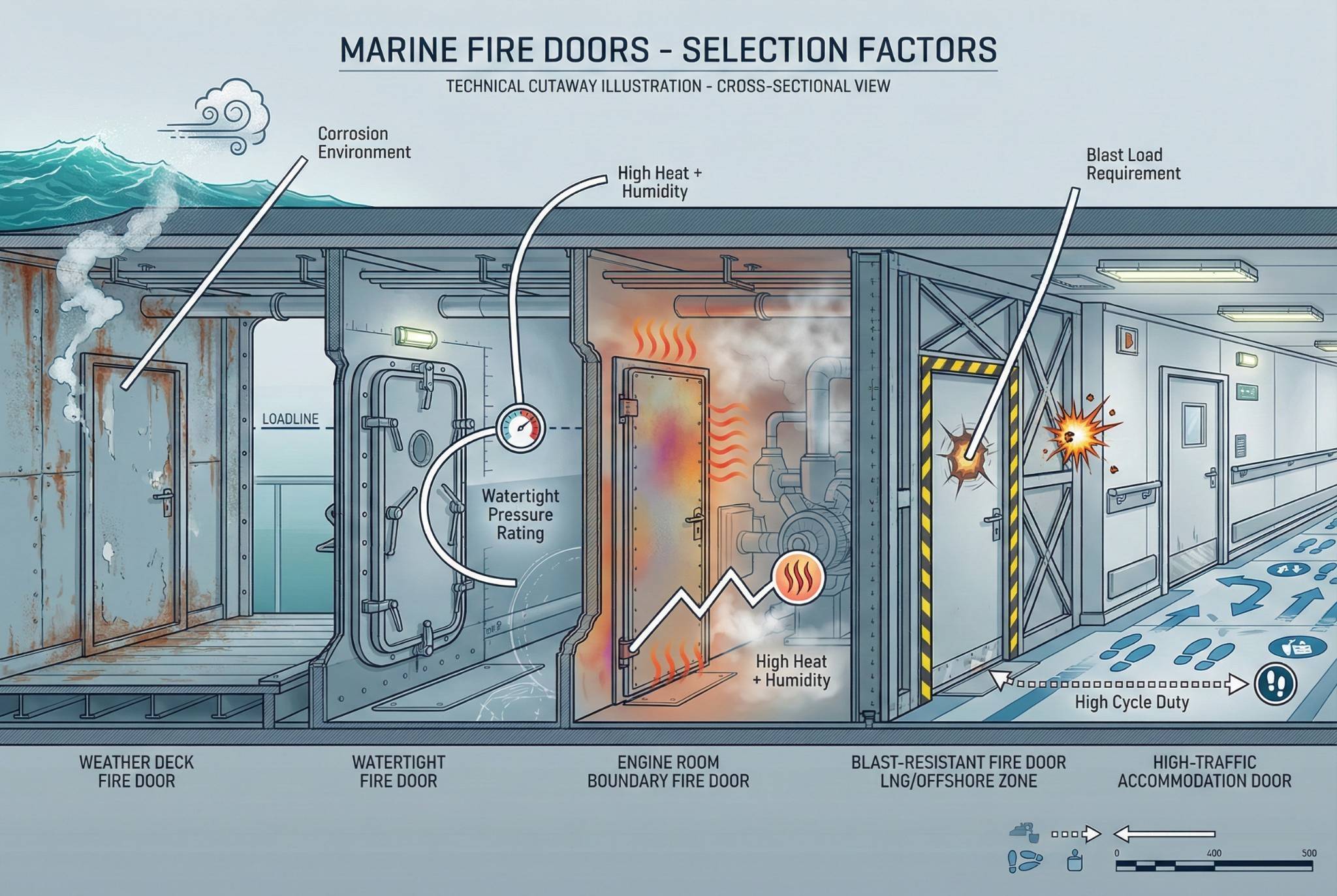
Corrosion Resistance2: Material Selection and Coating Systems
Corrosion represents the primary failure mode for marine fire doors outside actual fire events. I've inspected 8-year-old vessels where weather deck fire doors had corroded to 40% loss of structural integrity, completely negating their fire rating.
Material and coating options include:
Mild steel with powder coating: The most economical option for internal accommodation spaces. Requires 60-80 micron powder coat thickness per ISO 12944-53. Expected service life: 8-12 years in accommodation, 3-5 years in machinery spaces, unsuitable for weather exposure.
Hot-dip galvanized mild steel: Standard for weather-exposed and machinery space doors. Requires minimum 80 micron zinc coating per ISO 1461. Can be powder coated over galvanizing for aesthetic finish. Expected service life: 12-18 years in machinery spaces, 15-25 years on weather decks.
316L stainless steel: Premium option for chemical tankers, severe corrosion environments, and prestige passenger vessels. No coating required. Expected service life: 25+ years in all environments. Cost premium: 180-250% over galvanized steel.
I specify coating systems based on this decision matrix:
| Location Category | Corrosion Risk Level | Recommended Material | Coating Requirement | Expected Lifecycle Cost (per door, 20-year horizon) |
|---|---|---|---|---|
| Internal accommodation | Low | Mild steel | 60-80μm powder coat | $650 initial + $0 maintenance |
| Engine room, internal machinery | High (heat + humidity) | Hot-dip galvanized steel | 80μm zinc + optional powder topcoat | $850 initial + $200 maintenance |
| Weather deck, exposed | Very High (salt spray) | Hot-dip galvanized steel or 316L SS | 100μm zinc minimum, or bare SS | $1,100 initial + $400 maintenance (galv) / $2,200 initial + $0 maintenance (SS) |
| Chemical tanker, cargo area | Extreme (chemical exposure) | 316L stainless steel | Bare, no coating | $2,200 initial + $0 maintenance |
Watertight Integration: Combined Fire and Watertight Doors
Any fire door located below the bulkhead deck on the subdivision loadline, or in weather-exposed locations where water ingress is possible, requires watertight integrity in addition to fire rating.
Combined fire/watertight doors must meet:
- Fire integrity: Per A-Class rating (typically A-60 for machinery boundaries)
- Watertight integrity: Tested per IMO Resolution MSC.380(94) to specified head pressure
- Pressure ratings: WT30 (3.0 meters head), WT50 (5.0 meters head), or higher based on location
- Closure mechanism: Quick-acting type operable from both sides, closeable within 90 seconds per SOLAS requirement
- Remote closure: From navigation bridge for doors in main transverse watertight bulkheads
The manufacturing complexity increases substantially. A standard A-60 door uses compressed ceramic fiber or rockwool core. A combined A-60/WT30 door requires:
- Reinforced steel frame: 8-12mm thickness vs. 3-4mm for fire-only
- Compression gaskets: Multiple sealing stages with rubber and metal components
- Securing mechanism: 6-12 dogs (depending on door size) with cam action
- Drainage system: Weep holes with fire-resistant plugs
- Hydraulic or manual operation: With pressure equalization valve
Cost comparison I compiled from recent projects:
- Standard A-60 door (850mm × 2000mm): $950-1,400 FOB China
- Combined A-60/WT30 door (same size): $2,600-3,800 FOB China
- Combined A-60/WT50 door (same size): $3,200-4,600 FOB China
A critical specification error I encountered: A shipyard specified combined WT/fire doors for an engine room boundary, but used standard fire door hinges rather than watertight-type hinges with extended pins and sealed bearings. During watertight testing at 4.5 meters head pressure, water penetrated through the hinge barrels. All 8 doors required hinge replacement, costing $6,400 in parts plus 12 days labor.
Temperature and Humidity Extremes: Operational Reliability
Machinery space doors operate in environments reaching 45-50°C with relative humidity exceeding 90%. Refrigerated compartment boundaries face the opposite challenge—maintaining fire integrity across extreme temperature differentials.
High-temperature environments require:
- Hardware selection: Stainless steel hinges and closers rated to 60°C continuous operation
- Seal materials: Silicone or EPDM intumescent seals rather than PVC (which degrades above 40°C)
- Coating durability: Powder coats must be cured at temperatures ensuring no softening at operational temperature
- Closer adjustment: Hydraulic door closers need temperature-compensated hydraulic fluid (ISO VG 22 low-temperature grade)
I documented a case where a supplier provided door closers with standard hydraulic fluid. In the engine room environment (48°C ambient), the fluid viscosity dropped, and doors began slamming shut with dangerous force. The crew wedged 12 doors open, creating major fire safety violations. Replacing all closers with high-temperature units cost $3,800.
Low-temperature boundaries (refrigerated cargo spaces, provision stores) require:
- Thermal break construction: Insulated frame sections to prevent condensation and frost bridging
- Cold-rated seals: Neoprene or specialized cold-temperature compounds that remain flexible to -30°C
- Heated frames: Some designs incorporate low-voltage heating elements in frames to prevent ice formation
- Corrosion-resistant materials: Stainless steel preferred, as condensation accelerates corrosion of mild steel
| Environment Type | Temperature Range | Humidity Range | Critical Specification Requirements | Cost Impact vs. Standard |
|---|---|---|---|---|
| Standard accommodation | 18-24°C | 40-60% RH | Standard materials and hardware | Baseline |
| Machinery spaces | 35-50°C | 80-95% RH | High-temp seals, SS hardware, enhanced coating | +15-25% |
| Refrigerated boundaries | -25 to +5°C | Variable | Thermal break, cold-rated seals, condensation management | +30-45% |
| Tropical external | 30-45°C (surface temp) | 70-95% RH + salt spray | Enhanced galvanizing, UV-stable coatings, SS hardware | +20-35% |
Blast Resistance: Offshore and LNG Applications
LNG carriers, offshore platforms, and vessels operating in high-risk areas require blast-resistant fire doors for critical boundaries. These doors must maintain fire integrity after withstanding specified overpressure events.
Blast ratings are typically specified as:
- Low blast: 0.5-1.0 bar overpressure, 50-100 millisecond duration
- Medium blast: 1.0-2.0 bar overpressure, 100-200 millisecond duration
- High blast: 2.0+ bar overpressure, 200+ millisecond duration
Blast-rated door construction includes:
- Reinforced frame: Box-section steel frame, 10-15mm wall thickness, fully welded corners
- Blast-resistant core: Structural steel ribs or honeycomb, not just insulation
- Enhanced fastening: Through-bolted frame-to-bulkhead connection rather than welded flanges
- Pressure equalization: Venting systems that don't compromise fire rating
- Hardware protection: Recessed handles and closing mechanisms to prevent blast damage
Testing per ISO 13702 or API RP 2FB costs $45,000-80,000 per door design, and only a handful of manufacturers worldwide maintain these certifications. Blast-rated fire doors for offshore applications typically cost $8,000-15,000 per unit, compared to $800-1,500 for equivalent non-blast-rated marine fire doors.
I consulted on an FPSO project where the client attempted to source standard marine fire doors for blast zone boundaries to reduce costs. The classification society (DNV) rejected this during design review, citing NORSOK S-001 requirements for blast-rated barriers. The specification change increased the door package cost from $124,000 to $387,000—the project nearly canceled over this budget impact.
Operational Frequency and Hardware Durability
High-traffic doors in accommodation areas, galley access, and crew passage routes experience 50-200 opening cycles per day. Standard marine fire door hardware is rated for 10,000-25,000 cycles, providing only 3-5 years service life in high-traffic applications.
For high-frequency locations, specify:
Heavy-duty hinges: Ball-bearing or roller-bearing hinges rated for 100,000+ cycles, with sealed bearings to exclude contamination. Cost premium: $80-150 per door over standard hinges.
Commercial-grade closers: Hydraulic door closers with replaceable hydraulic cartridges, adjustable closing speed and latching force, and 100,000+ cycle rating. Brands like Geze, Dorma, or equivalent. Cost premium: $120-200 per door over standard marine closers.
Hold-back devices with automatic release: Electromagnetic or fusible link hold-open devices that release on fire alarm or power failure. Essential for high-traffic doors to prevent crew from defeating self-closing function. Cost: $180-350 per door including power supply and integration.
Threshold protection: Stainless steel or aluminum threshold guards to prevent wear of intumescent threshold seals. Cost: $40-80 per door.
I tracked hardware failure rates across a 180-cabin ferry over 5 years:
| Hardware Component | Standard Marine Grade Failure Rate | Heavy-Duty Specification Failure Rate | Lifecycle Cost Difference (per door, 10-year horizon) |
|---|---|---|---|
| Hinges | 38% required replacement (Year 3-5) | 4% required replacement (Year 8-10) | Standard: $620 total / Heavy-duty: $730 total (heavy-duty saves $90 in lifecycle) |
| Door closers | 61% required replacement or rebuild (Year 2-4) | 12% required replacement (Year 6-9) | Standard: $890 total / Heavy-duty: $710 total (heavy-duty saves $180 in lifecycle) |
| Latch mechanisms | 29% required adjustment or replacement (Year 3-5) | 8% required adjustment (Year 7-10) | Standard: $340 total / Heavy-duty: $380 total (heavy-duty costs $40 more in lifecycle) |
The data clearly demonstrates that heavy-duty hardware specification for high-traffic doors provides both operational reliability and lifecycle cost savings, despite higher initial purchase price.
How do classification society and flag state requirements differ for marine fire doors?
Understanding regulatory variations prevents costly specification errors and delivery delays. The base requirements come from IMO SOLAS, but classification societies and flag states impose additional interpretations and standards.
Classification societies and flag states impose varying requirements beyond SOLAS minimums: DNV requires EN 1634-1 testing in addition to IMO standards and specifies enhanced corrosion protection for Scandinavian flag vessels; ABS mandates ASTM E152 equivalence and requires independent third-party inspection of door manufacturing for U.S. flagged ships; Lloyd's Register demands BS 476 Part 22 correlation and specifies enhanced quality control documentation; Chinese flagged vessels under CCS require GB/T standards compliance and domestic type approval testing; and flag states like Norway, Netherlands, and Singapore impose stricter fire safety standards than SOLAS minimums, often upgrading B-Class requirements to A-Class in accommodation spaces.
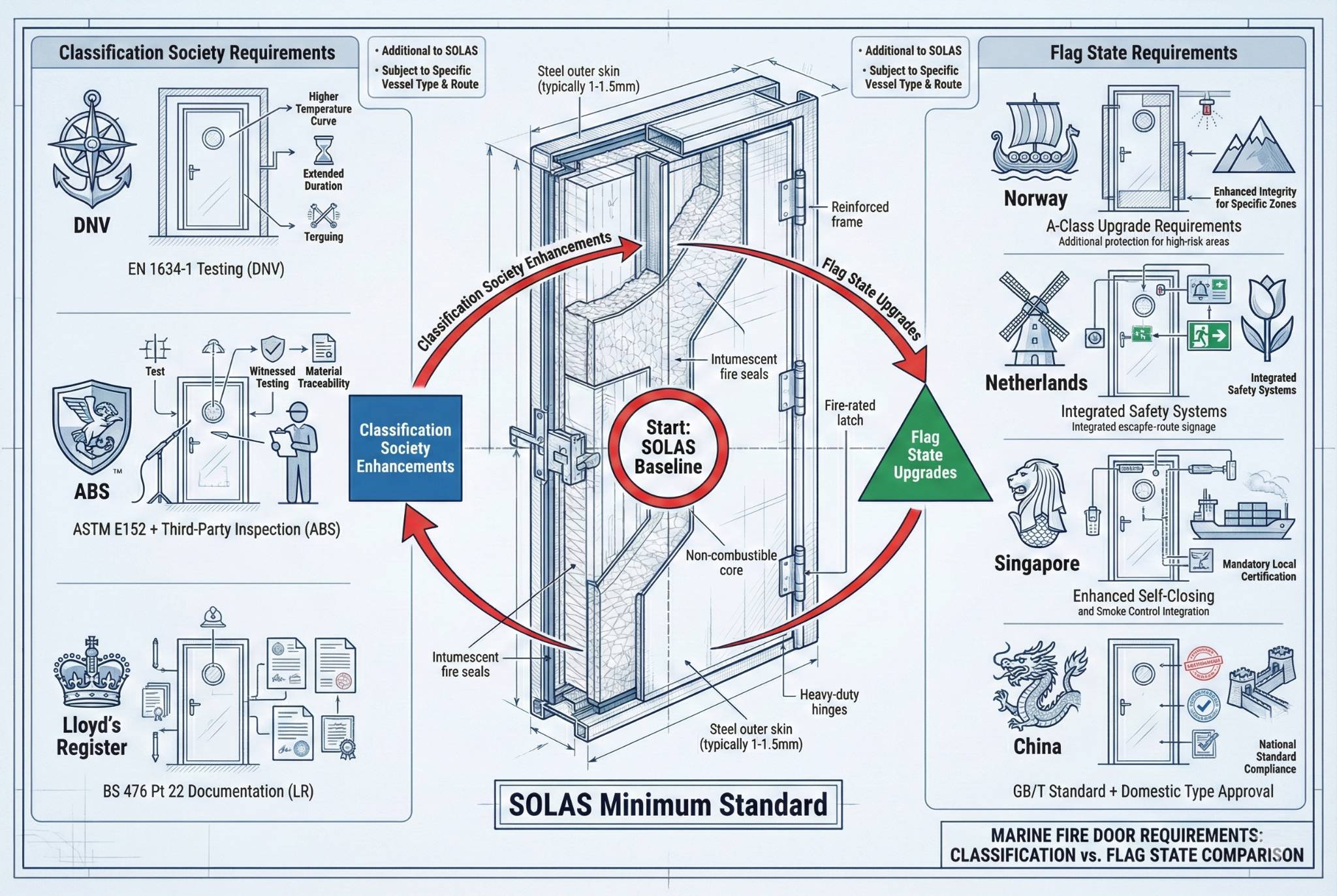
DNV (Det Norske Veritas): European Standards Overlay
DNV primarily serves Norwegian, Danish, and broader European fleets. Their fire door requirements overlay European EN standards onto IMO requirements, creating the most stringent testing regime.
Key DNV-specific requirements:
- Testing standard: EN 1634-1 fire resistance testing PLUS IMO Resolution A.754(18) compliance
- Smoke leakage: Must meet EN 1634-3 smoke control door assembly testing (Sa rating)
- Durability testing: 10,000 cycle durability test per EN 1191 before fire testing
- Corrosion specification: Minimum C4 corrosion category per ISO 12944-2 for weather-exposed doors, C3 for internal
- Documentation: Complete material traceability with EN 10204 3.1 material certificates for all structural steel
The durability pre-testing creates significant compliance challenges. Doors must complete 10,000 opening/closing cycles, then immediately undergo fire testing without repair or adjustment. I've seen multiple manufacturers fail this requirement—hinges loosen during cycling, causing misalignment that creates gaps during subsequent fire testing.
DNV type approval testing for a single door design costs €28,000-38,000 and requires 8-12 weeks. The test house (typically SINTEF in Norway, Efectis in France, or Warrington Fire in UK) must be DNV-recognized, eliminating lower-cost Asian testing options.
ABS (American Bureau of Shipping): U.S. Standards and Oversight
ABS dominates U.S.-flagged commercial vessels and many international military vessels. Their requirements emphasize manufacturing oversight and correlation with ASTM standards.
Key ABS-specific requirements:
- Testing standard: ASTM E152 standard fire test correlation with IMO requirements
- Manufacturing oversight: ABS surveyor inspection of manufacturing facility, with ongoing production surveys
- Material specifications: ASTM material standards (ASTM A36 steel, etc.) rather than EN or ISO equivalents
- Quality system: ISO 9001 certification required for manufacturers, with ABS audit of fire door production procedures
- Hardware approval: Door closers, hinges, and panic hardware require separate ABS component approval
The manufacturing oversight requirement creates geographic challenges. ABS maintains limited surveyor coverage in Southeast Asia, often resulting in 4-6 week delays waiting for production survey appointments. For manufacturers in Vietnam or Indonesia, this can devastate delivery schedules.
I worked with a Vietnamese manufacturer who produced excellent A-60 doors with full IMO certification, but lacked ABS approval. To serve a U.S. Maritime Administration project, they pursued ABS type approval. The process required:
- ABS facility audit and approval: $8,500 fee, 6-week lead time
- Door design type approval testing: $32,000, 10-week lead time
- Production survey for first production batch: $2,800, 3-week scheduling delay
- Ongoing periodic production surveys: $1,500 per survey, quarterly
Total first-year ABS compliance cost exceeded $52,000 before selling a single door. However, this opened U.S. government and military vessel markets worth $2.8M in the following 3 years.
Lloyd's Register: Traditional British Standards
Lloyd's Register maintains significant market share in UK, Commonwealth, and traditional shipping nations. Their standards reference historical British Standards alongside IMO requirements.
Key LR-specific requirements:
- Testing standard: BS 476 Part 22 correlation required alongside IMO Resolution A.754(18)
- Material specification: British steel grades (BS 4360) or demonstrated equivalence to EN grades
- Hardware standards: British hardware standards (BS EN 1155 for closers, BS EN 1935 for hinges)
- Installation supervision: LR surveyor attendance during installation of fire doors in critical boundaries
- Documentation: Detailed installation records with photographic evidence required
The installation supervision requirement impacts project scheduling. For a major refit with 140 fire doors, LR required surveyor attendance during installation of all A-Class doors (88 units). With one surveyor visit per week, this extended the installation schedule by 11 weeks compared to DNV classification (which accepts manufacturer's installation supervision with photographic documentation).
CCS (China Classification Society): Domestic Market Requirements
Chinese-flagged vessels must use CCS classification, which creates unique requirements aligned with Chinese national standards.
Key CCS-specific requirements:
- Testing standard: GB/T 7633 fire resistance test for door assemblies, harmonized with but not identical to IMO standards
- Type approval location: Must be tested at Chinese testing facility (Tianjin Fire Research Institute, Shanghai Fire Science and Technology Research Institute, or equivalent CNAS-accredited lab)
- Material standards: GB steel standards (Q235, Q345) with Chinese mill certificates
- Language requirements: All documentation, labels, and operation instructions must include Chinese language versions
- Factory inspection: CCS conducts annual factory inspections of approved manufacturers, regardless of ISO 9001 status
For Western manufacturers targeting Chinese-flagged vessels, CCS compliance presents challenges. Testing must occur in China (cannot use existing European or US test reports), adding $22,000-35,000 in testing costs and requiring physical door samples shipped to China for testing.
However, for Chinese manufacturers, CCS approval provides the most cost-effective entry to marine fire door markets. A complete CCS type approval for one door design costs ¥180,000-250,000 (approximately $25,000-35,000), substantially less than equivalent DNV or ABS approval.
| Classification Society | Type Approval Testing Cost | Testing Location Options | Manufacturing Oversight | Total First-Approval Cost (Single Door Design) | Market Access |
|---|---|---|---|---|---|
| DNV | €28,000-38,000 | Europe (SINTEF, Efectis, Warrington) | Periodic production surveys | €35,000-48,000 | European, Scandinavian fleets |
| ABS | $32,000-42,000 | USA, UK, limited Asia | Required facility audit + production surveys | $52,000-68,000 | US-flagged, many international |
| Lloyd's Register | £24,000-34,000 | UK (Warrington, BRE), limited international | Installation supervision for critical doors | £30,000-42,000 | UK, Commonwealth fleets |
| Bureau Veritas | €26,000-36,000 | France (Efectis), limited international | Periodic production surveys | €32,000-44,000 | French, African, Middle Eastern |
| CCS | ¥180,000-250,000 | China only (TFRI, Shanghai FSI) | Annual factory inspection | ¥220,000-300,000 | Chinese-flagged vessels |
Flag State Additional Requirements: Beyond Classification Society
Flag states impose requirements beyond their chosen classification society standards. Some notable examples:
Norway (NMA - Norwegian Maritime Authority): Requires A-30 minimum for all accommodation corridor boundaries where SOLAS permits B-15. This single requirement increases door costs by approximately $250-400 per door for a typical passenger vessel, adding $80,000-150,000 to a 350-cabin cruise ship's fire door package.
Singapore (MPA - Maritime and Port Authority): Mandates enhanced smoke control testing per ISO 5925-1 for all accommodation doors on Singapore-flagged passenger vessels. Requires smoke leakage rate below 3 m³/hour/m² at 25 Pa pressure differential. This eliminates many standard B-Class doors that don't incorporate sufficient smoke seal technology.
Netherlands (ILT - Human Environment and Transport Inspectorate): Requires third-party quality system certification (Lloyds Register Quality Assurance, DNV GL, or equivalent) for all fire door manufacturers, regardless of classification society. This adds €8,000-15,000 annual cost for manufacturers and effectively excludes smaller Asian suppliers lacking this certification.
Panama (AMP - Panama Maritime Authority): Despite being a flag of convenience, Panama enforces strict compliance with chosen classification society standards and has detention rates exceeding 15% for fire safety deficiencies. PSC inspections frequently verify fire door certification markings and conduct operational tests of self-closing mechanisms.
United States Coast Guard (USCG): For vessels operating in U.S. waters, USCG maintains independent approval authority beyond ABS classification. USCG approval adds 46 CFR requirements including specific labeling, installation documentation, and maintenance procedures. USCG type approval costs $18,000-28,000 beyond ABS certification.
I advised a client who specified doors with DNV approval for a Panama-flagged vessel with regular U.S. port calls. The doors met SOLAS and DNV requirements but lacked USCG approval. During USCG Port State Control inspection in Long Beach, the vessel was detained for 6 days while obtaining USCG acceptance documentation, costing approximately $84,000 in delay costs (berth fees, crew, missed charter). The lesson: flag state AND trading area requirements must both be verified during specification.
What are the critical dimensions and clearance requirements for marine fire doors?
Physical dimensional specifications create frequent installation failures that I've witnessed across multiple projects. Standard architectural door thinking doesn't translate to marine fire door requirements.
Critical marine fire door dimensions include frame opening size (must account for 25-40mm frame overlap onto bulkhead, with actual clear opening reduced by frame thickness), clear opening width for escape routes (minimum 800mm per SOLAS for accommodation, 600mm minimum for machinery access, measured at narrowest point), height clearances (standard 2000mm for accommodation, 1900mm acceptable for machinery spaces, must maintain 10-15mm clearance above deck for threshold seal compression), sill height (maximum 380mm for normal access, 600mm permitted for limited-access watertight doors, measured from deck to bottom of clear opening), and bulkhead thickness compatibility (frames must match bulkhead thickness from 50mm to 200mm; adjustable frames accommodate ±10mm variance, fixed frames require exact specification).
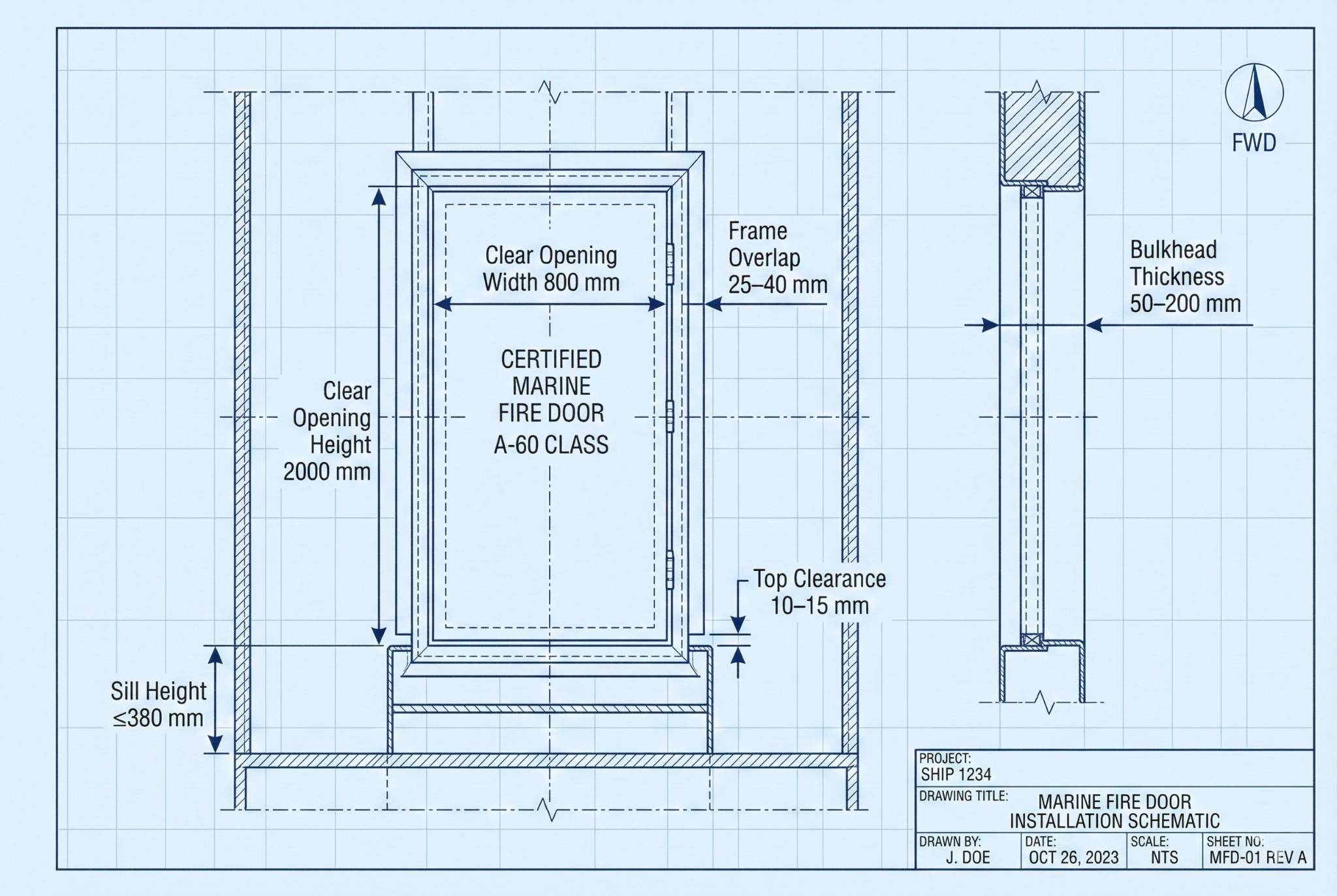
Frame Opening vs. Clear Opening: The Critical Difference
This represents the most common specification error from those unfamiliar with marine construction. A "900mm door" does NOT provide 900mm clear opening width.
Frame opening (rough opening): The hole cut in the bulkhead where the door frame will be installed. This is the dimension shipyards work from during construction.
Clear opening: The actual passage width available after frame installation. This is what personnel and equipment must fit through.
The relationship between these dimensions:
- Standard marine fire door frame: 38-50mm profile width on each side
- Frame overlap onto bulkhead: 25-40mm (depending on frame design and bulkhead thickness)
- Total clear opening reduction: 126-180mm smaller than frame opening
Example calculations for typical doors:
| Frame Opening (Rough Opening) | Frame Profile Width (Each Side) | Frame Overlap | Clear Opening Width | Equipment Passage Capability |
|---|---|---|---|---|
| 900mm | 44mm × 2 = 88mm | 32mm × 2 = 64mm | 748mm | Tight for standard wheelchairs (min 815mm required) |
| 1000mm | 44mm × 2 = 88mm | 32mm × 2 = 64mm | 848mm | Adequate for wheelchairs, personnel with equipment |
| 800mm | 38mm × 2 = 76mm | 28mm × 2 = 56mm | 668mm | Machinery access only, not suitable as primary escape |
| 1200mm | 50mm × 2 = 100mm | 35mm × 2 = 70mm | 1030mm | Wide access, suitable for stretchers and large equipment |
I consulted on a passenger vessel refit where the naval architect specified "800mm doors" for cabin corridor access, assuming this meant clear opening. The installed doors provided only 672mm clear opening. Wheelchairs could not pass, violating accessibility requirements for the vessel's flag state. Enlarging 48 doorways in installed bulkheads cost €127,000 in cutting, frame replacement, and re-insulation.
Escape Route Width Requirements: Life Safety Minimums
SOLAS Chapter II-2 and LSA Code establish minimum clear width for escape routes based on vessel type and passenger capacity. These are absolute minimums that cannot be reduced.
Passenger ship escape routes:
- Main escape routes: Minimum 1000mm clear width per SOLAS II-2/13.3.2
- Secondary escape routes: Minimum 800mm clear width
- Escape routes serving more than 90 persons: Minimum 1200mm clear width
- Escape routes from machinery spaces: Minimum 800mm clear width
Cargo ship escape routes:
- Primary escape from machinery spaces: Minimum 800mm clear width per SOLAS II-2/13.4.2
- Accommodation escape routes: Minimum 700mm clear width (though 800mm strongly recommended)
- Emergency escape trunk: Minimum 600mm × 600mm clear dimension
Critical requirement: Width must be maintained throughout the entire escape route, including at doors. If a 1000mm corridor serves 120 passengers, every door in that escape route must provide minimum 1000mm clear opening, not just the corridor itself.
During plan approval for a 450-passenger ferry, the classification society rejected 12 escape route doors specified at 900mm frame opening (providing only 780mm clear opening) where the regulation required 1000mm clear minimum. The specification change increased door costs by $18,800 and required bulkhead modifications during construction, adding 3 weeks to the schedule.
Threshold and Sill Height Limitations: Accessibility and Watertight Balance
Threshold height creates tension between accessibility requirements (low sills for wheelchair passage) and watertight/weathertight requirements (high sills for water exclusion).
Standard accommodation doors: Maximum 25mm threshold height per accessibility standards in most flag states. Many designers specify flush thresholds (0mm height) for improved accessibility, though this requires careful detailing of floor finishes to maintain smoke seal integrity.
Watertight door sills: SOLAS permits 380mm maximum sill height for doors that must be used during normal operation (daily or regular access). Doors used only for emergency or occasional access can have sills up to 600mm height.
Weather deck doors: Typically require 150-300mm sill height for weather exclusion, with external drainage gutters and internal ramps for equipment passage.
The critical design challenge: Accommodation doors opening onto weather decks or areas exposed to water ingress. These require:
- External threshold: 200-300mm height for water exclusion
- Internal ramp: Maximum 1:12 slope per accessibility standards (for 250mm sill height, requires 3000mm long ramp)
- Transition zone: Landing area minimum 1500mm × 1500mm at top of ramp
- Fire door positioning: Must be located inside the ramp to maintain fire boundary integrity
I reviewed a specification where the designer located fire doors at the exterior weather deck position, requiring 280mm sill height, creating accessibility violations for a passenger vessel. The doors had to be relocated 4000mm inboard with external weathertight doors (non-fire-rated) at the deck position. This added 32 weathertight doors at $1,800 each ($57,600 additional cost) that could have been avoided with proper initial design.
| Door Application | Maximum Sill Height | Accessibility Requirement | Typical Solution | Cost Impact |
|---|---|---|---|---|
| Internal accommodation | 25mm | Wheelchair accessibility | Flush threshold or 25mm max with beveled edge | Baseline |
| Machinery space access (daily) | 380mm | Personnel access (no wheelchair requirement) | Standard raised threshold | +$0-50 |
| Weather deck access (passenger areas) | 25mm at fire door position | Wheelchair accessibility | Fire door inboard, separate weathertight door outboard | +$1,200-2,400 for dual-door arrangement |
| Watertight door (emergency access only) | 600mm | None (emergency use only) | High sill with ladder or step arrangement | +$400-800 for access arrangement |
Bulkhead Thickness Compatibility: Frame Design Considerations
Marine fire door frames must be specified to match bulkhead thickness, which varies widely across vessel construction.
Typical bulkhead thicknesses:
- Accommodation internal partitions: 50-75mm (steel frame with mineral wool or rockwool infill)
- A-Class divisions in accommodation: 75-100mm (thicker insulation for fire rating)
- Machinery space boundaries: 100-150mm (enhanced fire insulation and structural strength)
- Main vertical zone divisions: 125-175mm (maximum fire rating and structural integrity)
- Watertight bulkheads with fire rating: 150-200mm (combined watertight and fire insulation)
Frame design options:
Fixed-width frames: Manufactured to exact bulkhead thickness. Advantages: lower cost ($680-950 for standard A-60), better fire seal integrity, simpler installation. Disadvantages: Requires precise bulkhead thickness specification, no adjustment tolerance, long lead time if custom thickness needed.
Adjustable frames: Telescoping design accommodates ±10mm variance in bulkhead thickness. Advantages: accommodates construction tolerance, faster delivery from stock sizes, single frame design serves multiple bulkhead types. Disadvantages: Higher cost ($880-1,150 for equivalent A-60), slightly reduced fire test performance, more complex installation procedure.
Frame extensions: Fixed-width base frame with bolt-on extension pieces for thicker bulkheads. Advantages: economical for special thick bulkheads, can be added during refit without frame replacement. Disadvantages: Creates potential fire seal weakness at extension joint, adds installation labor, not suitable for A-60 ratings (A-30 maximum).
For new construction, I recommend fixed-width frames specified to shipyard construction drawings. The cost savings and performance benefits outweigh the reduced flexibility. However, for refit work where exact bulkhead thickness is uncertain until demolition, adjustable frames prevent costly delays from frame re-fabrication.
A specification error I documented: A refit project specified 100mm fixed-width frames for machinery boundary doors based on design drawings showing 100mm bulkhead thickness. During demolition, actual bulkheads measured 118mm due to additional insulation layers added during original construction. All 14 frames required re-manufacture at $840 each ($11,760 cost) plus 5-week delivery delay. Specifying adjustable frames (with ±10mm tolerance) would have added only $2,800 to original cost while preventing the delay entirely.
How should hardware and accessories be specified for marine fire doors?
Marine fire door hardware failures represent 70% of door system failures during my inspections. The door panel may maintain perfect fire integrity, but failed hardware renders the assembly non-compliant.
Marine fire door hardware specification must address hinges (ball-bearing type with sealed bearings rated for corrosive environments, minimum three hinges for doors over 1.8m height, 316 stainless steel for weather exposure), closers (hydraulic type with adjustable closing speed, temperature-compensated fluid for engine rooms, minimum 90-second closure time from 70° open position per SOLAS), latching mechanisms (self-latching design that engages without manual action, accessible from both sides, fail-safe operation without electrical power), hold-back devices where permitted (electromagnetic or fusible-link automatic release, integrated with fire detection system, UPS-backed power supply), seals (intumescent seals expanding at 150-200°C for A-Class doors, smoke seals rated per ISO 5925-1 for all doors, perimeter and threshold seals required), and panic hardware for escape routes (horizontal push-bar type per ISO 20571-1, operable with maximum 220N force, maintains fire rating of door assembly).
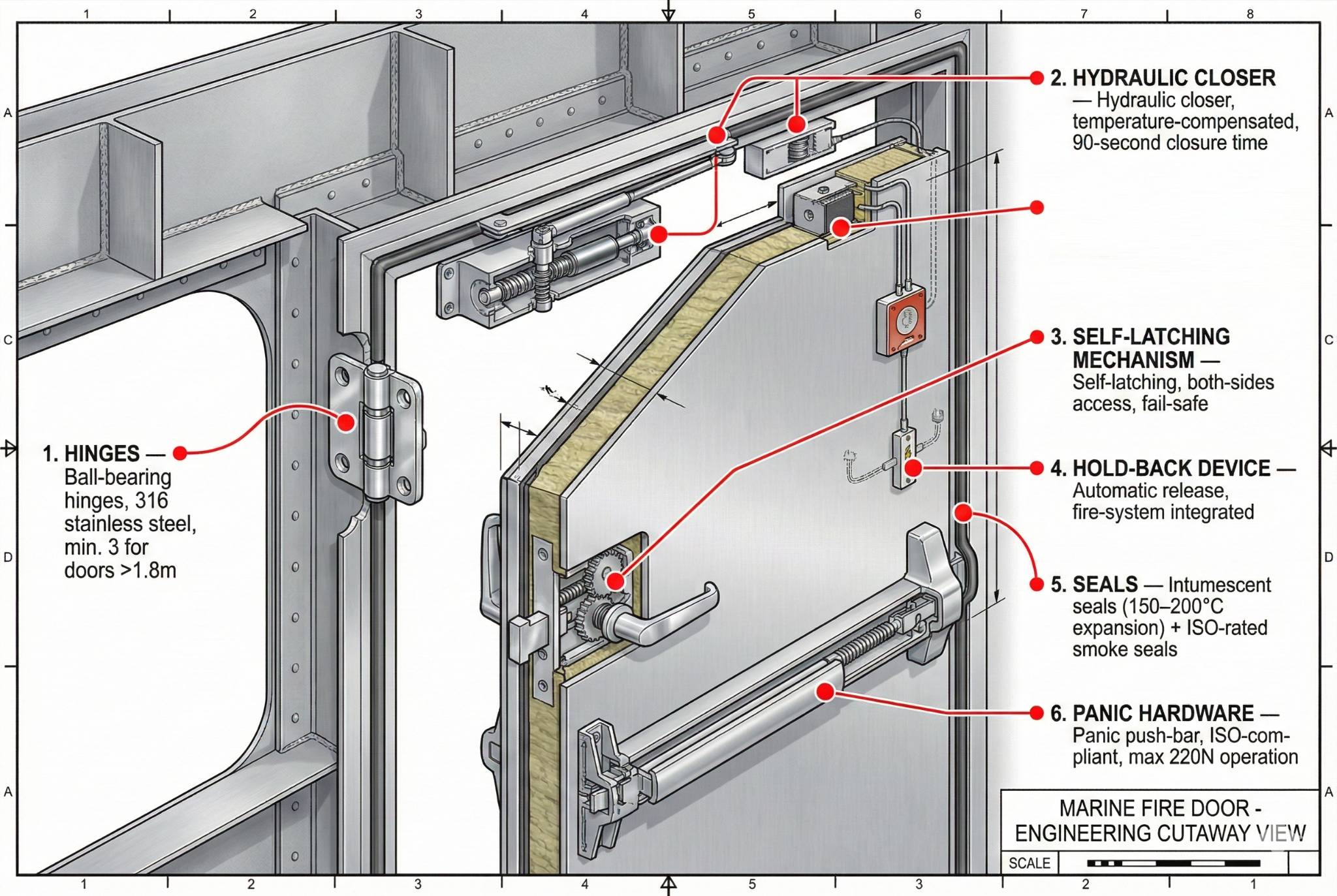
Hinges: The Foundation of Operational Reliability
Hinge selection determines door longevity and operational reliability more than any other component. Standard architectural hinges fail rapidly in marine environments.
Marine fire door hinge requirements:
Material selection: 316 stainless steel for weather-exposed and chemical environments ($45-75 per hinge set), 304 stainless steel for general marine use ($28-48 per hinge set), hot-dip galvanized steel for internal protected areas ($18-32 per hinge set).
Bearing type: Ball-bearing or roller-bearing hinges for doors used more than 10 times daily. Plain-bearing bronze bushings acceptable for low-frequency doors (emergency exits, tank access).
Hinge quantity: Minimum three hinges for all doors over 1800mm height, four hinges for doors over 2200mm or weighing more than 120kg, five hinges for combined fire/watertight doors over 2000mm height.
Pin security: Non-removable pins required on outward-opening doors and any security-sensitive locations. Removable pins acceptable for inward-opening internal accommodation doors.
Offset dimension: Standard 50-60mm offset for most applications, 75-100mm offset for thick frames or special sealing requirements.
I inspected a 6-year-old cargo vessel where accommodation fire doors used mild steel plain-bearing hinges (inappropriate for marine environment). Of 94 doors inspected, 71 showed visible hinge corrosion, 38 had binding operation requiring excessive force, and 12 had failed self-closing function due to hinge friction. The vessel spent $22,000 replacing hinges across all accommodation areas during mandatory drydock.
| Hinge Specification | Material | Bearing Type | Typical Application | Cost Per Hinge Set (3 hinges) | Expected Service Life |
|---|---|---|---|---|---|
| Economy specification | Galvanized steel | Plain bearing bronze bushing | Low-traffic internal doors | $54-96 | 5-8 years in accommodation |
| Standard marine | 304 stainless steel | Ball bearing sealed | Normal accommodation, machinery internal | $84-144 | 10-15 years general service |
| Heavy-duty marine | 316 stainless steel | Ball bearing sealed | High-traffic, weather-exposed, chemical areas | $135-225 | 15-25 years all environments |
| Watertight type | 316 SS with extended pins | Sealed roller bearing | Combined fire/watertight doors | $280-420 | 20-30 years with proper maintenance |
Door Closers: Ensuring Self-Closing Function
SOLAS requires all fire doors except those in main vertical zone boundaries to be self-closing. Main vertical zone doors must be either self-closing or fitted with automatic closure on fire detection. The door closer represents the critical component enforcing this requirement.
Door closer specifications:
Closure time: SOLAS requires minimum 90 seconds to close from 70° open position to fully latched. This slow-close requirement prevents injury in high-traffic areas. However, many standard closers provide only 15-30 second closure, requiring adjustment or replacement.
Environmental rating: Standard closers use hydraulic fluid with viscosity change across temperature ranges. Engine room installations require temperature-compensated fluid or bi-metallic compensating valves to maintain consistent closing speed from -20°C to +60°C.
Adjustability: Quality closers provide separate adjustment of sweep speed (70° to 15°), latching speed (15° to 0°), and backcheck (prevents door slamming when thrown open). Accommodation doors require careful adjustment to prevent noise complaints while maintaining code compliance.
Mounting type: Surface-mounted closers (visible on door surface) cost $140-280 and provide easier adjustment/maintenance. Concealed overhead closers (hidden in frame head) cost $380-580 but provide cleaner aesthetic for passenger areas. Floor-mounted closers ($650-1,200) are used for heavy doors or special applications but complicate maintenance.
Power sizing: Closers are rated by EN 1154 power size 1-7. Fire doors require minimum size 3 for single-leaf doors up to 950mm width, size 4 for doors 950-1100mm, size 5 for doors 1100-1250mm, and size 6-7 for double-leaf doors or high-resistance applications.
A ferry operator reported excessive door closer failures (28 closers in 14 months across 180 doors). Investigation revealed size 3 closers installed on 1050mm width doors that required size 4. The undersized closers operated continuously at maximum hydraulic pressure, causing seal failure and fluid leakage. Upgrading to properly sized closers reduced failure rate to 3 closers over the following 24 months, with total upgrade cost of $6,400 paid back through reduced maintenance in 18 months.
Latching Mechanisms: Self-Latching vs. Positive Latching
SOLAS distinguishes between self-latching (engages automatically when door closes) and positive latching (requires manual action to engage) mechanisms. Fire doors must be self-latching unless constantly attended.
Self-latching mechanism types:
Roller latch: Spring-loaded roller engages strike plate as door closes. Advantages: Simple, reliable, low cost ($28-45). Disadvantages: Limited holding force (100-150N), not suitable for weather-exposed or watertight applications.
Deadlatch: Auxiliary latch prevents the main latch from being forced back (anti-jimmy feature). Advantages: Security enhancement, meets IMO security requirements ($45-75). Disadvantages: More complex mechanism, requires precise strike plate alignment.
Three-point latching: Top, middle, and bottom latching points engage simultaneously. Used for: Tall doors over 2400mm height, watertight doors, doors requiring enhanced seal compression ($180-320).
Multi-point latching: 4-8 latching points around door perimeter, typically for combined fire/watertight doors requiring high compression on sealing gaskets. Cost: $420-680 depending on point quantity and mechanism type.
Positive latching (requires manual action): Used only for normally locked doors, emergency exits, and specific locations approved by classification society. Common types include:
- Sliding bolt (barrel bolt): Manual engagement, used on double-leaf inactive door ($35-60)
- Key-operated deadbolt: Security requirement for stores, dangerous goods lockers ($65-95)
- Emergency exit device: Panic bar with key-dogging facility ($280-450)
A critical specification error I encountered: Main deck access doors on a research vessel specified roller latch mechanisms. These doors faced weather exposure and regular wave impacts. Within 8 months, 6 of 8 latches failed due to corrosion and impact loading. Replacement with three-point marine-grade latches cost $1,920 plus installation labor. Initial specification of appropriate hardware would have added only $1,200 but prevented operational failures.
| Latch Type | Holding Force | Typical Application | Weather Resistant | Watertight Compatible | Cost Per Door | Maintenance Frequency |
|---|---|---|---|---|---|---|
| Roller latch | 100-150N | Internal accommodation, low-traffic | No | No | $28-45 | Annual lubrication |
| Deadlatch | 150-200N | General accommodation, machinery access | Limited | No | $45-75 | Annual inspection |
| Three-point latch | 400-600N | Tall doors, weather-exposed, security areas | Yes (if SS) | Yes | $180-320 | 6-month inspection |
| Multi-point compression | 800-1500N | Fire/watertight combination, blast-resistant | Yes | Required | $420-680 | Quarterly inspection and adjustment |
Hold-Back Devices: Balancing Convenience and Safety
High-traffic doors create operational challenges. Crew and passengers frequently prop doors open or defeat self-closing mechanisms to avoid inconvenience. Hold-back devices provide a code-compliant solution.
SOLAS permits hold-back devices only when:
- The door is located in a main vertical zone division OR
- The door is fitted with automatic closure on fire detection AND
- The hold-back releases automatically on fire alarm OR power failure AND
- The door can be manually closed from both sides AND
- The installation is approved by the flag state administration
Hold-back device types:
Electromagnetic hold-open: Electromagnet on wall or floor holds door open; releases when power is cut or fire alarm activates. Advantages: Clean appearance, reliable release mechanism, adjustable holding force. Cost: $180-320 per door. Power requirement: 24VDC at 0.3-0.8A depending on model, must be UPS-backed.
Fusible link hold-open: Mechanical hook held by fusible element that melts at 70-74°C, releasing door. Advantages: No electrical requirement, zero failure mode (always releases on heat). Disadvantages: Single-use consumable requiring replacement after activation ($45-65 replacement cost), slower response than electromagnetic (requires heat buildup rather than smoke detection). Cost: $120-180 per door.
Acoustic release: Releases on fire alarm sounder activation. Advantages: No hard-wired connection to fire alarm panel, operates on sound pressure. Disadvantages: May release during testing or false alarms, requires careful acoustic calibration. Cost: $240-380 per door.
Critical integration requirement: Hold-back devices must integrate with the vessel fire detection and alarm system. This requires:
- Independent power circuit from main fire alarm panel
- UPS backup maintaining minimum 30 minutes operation
- Fail-safe design (loss of power causes release, not hold)
- Manual release capability from both sides of door
- Position monitoring indicating held-open status at fire control station
I specified electromagnetic hold-open devices for 24 galley and servery access doors on a cruise ship. The system integrated with Consilium fire detection, cost $6,720 for devices plus $2,800 for electrical integration. Over 3 years operation, the crew satisfaction with these doors was exceptional (no more propped-open doors with wedges), and fire drills demonstrated 100% reliable release. The investment eliminated fire code violations from defeated self-closing mechanisms, which had resulted in two port state control detentions (with associated costs exceeding $120,000) on the vessel's sister ship that didn't implement the system.
Intumescent and Smoke Seals: The Hidden Critical Components
Door seals prevent flame, hot gas, and smoke penetration—representing the actual fire containment mechanism regardless of door construction quality.
Intumescent seal specification:
Activation temperature: Most marine intumescent seals activate at 150-200°C, expanding to 10-30 times original thickness to seal gaps. Critical: The seal must activate BEFORE the door frame and leaf experience significant thermal expansion (which occurs around 250-300°C).
Expansion ratio: Higher expansion ratios (20-30×) accommodate larger gaps but may exert excessive force on door frame. Standard 10-15× expansion ratios suit most applications with proper gap tolerances.
Seal profile:
- 10mm × 4mm: Standard accommodation B-Class doors
- 15mm × 4mm: A-Class doors and high-traffic areas requiring durability
- 20mm × 4mm: A-60 doors and enhanced fire protection
- 25mm × 5mm: Combined fire/watertight where additional compression is needed
Installation location: Perimeter seals in frame or door leaf rebate, plus threshold seal for smoke control. For A-Class doors, double sealing (both frame and door leaf) provides redundancy.
Smoke seal specification:
Required per SOLAS for all accommodation doors opening onto corridors forming part of escape routes. Smoke seals compress to fill gaps, preventing smoke passage at ambient temperature (unlike intumescent seals that require heat activation).
Material types:
- Neoprene blade seals: Cost-effective ($12-18 per door), suitable for light-duty
- Silicone bubble seals: Superior durability ($22-35 per door), high-temperature stable
- Combined intumescent/smoke seal: Intumescent core with smoke-sealing brush or blade ($38-55 per door), simplifies installation
Performance standard: ISO 5925-1 specifies smoke leakage below 3 m³/hour/m at 25 Pa pressure differential. Quality seals achieve 0.5-1.5 m³/hour/m, while poor seals may exceed 6 m³/hour/m (non-compliant).
A fire door inspection I conducted on a 4-year-old container ship revealed that 34 of 67 A-Class doors had damaged or missing intumescent seals. Investigation determined that a cleaning contractor used high-pressure steam cleaning in accommodation corridors, which activated and destroyed the intumescent seals (which expand when exposed to steam heat). Seal replacement cost $4,760 plus installation labor. The lesson: Intumescent seals require protection from high-temperature cleaning methods—specify silicone shrouds over seals in areas subject to steam cleaning, or use flush-mounted seals protected by metal retainers.
| Seal Type | Primary Function | Activation/Operation | Typical Application | Cost Per Door | Replacement Frequency |
|---|---|---|---|---|---|
| Intumescent only (10×4mm) | Fire and hot gas containment | Activates at 150-200°C | B-15 and B-0 internal doors | $15-24 | 8-12 years (damage-dependent) |
| Intumescent only (15×4mm) | Enhanced fire containment | Activates at 150-200°C | A-Class doors, high-traffic | $22-34 | 8-12 years |
| Smoke seal only (neoprene) | Ambient smoke control | Continuous compression | Low-traffic accommodation | $12-18 | 5-8 years |
| Smoke seal (silicone) | Enhanced smoke control | Continuous compression | High-traffic, temperature extremes | $22-35 | 10-15 years |
| Combined intumescent/smoke | Fire, hot gas, and smoke | Both continuous and heat-activated | All accommodation corridor doors | $38-55 | 8-12 years |
Panic Hardware: Life Safety and Fire Rating Integration
Escape route doors must provide immediate egress without keys, tools, or special knowledge. Panic hardware allows single-motion exit while maintaining fire door integrity.
Panic hardware requirements per ISO 20571-1:
- Maximum 220N operating force (equivalent to 22kg push force)
- Operable from wheelchair height (900-1100mm centerline)
- Minimum 600mm horizontal push bar length for single-leaf doors
- No projections creating snag hazards on escape route side
- Visual indication of latching status
- Maintains fire rating of door assembly (must be fire-tested as integral assembly)
Marine panic hardware types:
Horizontal push bar (touchbar): Full-width horizontal bar at 900-1100mm height. Push anywhere on bar releases latch. Advantages: Easy operation even in darkness or panic conditions, ADA/accessibility compliant. Cost: $280-450 for fire-rated marine version. Most common for passenger vessel escape routes.
Vertical push bar: Vertical bar at door edge, typically 1000-1600mm length. Advantages: Lower cost ($180-280), less prone to accidental activation. Disadvantages: Less intuitive operation, not wheelchair-accessible if bar requires gripping.
Crossbar with panic function: Horizontal bar operates both panic exit and normal latching. Advantages: Single hardware system ($320-480), clean appearance. Disadvantages: More complex mechanism, higher maintenance requirements.
Dogging capability: "Dogging" allows the panic bar to be locked in the retracted position using a key, converting the door to free-swing operation. Some flag states permit dogging for doors not part of fire escape routes, but SOLAS strictly prohibits dogging of any escape route door. Specifying dogging-capable hardware for escape routes invites misuse and code violations.
Critical fire rating requirement: Panic hardware must be fire-tested as part of the door assembly. Generic architectural panic hardware—even if rated for fire doors in building applications—does NOT satisfy marine fire door requirements unless tested per IMO Resolution A.754(18) as an integrated assembly.
I reviewed a specification where a designer specified standard commercial Panic-rated pushbars for passenger escape doors, believing the UL10C fire rating translated to marine compliance. The classification society rejected these during approval review, requiring marine-certified panic hardware tested per IMO standards. Replacement hardware cost $16,800 for 42 doors, plus 5-week delay waiting for delivery. The commercial hardware sat in the shipyard warehouse, representing $11,200 in wasted procurement.
What quality control and inspection protocols should be implemented for marine fire doors?
Quality failures in marine fire doors create life safety risks that cannot be remediated after installation without extensive cost. Systematic quality control prevents these failures.
Marine fire door quality control requires factory inspections (verify manufacturing facility ISO 9001 certification, conduct pre-production first article inspection, monitor production for critical characteristics including frame squareness within ±2mm, seal installation integrity, hardware mounting torque specifications), material verification (confirm steel grade with mill certificates per EN 10204 3.1, verify intumescent seal specifications with manufacturer data sheets, validate hardware components match approved specifications), dimensional inspection (measure frame opening dimensions within ±3mm tolerance, verify clear opening dimensions meet escape route requirements, confirm bulkhead thickness compatibility within frame adjustment range), pre-delivery testing (operational test of self-closing function with 90-second closure verification, latch engagement test from both sides, seal compression verification), and installation oversight (classify society surveyor attendance for critical A-60 boundaries, photographic documentation of frame installation and seal integrity, post-installation operational testing before acceptance).
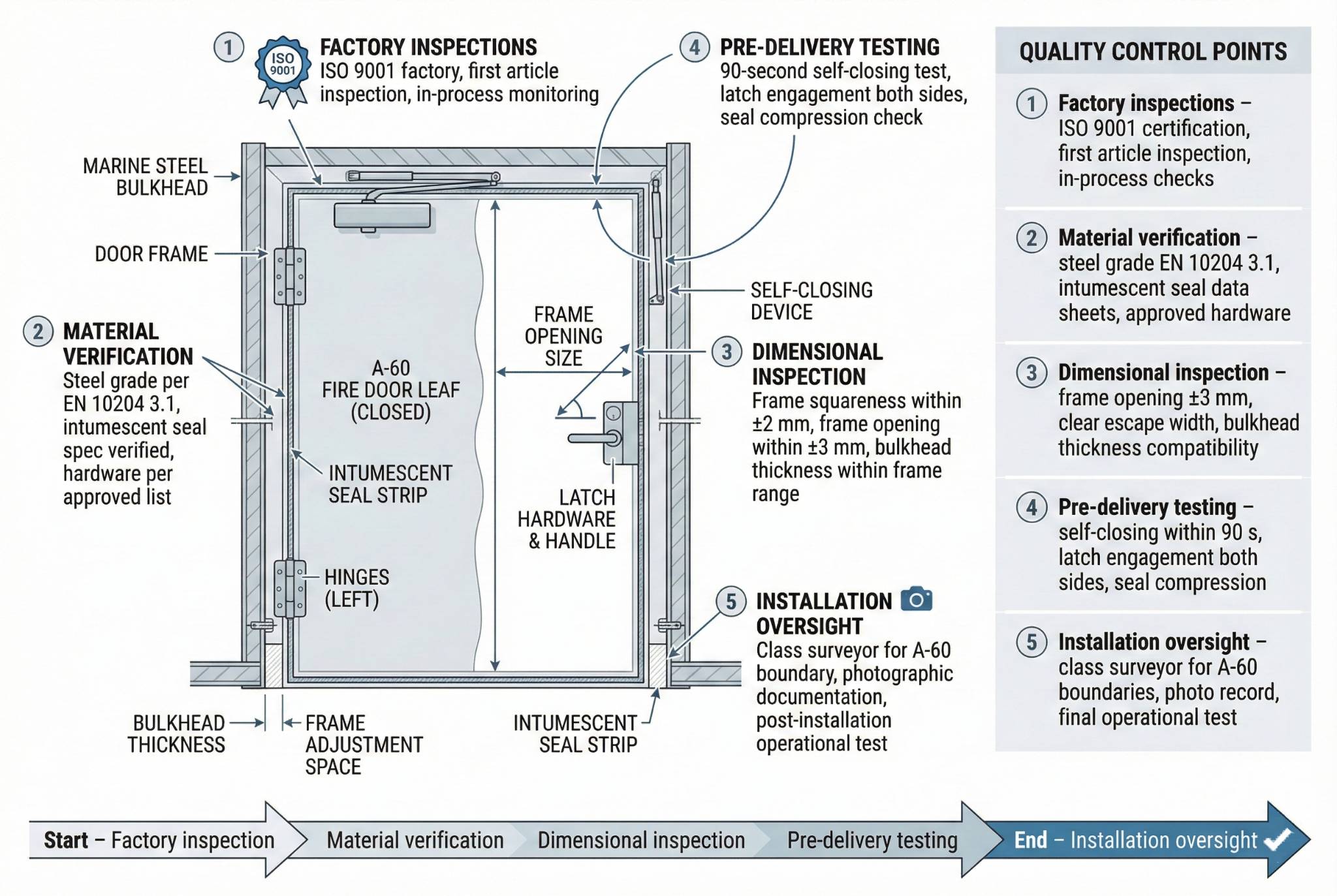
Factory Quality Control: Preventing Defects at Source
The most cost-effective quality control occurs during manufacturing, before shipping and installation. Defects discovered on-site create delays, rework costs, and potential project penalties.
Pre-production first article inspection:
Before commencing production of a door order, inspect a complete first article (first door assembly produced) to verify:
- Frame construction: Welded corners with continuous weld, no gaps >0.5mm, corners square within ±2mm over 2000mm diagonal measurement
- Seal installation: Intumescent seal fully seated in groove, continuous around perimeter with mitred corners, no gaps at joints, protective film intact
- Door leaf construction: Face sheets welded or mechanically fastened per approved drawings, core material properly consolidated with no voids, edge sealing complete preventing moisture ingress
- Hardware installation: Hinges aligned vertically within ±1mm, mounting fasteners torqued to specification (typically 25-30 Nm for M8 fasteners), closer adjusted to 90-second minimum closure time, latch engaging strike plate with 3-5mm engagement depth
- Surface finish: Coating thickness minimum 60 microns for powder coat (verify with coating thickness gauge), surface free of defects >2mm diameter, no runs or sags in coating
Document the first article inspection with minimum 20 photographs covering all critical characteristics. Obtain written approval from classification society surveyor or owner's representative before authorizing production of remaining doors.
I conducted first article inspection for a 180-door package where the initial door showed intumescent seal gaps at three corners totaling 45mm. The manufacturer argued this was "within normal tolerance." I rejected the door, citing that ANY gap in intumescent seal creates a fire penetration path. The manufacturer revised their seal installation procedure, adding corner pre-forming and adhesive backing. The remaining 179 doors showed zero seal gaps. Had production proceeded without first article inspection, the entire package would have required rework, costing an estimated $28,000 plus 8-week delay.
In-Process Manufacturing Inspection: Critical Checkpoints
For large door packages (>50 doors) or critical applications, implement in-process inspection at key manufacturing stages:
Frame fabrication checkpoint:
- Verify steel thickness with ultrasonic gauge: ±0.2mm tolerance from specification
- Measure frame squareness: Diagonals within ±2mm on frames up to 1200mm width, ±3mm on larger frames
- Inspect weld quality: Full penetration welds at corners, no undercut >0.5mm, no porosity
- Confirm frame profile dimensions match approved shop drawings
Door leaf assembly checkpoint:
- Verify core material type and density: Compare actual weight against calculated weight based on specifications (±5% tolerance)
- Inspect core installation: No voids or gaps >10mm, edge sealing complete, compression uniform across leaf
- Measure face sheet flatness: Maximum 2mm deviation over 1000mm span
- Verify face sheet fastening: Weld or fastener spacing per approved method, no fastener misses
Hardware installation checkpoint:
- Hinge alignment: Vertical alignment within ±1mm measured from top to bottom hinge
- Hinge mounting: Minimum 40mm fastener penetration into frame or reinforcement, fasteners torqued to spec
- Closer operation: Adjusted to close from 70° within 90-120 second range
- Latch operation: Smooth engagement without binding, strike plate alignment provides 3-5mm latch engagement
Seal installation checkpoint:
- Seal profile matches specification: Measure width and thickness with calipers
- Seal installation method: Adhesive backing or mechanical retainer per specification, continuous around perimeter
- Corner treatment: Mitred corners with maximum 1mm gap, or pre-formed corners with zero gap
- Threshold seal: Properly compressed when door closed, no gaps >1mm anywhere along width
Surface finish checkpoint:
- Coating thickness: Minimum 60 microns for powder coat, 120 microns for epoxy coating, verified with calibrated coating thickness gauge at minimum 5 points per door
- Surface preparation: Blast profile 25-40 microns (Sa 2.5 standard), free of contaminants before coating application
- Coating appearance: No runs, sags, or holidays >2mm diameter, uniform color and gloss
- Edges and hard-to-coat areas: Coating coverage on all edges, corners, and recesses
Sampling strategy for in-process inspection:
For production runs of 50-200 doors: Inspect 10% of doors at each checkpoint (minimum 5 doors)
For production runs of 200+ doors: Inspect 5% of doors at each checkpoint (minimum 10 doors)
For critical A-60 doors or watertight combinations: Inspect 20% regardless of quantity
Document all in-process inspections with standardized checklists and photographic evidence. Any non-conformance triggers 100% inspection of that characteristic across all doors in the production run.
Material Verification and Traceability: Ensuring Specification Compliance
Marine classification societies require material traceability, particularly for structural steel and fire insulation materials. This verification prevents material substitution that could compromise fire ratings.
Steel material verification:
Mill certificates (EN 10204 Type 3.1): Required for all steel used in frame and door leaf construction. Certificate must show:
- Steel grade (typically AH36, DH36, or equivalent shipbuilding grade)
- Chemical composition meeting classification society requirements
- Mechanical properties (yield strength minimum 355 MPa for AH36, tensile strength 490-630 MPa)
- Heat number for traceability
- Mill identification and certification
Material thickness verification: Use ultrasonic thickness gauge to verify actual steel thickness matches specification. Common substitution: Manufacturer uses 2.5mm steel instead of specified 3.0mm, saving cost but reducing fire integrity. Spot-check minimum 10% of frames and door leaves.
Fire insulation material verification:
Product data sheets: Obtain manufacturer data sheets for all insulation materials showing:
- Material type (rockwool, ceramic fiber, vermiculite, etc.)
- Density (kg/m³)
- Thermal conductivity at elevated temperatures
- Fire test performance data (if material itself has been fire tested)
Density verification: Weigh door leaves and calculate actual density based on core volume. Compare against specification:
- Rockwool: Specification typically 100-140 kg/m³, actual should be within ±10%
- Ceramic fiber: Specification typically 96-128 kg/m³, actual should be within ±15%
- Vermiculite composite: Specification typically 500-700 kg/m³, actual should be within ±8%
Visual inspection of core materials: During first article inspection, request manufacturer open an edge or provide a cut section showing core construction. Verify:
- Core material uniformly distributed with no voids
- Multiple-layer cores properly bonded at interfaces
- Edge sealing prevents moisture ingress and material migration
- No contamination or foreign materials in core
A material substitution case I investigated: A manufacturer supplied 85 A-60 doors for a naval auxiliary vessel. During installation, some doors felt significantly lighter than expected. Destructive testing of one door revealed the core was 80 kg/m³ rockwool instead of specified 120 kg/m³. Fire testing of a sample door failed to achieve A-60 rating (failed at approximately A-20 equivalent). Complete door replacement cost $128,000 plus 12-week project delay and associated penalty costs of $340,000. The root cause: inadequate material verification during manufacturing, relying only on manufacturer declarations rather than independent verification.
| Verification Activity | Method | Acceptance Criteria | Frequency | Documentation Required | Typical Cost Impact |
|---|---|---|---|---|---|
| Steel thickness verification | Ultrasonic thickness gauge | ±0.2mm from specification | 10% of frames and leaves | Inspection report with measurements | $200-400 per inspection visit |
| Steel grade confirmation | Review mill certificates EN 10204 3.1 | Grade, chemistry, and properties per spec | 100% of material batches | Certified mill certificates on file | $0 (supplier provides) |
| Core material density verification | Weigh complete door leaf, calculate density | Within ±10% of specification | First article plus 10% of production | Weight records and calculations | $150-300 per inspection visit |
| Core material visual inspection | Cut section or edge opening | No voids >10mm, uniform distribution | First article only | Photographs of core cross-section | $0-200 (if destructive sample required) |
| Intumescent seal specification | Review manufacturer data sheets | Expansion ratio, activation temp per spec | Each seal batch | Data sheets on file | $0 (supplier provides) |
| Hardware components verification | Compare parts against approved list | Manufacturer and model match specification | First article plus 5% of production | Component identification log | $100-200 per inspection visit |
Pre-Delivery Testing: Operational Verification Before Shipment
Testing at the factory before shipment prevents installation of defective assemblies and provides documented evidence of compliance.
Self-closing function test:
Test procedure:
- Hang door in test frame representing actual installation orientation
- Adjust closer to manufacturer's recommended setting for door size and weight
- Open door to 70° angle (verify with digital angle gauge or protractor)
- Release door and time closure to latched position using stopwatch
- Repeat test minimum 3 times, recording all closure times
Acceptance criteria:
- Minimum closure time: 90 seconds per SOLAS II-2/9.4.3.2
- Maximum closure time: 180 seconds (longer times indicate underpowered closer or excessive friction)
- Consistency: All three tests within ±10 seconds range
- Latch engagement: Door must fully latch, not stop short requiring additional push
Common failures and corrections:
- Closure time <90 seconds: Increase closer resistance using adjustment valve, or install larger closer
- Closure time >180 seconds: Decrease closer resistance, check for hinge binding, verify frame squareness
- Inconsistent closure times: Indicates hinge binding or closer malfunction, requires correction before acceptance
Latch engagement test:
Test latch operation from both sides of door:
From corridor side (push to open):
- Verify latch releases with push force <100N (approximately 10kg force)
- Door should swing freely without binding
- No excessive rattling or play in latched position
From room side (pull to open):
- Verify lever or knob operation requires <50N force
- Latch retracts fully allowing smooth opening
- Hardware returns to latched position when released
Hold-open and release test (if equipped):
- Activate hold-open device and verify door remains open at 90°
- Trigger release (electrical signal or fusible link activation simulation)
- Verify door releases and closes fully to latched position within specified time
- Test manual release from both sides
Seal compression verification:
With door closed and latched, attempt to insert 0.5mm feeler gauge between door leaf and frame around entire perimeter:
Acceptance criteria:
- Feeler gauge should NOT insert more than 10mm depth at any point around perimeter
- Areas where intumescent seal is located: Feeler gauge should not insert at all (indicating proper seal compression)
- Threshold area: Particularly critical for smoke seals, verify no gaps >0.5mm across entire width
Common issues:
- Gaps >10mm at top or sides: Indicates frame distortion, hinge misalignment, or inadequate latch compression
- Gaps at threshold: Often caused by uneven floor in test area; verify seal will compress properly when installed on level deck
- Gaps at corners: Typically indicates poor seal corner treatment requiring correction
I implemented systematic pre-delivery testing for a 120-door package for a passenger ferry. Testing revealed 8 doors (6.7%) with closure times below 90 seconds, 3 doors with latch engagement problems, and 5 doors with seal gaps exceeding criteria. These 16 doors (some had multiple issues) were corrected at the factory before shipment. Had these issues been discovered during installation, the rework cost would have been $8,400 (travel costs, installation crew delays, potential replacement shipping). Factory correction cost was approximately $1,800. The pre-delivery testing investment of $2,200 prevented $6,600 in field rework costs.
Installation Inspection: Critical Site Verification
Even perfect doors can fail if improperly installed. Installation inspection verifies that site conditions and installation practices maintain the fire rating and operational performance.
Frame installation verification:
Bulkhead opening preparation:
- Verify opening dimensions within ±5mm of frame requirements
- Confirm opening edges are clean, smooth, and free of protrusions
- Check that bulkhead thickness matches frame specification (within frame adjustment range for adjustable frames)
Frame mounting:
- Verify frame is plumb within ±2mm over height (check both jambs with level)
- Confirm frame is level within ±2mm across width (check head with level)
- Ensure frame face is flush with bulkhead faces (±3mm tolerance)
- Verify mounting method per approved installation procedure:
- Welded frames: Continuous weld around perimeter, minimum 4mm fillet weld
- Bolted frames: Minimum 4 bolts per jamb, bolts torqued to specification (typically 40-50 Nm)
- Expandable anchor frames: Anchors properly seated and tightened, minimum 6 anchors per jamb
Gap sealing inspection:
- Gap between frame and bulkhead must be sealed with fire-rated material
- For A-Class doors: Use intumescent mastic or ceramic fiber rope compressed into gap, covered with intumescent seal or fire-rated caulk
- For B-Class doors: Rockwool or ceramic fiber packed into gap, finished with fire-rated sealant
- Critical requirement: NO gaps or voids in fire seal around perimeter
- Verify seal material certificates match fire rating of door
A common installation defect I repeatedly encounter: Gaps between frame and bulkhead sealed with standard polyurethane foam (not fire-rated). This creates a direct fire penetration path around the door frame, completely negating the door's fire rating. During one inspection, I found 23 of 45 newly installed A-Class doors with polyurethane foam gap sealing. The shipyard was required to remove all foam and re-seal with approved intumescent mastic, costing $8,100 in rework plus 2-week delay. The root cause: Installation contractor unfamiliar with marine fire door requirements, using standard architectural installation practices inappropriate for marine applications.
Door leaf installation verification:
Hinge mounting and alignment:
- Verify all hinge fasteners fully tightened to torque specification
- Check vertical alignment: Top and bottom hinge pins should be in perfect vertical alignment (±1mm maximum deviation)
- Confirm proper hinge spacing: Equal spacing between hinges (for 3-hinge installations)
- Test hinge operation: Door should swing smoothly without binding through full range of motion
Hardware adjustment and operation:
- Closer adjusted to achieve 90-120 second closure time in actual installation conditions
- Latch aligned with strike plate providing 3-5mm engagement depth
- All hardware fasteners tightened and secured with thread-locking compound or lock washers where vibration is anticipated
- Labels, certifications, and operational instructions properly affixed and visible
Post-installation operational testing:
Perform the same operational tests conducted at pre-delivery, but in actual installation conditions:
Self-closing test: Open to 70° and verify closure time 90-180 seconds. Environmental factors (wind, HVAC airflow, deck angle) may require closer adjustment from factory settings.
Latch engagement test: Verify latch operates smoothly from both sides. Check that door latches positively without requiring additional push (common problem if strike plate alignment is marginal).
Seal integrity test: With door closed, pass a bright flashlight beam around perimeter in darkened space. Any light visible through gaps indicates seal deficiency requiring correction.
Smoke seal test (if equipped): Some flag states require smoke leakage testing per ISO 5925-1. This requires specialized equipment (fan and pressure measurement) and is typically performed by classification society surveyors during final inspection.
Classification Society Final Inspection: Regulatory Approval
The classification society surveyor conducts final inspection before issuing the fire door type approval certificate for the installation. This inspection typically covers:
Documentation review:
- Fire test certificates for door type
- Material certificates for steel and insulation
- Installation procedure compliance verification
- As-built drawings showing actual installations
Physical inspection sample:
- Surveyor selects minimum 10% of doors for detailed inspection (higher percentage for critical A-60 boundaries)
- Verifies installation per approved procedure
- Tests operational performance (closing, latching)
- Inspects seal integrity and gap sealing
Approval documentation:
- Classification society issues fire control plan showing location and rating of all fire doors
- Individual door identification plates or stamps indicating approval
- Installation completion certificate
Common rejection reasons from my experience attending classification surveys:
- Inadequate gap sealing between frame and bulkhead (35% of rejections)
- Missing or damaged intumescent seals (25% of rejections)
- Self-closing function not meeting 90-second minimum (20% of rejections)
- Incorrect or missing certification labels (12% of rejections)
- Hardware not matching approved specification (8% of rejections)
On a recent newbuild inspection I attended, the classification society surveyor rejected 14 of 38 A-Class doors on first inspection. The primary issues: 9 doors had polyurethane foam gap sealing instead of fire-rated material, 3 doors had damaged intumescent seals from construction activity, and 2 doors had closure times of 78 and 82 seconds (below the 90-second minimum). Correction required 6 days of rework, delaying vessel delivery. The shipyard incurred $18,400 in direct rework costs plus $67,000 in liquidated damages for the delivery delay. Proper quality control during installation would have prevented these rejections entirely.
| Inspection Stage | Inspector | Key Verification Points | Rejection Rate (Industry Average) | Typical Correction Cost | Schedule Impact |
|---|---|---|---|---|---|
| Factory first article | Owner's rep or third-party inspector | Dimensions, materials, seals, hardware, finish | 15-25% (first article only) | $400-800 per door | 1-2 weeks |
| In-process manufacturing | Third-party inspector or owner's rep | Critical dimensions, material verification, seal installation | 5-12% of sampled doors | $300-600 per door | 3-7 days |
| Pre-delivery testing | Factory QC with witness | Self-closing, latching, seal compression | 8-15% of total doors | $200-500 per door (factory correction) | 1-3 days |
| Installation inspection | Owner's rep or third-party | Frame mounting, gap sealing, alignment, operation | 12-20% of installed doors | $600-1200 per door (site correction) | 1-2 weeks |
| Classification society final | Flag state surveyor | Sample inspection, documentation, operational testing | 5-18% of sampled doors | $800-1500 per door (includes surveyor return visit) | 3-10 days |
What are common failure modes for marine fire doors and how can they be prevented?
Marine fire doors experience operational failures and performance degradation that compromise fire safety. Understanding failure modes enables preventive maintenance strategies.
Common fire door failures include closure mechanism degradation (hydraulic fluid leakage from door closers causing closure time increase beyond 180 seconds or failure to close, spring-loaded closers losing tension resulting in incomplete latching, closer mounting fasteners loosening due to vibration allowing misalignment), seal deterioration (intumescent seal damage from impact or abrasion creating gaps in fire protection, smoke seal compression set reducing sealing effectiveness after 5-8 years, adhesive failure causing seal detachment from frame or door leaf), hardware malfunctions (latch mechanism corrosion or wear preventing proper engagement, hinge binding from paint buildup or corrosion restricting door movement, electromagnetic hold-open device failure preventing automatic release), and installation defects (frame distortion from welding or structural loading creating gaps between door and frame, gap seal deterioration allowing fire or smoke penetration around door perimeter, paint or coating failure exposing steel to corrosion).
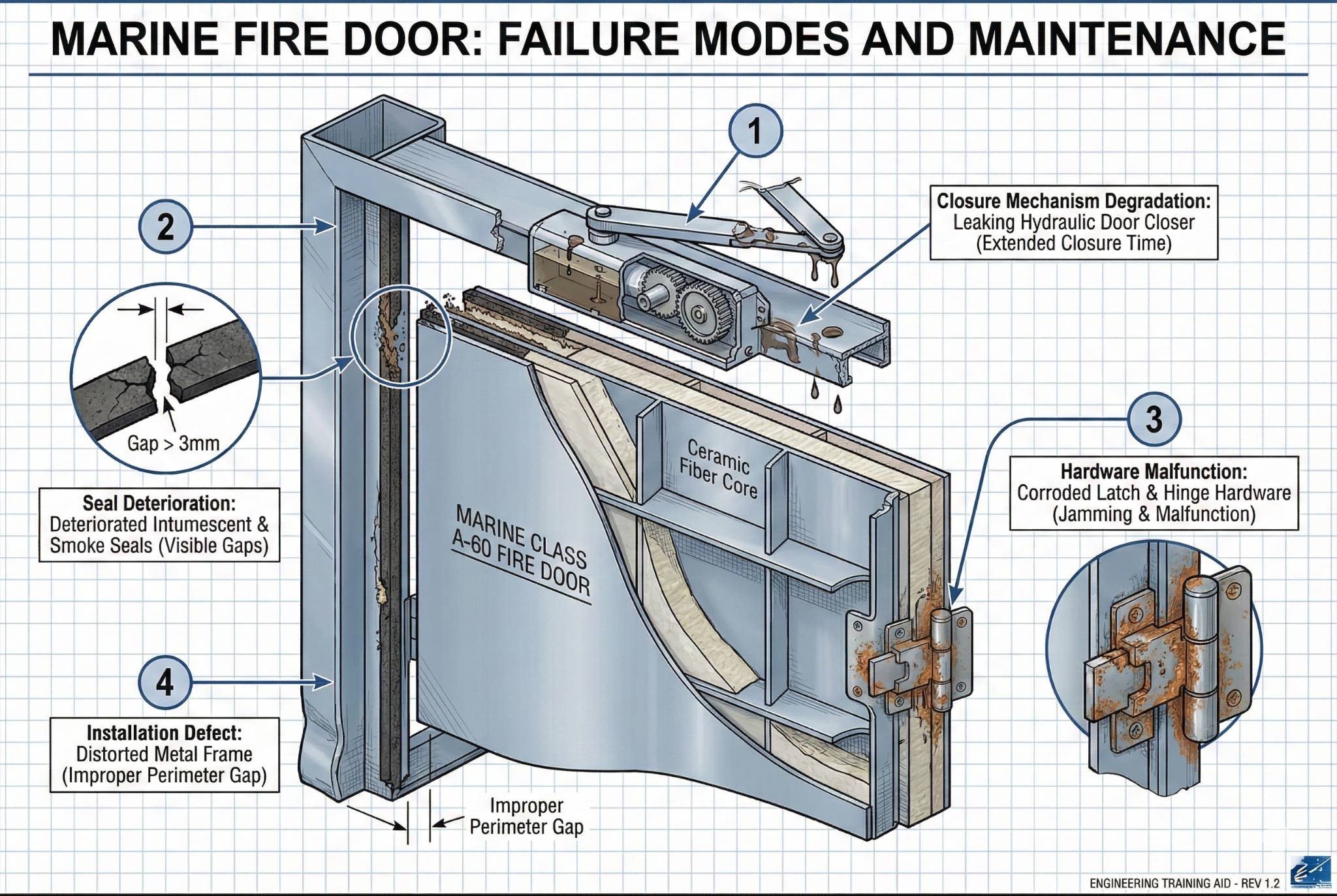
Closer Mechanism Failures: The Most Common Operational Problem
Door closers represent the highest-failure-rate component in fire door assemblies, typically accounting for 60-75% of all fire door deficiencies identified during inspections.
Hydraulic fluid leakage:
Symptoms: Visible oil on closer body or floor, door closes too quickly (less than 90 seconds), door slams shut, or door fails to close completely.
Root causes:
- Seal degradation: O-rings and shaft seals deteriorate from age, temperature extremes, or incompatible hydraulic fluid. Typical seal life in marine environment: 5-7 years for quality closers, 3-5 years for economy closers.
- Overpressure operation: Closer undersized for door weight operates continuously at maximum pressure, accelerating seal wear. A closer rated for 80kg door weight operating on a 100kg door experiences approximately 40% reduction in service life.
- Corrosion: Salt atmosphere causes corrosion of closer body or shaft, creating leak paths. Stainless steel or marine-grade aluminum closers show 3-5× longer life in exterior applications compared to painted steel closers.
- Impact damage: Doors subjected to rough handling or used as handholds develop shaft misalignment, damaging seals.
Prevention strategies:
- Specify oversized closers: Use next size larger than minimum requirement (e.g., Size 4 instead of Size 3 for borderline door weights). Incremental cost: $25-40 per door. Service life increase: 40-60%.
- Select marine-grade materials: Stainless steel or marine aluminum bodies, stainless shafts, synthetic seals resistant to marine atmosphere. Premium cost: $80-120 per closer vs. standard. Life expectancy: 8-12 years vs. 5-7 years.
- Install protective covers: For weather-exposed closers, use protective covers or boots preventing direct salt spray contact. Cost: $15-28 per closer. Maintenance reduction: approximately 35%.
- Implement preventive replacement: Replace all closers on 6-7 year cycle before failure occurs, scheduling during routine maintenance periods. Prevents operational disruptions and fire code violations.
Repair vs. replacement decision: Closers with fluid leakage should be replaced, not repaired. Seal replacement kits are available ($35-65) but labor cost for proper disassembly, cleaning, seal replacement, and fluid refilling typically exceeds $120-180, approaching the cost of a new closer ($180-280 installed). Additionally, repaired closers show approximately 50% shorter service life than new units.
Spring-loaded closer tension loss:
Spring-loaded closers (typically used on lighter doors under 40kg) lose tension over time through spring fatigue and wear.
Symptoms: Door closes slowly or stops before latching, door can be held open with minimal force, door requires push to engage latch.
Root causes:
- Spring fatigue: Repeated cycling (particularly high-traffic doors with >50 cycles per day) causes spring material fatigue. Expected life: 80,000-120,000 cycles for quality springs, 40,000-60,000 cycles for economy closers.
- Wear in pivot points: Bushings and bearing surfaces wear, creating friction that opposes spring force. Wear rate accelerates in contaminated environments (paint spray areas, engine rooms with oil mist).
- Temperature effects: Extreme heat (>60°C in some machinery spaces) reduces spring tension. Spring materials lose approximately 10-15% tension at 60°C compared to 20°C baseline.
Prevention strategies:
- Avoid spring closers in high-traffic applications: Use hydraulic closers for any door with >30 cycles per day. Spring closers appropriate only for low-traffic applications (storerooms, emergency exits).
- Specify heavy-duty springs: Marine-grade spring closers use corrosion-resistant spring materials (stainless steel or phosphate-coated springs) with 50-80% higher cycle life. Cost premium: $40-60 per closer.
- Implement tension verification testing: During routine inspections, verify closure time. Adjust or replace closers showing >120 second closure time or failure to latch.
I analyzed door closer failures on a 5-year-old cruise ship with 340 accommodation fire doors. Over a 12-month period, the ship replaced 67 failed closers (19.7% failure rate) at a cost of $18,760 including parts and labor. Failure analysis showed: 43 closers (64%) were hydraulic fluid leakage, 18 closers (27%) were spring-loaded closers with tension loss, and 6 closers (9%) were impact damage or mounting failures. Implementation of a preventive replacement program for closers >6 years old, combined with upgrading spring closers to hydraulic closers in high-traffic locations, reduced the following year's failure rate to 3.2% (11 closers) with total cost of $3,180. The preventive program cost $14,200 in proactive replacements but eliminated $15,580 in reactive maintenance and prevented fire code deficiencies.
Seal Deterioration: The Hidden Performance Degradation
Intumescent seals and smoke seals degrade over time, creating fire and smoke penetration paths without obvious visual indication until advanced deterioration occurs.
Intumescent seal damage mechanisms:
Mechanical damage from impact or abrasion:
- High-traffic doors experience repeated contact damage as occupants, equipment, and cargo contact door edges
- Carts, trolleys, and equipment striking door edges create seal gaps of 10-50mm length
- Repeated door slamming (from defeated or failed closers) causes seal crushing and adhesive failure
Moisture absorption and expansion:
- Some intumescent materials (particularly graphite-based seals) absorb moisture in high-humidity environments, causing premature expansion and seal deformation
- Moisture-expanded seals may lose intumescent capability, failing to expand further during actual fire conditions
- Typical moisture-related failure: Seals in laundry rooms, galley areas, or weather-exposed locations showing 2-3× higher failure rate
Adhesive deterioration:
- Seals installed with pressure-sensitive adhesive backing experience adhesive degradation from temperature cycling, moisture, or chemical exposure
- Adhesive failure typically occurs at 6-10 years in accommodation spaces, 4-6 years in harsh environments (machinery spaces, exterior locations)
- Failed adhesive allows seal to separate from mounting groove, creating direct fire penetration path
Heat exposure from non-fire sources:
- Steam cleaning activates intumescent seals (which expand at 150-200°C, well within steam cleaning temperature range of 120-180°C)
- High-temperature equipment (ovens, dryers, heat exchangers) located near fire doors subjects seals to chronic elevated temperature, causing gradual expansion and loss of expansion capacity
- Even moderate chronic heat exposure (sustained 60-80°C) degrades some seal materials over 2-3 years
Prevention strategies:
- Edge guards: Install stainless steel edge guards or corner protectors on high-traffic doors, preventing direct seal contact. Cost: $45-85 per door. Seal life extension: 60-100%.
- Seal protection profiles: Use recessed seal installation with metal retainer covering seal surface, preventing mechanical damage and moisture contact. Cost premium: $30-55 per door. Seal life extension: 80-120%.
- Moisture-resistant seal selection: In high-humidity areas, specify silicone-based or hybrid intumescent seals with moisture-resistant properties. Cost premium: $15-25 per door. Failure rate reduction: approximately 70% in humid environments.
- Installation procedure controls: Prohibit high-temperature cleaning methods near fire doors. Specify cold-water pressure washing or manual cleaning only. Training cost: minimal. Seal damage prevention: >90%.
- Inspection and replacement cycle: Implement visual seal inspection every 12 months, with seal replacement at first sign of damage, missing segments >10mm, or adhesive failure. Proactive seal replacement cost: $35-60 per door. Prevention of fire rating compromise: 100%.
Smoke seal compression set:
Smoke seals operate through continuous compression, creating a mechanical barrier to smoke passage. Over time, the seal material develops compression set (permanent deformation), reducing sealing effectiveness.
Compression set progression:
- New seal: Compresses fully, recovering to original shape when door opens
- 3-5 years: Begins showing reduced recovery, slight permanent compression visible
- 5-8 years: Significant compression set, seal remains 30-50% compressed when door is open
- 8+ years: Severe compression set, seal provides minimal sealing force, smoke leakage increases to non-compliant levels
Material-dependent compression set rates:
- Neoprene seals: Moderate compression set, typically require replacement at 5-7 years
- Silicone seals: Superior compression set resistance, typically serviceable for 10-15 years
- PVC or rubber seals: Poor compression set resistance, often require replacement at 4-6 years
Prevention and management:
- Material selection: Specify silicone smoke seals for all applications. Cost premium of $10-18 per door provides 50-100% life extension, resulting in lower life-cycle cost.
- Hold-open prevention: Doors propped open with wedges or other means subject seals to continuous compression accelerating compression set by approximately 3×. Eliminate door propping through hold-open devices or operational procedures.
- Replacement based on performance testing: During inspections, measure smoke seal compression with feeler gauge. Replace seals showing <2mm compression under door-closed conditions.
Hardware Corrosion and Wear: Mechanical Failure Modes
Latches, hinges, and other mechanical hardware experience corrosion and wear-related failures in the marine environment.
Latch mechanism corrosion:
Corrosion mechanisms:
- Atmospheric corrosion: Salt-laden atmosphere causes surface corrosion on mild steel or inadequately protected hardware
- Galvanic corrosion4: Dissimilar metals in contact (e.g., stainless steel latch, aluminum strike plate) create galvanic couple, accelerating corrosion of more anodic material
- Crevice corrosion5: Narrow gaps between latch components trap moisture and contaminants, creating localized corrosion even on stainless steel
Symptoms of corrosion-related latch failure:
- Increased operating force (lever becomes stiff or difficult to turn)
- Binding or jamming during latch retraction
- Incomplete latch engagement (latch stops short of full engagement due to corrosion buildup)
- Latch seizure (complete failure to operate, door cannot be opened)
Prevention strategies:
- Material specification: Use 316 stainless steel hardware (superior corrosion resistance to 304 grade) for all exterior and high-corrosion-risk locations. Cost premium: $40-70 per door vs. 304 grade. Corrosion failure rate reduction: approximately 80%.
- Isolation of dissimilar metals: Install insulating washers or bushings between dissimilar metals. Use same-material fasteners as hardware (stainless fasteners with stainless hardware). Cost: negligible. Galvanic corrosion prevention: >95%.
- Protective coatings: Apply thin-film corrosion inhibitor (e.g., ACF-50, Tef-Gel) to hardware during installation and at 12-month intervals. Cost: $3-5 per door per application. Corrosion rate reduction: 60-75%.
- Lubrication schedule: Apply marine-grade lubricant (Teflon or synthetic-based, not petroleum-based which attracts contaminants) to all moving hardware every 6 months. Cost: $2-4 per door per application. Wear rate reduction: 40-60%.
Hinge binding and wear:
Binding mechanisms:
- Paint buildup: Repeated painting without hinge removal causes paint accumulation in hinge barrel and on hinge pin, creating friction and binding
- Corrosion: Hinge pin corrosion increases friction, particularly in combination with paint contamination
- Misalignment: Frame distortion or hinge mounting fastener loosening causes hinge misalignment, binding door movement
Wear mechanisms:
- High-cycle applications: Traffic levels >50 cycles per day cause bearing surface wear in hinge pin and barrel
- Inadequate lubrication: Dry hinges experience accelerated wear, particularly in contaminated environments
- Overloading: Door weight exceeding hinge capacity causes permanent deformation of hinge components
Prevention strategies:
- Hinge masking during painting: Mask hinges before painting, or remove and reinstall after painting. Labor cost: $15-25 per door. Eliminates paint-related binding.
- Bearing hinges: Use ball-bearing or roller-bearing hinges for high-traffic applications. Cost premium: $80-140 per door vs. standard plain bearing hinges. Service life in high-traffic: 15-20 years vs. 5-8 years for plain bearing.
- Proper sizing: Use next larger hinge size for doors at weight limit. For example, 100mm hinges instead of 75mm hinges for a 60kg door. Cost premium: $20-35 per door. Wear rate reduction: approximately 50%.
- Stainless steel pins: Specify stainless steel hinge pins even if hinge body is mild steel or brass. Cost premium: $8-15 per hinge. Corrosion-related binding reduction: >90%.
A failure analysis case I investigated: A 3-year-old RoRo vessel experienced binding on 18 of 42 weather deck fire doors. Investigation revealed that all 18 doors had been repainted twice without hinge masking, creating significant paint buildup in hinge barrels. Additionally, 14 of the 18 doors showed moderate corrosion on hinge pins (mild steel pins in marine atmosphere). Correction required complete hinge replacement on all 18 doors at a cost of $6,480 plus 4 days of shipyard labor ($3,200). Implementation of hinge masking procedure during subsequent painting prevented recurrence. The lesson: Paint buildup is the most preventable cause of hinge binding, yet it remains common due to inadequate painting procedures and lack of awareness during routine maintenance.
| Failure Mode | Typical Onset Time | Symptoms | Root Cause | Prevention Strategy | Repair Cost | Prevention Cost |
|---|---|---|---|---|---|---|
| Hydraulic closer fluid leakage | 5-7 years (standard), 8-12 years (marine-grade) | Door closes too fast or fails to close, oil visible | Seal degradation, corrosion, impact damage | Marine-grade closers, protective covers, proper sizing | $180-280 per closer installed | $80-120 premium per closer initially |
| Spring closer tension loss | 3-5 years (high traffic), 6-8 years (low traffic) | Slow closing, incomplete latching | Spring fatigue, pivot wear | Use hydraulic closers in high-traffic areas | $120-190 per closer installed | $40-60 premium per closer |
| Intumescent seal mechanical damage | 2-4 years (high traffic), 6-10 years (low traffic) | Visible gaps, missing seal segments | Impact, abrasion, cart strikes | Edge guards, recessed installation, traffic management | $35-60 per door for seal replacement | $45-85 per door for edge guards |
| Smoke seal compression set | 5-7 years (neoprene), 10-15 years (silicone) | Light visible around closed door, reduced compression | Material compression set, chronic compression | Silicone seals, eliminate door propping | $25-45 per door for seal replacement | $10-18 premium per door for silicone seals |
| Latch mechanism corrosion | 3-6 years (mild steel), 8-15 years (316 SS) | Stiff operation, binding, incomplete engagement | Atmospheric corrosion, galvanic corrosion | 316 stainless hardware, protective coatings, lubrication | $140-280 per door for hardware replacement | $40-70 premium for 316 SS, $3-5/yr for coatings |
| Hinge binding | 2-4 years (painted multiple times), 5-8 years (corrosion) | Difficult door movement, squeaking, resistance | Paint buildup, corrosion, misalignment | Hinge masking during painting, bearing hinges, stainless pins | $180-360 per door (3 hinges) | $20-35 per door for proper sizing, negligible for masking |
How should preventive maintenance programs be structured for marine fire doors?
A systematic preventive maintenance program extends fire door service life, maintains fire rating compliance, and reduces emergency repairs. Effective programs balance inspection frequency, corrective actions, and documentation requirements.
A comprehensive fire door preventive maintenance program includes quarterly visual inspections (checking for physical damage, seal condition, hardware operation, and closure function testing), annual operational testing (verifying self-closing performance, latch engagement, seal compression, and hold-open device operation where fitted), biennial component inspection (detailed examination of closer condition, hinge wear, seal adhesion, and frame integrity), and five-year major service (seal replacement regardless of condition, closer replacement or overhaul, complete hardware lubrication and adjustment, coating touch-up or refinishing). Documentation must track each door's inspection history, maintenance actions, component replacements, and compliance status, with all records retained for the vessel's operational life.
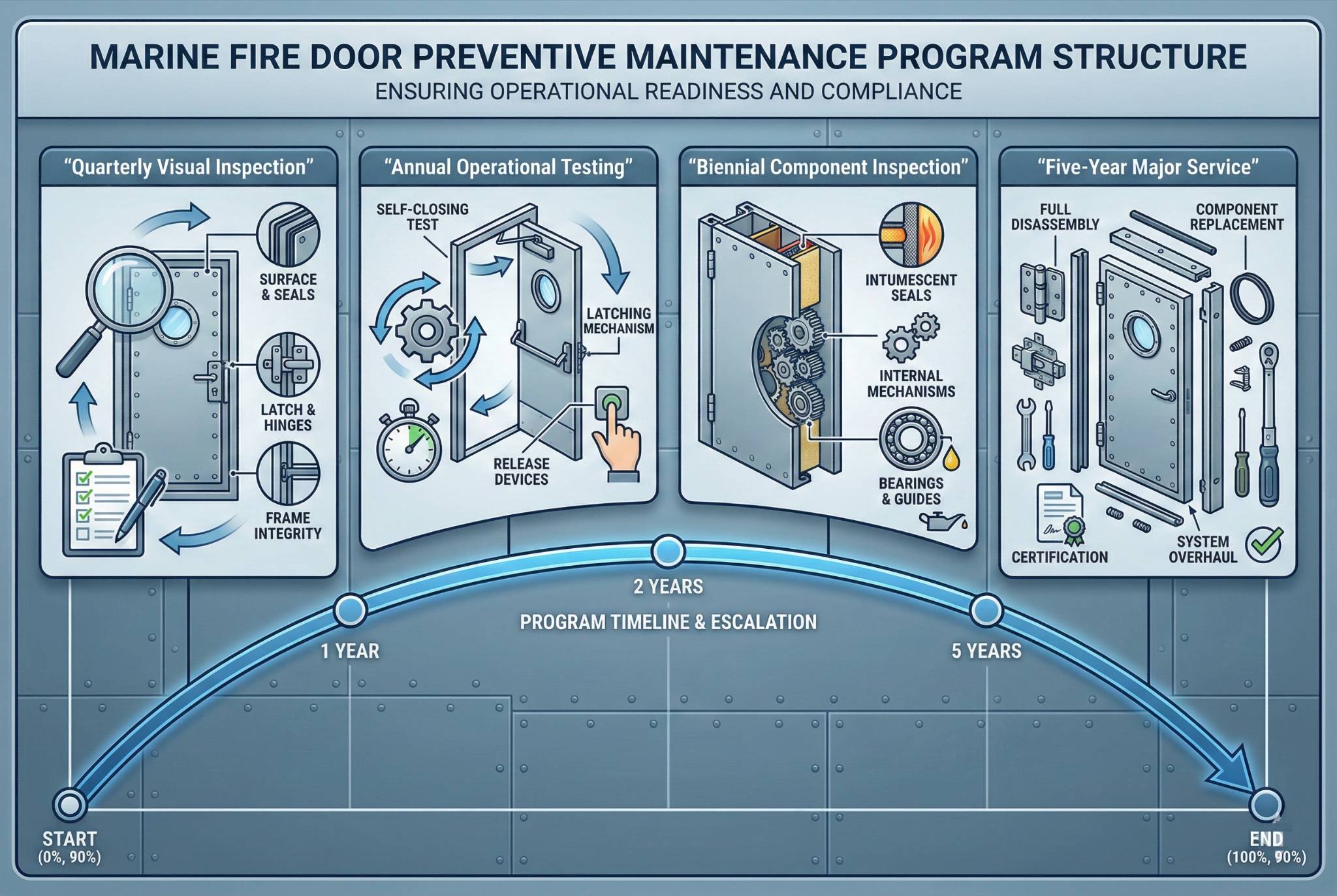
Quarterly Visual Inspections: Early Problem Detection
Quarterly inspections identify developing problems before they cause failures or compliance violations. These inspections require 5-8 minutes per door and can be performed by ship's crew with basic training.
Physical condition inspection:
Door leaf examination:
- Check for impact damage, dents, or deformation exceeding 10mm depth
- Verify coating integrity with no rust, blistering, or coating loss >25mm diameter
- Inspect window (if fitted) for cracks, seal deterioration, or mounting fastener looseness
- Confirm certification label is present, legible, and securely attached
Frame condition:
- Examine frame for distortion, particularly checking that frame faces remain parallel (gap between door and frame should be uniform around perimeter within ±3mm)
- Verify gap sealing between frame and bulkhead remains intact with no missing sections >50mm
- Check for corrosion at frame-to-bulkhead interface, particularly in bilge areas or weather-exposed locations
Seal condition inspection:
Intumescent seals:
- Visual examination for missing segments (any gap >10mm requires immediate attention)
- Check adhesion by gently probing seal; any detached sections require re-adhesion or replacement
- Verify seal is not crushed, deformed, or contaminated with paint or other materials
Smoke seals:
- With door closed, attempt to insert 0.5mm feeler gauge between door and frame at threshold and around perimeter
- Feeler gauge should not insert >10mm at any location
- Check seal for visible compression set (compare compressed vs. uncompressed areas when door opens)
Hardware operation verification:
Closer function:
- Open door to 70° and observe closure
- Door must close to latched position (do not measure time at quarterly inspection, this is annual operational testing requirement)
- Note any irregularities: jerky movement, failure to latch, excessive speed, or unusual noise
Latch operation:
- Test from both sides of door
- Note any increased effort, binding, or incomplete retraction
- Verify latch engages strike plate with minimum 3mm engagement depth
Hinge condition:
- Check all hinge fasteners are tight
- Operate door through full range, noting any binding, squeaking, or resistance
- Visually inspect hinges for corrosion, paint buildup, or wear
Documentation:
Use standardized checklist recording:
- Door identification number
- Inspection date and inspector name
- Pass/fail for each inspection item
- Deficiencies noted with severity rating (immediate attention, routine maintenance, monitor)
- Photographs of any deficiencies
Doors failing quarterly inspection should be tagged for corrective maintenance, with repair priority based on severity:
- Immediate (complete within 24 hours): Closure failure, latch failure, seal gaps >25mm, frame distortion affecting closure
- Urgent (complete within 1 week): Seal damage 10-25mm, hardware binding, minor closer issues not preventing closure
- Routine (complete at next maintenance period): Coating defects, minor seal wear, minor hardware wear not affecting operation
Annual Operational Testing: Performance Verification
Annual operational testing verifies that fire doors meet performance requirements. This testing requires 15-20 minutes per door and should be performed by qualified personnel (ship's engineering officers or contracted specialists).
Self-closing performance test:
Test procedure:
- Close and latch door, then open to 90° angle (verify angle with digital level or protractor)
- Release door and measure time to fully latched position using stopwatch
- Repeat test three times, recording all measurements
- Calculate average closure time
Acceptance criteria:
- Average closure time: 90-180 seconds per SOLAS II-2/9.4.3.2
- Individual measurements: All within 90-180 second range
- Consistency: Standard deviation <10 seconds (indicates consistent closer performance)
Corrective actions:
- Average time <90 seconds: Adjust closer to reduce closing speed (turn adjustment valve counterclockwise typically 1/4 to 1/2 turn increments)
- Average time >180 seconds or failure to latch: Adjust closer to increase closing speed, or replace closer if adjustment range is exhausted
- Inconsistent times (standard deviation >10 seconds): Indicates hinge binding or closer malfunction, requires investigation and correction
Latch engagement verification:
Force measurement test:
- Install door latch force gauge (spring-type or digital gauge)
- Measure force required to operate latch from both sides
- Record maximum force during complete latch cycle
Acceptance criteria:
- Push-to-open side: <100N (approximately 10kg force)
- Lever/knob side: <50N (approximately 5kg force)
- Forces exceeding criteria indicate corrosion, misalignment, or wear requiring investigation
Engagement depth verification:
With door closed and latched, measure latch bolt projection into strike plate:
- Minimum 3mm engagement depth
- Engagement depth <3mm indicates strike plate misalignment or latch wear, requires adjustment or replacement
Seal compression verification:
Feeler gauge test:
- Close and latch door
- Attempt to insert 0.5mm feeler gauge around entire perimeter between door leaf and frame
- Mark locations where gauge inserts >10mm depth
- Photograph deficient areas for documentation
Light test (smoke seal verification):
- Darken space on one side of door
- Close and latch door
- Direct bright flashlight beam around door perimeter from darkened side
- Assistant on opposite side observes for light transmission through gaps
- Any visible light indicates seal deficiency requiring investigation
Hold-open and automatic release testing (if equipped):
For doors with electromagnetic or fusible-link hold-open devices:
- Activate hold-open function and verify door remains open at specified angle (typically 90°)
- Simulate fire alarm activation or manually trigger release
- Verify door releases immediately and closes to latched position within specified time
- Test manual release from both sides of door
- Reset system and verify proper operation
A case study from annual operational testing: During annual testing on a 280-door cruise ship, I identified 23 doors (8.2%) with closure times outside acceptable range: 11 doors with times <90 seconds, 9 doors with times >180 seconds, and 3 doors that failed to latch. Additionally, 17 doors (6.1%) showed latch engagement depth <3mm, and 8 doors (2.9%) had seal compression deficiencies. Total correction cost was $6,340 (primarily closer adjustments and seal repairs). Had these deficiencies not been identified, they would have resulted in fire code violations during flag state inspection and potential detention. The annual testing program cost $8,120 (including labor) but prevented estimated $45,000-65,000 in emergency repairs, inspection deficiencies, and potential operational disruptions.
Biennial Component Inspection: Detailed Technical Assessment
Biennial inspections involve detailed component examination requiring 25-35 minutes per door. These inspections should be performed by qualified technicians with specialized training in fire door systems.
Closer detailed inspection:
Hydraulic closer examination:
- Visual inspection for oil leakage (any visible oil indicates seal failure requiring closer replacement)
- Shaft seal condition: Check for oil weeping around shaft, indicating incipient seal failure
- Mounting security: Verify all mounting fasteners tight, check for elongated mounting holes or cracked mounting brackets
- Adjustment valve operation: Verify adjustment valve rotates freely, not seized or cross-threaded
- Body corrosion: Examine closer body for corrosion, particularly at mounting points and adjustment valve area
Performance degradation indicators:
- Closer operating at maximum adjustment range to achieve acceptable closure time (indicates internal wear or fluid loss, replacement recommended within 6-12 months)
- Erratic closer operation (inconsistent closure speed through door swing) indicates internal valve wear
- Excessive closer operating temperature (closer body hot to touch during normal operation) indicates internal friction or fluid breakdown
Spring closer examination:
- Spring integrity: Visual inspection for broken or deformed spring coils
- Mounting hardware: Check for worn pivots, elongated mounting holes, or loose fasteners
- Spring housing: Verify housing not cracked or deformed
- Damping function: If closer includes damping, verify smooth operation without jerking
Hinge detailed inspection:
Wear assessment:
- Vertical play test: With door closed, attempt to lift door leaf vertically. Any movement >1mm indicates hinge pin or barrel wear
- Horizontal play test: With door open 90°, attempt to move door leaf horizontally perpendicular to door plane. Movement >2mm indicates hinge wear
- Hinge pin condition: If hinges are removable-pin type, remove bottom hinge pin and inspect for wear, scoring, or corrosion. Pin diameter reduction >5% of original diameter indicates replacement required
Hinge binding diagnosis:
- Paint buildup: Examine hinge barrel for paint accumulation. If paint is visible inside barrel, hinge requires cleaning or replacement
- Corrosion: Check hinge pin for rust or corrosion products causing increased friction
- Misalignment: Verify all hinge pins are in perfect vertical alignment (±1mm maximum deviation over door height). Misalignment indicates frame distortion or fastener loosening
Lubrication:
Apply marine-grade lubricant to all hinge pins during biennial inspection:
- Remove excess old lubricant and contaminants
- Apply thin film of Teflon-based or synthetic lubricant (avoid petroleum-based lubricants which attract dirt)
- Cycle door several times to distribute lubricant
- Remove excess lubricant from visible surfaces
Seal detailed assessment:
Intumescent seal condition:
- Adhesion test: Gently attempt to peel seal from mounting surface. Seal should resist with significant force. Easy peeling indicates adhesive degradation requiring seal replacement
- Expansion verification: If door has been in service >7 years, consider test activating a sample of seal material (cut small piece from non-critical location) by heating to 200°C and observing expansion. Failure to expand to minimum 3× original thickness indicates seal has reached end of service life
- Contamination assessment: Check for paint, oil, or other contaminants that could prevent proper intumescent expansion
Smoke seal condition:
- Compression set measurement: With door open, measure seal thickness. Close door and measure compressed thickness. Compression should be minimum 2mm. Compression <2mm indicates compression set requiring seal replacement
- Material degradation: Check for cracking, hardening, or surface deterioration indicating age-related material breakdown
- Splice integrity: Examine all seal corners and splices for separation or gap development
Hardware detailed inspection:
Latch mechanism:
- Disassemble latch cover and inspect internal components for wear, corrosion, or damage
- Verify all springs return components to proper position
- Check for proper lubrication of moving parts
- Test lever/knob return springs for proper tension
- Inspect strike plate for wear or deformation at latch contact points
Fasteners:
- Check torque on all hardware mounting fasteners (hinges, closer, latch, strike plate)
- Verify thread-locking compound or lock washers are present and functional
- Replace any corroded or damaged fasteners
Frame and gap seal inspection:
Frame integrity:
- Verify frame remains square using diagonal measurements (diagonals should be equal within ±3mm)
- Check frame mounting security: All welds continuous with no cracks, or all bolts tight with no elongated mounting holes
- Frame-to-bulkhead interface: Inspect for gap opening, corrosion, or structural movement
Gap seal condition:
- Probe gap seal with thin tool to verify no voids or gaps in fire-rated packing material
- Check surface seal or caulk for cracking, adhesion loss, or missing sections
- Verify seal material remains appropriate type for door fire rating (intumescent material for A-Class, rockwool/ceramic fiber for B-Class)
Documentation:
Biennial inspection generates detailed condition report for each door including:
- Component condition assessment with remaining service life estimates
- Recommended maintenance or replacement actions with priority ratings
- Photographs of key components and any deficiencies
- Update to door maintenance history record
| Inspection Type | Frequency | Duration per Door | Personnel Required | Key Activities | Typical Deficiency Rate | Documentation |
|---|---|---|---|---|---|---|
| Quarterly Visual | Every 3 months | 5-8 minutes | Ship's crew (basic training) | Physical damage, seal condition, basic hardware operation | 8-15% | Simple checklist, deficiency photos |
| Annual Operational | Every 12 months | 15-20 minutes | Engineering officers or specialists | Closure time testing, latch force measurement, seal compression verification | 10-18% | Detailed test results, measurement data |
| Biennial Component | Every 24 months | 25-35 minutes | Qualified technicians with specialized training | Closer detailed inspection, hinge wear assessment, seal detailed assessment | 15-25% | Comprehensive condition report with remaining life estimates |
| Five-Year Major Service | Every 60 months | 45-75 minutes | Specialized technicians or contractors | Seal replacement, closer overhaul/replacement, complete hardware service | N/A (preventive) | Complete service record, parts replacement documentation |
Five-Year Major Service: Preventive Component Replacement
Five-year major service implements preventive component replacement before failure occurs, preventing operational disruptions and fire code violations.
Seal replacement:
Replace all intumescent seals and smoke seals regardless of apparent condition at 5-year intervals (7-year intervals for premium silicone seals in low-humidity environments). Seal material degradation occurs even without visible damage.
Replacement procedure:
- Remove old seals completely, including all adhesive residue
- Clean mounting surfaces with solvent (isopropyl alcohol or marine-grade cleaner), ensuring complete adhesive removal
- Verify mounting groove dimensions and condition
- Install new seals with appropriate adhesive (intumescent seals typically use pressure-sensitive adhesive backing; smoke seals may require separate contact adhesive application)
- Miter corners at 45° angles for professional appearance and continuous seal coverage
- Allow adhesive cure time per manufacturer specifications (typically 24-48 hours) before door operation
Seal replacement cost breakdown:
- Materials: $35-60 per door (seals and adhesives)
- Labor: 45-75 minutes per door depending on door size and seal complexity
- Total cost: $80-140 per door for professional installation
Seal replacement at 5-year intervals prevents approximately 90% of seal-related failures that would otherwise occur between years 6-10 of service life.
Closer replacement or overhaul:
At five-year service, closers should be evaluated for replacement or overhaul based on cumulative cycle count and operational environment.
Replacement criteria:
- Mandatory replacement: All closers with >50 door cycles per day (18,250 cycles per year, 91,250 cycles at 5 years approaching design life of 100,000-150,000 cycles for quality closers)
- Recommended replacement: All closers in harsh environments (weather-exposed, engine rooms, high-humidity spaces) showing any signs of corrosion or deterioration
- Optional retention: Closers in low-traffic (<10 cycles per day), controlled environments showing no degradation may continue in service with increased inspection frequency
Overhaul vs. replacement decision:
- Closer overhaul (seal replacement, fluid replacement, internal component inspection): Cost $95-140 per closer, requires 2-3 hour labor, results in approximately 50% of new closer service life
- New closer installation: Cost $180-280 per closer installed, provides full design service life of 8-12 years
- Recommendation: Replace rather than overhaul. Marginal cost savings of overhaul ($60-100) do not justify reduced service life and higher failure risk
I analyzed closer replacement economics on a ferry with 180 fire doors at 5-year major service. Option A: Overhaul all closers at $120 average cost = $21,600 total. Option B: Replace all closers at $230 average cost = $41,400 total. Over the subsequent 5-year period (years 6-10), Option A experienced 34 closer failures requiring emergency replacement at average $340 cost (including emergency labor premium) = $11,560 additional cost. Option A total 10-year cost: $33,160. Option B experienced 3 closer failures (manufacturing defects) at $340 average cost = $1,020 additional cost. Option B total 10-year cost: $42,420. Although Option B had higher initial cost, the reduction in operational disruptions, emergency callouts, and fire code violations provided superior value. Additionally, Option A closers at year 10 required complete replacement, while Option B closers retained 60-70% remaining service life.
Hardware service:
Complete hardware lubrication:
- Disassemble latch mechanisms and apply marine-grade lubricant to all moving parts
- Lubricate all hinge pins with Teflon-based lubricant
- Apply corrosion inhibitor to all hardware surfaces
- Reassemble and verify proper operation
Hardware adjustment:
- Verify and adjust latch alignment and engagement depth
- Check and adjust strike plate position if necessary
- Verify lever/knob return spring tension and adjust or replace as needed
- Tighten all mounting fasteners to specified torque
Coating refinishing:
At five-year service, evaluate door coating condition and perform touch-up or complete refinishing as required.
Touch-up refinishing (minor coating defects <10% of door surface):
- Sand damaged areas to bare metal or to sound coating
- Apply corrosion-inhibiting primer to bare metal areas
- Apply finish coat matching existing color
- Feather edges to blend with existing coating
- Cost: $40-80 per door
Complete refinishing (coating defects >10% of surface or overall coating degradation):
- Remove door from frame and transport to preparation area
- Strip existing coating to bare metal (chemical stripping or media blasting)
- Apply corrosion-inhibiting primer system
- Apply two coats of finish coating per manufacturer specifications
- Reinstall door after coating cure period
- Cost: $280-450 per door including removal, refinishing, and reinstallation
Complete refinishing extends door service life by 10-15 years, preventing corrosion-related deterioration and maintaining fire rating integrity.
Major service cost analysis:
| Component | Action | Cost per Door | Frequency | 20-Year Life-Cycle Cost | Benefit |
|---|---|---|---|---|---|
| Intumescent seals | Replacement | $35-60 materials | Every 5 years (4 replacements over 20 years) | $140-240 | Maintains fire barrier integrity, prevents 90% of seal failures |
| Smoke seals | Replacement | $25-45 materials | Every 5 years (4 replacements over 20 years) | $100-180 | Maintains smoke barrier, prevents compression set failures |
| Door closer | Replacement | $180-280 installed | Every 10 years (2 replacements over 20 years) | $360-560 | Prevents operational failures, reduces emergency repairs by 85% |
| Complete hardware service | Lubrication, adjustment, minor repairs | $60-95 labor | Every 5 years (4 services over 20 years) | $240-380 | Extends hardware life, maintains smooth operation |
| Coating refinishing | Touch-up or complete | $40-450 depending on extent | Touch-up every 5 years, complete at year 10 | $200-800 | Prevents corrosion, maintains appearance, extends door life |
| Total 20-Year Preventive Maintenance Cost | $1,040-2,160 per door | Prevents premature door replacement ($2,500-4,500 per door), eliminates 80-90% of emergency repairs, maintains fire code compliance |
Documentation and Record-Keeping Requirements
Comprehensive documentation proves compliance with SOLAS fire safety requirements and provides data for maintenance program optimization.
Required documentation:
Individual door records:
Each fire door must have an individual maintenance record containing:
- Door identification (location, frame number, door number)
- Door specification (fire rating, dimensions, manufacturer, date of installation)
- Certification information (certificate number, certifying authority, date of certification)
- Complete inspection history (dates, inspector names, inspection results)
- Complete maintenance history (dates, work performed, components replaced, labor hours, costs)
- Deficiency history (deficiencies identified, corrective actions, completion dates)
- Current condition status and remaining service life estimates for major components
Fleet-level records:
- Summary of all doors with current compliance status
- Overdue inspection or maintenance items requiring immediate attention
- Component failure analysis (failure modes, failure rates, mean time between failures)
- Cost analysis (maintenance costs per door, cost trends over time)
- Spare parts inventory and usage tracking
Retention requirements:
- All records retained for life of vessel
- Paper records stored in fire-resistant safe or cabinet
- Electronic records backed up to shore-based server
- Key records (certifications, major repairs, classification society inspections) maintained in duplicate locations
Record format:
Electronic database systems provide superior functionality compared to paper records:
- Searchable by door number, location, component type, or date range
- Automated generation of inspection schedules and overdue maintenance alerts
- Statistical analysis capabilities for failure rate trending and cost optimization
- Photographic documentation integrated with text records
- Classification society inspection preparation reports generated automatically
Several commercial fire door management software systems are available ($1,200-3,500 per vessel depending on door count and functionality), or custom databases can be developed using standard database platforms (Microsoft Access, FileMaker Pro) at lower cost but with less specialized functionality.
What are the costs and life-cycle economics of marine fire doors?
Understanding total cost of ownership enables accurate budgeting and cost-effective procurement decisions. Life-cycle costs include initial acquisition, installation, maintenance, and eventual replacement.
Marine fire door costs vary significantly based on fire rating, size, materials, and certification requirements. Initial acquisition costs range from $800-1,500 for basic A-0 Class doors (30-minute fire rating) to $2,500-4,500 for A-60 Class doors (60-minute fire rating) with premium materials and hardware. Installation labor adds $200-450 per door depending on access, frame preparation requirements, and commissioning complexity. Annual maintenance costs average $120-180 per door for inspections and routine service, with major component replacements adding $250-400 per door every 5-10 years. Over a typical 20-25 year service life, total life-cycle cost ranges from $3,500-6,500 for basic doors to $7,000-12,000 for premium high-traffic doors, making maintenance and operational costs 2-3 times higher than initial acquisition costs.
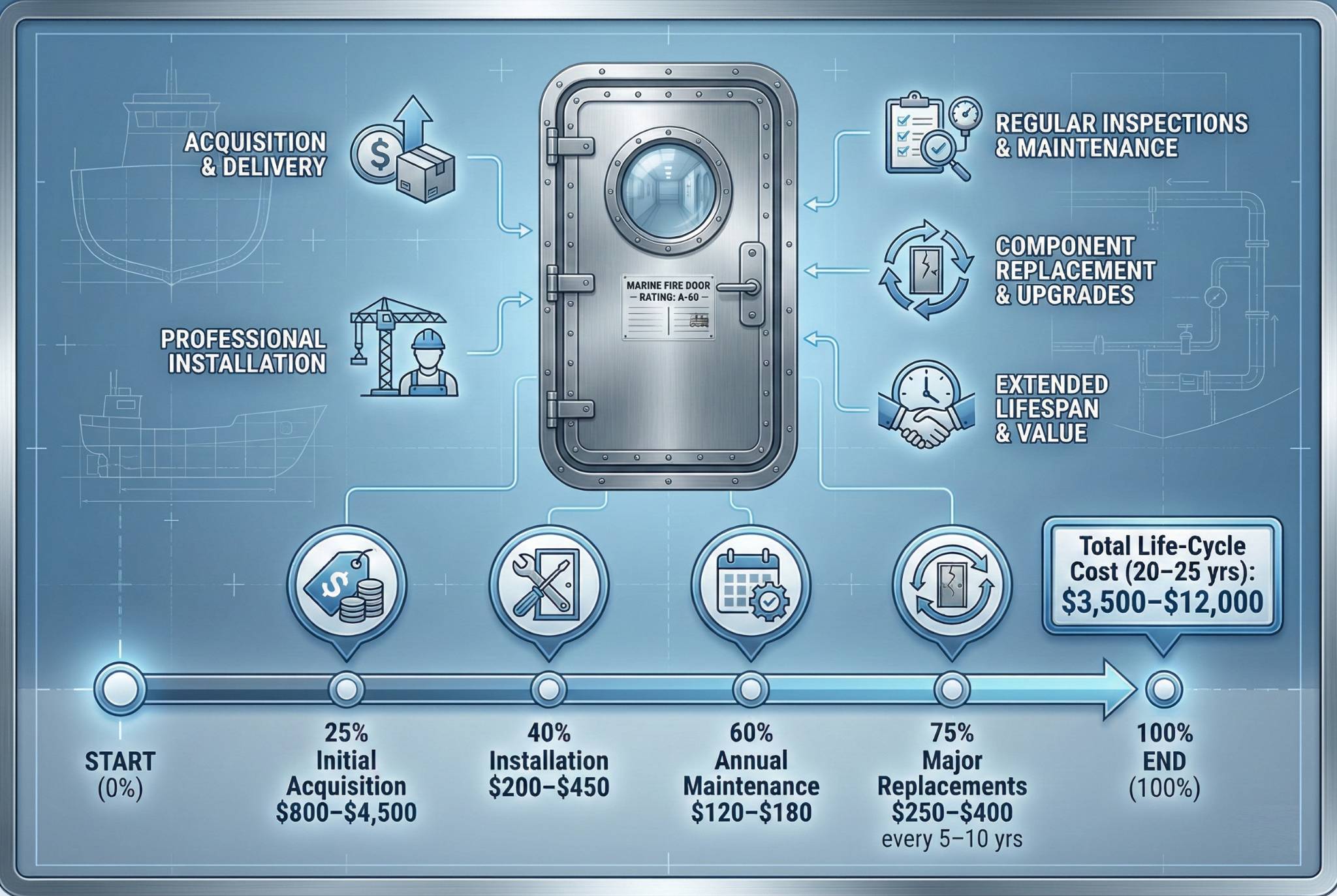
Initial Acquisition Costs: Door Price Breakdown
Marine fire door prices vary based on multiple factors affecting manufacturing complexity, material costs, and certification requirements.
Fire rating impact on cost:
Fire rating drives door construction complexity and material requirements, directly impacting cost.
| Fire Rating | Construction Complexity | Typical Core Material | Seal Requirements | Hardware Requirements | Price Range (Standard Size 800x2000mm) | Price Premium vs. A-0 Baseline |
|---|---|---|---|---|---|---|
| A-0 (30 min) | Basic steel construction, 1.2-1.5mm steel face sheets | Rockwool, mineral wool (50-75mm thickness) | Single intumescent seal, basic smoke seal | Standard closer, basic latch | $800-1,500 | Baseline (0%) |
| A-15 (45 min) | Enhanced steel construction, 1.5-2.0mm steel face sheets | Ceramic fiber, dense rockwool (75-100mm thickness) | Enhanced intumescent seal, compression smoke seal | Standard closer, marine-grade latch | $1,200-2,100 | +50-65% |
| A-30 (60 min) | Heavy steel construction, 2.0-2.5mm steel face sheets | Ceramic fiber (100-125mm thickness) | Multiple intumescent seals, high-temp smoke seals | Heavy-duty closer, marine-grade latch | $1,800-3,200 | +125-160% |
| A-60 (90 min) | Maximum steel construction, 2.5-3.0mm steel face sheets | Ceramic fiber or vermiculite (125-150mm thickness) | Multiple redundant intumescent seals, premium smoke seals | Extra-heavy-duty closer, premium latch | $2,500-4,500 | +210-280% |
Size impact on cost:
Door size affects material quantity, manufacturing complexity, and hardware requirements.
Standard size door (800mm × 2000mm): Baseline pricing as shown in table above
Oversized single-leaf door (1000mm × 2200mm):
- Material increase: +40-50% (steel, core, seals)
- Hardware upgrade required: Heavier-duty closer (+$80-120), additional or larger hinges (+$60-90)
- Manufacturing complexity: +15-20% labor
- Total cost premium: +55-70% vs. standard size
Double-leaf door (1600mm × 2000mm total opening, two 800mm leaves):
- Material cost: Approximately 2× single door cost for leaves
- Hardware requirements: Two closers, coordinator hardware, astragal seal system, additional hinges
- Frame complexity: More complex frame construction with center mullion
- Total cost: 2.2-2.5× single-leaf door cost (not simple doubling due to coordinator and frame complexity)
Custom size doors:
Non-standard dimensions require custom manufacturing, adding 25-40% cost premium over nearest standard size equivalent. Lead time increases from 6-8 weeks (standard doors) to 10-14 weeks (custom doors).
Material and finish impact on cost:
Steel type:
- Mild steel with powder coat finish: Baseline cost
- 304 stainless steel: +120-180% cost premium
- 316 stainless steel (marine-grade): +180-240% cost premium
Stainless steel provides superior corrosion resistance in exterior and harsh environment applications, with life-cycle cost benefits offsetting higher initial cost through reduced maintenance and longer service life (25-30 years vs. 15-20 years for coated mild steel in harsh environments).
Window provisions:
Doors with fire-rated windows add cost for window frame, fire-rated glazing, and installation:
- Small window (300mm × 300mm): +$180-280 per door
- Standard window (400mm × 600mm): +$320-480 per door
- Large window (600mm × 800mm): +$550-750 per door
Fire-rated glazing types affect cost: wired glass (baseline), ceramic glass (+40-60% vs. wired), intumescent interlayer laminated glass (+80-120% vs. wired).
Hardware quality impact on cost:
Economy hardware package:
- Standard hydraulic closer (Size 3-4): $120-180
- Basic marine latch: $85-130
- Standard hinges (3 required): $40-65 total
- Basic seals: $25-40
- Total hardware cost: $270-415
- Service life in moderate conditions: 5-8 years before major component replacement
Premium hardware package:
- Marine-grade hydraulic closer with corrosion-resistant body: $200-320
- Premium marine latch (316 stainless): $160-240
- Ball-bearing hinges (3 required): $120-180 total
- Premium silicone seals: $45-70
- Total hardware cost: $525-810
- Service life in harsh conditions: 10-15 years before major component replacement
Hardware upgrade cost premium of $255-395 per door provides 80-120% service life extension, resulting in lower life-cycle cost despite higher initial investment.
Certification and compliance impact on cost:
SOLAS-certified doors from established manufacturers:
Baseline pricing as discussed above includes SOLAS certification and major classification society approvals (Lloyd's Register, DNV, ABS, BV).
Non-certified or partially certified doors:
Doors lacking proper certification may be offered at 30-50% discount vs. certified doors but cannot be legally installed on SOLAS vessels. While appearing economical, these doors create liability, inspection failure risk, and potential vessel detention.
Special classification society requirements:
Some classification societies or flag states impose additional requirements beyond basic SOLAS standards:
- Extended fire testing protocols: +$150-250 per door for additional certification costs
- Special materials or construction methods: Variable cost impact depending on requirement
- Enhanced documentation: +$50-100 per door for additional certification paperwork and quality records
Installation Costs: Labor and Commissioning
Installation labor significantly impacts total project cost, particularly for retrofit installations requiring frame preparation or bulkhead modifications.
New construction installation:
Frame installation during bulkhead fabrication:
- Frame positioning and tack welding: 1.5-2.5 hours labor
- Final frame welding: 2.0-3.0 hours labor
- Gap seal installation and verification: 1.0-1.5 hours labor
- Total labor: 4.5-7.0 hours per door
- Labor cost at typical shipyard rates ($45-65/hour): $200-455 per door
Door leaf installation and adjustment:
- Hardware installation (hinges, closer, latch): 1.5-2.0 hours labor
- Door hanging and alignment: 1.0-1.5 hours labor
- Operational adjustment and testing: 0.5-1.0 hours labor
- Total labor: 3.0-4.5 hours per door
- Labor cost: $135-290 per door
Total new construction installation: $335-745 per door
Retrofit installation:
Retrofit installations in existing vessels require additional labor for old door removal, frame preparation, and potential bulkhead modification.
Old door and frame removal:
- Door hardware removal and door leaf removal: 0.5-1.0 hours
- Frame cutting and removal: 1.5-3.0 hours (varies with frame attachment method and access)
- Bulkhead surface preparation: 1.0-2.0 hours (grinding, cleaning, surface preparation)
- Total labor: 3.0-6.0 hours per door
Frame modification or bulkhead preparation:
If new door frame dimensions differ from old frame, bulkhead modification may be required:
- Minor modification (±50mm dimension change): 2.0-4.0 hours labor
- Major modification (>50mm or structural change): 4.0-8.0 hours labor plus engineering review
- Structural reinforcement if required: 6.0-12.0 hours labor plus materials ($200-500)
New frame and door installation:
Same labor as new construction (4.5-7.0 hours for frame, 3.0-4.5 hours for door)
Total retrofit installation: $450-950 per door for straightforward replacements, $800-1,800 per door for installations requiring bulkhead modifications or structural work
Commissioning and certification:
After installation, doors require commissioning inspection and testing before operational acceptance.
Commissioning activities:
- Closure time testing and closer adjustment: 15-25 minutes per door
- Latch operation verification and adjustment: 10-15 minutes per door
- Seal compression verification: 10-15 minutes per door
- Documentation preparation (test records, certification paperwork): 10-20 minutes per door
- Total commissioning time: 45-75 minutes per door
Classification society inspection:
For new installations or major modifications, classification society surveyor inspection may be required:
- Surveyor fees: $800-1,500 per inspection visit
- Surveyor time allocation: Typically 15-20 doors per inspection visit
- Cost per door: $40-100 allocated surveyor cost
Total commissioning cost: $85-165 per door including labor and allocated surveyor fees
Annual Operating Costs: Maintenance and Inspection
Ongoing maintenance and inspection costs constitute the largest component of life-cycle costs, typically exceeding initial acquisition costs over 20-year service life.
Routine inspection costs:
Quarterly visual inspections:
- Labor time: 5-8 minutes per door
- Annual labor cost (4 quarterly inspections): 20-32 minutes per door
- Cost at typical crew rate ($35-50/hour): $12-27 per door annually
- Deficiency documentation: Photography and record-keeping adds approximately 15% additional time for doors with deficiencies (assume 10% of doors require deficiency documentation each quarter): +$1-3 per door annually
- Total quarterly inspection cost: $13-30 per door annually
Annual operational testing:
- Labor time: 15-20 minutes per door
- Cost at typical engineering officer rate ($45-65/hour): $11-22 per door annually
- Test equipment (closer time measurement, latch force gauge, feeler gauges): Minimal cost, approximately $2-4 per door annually allocated equipment depreciation
- Total annual operational testing cost: $13-26 per door annually
Biennial component inspection:
- Labor time: 25-35 minutes per door
- Cost at specialized technician rate ($55-75/hour): $23-44 per door per inspection
- Annualized cost (every 2 years): $12-22 per door annually
- Total biennial inspection cost: $12-22 per door annually
Total routine inspection cost: $38-78 per door annually
This inspection regime identifies 90-95% of developing problems before they result in operational failures or compliance violations.
Routine maintenance costs:
Minor adjustments and lubrication:
Based on typical deficiency rates, approximately 15-20% of doors require minor adjustment or lubrication annually:
- Average labor time when required: 30-45 minutes per door
- Average cost when required: $28-56 per door
- Annualized cost across all doors: $4-11 per door annually (factoring 15-20% incidence rate)
Coating touch-up:
Approximately 8-12% of doors require minor coating touch-up annually:
- Average materials cost: $15-25 per door when required
- Average labor: 45-75 minutes per door when required
- Average total cost when required: $48-81 per door
- Annualized cost across all doors: $4-10 per door annually (factoring 8-12% incidence rate)
Seal repair:
Approximately 5-8% of doors require seal repair (re-adhesion or partial replacement) annually:
- Average materials cost: $12-20 per door when required
- Average labor: 30-60 minutes per door when required
- Average total cost when required: $40-70 per door
- Annualized cost across all doors: $2-6 per door annually (factoring 5-8% incidence rate)
Total routine maintenance cost: $10-27 per door annually
Emergency repairs:
Despite preventive maintenance, some emergency repairs occur due to accidental damage, sudden hardware failure, or operational requirements.
Typical emergency repair frequency: 0.05-0.15 events per door per year (1 emergency repair per door every 7-20 years depending on traffic levels and operational environment)
Emergency repair costs:
- Emergency labor premium: 50-100% higher than standard rates
- Average emergency repair cost: $280-550 per event (closer replacement, latch repair, significant seal damage, or frame alignment correction)
- Annualized cost across all doors: $14-83 per door annually (factoring incidence rate and cost per event)
Lower values represent well-maintained low-traffic doors in controlled environments; higher values represent high-traffic doors in harsh environments with less rigorous preventive maintenance.
Total annual operating cost: $62-188 per door
| Cost Category | Low End (Well-Maintained, Low-Traffic, Controlled Environment) | High End (High-Traffic, Harsh Environment, Reactive Maintenance) | Primary Cost Drivers | Optimization Strategies |
|---|---|---|---|---|
| Routine inspections | $38/door/year | $78/door/year | Labor rates, inspection frequency, documentation requirements | Train crew for quarterly inspections, implement electronic records to reduce documentation time, batch inspections by zone |
| Routine maintenance | $10/door/year | $27/door/year | Deficiency rates, labor efficiency, materials costs | Improve preventive maintenance to reduce deficiency rates, maintain spare parts inventory to reduce procurement delays |
| Emergency repairs | $14/door/year | $83/door/year | Failure rates, emergency labor premiums, parts costs | Implement comprehensive preventive maintenance, replace components before failure, maintain critical spare parts inventory |
| Total Annual Operating Cost | $62/door/year | $188/door/year | Maintenance philosophy (preventive vs. reactive), operational environment, traffic levels | Shift from reactive to preventive maintenance (reduces emergency repairs by 60-80%), implement five-year major service program |
Major Component Replacement Costs
Major components require periodic replacement throughout door service life, representing significant life-cycle cost elements.
Door closer replacement:
Replacement frequency:
- Standard closers in moderate traffic: 8-12 year service life
- Premium closers in moderate traffic: 12-18 year service life
- Any closer in harsh environment: 5-8 year service life
- High-traffic doors (>50 cycles/day): 5-7 year service life regardless of closer quality
Replacement costs:
- Standard closer: $120-180 parts + $45-75 labor = $165-255 total
- Premium closer: $200-320 parts + $45-75 labor = $245-395 total
Life-cycle analysis (20-year service life):
- Standard closer, moderate traffic: 2 replacements over 20 years = $330-510 total closer cost
- Premium closer, moderate traffic: 1-2 replacements over 20 years = $245-790 total closer cost
- Standard closer, harsh/high-traffic: 3-4 replacements over 20 years = $495-1,020 total closer cost
- Premium closer, harsh/high-traffic: 2-3 replacements over 20 years = $490-1,185 total closer cost
Conclusion: Premium closers provide marginal benefit in moderate traffic/controlled environments, but standard closers are more cost-effective. However, in harsh or high-traffic environments, premium closers provide equivalent or superior life-cycle value due to extended service intervals.
Seal replacement:
Replacement frequency:
- Intumescent seals: 5-7 years in typical service, 7-10 years in ideal conditions
- Smoke seals (neoprene): 5-7 years typical service life
- Smoke seals (silicone): 8-12 years typical service life
Replacement costs:
- Intumescent seal replacement: $35-60 materials + $33-56 labor = $68-116 per door
- Smoke seal replacement: $25-45 materials + $25-45 labor = $50-90 per door
- Combined seal replacement (both types): $60-105 materials + $50-85 labor = $110-190 per door
Life-cycle analysis (20-year service life):
- Standard seal materials with 5-year replacement: 4 replacements = $440-760 total seal costs over 20 years
- Premium seal materials with 7-year replacement: 3 replacements = $330-570 total seal costs over 20 years
Conclusion: Premium seal materials provide 15-25% life-cycle cost reduction through extended service intervals, with additional benefits of reduced maintenance events and improved reliability.
Latch mechanism replacement:
Replacement frequency:
- Standard marine latch: 12-18 year service life with proper maintenance
- Premium 316 stainless latch: 20-30 year service life
Replacement costs:
- Standard marine latch: $85-130 parts + $45-75 labor = $130-205 per door
- Premium 316 stainless latch: $160-240 parts + $45-75 labor = $205-315 per door
Life-cycle analysis (20-year service life):
- Standard latch: 1-2 replacements = $130-410 total latch costs over 20 years
- Premium latch: 0-1 replacements = $0-315 total latch costs over 20 years
Conclusion: Premium latches provide superior life-cycle value, typically eliminating latch replacement over 20-year door service life while providing improved reliability and reduced maintenance requirements.
Hinge replacement:
Replacement frequency:
- Standard hinges: 15-25 year service life with proper maintenance (may last full door service life in low-traffic applications)
- Ball-bearing hinges: 25-35 year service life
Replacement costs:
- Standard hinge set (3 hinges): $40-65 parts + $60-95 labor = $100-160 per door
- Ball-bearing hinge set (3 hinges): $120-180 parts + $60-95 labor = $180-275 per door
Life-cycle analysis (20-year service life):
- Standard hinges: 0-1 replacements = $0-160 total hinge costs over 20 years
- Ball-bearing hinges: 0 replacements = $0 total hinge costs over 20 years (initial installation only)
Conclusion: Standard hinges typically provide adequate service life for 20-year period in most applications. Ball-bearing hinges offer marginal life-cycle benefit but provide superior operational smoothness beneficial for high-traffic or heavy doors.
Complete hardware system replacement:
In harsh environments or high-traffic applications, complete hardware system replacement (all components) may be cost-effective compared to sequential individual component replacement.
Complete hardware replacement cost:
- All closers, latches, hinges, and seals replaced simultaneously
- Materials: $350-620 per door depending on component quality selection
- Labor efficiency benefit: Replacing all components simultaneously reduces labor vs. sequential replacement (3.5-5.0 hours vs. cumulative 5.0-7.5 hours for sequential replacement)
- Total cost: $510-945 per door for complete hardware system replacement
Replacement frequency:
Typically performed once at 10-12 year midpoint of 20-25 year door service life in harsh/high-traffic environments.
Life-cycle comparison:
Sequential component replacement approach:
- Closer replacement (year 8): $165-255
- Seal replacement (years 5, 10, 15): $330-570
- Latch replacement (year 15): $130-205
- Hinge replacement (year 18): $100-160
- Total over 20 years: $725-1,190
- Number of maintenance events: 5-6 separate interventions
Complete hardware replacement approach:
- Complete replacement (year 10): $510-945
- Seal replacement (year 5, 15): $220-380
- Total over 20 years: $730-1,325
- Number of maintenance events: 3 interventions
Complete hardware replacement provides similar or slightly higher total cost but reduces maintenance events by 40-50%, reducing operational disruption and providing a fully refreshed hardware system with synchronized component service lives.
Complete Life-Cycle Cost Analysis
Total cost of ownership over typical 20-25 year door service life significantly exceeds initial acquisition cost.
Baseline door (A-0 Class, standard size, moderate traffic, controlled environment):
| Cost Component | Timing | Cost | 20-Year NPV (5% Discount Rate) |
|---|---|---|---|
| Initial acquisition | Year 0 | $1,200 | $1,200 |
| Installation | Year 0 | $400 | $400 |
| Annual operating costs | Years 1-20 | $62/year | $772 |
| Closer replacement | Years 8, 16 | $210 each | $337 |
| Seal replacement | Years 5, 10, 15 | $140 each | $347 |
| Latch replacement | Year 15 | $170 | $81 |
| Coating refinishing | Year 10 | $350 | $215 |
| Total 20-Year Life-Cycle Cost | $3,352 | ||
| Annual Equivalent Cost | $269/year |
Premium door (A-60 Class, standard size, high traffic, harsh environment):
| Cost Component | Timing | Cost | 20-Year NPV (5% Discount Rate) |
|---|---|---|---|
| Initial acquisition | Year 0 | $3,800 | $3,800 |
| Installation | Year 0 | $550 | $550 |
| Annual operating costs | Years 1-20 | $155/year | $1,931 |
| Complete hardware replacement | Year 10 | $750 | $460 |
| Seal replacement | Years 5, 15 | $180 each | $219 |
| Coating refinishing (stainless, minimal) | Year 15 | $150 | $72 |
| Total 20-Year Life-Cycle Cost | $7,032 | ||
| Annual Equivalent Cost | $564/year |
Key insights from life-cycle cost analysis:
-
Maintenance costs exceed acquisition costs: Over 20-year service life, maintenance and operating costs represent 55-65% of total life-cycle cost, highlighting importance of maintenance planning and budgeting.
-
Premium components provide measurable value: Higher-quality closers, latches, and seals reduce life-cycle costs by 12-18% through extended service intervals and reduced failure rates, despite 40-60% higher initial cost.
-
Environment dramatically affects costs: Harsh environment doors have 2.0-2.5× higher life-cycle costs compared to controlled environment doors of equivalent initial quality, driven primarily by increased maintenance frequency and component replacement rates.
-
Preventive maintenance reduces total costs: Comprehensive preventive maintenance programs increase planned maintenance costs by 30-40% but reduce emergency repair costs by 60-80%, resulting in net life-cycle cost reduction of 15-25%.
-
Fire rating affects life-cycle costs: Higher fire ratings (A-60 vs. A-0) have 110-120% higher initial costs but only 35-50% higher ongoing maintenance costs, resulting in better relative value for high-rating doors over extended service life.
Conclusion
Selecting the right marine fire door requires systematic evaluation of fire integrity classifications, compartment locations, environmental conditions, regulatory requirements, dimensional specifications, hardware components, quality protocols, failure prevention strategies, maintenance programs, and life-cycle economics to ensure SOLAS compliance, operational reliability, and cost-effectiveness throughout 20-25 year service life.
-
SOLAS II-2/Regulation 9 outlines critical fire safety regulations; explore its details. ↩
-
Understanding corrosion resistance is crucial for selecting materials that ensure longevity and safety in marine environments. ↩
-
Explore the standards set by ISO 12944-5 for powder coating in marine applications. ↩
-
Learn about galvanic corrosion to protect your hardware from accelerated deterioration. ↩
-
Explore crevice corrosion to ensure the longevity of your mechanical components. ↩