Shipbuilders often struggle with heavy, outdated interior materials that increase fuel consumption and slow down installation. Continuing to rely on traditional rockwool or steel panels adds unnecessary deadweight to your vessel, leading to higher operational costs and lower efficiency over time. Marine aluminum honeycomb panels solve this by offering a lightweight, rigid, and fire-compliant solution that drastically reduces weight without sacrificing structural integrity.
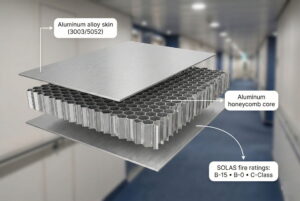
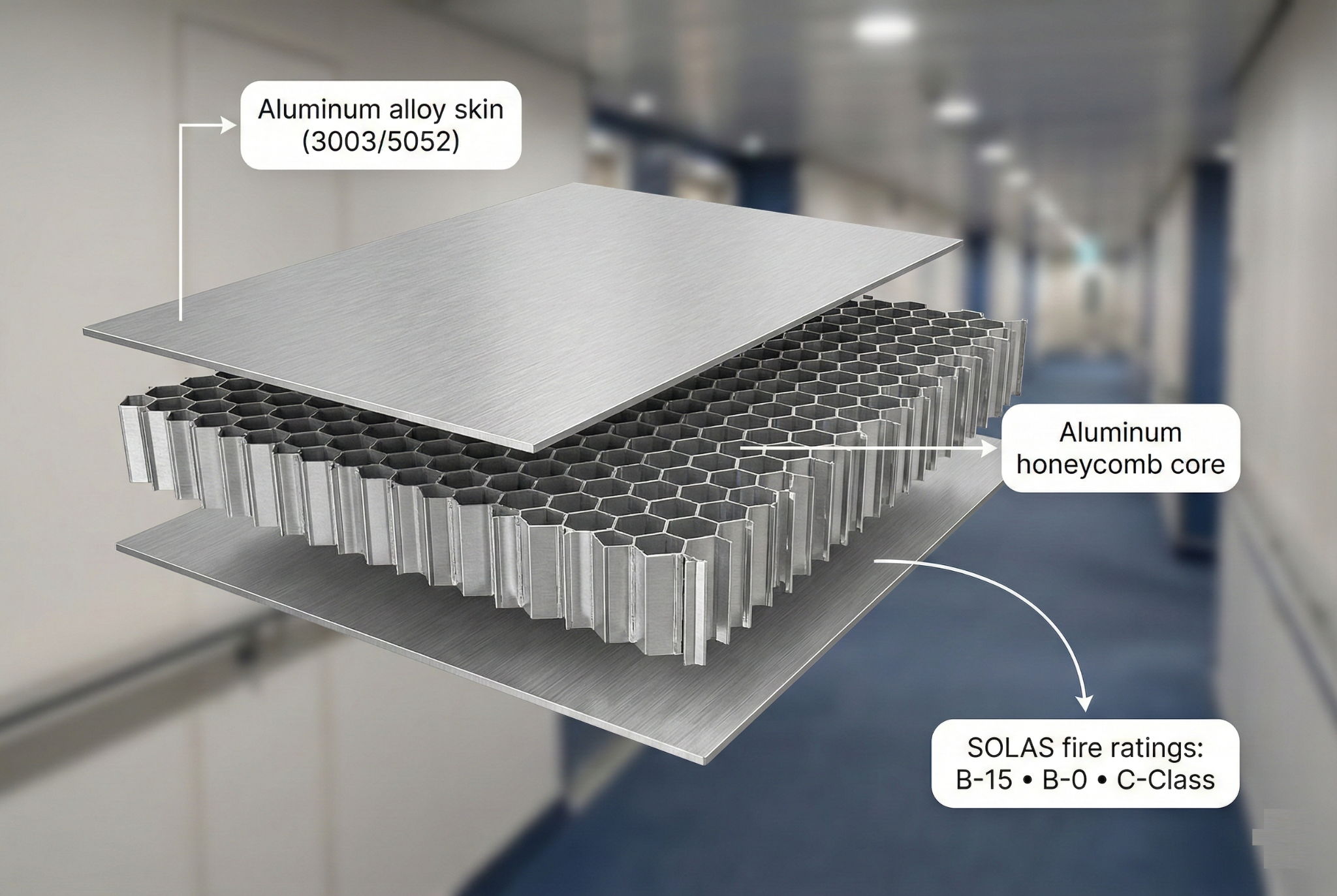
Marine aluminum honeycomb panels are lightweight composite sandwich structures used in ship interiors, composed of an aluminum honeycomb core bonded between two aluminum alloy skins (typically 3003 or 5052 series). They provide specific SOLAS-compliant fire ratings (B-15, B-0, C-Class), varying surface finishes like PVC or HPL, and distinct mechanical advantages including a high strength-to-weight ratio and excellent moisture resistance, primarily serving as weight-saving partitions and ceilings in passenger and crew accommodations.
For many years working in the shipyard, I saw workers struggle to lift heavy steel panels. The shift to aluminum honeycomb changed the workflow completely. It is not just about the material; it is about how it fits into the complex ecosystem of marine outfitting.
What distinct advantages make aluminum honeycomb panels suitable for marine interiors?
Ship designers and owners constantly fight against weight. Every kilogram saved on the superstructure allows for more cargo or lower fuel consumption.
The distinct advantages of marine aluminum honeycomb panels include significant weight reduction (weighing approximately 5 to 7 kg/m2 compared to 18 kg/m2 for rockwool), high structural rigidity ensuring flatness over large spans, and inherent moisture resistance due to the all-aluminum construction. Additionally, they offer ease of installation through modular profiles and 100% recyclability, making them an ideal choice for weight-sensitive projects like high-speed ferries and cruise ships.
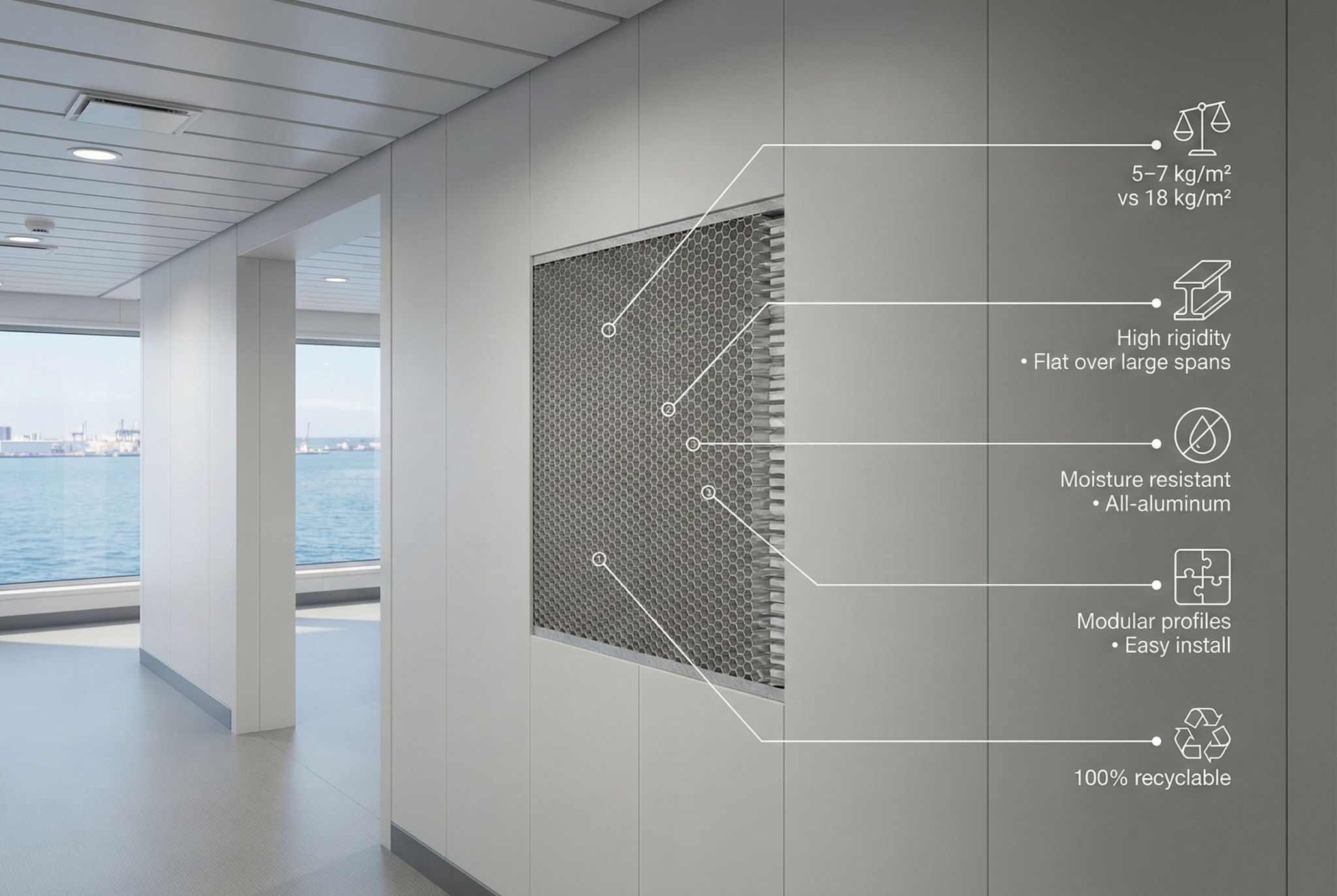
The most obvious benefit I see in projects is the weight factor. In a recent project for a high-speed catamaran, we replaced traditional calcium silicate panels with aluminum honeycomb. The weight of the interior fit-out dropped by 60%. This is critical because high-speed vessels have strict draft limitations. Beyond weight, these panels do not warp easily. The hexagonal core acts like hundreds of I-beams, keeping the surface perfectly flat even when the panel is 2400mm or 3000mm long.
Weight Reduction Analysis for Vessel Efficiency
The specific gravity of aluminum is roughly 2.7 g/cm3, but the honeycomb structure is 95% air. A standard 25mm thick marine honeycomb panel typically weighs between 5.5 kg/m2 and 7.5 kg/m2, depending on the skin thickness (usually 0.7mm or 1.0mm). In contrast, a composite rockwool panel with steel skins weighs about 16 kg/m2 to 20 kg/m2. For a cruise ship with 20,000 square meters of partition walls, using honeycomb panels saves approximately 240 tons of deadweight. This reduction directly correlates to fuel efficiency, especially for fast ferries where engine load is high.
Moisture Resistance Capabilities in Marine Environments
Humidity is a constant enemy on ships. Traditional composite panels often use glue or cores that degrade when exposed to salty, humid air over 10 or 15 years. Aluminum honeycomb panels are inorganic. They do not rot, swell, or absorb water. This makes them the only logical choice for "wet units" (marine bathrooms) and galleys. Even if the surface paint is scratched, the underlying alloy (typically 3000 series) naturally forms an oxide layer that resists corrosion.
| Feature | Aluminum Honeycomb Panel | Traditional Rockwool Panel | Calcium Silicate Panel |
|---|---|---|---|
| Average Weight (25mm) | 5.5 - 7.5 kg/m2 | 16.0 - 20.0 kg/m2 | 12.0 - 15.0 kg/m2 |
| Water Absorption | 0% (Impermeable) | High (if seal breaks) | Medium (Porous) |
| Structural Rigidity | High (Self-supporting) | Low (Needs frame) | Medium (Brittle) |
| Recyclability | 100% | Low (Mixed waste) | Low |
How do marine fire ratings classify aluminum honeycomb panels?
Safety at sea is governed by SOLAS (Safety of Life at Sea) regulations. Materials must prevent the spread of fire.
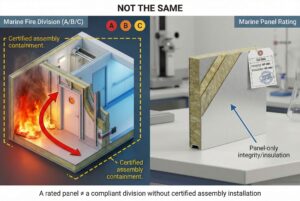
Marine fire ratings classify aluminum honeycomb panels primarily as B-Class (B-15, B-0) for cabin partitions and C-Class for areas requiring no fire integrity but low flame spread. B-15 rating requires the panel to maintain integrity for 30 minutes and insulate against heat for 15 minutes, while B-0 requires 30 minutes of integrity with no insulation requirement. C-Class panels must simply be non-combustible. Aluminum panels generally do not achieve A-Class ratings (A-60) without significant modification because aluminum melts at approximately 660°C.
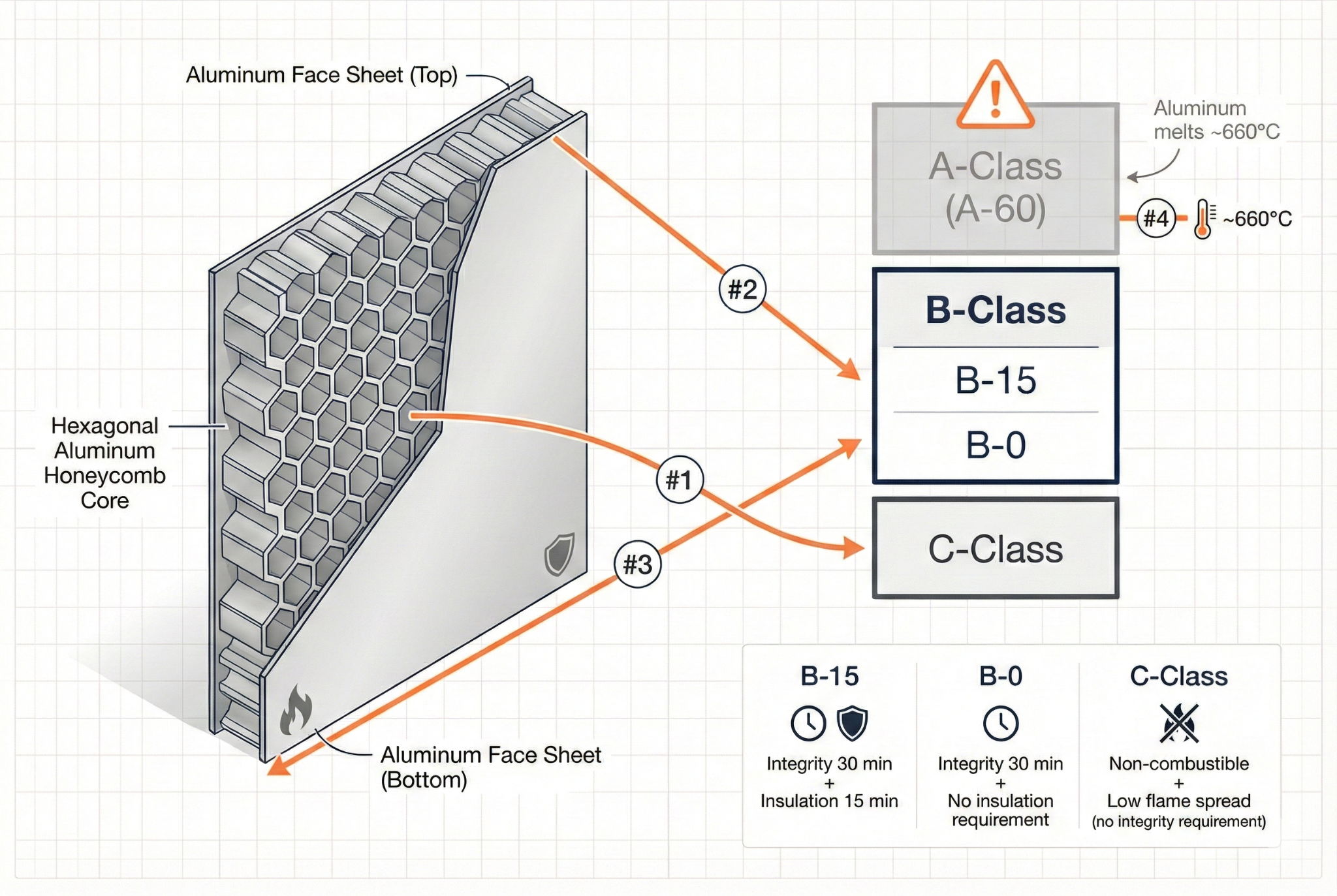
It is important to understand that aluminum has a melting point of roughly 660°C. A standard ISO 834 fire test curve1 reaches this temperature very quickly. Therefore, you rarely see aluminum honeycomb panels used for "A-Class" divisions (which separate main vertical zones) unless they are heavily insulated with ceramic wool, which defeats the purpose of being lightweight. They are the standard for B-Class divisions—the walls inside a cabin or corridor.
B-Class Fire Rating Standards
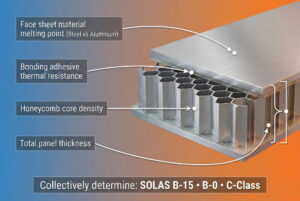
For a panel to be certified as B-15, it must undergo a fire test where the unexposed side does not rise more than 140°C above the ambient temperature for the first 15 minutes. However, the aluminum core itself conducts heat very well. To achieve B-15, manufacturers must insert a layer of thermal insulation (often a thin ceramic fiber sheet or intumescent material) between the aluminum skin and the honeycomb core. For B-0 ratings, this insulation is not needed; the panel only needs to stay standing and stop flames for 30 minutes. Most corridors in crew areas utilize B-0 or B-15 panels.
C-Class Fire Rating Standards
C-Class divisions are constructed of non-combustible materials. They do not need to meet requirements relative to the passage of smoke and flame or limitations relative to the temperature rise. We often use C-Class aluminum honeycomb panels for ceiling systems or lining walls where the steel bulkhead behind the panel already provides the A-Class protection. If you use a B-15 panel where only C-Class is required, you are overspending.
| Fire Class | Integrity Requirement | Insulation Requirement | Typical Application |
|---|---|---|---|
| B-15 | 30 Minutes | 15 Minutes | Cabin walls, Corridor partitions |
| B-0 | 30 Minutes | 0 Minutes | Crew cabins, Storage areas |
| C-Class | None | None | Ceilings, linings against steel hull |
| A-60 | 60 Minutes | 60 Minutes | Not applicable for std. honeycomb |
Which aluminum alloys are recommended for marine honeycomb panel skins?
Not all aluminum is the same. The marine environment attacks weak metals quickly.
The recommended aluminum alloys for marine honeycomb panel skins are the 3000 series (specifically 3003 and 3004) and the 5000 series (specifically 5052). The 3000 series, containing manganese, offers a cost-effective balance of moderate strength and good corrosion resistance for interior dry areas. The 5000 series, containing magnesium, provides superior corrosion resistance and higher strength, making it the mandatory choice for wet areas, galleys, or offshore platforms where salt exposure is higher.
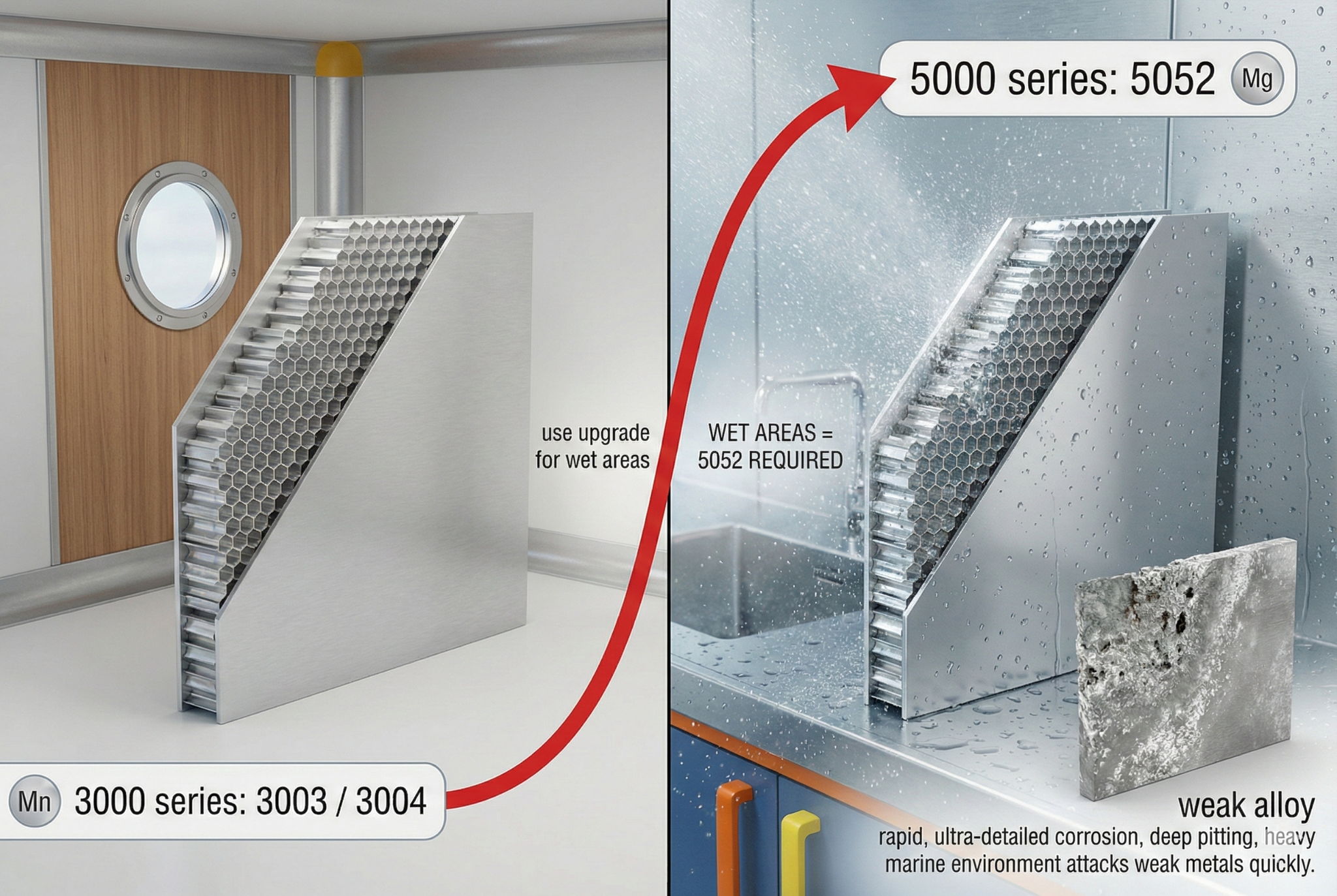
I often see purchase orders that just say "aluminum panel" without specifying the alloy. This is a risk. Using 1000 series aluminum (pure aluminum) is too soft and dents easily during installation. For marine interiors, the industry standard is the 3000 series.
Properties of 3000-Series Aluminum
The 3003 and 3004 alloys are Al-Mn (Aluminum-Manganese) alloys. Manganese increases the strength of the metal by about 20% over pure aluminum without reducing its corrosion resistance. For interior partitions in cabins, mess rooms, and corridors, 3003 H242 is the most common specification. It is cheaper than the 5000 series. If a supplier offers a very low price, check if they are using 1100 series; if they are, the panels will likely be damaged by furniture movement or rough crew usage.
Comparison with 5000-Series Alloys
The 5052 alloy3 belongs to the Al-Mg (Aluminum-Magnesium) family. It is often called "marine grade" aluminum. It is stronger and harder than 3003. More importantly, it resists saltwater corrosion much better. We strictly advise using 5052 for sanitary units (bathrooms) or panels near the open deck entrances. However, 5052 costs roughly 15-20% more than 3003. For a procurement officer, knowing the location of the panel determines whether you pay the premium for 5052 or save money with 3003.
| Alloy Series | Main Element | Strength Level | Corrosion Resistance | Recommended Marine Area |
|---|---|---|---|---|
| 1100 | Pure Al | Low (Soft) | Good | Avoid (Too easily dented) |
| 3003 | Manganese | Medium | Very Good | Cabins, Corridors, Ceilings |
| 5052 | Magnesium | High | Excellent | Wet Units, Galleys, Offshore |
How does the manufacturing process impact the quality of marine aluminum honeycomb panels?
Quality varies wildly in Asia because the barrier to entry for manufacturing is low, but the barrier for quality manufacturing is high.
The manufacturing process impacts the quality of marine aluminum honeycomb panels through three critical factors: the type of adhesive used (epoxy vs. polyurethane), the pressing method (cold press vs. hot press), and the core expansion precision. High-quality panels utilize hot-press technology with thermosetting epoxy adhesives to ensure high peel strength and prevent delamination over time. In contrast, cheaper cold-press methods often result in weaker bonds and uneven surfaces that can fail under marine vibration.
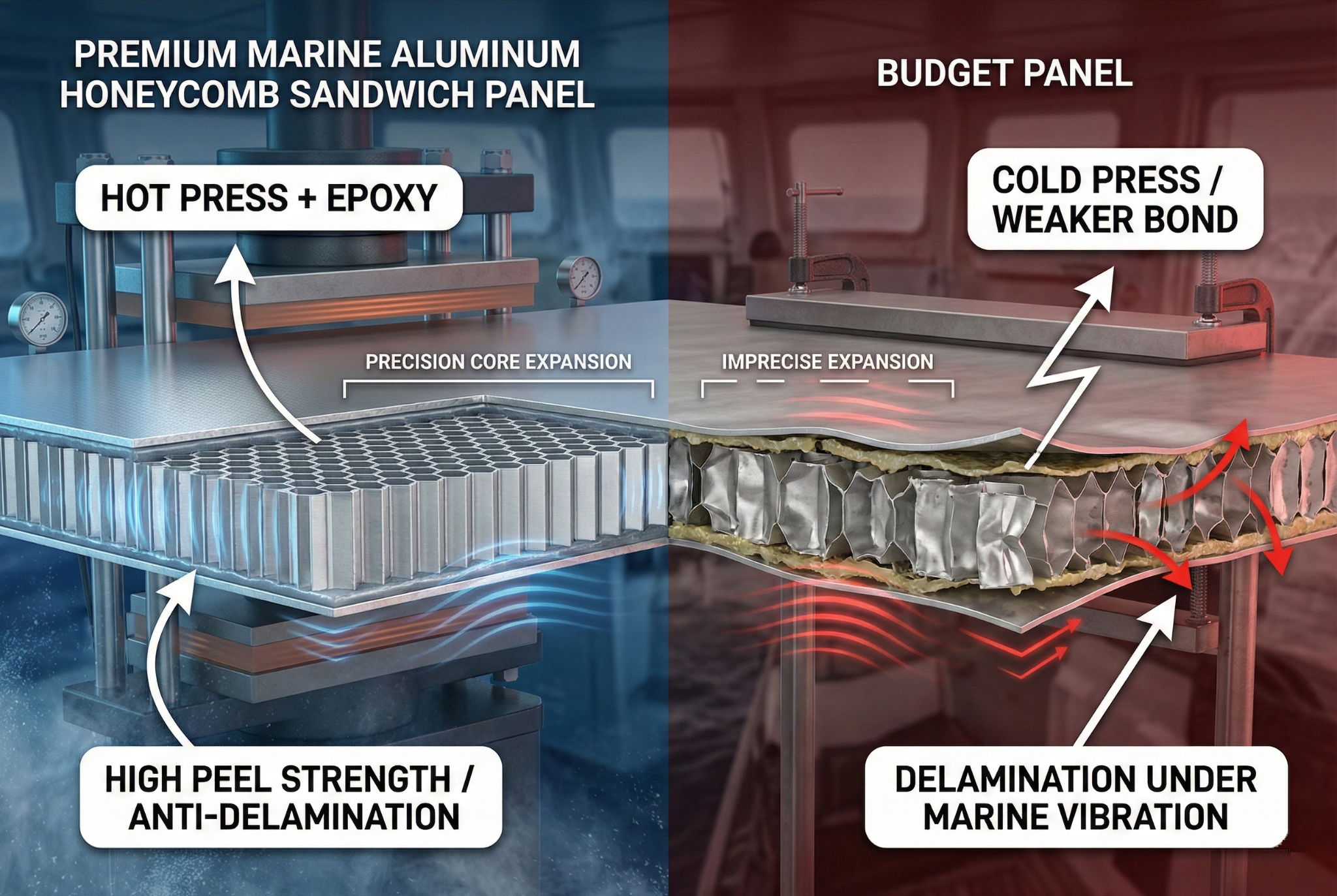
In my experience inspecting factories in China and Vietnam, the biggest secret lies in the glue. You cannot see the glue once the panel is finished, but it determines if the panel will last 20 years or 2 years.
Adhesive Selection: Epoxy vs. Polyurethane
There are generally two types of adhesives used. Two-component Polyurethane (PU) is common in cold-pressing. It is cheaper and cures at room temperature. However, its heat resistance is lower. Epoxy film adhesive4 (often used in aviation) or high-grade thermal setting epoxies are used in hot-pressing. For marine applications where fire safety is paramount, epoxy is superior because it maintains bond strength even when the panel heats up during a fire test. A low-quality glue will bubble or delaminate when the temperature hits 80°C, which is common in tropical storage conditions.
Pressing Technology: Hot Press5 vs. Cold Press
The Cold Press method involves stacking panels and applying weight. It is slow and often leads to uneven pressure. This causes "telegraphing"—where you can see the honeycomb hexagon shape through the skin. Hot Press machines apply heat (120°C - 150°C) and high pressure simultaneously. This cures the adhesive instantly and flattens the aluminum skin perfectly. Procurement officers should always ask the supplier: "Do you use a continuous hot press or a static cold press?" The price difference is justified by the flatness and longevity of the hot-pressed panel.
| Manufacturing Method | Adhesive Type | Bond Strength | Surface Flatness | Risk Level |
|---|---|---|---|---|
| Cold Press | 2-Part PU / Contact Glue | Low to Medium | Variable (Telegraphing risk) | High (Delamination) |
| Hot Press | Thermosetting Epoxy | Very High | Excellent | Low |
| Continuous Line | Hot Melt Film | High | Perfect | Lowest |
What surface finish options are available for marine aluminum honeycomb panels?
The raw aluminum look is industrial, but cruise ships and ferries require aesthetics.
The available surface finish options for marine aluminum honeycomb panels include PVC film lamination (standard for interiors, offering wood or color patterns), High-Pressure Laminate (HPL) for extreme durability in high-traffic areas, and Powder Coating or Fluorocarbon (PVDF) painting for uniform, solid colors. PVC film is the most cost-effective and common choice for crew areas, while HPL provides superior scratch resistance for passenger areas, and powder coating is preferred for ceilings and technical spaces.
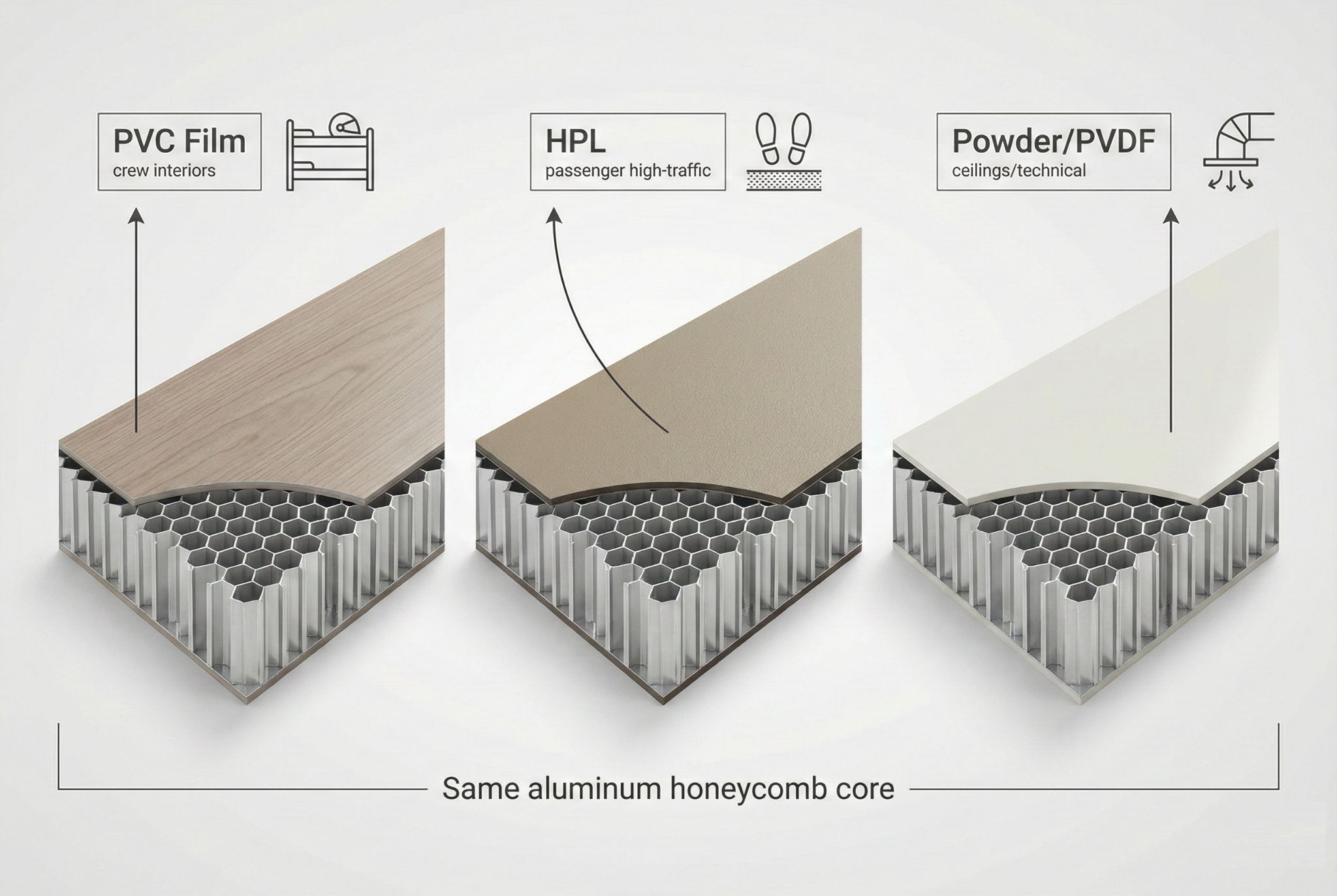
The "skin" of the panel defines the look of the room. In my experience, 80% of marine projects use PVC lamination because it is versatile. You can make an aluminum panel look like oak, maple, or fabric.
PVC Film Application Features
Polyvinyl Chloride (PVC) film6 is typically 150 to 180 microns thick. It is laminated onto the aluminum skin using a high-temperature bonding process. The advantage is variety. Shipyards can choose from hundreds of patterns. It is also easy to clean. However, PVC can peel if exposed to high heat over long periods, so it is not suitable for spaces near engine casings unless insulated. In terms of cost, this is the baseline standard.
HPL Surface Durability Analysis
High-Pressure Laminate (HPL)7 is a hard material, usually 0.7mm to 1.0mm thick, glued to the aluminum. It is incredibly impact-resistant. On a passenger ferry where hundreds of people drag luggage down corridors, PVC film will scratch. HPL will not. The downside is weight and cost. Adding 1.0mm HPL to both sides of a honeycomb panel adds roughly 2.8 kg/m2 to the weight. It also requires a different adhesive system.
| Finish Type | Durability | Cost Level | Weight Impact | Best Application |
|---|---|---|---|---|
| PVC Film | Medium | Low | Negligible | Crew Cabins, Ceilings |
| Powder Coat | High | Medium | Low | Wet Units, Galleys |
| HPL | Very High | High | High (+2.8 kg/m2) | Passenger Corridors, Public Halls |
What specific defects should procurement officers look for during inspection?
Understanding defects helps you negotiate better and avoid rejection at the shipyard.
Specific defects that procurement officers should look for during inspection include surface "telegraphing" (where the honeycomb core pattern is visible through the skin), delamination or bubbling at the edges, color variation between batches, and inconsistent panel thickness. Additionally, officers must check for "hollow sounds" by tapping the panel, which indicates areas where the glue has failed or was missed, as these weak spots will compromise the structural integrity and fire resistance of the panel.
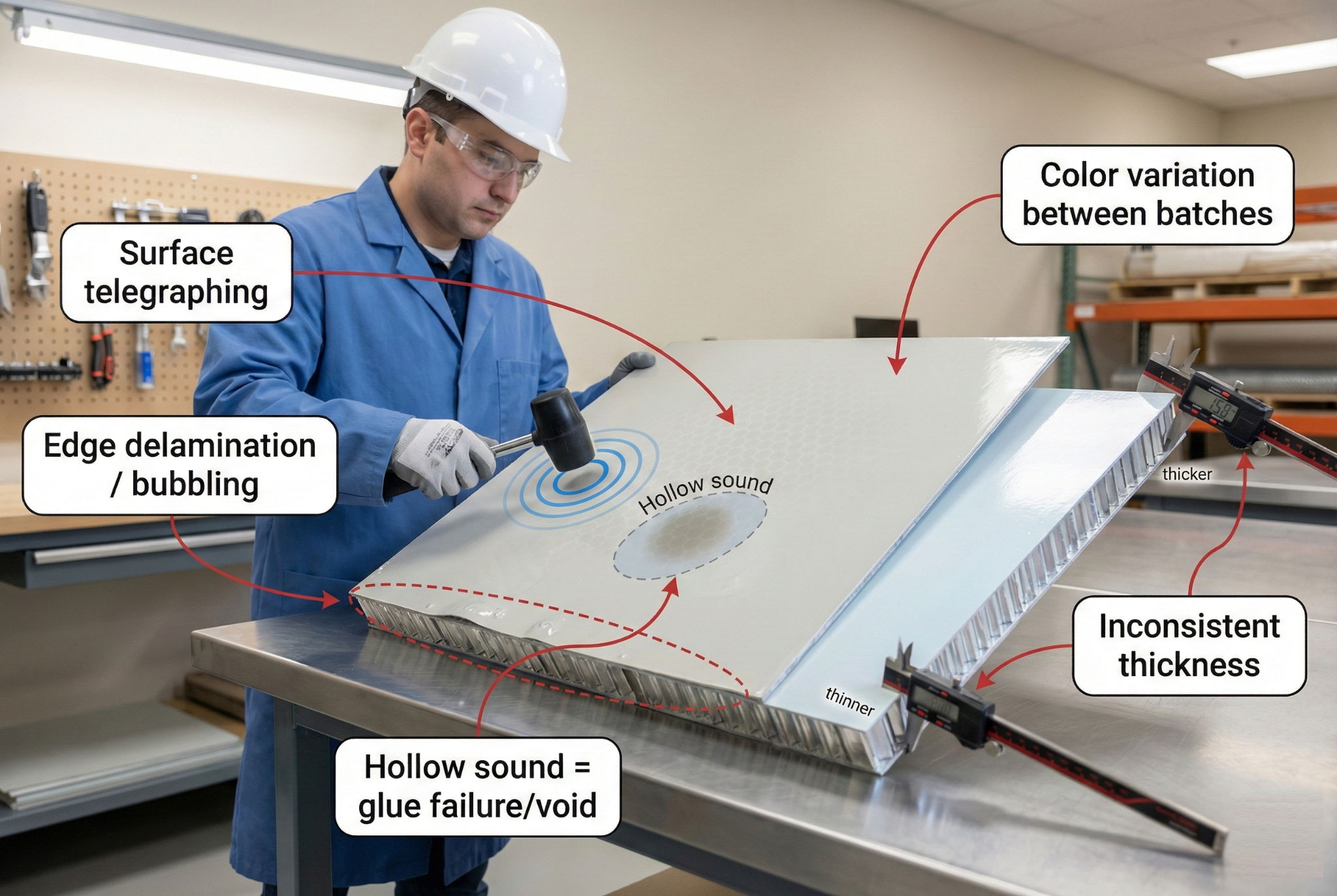
I once had a client receive a batch of panels that looked perfect in the photos, but when we installed them, the light hit them at an angle, and the wall looked like a golf ball. The honeycomb core was printing through the skin. This is a disaster for acceptance.
Inspecting for Telegraphing and Flatness
Telegraphing occurs when the skin is too thin (e.g., 0.5mm) or the adhesive layer is too thick and shrinks during curing. To inspect this, do not look at the panel straight on. Stand at a 15-degree angle to the surface under bright light. The reflection should be smooth. If you see a grid pattern, the panel is defective. For marine ceilings, this is critical because the lighting is usually flush-mounted, which highlights any imperfection.
Verifying Bond Strength (The Peel Test)
You cannot see the bond strength, but you can test it. Request a "climbing drum peel test"8 report from the batch. On-site, you can perform a destructive test on a scrap piece. Try to peel the aluminum skin off the core using pliers. If the skin peels off clean with no honeycomb attached, the bond is a failure (adhesive failure). If the honeycomb core tears apart while the glue holds (cohesive failure), the bond is excellent. The core should break before the glue does.
| Defect Type | Method of Detection | Cause | Consequence |
|---|---|---|---|
| Telegraphing | Visual (Low angle) | Thin skin / Cold Press | Aesthetic rejection |
| Delamination | Tapping (Hollow sound) | Lack of Glue / Dirty Skin | Structural failure |
| Color Variation | Side-by-side comparison | Different PVC batches | Rejection by owner |
| Bow/Warping | Straight edge ruler | Unbalanced skins | Installation gap issues |
What factors influence the pricing structure of marine aluminum honeycomb panels in Asian markets?
Price is not just a number; it is a reflection of raw material costs and processing choices.
The pricing structure of marine aluminum honeycomb panels in Asian markets is influenced by three main factors: the fluctuation of the LME (London Metal Exchange) aluminum ingot price, the thickness and alloy of the aluminum skins (0.7mm vs 1.0mm, 3003 vs 5052), and the certification costs (MED/EC, DNV, USCG). Raw material accounts for approximately 60-70% of the total cost, meaning prices are highly sensitive to global market trends, while fire ratings and surface finishes (HPL vs PVC) act as secondary cost multipliers.
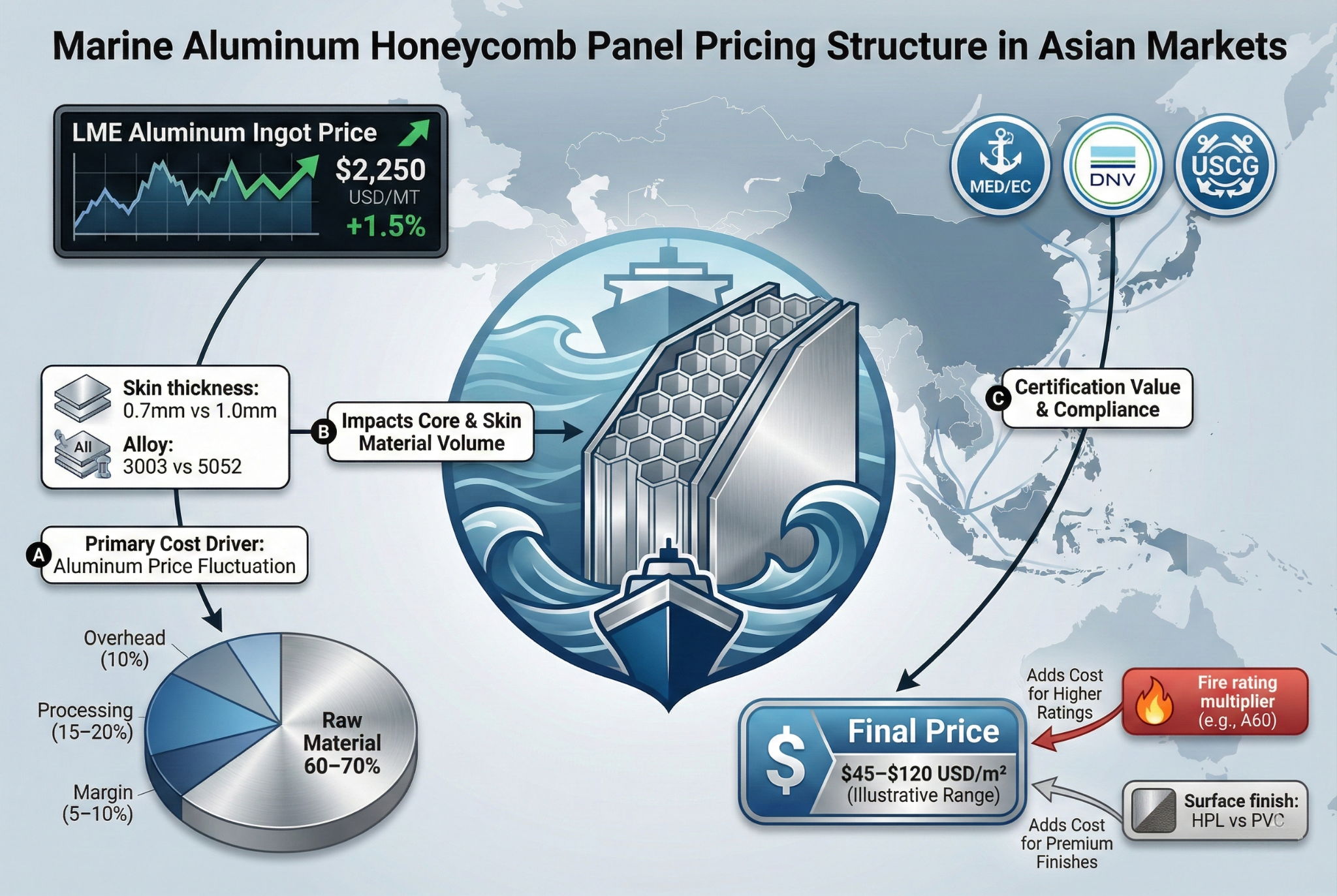
When a supplier quotes you a price valid for 90 days, be careful. Aluminum prices change daily. A smart procurement strategy involves locking in the aluminum price when the market dips.
Raw Material Cost Sensitivity
Since the panel is 95% aluminum by weight (excluding HPL finishes), the LME index is the baseline. For example, if aluminum is trading at $2,200/ton, a finished panel might cost $45/m2. If aluminum spikes to $2,800/ton, that same panel rises to $52/m2. This is why many Chinese factories offer a formula price: "LME + Processing Fee." Understanding this helps you know if a price increase is legitimate or if the supplier is just increasing their margin.
Certification and Processing Premiums
A panel with a DNV or ABS certificate costs more than a generic panel, not because the material is different, but because of the testing and audit fees. A "Type Approval Certificate" requires annual factory audits. Furthermore, the finish dictates the final price.
- Standard PVC: Base Price.
- PVDF Paint: + $5 to $8 / m2.
- HPL Laminate: + $15 to $20 / m2 (due to material cost + extra glue).
Knowing these add-ons allows you to value-engineer the project. Do you really need HPL in the crew storage room? Probably not.
| Cost Component | Percentage of Total Price | Variable Factor |
|---|---|---|
| Aluminum Coil (Skin & Core) | 60% - 70% | LME Market Price |
| Adhesive | 10% | Quality (Epoxy vs PU) |
| Manufacturing Labor/Power | 15% | Efficiency / Automation |
| Certification & Profit | 5% - 15% | Order Volume / Agency |
How does the installation system function for marine honeycomb panels?
A panel is useless if it cannot be connected securely to the ship's structure.
The installation system for marine aluminum honeycomb panels functions using a system of extruded aluminum profiles, primarily including H-profiles for panel-to-panel connections, U-profiles for floor and ceiling tracks, and corner profiles (L-shaped or rounded) for turns. These profiles allow for a modular "tongue and groove" or "slot-in" assembly, enabling rapid construction. The system accommodates ship movement and vibration, and connections can be either exposed (visible profiles) or hidden (flush joints) depending on the aesthetic requirements.
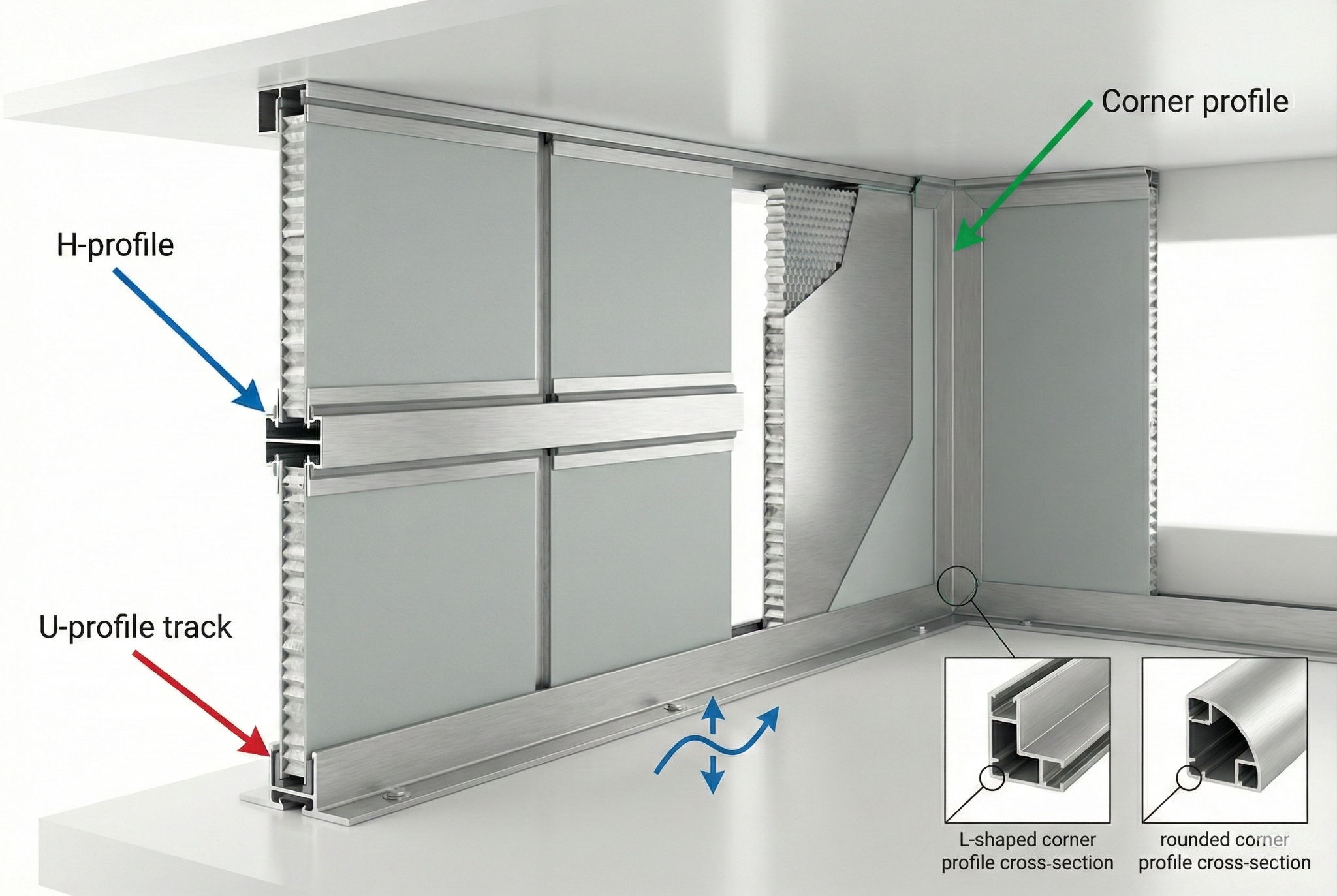
Installation speed is where money is made or lost in a shipyard. Aluminum honeycomb systems are much faster to install than steel systems because they can be cut on-site with standard woodworking saws. You do not need cutting torches or heavy grinders.
Standard Profile Configurations
The foundation of the wall is the U-profile (Floor Track). This is welded or screwed to the deck. The panels slide into this track. To connect two panels side-by-side, we use an H-profile (or I-profile). The edge of panel A goes into the left side of the H, and panel B goes into the right. This joint is flexible enough to handle the hogging and sagging of the ship in rough seas without buckling the wall.
Connection Methods for Panels
There are two main connection styles:
- Sandwich/H-Post System: A visible aluminum strip separates each panel. This is the strongest method and easiest to repair. If one panel is damaged, you can slide it out.
- Hard Joint/Tongue-and-Groove: The panels have male and female edges. They lock together without a visible aluminum strip. This looks like a continuous wall, which architects prefer for luxury areas. However, if one panel is damaged, you often have to disassemble the entire wall to replace it.
| Profile Name | Shape | Function | Material |
|---|---|---|---|
| Floor Channel | U-Shape | Secures panel to deck | Aluminum 6063-T5 |
| Joint Profile | H-Shape | Connects vertical edges | Aluminum 6063-T5 |
| Top Channel | Deep U | Secures panel to ceiling | Aluminum 6063-T5 |
| Corner Post | Radius/Square | connects 90-degree turns | Aluminum 6063-T5 |
How do marine aluminum honeycomb panels compare to traditional rockwool panels?
This is the most common question I get from procurement teams trying to balance the budget.
Marine aluminum honeycomb panels differ from traditional rockwool panels primarily in cost, weight, and acoustic performance. Honeycomb panels are significantly lighter (approx. 6 kg/m2 vs. 18 kg/m2) and offer superior aesthetics and moisture resistance, but they are more expensive (typically 2-3 times the price per square meter) and have lower acoustic insulation (Sound Transmission Class ~30dB vs. ~45dB for rockwool). Therefore, honeycomb is chosen for speed and weight, while rockwool is chosen for budget and soundproofing.
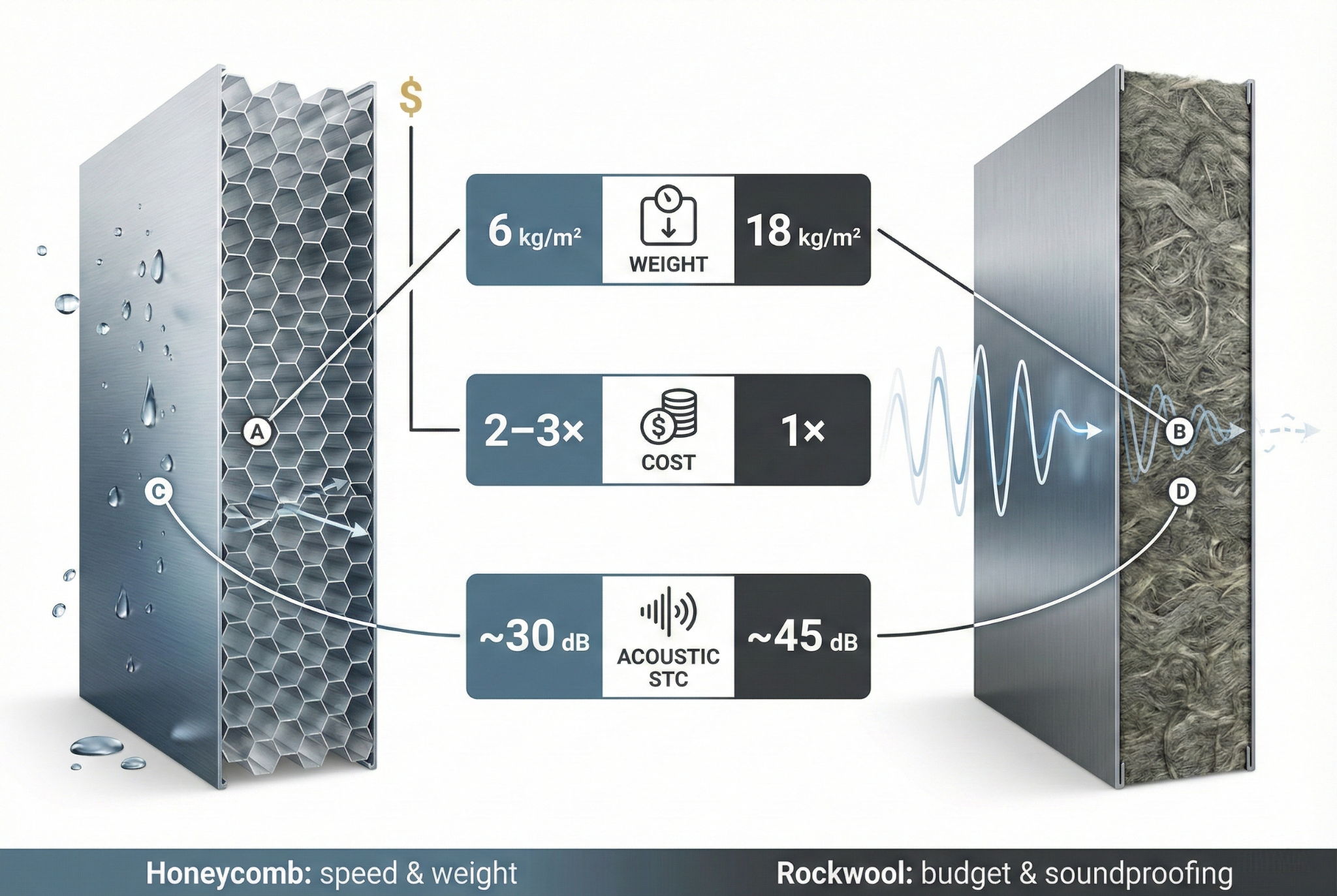
The choice between honeycomb and rockwool is rarely about quality; it is about the vessel's priorities. If the ship is a slow-moving cargo vessel, rockwool is fine. If it is a fast ferry, honeycomb is mandatory.
Cost and Weight Trade-offs
A standard rockwool panel made in China might cost roughly $15 to $20 per square meter. A marine aluminum honeycomb panel usually starts at $45 to $60 per square meter, depending on the aluminum price and finish. This is a massive difference. However, you must calculate the installed cost and operational cost. The lighter weight of honeycomb means less fuel burned over 20 years. Also, honeycomb panels come with finished surfaces, whereas raw rockwool bulkheads often need separate lining.
Acoustic Performance Differences
Mass stops sound. Because rockwool panels are heavy and dense, they are excellent at blocking noise (Sound Reduction Index of 40-45 dB). Aluminum honeycomb is mostly air. Its acoustic performance is poor (roughly 20-30 dB). To fix this, we often fill the honeycomb cells with rockwool foam or add a heavy mass layer (damping sheet) inside the panel. This increases the cost further. If the cabin is next to the engine room, honeycomb alone is not enough.
| Feature | Aluminum Honeycomb | Mineral Wool (Rockwool) | Decision Factor |
|---|---|---|---|
| Unit Price | High ($45 - $80/m2) | Low ($15 - $25/m2) | Budget vs. Quality |
| Weight | Very Light | Heavy | Fuel Savings vs. Ballast |
| Sound Insulation | Poor (needs modification) | Excellent | Passenger Comfort |
| Moisture Risk | None | High | Area of application |
Conclusion
Marine aluminum honeycomb panels are high-performance solutions defined by their lightweight structure (5-7 kg/m2), moisture resistance, and B-Class fire ratings. While more expensive than rockwool, they are essential for weight-sensitive vessels.
-
Review the official temperature–time curve used for structural fire testing to understand certification limits and test procedures. ↩
-
Spec sheets and industry guidance confirm strength, formability and recommended uses for 3003 H24 in cabins and interior panels. ↩
-
Authoritative resources explain 5052's superior saltwater corrosion resistance and when its higher cost is justified for wet or exposed areas. ↩
-
Discover why epoxy film adhesive holds bond strength under heat, crucial for fire-safe marine and aviation panels and long-term durability. ↩
-
See how hot press delivers instant cure, consistent pressure and superior flatness—essential for longevity and avoiding telegraphing. ↩
-
Find technical specs, temperature tolerance and best installation practices to avoid peeling near engines—essential for safe marine panel selection. ↩
-
Explore durability data, real-world impact tests and adhesive recommendations to justify HPL where scratch and impact resistance is critical on vessels. ↩
-
Find test procedures, acceptance criteria and interpretation to verify adhesive vs cohesive failure before accepting a batch. ↩