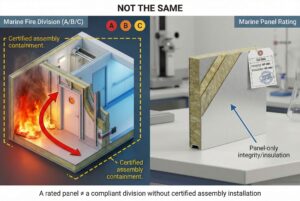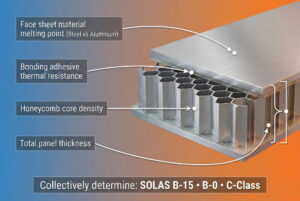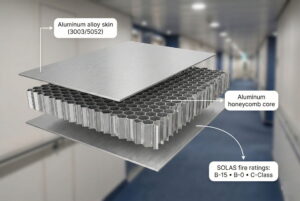
Fires at sea are terrifying. Without the right barriers, flames spread instantly, trapping the crew. Marine fire doors are the critical line of defense that saves lives and ships.
Marine fire doors are specialized heavy-duty doors designed to prevent the passage of fire and smoke on ships for specific durations (15, 30, or 60 minutes). They are constructed from non-combustible materials like steel and mineral wool to meet strict SOLAS and IMO safety standards.
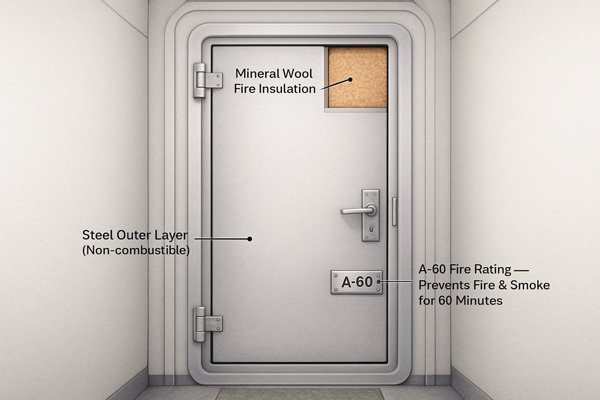
Now that we have defined what these doors are, it is vital to understand the technical specifics. Many buyers struggle with the vast array of classifications. Let’s break down exactly how these doors work and how they differ, so you can make the right purchase decision without confusion.
What is the difference between A-class and B-class marine fire doors?
Choosing the wrong class is a costly mistake. If you mix up A-class and B-class, the ship fails inspection immediately, delaying the whole project.
A-class marine fire doors are heavy-duty barriers designed for high-risk areas to block smoke, flames, and heat for 60 minutes. B-class doors are lighter units used in lower-risk accommodation areas, designed to block flames for 30 minutes with reduced thermal insulation requirements.
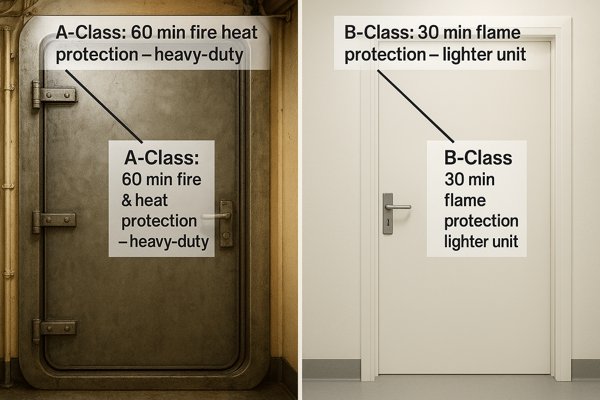
Construction Differences between A-Class and B-Class Doors
When I worked on the factory floor, I could tell the difference between an A-class and B-class door just by lifting them. The weight difference is significant because the internal materials are completely different.
A-class doors are your heavy hitters. We build them using thick galvanized steel sheets, usually between 0.8mm and 1.2mm thick. Inside, we pack high-density rock wool. The density here is key. For A-class, the rock wool density is typically around 150 kg/m³ to 180 kg/m³. This density is necessary to stop the intense heat of an engine fire from passing through. If you tap on the door, it sounds solid, almost like a brick wall.
B-class doors are lighter. We use them for cabins and corridors where the fire risk is lower. The steel skin is often thinner, around 0.6mm or 0.7mm. The core is still mineral wool, but the density drops to about 100 kg/m³ to 120 kg/m³. These doors are easier to handle during installation, which is good because a cruise ship might need 2,000 of them.
IMO Performance Requirements for A and B Class Doors
The International Maritime Organization (IMO)1 sets very specific rules for these classes under the FTP Code.
- A-Class (Fire & Smoke & Heat): These must stop smoke and flame for 60 minutes. Crucially, they must also stop heat. The side of the door not facing the fire cannot get too hot.
- B-Class (Fire only): These must stop flames for 30 minutes. They do not have to stop heat transfer as strictly as A-class doors, except for short periods.
Here is a table to help you compare the two quickly:
| Feature | A-Class Door | B-Class Door |
|---|---|---|
| Primary Use | Engine rooms, Stairwells, Galleys | Cabins, Corridors, Mess rooms |
| Flame Stop Time | 60 Minutes | 30 Minutes |
| Core Density | 150 - 180 kg/m³ | 100 - 120 kg/m³ |
| Steel Thickness | 0.8mm - 1.2mm | 0.6mm - 0.7mm |
| Typical Weight | 60 kg - 90 kg | 35 kg - 50 kg |
If you are buying for a project in Europe, always check the bulkhead (wall) rating first. You cannot put a B-class door in an A-class wall. It is a waste of money to do the opposite, but it is a safety violation to downgrade.
What are the SOLAS requirements for marine fire doors?
Ignoring international regulations stops your shipment at the port. SOLAS rules are strict, non-negotiable, and enforced globally.
SOLAS Chapter II-2 regulations require marine fire doors to be non-combustible, self-closing within 10 to 40 seconds, and fully operational at an inclination of 3.5 degrees. They must also incorporate fail-safe hold-back systems that release automatically upon alarm activation.
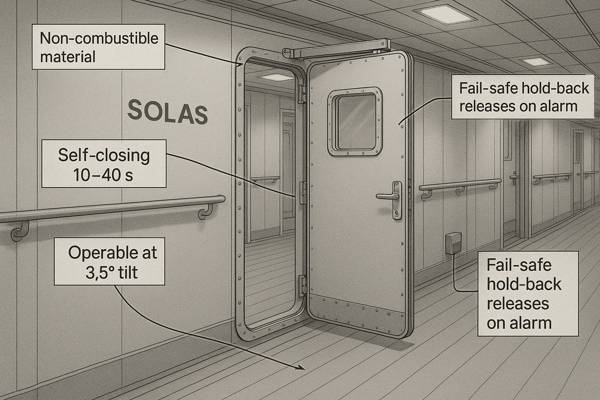
SOLAS Requirements for Self-Closing Mechanisms
The most important SOLAS requirement for a fire door is that it must close itself. In a real fire, people panic. They run through the door and forget to close it. If the door stays open, the fire barrier is useless.
SOLAS states that all fire doors in main vertical zone bulkheads, galley boundaries, and stairway enclosures must be self-closing.
- Angle of Closure: The door must be able to close and latch even if the ship is tilting. The specific rule is an inclination of 3.5 degrees opposing the closure. We test this by physically tilting the door frame in the factory test rig. If the hinge friction is too high, the door will hang open at this angle, causing a test failure.
- Closure Speed: The door cannot slam shut instantly (crushing fingers) or take forever to close. The standard acceptable time is usually between 10 seconds and 40 seconds.
Regulations for Magnetic Hold-Back Hooks
You will often see doors held open with a hook or a magnet. SOLAS allows this, but only if the system is "fail-safe2."
This means the door is held open by an electromagnet. If the fire alarm goes off, the power cuts, the magnet releases, and the door swings shut. You cannot use a simple mechanical hook or a door wedge. I often see inspectors issue fines for wooden wedges holding open fire doors. It is a major safety violation because a wooden wedge does not know when the fire alarm is ringing.
Allowable Clearance and Gaps for Fire Door Installation
For the door to stop smoke, the gaps around the edges must be tiny.
- Top and Sides: The gap between the door leaf and the frame is usually 3mm to 4mm.
- Bottom Gap: This is critical. To allow for ventilation in cabins, a gap is allowed, but it is restricted. For A-class doors, we try to keep the bottom gap under 12mm unless there is a specific sill detail. If the gap is too big, smoke will pour under the door, suffocating people in the next room.
To help you visualize the specific numeric requirements, I have summarized them below:
| Parameter | SOLAS Requirement / Industry Standard | Purpose |
|---|---|---|
| Closing Inclination | 3.5 degrees | Ensures door closes even if ship lists |
| Closing Time | 10 - 40 seconds | Balances safety with accessibility |
| Max Opening Force | ~100N | Ensures crew/passengers can open it |
| Top/Side Gap | 3mm - 4mm | Prevents smoke leakage |
| Bottom Gap (A-Class) | Max 12mm | Prevents smoke while allowing air flow |
How do marine fire doors differ from regular commercial fire doors?
Using a regular hotel fire door on a ship is illegal and dangerous. The environment at sea destroys standard land-based doors quickly.
Marine fire doors differ from commercial doors by using corrosion-resistant galvanized or stainless steel and internal reinforcements to withstand ship vibration. Unlike static building doors, marine doors must pass IMO fire tests and feature raised sills to accommodate ship movements.
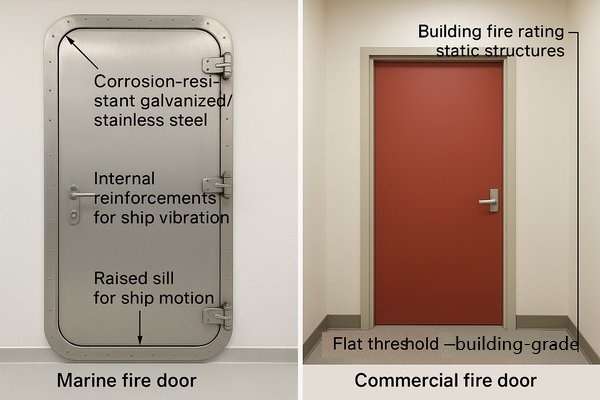
Material Selection: Marine Grade vs. Commercial Grade Steel
The biggest enemy at sea is salt. A standard commercial fire door is often made of cold-rolled steel with a simple coat of paint. On a ship, especially on open decks or high-humidity areas, that door will rust within 6 months.
For marine doors, we strictly use Galvanized Steel Sheets (grade Z275 or higher)3 or Stainless Steel (grade 304 or 316)4.
- Commercial: Cold-rolled steel (mild steel), often painted without a primer that resists salt.
- Marine: Galvanized steel where the zinc coating (Z275) acts as a sacrificial layer. For luxury yachts or offshore rigs, we upgrade to 316L stainless steel, which costs about 3 to 4 times more but lasts 20 years.
Structural Reinforcement for Vibration Resistance on Ships
Buildings do not move. Ships do. A ship engine creates constant low-frequency vibration (around 5Hz to 100Hz).
If you put a commercial honeycomb-core door on a ship, the vibration will eventually cause the internal glue to fail, and the skin will delaminate.
Marine doors use high-density mineral wool slabs that are glued under pressure. We also weld extra U-shaped stiffeners inside the door leaf—usually spaced every 300mm to 400mm—to prevent it from warping when the ship twists in heavy waves. This internal skeleton is crucial.
Door Sills and Coamings in Marine Applications
In a hotel, the floor is flat to allow for wheelchair access easily. On a ship, we have "coamings" or sills.
To prevent water from sloshing between rooms and to stop smoke near the floor, marine fire doors often come with a raised steel sill (typically 20mm to 30mm high) or a flat bar sill. Commercial doors rarely have this. You must step over a marine door frame; you walk through a commercial one.
| Feature | Marine Door | Commercial Door |
|---|---|---|
| Base Material | Galvanized / Stainless Steel | Cold Rolled Steel |
| Core Material | High-density Rock Wool / Ceramic Wool | Honeycomb paper / Gypsum |
| Testing Standard | IMO 2010 FTP Code | UL 10C / EN 1634 |
| Vibration Resistance | High (Reinforced) | Low |
Where are marine fire doors required on a ship?
You cannot just install these doors anywhere. Their location is dictated by the strategy of "containing" a fire within a specific zone.
Marine fire doors are mandatorily required in Main Vertical Zone (MVZ) bulkheads, stairwell enclosures, engine room boundaries, and galley entrances. Their specific locations are dictated by the ship's Fire Control Plan to contain hazards within defined safety zones.
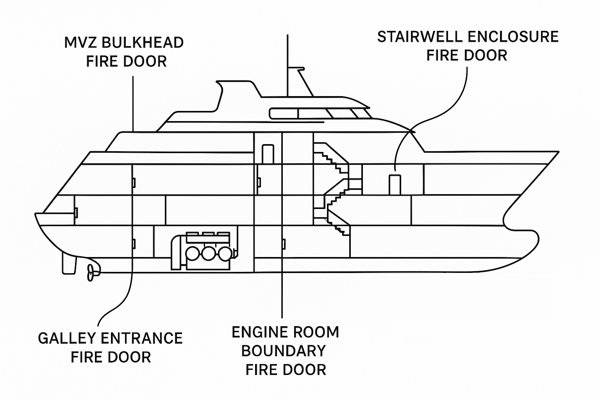
Fire Door Requirements for Main Vertical Zones5 (MVZ)
Ships are sliced into "zones" to stop fire from traveling from the bow to the stern. These slices are called Main Vertical Zones. The bulkheads (walls) separating these zones are usually A-60 class.
Every door passing through an MVZ bulkhead must be a fire door, usually A-60. This ensures that if Zone 1 is on fire, Zone 2 remains safe for at least one hour. The maximum length of an MVZ is typically 40 meters (limit set by SOLAS), so you will encounter these barriers regularly as you walk down the length of a ship.
Mandatory A-Class Doors for High-Risk Service Spaces
Certain rooms are fire magnets. You must install A-class doors (usually A-60) around:
- Engine Rooms: The most common source of ship fires. The door here needs to be heavy-duty steel because engine room fires burn very hot due to fuel oil.
- Galleys (Kitchens): High risk of grease fires. The door separates the cooking area from the dining area.
- Paint Lockers: Filled with flammable fumes.
- Control Stations: The bridge or engine control room must be protected so the crew can still command the ship during an emergency.
Fire Door Protection for Stairwells and Escape Routes
Stairwells act like chimneys. If smoke gets into a stairwell, it acts as a flue, pulling smoke up and killing everyone trying to escape from lower decks.
Therefore, all doors leading into a stairwell must be fire doors (usually A-class). They must be self-closing to keep the stairwell smoke-free.
B-15 Fire Doors for Passenger Cabin Corridors
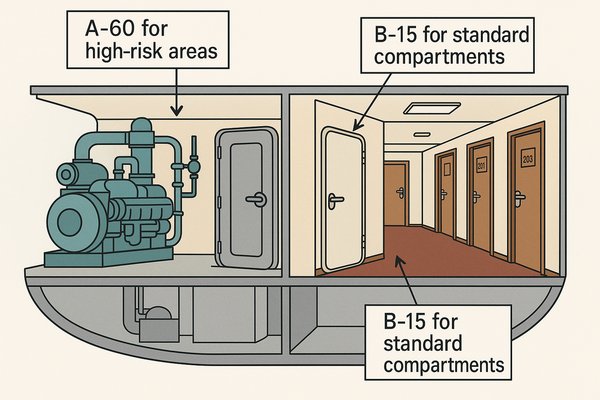
In cruise ships or ferries, every cabin door leading to the corridor is a fire door, typically B-15. This creates a "safe corridor" allowing passengers to run to the muster station even if a fire starts inside a cabin. These doors often include a "kick-out" panel or are designed to be easily breached by fire crews if locked from the inside.
How to properly install marine fire doors on a vessel?
A perfect door installed poorly will fail. The installation process on a steel ship requires welding skills and precise alignment that differs from fixing a door into concrete.
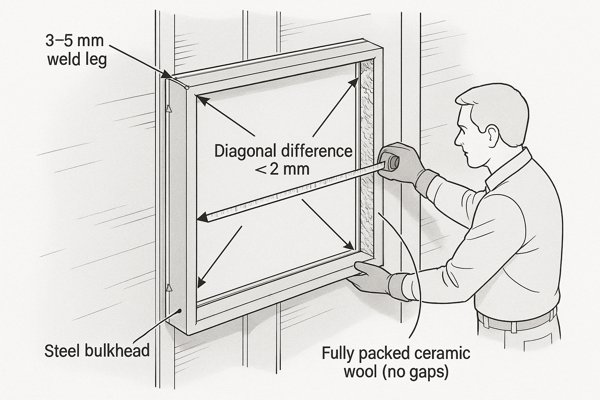
Proper marine fire door installation requires tack-welding the frame to the steel bulkhead with a 3-5mm weld leg, ensuring diagonal frame measurements differ by less than 2mm. All gaps between the frame and bulkhead must be fully packed with ceramic wool to prevent thermal bridging.
Step 1: Verifying the Bulkhead Opening and Frame Squareness
Before you lift the heavy door frame, check the cutout in the steel wall. It needs to be about 10mm to 20mm wider than the door frame outer size to allow for adjustment.
Once the frame is inserted, you must check the diagonals. Measure from the top-left corner to the bottom-right, and vice versa.
- Tolerance: The difference between these two measurements must be less than 2mm. If the difference is 5mm, the frame is twisted (parallelogram shape). If you weld it like this, the door leaf will bind against the frame, and the self-closing mechanism will fail. This is the most common installation error I see in shipyards.
Step 2: Proper Welding Techniques for Marine Door Frames
Do not weld the whole frame at once. The intense heat will warp the steel frame, bending it out of shape.
- Tack Weld: Spot weld the corners and the middle of the jambs first.
- Check Operation: Open and close the door multiple times. Does it latch smoothly? Does the gap look even all around?
- Full Weld: Once aligned, weld the frame to the bulkhead. The weld leg length is usually 3mm to 5mm.
- Note: Some doors are "bolted" types, used when the wall is already finished with sandwich panels. For these, you use M8 or M10 self-tapping screws or through-bolts every 300mm.
Step 3: Insulating the Gap and Finishing the Installation
This is the step installers often forget. After welding, there is a gap between the door frame and the steel bulkhead.
You must stuff this gap with loose ceramic wool or rock wool. If you leave it empty, heat will conduct through the steel frame, bypassing the insulation. This creates a "thermal bridge."
Finally, cover the weld marks. We usually use a PVC profile or a stainless steel trim to make it look good. If it is a painted area, ensure you use a zinc-rich primer on the welds before applying the topcoat to prevent rust from starting at the weld seam.
To ensure your installation team gets it right, use this quick tolerance checklist:
| Installation Step | Required Value / Tolerance | Why it matters |
|---|---|---|
| Wall Cutout Size | Frame Size + 10mm to 20mm | Allows room to adjust level/square |
| Diagonal Difference | Max 2mm | Prevents door twisting/binding |
| Weld Leg Length | 3mm - 5mm | Ensures structural strength |
| Fixing Spacing (Bolted) | Every 300mm | Prevents gapping during fire |
| Insulation Packing | 100% Fill (No voids) | Stops heat transfer through frame |
What are the inspection and maintenance requirements for marine fire doors?
Fire doors are not "install and forget" items. Salt air seizes hinges, and heavy crew traffic damages latches, requiring a strict maintenance schedule.
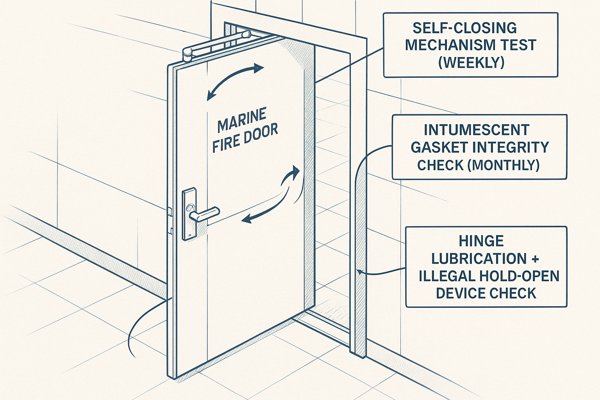
Marine fire door maintenance requires weekly checks of the self-closing mechanism to ensure latching from any angle. Monthly inspections must verify the integrity of intumescent gaskets and apply lithium grease to hinges, while ensuring no illegal hold-open devices are in use.
Mandatory SOLAS Maintenance Schedule for Fire Doors
According to the MSC.1/Circ.1432 (Revised Guidelines for Maintenance), you need a routine.
- Weekly: Test all fire doors in main vertical zones. Release them from their magnetic holders and ensure they close fully.
- Quarterly (Every 3 months): Check all door control panels and local alarms.
Three Key DIY Inspection Points for Crew Members
When I advise clients on maintenance, I tell them to check these three things:
- The Latch Test: Open the door just 10cm (a hand's width) and let go. Does it latch?
- Requirement: It must close and latch from any open position. If it stops before latching, the closer force is too weak or the hinges are dry.
- The Gasket Check: Look at the rubber/intumescent strip around the frame. Is it torn? Is it painted over?
- Warning: Never paint over the fire seal. Paint hardens the rubber and prevents it from expanding during a fire. If you see paint on the seal, you must replace the seal immediately.
- Hinge Wear: Lift the door handle up and down. If the door moves vertically more than 1mm or 2mm, the hinge bearings are worn out. This causes the door to "sag" and drag on the floor, preventing it from closing.
Lubrication Schedule for Marine Hinges and Latches
Marine environments dry out grease. Use a high-quality Lithium-based marine grease on hinges and lock tongues at least every 3 months. If the door is on an open deck, do it every month. A seized hinge on a fire door is a safety violation that can detain your ship.
Here is a recommended maintenance schedule you can give to your crew:
| Frequency | Component | Action Required |
|---|---|---|
| Weekly | MVZ Doors | Test self-closing from open position |
| Monthly | Gaskets & Seals | Check for tears, paint, or brittleness |
| Monthly | External Hinges | Apply Lithium grease (Open Deck doors) |
| Quarterly | Internal Hinges | Apply Lithium grease (Cabin/Corridor doors) |
| Quarterly | Latches & Locks | Lubricate tongue and strike plate |
| Annually | Door Closer | Check hydraulic fluid levels and arm tension |
How to choose the right marine fire door for different ship compartments?
Buying the most expensive door is not always right. You waste budget if you put an A-60 door in a B-15 zone, and you risk lives if you do the reverse.
To choose the right marine fire door, consult the ship's Fire Control Plan to match the door class to the bulkhead rating. Typically, A-60 doors are required for high-risk engine rooms and galleys, while B-15 doors are standard for passenger cabins and corridors.
How to Read a Ship's Fire Control Plan
Before you place an order with a supplier in China or Vietnam, you must ask the shipyard for the "Fire Control Plan." This is a drawing that uses colors and symbols to tell you the fire rating of every wall (bulkhead).
- Red Lines: Usually indicate A-class divisions.
- Green/Yellow Lines: Often indicate B-class divisions.
You simply match the door to the wall. If the wall is A-60, the door must be A-60. If the wall is B-15, the door must be B-15.
Recommended Fire Door Types for Specific Ship Locations
Based on my experience supplying interiors for projects in Europe, here is a cheat sheet for where each door type typically goes.
- Engine Room & Machinery Spaces (A-60):
This is the most dangerous place on a ship. Fuel and heat are everywhere. You need the highest protection. Always specify A-60 here. Do not try to save money with A-0. - Galley (Kitchen) (A-60):
Grease fires are common. A-60 is required to protect the dining area from a kitchen fire. - Stairwells (A-Class):
Stairwells act like chimneys for smoke. They must be isolated. Usually, A-class doors are used here to ensure the escape route remains safe. - Passenger Cabins (B-15):
This is the highest volume purchase. A cruise ship might need 2,000 of these. B-15 is the standard. It provides enough time for evacuation.
Acoustic Ratings and Sound Reduction in Fire Doors
While we are talking about fire ratings, do not forget comfort. A fire door is also a sound barrier.
- A standard B-15 cabin door usually has a sound reduction of 30 dB to 33 dB.
- If you have a luxury project, you might need to ask for "High Sound Reduction" doors, which can go up to 40 dB or 42 dB.
This requires heavier insulation and better seals. As a procurement officer, if you see a specification for "40dB B-15," expect the price to be 20% to 30% higher than a standard door. The door leaf will also be thicker, usually 50mm instead of 40mm.
If you would like to gain a detailed understanding of how to select a marine fire door, please read my article:How to choose the right marine fire door for different ship compartments?
What certifications and documentation are required for marine fire doors?
A fire door without a certificate is just a piece of scrap metal. Classification societies will not accept a door unless the paperwork proves it passed the fire test.
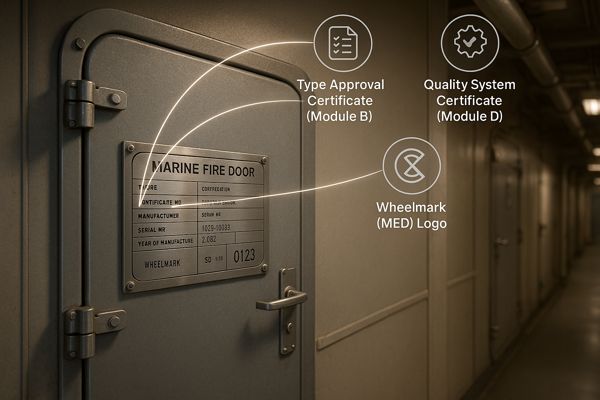
Valid marine fire door documentation requires a Type Approval Certificate (Module B) confirming design compliance and a Quality System Certificate (Module D) for production oversight. For European vessels, the Wheelmark (MED) logo must be present on the ID plate.
Understanding the Wheelmark (MED Certification) for European Waters
If you are supplying to a ship sailing in European waters, you need MED (Marine Equipment Directive) certification. We call this the "Wheelmark" because the logo looks like a ship's steering wheel.
This requires two documents:
- Module B (Type Examination): Proves the design passed the fire test. Valid usually for 5 years.
- Module D (Production Quality Assurance): Proves the factory maintains quality consistently. This requires an annual audit by the Class Surveyor.
You need both. If a supplier sends you only Module B, you cannot install the door. The Wheelmark on the product must be followed by two numbers: the Notified Body number and the year of manufacture (e.g., 0098/23).
Certifications from Major Classification Societies (IACS)
If the ship is not European, you usually need a certificate from an IACS member6. The most common ones I deal with are:
- DNV (Det Norske Veritas)
- ABS (American Bureau of Shipping)
- BV (Bureau Veritas)
- LR (Lloyd’s Register)
Some Asian shipyards might accept NK (Japan) or KR (Korea), but DNV and ABS are the safest bets for global acceptance.
Verifying the Fire Door Identification Plate
Every single door must have a metal ID plate riveted to the frame. It is like the passport for the door. It must show:
- Manufacturer Name
- Fire Rating (e.g., A-60)
- Certificate Number
- Year of Manufacture
- The Wheelmark logo7 (if applicable)
Crucial Tip: When the door arrives at your warehouse, check the ID plate immediately. If the certificate number on the plate does not match the paper document you received, the surveyor will reject the door during the final ship inspection. I have seen entire batches of doors rejected because the factory put the wrong year on the plate.
Here is a checklist to use when reviewing supplier documents:
| Document / Item | Description | Verification Tip |
|---|---|---|
| Module B Cert | Type Approval (Design) | Check expiry date (max 5 years) |
| Module D Cert | Quality Assurance (Factory) | Check factory name matches supplier |
| ID Plate | Metal Tag on Frame | Must match Certificate Number exactly |
| Fire Test Report | The original lab test | Usually not needed unless Class requests it |
| Wheelmark Logo | Steering wheel icon | Mandatory for EU vessels |
What are common fire door deficiencies found during ship inspections?
Port State Control (PSC) inspectors love to check fire doors because they are easy to inspect and often fail. A failed door can lead to the detention of the ship.
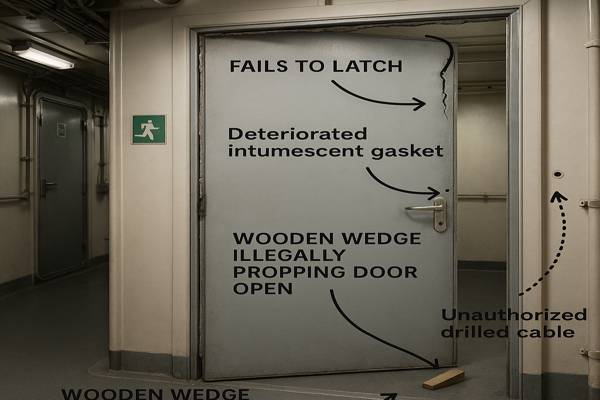
Common marine fire door deficiencies include failure to fully latch due to air pressure or twisted frames, the use of illegal wooden wedges, deteriorated intumescent gaskets, and unauthorized penetrations such as drilled cable holes in the door frame.
Deficiency 1: Door Failure to Close Properly
The most common finding is a door that stops 10cm before the frame. This is usually caused by:
- Air Pressure: The AC system creates positive pressure in the cabin, pushing against the door.
- Twisted Frame: Poor installation (as mentioned earlier).
- Dry Hinges: Lack of grease.
- The Fix: Adjust the door closer power. Most heavy-duty marine closers (like Dorma or Geze) have a "latching speed" valve. Turn it slightly to give the door a final "snap" shut. However, do not make it too strong, or it will be too hard for passengers to open. The maximum opening force should not exceed 100N.
Deficiency 2: Use of Illegal Hold-Back Devices
I have seen crew members tie doors open with rope or jam a wooden block under them to get fresh air. This is an instant deficiency.
- The Rule: Only approved electromagnetic holders connected to the alarm system are allowed.
- The Fix: Crew training. If the door needs to be open for operations, install a proper magnet system.
Deficiency 3: Damaged or Missing Intumescent Gaskets
The intumescent strip (the seal that expands in heat) is often brittle. On older ships, pieces of it fall off. If more than 10% to 20% of the gasket is missing, the door is no longer considered smoke-tight.
Sometimes, the electrical team needs to run a cable, so they drill a hole through the fire door frame. This destroys the fire rating. A fire door frame is a tested system; you cannot penetrate it. If you need to pass a cable, it must go through a separate certified cable transit in the bulkhead, not the door frame. Any hole in the frame voids the certificate immediately.
To simplify troubleshooting, here is a quick "Problem vs. Solution" guide:
| Common Deficiency | Likely Cause | Immediate Action |
|---|---|---|
| Door stops halfway | Dry hinges / Weak closer | Grease hinges + Adjust closer spring |
| Door slams too loud | Hydraulic fluid leak | Replace door closer unit |
| Gaps seen when closed | Twisted installation | Re-shim hinges or reinstall frame |
| Wedge holding door | Crew habit | Remove wedge + Crew training |
| Hole in frame | Cable routing | Seal with certified fire compound (if allowed) or replace frame |
What is the difference between A-0, A-15, A-30, A-60 and B-0, B-15 fire door ratings?
The numbers after the letter confuse many buyers. Getting this wrong means overpaying for insulation you do not need or failing safety checks.
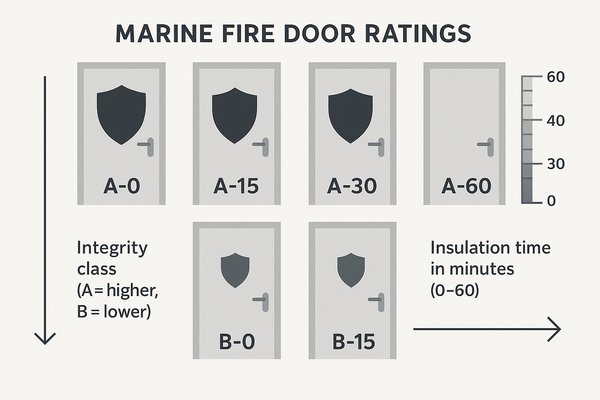
In marine fire ratings like A-60 or B-15, the letter (A or B) indicates the door's ability to stop smoke and flames (integrity), while the number (0, 15, 30, 60) represents the minutes the door restricts heat transfer (insulation) to the unexposed side.
Understanding Integrity vs. Insulation in Fire Ratings
This is where many procurement officers get lost. The letter (A or B) tells you the "Integrity" (stopping fire). The number (0, 15, 30, 60) tells you the "Insulation" (stopping heat).
When we test these doors in the lab, we put thermocouples (heat sensors) on the safe side of the door. We blast the other side with fire that reaches over 900°C.
- The Rule: The average temperature on the safe side cannot rise more than 140°C above the starting temperature.
- The Meaning: If you have an A-60 door, the door stays cool enough to touch (under roughly 160-180°C total) for a full hour. If you have an A-0 door, the steel will glow red hot in minutes. It stops the fire, but the radiant heat could start a fire on the other side (auto-ignition of paper or curtains).
Cost Differences and Applications for A-0 to A-60 Ratings
In my experience at Magellan Marine, clients often ask, "Why is A-60 so much more expensive than A-0?" It comes down to the insulation thickness and the specialized ceramic wool used in the core.
- A-60: The most expensive standard door. It uses the thickest, highest density insulation (often ceramic fiber which is pricier than rock wool). Used in high-risk zones like the engine control room.
- A-0: The cheapest A-class. It is basically a steel barrier with no thermal protection requirements. Used where heat transfer does not matter, like between two steel storage rooms.
- B-15: The standard cabin door. It holds back heat for 15 minutes. This gives the crew 15 minutes to wake up and escape before the heat in the corridor becomes deadly.
Here is the specific insulation time required for each rating:
| Rating | Stops Flame (Integrity) | Stops Heat (Insulation) | Typical Application |
|---|---|---|---|
| A-60 | 60 Minutes | 60 Minutes | Engine Room / Control Room |
| A-30 | 60 Minutes | 30 Minutes | High-traffic stairwells |
| A-15 | 60 Minutes | 15 Minutes | Less common, specific zones |
| A-0 | 60 Minutes | 0 Minutes | Storage lockers, oily spaces |
| B-15 | 30 Minutes | 15 Minutes | Passenger Cabins |
| B-0 | 30 Minutes | 0 Minutes | Washrooms within a cabin |
Conclusion
Marine fire doors are life-saving devices defined by their class (A or B) and insulation time (0-60 minutes). Whether checking installation gaps, verifying A-60 certifications, or maintaining self-closing latches, strict adherence to SOLAS ensures safety and compliance at sea.
-
Learn about the regulations set by the IMO to ensure safety in maritime construction. ↩
-
Learn about fail-safe mechanisms in fire doors to ensure compliance and safety during emergencies. ↩
-
Explore the advantages of using galvanized steel in marine environments, ensuring durability and resistance to corrosion. ↩
-
Learn why stainless steel is essential for marine applications, offering superior corrosion resistance and longevity. ↩
-
Understanding MVZ regulations is crucial for ensuring fire safety on ships, protecting both crew and passengers. ↩
-
Exploring IACS members can provide insights into global certification standards, enhancing your ship's acceptance and safety. ↩
-
Discover the significance of the Wheelmark logo for marine equipment, ensuring your products meet EU safety standards. ↩