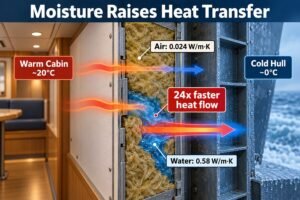
You buy expensive interior panels for your ship projects, but cabins still get too hot. You might be ignoring the lambda value. Let us fix this costly mistake today.
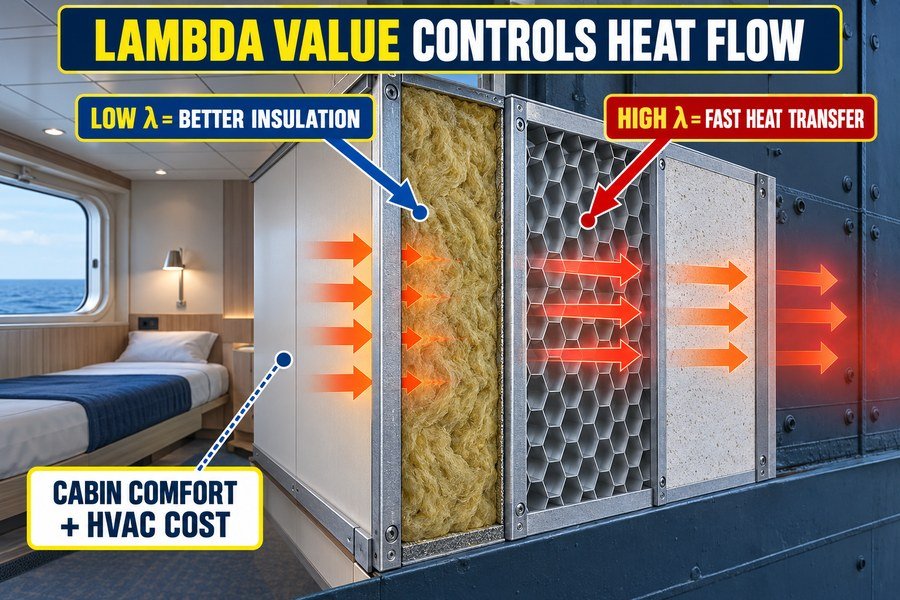
Thermal conductivity, or lambda value, measures how easily heat passes through a material. For marine interior panels, it dictates insulation efficiency. The three core materials used—rockwool, aluminum honeycomb, and calcium silicate—all have different lambda values that directly control cabin temperature and HVAC energy costs.
I see many procurement managers struggle with technical specs from Asian factories. Understanding this one value will help you buy better quality panels at competitive prices.
What Exactly Does Thermal Conductivity Measure in Marine Interior Panels?
Do your shipyard clients complain about poor insulation? You lose money if the cabin fails the sea trial. This metric measures the exact heat flow through your panels.
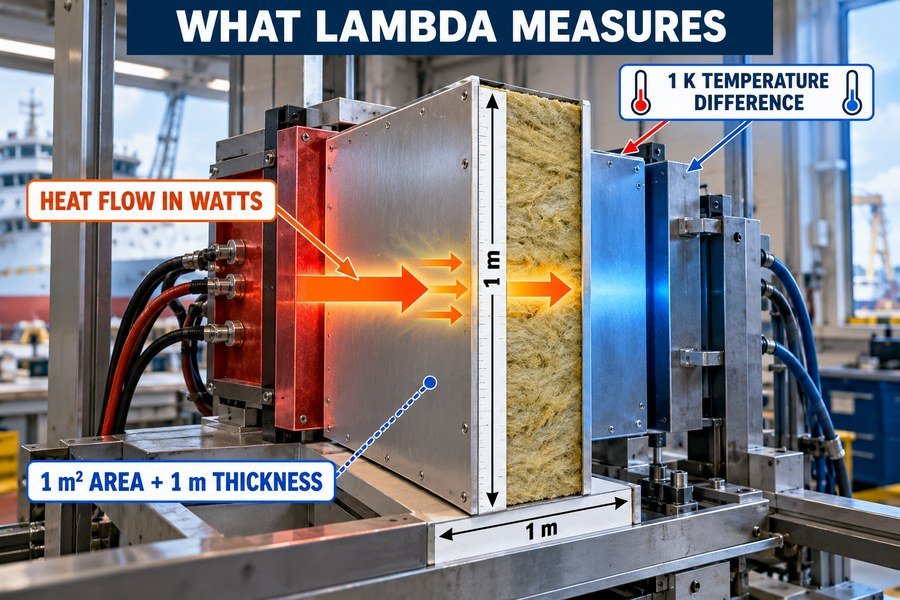
Thermal conductivity measures the exact rate of heat transfer through one square meter of a marine panel material that is one meter thick, when the temperature difference is one degree Kelvin. It applies to all common cores: rockwool, polyurethane foam, and aluminum honeycomb.
The Science Behind Heat Transfer in Marine Panels
When you order marine interior panels, you are buying a barrier. This barrier must stop heat. Thermal conductivity tells you exactly how good that barrier is.1 We use a specific scientific definition for this. It measures the heat energy in watts. This energy travels through an area of one square meter. The material has a thickness of one meter. The temperature difference between the hot side and the cold side is one degree Kelvin.
I work with many buyers who just look at the price. They forget to ask the factory for this exact measurement. If the value is high, heat moves fast. If the value is low, heat moves slow. A slow heat transfer means a comfortable cabin for the ship's crew. You must know this metric to compare different factory offers. If Factory A is cheaper but has a higher thermal conductivity than Factory B, Factory A is actually selling you a worse product.
Comparing Core Material Conductivity Ratings
Let us look at the three common core materials I mentioned earlier. You will see how different they are. Rockwool is the most common core for B-15 and B-0 marine wall panels. According to the ISO 8301 test standard, marine-grade rockwool with a density of 120 kg/m³ has a lambda value of about 0.040 W/m·K.2 This is very good for stopping heat.
Polyurethane (PU) foam is used in cold room panels on ships. It has a much lower value, around 0.022 W/m·K.3 It stops heat better than rockwool. But PU foam has bad fire ratings, so you cannot use it in normal passenger cabins.4 Aluminum honeycomb is strong and light. But metal conducts heat very fast. An aluminum honeycomb panel has a very high lambda value, often above 1.5 W/m·K depending on the skin design. It offers almost no thermal insulation.
| Core Material Type | Average Density (kg/m³) | Lambda Value (W/m·K) | Best Marine Application |
|---|---|---|---|
| Polyurethane Foam | 40 - 50 | 0.022 - 0.025 | Provision stores, cold rooms |
| Marine Rockwool | 100 - 150 | 0.034 - 0.045 | B-Class and A-Class bulkheads |
| Calcium Silicate | 200 - 250 | 0.060 - 0.080 | High fire risk areas |
| Aluminum Honeycomb | 20 - 30 | 1.500 - 2.000 | Light weight partitions (no fire rating) |
Which Units Express Marine Accommodation Panel Lambda Values?
Reading test reports from Chinese or European labs can be confusing. If you read the units wrong, you buy the wrong panel. Here is the simple truth.
Marine accommodation panel lambda values are universally expressed in two standard unit systems: Watts per meter-Kelvin (W/m·K) in the metric system (SI), and British Thermal Units inch per hour square foot Fahrenheit (BTU·in/hr·ft²·°F) in the Imperial system used by US shipyards.
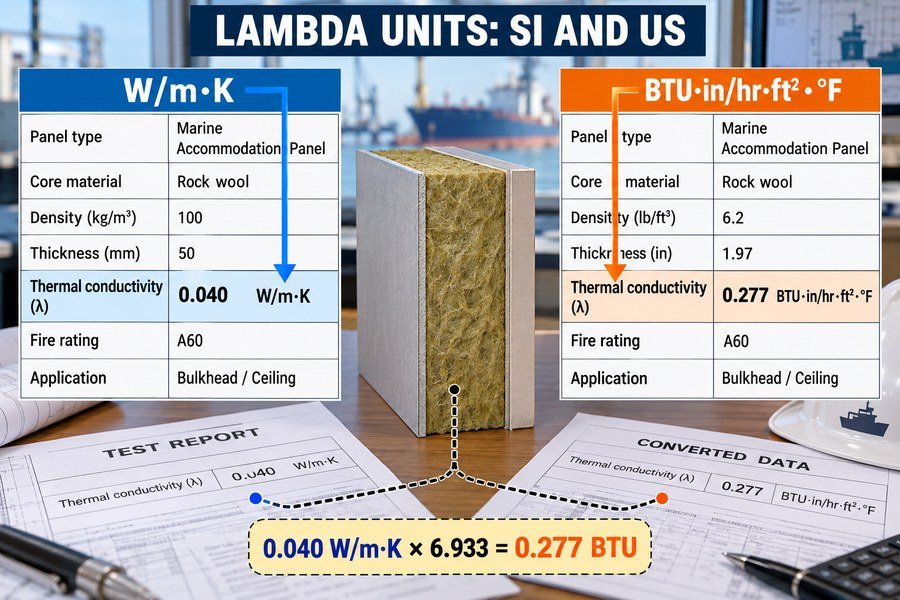
Understanding the Metric Unit W/m·K for European Shipyards
If you buy panels from China or Vietnam to sell to European shipyards, you will see W/m·K. This is the metric standard. The International Organization for Standardization (ISO) requires this unit in standards like ISO 10456. "W" stands for Watts, which is the heat energy. "m" stands for meters, which is the thickness. "K" stands for Kelvin, which is the temperature difference.
I check technical data sheets every day. The best suppliers always list their insulation performance in W/m·K. If you see a rockwool panel with a rating of 0.038 W/m·K5, you know it is a good product. The number is small, so the heat transfer is slow. When you talk to European project managers, you must use this unit. They will not understand anything else. If you use the wrong unit, they will think you do not understand marine outfitting.
Converting to Imperial Units for US Projects
Sometimes you will win a project for an American shipyard. The United States uses the Imperial system. They use BTU·in/hr·ft²·°F. This looks very long and scary. It means British Thermal Units of energy, moving through one inch of thickness, in one hour, over one square foot of area, for every one degree Fahrenheit of temperature difference.
You must know how to translate the metric data from your Asian factory into the Imperial data for your US buyer. The conversion factor is fixed. One W/m·K equals 6.933 BTU·in/hr·ft²·°F. So, if your Chinese supplier gives you a rockwool panel at 0.040 W/m·K, you multiply 0.040 by 6.933. The answer is 0.277 BTU·in/hr·ft²·°F. You put this number on your proposal. The American buyer will be happy.
| Metric System Unit (SI) | Imperial System Unit (US) | Conversion Formula (Metric to US) | Example Value (Rockwool) |
|---|---|---|---|
| W/m·K | BTU·in/hr·ft²·°F | W/m·K × 6.933 | 0.040 W/m·K = 0.277 BTU |
| kW/m·K | BTU·in/hr·ft²·°F | kW/m·K × 6933 | 0.00004 kW/m·K = 0.277 BTU |
| mW/m·K | BTU·in/hr·ft²·°F | mW/m·K × 0.006933 | 40 mW/m·K = 0.277 BTU |
How Does Low Thermal Conductivity Cut Marine Interior Panel Heat Transfer?
High HVAC power consumption hurts the ship's operating cost. The shipyard will blame your interior outfitting. Lower conductivity stops heat flow and saves real money.
Low thermal conductivity cuts heat transfer by trapping air in microscopic pockets, blocking all three heat movement paths: conduction, convection, and radiation. A lower lambda value means the panel actively resists heat from entering the cabin in summer or escaping during winter.
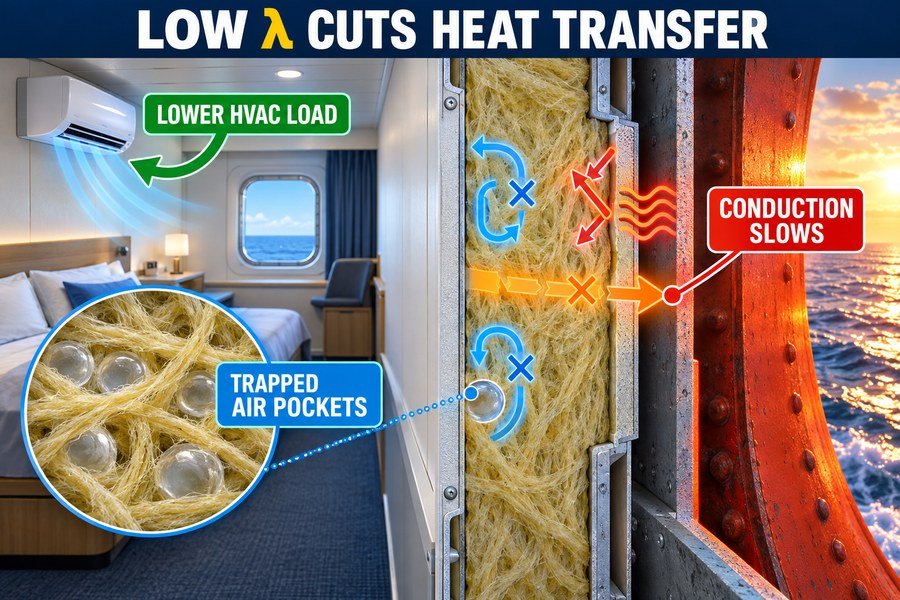
Blocking Conduction, Convection, and Radiation
Heat always tries to move from a hot place to a cold place. It does this in three ways.6 The first way is conduction. This is heat moving through solid matter. The steel hull of a ship conducts heat very fast. The second way is convection. This is heat moving through the air. The third way is radiation. This is heat moving in invisible waves, like heat from the sun.
A panel with low thermal conductivity stops all three. Let us look at rockwool. Inside the rockwool, there are millions of tiny fibers. These fibers trap tiny pockets of still air. Still air has a very low lambda value (about 0.026 W/m·K).7 Because the air cannot move, convection stops.8 Because the fibers are thin and broken up, solid conduction stops. Because the fibers are dense, radiation waves bounce back. I always tell my clients: you are not just buying a wall, you are buying trapped air.
The Financial Impact of Low Lambda Values on HVAC Systems
Shipowners care about fuel. Fuel costs money. The ship's HVAC (Heating, Ventilation, and Air Conditioning) system burns a lot of fuel. If your interior panels have a high lambda value, heat enters the cabin easily. The AC must work harder. This burns more fuel.
If you choose a panel with a lower lambda value, you save money. According to basic thermal dynamic calculations, improving a bulkhead's insulation from 0.06 W/m·K to 0.04 W/m·K can reduce the heat load on that wall by 33%.9 On a large cruise ship or an offshore platform, this adds up fast. I had a client last year who paid $3 more per square meter for better panels. But the shipyard calculated they would save over $15,000 a year in AC electrical costs. You can use this argument to sell higher-quality panels to your customers.
| Panel Lambda Value (W/m·K) | Heat Transfer Rate | HVAC Energy Workload | Long-term Fuel Cost Impact |
|---|---|---|---|
| 0.080 (Poor Insulation) | Very Fast | Maximum Load | Very High Cost |
| 0.060 (Basic Insulation) | Fast | Heavy Load | High Cost |
| 0.040 (Good Marine Standard) | Slow | Normal Load | Standard Cost |
| 0.025 (Premium Cold Room) | Very Slow | Low Load | Lowest Cost |
Why Isn't Lambda Value a Complete Marine Accommodation Panel Insulation Rating?
Many buyers look only at the lambda value and think they are safe. This is a trap. You need the whole picture to pass SOLAS fire rules.
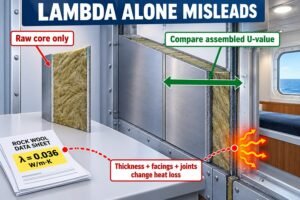
Lambda value is incomplete because it only measures material conductivity, ignoring three critical real-world factors: panel thickness (R-value), thermal bridging from steel framing, and the U-value of the entire bulkhead assembly. You must calculate all three elements to determine actual insulation performance.
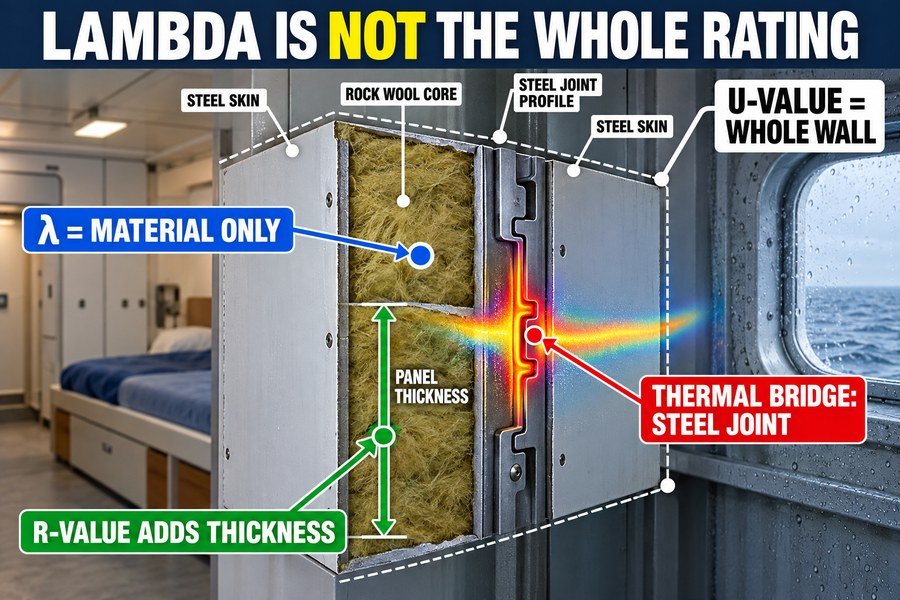
The Difference Between Lambda Value, R-Value, and U-Value
The lambda value is only a material property. It does not care how thick the panel is. But in real life, thickness matters. A 50mm panel stops more heat than a 25mm panel, even if they have the same lambda value. This is why we must calculate the R-value (Thermal Resistance). You find the R-value by dividing the panel thickness (in meters) by the lambda value.
Then we have the U-value (Thermal Transmittance). The U-value measures the heat flow through the whole wall system, including the steel skins and the air films on both sides. You find the U-value by taking 1 and dividing it by the total R-value.10 Shipyards usually ask for the U-value, not the lambda value. If a shipyard asks you for a U-value of 0.60 W/(m²·K), you must do the math to see if your 50mm panel with a lambda of 0.040 W/m·K will pass. I spend a lot of time doing these calculations for buyers to make sure they do not fail the shipyard inspection.
The Impact of Steel Framework and Thermal Bridges
There is a big problem called a thermal bridge. A marine wall panel is not just rockwool. It has a steel skin on the outside. Often, panels connect together with steel splines or joint profiles. Steel is a metal. It conducts heat very well. The lambda value of carbon steel is around 45 to 50 W/m·K. That is more than 1,000 times higher than rockwool!
When heat hits the wall, it looks for the easiest path. It will skip the rockwool and travel straight through the steel joints. This is a thermal bridge. The International Maritime Organization (IMO) FTP Code knows this. That is why fire tests test the whole joint system, not just the core.11 A panel might have a great core lambda value, but terrible joints. You must look at the test report for the full assembly.
| Metric Name | What it Measures | Formula / Relationship | Unit |
|---|---|---|---|
| Lambda Value (λ) | Core material conductivity only | Intrinsic material property | W/m·K |
| Thermal Resistance (R) | Insulation ability based on thickness | Thickness (meters) ÷ Lambda | m²·K/W |
| Thermal Transmittance (U) | Heat flow through the total wall assembly | 1 ÷ Total R-value | W/(m²·K) |
| Thermal Bridge Factor | Heat leak through metal joints | Added penalty to U-value | W/K |
Where Do Marine Interior Panel Data Sheets List Thermal Conductivity?
You stare at a supplier's PDF and cannot find the insulation data. Missing this detail delays your project approval. I will show you exactly where to look.
Marine interior panel data sheets list thermal conductivity in three distinct sections: the "Physical Properties" table, the "Core Material Specifications" section, or the attached third-party laboratory test reports (such as DNV or ABS certificates). It is usually marked with the Greek letter λ.
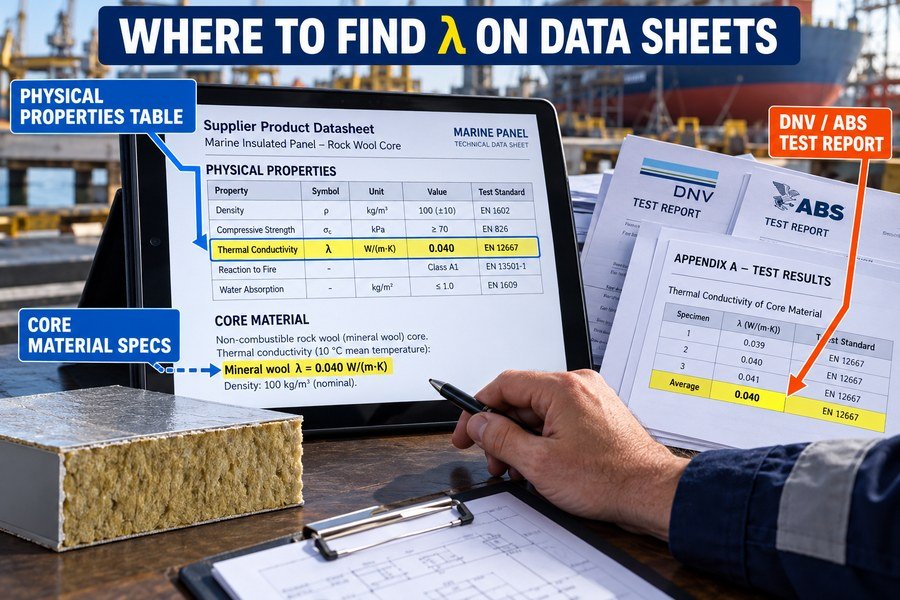
Locating Lambda in the Physical Properties Table
When you get a Technical Data Sheet (TDS) from a supplier in China or Vietnam, the layout is usually the same. You need to look for a table titled "Physical Properties" or "Technical Parameters". Look down the left column. You are looking for the words "Thermal Conductivity". Sometimes, factories translate this poorly into English. They might write "Heat Conduct Coefficient" or "Thermal Conduction Rate".
You can also look for the symbol. The symbol is the lowercase Greek letter lambda (λ). Look for the unit W/m·K. If you see a number like 0.038 W/m·K next to a λ symbol, you have found it. I review many data sheets. Often, I have to point exactly to this line so the buyer can copy it for their shipyard client. If the table does not have it, look at the next section.
Finding Thermal Data in Core Specs and Third-Party Reports
Sometimes the TDS only talks about the finished panel size and weight. In this case, you must look at the "Core Material Specifications" paragraph. The factory might write, "Filled with 120kg/m3 mineral wool (λ = 0.040)12".
If the factory TDS is totally empty, you must ask for their third-party laboratory test reports. Serious marine factories test their products with labs approved by DNV, ABS, or Lloyd's Register. Look at the Type Approval certificate. Go to the appendix pages. There is usually a section called "Thermal Insulation Properties". The lab will list the exact tested lambda value there. This lab number is the most honest number. It is much better than a number a sales person just typed into a brochure.
| Document Source | Section to Check | Common Keywords Used | Reliability Level |
|---|---|---|---|
| Factory TDS | Physical Properties Table | Thermal Conductivity, Heat Conduct, λ | Medium |
| Factory TDS | Core Material Specs | Core Insulation, Mineral Wool spec | Medium |
| Third-Party Lab Report | Test Results Appendix | ISO 8301 result, Thermal Transmittance | High (Trusted) |
| Class Society Certificate | Product Details Schedule | Insulation Properties, Thermal Rating | Very High (Official) |
At What Temperature Are Marine Accommodation Panel Lambda Values Measured?
Did you know that thermal conductivity changes as it gets hotter? Using the wrong temperature baseline ruins your calculations. You must check the test conditions.
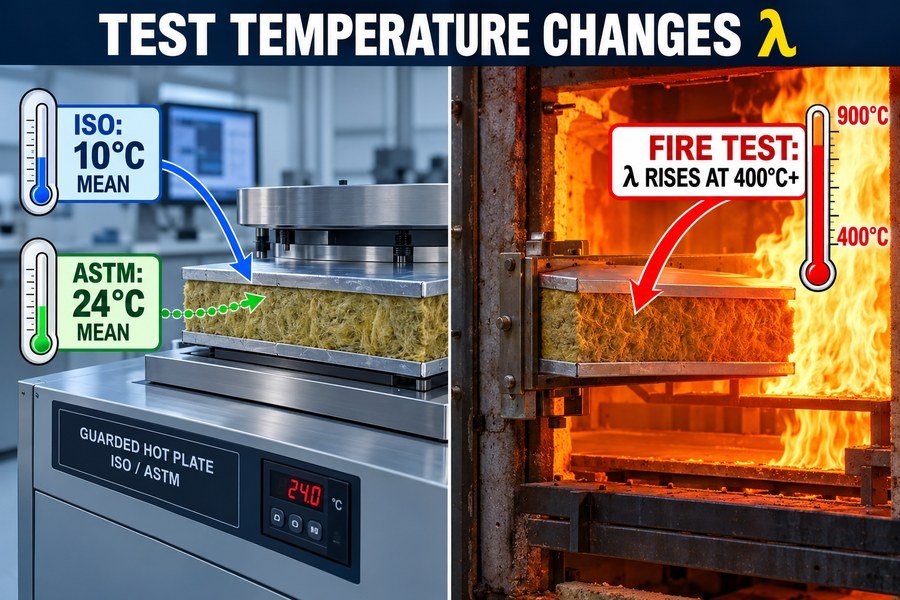
Marine accommodation panel lambda values are officially measured at three standard mean temperatures depending on the testing standard: 10°C (50°F) for European ISO standards, 24°C (75°F) for US ASTM standards, and elevated temperatures like 400°C for SOLAS fire-rating tests.
Standard Mean Temperatures for ISO and ASTM Tests
Materials act differently at different temperatures. When a material gets warmer, the air inside it expands. The fibers vibrate more. This makes it easier for heat to pass through. So, the lambda value goes up when the temperature goes up. To be fair, laboratories must test all panels at the same exact temperature. This is called the "mean temperature".
For European standards like ISO 8301, the lab tests the panel at a mean temperature of 10°C. They might make one side 0°C and the other side 20°C. The average is 10°C. If your project is in America, they use the ASTM C518 standard. ASTM usually tests at a mean temperature of 24°C (about 75°F). I always warn buyers: a panel tested at 10°C will show a lower (better) lambda value than the exact same panel tested at 24°C. You must read the small print on the data sheet to see the test temperature.
How High Heat from Ship Fires Alters the Lambda Value
Ship interior panels are not just for comfort. They stop fires. The SOLAS (Safety of Life at Sea) convention requires A-Class and B-Class panels to block extreme heat during a fire. A normal lambda value of 0.040 W/m·K at 10°C means nothing when a room is on fire.
During an IMO A.754(18) fire test, the furnace gets up to 900°C. We must know the lambda value at high temperatures like 400°C or 500°C. At 400°C, the thermal conductivity of rockwool jumps to over 0.120 W/m·K.13 The heat moves three times faster! This is why factories must put dense rockwool inside fire doors and A-60 bulkheads. If the density is too low, the high-temperature lambda value will be too high, and the unexposed side of the wall will burn people.
| Testing Standard / Situation | Mean Test Temperature | Rockwool Lambda (Approximate W/m·K) | Primary Purpose |
|---|---|---|---|
| ISO 8301 (European) | 10°C (50°F) | 0.035 - 0.040 | Standard HVAC calculations |
| ASTM C518 (American) | 24°C (75°F) | 0.038 - 0.043 | US market HVAC calculations |
| High Temp Lab Test | 100°C (212°F) | 0.050 - 0.060 | Engine room casing baseline |
| SOLAS Fire Condition | 400°C (752°F) | 0.120 - 0.150 | A-Class fire containment |
Conclusion
Understanding the lambda value of marine interior panels helps you control costs, pass shipyard inspections, and buy the right products. Always check the data sheets carefully before you order.
-
"Thermal conductivity and resistivity", https://en.wikipedia.org/wiki/Thermal_conductivity_and_resistivity. Thermal conductivity is a material property that quantifies heat flow through a material under a temperature gradient, and lower values generally indicate greater resistance to conductive heat transfer. Evidence role: definition; source type: education. Supports: Thermal conductivity indicates how well a panel material resists heat transfer.. Scope note: This supports the conductive heat-transfer concept only; overall panel performance also depends on thickness, joints, skins, convection, and installation conditions. ↩
-
"Determination of Thermal Properties of Mineral Wool ... - PMC", https://pmc.ncbi.nlm.nih.gov/articles/PMC10488771/. Published mineral-wool insulation data commonly report thermal conductivity values near 0.035–0.045 W/m·K, which is consistent with a stated approximate lambda value of 0.040 W/m·K for dense rockwool insulation. Evidence role: statistic; source type: paper. Supports: Marine-grade rockwool around 120 kg/m³ can have an approximate thermal conductivity of 0.040 W/m·K.. Scope note: The source may support mineral-wool ranges generally rather than the exact performance of a specific marine-grade 120 kg/m³ product tested under ISO 8301. ↩
-
"Porous Thermal Insulation Polyurethane Foam Materials - PMC", https://pmc.ncbi.nlm.nih.gov/articles/PMC10537539/. Engineering references for polyurethane foam insulation report low thermal conductivity values, often around 0.02–0.03 W/m·K, explaining its use where refrigeration or cold-room insulation is required. Evidence role: statistic; source type: institution. Supports: Polyurethane foam has a thermal conductivity around 0.022 W/m·K and is suitable for cold-room insulation.. Scope note: This supports the thermal-insulation range for PU foam generally; it does not verify a particular shipboard panel product or installation. ↩
-
"OSHA Hazard Information Bulletins Fire Hazard of Polyurethane ...", https://www.osha.gov/publications/hib19890510. Fire-safety literature and maritime fire-test requirements treat polyurethane foam as combustible and capable of contributing to fire growth unless specially protected or certified, which contextualizes restrictions on its use in accommodation spaces. Evidence role: expert_consensus; source type: government. Supports: PU foam generally has poor fire-performance characteristics for ordinary passenger-cabin panel use unless protected or certified.. Scope note: The source may establish combustibility and regulatory testing requirements rather than a universal prohibition for every certified PU-containing marine assembly. ↩
-
"Determination of Thermal Properties of Mineral Wool ... - PMC", https://pmc.ncbi.nlm.nih.gov/articles/PMC10488771/. Published technical and research references commonly report mineral wool or rock wool thermal conductivity values in the approximate range of 0.03–0.04 W/(m·K), placing 0.038 W/(m·K) within a typical insulation range. Evidence role: statistic; source type: paper. Supports: A rockwool panel rated at 0.038 W/m·K has a plausible insulation-performance value.. Scope note: This supports the value as plausible for rock wool, but it does not independently verify that any specific panel is high quality or suitable for a particular marine application. ↩
-
"Conduction, Convection, Radiation • Combined-Mode Heat ...", https://www.purdue.edu/freeform/me418/wp-content/uploads/sites/30/2025/09/ME-418-Lec-67-Heat-Transfer.pdf. Standard heat-transfer references describe heat transfer as energy flow caused by a temperature difference and commonly classify its mechanisms as conduction, convection, and radiation. Evidence role: definition; source type: education. Supports: Heat moves from hotter regions to colder regions through conduction, convection, and radiation.. Scope note: This supports the general framework, not the later ship-specific examples. ↩
-
"Thermal conducTiViTy of gases", https://tsapps.nist.gov/publication/get_pdf.cfm?pub_id=907540. Engineering property tables commonly report the thermal conductivity of air near room temperature at approximately 0.026 W/m·K, supporting the stated order of magnitude for still air. Evidence role: statistic; source type: institution. Supports: Still air has a thermal conductivity of about 0.026 W/m·K.. Scope note: The exact value varies with temperature, pressure, humidity, and whether the air is perfectly stagnant. ↩
-
"Gas Baking Report-FINAL - INFO", https://info.ornl.gov/sites/publications/files/Pub24543.pdf. Research and educational sources on fibrous insulation explain that small, enclosed air spaces reduce convective heat transfer by restricting air movement within the material. Evidence role: mechanism; source type: research. Supports: Trapped, immobile air pockets in rockwool reduce convective heat transfer.. Scope note: The evidence supports substantial suppression of convection, but “stops” is an idealized wording; some heat transfer still occurs through gas conduction, fibers, radiation, and minor air movement. ↩
-
"1 UNIT 1: DESIGN OF HEAT FINS: HEAT CONDUCTION, ...", https://faculty.college.emory.edu/sites/brody/Advanced%20Lab/phys%20222%20lecture%20notes.pdf. Fourier’s law of heat conduction shows that, for the same wall thickness, area, and temperature difference, conductive heat flow is proportional to thermal conductivity; reducing conductivity from 0.06 to 0.04 W/m·K therefore gives a one-third reduction in the conductive component. Evidence role: mechanism; source type: education. Supports: Lowering thermal conductivity from 0.06 to 0.04 W/m·K can reduce conductive heat transfer through an otherwise identical wall by about 33%.. Scope note: This supports the simplified conductive calculation only; real bulkhead heat load also depends on thickness, thermal bridges, air leakage, solar/radiant gains, surface coefficients, and HVAC operation. ↩
-
"Thermal transmittance - Wikipedia", https://en.wikipedia.org/wiki/Thermal_transmittance. The source defines thermal transmittance as the reciprocal of total thermal resistance, supporting the stated U-value relationship for building or enclosure assemblies. Evidence role: definition; source type: government. Supports: U-value is calculated as 1 divided by the total R-value.. Scope note: The source may describe building envelopes rather than marine wall panels, so it supports the heat-transfer principle rather than a ship-specific requirement. ↩
-
"How Does the IMO FTP Code Govern Fire Testing Procedures ...", https://magellanmarinetech.com/how-does-imo-ftp-code-govern-fire-testing-procedures-for-marine-panels/. The IMO FTP Code describes fire test procedures for divisions and assemblies, including joint or construction details, supporting the claim that compliance testing is based on the assembled system rather than only the insulation core. Evidence role: expert_consensus; source type: institution. Supports: IMO fire testing evaluates the full panel or joint assembly, not merely the insulation core.. Scope note: The FTP Code concerns fire performance; it supports assembly-level testing for fire safety, not direct thermal conductivity or U-value performance. ↩
-
"Determination of Thermal Properties of Mineral Wool ... - PMC", https://pmc.ncbi.nlm.nih.gov/articles/PMC10488771/. Published material-property data for mineral wool indicate thermal conductivity values commonly in the approximate range of 0.03–0.05 W/m·K, supporting the example value as plausible for mineral-wool insulation rather than proving any specific supplier’s product value. Evidence role: general_support; source type: paper. Supports: A mineral-wool core may be specified with a thermal conductivity near λ = 0.040 W/m·K.. Scope note: Contextual support only; the exact λ value for a purchased panel depends on the tested product, density, temperature, moisture, and manufacturing details. ↩
-
"Determination of Thermal Properties of Mineral Wool ... - PMC", https://pmc.ncbi.nlm.nih.gov/articles/PMC10488771/. Experimental studies of mineral-wool and rock-wool insulation report that apparent thermal conductivity increases substantially with temperature and can reach values on the order of 0.12 W/m·K at several hundred degrees Celsius. Evidence role: statistic; source type: paper. Supports: Rockwool’s thermal conductivity can exceed about 0.120 W/m·K around 400°C under high-temperature test conditions.. Scope note: Reported values vary with density, fiber orientation, binder content, compression, and test method, so the source would contextualize rather than universally prove the exact threshold for every rockwool product. ↩