Failing a fire inspection because of a cheap panel specification causes massive project delays. You need to know exactly what technical factors change the fire rating to avoid rejection.
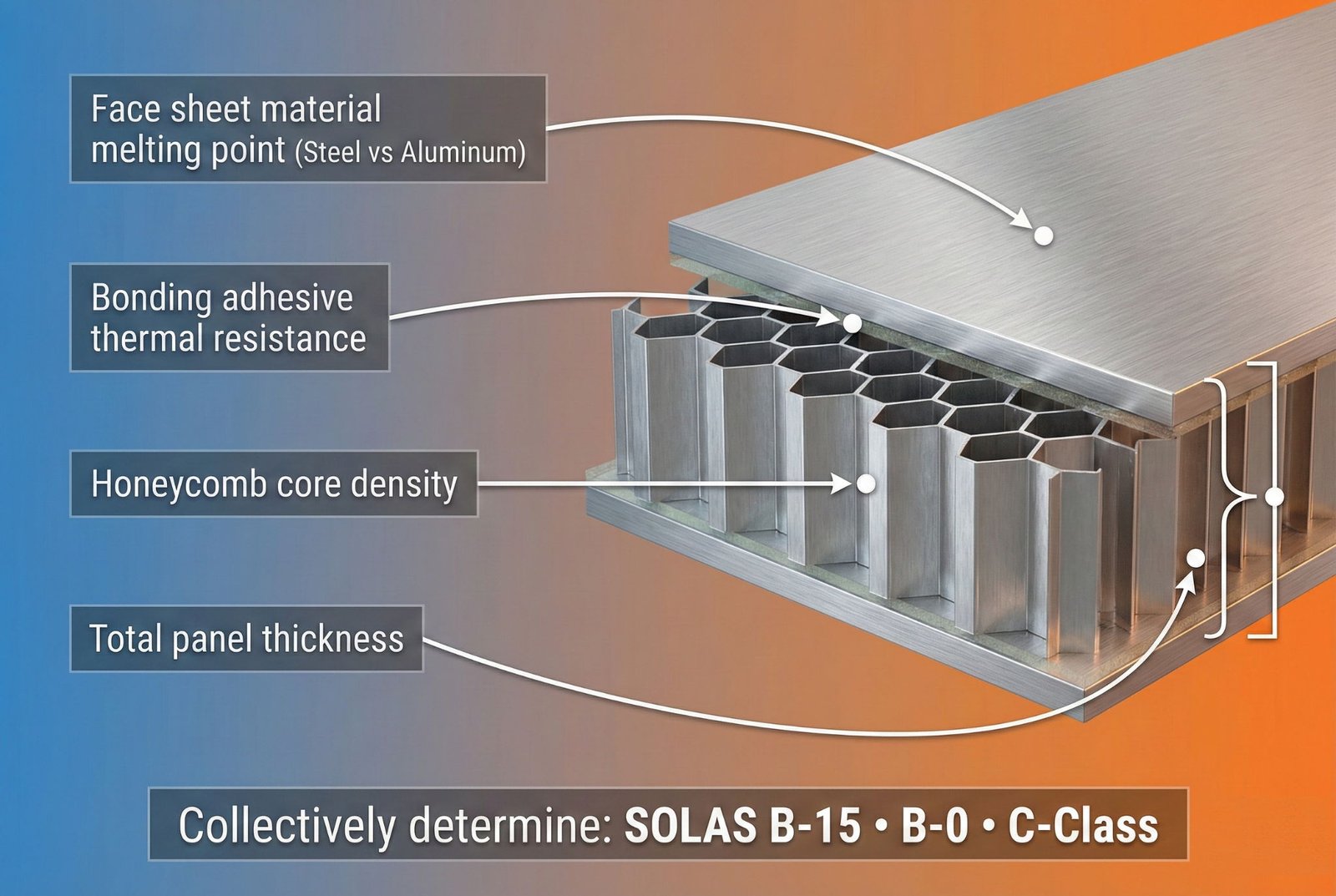
The fire rating of marine aluminum honeycomb panels is determined by the melting point of the face sheet material (Steel vs. Aluminum), the thermal resistance of the bonding adhesive, the density of the honeycomb core, and the total panel thickness. These four parameters collectively define whether a panel meets SOLAS B-15, B-0, or C-Class standards.
Many procurement officers focus only on the price per square meter, ignoring the glue or the core density. If you ignore the technical composition, the panel might look right but will fail the first time a surveyor tests it.
How does the selection of face sheet materials affect the fire resistance of marine aluminum honeycomb panels?
Choosing the wrong skin material is the most common reason for fire test failure. You must balance weight reduction with the melting point of the metal.
Face sheet materials dictate the structural survival time under heat. Stainless steel and galvanized iron, with melting points above 1400°C, provide the integrity needed for B-Class ratings, while aluminum skins, melting at ~660°C, are typically limited to C-Class or lower fire risk areas unless heavily insulated.
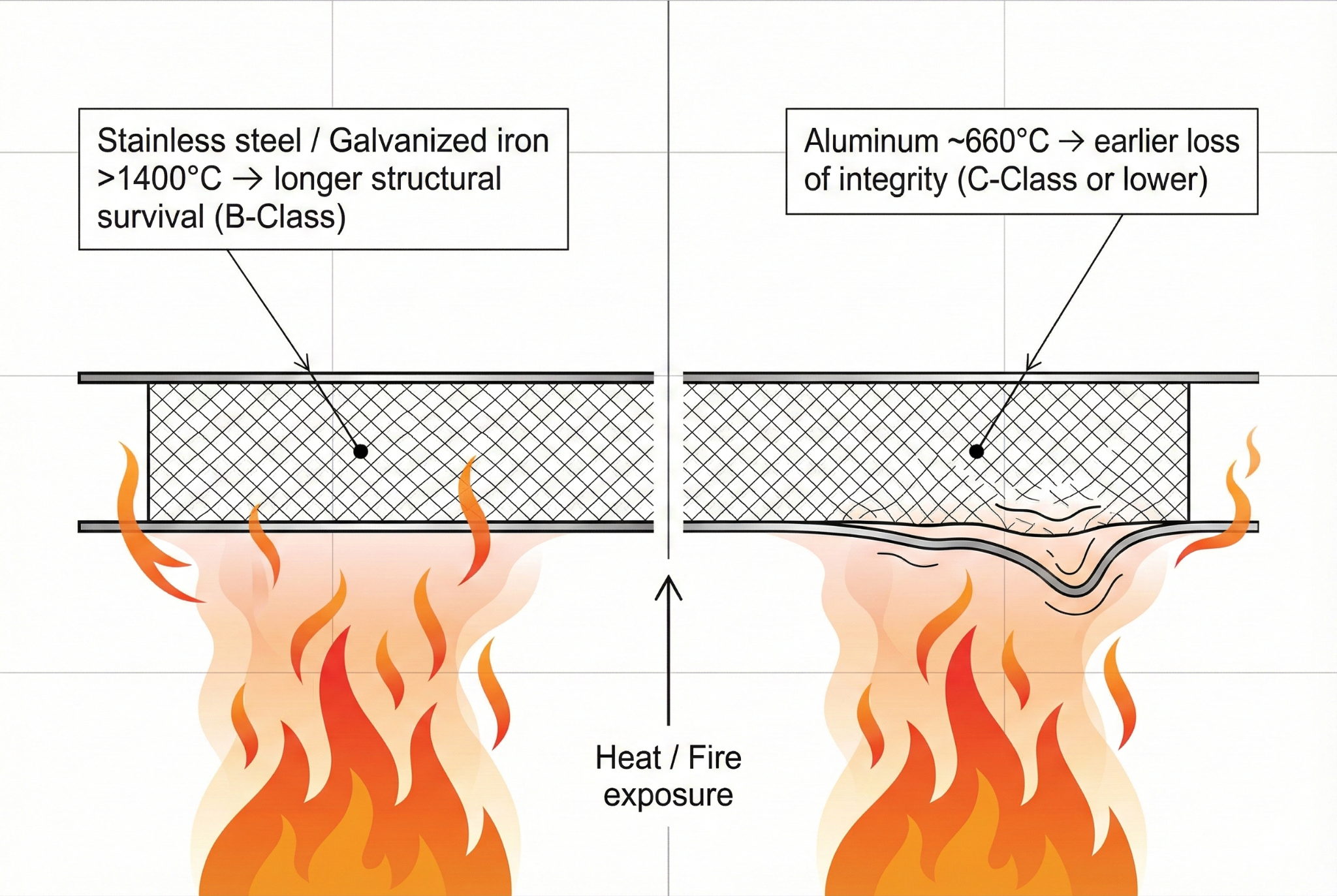
When I worked on a retrofit project in Singapore, we had to replace an entire corridor of panels. The client bought standard aluminum-skinned panels thinking they were B-15. They melted too fast during the lab test. The face sheet is your first line of defense. In the marine industry, we usually see three options: Aluminum, Stainless Steel, and Galvanized Iron (GI).
Performance of Stainless Steel vs Aluminum Face Sheets
Aluminum is light, but physically it cannot withstand a standard fire curve for long. Pure aluminum melts at approximately 660°C. In a SOLAS fire test, the furnace temperature exceeds this within minutes. If you need a B-15 rating1 (which requires the panel to stop fire and heat for 15 minutes), a thin aluminum skin often fails without extra insulation layers. Stainless steel or GI sheets are heavy, but they melt at around 1450°C to 1500°C. This allows the panel to stay solid even when the fire is raging.
Cost and Weight Trade-offs for Face Materials
For interior decoration, you are always balancing cost, weight, and safety. If you are outfitting a high-speed ferry, you want aluminum. If you are building an offshore accommodation module, you often need steel. You must check the project fire plan first. If the area requires B-0 or B-15, steel skins are the safer bet for passing certification.
| Face Material | Melting Point (Approx.) | Weight Impact | Typical Fire Rating Suitability | Cost Level |
|---|---|---|---|---|
| Aluminum Alloy (3003) | 660°C | Low | C-Class (Low Fire Risk) | Medium |
| Stainless Steel (304) | 1450°C | High | B-0, B-15 | High |
| Galvanized Iron (GI) | 1530°C | High | B-0, B-15 | Low |
Why is the selection of adhesives for marine aluminum honeycomb panels critical for achieving fire certification?
The glue is the invisible weak link. If the glue fails, the skins fall off, and the fire barrier disappears immediately.
Adhesive selection is critical because delamination causes immediate structural failure. Two-component polyurethane or epoxy adhesives with high thermal resistance preventing delamination up to 200°C are essential for passing the fire test, whereas standard general-purpose glues soften and fail rapidly under heat.
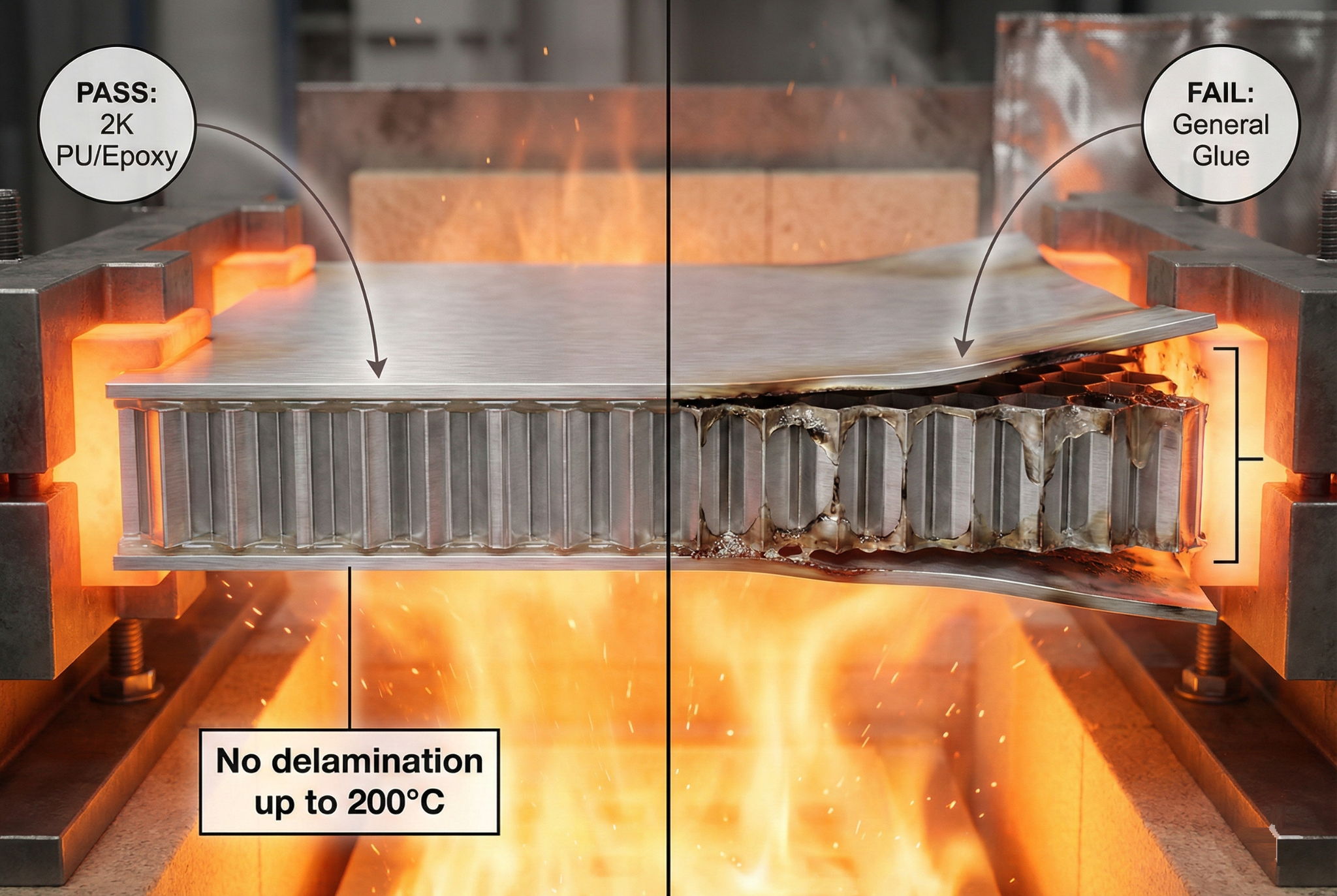
I once saw a batch of panels delaminate just from sitting in a hot container in Dubai. Imagine what happens in a fire. The honeycomb core has very little surface area touching the face sheet. The adhesive must be strong and heat resistant. If you use cheap glue to save $2 per panel, the face sheet peels off when the temperature hits 100°C.
Critical Temperature Thresholds for Marine Adhesives
In a fire test, the heat travels through the metal skin to the glue line instantly. Standard commercial glues soften at 60°C to 80°C.2 For marine fire-rated panels, we need adhesives that hold up to at least 150°C to 200°C before losing grip. While the glue itself is not fireproof, it must hold the skin to the core long enough for the panel to perform its duty. We often use modified epoxy or specific polyurethane blends.
Consequences of Adhesive Delamination
If the adhesive gives up, the "sandwich" structure collapses. The strength of a honeycomb panel comes from the bond between the skin and the core. Once that bond breaks, the thin metal sheet warps and opens gaps for the fire to pass through. This is an automatic failure in any IMO FTP Code test3. You must ask your supplier for the technical data sheet (TDS) of the adhesive, not just the panel.
| Adhesive Type | Softening Temperature | Bond Strength | Risk of Fire Delamination |
|---|---|---|---|
| Standard Neoprene | ~70°C | Medium | Very High |
| General Polyurethane | ~100°C | High | High |
| Modified FR Epoxy | >180°C | Very High | Low |
| High-Temp Phenolic | >300°C | Low/Brittle | Very Low |
Which honeycomb core specifications define structural integrity under heat?
The core is 95% air, but the remaining 5% of aluminum must handle the heat transfer and mechanical load.
Core specifications, specifically cell size and foil thickness, dictate heat transfer rates and crush strength. Smaller cell sizes (e.g., 6mm) and thicker foil (0.05-0.07mm) increase density, slowing heat transmission and preventing rapid structural collapse during SOLAS fire tests.
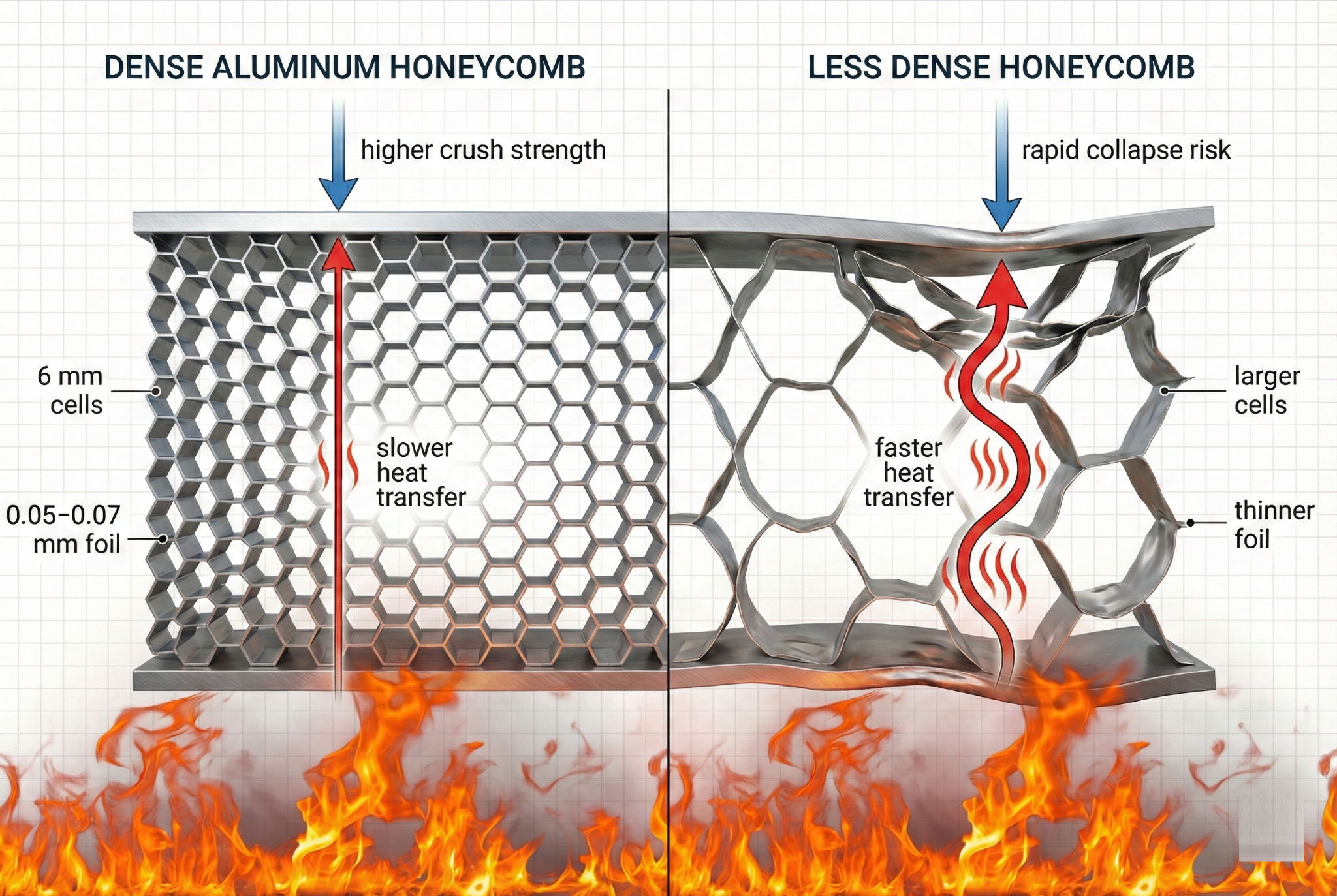
Suppliers often try to sell "standard" core without defining the specs. But a core with large holes transmits heat faster. I always advise clients to specify the exact cell size. It changes the physics of the panel.
Influence of Honeycomb Cell Size on Heat Transfer
The cell size is the distance across the hexagon. Common sizes in marine use are 6mm, 10mm, and 19mm. A smaller cell size (like 6mm) means there is more aluminum metal in every square meter. This adds weight, but it also creates a denser barrier. Heat has a harder time rushing through a dense grid than a wide open one.4 For better fire ratings, we prefer smaller cells.
Importance of Aluminum Foil Thickness
The honeycomb is made of thin aluminum foil. Cheap cores use 0.04mm foil. Good marine cores use 0.05mm to 0.07mm foil. It sounds like a tiny difference. But when you are fighting fire, that extra 0.02mm adds significant stiffness.5 It prevents the core from crushing under the thermal expansion of the face sheets. If the core crushes, the panel buckles and the fire seal breaks.
| Core Cell Size | Foil Thickness | Density (kg/m³) | Fire Integrity Support |
|---|---|---|---|
| 19mm (Large) | 0.04mm | ~15-20 | Poor (Too much air flow) |
| 10mm (Medium) | 0.05mm | ~25-30 | Moderate |
| 6mm (Small) | 0.07mm | ~50-55 | Excellent (High stability) |
How does the total thickness of marine aluminum honeycomb panels affect their SOLAS fire ratings?
Thickness is not just about fitting into the wall track; it is about creating an insulation buffer.
Total panel thickness provides the necessary air gap volume to act as a thermal insulator. Increasing thickness from 10mm to 50mm creates a larger distance between the fire side and the unexposed side, significantly improving the thermal insulation properties required to meet B-15 temperature rise limits.
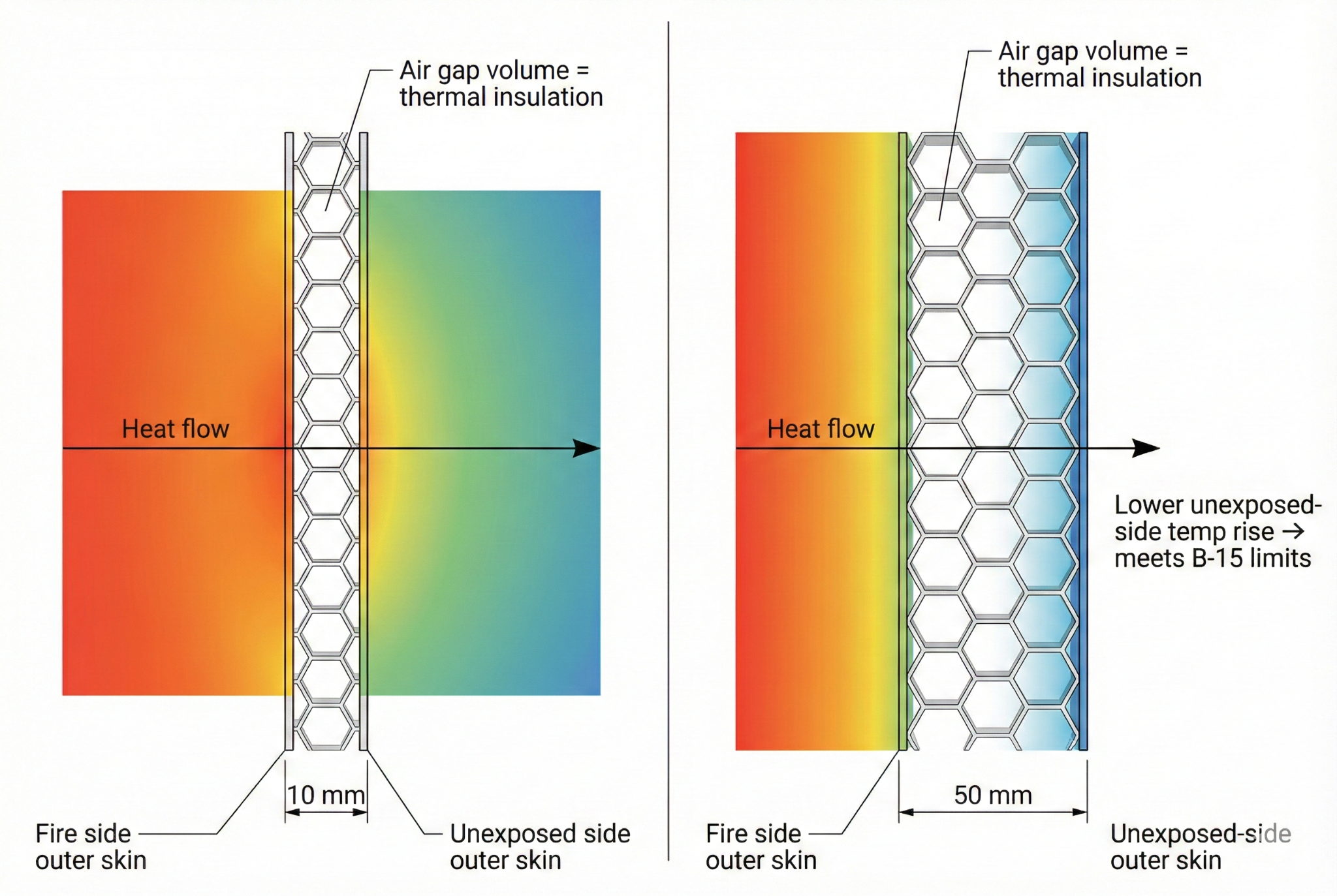
I had a client in Vietnam who wanted to use 15mm panels for a partition wall to save cabin space. I had to explain that 15mm is too thin to stop the heat transfer required for a B-15 rating. The heat jumps from one side to the other too quickly.
Insulation Capability of 50mm vs 25mm Panels
SOLAS ratings like B-15 measure two things: Integrity (stopping the flame) and Insulation (keeping the other side cool). Honeycomb panels are metal, so they conduct heat well. The only insulation is the air inside the cells. A 50mm panel has a much bigger air gap than a 15mm panel. This air gap slows down the temperature rise on the "safe" side of the wall. For B-15 requirements, you almost always need at least 25mm or 50mm thickness, or you need to fill the honeycomb with rock wool.
Structural Stability of Thicker Panels
Thicker panels also resist warping better. When metal gets hot, it expands. A thin 10mm panel will bow and twist violently in a fire. A 50mm panel has more geometric rigidity.6 This stiffness keeps the joints tight. If the joints open up, smoke and fire get through, and you fail the test. Thickness buys you time.
| Panel Thickness | Primary Application | Insulation Value | Typical Fire Class |
|---|---|---|---|
| 10mm - 15mm | Ceiling / Lining | Low | C-Class |
| 20mm - 25mm | Partition / Furniture | Medium | B-0 |
| 50mm | Bulkhead / Partition | High | B-15 (with proper core) |
Conclusion
To secure the right fire rating, you must specify the face material (steel for B-class), high-temp adhesive, dense core (small cells), and sufficient thickness (25-50mm). Ignore these, and you risk compliance failure.
-
"46 CFR Part 116 Subpart D -- Fire Protection - eCFR", https://www.ecfr.gov/current/title-46/chapter-I/subchapter-K/part-116/subpart-D. SOLAS/IMO fire-test provisions define B-class divisions by limits on flame passage and temperature rise, with the B-15 designation requiring the insulation criterion to be maintained for 15 minutes; this supports the regulatory meaning of the rating but does not determine whether a particular product will pass certification. Evidence role: definition; source type: institution. Supports: A B-15 rating requires a marine panel or division to satisfy specified fire and heat-insulation criteria for 15 minutes.. Scope note: The source defines the rating criteria, but certification still depends on testing the complete panel system. ↩
-
"Influence of temperature on the strength of bonded joints", https://bioresources.cnr.ncsu.edu/resources/influence-of-temperature-on-the-strength-of-bonded-joints/. A materials-science source on adhesive thermal properties can support that many common commercial adhesive systems lose stiffness or bond performance near their glass-transition or heat-deflection range, often in the tens of degrees Celsius rather than at fire-test temperatures. Evidence role: statistic; source type: paper. Supports: Standard commercial glues soften at 60°C to 80°C.. Scope note: The exact softening range depends strongly on adhesive chemistry, formulation, cure state, and test method; the source would contextualize the range rather than prove it for all 'standard commercial glues.' ↩
-
"What Is the Purpose and Scope of the IMO FTP Code?", https://magellanmarinetech.com/what-purpose-scope-of-imo-ftp-code/. The IMO FTP Code test criteria for fire-resisting divisions document that loss of integrity, openings, or passage of flame/hot gases are failure conditions in relevant fire-resistance tests. Evidence role: definition; source type: institution. Supports: Gaps or loss of panel integrity caused by delamination can lead to failure under relevant IMO FTP Code fire-resistance criteria.. Scope note: The FTP Code contains multiple test parts; this support is direct for relevant integrity/fire-resistance tests, not for every test procedure covered by the Code. ↩
-
"Study of the Heat Transfer Performance of Laminated Paper ...", https://pmc.ncbi.nlm.nih.gov/articles/PMC9944516/. Studies of honeycomb-core heat transfer model effective conductivity as a function of cell geometry and show that cell size can affect conductive, radiative, and convective heat-transfer paths; this supports the general mechanism but does not by itself establish a specific marine fire rating. Evidence role: mechanism; source type: paper. Supports: Smaller honeycomb cell sizes can reduce or alter heat transfer through the panel compared with larger, more open cells.. Scope note: The support is contextual because certified fire performance also depends on face sheets, adhesives, edge details, insulation, and the applicable fire test standard. ↩
-
"The Lateral Compressive Buckling Performance of Aluminum ...", https://pmc.ncbi.nlm.nih.gov/articles/PMC5456758/. Mechanical analyses of honeycomb cores relate core stiffness and compressive strength to wall thickness and relative density, supporting the statement that thicker foil can increase stiffness; the source would not directly prove the quoted 0.02 mm increment is sufficient for every marine fire-panel design. Evidence role: mechanism; source type: paper. Supports: Increasing aluminum honeycomb foil thickness increases core stiffness and resistance to crushing.. Scope note: The evidence is likely to support the general thickness–stiffness relationship rather than the exact performance of 0.05–0.07 mm foil under a specific fire exposure. ↩
-
"theoretical flexural behavior of sandwich panel using", https://www.academia.edu/7559775/THEORETICAL_FLEXURAL_BEHAVIOR_OF_SANDWICH_PANEL_USING. Sandwich-panel mechanics literature explains that increasing the distance between face sheets increases flexural rigidity, which helps panels resist bending and deformation under load or thermal stress. Evidence role: mechanism; source type: paper. Supports: Thicker sandwich or honeycomb panels have greater geometric rigidity and are generally more resistant to warping than thinner panels.. Scope note: This supports the general structural mechanism; actual fire-test behavior still depends on panel materials, joints, core type, and test configuration. ↩