Worried about your Asian marine panel shipment getting rejected by a European shipyard? One missing compliance detail can freeze your project and ruin your procurement budget. Let us fix this.
Marine accommodation panels entering the EU market must comply with the Marine Equipment Directive (MED 2014/90/EU). This strictly requires passing IMO FTP Code fire tests, holding valid Type Examination (Module B) and Quality Assurance (Module D/E/F) certificates, affixing the Wheelmark, and providing a valid Declaration of Conformity.
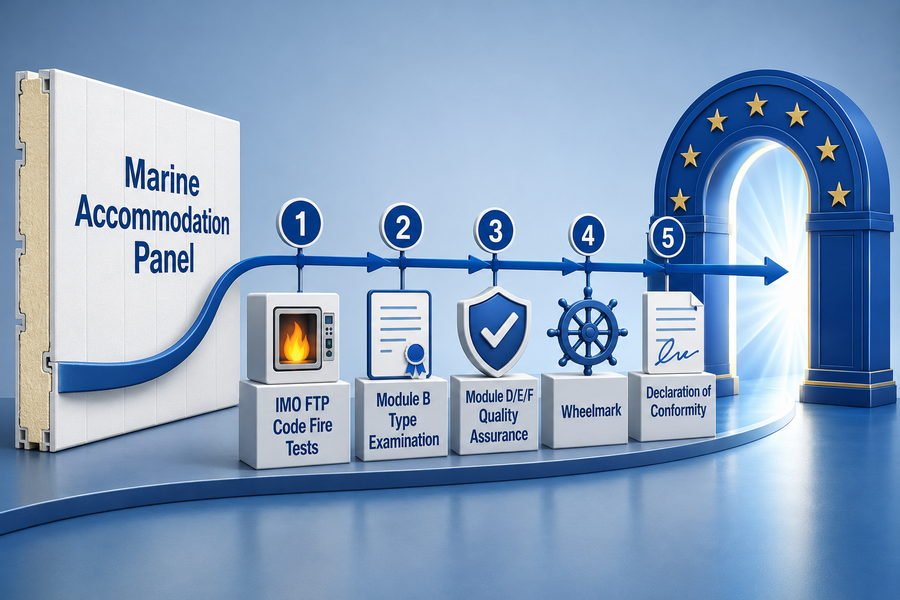
I remember when I first started working at the marine outfitting factory. We saw foreign buyers lose thousands of dollars because they trusted suppliers blindly and received incorrect paperwork. Now, as a specialist at Magellan Marine, I help procurement managers avoid these expensive mistakes. I know you purchase panels from China and Vietnam for large shipyard projects in Europe. You want low prices, but you also need perfect quality and certification. Let us look at the exact rules you must follow to protect your import investments.
Which MED Documents Must Ship with Marine Accommodation Panels to EU Shipyards?
Are your panels stuck at an EU port? Missing documents cause huge delays. You need the right paperwork in the box before the ship leaves Asia.
You must ship exactly three MED documents with marine accommodation panels to EU shipyards: a copy of the EC Type Examination Certificate (Module B), the Production Quality Assurance Certificate (Module D, E, or F), and the signed Declaration of Conformity (DoC) connecting the product to the certificates.
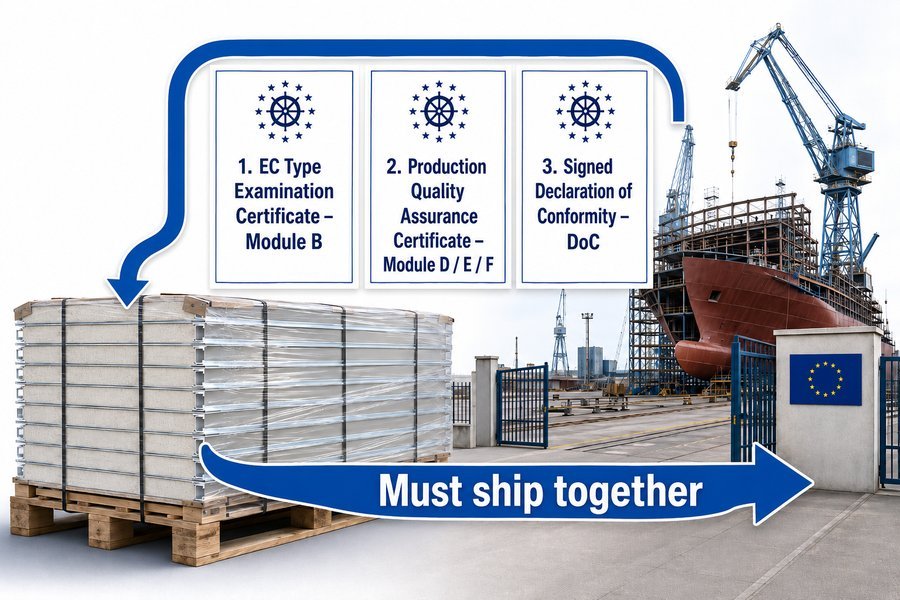
Understanding the Module B Design Certificate and Factory Quality Certifications
To clear EU customs and pass shipyard inspections smoothly, you must verify the three documents your supplier provides. The first document is the Module B certificate. This certificate proves the physical design of the panel meets international safety laws. An approved European lab must test the panel inside a fire chamber. The panel must pass the International Maritime Organization (IMO) 2010 FTP Code Part 3 fire test1. For a B-15 class wall panel, the laboratory heats the panel up to 843°C for exactly 30 minutes according to IMO Resolution MSC.307(88). The temperature on the safe side cannot rise more than 140°C on average2. If it passes, the lab issues a Module B certificate that lasts for 5 years.
The second document is the factory quality certificate, which is usually a Module D certificate in Asia. The Module B certificate only covers the prototype, but Module D covers the actual production line3. An auditor from an official European body travels to the factory in China or Vietnam once every year. The auditor checks raw materials like rock wool density and steel plate thickness. This yearly audit costs the manufacturer about $3,000 to $5,000 USD. It ensures the factory does not use cheaper, dangerous materials after they pass the initial laboratory fire test. You must obtain a fresh copy of this certificate from your supplier before making your final payment.
The Role of the Signed Declaration of Conformity in Shipyard Procurement
The third essential document is the Declaration of Conformity (DoC). The manufacturer creates and signs this specific paper for every single shipping batch. The DoC acts as a legal bridge4. It connects the exact batch of panels inside your shipping container to the original Module B and Module D certificates. It states clearly that the goods you are importing are identical to the panels tested in the European lab. If your supplier fails to provide this signed document, the shipyard quality inspector will reject the delivery immediately, and your project schedule will suffer.
| Document Name | Primary Purpose for Buyers | Issuer of Document | Standard Validity Period |
|---|---|---|---|
| Module B Certificate | Proves the panel design passed IMO fire tests | EU Notified Body | 5 years |
| Module D Certificate | Proves the factory production quality is stable | EU Notified Body | 3 to 5 years (requires annual audit) |
| Declaration of Conformity | Connects your specific batch to the certificates | Panel Manufacturer | Created fresh for each shipment |
Must Wheelmark Be Affixed on Each Marine Accommodation Panel Unit?
Worried about port inspectors rejecting your panels? A missing Wheelmark is a direct violation. You must know exactly where and how to place this mark.
Yes, the Wheelmark must be affixed visibly, legibly, and indelibly to each individual marine accommodation panel unit or its data plate. If the panel size or nature prevents this, the mark must appear completely on the packaging and the accompanying commercial documents under MED Article 10.
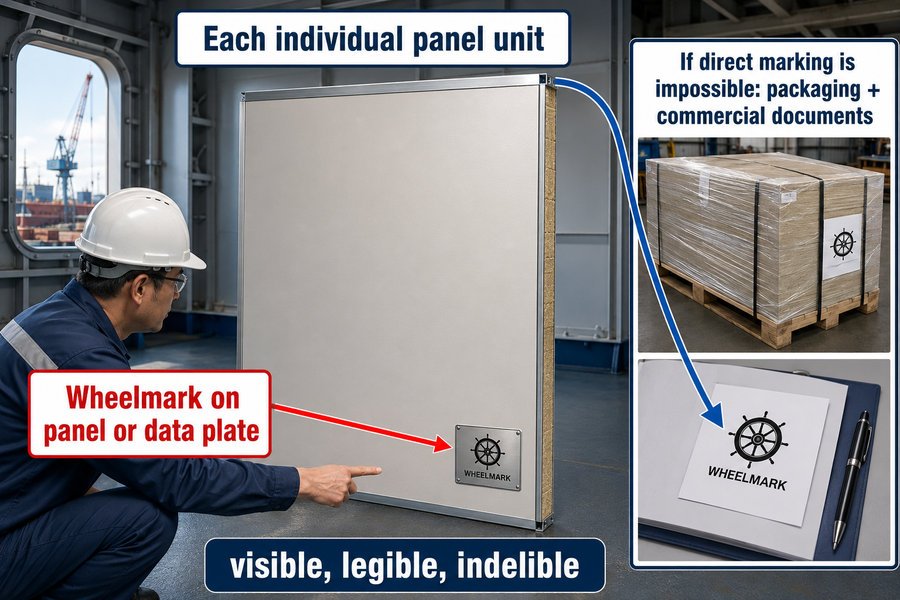
Rules for Physical Wheelmark Markings on Panels and Data Plates
The Wheelmark logo is the official proof of compliance for the European marine market5. You must ensure your supplier follows the application laws strictly. According to MED 2014/90/EU Article 10, the Wheelmark logo must have a minimum height of 5 millimeters6. For standard marine wall panels, the factory must print this logo on a permanent sticker or stamp it directly onto the steel edge of every single panel. This is called the unit method.
Alternatively, if the panels use a metal data plate on the back, the factory can engrave the Wheelmark onto that plate. Printing these stickers or engraving plates costs the factory very little money, usually less than $0.10 USD per panel. However, if your supplier forgets to apply these marks, European customs officers can seize your container7. Port storage fees in Europe can quickly accumulate to $100 or $200 USD per day while you scramble to fix the labeling error.
Using Packaging and Commercial Documents for Special Wheelmark Placement
Sometimes a factory cannot place a permanent stamp or sticker directly onto the panel surface. For example, some high-end ceiling panels feature very thin, delicate decorative PVC films. A strong sticker might leave glue residue that ruins the aesthetic finish, and the panel edges are completely hidden inside aluminum profile slots after installation. In this special situation, the European directive provides an alternative solution.
The factory must print the Wheelmark clearly on the outer packaging8, such as the wooden crates or thick cardboard boxes. At the same time, they must print the Wheelmark logo and identification text onto the official commercial documents. This means the mark must appear on your commercial invoice and packing list. As a buyer, you must check these packing details during your pre-shipment inspections to avoid costly disputes with the shipyard.
| Marking Location | When to Use This Method | Technical Requirements | Cost Impact for Factory |
|---|---|---|---|
| Individual Panel Unit | Standard method for most wall panels | Permanent sticker or stamp, min 5mm height | Very low, under $0.10 USD per unit |
| Metal Data Plate | For panels with permanent backplates | Laser engraved or stamped, min 5mm height | Low, included in plate cost |
| Outer Packaging | Only if direct marking damages the panel | Printed clearly on wooden crates or boxes | Low, standard label printing cost |
| Commercial Documents | Mandatory when packaging method is used | Printed on commercial invoice and packing list | Zero extra cost, digital format |
Can Non-MED Marine Accommodation Panels Sell in the EU Aftermarket?
Trying to buy cheaper non-certified panels for ship repairs? You might face heavy fines. The EU aftermarket has strict rules for ship components.
No, non-MED marine accommodation panels cannot sell in the EU aftermarket for use on EU-flagged ships. Both new builds and aftermarket repairs on EU-flagged vessels strictly require full MED certification (Wheelmark). Non-MED panels can only be sold for non-marine applications or non-EU flagged vessels repairing in EU ports.
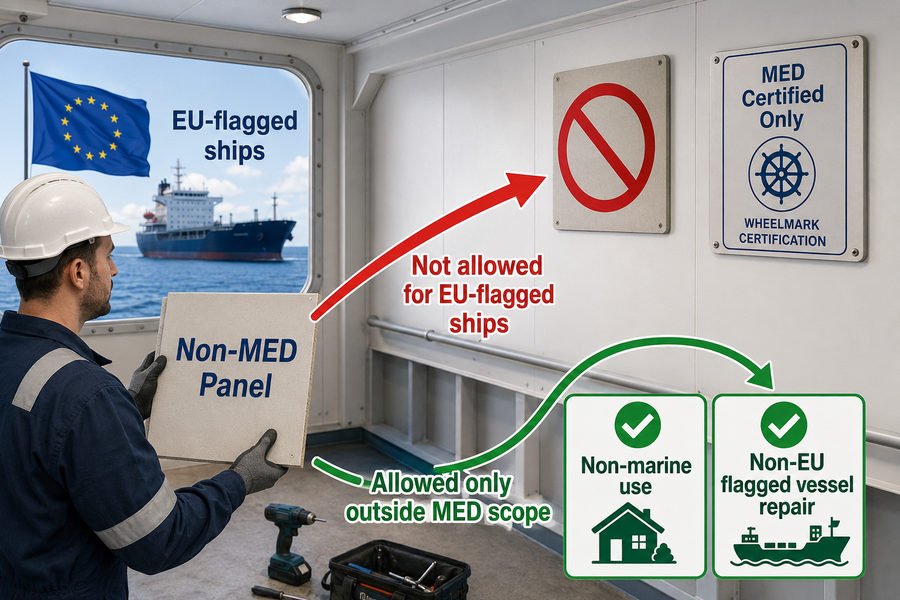
Strict Wheelmark Rules for EU-Flagged New Builds and Aftermarket Repairs
When you browse online B2B platforms, you will find many cheap panels from factories in Asia that look beautiful but do not have MED certificates. You might think you can buy these cheap panels to save money on simple interior repair jobs. This is a dangerous mistake. The Marine Equipment Directive applies to all ships that fly the flag of an EU member state.9 If an interior decoration company repairs a 15-year-old ship flying the French or Italian flag, every single replacement wall panel must carry the Wheelmark10.
There are no exceptions for the aftermarket. Port State Control officers inspect these ships regularly. If an inspector finds non-certified panels inside an accommodation cabin, they can detain the entire ship at the port11. A detained commercial vessel can cost the shipowner between $10,000 and $50,000 USD every day in lost revenue12. If your non-certified panels cause a detention, the shipyard will hold your company financially responsible for the disaster.
Selling Non-MED Panels for Non-EU Flagged Vessels and Non-Marine Applications
You can buy and sell non-MED panels within Europe under two specific conditions. First, you can use them for non-EU flagged vessels. If a cargo ship flies the flag of Panama or Liberia, and it stops at a shipyard in Rotterdam for quick cabin repairs, the EU Wheelmark law does not apply to that vessel. The shipyard can legally install panels that meet general international IMO SOLAS safety standards, even without the specific European Wheelmark.
Second, you can buy these panels for non-marine applications. Many industrial buyers purchase strong marine rock wool panels because they offer excellent soundproofing and fire isolation. They use them to build land-based modular houses, offshore oil rigs, or factory electrical rooms. These land-based projects must follow local construction codes instead of marine directives, so they do not require a Wheelmark.
| Project Type | Vessel Flag State | Certification Requirement | Procurement Risk Level |
|---|---|---|---|
| New Ship Building | EU Member State Flag | Full MED Wheelmark is mandatory | High risk if documents are wrong |
| Aftermarket Ship Repair | EU Member State Flag | Full MED Wheelmark is mandatory | High risk of Port State detention |
| Aftermarket Ship Repair | Non-EU Flag (e.g., Panama) | IMO SOLAS compliance is sufficient | Medium risk, check flag regulations |
| Land-Based Modular House | Not Applicable | Local land building codes apply | Low risk, no marine laws apply |
What Declaration of Conformity Format Is Required for EU Marine Accommodation Panels?
Did a shipyard reject your DoC document? A wrong layout stops the payment process. You must format this document exactly as EU law dictates.
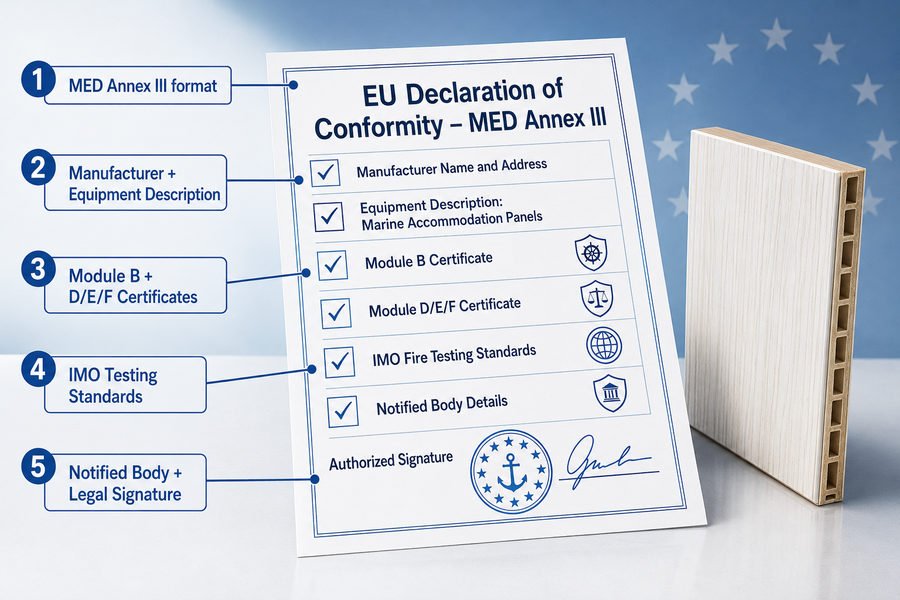
The EU Declaration of Conformity for marine accommodation panels must precisely follow the format in MED Annex III. It must include the manufacturer's name and address, equipment description, valid Module B and D/E/F certificate numbers, the applied IMO testing standards, Notified Body details, and a legally binding signature.
Essential Manufacturer Details and Equipment Descriptions on the Declaration of Conformity
The Declaration of Conformity is usually just a single sheet of A4 paper, but it is a legal document. If your Asian supplier makes a layout mistake, the shipyard will freeze your project payment, and your bank might reject your Letter of Credit. You must ensure the document includes the six parts required by MED Annex III13. The first part is the manufacturer details. The document must show the real factory name and physical manufacturing address in China or Vietnam. You cannot use a virtual sales office address.
The second part is a detailed equipment description. The factory must write the exact product model name, such as "50mm Rockwool B-15 Class Wall Panel." They must also state the specific MED item classification number. For marine accommodation panels, this number is typically MED/3.11a for A and B class divisions. According to European law, the manufacturer must keep a digital copy of this document on file for at least 10 years after they produce the panels.
Listing Certificate Numbers, IMO Standards, Notified Bodies, and Signatures
The third part requires the exact certificate numbers. The document must list your specific Module B design certificate number and the factory's Module D production certificate number. The fourth part must list the exact international testing standards. For these panels, the factory must print "IMO 2010 FTP Code Part 314" on the page.
The fifth part covers the Notified Body details. The document must list the official name and the four-digit registration number of the European laboratories that issued the certificates. Finally, the sixth part is the legally binding signature. A senior manager or the quality director at the factory must sign the document by hand and stamp it with the official company seal. This signature means the factory takes full legal and financial responsibility for the safety of the panels.
| Required DoC Section | Specific Technical Content Example | Purpose for Procurement Officers |
|---|---|---|
| Manufacturer Information | ABC Outfitting Co., No. 88 Factory Road, China | Verifies the physical origin of the goods |
| Equipment Description | MED/3.11a B-15 Class Marine Wall Panel | Matches the cargo description on the bill of lading |
| Certificate Numbers | Module B: MEDB0000XYZ / Module D: MEDD0000ABC | Allows the shipyard to verify validity online |
| Applied Testing Standards | IMO Resolution MSC.307(88) Fire Tests | Proves compliance with international fire safety laws |
| Notified Body Details | DNV (Notified Body Number 0575) | Identifies the European laboratory responsible |
| Official Signature | Signed by Quality Director + Company Seal | Provides legal accountability for panel safety |
Are UKCA-Marked Marine Accommodation Panels Accepted in EU Projects?
Do you have panels with the UK Red Ensign mark? Do not send them to a French or Italian shipyard yet. The rules changed after Brexit.
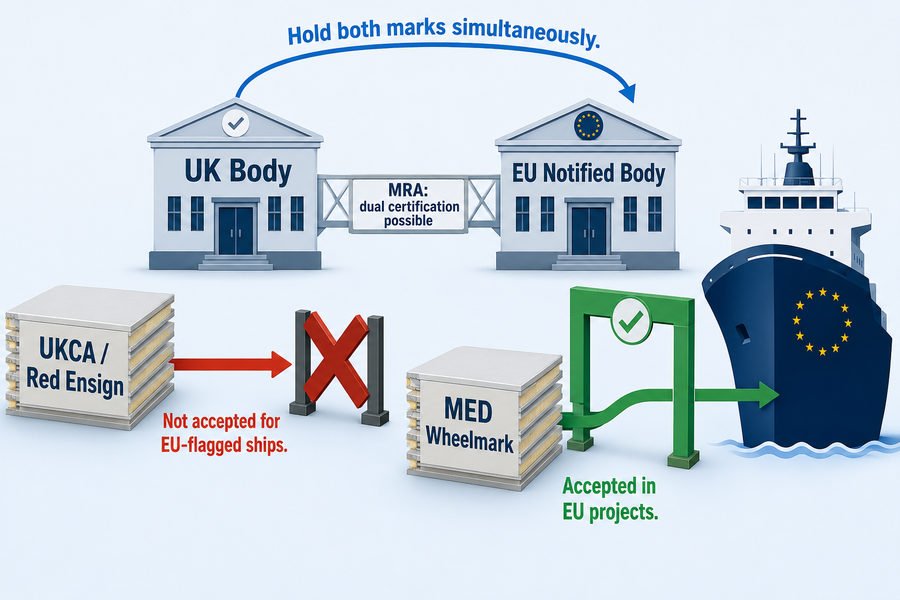
No, UKCA-marked (Red Ensign) marine accommodation panels are not accepted in EU projects for EU-flagged ships. The EU only recognizes the MED Wheelmark. However, thanks to a Mutual Recognition Agreement (MRA), manufacturers can hold both marks simultaneously if they use Notified Bodies recognized by both the EU and UK.
Why the UKCA Red Ensign Mark Fails to Meet EU Project Requirements
When the United Kingdom left the European Union, the technical laws for marine equipment split into two separate systems. The UK created its own certification mark, known as the UK Conformity Assessed (UKCA) mark, or the Red Ensign mark. This system follows the UK Merchant Shipping Notice MSN 1874. The European Union kept the standard Wheelmark system under the MED directive.
If you purchase a batch of ceiling panels from an Asian supplier that only carries the UK Red Ensign mark, you cannot use them in an EU shipyard project. If you ship them to a port in France or Spain, the shipyard quality managers will reject the cargo immediately. They cannot install UKCA-only panels onto an EU-flagged ship.15 Sending the wrong cargo will cost you thousands of dollars in return freight fees and cause severe project delays.
How the Mutual Recognition Agreement Allows Dual Certification for Shipyards
Fortunately, there is an efficient solution to this problem. The UK government and the European Union signed a Mutual Recognition Agreement (MRA) for marine equipment16. This agreement allows an Asian factory to apply both the Wheelmark and the Red Ensign mark to the exact same panel shipment. To achieve this, the manufacturer must hire a certification body that holds official recognition from both governments.
For example, large inspection bodies like DNV or Bureau Veritas maintain separate registration branches in both Europe and the UK. The factory pays the main laboratory fee, plus an extra 15% to 20% administrative fee, to secure both certificates at the same time. The factory can then print both logos side-by-side on the product label. Buying dual-marked panels reduces your inventory risks because you can use the same stock for both British and European shipyard contracts.
| Certification Logo | Governing Legal Directive | Accepted in European Union? | Accepted in United Kingdom? |
|---|---|---|---|
| Wheelmark Only | EU MED 2014/90/EU | Yes, fully accepted | No, rejected at UK ports |
| Red Ensign (UKCA) Only | UK MSN 1874 | No, rejected at EU shipyards | Yes, fully accepted |
| Dual Marking (MRA) | Combined EU and UK Laws | Yes, fully accepted | Yes, fully accepted |
Which Notified Body Number Must Appear on MED Marine Accommodation Panel Certificates?
Confused by all the numbers on the Wheelmark? Printing the wrong Notified Body number ruins your product packaging. You must pick the exact right number.
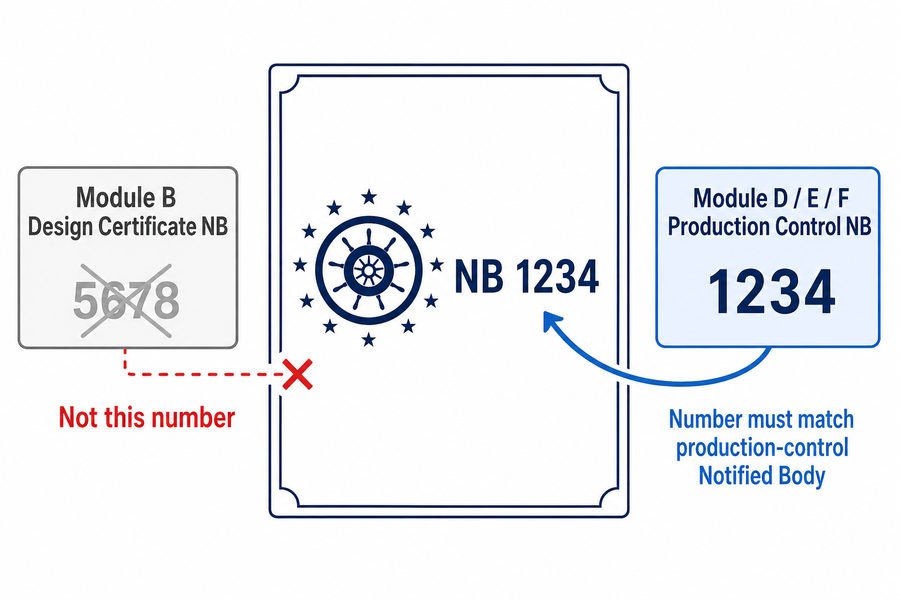
The Notified Body number that must appear on the MED marine accommodation panel certificates and Wheelmark is the four-digit identification number of the Notified Body that controls the production phase (Module D, E, or F), not the Notified Body that issued the Module B design certificate.
Identifying the Correct Production Phase Notified Body Number for Your Labels
Many panel factories in Asia use two completely different European laboratories to save certification costs. For example, a manufacturer might send their prototype wall panel to ABS (Notified Body Number 0282) in Italy to perform the initial Module B fire test. However, the same factory might hire DNV (Notified Body Number 0575) in China to conduct their annual Module D factory quality audits.
According to MED Article 10, the physical Wheelmark label on the panel must display the four-digit identification number of the laboratory that manages the production phase17. In this scenario, the production phase is Module D, which is handled by DNV. Therefore, the factory must print the number 0575 directly underneath or next to the Wheelmark logo. They must not print the ABS number 0282 on the product sticker. The Module B body only checked a single sample years ago, but the Module D body inspects the actual factory line that manufactured your panels.18
The Legal Formatting Rules for the Four-Digit Number and Production Year
European maritime law enforces a very strict visual layout for these markings. The label text must follow this exact sequence: the Wheelmark logo, followed by the four-digit Notified Body number, followed by a slash, and then the year the panel was produced19. The year must use exactly four digits.
If your supplier uses DNV for their Module D certificate and manufactures your panels in 2026, the text next to the logo must read "0575/2026". If the factory manufactures the cargo in December 2025 but the ship leaves the port in January 2026, the label must still print "0575/2025" because the year must match the actual date of production. You must check this layout during your quality inspections before approving the final factory payment.
| Manufacturing Phase | Responsible Laboratory Example | Notified Body Number | Must Appear on the Wheelmark? |
|---|---|---|---|
| Module B (Initial Fire Test) | ABS Italy | 0282 | No, omit from the label |
| Module D (Annual Factory Audit) | DNV China | 0575 | Yes, mandatory on the label |
| Module B (Initial Fire Test) | RINA Italy | 0474 | No, omit from the label |
| Module D (Annual Factory Audit) | RINA China | 0474 | Yes, mandatory on the label |
Conclusion
Sourcing marine panels for EU shipyards requires strict MED compliance. Always verify your Wheelmarks, four-digit laboratory numbers, and Declaration of Conformity details to avoid expensive port delays.
-
"How Does IMO MSC.307(88) Apply To Marine Interior Panels?", https://magellanmarinetech.com/how-imo-msc-30788-apply-to-marine-interior-panels/. The IMO 2010 FTP Code, adopted by Resolution MSC.307(88), identifies Part 3 as the test procedure for fire-resisting divisions such as A, B and F class divisions used in ships. Evidence role: definition; source type: institution. Supports: Marine wall panels claiming B-class fire resistance should be assessed under the IMO 2010 FTP Code Part 3 fire test.. Scope note: This supports the relevant test standard, but not the compliance status of any specific panel product. ↩
-
"What Is the Purpose and Scope of the IMO FTP Code? - Magellan ...", https://magellanmarinetech.com/what-purpose-scope-of-imo-ftp-code/. The 2010 FTP Code specifies the standard fire exposure curve and insulation criteria for fire-resisting divisions, including a 30-minute B-class test duration and an average unexposed-face temperature-rise limit of 140°C. Evidence role: mechanism; source type: institution. Supports: B-15 panels are tested for 30 minutes under the IMO FTP Code fire curve, with an average unexposed-side temperature-rise limit of 140°C.. Scope note: The cited code establishes the test conditions and acceptance criteria; the precise furnace temperature is derived from the standard time-temperature curve rather than being a separate product-specific requirement. ↩
-
"Conformity Assessment of Medical Devices: An Overview from a ...", https://pmc.ncbi.nlm.nih.gov/articles/PMC12821529/. EU conformity-assessment Module D is defined as conformity to type based on quality assurance of the production process, under which a notified body assesses and surveils the manufacturer’s approved quality system for production, final inspection and testing. Evidence role: definition; source type: government. Supports: Module D concerns production quality assurance rather than only prototype design approval.. Scope note: This supports the regulatory function of Module D generally; audit frequency and factory-specific inspection scope may depend on the applicable marine-equipment rules and notified-body procedures. ↩
-
"Directive 96/98/EC - Wikipedia", https://en.wikipedia.org/wiki/Directive_96/98/EC. Under the EU Marine Equipment Directive framework, the manufacturer’s EU declaration of conformity states that marine equipment complies with the applicable requirements and records key identification and conformity-assessment information, linking the supplied equipment to its certified conformity basis. Evidence role: general_support; source type: government. Supports: A Declaration of Conformity links supplied marine equipment to the relevant conformity assessment and regulatory compliance claims.. Scope note: The legal source supports the declaration’s compliance-linking function, but it may not require a separate declaration for every commercial shipping batch in all procurement contexts. ↩
-
"Directive 96/98/EC - Wikipedia", https://en.wikipedia.org/wiki/Directive_96/98/EC. Directive 2014/90/EU establishes the wheel mark as the conformity mark for marine equipment covered by the Directive and links its use to compliance with applicable EU marine-equipment requirements. Evidence role: definition; source type: institution. Supports: The Wheelmark logo is the official proof of compliance for the European marine market.. Scope note: This supports the legal meaning of the wheel mark for equipment within the Directive’s scope, but it does not prove that any specific product or supplier is compliant. ↩
-
"How Does the IMO FTP Code Connect with Other Marine Fire Safety ...", https://magellanmarinetech.com/how-imo-ftp-code-connect-with-other-marine-fire-safety-frameworks/. Annex I to Directive 2014/90/EU specifies the graphical form of the wheel mark and states that the mark must have a minimum height of 5 mm, except where smaller dimensions are allowed for small devices. Evidence role: definition; source type: institution. Supports: MED 2014/90/EU requires the Wheelmark logo to have a minimum height of 5 millimeters.. Scope note: The height requirement is subject to exceptions for certain small devices, so the citation should not be read as an unconditional rule for every possible item. ↩
-
"EU Legislation and CE Marking - International Trade Administration", https://www.trade.gov/country-commercial-guides/eu-eu-legislation-and-ce-marking. EU product-safety and market-surveillance rules allow customs and market-surveillance authorities to suspend release or take action against products presenting compliance concerns at the border, including goods with deficient conformity marking. Evidence role: general_support; source type: institution. Supports: Missing or incorrect Wheelmark labeling can lead to customs or border enforcement problems in Europe.. Scope note: This provides contextual support for possible detention or enforcement action; it does not show that every missing Wheelmark results in seizure of an entire container. ↩
-
"Marine Equipment Directive enters into force in the EEA - Efta.Int", https://www.efta.int/media-resources/news/marine-equipment-directive-enters-force-eea. Directive 2014/90/EU Article 10 provides that, where the wheel mark cannot be affixed to the equipment or its data plate because of the nature of the equipment, it must be affixed to the packaging and to accompanying documents. Evidence role: definition; source type: institution. Supports: When a permanent mark cannot be placed directly on the panel, the factory may use outer packaging and accompanying documents for Wheelmark placement.. Scope note: The Directive sets the legal condition for using packaging and documents, but it does not list every acceptable packaging material or prescribe the article’s specific examples. ↩
-
"Marine Equipment Directive enters into force in the EEA - Efta.Int", https://www.efta.int/media-resources/news/marine-equipment-directive-enters-force-eea. Directive 2014/90/EU establishes harmonised requirements for marine equipment placed on board ships flying the flag of an EU Member State, supporting the article’s statement about the flag-state scope of the Marine Equipment Directive. Evidence role: definition; source type: government. Supports: The Marine Equipment Directive applies to all ships that fly the flag of an EU member state.. Scope note: The directive applies to marine equipment within its defined scope, not to every object or material on a ship. ↩
-
"How Do EU Rules Differ From IMO Standards for Marine Panels?", https://magellanmarinetech.com/how-eu-rules-differ-from-imo-standards-for-marine-panels/. EU marine-equipment rules require covered equipment placed on board EU-flagged ships to comply with MED conformity assessment and bear the wheel mark, which provides contextual support for applying the requirement to replacement accommodation panels when those panels fall within the directive’s listed equipment categories. Evidence role: general_support; source type: government. Supports: Replacement wall panels installed on EU-flagged vessels must carry the Wheelmark when they are marine equipment covered by the MED.. Scope note: The source may not state that every replacement wall panel is covered; applicability depends on whether the specific panel type is listed under MED implementing rules and relevant fire-protection categories. ↩
-
"[PDF] PROCEDURES FOR PORT STATE CONTROL, 2023", https://wwwcdn.imo.org/localresources/en/OurWork/IIIS/Documents/A%2033-Res.1185%20-%20PROCEDURES%20FOR%20PORT%20STATE%20CONTROL,%202023%20(Secretariat)%20(1).pdf. Port State Control rules under instruments such as the Paris MoU and EU port-state-control legislation permit detention where deficiencies create grounds for non-compliance with applicable safety conventions, supporting the possibility that serious certification or fire-safety deficiencies may lead to vessel detention. Evidence role: mechanism; source type: institution. Supports: Port State Control officers can detain a vessel when non-compliant safety equipment or material deficiencies are found.. Scope note: Detention is discretionary and depends on the severity of the deficiency, the applicable convention requirement, and the inspector’s assessment; a non-certified panel would not automatically require detention in every case. ↩
-
"Demurrage and detention: from operational challenges towards ...", https://pmc.ncbi.nlm.nih.gov/articles/PMC10026217/. Studies and industry analyses of commercial vessel delay and detention costs document that off-hire time, lost charter revenue, port fees, and operational disruption can produce daily losses in the tens of thousands of U.S. dollars for some vessels, providing contextual support for the stated cost range. Evidence role: statistic; source type: paper. Supports: A detained commercial vessel can cost the shipowner between $10,000 and $50,000 per day in lost revenue.. Scope note: Daily loss varies substantially by vessel type, charter market, cargo, port, and duration of detention; a single source may support the order of magnitude rather than the exact range for all vessels. ↩
-
"Directive 96/98/EC - Wikipedia", https://en.wikipedia.org/wiki/Directive_96/98/EC. Directive 2014/90/EU Annex III sets out the model structure and required content for an EU declaration of conformity for marine equipment, including manufacturer identification, equipment description, conformity references, notified-body information, and signature. Evidence role: definition; source type: government. Supports: A Marine Equipment Directive declaration of conformity must include the core information listed in Annex III.. Scope note: The directive provides the legal template and required content, but it does not describe procurement or banking consequences of omissions. ↩
-
"How Does IMO MSC.307(88) Apply To Marine Interior Panels?", https://magellanmarinetech.com/how-imo-msc-30788-apply-to-marine-interior-panels/. The 2010 FTP Code, adopted by IMO Resolution MSC.307(88), contains Part 3 test procedures for A, B and F class divisions, providing the fire-test framework commonly referenced for marine accommodation panel divisions. Evidence role: definition; source type: institution. Supports: Marine A- and B-class accommodation panels are tested by reference to IMO 2010 FTP Code Part 3.. Scope note: This supports the relevance of FTP Code Part 3 to fire-test procedures for class divisions; the applicable test standard for a specific product still depends on the certification scope and MED item entry. ↩
-
"Directive 96/98/EC", https://en.wikipedia.org/wiki/Directive_96/98/EC. EU marine-equipment rules require equipment placed on board EU-flagged ships within the scope of Directive 2014/90/EU to carry the wheel mark following the required conformity-assessment procedure. Evidence role: general_support; source type: government. Supports: UKCA-only marine equipment cannot be installed on EU-flagged ships when the equipment falls within the EU Marine Equipment Directive.. Scope note: This supports the general legal requirement for EU-flagged ships; whether a particular ceiling panel is covered depends on its classification under the Directive and implementing acts. ↩
-
"[PDF] US-UK-Marine-Eq-MRA-signed.pdf - USTR", https://ustr.gov/sites/default/files/US-UK-Marine-Eq-MRA-signed.pdf. An official UK-EU legal text or government notice is needed to show the scope of any mutual-recognition arrangement for marine equipment conformity assessment and whether it permits dual UK and EU marking on the same product. Evidence role: case_reference; source type: government. Supports: A UK-EU mutual-recognition arrangement exists for marine equipment and can enable dual marking under specified conditions.. Scope note: The source may show a narrower arrangement than the article implies; it may support dual certification procedures without proving automatic market acceptance in every project. ↩
-
"Directive 96/98/EC - Wikipedia", https://en.wikipedia.org/wiki/Directive_96/98/EC. Directive 2014/90/EU states that the wheel mark must be followed by the identification number of the notified body where that body is involved in the production-control phase, supporting the requirement to use the production-phase body’s number. Evidence role: general_support; source type: government. Supports: Under the Marine Equipment Directive, the Wheelmark must show the identification number of the notified body involved in the production phase.. Scope note: The Directive uses the legal term “notified body” and “production-control phase,” rather than the article’s informal term “laboratory.” ↩
-
"Conformity Assessment of Medical Devices: An Overview from a ...", https://pmc.ncbi.nlm.nih.gov/articles/PMC12821529/. The EU conformity-assessment module framework defines Module B as EU-type examination of a product type or design, while Module D concerns production quality assurance under notified-body assessment and surveillance, supporting the distinction between prototype/type testing and production-phase control. Evidence role: definition; source type: government. Supports: Module B relates to type examination, whereas Module D relates to production quality assurance and factory production control.. Scope note: The framework supports the general difference between Modules B and D; it does not prove that a particular body checked only one sample or that the examination occurred years earlier in this specific scenario. ↩
-
"Directive 96/98/EC - Wikipedia", https://en.wikipedia.org/wiki/Directive_96/98/EC. EU Marine Equipment Directive materials and related implementation guidance describe the wheel mark as accompanied by the notified-body identification number and the year of marking, providing legal context for the label sequence shown in the article. Evidence role: definition; source type: government. Supports: The MED label format includes the Wheelmark, the notified-body number, and the year marking in a defined visual sequence.. Scope note: Official legal text clearly supports inclusion of the notified-body number and year; a source may be needed to confirm the article’s exact slash typography if that formatting is asserted as mandatory. ↩