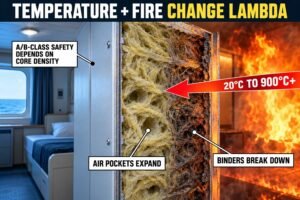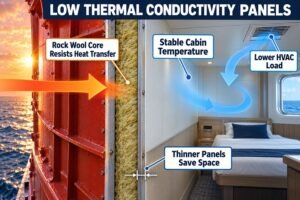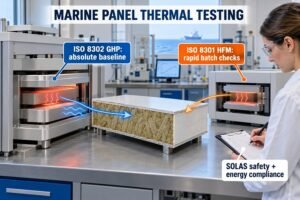
Fire spreads fast on ships. A weak panel means danger for everyone on board. I will show you how specific panel shapes stop fire completely.
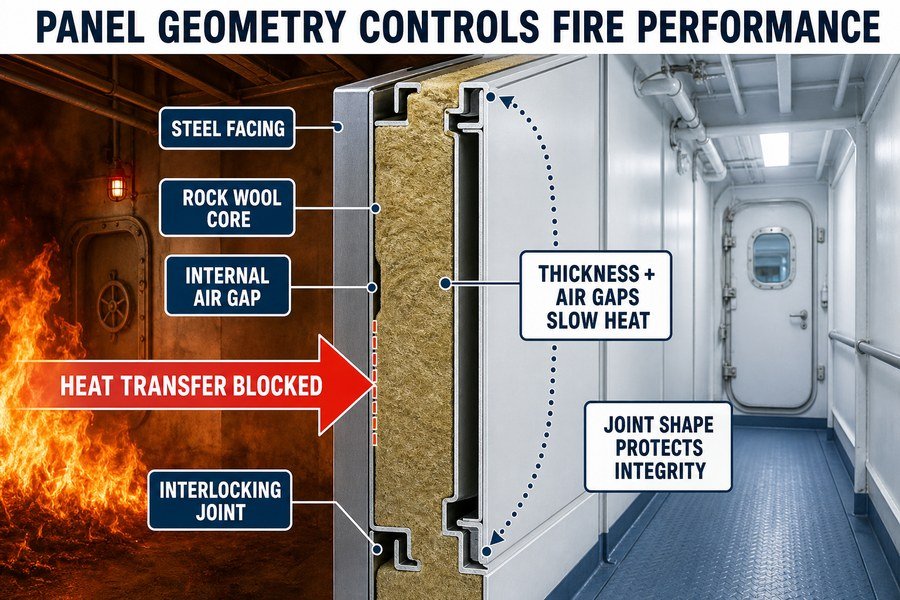
Panel geometry determines marine interior panel fire performance by controlling heat transfer, structural stability, and joint integrity. Specifically, sandwich thicknesses, edge profiling, internal air gaps, and joint designs work together to meet strict IMO SOLAS A-Class and B-Class fire ratings during actual marine emergencies.
If you stop reading now, you will miss the key design secrets that help shipyard buyers save money and pass strict safety checks. Keep reading to see the exact details.
How Do Sandwich Constructions Improve a Marine Interior Panel's Fire Resistance?
Single-layer panels melt fast. A fire can destroy a cabin in minutes. Sandwich panels use multiple layers to block heat and save lives.
Sandwich constructions improve a marine panel's fire resistance through three mechanisms: thermal insulation from rockwool cores, structural rigidity from steel outer skins, and heat-absorbing properties of specialized adhesives. Together, these three layers prevent temperature rises above the IMO FTP Code 140°C limit on the unexposed side.
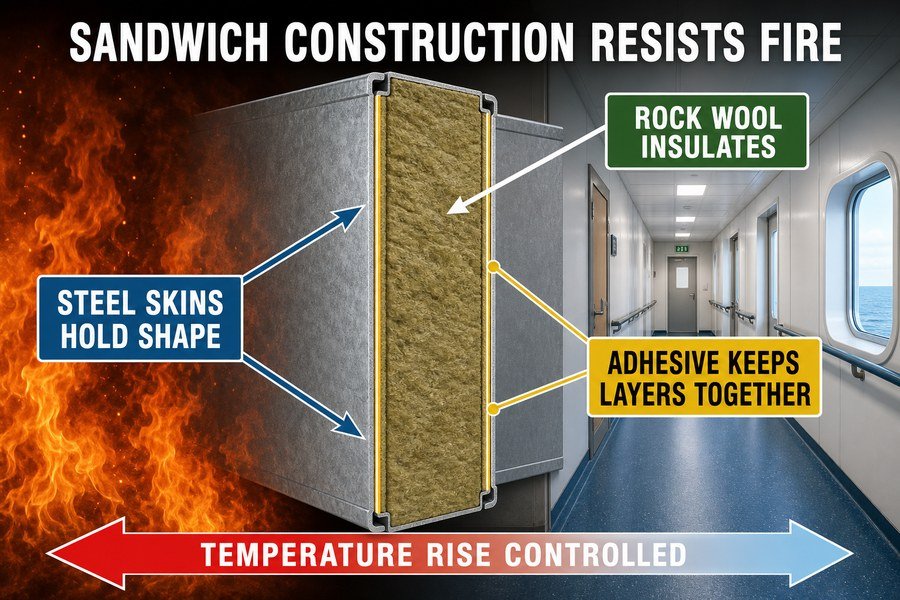
In my work at Magellan Marine, I see many buyers choose cheap panels. They regret it later when the ship fails inspection. I always tell them to understand the sandwich construction. A sandwich panel has three main mechanisms to stop fire, and we must look at each of these three mechanisms closely to buy the right product.
Thermal Insulation from Rockwool Cores in Sandwich Panels
The first mechanism is the thermal insulation from the rockwool core. Rockwool is made of melted stone. It does not burn.1 According to the IMO FTP Code Part 3, the unexposed side of an A-60 panel must not exceed an average temperature rise of 140°C above the starting temperature.2 To meet this standard, we use rockwool with a density of 120 to 150 kilograms per cubic meter3. If the density is lower, the fire will burn through the panel. If it is higher, the panel becomes too heavy for the ship. This core acts as a thick shield against the heat.
Structural Rigidity and Adhesives in Steel Outer Skins
The second mechanism is the structural rigidity from the steel outer skins. The steel layers hold the rockwool in place. We normally use 0.6 millimeter thick galvanized steel for marine wall panels. When a fire reaches 900°C in an A-Class test, the steel keeps its shape and prevents the rockwool from falling apart. The third mechanism is the heat-absorbing property of the adhesive. We use two-component polyurethane glue. This glue binds the steel and the rockwool together. During a fire, a high-quality glue does not melt quickly. It holds the layers tight for a longer time.4
| Sandwich Component | Primary Fire Function | Critical Specification |
|---|---|---|
| Rockwool Core | Blocks heat transfer | 120-150 kg/m3 density |
| Steel Outer Skin | Maintains physical shape | 0.6 mm minimum thickness |
| Polyurethane Adhesive | Prevents layer separation | High-temperature resistance |
When you buy these panels from suppliers in Asia, you must ask for the exact steel thickness and rockwool density. If they reduce the steel to 0.4 millimeters, you will fail the structural test.
Why Are Edge Profiles the Weakest Point in Marine Wall Panel Fire Integrity?
Fire always finds the weakest link. Bad edges let smoke leak through the walls. You must understand edge profiles to keep your ship safe.
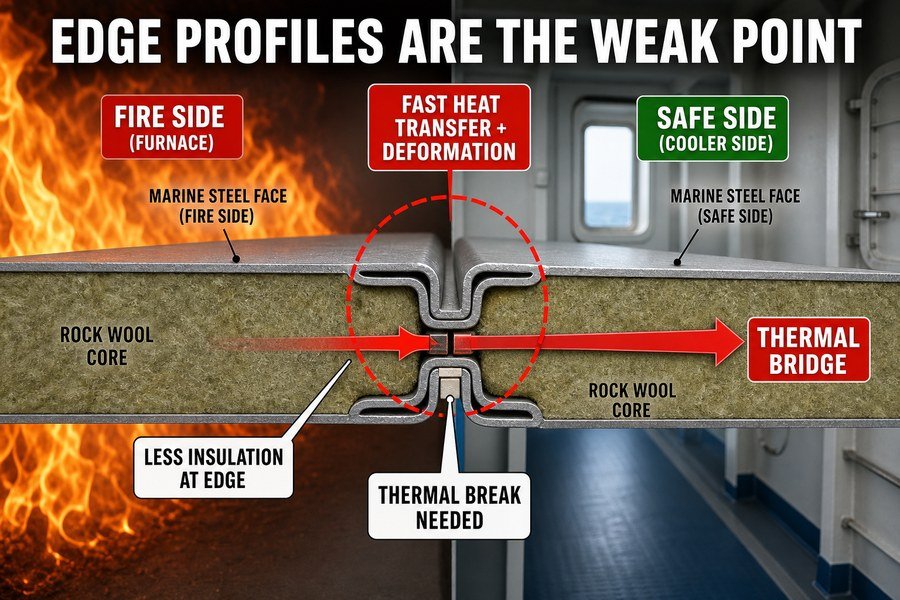
Edge profiles are the weakest point in marine wall panel fire integrity for two main reasons: they have less insulation material than the center, and metal-to-metal contact creates a thermal bridge. These two factors cause fast heat transfer and deformation under high fire temperatures.
When we build a wall, we connect many panels together. The place where they connect is the edge. Even if the center of the panel is perfect, a bad edge will destroy the whole wall. Let us break down the two main reasons why edges fail so often.
Reduced Insulation Material at the Panel Edges
The first reason edge profiles fail is because they have less insulation material than the center of the panel. A standard marine wall panel is 50 millimeters thick in the middle. But at the edge, the steel skins bend inward to form the connection joint. This bending leaves a space that is only 30 millimeters thick or less for the rockwool core. Because there is less rockwool at the edge, the fire can heat up this area much faster.5 In my past projects, I saw temperature readings at the panel joints rise 30% faster than the center during an IMO 60-minute fire test6. This thin section gives the fire an easy path to cross the bulkhead.
Thermal Bridging from Metal-to-Metal Contact at Edges
The second reason is the thermal bridging caused by metal-to-metal contact. Steel conducts heat very well. The thermal conductivity of steel is about 50 Watts per meter-Kelvin (W/m·K).7 When two panels join together, the steel skins touch each other. Heat from the fire side travels directly through the metal edge to the safe side. This is called a thermal bridge. The heat bypasses the rockwool completely.8 To solve this, good panel factories add small strips of ceramic paper inside the edge profile. This breaks the metal contact. If you buy cheap panels, the factory will skip this ceramic paper to save 2 dollars per square meter. This small saving will cost you the entire IMO certification.
| Wall Panel Location | Insulation Thickness | Heat Transfer Speed | Risk Level |
|---|---|---|---|
| Panel Center | 50 mm | Slow | Low |
| Panel Edge Profile | 20 mm - 30 mm | Fast | High |
You must always check the edge drawings before placing an order to ensure they include thermal breaks.
How Do Internal Air Gaps Function in B-Class Marine Ceiling Panels?
Heavy panels cost more to ship. Solid ceilings add too much weight to a vessel. Air gaps fix this problem while stopping fire.
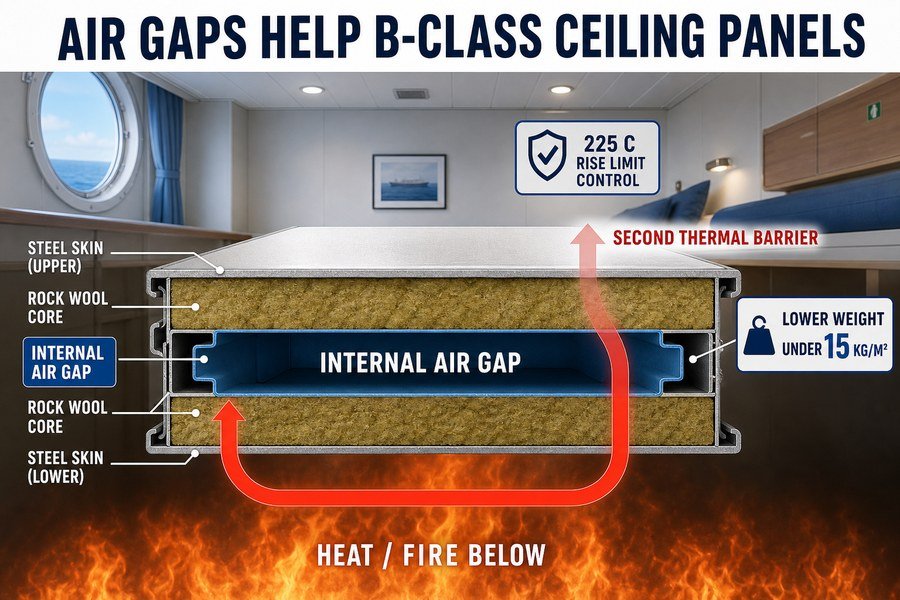
Internal air gaps function in B-Class marine ceiling panels by acting as a secondary thermal barrier and reducing overall panel weight. These two functions help maintain the unexposed side temperature below the 225°C maximum allowed for B-Class panels while keeping the weight under 15 kg/m2.
Ship ceilings have different rules than ship walls. Ceilings hang above our heads, so they must be light. But they still must stop fire. Internal air gaps are the best solution to balance these two needs. We will examine the two functions of these air gaps.
Acting as a Secondary Thermal Barrier in Ceiling Panels
The first function of internal air gaps is to act as a secondary thermal barrier. In B-Class marine ceiling panels, we often leave a small empty space between the rockwool and the steel skin. Air is a very bad conductor of heat. Its thermal conductivity is only 0.026 Watts per meter-Kelvin (W/m·K) at room temperature9. This is even lower than rockwool. During a fire, the heat must pass through the steel, then the air gap, and then the rockwool. This air layer slows down the heat transfer significantly10. According to SOLAS rules, a B-15 ceiling panel must keep the unexposed side temperature below a 225°C rise for 15 minutes. The air gap helps the ceiling pass this test easily without adding more solid material.
Reducing Overall Weight for Marine B-Class Ceilings
The second function is reducing the overall weight of the panel. Shipbuilders always want to reduce the weight of the ship. Less weight means the ship uses less fuel11. A solid 50-millimeter rockwool ceiling panel weighs about 18 kilograms per square meter. If we use a thinner rockwool layer and create an internal air gap, we can drop the weight to 13 kilograms per square meter. This saves 5 kilograms for every single square meter of ceiling. On a large cruise ship with 10,000 square meters of ceiling, you save 50,000 kilograms. This massive weight reduction saves a lot of money on fuel over the life of the ship.
| Ceiling Construction Type | Weight per Square Meter | Primary Thermal Barrier | B-15 Test Pass Rate |
|---|---|---|---|
| Solid Rockwool Core | 18 kg | Rockwool only | Very High |
| Air Gap Design | 13 kg | Air + Thin Rockwool | Very High |
The air gap gives you both high fire safety and lower fuel costs for the ship owner.
What Assembly Defects Cause Marine Interior Panels to Fail IMO Fire Tests?
Failing a fire test wastes money and time. Shipyards reject bad panels immediately. You need to know which assembly mistakes cause these test failures.
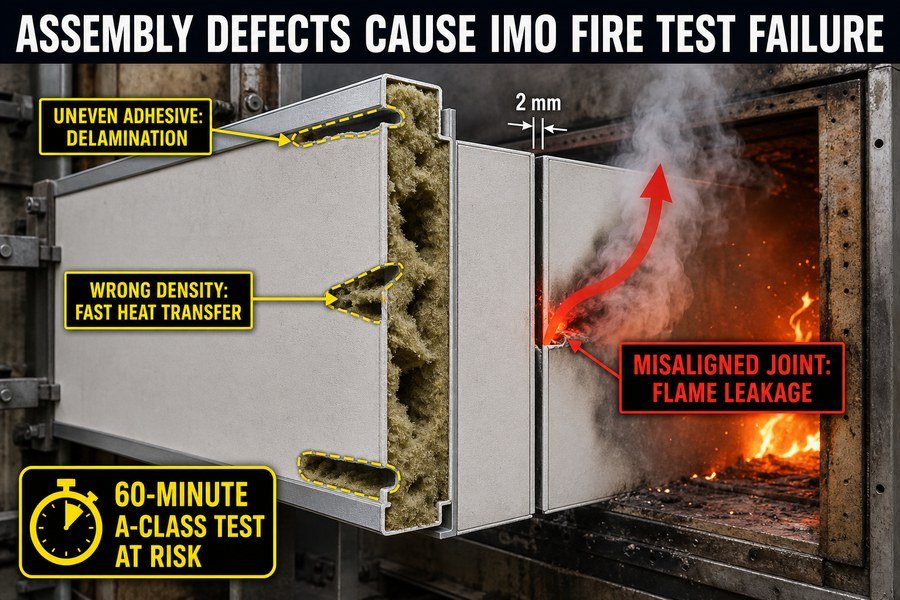
Three main assembly defects cause marine interior panels to fail IMO fire tests: uneven adhesive application, incorrect rockwool density, and misaligned joint connections. These three defects lead to skin delamination, fast heat transfer, and flame leakage, which ruin the panel during the 60-minute A-Class test.
When an interior panel fails the IMO fire test at the laboratory, we must find the exact cause. It is almost always a manufacturing or assembly mistake. If you buy panels, you must check the factory for these three main assembly defects.
Uneven Adhesive Application and Incorrect Rockwool Density
The first defect is uneven adhesive application. Factories use machines to spray glue on the steel skins. If the nozzles are blocked, the glue is uneven. During a fire, the areas without glue will detach12. The steel skin peels off the rockwool in less than 10 minutes. This ruins the panel's structure. The second defect is incorrect rockwool density. Sometimes factories use a lower density to save raw material costs. If the IMO certificate requires 150 kilograms per cubic meter, and the factory uses 100 kilograms per cubic meter13, the fire will burn straight through the core. The low-density rockwool cannot block the 900°C heat in the A-Class test. The unexposed side will get too hot too fast.
Misaligned Joint Connections in Panel Assembly
The third defect is misaligned joint connections. When workers assemble the panels in the factory or on the ship, they must push the joints tightly together. If the male and female edges do not align perfectly, there will be a small gap. Even a gap of 2 millimeters is very dangerous14. During a fire test, the hot gases create high pressure inside the furnace. This pressure will push smoke and real flames through that tiny 2-millimeter gap. I have seen panels fail at 45 minutes just because of a bad joint assembly.
| Assembly Defect | Direct Consequence in Fire | Average Time to Failure |
|---|---|---|
| Uneven Adhesive | Steel skin delamination | 10 to 15 minutes |
| Incorrect Density | Fast heat transfer | 30 to 40 minutes |
| Misaligned Joints | Flame and smoke leakage | 40 to 45 minutes |
When you hire an interior decoration team, you must train them to check every single joint. A perfect panel will fail if the installation is wrong.
How Is Construction Quality Audited for Onboard Marine Accommodation Panels?
Bad panels look good on the outside. You cannot trust your eyes alone. A strict audit process protects your project from fake materials.
Construction quality for onboard marine accommodation panels is audited through four steps: visual surface inspections, destructive core sampling, acoustic joint testing, and checking certification documents against the IMO FTP Code. These four steps verify that the delivered product matches the approved lab prototype exactly.
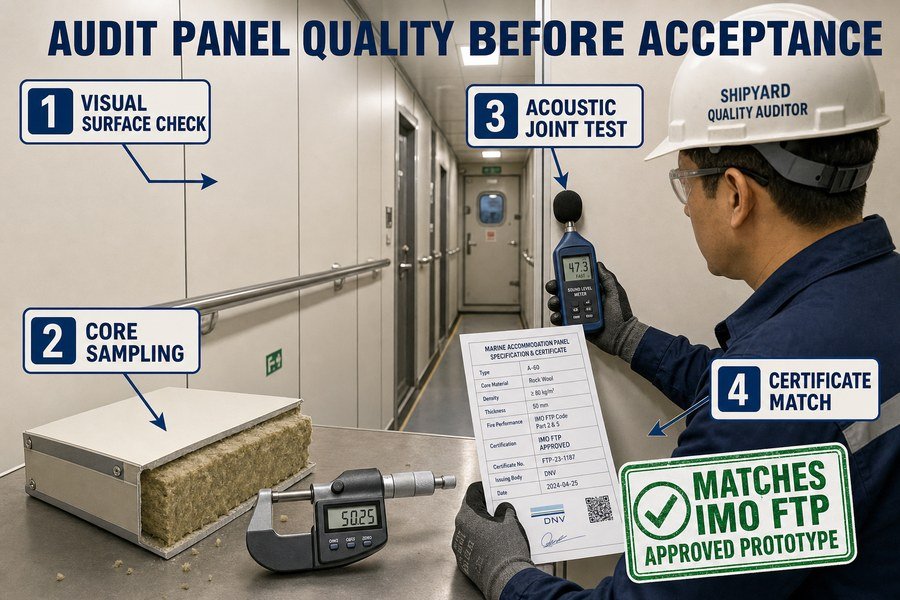
As a procurement officer, you cannot just trust the supplier's word. You need a strict audit process when the goods arrive at the shipyard. You must follow four specific steps to ensure the panels are safe and legal.
Visual Surface Inspections and Checking Certification Documents
The first step is visual surface inspections. We walk through the ship and check every wall panel. We look for scratches, dents, or loose steel skins. The surface must be perfectly flat and clean. The fourth step is checking certification documents against the IMO FTP Code15. You must take the fire test certificates and compare them to the panels on the ship. If the certificate says the panel uses 0.6 millimeter steel, but the panel feels thin, you have a problem. The documents must match the physical product exactly. This prevents suppliers from sending low-quality substitute materials.
Destructive Core Sampling and Acoustic Joint Testing
The second step is destructive core sampling16. We take a few actual panels and cut them open. This is the only way to see inside. We measure the thickness of the steel with a micrometer. We weigh the rockwool to check if the density is truly 120 kilograms per cubic meter. If the factory cheated, we will find it here. The third step is acoustic joint testing. We use sound machines to test the joints. If sound passes through the joint easily, it means smoke and fire can also pass through. We expect a good marine wall panel to reduce sound by at least 35 decibels (dB)17. If the sound reduction is lower, the joint is loose.
| Audit Step | Inspection Method | Acceptance Criteria |
|---|---|---|
| Visual Inspection | Eye and touch | Flat surface, no dents |
| Core Sampling | Micrometer and scale | Matches IMO certificate specs |
| Acoustic Testing | Sound meter | Minimum 35 dB reduction |
| Document Check | Paperwork review | Valid IMO FTP approvals |
By combining these four steps, you force the factory to deliver high-quality products every single time.
Why Is Joint Profile Geometry Crucial for Marine Wall Panel Fire Integrity?
Straight joints break open in a fire. Smoke spreads fast if joints fail. The right joint shape locks out the fire completely.
Joint profile geometry is crucial for marine wall panel fire integrity because it provides three key benefits: structural interlocking to prevent warping, a tortuous path that blocks smoke, and space for intumescent strips to expand. These three features keep the wall intact under high pressure.
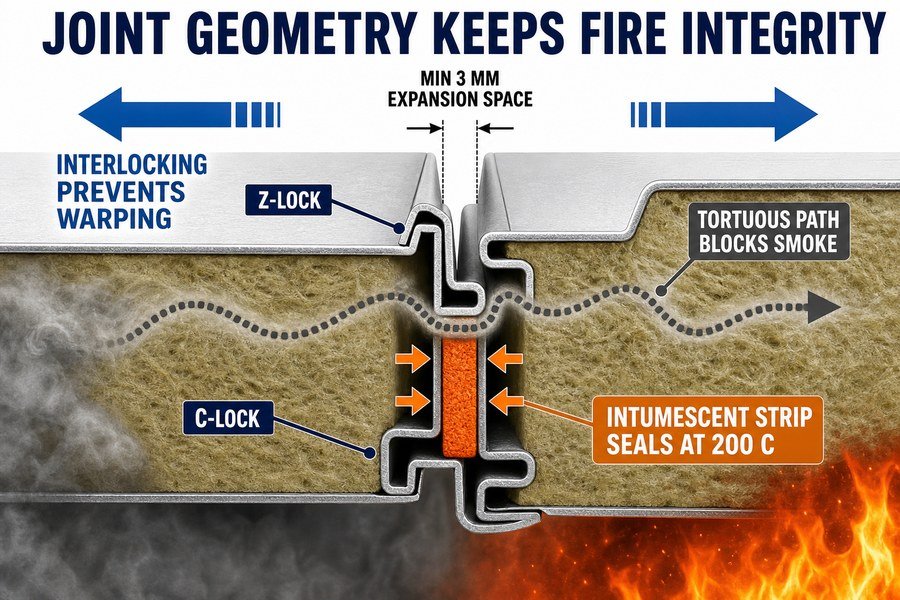
The joint is the most critical part of the panel system. A bad joint ruins a good panel. The geometry of the joint must be complex to work properly. Let us look at the three benefits that a good joint profile gives us.
Structural Interlocking to Prevent Warping in High Heat
The first benefit of good joint geometry is structural interlocking to prevent warping. In a fire, the steel skin heats up and expands. This expansion makes the panel bend and warp.18 If the joint is just a flat connection, the panels will pull apart and fall down. We use complex shapes like Z-lock or C-lock profiles. These shapes hook into each other. When the fire tries to pull the panels apart, the metal hooks grab tighter. This interlocking keeps the wall standing up straight for the full 60 minutes of the IMO A-60 test.19 It provides mechanical strength when the materials get soft.
Blocking Smoke with a Tortuous Path and Intumescent Strips
The second benefit is creating a tortuous path that blocks smoke. A tortuous path means the gap between the panels goes left, right, up, and down. It is not a straight line. If smoke wants to pass through, it must hit many metal walls and lose its energy.20 This complex path stops the toxic smoke from entering safe areas. The third benefit is providing space for intumescent strips. Intumescent strips are special tapes that expand when they get hot. We stick them inside the joint gaps. When the fire reaches 200°C, the strip expands up to five times its normal size. It completely seals the gap.
| Joint Geometry Feature | Primary Fire Defense Role | Critical Requirement |
|---|---|---|
| Interlocking Shape (Z/C) | Stops panel warping | Must grip tighter under stress |
| Tortuous Path | Blocks toxic smoke | No straight lines through joint |
| Expansion Gap | Holds intumescent strips | Minimum 3 mm empty space |
The joint geometry must have enough empty space to let this tape expand. If the joint is too tight, the expanding tape will break the panel open.
Conclusion
Panel geometry, from sandwich layers to complex joints, dictates fire safety. Controlling these structural elements ensures your ships pass IMO rules and keeps everyone on board safe from fire.
-
"Wool insulation - Wikipedia", https://en.wikipedia.org/wiki/Wool_insulation. A neutral mineral-wool reference can support that rock wool is produced from molten mineral/stone feedstocks and is generally treated as non-combustible insulation in fire-resistance applications. Evidence role: definition; source type: encyclopedia. Supports: Rockwool is made from melted stone/mineral material and is non-combustible.. Scope note: Non-combustibility may depend on the finished product, binder content, and the specific fire-classification test used. ↩
-
"What Is the Purpose and Scope of the IMO FTP Code?", https://magellanmarinetech.com/what-purpose-scope-of-imo-ftp-code/. The IMO FTP Code fire-resistance test criteria for A-class divisions can support that an A-60 division must limit the average temperature rise on the unexposed face to 140°C during the specified test period. Evidence role: definition; source type: institution. Supports: IMO FTP Code Part 3 sets a 140°C average unexposed-side temperature-rise limit for A-60 panels.. ↩
-
"[PDF] Bulkhead Insulation Systems - NIST Technical Series Publications", https://nvlpubs.nist.gov/nistpubs/Legacy/IR/nbsir76-1012.pdf. Research on mineral-wool or rock-wool sandwich panels can support that core density affects thermal insulation, fire resistance, and panel mass, providing context for specifying a density range in fire-rated marine panels. Evidence role: mechanism; source type: paper. Supports: Using rockwool at 120–150 kg/m³ is presented as necessary to meet A-60 thermal performance while controlling weight.. Scope note: Such evidence would usually support the density-performance relationship generally; it may not prove that 120–150 kg/m³ is required for every A-60 panel design without product-specific test certification. ↩
-
"(PDF) Sandwich Panels – Behavior in Fire Based on Fire ...", https://www.academia.edu/125106695/Sandwich_Panels_Behavior_in_Fire_Based_on_Fire_Resistance_Tests. Fire-testing or materials research on sandwich panels can support that adhesive thermal stability influences delamination and integrity of bonded steel–mineral-wool assemblies under fire exposure. Evidence role: mechanism; source type: paper. Supports: Heat-resistant adhesive can delay layer separation in sandwich panels during fire exposure.. Scope note: The evidence would support the mechanism generally; performance of a specific two-component polyurethane adhesive still requires product-specific fire-test or classification data. ↩
-
"Sandwich Panels – Behavior in Fire Based on Fire Resistance Tests", https://www.academia.edu/125106695/Sandwich_Panels_Behavior_in_Fire_Based_on_Fire_Resistance_Tests. Heat-transfer references describe conductive heat flow through insulation as inversely related to material thickness, supporting the general claim that a thinner mineral-wool section can reach higher temperatures more quickly under the same fire exposure. Evidence role: mechanism; source type: education. Supports: Reduced rockwool thickness at the panel edge can allow faster heat transfer than the thicker panel center.. Scope note: This supports the physical mechanism, but it does not directly validate the specific edge geometry or heating rate of the described marine panel. ↩
-
"What Is the Purpose and Scope of the IMO FTP Code?", https://magellanmarinetech.com/what-purpose-scope-of-imo-ftp-code/. IMO fire-test standards for fire-resisting divisions include furnace exposure and temperature-rise criteria over specified durations such as 60 minutes for A-class divisions, supporting the relevance of a 60-minute test to marine fire-rated wall panels. Evidence role: historical_context; source type: institution. Supports: Marine fire-rated wall panels may be evaluated under IMO fire-test procedures that include 60-minute fire exposure criteria.. Scope note: This supports the regulatory testing context, but not the article’s specific reported 30% faster joint temperature rise or any particular manufacturer’s certification outcome. ↩
-
"Thermal Conductivity", http://hyperphysics.phy-astr.gsu.edu/hbase/Tables/thrcn.html. Materials-property tables commonly report carbon steel thermal conductivity in the approximate range of 45–60 W/m·K at room temperature, supporting the stated order-of-magnitude value for steel. Evidence role: statistic; source type: institution. Supports: Steel has a thermal conductivity of roughly 50 W/m·K.. Scope note: The exact value varies by steel grade, temperature, and alloy composition. ↩
-
"Thermal bridge - Wikipedia", https://en.wikipedia.org/wiki/Thermal_bridge. Building-science and energy-efficiency sources define a thermal bridge as a conductive path through or around insulation that increases heat flow, supporting the explanation that metal edge contact can bypass the insulating core. Evidence role: definition; source type: government. Supports: Metal-to-metal contact at a panel joint can act as a thermal bridge that bypasses insulation.. Scope note: Most public sources discuss building envelopes rather than marine fire-rated panels, so the support is contextual rather than a direct test of this panel joint. ↩
-
"[PDF] The Thermal Conductivity of Fluid Air - Standard Reference Data", https://srd.nist.gov/jpcrdreprint/1.555749.pdf. Reference data for dry air near room temperature report a thermal conductivity of about 0.026 W/m·K, supporting the stated order of magnitude for air as a low-conductivity medium. Evidence role: statistic; source type: government. Supports: Air has a thermal conductivity of about 0.026 W/m·K at room temperature.. Scope note: The exact value varies with temperature, pressure, and humidity; it does not by itself prove whole-panel fire performance. ↩
-
"[PDF] Conduction, Convection, Radiation • Combined-Mode Heat Transfer", https://www.purdue.edu/freeform/me418/wp-content/uploads/sites/30/2024/09/ME-418-Heat-Transfer_Empty.pdf. Heat-transfer literature describes enclosed air spaces as adding thermal resistance by limiting conductive heat flow, while also noting that radiation and convection can reduce the insulating effect depending on cavity geometry and temperature difference. Evidence role: mechanism; source type: paper. Supports: An internal air gap can reduce heat transfer through a panel by adding thermal resistance.. Scope note: This supports the general mechanism of an air gap as thermal resistance, not the specific performance of the described marine ceiling assembly. ↩
-
"[PDF] Lightweighting Impacts on Fuel Economy, Cost, and Component ...", https://docs.nlr.gov/docs/fy13osti/57607.pdf. Naval architecture and maritime energy-efficiency studies relate fuel consumption to the propulsion power required to overcome ship resistance, which is affected by displacement; reducing lightweight or payload mass can therefore reduce fuel use under comparable operating conditions. Evidence role: general_support; source type: paper. Supports: Reducing ship weight can reduce fuel consumption under comparable operating conditions.. Scope note: The amount of fuel saved depends on vessel type, speed, route, loading condition, and operational profile, so this source would support the direction of the effect rather than the article’s implied savings magnitude. ↩
-
"Performance of wood adhesives for cross laminated timber ...", https://research.fs.usda.gov/download/treesearch/57073.pdf. Research on steel-faced sandwich panels notes that adhesive bonding between facings and core is critical to composite action and that debonding or delamination can reduce structural integrity under load and elevated temperature; this supports the mechanism, while the exact timing depends on the tested assembly and adhesive system. Evidence role: mechanism; source type: paper. Supports: Uneven or missing adhesive can cause steel skins to detach from the rockwool core during fire exposure.. Scope note: Supports the delamination mechanism generally, not the article’s specific failure time of under 10 minutes. ↩
-
"Determination of Thermal Properties of Mineral Wool Required for ...", https://pmc.ncbi.nlm.nih.gov/articles/PMC10488771/. Technical literature on mineral-wool sandwich panels describes core density as a specified material parameter that affects fire resistance and thermal performance; this supports the relevance of verifying density against the certified construction, although it does not establish that every 100 kg/m³ core will fail a given IMO test. Evidence role: mechanism; source type: paper. Supports: Using a lower rockwool density than the certified panel specification can affect fire-resistance performance.. Scope note: Provides general material-performance support rather than direct proof for the exact 150 kg/m³ versus 100 kg/m³ example. ↩
-
"What Is the Purpose and Scope of the IMO FTP Code?", https://magellanmarinetech.com/what-purpose-scope-of-imo-ftp-code/. Fire-resistance test standards for ship divisions include integrity criteria for preventing passage of flames and hot gases through openings, supporting the importance of joint tightness; however, a source may document the principle without proving that a 2 mm gap always causes failure. Evidence role: expert_consensus; source type: institution. Supports: Small gaps in panel joints can compromise fire integrity by allowing flame, smoke, or hot gases to pass through.. Scope note: Supports the hazard of gaps and leakage paths in fire-rated assemblies, but the 2 mm threshold may require specific test evidence. ↩
-
"What Is the Purpose and Scope of the IMO FTP Code?", https://magellanmarinetech.com/what-purpose-scope-of-imo-ftp-code/. The IMO Fire Test Procedures Code sets internationally used fire-test procedures for materials and constructions installed on ships, including non-combustibility, fire-resistance, and surface flammability testing; this supports using the Code as the benchmark for certificate review. Evidence role: definition; source type: institution. Supports: Certification documents for marine wall panels should be checked against the IMO FTP Code.. Scope note: The Code establishes testing and approval procedures, but it does not by itself verify that a delivered panel matches a specific certificate. ↩
-
"Non-destructive testing of steel-lined concrete structure using ... - PMC", https://pmc.ncbi.nlm.nih.gov/articles/PMC12378451/. Materials inspection literature describes destructive testing or sampling as a method for directly examining internal composition, dimensions, and material properties when these cannot be fully confirmed from the exterior; this supports core sampling as a way to verify hidden panel construction. Evidence role: mechanism; source type: education. Supports: Cutting open selected panels can verify internal construction details such as steel thickness and core material characteristics.. Scope note: The source may establish the general inspection principle rather than mandate destructive sampling for every marine wall-panel procurement audit. ↩
-
"How to choose the right marine wall panels for marine interior ...", https://magellanmarinetech.com/how-choose-right-marine-wall-panels-for-marine-interior-projects/. Ship-noise and acoustic standards use decibel-based airborne sound insulation ratings to assess how effectively partitions reduce transmitted sound, and some marine accommodation guidance includes insulation values in the range of tens of decibels for bulkheads and partitions; this supports using a measured dB reduction as an acceptance criterion. Evidence role: expert_consensus; source type: institution. Supports: Marine wall panels can be assessed by measured sound reduction, with 35 dB presented as a minimum criterion in this audit procedure.. Scope note: A neutral source may support the use of dB sound-reduction criteria, but the exact 35 dB threshold may depend on vessel type, location, notation, contract specification, or applicable noise standard. ↩
-
"[PDF] An Assessment of the Use of Structural Deformation as a Method of ...", https://encompass.eku.edu/cgi/viewcontent.cgi?article=1006&context=sse_fsresearch. Engineering references on structural fire behavior describe thermal expansion of heated steel as a source of deformation and restraint-induced stresses, supporting the general mechanism by which steel-faced panels may warp under fire exposure. Evidence role: mechanism; source type: education. Supports: Heating in a fire causes steel skins to expand, which can contribute to bending and warping of panels.. Scope note: This supports the physical mechanism generally; it may not document the behavior of the specific panel system described in the article. ↩
-
"What Is the Purpose and Scope of the IMO FTP Code?", https://magellanmarinetech.com/what-purpose-scope-of-imo-ftp-code/. The IMO Fire Test Procedures Code defines A-class divisions, including the A-60 rating, by integrity and insulation performance during a standardized 60-minute fire exposure; this establishes the regulatory test duration but does not by itself prove that a particular interlocking joint will pass. Evidence role: definition; source type: institution. Supports: IMO A-60 fire testing involves maintaining required performance during a 60-minute standardized fire test.. Scope note: The source can verify the A-60 test duration and criteria, not the performance of the specific joint geometry unless paired with a product test report. ↩
-
"improved prediction of leakage in gas labyrinth seals using an ...", https://rotorlab.tamu.edu/TRIBGROUP/Pubs_An_Seals_files/TRC-SEAL-01-19%20Laby%20Seal%20Carry-Over%20Coef%20REPORT.pdf. Fire-safety and fluid-flow literature describes leakage paths and labyrinth or tortuous geometries as increasing flow resistance, providing contextual support for the claim that non-straight joints can reduce smoke passage compared with direct openings. Evidence role: mechanism; source type: paper. Supports: A tortuous or labyrinthine joint path can impede smoke movement by increasing flow resistance compared with a straight gap.. Scope note: This is contextual support for reduced leakage resistance; actual smoke-tightness depends on tested joint dimensions, pressure, temperature, and seal materials. ↩