You want to sell marine panels globally, but the rules confuse you. Missing the differences between EU and IMO standards ruins your projects. Let us clarify these standards.
EU rules (MED 2014/90/EU) require a Wheelmark certificate, Module B testing, and continuous Module D quality audits by an EU Notified Body, while IMO standards (FTP Code 2010) only require a one-time fire test and Flag State approval, meaning EU rules demand stricter continuous factory audits and administrative traceability.
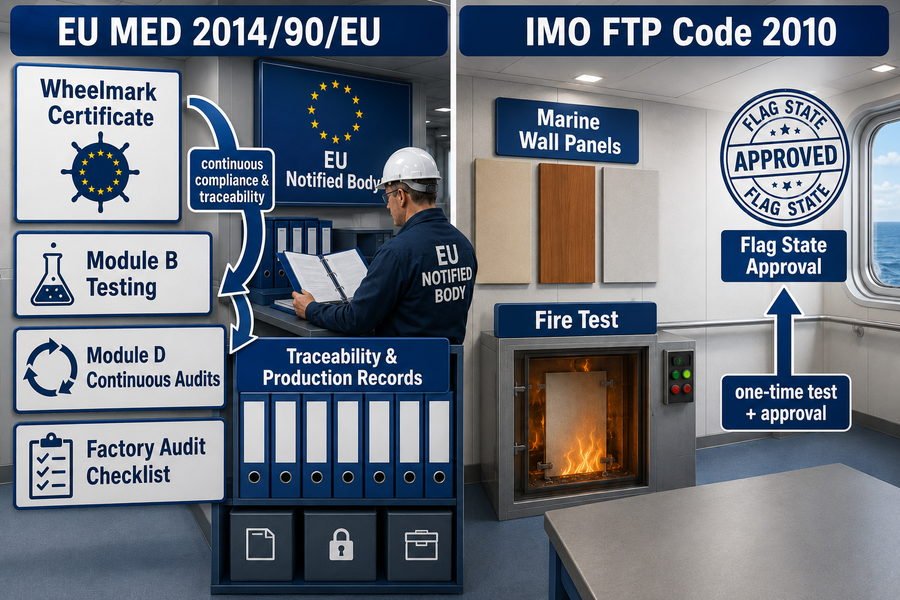
Many manufacturers assume IMO compliance automatically guarantees entry into the European market. They ship their products. They fail European shipyard inspections. I will break down exactly how these two major regulatory frameworks differ.
Why Does the EU Add Extra Requirements on Marine Panels Beyond IMO?
Your IMO-approved panels get rejected by European shipyards. You lose money and time. You need to understand why the EU adds extra rules for your marine panels.
The EU adds extra requirements beyond the IMO FTP Code to ensure unified safety across Member States, prevent localized corruption, guarantee continuous manufacturing quality through Module D audits, and enforce strict traceability for market surveillance under the Marine Equipment Directive (MED 2014/90/EU).
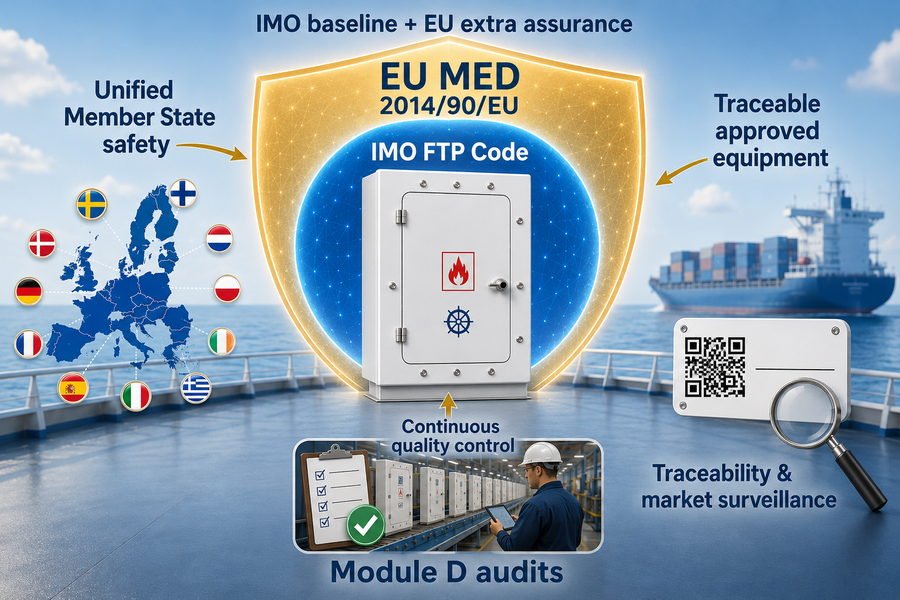
I remember helping a client from Vietnam who had IMO A-60 class fire doors and panels. He thought he could sell directly to a shipyard in Germany. The German shipyard rejected his panels immediately. The buyer asked for the Wheelmark. My client was confused. IMO standards set the minimum baseline for global shipping safety under the SOLAS convention.1 The IMO created the Fire Test Procedures (FTP) Code 2010.2 This code tells us how a panel must perform in a fire. However, the IMO does not act as a police force. The IMO leaves the enforcement to individual countries, known as Flag States.3 Some Flag States have very loose enforcement. The European Union saw this problem. The EU created the Marine Equipment Directive (MED) 2014/90/EU.4 The EU wanted to ensure every ship flying an EU flag maintains the highest safety level.
Unified Safety Standards Across European Member States
The first reason the EU adds extra requirements is unified safety. The EU has 27 Member States. Without a unified rule, a marine panel approved in one country might fail safety checks in another. The MED 2014/90/EU replaces individual national rules. It forces all EU countries to accept the same high standard. The Wheelmark logo proves this compliance.
Prevention of Localized Corruption and Weak Enforcement
The second reason is the prevention of localized corruption. Under simple IMO rules, a manufacturer might find a loose laboratory in a developing country to pass a test. The EU blocks this practice. The EU requires a Notified Body to oversee the testing. A Notified Body is an independent, European-government-approved organization like DNV or Bureau Veritas. They ensure the testing lab strictly follows the IMO FTP Code 2010.
Continuous Manufacturing Quality Through Module D Audits
The third reason is continuous manufacturing quality. IMO standards often only require a single prototype test. You test one good marine ceiling panel. You get a certificate. The EU adds the Module D requirement. Module D is a strict production quality assurance process. The Notified Body audits your factory every year. They check if you use the same 120 kg/m³ rockwool insulation as the prototype. They ensure your daily production matches the tested prototype exactly.
Strict Traceability for Market Surveillance
The fourth reason is strict traceability. The EU wants to track every marine panel on a ship back to the factory. The MED requires you to place the Wheelmark directly on the panel. You must also print the Notified Body number and the year of manufacture on the label.5 This allows port state control officers to easily verify the equipment during physical inspections.
| Regulatory Aspect | IMO Standard (FTP Code 2010) | EU Rule (MED 2014/90/EU) |
|---|---|---|
| Primary Goal | Minimum global safety baseline | Unified, strict EU market safety |
| Enforcement Body | Individual Flag States | EU Member States via Notified Bodies |
| Production Audits | Usually not mandated | Mandatory annual audits (Module D) |
| Traceability | Basic labeling | Wheelmark, Notified Body ID, Year |
What Gaps Exist Between IMO and EU Fire Rules for Marine Panels?
You passed the fire test, but the EU inspector still says no. You waste materials trying to guess the problem. You must know the exact technical gaps between these rules.
The primary gaps between IMO FTP Code and EU MED fire rules involve the mandatory use of EU-approved Notified Bodies for testing, stricter definitions of non-combustible materials, rigorous smoke and toxicity limits enforcement, and the non-acceptance of older national test certificates that lack explicit Module B verification.
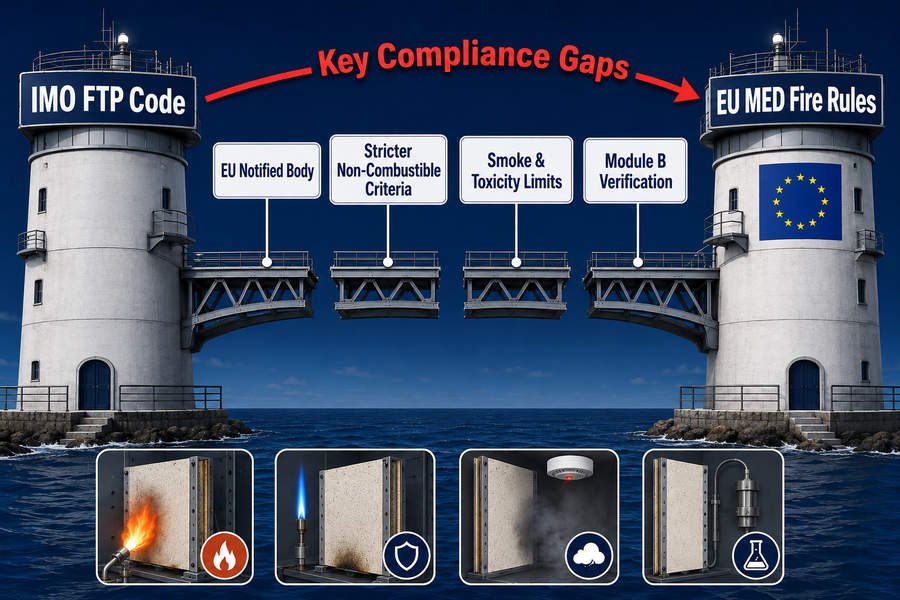
I once visited a factory that produced beautiful aluminum honeycomb panels. They passed the fire test at a local laboratory. They showed the IMO FTP Code 2010 Part 3 certificate to a French buyer. The French buyer refused the order. The gap between the technical requirements of the IMO and the administrative requirements of the EU is huge. The IMO FTP Code 2010 provides the technical test methods. The EU MED 2014/90/EU adopts these exact test methods.6 The physical fire test in the furnace is identical. An A-60 bulkhead must still resist a temperature of 945°C for 60 minutes.7 The unexposed side must not exceed 140°C above the original temperature. The gap lies in who watches the test and how the materials are classified administratively.
Mandatory Oversight by EU-Approved Notified Bodies
The most significant gap is the testing authority. The IMO allows any laboratory approved by a Flag State to conduct the test. The EU does not accept this freedom. The EU demands that an EU Notified Body must witness the test or audit the laboratory. If your local lab tests your marine wall panel without a Notified Body present, the test is useless for the European market. You must obtain an EC Type Examination certificate from the Notified Body.
Stricter Definitions of Non-Combustible Materials
The second gap involves non-combustible materials. IMO FTP Code 2010 Part 1 defines non-combustible materials. The EU enforces these definitions rigidly. If your marine panel uses an adhesive, the EU inspector will scrutinize the adhesive's calorific value. The EU requires strict documentation proving the organic content is below the 45 MJ/m² limit8. This proves the product has low flame-spread characteristics.
Rigorous Enforcement of Smoke and Toxicity Limits
The third gap is smoke and toxicity. IMO FTP Code Part 2 tests smoke generation. The EU requires comprehensive data on toxic gases. They check carbon monoxide, hydrogen chloride, and hydrogen cyanide levels.9 The Notified Body will reject your panel if your paint system releases toxic fumes near the maximum allowed limits. Some non-EU Flag States might show leniency here, but the EU does not.
Non-Acceptance of Older National Test Certificates
The fourth gap is the validity of older certificates. Some Flag States accept old fire test reports forever. The EU MED updates its Implementing Regulation frequently.10 If an old IMO standard is updated, the EU forces you to re-test your panel immediately. You must do this to keep your Wheelmark. The EU does not accept grandfathered certificates without explicit verification under the newest regulation.
| Fire Rule Aspect | IMO Standards Application | EU MED Application |
|---|---|---|
| Testing Authority | Flag State approved laboratory | EU Notified Body (Module B) |
| Fire Resistance Test | 945°C for 60 mins (A-60) | 945°C for 60 mins (A-60) |
| Material Traceability | Moderate tracking | Extremely strict tracking |
| Old Certificate Validity | Often grandfathered | Must update to latest EU Regulation |
How Does EU Acceptance of Marine Panels Compare With IMO Acceptance?
You submit your product documents, but the shipyard ignores you. Your sales process stalls. You must understand how the EU accepts marine panels compared to standard IMO acceptance.
IMO acceptance relies on Flag State Type Approval based on successful fire test reports, whereas EU acceptance mandates the Wheelmark certification process, which combines a Module B design examination with a Module D, E, or F production quality system, creating a multi-layered legal acceptance framework.
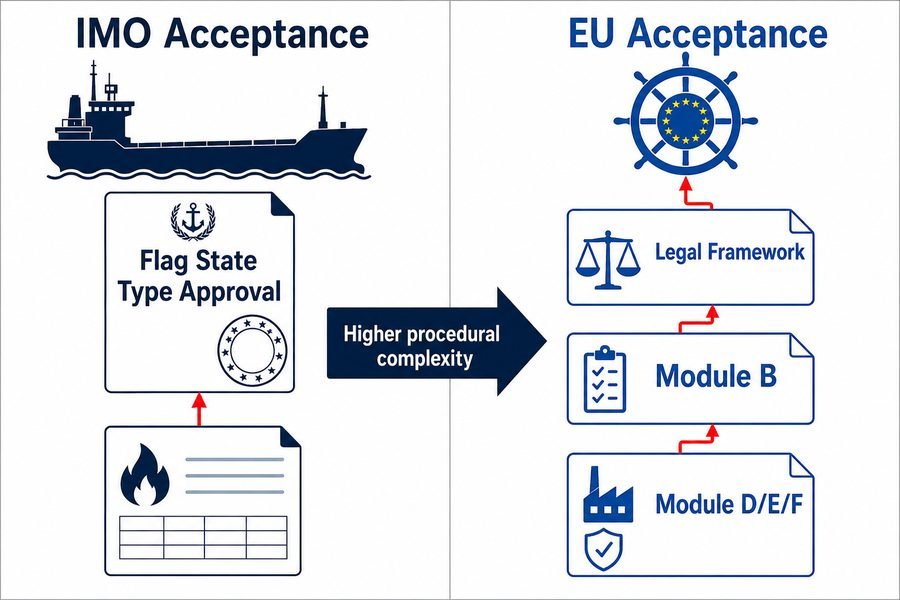
I worked with a supplier in China who made excellent B-15 class ceiling panels. They received a Type Approval certificate from the Panama maritime authority. They thought this IMO-backed certificate opened the doors to all European shipyards. They were wrong. Acceptance under IMO rules is very different from acceptance under EU rules. The IMO framework is decentralized. The EU framework is centralized and highly structured. When you understand this difference, you can prepare the right documents for your buyers easily.
IMO Acceptance via Flag State Type Approval
The first difference is how IMO acceptance works. Under the IMO framework, you test your marine panel. You send the test report to a Flag State authority. This could be the Bahamas or Liberia. The Flag State reviews the report11. If the panel meets the IMO FTP Code 201012, the Flag State issues a Type Approval certificate. The shipyard then accepts your panel for ships flying that specific flag. This process relies heavily on the initial test report.
EU Acceptance via Module B Design Examination
The second difference is the EU design examination. The EU MED does not just look at a test report. You must apply for a Module B certificate. The EU Notified Body examines your product design. They examine your material specifications. They examine your test reports. They ensure your marine panel design perfectly aligns with the current EU Implementing Regulation. This is a rigorous legal and technical review. It is not just a simple stamp on a test report.
EU Acceptance via Production Quality Modules
The third difference is the mandatory production module. The EU does not accept your panel with just a design certificate. You must also have a Module D, Module E, or Module F certificate. Module D is the most common for marine panels. It requires an annual factory audit by the Notified Body. The Notified Body verifies your ISO 9001 system. They verify your factory production control ensures consistent quality.
The Multi-Layered Legal Acceptance Framework
The fourth difference is the legal framework. EU acceptance culminates in the Declaration of Conformity. You, the manufacturer, must sign this legal document. You state you take full legal responsibility for the panel. You state it complies with the MED. The Wheelmark on your product visually confirms this multi-layered acceptance. Standard IMO acceptance lacks this strict, unified legal declaration.
| Acceptance Feature | IMO Acceptance Process | EU Acceptance Process |
|---|---|---|
| Core Certificate | Flag State Type Approval | Wheelmark (Module B + Module D) |
| Factory Audit | Sometimes required | Mandatory strict annual audit |
| Legal Declaration | Basic manufacturer statement | Mandatory EU Declaration of Conformity |
| Shipyard Recognition | Limited to specific Flag States | Accepted by all EU Member States |
Why Do EU Reviewers Reject IMO-Compliant Marine Panels?
Your panel passed every IMO test, yet the EU reviewer says it fails. You feel frustrated and confused. You must learn the hidden reasons EU reviewers reject your marine panels.
EU reviewers reject IMO-compliant marine panels due to missing Module B and D certificates, outdated testing standards under the latest MED Implementing Regulation, unverified material modifications, lack of a signed Declaration of Conformity, and improper application of the physical Wheelmark logo on the product.
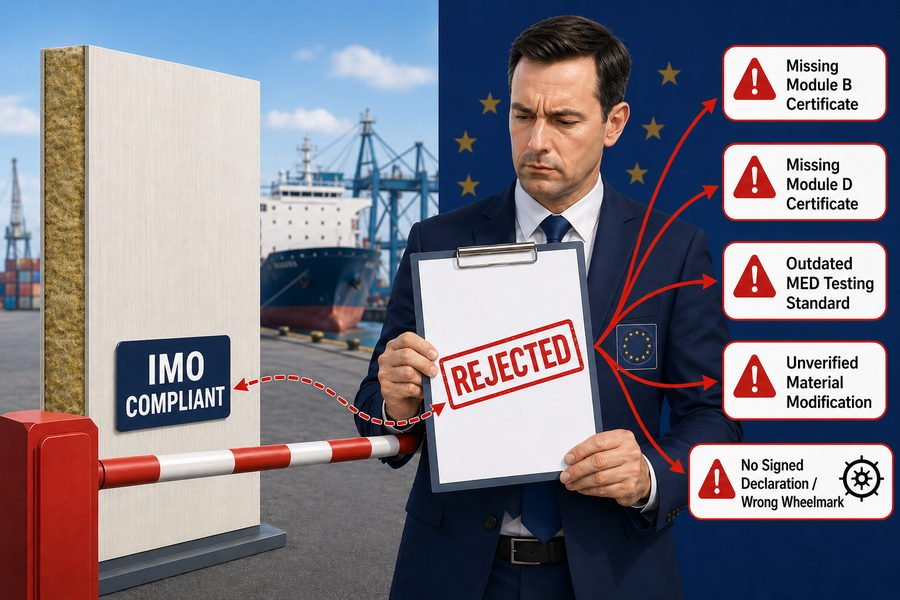
A client once called me in a panic. He shipped three containers of rockwool marine wall panels to a shipyard in Italy. The panels had valid IMO A-0 and A-30 fire test reports. The Italian marine surveyor inspected the cargo. The surveyor rejected everything. My client had to pay massive storage fees. He asked me why this happened. An IMO test report only proves the panel survived the fire in the lab. The EU reviewer looks for a complete chain of compliance. If one link is missing, they reject the entire shipment.
Missing Module B and D Certificates
The first reason for rejection is missing EU certificates. The EU reviewer does not care about your IMO test report if you lack the official EU documents. You must present a valid Module B certificate. You must also present a valid Module D certificate. An EU Notified Body must issue these documents. If you only show a test report from an independent lab, the reviewer will reject the panels immediately.
Outdated Standards Under the MED Implementing Regulation
The second reason is outdated standards. The IMO updates the FTP Code periodically. The EU updates its MED Implementing Regulation every year. For example, Regulation (EU) 2021/1158 changed specific testing validity dates.13 If your panel was tested under an older standard, the EU does not accept it. The reviewer checks the specific regulation dates. If your certificate is out of date, they reject the product.
Unverified Material Modifications in Production
The third reason is unverified material modifications. The EU reviewer cross-checks the panel delivered to the shipyard with the panel described in the Module B certificate. You might use a 0.6 mm steel sheet in the IMO test. If you deliver panels with a 0.5 mm steel sheet to save money, the reviewer will notice. Any deviation from the approved design without Notified Body approval causes an automatic rejection.
Missing Declaration of Conformity and Wheelmark
The fourth reason is missing legal marks. You must provide a signed EU Declaration of Conformity with every shipment. Furthermore, every single panel must bear the physical Wheelmark logo. You must print the Notified Body identification number. You must print the year of manufacture.14 If your panels arrive blank, the EU reviewer will reject them for non-compliance with marking rules.
| Rejection Reason | Explanation for Rejection | Solution for Manufacturer |
|---|---|---|
| Missing EU Certificates | Lack of Module B and D documents | Hire a Notified Body for MED certification |
| Outdated Standards | Certificate does not match new EU rule | Retest or update under the latest MED rules |
| Material Deviation | Delivered product differs from prototype | Strictly follow the Module B approved design |
| Missing Markings | No Wheelmark or DoC provided | Apply Wheelmark properly and sign the DoC |
Which EU Documents Are Needed for Marine Panels Beyond IMO Evidence?
You send your IMO test report, but the buyer asks for more paperwork. You do not know what else to send. You must prepare the specific EU documents for your marine panels.
Beyond basic IMO test reports, exporting marine panels to the EU requires an EC Type Examination Certificate (Module B), a Production Quality Assurance Certificate (Module D), a formally signed EU Declaration of Conformity (DoC), and detailed technical files including installation manuals and material traceability records.
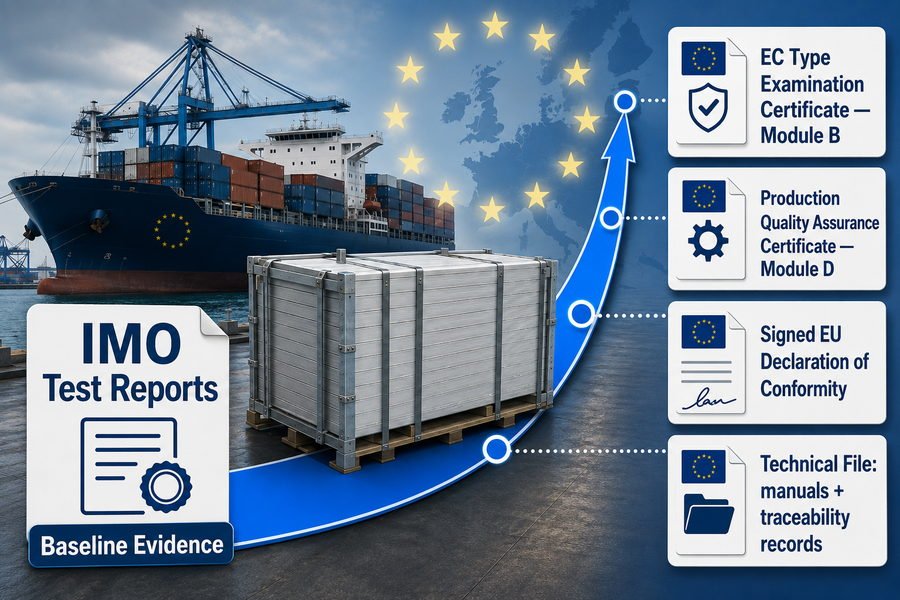
When I managed marine outfitting projects, documentation was always the biggest headache for new suppliers. I helped a factory that only knew how to provide a simple invoice and an IMO fire test report. They wanted to supply B-15 marine fire doors and panels to a cruise ship builder in France. I had to teach them that the European market runs on strict paperwork. The EU Marine Equipment Directive demands a specific set of documents. These documents prove that you maintain quality over time, not just on the day of the fire test.
The EC Type Examination Certificate (Module B)
The first mandatory document is the Module B certificate. This is the foundation of EU compliance. An EU Notified Body issues this document. They review your IMO fire test reports. They review your product drawings. The Module B certificate proves your marine panel design meets the MED 2014/90/EU requirements. It usually remains valid for five years. You must provide a copy of this certificate to your European buyer.
The Production Quality Assurance Certificate (Module D)
The second required document is the Module D certificate. This document proves you can manufacture the marine panels consistently. The Notified Body issues this certificate after auditing your factory. They check your raw material purchases. They check your production lines. They check your final inspections. Shipyards will not accept your panels without proof of this ongoing quality control.
The EU Declaration of Conformity (DoC)
The third critical document is the EU Declaration of Conformity. This is a legal statement created and signed by you. You cannot ask a testing lab to write it. The DoC must list the product name. It must list the Module B certificate number. It must list the Module D certificate number. It must list the specific MED regulation applied. You must send a signed DoC with every batch of panels you ship to Europe.
Comprehensive Technical Files and Traceability Records
The fourth requirement involves detailed technical files. You must supply comprehensive installation manuals. These manuals must be written in a language understood by the shipyard workers. You also need material traceability records. The Notified Body might ask to see the exact batch of PVC film used in a specific panel. These technical files ensure the panel is installed correctly on the ship.
| Document Name | Issued By | Purpose |
|---|---|---|
| Module B Certificate | EU Notified Body | Proves product design meets MED standards |
| Module D Certificate | EU Notified Body | Proves continuous factory quality assurance |
| Declaration of Conformity | Manufacturer | Legal declaration of product compliance |
| Technical Manuals | Manufacturer | Provides correct installation instructions |
How Can Exporters Meet Both IMO and EU Rules for Marine Panels?
You want to sell everywhere without testing your product twice. Double testing wastes your money and delays your production. You must learn the strategy to meet both IMO and EU rules efficiently.
Exporters can meet both IMO and EU rules by simultaneously testing marine panels at an IMO-recognized laboratory supervised by an EU Notified Body, securing Module B and D certifications to obtain the Wheelmark, maintaining an ISO 9001 quality system, and ensuring all material changes receive prior Notified Body approval.
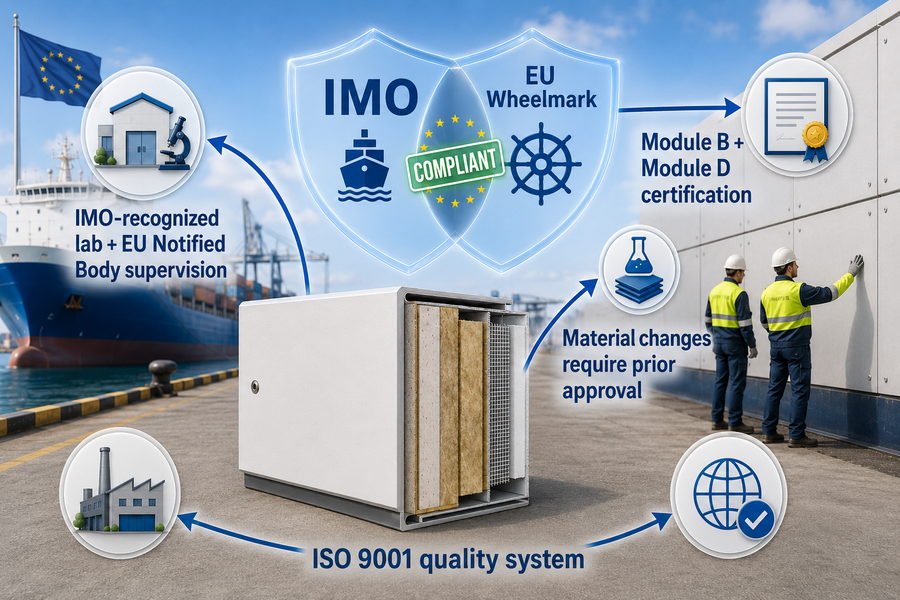
I always advise marine panel manufacturers to aim for the highest standard first. A factory manager once asked me if he should get the simple IMO certificate first. He wanted to worry about the EU later. I told him that was a waste of money. An A-60 fire test can cost over $5,000 to $10,000. You do not want to pay that twice. If you test for IMO without an EU Notified Body present, you must pay for a second fire test later for the European market. You need a unified certification strategy.
Simultaneous Testing Supervised by an EU Notified Body
The first step is simultaneous testing. Find a fire testing laboratory that is approved by the IMO. Ensure it is also recognized by an EU Notified Body. Before you start the fire test, hire the Notified Body to witness the test. When the panel passes the FTP Code 2010 requirements, you get an IMO-compliant test report. The EU fully accepts this supervised report. This single test serves both regulatory frameworks.
Securing Module B and D Certifications for the Wheelmark
The second step is securing the MED certificates. Use your supervised test report to apply for the Module B certificate. Then, invite the Notified Body to your factory. They will audit your production process for the Module D certificate. Once you hold both documents, you can legally affix the Wheelmark to your marine panels.15 A Wheelmark product is automatically accepted as IMO-compliant globally.16
Maintaining a Robust ISO 9001 Quality System
The third step is maintaining an ISO 9001 quality system. The EU Module D audit relies heavily on your factory's quality management. You must control your supply chain strictly. If you buy steel or insulation from a new supplier, you must verify the specifications. An active ISO 9001 system ensures you pass your annual Notified Body audit easily. It keeps your EU certificates valid.
Managing Material Changes with Prior Approval
The fourth step is managing material changes carefully. Never change a component of your marine panel without asking the Notified Body first. If you want to use a cheaper adhesive, you must submit the new technical data. The Notified Body will tell you if you need a new fire test. Strict control of changes ensures your panels remain compliant with both IMO safety standards and EU legal requirements.
| Compliance Step | Action Required | Cost/Benefit Impact |
|---|---|---|
| Supervised Testing | Hire Notified Body to witness IMO test | Saves $5,000 to $10,000 by avoiding double testing |
| MED Certification | Obtain Module B and Module D | Opens the lucrative European shipyard market |
| Quality System | Implement and maintain ISO 9001 | Ensures continuous compliance during annual audits |
| Change Control | Get Notified Body approval before changes | Prevents product rejection and certificate suspension |
Conclusion
Understanding the strict differences between IMO baseline standards and EU MED requirements allows you to navigate certification smoothly, avoid costly rejections, and successfully supply high-quality marine panels to global shipyards.
-
"[PDF] solas - International Maritime Organization", https://wwwcdn.imo.org/localresources/en/publications/Documents/Supplements/English/QH110E_supplement_January2026.pdf. The SOLAS Convention is the principal IMO treaty establishing minimum international safety standards for the construction, equipment, and operation of merchant ships. Evidence role: historical_context; source type: institution. Supports: IMO standards set a minimum baseline for global shipping safety under SOLAS.. Scope note: This supports the role of SOLAS as a minimum international safety framework, but it does not evaluate the adequacy of any specific fire-door or panel product. ↩
-
"How Does the IMO FTP Code Connect with Other Marine Fire Safety ...", https://magellanmarinetech.com/how-imo-ftp-code-connect-with-other-marine-fire-safety-frameworks/. IMO documentation identifies the 2010 FTP Code as the International Code for Application of Fire Test Procedures, adopted by IMO resolution MSC.307(88). Evidence role: historical_context; source type: institution. Supports: The IMO created/adopted the 2010 Fire Test Procedures Code.. Scope note: This verifies the existence and IMO adoption of the Code, but not whether a particular panel complies with it. ↩
-
"Implementation, Control and Coordination", https://www.imo.org/en/ourwork/msas/pages/implementationofimoinstruments.aspx. IMO materials describe flag States as responsible for ensuring that ships flying their flag comply with international maritime instruments, including SOLAS requirements. Evidence role: mechanism; source type: institution. Supports: IMO implementation and enforcement are carried out through flag States rather than by IMO as a direct police authority.. Scope note: This supports the general enforcement structure; actual oversight practices vary by flag State and by equipment category. ↩
-
"Factsheet - 32014L0090 | European Free Trade Association - Efta.Int", https://www.efta.int/eea-lex/32014l0090. Directive 2014/90/EU of the European Parliament and of the Council establishes EU rules on marine equipment placed on board EU ships and is commonly referred to as the Marine Equipment Directive. Evidence role: definition; source type: government. Supports: The EU established the Marine Equipment Directive as Directive 2014/90/EU.. ↩
-
"Directive 96/98/EC - Wikipedia", https://en.wikipedia.org/wiki/Directive_96/98/EC. Directive 2014/90/EU requires the wheel mark to be accompanied by the identification number of the notified body involved in production control and by the year in which the mark is affixed. Evidence role: mechanism; source type: government. Supports: MED-compliant marine equipment must display the notified-body identification number and year with the wheel mark.. Scope note: This supports the marking requirement under the MED; exact placement and product-label details may depend on implementing acts and the specific equipment item. ↩
-
"[PDF] RESOLUTION MSC.307(88) (adopted on 3 December 2010 ...", https://wwwcdn.imo.org/localresources/en/KnowledgeCentre/IndexofIMOResolutions/MSCResolutions/MSC.307(88).pdf. Directive 2014/90/EU and the related Commission implementing acts identify international testing standards for marine equipment, including IMO fire-test procedures for fire-protection products, supporting the regulatory link between EU MED approval and IMO FTP Code testing. Evidence role: general_support; source type: government. Supports: The EU Marine Equipment Directive adopts IMO FTP Code fire-test methods for relevant marine fire-protection products.. Scope note: The source may show incorporation of IMO test standards by reference, but it may not prove that every EU administrative procedure is identical to IMO or Flag State practice. ↩
-
"How Does the IMO FTP Code Connect with Other Marine Fire Safety ...", https://magellanmarinetech.com/how-imo-ftp-code-connect-with-other-marine-fire-safety-frameworks/. The IMO FTP Code and SOLAS fire-division rules describe A-60 class divisions using the standard fire-exposure curve and a 60-minute insulation criterion, including limits on temperature rise on the unexposed face. Evidence role: definition; source type: institution. Supports: An A-60 bulkhead is evaluated under a standard fire-resistance test lasting 60 minutes, with specified furnace temperature and unexposed-side temperature-rise criteria.. Scope note: The 945°C value is tied to the standard time-temperature curve at approximately 60 minutes; the exact wording and acceptance criteria should be checked against the official test standard. ↩
-
"How Does the IMO FTP Code Connect with Other Marine Fire Safety ...", https://magellanmarinetech.com/how-imo-ftp-code-connect-with-other-marine-fire-safety-frameworks/. The IMO FTP Code includes calorific-value limits for certain combustible components or surface materials in fire-test classifications, providing context for documentation of organic content in marine interior products. Evidence role: definition; source type: institution. Supports: Certain IMO FTP Code fire-performance classifications use a 45 MJ/m² calorific-value limit for relevant organic or combustible content.. Scope note: The 45 MJ/m² threshold should be verified against the specific FTP Code part and product category; it is not necessarily a universal criterion for all non-combustible materials. ↩
-
"[PDF] RESOLUTION MSC.307(88) (adopted on 3 December 2010 ...", https://wwwcdn.imo.org/localresources/en/KnowledgeCentre/IndexofIMOResolutions/MSCResolutions/MSC.307(88).pdf. IMO FTP Code Part 2 covers smoke and toxicity testing for specified marine materials and includes measurement of toxic combustion gases such as carbon monoxide, hydrogen chloride, and hydrogen cyanide. Evidence role: definition; source type: institution. Supports: Smoke and toxicity testing for relevant marine materials includes measurement of CO, HCl, and HCN emissions.. Scope note: The gases and limit values apply to products within the scope of the smoke-and-toxicity test; applicability should be confirmed for the specific panel system and coatings. ↩
-
"Factsheet - 32025R1533 | European Free Trade Association - Efta.Int", https://www.efta.int/eea-lex/32025r1533. Successive European Commission implementing regulations under Directive 2014/90/EU replace or amend the lists of design, construction, performance, and testing standards for marine equipment, supporting the need to track current MED requirements for Wheelmark approval. Evidence role: historical_context; source type: government. Supports: The EU periodically updates MED implementing regulations that list applicable standards for marine equipment conformity assessment.. Scope note: Frequent updates do not by themselves prove that every older certificate must be retested immediately; transitional provisions and notified-body certificate conditions determine the effect on a specific product. ↩
-
"SURVEYS, VERIFICATIONS AND CERTIFICATION", https://www.imo.org/en/OurWork/IIIS/Pages/Survey-Verification-Certification.aspx. The source should explain that, under IMO conventions, administrations of flag States are responsible for approving or accepting equipment for ships under their flag, often on the basis of recognized tests and documentation. Evidence role: mechanism; source type: institution. Supports: Under the IMO framework, a Flag State authority reviews the marine panel test report as part of the acceptance process.. Scope note: This supports the general flag-State approval mechanism; the exact review procedure can vary by administration and product category. ↩
-
"Fire testing laboratories - International Maritime Organization", https://www.imo.org/en/ourwork/safety/pages/firetestinglaboratories-default.aspx. The source should establish that the 2010 IMO FTP Code sets international fire test procedures for materials and components used on ships, including fire-resisting divisions relevant to marine panels. Evidence role: definition; source type: institution. Supports: A marine panel may be assessed against the IMO FTP Code 2010 as part of the Type Approval process.. Scope note: This supports the role of the FTP Code as a testing standard; it does not by itself prove that any specific panel satisfies the Code. ↩
-
"Factsheet - 32021R1158 | European Free Trade Association - Efta.Int", https://www.efta.int/eea-lex/32021r1158. Commission Implementing Regulation (EU) 2021/1158 amends the list of marine equipment standards and related requirements under the Marine Equipment Directive, including entries with applicable testing standards and validity-related dates; the source supports the regulatory-change point, though it may need to be checked against the particular wall-panel category. Evidence role: historical_context; source type: government. Supports: Regulation (EU) 2021/1158 changed MED testing-standard entries or validity dates relevant to acceptance of marine equipment certificates.. Scope note: Supports that Regulation (EU) 2021/1158 revised MED technical entries; direct applicability depends on the exact equipment item and certificate scope. ↩
-
"Directive 96/98/EC - Wikipedia", https://en.wikipedia.org/wiki/Directive_96/98/EC. Directive 2014/90/EU sets out the wheel mark requirements for compliant marine equipment, including the notified body identification number where involved and the year in which the mark is affixed; this supports the marking elements but does not determine whether each individual panel, rather than packaging or documentation, is the required marking location for this product. Evidence role: general_support; source type: government. Supports: MED-compliant marine equipment must carry the wheel mark with required associated information such as notified body identification and year of affixing/manufacture.. Scope note: Marking placement can depend on feasibility and product-specific rules; the directive should be checked for exceptions where marking on the product is not possible. ↩
-
"Directive 96/98/EC - Wikipedia", https://en.wikipedia.org/wiki/Directive_96/98/EC. Directive 2014/90/EU establishes that marine equipment meeting the directive’s conformity-assessment requirements may bear the wheel mark; this supports the link between MED certification and legal affixing of the Wheelmark. Evidence role: definition; source type: government. Supports: Holding the required MED conformity certificates allows a manufacturer to affix the Wheelmark to marine panels.. ↩
-
"Directive 96/98/EC - Wikipedia", https://en.wikipedia.org/wiki/Directive_96/98/EC. The Marine Equipment Directive aligns EU marine-equipment approval with international instruments such as SOLAS and IMO performance/testing standards; this supports the relationship between Wheelmark approval and IMO-based requirements, but it does not establish automatic global acceptance by every non-EU flag administration. Evidence role: historical_context; source type: government. Supports: Wheelmark approval is based on IMO/SOLAS-related requirements and is commonly tied to IMO compliance.. Scope note: The source would support regulatory alignment, not universal automatic acceptance outside jurisdictions that recognize the approval. ↩