Buying marine panels? You might think one certificate fits all, but rejected panels at ports waste your money. Here is how global and local rules differ to save your projects.
IMO standards provide the global baseline for marine panel safety, focusing on fire resistance and toxicity through SOLAS. Regional regulations, like USCG or MED, add stricter local requirements for specific testing, quality control, and certification formats. Therefore, IMO compliance does not automatically guarantee regional approval.
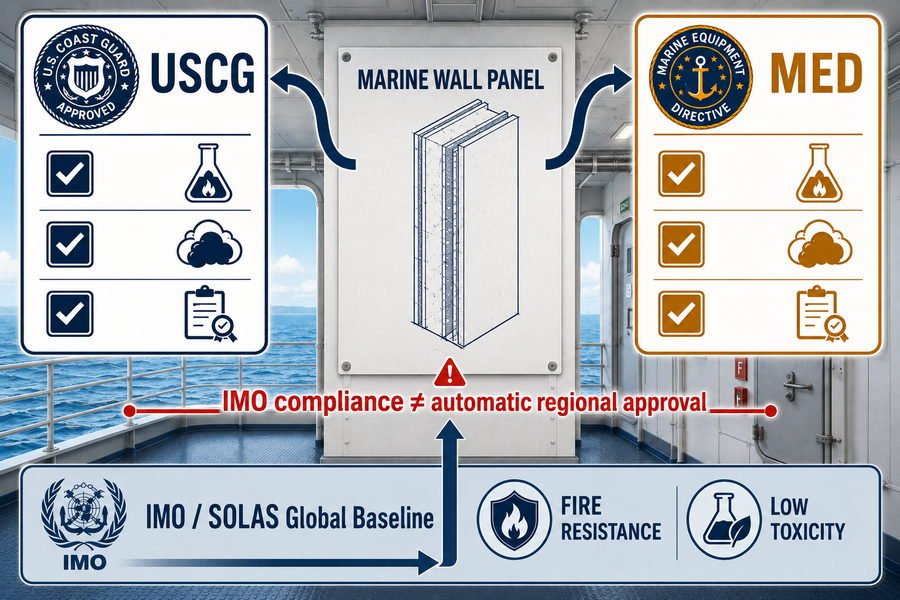
Understanding this difference is not just about passing inspections. It is about protecting your profit margins when you work with large shipyards in Europe or the United States. I see many buyers struggle to find good suppliers in Asia because they do not understand these certificate differences. Let us break down exactly why these rules do not always match and what it means for your purchasing choices.
Why Don't IMO Standards Cover Regional Rules for Marine Panels?
Global rules are good, but they leave gaps. If you rely only on IMO, your panels might fail local checks. Let us see why global rules cannot cover everything.
IMO standards act as a universal minimum safety floor, not a ceiling. They lack the authority to govern specific local port requirements, environmental mandates, or specialized national security protocols. These gaps require regional bodies like the USCG to add extra layers of testing and factory audits.
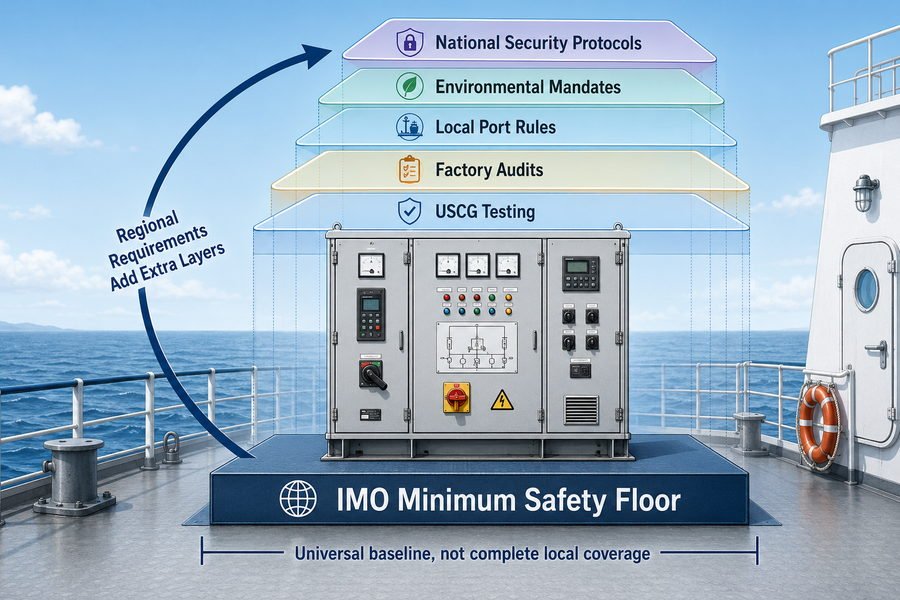
When I started in the marine outfitting industry, I thought the International Maritime Organization (IMO) was the absolute boss. I learned quickly that this is only partially true. We must look at the scope of these rules to understand the gaps.
The Scope Limitation of IMO Standards for Marine Panels
The IMO creates the Fire Test Procedures (FTP) Code. This code sets a basic safety level for all ships worldwide. For example, according to the IMO SOLAS Chapter II-2, a standard marine wall panel must block a fire. But the IMO is an international agency. It does not have its own police force or port inspectors. It relies on each country to enforce the rules.1 Because every country has different weather, port sizes, and local laws, the IMO cannot make one rule that covers every single local detail. The IMO sets the minimum passing grade.
The Need for Regional Additions to Marine Panel Rules
Because the IMO only gives the minimum grade, countries create their own regional rules to protect their specific waters. For instance, the United States Coast Guard (USCG) and the European Union add strict rules about how a factory makes the panel. They want to know that panel number 1,000 is just as safe as panel number 1. To prove this, they require expensive factory audits. An annual factory audit for the European Marine Equipment Directive (MED) costs between $5,000 and $15,000. Many small factories in Asia only test one panel to get an IMO paper. They refuse to pay the $5,000 annual fee for the European audit. Therefore, their IMO-approved panel cannot enter Europe.
| Rule Type | Enforcing Body | Main Focus | Factory Audit Required? | Estimated Audit Cost |
|---|---|---|---|---|
| Global Baseline | IMO | Basic Fire Testing | No | $0 |
| Regional Addition | European Union (MED) | Quality Consistency | Yes | $5,000 - $15,000 / year |
| Regional Addition | USCG | Laboratory Approval | Yes | $5,000 - $15,000 / year |
How Do IMO Resolutions Set Baseline Compliance for Marine Panels?
Starting a project without knowing the basics is risky. Without a clear baseline, you buy blindly. IMO sets this exact baseline for marine panels to start your compliance journey.
IMO sets the global baseline through the SOLAS convention and the FTP Code. These establish three non-negotiable pass/fail metrics for marine panels: non-combustibility of materials, strict limits on smoke toxicity, and exact fire containment times, such as 60 minutes for A-60 and 15 minutes for B-15.
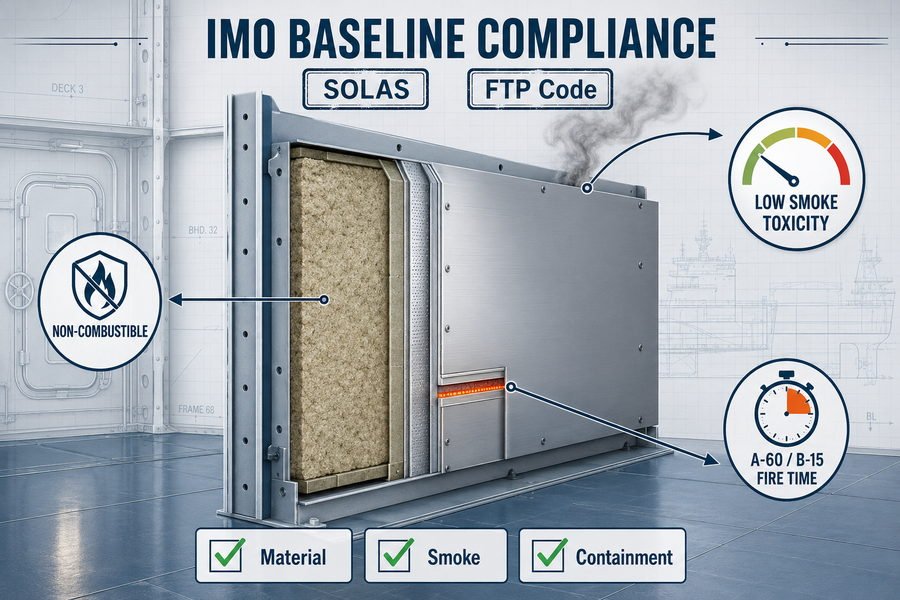
To buy panels correctly, you must know the numbers behind the IMO rules. I help many clients solve technical issues by pointing them back to the original IMO text. The IMO uses the 2010 FTP Code to test panels in a laboratory. They focus on three exact things.
Fire Containment Baselines in SOLAS Regulations
The first metric is fire containment. The IMO divides panels into A-Class, B-Class, and C-Class. An A-60 bulkhead must hold back fire and heat for exactly 60 minutes.2 During a test, the furnace reaches about 945°C. According to the 2010 FTP Code Part 3, the unexposed side of the A-60 panel cannot rise more than 140°C above its starting temperature. A B-15 panel must do this for 15 minutes. If a panel fails at 14 minutes and 50 seconds, it fails the IMO baseline.
Non-Combustibility Baselines for Core Materials
The second metric is non-combustibility. The core material inside the panel, usually rockwool, must not burn. According to FTP Code Part 1, the laboratory puts the rockwool in a furnace at 750°C. The material must not flame for more than 10 seconds. It also cannot lose more than 50% of its weight.
Smoke Toxicity Limits for Surface Finishes
The third metric is smoke toxicity. The PVC film or paint on the outside of the panel will burn. The IMO controls the poison in the smoke. According to FTP Code Part 2, the carbon monoxide (CO) level must not exceed 1450 parts per million (ppm).3 If a cheap PVC film releases 1500 ppm of CO, it fails the test. You must check these three metrics on every test report.
| IMO Metric | FTP Code Section | Pass/Fail Limit | Example Component |
|---|---|---|---|
| Containment | Part 3 | Max temp rise 140°C | Complete A-60 Panel |
| Non-combustibility | Part 1 | Max flame 10 seconds at 750°C | Rockwool Core |
| Smoke Toxicity | Part 2 | Max CO 1450 ppm | PVC Surface Film |
Which Marine Panel Rules Exist Outside the IMO Framework?
Do you know the local rules? Missing them means your shipment gets stuck at customs. We must look at the exact regional rules outside the IMO framework.
Outside the IMO framework, marine panels must follow three major regional rules: the European Marine Equipment Directive (MED) requiring the Wheelmark, the United States Coast Guard (USCG) Type Approvals, and national class society rules like DNV or ABS which add strict production and mechanical audits.
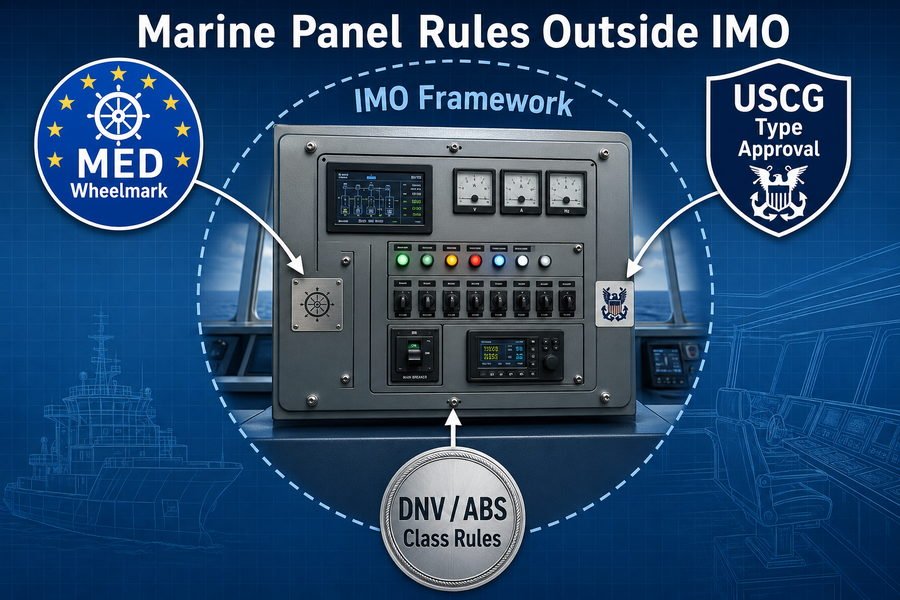
When I worked at Magellan Marine, we supplied outfitting parts to global buyers. We had to know every regional rule. A buyer cannot just hand an IMO paper to a shipyard in Germany or America. You must know these three major outside frameworks.
European Marine Equipment Directive (MED) Wheelmark Rules
If your shipyard is in Europe, you need the MED Wheelmark. The MED uses IMO tests, but they add Module B and Module D. Module B is a Type Examination. Module D is a Production Quality Assurance check. The factory must prove they have a quality system like ISO 9001. A marine panel with a Wheelmark means an inspector visits the factory every year. Getting a Wheelmark costs a factory about $3,000 to $8,000 per product type.
United States Coast Guard (USCG) Type Approval Rules
If your ship sails under the US flag, you need USCG approval. The USCG does not trust every laboratory in the world. They have a strict list of accepted independent labs.4 A panel can pass an IMO test in an unlisted lab, and the USCG will reject it. Also, the US and the EU have a Mutual Recognition Agreement (MRA). This means a European Wheelmark can sometimes serve as a USCG approval, but the supplier still needs a specific USCG approval number on their documents.
National Classification Society Additions
Finally, ship owners hire classification societies like DNV (Norway), ABS (America), or Lloyd's Register (UK). These societies issue their own Type Approval certificates. While IMO focuses strictly on fire and smoke, these societies also look at mechanical strength. They check if the panel can survive ship vibrations.
| Regional Rule | Main Requirement | Key Identifying Mark | Focus Area |
|---|---|---|---|
| Europe (MED) | Module D Audit | Wheelmark Logo | Factory Production Quality |
| USA (USCG) | Approved Laboratory | USCG Number | Lab Trust and Documentation |
| Class Societies | Mechanical Review | DNV/ABS/LR Logo | Vibration and Strength |
Why Are IMO-Compliant Marine Panels Sometimes Rejected Regionally?
Your panel has an IMO certificate, but the shipyard says no. This hurts your wallet and timeline. Let us uncover exactly why this rejection happens in regional ports.
IMO-compliant panels face regional rejection due to three main reasons: lacking a specific local certification mark like the MED Wheelmark, failing mandatory regional factory audits, or using testing laboratories that are not officially recognized by the local maritime authority like the USCG.
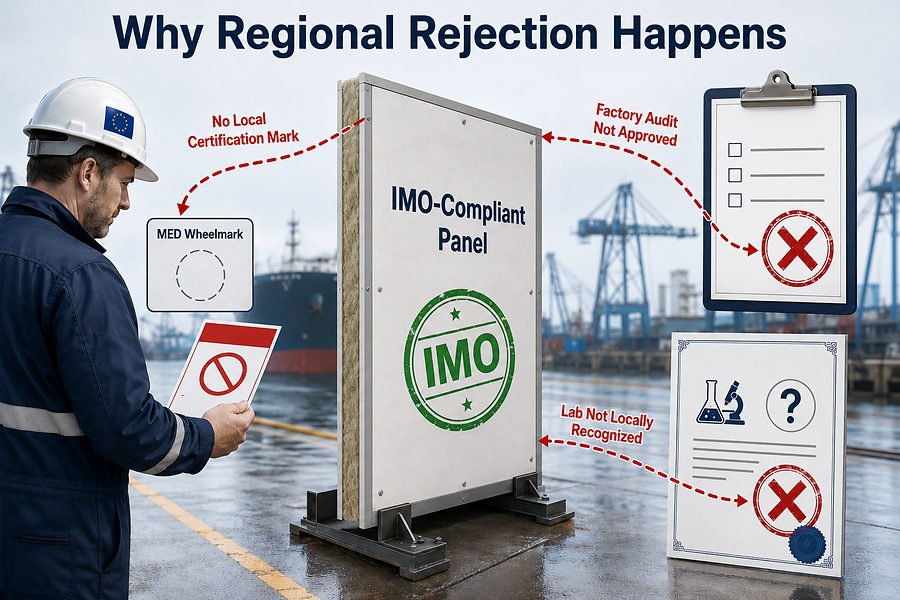
I have seen many buyers lose money because they trusted a factory sales rep who said, "Our panels are IMO approved." The buyer shipped the goods, and the shipyard rejected them. Let us look at the three specific reasons this happens.
Rejection Due to Missing Local Certification Marks
The first reason is simple but critical. The panels arrive without the right sticker. Even if a panel passes the IMO fire test perfectly, Europe will reject it if it lacks the MED Wheelmark sticker and the correct Declaration of Conformity (DoC) paper5. A DoC is a legal paper signed by the factory manager. If the physical mark is missing on the panels, the local port surveyor will refuse to let them on the ship.
Rejection Due to Failed or Missing Factory Audits
The second reason involves factory audits. IMO rules care about the test day. Regional rules care about every day. If a factory in China has an IMO test report from 2021, but they failed to pay for their annual Module D audit in 2025, their MED certificate is dead. I once saw a buyer lose a $50,000 order because the factory's audit expired two weeks before shipping. The local surveyor checked the database and rejected the entire container.
Rejection Due to Unrecognized Testing Laboratories
The third reason is about lab trust. The USCG only accepts fire test data from labs they officially recognize6. Many factories test their panels at cheap local labs to save money. The test report might say "Tested to IMO standards." But when the buyer submits this report to the USCG, the USCG rejects it immediately because the lab is not on their approved list.
| Rejection Reason | Missing Element | Resulting Action by Authority | Solution for Buyer |
|---|---|---|---|
| Missing Mark | Wheelmark or USCG sticker | Goods held at port / Shipyard refusal | Demand DoC before shipping |
| Failed Audit | Valid Module D certificate | Certificate revoked in database | Check validity dates online |
| Unrecognized Lab | USCG listed laboratory | Test report ignored | Only accept USCG approved labs |
How Should Buyers Read IMO Compliance Claims on Marine Panels?
Salespeople will tell you their panels are IMO approved. Believing them without checking is a trap. You need to know how to read these claims correctly.
Buyers must read IMO compliance claims by verifying three elements: checking if the test report is from a recognized lab, ensuring the certificate matches the exact panel thickness and density purchased, and confirming the manufacturer holds a valid, unexpired production quality certificate for regional use.
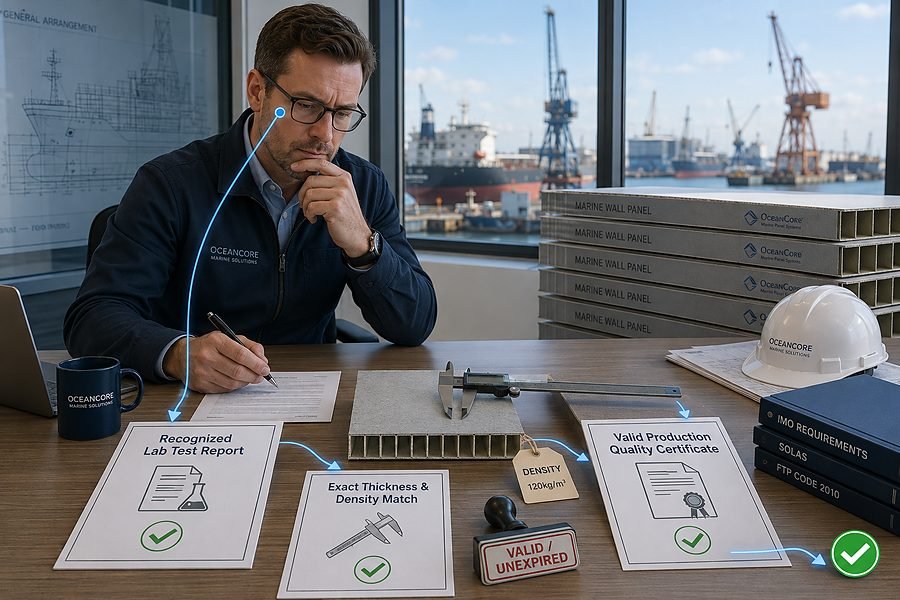
When you want to find high-quality marine interior suppliers with low prices in Asia, you must act like a detective. You cannot just look at the title of a certificate. You must read the details. I always use a strict process to check certificates before I place an order.
Verifying the Test Laboratory and Report Validity
First, you must check the laboratory name on the test report. Search the lab online to see if they are approved by the IMO and the USCG. Then, look at the dates. A fire test report usually does not expire, but the Type Approval Certificate usually expires every five years7. If the certificate expired last month, do not pay the deposit.
Matching Certificate Details to Physical Panel Specs
Second, you must check the exact numbers. This is where many buyers get tricked. Look at the certificate. It will list a specific rockwool density. For a standard A-60 wall panel, the density is usually 120 kg/m3. The thickness is usually 50mm. Sometimes, a factory will ship you a panel with 100 kg/m3 rockwool to save money. The cost difference is about $2 to $4 per square meter. But if the physical panel is lighter than the certificate states8, the certificate is completely void. The panel is illegal.
Confirming Valid Production Quality Certificates
Third, you must check the factory quality papers. Look for the MED Module D certificate or a marine-specific ISO 9001 certificate. Call the issuing agency, like DNV or ABS, or check their online database. Confirm that the factory passed their audit this year. If they cannot show you a valid quality paper, their IMO claim is useless for your regional projects.
| Element to Verify | Where to Look | Red Flag to Watch For | Acceptable Standard |
|---|---|---|---|
| Laboratory | First page of test report | Unknown local lab | USCG / IMO listed lab |
| Panel Density | Technical annex of certificate | Mismatch with purchase order | E.g., 120 kg/m3 matching PO |
| Quality Audit | Module D certificate | Expired date or no certificate | Valid until next year |
What Risks Come From Treating IMO Approval as Universal for Marine Panels?
Buying based on IMO alone seems cheap and fast. But the hidden costs can ruin your business. Here are the real risks of treating IMO as universal.
Treating IMO approval as universal introduces severe risks, including complete project delays due to customs rejection, heavy financial penalties for removing and replacing installed panels, and severe legal liabilities if non-compliant panels fail to contain a fire on a passenger or cargo ship.
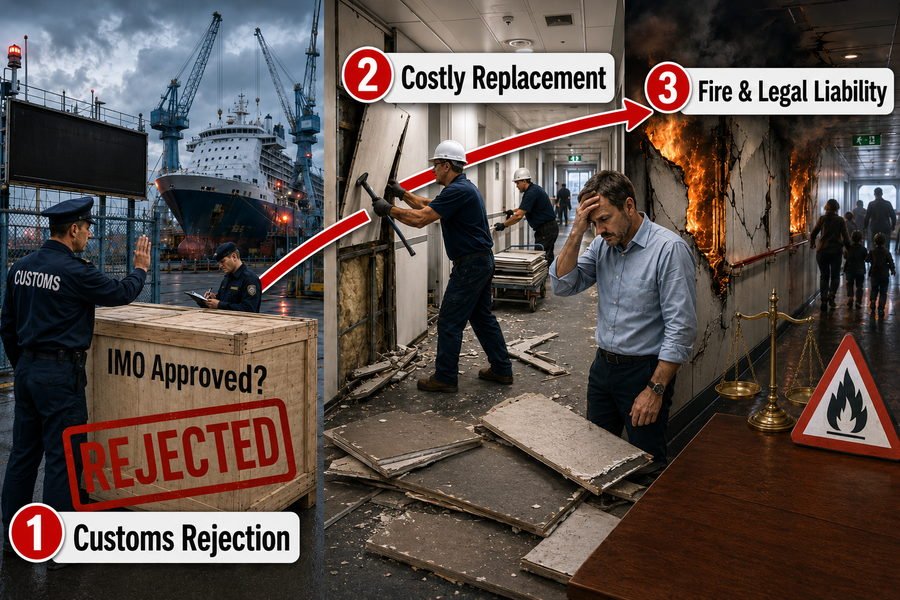
Many people focus only on the price of the panel. They forget the cost of failure. If you buy panels for a large shipyard in Europe based only on a basic IMO paper, you face massive risks. I always remind buyers to look at the total risk.
Project Delays and Customs Rejections
The first risk is time. If you ship panels without regional approvals, customs or port surveyors will stop the container.9 Port storage fees are very expensive. They can cost $100 to $300 per day. If you have to order new panels from a better supplier, the lead time is usually 30 to 60 days. The ocean shipping takes another 30 days. You will delay the shipyard's project by three months. The shipyard will never buy from you again.
Financial Penalties of Replacing Installed Marine Panels
The second risk is money. Sometimes, the wrong panels pass customs. The workers install them. Then, the final ship surveyor arrives and checks the papers. He sees no Wheelmark. He orders you to remove all panels. A standard ship cabin uses about 30 square meters of wall panels. Good marine panels cost $15 to $25 per square meter. If you must replace panels in a 100-cabin ship, the material alone costs $75,000. Adding labor, the mistake will cost you well over $100,000.
Legal Liabilities in the Event of a Ship Fire
The third and biggest risk is legal. Ship fires are deadly. If a fire happens and investigators find that the panels lacked the proper regional fire approvals, the situation becomes a crime.10 The procurement officer and the decoration company can face massive lawsuits. Saving $3 per square meter is never worth this legal danger.
| Risk Category | Specific Consequence | Estimated Financial Impact | Avoidance Strategy |
|---|---|---|---|
| Delay | Port holding and re-ordering | $100 - $300 per day in fees | Verify DoC before shipping |
| Replacement | Tear down and reinstall | Over $100,000 for 100 cabins | Hire a third-party inspector |
| Legal | Lawsuits after a fire | Unlimited liability / Prison | Demand full regional certificates |
Conclusion
Navigating marine panel regulations means looking beyond basic IMO rules. By understanding regional needs like MED and USCG, you secure better panels, avoid costly delays, and protect your shipyard projects.
-
"Port State Control - International Maritime Organization", https://www.imo.org/en/ourwork/msas/pages/portstatecontrol.aspx. IMO materials on implementation explain that IMO adopts maritime safety instruments, while enforcement is carried out by member governments, principally through flag-state and port-state control mechanisms. Evidence role: mechanism; source type: institution. Supports: The IMO does not directly police compliance with its rules and relies on national authorities to implement and enforce them.. Scope note: This supports the institutional enforcement model generally, rather than the specific enforcement of every marine panel approval decision. ↩
-
"[PDF] RESOLUTION MSC.307(88) (adopted on 3 December 2010 ...", https://wwwcdn.imo.org/localresources/en/KnowledgeCentre/IndexofIMOResolutions/MSCResolutions/MSC.307(88).pdf. The IMO 2010 FTP Code, Part 3, specifies the fire-resistance test procedures and insulation criteria used to classify A-class divisions, including the 60-minute performance duration associated with A-60 ratings. Evidence role: definition; source type: institution. Supports: An A-60 bulkhead is classified by its ability to satisfy A-class fire-resistance and insulation criteria for 60 minutes.. ↩
-
"RESOLUTION MSC.307(88) (adopted on 3 December ...", https://wwwcdn.imo.org/localresources/en/KnowledgeCentre/IndexofIMOResolutions/MSCResolutions/MSC.307(88).pdf. The IMO 2010 FTP Code, Part 2, gives smoke and toxicity test criteria for surface materials and lists maximum permitted concentrations for gases including carbon monoxide; this supports the stated CO threshold as a regulatory test limit, not as evidence that any particular PVC film will exceed it. Evidence role: definition; source type: institution. Supports: FTP Code Part 2 limits carbon monoxide concentration in smoke toxicity testing to 1450 ppm.. Scope note: Supports the regulatory threshold only; it does not substantiate the performance of a specific unnamed PVC product. ↩
-
"46 CFR Part 159 Subpart 159.010 -- Independent Laboratory - eCFR", https://www.ecfr.gov/current/title-46/chapter-I/subchapter-Q/part-159/subpart-159.010. U.S. Coast Guard equipment-approval materials and regulations identify accepted independent laboratories for specific approval testing, supporting the claim that test results must come from recognized laboratories for USCG type approval. Evidence role: general_support; source type: government. Supports: For USCG type approval, testing generally must be performed by independent laboratories accepted or recognized by the Coast Guard.. Scope note: The source can establish the laboratory-recognition requirement, but rejection of a particular IMO test report depends on the applicable equipment category and approval procedure. ↩
-
"Directive 96/98/EC - Wikipedia", https://en.wikipedia.org/wiki/Directive_96/98/EC. EU Marine Equipment Directive materials explain that covered marine equipment must bear the wheel mark and be accompanied by an EU declaration of conformity to demonstrate conformity with applicable approval requirements. Evidence role: definition; source type: government. Supports: Marine equipment placed on EU ships may require the MED Wheelmark and a Declaration of Conformity, and missing documentation or marking can cause rejection.. Scope note: This supports the regulatory requirement in general; whether a specific port surveyor rejects a shipment depends on the equipment category and inspection context. ↩
-
"Fire testing laboratories - International Maritime Organization", https://www.imo.org/en/ourwork/safety/pages/firetestinglaboratories-default.aspx. U.S. Coast Guard type-approval regulations and guidance identify accepted independent laboratories and require testing or evaluation by recognized laboratories for relevant marine equipment approval processes. Evidence role: general_support; source type: government. Supports: For USCG approval, fire test data or evaluations must come from laboratories recognized or accepted by the Coast Guard rather than from any local testing facility.. Scope note: This supports the approval-framework requirement for recognized laboratories; the exact handling of a submitted report may vary by product category and approval pathway. ↩
-
"46 CFR Part 189 -- Inspection and Certification - eCFR", https://www.ecfr.gov/current/title-46/chapter-I/subchapter-U/part-189. Official marine-equipment approval schemes treat type approval as time-limited and subject to renewal; many certificates are issued on a five-year cycle, supporting the need to verify the certificate expiry date separately from the underlying test report. Evidence role: general_support; source type: government. Supports: A fire test report may remain usable as technical evidence, but a Type Approval Certificate is typically time-limited and often renewed about every five years.. Scope note: Validity periods can vary by flag administration, product category, and approval scheme, so the source should be used to support the general verification practice rather than a universal five-year rule. ↩
-
"What Is the Purpose and Scope of the IMO FTP Code? - Magellan ...", https://magellanmarinetech.com/what-purpose-scope-of-imo-ftp-code/. The IMO FTP Code and related flag-administration approval practices approve fire divisions as tested assemblies with specified construction details; this supports checking that delivered panel characteristics such as insulation type, thickness, and density match the approved certificate configuration. Evidence role: mechanism; source type: institution. Supports: Delivered A-60 panels must match the certified/tested construction details, including insulation density, for the approval to apply.. Scope note: Such sources establish that deviations may make the item non-conforming with the approved assembly; the formal legal consequence for a shipment or installation depends on the competent authority and contract terms. ↩
-
"[PDF] LIST OF CERTIFICATES AND DOCUMENTS REQUIRED", https://wwwcdn.imo.org/localresources/en/publications/Documents/IMO-Vega/B-FAL.2-Circ.133%20-%20List%20Of%20Certificates%20And%20Documents%20RequiredTo%20Be%20Carried%20On%20Board%20Ships,%202022%20(Secretariat).pdf. Official marine-equipment and port-state-control guidance establishes that fire-safety materials used on ships may require documented conformity approval, and that authorities may inspect certificates and detain vessels or equipment for safety deficiencies. Evidence role: general_support; source type: institution. Supports: Shipping marine panels without required regional approvals can result in inspection, detention, or rejection by port or maritime authorities.. Scope note: This supports the regulatory basis for inspection or detention, but it does not prove that every non-approved shipment will be stopped at customs. ↩
-
"Summary of SOLAS chapter II-2 - International Maritime Organization", https://www.imo.org/en/ourwork/safety/pages/summaryofsolaschapterii-2-default.aspx. Maritime safety regulations implementing SOLAS and marine-equipment conformity rules can make the supply, installation, or use of non-compliant fire-safety materials subject to enforcement penalties, including criminal offences in some jurisdictions. Evidence role: general_support; source type: government. Supports: Using marine panels without required fire approvals can create legal or criminal exposure after a ship fire.. Scope note: The source would support legal exposure from non-compliance, but whether a specific incident is criminal depends on jurisdiction, intent, causation, and the facts found by investigators. ↩