You buy marine wall panels to finish a ship, but the surveyor rejects them. The pain is real. Outdated IMO MSC references stop your project dead. Let us fix this.
Outdated IMO MSC references cause marine panel rejection because they violate strict SOLAS compliance rules, trigger flag state survey failures, lead to port state control detentions, and result in massive financial losses from forced material replacement and shipyard delays. All five consequences happen when certificates cite withdrawn safety standards.
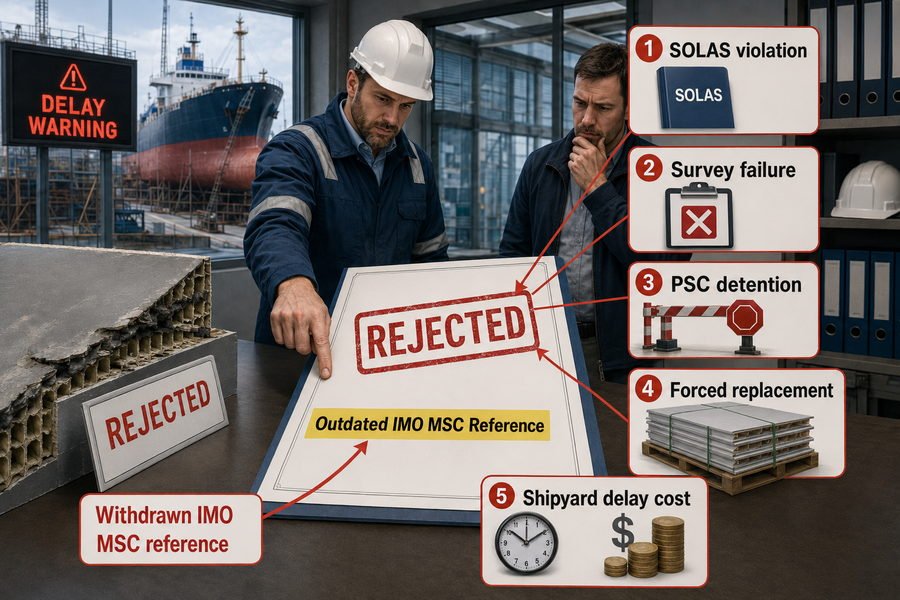
When you face these rejections, the entire supply chain breaks down. You cannot afford to lose money and time. You need to secure good products from Asia for your European and American projects without headaches. Let us look deeper into the specific risks and how to protect your business.
What Risks Arise When Marine Panel Documents Cite Superseded MSC Resolutions?
A supplier sends you cheap panels with old certificates. You think you saved money. But superseded documents create hidden traps that will destroy your hard-earned profit margin.
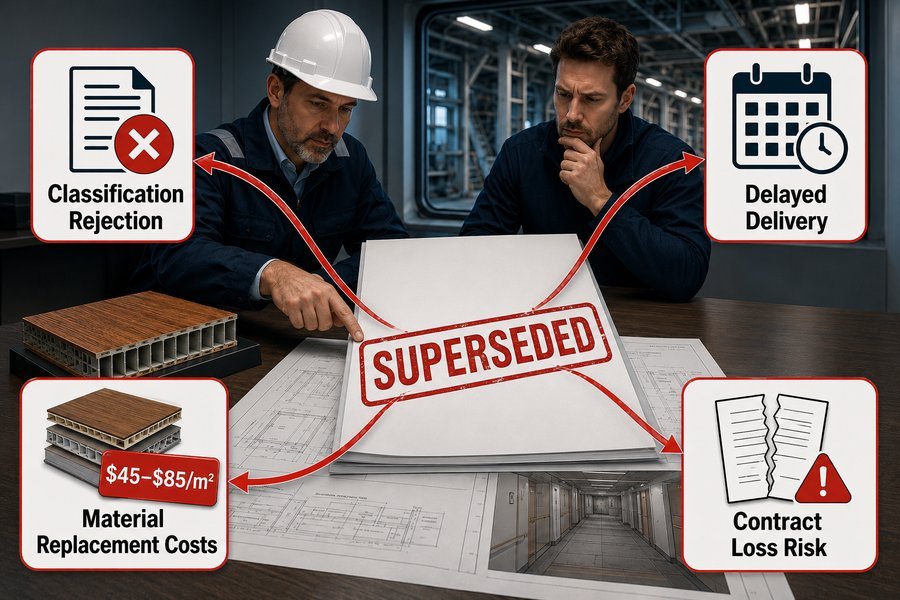
When marine panel documents cite superseded MSC resolutions, you face four major risks: total rejection by the classification society, delayed vessel delivery, mandatory material replacement costs averaging $45 to $85 per square meter, and potential loss of your interior outfitting contract due to non-compliance with current SOLAS requirements.
Total Rejection and Delayed Vessel Delivery Risks
In my early days working at a marine outfitting factory, I saw many buyers ignore the fine print on certificates. This is a huge mistake. The first risk you face is total rejection by the classification society. When a surveyor from DNV or Lloyd's Register boards the ship, they check the Type Approval Certificate for every marine wall panel and ceiling panel1. If the certificate lists a superseded standard, like the old MSC.61(67)2, the surveyor will immediately reject the materials. They will not compromise. The second risk is delayed vessel delivery. Because the panels are rejected, you cannot install them. If you already installed them, you must tear them down. Shipyards in Europe and the United States have very tight schedules. A delay can trigger penalty clauses.3 The daily penalty for a delayed commercial vessel can easily range from $5,000 to $15,000. You, as the outfitter, will have to pay this penalty.
Financial Costs and Contract Loss from Superseded Resolutions
The third risk is the massive cost of mandatory material replacement. You bought the wrong panels, and now you must buy new ones fast. Based on my data from Magellan Marine, high-quality A-class or B-class marine panels from reliable factories in China or Vietnam cost between $45 and $85 per square meter. If an accommodation block needs 2,000 square meters of panels, you will spend an extra $90,000 to $170,000 just to replace the material. This does not even include the extra shipping costs or the labor cost to remove the bad panels. The fourth risk is the potential loss of your interior outfitting contract. European and American shipyards demand professionalism. If you bring non-compliant materials to their yard, they will lose trust in your procurement skills. They will cancel your current contract and remove you from their approved vendor list forever.
| Risk Category | Specific Impact on Your Project | Estimated Cost or Penalty |
|---|---|---|
| Total Rejection | Surveyor stops installation of all non-compliant panels. | Total loss of initial material investment. |
| Delayed Delivery | Project timeline stops while waiting for new compliant panels. | $5,000 - $15,000 per day in shipyard delay penalties. |
| Material Replacement | Must buy new panels with correct MSC.307(88) certificates. | $45 - $85 per square meter (based on Asian factory prices). |
| Contract Loss | Shipyard terminates your interior outfitting agreement. | 100% loss of future project revenue from that shipyard. |
How Can Shipyards Confirm Marine Panel Suppliers Cite Current MSC Resolutions?
You need to trust your suppliers in developing countries, but you must verify their papers. Relying on blind trust leads to disaster. Here is how you can confirm the facts easily.
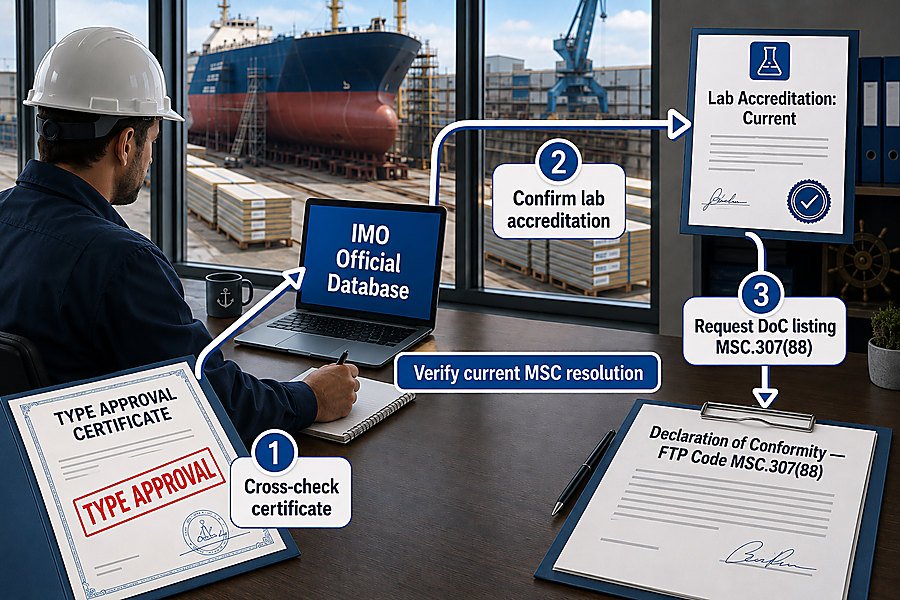
Shipyards can confirm suppliers cite current MSC resolutions through three steps: cross-checking the Type Approval Certificate against the IMO official database, verifying the testing laboratory's current accreditation status, and requesting a Declaration of Conformity that explicitly lists the active FTP Code, such as MSC.307(88), rather than older versions.
Cross-Checking Type Approval Certificates in IMO Databases
You cannot just look at a piece of paper and assume it is true. The first step is cross-checking the Type Approval Certificate against the IMO official database or the classification society's digital register. Every major classification society, such as ABS, DNV, or Bureau Veritas, has a free online database for approved products. You just need to type in the certificate number printed on the supplier's document. The database will show you the exact status of the certificate. It will tell you if the certificate is active, expired, or withdrawn. More importantly, the database will list the exact IMO MSC resolution the panel was tested against. If the supplier's paper says the certificate is valid, but the database says it was withdrawn because it used an old resolution, you know the supplier is hiding something. This simple check takes five minutes but saves you thousands of dollars.
Verifying Lab Accreditation and Requesting the Declaration of Conformity
The second step is verifying the testing laboratory's current accreditation status. The fire test report comes from a lab, not the factory. Look at the name of the lab on the report. For example, many panels from China are tested at the Far East Fire Testing Centre. You must check if that lab currently holds an ISO/IEC 17025 accreditation for fire testing4. If the lab lost its accreditation, the test report is worthless. The third step is requesting a Declaration of Conformity directly from the factory manager. This is a legally binding document. You must demand that this document explicitly lists the active FTP Code. Right now, that is the 2010 FTP Code, known as MSC.307(88). If the factory sends you a Declaration of Conformity that still lists MSC.61(67), you must reject it. I have helped many clients filter out bad suppliers just by asking for this specific document.
| Verification Step | Tool or Document Used | What to Look For |
|---|---|---|
| 1. Database Cross-Check | DNV / ABS / LR Online Approvals Register | Match the certificate number. Ensure status is "Active" and lists current MSC rules. |
| 2. Lab Accreditation Verify | ISO/IEC 17025 Certificate of the Lab | Confirm the lab is legally authorized to conduct IMO fire tests today. |
| 3. Requesting Declaration | Factory Declaration of Conformity (DoC) | Ensure the DoC explicitly states compliance with "MSC.307(88) / 2010 FTP Code". |
Why Do Flag States Reject Marine Panels Tested Under Withdrawn MSC Resolutions?
You might wonder why a panel tested years ago is suddenly bad today. The fire did not change. But the rules did. Flag states have very strict safety reasons for this.
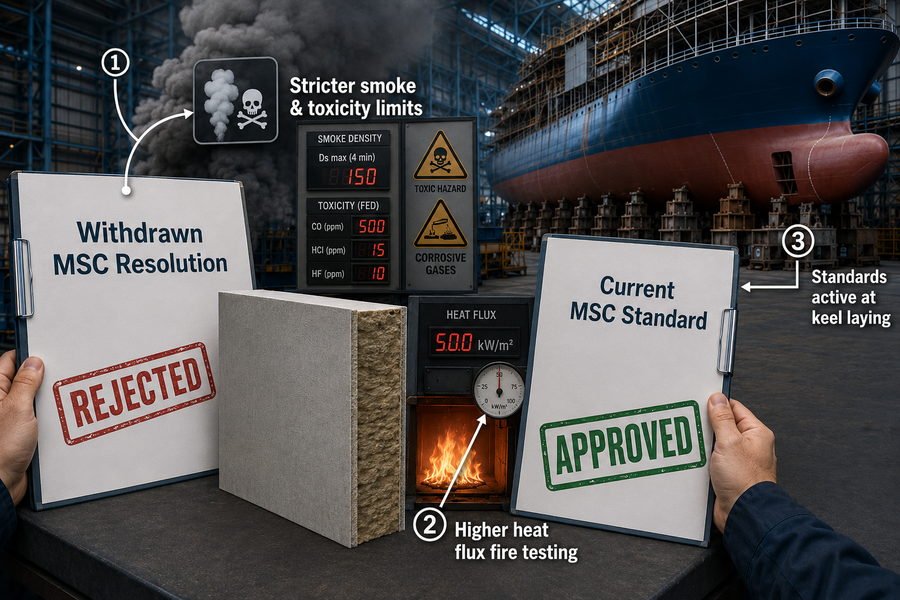
Flag states reject marine panels tested under withdrawn MSC resolutions for three reasons: newer resolutions require stricter smoke and toxicity limits, modern testing methods use higher heat fluxes to simulate real fires better, and international law strictly mandates that vessels must comply with the safety standards active during keel laying.
Stricter Smoke Limits and Higher Heat Fluxes in Modern Testing
I always explain to my clients that marine safety rules are written in blood. After a major ship fire, the IMO studies what went wrong and makes the rules harder to pass. This is the first reason flag states reject old panels: newer resolutions require stricter smoke and toxicity limits5. Under the old 1996 FTP Code, a marine wall panel might pass the smoke test easily. But under the 2010 FTP Code, the allowable limits for toxic gases like carbon monoxide and hydrogen cyanide are much lower (Source: IMO MSC.307(88) Annex 1). If a fire breaks out, passengers need clear air to escape. The old panels simply produce too much toxic smoke by today's standards. The second reason is that modern testing methods use higher heat fluxes to simulate real fires better. The testing equipment applies a specific amount of radiant heat to the panel, measured in kilowatts per square meter (kW/m2). The new rules often require testing at 50 kW/m26 instead of lower levels used in the past. If a panel was never tested against this higher heat, the flag state will not trust it to stop a modern fire.
International Law and Keel Laying Date Compliance
The third reason flag states reject these panels is because of international law. International law strictly mandates that vessels must comply with the safety standards active during keel laying7. Keel laying is the official start date of the ship's construction. SOLAS Chapter II-2 dictates this rule clearly. The flag state, which gives the ship its nationality and right to sail, enforces SOLAS. If the ship's keel was laid in 2024, the ship must use materials that meet the rules active in 2024. The 2010 FTP Code became mandatory for ships constructed on or after July 1, 2012.8 If you try to use a marine ceiling panel tested under the withdrawn 1996 code on a ship built today, you are breaking international maritime law. The flag state inspector has no choice but to reject your material to protect their own legal liability.
| Factor | Withdrawn Resolution (e.g., MSC.61(67)) | Current Resolution (e.g., MSC.307(88)) | Flag State Action |
|---|---|---|---|
| Smoke & Toxicity | Higher allowable limits for toxic gases. | Stricter, lower limits for CO, HCl, and HCN. | Reject old panels to ensure safe passenger escape routes. |
| Test Heat Flux | Often tested at lower radiant heat levels. | Tested at 50 kW/m2 to simulate severe fires. | Reject old panels because they fail under modern heat loads. |
| Legal Compliance | Valid for ships built before July 2012. | Mandatory for ships built after July 2012. | Reject old panels as they violate SOLAS Chapter II-2 laws. |
What Are Common Errors Linking Marine Panels To Wrong MSC Resolutions?
Even good suppliers in Asia make silly mistakes. You look at the certificate and everything seems fine. But tiny errors hide in the text. You must catch these errors early.
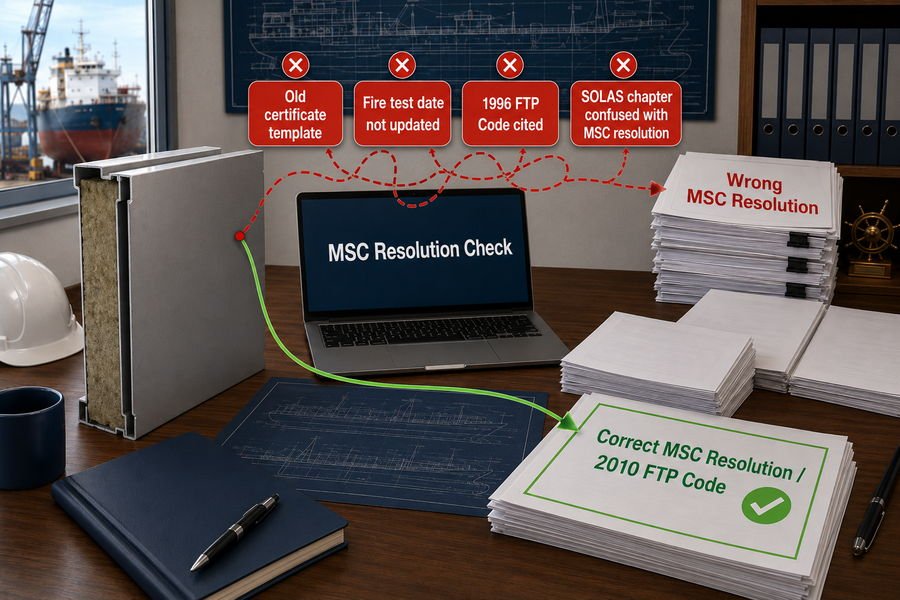
The four most common errors linking marine panels to wrong MSC resolutions are: copying old certificate templates, failing to update the fire test report dates, citing the 1996 FTP Code instead of the 2010 FTP Code, and confusing SOLAS chapter references with specific material testing resolution numbers.
Copying Old Templates and Failing to Update Test Report Dates
When you deal with factory sales teams who do not speak perfect English, you will see many paperwork errors. The first common error is copying old certificate templates. Many factories use the same Microsoft Word template for their internal product data sheets for ten years. When they get a new product, they just change the product name but forget to update the regulatory text at the bottom. This makes the panel look like it uses a wrong MSC resolution. The second error is failing to update the fire test report dates. A Type Approval Certificate is usually valid for five years.9 When the factory renews the certificate, the classification society issues a new paper. However, the factory sometimes attaches the original fire test report from 2015 instead of the newly reviewed engineering data from 2024. When the European shipyard sees a ten-year-old test date, they immediately flag the panel for rejection, even if the actual panel design never changed.
Citing the 1996 FTP Code and Confusing SOLAS Chapter References
The third most common error is citing the 1996 FTP Code instead of the 2010 FTP Code. This happens often on the commercial invoice or the packing list. The customs officer or the receiving manager at the shipyard will read the packing list. If it says "Marine Fire Door - Complies with 1996 FTP Code (MSC.61(67))10", they will stop the shipment. The correct reference must always be the 2010 FTP Code (MSC.307(88))11. The fourth error is confusing SOLAS chapter references with specific material testing resolution numbers. A supplier might write "Approved by SOLAS Chapter II-2" on the product label. While SOLAS Chapter II-2 is the correct chapter for fire protection, it is just a broad legal framework. It is not a testing standard.12 The shipyard needs to see the exact MSC resolution number that proves the panel passed the fire test. Writing just "SOLAS" is too vague and causes instant delays during documentation review.
| Common Error | How It Appears on Documents | How to Correct It |
|---|---|---|
| Old Templates | Data sheet shows outdated regulations at the bottom. | Demand factory creates a fresh data sheet matching the new TAC. |
| Old Test Dates | Attached fire test report is more than 5-10 years old. | Ask for the latest engineering review letter from the testing lab. |
| Wrong FTP Code | Invoice states "1996 FTP Code" or "MSC.61(67)". | Require factory to revise invoice to state "2010 FTP Code / MSC.307(88)". |
| Vague SOLAS Referencing | Label only says "Complies with SOLAS II-2". | Force supplier to print the exact MSC resolution number on every panel. |
How Should Suppliers Update Marine Panel Certificates After New MSC Resolutions?
When the IMO issues a new rule, your supplier must act fast. If they wait, you suffer. Updating certificates is a clear, step-by-step process they must follow closely.
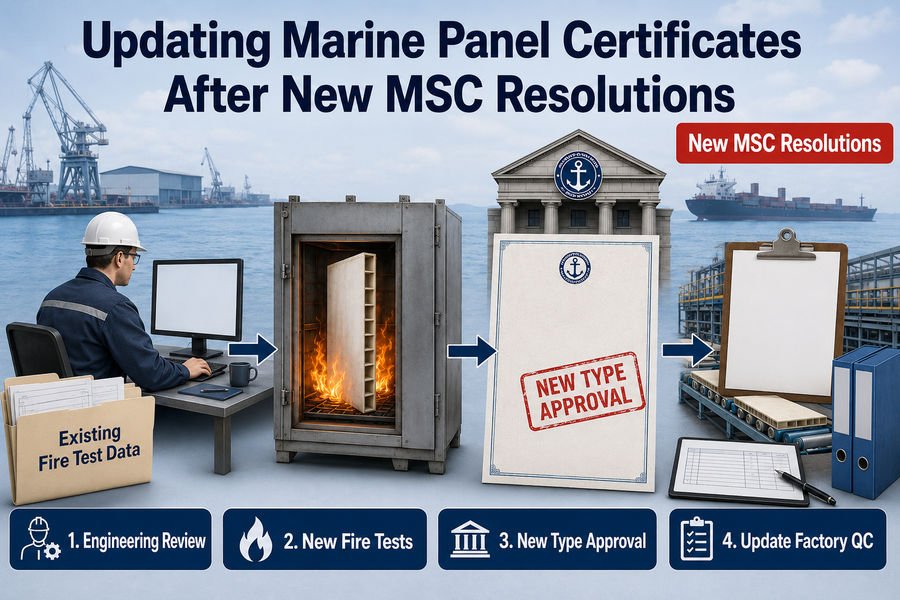
Suppliers must update marine panel certificates after new MSC resolutions through four mandatory steps: submitting existing test data for engineering review, conducting new fire tests if old data fails new criteria, applying for a new Type Approval from the classification society, and updating all factory quality control documentation.
Engineering Reviews and Conducting New Fire Tests
I always advise marine outfitting factories on how to handle new IMO rules. The first mandatory step is submitting existing test data for engineering review13. The factory must take their old fire test reports and send them to an approved laboratory. The engineers at the lab will compare the old performance data against the new MSC resolution requirements. Sometimes, the old panel is so good that it actually passes the new rules without doing anything. In that case, the lab just writes an assessment report. But usually, that is not enough. The second step is conducting new fire tests if the old data fails the new criteria. If the new rule demands lower smoke toxicity, the factory must put a brand new marine panel into the test furnace. Based on current market rates in Asia, a full A-60 bulkhead fire test costs between $3,000 and $5,00014. It takes about a month to prepare the sample, book the lab, and run the burn test. The factory must pay this money to stay in business.
Applying for Type Approval and Updating Factory Quality Control
Once the panel passes the physical fire test, the factory moves to the third step: applying for a new Type Approval from the classification society. The factory gathers the new test report, detailed product drawings, and material lists, and submits them to DNV, ABS, or another recognized society. The society reviews the file and issues a new Type Approval Certificate. This certification process costs an additional $2,000 to $4,000 and can take two to three months. The final, fourth step is updating all factory quality control documentation. The factory cannot just put the new certificate in a drawer. They must update their ISO 9001 quality manual. They must change their standard operating procedures on the factory floor to ensure every worker builds the panel exactly as it was tested. They must also update their Declaration of Conformity templates so that buyers like you get the right paperwork with every order.
| Update Step | Action Required by Supplier | Estimated Cost | Estimated Timeframe |
|---|---|---|---|
| 1. Engineering Review | Send old test data to an approved lab for comparison. | $500 - $1,000 | 1 to 2 weeks |
| 2. New Fire Tests | Burn new panel samples if old data does not meet new rules. | $3,000 - $5,000 per test | 3 to 5 weeks |
| 3. Type Approval Application | Submit new test reports to Class Society (e.g., DNV, ABS). | $2,000 - $4,000 | 8 to 12 weeks |
| 4. QC Document Update | Revise ISO manuals, data sheets, and DoC templates. | Internal labor cost | 1 week |
Which Transitional Clauses In MSC Resolutions Affect Marine Panel Validity?
Rules do not change overnight. The IMO gives the industry time to adjust. You must understand these grace periods to know exactly when an old certificate actually expires.
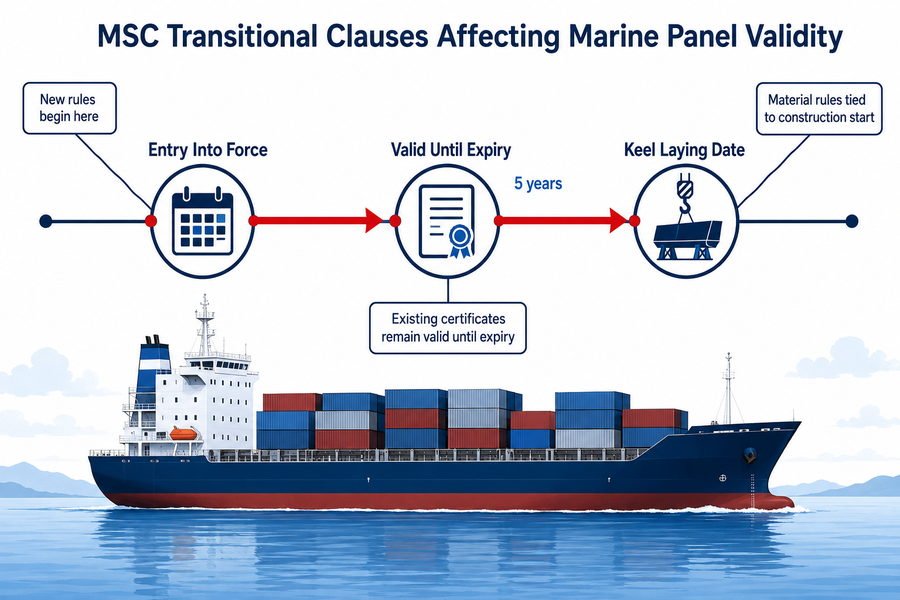
Three transitional clauses in MSC resolutions affect marine panel validity: the "entry into force" date dictating when new rules apply, the "valid until expiry" clause allowing current certificates to run their five-year term, and the "keel laying" clause linking material rules to the ship's construction start date.
Understanding the Entry Into Force Date and Keel Laying Clause
Reading IMO documents is boring, but you must know the dates to avoid buying useless materials. The first transitional clause you must watch is the "entry into force" date. When the IMO writes a new resolution, they agree on a specific date when it becomes global law. This date dictates when new rules apply to the shipping industry. For example, MSC.307(88) was adopted in December 2010, but its entry into force date was July 1, 2012.15 You must never confuse the adoption date with the entry into force date. The second, and most important, transitional clause is the "keel laying" clause. This clause links the material rules to the ship's construction start date.16 If a shipyard laid the keel of a vessel on June 30, 2012, they could legally use marine panels tested under the older rules. But if they laid the keel on July 2, 2012, they must strictly use panels tested under the new MSC.307(88) rules. Your procurement decisions must perfectly match the shipyard's keel laying schedule.
The Valid Until Expiry Clause for Existing Marine Panel Certificates
The third transitional clause is the "valid until expiry" clause. This rule is designed to protect factories that just paid for new certificates before the law changed. It allows current certificates to run their full five-year term, but with a big catch. If a factory received a five-year Type Approval Certificate in January 2011, it technically expired in January 2016. The factory could keep selling panels using that certificate until 2016, but only for ships whose keels were laid before the July 1, 2012 cutoff17. This is where many buyers get confused. A supplier will show you a certificate that says it is still valid until 2016. You think it is safe to buy. But if your shipyard is building a new ship today, that certificate is completely useless to you, regardless of the expiry date printed on it. You must always check the certificate's reference rules against your specific project timeline.
| Transitional Clause | What It Means | How It Affects Your Procurement |
|---|---|---|
| Entry Into Force Date | The exact day the new IMO rule becomes mandatory global law. | Sets the strict deadline for when you must switch to new panel types. |
| Keel Laying Clause | Ties the required safety standard to the date ship construction starts. | You must ask the shipyard for the exact keel laying date before buying panels. |
| Valid Until Expiry | Allows old certificates to finish their 5-year life cycle. | Only valid for older ships. Do not buy these for new shipbuilding projects. |
Conclusion
Outdated IMO MSC references cause severe delays and wipe out your profit margins. Always verify supplier certificates, understand transitional clauses, and ensure your panels comply with the most current safety codes.
-
"What Is the Purpose and Scope of the IMO FTP Code? - Magellan ...", https://magellanmarinetech.com/what-purpose-scope-of-imo-ftp-code/. Classification-society and flag-state approval frameworks require documentary evidence that shipboard fire-protection materials and interior divisions have been tested and approved under applicable fire-test procedures, supporting the need for surveyors to verify certificates during compliance checks. Evidence role: mechanism; source type: institution. Supports: Surveyors verify Type Approval Certificates for marine wall and ceiling panels as part of compliance checks.. Scope note: This supports the general certification-check mechanism; individual survey practice may vary by flag state, class society, vessel type, and inspection stage. ↩
-
"[PDF] RESOLUTION MSC.307(88) (adopted on 3 December 2010 ...", https://wwwcdn.imo.org/localresources/en/KnowledgeCentre/IndexofIMOResolutions/MSCResolutions/MSC.307(88).pdf. The IMO adopted the 2010 International Code for Application of Fire Test Procedures through Resolution MSC.307(88), replacing the earlier FTP Code adopted by Resolution MSC.61(67), which supports treating MSC.61(67) as a superseded reference for current approvals. Evidence role: historical_context; source type: institution. Supports: MSC.61(67) is an older FTP Code resolution that was superseded by MSC.307(88).. Scope note: The source establishes the regulatory succession; whether a specific certificate is invalid depends on flag-state acceptance, certificate validity dates, and transitional provisions. ↩
-
"[PDF] Navy Shipbuilding - Excerpt from the Proceedings", https://dair.nps.edu/bitstream/123456789/5384/1/SYM-AM-25-320.pdf. Shipbuilding-contract scholarship describes late delivery clauses as a common contractual mechanism in which builders may owe liquidated damages after the contractual delivery date, supporting the claim that vessel-delivery delays can trigger penalty or damages provisions. Evidence role: general_support; source type: paper. Supports: Delayed vessel delivery can activate contractual penalty or liquidated-damages clauses.. Scope note: This supports the existence and function of delay-damages clauses; it does not prove that every shipyard contract contains such a clause or that a particular delay will trigger liability. ↩
-
"[PDF] SCOPE OF ACCREDITATION TO ISO/IEC 17025:2017", https://www.nrel.gov/media/docs/libraries/pv/nrel-17025-iso-cert-2025.pdf?sfvrsn=ea661dc0_2. ISO/IEC 17025 defines requirements for the competence, impartiality, and consistent operation of testing laboratories, and accreditation scopes identify the specific tests for which a laboratory is accredited. Evidence role: definition; source type: institution. Supports: A testing laboratory’s current ISO/IEC 17025 accreditation and scope should be checked for the relevant fire-testing methods.. Scope note: The standard supports checking laboratory competence and scope; it does not by itself determine the validity of a particular fire-test report or certificate. ↩
-
"What Is the Purpose and Scope of the IMO FTP Code? - Magellan ...", https://magellanmarinetech.com/what-purpose-scope-of-imo-ftp-code/. IMO Resolution MSC.307(88), adopting the 2010 FTP Code, specifies smoke and toxicity test criteria for shipboard materials, including limits for gases such as CO, HCl, and HCN, supporting the statement that current fire-test approval includes defined smoke-toxicity thresholds. Evidence role: general_support; source type: institution. Supports: Newer IMO fire test resolutions require stricter smoke and toxicity limits for marine panels.. Scope note: The source directly establishes the 2010 Code requirements; a separate comparison with MSC.61(67) may be needed to prove every limit is stricter than the prior code. ↩
-
"[PDF] RESOLUTION MSC.307(88) (adopted on 3 December 2010 ...", https://wwwcdn.imo.org/localresources/en/KnowledgeCentre/IndexofIMOResolutions/MSCResolutions/MSC.307(88).pdf. The 2010 FTP Code test procedures include radiant heat exposure conditions expressed in kW/m², including 50 kW/m² in relevant fire-test methods, supporting the article’s description of high heat-flux testing for marine materials. Evidence role: mechanism; source type: institution. Supports: Modern marine fire testing can require panels to be tested at 50 kW/m² radiant heat flux.. Scope note: The citation supports the existence of 50 kW/m² test exposure conditions; it does not by itself show that every prior approval used a lower heat flux or that every panel would fail under the newer condition. ↩
-
"Summary of SOLAS chapter II-2 - International Maritime Organization", https://www.imo.org/en/ourwork/safety/pages/summaryofsolaschapterii-2-default.aspx. SOLAS applies construction and fire-safety requirements by reference to whether a ship is constructed on or after specified dates, with “constructed” generally tied to keel laying or a similar stage of construction, supporting the article’s use of keel-laying date as the compliance trigger. Evidence role: historical_context; source type: institution. Supports: A vessel’s applicable SOLAS safety standards are generally determined by the rules in force at its construction or keel-laying date.. Scope note: The source supports the legal timing mechanism; applicability can vary by ship type, tonnage, exemptions, and transitional provisions. ↩
-
"[PDF] RESOLUTION MSC.307(88) (adopted on 3 December 2010 ...", https://wwwcdn.imo.org/localresources/en/KnowledgeCentre/IndexofIMOResolutions/MSCResolutions/MSC.307(88).pdf. IMO Resolution MSC.307(88) adopted the 2010 FTP Code and states its application to ships constructed on or after 1 July 2012, supporting the article’s date-based compliance claim. Evidence role: case_reference; source type: institution. Supports: The 2010 FTP Code became mandatory for ships constructed on or after July 1, 2012.. ↩
-
"Directive 96/98/EC - Wikipedia", https://en.wikipedia.org/wiki/Directive_96/98/EC. Marine-equipment conformity-assessment rules commonly limit type-examination certificates to a maximum validity period of five years, supporting the article’s statement about typical TAC duration; individual flag-state or classification-society schemes may impose different renewal conditions. Evidence role: general_support; source type: government. Supports: A Type Approval Certificate is usually valid for five years.. Scope note: The support is contextual because validity periods can vary by approval scheme and issuing authority. ↩
-
"[PDF] RESOLUTION MSC.61(67) (adopted on 5 December 1996 ...", https://wwwcdn.imo.org/localresources/en/KnowledgeCentre/IndexofIMOResolutions/MSCResolutions/MSC.61(67).pdf. IMO materials and consolidated SOLAS references identify the earlier International Code for Application of Fire Test Procedures as the 1996 FTP Code adopted by resolution MSC.61(67), supporting the article’s mapping of the older code to that resolution; this citation establishes historical context rather than proving a shipment would be rejected. Evidence role: historical_context; source type: institution. Supports: The 1996 FTP Code is associated with IMO resolution MSC.61(67).. Scope note: The source would support the code history, not the operational outcome of a particular customs or shipyard review. ↩
-
"[PDF] RESOLUTION MSC.307(88) (adopted on 3 December 2010 ...", https://wwwcdn.imo.org/localresources/en/KnowledgeCentre/IndexofIMOResolutions/MSCResolutions/MSC.307(88).pdf. The IMO identifies the International Code for Application of Fire Test Procedures, 2010 as the 2010 FTP Code adopted by resolution MSC.307(88), supporting the resolution reference used for current FTP Code documentation; this does not by itself determine the validity of every legacy approval. Evidence role: definition; source type: institution. Supports: The 2010 FTP Code is correctly identified as MSC.307(88).. Scope note: Legacy equipment or transitional cases may require separate approval-history review. ↩
-
"Summary of SOLAS chapter II-2 - International Maritime Organization", https://www.imo.org/en/ourwork/safety/pages/summaryofsolaschapterii-2-default.aspx. SOLAS Chapter II-2 sets out fire-safety objectives and requirements for construction, fire protection, detection, and extinction, while the FTP Code provides the detailed fire-test procedures referenced for material and division testing; this supports the distinction between a legal framework and a testing standard, though product documentation requirements may be specified by separate approval rules. Evidence role: definition; source type: institution. Supports: SOLAS Chapter II-2 is the fire-protection chapter, but detailed fire testing is governed by the FTP Code rather than by a generic SOLAS reference alone.. Scope note: The citation would explain the regulatory structure but may not directly document a particular shipyard’s review practice. ↩
-
"How Does the IMO FTP Code Connect with Other Marine Fire Safety ...", https://magellanmarinetech.com/how-imo-ftp-code-connect-with-other-marine-fire-safety-frameworks/. IMO FTP Code or recognized-organization guidance describes the use of approved test reports and technical assessments in marine fire-safety product approval; this supports the procedural role of engineering review but may not establish that it is universally the first mandatory step in every jurisdiction. Evidence role: general_support; source type: institution. Supports: The factory must submit existing fire-test data to an approved laboratory for engineering review before determining whether new testing is required.. Scope note: The source may support the review process generally rather than the article’s exact sequencing as a mandatory first step. ↩
-
"[PDF] RESOLUTION MSC.307(88) (adopted on 3 December 2010 ...", https://wwwcdn.imo.org/localresources/en/KnowledgeCentre/IndexofIMOResolutions/MSCResolutions/MSC.307(88).pdf. A public laboratory or accredited testing fee schedule can provide contextual evidence for typical fire-resistance test charges; it supports the plausibility of the stated range but may not prove current market pricing across all Asian laboratories. Evidence role: statistic; source type: institution. Supports: A full A-60 bulkhead fire test in Asia typically costs between $3,000 and $5,000.. Scope note: Testing fees vary by country, laboratory accreditation, specimen size, furnace time, and reporting requirements. ↩
-
"[PDF] RESOLUTION MSC.307(88) (adopted on 3 December 2010 ...", https://wwwcdn.imo.org/localresources/en/KnowledgeCentre/IndexofIMOResolutions/MSCResolutions/MSC.307(88).pdf. IMO Resolution MSC.307(88), which adopted the 2010 FTP Code, records adoption by the Maritime Safety Committee at its 88th session and states that the Code entered into force on 1 July 2012. Evidence role: historical_context; source type: institution. Supports: MSC.307(88) was adopted in December 2010 and entered into force on July 1, 2012.. ↩
-
"[PDF] Circular Letter No.4204/Add.7 3 April 2020 To: All IMO Member ...", https://wwwcdn.imo.org/localresources/en/MediaCentre/HotTopics/Documents/Circular%20Letter%20No.4204-Add.7%20-%20Coronavirus.pdf. SOLAS and associated IMO instruments commonly apply amended requirements to ships constructed on or after a specified date, with construction generally tied to keel-laying or a similar stage of construction. Evidence role: definition; source type: institution. Supports: The keel-laying clause links applicable material rules to the ship's construction start date.. Scope note: This supports the regulatory mechanism generally; the exact application must still be checked in the relevant IMO resolution and flag-state implementation documents. ↩
-
"How Does the IMO FTP Code Connect with Other Marine Fire Safety ...", https://magellanmarinetech.com/how-imo-ftp-code-connect-with-other-marine-fire-safety-frameworks/. IMO transitional guidance for the 2010 FTP Code distinguishes the continued validity of approvals issued under the previous FTP Code from the Code’s application to ships constructed on or after 1 July 2012, supporting the need to match certificate basis with the vessel’s keel-laying date. Evidence role: mechanism; source type: institution. Supports: Old certificates could remain usable only for ships whose keel-laying date placed them under the pre-1 July 2012 rules.. Scope note: This is contextual support for the procurement conclusion; the legal effect for a particular project depends on the exact certificate, flag administration acceptance, and ship construction date. ↩