Keeping up with fire safety rules is tough. Overlooking a single IMO circular can mean your marine panels get rejected, delaying your entire shipbuilding project and wiping out your profits.
IMO MSC.1/Circulars affect marine interior panel compliance by providing mandatory unified interpretations of SOLAS regulations and the 2010 FTP Code. They clarify exact testing parameters for non-combustibility, surface flammability, and smoke toxicity, ensuring that classification societies uniformly approve, reject, or require re-testing for A-Class, B-Class, and C-Class bulkhead and ceiling panels.
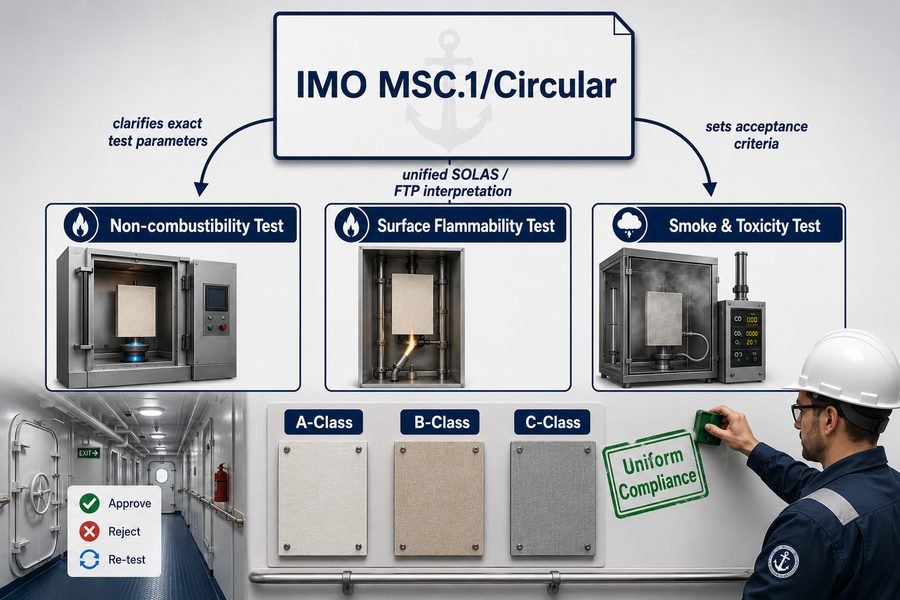
Understanding these circulars is not just for engineers. It is a critical skill for procurement officers who want to control costs and avoid nasty surprises during class inspections.
How Do MSC.1/Circulars Clarify Marine Panel Fire Safety Rules?
Reading the SOLAS convention alone is never enough. You must understand how circulars fill in the missing details to avoid buying the wrong materials.
MSC.1/Circulars clarify marine panel fire safety rules by detailing specific test sample thicknesses, specifying required mounting methods during fire tests, establishing precise acceptable temperature rise limits for A and B class divisions, and defining the exact adhesive application rates needed to pass the FTP Code Part 1 and Part 5 tests.
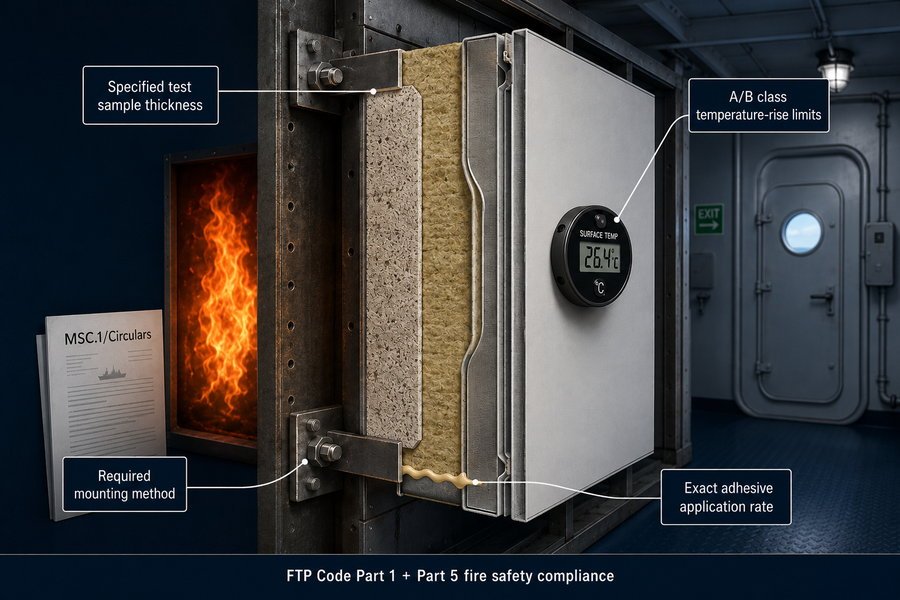
To truly grasp how these rules work in the real world, I always tell my clients to look beyond the basic fire rating. The 2010 Fire Test Procedures (FTP) Code provides the foundation, but the MSC.1/Circulars act as the instruction manual for the testing labs. Without these circulars, one lab might test a panel differently than another.
Breaking Down the Testing Parameters and Temperature Limits
First, these circulars detail specific test sample thicknesses. For example, if you are buying a B-15 marine wall panel, the circulars dictate exactly how thick the steel or mineral wool core must be during the fire test. You cannot test a 100mm panel and then sell a 25mm version using the same certificate.1 The rules establish precise acceptable temperature rise limits for A and B class divisions. According to SOLAS Chapter II-2, an A-60 bulkhead must prevent the unexposed side from rising more than 140°C on average above the original temperature for 60 minutes2. The circulars tell the labs exactly where to place the thermocouples to measure this limit accurately. This ensures that every panel you buy has passed the exact same rigorous standard.
The Impact of Mounting Methods and Adhesives
Second, the way a panel is put together during a test matters just as much as the materials themselves. The circulars specify required mounting methods during fire tests. If a ceiling panel is tested with a specific type of metal profile and screw spacing, it must be installed on the ship in that exact same way.3 If you change the mounting method, the certificate is useless. Furthermore, the circulars define the exact adhesive application rates needed. If a manufacturer uses 200 grams per square meter of glue to attach the PVC film to the steel skin during the test, they cannot use 400 grams per square meter in production. More glue means more fuel for a fire, which would fail the Part 5 surface flammability test.4
| Fire Rule Clarification | Specific Parameter Managed by MSC.1/Circular | Real-World Impact on Procurement |
|---|---|---|
| Test Sample Thickness | Defines maximum and minimum core thickness for testing | You cannot apply a certificate to thinner, untested panels. |
| Mounting Methods | Dictates joint types, profiles, and screw spacing | Installation instructions must match the lab test setup perfectly. |
| Temperature Rise Limits | Enforces the 140°C average rise limit for A/B Class | Guarantees the insulation actually stops heat transfer. |
| Adhesive Application Rates | Limits the grams per square meter of glue used | Prevents toxic smoke and rapid flame spread from excess glue. |
What Is The Difference Between An MSC Resolution And An MSC.1/Circular For Marine Panels?
Many buyers get confused by IMO document names. Mixing up a resolution and a circular can cause you to miss a legally binding regulation.
The difference is that an MSC Resolution is a legally binding, mandatory amendment to international conventions like SOLAS or the FTP Code, whereas an MSC.1/Circular provides the Unified Interpretations (UI) and technical guidance that classification societies use to consistently enforce those resolutions during marine panel type approval and vessel inspections.
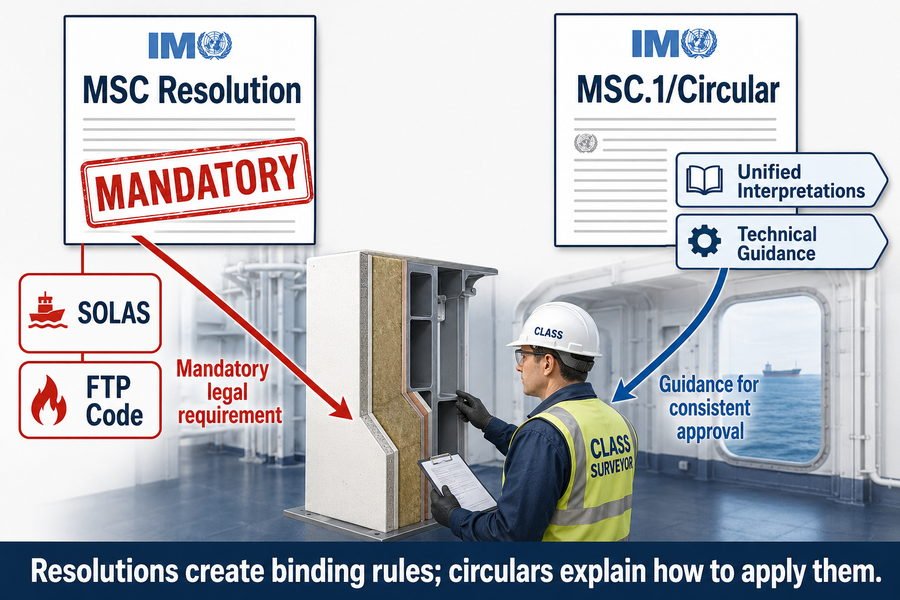
In my years dealing with marine outfitting, I have seen many people treat these two types of documents as the same thing. They are not. Knowing the difference helps you argue effectively with suppliers who might be using outdated information.
The Legal Weight of MSC Resolutions
An MSC Resolution is the highest level of rule changes made by the Maritime Safety Committee. It is a legally binding, mandatory amendment. When the IMO adopted the 2010 FTP Code, they did so via Resolution MSC.307(88)5. This means that every country that signed the SOLAS convention must obey it by law6. If a panel does not meet the standards set in a resolution, it is illegal to use it on a commercial vessel. These documents set the big picture. They tell us that a marine panel must be "non-combustible" or have "low flame spread." However, because they cover so much ground, they sometimes leave room for confusion regarding exactly how to conduct a specific test in a laboratory.
How MSC.1/Circulars Guide Classification Societies
This is where the circulars come in. An MSC.1/Circular provides the Unified Interpretations (UI) and technical guidance.7 Think of a resolution as the law, and the circular as the judge's interpretation of that law. These circulars are essential for classification societies like DNV, ABS, or Lloyd's Register. They use them to consistently enforce those resolutions during marine panel type approval and vessel inspections.8 For example, if a resolution says a door needs a "suitable" latch, an MSC.1/Circular will define exactly how many millimeters that latch must engage. Without circulars, a surveyor in China might approve a panel that a surveyor in Europe would reject. The circulars ensure everyone plays by the exact same rules.
| Document Type | Legal Status | Function for Marine Panels | Example |
|---|---|---|---|
| MSC Resolution | Mandatory, legally binding | Adopts major codes (like FTP Code) and sets broad safety laws. | Resolution MSC.307(88) (2010 FTP Code) |
| MSC.1/Circular | Technical guidance, Unified Interpretation | Provides exact testing steps and clarifies vaguely worded rules. | MSC.1/Circ.1120 (Interpretations of SOLAS) |
| IACS Unified Requirement | Industry standard | Rules agreed upon by major class societies, often turned into Circulars. | IACS UR F (Fire Protection) |
| Type Approval Certificate | Product specific | Proof that a specific panel meets both the Resolution and the Circular. | MED Module B Certificate |
Which MSC.1/Circulars Address Surface Flammability Of Marine Linings?
Surface flammability is a major reason why panels fail inspections. Knowing which documents control these tests will help you buy safer materials.
MSC.1/Circulars like MSC.1/Circ.1120 and subsequent updates address surface flammability by interpreting the 2010 FTP Code Part 5. They regulate the critical heat flux at extinguishment, define acceptable heat release rates, establish limits for continuous flaming, and dictate the maximum allowable flame spread distance for marine wall panels and ceiling linings.
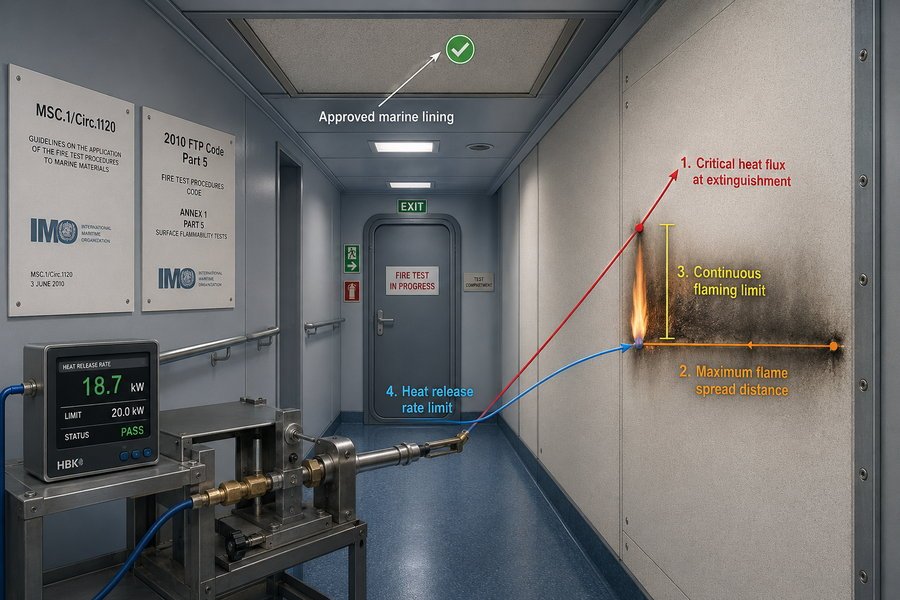
When you buy a marine wall panel with a beautiful PVC finish, you are introducing plastic onto a ship. Plastic burns. Therefore, controlling how that surface reacts to fire is one of the most critical aspects of marine outfitting.
Understanding Critical Heat Flux and Heat Release Rates
The rules for this are mainly found in the 2010 FTP Code Part 59, but circulars like MSC.1/Circ.1120 help clarify them. First, they regulate the critical heat flux at extinguishment (known as qs). This value measures how much heat is required to keep the panel burning. According to the rules, for bulkheads and ceilings, this value must be greater than or equal to 20.0 kW/m²10. If the number is lower, the panel catches fire too easily. Second, these documents define acceptable heat release rates. When a panel does catch fire, it releases heat, which can ignite other items in the room. The total heat release (Qt) must not exceed 0.7 MJ, and the peak heat release rate (qp) must remain below 4.0 kW11. These strict numbers prevent a small cabin fire from turning into a massive inferno.
Limits on Continuous Flaming and Flame Spread Distance
The circulars also govern how the fire behaves visually. They establish limits for continuous flaming. During the lab test, if the decorative surface catches fire and produces a steady flame for more than a few seconds, it fails. You cannot have a panel that actively feeds the fire. Finally, they dictate the maximum allowable flame spread distance. The rules strictly measure how far the burn mark travels across the test sample. For marine wall panels and ceiling linings, the fire must not spread rapidly across the surface. If you buy a panel that ignores these specific metrics, you risk turning the ship's corridors into pathways for fire.
| Flammability Metric | FTP Code Part 5 Requirement | Why It Matters for Procurement |
|---|---|---|
| Critical Heat Flux (qs) | ≥ 20.0 kW/m² | Ensures the decorative film does not ignite easily from small heat sources. |
| Peak Heat Release (qp) | ≤ 4.0 kW | Prevents the panel from adding too much heat to an existing cabin fire. |
| Total Heat Release (Qt) | ≤ 0.7 MJ | Limits the total energy added to the room, preventing flashover12. |
| Continuous Flaming | Strictly limited duration | Stops the wall finish from acting as a continuous fuel source. |
Why Should Procurement Verify Marine Panels Against Latest MSC.1/Circulars?
Buying cheap panels with outdated certificates is a common trap. You need to verify documents to protect your project budget and timeline.
Procurement must verify marine panels against the latest MSC.1/Circulars to prevent port state control detentions, avoid the massive costs of ripping out non-compliant materials, ensure smooth acceptance by IACS surveyors, and accurately compare supplier pricing by confirming all quoted panels meet the exact same current regulatory testing baselines.
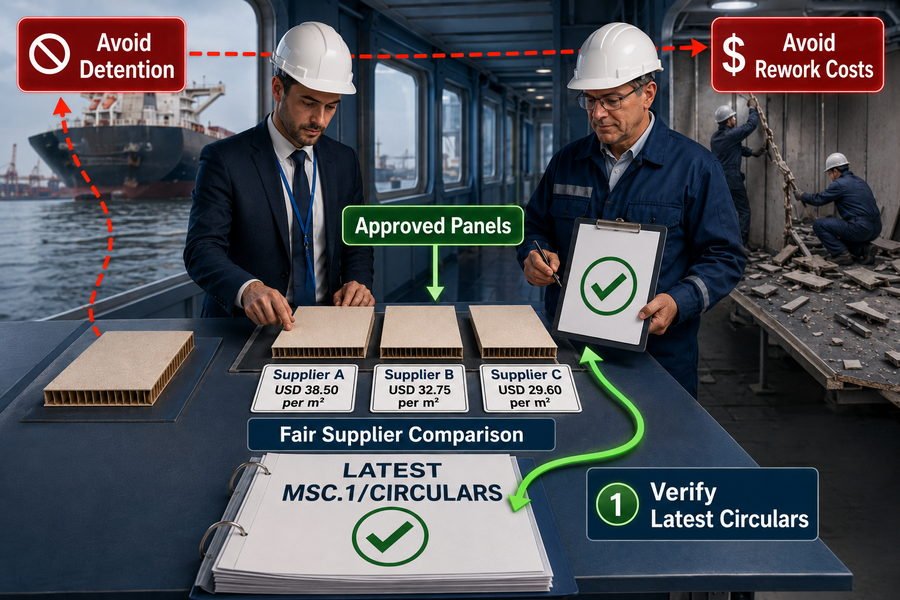
I once worked with a buyer who purchased three containers of B-15 wall panels from a new supplier because the price was 15% lower than the market average. She only looked at the title of the certificate. When the panels arrived, the surveyor rejected them all.
Avoiding Detentions and Costly Rework
The primary reason to verify documents is to prevent port state control detentions13. If a ship is inspected in Europe or the US and found to have non-compliant fire panels, the ship cannot leave the port. This costs the shipowner tens of thousands of dollars per day14. Furthermore, you must verify documents to avoid the massive costs of ripping out non-compliant materials. Tearing out installed panels, re-purchasing compliant ones, and paying for emergency labor can easily cost between $10,000 to $50,000 per cabin. It is a financial disaster.
Establishing Accurate Pricing Baselines for Suppliers
Verification also ensures smooth acceptance by IACS surveyors. Surveyors from classification societies like ABS or DNV know the latest MSC.1/Circulars by heart. If your paperwork matches the latest rules, the inspection takes hours instead of weeks. Finally, checking these rules allows you to accurately compare supplier pricing. Supplier A might quote $25 per square meter, while Supplier B quotes $30. If you do not verify the certificates against the current regulatory testing baselines, you might not realize that Supplier A is selling an old, obsolete panel design that uses cheaper, non-compliant glue. By forcing all suppliers to prove they meet the exact same current standard, you ensure you are comparing apples to apples, making your purchasing decisions bulletproof.
| Procurement Risk | Consequence of Ignoring MSC.1/Circulars | How to Mitigate the Risk |
|---|---|---|
| Port State Detentions | Ship is grounded; massive daily fines incurred. | Always demand the latest MED Declaration of Conformity. |
| Ripping Out Materials | $10,000 - $50,000 loss per cabin for replacement. | Get class surveyor pre-approval on all panel certificates before shipping. |
| Surveyor Rejection | Project delays of 4 to 8 weeks waiting for new panels. | Ensure the test report date matches the latest IMO rule updates. |
| Unfair Price Quotes | Buying obsolete inventory disguised as a bargain. | Compare quotes only after verifying all suppliers meet the same baseline. |
How Do MSC.1/Circulars Impact Existing Marine Panel Certificates?
Just because a supplier sends you a certificate does not mean it is still valid. Rules change, and old paperwork can expire unexpectedly.
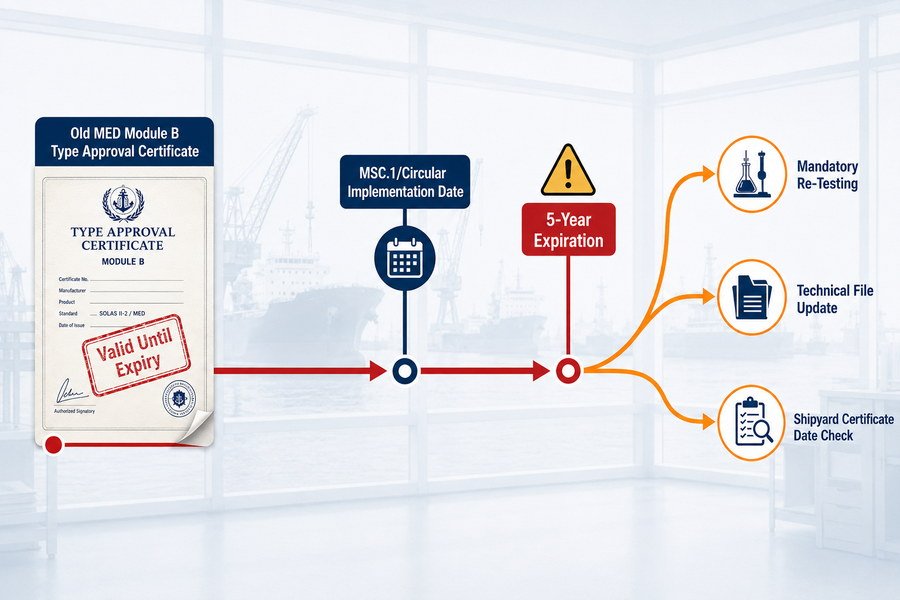
MSC.1/Circulars impact existing marine panel certificates by potentially rendering older Type Approval Certificates (MED Module B) invalid upon their five-year expiration, triggering mandatory re-testing to new standards, forcing manufacturers to update their technical files, and requiring shipyards to verify the certificate issue date against the circular's date of implementation.
The shipbuilding industry never stops updating its safety standards. A certificate that was perfectly good in 2021 might be worthless in 2026. Understanding how circulars affect existing paperwork is vital for anyone sourcing materials from overseas.
Expiration and Renewal of MED Module B Certificates
The most common certificate for marine panels in the European market is the MED Type Examination Certificate, also known as Module B. These certificates are generally valid for a period of five years. MSC.1/Circulars can make older Type Approval Certificates invalid upon their five-year expiration. If the IMO issues a new circular that changes a test method, the manufacturer cannot simply renew their old certificate. The new rule triggers mandatory re-testing to new standards15. The factory must send a brand new panel to a certified laboratory, burn it again under the new rules, and prove it still passes. If your supplier refuses to do this because of the high lab fees, their certificate will permanently expire, and you cannot use their products anymore.
Implementation Dates and Mandatory Re-Testing
When new rules are adopted, they force manufacturers to update their technical files. These files contain all the drawings, glue specs, and core densities. If a circular changes the allowed glue amount, the factory must change its production line and its paperwork. As a buyer, this requires shipyards to verify the certificate issue date against the circular's date of implementation. For example, if a circular became mandatory on January 1, 2024, and your supplier sends you a certificate issued in 2022, you must ask questions. Does that 2022 certificate comply with the 2024 rule? Sometimes there is a grace period, but you must confirm this with the classification society in writing to avoid risks.
| Certificate Element | Impact of a New MSC.1/Circular | Required Action from Buyer |
|---|---|---|
| MED Module B | May become invalid at its 5-year expiry date. | Check the expiration date; demand proof of renewal testing. |
| Lab Test Reports | Old test methods become obsolete. | Ensure the report references the latest FTP Code amendments. |
| Technical Files | Factory drawings must reflect new material limits. | Request an updated data sheet to match the new certificate. |
| Implementation Date | Determines when old stock becomes illegal to install. | Cross-check the ship's keel-laying date with the rule date. |
Where Can Outfitters Find Updated MSC.1/Circulars On Marine Panels?
Finding the right information quickly is a superpower. You do not need to be a lawyer to track down current IMO regulations.
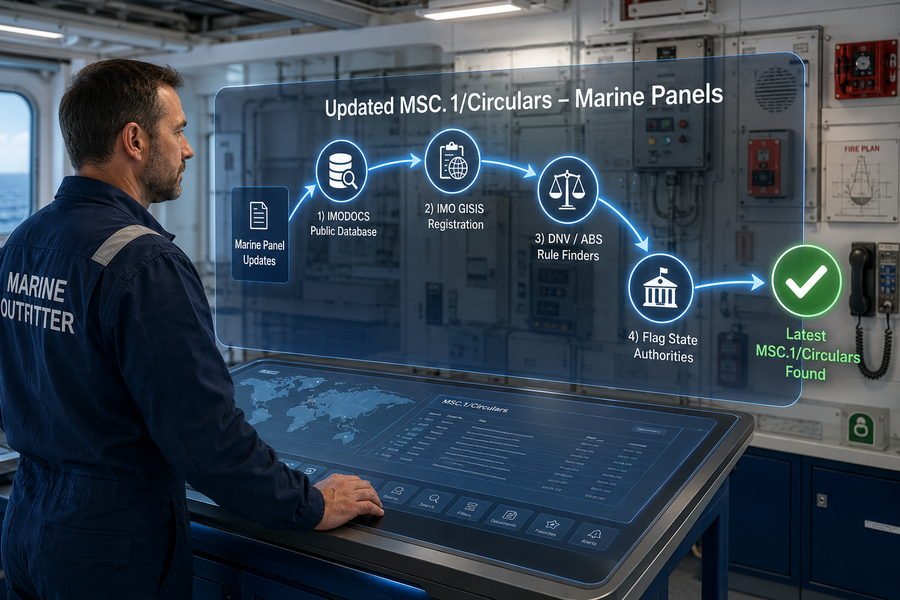
Outfitters can find updated MSC.1/Circulars on marine panels by accessing the public IMODOCS database, registering for the IMO Global Integrated Shipping Information System (GISIS), consulting the official rule finders published by classification societies like DNV or ABS, and reviewing updates provided by national maritime administrations and flag state authorities.
When I am checking a supplier's background, I do not just trust what they send me. I go straight to the source. If you rely only on the supplier to tell you what the rules are, you are handing over all your negotiating power.
The first place to look is the source itself. You can find these documents by accessing the public IMODOCS database16. This is the official document repository of the International Maritime Organization. While it can be a bit tricky to search, it holds every resolution and circular ever published17. For a more user-friendly experience, I recommend registering for the IMO Global Integrated Shipping Information System (GISIS)18. This system is free to use for basic searches and allows you to look up approved marine equipment and the specific rules they were tested against. It is an excellent tool for verifying if a factory's claims align with international records.
Leveraging Classification Society Rule Finders and Flag States
If you find the IMO websites too confusing, there is an easier way. You should start consulting the official rule finders published by classification societies like DNV, ABS, or Lloyd's Register. These societies build software specifically to help shipyards and buyers find the right rules. They summarize the complex MSC.1/Circulars into simple, searchable databases. If you search for "B-15 wall panel" in the DNV rule finder, it will list all the current circulars you need to care about. Lastly, do not forget about reviewing updates provided by national maritime administrations and flag state authorities19. Organizations like the US Coast Guard (USCG) or the UK Maritime and Coastguard Agency (MCA) frequently publish simple guidance notices summarizing how new IMO circulars will affect marine equipment approvals in their jurisdictions.
| Information Source | Best Used For | Accessibility |
|---|---|---|
| IMODOCS | Reading the exact legal text of a new circular. | Requires a free account; search can be complex. |
| IMO GISIS | Verifying equipment approvals and general rules. | Free public access; good for checking supplier claims. |
| Class Rule Finders (DNV, ABS) | Finding practical summaries of how rules apply to panels. | Excellent user interfaces; highly recommended for buyers. |
| Flag State Notices (USCG) | Understanding how specific countries enforce the circulars. | Publicly available on government websites; easy to read. |
Conclusion
IMO MSC.1/Circulars are the blueprint for marine panel compliance. By mastering these documents, you will buy safer materials, satisfy class surveyors, and keep your outfitting projects profitable and on schedule.
-
"[PDF] MSC.1-Circ.1321-Guidelines-For-Measures-To-Prevent-Fires-In ...", https://greenvoyage2050.imo.org/wp-content/uploads/2023/02/MSC.1-Circ.1321-Guidelines-For-Measures-To-Prevent-Fires-In-Engine-Rooms-And-Cargo-Pump-Rooms-Secretariat.pdf. IMO fire-test approval guidance for A- and B-class divisions ties approval to the tested specimen configuration and dimensional range, including insulation/core thickness, rather than allowing unrestricted substitution of thinner or otherwise different constructions. Evidence role: general_support; source type: institution. Supports: A fire-test certificate for a marine panel cannot automatically be applied to a substantially thinner, untested version.. Scope note: The source may define permitted ranges or extension rules rather than using this exact 100 mm-to-25 mm example. ↩
-
"[PDF] RESOLUTION MSC.307(88) (adopted on 3 December 2010 ...", https://wwwcdn.imo.org/localresources/en/KnowledgeCentre/IndexofIMOResolutions/MSCResolutions/MSC.307(88).pdf. SOLAS Chapter II-2 and the IMO FTP Code define A-class division insulation performance by the average temperature rise on the unexposed face and specify the A-60 rating by maintaining that criterion for 60 minutes. Evidence role: definition; source type: institution. Supports: An A-60 bulkhead must limit the average temperature rise on the unexposed side to no more than 140°C above the initial temperature for 60 minutes.. ↩
-
"What Is the Purpose and Scope of the IMO FTP Code? - Magellan ...", https://magellanmarinetech.com/what-purpose-scope-of-imo-ftp-code/. IMO FTP Code test procedures and associated approval documentation require the tested construction, including joints, supports, fixings, and installation details, to be described and used as the basis for approved application on board. Evidence role: mechanism; source type: institution. Supports: A ceiling panel’s shipboard installation must correspond to the tested and approved mounting arrangement, including profiles and fixing details.. Scope note: The rule may allow formally assessed variations or extensions of approval, so the support is strongest for the general principle that installation must match the approved tested arrangement unless an approved variation exists. ↩
-
"[PDF] RESOLUTION MSC.61(67) (adopted on 5 December 1996 ...", https://wwwcdn.imo.org/localresources/en/KnowledgeCentre/IndexofIMOResolutions/MSCResolutions/MSC.61(67).pdf. The IMO FTP Code Part 5 surface-flammability test evaluates flame spread and heat-release-related behavior of surface materials, and fire-safety literature treats additional combustible adhesive or organic material as contributing to fire load and combustion products. Evidence role: mechanism; source type: paper. Supports: Increasing adhesive quantity can add combustible material and may worsen performance in the IMO FTP Code Part 5 surface flammability test.. Scope note: This supports the mechanism that added adhesive can worsen surface-flammability performance, but it does not prove that every increase from 200 to 400 g/m² would necessarily fail the IMO Part 5 test. ↩
-
"How Does the IMO FTP Code Connect with Other Marine Fire Safety ...", https://magellanmarinetech.com/how-imo-ftp-code-connect-with-other-marine-fire-safety-frameworks/. The IMO record for Resolution MSC.307(88) identifies it as the instrument by which the Maritime Safety Committee adopted the 2010 International Code for Application of Fire Test Procedures, supporting the article’s statement about the FTP Code’s adoption route. Evidence role: historical_context; source type: institution. Supports: The IMO adopted the 2010 FTP Code via Resolution MSC.307(88).. Scope note: This supports the adoption instrument, but separate treaty materials are needed to establish how the Code becomes binding for individual SOLAS parties. ↩
-
"International Convention for the Safety of Life at Sea (SOLAS), 1974", https://www.imo.org/en/about/conventions/pages/international-convention-for-the-safety-of-life-at-sea-(solas),-1974.aspx. SOLAS treaty documentation and IMO explanatory materials describe SOLAS as an international convention whose contracting governments undertake to give effect to its safety requirements, supporting the general claim that SOLAS parties are legally bound to implement mandatory amendments. Evidence role: general_support; source type: institution. Supports: Countries that are parties to SOLAS must comply with mandatory SOLAS requirements and amendments such as those incorporating the FTP Code.. Scope note: The source may describe obligations of contracting governments generally; national implementation and enforcement details vary by flag state. ↩
-
"Maritime Safety Committee - 110th session (MSC 110), 18-27 June ...", https://www.imo.org/en/mediacentre/meetingsummaries/pages/msc-110th-session.aspx. IMO circulars and Unified Interpretation documents show that MSC.1 circulars are used to publish interpretations and technical guidance for applying SOLAS-related instruments, supporting the description of their interpretive function. Evidence role: definition; source type: institution. Supports: MSC.1/Circulars provide Unified Interpretations and technical guidance for applying IMO safety instruments.. Scope note: The source supports the general function of MSC.1 circulars; individual circulars differ in subject matter and may not all contain Unified Interpretations. ↩
-
"SURVEYS, VERIFICATIONS AND CERTIFICATION", https://www.imo.org/en/OurWork/IIIS/Pages/Survey-Verification-Certification.aspx. Classification-society and IACS materials describe survey and type-approval work as applying statutory instruments, unified interpretations, and class rules to verify compliance, providing contextual support for the role of circulars in consistent implementation. Evidence role: general_support; source type: institution. Supports: Classification societies use IMO interpretations and related guidance to apply mandatory safety requirements during product approval and vessel survey activities.. Scope note: This is contextual evidence for common class-society practice rather than direct proof that every DNV, ABS, or Lloyd’s Register surveyor applies every MSC.1 circular identically. ↩
-
"[PDF] RESOLUTION MSC.307(88) (adopted on 3 December 2010 ...", https://wwwcdn.imo.org/localresources/en/KnowledgeCentre/IndexofIMOResolutions/MSCResolutions/MSC.307(88).pdf. The IMO 2010 FTP Code identifies Annex 1, Part 5 as the test method and acceptance framework for surface flammability of bulkhead, wall, and ceiling linings, supporting the article’s placement of these rules in that instrument. Evidence role: definition; source type: institution. Supports: The rules for critical heat flux and heat release rates for marine panel surface flammability are mainly found in the 2010 FTP Code Part 5.. Scope note: This supports the regulatory location and scope, but separate circulars or amendments may be needed for interpretations and current implementation details. ↩
-
"How Does the IMO FTP Code Connect with Other Marine Fire Safety ...", https://magellanmarinetech.com/how-imo-ftp-code-connect-with-other-marine-fire-safety-frameworks/. The FTP Code Part 5 acceptance criteria state that critical flux at extinguishment for applicable bulkhead, wall, and ceiling linings must be not less than 20.0 kW/m², supporting the numerical threshold cited here. Evidence role: statistic; source type: institution. Supports: For bulkheads and ceilings, the critical heat flux at extinguishment must be greater than or equal to 20.0 kW/m².. ↩
-
"[PDF] RESOLUTION MSC.307(88) (adopted on 3 December 2010 ...", https://wwwcdn.imo.org/localresources/en/KnowledgeCentre/IndexofIMOResolutions/MSCResolutions/MSC.307(88).pdf. The FTP Code Part 5 acceptance criteria list limits for total heat release and peak heat release rate, supporting the stated limits of 0.7 MJ for total heat release and 4.0 kW for peak heat release rate where those criteria apply. Evidence role: statistic; source type: institution. Supports: Total heat release must not exceed 0.7 MJ, and peak heat release rate must remain below 4.0 kW.. Scope note: The source should be checked for the exact material class and any amendments, because FTP criteria can vary by application and edition. ↩
-
"[PDF] Estimating Temperatures in Compartment Fires", https://tsapps.nist.gov/publication/get_pdf.cfm?pub_id=907752. Fire dynamics literature from NIST and similar research bodies describes heat release rate as a principal driver of compartment fire growth and flashover conditions, providing contextual support for linking heat-release limits to reduced flashover risk. Evidence role: mechanism; source type: government. Supports: Limiting the total energy added by a panel helps reduce the risk of flashover.. Scope note: This supports the general fire-science mechanism; it does not directly prove that the specific 0.7 MJ limit alone prevents flashover in every shipboard cabin configuration. ↩
-
"[PDF] PROCEDURES FOR PORT STATE CONTROL, 2023", https://wwwcdn.imo.org/localresources/en/OurWork/IIIS/Documents/A%2033-Res.1185%20-%20PROCEDURES%20FOR%20PORT%20STATE%20CONTROL,%202023%20(Secretariat)%20(1).pdf. Port state control authorities are empowered to inspect foreign ships and detain vessels when deficiencies create a serious safety or regulatory compliance issue; this supports the link between documentary non-compliance and detention risk. Evidence role: general_support; source type: government. Supports: The primary reason to verify documents is to prevent port state control detentions.. Scope note: The source may support detention powers and fire-safety deficiency categories generally, rather than proving that every non-compliant fire panel will automatically detain a vessel. ↩
-
"[PDF] PROCEDURES FOR PORT STATE CONTROL, 2023", https://wwwcdn.imo.org/localresources/en/OurWork/IIIS/Documents/A%2033-Res.1185%20-%20PROCEDURES%20FOR%20PORT%20STATE%20CONTROL,%202023%20(Secretariat)%20(1).pdf. Studies of vessel delay, off-hire exposure, and port-state-control-related disruption show that daily financial losses can reach tens of thousands of dollars depending on vessel type, charter terms, and port costs. Evidence role: statistic; source type: paper. Supports: Port state control detention can cost a shipowner tens of thousands of dollars per day.. Scope note: This would contextualize the magnitude of detention costs but may not provide a universal daily cost for every shipowner or every fire-panel deficiency. ↩
-
"Maritime Safety Committee - 110th session (MSC 110), 18-27 June ...", https://www.imo.org/en/mediacentre/meetingsummaries/pages/msc-110th-session.aspx. Official MED conformity-assessment provisions and IMO FTP Code amendment documentation can show that marine equipment must be assessed against the applicable testing standards in force; this supports the need for renewed testing when the relevant test method changes, although the exact retesting obligation depends on the wording and transition provisions of the particular amendment or circular. Evidence role: mechanism; source type: government. Supports: A new IMO circular changing a test method can require manufacturers to test products against the new standard rather than simply renewing an old certificate.. Scope note: Contextual support only; not every IMO circular automatically requires physical retesting of every existing product type. ↩
-
"imodocs - International Maritime Organization", https://docs.imo.org/. The IMO describes IMODOCS as its document-access system for IMO meeting and regulatory documents, supporting its use as a primary source for IMO resolutions, circulars, and related materials. Evidence role: definition; source type: institution. Supports: IMODOCS is a public official document repository for International Maritime Organization documents.. Scope note: The source may document the purpose and access conditions of IMODOCS, but may not verify that every historical resolution and circular is available without exception. ↩
-
"Circulars - International Maritime Organization", https://www.imo.org/en/ourwork/circulars/pages/default.aspx. IMO guidance on document access indicates that IMODOCS provides access to IMO documents, including resolutions and circulars, but this should be read as evidence of repository coverage rather than independent proof that every historical item is complete and publicly accessible. Evidence role: general_support; source type: institution. Supports: IMODOCS contains IMO resolutions and circulars and is a key place to search for them.. Scope note: The claim is absolute; an IMO access page may support broad coverage but not necessarily confirm complete availability of every document ever published. ↩
-
"IMO | Global Integrated Shipping Information System (GISIS)", https://gisis.imo.org/public/default.aspx. The IMO identifies GISIS as an online system that provides public access to selected maritime safety, security, environmental, and facilitation information modules maintained by the Organization. Evidence role: definition; source type: institution. Supports: GISIS is an IMO system available for public use for certain maritime information searches.. Scope note: This supports the nature and public-access role of GISIS generally; module availability and search functions can vary by user permissions and data category. ↩
-
"Flag State implementation - International Maritime Organization", https://www.imo.org/en/OurWork/Safety/Pages/FlagStateImplementation.aspx. Flag state administrations are responsible for implementing and enforcing IMO convention requirements for ships under their registry, which explains why national maritime authorities publish notices or guidance on IMO requirements within their jurisdictions. Evidence role: mechanism; source type: institution. Supports: National maritime administrations and flag states issue implementation guidance because they enforce IMO requirements for ships under their jurisdiction.. Scope note: This supports the general role of flag states in implementation and enforcement; it does not prove that every administration frequently issues simplified guidance on all IMO circulars. ↩