Are you confused by the sea of maritime rules? Buying the wrong panels wastes money and delays projects. I will show you the exact IMO MSC resolutions you need.
Marine interior panels are regulated primarily by IMO MSC.307(88) (the 2010 FTP Code) for fire testing, MSC.61(67) for older legacy approvals, and MSC.36(63) for high-speed craft. Understanding these three core resolutions guarantees your panels meet international safety standards and pass shipyard inspections.
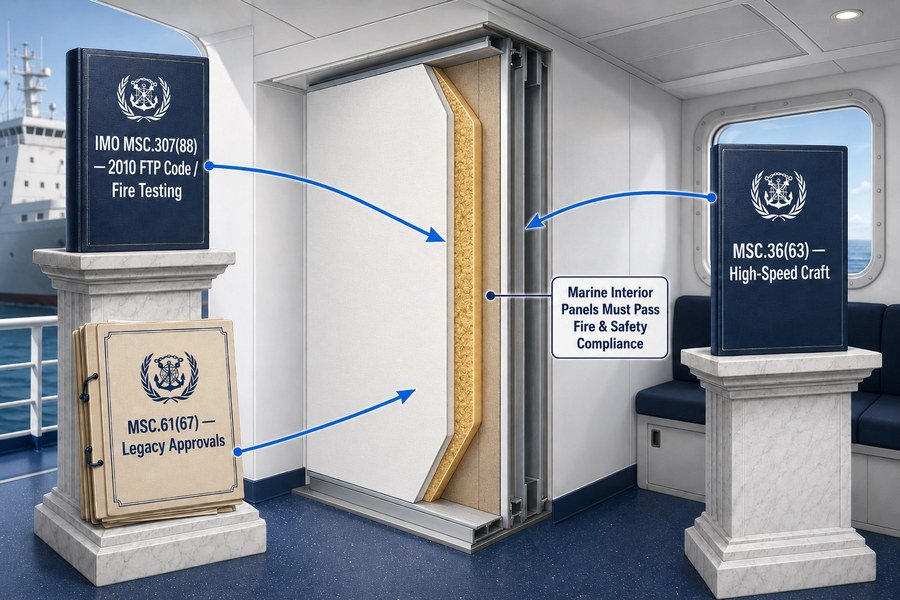
Let us look closely at how these rules work so you can buy with confidence and avoid costly mistakes.
What Role Do IMO MSC Resolutions Play In Marine Panel Compliance?
Shipyards reject panels without proper paperwork. This causes massive delays and hurts your profits. IMO MSC resolutions provide the exact testing rules to prevent this.
IMO MSC resolutions serve as the mandatory technical testing standards for marine panel compliance. They dictate three critical roles: defining exact fire-testing laboratory procedures, setting performance criteria for non-combustibility and smoke toxicity, and establishing the uniform baseline for issuing Type Approval Certificates by classification societies.
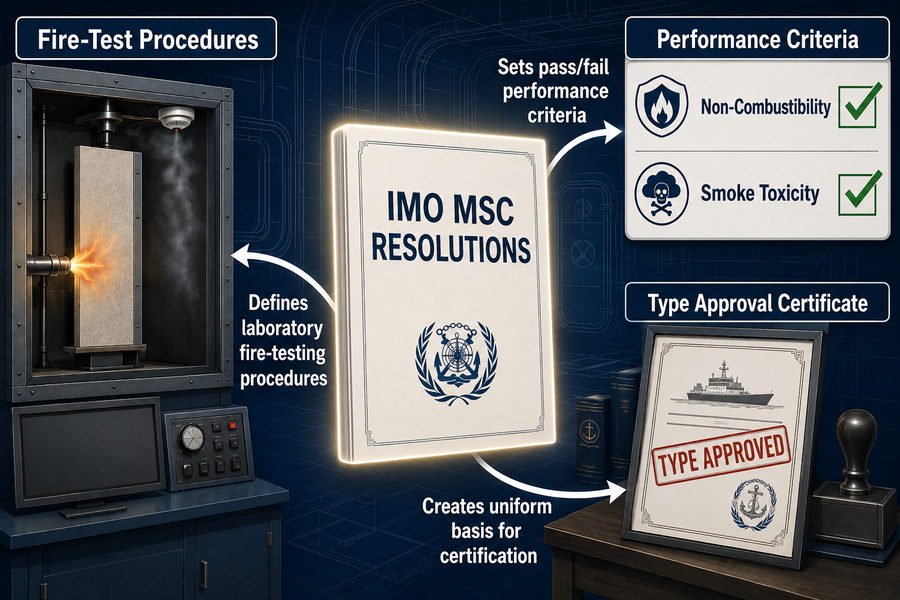
When I worked at Magellan Marine, I saw many buyers struggle because they did not understand the rules. They bought cheap panels that looked great but failed inspection. The IMO MSC resolutions are the rulebooks that stop this from happening. They take the broad safety goals of shipping and turn them into strict, testable numbers. Based on the snippet above, we must look at the three specific roles these resolutions play in the real world.
Defining Exact Fire-Testing Laboratory Procedures for Marine Panels
The first role of IMO MSC resolutions is to tell laboratories exactly how to test a panel. Without a standard method, one lab might use a small flame, and another might use a huge fire. The MSC rules make sure every test is the same. For example, under MSC.307(88)1, the laboratory must place the core material of a wall panel into a testing furnace. They do not just guess the heat. The rule specifically states they must heat the furnace to 750°C2. This specific temperature value comes directly from the 2010 FTP Code, which refers to the ISO 1182 standard. If the laboratory tests the panel at 700°C instead of 750°C, the test is invalid.3 This strict procedure ensures a panel bought in China passes the exact same physical test as a panel made in Germany.
Setting Performance Criteria for Non-Combustibility and Toxicity
The second role is setting the pass or fail criteria. After the laboratory completes the test procedure, they must look at the results. The MSC resolutions provide the exact numbers a panel must meet to pass. They look at non-combustibility and smoke toxicity. For non-combustibility, the rule dictates that the material must not flame for more than 10 seconds4. For smoke toxicity, the rule limits dangerous gases. For example, the FTP Code dictates that carbon monoxide levels must not exceed 1,450 parts per million (ppm)5 during the test. If a panel produces 1,500 ppm of carbon monoxide, it fails. The MSC resolutions give us these hard numbers so there is no debate about safety.
Establishing the Baseline for Classification Society Type Approvals
The third role is creating a baseline for certification. Classification societies, like DNV or Lloyd's Register, do not make up their own rules for fire doors or wall panels. They use the IMO MSC resolutions as their baseline.6 When an inspector from DNV looks at a factory's test report, they check it against the MSC rule. If the report proves the panel passed the exact laboratory procedures and met the specific performance criteria, DNV issues a Type Approval Certificate. This certificate is the final proof you need to sell to shipyards in the United States and Europe.
| Role of IMO MSC Resolution | Practical Action | Desired Outcome |
|---|---|---|
| Define Laboratory Procedures | Heats furnace to exactly 750°C. | Ensures global testing consistency. |
| Set Performance Criteria | Limits flaming to under 10 seconds. | Prevents dangerous materials from passing. |
| Establish Certification Baseline | Used by DNV to check test reports. | Results in a valid Type Approval Certificate. |
Which IMO MSC Resolutions Cover Non-Combustibility Of Marine Panels?
A fire on a ship is a disaster. If your panels burn, lives are lost. You must know which rules ensure your panels will not catch fire.
Non-combustibility of marine panels is governed by three specific resolutions: MSC.307(88) Part 1 for current non-combustibility tests, MSC.61(67) Part 1 for legacy ships, and MSC.437(99) which amends testing details. These require core materials to withstand 750°C without flaming for more than 10 seconds.
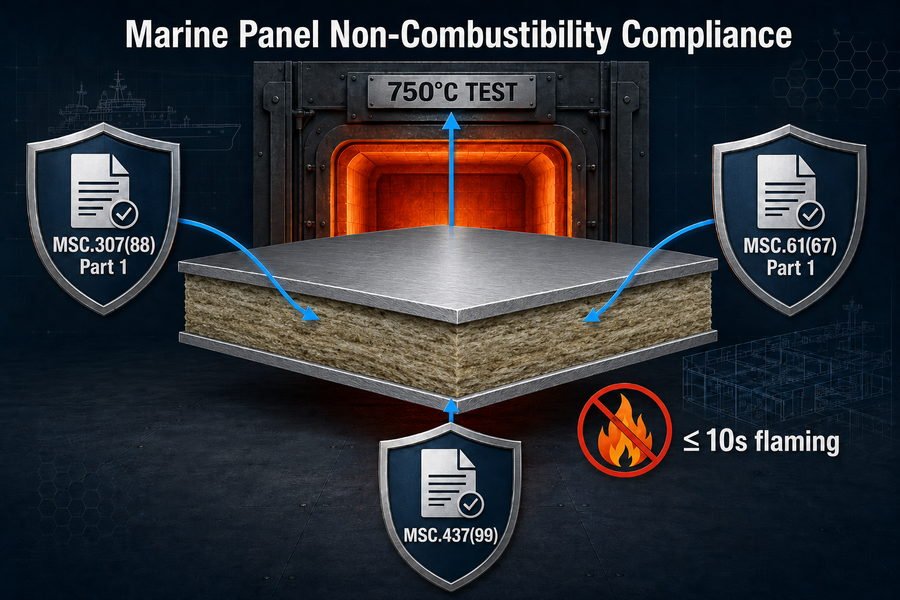
When a shipyard asks for a non-combustible panel, they do not just mean it feels safe. They mean it legally complies with strict heating rules. Marine wall panels usually have a core made of rockwool. This rockwool core is what stops the fire. The surface might have a thin PVC film that burns a little, but the core must stop the heat. To prove this, we must look at the three specific IMO MSC resolutions mentioned in the snippet that regulate non-combustibility.
MSC.307(88) Part 1 Requirements for Current Non-Combustibility Tests
This is the most important rule you need today. MSC.307(88) is the adoption of the 2010 Fire Test Procedures (FTP) Code7. Part 1 of this code is titled "Non-combustibility test". If you buy a new marine ceiling panel today, the factory must test the core material according to this exact rule. The test puts a sample of the material into a furnace. According to the authoritative text of the 2010 FTP Code, the furnace starts at 750°C. To pass the test and be called non-combustible, the material must meet three strict numbers8. First, the temperature inside the furnace cannot rise more than 50°C above the starting 750°C. Second, the sample must not flame for more than 10 seconds. Third, the sample cannot lose more than 50% of its weight. If your rockwool core meets these three numbers, it passes MSC.307(88) Part 1.
MSC.61(67) Part 1 Legacy Rules and MSC.437(99) Amendments
You will also see MSC.61(67) in the market. This is the old 1996 FTP Code. It also has a Part 1 for non-combustibility. Why do we still care about it? Because many older ships were built under this rule. If a shipyard is repairing a ship built in 2005, they might accept panels tested under MSC.61(67). However, for new ships, this rule is outdated. You must also know about MSC.437(99). This is a newer resolution that amends the 2010 FTP Code. It updates small details about how to prepare the test samples and how to handle the testing equipment. While MSC.307(88) is the main book, MSC.437(99) acts as a small update patch that test labs must follow to keep their methods accurate.
| Resolution Number | Common Name | Application Scope | Key Testing Requirement |
|---|---|---|---|
| MSC.307(88) Part 1 | 2010 FTP Code | Current standard for all new shipbuilding projects. | Withstand 750°C, flame < 10 seconds. |
| MSC.61(67) Part 1 | 1996 FTP Code | Legacy standard for older ship repairs. | Similar to 2010, but older admin rules. |
| MSC.437(99) | FTP Code Amendments | Updates to the current 2010 standard. | Adjusts sample preparation methods. |
How Do IMO MSC Resolutions Differ From SOLAS Amendments For Marine Panels?
Mixing up SOLAS and MSC rules causes confusion during audits. When you quote the wrong rule, inspectors doubt your expertise. Here is the difference.
SOLAS sets the broad legal requirements for ship safety, mandating that ships must have fire-resistant divisions. In contrast, IMO MSC resolutions provide the specific, technical testing manuals, dictating the exact laboratory methods, temperatures, and pass/fail criteria that prove a panel actually meets the broad SOLAS mandates.
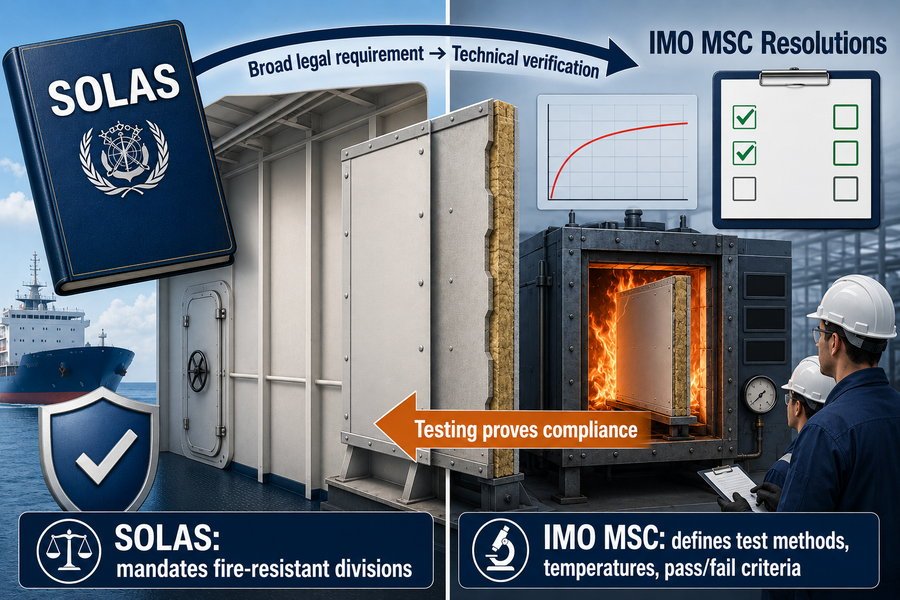
I remember talking to a sales manager who told me his panels were "SOLAS approved." I had to correct him. SOLAS does not approve panels; classification societies approve panels based on MSC tests. Understanding the difference between these two sets of rules is critical when you communicate with European shipyards. If you mix them up, you look unprofessional. As our summary states, one is a broad legal mandate, and the other is a specific technical manual. We must break down both to see how they work together.
SOLAS as the Broad Legal Requirement for Ship Safety
SOLAS stands for the Safety of Life at Sea. It is an international treaty. Think of SOLAS as the supreme law of the sea. Chapter II-2 of SOLAS deals directly with fire protection.9 This chapter states the broad rules. For example, SOLAS Chapter II-2 Regulation 9 says that ships must be divided into vertical zones by "A" class divisions.10 It says the bulkheads must be constructed of steel or equivalent material and must be non-combustible. This is a legal mandate. It tells the shipbuilder what they must achieve to make the ship legal. However, SOLAS does not tell you how to build the panel, how to test the panel, or what temperature to use in the laboratory. It simply demands that the ship is safe from fire.
IMO MSC Resolutions as the Specific Technical Testing Manuals
This is where the IMO MSC resolutions step in. MSC stands for the Maritime Safety Committee. This committee writes the detailed rulebooks that support SOLAS. When SOLAS says a wall must be an "A-60" class division, it stops there. It is the IMO MSC.307(88) resolution (the FTP Code) that takes over. The MSC resolution acts as the specific technical testing manual. It dictates the exact laboratory methods. It tells the lab to put the panel in a furnace. It dictates the exact temperatures, stating the furnace must follow a standard time-temperature curve reaching 945°C after 60 minutes (based on ISO 834-1)11. It dictates the pass/fail criteria, stating the unexposed side of the panel cannot rise more than 140°C on average. Without the MSC resolutions, nobody would know how to prove they met the broad SOLAS requirements.
| Feature | SOLAS Amendments | IMO MSC Resolutions |
|---|---|---|
| Main Function | Sets broad legal safety mandates. | Provides specific technical testing manuals. |
| Content Style | General text, policy rules. | Exact numbers, temperatures, lab procedures. |
| Example Rule | "Ships must use A-Class bulkheads." | "Furnace must reach 945°C in 60 minutes." |
Why Must Marine Panel Suppliers Cite Specific IMO MSC Resolution Numbers?
Generic certificates are useless. If your supplier just says "fireproof," European shipyards will reject the cargo. Specific resolution numbers prove the product is legally valid.
Suppliers must cite specific IMO MSC resolution numbers to prove legal compliance, ensure global traceability, and facilitate fast shipyard inspections. Citing exact numbers like MSC.307(88) shows the specific test method used, allows classification societies to verify the Type Approval, and protects buyers from purchasing non-compliant, dangerous materials.
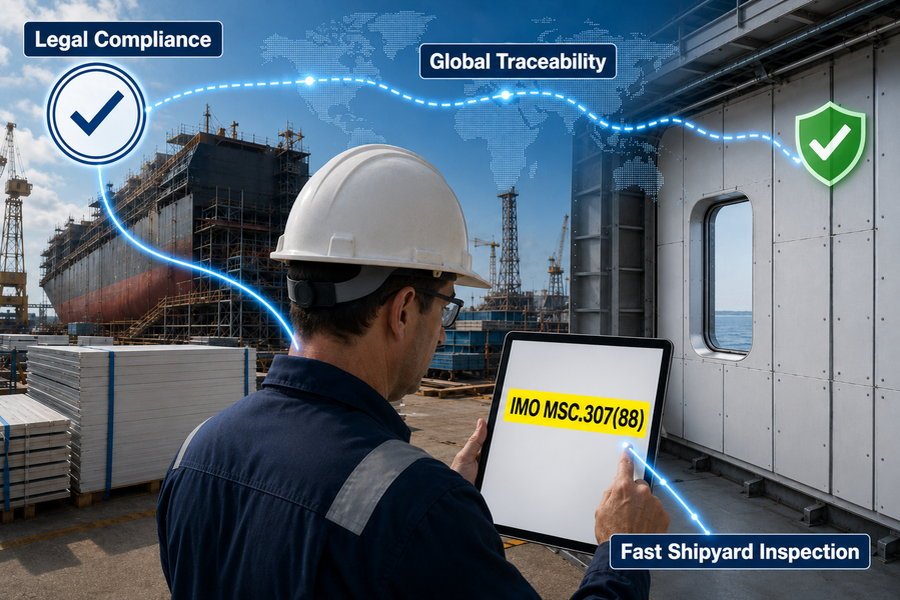
When you import materials from Asia to supply a major shipyard, paperwork is just as important as the product. A thick, heavy marine fire door means nothing if the certificate does not have the right numbers on it. I have seen containers of doors sit in ports because the supplier used vague words instead of exact codes. As noted in the snippet, citing specific numbers solves three major problems for buyers. Let us explore each of these three reasons in detail.
Proving Legal Compliance Through Specific Test Methods
The first reason suppliers must cite specific numbers is to prove legal compliance. Words like "fire-retardant" or "high-temperature resistant" are marketing words. They have no legal meaning in shipbuilding. When a supplier cites an exact number, like MSC.307(88) Part 3 (for "A" and "B" class divisions), they are making a legal claim. They are proving that the panel was tested using the specific test method required by international law. European shipyards operate under strict rules like the Marine Equipment Directive (MED)12. The MED requires the famous "Wheelmark" logo on products. To get a Wheelmark, the product certificate must explicitly list the exact MSC testing resolution13. Without that specific citation, the product is not legally compliant for European vessels.
Ensuring Global Traceability and Fast Shipyard Inspections
The second reason is to ensure global traceability and speed up inspections. Shipyard inspectors are busy people. When they walk onto a ship to inspect the interior outfitting, they look at the material certificates. If they see MSC.307(88) listed clearly, they instantly know what standard was used. They can trace that number back to the laboratory report and the classification society's database. This makes the shipyard inspection very fast. If the supplier does not cite the number, the inspector has to stop the job, send emails to the classification society, and ask for proof. This causes delays, and delays cost money.
Protecting Buyers from Non-Compliant Materials
The final reason is self-protection for you, the buyer. There are many factories that make cheap panels for land-based construction. These land panels look exactly like marine panels, but they use lower-quality rockwool that fails at 750°C14. If you accept a certificate without a specific IMO MSC number, you might accidentally buy dangerous land-based materials. When you force the supplier to cite the exact MSC resolution, you filter out the bad factories. You protect yourself from buying non-compliant materials that will ruin your project.
| Document Practice | Result During Shipyard Audit | Impact on the Buyer |
|---|---|---|
| Citing exact MSC.307(88) | Inspector verifies traceability instantly. | Fast approval, smooth project flow. |
| Using generic "fireproof" terms | Inspector rejects the legal compliance. | Severe delays, potential cargo rejection. |
| Showing land-based standard | Inspector identifies non-compliant material. | Buyer forced to buy new materials. |
Which IMO MSC Resolutions Appear Most In Marine Panel Type Approvals?
Reading a Type Approval certificate can give you a headache. Missing a key resolution means buying the wrong panel. These are the ones you will see most.
The four IMO MSC resolutions most frequently appearing in marine panel Type Approvals are MSC.307(88) (2010 FTP Code), MSC.61(67) (old FTP Code), MSC.36(63) (High-Speed Craft Code), and MSC.97(73) (High-Speed Craft Code 2000). Checking for these four ensures your panels fit commercial vessels and fast ferries.
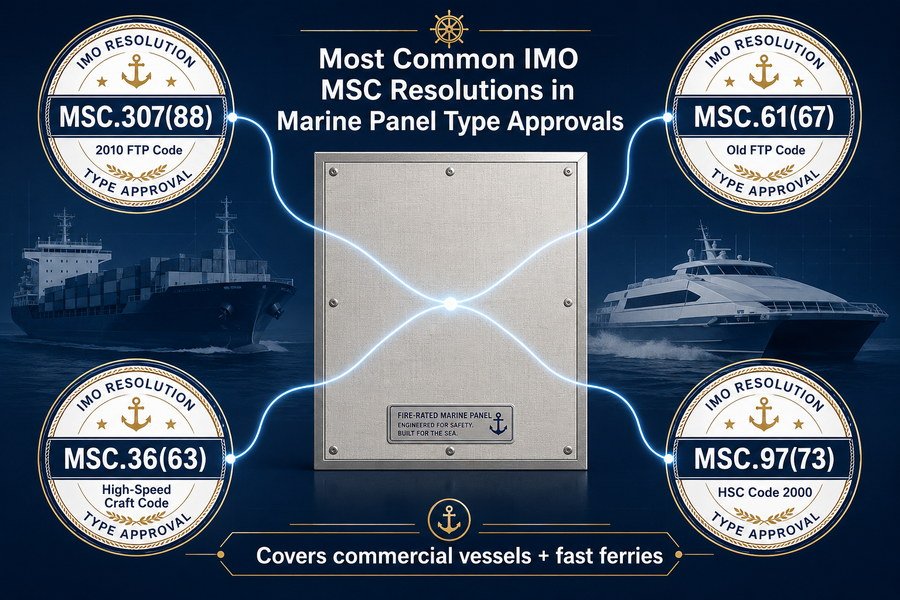
When you hold a Type Approval Certificate from DNV or ABS, you will see a small box labeled "Testing Standards." This box is usually filled with codes. You do not need to memorize every code ever written, but you must know the common ones. If you buy panels for different types of ships, you will quickly notice a pattern. Based on the summary above, there are four specific resolutions that appear almost every time. We can group these four into two main categories based on the type of ship.
MSC.307(88) and MSC.61(67) for Standard Commercial Vessels
For regular ships—like large cruise ships, oil tankers, and bulk carriers—you will see these two codes. MSC.307(88) is the 2010 FTP Code.15 This is the absolute standard for all modern commercial shipbuilding. If you are outfitting a new cruise ship in Europe today, the marine ceiling and wall panels must have MSC.307(88) on the certificate. As I mentioned earlier, MSC.61(67) is the 1996 FTP Code.16 While it is older, it still appears frequently on certificates for panels used in repair jobs or for ships that had their keels laid many years ago. Every standard marine fire door or bulkhead panel will list at least one of these two resolutions to prove standard fire resistance.
MSC.36(63) and MSC.97(73) for High-Speed Craft Applications
The rules change when you build fast ferries. High-Speed Craft (HSC) must be very light to move fast over the water. Heavy steel A-class divisions are often too heavy. Instead, they use special lightweight panels. These lightweight panels are governed by the HSC Codes. MSC.36(63) is the International Code of Safety for High-Speed Craft, adopted in 1994.17 MSC.97(73) is the newer HSC Code adopted in 2000.18 These resolutions dictate special fire-resisting divisions, often called "Fire-Restricting Materials." If your company wins a project to outfit an aluminum fast ferry, you cannot use standard MSC.307(88) heavy panels. You must check the certificate and look specifically for MSC.36(63) or MSC.97(73) to ensure the panels meet the strict weight and fire rules for fast ferries.
| IMO MSC Resolution | Code Name | Primary Ship Type Application | Typical Material Focus |
|---|---|---|---|
| MSC.307(88) | 2010 FTP Code | New Commercial Vessels / Cruise Ships | Heavy A-Class and B-Class panels. |
| MSC.61(67) | 1996 FTP Code | Older Commercial Vessel Repairs | Legacy A-Class and B-Class panels. |
| MSC.97(73) | 2000 HSC Code | Modern High-Speed Ferries | Lightweight fire-restricting materials. |
| MSC.36(63) | 1994 HSC Code | Older High-Speed Ferries | Lightweight fire-restricting materials. |
How Often Are IMO MSC Resolutions On Marine Interior Materials Updated?
Outdated panels are illegal panels. If you buy based on old rules, customs and surveyors will stop your shipment. You need to know the update cycle.
IMO MSC resolutions on marine interior materials are typically updated every 10 to 15 years for major code revisions, with smaller amendments occurring every 2 to 4 years. Staying current with these three types of updates—major codes, minor amendments, and circulars—keeps your supply chain legal and safe.
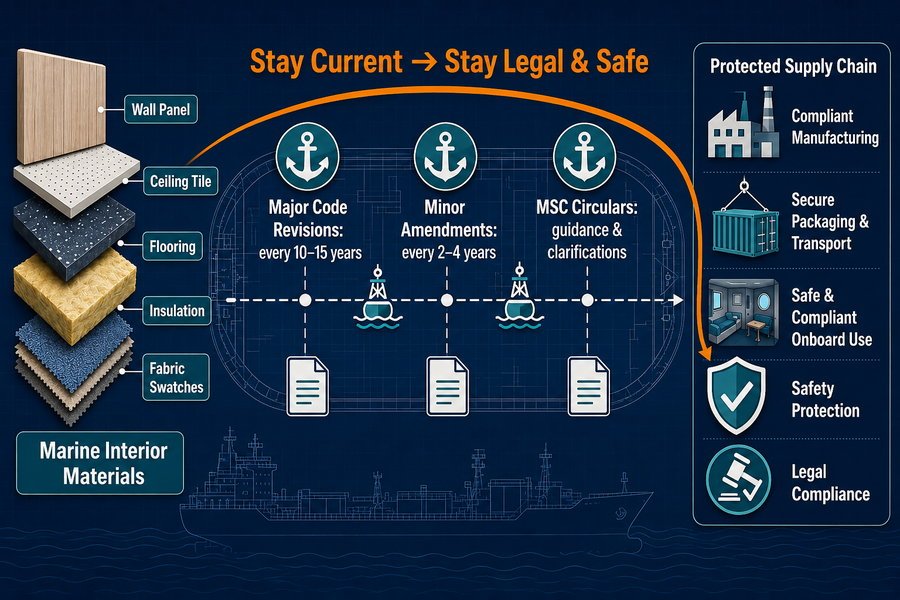
The maritime industry moves slowly, but it does move. When I first started working with marine wall panels, everyone used the 1996 rules. When the new 2010 rules came out, many factories were caught off guard. They had to spend thousands of dollars to re-test all their products. If you rely on old certificates, your shipyard clients will reject the products. To avoid this, you must understand the timeline of the changes. As outlined in the snippet, there are three types of updates you must track.
Major Code Revisions Every 10 to 15 Years
The biggest changes happen through major code revisions. These do not happen often because re-writing international law takes a long time. Generally, you will see a major revision every 10 to 15 years.19 The clearest example is the shift in the Fire Test Procedures Code. The IMO adopted the first major FTP Code in 1996 via MSC.61(67). It took 14 years for the IMO to release the next major version, which was the 2010 FTP Code adopted via MSC.307(88).20 When a major revision happens, all factories usually have a grace period (often 1 to 2 years) to send their marine doors and panels back to the laboratory for completely new fire tests.
Minor Amendments Every 2 to 4 Years
Between the major revisions, the IMO releases minor amendments. These happen more frequently, usually every 2 to 4 years. These amendments do not change the whole book. Instead, they fix small errors or update specific laboratory tools. For example, MSC.437(99) is an amendment to the 2010 FTP Code. It did not change the 750°C furnace requirement, but it updated details on how to measure the heat.21 As a buyer, you need to check if your supplier's Type Approval Certificate includes these recent minor amendments, as it proves their testing is totally up to date.
The Role of MSC Circulars in Clarifying Rules
The third type of update is the MSC Circular. Circulars are issued often, sometimes several times a year. A circular is not a new rule; it is an explanation of an existing rule.22 Sometimes, a testing laboratory finds a rule confusing. The IMO will issue a circular to explain exactly how to perform the test. While a circular rarely forces a factory to re-test a panel, shipyard inspectors read them closely. Staying aware of circulars helps you understand the newest interpretations of the rules, ensuring your supply chain remains fully legal and safe.
| Update Type | Typical Frequency | Impact on Panel Suppliers | Example |
|---|---|---|---|
| Major Code Revision | 10 to 15 Years | Requires complete re-testing of all panels. | 1996 FTP to 2010 FTP. |
| Minor Amendment | 2 to 4 Years | May require certificate updates or minor tests. | MSC.437(99). |
| MSC Circular | Frequent (Yearly) | Clarifies rules for labs and inspectors. | Guidelines on test sample mounting. |
Conclusion
Understanding IMO MSC rules like MSC.307(88) protects your projects. Always check certificates for exact resolution numbers to ensure quality, pass shipyard audits, and build safer ships worldwide.
-
"[PDF] RESOLUTION MSC.307(88) (adopted on 3 December 2010 ...", https://wwwcdn.imo.org/localresources/en/KnowledgeCentre/IndexofIMOResolutions/MSCResolutions/MSC.307(88).pdf. The IMO resolution MSC.307(88) adopted the 2010 FTP Code, which sets internationally referenced fire-test procedures for materials and components used on ships. Evidence role: historical_context; source type: institution. Supports: MSC.307(88) is the IMO instrument that contains the 2010 FTP Code fire-test procedures for marine panels and related materials.. ↩
-
"[PDF] RESOLUTION MSC.307(88) (adopted on 3 December 2010 ...", https://wwwcdn.imo.org/localresources/en/KnowledgeCentre/IndexofIMOResolutions/MSCResolutions/MSC.307(88).pdf. The 2010 FTP Code, through its non-combustibility test method based on ISO 1182, specifies a furnace temperature of about 750°C for evaluating whether shipboard materials qualify as non-combustible. Evidence role: mechanism; source type: institution. Supports: The non-combustibility test for marine panel core material requires heating the test furnace to 750°C.. ↩
-
"What Is the Purpose and Scope of the IMO FTP Code? - Magellan ...", https://magellanmarinetech.com/what-purpose-scope-of-imo-ftp-code/. Standardized fire-test codes require laboratories to conduct tests under prescribed apparatus and temperature conditions; results obtained outside those specified conditions are not equivalent to a compliant FTP Code non-combustibility test. Evidence role: mechanism; source type: institution. Supports: A non-combustibility test performed at 700°C rather than the specified 750°C would not satisfy the required test procedure.. Scope note: This supports the general validity principle for standardized testing; the source may not use the exact hypothetical example of 700°C versus 750°C. ↩
-
"What Is the Purpose and Scope of the IMO FTP Code? - Magellan ...", https://magellanmarinetech.com/what-purpose-scope-of-imo-ftp-code/. The IMO 2010 FTP Code’s non-combustibility criteria include a limit on sustained flaming, commonly stated as no more than 10 seconds, as part of the pass/fail assessment for tested materials. Evidence role: definition; source type: institution. Supports: A material fails the non-combustibility criterion if it flames for more than 10 seconds during the relevant test.. ↩
-
"[PDF] RESOLUTION MSC.307(88) (adopted on 3 December 2010 ...", https://wwwcdn.imo.org/localresources/en/KnowledgeCentre/IndexofIMOResolutions/MSCResolutions/MSC.307(88).pdf. The IMO 2010 FTP Code includes smoke and toxicity criteria for certain material tests, including a carbon monoxide concentration limit of 1,450 ppm in the specified test context. Evidence role: statistic; source type: institution. Supports: The FTP Code sets a carbon monoxide limit of 1,450 ppm for the relevant smoke toxicity test.. Scope note: The limit applies within the FTP Code’s defined smoke and toxicity test conditions and should not be read as a general occupational exposure limit. ↩
-
"Fire testing laboratories - International Maritime Organization", https://www.imo.org/en/ourwork/safety/pages/firetestinglaboratories-default.aspx. Classification-society approval rules for marine equipment typically reference IMO instruments such as the FTP Code when assessing fire safety of shipboard materials, showing that IMO requirements provide the regulatory baseline for type approval; individual societies may add procedural or documentation requirements. Evidence role: general_support; source type: institution. Supports: Classification societies use IMO MSC fire-safety requirements as the baseline when issuing type approvals for marine panels or similar products.. Scope note: This supports the baseline role of IMO rules but does not prove that every classification society applies them identically in every approval case. ↩
-
"How Is the IMO FTP Code Structured into Annexes and Parts?", https://magellanmarinetech.com/how-is-imo-ftp-code-structured-into-annexes-parts/. IMO Resolution MSC.307(88) adopted the International Code for Application of Fire Test Procedures, 2010, establishing the 2010 FTP Code used for prescribed fire tests under SOLAS. Evidence role: historical_context; source type: institution. Supports: MSC.307(88) adopted the 2010 Fire Test Procedures Code.. Scope note: This source establishes the regulatory instrument and code adoption, but does not by itself verify a specific panel product’s compliance. ↩
-
"What Is the Purpose and Scope of the IMO FTP Code? - Magellan ...", https://magellanmarinetech.com/what-purpose-scope-of-imo-ftp-code/. Part 1 of the 2010 FTP Code specifies non-combustibility test acceptance criteria, including limits on furnace temperature rise, sustained flaming, and specimen mass loss after exposure in a furnace nominally maintained at 750°C. Evidence role: definition; source type: institution. Supports: To pass the 2010 FTP Code non-combustibility test, the material must satisfy numerical limits for furnace temperature rise, flaming duration, and mass loss.. Scope note: The source supports the test criteria in the code; it does not show that any particular rockwool core or finished marine panel has passed the test. ↩
-
"Summary of SOLAS chapter II-2 - International Maritime Organization", https://www.imo.org/en/ourwork/safety/pages/summaryofsolaschapterii-2-default.aspx. SOLAS Chapter II-2 is titled and organized around construction, fire protection, fire detection, and fire extinction requirements, supporting its role as the convention’s principal fire-safety chapter. Evidence role: definition; source type: institution. Supports: SOLAS Chapter II-2 addresses fire protection requirements for ships.. Scope note: This supports the subject matter of the chapter, not the full interpretation of every regulation within it. ↩
-
"International Convention for the Safety of Life at Sea (SOLAS), 1974", https://www.imo.org/en/about/conventions/pages/international-convention-for-the-safety-of-life-at-sea-(solas),-1974.aspx. SOLAS Chapter II-2 Regulation 9 sets containment requirements for fire by thermal and structural boundaries and includes provisions for main vertical zones and A-class divisions. Evidence role: general_support; source type: institution. Supports: SOLAS Chapter II-2 Regulation 9 requires fire containment arrangements involving vertical zones and A-class divisions.. Scope note: The exact wording and applicability depend on vessel type, size, and the consolidated SOLAS edition in force. ↩
-
"How Does the IMO FTP Code Connect with Other Marine Fire Safety ...", https://magellanmarinetech.com/how-imo-ftp-code-connect-with-other-marine-fire-safety-frameworks/. The IMO FTP Code and ISO 834-1 describe a standard fire-resistance time-temperature curve, with the furnace temperature reaching about 945°C at 60 minutes, providing the laboratory basis for A-class fire test exposure. Evidence role: mechanism; source type: institution. Supports: The FTP Code uses a standard furnace time-temperature curve reaching approximately 945°C after 60 minutes for relevant fire-resistance testing.. Scope note: This supports the test-temperature curve; separate FTP Code provisions are needed to confirm all pass/fail criteria for a given product or assembly. ↩
-
"Directive 96/98/EC - Wikipedia", https://en.wikipedia.org/wiki/Directive_96/98/EC. Directive 2014/90/EU establishes the EU conformity-assessment framework for marine equipment and provides for the wheel mark as the conformity mark for covered equipment, supporting the statement that MED approval is a legal requirement in the European marine-equipment regime. Evidence role: historical_context; source type: government. Supports: European marine equipment covered by the MED is subject to a formal EU conformity regime associated with the Wheelmark.. Scope note: The Directive applies to marine equipment within its defined scope and does not automatically cover every material used in every shipyard project. ↩
-
"How Does the IMO FTP Code Connect with Other Marine Fire Safety ...", https://magellanmarinetech.com/how-imo-ftp-code-connect-with-other-marine-fire-safety-frameworks/. EU MED implementing rules and related marine-equipment conformity documentation list applicable IMO and EU testing standards for covered equipment, supporting the need for certificates to identify the governing test standard such as the IMO FTP Code resolution. Evidence role: general_support; source type: government. Supports: Marine-equipment certification should identify the applicable IMO/MED testing standard rather than relying only on generic product descriptions.. Scope note: This supports the general certification practice of referencing applicable standards; it may not prove that every valid certificate must reproduce the MSC resolution in the same wording or format. ↩
-
"How Is the IMO FTP Code Structured into Annexes and Parts?", https://magellanmarinetech.com/how-is-imo-ftp-code-structured-into-annexes-parts/. The IMO FTP Code fire-resistance tests use a standard fire-exposure curve in which furnace temperatures rise well above 750°C during longer division tests, providing contextual support for the concern that materials unable to tolerate that temperature may be unsuitable for certain marine fire-resistance ratings. Evidence role: mechanism; source type: institution. Supports: Marine fire-resistance testing can expose divisions to temperatures exceeding 750°C, making performance at that temperature relevant to compliance.. Scope note: This does not prove that land-based panels commonly fail at 750°C or that any named product is non-compliant; it only supports the relevance of high-temperature performance to marine fire testing. ↩
-
"MSC 2010-13 - International Maritime Organization", https://www.imo.org/en/knowledgecentre/indexofimoresolutions/pages/msc-2010-13.aspx. The IMO identifies resolution MSC.307(88) as the instrument adopting the International Code for Application of Fire Test Procedures, 2010, which specifies fire-test procedures used under SOLAS for materials and constructions on ships. Evidence role: definition; source type: institution. Supports: MSC.307(88) is the 2010 FTP Code used as a principal fire-test procedure code for modern commercial ships.. Scope note: This supports the identity and regulatory role of the code, but not the article’s broader claim that it appears on every modern commercial vessel certificate. ↩
-
"[PDF] RESOLUTION MSC.61(67) (adopted on 5 December 1996 ...", https://wwwcdn.imo.org/localresources/en/KnowledgeCentre/IndexofIMOResolutions/MSCResolutions/MSC.61(67).pdf. IMO documentation describes resolution MSC.61(67) as the adoption instrument for the International Code for Application of Fire Test Procedures, commonly referred to as the 1996 FTP Code. Evidence role: definition; source type: institution. Supports: MSC.61(67) is the resolution associated with the 1996 FTP Code.. Scope note: This verifies the code’s identity and adoption, but does not independently establish how frequently it appears on repair or legacy-vessel certificates. ↩
-
"[PDF] 1994 HSC Code - International Maritime Organization", https://wwwcdn.imo.org/localresources/en/publications/Documents/Supplements/English/QQQQ187E_January2024_PQ.pdf. The IMO records resolution MSC.36(63) as the adoption of the International Code of Safety for High-Speed Craft, 1994, establishing safety requirements for qualifying high-speed craft. Evidence role: historical_context; source type: institution. Supports: MSC.36(63) adopted the 1994 International Code of Safety for High-Speed Craft.. Scope note: This supports the adoption and subject matter of the code, but not project-specific conclusions about which panels may be used on a particular ferry. ↩
-
"MSC 1994-96 - International Maritime Organization", https://www.imo.org/en/knowledgecentre/indexofimoresolutions/pages/msc-1994-96.aspx. IMO sources identify resolution MSC.97(73) as the adoption of the International Code of Safety for High-Speed Craft, 2000, which updated the earlier HSC Code framework for high-speed craft safety. Evidence role: historical_context; source type: institution. Supports: MSC.97(73) adopted the 2000 HSC Code as a newer high-speed craft safety code.. Scope note: This establishes the code’s adoption and relationship to the HSC framework, but it does not by itself verify specific certificate wording for all lightweight panel products. ↩
-
"[PDF] RESOLUTION MSC.307(88) (adopted on 3 December 2010 ...", https://wwwcdn.imo.org/localresources/en/KnowledgeCentre/IndexofIMOResolutions/MSCResolutions/MSC.307(88).pdf. A historical list of IMO FTP Code instruments supports the observation that major FTP Code revisions have been separated by long intervals, notably between the 1996 and 2010 Codes. Evidence role: historical_context; source type: institution. Supports: Major maritime code revisions, such as FTP Code revisions, tend to occur at long intervals of about 10 to 15 years.. Scope note: This supports the observed interval in the FTP Code example, but it may not prove a universal 10-to-15-year cycle for all IMO code revisions. ↩
-
"[PDF] RESOLUTION MSC.61(67) (adopted on 5 December 1996 ...", https://wwwcdn.imo.org/localresources/en/KnowledgeCentre/IndexofIMOResolutions/MSCResolutions/MSC.61(67).pdf. IMO records identify resolution MSC.61(67) as the 1996 International Code for Application of Fire Test Procedures and resolution MSC.307(88) as the 2010 FTP Code, supporting the stated adoption sequence. Evidence role: historical_context; source type: institution. Supports: The 1996 FTP Code was adopted by MSC.61(67), and the 2010 FTP Code was adopted by MSC.307(88) fourteen years later.. ↩
-
"[PDF] RESOLUTION MSC.437(99) (adopted on 24 May 2018 ...", https://wwwcdn.imo.org/localresources/en/KnowledgeCentre/IndexofIMOResolutions/MSCResolutions/MSC.437(99).pdf. The text of MSC.437(99) supports that the resolution amended the 2010 FTP Code and revised technical provisions related to temperature measurement in fire test procedures. Evidence role: case_reference; source type: institution. Supports: MSC.437(99) amended the 2010 FTP Code and updated heat or temperature measurement details without changing the stated 750°C furnace requirement.. Scope note: The source can confirm the specific amendment language; any conclusion that the 750°C requirement was unchanged should be checked against the amended and prior texts together. ↩
-
"Guidance - International Maritime Organization", https://www.imo.org/en/OurWork/Security/Pages/Guidance-home.aspx. IMO descriptions of MSC circulars support that circulars are used to communicate guidance, interpretations, or recommendations connected to existing IMO instruments rather than to adopt treaty text themselves. Evidence role: definition; source type: institution. Supports: MSC circulars generally clarify or provide guidance on existing IMO rules rather than creating new rules on their own.. Scope note: Some circulars may have practical regulatory significance when incorporated by flag states or referenced by mandatory instruments, so this support is definitional rather than a complete legal analysis. ↩