Confused by outdated fire test certificates? You risk rejected shipments if your marine panels fail the latest rules. Let me explain the key differences to keep your projects compliant.
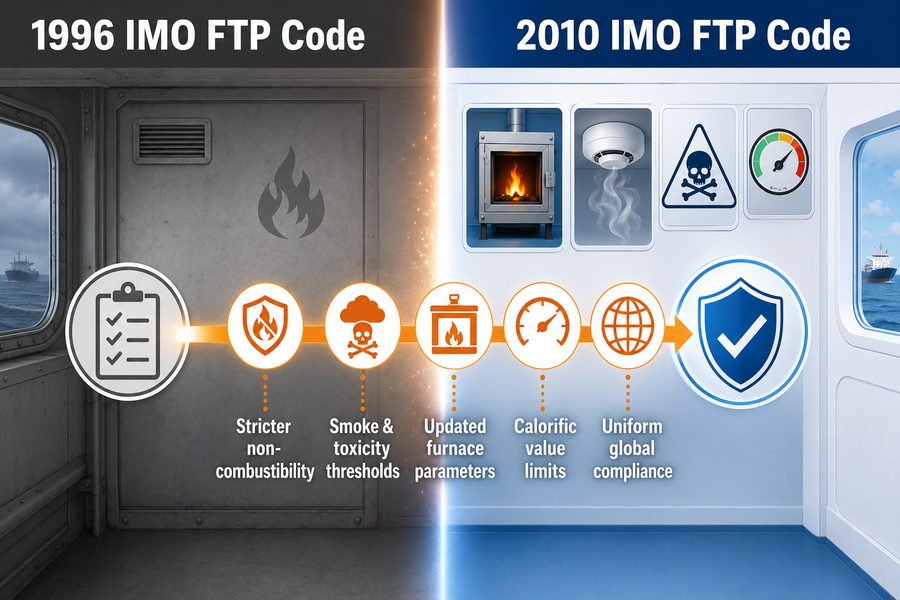
The 2010 IMO FTP Code introduced stricter non-combustibility criteria, mandated new smoke and toxicity thresholds, updated test furnace parameters, and established explicit limits on calorific values compared to the 1996 version. It consolidated test procedures to ensure uniform global fire safety compliance for marine outfitting materials.
Understanding these updates is the first step to avoiding costly delays with your marine interior materials. Let us dive into the specific comparisons and updates so you can buy with confidence.
What Is the Difference Between the 1996 and 2010 IMO FTP Code?
Are your suppliers still referencing the 1996 rules? Using old standards causes certification failures. You must know the exact shifts to secure the right panels.
The primary differences involve four key areas: updated fire testing furnace standards, revised criteria for smoke generation and toxicity, stricter limits on surface flammability, and the consolidation of previously scattered IMO resolutions into one unified document for easier global application.
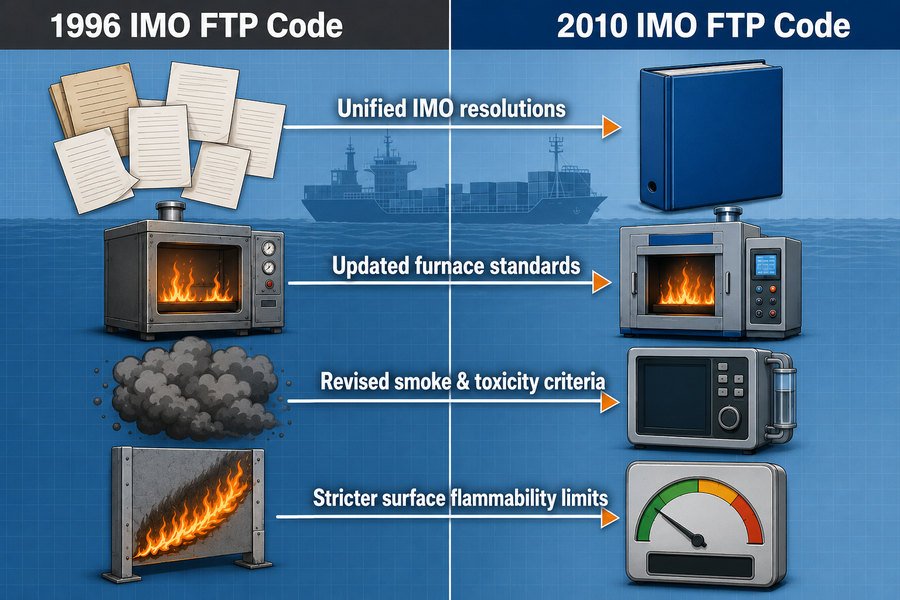
When I worked at the marine outfitting factory, I saw many buyers struggle because they did not understand the differences between the old and new codes. The International Maritime Organization (IMO) adopted the 1996 Fire Test Procedures (FTP) Code through Resolution MSC.61(67). The 2010 FTP Code, adopted through Resolution MSC.307(88), replaced it completely.1 You must check every certificate to see which resolution it lists.
Evolution of Fire Testing Furnace Standards in 2010
The first major difference is the testing equipment. Under the 1996 code, laboratories used older furnace designs. The 2010 code updated the furnace requirements to match modern ISO standards.2 This means testing labs had to buy new equipment or upgrade their old furnaces to meet tighter calibration rules. If a wall panel passed in a 1996 furnace, it might fail in a 2010 furnace because the heat distribution is much more precise and intense. I always ask suppliers if their test reports come from labs with upgraded 2010-compliant furnaces.
Revised Criteria for Smoke Generation and Toxicity
The second difference involves how we measure dangerous gases. The 1996 code had basic ways to measure smoke. The 2010 code forces labs to use Fourier Transform Infrared (FTIR) spectroscopy.3 This equipment measures exact parts per million (ppm) for deadly gases. The 2010 code set strict limits. For example, Carbon Monoxide (CO) cannot exceed 1450 ppm for floor coverings.4
Stricter Limits on Surface Flammability and Consolidation of Resolutions
The third difference targets surface flammability. The 2010 code lowered the allowable heat release rates. This means the decorative films on marine panels must resist fire longer. The fourth difference is organization. The 1996 code relied on many separate circulars and amendments scattered over the years. The 2010 code took all those separate rules and put them into one thick book. This helps shipyards, buyers, and inspectors look at the same rules in one place.
| Feature Area | 1996 IMO FTP Code (MSC.61(67)) | 2010 IMO FTP Code (MSC.307(88)) | Impact on Marine Buyers |
|---|---|---|---|
| Furnace Standards | Based on older ISO 1182 versions | Based on updated ISO 1182:2010 | Older panel core materials may fail new tests. |
| Toxicity Testing | Basic gas measurement methods | Mandatory FTIR gas analysis | PVC films must be much higher quality to pass. |
| Surface Flammability | Higher allowed heat release | Lower allowed heat release limits | Decorative finishes must be thinner or less flammable. |
| Document Structure | Scattered across multiple circulars | Consolidated into one unified text | Easier to verify supplier compliance directly. |
Why Was the IMO FTP Code Revised in 2010?
Wondering why the maritime industry forced this change? Sticking to outdated logic puts passenger safety at risk. Let me show you the driving forces behind the 2010 update.
The IMO revised the code in 2010 to address three main issues: closing safety loopholes from new material technologies, harmonizing testing methods with updated ISO standards, and resolving inconsistent interpretations of fire test results across different testing laboratories and flag states.
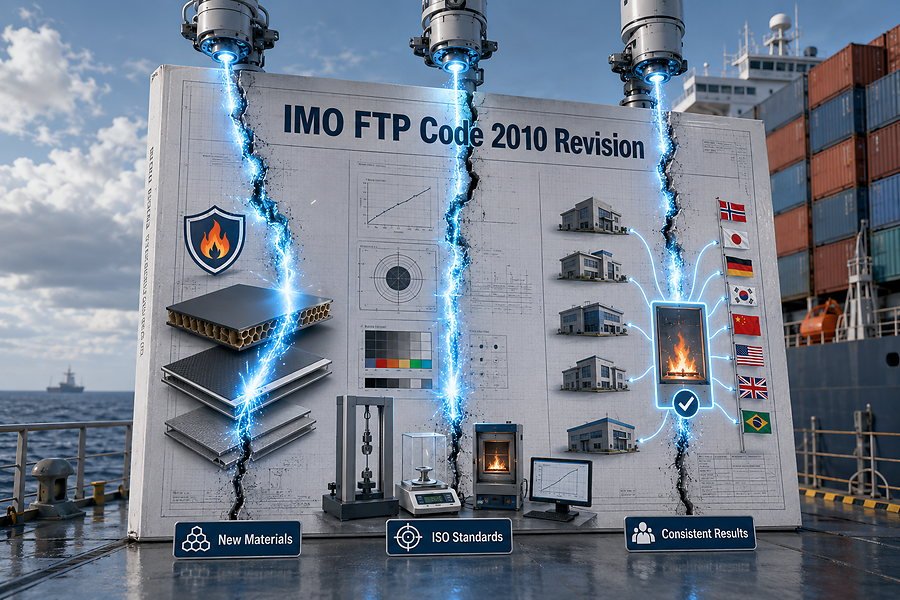
The shipping industry does not change rules just to make our jobs harder. They change rules because real-world fires show the weak points in ship designs. By 2010, the 1996 FTP Code was fourteen years old. During that time, factories invented new types of plastics, glues, and composite materials for ship interiors.
Closing Safety Loopholes for Modern Marine Materials
The first reason for the revision was new materials. In the 2000s, marine interior factories started using new synthetic adhesives and lightweight composite panels5. The 1996 code did not know how to test these new materials properly. Some materials passed the old tests but still burned badly in real ship fires. The 2010 code updated the test methods6 to catch these dangerous new materials. When I help buyers select marine ceiling panels today, I always point out that the 2010 code forces the manufacturer to test the exact glue they use in production.
Harmonizing Marine Testing with Updated ISO Standards
The second reason was standardization. The IMO relies heavily on the International Organization for Standardization (ISO). Between 1996 and 2010, ISO updated many fire test standards, like ISO 1182 for non-combustibility and ISO 1716 for calorific potential7. The IMO had to revise the FTP Code to match these new ISO standards. If they did not, a marine test lab would have to follow different rules than a normal building test lab.
Resolving Inconsistent Interpretations Across Laboratories
The third reason was laboratory inconsistency. Under the 1996 code, a marine door might fail a test in a German lab but pass in a Chinese lab. This happened because the old rules were not clear about how to mount the door in the test frame. The 2010 code removed this confusion. It gave exact, step-by-step instructions for mounting test samples. This ensures that a fire test result in Asia is exactly the same as a fire test result in Europe.8
| Driving Issue for 2010 Revision | Weakness in the 1996 FTP Code | Solution in the 2010 FTP Code |
|---|---|---|
| New Material Technologies | Old tests could not evaluate new synthetic glues and composites accurately. | Added specific test protocols for adhesives and modern multi-layer panels. |
| Outdated ISO References | Referenced old ISO fire test standards from the early 1990s. | Fully aligned with modern ISO 1182 and ISO 1716 testing standards. |
| Inconsistent Lab Results | Vague sample mounting instructions led to different results worldwide. | Established strict, universal mounting and calibration instructions for all labs. |
Which Marine Panel Testing Requirements Were Updated in the 2010 FTP Code?
Worried your wall panels might fail modern tests? Missing these specific updates means blocked shipyard approvals. Here are the exact testing changes you must verify.
For marine panels, the 2010 code updated three specific tests: Part 1 for non-combustibility using stricter ISO 1182:2010 parameters, Part 2 for smoke and toxicity with mandatory FTIR gas analysis, and Part 5 for surface flammability requiring lower critical heat flux values.
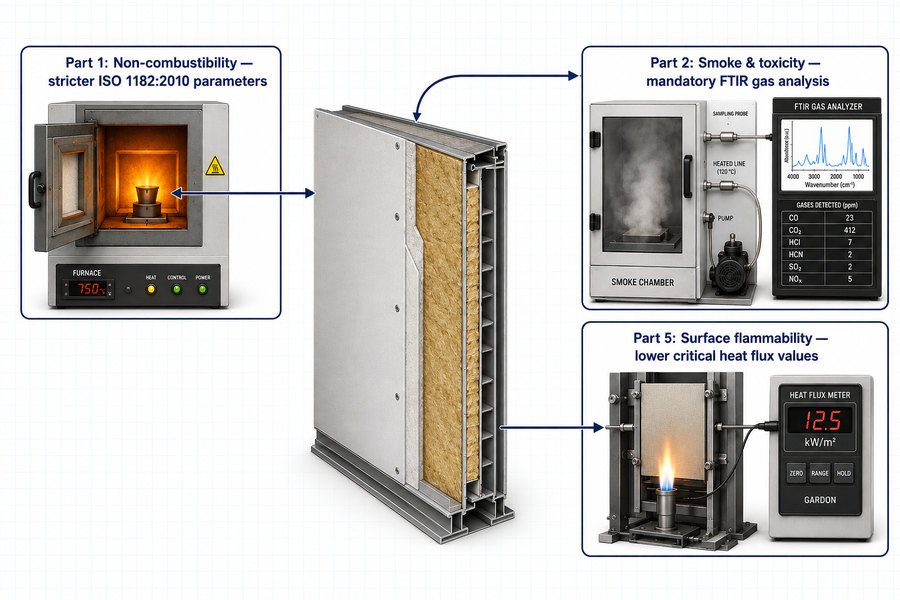
When you buy marine wall and ceiling panels, you usually care about three main documents. These are the test reports for Part 1, Part 2, and Part 5 of the FTP Code. The 2010 update changed the technical rules for all three of these tests.9 If your factory uses cheap raw materials, their panels will fail these updated tests.
Stricter Parameters in Part 1 Non-Combustibility Testing
Part 1 tests the core material of the panel, like rock wool or ceramic wool. The 2010 code updated Part 1 to use the ISO 1182:2010 standard. To pass Part 1 today, the core material must not cause the furnace temperature to rise more than 30 degrees Celsius. Also, the material cannot lose more than 50% of its original mass during the test.10 I remember a supplier who tried to use low-density rock wool. It passed the old 1996 test but lost 60% of its mass in the 2010 test. The panel failed, and they could not sell it to the European shipyard.
Mandatory FTIR Gas Analysis in Part 2 Smoke and Toxicity Testing
Part 2 tests the toxic smoke created by the decorative surface of the panel. The 2010 code made Part 2 much harder to pass. It introduced very strict limits for poisonous gases. The test lab must measure the gases using FTIR equipment. The maximum allowed levels for panel surfaces are: Carbon Monoxide (CO) 1450 ppm, Hydrogen Chloride (HCl) 600 ppm, Hydrogen Fluoride (HF) 600 ppm, Nitrogen Oxides (NOx) 350 ppm, and Sulfur Dioxide (SO2) 120 ppm11. You must check your supplier's Part 2 report to ensure all gas levels are below these numbers.
Lower Critical Heat Flux in Part 5 Surface Flammability Testing
Part 5 tests how fast fire spreads across the surface of the panel. The 2010 code lowered the limit for the Critical Heat Flux at Extinguishment (CFE). It also placed stricter limits on the total heat release.12 This means the PVC film or painted surface on your wall panels must be specially formulated to stop fire from spreading. Standard commercial PVC films will fail this test instantly. You must buy panels with marine-grade low-flame-spread finishes.
| Test Part | What It Tests on the Marine Panel | 2010 FTP Code Key Requirement Updates |
|---|---|---|
| Part 1 | Non-combustibility of the core material (e.g., rock wool). | Adopts ISO 1182:2010; max temp rise 30°C, max mass loss 50%. |
| Part 2 | Smoke and toxicity of the surface finish. | Explicit limits added: CO < 1450 ppm, HCl < 600 ppm, NOx < 350 ppm. |
| Part 5 | Surface flammability and fire spread. | Stricter Critical Heat Flux (CFE) and total heat release limits. |
Are Older IMO FTP Code Certificates Still Valid for Marine Panels Today?
Holding a supplier's old certificate? Assuming it is still good can ruin your project timeline. You need to know the strict validity rules in place today.
Certificates issued under the 1996 Code are generally no longer valid for new ship constructions. The IMO mandated that as of July 1, 2012, all new tests must follow the 2010 Code, and existing certificates required renewal under the new criteria upon their standard five-year expiration.
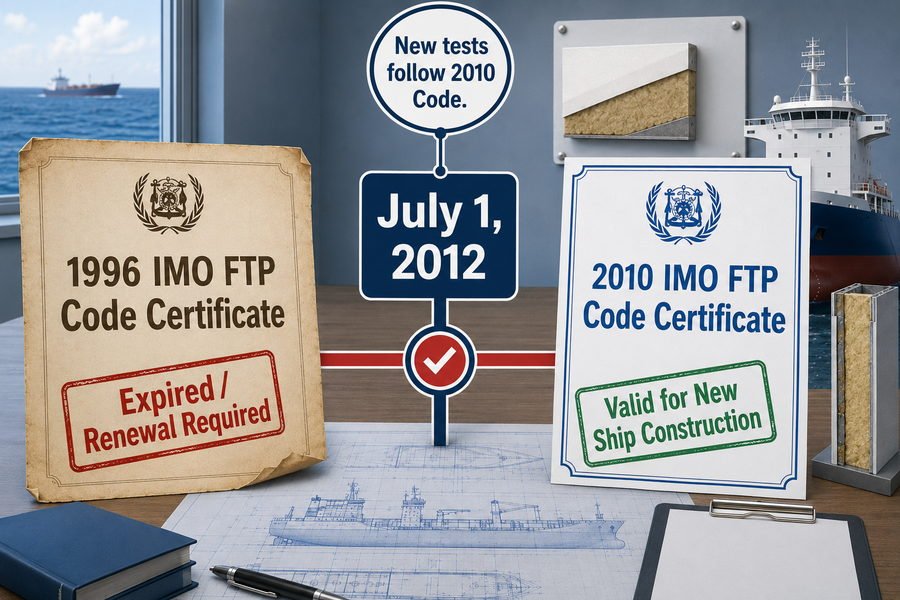
You cannot use expired certificates for shipyard projects. Ship owners rely on classification societies like DNV, ABS, or Lloyd's Register to check all paperwork. If you submit a marine fire door certificate based on the 1996 code today, the surveyor will reject it immediately. This causes massive headaches because the goods might already be at the port.
Timeline for Phasing Out 1996 IMO FTP Code Certificates
The IMO was very clear about the timeline. The 2010 FTP Code entered into force on July 1, 2012.13 After this exact date, no testing laboratory was allowed to issue a new certificate using the 1996 rules14. All new products had to face the 2010 tests. However, the IMO gave factories a grace period for existing products. If a factory had a valid 1996 certificate issued before July 1, 2012, they could keep using it until the certificate reached its normal expiration date.15
Required Steps for Renewing Outdated Marine Panel Certificates
Marine type approval certificates (like the European Wheelmark Module B) are usually valid for exactly five years. Because of this five-year rule, every single 1996 certificate naturally expired by July 2017 at the latest. Therefore, today, there are absolutely no valid 1996 FTP Code certificates for new ship construction. If a supplier shows you a certificate mentioning MSC.61(67), you must ask them for their updated Wheelmark certificate. They must send their panels to a lab like SGS, Far East Fire Testing, or Warringtonfire to do a completely new test under MSC.307(88). Never pay a deposit until you see the valid, current document.
| Certificate Issue Date | Governing Code | Current Validity Status in 2026 | Action Required by Buyer |
|---|---|---|---|
| Before July 1, 2012 | 1996 FTP Code (MSC.61(67)) | Completely Invalid (Expired by 2017) | Reject the certificate. Demand new testing. |
| After July 1, 2012 | 2010 FTP Code (MSC.307(88)) | Valid only if within its 5-year issue window | Check the expiration date on the certificate. |
| Expired 2010 Cert | 2010 FTP Code (MSC.307(88)) | Invalid | Supplier must renew Module B and Module D audits. |
What Amendments Has the IMO FTP Code Received Since 2010?
Think the 2010 version is the final word? Ignoring recent circulars means you are missing critical safety updates. Let us look at what changed recently.
Since 2010, the code has received two main types of amendments: unified interpretations (like MSC.1/Circ.1456) to clarify testing for specific joints and adhesives, and minor technical corrections regarding test specimen mounting methods to ensure laboratories test materials exactly as they are installed on ships.
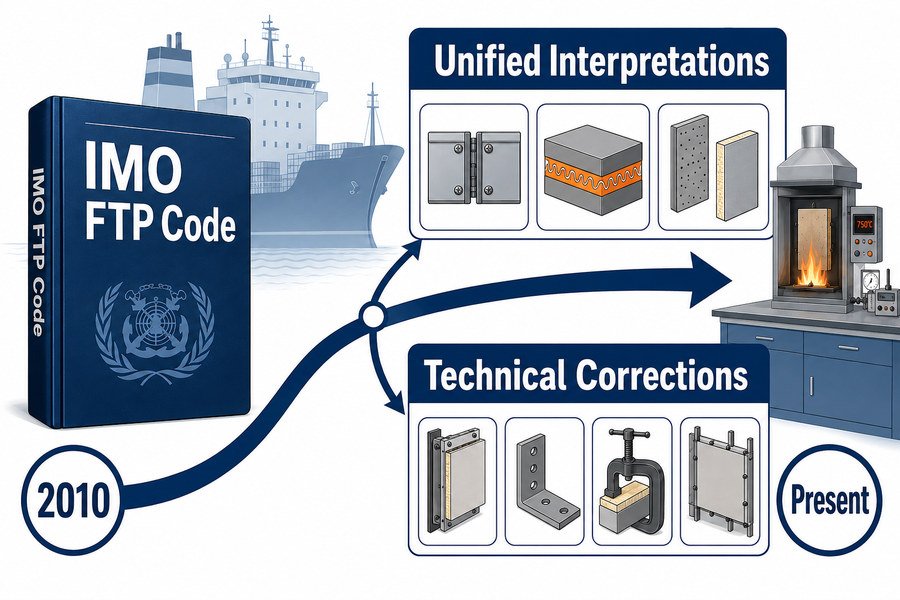
Even though the 2010 Code is the main rulebook, the IMO still makes small adjustments16. These adjustments do not replace the 2010 Code. Instead, they fix small mistakes or answer questions from testing labs. If your supplier does not know about these small amendments, they might manufacture panels the wrong way.
Unified Interpretations Issued via MSC Circulars
The first type of amendment is called a Unified Interpretation. Sometimes, a rule in the 2010 Code is a little confusing. Different labs might read the rule differently. To fix this, the IMO releases an MSC Circular17. A famous example is MSC.1/Circ.145618. This circular explained exactly how to test the joints between two marine wall panels. Before this circular, some labs tested flat panels without joints. The IMO clarified that if a wall system uses a steel spline or connecting profile, the fire test must include that exact joint.
Technical Corrections for Specimen Mounting Methods
The second type of amendment involves technical corrections for mounting test samples. The IMO noticed that some factories used one type of strong glue for the fire test, but used a cheaper, weaker glue for real ship installations. To stop this, the IMO issued corrections stating that the exact adhesive type, brand, and application amount (measured in grams per square meter) used in the fire test must be permanently recorded on the certificate. If your factory changes their glue brand, their fire certificate becomes invalid immediately19. I always check the glue specifications on the test report against the factory's actual production line.
| Amendment Type | Example Document | Impact on Marine Outfitting Testing |
|---|---|---|
| Unified Interpretations | MSC.1/Circ.1456 | Clarifies how to build the test sample (e.g., mandating joints in panel tests). |
| Technical Corrections | Minor MSC Resolutions | Fixes typos or updates specific ISO standard reference numbers within the text. |
| Mounting Clarifications | Included in Circulars | Forces factories to declare exact adhesive usage rates (g/m²) on final certificates. |
How Should Panel Manufacturers Track Future IMO FTP Code Revisions?
Tired of surprise regulatory changes? Falling behind means unsellable inventory. Here is how you can stay ahead of every upcoming IMO rule change.
Manufacturers must track revisions through three reliable methods: monitoring the IMO Maritime Safety Committee (MSC) session reports directly, maintaining active communication with major classification societies like DNV or LR, and using a certified third-party testing laboratory to conduct annual compliance audits.
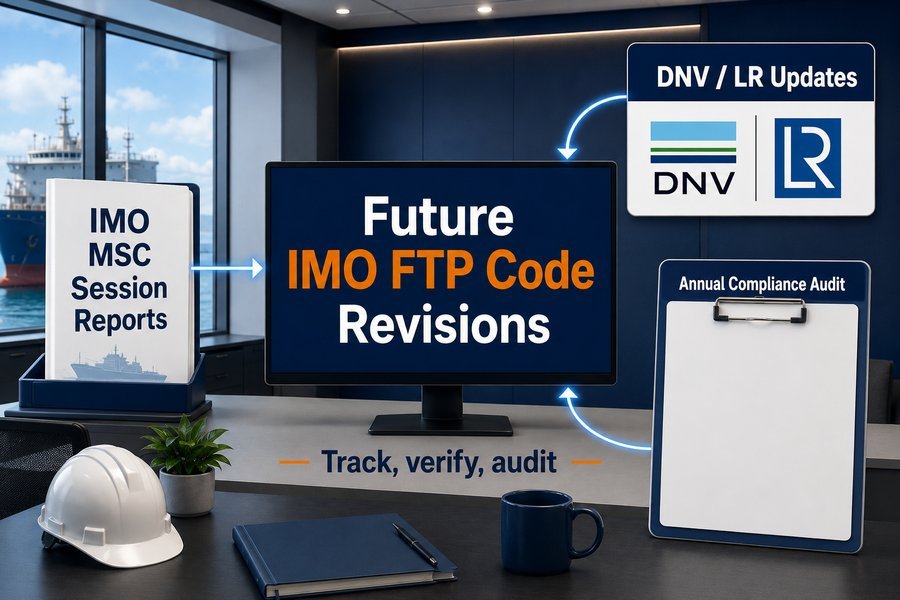
If you buy marine outfitting products in Asia, you need suppliers who stay updated. You do not want a supplier who finds out about a rule change only after their goods are rejected at the shipyard. A professional factory has systems in place to track international laws.
Monitoring the IMO Maritime Safety Committee Session Reports
The first method is direct monitoring. The IMO's Maritime Safety Committee (MSC) meets once or twice a year in London20. Every time they meet, they publish a detailed report21. Factories should assign their technical manager to read the MSC session summaries. These summaries are free to download from the official IMO website. They give advance warning of any upcoming changes to the fire test rules. It takes about two years for a new rule to go from a discussion in London to a mandatory law22. This gives factories plenty of time to adjust their product designs.
Partnering with Major Classification Societies and Testing Laboratories
The second and third methods involve professional partners. Factories should subscribe to newsletters from major classification societies like DNV, Lloyd's Register (LR), or Bureau Veritas (BV). These societies always send out "Regulatory Update" emails to their clients when the IMO changes a rule. Finally, factories must rely on their third-party testing labs. When a factory holds a European Wheelmark certificate, they must undergo an annual factory audit (Module D). A good auditor from a lab will sit down with the factory manager and explain any new IMO FTP Code circulars that affect their wall panels or fire doors.
| Tracking Method | Source of Information | Frequency of Updates | Benefit to Manufacturer |
|---|---|---|---|
| Direct Monitoring | IMO MSC Session Reports (via IMO website) | 1 to 2 times per year | Provides the earliest possible warning of future rule changes. |
| Class Societies | Newsletters from DNV, LR, ABS, BV | Monthly or upon new releases | Delivers easy-to-read summaries of complex regulatory updates. |
| Laboratory Audits | Third-party Module D annual factory inspections | Annually | Offers face-to-face guidance and confirms current factory compliance. |
Conclusion
The shift from the 1996 to the 2010 IMO FTP Code brought strict fire safety upgrades. You must always verify your marine outfitting materials meet these current, unified global standards.
-
"[PDF] RESOLUTION MSC.307(88) (adopted on 3 December 2010 ...", https://wwwcdn.imo.org/localresources/en/KnowledgeCentre/IndexofIMOResolutions/MSCResolutions/MSC.307(88).pdf. IMO Resolution MSC.307(88) adopts the 2010 FTP Code and states its relationship to the earlier FTP Code adopted by MSC.61(67), supporting the chronology and replacement claim. Evidence role: historical_context; source type: institution. Supports: The 1996 FTP Code was adopted by IMO Resolution MSC.61(67), and the 2010 FTP Code was adopted by MSC.307(88) as its replacement.. ↩
-
"[PDF] RESOLUTION MSC.307(88) (adopted on 3 December 2010 ...", https://wwwcdn.imo.org/localresources/en/KnowledgeCentre/IndexofIMOResolutions/MSCResolutions/MSC.307(88).pdf. The 2010 FTP Code and ISO 1182:2010 describe non-combustibility test furnace apparatus and calibration requirements, providing support for the statement that the 2010 framework aligned fire-test equipment requirements with updated ISO methods. Evidence role: definition; source type: institution. Supports: The 2010 FTP Code updated furnace-related test requirements in line with contemporary ISO fire testing standards.. Scope note: This supports the standards alignment and apparatus requirements, but it does not by itself prove that every laboratory had to replace its furnace rather than recalibrate or modify existing equipment. ↩
-
"[PDF] RESOLUTION MSC.307(88) (adopted on 3 December 2010 ...", https://wwwcdn.imo.org/localresources/en/KnowledgeCentre/IndexofIMOResolutions/MSCResolutions/MSC.307(88).pdf. The 2010 FTP Code’s smoke and toxicity test provisions identify FTIR-based gas analysis for measuring combustion gases, supporting the statement that the revised method requires FTIR instrumentation for those measurements. Evidence role: mechanism; source type: institution. Supports: The 2010 FTP Code requires FTIR spectroscopy for relevant smoke toxicity gas measurements.. Scope note: The support applies to the relevant smoke and toxicity test procedures in the FTP Code, not necessarily to every fire test performed under the Code. ↩
-
"[PDF] RESOLUTION MSC.307(88) (adopted on 3 December 2010 ...", https://wwwcdn.imo.org/localresources/en/KnowledgeCentre/IndexofIMOResolutions/MSCResolutions/MSC.307(88).pdf. The 2010 FTP Code specifies maximum gas concentration criteria for smoke toxicity testing, including a carbon monoxide limit for applicable material categories, supporting the stated ppm threshold for floor coverings if the cited table matches that category. Evidence role: statistic; source type: institution. Supports: The 2010 FTP Code sets a 1450 ppm carbon monoxide limit for floor coverings under the relevant toxicity test criteria.. Scope note: The citation should be checked against the exact FTP Code table and product category because toxicity limits can vary by material classification and test part. ↩
-
"[PDF] ssc-403 design guide for marine applications of composites - ROSA P", https://rosap.ntl.bts.gov/view/dot/40834/dot_40834_DS1.pdf. A review or research source on marine composite construction and adhesive bonding can document the increased use of lightweight composite structures and polymer-based bonding systems in ship and marine applications during this period. Evidence role: historical_context; source type: paper. Supports: In the 2000s, marine interior factories started using new synthetic adhesives and lightweight composite panels.. Scope note: Such a source would support the broader material trend, but may not specifically verify adoption by marine interior factories in every market. ↩
-
"[PDF] RESOLUTION MSC.307(88) (adopted on 3 December 2010 ...", https://wwwcdn.imo.org/localresources/en/KnowledgeCentre/IndexofIMOResolutions/MSCResolutions/MSC.307(88).pdf. IMO Resolution MSC.307(88), which adopted the International Code for Application of Fire Test Procedures, 2010, provides revised fire-test procedures for materials and assemblies used under SOLAS, supporting the statement that the FTP Code’s test framework was updated in 2010. Evidence role: general_support; source type: institution. Supports: The 2010 code updated the test methods to catch these dangerous new materials.. Scope note: The resolution establishes the updated code, but it may not by itself prove that every change was introduced specifically to address newly developed materials. ↩
-
"[PDF] Flammability tests for regulation of building and construction materials", https://research.fs.usda.gov/treesearch/download/23126.pdf. ISO catalogue records for ISO 1182 and ISO 1716 identify these standards as fire-test methods for non-combustibility and gross heat of combustion/calorific potential, and their edition histories can substantiate that the referenced ISO fire-test standards were updated before or around the 2010 FTP Code. Evidence role: definition; source type: institution. Supports: Between 1996 and 2010, ISO updated many fire test standards, including ISO 1182 for non-combustibility and ISO 1716 for calorific potential.. Scope note: ISO catalogue pages support the scope and publication history of the standards, but they do not alone prove IMO’s internal reason for revising the FTP Code. ↩
-
"[PDF] Modern test methods for flammability", https://nvlpubs.nist.gov/nistpubs/Legacy/IR/nistir4326.pdf. ISO/IEC laboratory-standardization guidance, such as ISO/IEC 17025 materials on competence and consistent operation of testing laboratories, supports the general principle that standardized methods and controlled procedures improve comparability of test results across laboratories. Evidence role: expert_consensus; source type: institution. Supports: Strict, universal mounting and calibration instructions make fire-test results from laboratories in different regions equivalent.. Scope note: This would support improved comparability, not the absolute claim that results in different regions will be exactly identical. ↩
-
"[PDF] RESOLUTION MSC.307(88) (adopted on 3 December 2010 ...", https://wwwcdn.imo.org/localresources/en/KnowledgeCentre/IndexofIMOResolutions/MSCResolutions/MSC.307(88).pdf. IMO Resolution MSC.307(88), which adopted the 2010 FTP Code, provides revised test procedures and criteria for fire-test methods including Parts 1, 2, and 5. Evidence role: historical_context; source type: institution. Supports: The 2010 update changed the technical rules for Part 1, Part 2, and Part 5 FTP Code tests.. Scope note: A single 2010 Code source establishes the updated requirements, but a direct claim that all three changed is strongest when compared with the 1996 FTP Code text. ↩
-
"[PDF] RESOLUTION MSC.307(88) (adopted on 3 December 2010 ...", https://wwwcdn.imo.org/localresources/en/KnowledgeCentre/IndexofIMOResolutions/MSCResolutions/MSC.307(88).pdf. The 2010 FTP Code Part 1, based on ISO 1182:2010 non-combustibility testing, specifies pass criteria including limits on furnace temperature rise and specimen mass loss. Evidence role: definition; source type: institution. Supports: Part 1 non-combustibility testing requires limits of no more than 30°C furnace temperature rise and no more than 50% mass loss.. ↩
-
"Sulphur oxides (SOx) and Particulate Matter (PM) – Regulation 14", https://www.imo.org/en/ourwork/environment/pages/sulphur-oxides-(sox)-%E2%80%93-regulation-14.aspx. The 2010 FTP Code Part 2 sets maximum gas concentration criteria for smoke and toxicity testing, including limits for CO, HCl, HF, NOx, and SO2 measured during the prescribed test method. Evidence role: statistic; source type: institution. Supports: Part 2 sets the listed maximum allowed gas levels for panel-surface smoke and toxicity testing.. ↩
-
"[PDF] RESOLUTION MSC.307(88) (adopted on 3 December 2010 ...", https://wwwcdn.imo.org/localresources/en/KnowledgeCentre/IndexofIMOResolutions/MSCResolutions/MSC.307(88).pdf. The FTP Code Part 5 low flame-spread test defines criteria involving critical flux at extinguishment and heat-release measurements; comparison of the 1996 and 2010 Code texts is needed to document the stated change in stringency. Evidence role: historical_context; source type: institution. Supports: The 2010 FTP Code changed Part 5 requirements for Critical Heat Flux at Extinguishment and total heat release.. Scope note: The Part 5 source supports the relevance of CFE and heat-release criteria, while the claim that the limit was lowered requires a version-to-version comparison. ↩
-
"[PDF] RESOLUTION MSC.307(88) (adopted on 3 December 2010 ...", https://wwwcdn.imo.org/localresources/en/KnowledgeCentre/IndexofIMOResolutions/MSCResolutions/MSC.307(88).pdf. The IMO adoption materials for resolution MSC.307(88) identify the 2010 FTP Code and record its entry into force date as 1 July 2012. Evidence role: historical_context; source type: institution. Supports: The 2010 FTP Code entered into force on July 1, 2012.. ↩
-
"Fire testing laboratories - International Maritime Organization", https://www.imo.org/en/ourwork/safety/pages/firetestinglaboratories-default.aspx. IMO transitional guidance for the 2010 FTP Code states how approvals issued under the 1996 FTP Code were to be treated after the 2010 Code entered into force, supporting the claim that new approvals were to follow the 2010 Code after the transition date. Evidence role: expert_consensus; source type: institution. Supports: After July 1, 2012, testing laboratories could no longer issue new certificates under the 1996 FTP Code rules.. Scope note: The source should be checked for the exact wording, because IMO guidance may distinguish between new approvals, renewals, and continued acceptance of previously issued certificates. ↩
-
"Listing of current IMO publications", https://www.imo.org/en/publications/pages/currentpublications.aspx. IMO or flag-state guidance on implementation of the 2010 FTP Code explains that existing type approvals issued under the 1996 FTP Code could remain acceptable for a limited period until their stated expiry, providing contextual support for the grace-period statement. Evidence role: historical_context; source type: institution. Supports: Valid 1996 FTP Code certificates issued before July 1, 2012 could continue to be used until their normal expiration date.. Scope note: The support is contextual unless the cited document expressly addresses the same certificate type and flag-state acceptance conditions discussed in the article. ↩
-
"Sub-Committee on Ship Systems and Equipment, 11th session (SSE ...", https://www.imo.org/en/MediaCentre/MeetingSummaries/Pages/SSE-11th-session.aspx. IMO documentation for the 2010 FTP Code and subsequent MSC circulars/resolutions shows that the Code has been supplemented by amendments and unified interpretations after its adoption. Evidence role: historical_context; source type: institution. Supports: The IMO continues to issue smaller amendments, corrections, or interpretations related to the 2010 Code.. Scope note: This supports the general practice of post-adoption updates, but individual adjustments must be verified against the specific IMO instrument. ↩
-
"Maritime Safety Committee - 110th session (MSC 110), 18-27 June ...", https://www.imo.org/en/mediacentre/meetingsummaries/pages/msc-110th-session.aspx. IMO Maritime Safety Committee circulars are used to circulate unified interpretations of IMO instruments, including interpretations of the 2010 FTP Code, supporting the procedural claim that clarifications may be issued through MSC circulars. Evidence role: mechanism; source type: institution. Supports: The IMO can issue Unified Interpretations through MSC Circulars when Code provisions require clarification.. Scope note: This establishes the publication mechanism, not the substance of every interpretation issued under it. ↩
-
"[PDF] 2010 FTP Code - International Maritime Organization", https://wwwcdn.imo.org/localresources/en/publications/Documents/Supplements/English/QQQC844E_122019.pdf. IMO MSC.1/Circ.1456 provides unified interpretations of the 2010 FTP Code, including guidance on how representative test specimens should account for construction details such as joints or connections used in service. Evidence role: case_reference; source type: institution. Supports: MSC.1/Circ.1456 clarified how joints between marine wall panels should be represented in fire testing.. Scope note: The citation should be checked against the exact paragraph of the circular to confirm the specific wording on steel splines or connecting profiles. ↩
-
"[PDF] RESOLUTION MSC.307(88) (adopted on 3 December 2010 ...", https://wwwcdn.imo.org/localresources/en/KnowledgeCentre/IndexofIMOResolutions/MSCResolutions/MSC.307(88).pdf. The 2010 FTP Code approval framework ties certification to the tested and documented construction; changes to essential materials such as adhesives generally require reassessment or approval by the administration before the certificate can continue to be relied upon. Evidence role: general_support; source type: institution. Supports: Changing the adhesive brand or specification used in certified production can invalidate, or at least remove confidence in, the existing fire certificate unless approved or retested.. Scope note: Authoritative sources may not use the phrase “invalid immediately”; the stronger, supportable point is that an unapproved material change can put the approval outside its certified scope. ↩
-
"Meeting Summaries and Schedule", https://www.imo.org/en/mediacentre/meetingsummaries/pages/default.aspx. The IMO describes the Maritime Safety Committee as one of its main technical bodies and publishes session calendars showing MSC meetings at IMO headquarters in London. Evidence role: general_support; source type: institution. Supports: The IMO Maritime Safety Committee meets periodically, typically once or twice per year, at IMO headquarters in London.. Scope note: Meeting frequency can vary by year, so the source supports the general pattern rather than a fixed annual schedule. ↩
-
"Maritime Safety Committee (MSC)", https://www.imo.org/en/MediaCentre/MeetingSummaries/Pages/MSC-Default.aspx. IMO post-session materials for MSC meetings document the outcomes of each session and identify adopted or approved safety-related amendments and circulars. Evidence role: historical_context; source type: institution. Supports: MSC meetings are followed by official IMO documentation or summaries that record the outcomes of the session.. Scope note: Public IMO pages often provide summaries or highlights; full official reports may be distributed through IMO document systems and may not be equally accessible to all readers. ↩
-
"[PDF] SOLAS Convention - INTERNATIONAL MARITIME ORGANIZATION", https://wwwcdn.imo.org/localresources/en/About/Conventions/StatusOfConventions/Status%202026%2025%20mar.pdf. IMO explanations of the treaty amendment process, including tacit acceptance procedures for instruments such as SOLAS, show that adopted amendments generally require a defined acceptance period before entry into force. Evidence role: mechanism; source type: institution. Supports: IMO regulatory changes normally move through proposal, adoption, acceptance, and entry-into-force stages, creating a lead time before requirements become mandatory.. Scope note: The exact timeline depends on the convention, amendment procedure, and adoption date; the source supports the regulatory mechanism and typical lead time, not a universal two-year rule. ↩