Marine fire safety rules are confusing. Missing one certification connection can reject your entire interior shipment. I will show you exactly how the IMO FTP Code links these frameworks together.
The IMO FTP Code acts as the universal testing standard that underpins global marine fire safety. It directly supports SOLAS regulations, enables MED Wheelmark certification, guides flag state enforcement, dictates shipyard batch approvals, streamlines global newbuild workflows, and forms the basis for type approval of all marine interior outfitting panels.
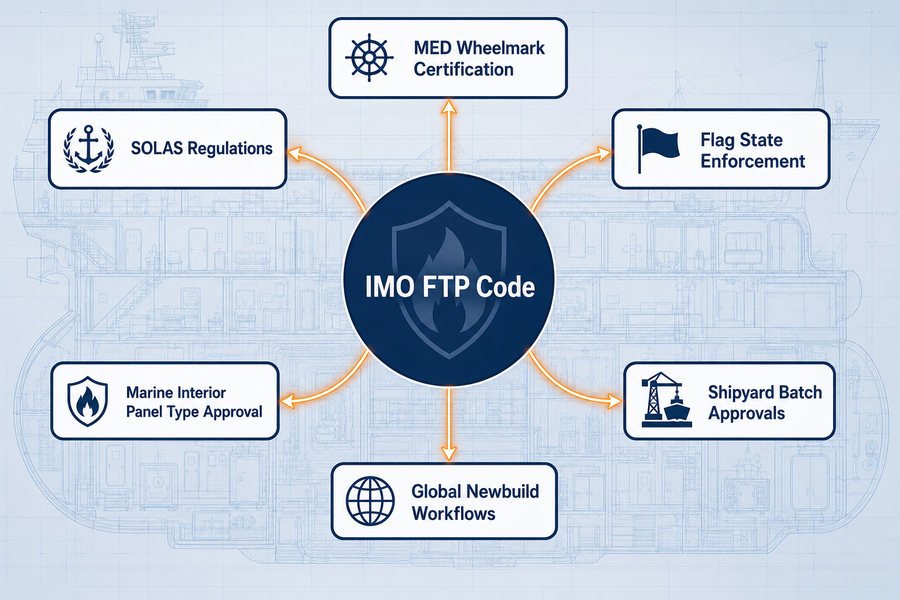
Understanding these connections is the only way to avoid costly delays when supplying marine wall and ceiling panels.
How does the IMO FTP Code relate to the SOLAS Convention?
Do your panels meet SOLAS rules? Many buyers struggle to prove this. The IMO FTP Code is the exact testing manual used to prove SOLAS compliance for ship interiors.
SOLAS Chapter II-2 mandates fire safety goals, while the IMO FTP Code provides the exact nine-part testing procedures to achieve those goals. Specifically, SOLAS requires non-combustibility and low flame spread, which are tested and proven using FTP Code Parts 1 and 5, respectively, making them legally inseparable.
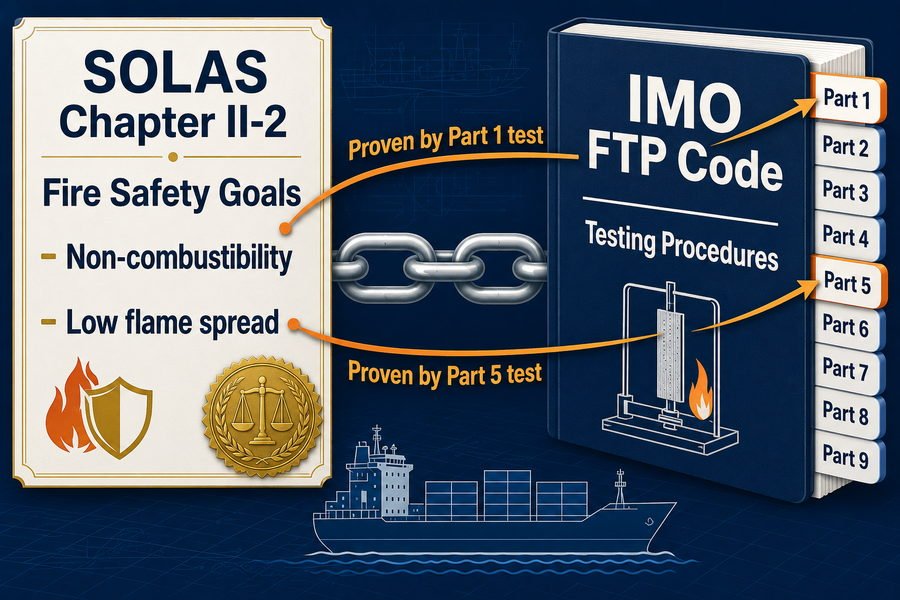
Defining the Legal Bond Between SOLAS Chapter II-2 and the FTP Code
When you read the International Convention for the Safety of Life at Sea (SOLAS), specifically Chapter II-2, you will see many high-level safety goals. SOLAS says that ships must be built with materials that restrict the spread of fire1. However, SOLAS itself is just a set of rules. It does not tell a laboratory how to burn a piece of marine wall panel. This is exactly where the IMO Fire Test Procedures (FTP) Code comes in. The IMO FTP Code is the testing manual that makes SOLAS rules measurable and enforceable2. I often tell my clients that if SOLAS is the law, the IMO FTP Code is the judge. You cannot claim that a marine ceiling panel meets SOLAS Chapter II-2 unless it has physically passed the exact test methods outlined in the IMO FTP Code. They work together as a single, inseparable framework. If you buy panels from Asia for a European yard, the shipyard inspector will not just ask if it is "SOLAS compliant." They will ask to see the test report proving it passed the IMO FTP Code.
Applying FTP Code Parts 1 and 5 to Meet SOLAS Requirements
To understand this connection deeply, we must look at the specific parts of the IMO FTP Code. As mentioned in the summary, SOLAS requires non-combustibility and low flame spread for interior materials. The IMO 2010 FTP Code addresses non-combustibility in Part 1. According to Part 1, a material is only non-combustible if its gross calorific value is less than 45 MJ/m23. This is a hard number. For low flame spread, we use Part 5. A surface material must pass Part 5 testing to prove that a fire will not travel quickly across the panel surface. When I used to work in the factory, we spent weeks adjusting our panel coatings just to pass the Part 5 flame spread limits. You must understand both parts to sell a complete panel. The core material of the panel must pass Part 1, while the decorative PVC film on the outside must pass Part 5.
| SOLAS Chapter II-2 Requirement | IMO 2010 FTP Code Test Standard | Specific Test Metric / Limit (Authoritative Source) |
|---|---|---|
| Non-combustible base materials | Part 1: Non-combustibility test | Gross calorific value ≤ 45 MJ/m2 (IMO 2010 FTP Code) |
| Low flame spread surfaces | Part 5: Test for surface flammability | Critical flux at extinguishment > 20 kW/m24 (IMO 2010 FTP Code) |
| Smoke and toxicity limits | Part 2: Smoke and toxicity test | Maximum CO concentration < 1450 ppm (IMO 2010 FTP Code) |
Is the IMO FTP Code referenced by MED Wheelmark certification?
Want to sell panels to European shipyards? Without the Wheelmark, you cannot. The IMO FTP Code is the direct testing foundation for this critical European certification.
Yes, the MED Wheelmark certification strictly references the IMO FTP Code as its primary testing standard. To get the Wheelmark for interior materials, products must pass FTP Code fire tests. The MED simply adds European production quality control audits on top of the base IMO FTP Code test results.
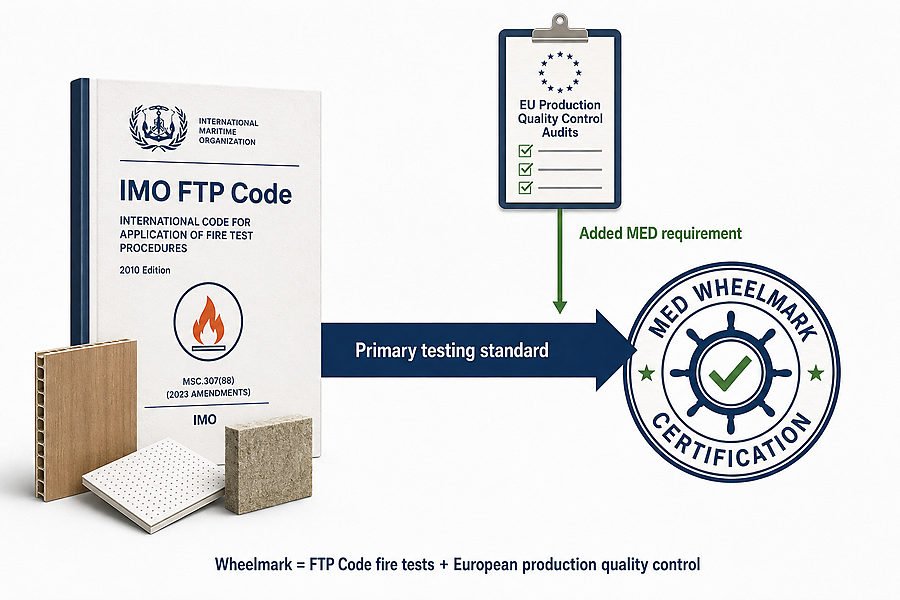
How MED Modules B and D Rely on IMO FTP Code Testing
The Marine Equipment Directive (MED) Wheelmark is mandatory for any equipment installed on European-flagged ships5. Many procurement officers get confused and think MED and IMO are two completely different fire standards. They are not. The MED Wheelmark uses the exact same fire testing rules as the IMO FTP Code6. The MED certification process is usually split into two parts: Module B and Module D. Module B is the Type Examination. To pass Module B, the panel manufacturer must send their product to an approved European laboratory. What does the laboratory do? They burn the panel strictly following the IMO 2010 FTP Code. For example, if you are testing a B-15 marine fire door, the lab uses IMO FTP Code Part 3. The door must limit the unexposed face temperature rise to an average of 140°C over 15 minutes7. The MED does not invent new temperatures; it copies the IMO FTP Code values exactly. Therefore, passing the IMO FTP Code is the first and most critical step to getting a Wheelmark.
European Quality Control Additions to Standard IMO Testing
While the fire tests are identical, the MED Wheelmark adds an extra layer of security that standard IMO Type Approval might lack. This extra layer is MED Module D, which focuses entirely on production quality control. As stated in the summary, the MED simply adds European production audits on top of the base IMO test results. Under Module D, an auditor must visit the factory in China or Vietnam to check the manufacturing process. They want to ensure that the factory can consistently produce panels that match the exact prototype that passed the IMO FTP Code fire test. The auditor will check the density of the rockwool, the thickness of the steel, and the type of glue used. If the factory changes the glue without telling the testing body, they will lose their Wheelmark. This is why European and American shipyards trust the Wheelmark so much. It proves the product passed the IMO FTP Code fire test and that the factory is under strict, ongoing quality control.
| Certification Stage | Framework Name | Role and Function | Primary Action Required by Manufacturer |
|---|---|---|---|
| Product Fire Testing | IMO 2010 FTP Code | Defines the technical fire limits and laboratory procedures. | Submit panel prototypes to a lab for burning. |
| Type Examination | MED Module B | Verifies the IMO test report meets European legal standards. | Submit IMO test reports and technical drawings to a Notified Body. |
| Production Auditing | MED Module D | Ensures ongoing factory quality matches the tested prototype. | Pass an annual factory quality system inspection. |
How do flag state administrations enforce the IMO FTP Code?
Flag states hold the ultimate power to approve or ban your panels. They use the IMO FTP Code as their strict measuring stick during vessel inspections.
Flag state administrations enforce the IMO FTP Code through three main actions: authorizing recognized organizations to issue type approvals, requiring continuous factory audits, and performing on-board port state control inspections. If interior panels fail to present valid FTP Code documentation during these checks, the flag state will deny ship sailing.
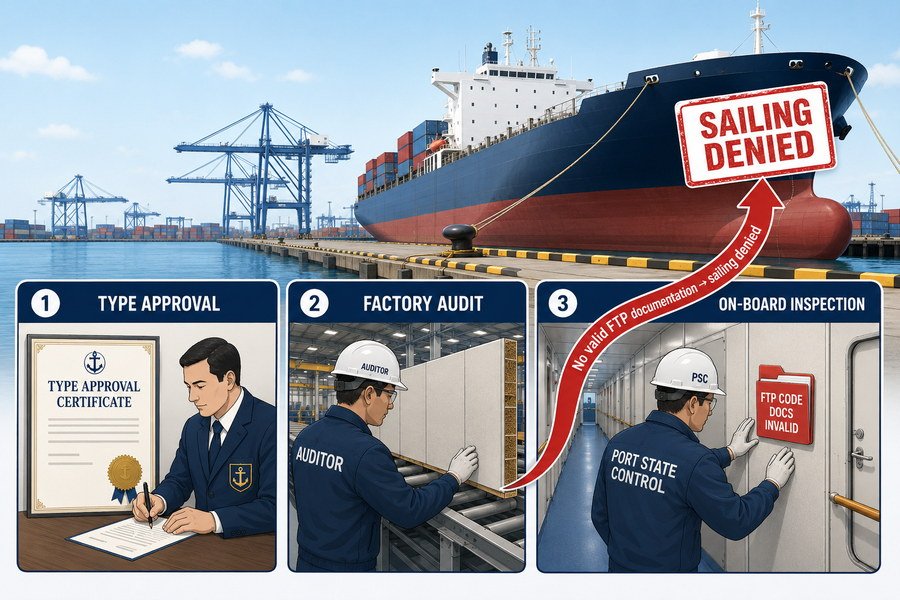
Flag State Authorization of Recognized Organizations for Type Approval
A flag state administration is the government authority of the country where a ship is registered. Countries like Panama, Liberia, or the Marshall Islands are common flag states. These governments are responsible for making sure their ships are safe. However, a government office does not have the time or technical staff to test marine wall panels. Therefore, they enforce the IMO FTP Code by authorizing Recognized Organizations (ROs)8, such as DNV, ABS, or Lloyd's Register. The flag state gives these classification societies the legal power to review IMO FTP Code test reports on their behalf.9 When an RO issues a Type Approval certificate for a marine fire door, they are doing so under the authority of the flag state. If a panel manufacturer wants to sell to a ship registered in Panama, they must provide a Type Approval certificate from an RO that Panama accepts. This certificate proves the product passed the IMO FTP Code. This authorization process is the primary way flag states ensure global compliance without doing the testing themselves.
Continuous Factory Audits and Port State Control Inspections
The enforcement does not stop at the certificate level. As highlighted in the snippet paragraph, flag states also enforce the rules through continuous factory audits and on-board port state control inspections. First, the flag state requires the RO to conduct annual audits at the panel factory10. If the factory stops following the IMO FTP Code material recipes, the RO will cancel the certificate, and the flag state will ban the product. Second, when the ship is built and sailing, it is subject to Port State Control (PSC) inspections. When a ship arrives at a port, local government inspectors come on board. They will check the ship's fire safety manual and look at the actual interior panels. They will demand to see the valid IMO FTP Code documentation for the installed materials. If the documents are missing, or if the panels look modified, the PSC inspector has the power to detain the ship11. A detained ship costs the owner thousands of dollars a day. This strict enforcement is why shipyards are so demanding about getting the correct IMO paperwork from their suppliers.
| Enforcement Method | Executing Body | Description of Action | Consequence of Failure |
|---|---|---|---|
| Type Approval Authorization | Recognized Organization (DNV, ABS) | Reviewing IMO FTP test reports on behalf of the flag state. | Product cannot be installed on the registered ship. |
| Factory Quality Audits | Recognized Organization | Annual visits to check if mass production matches the tested prototype. | Cancellation of the Type Approval certificate. |
| Port State Control | Local Port Authority Inspectors | Physical on-board checks of panels and IMO certification documents. | The ship is detained in port and not allowed to sail. |
Why do shipyards request IMO FTP Code certificates for every panel batch?
Are shipyards asking you for papers with every single delivery? This is not to annoy you. It is a strict legal requirement to guarantee continuous batch safety.
Shipyards request IMO FTP Code certificates for every panel batch to verify consistent material composition, ensure compliance with the vessel's specific fire plan, and pass surveyor inspections. The initial type approval only proves the prototype passed, so batch certificates confirm the mass-produced panels match the tested prototype exactly.
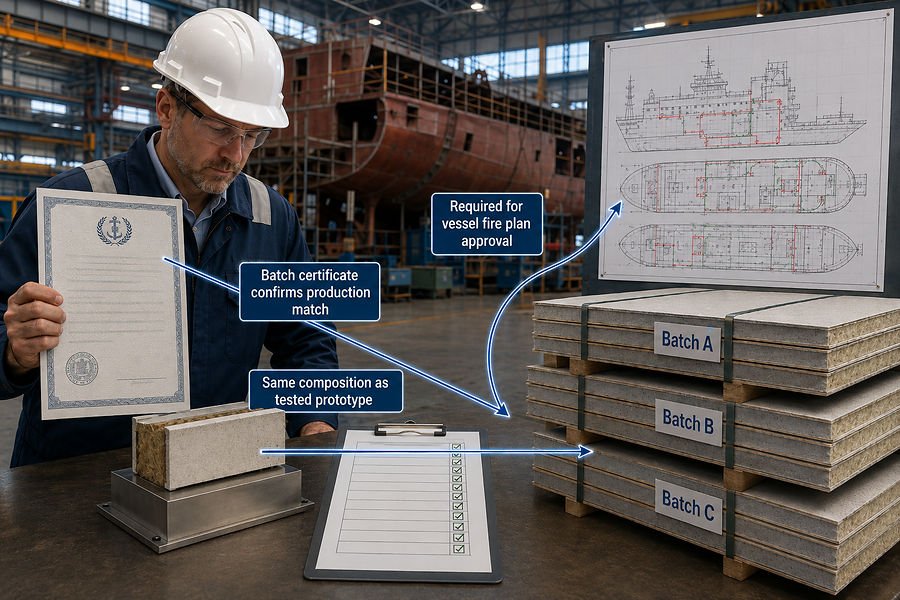
Verifying Consistent Material Composition in Mass Production
When you work as a procurement officer, you buy panels in large volumes. You might order 5,000 square meters of marine wall panels for a single cruise ship. The shipyard knows that a Type Approval certificate only proves that one single prototype passed the IMO FTP Code test12 two years ago. It does not prove that the 5,000 square meters you just delivered are safe. Therefore, shipyards request batch certificates, often called a Declaration of Conformity or a Batch Release Certificate, to verify consistent material composition. They need legal proof that the density of the rockwool (e.g., 120 kg/m3) and the thickness of the steel skin (e.g., 0.6mm) in the current batch exactly match the prototype that passed the IMO FTP Code test. If a factory tries to save money by reducing the rockwool density to 100 kg/m3 for a specific batch, that batch is no longer IMO compliant13. The batch certificate is a legally binding document where the factory promises they have not changed the recipe.
Passing Surveyor Inspections and Meeting Vessel Fire Plans
The other major reasons shipyards demand batch certificates involve vessel fire plans and surveyor inspections, as noted in the summary. Every new ship has an approved fire safety plan14. This drawing shows exactly where an A-60 bulkhead is needed and where a B-15 partition is allowed. When the panels arrive at the shipyard, the quality control team must check the batch certificates against this fire plan. If the plan calls for IMO FTP Code Part 3 compliant A-60 panels, the batch certificate must state exactly that. Furthermore, during the construction of the ship, marine surveyors from the classification society walk through the ship. They will point to a newly installed marine fire door and ask the shipyard manager for its paperwork. If the shipyard cannot produce a batch certificate linking that specific door to a valid IMO FTP Code Type Approval, the surveyor will force the shipyard to rip the door out. This is a massive waste of time and money, which is why shipyards enforce strict paperwork rules on their suppliers.
| Shipyard Requirement | Reason for Requirement | Link to IMO FTP Code |
|---|---|---|
| Match prototype material composition | To prevent factories from using cheaper, untested materials in mass production. | Ensures the batch performs the same as the prototype tested under the FTP Code. |
| Comply with vessel fire plan | To ensure the right fire-rated panel is installed in the correct ship zone. | Confirms the delivered batch meets the specific A-Class or B-Class FTP Code rating needed. |
| Pass surveyor inspections | To provide a paper trail to the classification society during ship construction. | Proves to the surveyor that the physical product installed has valid FTP Code backing. |
What role does the IMO FTP Code play in global newbuild approval workflows?
Building a new ship requires a huge amount of paperwork. The IMO FTP Code simplifies this by providing a single standard that all global shipyards accept.
The IMO FTP Code streamlines global newbuild approval workflows by standardizing the design specification phase, fast-tracking the procurement review process, and simplifying the final classification society sign-off. Because it is globally recognized, it prevents the need for duplicate local fire testing across different countries during a newbuild project.
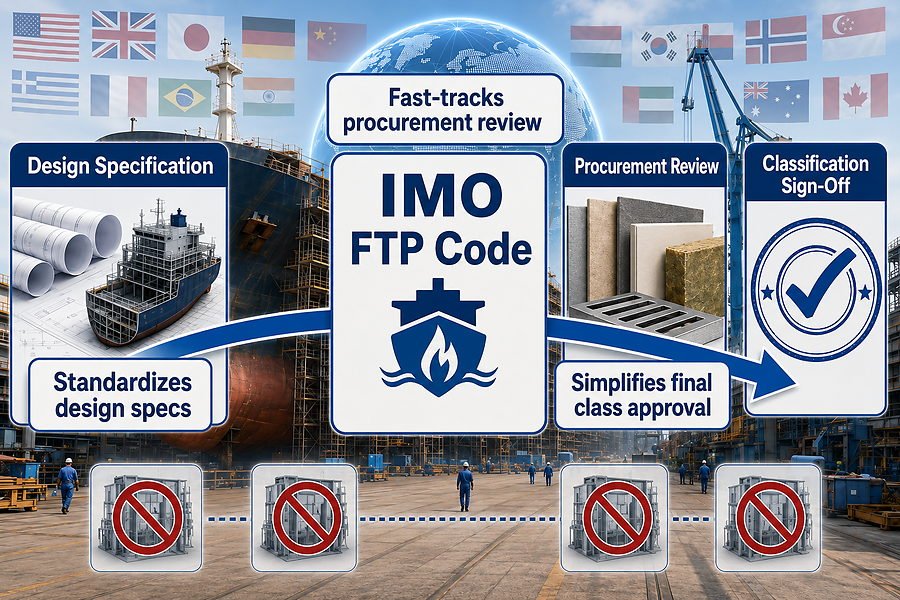
Standardizing the Design Specification and Procurement Review
When a shipowner decides to build a new vessel, the first step is the design specification phase. Naval architects must draw up the plans. Because the IMO FTP Code is universally accepted15, architects do not need to research the local fire laws of the country where the ship will be built. They simply write "A-60 class bulkhead per IMO FTP Code16" on the drawings. This standardization saves months of design time.17 Once the design is done, the workflow moves to the procurement review process. This is where people like Helen, the procurement officers, get involved. You take the drawings and look for suppliers in Asia. Because the IMO FTP Code is standard, you can easily compare a supplier in China with a supplier in Vietnam. You just ask both of them, "Do you have the IMO FTP Code Part 3 test report for this panel?" If both say yes, you can then focus entirely on comparing their prices and lead times. The Code fast-tracks procurement because it removes technical arguments about whose fire test is better.
Simplifying Final Classification Society Sign-Off for Newbuilds
The final step in a newbuild workflow is the classification society sign-off. As mentioned in the snippet, the IMO FTP Code simplifies this process and prevents duplicate local testing18. Imagine a ship designed in Norway, built in China, and registered in the Bahamas. Without the IMO FTP Code, the Chinese shipyard might test the panels to Chinese standards, which the Bahamian flag state might reject. The IMO FTP Code stops this chaos. It acts as a universal language. When the DNV or ABS surveyor does the final walkthrough of the new ship in China, they do not care about Chinese or Norwegian local fire codes. They only look at the IMO FTP Code documentation. Because all countries involved recognize this single standard, the surveyor can quickly approve the interior outfitting and issue the final ship safety certificates. This smooth workflow is essential for delivering ships on time and on budget.
| Newbuild Workflow Stage | Action Taken | How IMO FTP Code Streamlines the Process |
|---|---|---|
| Design Specification | Naval architects draft interior plans. | Allows architects to use universally understood terms like "A-60" or "B-15" without local code research. |
| Procurement Review | Buyers source materials from global suppliers. | Enables buyers to easily compare global suppliers by checking for one standard test report. |
| Final Society Sign-Off | Surveyors approve the built ship. | Prevents duplicate fire testing and arguments between different national authorities. |
How does the IMO FTP Code support type approval of marine interior panels?
Type approval is the golden ticket for selling marine panels. The IMO FTP Code is the exact rulebook you must follow to earn that ticket.
The IMO FTP Code supports type approval of marine interior panels by defining the exact test specimen sizes, outlining the specific laboratory furnace conditions, and setting the hard pass or fail limits for smoke, toxicity, and temperature rise. These three elements form the mandatory data for type approval certificates.
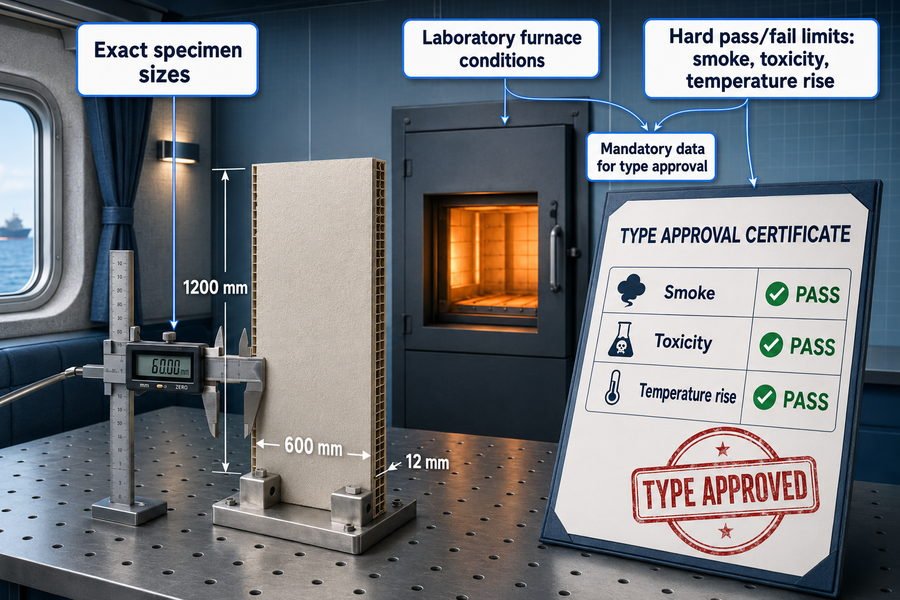
Defining Test Specimen Sizes and Laboratory Furnace Conditions
When a manufacturer wants to get a Type Approval certificate for a new marine ceiling panel, they must follow the IMO FTP Code exactly as written. The Code acts as the instruction manual for the testing laboratory. First, it defines the exact test specimen sizes. You cannot just send a tiny piece of metal to the lab. For example, under IMO 2010 FTP Code Part 3 (test for A, B, and F class divisions), the test specimen for a bulkhead must have an exposed surface area of at least 4.65 square meters, and a height of 2.44 meters19. This ensures the test represents a real wall on a ship. Second, the Code outlines specific laboratory furnace conditions. It dictates exactly how fast the furnace must heat up. This is known as the standard time-temperature curve. At the end of 60 minutes, the furnace temperature must reach exactly 945°C20. These strict rules ensure that a Type Approval issued by a lab in Italy is technically identical to a Type Approval issued by a lab in China.
Setting Hard Limits for Smoke, Toxicity, and Temperature Rise
The most important way the IMO FTP Code supports Type Approval is by setting hard pass or fail limits, which must be printed on the certificate. The summary highlighted smoke, toxicity, and temperature rise. Let's look at the numbers. For smoke and toxicity, the lab uses FTP Code Part 2. The Code dictates strict chemical limits. For instance, when a material burns, the Carbon Monoxide (CO) concentration must not exceed 1450 ppm, and Hydrogen Chloride (HCl) must not exceed 600 ppm21. If the material produces 601 ppm of HCl, it fails, and it cannot get Type Approval. For temperature rise, Part 3 dictates that the unexposed side of an A-60 panel cannot rise more than 140°C on average, or 180°C at any single point, during a 60-minute fire22. The surveyor issuing the Type Approval certificate simply looks at the lab report. If the numbers from the lab are lower than the limits set by the IMO FTP Code, the certificate is granted. The Code removes all guesswork.
| IMO 2010 FTP Code Part | Technical Parameter Regulated | Specific Value / Limit Example (Authoritative Source) |
|---|---|---|
| Part 3: Fire Resistance | Specimen Size (Bulkhead) | Minimum 4.65 square meters, 2.44m high (IMO 2010 FTP Code) |
| Part 3: Fire Resistance | Furnace Temperature | Must reach 945°C at 60 minutes (IMO standard time-temperature curve) |
| Part 2: Smoke & Toxicity | Toxicity Limits | Hydrogen Chloride (HCl) < 600 ppm (IMO 2010 FTP Code) |
| Part 3: Fire Resistance | Temperature Rise (A-60) | Unexposed face average rise ≤ 140°C over 60 mins (IMO 2010 FTP Code) |
Conclusion
The IMO FTP Code links SOLAS, MED Wheelmark, and flag state rules. Mastering these connections helps you procure compliant panels, avoid shipyard rejections, and save money on global interior projects.
-
"Summary of SOLAS chapter II-2 - International Maritime Organization", https://www.imo.org/en/ourwork/safety/pages/summaryofsolaschapterii-2-default.aspx. SOLAS Chapter II-2 sets fire-safety objectives and functional requirements for ship construction, including limiting fire and smoke generation and spread within ships. Evidence role: general_support; source type: institution. Supports: SOLAS Chapter II-2 requires ship construction and materials to address restriction of fire spread.. Scope note: This supports the general SOLAS objective; it does not by itself specify the laboratory test method for any individual panel product. ↩
-
"[PDF] RESOLUTION MSC.307(88) (adopted on 3 December 2010 ...", https://wwwcdn.imo.org/localresources/en/KnowledgeCentre/IndexofIMOResolutions/MSCResolutions/MSC.307(88).pdf. The IMO Fire Test Procedures Code provides internationally standardized fire-test methods referenced by SOLAS for demonstrating that materials and assemblies meet prescribed fire-safety requirements. Evidence role: definition; source type: institution. Supports: The IMO FTP Code operationalizes SOLAS fire-safety requirements through standardized test procedures.. Scope note: The source should establish the Code’s role and legal reference framework; enforcement practices may still depend on flag-state and recognized-organization implementation. ↩
-
"What Is the Purpose and Scope of the IMO FTP Code? - Magellan ...", https://magellanmarinetech.com/what-purpose-scope-of-imo-ftp-code/. The 2010 FTP Code Part 1 sets acceptance criteria for non-combustibility testing, including calorific-value-related limits used to assess whether a material qualifies as non-combustible for SOLAS purposes. Evidence role: statistic; source type: institution. Supports: FTP Code Part 1 defines quantitative criteria for determining whether a material is non-combustible.. Scope note: The exact threshold and unit should be checked against the current official FTP Code text, because non-combustibility criteria may distinguish between material calorific value, surface area, mass loss, temperature rise, and flaming duration. ↩
-
"[PDF] RESOLUTION MSC.307(88) (adopted on 3 December 2010 ...", https://wwwcdn.imo.org/localresources/en/KnowledgeCentre/IndexofIMOResolutions/MSCResolutions/MSC.307(88).pdf. The 2010 FTP Code Part 5 surface-flammability test includes quantitative performance criteria such as critical flux at extinguishment for assessing whether exposed surfaces have low flame-spread characteristics. Evidence role: statistic; source type: institution. Supports: FTP Code Part 5 uses critical flux at extinguishment as a quantitative criterion for low flame-spread surface materials.. Scope note: The threshold may vary by material category or application, so the cited source should be checked for the specific surface type and SOLAS use case discussed. ↩
-
"Directive 96/98/EC - Wikipedia", https://en.wikipedia.org/wiki/Directive_96/98/EC. Directive 2014/90/EU establishes the EU marine-equipment conformity regime and requires the wheel mark for covered marine equipment placed on board ships flying an EU Member State flag. Evidence role: historical_context; source type: government. Supports: The MED Wheelmark is mandatory for marine equipment covered by the Directive when installed on EU-flagged ships.. Scope note: The Directive applies to marine equipment within its scope, not literally every item installed on a ship. ↩
-
"Fire testing laboratories - International Maritime Organization", https://www.imo.org/en/ourwork/safety/pages/firetestinglaboratories-default.aspx. EU MED implementing rules identify fire-protection equipment approval standards by reference to international instruments, including IMO fire-test procedures such as the 2010 FTP Code, showing that MED conformity assessment relies on IMO test methods for covered fire-safety products. Evidence role: general_support; source type: government. Supports: For relevant fire-safety equipment, MED Wheelmark approval relies on IMO FTP Code fire-test procedures rather than a separate EU fire-test code.. Scope note: This supports the relationship for MED-listed fire-protection equipment; it does not establish that every MED product category uses the FTP Code. ↩
-
"[PDF] RESOLUTION MSC.307(88) (adopted on 3 December 2010 ...", https://wwwcdn.imo.org/localresources/en/KnowledgeCentre/IndexofIMOResolutions/MSCResolutions/MSC.307(88).pdf. The IMO FTP Code fire-resistance criteria for B-class divisions specify that the average temperature rise on the unexposed face must not exceed 140°C, with B-15 classification requiring the criterion to be maintained for 15 minutes. Evidence role: definition; source type: institution. Supports: A B-15 marine fire door must meet the IMO FTP Code criterion of an average unexposed-face temperature rise not exceeding 140°C for 15 minutes.. ↩
-
"[PDF] RESOLUTION MSC.349(92) (Adopted on 21 June 2013) CODE ...", https://wwwcdn.imo.org/localresources/en/KnowledgeCentre/IndexofIMOResolutions/MSCResolutions/MSC.349(92).pdf. IMO instruments and flag-state guidance describe Recognized Organizations as bodies authorized by an administration to carry out statutory certification and survey functions on its behalf. Evidence role: definition; source type: institution. Supports: Flag state administrations enforce maritime safety rules partly by authorizing Recognized Organizations to act on their behalf.. Scope note: This supports the general delegation mechanism; individual authorizations and scopes vary by flag state and by convention. ↩
-
"RESOLUTION MSC.307(88) (adopted on 3 December ...", https://wwwcdn.imo.org/localresources/en/KnowledgeCentre/IndexofIMOResolutions/MSCResolutions/MSC.307(88).pdf. The IMO FTP Code and related statutory certification regimes require fire-test procedures and approval documentation for ship materials, while flag administrations may rely on authorized organizations to perform approval and certification tasks. Evidence role: mechanism; source type: institution. Supports: Classification societies acting as Recognized Organizations may review fire-test documentation and issue approvals under flag-state authority.. Scope note: A source may confirm the general statutory approval framework but may not specify every product category or every flag-state delegation arrangement. ↩
-
"Fire testing laboratories - International Maritime Organization", https://www.imo.org/en/ourwork/safety/pages/firetestinglaboratories-default.aspx. Marine-equipment conformity-assessment schemes commonly require production-quality surveillance or periodic audits to verify that manufactured products remain consistent with the approved design or tested prototype. Evidence role: mechanism; source type: government. Supports: Ongoing factory audits can be part of maintaining marine type approval for fire-rated materials or equipment.. Scope note: The frequency and audit procedure depend on the applicable approval scheme, flag administration, and Recognized Organization; annual factory audits may not be universal for all products. ↩
-
"[PDF] PROCEDURES FOR PORT STATE CONTROL, 2023", https://wwwcdn.imo.org/localresources/en/OurWork/IIIS/Documents/A%2033-Res.1185%20-%20PROCEDURES%20FOR%20PORT%20STATE%20CONTROL,%202023%20(Secretariat)%20(1).pdf. IMO and regional port state control regimes state that port authorities may inspect foreign ships for compliance with applicable conventions and may detain vessels when deficiencies create grounds for detention. Evidence role: general_support; source type: institution. Supports: Port State Control inspectors can detain ships for serious compliance deficiencies found during inspection.. Scope note: Detention depends on the severity and legal classification of the deficiency; missing or suspect fire-safety documentation would need to meet the relevant PSC criteria. ↩
-
"[PDF] RESOLUTION MSC.307(88) (adopted on 3 December 2010 ...", https://wwwcdn.imo.org/localresources/en/KnowledgeCentre/IndexofIMOResolutions/MSCResolutions/MSC.307(88).pdf. A source describing IMO FTP Code/type-approval procedures would support that fire-test approval is based on tested specimens assessed against the Code rather than automatic verification of every production batch. Evidence role: mechanism; source type: institution. Supports: A Type Approval certificate demonstrates that a tested specimen or prototype met IMO FTP Code requirements, not that each later production batch was independently tested.. Scope note: The source may describe the approval/testing framework generally and may not use the article’s exact wording of “one single prototype.” ↩
-
"Are Marine Fire Divisions the Same as Marine Panel Ratings?", https://magellanmarinetech.com/are-marine-fire-divisions-same-as-marine-panel-ratings/. Guidance on IMO FTP Code approvals or classification-society product certification would support that material construction and configuration must remain consistent with the tested and approved specimen for the approval to remain applicable. Evidence role: mechanism; source type: institution. Supports: If a manufacturer changes key material properties from the tested prototype, the resulting batch cannot be assumed to retain the original IMO FTP Code compliance.. Scope note: A general certification source may not discuss the specific example of reducing rockwool density from 120 kg/m3 to 100 kg/m3, but it can support the principle that unapproved material changes invalidate reliance on the original test approval. ↩
-
"[PDF] Resolution A.952(23) Adopted on 5 December 2003 (Agenda item ...", https://wwwcdn.imo.org/localresources/en/KnowledgeCentre/IndexofIMOResolutions/AssemblyDocuments/A.952(23).pdf. SOLAS or IMO guidance on fire control plans would support that ships are required to carry approved plans showing fire-protection arrangements, including divisions and firefighting information, as part of maritime fire-safety compliance. Evidence role: expert_consensus; source type: institution. Supports: New ships subject to SOLAS/IMO requirements have approved fire-related plans showing where fire-rated divisions and safety arrangements apply.. Scope note: The source may use the term “fire control plan” rather than “fire safety plan,” and requirements can vary by vessel type, size, and regulatory regime. ↩
-
"Fire testing laboratories - International Maritime Organization", https://www.imo.org/en/ourwork/safety/pages/firetestinglaboratories-default.aspx. A source from IMO or SOLAS documentation should establish that the FTP Code is incorporated into the international safety regime for ships and is used by flag states and classification societies when assessing fire-test procedures. Evidence role: expert_consensus; source type: institution. Supports: The IMO FTP Code is broadly accepted as the common international fire-testing framework for ship construction.. Scope note: This would support broad international recognition for SOLAS-covered ships, but not prove literal acceptance by every country or for every vessel type. ↩
-
"[PDF] RESOLUTION MSC.307(88) (adopted on 3 December 2010 ...", https://wwwcdn.imo.org/localresources/en/KnowledgeCentre/IndexofIMOResolutions/MSCResolutions/MSC.307(88).pdf. A technical or institutional source should define A-class divisions and the A-60 rating under SOLAS/FTP Code fire-test criteria, including the duration and insulation-performance basis for the classification. Evidence role: definition; source type: institution. Supports: “A-60 class bulkhead” is a recognized fire-resistance classification within the IMO/SOLAS fire-testing framework.. ↩
-
"Reducing U.S. Naval Shipbuilding Costs Using Collaborative PLM ...", https://dair.nps.edu/handle/123456789/2552. A shipbuilding or engineering-management source should show that using internationally standardized technical requirements can reduce design iteration, rework, or approval time in complex engineering projects. Evidence role: general_support; source type: paper. Supports: Standardized fire-safety specifications can reduce design effort and approval delays in shipbuilding workflows.. Scope note: Such evidence would provide contextual support for time savings from standardization, but may not directly verify the specific claim of saving “months” in vessel fire-safety design. ↩
-
"Fire testing laboratories - International Maritime Organization", https://www.imo.org/en/ourwork/safety/pages/firetestinglaboratories-default.aspx. An IMO, flag-state, or classification-society source should indicate that FTP Code test procedures are intended to provide a common basis for approval of fire-safety materials and constructions, reducing the need for separate national fire tests for SOLAS compliance. Evidence role: mechanism; source type: institution. Supports: The IMO FTP Code helps avoid repeated fire testing under multiple national standards by providing a common test basis.. Scope note: The source may show the harmonizing function of the Code, while individual administrations may still require additional documentation or approval steps. ↩
-
"[PDF] RESOLUTION MSC.307(88) (adopted on 3 December 2010 ...", https://wwwcdn.imo.org/localresources/en/KnowledgeCentre/IndexofIMOResolutions/MSCResolutions/MSC.307(88).pdf. The IMO 2010 FTP Code, Part 3, specifies the minimum dimensions for fire-resistance test specimens for bulkheads, including exposed surface area and height requirements used in type-approval testing. Evidence role: general_support; source type: institution. Supports: Under IMO 2010 FTP Code Part 3, a bulkhead test specimen must have an exposed surface area of at least 4.65 m² and a height of 2.44 m.. ↩
-
"How Is the IMO FTP Code Structured into Annexes and Parts?", https://magellanmarinetech.com/how-is-imo-ftp-code-structured-into-annexes-parts/. The IMO fire-resistance test procedure adopts a standard time-temperature curve that gives a furnace temperature of approximately 945°C at 60 minutes for the relevant test exposure. Evidence role: mechanism; source type: institution. Supports: The IMO FTP Code fire-resistance test requires the furnace temperature to reach 945°C at 60 minutes under the standard time-temperature curve.. Scope note: The source supports the prescribed furnace-temperature curve; actual furnace control may be subject to tolerances stated in the test procedure. ↩
-
"[PDF] RESOLUTION MSC.307(88) (adopted on 3 December 2010 ...", https://wwwcdn.imo.org/localresources/en/KnowledgeCentre/IndexofIMOResolutions/MSCResolutions/MSC.307(88).pdf. The IMO 2010 FTP Code, Part 2, sets maximum allowable concentrations for toxic combustion gases in smoke and toxicity testing, including limits for carbon monoxide and hydrogen chloride. Evidence role: statistic; source type: institution. Supports: FTP Code Part 2 sets maximum toxicity limits of 1450 ppm for carbon monoxide and 600 ppm for hydrogen chloride.. Scope note: The source supports the specified gas concentration limits within the FTP Code test method; it does not by itself establish toxicity outcomes in real shipboard fires. ↩
-
"[PDF] RESOLUTION MSC.307(88) (adopted on 3 December 2010 ...", https://wwwcdn.imo.org/localresources/en/KnowledgeCentre/IndexofIMOResolutions/MSCResolutions/MSC.307(88).pdf. The IMO FTP Code fire-resistance criteria for A-class divisions specify insulation performance limits based on average and maximum temperature rise on the unexposed face during the rated exposure period. Evidence role: general_support; source type: institution. Supports: For an A-60 panel, the unexposed face temperature rise must not exceed 140°C on average or 180°C at any single point during the 60-minute fire-resistance test.. Scope note: The source supports the A-class temperature-rise criteria; application to a specific ceiling or panel depends on the tested construction and its approved configuration. ↩