Ship fires cost lives and destroy millions in assets. You want safe ships, but confusing fire codes block your progress. MSC.307(88) is the standard you must follow.
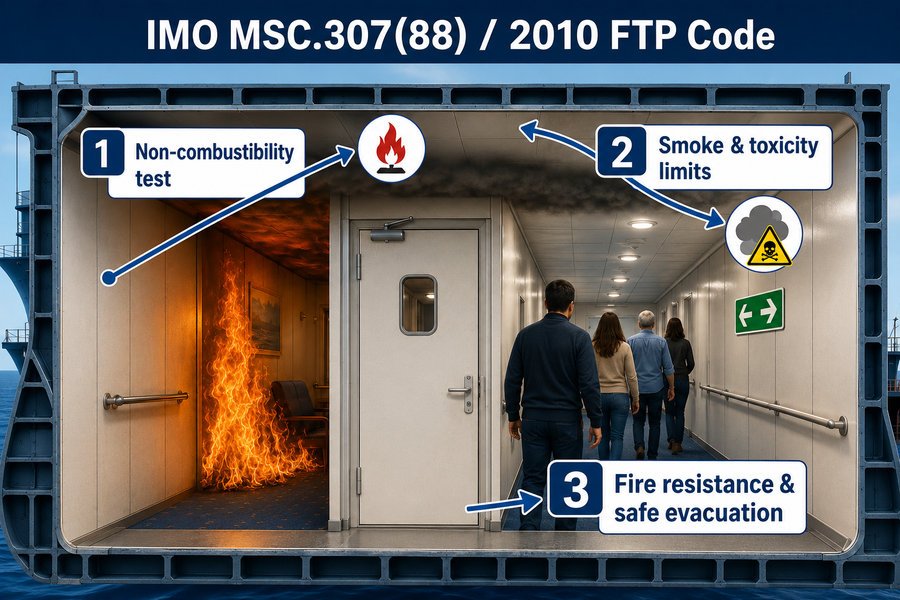
IMO MSC.307(88), known as the 2010 FTP Code, mandates strict fire testing procedures for marine interior panels. It applies comprehensively by dictating non-combustibility, smoke toxicity, and fire resistance standards for bulkheads, ceilings, and doors to ensure safe evacuation and fire containment on all commercial vessels.
Many buyers struggle with these strict rules. If you ignore them, your panels will fail shipyard inspections, costing you time and money. Let me break down exactly how this code impacts your marine panel purchases.
What Does MSC.307(88) Require For Marine Panel Fire Testing?
Failed panel tests mean ruined project schedules. You need to know the exact testing demands. MSC.307(88) requires three main tests for panels.
MSC.307(88) requires marine interior panels to pass three distinct tests: non-combustibility testing for core materials (Part 1), smoke and toxicity limits for surface finishes (Part 2), and structural fire resistance for A, B, or F class divisions (Part 3). All three ensure total fire safety.
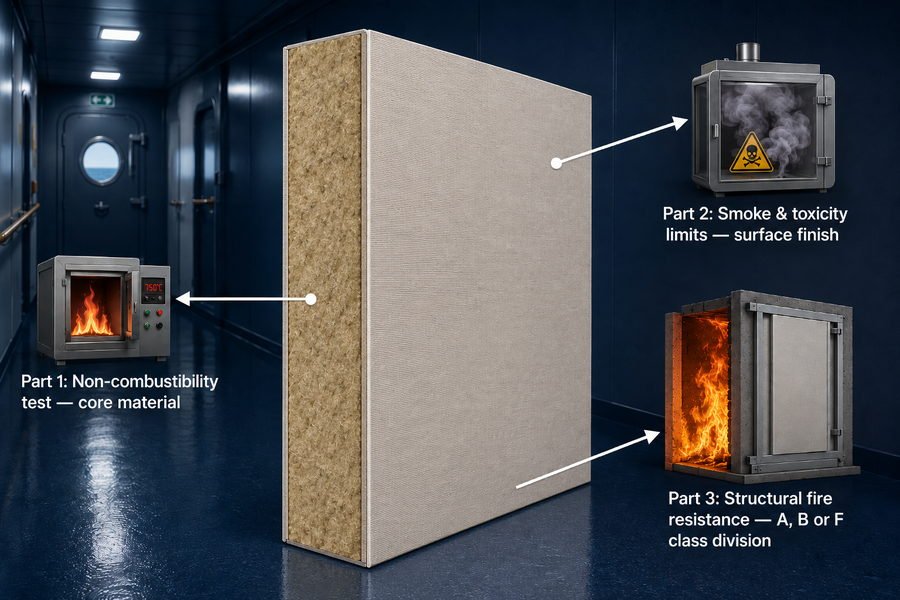
When I worked at the marine outfitting factory, I saw many panels fail in the lab. Testing is brutal. The IMO MSC.307(88) document outlines three specific hurdles1 every panel must jump over. We will look at all three parts mentioned above.
Non-Combustibility Testing for Panel Core Materials (Part 1)
The first test targets the core material, like rockwool. Under Part 1 of the code, a lab places a sample into a furnace heated to 750°C2. The core cannot burn. It cannot raise the furnace temperature by more than 30°C. If the rockwool loses more than 50% of its mass, it fails. The lab measures this precisely. I always tell buyers to ask for 120 kg/m3 density rockwool because it passes this test easily.
Smoke and Toxicity Limits for Surface Finishes (Part 2)
The second test looks at the surface finishes, like PVC films or painted steel. Part 2 dictates that these veneers must not release toxic gas when they burn. The code sets hard limits.3 For example, the test measures Carbon Monoxide (CO). The limit is 1450 parts per million (ppm). It also measures Hydrogen Chloride (HCl), which must stay below 600 ppm. If your panel uses cheap PVC film, it will exceed these limits. People die from toxic smoke before the fire reaches them. This test stops that.
Structural Fire Resistance for Marine Divisions (Part 3)
The third test checks the whole panel assembly. Part 3 places a full-size bulkhead in a massive furnace. The lab fires burners to follow a standard time-temperature curve4. For an A-Class panel, the test lasts 60 minutes, and the furnace reaches 945°C. For a B-Class panel, the test lasts 30 minutes, reaching 842°C. The unexposed side of the panel cannot get hotter than 140°C on average. If smoke or flames pass through the joints, the panel fails.
| MSC.307(88) Test Part | Component Tested | Key Passing Criteria (According to IMO) |
|---|---|---|
| Part 1: Non-Combustibility | Rockwool or Ceramic Core | Max 30°C temp rise at 750°C furnace heat |
| Part 2: Smoke & Toxicity | PVC Film or Paint Veneer | CO < 1450 ppm, HCl < 600 ppm, HF < 600 ppm |
| Part 3: Fire Resistance | Full Panel Assembly | Unexposed face temp rise < 140°C average |
Why Is The 2010 FTP Code Mandatory For Marine Panel Suppliers?
Buying cheap, uncertified panels looks good until the shipyard rejects them. Your profit vanishes instantly. The 2010 FTP Code is legally mandatory for international shipping.
The 2010 FTP Code is mandatory because SOLAS Chapter II-2 legally binds all 175 IMO member states to enforce it. Marine panel suppliers must comply to receive Type Approval certificates from classification societies, which shipyards legally require before allowing any panel installation on commercial vessels.
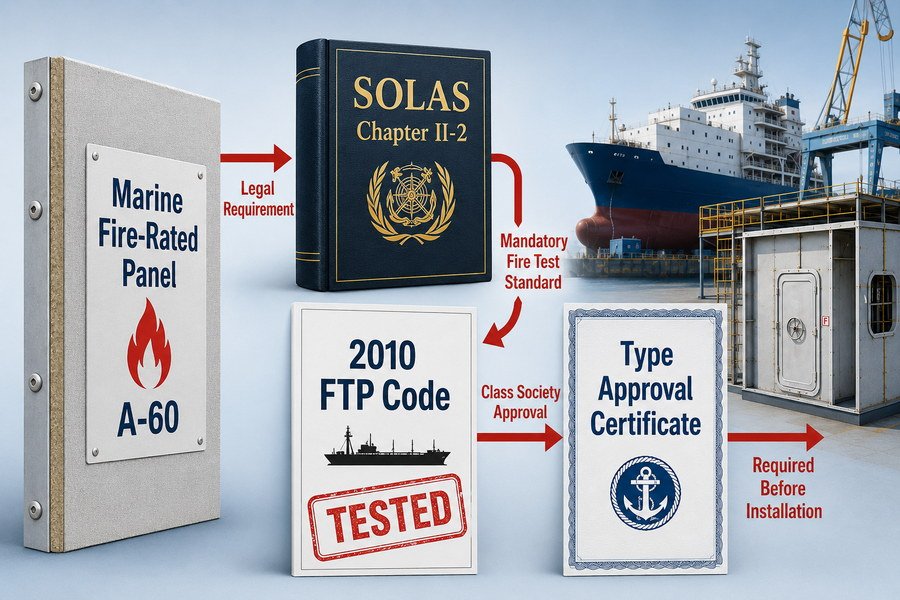
You cannot choose to ignore the 2010 FTP Code. The rules are not suggestions. The entire marine industry relies on a strict legal framework. I spend a lot of time explaining this chain of command to new buyers. We must look at the two main reasons the code is mandatory: SOLAS law and Classification Society rules.
Legal Enforcement Under SOLAS Chapter II-2
The International Maritime Organization (IMO) created the Safety of Life at Sea (SOLAS) convention. SOLAS Chapter II-2 focuses on fire protection. This chapter explicitly states that the 2010 FTP Code (MSC.307(88)) is the required testing standard5. There are 175 member states in the IMO. This means countries like the United States, China, and Germany write this code into their national laws. If a ship flies their flag, it must follow SOLAS. If you supply panels to a shipyard building an international vessel, you must provide materials that meet this international law. There is no loophole.
Classification Society Type Approval Process
Shipyards do not test panels themselves. They rely on classification societies like DNV, ABS, or Lloyd's Register. These societies act as the police for SOLAS. A panel supplier must send their panels to an approved lab. The lab tests the panels according to the 2010 FTP Code. If the panel passes, the classification society issues a Type Approval Certificate. Shipyards demand this certificate. Without a Type Approval based on the 2010 FTP Code, the shipyard cannot legally install your panel. If they do, the classification surveyor will fail the final ship inspection. A delayed ship costs the shipyard up to $50,000 per day in penalties.6 They will not risk this for your uncertified panels.
| Authority Level | Role in Enforcement | Impact on Panel Buyer |
|---|---|---|
| IMO (SOLAS Chapter II-2) | Creates the international legal requirement | Sets the global baseline you must meet |
| Flag States (175 Countries) | Enforces IMO laws locally | Can detain ships with non-compliant panels |
| Classification Societies (DNV, ABS) | Issues Type Approval based on tests | You must provide their certificates |
| Shipyards | Buys and installs the panels | Will reject panels without valid certificates |
Which Annexes Of MSC.307(88) Cover Marine Bulkhead And Ceiling Materials?
Digging through dense maritime codes wastes your valuable time. You just want to know where to look. MSC.307(88) has specific annex parts for panels.
Marine bulkhead and ceiling materials are governed entirely by Annex 1 of MSC.307(88), specifically Part 1 for non-combustible cores, Part 2 for low smoke and toxicity surface veneers, Part 3 for A/B Class division fire resistance, and Part 5 for surface flammability testing.
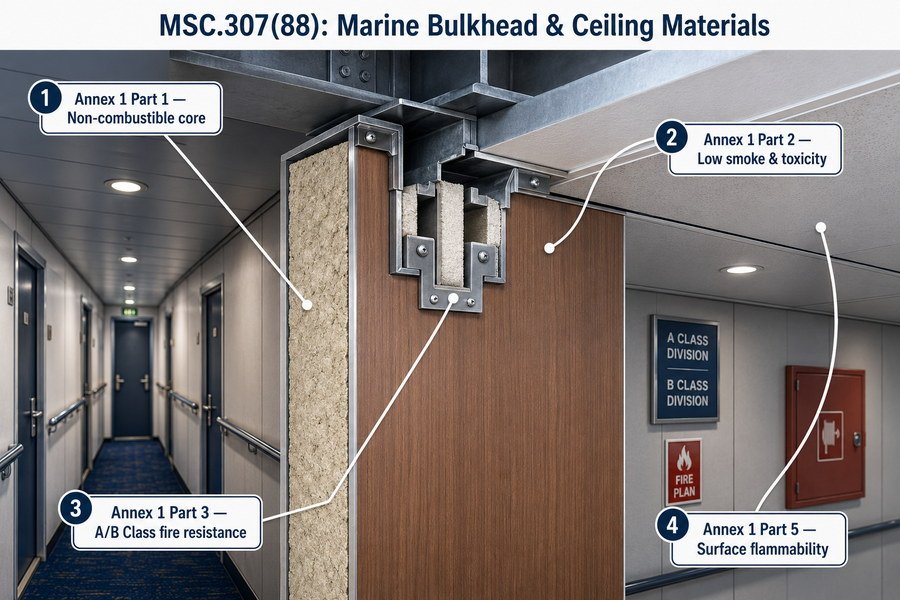
When you read a test report, you will see references to Annex 1. MSC.307(88) contains many rules for things like lifeboats or fire extinguishers, but panel buyers only care about Annex 1. This annex breaks down into specific parts. I will explain the four parts that dictate how we manufacture bulkheads and ceilings.
Annex 1 Part 1 and Part 3 for Core and Structural Integrity
We use Part 1 and Part 3 to test the core strength and fire stopping power. Part 1 is the Non-combustibility test. We only test the raw inner material here. For a standard 50mm marine bulkhead, this is usually mineral wool. The test proves the wool will not catch fire. Part 3 is the Test for A, B, and F class divisions. This tests the whole panel system, including the steel skins, the core, and the joint profiles. We build a massive 2.44m by 2.5m wall in the lab. The lab burns it to see if the joints hold up. This proves the bulkhead will stop fire from moving between cabins.
Annex 1 Part 2 and Part 5 for Surface Veneer Safety
We use Part 2 and Part 5 to test the decorative finish. Shipowners want panels that look like wood or marble. We apply PVC films to steel sheets to achieve this. Part 2 tests Smoke and toxicity. The lab burns the PVC film and measures the deadly gases. Part 5 tests Surface flammability. The lab measures how fast flames travel across the surface of the PVC film. The code requires a Critical Flux at Extinguishment (CFE) of at least 20 kW/m27. This means the surface needs a lot of heat to keep burning. If the flame spreads too fast, the panel fails Part 5.
| Annex 1 Section | Target Component | Purpose of Test |
|---|---|---|
| Part 1 | Mineral Wool / Ceramic Core | Proves the inner material will not ignite |
| Part 2 | PVC Film / Decorative Veneer | Proves the surface will not gas passengers |
| Part 3 | Complete Bulkhead / Ceiling | Proves the assembled wall stops fire spread |
| Part 5 | PVC Film / Decorative Veneer | Proves flames will not spread across the wall |
How Does MSC.307(88) Supersede Earlier Marine Panel Fire Tests?
Holding outdated test reports is a trap. You think you are compliant, but inspectors will fine you. MSC.307(88) introduces much stricter rules than older codes.
MSC.307(88) supersedes the older 1998 FTP Code by mandating updated test furnace calibration, introducing stricter smoke toxicity limits for modern synthetic veneers, and demanding longer test durations for B-class panel doors. It legally invalidated all old 1998 test approvals after July 1, 2012.
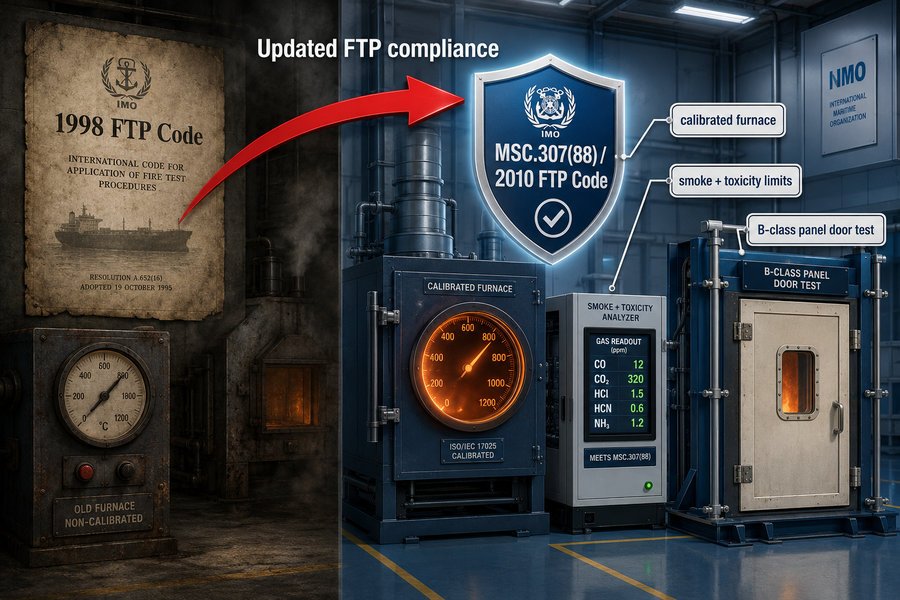
A client once showed me a cheap price from a supplier. I looked at their certificate. It referenced the old 1998 FTP Code. I told the client to run away. The IMO replaced the 1998 code with MSC.307(88) (the 2010 FTP Code) for very specific technical and legal reasons. We must look at the three major changes the new code brought to panel testing.
Upgraded Furnace Calibration for Accurate Panel Testing
The biggest technical change was how labs measure heat. Under the old 1998 code, labs used basic thermocouples inside the test furnace. These sensors measured air temperature. But fire also creates radiant heat, which damages panels quickly. MSC.307(88) forces labs to use plate thermometers. Plate thermometers measure both air temperature and radiant heat.8 This creates a much harsher, more realistic fire environment in the lab. A panel that passed in 1998 might easily fail the plate thermometer test today because the heat data is now accurate and strict.
Stricter Limits on Modern Synthetic Panel Veneers
In 1998, cabins used simple materials. By 2010, the industry used heavy plastics and modern synthetic veneers. These materials create toxic smoke. MSC.307(88) introduced stricter gas limits. It specifically tightened the rules for Nitrogen Oxides (NOx) and Hydrogen Cyanide (HCN). The old code allowed some dangerous materials to pass. The new code catches them.
Invalidation of 1998 FTP Code Approvals and B-Class Changes
The IMO gave the industry a deadline. Any Type Approval certificate based on the 1998 FTP Code became invalid for ships whose keels were laid on or after July 1, 2012.9 Additionally, the new code changed testing for B-Class doors built into panels. The old code stopped the door test at 30 minutes. The new code requires labs to keep measuring the unexposed face temperature for a full 36 minutes, making it harder to pass.
| Feature | Old 1998 FTP Code | New 2010 FTP Code (MSC.307(88)) |
|---|---|---|
| Heat Measurement | Standard Thermocouples | Plate Thermometers (More accurate) |
| Toxicity Rules | Basic limits | Stricter limits for synthetic plastics |
| B-Class Door Temp | Measured to 30 mins | Measured to 36 mins |
| Legal Status | Invalid after July 1, 2012 | Current mandatory standard |
What Documents Prove Marine Panel Compliance With MSC.307(88)?
Missing paperwork stops port clearance immediately. Your panels will sit in the warehouse. You need three specific documents to prove MSC.307(88) compliance.
To prove MSC.307(88) compliance, marine panel suppliers must provide three mandatory documents: a valid Type Approval Certificate (Module B) from a recognized classification society, a Quality System Certificate (Module D) or batch test report, and a detailed Fire Test Report from an IMO-approved independent laboratory.
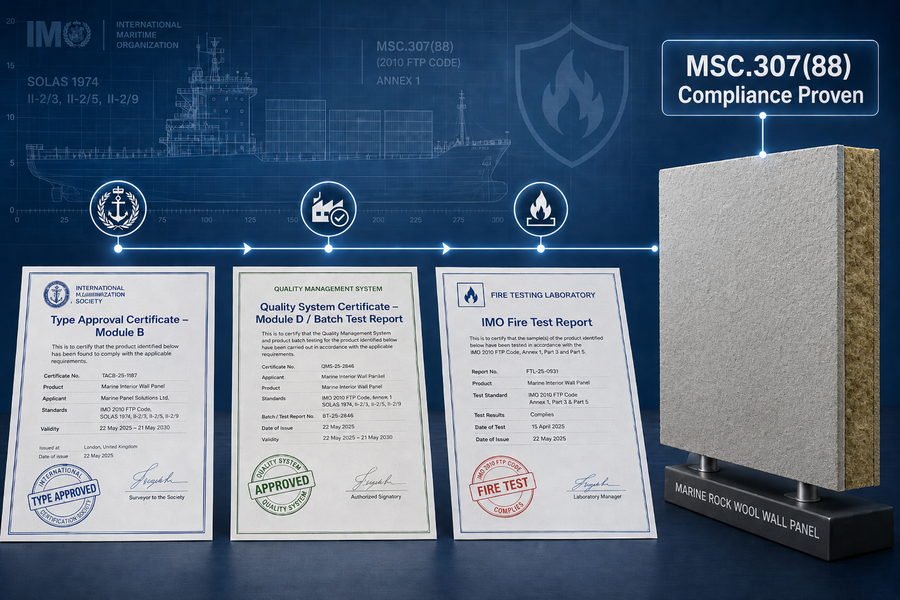
You cannot just tell a shipyard your panels are safe. You must show them the paper trail. I spend hours checking documents for my clients. If one page is missing or expired, the deal dies. When you buy marine panels, you must ask the supplier for all three of these documents. Let us review each one.
The Module B Type Approval Certificate for Marine Panels
The first document is the Type Approval Certificate, often called Module B under the Marine Equipment Directive (MED). This is a 2 to 4-page summary. A classification society, like DNV or Bureau Veritas, issues it. The certificate states the supplier's name, the product name (e.g., "50mm B-15 Wall Panel"), and explicitly lists "IMO MSC.307(88)" under the testing standards. This document is valid for exactly 5 years from the date of issue. You must check the expiration date. If it is expired, the document is worthless.
The Module D Quality System Certificate for Production
Passing a fire test once is easy. Building 10,000 safe panels is hard. The Module D Quality System Certificate proves the factory has strict quality control. A surveyor visits the factory every year10. They check if the factory uses the exact same rockwool and steel that passed the lab test. If the factory does not have a Module D certificate, they must hire a surveyor to test every single batch of panels before shipping. This is called a Module F certificate. Without Module D or Module F, the shipyard will reject the panels.
The Detailed Fire Test Report from Approved Labs
The Module B certificate is just a summary. The detailed Fire Test Report is the raw data. This document is usually 30 to 50 pages long. An independent, IMO-approved testing lab, like Far East Fire Testing Centre, issues it. It contains graphs showing the furnace temperatures11, photographs of the burnt panel, and exact measurements of the toxic gases. Smart shipyard engineers will read this full report to make sure the supplier did not cheat on the panel drawings.
| Required Document | Issued By | Purpose | Validity Period |
|---|---|---|---|
| Type Approval (Module B) | Classification Society (e.g., DNV) | Certifies the design meets MSC.307(88) | 5 Years |
| Quality System (Module D) | Classification Society (e.g., DNV) | Certifies the factory builds it right | Usually 3 Years |
| Fire Test Report | Independent IMO Lab | Provides the exact raw testing data | Permanent for that specific design |
Why Do Shipyards Reject Marine Panel Reports Predating MSC.307(88)?
Getting a rejected delivery notice is a nightmare. Shipyards do not negotiate on safety rules. They reject old reports for three absolute legal and technical reasons.
Shipyards reject marine panel reports predating MSC.307(88) because older 1998 certificates are legally void for ships built after July 2012, older tests lacked modern plate thermometer calibration causing unreliable heat data, and port state control will detain ships holding invalid fire safety documentation.
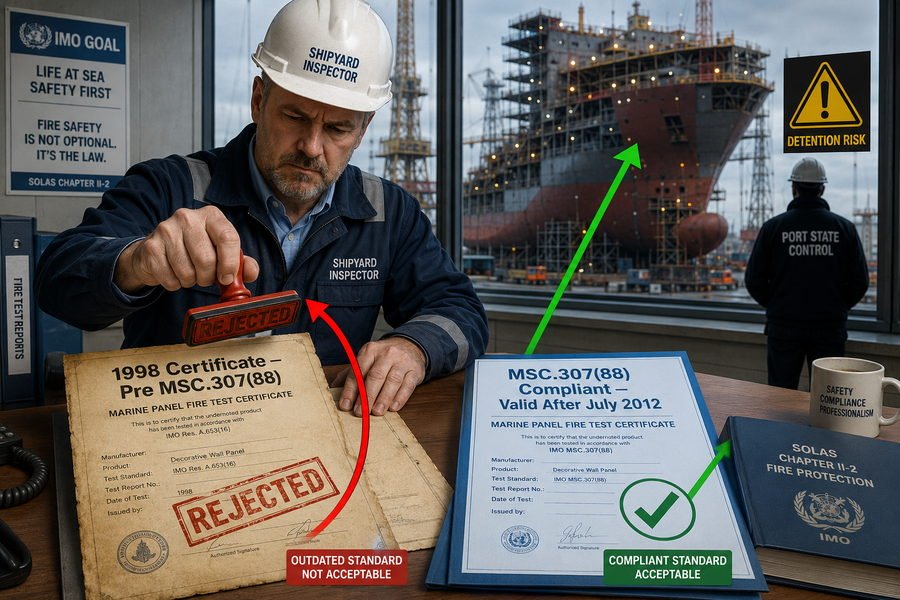
A supplier might try to sell you discounted panels with an old test report from 2009. They will say, "Fire is fire, the old test is fine." They are lying. I have seen shipyards rip out entire corridors of installed panels because the paperwork was old. It cost the contractor tens of thousands of dollars. Shipyards reject old reports based on the 1998 FTP code because they face severe legal and technical risks. We will cover the three main reasons.
Legal Void Status of Pre-2012 Marine Panel Certificates
The law is completely clear. The IMO declared that any ship with a keel-laying date on or after July 1, 2012, must use materials tested to MSC.307(88)12. A shipyard building a new vessel today cannot legally accept a 1998 FTP code certificate. The classification surveyor at the shipyard will review the document package. If they see the old 1998 standard, they will immediately stamp "REJECTED" on the file. They cannot sign the final ship safety certificate.
Flawed Heat Data from Outdated Test Calibration Methods
Shipyard engineers know that the old 1998 tests were weaker. As I explained earlier, the old tests used air thermocouples13. These sensors missed the intense radiant heat inside a real ship fire. Shipyards know that a panel tested in 1999 might actually fail after 20 minutes in a modern test. Shipowners want safe ships. Shipyards refuse to install panels with questionable fire resistance, even if the supplier claims the panels are identical to the old tested design.
Risk of Ship Detention by Port State Control (PSC)
When a ship enters a foreign port, inspectors from Port State Control (PSC) board the vessel. They check fire safety documents. If they find the ship was built in 2024 but has panels certified only to the 1998 code, they declare the ship unseaworthy. They will detain the vessel. The shipowner loses thousands of dollars every day the ship sits in port. The shipyard gets sued. To prevent this, the shipyard stops the problem at the gate. They simply reject any panel lacking MSC.307(88) proof.
| Rejection Reason | Cause | Consequence for the Project |
|---|---|---|
| Legally Void | IMO set July 1, 2012 cut-off for old rules | Classification society fails the ship |
| Weak Technical Data | Old tests missed radiant heat measurements | Shipyard engineers reject the product |
| PSC Detention Risk | Port inspectors check for valid 2010 code | Shipowner sues shipyard for delays |
Conclusion
MSC.307(88) is strictly enforced for marine panels. Always verify the 2010 FTP Code on Type Approval certificates to guarantee safety, ensure shipyard acceptance, and protect your investments.
-
"What Is the Purpose and Scope of the IMO FTP Code? - Magellan ...", https://magellanmarinetech.com/what-purpose-scope-of-imo-ftp-code/. The 2010 IMO FTP Code, adopted by MSC.307(88), organizes fire-test procedures into numbered parts including non-combustibility, smoke and toxicity, and fire-resistance tests, supporting the article’s framing of three relevant test categories. Evidence role: historical_context; source type: institution. Supports: IMO MSC.307(88) includes test procedures for non-combustibility, smoke and toxicity, and fire resistance that are relevant to marine panel approval.. Scope note: The Code contains more than these three parts overall; the source supports that these are three applicable parts, not that they are the only tests relevant to every panel. ↩
-
"[PDF] RESOLUTION MSC.307(88) (adopted on 3 December 2010 ...", https://wwwcdn.imo.org/localresources/en/KnowledgeCentre/IndexofIMOResolutions/MSCResolutions/MSC.307(88).pdf. The IMO FTP Code Part 1 non-combustibility procedure specifies exposure of specimens in a furnace at approximately 750°C and evaluates criteria including furnace temperature rise and mass loss, supporting the stated test conditions. Evidence role: definition; source type: institution. Supports: Part 1 non-combustibility testing places a sample in a 750°C furnace and applies temperature-rise and mass-loss pass/fail criteria.. Scope note: The citation verifies the standardized test method and criteria; it does not prove that any specific rockwool product will pass. ↩
-
"[PDF] RESOLUTION MSC.307(88) (adopted on 3 December 2010 ...", https://wwwcdn.imo.org/localresources/en/KnowledgeCentre/IndexofIMOResolutions/MSCResolutions/MSC.307(88).pdf. The IMO FTP Code Part 2 smoke and toxicity test sets maximum allowable gas concentrations for combustion products, including limits for carbon monoxide and hydrogen chloride, supporting the claim that surface materials are assessed against fixed toxicity thresholds. Evidence role: definition; source type: institution. Supports: Part 2 of the IMO FTP Code sets maximum permitted concentrations for toxic gases such as CO and HCl during smoke and toxicity testing.. Scope note: The source supports the existence of fixed limits under the test; it does not establish that all PVC films, or any particular inexpensive film, exceed them. ↩
-
"[PDF] RESOLUTION MSC.307(88) (adopted on 3 December 2010 ...", https://wwwcdn.imo.org/localresources/en/KnowledgeCentre/IndexofIMOResolutions/MSCResolutions/MSC.307(88).pdf. The IMO FTP Code fire-resistance procedure uses a standard furnace time-temperature curve and classification criteria for A- and B-class divisions, including limits on unexposed-face temperature rise, supporting the described assembly-level fire-resistance test. Evidence role: definition; source type: institution. Supports: Part 3 fire-resistance testing exposes full panel assemblies to a standard time-temperature furnace curve and applies A- and B-class duration and temperature-rise criteria.. Scope note: The citation supports the standardized curve and classification criteria; it does not verify the performance of any specific panel assembly unless paired with that assembly’s test report. ↩
-
"[PDF] RESOLUTION MSC.307(88) (adopted on 3 December 2010 ...", https://wwwcdn.imo.org/localresources/en/KnowledgeCentre/IndexofIMOResolutions/MSCResolutions/MSC.307(88).pdf. The IMO’s SOLAS Chapter II-2 and the International Code for Application of Fire Test Procedures identify the FTP Code as the framework for prescribed fire-test procedures for relevant ship materials and assemblies. Evidence role: definition; source type: institution. Supports: SOLAS Chapter II-2 requires use of the 2010 FTP Code as the fire-testing standard for covered ship materials.. Scope note: The source supports the regulatory role of the FTP Code generally; applicability to a specific panel depends on the product’s intended shipboard use and installation category. ↩
-
"Subpart 11.5 - Liquidated Damages - Acquisition.GOV", https://www.acquisition.gov/far/subpart-11.5. Maritime law and shipbuilding-contract sources describe daily liquidated damages for delayed vessel delivery, sometimes reaching substantial five-figure daily sums depending on vessel type and contract terms. Evidence role: statistic; source type: paper. Supports: Ship delivery delays can expose shipyards to high daily contractual penalties, potentially up to about USD 50,000 per day in some contracts.. Scope note: The cited source may establish the plausibility or common contractual mechanism for delay penalties, but a universal USD 50,000-per-day figure would require contract-specific evidence. ↩
-
"[PDF] RESOLUTION MSC.307(88) (adopted on 3 December 2010 ...", https://wwwcdn.imo.org/localresources/en/KnowledgeCentre/IndexofIMOResolutions/MSCResolutions/MSC.307(88).pdf. The 2010 IMO FTP Code, Annex 1, Part 5 sets criteria for surface flammability testing of bulkhead, wall, and ceiling linings, including a critical flux at extinguishment threshold, which provides regulatory context for the stated 20 kW/m² requirement. Evidence role: general_support; source type: institution. Supports: Part 5 surface flammability testing can require a Critical Flux at Extinguishment value of at least 20 kW/m² for relevant marine interior surface materials.. Scope note: The threshold can depend on material category and application within the FTP Code tables, so the citation should be checked against the specific product use case. ↩
-
"[PDF] RESOLUTION MSC.307(88) (adopted on 3 December 2010 ...", https://wwwcdn.imo.org/localresources/en/KnowledgeCentre/IndexofIMOResolutions/MSCResolutions/MSC.307(88).pdf. A technical source on fire-resistance furnace instrumentation explains that plate thermometers are designed to respond to the combined convective and radiative heat transfer conditions in a furnace, supporting the distinction from air-temperature-only thermocouple readings. Evidence role: mechanism; source type: paper. Supports: Plate thermometers measure both air temperature and radiant heat rather than only furnace air temperature.. Scope note: This supports the heat-measurement mechanism generally; it may not by itself prove every comparative statement about pass/fail outcomes under the 1998 and 2010 FTP Codes. ↩
-
"[PDF] RESOLUTION MSC.307(88) (adopted on 3 December 2010 ...", https://wwwcdn.imo.org/localresources/en/KnowledgeCentre/IndexofIMOResolutions/MSCResolutions/MSC.307(88).pdf. The IMO 2010 FTP Code adoption materials and related SOLAS implementation guidance identify 1 July 2012 as the application date for the revised FTP Code, supporting the article’s statement about the transition from approvals based on the 1998 FTP Code for newly constructed ships. Evidence role: historical_context; source type: institution. Supports: Type approvals based on the 1998 FTP Code were no longer applicable for ships with keels laid on or after 1 July 2012.. Scope note: The source should be checked for the precise legal wording on certificate validity, because application dates and certificate invalidation rules may depend on flag-state implementation and product approval scope. ↩
-
"[PDF] Medical Device Single Audit Program Frequently Asked Questions", https://www.fda.gov/media/90179/download. Directive 2014/90/EU, Annex II, Module D describes production-quality-assurance surveillance by a notified body and requires periodic audits at least once every 12 months, supporting the statement that annual factory surveillance is part of Module D certification. Evidence role: definition; source type: government. Supports: Module D production quality assurance involves annual notified-body surveillance of the factory quality system.. Scope note: The Directive supports annual audits of the quality system; it does not independently confirm that every audit checks the exact rockwool and steel used in the original test. ↩
-
"[PDF] RESOLUTION MSC.307(88) (adopted on 3 December 2010 ...", https://wwwcdn.imo.org/localresources/en/KnowledgeCentre/IndexofIMOResolutions/MSCResolutions/MSC.307(88).pdf. IMO Resolution MSC.307(88), the 2010 FTP Code, prescribes fire-resistance test procedures with furnace temperature-time control and temperature measurement requirements, supporting the expectation that a detailed fire test report includes furnace-temperature data. Evidence role: mechanism; source type: institution. Supports: Detailed fire test reports for MED fire-resisting divisions include furnace-temperature data required by the IMO FTP Code test procedure.. Scope note: This directly supports the need for furnace-temperature data, but not the article’s separate assertions about report length, photographs, or toxic-gas measurements for every marine panel test. ↩
-
"[PDF] RESOLUTION MSC.307(88) (adopted on 3 December 2010 ...", https://wwwcdn.imo.org/localresources/en/KnowledgeCentre/IndexofIMOResolutions/MSCResolutions/MSC.307(88).pdf. IMO Resolution MSC.307(88) adopted the 2010 FTP Code, which entered into force under SOLAS fire-safety requirements on 1 July 2012 and applies to new ships from that regulatory cut-off; this supports the date-based requirement, although acceptance or rejection of a specific certificate is administered by flag states and recognized organizations rather than by the IMO itself. Evidence role: historical_context; source type: institution. Supports: Ships with a keel-laying date on or after July 1, 2012, must comply with the 2010 FTP Code adopted by MSC.307(88), rather than relying only on pre-2012 FTP approvals.. Scope note: The source supports the regulatory cut-off and mandatory status of the 2010 FTP Code, but not the article’s stronger procedural claim that every shipyard or surveyor will reject a given document in the same way. ↩
-
"[PDF] RESOLUTION MSC.307(88) (adopted on 3 December 2010 ...", https://wwwcdn.imo.org/localresources/en/KnowledgeCentre/IndexofIMOResolutions/MSCResolutions/MSC.307(88).pdf. Comparative technical discussions of the 1998 and 2010 FTP Code fire-resistance test procedures note changes in furnace temperature measurement and calibration practices, including the use of plate thermometers in the revised regime; this supports the claim that the older procedure differed materially in heat-exposure measurement, though it does not by itself prove that every product certified under the older code would fail a modern test. Evidence role: mechanism; source type: paper. Supports: The pre-2012 fire test procedure used older temperature-measurement methods that differed from the revised MSC.307(88) test calibration approach.. Scope note: The evidence should be used to substantiate the technical difference in test instrumentation, not the broader assertion that old tests were categorically weaker or that specific panels would fail after a stated time. ↩