Are your marine panels failing shipyard inspections despite holding IMO certificates? This frustration happens when buyers ignore flag state rules. Here is how flag authorities reshape your compliance strategy.
Flag state rules affect marine panel compliance by imposing stricter national safety laws over the IMO FTP Code baseline. They mandate unique local testing, require additional quality audits, restrict specific core materials, and enforce specialized environmental standards that dictate the final approval for vessel interior outfitting.
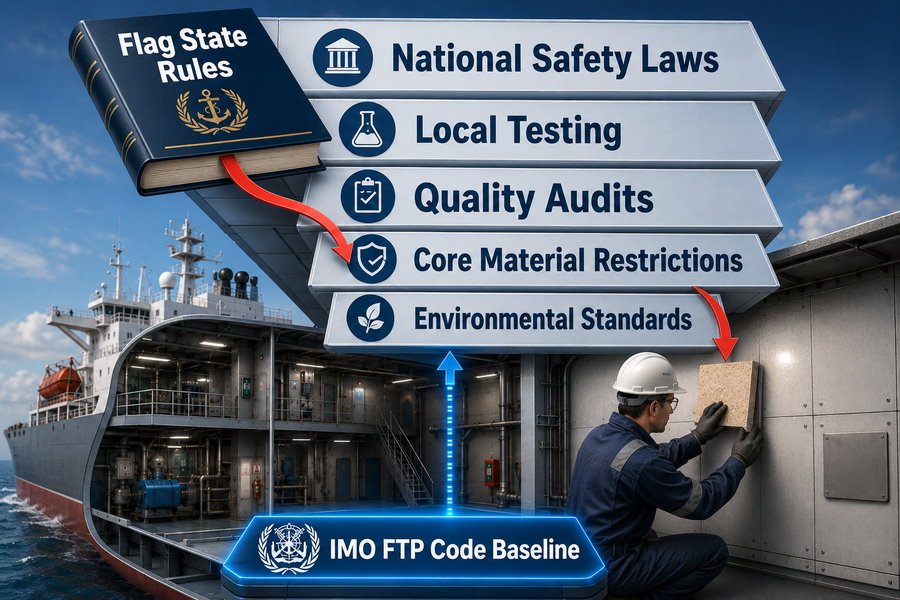
Let us look closely at how different flag states enforce their own rules so you can avoid costly delays.
Why Do Flag States Add Rules on Marine Panels Above IMO Baselines?
Do you wonder why a valid IMO type approval is sometimes not enough? Missing local rules will pause your shipyard project. Here are the true drivers behind these extra demands.
Flag states add rules above IMO baselines to address local extreme weather risks, align with national environmental protection laws, mitigate specific historical passenger vessel accidents, and enforce domestic labor regulations regarding crew accommodation sizes and acoustic insulation requirements.
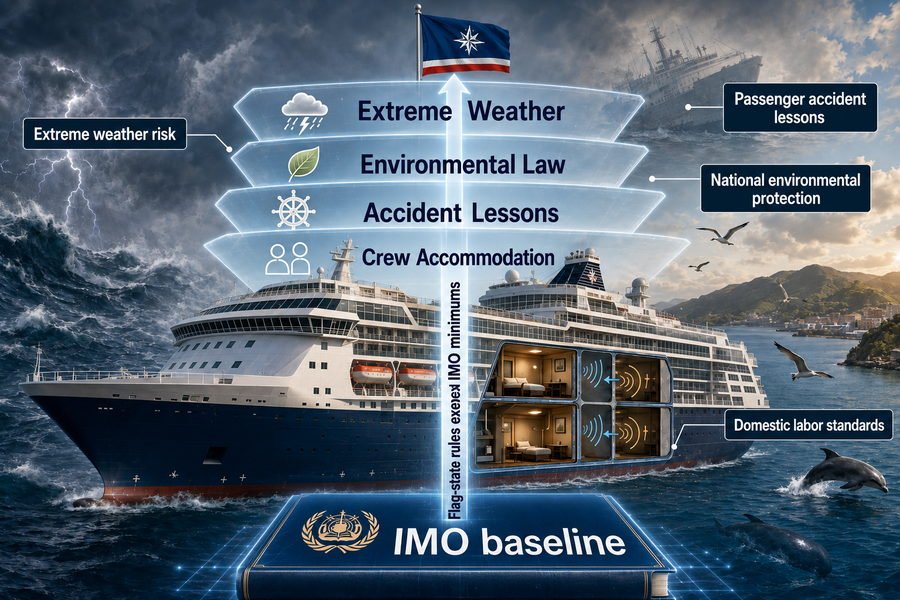
The International Maritime Organization (IMO) creates the absolute minimum safety floor for global shipping. However, a flag state acts as the ultimate legal authority for any ship flying its flag1. If the IMO is the foundation, the flag state is the entire house. I have seen many buyers purchase marine wall panels that easily pass IMO Fire Test Procedures (FTP) Code Part 3 for B-15 fire resistance, only to have them rejected by a European flag state inspector. This happens because individual countries have different sovereign priorities.
Addressing Local Weather Risks and Historical Accidents
First, flag states add rules to combat local extreme weather risks. For example, vessels operating under the Canadian or Russian flags often face Arctic conditions2. These states demand that marine panels endure extreme low temperatures without losing structural integrity or fire resistance. They require specific thermal insulation values that exceed the basic SOLAS Chapter II-2 baseline.
Second, historical passenger vessel accidents force flag states to react swiftly. Following severe ferry fires in their domestic waters3, some European states implemented stricter surface flammability rules than the IMO FTP Code Part 5. They do not wait for the IMO to update global codes; they immediately protect their citizens by demanding lower smoke toxicity and slower flame spread speeds for interior finishes.
Enforcing Environmental Laws and Domestic Labor Regulations
Third, national environmental protection laws play a massive role. The IMO focuses heavily on fire safety, but many flag states also restrict the chemical composition of the panels. Some states strictly prohibit the use of certain adhesives or formaldehyde-emitting binders in rock wool cores, demanding VOC (Volatile Organic Compound) emissions testing that the IMO does not require.
Finally, domestic labor regulations directly shape panel specifications4. Flag states care deeply about crew welfare. According to national labor codes, they enforce strict acoustic insulation requirements to reduce machinery noise in crew cabins. This means a standard IMO-approved 50mm marine panel might fail a flag state inspection if it only offers 30 dB sound reduction when the national labor law demands 35 dB.
| Flag State Rule Driver | Typical Addition Beyond IMO Baseline | Example Affected Panel Property | Authoritative Standard Reference |
|---|---|---|---|
| Extreme Weather Risks | Mandatory cold-weather thermal retention tests | Thermal conductivity (U-value) | Polar Code / National Ice Class rules |
| Historical Accidents | Lower smoke toxicity limits | Calorific value < 45 MJ/m² | Local fire safety ordinances |
| Environmental Laws | Zero formaldehyde emissions | VOC content in adhesives | National EPA or REACH equivalents |
| Domestic Labor Rules | Minimum acoustic reduction for crew cabins | Airborne sound insulation (Rw > 35 dB) | Maritime Labour Convention (MLC 2006) variations |
How Do USCG Rules for Marine Panels Differ From IMO Standards?
Are you trying to sell marine panels to a United States shipyard? Using only an IMO certificate will cause instant rejection. Here is how USCG standards differ.
USCG rules differ from IMO standards by enforcing the Code of Federal Regulations (CFR) Subchapter Q, demanding independent Coast Guard type approval, restricting alternative design equivalence, and requiring stricter fire testing procedures for domestic vessels that often reject standard MED Wheelmark or Mutual Recognition Agreement certificates.
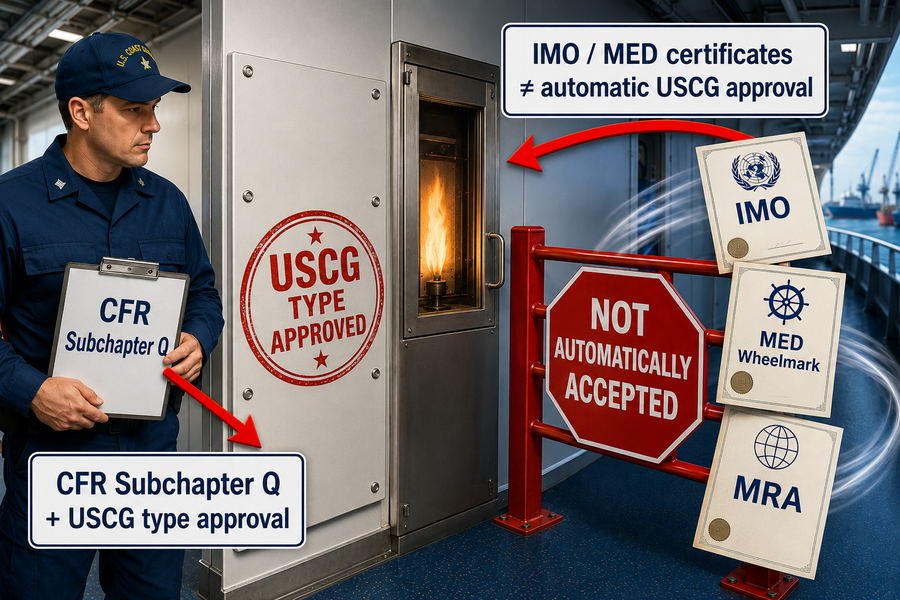
When dealing with shipyards in the United States, I always warn buyers that the United States Coast Guard (USCG) operates its own strict regulatory universe. You cannot simply present an IMO FTP Code certificate and expect approval. The USCG enforces its own domestic laws, and understanding these differences is critical for your procurement success.
CFR Subchapter Q and Independent Type Approval
The most fundamental difference is that the USCG enforces Title 46 of the Code of Federal Regulations (CFR), specifically Subchapter Q5. While SOLAS and the IMO FTP Code are international treaties, the CFR is domestic US law. For example, under 46 CFR 164.007 for structural insulations, the material must prevent the average temperature rise on the unexposed side from exceeding 139°C (250°F) during a 60-minute test6. This is slightly different from the IMO FTP Code's 140°C limit.
Furthermore, the USCG demands independent Coast Guard type approval. Even if your panel has a European MED Wheelmark, the USCG will not automatically accept it for a vessel operating solely in US domestic waters. The manufacturer must apply directly to the USCG, submit test reports from a USCG-accepted laboratory, and obtain an official USCG Certificate of Approval.7
Restricting Equivalence and Stricter Domestic Testing
Another major difference lies in how the USCG handles alternative design equivalence. The IMO SOLAS Regulation II-2/17 allows ship designers to use performance-based engineering to deviate from prescriptive rules. The USCG, however, accepts these SOLAS equivalencies on a very limited basis. They rely heavily on proven, prescriptive arrangements outlined in the CFR.
Finally, the USCG requires stricter fire testing procedures for domestic vessels. For ships that do not travel internationally, the USCG often rejects standard Mutual Recognition Agreement (MRA) certificates. As clearly stated in the Coast Guard NVIC 9-97 guidelines, fire testing criteria in 46 CFR Subchapter Q are not identical to the FTP Code or MRA requirements8. Therefore, panels with only MRA type approval under the FTP Code are not acceptable on vessels requiring strict domestic SOLAS compliance.
| Feature Comparison | IMO FTP Code Standards | USCG 46 CFR Subchapter Q Rules |
|---|---|---|
| Core Legal Framework | International Treaty (SOLAS) | United States Domestic Law |
| Standard Temperature Limit | 140°C average rise | 139°C (250°F) average rise |
| Alternative Designs | Broadly allowed under SOLAS II-2/17 | Restricted; heavily favors prescriptive rules |
| Mutual Recognition (MRA) | Widely accepted globally | Often rejected for strictly domestic US vessels |
Why Do Nordic Flags Demand Stricter Marine Panel Specs Than IMO?
Do you find selling panels to Norwegian or Swedish shipyards difficult? Standard panels often fail their harsh technical reviews. Here is why Nordic countries demand much more.
Nordic flags demand stricter marine panel specs than IMO to ensure survival in harsh Arctic climates, enforce rigorous domestic environmental sustainability laws, support high standards of crew welfare through superior noise reduction, and mandate elite fire safety protocols driven by the offshore oil and gas industry.
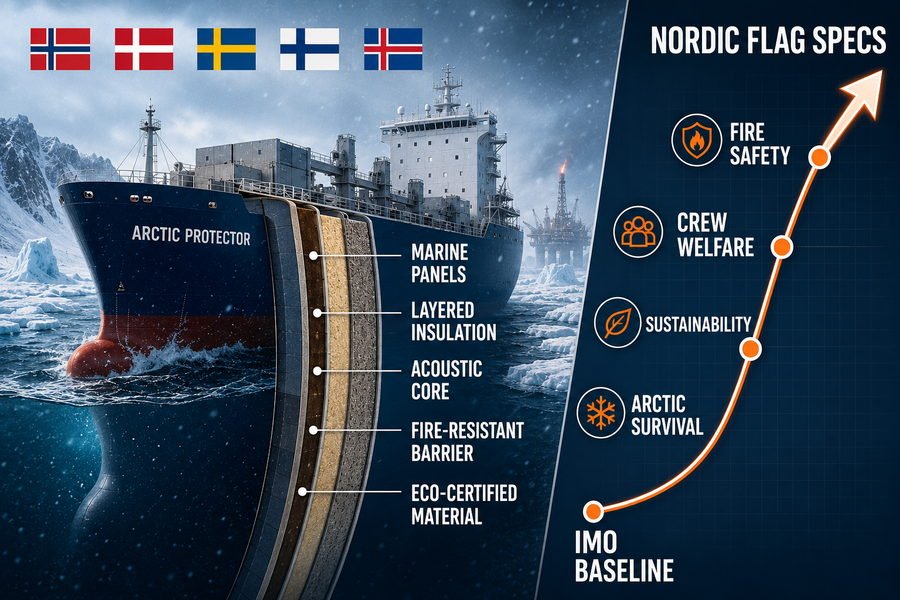
If you want to supply marine outfitting to shipyards in Norway, Sweden, or Denmark, you must prepare for some of the toughest technical reviews in the world. I have worked on interior projects for Norwegian vessels, and their flag authorities, such as the Norwegian Maritime Authority (NMA), push panel requirements far beyond the basic IMO FTP Code.
Arctic Climates and Environmental Sustainability Laws
First, Nordic flags demand specific panel properties to ensure survival in harsh Arctic climates. Standard marine panels are designed for general ocean transit. However, Nordic rules often mandate that insulation materials maintain flexibility and thermal performance at extreme sub-zero temperatures9. They require panels with exceptional thermal transmittance (U-values) to prevent condensation and freezing inside the cabin.
Second, these countries enforce rigorous domestic environmental sustainability laws. While the IMO focuses on maritime safety, Nordic states integrate green building standards into shipbuilding. They strictly prohibit panels containing harmful chemicals, such as certain brominated flame retardants10, even if those chemicals help pass the IMO FTP Code fire tests. You must provide extensive documentation proving low volatile organic compound (VOC) emissions to meet their national environmental protection acts.
Crew Welfare and Offshore Fire Safety Protocols
Third, Nordic flags lead the world in crew welfare, particularly through superior noise reduction. Following guidelines similar to the strict NORSOK standards, they demand exceptional acoustic insulation. While a standard IMO panel might offer 30 dB sound reduction, Nordic rules often require 35 dB or even 40 dB for crew resting areas11 to prevent fatigue from engine noise.
Finally, Nordic rules mandate elite fire safety protocols driven by the offshore oil and gas industry. Because many Nordic vessels service North Sea oil rigs, flag states often borrow the brutal H-Class (Hydrocarbon) fire standards from offshore regulations. While the IMO FTP Code A-60 test uses a standard cellulosic fire curve reaching 945°C, an H-60 Nordic requirement forces the panel to survive a hydrocarbon fire curve that spikes to 1100°C almost instantly12.
| Requirement Category | Standard IMO FTP Code Baseline | Nordic Flag State Strict Addition |
|---|---|---|
| Climate Resilience | Standard thermal testing | Mandatory extreme sub-zero thermal retention |
| Environmental | Basic non-combustibility | Strict prohibition of specific chemical retardants |
| Acoustic Welfare | General SOLAS noise limits | Rw > 35-40 dB for crew accommodation areas |
| Fire Safety | A-Class (Cellulosic fire curve 945°C) | H-Class (Hydrocarbon fire curve 1100°C) |
How Do Asian Flag Rules for Marine Panels Differ From IMO?
Are you outfitting a domestic ferry in Asia? You cannot assume your international certificates cover local laws. Here is how Asian flag rules reshape your panel choices.
Asian flag rules for marine panels differ from IMO by incorporating localized material testing standards like GB or JIS, adjusting requirements for domestic-only coastal routes, prioritizing cost-effective regional certifications, and enforcing specific national quality supervision protocols that may bypass the standard European MED Wheelmark system.
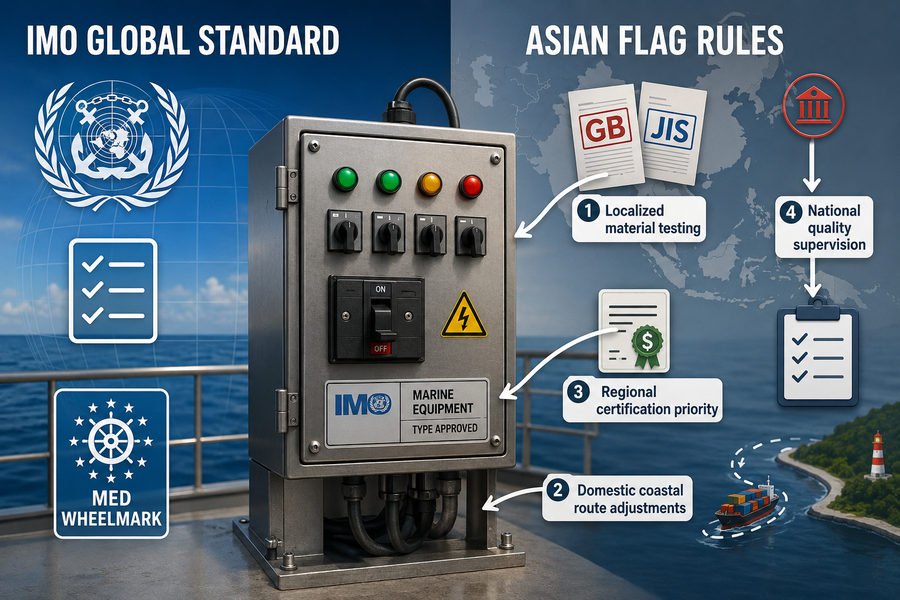
When I help clients source materials for shipyards in China or Japan, they often make the mistake of assuming that the MED Wheelmark is the ultimate global passport. It is not. Asian flag states have established their own highly specific domestic frameworks that diverge from standard IMO applications.13
Localized Testing Standards and Domestic Coastal Routes
First, Asian flag rules differ by incorporating localized material testing standards. In China, marine panels must often comply with Guobiao (GB) national standards14, while in Japan, they follow Japanese Industrial Standards (JIS). For instance, a panel might need to pass a specific GB test for mechanical impact resistance that the IMO FTP Code does not explicitly cover.
Second, these authorities make significant adjustments for domestic-only coastal routes. The IMO SOLAS regulations are designed primarily for international voyages15. However, an Asian flag state might allow a slightly thinner B-Class bulkhead panel on a domestic river ferry because the vessel is always close to shore and rescue is immediate. This allows shipyards to use lighter panels, provided they meet the specific domestic coastal navigation rules.
Regional Certifications and National Quality Supervision
Third, Asian flag rules prioritize cost-effective regional certifications. Instead of forcing builders to pay for expensive European notified body audits, states like China rely heavily on their own classification societies to issue domestic type approvals. These regional certificates are legally binding for local flag vessels and are much faster to obtain.
Finally, Asian states enforce specific national quality supervision protocols that bypass the standard European MED Wheelmark system. A European MED Module D audit focuses on factory production control. However, Asian flag rules often mandate mandatory random batch testing by local state-run laboratories before the panels can be installed on a domestic ship. They do not just trust the factory paperwork; they physically test the incoming goods under national supervision.
| Regulatory Aspect | International IMO / MED System | Asian Flag State System (e.g., China/Japan) |
|---|---|---|
| Primary Testing Standards | IMO FTP Code | Local standards (GB in China, JIS in Japan) |
| Scope of Application | International ocean voyages | Specific adjustments for domestic coastal routes |
| Preferred Certification | MED Wheelmark | Regional Classification Society (e.g., CCS, NK) |
| Quality Control Enforcement | MED Module D factory audits | National random batch testing at local labs |
Why Can a Mid-Project Flag Change Trigger Marine Panel Recompliance?
Has your shipyard suddenly decided to change the vessel's flag state halfway through construction? This administrative switch can destroy your budget. Here is why you must re-certify panels.
A mid-project flag change triggers marine panel recompliance because the new flag state holds independent legal jurisdiction, enforces different national testing interpretations, demands specific recognized organization approvals, and requires completely new localized documentation to issue the final statutory safety certificates for the vessel.
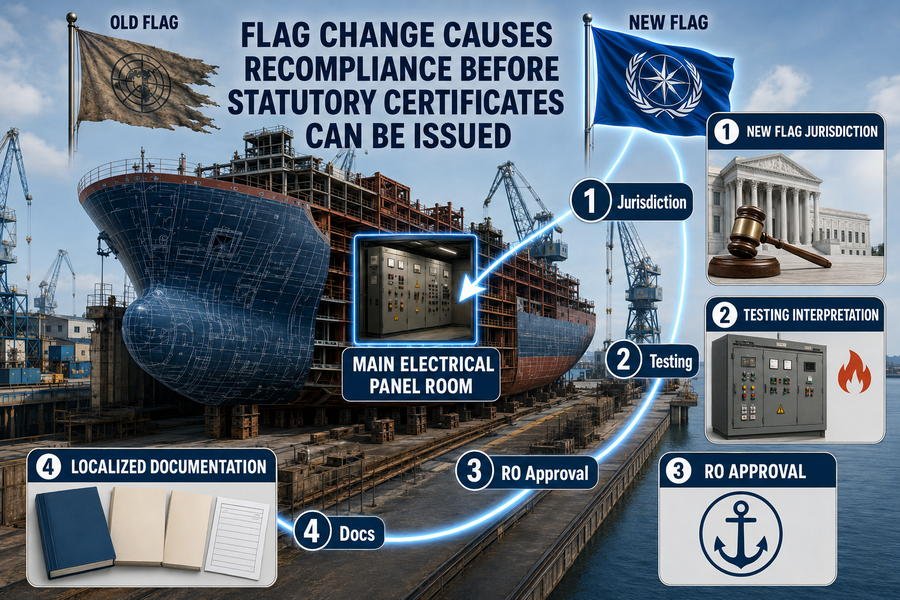
One of the most stressful situations I have managed is when a shipowner decides to change the flag state of a vessel while it is still sitting in the drydock. You might have already installed 5,000 square meters of B-15 marine wall panels. Suddenly, the new flag state inspector arrives and halts the work. This happens because a flag change is not just a paperwork update; it is a complete change in the governing law of the ship16.
Independent Legal Jurisdiction and Testing Interpretations
The primary reason a flag change triggers recompliance is that the new flag state holds independent legal jurisdiction. If a ship switches from the Marshall Islands to the United States flag, the USCG legally does not care what the Marshall Islands approved. The USCG enforces its own 46 CFR laws.17 Your previously installed panels are immediately subject to a totally new legal framework.
Consequently, the new flag state enforces different national testing interpretations. While the IMO FTP Code provides the base text18, different countries interpret ambiguous clauses differently. For example, the old flag state might have accepted a generic adhesive for the panel joints under FTP Code Part 3. The new flag state might strictly interpret the rule to demand that the specific adhesive itself passes a separate low flame-spread test.
Recognized Organization Approvals and Localized Documentation
Furthermore, a mid-project flag change demands specific recognized organization (RO) approvals. Flag states delegate inspection authority to classification societies like DNV, ABS, or LR.19 If the new flag state only authorizes ABS to act on its behalf, but your panels were type-approved by LR, you face a major problem. You must pay to have ABS review the testing data and issue a new certificate on behalf of the new flag.
Finally, the new flag state requires completely new localized documentation to issue the final statutory safety certificates. You cannot hand a Japanese flag inspector an English-only European fire test report. They will demand that the original test data be translated, reformatted, and re-submitted according to their national bureaucratic procedures before they will issue the Passenger Ship Safety Certificate.
| Recompliance Trigger | Impact on Installed Marine Panels | Required Action from Buyer |
|---|---|---|
| Independent Jurisdiction | Old approvals lose legal standing | Must re-verify against new national laws |
| Testing Interpretations | Previously accepted materials rejected | Must conduct additional fire or smoke tests |
| Recognized Organizations | Certificates issued by wrong class society | Must pay for a new class society review |
| Localized Documentation | Paperwork rejected due to language/format | Must translate and re-submit all test reports |
Which Flag State Variations Must Buyers Check Before Ordering Marine Panels?
Are you about to sign a massive contract for marine panels? Do not send the deposit until you verify the exact local rules. Here is the ultimate checklist.
Before ordering marine panels, buyers must check flag state variations regarding acceptable type approval certificates, specific national acoustic insulation minimums, localized environmental material bans, and mandatory domestic production quality audits to ensure the products will legally pass the final on-board port state control inspections.
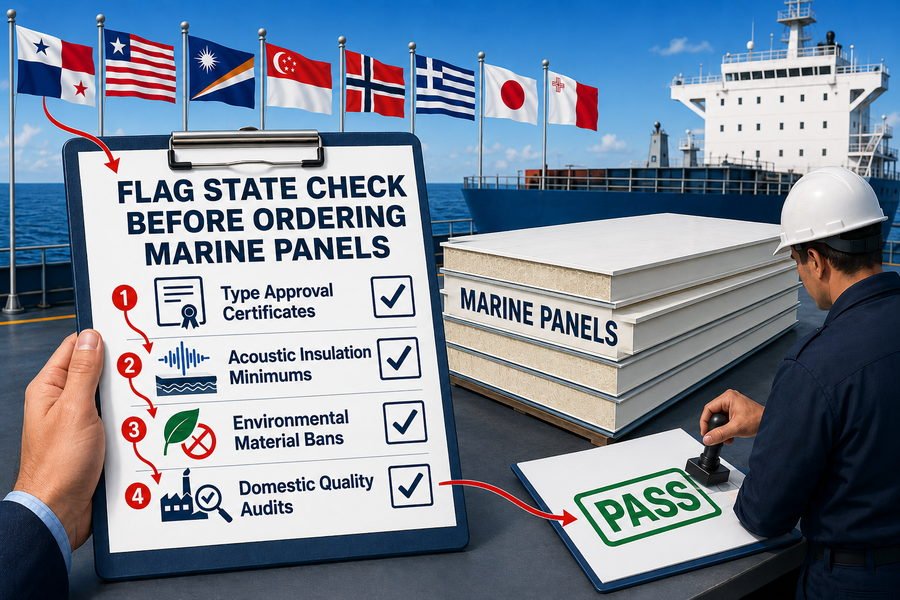
Whenever a procurement officer asks me for advice on buying marine panels, I always tell them to ask the shipyard one question first: "What is the final flag state of this vessel?" If you do not know the answer, you are gambling with your money. You must proactively check specific national variations before you finalize your purchase orders.
Type Approvals and Acoustic Insulation Minimums
The first variation you must check is the list of acceptable type approval certificates. Do not assume the MED Wheelmark is universally accepted.20 If the ship is flying the US flag, you must confirm if the manufacturer holds a valid USCG Certificate of Approval. If it is a British yacht, you must check if the panels comply with the Red Ensign Group (REG) Yacht Code or LY3 standards.
The second critical check involves specific national acoustic insulation minimums. The IMO provides general guidelines, but many flag states enforce the Maritime Labour Convention (MLC 2006) strictly through national laws. You must verify the exact decibel (dB) reduction required for the bulkheads. If a flag state requires a 36 dB reduction for cabin partitions and your chosen panel only provides 32 dB, you must change the core thickness or density before ordering.
Environmental Bans and Production Quality Audits
The third variation to investigate is localized environmental material bans. You must ask the panel supplier for a complete chemical declaration. Some European flag states have severe restrictions on asbestos replacements and specific types of synthetic mineral fibers.21 If your panel contains a binder that is banned by the target flag state's environmental protection agency, the panels will be seized at customs.
Finally, you must check the rules regarding mandatory domestic production quality audits. Some flag states will not accept a standard factory audit from a foreign country. They may demand that their own designated inspectors visit the factory in China or Vietnam to witness the production batch before shipment. You must budget for these inspector travel costs and schedule the audits properly.
| Flag State Check Item | What to Verify with the Supplier | Consequence of Ignoring This Rule |
|---|---|---|
| Type Approval | Does the panel hold the specific national certificate? | Panels rejected by local shipyard inspectors |
| Acoustic Minimums | Does the panel meet the national dB reduction law? | Fined for violating crew welfare regulations |
| Environmental Bans | Are all adhesives and core binders legally permitted? | Cargo seized at customs or shipyard gates |
| Quality Audits | Does the flag require a local inspector at the factory? | Installed panels forced to be ripped out |
Conclusion
Navigating marine panel compliance requires looking far beyond the basic IMO FTP Code to understand strict flag state laws. Master these national variations to ensure your shipbuilding projects stay profitable.
-
"Flag State implementation - International Maritime Organization", https://www.imo.org/en/OurWork/Safety/Pages/FlagStateImplementation.aspx. UNCLOS Article 94 provides that every state must effectively exercise jurisdiction and control in administrative, technical, and social matters over ships flying its flag, supporting the legal basis for flag-state authority over vessels. Evidence role: definition; source type: institution. Supports: A flag state has ultimate legal authority over ships registered under its flag.. ↩
-
"International Code for Ships Operating in Polar Waters (Polar Code)", https://www.imo.org/en/ourwork/safety/pages/polar-code.aspx. The IMO Polar Code identifies low air temperatures, ice, and other polar environmental hazards as operational risks for ships in polar waters, providing contextual support for additional cold-weather design and material requirements. Evidence role: general_support; source type: institution. Supports: Ships operating under Arctic or polar conditions may face additional requirements related to low-temperature performance and thermal protection.. Scope note: The Polar Code supports the need to address cold-weather hazards generally, but it does not by itself verify the specific panel-performance requirements of Canadian or Russian flag administrations. ↩
-
"MS Scandinavian Star", https://en.wikipedia.org/wiki/MS_Scandinavian_Star. Investigations and historical accounts of major passenger-ferry fires, such as the 1990 Scandinavian Star disaster, document how catastrophic ferry fires prompted regulatory scrutiny and later safety reforms in passenger-ship fire protection. Evidence role: historical_context; source type: institution. Supports: Severe ferry fires have historically influenced later passenger-vessel fire-safety regulation.. Scope note: Such sources can support the general regulatory impact of ferry-fire disasters, but a separate national rule or directive would be needed to prove a particular European state adopted stricter limits than FTP Code Part 5. ↩
-
"[PDF] MSC.337(91) (adopted on 30 November 2012) CODE ON NOISE ...", https://wwwcdn.imo.org/localresources/en/KnowledgeCentre/IndexofIMOResolutions/MSCResolutions/MSC.337(91).pdf. The Maritime Labour Convention, 2006 requires that crew accommodation be designed with regard to occupational health and safety, including protection from noise and vibration, supporting the role of labor standards in ship accommodation specifications. Evidence role: general_support; source type: institution. Supports: Labor and crew-welfare standards can influence acoustic insulation requirements for marine interior panels.. Scope note: The convention supports the relevance of noise control to crew accommodation, but it does not establish the article’s illustrative 35 dB panel threshold without an additional national standard. ↩
-
"eCFR :: 46 CFR Chapter I Subchapter Q", https://www.ecfr.gov/current/title-46/chapter-I/subchapter-Q. The electronic Code of Federal Regulations places Coast Guard marine engineering and material approval requirements in 46 CFR Subchapter Q, providing the domestic regulatory framework for approved vessel materials and equipment. Evidence role: definition; source type: government. Supports: The USCG enforces Title 46 of the CFR, specifically Subchapter Q, as a domestic regulatory framework for relevant vessel materials.. ↩
-
"46 CFR Part 164 Subpart 164.007 -- Structural Insulations - eCFR", https://www.ecfr.gov/current/title-46/chapter-I/subchapter-Q/part-164/subpart-164.007. 46 CFR § 164.007 specifies fire-test performance criteria for structural insulation, including the 60-minute test duration and the maximum permitted average temperature rise on the unexposed surface. Evidence role: mechanism; source type: government. Supports: 46 CFR 164.007 sets a 60-minute structural-insulation fire test criterion with an average unexposed-side temperature-rise limit of 139°C / 250°F.. ↩
-
"46 CFR Part 159 -- Approval of Equipment and Materials - eCFR", https://www.ecfr.gov/current/title-46/chapter-I/subchapter-Q/part-159. USCG approval regulations and type-approval guidance describe Coast Guard approval as a formal process requiring an application, supporting test evidence from accepted laboratories or recognized testing bodies, and issuance of a Coast Guard certificate or approval record. Evidence role: mechanism; source type: government. Supports: Manufacturers seeking USCG type approval generally must submit an application and acceptable test documentation and obtain a Coast Guard approval or Certificate of Approval.. Scope note: The exact documents required can vary by material category and approval series, so the source supports the general approval process rather than every possible product-specific submission detail. ↩
-
"[PDF] navigation and vessel inspection circular no. 9-97 - ROSA P", https://rosap.ntl.bts.gov/view/dot/66363/dot_66363_DS1.pdf. USCG NVIC 9-97 discusses implementation of the U.S.–EU Mutual Recognition Agreement and notes that Coast Guard approval criteria for certain fire-protection materials under 46 CFR Subchapter Q do not fully coincide with IMO FTP Code or MRA approval requirements. Evidence role: general_support; source type: government. Supports: USCG guidance indicates that Subchapter Q fire-test approval criteria are not identical to IMO FTP Code or MRA requirements.. Scope note: The source is best used to document differences in approval criteria and MRA treatment; it may not establish that every MRA-approved panel is rejected in every domestic-vessel context. ↩
-
"[PDF] MEPC 68/21/Add.1 Annex 10, page 3", https://wwwcdn.imo.org/localresources/en/MediaCentre/HotTopics/Documents/POLAR%20CODE%20TEXT%20AS%20ADOPTED.pdf. The IMO Polar Code requires ships intended for polar service to account for the lowest anticipated operating temperatures when selecting materials and designing equipment, which contextualizes the need for low-temperature insulation performance. Evidence role: general_support; source type: institution. Supports: Nordic or Arctic-service vessel rules may require insulation and panel materials to perform reliably at extreme sub-zero temperatures.. Scope note: This supports polar-service design requirements generally, but it does not by itself prove that every Nordic flag state mandates this exact panel property for all vessels. ↩
-
"Status of regulatory activities on brominated flame retardants in ...", https://hero.epa.gov/reference/1928025/. European chemicals regulation and international POPs controls restrict or prohibit several brominated flame retardants, including substances such as PBDEs and HBCD, supporting the claim that some flame-retardant chemicals may be unacceptable even when fire performance is otherwise adequate. Evidence role: general_support; source type: government. Supports: Nordic and European regulatory frameworks can restrict panels containing certain harmful brominated flame retardants.. Scope note: The support applies to regulated substances and products within the scope of those chemical-control regimes; it does not establish a blanket ban on all brominated flame retardants in all marine panels. ↩
-
"[PDF] MSC.337(91) (adopted on 30 November 2012) CODE ON NOISE ...", https://wwwcdn.imo.org/localresources/en/KnowledgeCentre/IndexofIMOResolutions/MSCResolutions/MSC.337(91).pdf. NORSOK acoustic standards for offshore facilities specify noise and sound-insulation criteria for accommodation and sleeping areas, providing contextual support for higher sound-reduction expectations in Nordic offshore-related projects. Evidence role: expert_consensus; source type: institution. Supports: Nordic offshore-related standards can require higher acoustic insulation levels for crew accommodation or resting areas.. Scope note: The cited standards may apply to offshore installations or project specifications rather than universally binding flag-state rules for every ship; exact decibel requirements can vary by room type and adjacent noise source. ↩
-
"What Is the Purpose and Scope of the IMO FTP Code? - Magellan ...", https://magellanmarinetech.com/what-purpose-scope-of-imo-ftp-code/. Standards and technical guidance on hydrocarbon fire testing define a more severe rapid-temperature fire curve than the cellulosic curve, commonly reaching about 1100°C, which supports the technical distinction between H-class and A-class fire exposure. Evidence role: mechanism; source type: institution. Supports: H-class hydrocarbon fire testing exposes panels to a faster and hotter fire curve than the IMO A-class cellulosic fire test.. Scope note: This supports the fire-curve comparison, but additional flag-state or project documents would be needed to prove when Nordic ship projects specifically require H-60 panels. ↩
-
"[PDF] MSC 108-10-1 - Online training material on domestic ferry safety ...", https://wwwcdn.imo.org/localresources/en/OurWork/Safety/Documents/MSC%20108-10-1%20-%20Online%20training%20material%20on%20domestic%20ferry%20safety%20(China).pdf. An IMO or flag-administration source can support that SOLAS/IMO instruments set international baseline requirements while national administrations maintain separate statutory rules for domestic vessels; this contextual support does not prove every Asian flag state diverges in the same way. Evidence role: general_support; source type: institution. Supports: Asian flag states use domestic regulatory frameworks that can differ from standard IMO applications.. Scope note: Supports the general regulatory distinction, not the full range of country-specific divergences across Asia. ↩
-
"National Standards of China - Wikipedia", https://en.wikipedia.org/wiki/National_Standards_of_China. A Chinese standards or government source can document that GB standards are national standards used in China, providing context for why Chinese marine materials may be assessed under domestic standards in addition to international codes. Evidence role: definition; source type: government. Supports: China uses Guobiao national standards that may apply to marine materials or related product testing.. Scope note: This would establish the status of GB standards generally; a separate source may be needed for a specific marine panel test requirement. ↩
-
"[PDF] solas/conf/d/6 - International Maritime Organization", https://wwwcdn.imo.org/localresources/en/KnowledgeCentre/ConferencesMeetings/SOLASConferenceDocuments/SOLAS%20CONF%20D%206.pdf. The SOLAS Convention text or IMO explanatory material states that SOLAS generally applies to ships engaged on international voyages, supporting the distinction between international SOLAS requirements and domestic-voyage regulation. Evidence role: definition; source type: institution. Supports: SOLAS regulations are primarily framed around ships on international voyages.. Scope note: SOLAS contains exemptions and flag-state implementation details, so the source supports the primary scope rather than every operational case. ↩
-
"Registration of ships and fraudulent registration matters", https://www.imo.org/en/ourwork/legal/pages/registration-of-ships-and-fraudulent-registration-matters.aspx. UNCLOS Article 94 establishes that a flag State exercises jurisdiction and control over ships flying its flag, supporting the proposition that a change of flag changes the legal authority responsible for statutory compliance. Evidence role: definition; source type: institution. Supports: A vessel’s flag state determines the legal regime and statutory authority governing the ship.. Scope note: This supports the jurisdictional basis of the claim, but it does not by itself prove that every installed component must be re-approved after every flag change. ↩
-
"46 CFR Part 2 -- Vessel Inspections - eCFR", https://www.ecfr.gov/current/title-46/chapter-I/subchapter-A/part-2. The U.S. Code of Federal Regulations, Title 46, sets out U.S. Coast Guard-administered shipping regulations, supporting the claim that U.S.-flag vessels are subject to U.S. maritime regulatory requirements. Evidence role: general_support; source type: government. Supports: When a vessel is reflagged to the United States, relevant U.S. maritime regulations in 46 CFR may apply.. Scope note: This establishes the existence and scope of U.S. maritime regulations, but specific applicability depends on vessel type, route, tonnage, and certificate category. ↩
-
"[PDF] RESOLUTION MSC.307(88) (adopted on 3 December 2010 ...", https://wwwcdn.imo.org/localresources/en/KnowledgeCentre/IndexofIMOResolutions/MSCResolutions/MSC.307(88).pdf. IMO materials describe the International Code for Application of Fire Test Procedures as the fire-test framework referenced by SOLAS for evaluating materials used on ships, supporting its role as a baseline for marine fire testing. Evidence role: definition; source type: institution. Supports: The IMO FTP Code is the international baseline text for fire-test procedures applied to ship materials.. Scope note: This supports the FTP Code’s baseline role in international fire testing; it does not establish how any individual flag administration interprets a particular clause. ↩
-
"[PDF] RESOLUTION MSC.349(92) (Adopted on 21 June 2013) CODE ...", https://wwwcdn.imo.org/localresources/en/KnowledgeCentre/IndexofIMOResolutions/MSCResolutions/MSC.349(92).pdf. The IMO Code for Recognized Organizations sets out the framework under which flag administrations may authorize recognized organizations to carry out statutory certification and survey functions on their behalf, supporting the claim that classification societies can act under flag-state delegation. Evidence role: mechanism; source type: institution. Supports: Flag states may delegate statutory survey and certification functions to recognized organizations such as classification societies.. Scope note: The source supports the general delegation mechanism; the specific authorization of DNV, ABS, LR, or any other society varies by flag administration and vessel category. ↩
-
"46 CFR Part 159 -- Approval of Equipment and Materials - eCFR", https://www.ecfr.gov/current/title-46/chapter-I/subchapter-Q/part-159. European Commission guidance describes the Wheelmark as evidence of conformity under the EU Marine Equipment Directive, while U.S. Coast Guard regulations maintain separate approval procedures for equipment installed on U.S.-flag vessels; this supports the need to verify flag-state acceptance rather than treating the Wheelmark as globally sufficient. Evidence role: general_support; source type: government. Supports: The MED Wheelmark should not be assumed to satisfy every flag state's marine equipment approval requirements.. Scope note: This supports the regulatory principle across EU and U.S. regimes, but acceptance of a specific panel still depends on the exact product category and vessel application. ↩
-
"Occupational exposure to asbestos and man‐made vitreous fibres ...", https://pmc.ncbi.nlm.nih.gov/articles/PMC2078502/. EU chemical-safety rules restrict asbestos and classify certain man-made vitreous or synthetic mineral fibres according to biopersistence and carcinogenicity criteria, showing that insulation fibres and substitutes may face material-specific regulatory controls in Europe. Evidence role: general_support; source type: government. Supports: European jurisdictions may restrict asbestos substitutes and certain synthetic mineral fibres used in insulation products.. Scope note: This supports the existence of European restrictions on relevant fibre materials generally; it does not prove that every European flag state imposes additional rules beyond EU chemical legislation. ↩