Are you struggling to pass marine fire tests? Failing to understand the IMO FTP Code costs time and money. Here is the simple breakdown of its structure.
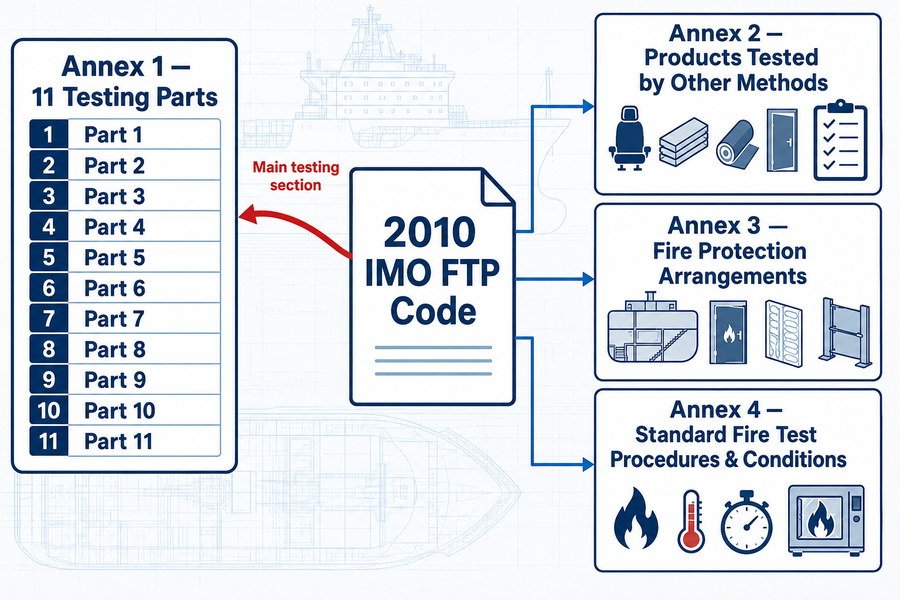
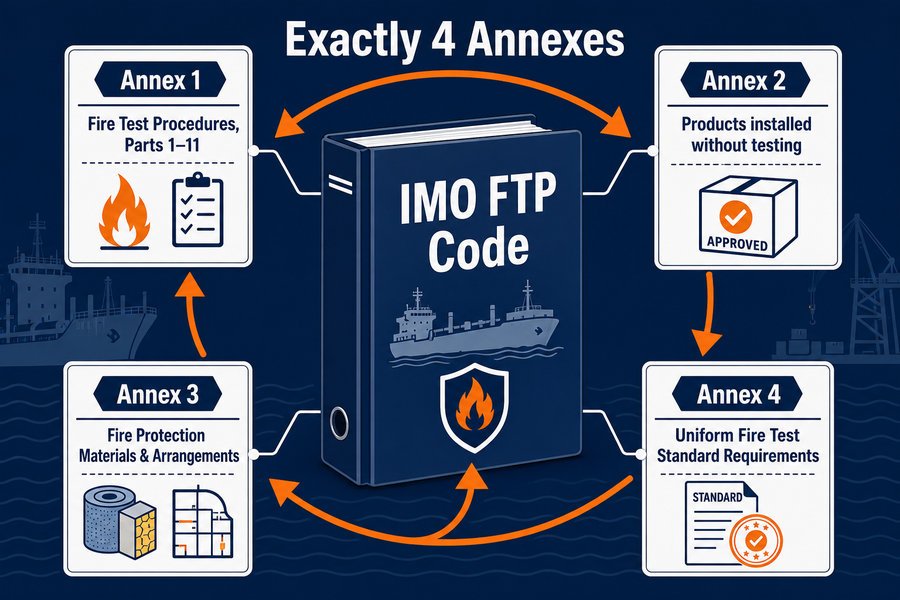
The 2010 IMO FTP Code is structured into 4 main Annexes. Annex 1 contains 11 distinct testing Parts for different materials. Annex 2 covers products tested by other methods. Annex 3 deals with fire protection arrangements, and Annex 4 explains the standard fire test procedures and conditions.
If you want to get your marine panels and doors certified fast without wasting money on wrong tests, you need to read the details below carefully.
How Many Annexes Does the IMO FTP Code Contain?
Buying marine panels without checking certifications is risky. You will fail shipyard inspections. Knowing the exact annexes helps you verify supplier test reports instantly.
The IMO FTP Code contains exactly 4 Annexes. Annex 1 covers Fire Test Procedures (Parts 1-11). Annex 2 covers Products which may be installed without testing. Annex 3 details Fire Protection Materials and specific arrangements. Annex 4 provides the uniform Fire Test standard requirements.
The Core Details of Annex 1 and Annex 2 for Marine Outfitting
When I worked at the marine outfitting factory, I saw many buyers get confused by test reports. They often saw local standard numbers instead of international rules. I always tell my clients that the IMO FTP Code is based on the IMO Maritime Safety Committee Resolution MSC.307(88)1. This resolution officially adopted the 2010 FTP Code, which has four clear annexes.
You must focus on the first two annexes to control your budget. Annex 1 is the core document. It holds all the specific laboratory test procedures2. If you buy a marine fire door, the factory must test it under Annex 1. On the other hand, Annex 2 is your best friend for saving money. Annex 2 lists products you can install on a ship without doing any fire tests3. For example, solid steel plates or copper pipes do not need a new test. This rule saves you thousands of dollars in laboratory fees and speeds up your project.
The Guidelines of Annex 3 and Annex 4 for Shipyards
Annex 3 and Annex 4 are also important, but they act more like instruction manuals. Annex 3 is about fire protection materials and arrangements. It tells the shipyard how to install materials safely. If you sell a great wall panel, but the shipyard installs it wrong, it will fail safety checks. Annex 3 prevents this.
Annex 4 sets the rules for the testing laboratories. It gives the uniform standard fire test procedures. For instance, Annex 4 says the test furnace must follow the ISO 834 time-temperature curve. According to this curve, the furnace temperature must reach exactly 945°C after 60 minutes. Knowing this helps you understand why marine products must use high-quality materials.
| IMO FTP Code Annex | Main Content Summary | Primary User | Application Example |
|---|---|---|---|
| Annex 1 | 11 Fire Test Procedures | Manufacturers, Laboratories | Testing a B-15 marine wall panel |
| Annex 2 | Products Not Requiring Testing | Shipyards, Procurement | Installing bare steel plates |
| Annex 3 | Fire Protection Arrangements | Shipyards, Designers | Spacing of fire dampers |
| Annex 4 | Standard Fire Test Conditions | Laboratories | Calibrating the test furnace |
What Does Annex 1 of the IMO FTP Code Cover?
Do you know which test part applies to your materials? Choosing the wrong test wastes laboratory fees. Annex 1 is the core rulebook you must master.
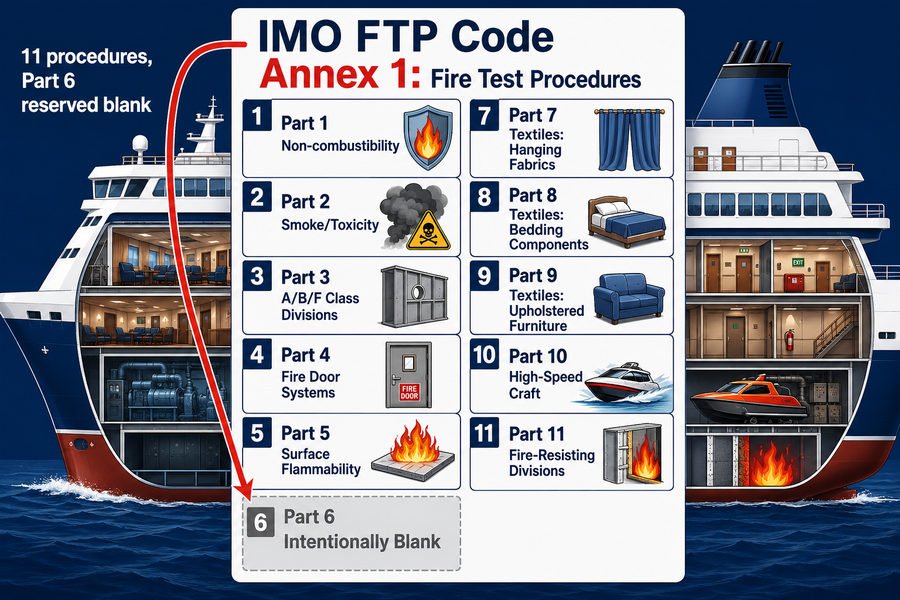
Annex 1 covers 11 specific fire test procedures. These include Part 1 (Non-combustibility), Part 2 (Smoke/Toxicity), Part 3 (A/B/F Class Divisions), Part 4 (Fire door systems), Part 5 (Surface flammability), Parts 7-9 (Textiles/Furniture), Part 10 (High-speed craft), and Part 11 (Fire-resisting divisions). Part 6 is left intentionally blank.
The Core Testing Parts for Marine Wall and Ceiling Panels
Annex 1 is the most used part of the IMO FTP Code. In my daily work as a marine outfitting specialist, I deal with Annex 1 every single day. You cannot sell interior materials without knowing these parts. I always group these 11 parts into categories to help my clients understand them.
The most common category is for structural panels and finishes. This includes Part 1, Part 2, Part 3, and Part 5. Part 1 tests if a material is non-combustible. The rule states the temperature rise inside the furnace cannot exceed 30°C4. Part 2 tests the smoke and toxicity5. It makes sure the PVC film on your panel does not release poison gas when it burns. Part 3 is the structural test for "A", "B", and "F" class divisions. It puts a whole panel wall into a huge furnace. Part 5 tests the surface flammability to see how fast flames travel across the surface. Part 6 is intentionally left blank in the 2010 code because older rules were reorganized6.
The Secondary Testing Parts for Doors, Furniture, and Fast Craft
The other parts of Annex 1 cover doors, soft items, and special ships. Part 4 is very specific. It tests fire door control systems. It checks if the fire door can close automatically during a fire. Parts 7, 8, and 9 are for soft furnishings. Part 7 tests draperies and curtains. Part 8 tests upholstered furniture like ship cabin sofas. Part 9 tests bedding components like mattresses and blankets.
Finally, Part 10 and Part 11 deal with special vessels. Part 10 provides fire test procedures for high-speed craft, which use lighter materials like aluminum. Part 11 tests fire-resisting divisions of high-speed craft. All these parts follow the strict guidelines of IMO Resolution MSC.307(88). You must match your product exactly to the right part.
| Annex 1 Part Number | Test Subject Focus | Key Requirement Example |
|---|---|---|
| Part 1 | Non-combustibility | Furnace temperature rise ≤ 30°C |
| Part 2 | Smoke and Toxicity | Carbon Monoxide (CO) limits |
| Part 3 | "A", "B" Class Divisions | B-15 must stop fire for 30 minutes7 |
| Part 4 | Fire Door Control Systems | Must close at 10 degrees list |
| Part 5 | Surface Flammability | Low flame spread rate |
Which Parts of the IMO FTP Code Apply to Marine Wall Panel Testing?
Are your marine wall panels failing port state control? Using incorrect test parts means custom holds. You must know exactly which parts apply to wall panels.
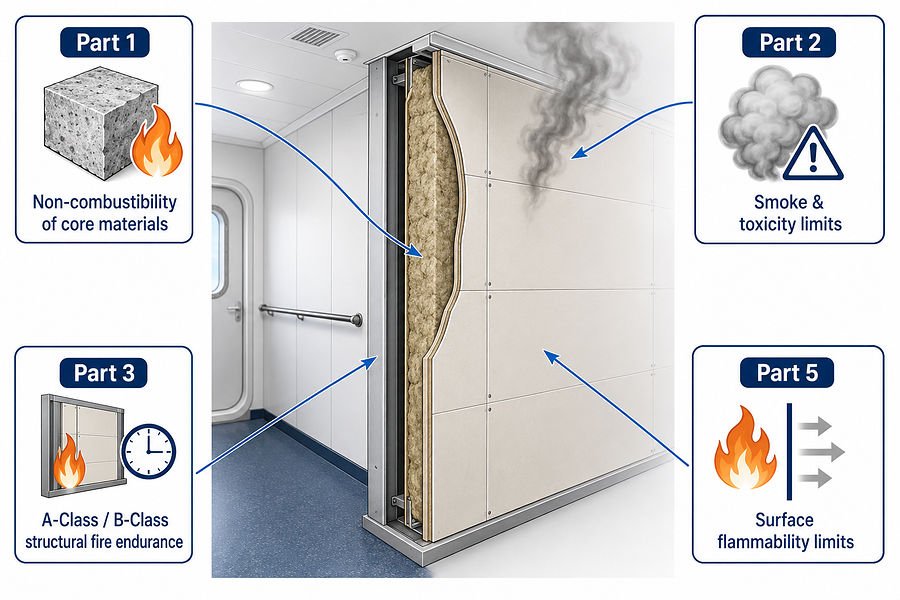
Marine wall panels must strictly pass 4 specific test parts of the IMO FTP Code Annex 1: Part 1 for the non-combustibility of core materials, Part 2 for smoke and toxicity limits, Part 3 for the B-Class or A-Class structural fire endurance, and Part 5 for surface flammability limits.
Testing the Core Materials with Part 1 and Part 2
A marine wall panel is a sandwich structure.8 It has a core material in the middle and a decorative finish on the outside. Because of this, a wall panel must pass multiple tests. I have seen buyers purchase panels with a Part 3 certificate, but they forget the Part 1 certificate for the core. The shipyard will reject this.
First, the core material, usually rock wool, must pass Annex 1 Part 1 for non-combustibility9. According to the IMO rule, a small sample is put into a 750°C furnace. It must not flame for more than 10 seconds. Second, the decorative finish, like a PVC film or PET film, must pass Annex 1 Part 210. This test measures smoke and toxicity. If the panel burns, it must not produce dangerous levels of gases. For example, the test checks limits for Carbon Monoxide (CO), Hydrogen Chloride (HCl), and Hydrogen Cyanide (HCN).
Structural and Surface Testing with Part 3 and Part 5
After the core and film pass, the whole panel system is tested together. Annex 1 Part 3 tests the structural fire endurance. The laboratory builds a sample wall measuring 2.44 meters by 2.44 meters. They put it in a massive furnace. If you are selling a B-15 wall panel11, the panel must stop flames for 30 minutes. Also, the unexposed side of the panel must not rise more than 140°C above the starting temperature within the first 15 minutes.
Finally, the decorative finish must pass Annex 1 Part 5 for surface flammability. This test uses a radiant heat panel to see if a fire will spread quickly across the wall. The finish must not spread flames to the end of the test specimen. You must collect the test reports for Part 1, Part 2, Part 3, and Part 5. Only then is your marine wall panel fully compliant and ready to sell.
| Test Part for Wall Panels | Component Tested | Primary Goal of the Test |
|---|---|---|
| Annex 1, Part 1 | Rock wool core | Prove the material will not burn |
| Annex 1, Part 2 | PVC or PET finish | Ensure no toxic gas is released |
| Annex 1, Part 3 | Complete wall system | Stop fire and heat from passing through |
| Annex 1, Part 5 | PVC or PET finish | Prevent rapid flame spread on the surface |
Which Parts of the IMO FTP Code Apply to Marine Ceiling Panel Testing?
Ceiling panels have unique fire risks on ships. If you mix up wall and ceiling test standards, you will buy unusable products. Let us clarify this.
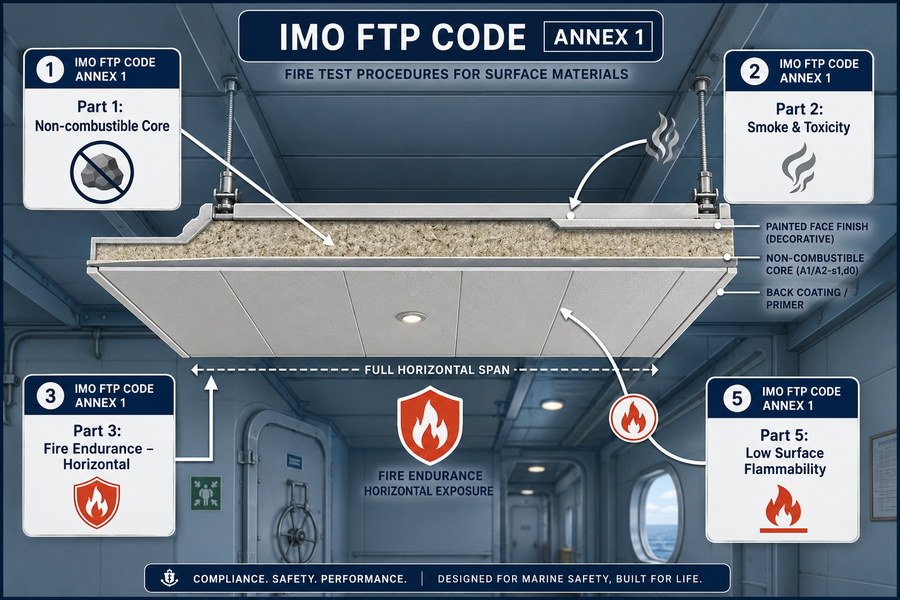
Marine ceiling panels must pass exactly 4 test parts under the IMO FTP Code Annex 1: Part 1 for non-combustible core materials, Part 2 for smoke and toxicity of face finishes, Part 3 for structural fire endurance in horizontal applications, and Part 5 for low surface flammability of finishes.
Core and Finish Requirements for Marine Ceiling Panels
Marine ceiling panels look similar to wall panels. They also have a rock wool core and a galvanized steel surface. Because they share this structure, ceiling panels share the same basic material tests as wall panels. I always remind my clients to check the material certificates first.
Just like wall panels, the core of the ceiling panel must pass Annex 1 Part 112. The rock wool must be completely non-combustible. The surface finish, usually a baked paint or PVC film, must pass Annex 1 Part 2 for smoke and toxicity13. Also, the finish must pass Annex 1 Part 5 for surface flammability. These three parts (Part 1, Part 2, and Part 5) are basically identical for walls and ceilings. You can often use the same material certificates if the factory uses the exact same core and film.
Horizontal Fire Endurance Testing for Ceilings
The biggest difference happens in Annex 1 Part 3. This is the structural test. Fire acts differently on a ceiling than on a wall. Heat rises, so a ceiling faces a huge amount of thermal pressure.
When testing a ceiling panel under Part 3, the laboratory builds a horizontal test specimen. The furnace is below the ceiling. The specimen must be at least 2.44 meters long and 1.52 meters wide14, according to IMO Resolution MSC.307(88). The furnace heats the ceiling from below. For a B-15 ceiling panel, it must block flames for 30 minutes. More importantly, the ceiling must not collapse. If the suspension system fails and the ceiling falls down, the test fails. This means the ceiling profile system, the hanging hooks, and the screws are all tested together. You cannot just buy the ceiling board; you must buy the exact same installation system that passed the Part 3 horizontal test.
| Test Parameter | Marine Wall Panel (Part 3) | Marine Ceiling Panel (Part 3) |
|---|---|---|
| Specimen Orientation | Vertical (Standing up) | Horizontal (Laying flat) |
| Minimum Specimen Size | 2.44m x 2.44m | 2.44m x 1.52m |
| Fire Exposure Direction | From one side | From underneath |
| System Components Tested | Panel joints, bottom tracks | Panels, hanging hooks, main profiles |
What Is the Difference Between Annex 1 and Annex 2 of the IMO FTP Code?
Paying for useless fire tests is burning your profit. Many buyers do not know they can skip tests. The secret lies in the difference between Annex 1 and 2.
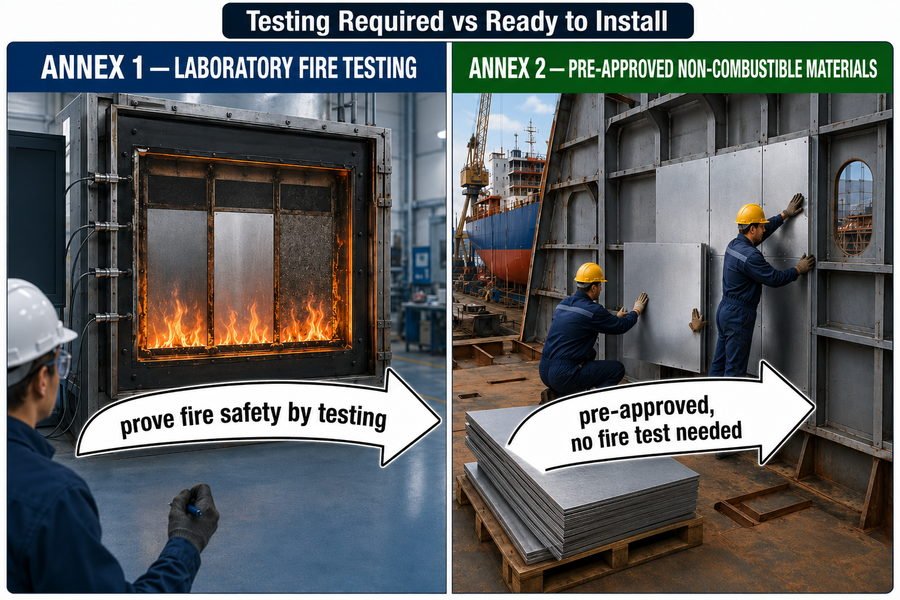
The fundamental difference is that Annex 1 mandates strict laboratory testing for materials to prove fire safety, while Annex 2 defines specific non-combustible materials, like untreated steel or aluminum alloys, that are pre-approved and can be installed immediately without undergoing any laboratory fire testing.
Understanding Annex 1 Laboratory Testing Requirements
Every procurement officer wants to save money. The best way to save money is to know the rules. The IMO FTP Code is split into parts that require action and parts that grant exemptions. Annex 1 is the action part. It is the rulebook for laboratory testing.
If you design a new type of composite marine panel, you must test it under Annex 1. You have to pay a laboratory, send them samples, and wait weeks for the result. The tests are very strict. As I mentioned before, Part 1 requires checking if the material burns at 750°C15. If a factory tells you their new plastic material is safe, you must ask for an Annex 1 certificate. Without the laboratory proof required by Annex 1, port inspectors will not let the ship sail16. Annex 1 is mandatory for any complex or mixed material.
Utilizing Annex 2 to Save Cost and Lead Time
Annex 2 is your shortcut. It lists products which may be installed without testing. The IMO knows that some materials are naturally safe. It is a waste of time to test pure steel every single time.
According to Annex 2, pure metals like steel, copper, and aluminum alloys do not need testing for non-combustibility17. Also, materials like concrete, natural stone, and glass are exempt. I once helped a client who wanted to use simple glass partitions. The factory wanted to charge him $3,000 for a fire test. I showed the client Annex 2 of the IMO Resolution MSC.307(88). It clearly states that normal glass does not need a Part 1 test. We saved $3,000 and two months of waiting. However, you must be careful. If the steel has a layer of paint or PVC on it, it is no longer pure. You then have to test the paint under Annex 1 Part 5.18
| Feature Comparison | Annex 1 of IMO FTP Code | Annex 2 of IMO FTP Code |
|---|---|---|
| Requirement | Mandatory laboratory testing | Pre-approved, no testing needed |
| Cost to Supplier | High (Requires lab fees) | Zero (No testing fees) |
| Time Delay | Weeks or months for testing | None (Immediate use) |
| Example Materials | Composite panels, PVC films | Bare steel plate, natural glass |
How Are Surface Flammability Tests Organized Within the IMO FTP Code Structure?
Decorative finishes spread fire fast if not tested. If your PVC film fails the check, the whole panel is rejected. Let us see how flammability is organized.
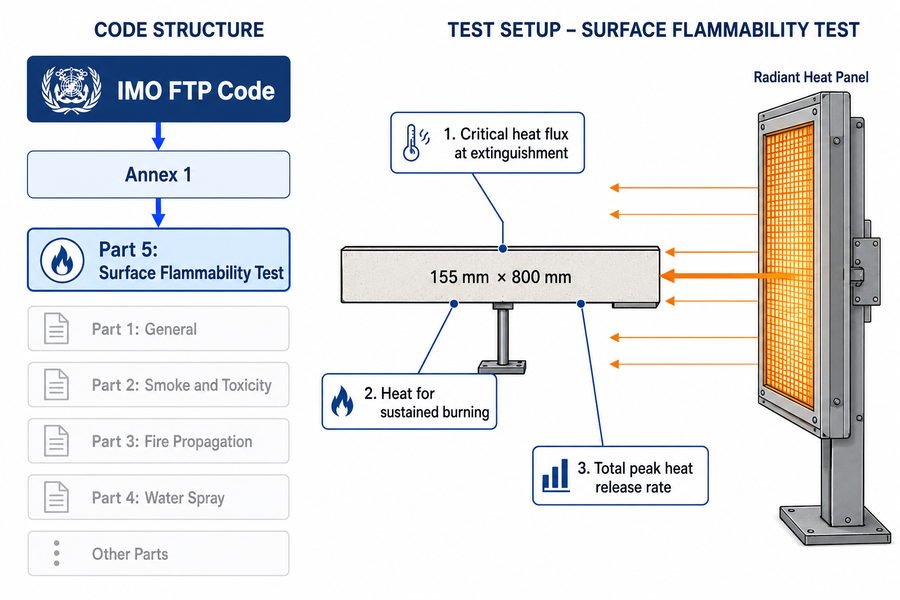
Surface flammability tests are organized exclusively under Annex 1, Part 5 of the IMO FTP Code. The test requires exposing a 155mm by 800mm specimen to a radiant heat panel. It strictly measures the critical heat flux at extinguishment, heat for sustained burning, and the total peak heat release rate.
Specimen Preparation and Heat Exposure Parameters
When you look at a beautiful cabin, you are looking at the surface finish. These finishes are very dangerous if they catch fire. The IMO controls this danger through Annex 1, Part 5.19
To run this test, the laboratory prepares a specific size of the material. The specimen must measure exactly 155 millimeters wide and 800 millimeters long.20 The material is conditioned in a room with standard humidity and temperature. During the test, the specimen is put in front of a gas-fired radiant panel.21 This panel produces extreme heat. The heat is highest at one end of the specimen and lower at the other end. A pilot flame is placed near the hot end to force the material to ignite. This simulates a real fire spreading across a cabin wall. The laboratory technicians watch the flame travel down the 800-millimeter length and record the exact time it takes to reach different points.
Passing Criteria for Surface Flammability in Part 5
Passing Part 5 is difficult. I have seen many cheap PVC films burn like paper during this test. The IMO Resolution MSC.307(88) gives very specific passing numbers.
The most important number is the Critical Flux at Extinguishment (CFE). This measures how much heat energy is needed to keep the fire going. For bulkheads and ceilings, the CFE must be greater than or equal to 20.0 kW/m².22 If the number is lower, the material fails. Another vital number is the Peak Heat Release Rate (Qp). The material must not release more than 4.0 kW of heat. Also, the test measures the Total Heat Release (Qt), which must not exceed 0.7 MJ. Finally, the laboratory checks for burning drops. If the PVC film melts and drops flaming liquid, it fails instantly. You must buy finishes that easily meet these specific values to guarantee safety.
| Measurement Parameter | Required Value for Bulkheads/Ceilings | Meaning of the Value |
|---|---|---|
| Critical Flux at Extinguishment (CFE) | ≥ 20.0 kW/m² | High number means it is hard to burn |
| Heat for Sustained Burning (Qsb) | ≥ 1.5 MJ/m² | High energy needed to keep flames alive |
| Total Heat Release (Qt) | ≤ 0.7 MJ | Low total heat added to the fire |
| Peak Heat Release Rate (Qp) | ≤ 4.0 kW | Low maximum flame intensity |
Conclusion
Mastering the IMO FTP Code structure, from its four annexes to specific testing parts, ensures you purchase compliant marine outfitting products, saving you money and avoiding disastrous project delays.
-
"[PDF] RESOLUTION MSC.307(88) (adopted on 3 December 2010 ...", https://wwwcdn.imo.org/localresources/en/KnowledgeCentre/IndexofIMOResolutions/MSCResolutions/MSC.307(88).pdf. IMO Resolution MSC.307(88) records the Maritime Safety Committee’s adoption of the International Code for Application of Fire Test Procedures, 2010, providing primary-source support for the Code’s formal basis. Evidence role: historical_context; source type: institution. Supports: The IMO FTP Code is based on IMO Maritime Safety Committee Resolution MSC.307(88), which officially adopted the 2010 FTP Code.. ↩
-
"[PDF] RESOLUTION MSC.307(88) (adopted on 3 December 2010 ...", https://wwwcdn.imo.org/localresources/en/KnowledgeCentre/IndexofIMOResolutions/MSCResolutions/MSC.307(88).pdf. The text of the 2010 FTP Code identifies Annex 1 as the section containing the fire test procedures used for approval of shipboard materials and constructions; this supports the structural description of Annex 1, though not the article’s evaluative wording that it is the “core” document. Evidence role: definition; source type: institution. Supports: Annex 1 contains the specific laboratory fire test procedures used under the IMO FTP Code.. Scope note: Supports the contents and function of Annex 1, but not the subjective characterization of it as the most important annex. ↩
-
"RESOLUTION MSC.307(88) (adopted on 3 December ...", https://wwwcdn.imo.org/localresources/en/KnowledgeCentre/IndexofIMOResolutions/MSCResolutions/MSC.307(88).pdf. Annex 2 of the 2010 FTP Code lists products that may be installed without testing and/or approval under the Code, giving direct support to the claim that some materials do not require new fire testing. Evidence role: definition; source type: institution. Supports: Annex 2 lists certain products that may be installed on ships without fire testing under the IMO FTP Code.. Scope note: The source supports the general exemption category; installation may still depend on flag-state, class-society, and project-specific approval requirements. ↩
-
"[PDF] RESOLUTION MSC.307(88) (adopted on 3 December 2010 ...", https://wwwcdn.imo.org/localresources/en/KnowledgeCentre/IndexofIMOResolutions/MSCResolutions/MSC.307(88).pdf. The 2010 FTP Code, Annex 1, Part 1 specifies the non-combustibility test criteria, including limits on furnace temperature rise during testing. Evidence role: definition; source type: institution. Supports: Part 1 tests if a material is non-combustible and includes a furnace temperature-rise limit of 30°C.. Scope note: The source supports the formal test criterion, but the article should ensure the wording matches the exact pass/fail conditions in the Code. ↩
-
"[PDF] RESOLUTION MSC.307(88) (adopted on 3 December 2010 ...", https://wwwcdn.imo.org/localresources/en/KnowledgeCentre/IndexofIMOResolutions/MSCResolutions/MSC.307(88).pdf. The 2010 FTP Code, Annex 1, Part 2 sets out the smoke and toxicity test for materials, including measurement of smoke generation and specified toxic gas concentrations. Evidence role: definition; source type: institution. Supports: Part 2 of Annex 1 tests smoke and toxicity characteristics of materials.. Scope note: The source supports the existence and scope of the Part 2 procedure; it does not prove that any particular PVC film or panel will meet the limits. ↩
-
"[PDF] RESOLUTION MSC.307(88) (adopted on 3 December 2010 ...", https://wwwcdn.imo.org/localresources/en/KnowledgeCentre/IndexofIMOResolutions/MSCResolutions/MSC.307(88).pdf. The 2010 FTP Code’s Annex 1 part structure identifies Part 6 as having no assigned test procedure, reflecting the revised organization of the Code. Evidence role: historical_context; source type: institution. Supports: Part 6 of Annex 1 in the 2010 FTP Code is left blank or unassigned following reorganization of earlier rules.. Scope note: The source may confirm that Part 6 is blank or unassigned; a separate explanatory IMO document may be needed to substantiate the reason for the reorganization. ↩
-
"[PDF] recommendation for fire test procedures for “a” and “b” class ...", https://wwwcdn.imo.org/localresources/en/KnowledgeCentre/IndexofIMOResolutions/AssemblyDocuments/A.163(ES.IV).pdf. SOLAS and the FTP Code define B-class divisions as preventing flame passage for the first half hour of the standard fire test, while the B-15 rating specifically denotes a 15-minute insulation criterion. Evidence role: definition; source type: institution. Supports: A B-15 division is associated with a 30-minute B-class fire integrity test and a 15-minute insulation rating.. Scope note: The source supports the regulatory distinction between integrity and insulation ratings; the article’s wording should avoid implying that B-15 has 30 minutes of insulation performance. ↩
-
"How to choose the right marine wall panels for marine interior ...", https://magellanmarinetech.com/how-choose-right-marine-wall-panels-for-marine-interior-projects/. A naval-architecture or marine fire-safety source should support that shipboard accommodation panels are commonly constructed as sandwich panels with facings bonded to a core material. Evidence role: definition; source type: education. Supports: Marine wall panels are commonly sandwich structures with a core and outer facings or finishes.. Scope note: This would establish the general construction concept, not prove that every marine wall panel uses the same materials or layup. ↩
-
"[PDF] RESOLUTION MSC.307(88) (adopted on 3 December 2010 ...", https://wwwcdn.imo.org/localresources/en/KnowledgeCentre/IndexofIMOResolutions/MSCResolutions/MSC.307(88).pdf. The IMO FTP Code Annex 1, Part 1 specifies the non-combustibility test method used for materials on ships, including furnace exposure criteria for determining whether a material is non-combustible. Evidence role: definition; source type: institution. Supports: The core material of a marine wall panel may need to satisfy IMO FTP Code Annex 1, Part 1 non-combustibility requirements.. Scope note: The source supports the regulatory test method; whether a particular rock wool product passes depends on its own certificate and test report. ↩
-
"[PDF] RESOLUTION MSC.307(88) (adopted on 3 December 2010 ...", https://wwwcdn.imo.org/localresources/en/KnowledgeCentre/IndexofIMOResolutions/MSCResolutions/MSC.307(88).pdf. The IMO FTP Code Annex 1, Part 2 describes smoke and toxicity testing for materials and sets measurement criteria for combustion gases such as carbon monoxide, hydrogen chloride, and hydrogen cyanide. Evidence role: general_support; source type: institution. Supports: Decorative finishes used on marine wall panels may be tested under IMO FTP Code Annex 1, Part 2 for smoke and toxic gas generation, including gases such as CO, HCl, and HCN.. Scope note: The source supports the existence and scope of the test; compliance for PVC or PET finishes requires product-specific laboratory results. ↩
-
"[PDF] RESOLUTION MSC.307(88) (adopted on 3 December 2010 ...", https://wwwcdn.imo.org/localresources/en/KnowledgeCentre/IndexofIMOResolutions/MSCResolutions/MSC.307(88).pdf. The IMO FTP Code and SOLAS fire-test framework define B-class divisions and their fire-resistance performance, including flame passage and temperature-rise criteria over the relevant test duration for B-15 divisions. Evidence role: definition; source type: institution. Supports: A B-15 wall panel rating is tied to specified fire-endurance and insulation performance criteria under IMO fire-test rules.. Scope note: This supports the regulatory meaning of a B-15 rating; it does not verify that any specific panel system has been tested or approved as B-15. ↩
-
"[PDF] RESOLUTION MSC.307(88) (adopted on 3 December 2010 ...", https://wwwcdn.imo.org/localresources/en/KnowledgeCentre/IndexofIMOResolutions/MSCResolutions/MSC.307(88).pdf. IMO Resolution MSC.307(88), the 2010 FTP Code, identifies Annex 1, Part 1 as the non-combustibility test used for materials in ship construction, supporting the claim that a mineral-wool ceiling core must be assessed under this part. Evidence role: definition; source type: institution. Supports: The core of the ceiling panel must pass Annex 1 Part 1, and the rock wool must be non-combustible.. Scope note: The source establishes the regulatory test category; it does not by itself certify any specific rock wool product as non-combustible. ↩
-
"History of SOLAS fire protection requirements", https://www.imo.org/en/OurWork/Safety/Pages/History-of-fire-protection-requirements.aspx. The 2010 FTP Code adopted by IMO Resolution MSC.307(88) sets out smoke and toxicity testing in Annex 1, Part 2 and surface flammability testing in Annex 1, Part 5, supporting the statement that ceiling panel finishes are evaluated for these fire-performance characteristics. Evidence role: definition; source type: institution. Supports: The ceiling panel surface finish must pass Annex 1 Part 2 for smoke and toxicity and Annex 1 Part 5 for surface flammability.. Scope note: The source supports the applicable test categories, but product-specific compliance depends on test reports for the exact finish system used. ↩
-
"[PDF] RESOLUTION MSC.307(88) (adopted on 3 December 2010 ...", https://wwwcdn.imo.org/localresources/en/KnowledgeCentre/IndexofIMOResolutions/MSCResolutions/MSC.307(88).pdf. IMO Resolution MSC.307(88), Annex 1, Part 3 specifies horizontal test arrangements for fire-resisting divisions, including minimum specimen dimensions for ceiling tests, supporting the stated size requirement for the test specimen. Evidence role: general_support; source type: institution. Supports: For a ceiling panel Part 3 fire-endurance test, the horizontal specimen must be at least 2.44 m by 1.52 m.. Scope note: The citation supports the standard test setup; laboratories may apply additional details from the full code, interpretations, or accreditation requirements. ↩
-
"[PDF] RESOLUTION MSC.307(88) (adopted on 3 December 2010 ...", https://wwwcdn.imo.org/localresources/en/KnowledgeCentre/IndexofIMOResolutions/MSCResolutions/MSC.307(88).pdf. The IMO FTP Code Part 1 non-combustibility test specifies furnace exposure at approximately 750°C for assessing whether a material is non-combustible under the Code. Evidence role: definition; source type: institution. Supports: Part 1 requires checking if the material burns at 750°C.. Scope note: This supports the test condition for Part 1, not the broader suitability of any specific product. ↩
-
"[PDF] RESOLUTION MSC.307(88) (adopted on 3 December 2010 ...", https://wwwcdn.imo.org/localresources/en/KnowledgeCentre/IndexofIMOResolutions/MSCResolutions/MSC.307(88).pdf. SOLAS and the IMO Fire Test Procedures Code establish that certain ship materials and components must demonstrate compliance through approved fire-test procedures; enforcement may occur through flag-state or port-state control regimes. Evidence role: general_support; source type: institution. Supports: Ships may need approved laboratory evidence under the FTP Code for materials subject to fire-test requirements, and lack of compliance can affect regulatory clearance.. Scope note: The source can support the general regulatory requirement for approved fire-test evidence, but whether a particular port inspector detains a ship depends on jurisdiction, ship type, deficiency severity, and inspection findings. ↩
-
"[PDF] RESOLUTION MSC.307(88) (adopted on 3 December 2010 ...", https://wwwcdn.imo.org/localresources/en/KnowledgeCentre/IndexofIMOResolutions/MSCResolutions/MSC.307(88).pdf. Annex 2 of the 2010 IMO FTP Code identifies specified products, including certain metals and metal alloys, that may be regarded as non-combustible without testing under Part 1. Evidence role: definition; source type: institution. Supports: Annex 2 exempts pure metals such as steel, copper, and aluminum alloys from non-combustibility testing.. Scope note: This applies only to the listed materials in the form and condition covered by Annex 2; coatings, composites, or non-listed formulations may fall outside the exemption. ↩
-
"[PDF] RESOLUTION MSC.307(88) (adopted on 3 December 2010 ...", https://wwwcdn.imo.org/localresources/en/KnowledgeCentre/IndexofIMOResolutions/MSCResolutions/MSC.307(88).pdf. The IMO FTP Code treats surface materials and primary deck coverings separately from bare non-combustible substrates, and Part 5 addresses surface flammability testing for exposed surface finishes. Evidence role: mechanism; source type: institution. Supports: Coatings such as paint or PVC on steel may require separate testing under Annex 1 Part 5 rather than relying on the bare-metal exemption.. Scope note: This supports the regulatory logic that coatings can trigger separate surface-flammability assessment; the exact test obligation depends on where and how the coated steel is installed. ↩
-
"[PDF] RESOLUTION MSC.307(88) (adopted on 3 December 2010 ...", https://wwwcdn.imo.org/localresources/en/KnowledgeCentre/IndexofIMOResolutions/MSCResolutions/MSC.307(88).pdf. IMO Resolution MSC.307(88), the 2010 FTP Code, Annex 1, Part 5, specifies the test for surface flammability used for materials such as bulkhead, wall, ceiling, and deck finishes in maritime applications. Evidence role: definition; source type: institution. Supports: IMO Annex 1, Part 5 controls surface flammability hazards for ship interior surface finishes.. Scope note: The source establishes the regulatory test framework, not the relative danger of every specific surface finish. ↩
-
"[PDF] RESOLUTION MSC.307(88) (adopted on 3 December 2010 ...", https://wwwcdn.imo.org/localresources/en/KnowledgeCentre/IndexofIMOResolutions/MSCResolutions/MSC.307(88).pdf. The 2010 FTP Code Part 5 test procedure describes rectangular specimens approximately 155 mm by 800 mm for the surface flammability test apparatus. Evidence role: mechanism; source type: institution. Supports: The Part 5 surface flammability test uses specimens measuring 155 mm wide and 800 mm long.. Scope note: The code may state permitted tolerances or preparation details, so the source should be checked before presenting the dimensions as absolutely exact. ↩
-
"[PDF] RESOLUTION MSC.307(88) (adopted on 3 December 2010 ...", https://wwwcdn.imo.org/localresources/en/KnowledgeCentre/IndexofIMOResolutions/MSCResolutions/MSC.307(88).pdf. The IMO FTP Code Part 5 method uses a radiant panel exposure arrangement, with a pilot flame and a heat-flux gradient along the specimen, to evaluate flame spread and heat-release behavior of surface materials. Evidence role: mechanism; source type: institution. Supports: The surface flammability test exposes the specimen to a gas-fired radiant panel with a pilot flame and varying heat flux.. Scope note: This supports the laboratory mechanism of the test; it does not by itself prove that the setup fully reproduces all conditions of an actual cabin fire. ↩
-
"[PDF] RESOLUTION MSC.307(88) (adopted on 3 December 2010 ...", https://wwwcdn.imo.org/localresources/en/KnowledgeCentre/IndexofIMOResolutions/MSCResolutions/MSC.307(88).pdf. IMO Resolution MSC.307(88), 2010 FTP Code, Annex 1, Part 5 gives acceptance criteria for bulkhead, wall, and ceiling linings, including CFE ≥ 20.0 kW/m² and associated limits for heat-release measures such as Qt and Qp. Evidence role: statistic; source type: institution. Supports: Bulkhead and ceiling materials must meet the stated CFE threshold and related heat-release limits under Part 5.. Scope note: The criteria depend on material category and application; the cited values should not be generalized to deck coverings or other FTP Code parts without checking the relevant table. ↩