Confused by marine certifications? If your interior panels fail fire tests, shipyards will reject your entire project. I will show you exactly what the IMO FTP Code means.
The IMO FTP Code (International Code for Application of Fire Test Procedures) is the mandatory testing standard under SOLAS. It provides the specific technical requirements, laboratory testing procedures, and certification criteria for all marine interior materials, ensuring they do not fuel fires or emit toxic smoke on ships.
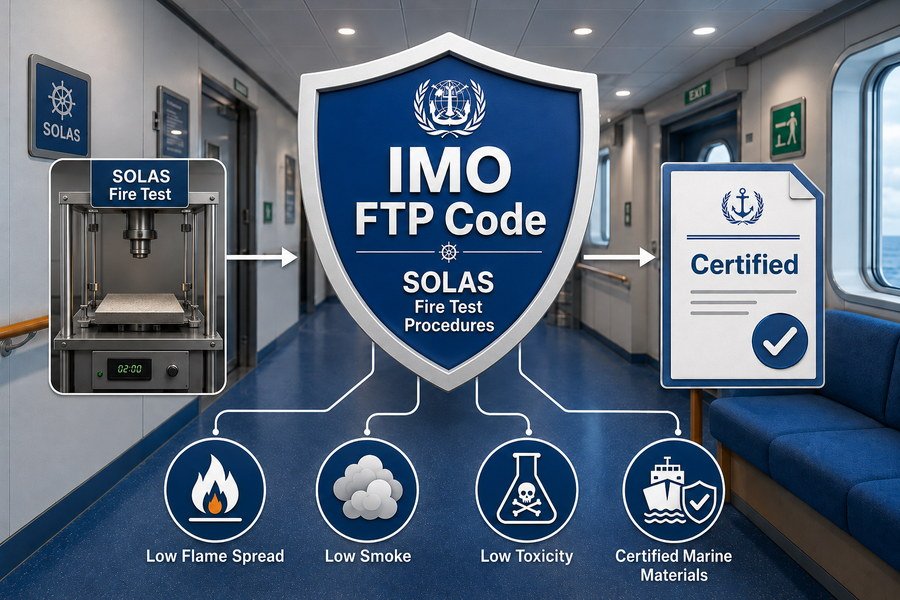
Passing these tests is the only way to sell your panels to European and American shipyards. Let us look closely at how this code affects your daily purchasing decisions.
What does IMO FTP Code stand for in marine fire testing?
Need the right certificate but do not know the exact term? Buying panels without knowing the FTP abbreviation wastes time. Here is the exact definition you need to know.
The IMO FTP Code stands for the International Maritime Organization's International Code for Application of Fire Test Procedures. It consists of three main components: testing requirements, laboratory accreditation rules, and specific criteria for testing non-combustibility, flammability, and smoke toxicity for marine outfitting products.
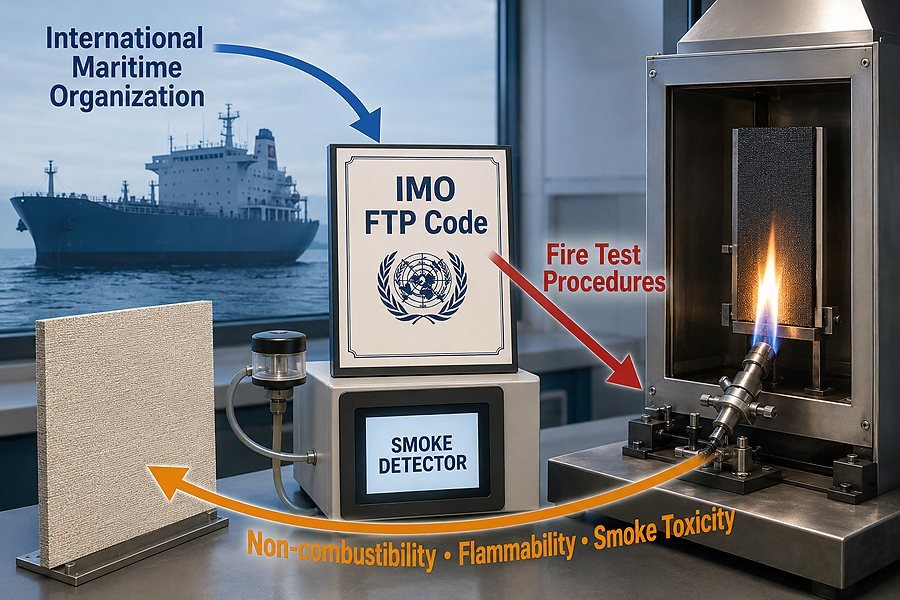
Understanding the International Maritime Organization Framework
I remember when a client from Asia sent their marine wall panels to Europe. They had local fire certificates, but the shipyard rejected them. Why? Because they did not understand the IMO framework. The International Maritime Organization (IMO), based in London, sets the global rules for shipping.1 Under the Safety of Life at Sea (SOLAS) convention, Chapter II-22 demands strict fire safety. The FTP Code is the rulebook that tells laboratories exactly how to test materials.3 Without this code, shipyards would not know if a panel is truly safe for ocean travel.
The Three Main Components of the FTP Code
As I stated earlier, the code has three main components. First, the testing requirements dictate the physical conditions. For example, a furnace must reach exactly 750°C (according to ISO 1182) to test non-combustibility.4 The technicians must measure the temperature inside the furnace, on the surface of the specimen, and in the center of the specimen. Second, the code gives the rules for laboratory accreditation. You cannot test materials in your own factory lab. You must use independent testing laboratories recognized by national maritime administrations, like DNV in Norway or Lloyd's Register in the UK. These labs charge around $3,000 to $5,000 USD per test part. Third, it sets the criteria for non-combustibility, flammability, and smoke toxicity. A marine ceiling panel might not burn, but if the PVC film melts and releases deadly gas, it fails the toxicity test. A panel must pass all three criteria to get the final certificate. You cannot pick and choose which rules to follow.
| FTP Code Component | Description | Purpose |
|---|---|---|
| Testing Requirements | Exact physical conditions, like a 750°C furnace test. | Ensures testing environments are identical worldwide. |
| Laboratory Accreditation | Rules stating only approved labs (e.g., DNV, ABS) can test. | Prevents fake testing in unverified factory laboratories. |
| Specific Criteria | Pass/fail limits for fire, smoke, and toxicity levels. | Ensures materials do not burn or kill passengers with smoke. |
It is clear that you must understand these components to verify your supplier's claims. Now let us look at the exact test parts you must ask your suppliers about.
Which fire test parts does the IMO FTP Code contain for marine panels?
Are you unsure which exact test your panels need? Guessing the wrong test wastes thousands of dollars. Here are the precise test parts required for your marine interior materials.
The IMO FTP Code contains eleven distinct fire test parts. For marine panels, the four critical parts are Part 1 (Non-combustibility), Part 2 (Smoke and toxicity), Part 3 (A, B and F class divisions), and Part 5 (Surface flammability). All four must be passed for complete certification.
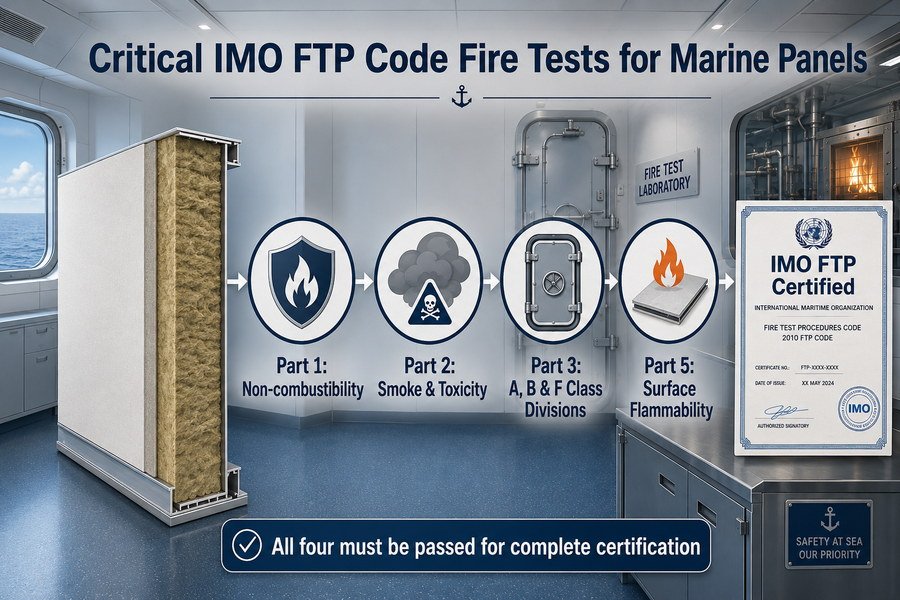
Examining Part 1 and Part 3 for Marine Core Materials
When I worked at the marine outfitting factory, we focused heavily on the core materials of our panels. To pass Part 1 (Non-combustibility), materials like rockwool must endure a furnace at 750°C for 30 minutes5. During this time, the furnace temperature must not rise by more than 30°C. Also, the sample must not lose more than 50% of its mass. This is according to the exact text in the 2010 FTP Code. Next is Part 3, which tests "A", "B" and "F" class divisions. Your marine fire doors and wall panels usually fall here. For a B-15 class marine panel, the unexposed side temperature must not rise more than 140°C above the starting temperature during a 15-minute standard fire test.6 If you are selling to high-end shipyards, they check these Part 3 certificates before anything else.
Analyzing Part 2 and Part 5 for Surface Finishes
After checking the core, you must look at the surface. You cannot put normal PVC on a marine panel. Part 5 (Surface flammability) checks how fast flames spread across your decorative finish. The lab measures the critical heat flux at extinguishment, which must be at least 20 kW/m2 for bulkhead finishes7. Part 2 (Smoke and toxicity) measures the deadly gases. For example, carbon monoxide limits are strict; the maximum allowed concentration during a test is 1450 ppm8 (parts per million). Hydrogen chloride must stay below 600 ppm, according to IMO resolution MSC.307(88). If your Asian supplier uses cheap glue, the panel will fail Part 2 immediately. I always advise buyers to ask the factory about their glue. All four parts are legally required.
| FTP Code Part | Target Component | Key Metric Example |
|---|---|---|
| Part 1 | Panel Core (e.g., Rockwool) | 750°C furnace test, max 30°C temperature rise. |
| Part 3 | Complete Panel Structure | Max 140°C unexposed side temp rise over 15 minutes (B-15). |
| Part 5 | PVC Film or Paint Finish | Minimum 20 kW/m2 critical heat flux to stop flame spread. |
| Part 2 | Adhesives and Finishes | Carbon monoxide must remain below 1450 ppm. |
Knowing these parts helps you avoid suppliers who only test half their product. Let us move on to the timeline of these rules so you do not buy outdated materials.
When was the IMO FTP Code adopted and revised?
Holding an outdated certificate? A shipyard will reject your products if your documents use old standards. Here is the timeline to ensure your certificates are completely valid today.
The original IMO FTP Code was adopted in 1996 through Resolution MSC.61(67). The most important revision happened when the 2010 FTP Code was adopted, which entered into force globally on July 1, 2012. You must ensure your current marine materials comply with the updated 2010 regulations.
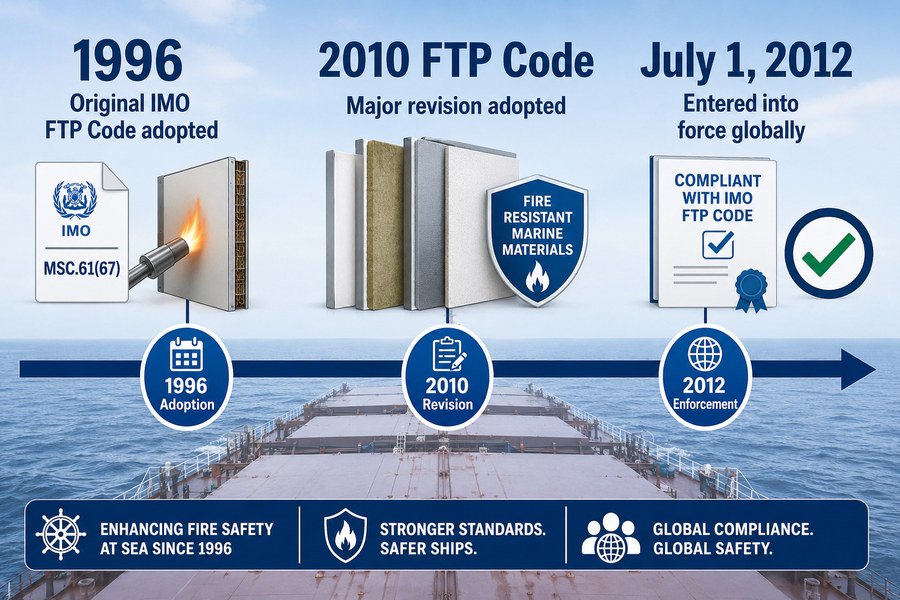
The Origins in the 1996 IMO FTP Code
History matters in this industry. The first formal, unified document was the 1996 FTP Code, officially adopted on December 5, 19969. Before this time, testing was chaotic. I heard stories from older engineers about how a panel approved in one country was blocked in another. The 1996 Code, created under Resolution MSC.61(67), fixed this problem. It forced all maritime nations to use the exact same test procedures for their ships. It became legally binding on July 1, 1998. This was a massive change for Asian factories exporting to Europe, as they suddenly had to buy new testing machines to match the global standard.
The Transition to the 2010 IMO FTP Code
Technology changed, and fires still happened. The IMO realized they needed stricter rules. They adopted the 2010 FTP Code on December 3, 2010, and it became mandatory on July 1, 2012.10 This is the version you must care about today. When you ask a supplier for a fire certificate for marine wall panels, check the top right corner of the paper. It must say "2010 FTP Code". The 2010 revision brought tougher smoke toxicity limits and updated test methods for new composite materials. It also improved the rules for testing floor coverings. If a Chinese factory shows you a certificate tested under the 1996 rules, you cannot use it for a new shipbuilding project in the US. The type approval certificates usually last for exactly 5 years before the factory needs to pay for a renewal audit.
| Code Version | Adoption Date | Mandatory Entry Date | Status Today |
|---|---|---|---|
| 1996 FTP Code | December 5, 1996 | July 1, 1998 | Outdated, rejected by new shipyards. |
| 2010 FTP Code | December 3, 2010 | July 1, 2012 | Active, required for all new purchases. |
Checking the dates on these certificates takes only a few seconds but saves you from massive losses. Next, let us explore why this code is so powerful in the industry.
Why is the IMO FTP Code called the central fire-test framework for marine interior materials?
Confused by the many maritime rules? Tracking multiple standards will ruin your procurement schedule. Here is why the FTP Code is the only framework you truly need.
The IMO FTP Code is the central framework because it directly supports SOLAS Chapter II-2. It unifies scattered regional rules, provides a single global baseline for all maritime classification societies like DNV or ABS, and guarantees consistent safety performance across all international shipbuilding projects.
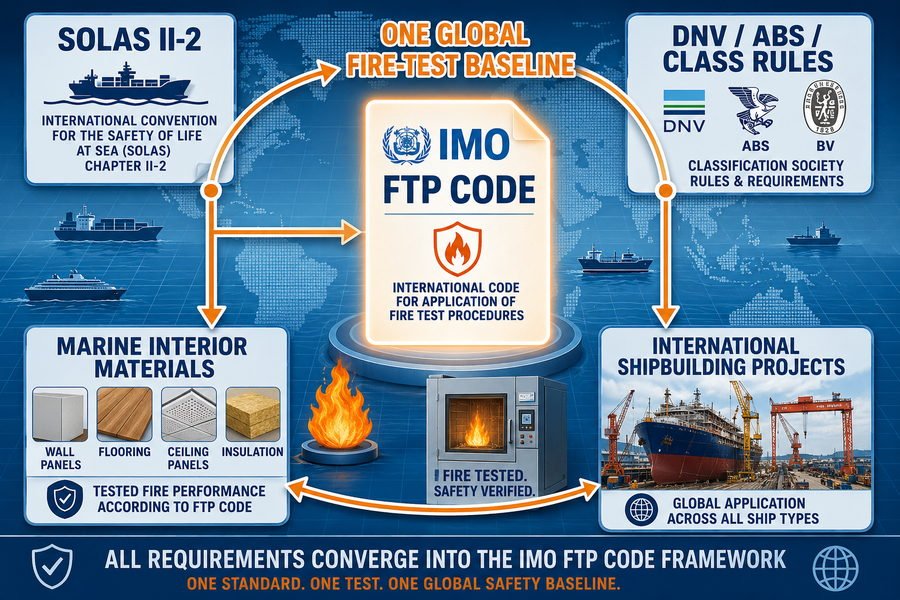
Direct Support for SOLAS Chapter II-2 Regulations
The easiest way to understand this is to look at the law. The Safety of Life at Sea (SOLAS) convention is the supreme law for global shipping.11 Specifically, SOLAS Chapter II-2 deals with fire protection, fire detection, and fire extinction.12 But SOLAS only gives the broad goals. It says things like "bulkheads must restrict the spread of fire." It does not tell you exactly how to prove it. That is why the FTP Code is the central framework. It takes the broad SOLAS goals and turns them into exact, measurable laboratory numbers.13 It acts as the direct bridge between the law and the factory floor. Without the FTP Code, SOLAS would be impossible to enforce for interior decoration companies.
Unifying Global Maritime Classification Societies
When you buy a marine fire door, you might need a DNV certificate for a European project, or an ABS certificate for an American project. Years ago, this was a nightmare. Now, because the FTP Code is the central framework, all the major classification societies use it as their absolute baseline.14 Whether you test in a lab in Shanghai or a lab in Hamburg, the engineers follow the exact same manual. This single global baseline saves procurement officers massive amounts of money. If a Chinese wall panel passes the FTP Code Part 3 test, ABS, Lloyd's Register, and DNV will all accept the test data. They will all issue their own certificates based on that one test report. This guarantees consistent safety performance across all international shipbuilding projects, no matter where the ship is built.
| Aspect | Problem Before FTP Code | Solution Provided by FTP Code |
|---|---|---|
| SOLAS Rules | Vague wording about stopping fires. | Provides exact temperatures, limits, and time frames. |
| Classification | Each society (DNV, ABS) had different rules. | One single baseline accepted by all major societies. |
| Safety Quality | Factories produced varying qualities for regions. | Consistent safety performance guaranteed globally. |
This unification makes your job as a buyer much simpler, as you only need to look for one standard. But you still need to know the exact legal resolution number.
Which IMO resolution officially issues the FTP Code?
Staring at complicated certification documents? Missing the exact resolution number can cause surveyors to reject your cargo. Here are the exact resolution numbers you need on your documents.
The 2010 IMO FTP Code was officially issued under the IMO Resolution MSC.307(88). The previous, outdated 1996 version was issued under Resolution MSC.61(67). For your current marine interior outfitting purchases, every valid test report and Type Approval certificate must explicitly reference Resolution MSC.307(88).
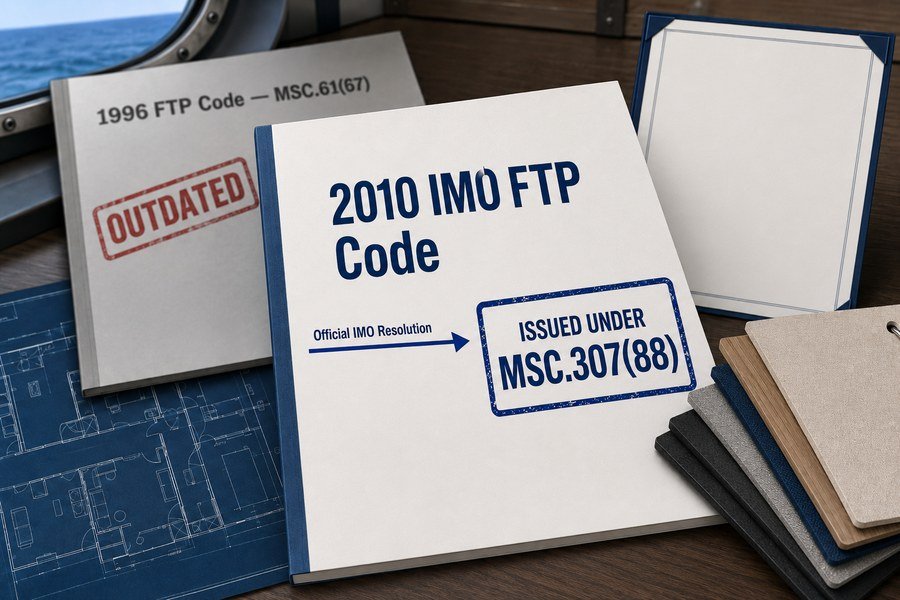
The Current Mandate: Resolution MSC.307(88)
I constantly remind my clients to read the fine print on their certificates. The Maritime Safety Committee (MSC) is the highest technical body of the IMO. When they agree on a new rule, they publish a resolution. The current 2010 FTP Code was officially issued by Resolution MSC.307(88).15 The number 88 means it was the 88th session of the committee. If you are buying marine ceiling panels today, the Type Approval certificate (also called a MED B certificate in Europe) must clearly state that the product was tested according to MSC.307(88). The test report from the laboratory must also print MSC.307(88) on the front cover. If it does not, a European shipyard will not accept your materials, and you will lose your money. I once saw a buyer lose a $50,000 order because of this simple missing number.
The Outdated Mandate: Resolution MSC.61(67)
It is also important to know the old rule so you can spot mistakes. The old 1996 FTP Code was issued under Resolution MSC.61(67). Some smaller, cheaper suppliers in developing countries might still try to show you older certificates from 10 years ago to prove their quality. Do not accept them. While MSC.61(67) was a great standard in the past, it is no longer valid for new ship constructions today16. You must explicitly demand MSC.307(88) compliance. Most major testing labs charge a re-testing fee of around $4,000 USD if a factory needs to upgrade their old MSC.61(67) certificate to the new standard. It costs money, which is why cheap suppliers try to avoid it and trick buyers.
| Resolution Number | Associated FTP Code | Buyer Action Required |
|---|---|---|
| MSC.307(88) | 2010 FTP Code | Demand this on all new panel and door certificates. |
| MSC.61(67) | 1996 FTP Code | Reject these documents for new shipbuilding projects. |
Now you know exactly what letters and numbers to look for. Finally, let us discuss why you cannot just use normal building materials on a ship.
How does the IMO FTP Code differ from generic land-based fire test standards?
Tempted to buy cheaper construction panels for a ship? Using land-based materials on marine projects leads to inspection failure. Here are the exact differences between the two standards.
The IMO FTP Code tests for the extreme, isolated environment of a ship at sea, requiring stricter smoke toxicity limits, higher non-combustibility thresholds, and marine-specific class division ratings (A, B, F) compared to the standard EN or ASTM land-based building codes which assume easier evacuation paths.
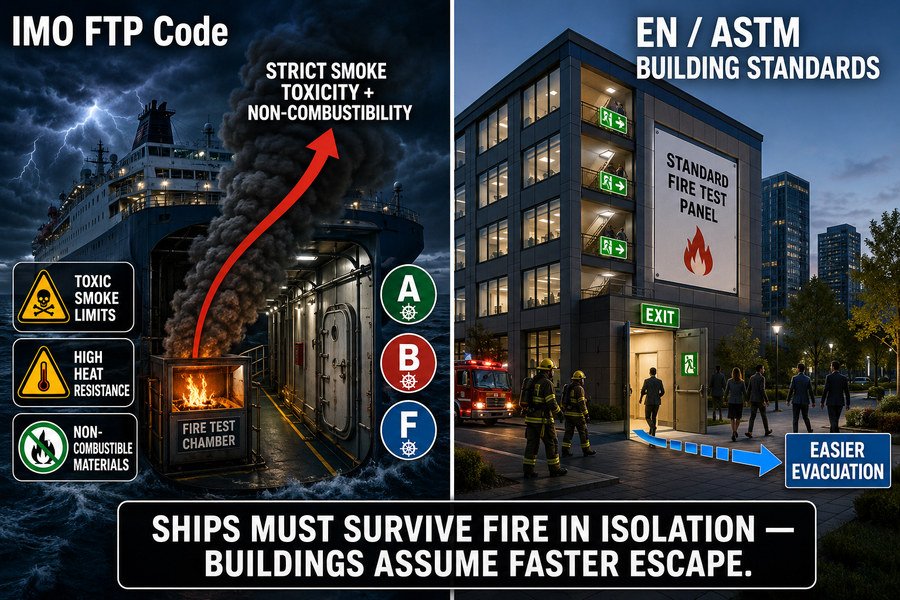
Stricter Smoke Toxicity Limits for Isolated Environments
I often get asked by buyers why they cannot just buy cheap office wall panels in China and put them on a cruise ship. The answer is evacuation. On land, if a building catches fire, you run outside to the street. On a ship in the middle of the ocean, there is no street. You are trapped in an isolated environment. Therefore, the IMO FTP Code has much stricter smoke toxicity limits17 than land-based standards like EN 13501 (for Europe) or ASTM E84 (for the US). For marine panels, the FTP Code strictly monitors the release of seven specific toxic gases18, including Carbon Monoxide (CO), Hydrogen Chloride (HCl), and Hydrogen Cyanide (HCN). Land-based standards often focus only on how far the flame spreads and total smoke volume, but they completely ignore the deadly chemical makeup of that smoke.
Higher Thresholds and Marine-Specific Class Ratings
Besides smoke, the heat thresholds and classifications are entirely different. Land-based codes talk about 1-hour or 2-hour firewalls for concrete structures. The marine industry uses specific A, B, and F class division ratings for lightweight steel structures. For example, an A-60 marine bulkhead must prevent flames and smoke passage for 60 minutes, and the unexposed side temperature must not rise more than 140°C on average19. To achieve this, marine panels often use high-density rockwool, typically 120 kg/m3 or 150 kg/m3. Cheap land-based office panels use 60 kg/m3 rockwool, which fails the IMO non-combustibility thresholds instantly. You might save 30% on the purchase price buying land panels, but you will lose 100% of your money when the marine surveyor rejects them.
| Feature | IMO FTP Code (Marine) | EN/ASTM Codes (Land-Based) |
|---|---|---|
| Environment | Isolated ship at sea (difficult evacuation). | Buildings on land (easy evacuation). |
| Toxicity Rules | Tests 7 specific deadly chemical gases. | Often ignores chemical makeup, focuses on smoke volume. |
| Fire Ratings | Specific A, B, F class divisions (e.g., A-60, B-15). | Generic hourly ratings (1-hour, 2-hour walls). |
| Core Material | Requires high density rockwool (120-150 kg/m3). | Allows low density rockwool (60 kg/m3) or foam. |
Conclusion
Passing the IMO FTP Code is non-negotiable for marine outfitting. By understanding these fire test procedures, you secure high-quality panels and ensure your European shipyard projects pass every safety inspection.
-
"International Maritime Organization", https://www.imo.org/. The IMO describes itself as the United Nations specialized agency responsible for the safety and security of shipping and the prevention of marine and atmospheric pollution by ships, with headquarters in London. Evidence role: definition; source type: institution. Supports: The International Maritime Organization is based in London and is responsible for global shipping regulation.. ↩
-
"Summary of SOLAS chapter II-2 - International Maritime Organization", https://www.imo.org/en/ourwork/safety/pages/summaryofsolaschapterii-2-default.aspx. IMO materials on SOLAS identify Chapter II-2 as the chapter governing fire protection, fire detection, and fire extinction requirements for ships. Evidence role: definition; source type: institution. Supports: SOLAS Chapter II-2 contains strict maritime fire-safety requirements.. Scope note: This supports the regulatory scope of Chapter II-2 generally; detailed obligations vary by ship type, construction date, and material application. ↩
-
"[PDF] RESOLUTION MSC.307(88) (adopted on 3 December 2010 ...", https://wwwcdn.imo.org/localresources/en/KnowledgeCentre/IndexofIMOResolutions/MSCResolutions/MSC.307(88).pdf. The IMO’s 2010 FTP Code, adopted by resolution MSC.307(88), sets out international fire test procedures for materials and components used in ships, including procedures referenced under SOLAS fire-safety requirements. Evidence role: definition; source type: institution. Supports: The FTP Code provides standardized procedures that laboratories use to test maritime materials for fire performance.. Scope note: The source supports the FTP Code’s role as a standardized testing framework, but individual test details depend on the relevant part of the Code and the material being assessed. ↩
-
"[PDF] RESOLUTION MSC.307(88) (adopted on 3 December 2010 ...", https://wwwcdn.imo.org/localresources/en/KnowledgeCentre/IndexofIMOResolutions/MSCResolutions/MSC.307(88).pdf. ISO 1182 specifies a non-combustibility test in which specimens are exposed in a furnace operated at approximately 750 °C, and the method is used in fire-test regimes for assessing whether building or marine materials are non-combustible. Evidence role: mechanism; source type: institution. Supports: The non-combustibility test referenced by ISO 1182 uses a furnace temperature of about 750°C.. Scope note: The wording “exactly 750°C” should be checked against the standard’s stated tolerance, as standards commonly specify an allowable temperature range rather than an absolute value. ↩
-
"[PDF] RESOLUTION MSC.307(88) (adopted on 3 December 2010 ...", https://wwwcdn.imo.org/localresources/en/KnowledgeCentre/IndexofIMOResolutions/MSCResolutions/MSC.307(88).pdf. IMO Resolution MSC.307(88), Annex 1, Part 1, specifies the non-combustibility test conditions, including furnace exposure at approximately 750°C and criteria based on temperature rise, flaming, and mass loss. Evidence role: general_support; source type: institution. Supports: Part 1 of the 2010 FTP Code requires marine core materials tested for non-combustibility to undergo furnace exposure at 750°C for 30 minutes with defined temperature-rise and mass-loss limits.. Scope note: The source supports the regulatory test method and criteria, but it does not certify any particular rockwool product as compliant. ↩
-
"[PDF] RESOLUTION MSC.307(88) (adopted on 3 December 2010 ...", https://wwwcdn.imo.org/localresources/en/KnowledgeCentre/IndexofIMOResolutions/MSCResolutions/MSC.307(88).pdf. The 2010 FTP Code and SOLAS fire-test provisions define B-class division performance by insulation criteria, including a mean unexposed-face temperature rise limit of 140°C and a 15-minute rating for B-15 divisions. Evidence role: definition; source type: institution. Supports: A B-15 class marine panel is assessed by a 15-minute fire-resistance test with an unexposed-side temperature-rise limit of 140°C above the initial temperature.. Scope note: The standard includes additional criteria, such as maximum single-point temperature rise and construction requirements, so the cited sentence summarizes only one key metric. ↩
-
"[PDF] RESOLUTION MSC.307(88) (adopted on 3 December 2010 ...", https://wwwcdn.imo.org/localresources/en/KnowledgeCentre/IndexofIMOResolutions/MSCResolutions/MSC.307(88).pdf. IMO Resolution MSC.307(88), Annex 1, Part 5, sets surface flammability criteria for bulkhead, wall, and ceiling linings, including a minimum critical flux at extinguishment expressed in kW/m². Evidence role: general_support; source type: institution. Supports: Part 5 surface flammability testing uses critical heat flux at extinguishment, with a 20 kW/m² threshold for certain bulkhead finish applications.. Scope note: The requirement varies by material category and application, so the source should be checked against the exact product type and installation location. ↩
-
"How Do Marine Panel Surface Finishes Affect Fire Safety ...", https://magellanmarinetech.com/how-marine-panel-surface-finishes-affect-fire-safety-compliance/. IMO Resolution MSC.307(88), Annex 1, Part 2, lists smoke and toxicity acceptance criteria, including maximum gas concentration limits for carbon monoxide and other combustion products measured during the test. Evidence role: general_support; source type: institution. Supports: Part 2 smoke and toxicity testing under the 2010 FTP Code sets a maximum carbon monoxide concentration of 1450 ppm during the test.. Scope note: The limit is part of a prescribed laboratory method and should not be interpreted as a general occupational exposure limit or a direct prediction of shipboard fire conditions. ↩
-
"MSC 1994-96 - International Maritime Organization", https://www.imo.org/en/knowledgecentre/indexofimoresolutions/pages/msc-1994-96.aspx. IMO Resolution MSC.61(67) adopted the International Code for Application of Fire Test Procedures (FTP Code) in 1996, providing a harmonized framework for fire test procedures under SOLAS; this supports the adoption and standardization claim, though it does not by itself document specific factory impacts in Asia. Evidence role: historical_context; source type: institution. Supports: The 1996 FTP Code was formally adopted by the IMO on December 5, 1996 and created a unified framework for maritime fire testing procedures.. Scope note: The source can verify adoption and harmonization, but not the anecdotal claim about panels being accepted in one country and blocked in another, nor the claimed effects on Asian factories. ↩
-
"[PDF] RESOLUTION MSC.307(88) (adopted on 3 December 2010 ...", https://wwwcdn.imo.org/localresources/en/KnowledgeCentre/IndexofIMOResolutions/MSCResolutions/MSC.307(88).pdf. IMO Resolution MSC.307(88) adopted the 2010 International Code for Application of Fire Test Procedures, and associated SOLAS amendments made the revised Code applicable from 1 July 2012; this supports the stated adoption and mandatory application dates, subject to implementation through SOLAS flag-state enforcement. Evidence role: historical_context; source type: institution. Supports: The 2010 FTP Code was adopted on December 3, 2010 and became mandatory on July 1, 2012.. Scope note: The source supports the regulatory dates and status, but does not directly prove that every individual certificate must display a particular top-right-corner wording. ↩
-
"[PDF] status of imo treaties - INTERNATIONAL MARITIME ORGANIZATION", https://wwwcdn.imo.org/localresources/en/About/Conventions/StatusOfConventions/Status%202025.pdf. The International Maritime Organization describes SOLAS as the principal international treaty governing the safety of merchant ships, supporting its central legal role in global shipping safety regulation. Evidence role: historical_context; source type: institution. Supports: SOLAS is the central international legal framework for merchant ship safety.. Scope note: This supports SOLAS as a principal international convention, but the phrase “supreme law” is rhetorical rather than a formal legal hierarchy in every jurisdiction. ↩
-
"[PDF] solas - International Maritime Organization", https://wwwcdn.imo.org/localresources/en/publications/Documents/Supplements/English/QH110E_supplement_January2026.pdf. SOLAS Chapter II-2 is titled and organized around construction provisions for fire protection, fire detection, and fire extinction, confirming that this chapter governs shipboard fire-safety requirements. Evidence role: definition; source type: institution. Supports: SOLAS Chapter II-2 covers fire protection, fire detection, and fire extinction requirements.. ↩
-
"Fire testing laboratories - International Maritime Organization", https://www.imo.org/en/ourwork/safety/pages/firetestinglaboratories-default.aspx. IMO Resolution MSC.307(88), adopting the 2010 FTP Code, sets out standardized fire-test procedures and acceptance criteria for materials and components required under SOLAS Chapter II-2, supporting the claim that the Code operationalizes SOLAS fire-safety requirements through laboratory testing. Evidence role: mechanism; source type: institution. Supports: The FTP Code translates relevant SOLAS fire-safety objectives into standardized laboratory test procedures and acceptance criteria.. Scope note: The source supports the Code’s role in standardized testing and criteria, but not every SOLAS fire-safety obligation is reduced to a laboratory number. ↩
-
"Summary of SOLAS chapter II-2 - International Maritime Organization", https://www.imo.org/en/ourwork/safety/pages/summaryofsolaschapterii-2-default.aspx. Rules and statutory-certification guidance from major classification societies generally reference SOLAS Chapter II-2 and the IMO FTP Code when assessing fire-safety materials and components, providing contextual support that the FTP Code functions as a common baseline for class approval. Evidence role: general_support; source type: institution. Supports: Major classification societies commonly use SOLAS Chapter II-2 and the IMO FTP Code as a baseline for fire-safety approval of marine materials and components.. Scope note: This would not by itself prove that every major society automatically accepts every test report, since acceptance can depend on laboratory accreditation, flag-state requirements, product scope, and society-specific approval procedures. ↩
-
"[PDF] RESOLUTION MSC.307(88) (adopted on 3 December 2010 ...", https://wwwcdn.imo.org/localresources/en/KnowledgeCentre/IndexofIMOResolutions/MSCResolutions/MSC.307(88).pdf. IMO Resolution MSC.307(88) adopts the International Code for Application of Fire Test Procedures, 2010, establishing the resolution as the formal instrument for the 2010 FTP Code. Evidence role: historical_context; source type: institution. Supports: The 2010 FTP Code was officially issued/adopted through IMO Resolution MSC.307(88).. ↩
-
"[PDF] RESOLUTION MSC.307(88) (adopted on 3 December 2010 ...", https://wwwcdn.imo.org/localresources/en/KnowledgeCentre/IndexofIMOResolutions/MSCResolutions/MSC.307(88).pdf. IMO materials on the 2010 FTP Code indicate that it superseded the 1996 FTP Code for applicable SOLAS fire-test requirements after its entry into force; this supports the need to use MSC.307(88) for newbuild approvals, although project-specific transitional provisions may depend on flag-state and contract dates. Evidence role: expert_consensus; source type: institution. Supports: The older MSC.61(67) / 1996 FTP Code is not the applicable standard for new ship construction approvals where the 2010 FTP Code applies.. Scope note: The support is contextual because exact acceptance rules for a particular shipyard or project can vary by flag administration, notified body, contract date, and class society interpretation. ↩
-
"RESOLUTION MSC.307(88) (adopted on 3 December ...", https://wwwcdn.imo.org/localresources/en/KnowledgeCentre/IndexofIMOResolutions/MSCResolutions/MSC.307(88).pdf. The IMO FTP Code includes smoke-toxicity testing with specified gas concentration limits for marine materials, whereas common building classifications such as ASTM E84 and EN 13501 primarily classify flame spread and smoke production; this supports the stated regulatory contrast in general terms. Evidence role: expert_consensus; source type: institution. Supports: The IMO FTP Code imposes smoke-toxicity requirements for marine materials that are not equivalent to common land-based fire classification systems such as EN 13501 or ASTM E84.. Scope note: A precise claim that one regime is universally “stricter” depends on the product, jurisdiction, and version of the standard being compared. ↩
-
"[PDF] RESOLUTION MSC.307(88) (adopted on 3 December 2010 ...", https://wwwcdn.imo.org/localresources/en/KnowledgeCentre/IndexofIMOResolutions/MSCResolutions/MSC.307(88).pdf. IMO FTP Code Part 2 smoke and toxicity procedures identify concentration limits for seven combustion gases, including CO, HCl, HBr, HF, HCN, NOx, and SO2, supporting the article’s description of the marine toxicity test scope. Evidence role: definition; source type: institution. Supports: The IMO FTP Code monitors seven specified toxic gases in smoke-toxicity testing for relevant marine materials.. ↩
-
"[PDF] RESOLUTION A.754(18) adopted on 4 November 1993 ...", https://wwwcdn.imo.org/localresources/en/KnowledgeCentre/IndexofIMOResolutions/AssemblyDocuments/A.754(18).pdf. SOLAS/IMO definitions for A-class divisions state that they must prevent smoke and flame passage for the relevant test period and that the average temperature rise on the unexposed side must not exceed 140°C, with A-60 corresponding to a 60-minute insulation period. Evidence role: definition; source type: institution. Supports: An A-60 marine division has a 60-minute fire-resistance requirement and a 140°C average unexposed-side temperature-rise limit.. Scope note: Exact test implementation details may vary by incorporated test procedure and edition of the IMO instruments. ↩