Are you struggling to pass ship fire inspections because of panel finishes? Choosing the wrong surface material can fail your whole project. I will show you how to fix this.
Marine panel surface finishes dictate fire safety compliance by controlling flame spread, smoke generation, and toxic gas emissions. According to SOLAS regulations, finishes must be low flame spread PVC, PET, or galvanized steel to pass the International Code for Application of Fire Test Procedures (FTP Code) Part 5 and Part 2.
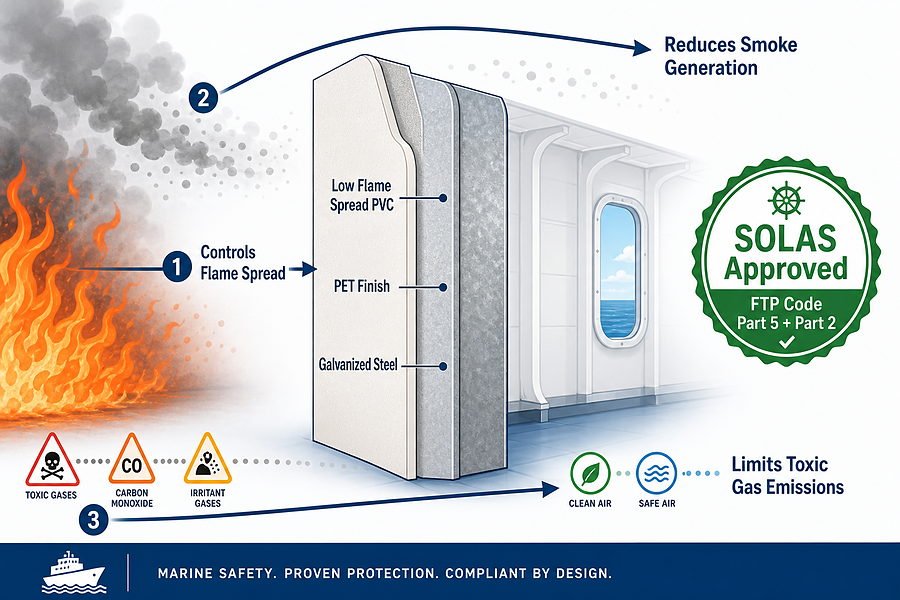
You might think the core material is all that matters for fire safety. But the thin surface layer on your panels can make or break your marine outfitting project. Let us look at exactly how this works for different panels.
How Do Surface Finishes Affect Marine Wall Panel Fire Rating?
Failing a wall panel fire test costs you time and money. Do your wall finishes burn too quickly? Let us explore how wall surfaces change your fire rating.
Surface finishes affect marine wall panel fire ratings by adding combustible mass and altering heat transfer to the core. Finishes must limit the calorific value to under 45 MJ/m², control smoke density, and prevent toxic gas release, ensuring the wall maintains its A-Class or B-Class integrity during a fire test.
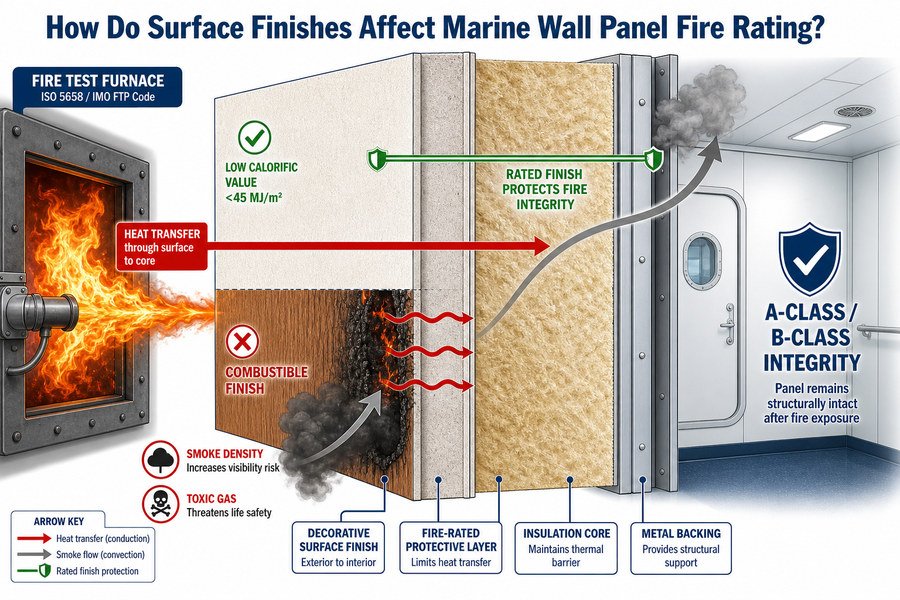
In my years at Magellan Marine, I saw many projects fail because buyers ignored the surface film. The core might be non-combustible rockwool, but the finish matters just as much.
Impact of Surface Combustibility on Wall Panels
The surface finish adds combustible mass. The International Maritime Organization (IMO) through the FTP Code 2010 specifies strict limits. The gross calorific value of the finish must not exceed 45 Megajoules per square meter (MJ/m²).1 If you use a thick PVC film, like 0.6mm, it will burn too hot and exceed this limit. This extra heat transfers to the steel sheet and the rockwool core. This causes the panel to warp and lose its structural integrity during the 60-minute A-60 test. We must control both the thickness and the material type.
| Fire Safety Factor | IMO FTP Code Reference | Safe Limit Value | Result of Exceeding Limit |
|---|---|---|---|
| Calorific Value | Part 5 | < 45 MJ/m² | High heat output, panel warps |
| Smoke Density (Ds max) | Part 2 | < 200 | Poor visibility during escape |
| Carbon Monoxide (CO) | Part 2 | < 1450 ppm | Fatal toxicity to passengers |
| Hydrogen Chloride (HCl) | Part 2 | < 600 ppm | Respiratory damage, panic |
Smoke and Toxicity Requirements for Wall Finishes
Beyond just burning, the finish affects smoke density and toxic gas. This is covered in FTP Code Part 2. When a PVC finish burns, it releases hydrogen chloride gas.2 SOLAS regulations mandate that maximum smoke density (Ds max) cannot go over 200 for wall materials. Also, toxic gases like Carbon Monoxide (CO) must stay below 1450 ppm (parts per million). If the finish creates too much smoke, people cannot see the exit. If it makes too much toxic gas, they cannot breathe. Therefore, keeping the surface finish thin is the best way to control both heat and smoke. A thickness between 0.12mm to 0.20mm is usually safe.
How Do Surface Finishes Affect Marine Ceiling Panel Fire Rating?
Ceiling panels face different fire risks than walls. Are your ceiling panels dropping burning plastic when heated? We must understand ceiling surface fire dynamics.
Surface finishes affect marine ceiling panel fire ratings through rapid overhead flame spread, burning droplets, and smoke accumulation. Ceiling finishes must be strictly tested for low flame spread and zero flaming drips under IMO FTP Code, as overhead fires spread heat radially and trap toxic smoke in passenger breathing zones.
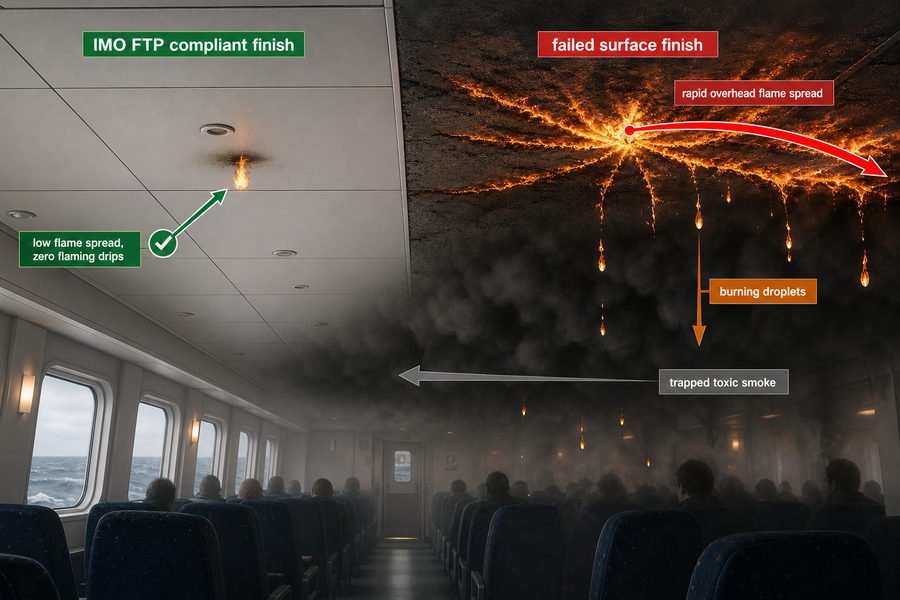
Fire behaves differently on a ceiling than on a wall. Hot air and flames rise. This means ceiling panels take the direct hit of the heat. During a project for a shipyard, I learned that ceiling panel finishes must be very thin.
Overhead Flame Spread Risks on Marine Ceilings
When fire hits the ceiling, it spreads outward in a circle. This overhead flame spread is very dangerous. According to the IMO FTP Code Part 5, the critical heat flux at extinguishment (CFE)3 for ceiling finishes must be high enough to stop the fire from moving fast. We usually require a CFE value of at least 20.0 kW/m² for safe ceiling finishes. If the finish is thick or highly combustible, the fire will race across the room.
| Ceiling Fire Risk | Cause from Surface Finish | Safe Solution |
|---|---|---|
| Rapid Overhead Spread | High calorific value > 45 MJ/m² | Use paint < 25 microns thick |
| Flaming Droplets | Thick melting PVC > 0.15mm | Use bare steel or 0.10mm PVC |
| Smoke Accumulation | High smoke density materials | Use low-smoke PET or powder coat |
The Danger of Burning Droplets from Ceiling Finishes
Another big problem is burning droplets. If you use the wrong plastic film on a ceiling panel, the heat will melt it. The melting plastic will drop to the floor while still on fire. This starts new fires on the carpet below. The FTP Code strictly bans flaming drips during the test. Also, smoke from ceilings is worse. Smoke gathers at the top of the room and pushes down into the breathing zone. We must use finishes that produce very low smoke. Usually, painted galvanized steel with a paint thickness of less than 45 microns (µm) is the safest choice. It does not melt or drip. PVC films must be very thin, around 0.10mm, to avoid these dripping risks.
What Surface Finish Is Suitable For A-Class Marine Wall Panels?
Finding the right finish for high-risk areas is tough. Need to meet A-class rules without spending too much? Here are the best materials to use.
Suitable surface finishes for A-Class marine wall panels include PVC laminate films (0.12mm-0.20mm), PET eco-friendly films, and powder-coated steel finishes. These three options provide excellent low flame spread properties, meet IMO FTP Code Part 5 and Part 2 standards, and offer durability against impact in high-traffic ship corridors.
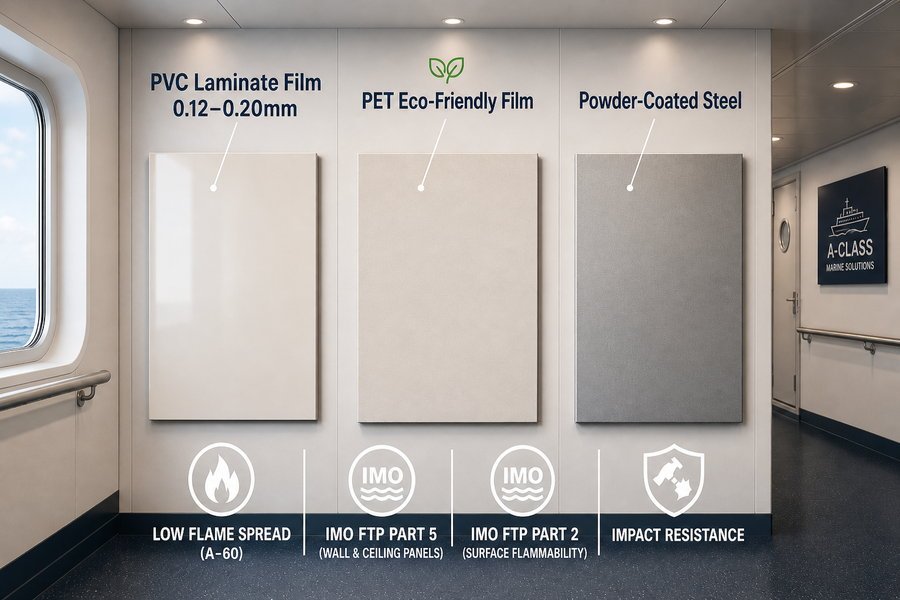
A-Class bulkheads, like A-60 or A-30, must stop fire and heat for up to 60 minutes. The surface finish on these panels must be tough but fire-safe.
PVC Laminate Films for A-Class Wall Panels
The most common choice I used at the factory is PVC laminate film. PVC film is cheap and looks good. However, to pass the A-Class fire test, the PVC film thickness must stay between 0.12mm and 0.20mm. If it is thicker, it holds too much fuel. The weight of this film is usually around 150 to 250 grams per square meter (g/m²). This specific range ensures the calorific value stays below the IMO limit of 45 MJ/m²4.
| Wall Finish Type | Normal Thickness | Main Advantage | Average Cost Impact |
|---|---|---|---|
| PVC Laminate Film | 0.12mm - 0.20mm | Low cost, many wood patterns | Base price |
| PET Eco-Film | 0.15mm | Zero toxic smoke (No HCl) | + 15% to 20% |
| Powder-Coated Steel | 60 - 80 microns | Zero combustible mass, hard | + 10% |
PET Films and Powder Coating for A-Class Corridors
The second great option is PET (Polyethylene Terephthalate) film. PET is more eco-friendly than PVC. It does not release hydrogen chloride gas when it burns5. This makes passing the FTP Code Part 2 smoke toxicity test very easy. PET films are usually 0.15mm thick. They cost about 15% to 20% more than PVC, but European shipyards love them. The third option is powder-coated steel. This is paint baked onto the metal. It is the best for fire safety because it has almost zero combustible mass. The powder coating thickness is normally 60 to 80 microns (µm). It easily passes all A-class fire tests and is very hard to scratch. All three of these finishes work perfectly for A-class walls if you control their thickness.
What Surface Finish Is Suitable For A-Class Marine Ceiling Panels?
Ceilings need lighter and safer finishes. Do you know which materials stop overhead fires best? Let us look at the top choices for ceilings.
Suitable surface finishes for A-Class marine ceiling panels include baked polyester paint (20-25 microns), thin PVC films (max 0.12mm), and bare galvanized steel. These three finishes prevent flaming droplets, keep combustible mass exceptionally low, and easily pass the strict A-Class overhead fire containment tests mandated by SOLAS.
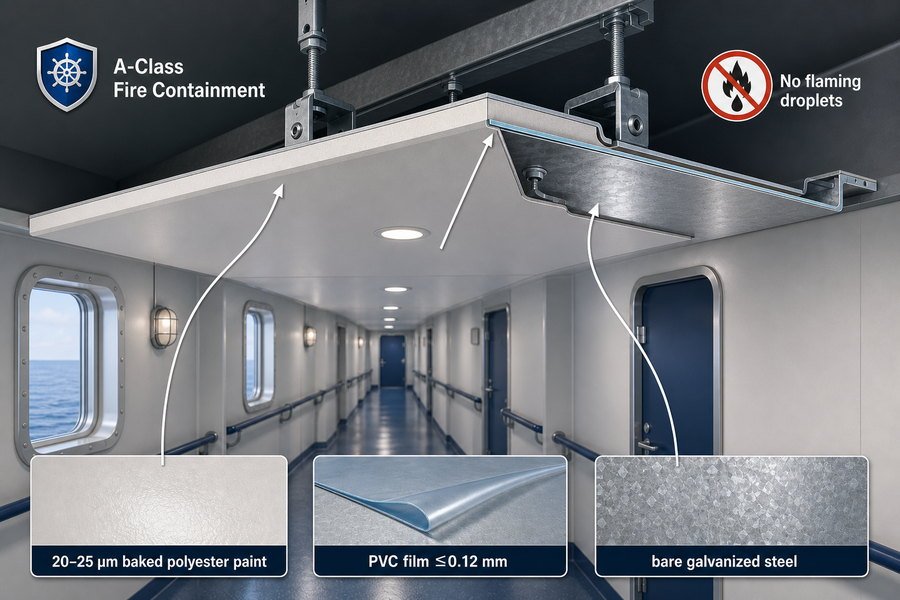
Because ceiling fires are so dangerous, the rules for A-Class ceilings are very strict. We cannot use thick materials overhead.
Baked Polyester Paint for A-Class Ceiling Panels
The best and most common surface finish for A-Class marine ceiling panels is baked polyester paint. This is a very thin layer of paint applied at the steel mill. According to industry standards and my factory experience, the dry film thickness of this paint must be between 20 and 25 microns (µm)6. Because it is so thin, its calorific value is less than 5 MJ/m². It will never produce burning droplets. This makes it perfect for A-60 ceiling systems.
| Ceiling Finish Type | Maximum Safe Thickness | Risk of Flaming Droplets | Best Use Case |
|---|---|---|---|
| Baked Polyester Paint | 25 microns (µm) | Zero | Passenger cabins, public spaces |
| Thin PVC Film | 0.12mm | Low | Decorative corridors |
| Bare Galvanized Steel | Zinc coating Z120-Z275 | Zero | Engine rooms, technical spaces |
Thin PVC Films and Bare Steel for Ceiling Safety
The second option is thin PVC film. You can use PVC on ceilings, but you must be careful. The maximum thickness should be 0.12mm. If you use the 0.20mm film that we use on walls, it might melt and drip during the fire test. The thinner 0.12mm PVC film weighs about 160 g/m² and bonds very tightly to the steel. The third option is simply bare galvanized steel. Sometimes, in technical rooms or engine control spaces, you do not need a pretty color. Bare galvanized steel has a zinc coating of about Z120 to Z275 (120 to 275 grams of zinc per square meter). It has zero combustible mass and is 100% fireproof. These three materials guarantee you will pass the ceiling fire test.
What Fire Safety Documents Are Needed For Marine Panel Finishes?
Customs and shipyard inspectors will stop your goods without paperwork. Are you missing key fire certificates? Here are the exact documents you must have.
The essential fire safety documents needed for marine panel finishes include the Marine Equipment Directive (MED) Module B Certificate (Type Approval), MED Module D Certificate (Quality Assurance), and comprehensive fire test reports covering IMO FTP Code Part 2 and Part 5. These three documents legally prove regulatory compliance.
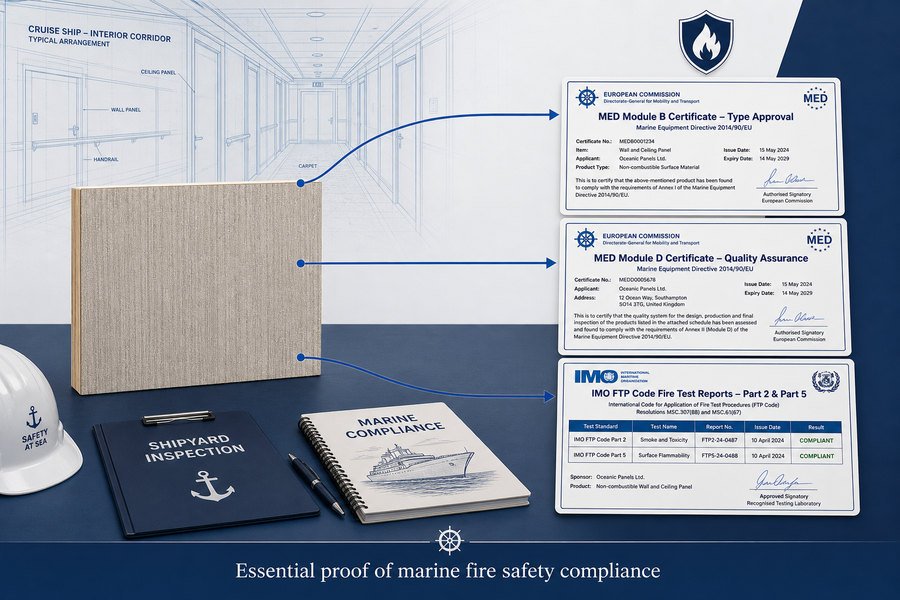
When you buy marine panels in Asia for projects in Europe or the US, the paperwork is just as important as the product. You cannot ship without them.
The Importance of MED Module B and D Certificates
The first document you must get from your supplier is the MED Module B Certificate. This is also called the EC Type Examination Certificate. It proves that the specific surface finish (like a 0.15mm PVC film) has passed the IMO fire tests at an approved lab. The second document is the MED Module D Certificate. This is a Production Quality Assurance certificate. It proves that the factory's daily production is just as good as the sample they tested for the Module B certificate.
| Document Name | What It Proves | Required By | Consequence of Missing Document |
|---|---|---|---|
| MED Module B | Passed laboratory fire test | SOLAS / EU MED | Cannot sell as marine grade |
| MED Module D | Factory quality is stable | SOLAS / EU MED | Cannot get Wheelmark logo |
| Fire Test Reports | Exact toxic limits and thickness | Shipyard Surveyors | Inspector rejects the shipment |
Detailed Fire Test Reports for Panel Finishes
If you only have Module B but no Module D, the product cannot get the "Wheelmark" logo. You cannot use it on European ships. The third required document is the actual fire test reports. Do not just look at the certificate. Ask for the full test reports for IMO FTP Code Part 2 (Smoke and Toxicity) and Part 5 (Surface Flammability). These reports will show the specific values. For example, the Part 5 report will show the exact maximum distance of flame spread. This should be under 400mm. The Part 2 report will list the exact ppm (parts per million) of toxic gases like Carbon Monoxide (CO limit 1450 ppm) and Hydrogen Chloride (HCl limit 600 ppm)7. You need all three of these documents to keep your project safe and legal.
How To Confirm Whether Marine Panel Finishes Meet Project Fire Requirements?
Do not just trust a supplier's word on fire safety. Need to be sure the panels are safe before you pay? Here is exactly how to check.
To confirm marine panel finishes meet project fire requirements, you must verify the Wheelmark logo on the product, cross-check the MED certificates with the USCG or European databases, and compare the supplier's stated film thickness against the maximum thickness listed in the approved IMO fire test reports.
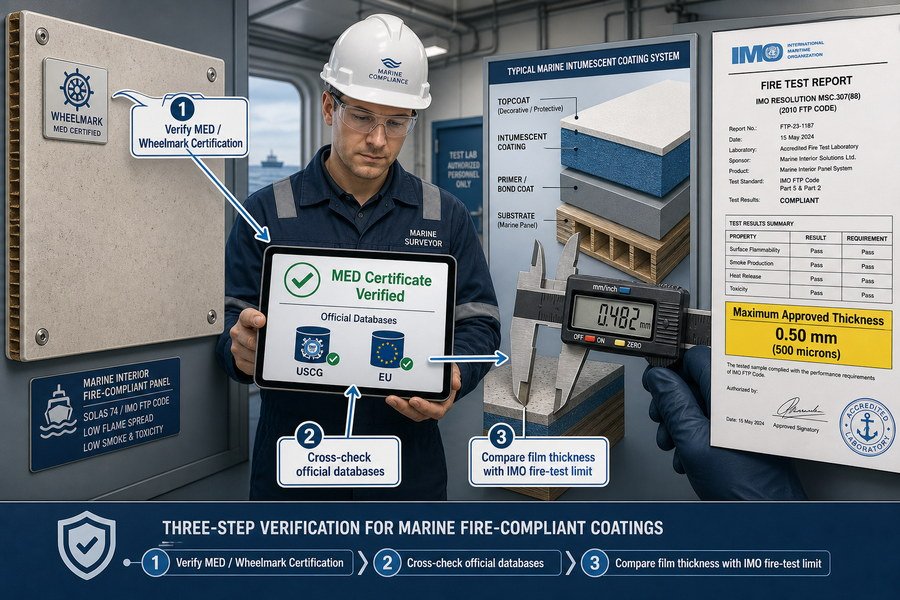
You must be very careful when confirming fire safety. I always use a clear system to protect my clients from bad suppliers.
Verifying Certificates and the Wheelmark Logo
The first step is to look for the Wheelmark logo. According to the Marine Equipment Directive (MED) 2014/90/EU, all approved low flame spread materials must have this mark. The mark will include the ID number of the Notified Body (like 0575 for DNV) and the year it was made.8 Next, you must cross-check the certificates. Do not just look at a PDF. Go to the European database (MarED) or the United States Coast Guard (USCG) Marine Information for Safety and Law Enforcement (MISLE) database. Type in the certificate number. Make sure it is real and not expired.
| Verification Step | Tool Needed | What to Look For |
|---|---|---|
| Check Logo | Eyes | Wheelmark, Notified Body ID, Year |
| Database Check | Internet (MarED/USCG) | Valid status, matching factory name |
| Thickness Check | Thickness Gauge | Value matches the exact IMO test report |
Cross-Checking Thickness and Database Records
The third and most critical step is checking the physical product against the paperwork. I always tell my clients to buy a thickness gauge. These cost about $50. Measure the surface finish of the panel. If the test report says the PVC film was tested at a maximum thickness of 0.15mm, but your supplier gives you a 0.25mm film, the product does not meet the fire requirements. Even if they give you a real certificate, a thicker film is illegal. It adds too much fuel and exceeds the 45 MJ/m² limit9. You must match the physical thickness to the number printed on the IMO test report. By checking the Wheelmark, the online database, and the film thickness, you can guarantee the panels will pass the shipyard's inspection.
Conclusion
Choosing the right marine panel surface finishes controls flame spread, passes strict IMO regulations, and ensures shipyard approvals. Always verify exact film thickness and valid MED certificates to protect your projects.
-
"[PDF] RESOLUTION MSC.307(88) (adopted on 3 December 2010 ...", https://wwwcdn.imo.org/localresources/en/KnowledgeCentre/IndexofIMOResolutions/MSCResolutions/MSC.307(88).pdf. The 2010 FTP Code’s criteria for surface materials include a gross calorific value threshold of 45 MJ/m² for certain exposed finishes, supporting the stated numerical fire-safety limit. Evidence role: statistic; source type: institution. Supports: The IMO FTP Code 2010 sets a gross calorific value limit of 45 MJ/m² for relevant wall-panel surface finishes.. Scope note: The source should be checked for the exact material category and installation context, because FTP Code limits can vary by application and test part. ↩
-
"[PDF] Toxicity of the pyrolysis and combustion of poly(vinyl chlorides)", https://www.govinfo.gov/content/pkg/GOVPUB-C13-1216c17eb433dd191ff5df1d55a1c900/pdf/GOVPUB-C13-1216c17eb433dd191ff5df1d55a1c900.pdf. Studies of polyvinyl chloride thermal degradation report dehydrochlorination and hydrogen chloride release during heating or combustion, supporting the claim that burning PVC can generate HCl gas. Evidence role: mechanism; source type: paper. Supports: Burning or thermally degrading PVC finishes can release hydrogen chloride gas.. Scope note: The amount of HCl released depends on formulation, additives, oxygen availability, and fire conditions, so the source supports the chemical mechanism rather than a specific concentration for this panel finish. ↩
-
"[PDF] RESOLUTION MSC.307(88) (adopted on 3 December 2010 ...", https://wwwcdn.imo.org/localresources/en/KnowledgeCentre/IndexofIMOResolutions/MSCResolutions/MSC.307(88).pdf. IMO FTP Code Part 5 specifies a surface-flammability test for marine finish materials and uses flame-spread measures such as critical flux at extinguishment, supporting the relevance of CFE to ceiling-finish fire performance; this source may not establish that 20.0 kW/m² is a universal minimum for all ceiling finishes. Evidence role: general_support; source type: institution. Supports: The IMO FTP Code Part 5 uses critical heat flux at extinguishment as a relevant measure for assessing marine ceiling finish flame-spread risk.. Scope note: Use as contextual support for CFE as an IMO surface-flammability metric unless the source explicitly confirms the article’s 20.0 kW/m² threshold for the relevant ceiling-finish category. ↩
-
"[PDF] RESOLUTION MSC.307(88) (adopted on 3 December 2010 ...", https://wwwcdn.imo.org/localresources/en/KnowledgeCentre/IndexofIMOResolutions/MSCResolutions/MSC.307(88).pdf. IMO fire-safety provisions specify a 45 MJ/m² calorific-value limit for certain combustible surface materials used on A-class divisions, supporting the stated regulatory threshold. Evidence role: definition; source type: institution. Supports: The applicable IMO limit for calorific value is 45 MJ/m².. Scope note: This source would support the regulatory limit, but not prove that the listed PVC thickness or weight range always stays below it. ↩
-
"Studies of the Effects of Hydrogen Chloride and Polyvinylchloride ...", https://scholars.uthscsa.edu/es/publications/studies-of-the-effects-of-hydrogen-chloride-and-polyvinylchloride/. Polyethylene terephthalate is a chlorine-free polyester, whereas hydrogen chloride formation during combustion is associated with chlorine-containing polymers such as PVC, supporting the chemical basis for the statement. Evidence role: mechanism; source type: paper. Supports: PET film does not release hydrogen chloride gas when it burns.. Scope note: This supports the expected absence of HCl from pure PET combustion; additives, coatings, or contaminants in commercial films could affect actual smoke-gas composition. ↩
-
"[PDF] coil coating | epa", https://www.epa.gov/sites/default/files/2017-07/documents/coil-coating_dd_1982.pdf. Standards and technical references for continuously organic-coated steel commonly describe polyester topcoats in the approximate 20–25 µm range, supporting the stated order of magnitude for baked polyester coil coatings. Evidence role: general_support; source type: institution. Supports: The dry film thickness of baked polyester paint on steel ceiling panels is typically or normatively between 20 and 25 microns.. Scope note: This supports typical coil-coating practice, not a universal mandatory thickness for every A-class marine ceiling panel specification. ↩
-
"[PDF] RESOLUTION MSC.307(88) (adopted on 3 December 2010 ...", https://wwwcdn.imo.org/localresources/en/KnowledgeCentre/IndexofIMOResolutions/MSCResolutions/MSC.307(88).pdf. The IMO FTP Code smoke and toxicity test procedures specify maximum allowable gas concentrations for tested materials, including limits for carbon monoxide and hydrogen chloride; these values provide the regulatory context for reporting CO and HCl ppm results in Part 2 test reports. Evidence role: statistic; source type: institution. Supports: IMO FTP Code Part 2 test reports list toxic gas concentrations and use limits such as CO 1450 ppm and HCl 600 ppm.. Scope note: The limits should be verified against the applicable edition of the FTP Code and the specific material classification being tested. ↩
-
"Directive 96/98/EC - Wikipedia", https://en.wikipedia.org/wiki/Directive_96/98/EC. Directive 2014/90/EU and its implementing provisions describe the wheel mark for marine equipment and require, where applicable, the notified body identification number and time-related marking, supporting the article’s description of what should appear on approved equipment. Evidence role: general_support; source type: government. Supports: The Wheelmark marking includes the notified body identification number and the year or date-related production marking.. Scope note: The Directive establishes marking requirements for equipment within its scope, but it does not verify the validity of any individual supplier certificate. ↩
-
"[PDF] RESOLUTION MSC.307(88) (adopted on 3 December 2010 ...", https://wwwcdn.imo.org/localresources/en/KnowledgeCentre/IndexofIMOResolutions/MSCResolutions/MSC.307(88).pdf. SOLAS Chapter II-2 limits the calorific value of combustible veneers on specified accommodation, service-space, and control-station surfaces to 45 MJ/m² for the thickness used, providing regulatory context for why increased film thickness can affect fire-safety compliance. Evidence role: statistic; source type: institution. Supports: A thicker decorative film can cause a surface material to exceed the 45 MJ/m² calorific-value limit relevant to certain shipboard fire-safety requirements.. Scope note: The 45 MJ/m² threshold applies to particular SOLAS-regulated surface materials and spaces; applicability to a specific panel depends on its construction, installation location, and approval basis. ↩