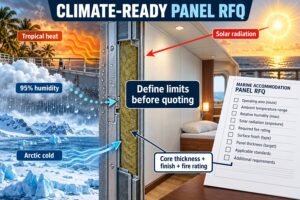
Dirty panels ruin a ship's interior. You want a great look without spending hours scrubbing. I will show you which marine panel finish makes cleaning fast and simple.
The easiest marine panel surface finishes to clean and maintain are PVC film lamination, galvanized steel with powder coating, and stainless steel. PVC offers great wipeability for cabins, powder-coated steel provides smooth durability for corridors, and stainless steel delivers ultimate hygiene for galleys and wet areas.
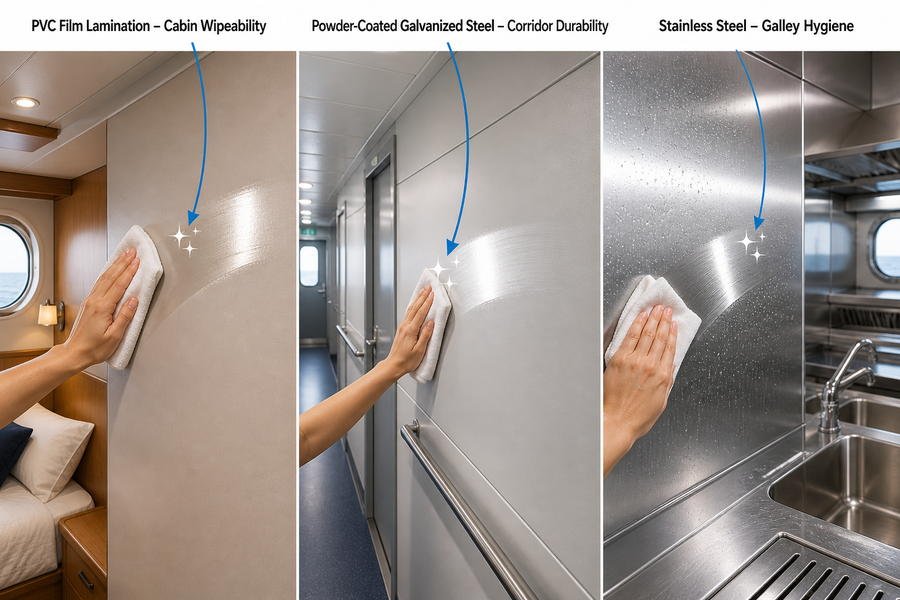
Let us look closely at how different surfaces perform so you can pick the right one for your ship interior projects.
Which marine wall panel finish is easiest to clean?
Cabins get messy fast. If the wall finish holds dirt, your cleaning crew loses time. Let us find out which wall panel finish wipes down the fastest.
PVC-laminated galvanized steel and Melamine-faced finishes are the easiest wall panel finishes to clean. PVC provides a non-porous, smooth surface that repels dust and simple smudges, while Melamine offers a hard, scratch-resistant barrier against daily wear. Both only need mild soap and water for daily upkeep.
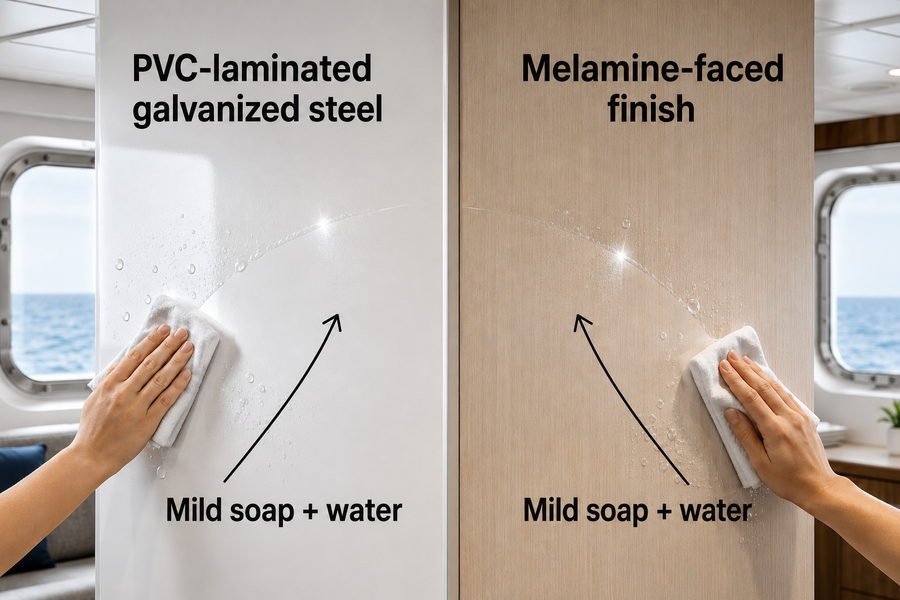
Knowing your options helps you cut down on labor costs. Here is the breakdown of why these two work best.
Cleaning Performance of PVC-Laminated Galvanized Steel Wall Panels
PVC film is very common in ship cabins. The factories apply a thin layer of PVC film over galvanized steel sheets. According to marine manufacturing standards, this PVC film is usually between 0.12mm and 0.16mm thick. The steel plate underneath is normally 0.5mm or 0.6mm thick. The PVC surface is completely non-porous1. This means dirt and liquids cannot go inside the material. They stay on the top. I remember a project back in 2018. A client used standard matte paint for their cabin walls instead of PVC. The cleaning crew spent hours trying to remove dirty handprints. The paint absorbed the oils from the hands. We changed the walls to PVC-laminated panels in the next ship. The crew only needed a wet cloth to wipe the walls clean in seconds. Dust does not stick to it easily. You do not need strong chemicals. Just basic water and soap will make it look new2.
Hardness and Wipeability of Melamine-Faced Wall Panels
Melamine is a hard resin material3. Manufacturers press it onto the panel surface under high heat. This finish is perfect for public spaces and mess rooms. Melamine meets the International Maritime Organization (IMO) FTP Code Part 5 for low flame spread. But it is also great for keeping out dirt. The surface is very hard. It resists scratches from luggage or food carts. Scratches trap dirt, so a scratch-resistant surface stays clean much longer. If someone spills coffee on a Melamine wall, it will not leave a mark. You can just wipe it away. The hard barrier stops the color from sinking in.
| Feature | PVC-Laminated Steel | Melamine-Faced Panel |
|---|---|---|
| Best Application Area | Passenger Cabins, Crew Quarters | Public Spaces, Mess Rooms |
| Surface Hardness | Medium (can be scratched by sharp objects) | High (very resistant to scratches) |
| Cleaning Method | Damp cloth, mild soap | Damp cloth, standard cleaners |
| Typical Thickness | 0.12mm - 0.16mm (film only) | 0.7mm - 1.0mm (laminate layer) |
| Porosity | Non-porous | Non-porous |
Which marine ceiling panel finish is easiest to clean?
High ceilings trap grease and smoke. If you use the wrong ceiling finish, you will spend extra money on lift equipment and deep cleaning.
Powder-coated galvanized steel and prepainted aluminum are the easiest marine ceiling finishes to clean. Powder coating creates a seamless, baked-on layer that stops dust from sticking. Prepainted aluminum is lightweight and highly resistant to moisture, making both options simple to wipe down using an extended mop.
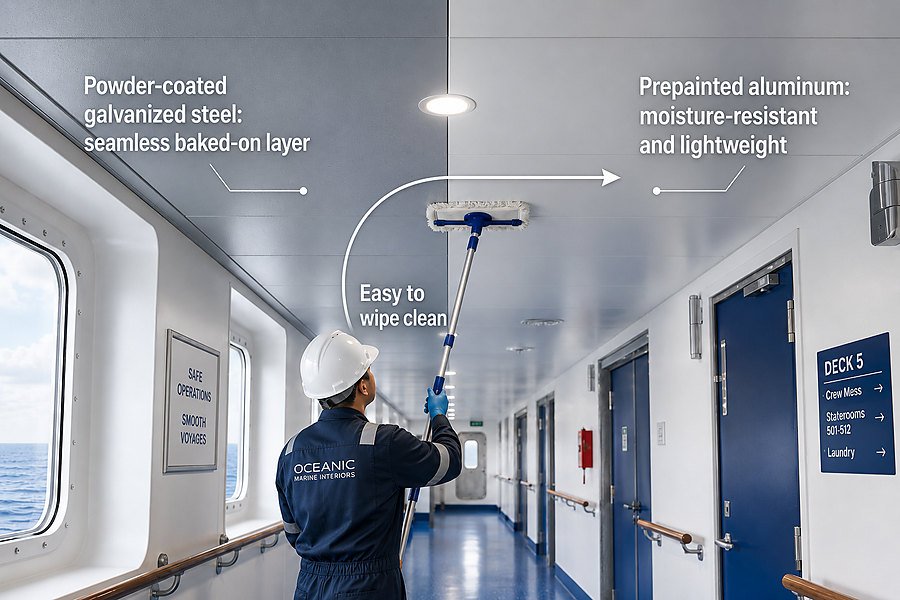
Ceilings need different materials than walls because gravity and smoke act differently on them. You need something smooth and light.
Dust Resistance of Powder-Coated Galvanized Steel Ceiling Panels
Powder coating is a dry powder. Factories spray it onto the galvanized steel ceiling panels. Then, they bake the panels in a large oven at about 200°C4. This melts the powder into a smooth, hard layer. The thickness of this coating is usually between 60 and 80 microns5. This baked layer has no pores or rough spots. Because the surface is so smooth, dust and smoke particles have nowhere to hold on. They just fall off or wipe away easily. I once helped a buyer from Europe fix a corridor ceiling problem. They bought panels with a rough, textured finish. Dust from the air conditioning vents stuck to the rough spots. The ceilings looked black after three months. We replaced them with smooth powder-coated steel panels. The dust problem stopped immediately. The crew could clean the new panels quickly with a long mop.
Moisture Resistance of Prepainted Aluminum Ceiling Panels
Prepainted aluminum is another great choice for ceilings, especially in wet areas. Factories use a roller to apply paint to the aluminum before cutting it. This paint layer is often polyester and is about 20 to 25 microns thick. Aluminum does not rust. When you put it in a bathroom or a ship hospital, the steam goes up to the ceiling. The prepainted surface stops the water from damaging the metal. You can just wipe the water droplets off. It is also very light. A standard aluminum ceiling panel is much lighter than steel. This makes it easier for workers to take the panels down if they need to clean the air ducts behind them.
| Specification | Powder-Coated Steel Ceiling | Prepainted Aluminum Ceiling |
|---|---|---|
| Base Material | Galvanized Steel | Aluminum Alloy |
| Coating Thickness | 60 - 80 microns | 20 - 25 microns |
| Key Cleaning Benefit | Extremely smooth, repels dust | Rust-proof, easy to wipe steam |
| Best Room Type | Dry Cabins, Long Corridors | Wet Units, Bathrooms, Hospitals |
| Maintenance Action | Dry dusting or damp mop | Wipe dry with soft cloth |
Which marine panel finish is suitable for frequent cleaning?
Wet units and galleys need constant scrubbing. If the finish is weak, harsh chemicals will destroy it fast. You need something tough.
Brushed stainless steel and high-pressure laminate (HPL) finishes are the most suitable for frequent, rigorous cleaning. Stainless steel (grade 304 or 316) withstands daily harsh chemical scrubbing without rusting. HPL features a tough surface layer that resists fading and damage from repeated wiping in high-traffic public ship areas.
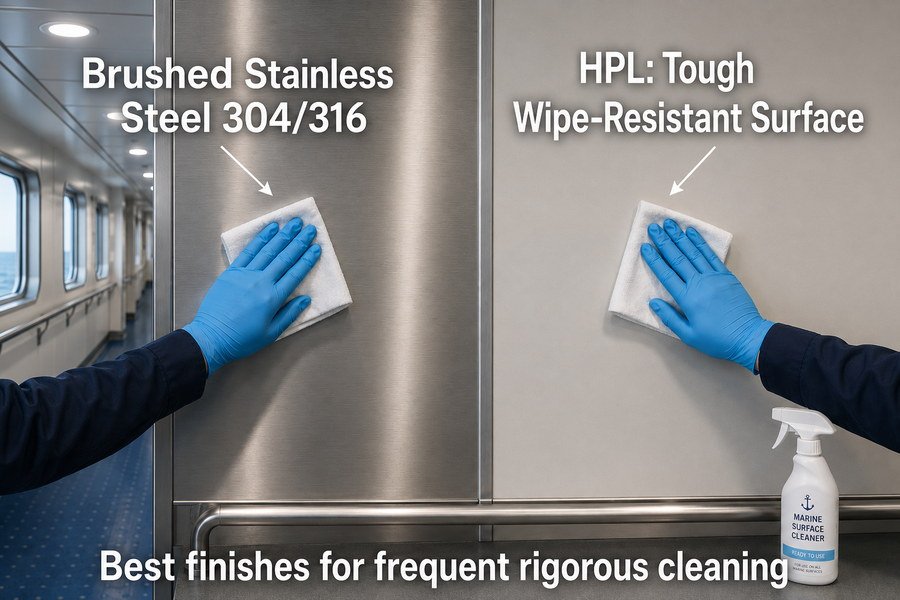
If your crew cleans an area three times a day, you must select materials built for extreme wear and tear.
Chemical Resilience of Brushed Stainless Steel Panels
Stainless steel is the king of the ship galley. Most galleys use grade 304 or grade 316 stainless steel. The facing sheet is usually 0.6mm or 0.8mm thick. The United States Public Health Service (USPHS) has strict rules for ship kitchens. They require surfaces that are easy to wash and sanitize.6 Stainless steel is perfect for this. In a galley, the cleaning crew uses strong alkaline cleaners to remove heavy cooking oil. Normal paint or PVC will melt or change color if you put these chemicals on them every day. Stainless steel does not react to these strong cleaners.7 You can spray heavy chemicals, scrub with a brush, and wash with hot water many times a day. The brushed finish also hides small scratches from cleaning tools. It stays looking clean and professional for years, even under the hardest conditions.
Surface Toughness of High-Pressure Laminate (HPL) Panels
High-pressure laminate, or HPL, is very tough. Factories make it by pressing many layers of paper and resin together under high heat and heavy pressure.8 The top layer is a clear protective sheet. The total HPL layer is often 0.7mm to 1.0mm thick. This is much thicker than PVC film. HPL is great for dining rooms or public toilets. These areas need frequent cleaning every few hours. I once advised a client who bought cheap vinyl panels for a busy crew mess. The crew wiped the tables and walls after every meal. After two months, the vinyl started to peel and lose its color. I told them to replace the walls with HPL panels. The HPL surface took the constant wiping without any fading. The hard resin top stops the friction of the cleaning cloth from wearing down the pattern.9
| Material | Brushed Stainless Steel | High-Pressure Laminate (HPL) |
|---|---|---|
| Chemical Resistance | Excellent (handles strong alkalis) | Good (handles standard detergents) |
| Friction Resistance | Very High | High |
| Best Location on Ship | Galleys, Pantries, Medical Rooms | Crew Mess, Public Toilets, Lounges |
| Standard Grades/Types | SUS 304, SUS 316 | 0.7mm - 1.0mm marine grade HPL |
| Visual Wear over Time | Hides scratches due to brushed lines | Maintains color, resists fading |
Which marine panel finish resists stains better?
Coffee spills, oil splashes, and dirty hands leave ugly marks. You want a surface that stops stains from soaking in. Let us look at stain blockers.
Fluorocarbon (PVDF) coating and Epoxy-painted finishes resist stains better than other options. PVDF has a dense chemical structure that prevents oil and ink from penetrating the surface. Epoxy paint forms a hard, sealed shell over steel panels, making it highly effective at blocking coffee, grease, and chemical stains.
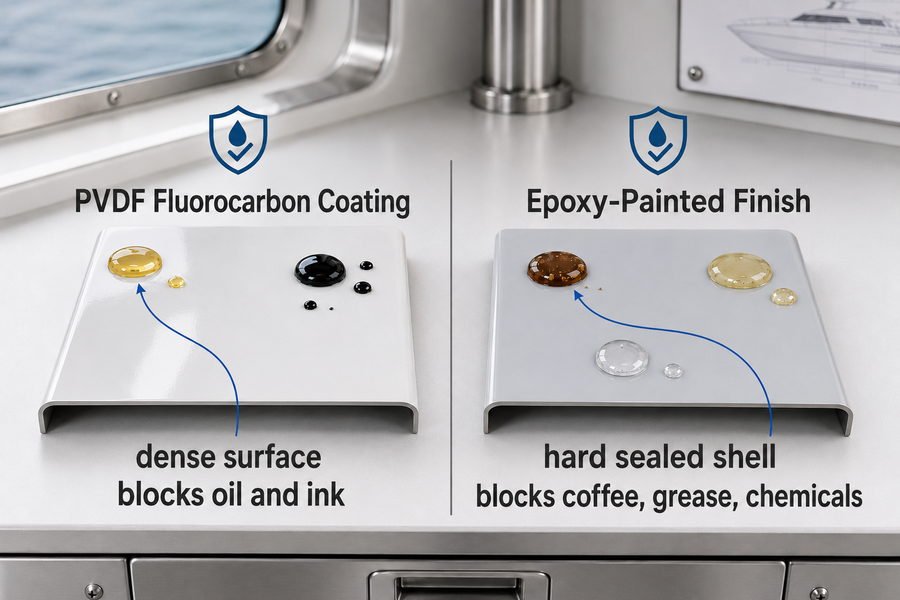
Stopping a stain before it becomes permanent saves you the cost of replacing the whole panel later.
Oil and Ink Blocking of PVDF Coated Panels
PVDF stands for Polyvinylidene fluoride10. It is a very high-quality coating. Factories usually apply it at a thickness of 25 to 35 microns11. PVDF has a very dense chemical structure. The molecules are packed tightly together. This means big stain molecules, like dirty engine oil or ink from a pen, cannot find a way in.12 They stay right on the top. If a crew member writes on a PVDF panel with a permanent marker, you can usually wipe it off with a little bit of alcohol. The ink does not sink into the paint. This is very important for areas near engine rooms or control rooms where grease is common. The PVDF finish is more expensive at first, but it saves panels from being ruined by permanent stains.
Hard Shell Sealing of Epoxy-Painted Marine Panels
Epoxy paint is another heavy-duty stain blocker. Shipbuilders use epoxy paint a lot in service spaces and cargo areas. When epoxy paint dries, it creates a very hard shell. It seals the metal panel completely.13 If someone spills black coffee or drops thick grease on an epoxy wall, the stain will sit on the hard shell. It will not eat into the paint. You can wipe it off days later, and the panel will still look fine. I have seen standard painted doors on ships get ruined by dirty boots and chemical spills. The regular paint stains easily. But doors and panels painted with marine-grade epoxy stay clean. The hard shell acts like a glass window over the metal. It simply does not allow the dirt to enter.
| Paint Type | PVDF Coating | Epoxy Paint |
|---|---|---|
| Stain Blocking Method | Dense molecular structure | Hard, sealed outer shell |
| Common Stains Resisted | Ink, markers, light oils | Heavy grease, coffee, chemicals |
| Typical Thickness | 25 - 35 microns | 100 - 150 microns (heavy duty) |
| Primary Advantage | Easy to wipe off surface marks | Resists deep chemical staining |
| Ideal Ship Area | Control rooms, bridge areas | Engine rooms, service corridors |
Which marine panel finish has lower long-term maintenance cost?
Replacing bad panels kills your project profit. You need a finish that lasts for years without needing expensive repairs or replacements.
PVC-laminated finishes and powder-coated steel finishes have the lowest long-term maintenance costs. PVC films are very cheap to produce, costing around $12 to $18 per square meter, and hide scratches well. Powder coating rarely chips, eliminating the need for expensive repainting work over a ship's typical 20-year lifespan.
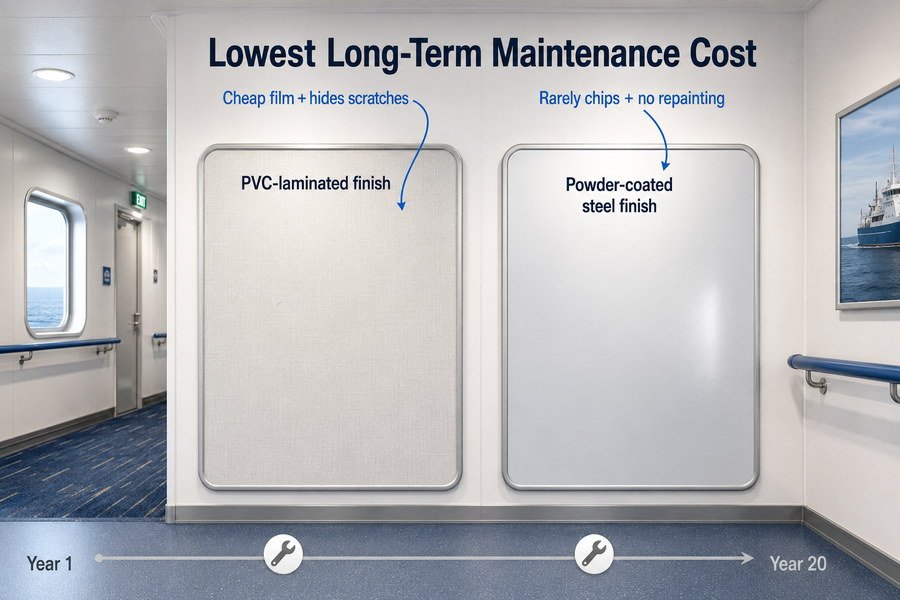
Let us talk about money. If you buy smart now, you will not pay for heavy maintenance later.
Life-Cycle Cost Savings of PVC-Laminated Finishes
PVC-laminated panels are very popular in Asia for a good reason. They are very cost-effective. Based on current prices from factories in China, a standard PVC-laminated rockwool wall panel costs about $12 to $18 per square meter. This initial price is very low. But the real savings come from maintenance. If a PVC panel gets a small scratch, the pattern on the film usually hides it. You do not need to call a painter to fix it. If the panel is treated normally, the PVC film can last 10 to 15 years. You just wipe it clean. There is no need to buy paint or pay workers to repaint the cabins every five years. The low upfront cost combined with zero repainting costs makes PVC the best choice for saving money in standard passenger and crew cabins.
Durability and Zero-Repaint Value of Powder-Coated Steel
Powder coating also saves a lot of money over time. It saves money because you almost never have to repair it. Liquid paint can flake or chip off over time. When liquid paint chips, the steel underneath starts to rust. To fix this, you must pay workers to sand the rust off and paint it again. Labor costs in Europe or the US are very high. A skilled worker can cost up to $50 per hour. Powder coating avoids this completely. The baked-on powder bonds strongly to the metal. It rarely chips.14 If you use powder-coated panels in your corridors, you eliminate the labor cost of maintenance painting. Saving just one hour of repair work per panel pays for the cost of the high-quality powder coating. It keeps the ship looking good for its 20-year lifespan with almost zero extra spending.
| Financial Factor | PVC-Laminated Finish | Powder-Coated Steel Finish |
|---|---|---|
| Average Initial Cost (per sqm) | $12 - $18 | $15 - $22 |
| Maintenance Requirement | Basic wiping | Basic wiping |
| Repainting Needed? | No | No |
| Cost Saving Mechanism | Cheap to buy, hides small damage | Prevents rust, stops labor costs |
| Expected Lifespan | 10 - 15 years | 15 - 20+ years |
How to maintain marine wall panel and ceiling panel surface finishes?
Even the best panels fail if you clean them wrong. Using the wrong tools will scratch the finish. Here are the exact steps to keep them perfect.
To maintain marine panel surface finishes, first use a soft microfiber cloth for daily dust removal. Second, wash with a pH-neutral cleaner mixed with warm water for light stains. Third, apply a specialized non-abrasive marine degreaser for heavy grease. Finally, always wipe the surface completely dry to prevent watermarks.
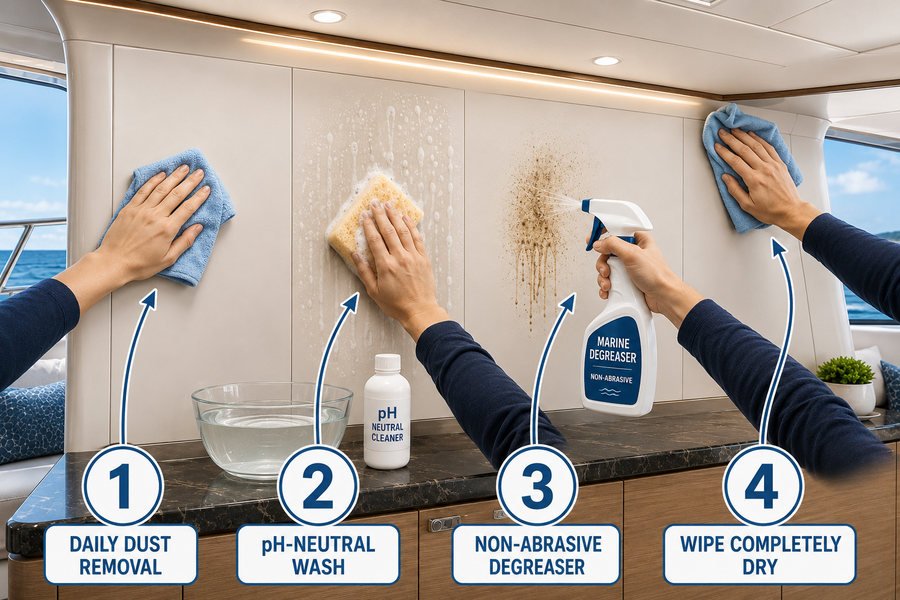
Good maintenance extends the life of your panels and keeps your ship looking new. Let me show you how to do it safely.
Step 1 and 2: Daily Dusting and Washing with pH-Neutral Cleaners
The first step is always dry cleaning. You must use a soft microfiber cloth. Microfiber grabs the dust without scratching the PVC or powder coating.15 Never use hard brushes or rough sponges. If you use a rough sponge on a PVC panel, you will leave tiny scratches. Dirt will enter these scratches later. The second step is for light dirt. You should mix warm water with a pH-neutral cleaner. A neutral cleaner has a pH level between 6.5 and 7.5.16 You must avoid harsh acids or strong bleaches. Acids will eat the color out of the PVC film. They will also damage the powder coating over time.17 Dip your soft cloth in the warm soapy water, squeeze out the extra water, and wipe the panel gently. This will remove most daily dirt like fingerprints or spilled drinks safely.
Step 3 and 4: Heavy Grease Removal and Proper Drying Techniques
Sometimes you will face heavy stains, like thick oil in the galley or dark scuff marks in the corridor. For the third step, you need a specialized non-abrasive marine degreaser. Non-abrasive means it does not have sand or hard particles in it. Spray the degreaser onto the stain. Wait for one minute to let the chemicals break down the oil. Then, wipe it away with a soft cloth. Do not rub too hard. Let the cleaner do the work. The fourth and most important step is drying. You must always wipe the surface completely dry with a clean towel. If you leave water on the panel, it will leave white watermarks. More importantly, water left at the joints where two panels meet can cause rust on the steel frame behind the panel.18 Drying the panel protects the whole wall system.
| Maintenance Step | Tool or Chemical Used | Purpose |
|---|---|---|
| 1. Daily Dust Removal | Soft microfiber cloth | Removes loose dirt without scratching |
| 2. Washing Light Stains | pH-neutral cleaner (pH 6.5-7.5) & warm water | Cleans marks safely without fading color |
| 3. Heavy Grease Removal | Non-abrasive marine degreaser | Melts thick oil without rough rubbing |
| 4. Final Drying | Dry clean towel | Stops watermarks and prevents joint rust |
Conclusion
Choose PVC or powder coating for easy cleaning and low cost. Use stainless steel for heavy washing. Good maintenance stops damage and saves you money. Keep your ship shining!
-
"Polyvinyl chloride - Wikipedia", https://en.wikipedia.org/wiki/Polyvinyl_chloride. A materials reference on polyvinyl chloride should support that rigid PVC has very low water absorption and forms a continuous polymer surface, which is consistent with describing PVC-coated panels as resistant to liquid penetration at the surface. Evidence role: mechanism; source type: encyclopedia. Supports: The PVC surface is non-porous, so dirt and liquids remain on the surface rather than entering the material.. Scope note: This supports the general material behavior of PVC, not the integrity of every laminated panel, seam, edge, or damaged coating. ↩
-
"Risks Associated with the Presence of Polyvinyl Chloride in ... - PMC", https://pmc.ncbi.nlm.nih.gov/articles/PMC10779931/. A neutral polymer or conservation source on PVC cleaning should support that PVC surfaces are commonly cleaned with water and mild detergent because the material has relatively low water absorption and chemical resistance to mild cleaners. Evidence role: general_support; source type: institution. Supports: PVC-laminated wall panels can usually be cleaned with water and mild soap rather than strong chemicals.. Scope note: The source would support routine cleaning practice for PVC surfaces generally, not the article’s experiential claim that every soiled ship panel will look new after cleaning. ↩
-
"Melamine resin - Wikipedia", https://en.wikipedia.org/wiki/Melamine_resin. An encyclopedia or educational chemistry source should support that melamine-formaldehyde resins are thermosetting plastics valued for hardness, heat resistance, and use in laminates. Evidence role: definition; source type: encyclopedia. Supports: Melamine used on wall panels is a hard resin-based surface material.. Scope note: This defines the resin family and typical properties; it does not verify the exact hardness of any specific marine wall-panel product. ↩
-
"[PDF] Evaluation of the Effects of Powder Coating Cure Temperatures on ...", https://digitalcommons.lmu.edu/cgi/viewcontent.cgi?referer=&httpsredir=1&article=1009&context=mech_fac. A coatings-engineering source describes thermoset powder coating as being cured by heating, with typical metal-substrate cure schedules commonly around 180–200°C, supporting the stated curing-temperature range. Evidence role: mechanism; source type: research. Supports: Powder-coated galvanized steel ceiling panels are typically baked at about 200°C to melt and cure the coating into a hard layer.. Scope note: Exact cure temperature varies by resin chemistry, film thickness, substrate mass, and manufacturer specification. ↩
-
"Powder coating - Wikipedia", https://en.wikipedia.org/wiki/Powder_coating. Industrial powder-coating guidance reports that architectural or protective powder-coating films on metal are commonly specified in the tens of micrometres, often near 60–80 μm, supporting the plausibility of the stated coating-thickness range. Evidence role: general_support; source type: institution. Supports: The powder coating thickness on galvanized steel ceiling panels is usually between 60 and 80 microns.. Scope note: The source may support a typical range for powder coatings generally, not the exact specification of every galvanized steel ceiling-panel product. ↩
-
"[PDF] Vessel Sanitation Program Environmental Public Health Standards", https://www.cdc.gov/vessel-sanitation/media/pdfs/2025/06/2025_VSP_Environmental_Public_Health_Standards-508.pdf. U.S. Public Health Service/CDC Vessel Sanitation Program guidance states that food-area surfaces on passenger vessels should be smooth, durable, nonabsorbent, and readily cleanable/sanitizable; this supports the sanitary-surface requirement but is specific to vessels under that program’s jurisdiction. Evidence role: general_support; source type: government. Supports: USPHS rules for ship kitchens require surfaces that are easy to wash and sanitize.. Scope note: Applies most directly to passenger vessels covered by the USPHS/CDC Vessel Sanitation Program, not necessarily every ship type worldwide. ↩
-
"[PDF] guide to the selection and use of high performance stainless steels", https://www.nrc.gov/docs/ML0334/ML033490048.pdf. Corrosion-resistance data for 304 and 316 stainless steels generally show good compatibility with many alkaline cleaning solutions because of the chromium-rich passive film; however, performance depends on cleaner concentration, temperature, chloride content, and exposure time. Evidence role: mechanism; source type: research. Supports: Stainless steel panels can tolerate repeated exposure to strong alkaline cleaners better than many coated or plastic surfaces.. Scope note: The claim is broadly true only under typical cleaning conditions; strong caustic solutions, chlorides, heat, or prolonged exposure can still damage stainless steel. ↩
-
"High-Pressure Decorative Laminates (HPDL) - NC State University", https://research.cnr.ncsu.edu/wptechservices/nema-ld3-laminate-testing/. Technical descriptions of high-pressure decorative laminate define HPL as layers of cellulose paper impregnated with thermosetting resins and consolidated under heat and high pressure; this supports the manufacturing description at a general material-definition level. Evidence role: definition; source type: institution. Supports: HPL is made by pressing multiple paper and resin layers together under heat and pressure.. Scope note: This supports the general HPL manufacturing process, not the exact thickness or marine-grade performance claimed elsewhere in the article. ↩
-
"Assessing the Weathering Performance and Functionality of ... - PMC", https://pmc.ncbi.nlm.nih.gov/articles/PMC10785317/. HPL standards and materials references describe protective melamine-resin overlay layers and abrasion-resistance testing for decorative laminates, supporting the claim that the surface layer helps protect the printed decor from wear; standardized results vary by grade and do not directly prove performance in the specific crew-mess example. Evidence role: general_support; source type: institution. Supports: The protective resin top layer of HPL helps resist abrasion from frequent wiping and protects the decorative pattern.. Scope note: Evidence would support abrasion resistance in standardized tests, not necessarily every cleaning chemical, cloth type, or installation condition. ↩
-
"Polyvinylidene fluoride - Wikipedia", https://en.wikipedia.org/wiki/Polyvinylidene_fluoride. A polymer reference source identifies PVDF as polyvinylidene fluoride, a fluoropolymer derived from vinylidene fluoride monomer. Evidence role: definition; source type: encyclopedia. Supports: PVDF is the abbreviation for polyvinylidene fluoride.. ↩
-
"[PDF] AAMA 2605-05 Voluntary Specification, Performance Requirements ...", https://downloads.regulations.gov/EPA-R03-OAR-2015-0404-0002/attachment_3.pdf. Architectural coil-coating and fluoropolymer-coating references commonly describe PVDF finish systems in the approximate tens-of-microns dry-film range; this supports the stated order of magnitude but may not prove that every factory applies exactly 25–35 microns. Evidence role: general_support; source type: institution. Supports: Factory-applied PVDF coatings are often applied at about 25–35 microns thickness.. Scope note: Thickness varies by coating system, standard, substrate, and manufacturer specification. ↩
-
"Brief Review of PVDF Properties and Applications Potential - PMC", https://pmc.ncbi.nlm.nih.gov/articles/PMC9698228/. Materials references describe PVDF as a fluoropolymer with strong chemical resistance and low permeability relative to many conventional polymers, which is consistent with reduced absorption of oils and inks at the coating surface; the source would support the mechanism generally rather than guarantee removal of all marker or oil stains. Evidence role: mechanism; source type: paper. Supports: PVDF’s polymer structure can reduce penetration or absorption of oil- and ink-like contaminants.. Scope note: Actual stain resistance depends on coating formulation, curing, surface wear, solvent type, contact time, and cleaning method. ↩
-
"Insights into the Development of Corrosion Protection Coatings", https://pmc.ncbi.nlm.nih.gov/articles/PMC12158252/. Protective-coatings literature explains that cured epoxy coatings form cross-linked films that act as barrier layers on metal substrates, supporting the description of a hard sealed coating surface; this is contextual support and does not show that any particular marine panel is completely sealed in service. Evidence role: mechanism; source type: paper. Supports: Cured epoxy paint forms a hard, cross-linked barrier film that can seal and protect metal panels.. Scope note: Barrier performance depends on surface preparation, film thickness, curing conditions, defects, immersion exposure, and mechanical damage. ↩
-
"Accelerated Corrosion Tests in Quality Labels for Powder Coatings ...", https://pmc.ncbi.nlm.nih.gov/articles/PMC8585214/. A coatings-engineering source describing electrostatic powder application, thermal curing, adhesion, impact resistance, and corrosion protection would support the mechanism that powder coatings form durable bonded films on metal substrates. Evidence role: mechanism; source type: paper. Supports: Baked-on powder coating bonds strongly to metal and is less prone to chipping than conventional liquid paint.. Scope note: Such evidence would support improved adhesion and chip resistance in general, but it would not prove that powder coating rarely chips in every shipboard application or eliminates all maintenance. ↩
-
"Evaluation of the Decontamination Efficacy of New and ... - PubMed", https://pubmed.ncbi.nlm.nih.gov/20123151/. Studies and technical descriptions of microfiber cleaning note that split synthetic fibers can retain fine particles and are commonly used for low-abrasion surface cleaning; this supports the general cleaning mechanism but does not directly test the specific PVC film and powder-coated panels described here. Evidence role: mechanism; source type: research. Supports: Microfiber cloth can remove dust while reducing the likelihood of scratching PVC or powder-coated surfaces.. Scope note: Contextual support only; evidence may address microfiber cleaning generally rather than the exact panel materials. ↩
-
"[PDF] Cleaning Products Ph", https://esports.bluefield.edu/textbooks-040/cleaning-products-ph.pdf. Reference material on the pH scale identifies pH 7 as neutral at standard conditions, providing definitional context for classifying cleaners near pH 7 as neutral; the cited source may not establish the article’s exact 6.5–7.5 product-label range. Evidence role: definition; source type: education. Supports: A pH-neutral cleaner is one whose pH is close to 7, such as the stated 6.5–7.5 range.. Scope note: The exact 6.5–7.5 range is a practical cleaning convention and may vary by manufacturer or regulatory context. ↩
-
"[PDF] Chemical Resistance and Chemical Applications for CPVC Pipe and ...", https://www.nrc.gov/docs/ML1820/ML18207A604.pdf. Chemical-resistance and coating-durability references report that strong acids, alkalis, oxidizing agents, or harsh cleaners can degrade polymers and protective coatings, including discoloration or loss of coating integrity; this supports the caution against harsh acids and bleaches but may not quantify damage under the article’s cleaning conditions. Evidence role: general_support; source type: research. Supports: Harsh acids or bleaches can discolor PVC film and degrade powder-coated finishes over time.. Scope note: The degree of damage depends on acid strength, concentration, exposure time, coating formulation, and PVC film composition. ↩
-
"[PDF] CORROSION BASICS", https://www.usna.edu/NAOE/_files/documents/Courses/EN380/Course_Notes/Corrosion%20Basics.pdf. Corrosion references describe moisture and oxygen as necessary contributors to steel rusting and identify joints or crevices as locations where retained water can accelerate localized corrosion; this supports the mechanism but does not prove that the specific wall assembly contains exposed steel vulnerable to such moisture. Evidence role: mechanism; source type: education. Supports: Water retained at panel joints can contribute to rusting of a steel frame behind the panels.. Scope note: Direct risk depends on the wall design, coating integrity, sealants, and whether the steel frame is exposed to retained water. ↩