You want your ship interiors to look amazing, but standard finishes feel cheap. Poor choices ruin the design and fail safety rules. I will show you the exact custom finish options.
Marine wall and ceiling panels offer four main custom surface finish categories: PVC film laminated finishes, PVC powder-coated finishes, galvanized steel plain finishes, and specialized decorative high-pressure laminate (HPL) finishes. These cover everything from solid colors and wood grains to metallic patterns, all meeting SOLAS fire safety standards.
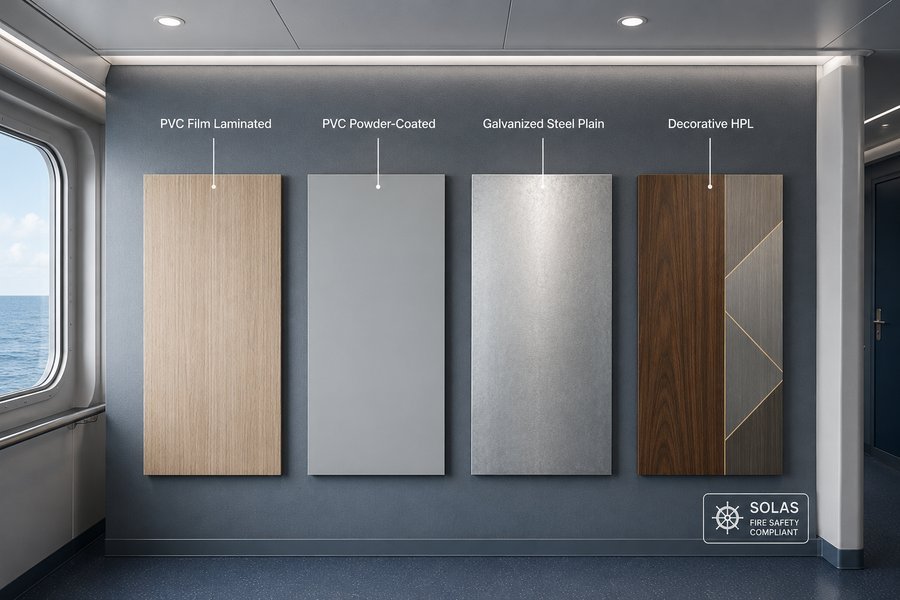
Finding the right look for marine spaces is hard when you must follow strict marine regulations. Let me break down the exact finish choices you have for your next big project.
What Color Options Are Available For Marine Wall Panel Finishes?
Gray walls make cabins look like prisons. You lose clients when you offer boring colors. Here are the exact solid colors you can choose for marine wall panels.
Marine wall panels come in over 200 standard RAL and PANTONE solid color options. The complete scope includes warm tones like beige and ivory, cool tones like light blue and sea green, and neutral tones like pure white and light gray, usually achieved through PVC film or powder coating.
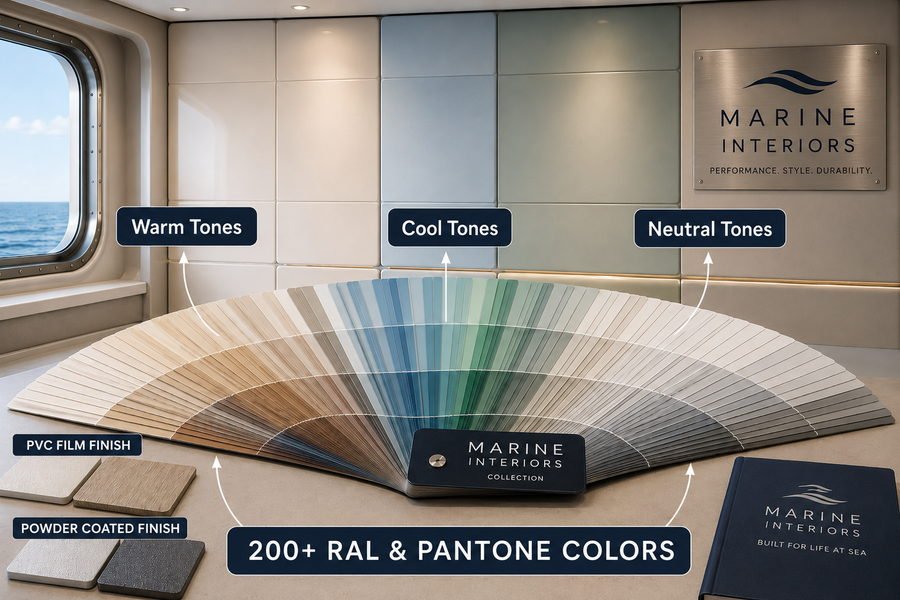
When you design a ship cabin, color is the most important choice. You cannot just pick any paint. Marine wall panels use specific systems to ensure the color lasts and passes fire tests. As I mentioned above, we use over 200 standard RAL and PANTONE colors. We group these into three main types: warm tones, cool tones, and neutral tones. We put these colors onto the panels using either PVC film or powder coating.
First, let us talk about the warm tones. These include beige and ivory. I always suggest warm tones for passenger cabins. They make the room feel like a home. Next, we have cool tones. These include light blue and sea green. Cool tones work very well in crew areas or medical rooms on the ship. They make the space feel clean and calm. Finally, we have neutral tones. These include pure white and light gray. You will see these colors in the main corridors. Neutral colors make narrow hallways look wider.1
Warm and Cool Tone Color Options for Cabin Spaces
Warm tones like beige and cool tones like light blue are very popular in Asian shipyards. The factory applies these colors using a PVC film. According to standard factory specifications, this PVC film is usually 0.12mm to 0.16mm thick. This thin film is glued directly to the galvanized steel surface. The steel is usually 0.6mm thick. This combination keeps the panel light but very strong. The PVC film gives a smooth finish that is easy to wash.
Neutral Tone Color Options for Public Ship Areas
Neutral tones like pure white and light gray are often applied using powder coating. Powder coating is different from PVC film. The factory sprays dry paint powder onto the steel and bakes it in an oven2. Based on marine industry standards, the powder coating thickness is usually between 60 and 80 microns. This coating is very hard. It resists scratches from people walking in busy hallways. Both the PVC film and the powder coating methods must pass the IMO FTP Code Part 5 test for low flame spread3.
| Color Category | Example Colors | Application Method | Standard Thickness | Best Ship Area |
|---|---|---|---|---|
| Warm Tones | Beige, Ivory | PVC Film | 0.12mm - 0.16mm | Passenger Cabins |
| Cool Tones | Light Blue, Sea Green | PVC Film | 0.12mm - 0.16mm | Crew Cabins, Medical |
| Neutral Tones | Pure White, Light Gray | Powder Coating | 60 - 80 microns | Corridors, Public Areas |
What Color Options Are Available For Marine Ceiling Panel Finishes?
Low ceilings make rooms feel tiny. Dark ceiling colors make cabins feel even worse. Let us look at the best color options to make marine ceilings feel higher and brighter.
Marine ceiling panels feature three main solid color categories to maximize light: ultra-white shades (RAL 9010), soft off-white shades (RAL 9001), and custom light metallic shades like brushed silver. These options reflect up to 85% of cabin light and are typically finished with anti-corrosion polyester powder coating.
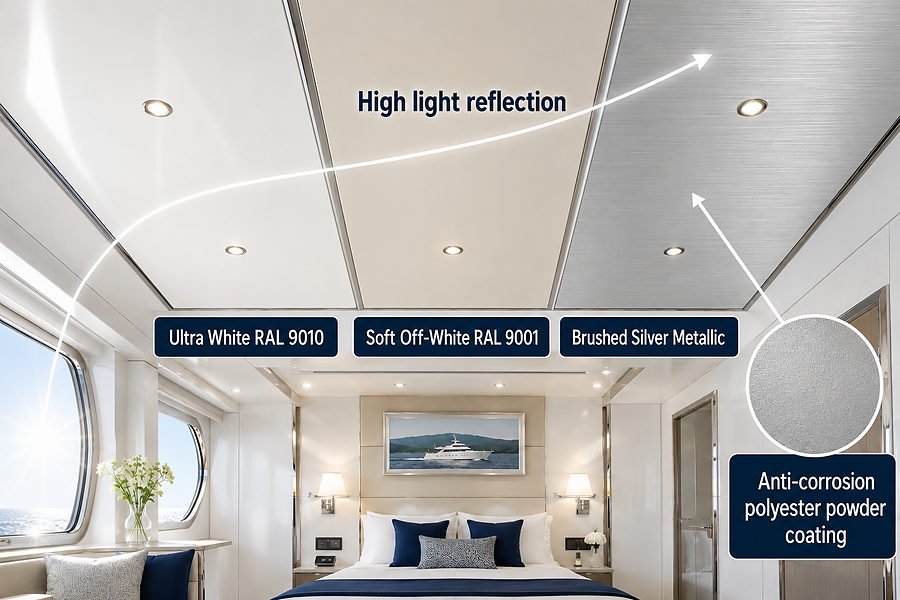
Ceilings on ships are usually very low. The standard height is often just 2.1 meters to 2.2 meters from the floor4. Because of this, the color of the ceiling panel must reflect light. If you use a dark color, the cabin will feel like a small box. To fix this, we use three main color categories for marine ceilings: ultra-white shades, soft off-white shades, and custom light metallic shades. These colors must have a high Light Reflectance Value (LRV)5. Based on the ISO 7724 standard for color measurement, a good ceiling panel reflects up to 85% of the light in the room.
We achieve these colors using a special anti-corrosion polyester powder coating. Marine ceilings face a lot of moisture, especially near the air conditioning vents. The factory applies this powder coating to a thickness of 50 to 70 microns. This thickness protects the metal behind it from rust.
Ultra-White and Soft Off-White Ceiling Color Options
The first category is ultra-white shades, like RAL 9010. This is the most common choice. I see this color on almost every commercial cargo ship. It reflects the maximum amount of light. The second category is soft off-white shades, like RAL 9001. This color has a little bit of yellow in it. It is less harsh on the eyes. Luxury cruise ships prefer soft off-white because it makes the artificial lights look warmer. Both of these white shades are excellent for small cabin spaces.
Light Metallic Ceiling Color Options for Modern Designs
The third category is custom light metallic shades. A good example is brushed silver. You do not use metallic colors in sleeping cabins. Instead, you use them in public areas like the dining room or the lobby. Metallic finishes reflect light differently. They create a high-end, modern look. The factory creates this finish by mixing metal flakes into the powder coating before baking it. The cost is slightly higher, but the visual result is very impressive for European design projects.
| Color Category | Standard RAL Code | Light Reflectance | Coating Material | Best Ship Area |
|---|---|---|---|---|
| Ultra-White | RAL 9010 | Up to 85% | Polyester Powder | Cargo Ship Cabins |
| Soft Off-White | RAL 9001 | 75% - 80% | Polyester Powder | Cruise Ship Cabins |
| Light Metallic | Custom Silver | 60% - 70% | Metallic Powder | Lobbies, Dining Rooms |
What Wood Grain Finishes Are Available For Marine Wall Panels?
Real wood rots and burns on ships. Your luxury cruise clients want wood, but SOLAS rules say no. We solve this with certified wood grain finishes for steel panels.
Marine wall panels offer three main wood grain finish categories via fire-rated PVC films: light woods like maple and birch, medium woods like oak and teak, and dark luxury woods like walnut and mahogany. These provide authentic textures while maintaining the required Class B-15 or A-60 fire ratings.
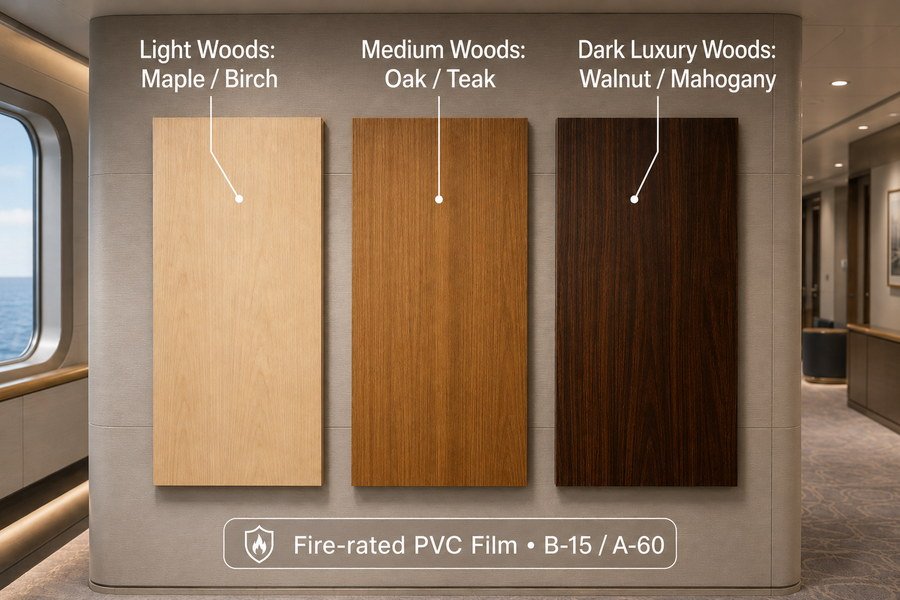
Many interior designers want to use wood on ships. Wood looks rich and natural. However, solid wood is too heavy. More importantly, solid wood burns fast. Marine safety rules do not allow regular wood on bulkheads.6 To solve this problem, we use fire-rated PVC films printed with wood grain patterns. As I noted in the short answer, we divide these into three exact categories: light woods, medium woods, and dark luxury woods.
The factory prints the wood pattern onto the PVC film. Then, they use a hot roller to press a texture into the film. When you touch the panel, you can feel the lines of the wood. This PVC film is slightly heavier than solid color films. According to standard marine factory production records, wood grain PVC film weighs between 150 and 180 grams per square meter. We glue this heavy film to rockwool core panels. This allows the panels to look like real wood while passing the Class B-15 or A-60 fire tests required by SOLAS7.
Light and Medium Wood Grain Finishes for Cabins
The first category is light woods, such as maple and birch. These finishes have a very pale yellow or white tone. I recommend light woods for small spaces. They make the room feel open. The second category is medium woods, such as oak and teak. Teak is a classic marine wood. It has a warm, brown color. Medium woods are very safe choices. They hide dirt well and look good in both passenger cabins and crew mess rooms.
Dark Luxury Wood Grain Finishes for High-End Spaces
The third category is dark luxury woods, such as walnut and mahogany. These finishes are dark brown or red-brown. They look very expensive. You should use dark woods in the captain's office or in VIP suites. However, you must be careful. If you put dark wood in a small room without windows, the room will look like a cave. I always tell my clients to use dark wood on only one feature wall, and use a solid light color on the other walls.
| Wood Finish Category | Examples | Visual Effect | PVC Film Weight | Fire Rating Standard |
|---|---|---|---|---|
| Light Woods | Maple, Birch | Makes room feel large | 150 - 180 g/m² | B-15 / A-60 |
| Medium Woods | Oak, Teak | Classic marine look | 150 - 180 g/m² | B-15 / A-60 |
| Dark Luxury Woods | Walnut, Mahogany | Expensive, heavy look | 150 - 180 g/m² | B-15 / A-60 |
What Decorative Finishes Are Available For Marine Ceiling Panels?
Plain flat ceilings look cheap in cruise ship lobbies. You need a high-end look without adding extra weight. Discover the exact decorative finishes available for marine ceilings today.
Marine ceiling panel decorative finishes include three primary styles: perforated acoustic patterns for noise reduction, stamped geometric patterns for visual depth, and printed abstract art patterns via heat transfer. These finishes combine visual appeal with functional marine requirements like 30 to 45 decibel sound reduction.
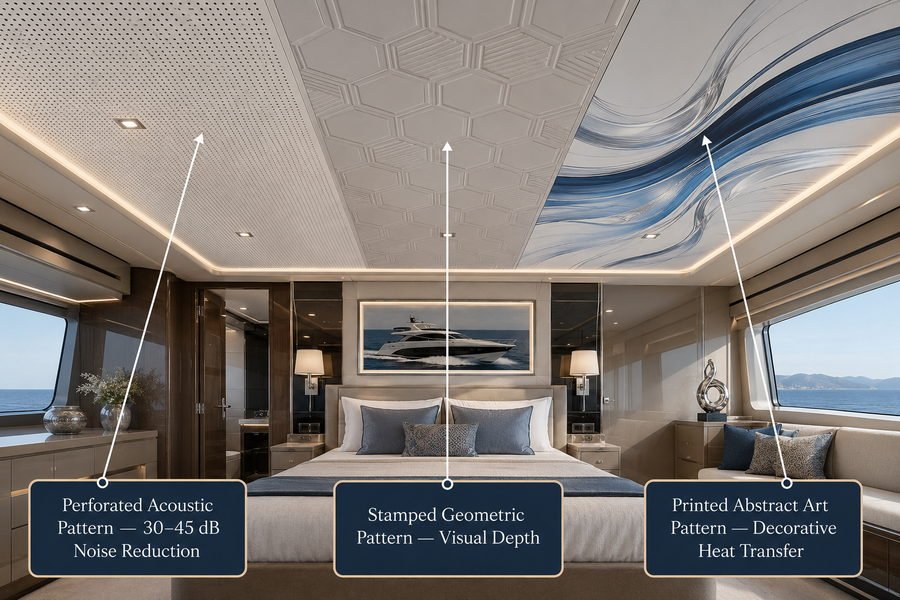
Sometimes, a plain white ceiling is not enough. For high-end marine projects, you need decorative finishes on the ceiling panels. These finishes must look beautiful, but they must also serve a physical purpose. In the marine industry, we use three primary styles of decorative ceiling finishes: perforated acoustic patterns, stamped geometric patterns, and printed abstract art patterns.
Every ceiling panel on a ship covers pipes and wires. The decorative finish cannot block access to these areas. The finishes are applied to the metal surface of the ceiling panel. The metal is usually 0.5mm to 0.7mm thick galvanized steel or aluminum8. Adding a decorative finish adds value to the product. It helps shipyard procurement teams justify the cost when building luxury passenger vessels.
Perforated Acoustic Patterns for Marine Noise Reduction
The first style is the perforated acoustic pattern. Ships have loud engines and vibrations. We use perforated ceilings to absorb this noise. The factory punches hundreds of small holes into the ceiling panel. According to acoustic testing standards like ISO 10140-2, the hole diameter is usually between 1.5mm and 3.0mm9. We place a black fire-proof acoustic tissue behind the holes. When sound hits the ceiling, it goes through the holes and gets trapped10. This specific finish can reduce cabin noise by 30 to 45 decibels11. It looks like a clean dot pattern from below.
Stamped Geometric and Printed Abstract Patterns
The second style is the stamped geometric pattern. The factory uses a heavy press machine to push shapes into the metal. They can create squares, waves, or lines. This gives the ceiling visual depth. It makes a flat ceiling look like a 3D structure. The third style is the printed abstract art pattern. We use a heat transfer process for this. The factory prints a design onto special paper. They place the paper on the metal panel and heat it to over 180 degrees Celsius. The ink moves from the paper into the coating of the panel. You can print any abstract pattern you want, which is perfect for large public entertainment rooms on ships.
| Decorative Style | Manufacturing Method | Primary Function | Standard Specs | Best Area |
|---|---|---|---|---|
| Perforated Acoustic | Metal Punching | Noise reduction | 1.5mm - 3.0mm holes, 30-45 dB | Engine Control Rooms |
| Stamped Geometric | Heavy Metal Press | Visual depth, 3D look | Press depth 1mm - 2mm | Hallways |
| Printed Abstract | Heat Transfer Ink | Custom art designs | Cures at 180+ °C | Entertainment Lounges |
How To Customize Marine Panel Finishes For Ship Interior Design?
Getting custom finishes wrong wastes thousands of dollars. Asian suppliers often misunderstand your design ideas. Follow these clear steps to customize your marine panels perfectly without any expensive mistakes.
Customizing marine panel finishes involves a strict four-step process: submitting high-resolution reference images or standard RAL/Pantone codes, choosing the base material like PVC film or HPL, producing a physical swatch sample for visual approval, and conducting an IMO FTP Code Part 5 test for low flame spread certification.
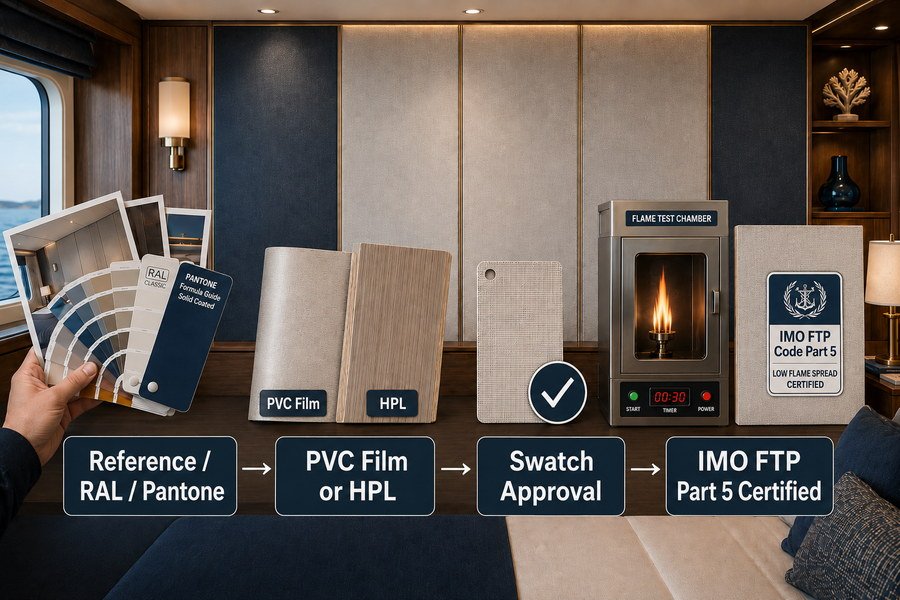
When you want a completely new look for a ship interior, you must create a custom finish. You cannot just call a factory and ask for "dark blue." You will get the wrong color. To avoid wasting money and time, you must follow a strict four-step process. If you miss one step, your custom panels might fail the shipowner's inspection or fail the marine safety rules.
The process includes submitting exact references, choosing the right base material, making a physical sample, and doing the fire test. I have helped many buyers through this process. It takes time, but it guarantees a perfect result. Let us break down exactly how you execute these four steps with your factory.
Design Submission and Base Material Selection
The first step is submitting high-resolution reference images or standard RAL/Pantone codes12. Do not send photos from your phone. Send the official color code. The factory needs this code to mix the exact ink or powder. The second step is choosing the base material. You must decide if the custom finish will be a PVC film or a High-Pressure Laminate (HPL). PVC film is cheaper and lighter. HPL is much harder and more scratch-resistant13. Based on marine supply data, HPL is usually 0.7mm to 1.0mm thick. You choose HPL for public areas and PVC film for sleeping cabins.
Physical Sampling and IMO Fire Safety Certification Testing
The third step is producing a physical swatch sample for visual approval. The factory will make a small piece of metal with your custom finish. You must look at this sample under sunlight and under indoor lights14 to check the color. The fourth and final step is conducting an IMO FTP Code Part 5 test15. Every new custom finish must be tested for low flame spread. Even if the steel is fireproof, the custom film or ink on the outside might burn. The factory must send the custom sample to a lab. The lab will give you a certificate. Without this certificate, you cannot install the panels on the ship.
| Customization Step | Action Required | Responsible Party | Expected Output | Timeframe |
|---|---|---|---|---|
| 1. Submit Reference | Provide RAL code or HD image | Buyer | Exact color match target | Day 1 |
| 2. Choose Material | Select PVC film (0.15mm) or HPL (0.8mm) | Buyer | Material specification confirmed | Day 2 |
| 3. Physical Swatch | Factory makes small test panel | Supplier | Tangible color sample | 7 - 10 Days |
| 4. Fire Certification | Lab tests IMO FTP Code Part 5 | Testing Lab | Official fire certificate | 14 - 21 Days |
What Samples Are Needed Before Confirming Custom Marine Panel Finishes?
Ordering bulk panels without seeing samples is a huge risk. Colors look different on computer screens. I will list the exact physical samples you must request from your factory.
Before confirming custom marine panel finishes, you must approve three mandatory samples: an A4-sized color and texture swatch (for visual matching), a 300mm by 300mm mock-up panel (to test edge wrapping and joint connections), and the official fire test certificate matching the exact custom finish production batch.
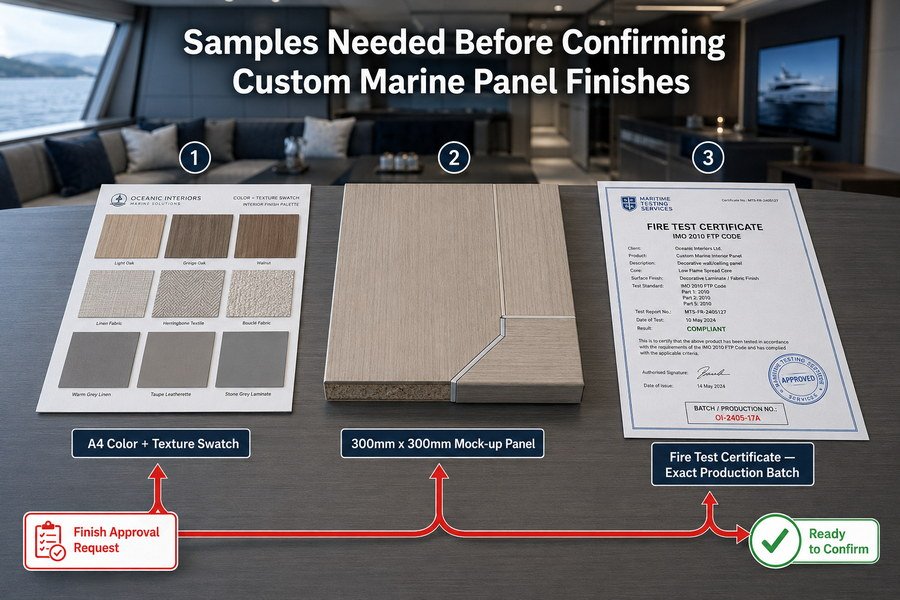
Never pay the full deposit for custom marine panels until you have physical items in your hands. A picture in an email is not enough. You must touch the material and see how it reflects light. To protect your project, you must demand three mandatory samples from the supplier.
These three items are an A4-sized color and texture swatch, a 300mm by 300mm mock-up panel, and the official fire test certificate16. I always make my clients wait for these three items. It delays the project by a few weeks, but it prevents disasters. If the factory refuses to send these samples, you should find a different supplier.
Visual A4 Swatch and Physical Mock-Up Panel Samples
The first sample is the A4-sized color and texture swatch. This is a flat piece of steel with the custom finish applied. You use this to match the color with your carpets and curtains. You can also feel the texture to make sure the wood grain or matte finish is correct. The second sample is the 300mm by 300mm mock-up panel. This is a real piece of the wall panel, filled with rockwool. Why 300mm by 300mm? Because it is big enough to test the joint connections. You need to see how two panels lock together. You also use this mock-up to check the edge wrapping. The factory must fold the PVC film over the steel edge by at least 10mm to 15mm17. If they do not wrap the edge, the film will peel off during installation.
Official Fire Test Certificates for the Custom Finish Batch
The third sample is not a physical piece of steel, but a document. You must receive the official fire test certificate. This certificate must match the exact custom finish production batch. Do not accept an old certificate from a different color. Different colored films have different chemical makeups.18 A white film might pass the fire test, but a custom dark red film might fail. The certificate must explicitly state that your specific custom finish passes the SOLAS requirements19.
| Required Sample Type | Dimensions / Format | Primary Purpose of Sample | Critical Check Item |
|---|---|---|---|
| Color & Texture Swatch | A4 Size Flat Sheet | Visual and touch matching | Correct RAL color under room lighting |
| Mock-Up Panel | 300mm x 300mm | Testing physical construction | Edge wrapping (10mm-15mm fold) |
| Fire Test Certificate | Official Lab Document | Verifying marine safety compliance | Matches exact custom finish batch |
Conclusion
Custom marine panel finishes give ship interiors life. By choosing the right colors, wood grains, and decorative styles, and testing samples properly, you guarantee beautiful and safe marine projects.
-
"Effect of Wall Texture on Perceptual Spaciousness of Indoor Space", https://pmc.ncbi.nlm.nih.gov/articles/PMC7312763/. Research in environmental psychology indicates that interior surface color, especially hue and lightness, can affect perceived spaciousness; this supports the claim that light neutral finishes may make confined corridors appear wider. Evidence role: general_support; source type: paper. Supports: Neutral colors make narrow hallways look wider.. Scope note: The evidence is contextual because most studies examine rooms or simulated interiors rather than ship corridors specifically. ↩
-
"[PDF] Powder Coatings Technology Update - US EPA", https://19january2017snapshot.epa.gov/sites/production/files/2016-01/documents/powdercoatingstechupdate.pdf. Government or technical descriptions of powder coating define the process as applying dry coating particles, commonly electrostatically, and curing them with heat to form a continuous film; this supports the described spray-and-bake mechanism. Evidence role: definition; source type: government. Supports: Powder coating is applied by spraying dry paint powder onto steel and baking it in an oven.. Scope note: This supports the general powder-coating process and does not verify the exact equipment or curing conditions used by a particular marine panel factory. ↩
-
"[PDF] RESOLUTION MSC.307(88) (adopted on 3 December 2010 ...", https://wwwcdn.imo.org/localresources/en/KnowledgeCentre/IndexofIMOResolutions/MSCResolutions/MSC.307(88).pdf. The IMO Fire Test Procedures Code Part 5 sets out test methods for surface flammability of bulkhead, ceiling, and deck finish materials, supporting its use as the relevant low-flame-spread reference for marine interior surface materials. Evidence role: definition; source type: institution. Supports: Both the PVC film and the powder coating methods must pass the IMO FTP Code Part 5 test for low flame spread.. Scope note: The Code establishes the test framework; it does not show that the specific PVC-film or powder-coated panels described here have passed unless product-specific certificates are provided. ↩
-
"[PDF] resolution msc.27(61) - International Maritime Organization", https://wwwcdn.imo.org/localresources/en/KnowledgeCentre/IndexofIMOResolutions/MSCResolutions/MSC.27(61).pdf. Maritime accommodation rules and guidance commonly specify minimum headroom for crew spaces around 2.03 m, which provides context for relatively low shipboard ceiling clearances compared with many buildings. Evidence role: general_support; source type: institution. Supports: Ship ceilings are commonly low, with cabin ceiling heights often around 2.1–2.2 m.. Scope note: This supports the general low-headroom context but does not prove that 2.1–2.2 m is a universal standard for all ship ceilings. ↩
-
"Light reflectance value - Wikipedia", https://en.wikipedia.org/wiki/Light_reflectance_value. Lighting and building-science references define Light Reflectance Value as the percentage of visible light reflected by a surface and explain its role in perceived brightness and light distribution indoors. Evidence role: definition; source type: education. Supports: Ceiling colors with high LRV help reflect light and reduce the enclosed feeling of low cabins.. Scope note: This supports the optical principle behind using high-LRV ceiling finishes but does not establish a mandatory LRV threshold for marine ceiling panels. ↩
-
"[PDF] recommendation for fire test procedures for “a” and “b” class ...", https://wwwcdn.imo.org/localresources/en/KnowledgeCentre/IndexofIMOResolutions/AssemblyDocuments/A.163(ES.IV).pdf. SOLAS Chapter II-2 and the International Code for Application of Fire Test Procedures set fire-safety requirements for ship divisions and restrict the use of combustible materials in accommodation and service spaces; this supports the general point that untreated ordinary wood is not freely permitted for bulkhead construction. Evidence role: expert_consensus; source type: institution. Supports: Marine safety rules restrict or disallow regular untreated wood on ship bulkheads because of fire-safety requirements.. Scope note: The rules vary by ship type, space, and approved construction, so the source would contextualize the statement rather than prove that all regular wood is prohibited in every bulkhead application. ↩
-
"[PDF] RESOLUTION MSC.307(88) (adopted on 3 December 2010 ...", https://wwwcdn.imo.org/localresources/en/KnowledgeCentre/IndexofIMOResolutions/MSCResolutions/MSC.307(88).pdf. SOLAS fire-protection rules and the IMO FTP Code define fire-resisting divisions such as A-60 and B-15 and prescribe standardized fire-test procedures, supporting the statement that these ratings are regulatory fire-performance classifications for ship interior divisions. Evidence role: definition; source type: institution. Supports: Class B-15 and A-60 are SOLAS/IMO fire-test classifications relevant to ship interior panels and divisions.. Scope note: Such sources define the ratings and test framework; they do not prove that the specific PVC-faced rockwool panels discussed in the article have passed those tests unless a certificate is also cited. ↩
-
"How to choose the right marine wall panels for marine interior ...", https://magellanmarinetech.com/how-choose-right-marine-wall-panels-for-marine-interior-projects/. A marine outfitting standard or classification-society technical document can contextualize typical ceiling-panel materials and sheet gauges used in ship accommodation spaces; it would support the stated range only if it gives comparable product or construction specifications rather than a universal marine requirement. Evidence role: general_support; source type: institution. Supports: Marine ceiling panels are commonly made from galvanized steel or aluminum sheets around 0.5–0.7 mm thick.. Scope note: Material thickness varies by manufacturer, fire rating, panel span, vessel type, and classification requirements, so a source may support this as a common specification rather than an industry-wide rule. ↩
-
"Exploring the acoustic potential of 3D printed micro-perforated panels", https://pmc.ncbi.nlm.nih.gov/articles/PMC11004209/. Acoustics literature on perforated or micro-perforated panel absorbers can support that small perforations in the millimeter range are commonly used to tune sound absorption; unless the source is a marine ceiling specification, it should be cited as contextual support for acoustic-panel design rather than proof of a marine-industry standard range. Evidence role: mechanism; source type: paper. Supports: Perforated acoustic ceiling panels commonly use small hole diameters, such as 1.5–3.0 mm, as part of their acoustic design.. Scope note: ISO 10140-2 concerns laboratory measurement of airborne sound insulation and may not prescribe perforation diameters, so the citation should not imply that the ISO standard itself sets the 1.5–3.0 mm range unless the source explicitly says so. ↩
-
"Acoustic performance optimization of natural-fiber micro-perforated ...", https://pmc.ncbi.nlm.nih.gov/articles/PMC12886837/. Research on perforated-panel and porous-backed absorbers explains that incident sound enters perforations and dissipates energy through viscous and thermal losses in the holes and backing layer; this supports the described absorption mechanism, although 'trapped' is a simplified explanation rather than the technical terminology. Evidence role: mechanism; source type: paper. Supports: Perforated ceilings with acoustic backing absorb sound by allowing sound waves to enter the perforations and dissipate energy in the backing material.. Scope note: The source would explain the general acoustic mechanism and may not be specific to ship ceiling panels. ↩
-
"[PDF] MSC.337(91) (adopted on 30 November 2012) CODE ON NOISE ...", https://wwwcdn.imo.org/localresources/en/KnowledgeCentre/IndexofIMOResolutions/MSCResolutions/MSC.337(91).pdf. A controlled acoustic test report or peer-reviewed study measuring noise reduction from ceiling treatments in ship cabins would be needed to support a 30–45 dB reduction; broader ship-noise guidance can contextualize acceptable cabin-noise limits but would not directly prove this performance figure. Evidence role: statistic; source type: paper. Supports: Perforated acoustic ceiling finishes can reduce cabin noise by 30–45 dB.. Scope note: Noise reduction depends on frequency, source-path geometry, installation details, backing material, and whether the metric is insertion loss, absorption improvement, or overall cabin sound-pressure reduction. ↩
-
"RAL colour standard - Wikipedia", https://en.wikipedia.org/wiki/RAL_colour_standard. Standardized color systems such as RAL and Pantone provide defined references for communicating intended colors across design and production contexts. Evidence role: definition; source type: institution. Supports: Official RAL or Pantone references are preferable to informal photographs when specifying a custom finish color.. Scope note: This supports the use of standardized color references generally, but it does not prove that any specific factory will reproduce a color exactly. ↩
-
"High Pressure Laminates with Antimicrobial Properties - PMC - NIH", https://pmc.ncbi.nlm.nih.gov/articles/PMC5456506/. Technical descriptions of high-pressure decorative laminate identify HPL as a thermoset laminate produced under heat and pressure and commonly evaluated for surface properties such as wear and scratch resistance. Evidence role: mechanism; source type: institution. Supports: HPL generally offers greater hardness and scratch resistance than softer decorative film finishes.. Scope note: This supports HPL’s material-performance profile in general; direct comparison with a specific PVC film depends on the exact product formulation and test method. ↩
-
"Color Metamerism and the Structure of Illuminant Space - PubMed", https://pubmed.ncbi.nlm.nih.gov/29603980/. Color-science literature describes metamerism and illuminant-dependent color appearance, showing that two colors or finishes may appear to match under one light source but differ under another. Evidence role: mechanism; source type: paper. Supports: Physical finish samples should be reviewed under different lighting conditions because perceived color can change with illumination.. Scope note: This supports the rationale for checking samples under multiple lighting conditions, but it does not specify a marine-panel inspection protocol. ↩
-
"[PDF] RESOLUTION MSC.61(67) (adopted on 5 December 1996 ...", https://wwwcdn.imo.org/localresources/en/KnowledgeCentre/IndexofIMOResolutions/MSCResolutions/MSC.61(67).pdf. The IMO Fire Test Procedures Code includes Part 5 as the test for surface flammability, used to assess flame-spread characteristics of materials used on ships under the SOLAS fire-safety framework. Evidence role: definition; source type: institution. Supports: Marine interior surface finishes may need assessment under IMO FTP Code Part 5 for low flame-spread performance.. Scope note: This supports the relevance of FTP Code Part 5 to low flame-spread assessment; whether every custom finish requires a new test depends on flag-state, class-society, and approval-scope rules. ↩
-
"Summary of SOLAS chapter II-2 - International Maritime Organization", https://www.imo.org/en/ourwork/safety/pages/summaryofsolaschapterii-2-default.aspx. The IMO SOLAS regime and Fire Test Procedures Code require certain shipboard materials and surface finishes to be verified through specified fire-test methods documented by recognized test reports or certificates. Evidence role: definition; source type: institution. Supports: Marine interior custom finish orders should include an official fire test certificate to verify safety compliance.. Scope note: This supports the need for documented fire-test compliance in marine interiors generally, but it does not prove that every supplier must provide a certificate before deposit payment. ↩
-
"[PDF] THE EFFECT OF ADHESIVE BONDLINE THICKNESS ON JOINT ...", https://rex.libraries.wsu.edu/view/delivery/01ALLIANCE_WSU/12368514090001842/13368514080001842. Engineering and materials references on adhesive bonding and laminate edge design identify exposed edges as vulnerable to peel stresses and moisture or handling damage, and describe edge wrapping or overlap as a method for improving durability. Evidence role: mechanism; source type: research. Supports: Wrapping decorative PVC film around the panel edge helps reduce peeling risk during handling and installation.. Scope note: Such sources can support the general mechanism that wrapped edges resist peeling better than exposed edges, but the exact 10–15 mm allowance may be an industry practice rather than a universally standardized requirement. ↩
-
"Flammability of Polymers", https://www.appstate.edu/~clementsjs/journalarticles/zeus_flammability.pdf. Polymer and coatings literature shows that pigments, plasticizers, stabilizers, and other additives can vary by color formulation and can influence properties such as flammability and smoke behavior. Evidence role: mechanism; source type: paper. Supports: Color variations in PVC or decorative films can reflect different formulations that may affect fire-test performance.. Scope note: This provides a material-science rationale for batch- or color-specific testing, but it does not establish that every white film will pass or every dark red film will fail. ↩
-
"[PDF] RESOLUTION MSC.307(88) (adopted on 3 December 2010 ...", https://wwwcdn.imo.org/localresources/en/KnowledgeCentre/IndexofIMOResolutions/MSCResolutions/MSC.307(88).pdf. SOLAS Chapter II-2 and the IMO FTP Code establish fire-safety requirements and test procedures for materials used in ships, including requirements relevant to interior surface finishes and low flame-spread characteristics. Evidence role: expert_consensus; source type: institution. Supports: A custom marine-panel finish must be shown to comply with applicable SOLAS fire-safety requirements.. Scope note: The source would confirm the regulatory framework; whether a specific custom finish passes depends on its own test report and approval scope. ↩