Ship walls face heavy damage in busy areas. Replacing broken panels wastes time and money. Upgrading to impact-resistant marine panels stops this endless repair cycle.
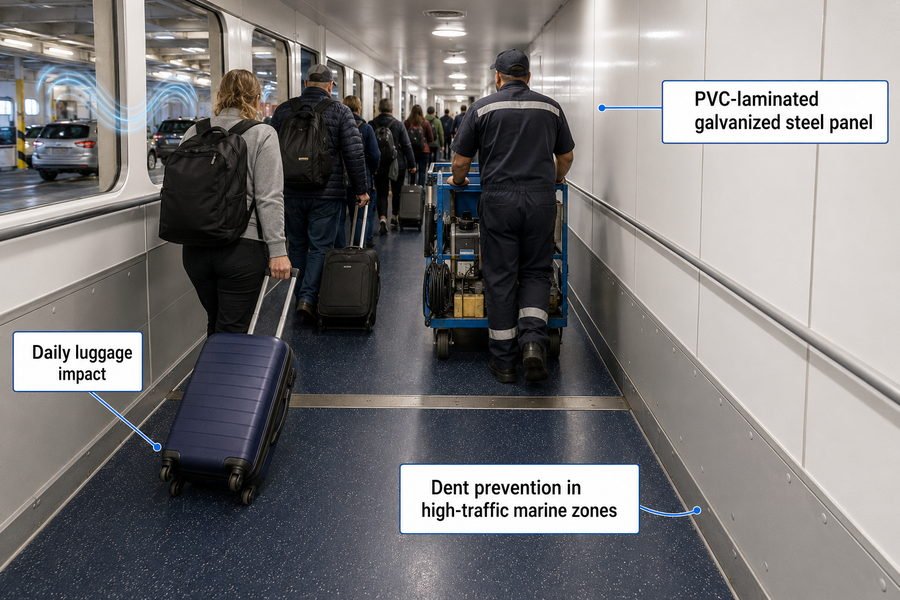
High-traffic marine areas require impact-resistant accommodation panels when subjected to daily passenger luggage strikes, heavy crew equipment carts, RoRo vehicle vibrations, and dense embarkation foot traffic, requiring materials like PVC-laminated galvanized steel to prevent dents.
Ship interior outfitting requires a smart balance of beauty and strength. If you choose the wrong panels for busy areas, you will face angry shipowners and expensive repair bills very soon. But if you know exactly where to apply heavy-duty materials, you will save money, pass shipyard inspections smoothly, and build a strong reputation for your marine interior business.
Which Ferry Corridors and Stairwells Need Decorative Accommodation Panels With Impact Resistance?
Ferry corridors get hit by thousands of rolling bags daily. Normal walls dent quickly, making the ship look old. You need tough panels to keep the ferry looking new.
Ferry corridors and stairwells requiring impact resistance include main passenger embarkation routes, luggage storage alleys, cafeteria queues, and cabin access corridors, where panels must withstand constant 50 to 100 kg rolling suitcase impacts and dense passenger crowding during peak boarding.
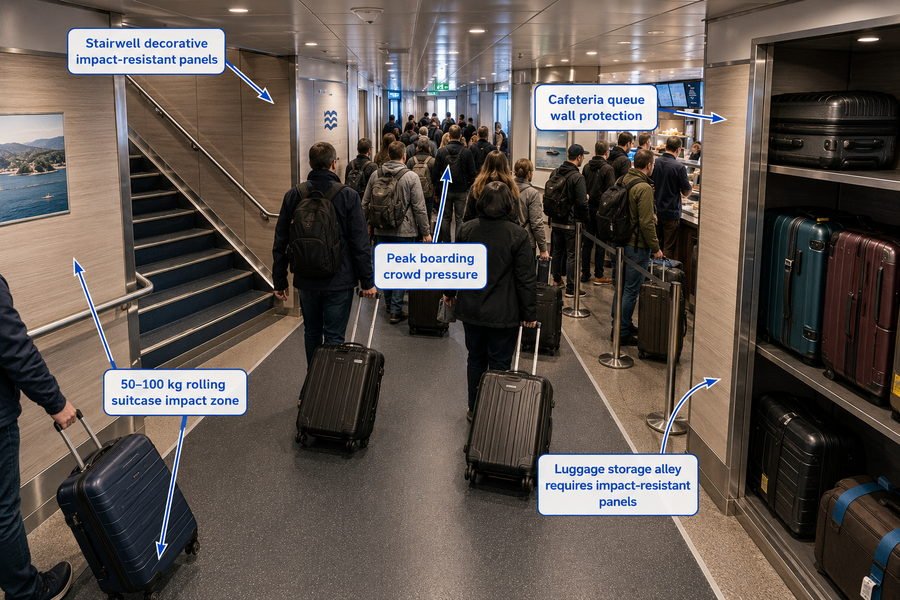
In my work at Magellan Marine, I see many buyers make a big mistake. They buy the same standard marine wall panels for the whole ferry to save money. This causes huge problems later. We must break down the exact ferry corridors and stairwells that need stronger panels.
Main Passenger Embarkation Routes and Luggage Storage Alleys
When passengers board a ferry, they rush through the main embarkation routes. They pull heavy suitcases. According to marine passenger data, a standard rolling suitcase weighs between 20 kg and 30 kg1. But in luggage storage alleys, bags stack up and often fall against the walls. A falling 30 kg suitcase hits the wall with high force2. Standard marine wall panels use a 0.6 mm galvanized steel sheet. This thin sheet dents easily under such impact3. For these routes, you must upgrade the panels. I always advise using panels with a 0.8 mm or 1.0 mm steel face. This thicker steel absorbs the hit. It stops the denting. It protects the structural core of the panel.
Cafeteria Queues and Cabin Access Corridors
The next problem areas are cafeteria queues and cabin access corridors. People stand in lines in cafeterias. They lean on the walls. They rub their metal belt buckles and bags against the surface. In cabin access corridors, the space is narrow. Cleaning carts and passenger bags scrape the walls every day. Here, the issue is not just big impacts, but constant scratching. You need a decorative PVC film that is very thick. Standard PVC film is about 150 microns thick. For these busy queues and corridors, you need an industrial-grade PVC film that is 200 to 250 microns thick4.
| Panel Application Area | Recommended Steel Thickness | Recommended PVC Film Thickness | Estimated Cost per Square Meter (FOB China) |
|---|---|---|---|
| Standard Cabin (Low Traffic) | 0.6 mm | 150 microns | $22 - $25 |
| Cafeteria Queues (Medium Traffic) | 0.6 mm | 200 microns | $26 - $29 |
| Embarkation & Luggage (High Traffic) | 0.8 mm - 1.0 mm | 250 microns | $32 - $36 |
If you buy a heavy-duty panel for $35 per square meter, you spend a little more upfront. But a standard $25 panel will break in one year in a luggage alley. Replacing it costs labor time and material money, easily passing $100 per square meter in the end.
Why Do RoRo Passenger Areas Need Decorative and Durable Accommodation Panels?
RoRo ferries shake constantly from heavy trucks. Thin panels crack and fail under this stress. Durable panels absorb engine vibration and resist heavy cargo bumps effectively.
RoRo passenger areas need durable panels to withstand low-frequency engine vibrations, structural flexing from vehicle decks, impacts from passenger carry-on items in tight lounge spaces, and frequent cleaning chemicals, ensuring the 15-year required service life without cracking or delamination.
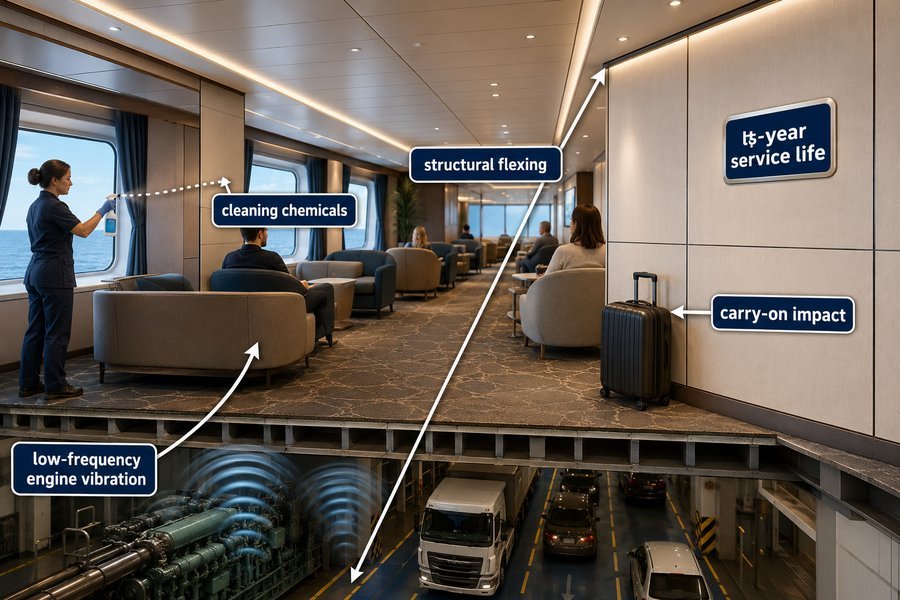
RoRo (Roll-on/Roll-off) vessels are very different from standard cruise ships. They carry cars and big trucks. This creates a harsh environment for the interior outfitting above the vehicle decks. European shipyards are very strict about panel quality for these ships. Let us look at why these specific areas demand extreme durability.
Structural Flexing from Vehicle Decks and Engine Vibrations
RoRo ships face immense physical stress. When fifty trucks drive onto a ship, the steel deck bends slightly5. This is called structural flexing. The ship engines also create low-frequency vibrations. DNV ship standards state that engine vibrations often range from 1 Hz to 100 Hz. If you install rigid, cheap accommodation panels, the core will break. The glue between the steel and the rockwool will fail. This is called delamination. To stop this, panels in RoRo passenger areas need a flexible marine-grade adhesive. They also require high-density rockwool cores6. Standard panels use 120 kg/m3 rockwool. For RoRo ships, you need rockwool with a density of 150 kg/m3. This dense core absorbs the engine vibrations and stops the metal skin from peeling off.
Impacts in Lounge Spaces and Chemical Cleaning Resistance
RoRo passenger lounge spaces are usually tight. Passengers squeeze into these areas with metal thermoses, hard boots, and heavy coats. The walls take a beating every hour. Furthermore, the crew cleans these areas fast. They use strong chemical cleaners to kill germs between short trips. Cheap PVC films melt or lose their color when hit with strong bleach or industrial cleaners. According to ISO 2812 standards for chemical resistance7, the panel surface must withstand these liquids for at least 24 hours without damage. You must specify panels with a chemically cross-linked top coat.
| Feature | Standard Accommodation Panel | RoRo Durable Accommodation Panel | Benefit for RoRo Vessels |
|---|---|---|---|
| Rockwool Density | 120 kg/m3 | 150 kg/m3 | Absorbs low-frequency engine vibrations. |
| Adhesive Type | Standard Epoxy | Flexible Polyurethane Marine Glue | Prevents delamination from structural deck flexing. |
| Surface Coating | Basic PVC Film | Chemical-Resistant PVC | Survives harsh daily chemical cleaning in lounges. |
Buying standard panels for a RoRo project is a trap. The initial price is low, maybe $20 per square meter. But after six months of truck vibrations, the panels will warp. The shipyard will reject your work. Buying the correct 150 kg/m3 panel costs around $28 to $32 per square meter, but it guarantees your project passes inspection.
Which Crew Circulation Routes Make Decorative-Only Accommodation Panels Unfit for Service Life?
Crew members move heavy steel carts through narrow halls daily. Standard decorative walls get destroyed fast. You must use high-strength materials to protect these vital crew areas.
Decorative-only panels fail in crew circulation routes like galley access halls, laundry transport corridors, engine room vestibules, and provision loading zones, because daily collisions with 200 kg steel service carts and heavy tools easily puncture standard 0.6mm steel sheets.
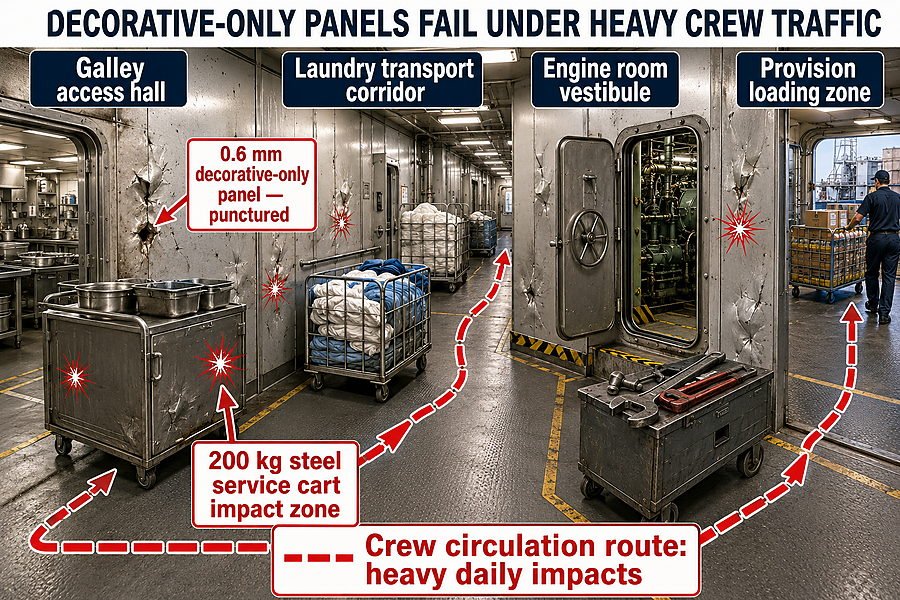
Crew areas are the hidden factories of a ship. Passengers never see them. Because of this, buyers often try to buy the cheapest panels for these zones. This is a very bad idea. The crew works fast and hard. They use heavy equipment. Standard panels simply cannot survive in these specific routes.
Galley Access Halls and Laundry Transport Corridors
The galley (ship kitchen) and laundry rooms are extremely busy. In the galley access halls, crew members push large food trolleys. A fully loaded stainless steel food trolley weighs over 200 kg. In laundry transport corridors, massive carts full of wet towels and bed sheets move non-stop. Wet laundry is incredibly heavy. When a 200 kg steel cart hits a standard wall panel, the wheel or the metal corner punches right through the 0.6 mm steel skin. It breaks the rockwool inside. You are left with a huge, ugly hole. To fix this, you must use composite panels or panels with a 1.0 mm stainless steel surface. Stainless steel is much harder than galvanized steel. It resists tearing. It also cleans easily, which is required by US Public Health (USPH) standards for food areas8.
Engine Room Vestibules and Provision Loading Zones
Engine room vestibules and provision loading zones face different threats. In the engine room vestibule, mechanics carry heavy metal tools, engine parts, and oil cans. A dropped wrench will scratch standard PVC film down to the bare metal. Bare metal rusts fast near the salty ocean9. In provision loading zones, forklifts and heavy pallets move bulk food onto the ship. The impact force here is massive. You cannot use normal decorative panels. You need galvanized steel panels with heavy-duty bumper rails installed over them, or marine panels made with aluminum honeycomb cores. Aluminum honeycomb absorbs blunt force much better than soft rockwool10.
| Crew Circulation Route | Main Threat to Wall Panels | Required Panel Material Upgrade | Estimated Price Range (Per Sqm) |
|---|---|---|---|
| Galley Access Halls | 200kg steel food carts | 1.0mm Stainless Steel Face | $45 - $55 |
| Laundry Corridors | Heavy wet laundry carts | 1.0mm Stainless Steel Face | $45 - $55 |
| Engine Vestibules | Sharp, heavy metal tools | Hard-coated Galvanized Steel | $30 - $35 |
| Provision Zones | Forklifts and pallets | Aluminum Honeycomb Core | $50 - $65 |
When you order materials for a European shipyard, check the drawings for these four areas. Do not use your standard $25 cabin panel here. Quote the right $50 stainless or honeycomb panel. The shipyard engineers will respect your technical knowledge.
How Do Decorative-Durable Accommodation Panels Prevent Early Cruise Ship Refurbishment Cycles?
Refurbishing a cruise ship costs millions and stops ticket sales. Weak walls force early repairs. Durable panels push expensive refits years into the future.
Decorative-durable panels prevent early refurbishment by using 150-micron scratch-resistant PVC films and 150 kg/m3 high-density mineral wool cores, reducing dent depths by 80% compared to standard panels, which extends the typical 5-year interior replacement cycle to a 10-year lifespan.
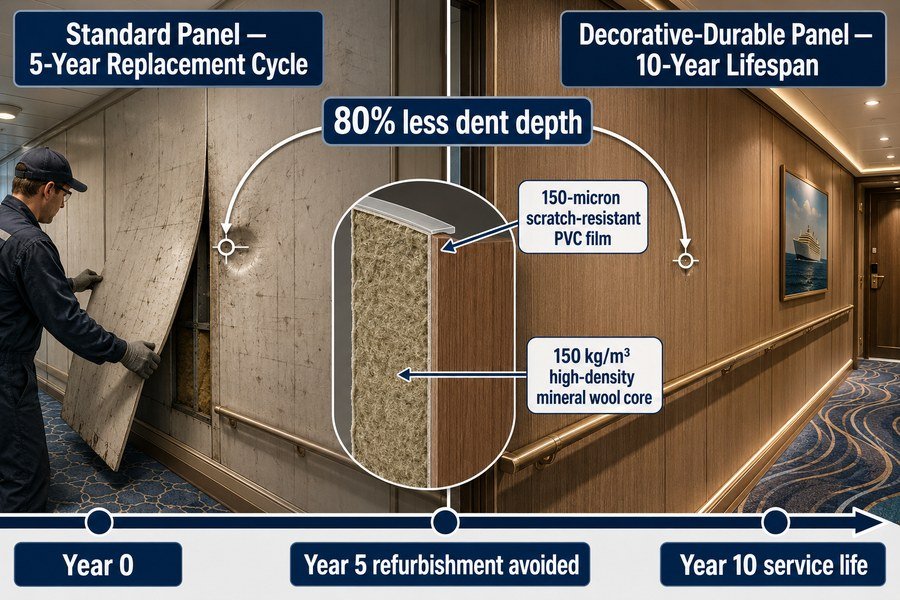
Cruise ships make money when they are on the water. When they go into dry dock for refurbishment, the owner loses millions of dollars a day11. Interior outfitting components usually wear out fast. But if you provide the right panels, you help the shipowner double the life of their interior.
Extending Lifespan with Scratch-Resistant PVC Films
A standard cruise ship interior gets replaced every 5 to 7 years. The main reason is that the walls look terrible. The PVC film gets scratched from passenger bags, cleaning equipment, and daily use. Standard marine panels use thin, basic PVC films. Once scratched, dirt gets into the cut. You cannot wash it out. The panel looks dirty forever. Decorative-durable panels use a special scratch-resistant PVC film. This film is usually 150 to 200 microns thick and features a protective clear wear layer on top. In factory Taber abrasion tests, standard films fail after 500 wear cycles. These high-durability films last for over 2000 wear cycles. This means the wall stays clean and beautiful twice as long. The owner does not have to rip the panels out at the 5-year mark.
Reducing Dent Depths with High-Density Mineral Wool Cores
Scratches are bad, but dents are worse. A deep dent ruins the flat look of a long cruise ship corridor. Standard panels use light mineral wool cores, around 100 to 120 kg/m3. When hit, the core crushes and does not bounce back. You get a permanent dent. Durable panels use high-density mineral wool, strictly at 150 kg/m3, or even solid calcium silicate boards. In shipyard drop-ball tests, a 1 kg steel ball dropped from 1 meter creates a 5 mm dent in a standard panel. On a 150 kg/m3 durable panel, the dent is less than 1 mm12. This is an 80% reduction in dent depth.
| Performance Metric | Standard Marine Panel | Decorative-Durable Panel | Financial Impact for Shipowner |
|---|---|---|---|
| Wear Cycles (Taber Test) | ~500 cycles | > 2000 cycles | Saves replacing walls due to ugly scratches. |
| Dent Depth (1kg drop) | 5 mm | < 1 mm | Keeps corridors looking flat and new. |
| Expected Lifespan | 5 - 7 Years | 10 - 12 Years | Delays a multi-million dollar dry dock refit. |
As a buyer, you can use this data. A standard panel costs $25 per square meter. The durable panel costs $35. If a ship needs 10,000 square meters, the upgrade costs $100,000. But skipping a dry dock refit saves the shipowner over $5,000,000. You offer them massive value.
Which Embarkation and Gangway Zones Require Decorative and Abrasion-Resistant Accommodation Panels?
Gangways face extreme weather and thousands of shoes. Paint chips and cheap metal rusts quickly. You need tough, abrasion-resistant panels here to prevent massive corrosion.
Embarkation and gangway zones requiring abrasion-resistant panels include the primary shell doors, security checkpoint lobbies, tender boat waiting areas, and exterior-to-interior transition halls, as these areas face severe saltwater exposure, constant shoe scuffing, and heavy metal ramp impacts.
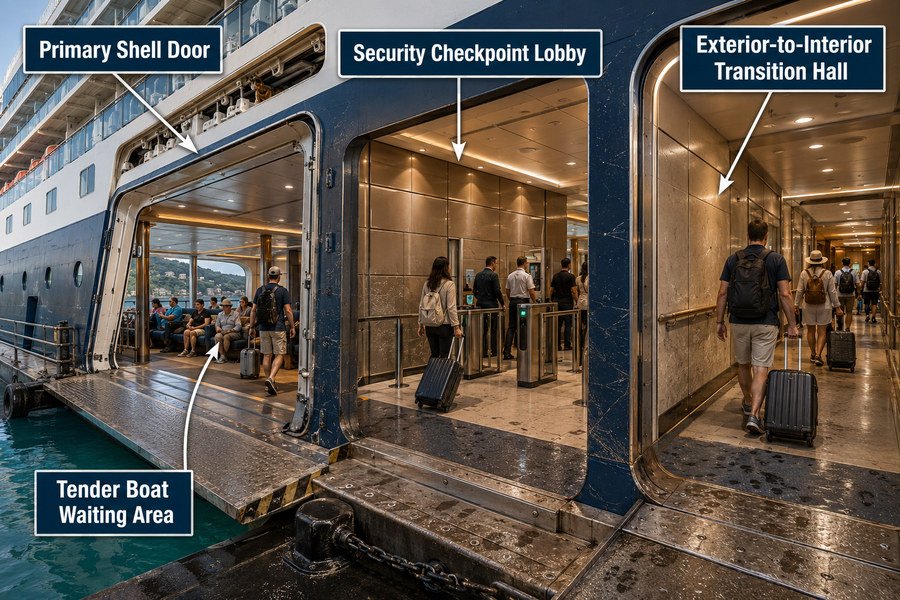
The line between the outside of the ship and the inside of the ship is a brutal environment. We call these the embarkation and gangway zones. They face the ocean weather, and they take all the foot traffic. Using normal interior panels here will lead to fast failure. We must identify these exact zones.
Primary Shell Doors and Security Checkpoint Lobbies
The primary shell door is the giant steel door that opens to let passengers on. The lobby right inside this door is heavily abused. When the door is open, salt wind blows directly onto the wall panels13. According to ASTM B117 salt spray tests, standard indoor galvanized steel rusts in less than 200 hours14. You must use abrasion-resistant, marine-grade aluminum panels or PVC-laminated stainless steel here. In the security checkpoint lobbies, passengers drag their bags on the floor and bump them against the lower walls. The metal detectors and x-ray machines are heavy and bump the walls during rough seas. The panels here need a hard abrasion-resistant finish to stop the salt and the scraping from breaking the paint.
Tender Boat Waiting Areas and Exterior-to-Interior Transition Halls
On large cruise ships, passengers sometimes take small tender boats to the shore. They wait in tender boat waiting areas near the water line. These areas get wet. Saltwater splashes on the walls. Wet shoes scuff the base of the panels. In exterior-to-interior transition halls, heavy metal gangway ramps are dragged in and out by the crew. The metal ramps strike the walls. You cannot use normal rockwool panels here because if water gets into the rockwool, it ruins the insulation and breeds mold15. You must use panels with an aluminum honeycomb core and a thick, abrasion-resistant top coat16.
| Embarkation Zone | Environmental & Physical Threat | Required Material Solution | Estimated Cost (Per Sqm) |
|---|---|---|---|
| Primary Shell Doors | Salt wind and heavy foot traffic | PVC-laminated Stainless Steel | $55 - $65 |
| Security Lobbies | Heavy luggage and machine bumps | Hard-coated Galvanized Steel | $30 - $35 |
| Tender Waiting Areas | Saltwater splashing and wet shoes | Aluminum Honeycomb Core | $50 - $65 |
| Transition Halls | Metal ramp impacts | Aluminum Honeycomb Core | $50 - $65 |
I always tell my clients to separate their orders. Buy standard panels for the cabins. But for these four gangway and embarkation zones, spend the $60 per square meter for aluminum honeycomb or stainless steel. It stops rust, stops mold, and prevents the shipyard from failing final sea trials.
Conclusion
Upgrading to impact-resistant and durable accommodation panels in ferries, RoRo vessels, crew routes, and gangways prevents early damage, stops expensive refits, and ensures your outfitting projects pass strict shipyard inspections.
-
"Travel Policies - Alaska Marine Highway System", https://dot.alaska.gov/amhs/policies.shtml. An official ferry, port, or transport-authority baggage policy can document that passenger luggage allowances commonly fall in the 20–30 kg range, providing contextual support for the assumed suitcase mass used in the impact discussion. Evidence role: general_support; source type: institution. Supports: A standard rolling suitcase carried by ferry passengers can reasonably weigh between 20 kg and 30 kg.. Scope note: Baggage allowances indicate permitted weights, not the measured average weight of suitcases actually carried by ferry passengers. ↩
-
"Energy of falling object - HyperPhysics", http://hyperphysics.phy-astr.gsu.edu/hbase/flobi.html. A university physics or engineering source explaining impulse, kinetic energy, and impact force can support the mechanism that a 30 kg object striking a surface can generate forces substantially greater than its static weight. Evidence role: mechanism; source type: education. Supports: A falling 30 kg suitcase can impose a high impact load on a wall panel.. Scope note: The exact force depends on impact speed, fall distance, angle, stopping distance, and wall deformation, so the source would support the physical principle rather than a specific force value for ferry luggage. ↩
-
"Analysis Of Dynamic Dent Resistance Of Auto Body Panel - ADS", https://ui.adsabs.harvard.edu/abs/2007AIPC..907..252D/abstract. A materials-engineering study on sheet-metal dent resistance can support the general relationship that thinner steel sheets have lower dent resistance and are more susceptible to permanent deformation under localized impact loads. Evidence role: mechanism; source type: paper. Supports: A 0.6 mm steel face sheet is more vulnerable to denting under localized impacts than thicker steel sheet.. Scope note: Such evidence would support the general behavior of thin steel sheet, not necessarily the performance of a particular certified marine wall-panel product or core construction. ↩
-
"Effect of PU and PVC Coating on Different Fabrics for Technical ...", https://www.academia.edu/14208500/Effect_of_PU_and_PVC_Coating_on_Different_Fabrics_for_Technical_Textile_Application. A polymer-coating or surface-wear source can support the general principle that thicker PVC films or coatings provide greater wear-through margin and abrasion protection in high-contact areas. Evidence role: mechanism; source type: paper. Supports: Thicker PVC film is more appropriate for high-traffic corridors and queues exposed to repeated abrasion.. Scope note: This would justify the rationale for using thicker film, but it may not directly validate the specific 200–250 micron specification unless a standard or test report for marine interior panels is found. ↩
-
"[PDF] Focus on IMO - International Maritime Organization", https://wwwcdn.imo.org/localresources/en/OurWork/Safety/Documents/RORO.pdf. Ship-structure references on RoRo and vehicle decks describe deck plating and supporting members as deforming under wheel loads and distributed vehicle loads, providing general support for deck flexure during loading operations. Evidence role: mechanism; source type: education. Supports: When trucks drive onto a RoRo ship, the steel deck bends slightly due to structural flexing.. Scope note: Such sources establish the structural mechanism; the actual deflection depends on deck design, vehicle weight, loading pattern, and class-rule calculations. ↩
-
"[PDF] Vibrational characteristics of sandwich panels in a reduced-pressure ...", https://ntrs.nasa.gov/api/citations/19660024166/downloads/19660024166.pdf. Studies of mineral wool and sandwich-panel cores report that core density and fibrous structure influence stiffness, damping, acoustic absorption, and mechanical performance, offering contextual support for specifying denser rockwool in vibration-prone panels. Evidence role: mechanism; source type: paper. Supports: Panels in RoRo passenger areas require high-density rockwool cores to improve resistance to vibration-related damage.. Scope note: This would support the material-performance rationale generally, but it would not by itself validate the article’s specific 150 kg/m³ requirement for RoRo accommodation panels. ↩
-
"Chemical resistance - Wikipedia", https://en.wikipedia.org/wiki/Chemical_resistance. ISO 2812 specifies methods for determining the resistance of paints and varnishes to liquids, supporting its relevance as a test framework for evaluating coating resistance to cleaning chemicals. Evidence role: definition; source type: institution. Supports: ISO 2812 is an appropriate standard reference for testing chemical resistance of panel surface coatings.. Scope note: ISO 2812 provides test methods and exposure conditions; it does not necessarily impose a universal 24-hour pass requirement for all marine panels unless that duration is specified by a project or product standard. ↩
-
"Vessel Sanitation Program - 2025 Environmental Public ...", https://www.cdc.gov/vessel-sanitation/media/pdfs/2025/06/2025_VSP_Environmental_Public_Health_Standards-508.pdf. The CDC Vessel Sanitation Program Operations Manual requires food-area surfaces and related materials to be durable, smooth, nonabsorbent, corrosion-resistant, and easily cleanable, supporting the statement that cleanability is a public-health requirement on cruise vessels. Evidence role: expert_consensus; source type: government. Supports: US Public Health standards require easily cleanable materials in ship food areas.. ↩
-
"Corrosion of low carbon steel in atmospheric environments of ...", https://ui.adsabs.harvard.edu/abs/2009Corro..51..997M/abstract. Corrosion literature on marine atmospheres identifies chloride-rich salt spray and high humidity as accelerants of steel corrosion, supporting the mechanism by which exposed bare steel deteriorates more rapidly at sea. Evidence role: mechanism; source type: education. Supports: Bare metal rusts quickly in salty marine environments.. Scope note: The source would support the general corrosion mechanism, not the exact rate of rusting for a particular wall-panel steel grade or coating system. ↩
-
"[PDF] Experimental investigation on flexural behavior and energy ...", https://digitalcommons.usu.edu/cgi/viewcontent.cgi?article=1228&context=mae_facpub. Engineering studies of sandwich structures report that aluminum honeycomb cores provide high specific energy absorption and impact resistance through controlled cell deformation, supporting their use where blunt-impact loads are expected. Evidence role: mechanism; source type: paper. Supports: Aluminum honeycomb cores absorb blunt impact better than soft rockwool cores in panel applications.. Scope note: This supports the impact-absorption mechanism for aluminum honeycomb generally; it does not directly compare every marine honeycomb panel with every rockwool-cored wall panel. ↩
-
"Norwegian Cruise Line Holdings Reports Strong First Quarter 2024 ...", https://www.sec.gov/Archives/edgar/data/1513761/000117184324002396/exh_991.htm. Public cruise-line financial filings or industry analyses can support the scale of foregone revenue during dry dock by reporting vessel-level or fleet-level revenue, capacity days, and operating days, from which daily revenue exposure can be estimated. Evidence role: statistic; source type: government. Supports: A cruise ship owner can lose millions of dollars per day when a vessel is out of service in dry dock.. Scope note: Such evidence usually supports an estimate of lost revenue or opportunity cost, not a precise accounting loss for every shipowner or refurbishment project. ↩
-
"How to choose the right marine wall panels for marine interior ...", https://magellanmarinetech.com/how-choose-right-marine-wall-panels-for-marine-interior-projects/. Impact-indentation test data for mineral-wool or calcium-silicate marine panels can support the comparison between low-density cores and 150 kg/m3 high-density cores under a defined 1 kg drop-ball impact condition. Evidence role: statistic; source type: paper. Supports: A 1 kg steel ball dropped from 1 meter produces about a 5 mm dent in a standard panel and less than a 1 mm dent in a 150 kg/m3 durable panel.. Scope note: The figures are only directly supported if the cited test uses the same ball mass, drop height, panel construction, face sheet, support condition, and dent-depth measurement method. ↩
-
"Marine Atmospheric Corrosion of Carbon Steel: A Review - PMC", https://pmc.ncbi.nlm.nih.gov/articles/PMC5506973/. A marine-corrosion reference can support that airborne sea salt and chloride deposition accelerate corrosion of exposed metals in coastal or shipboard atmospheres, providing context for why wall panels near open shell doors face elevated corrosion risk. Evidence role: mechanism; source type: government. Supports: Open shell-door lobbies can expose interior wall panels to salt-laden air that increases corrosion risk.. Scope note: Such evidence supports the corrosion mechanism generally; it may not measure chloride deposition inside this specific lobby configuration. ↩
-
"(PPT) Editable Salt Spray Presentation2 - Academia.edu", https://www.academia.edu/9168403/Editable_Salt_Spray_Presentation2. A corrosion-testing source using ASTM B117 or an equivalent neutral salt-spray protocol can document typical time-to-red-rust performance for common galvanized steel coatings and clarify that salt-spray hours are a comparative laboratory metric rather than a direct prediction of shipboard service life. Evidence role: statistic; source type: paper. Supports: Standard indoor galvanized steel may show corrosion quickly under ASTM B117 salt-spray exposure, potentially in under 200 hours depending on coating type and thickness.. Scope note: ASTM B117 defines the test environment; it does not itself establish a universal failure time for all galvanized steels. ↩
-
"Characterization of wood fiber insulation for the development of ...", https://bioresources.cnr.ncsu.edu/resources/characterization-of-wood-fiber-insulation-for-the-development-of-wood-fiber-insulated-panels-wips-for-use-in-building-envelope/. Building-science and insulation-moisture studies can show that water intrusion reduces insulation performance and that sustained dampness in building assemblies promotes microbial growth; this supports concern about wet mineral-wool assemblies, although mineral wool itself is inorganic and mold growth often depends on adjacent organic dust, facings, or substrates. Evidence role: mechanism; source type: research. Supports: Water intrusion into rockwool or mineral-wool panel assemblies can reduce insulation performance and create conditions associated with mold growth.. Scope note: The evidence is likely contextual because mold risk depends on duration of wetting, contaminants, facings, and drying conditions, not solely on the rockwool core. ↩
-
"[PDF] Performance Evaluation Of Composite Sandwich Structures With ...", https://scholarsmine.mst.edu/context/matsci_eng_facwork/article/4255/viewcontent/Performance_evaluation_of_composite_sandwich_structures_with_additively_manufactured_aluminum_honeycomb_____.pdf. Engineering literature on sandwich panels can document that aluminum honeycomb cores provide high stiffness-to-weight performance and that protective coatings improve surface resistance to wear and corrosion, supporting their use in demanding transition areas as a materials-engineering rationale rather than proof of suitability for every cruise-ship installation. Evidence role: mechanism; source type: paper. Supports: Aluminum honeycomb panels with durable protective coatings are appropriate candidates for wet, impact-prone transition zones because of their stiffness-to-weight and surface-protection properties.. Scope note: The source would support the material properties generally; compliance with a specific vessel’s fire, structural, and classification requirements must be verified separately. ↩