You found a beautiful panel for your ship interior, but the inspector rejected it. Wasting money on non-compliant panels hurts your profit. Here is how you can stop this from happening.
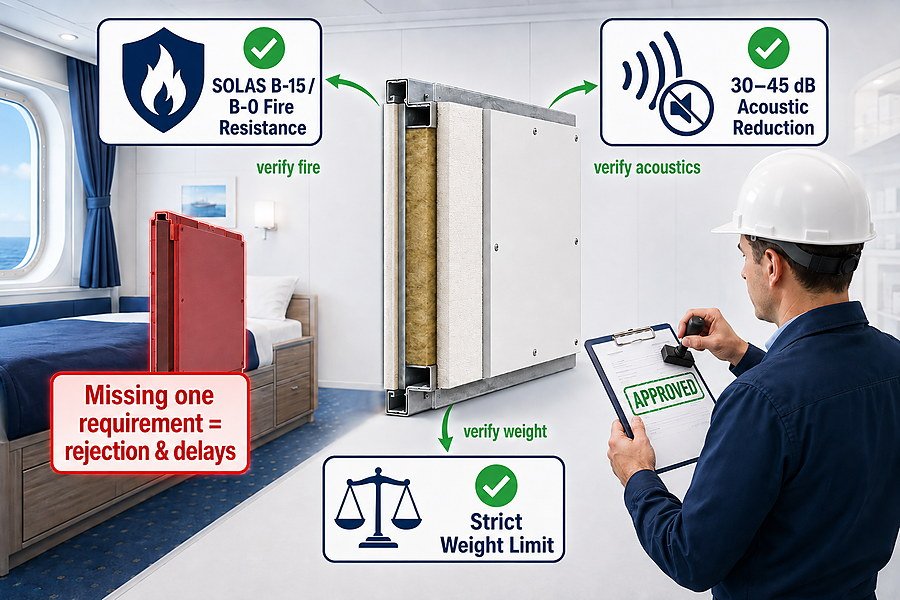
To avoid specifying a non-compliant marine accommodation panel, you must verify the panel meets all three core functional requirements: fire resistance (SOLAS B-15 or B-0), acoustic reduction (typically 30-45 dB), and strict weight limits. Missing any single requirement will cause immediate classification society rejection and project delays.
I remember a project in 2018 where a client bought cheap panels from Asia. They looked great but failed the acoustic test on the ship. The shipyard forced them to rip out the entire cabin. It was a costly disaster. Let us dive into the details so you do not make the same mistake.
Which Red Flags Show a Decorative Accommodation Panel Fails SOLAS Fire and Smoke Rules?
Are your beautiful panels actually fire hazards? Choosing panels that fail smoke tests puts lives and your project at risk. Learn the danger signs before you place an order.
The four main red flags indicating a decorative accommodation panel fails SOLAS fire and smoke rules are: missing IMO FTP Code Part 5 test reports, a PVC surface film thicker than 0.15mm, use of uncertified adhesives, and lack of a non-combustible core material like high-density rockwool.
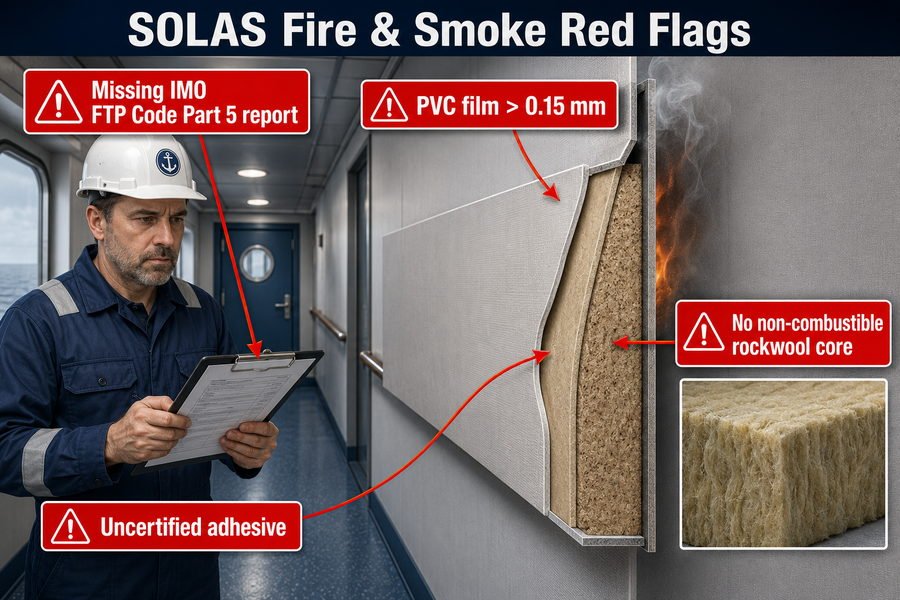
I have seen many buyers get tricked by smooth-talking salespeople. They focus only on the price and the color. But as an outfitting specialist, I look for the red flags. If you spot these four issues, you must walk away immediately.
Spotting Missing IMO FTP Code Part 5 Test Reports and Uncertified Adhesives
The first red flag is the lack of proper testing documents. If the supplier cannot show you an IMO FTP Code Part 5 test report1, the panel is useless for a ship. Part 5 tests surface flammability. If the panel burns too fast, it fails. You must ask for this specific report. Do not accept a general "fireproof" certificate.
The second red flag involves the glue. The supplier might use a great metal sheet and a good PVC film, but they use the wrong adhesive. According to the IMO FTP Code, adhesives used in panel construction must have low flame-spread characteristics2. If the factory uses standard commercial glue to save a few cents, that glue will release toxic smoke during a fire. I always ask the factory to name the specific marine-grade adhesive they use. If they hesitate, it is a bad sign.
Identifying PVC Surface Films Thicker Than 0.15mm and Combustible Cores
The third red flag is a thick surface film. SOLAS rules require decorative finishes on bulkheads to not exceed a specific calorific value, usually capped at 45 MJ/m²3. In my experience, if a PVC surface film is thicker than 0.15mm, it will likely fail this test. Some cheap panels use 0.30mm PVC because it is easier to apply and hides dents. This is a huge fire risk.
The fourth red flag is the core. The core must be a non-combustible material.4 For marine accommodation panels, this is almost always rockwool (mineral wool). The rockwool should have a density of around 100 to 120 kg/m³. If a supplier uses standard polyurethane foam or cheap glass wool, it will fail the SOLAS B-15 fire test.
| Red Flag Item | Dangerous Specification | Safe SOLAS Compliant Specification |
|---|---|---|
| Fire Test Report | Missing or generic commercial test | IMO FTP Code Part 5 Report |
| Panel Adhesive | Standard industrial glue | Certified low flame-spread adhesive |
| PVC Film Thickness | Greater than 0.15mm | Maximum 0.15mm |
| Core Material | Polyurethane foam or low-density wool | Rockwool (100-120 kg/m³) |
Which Documents Prove a Marine Accommodation Panel Combines Decorative, Fire, and Acoustic Ratings?
A supplier says their panel does it all. Do you believe them? Without the right paperwork, their word means absolutely nothing. You need hard proof.
To prove a marine accommodation panel combines decorative, fire, and acoustic ratings, you must collect three specific documents: the Type Approval Certificate (MED Wheelmark) for fire safety, an ISO 10140 acoustic lab test report, and a detailed material declaration outlining the exact finish and core specs.
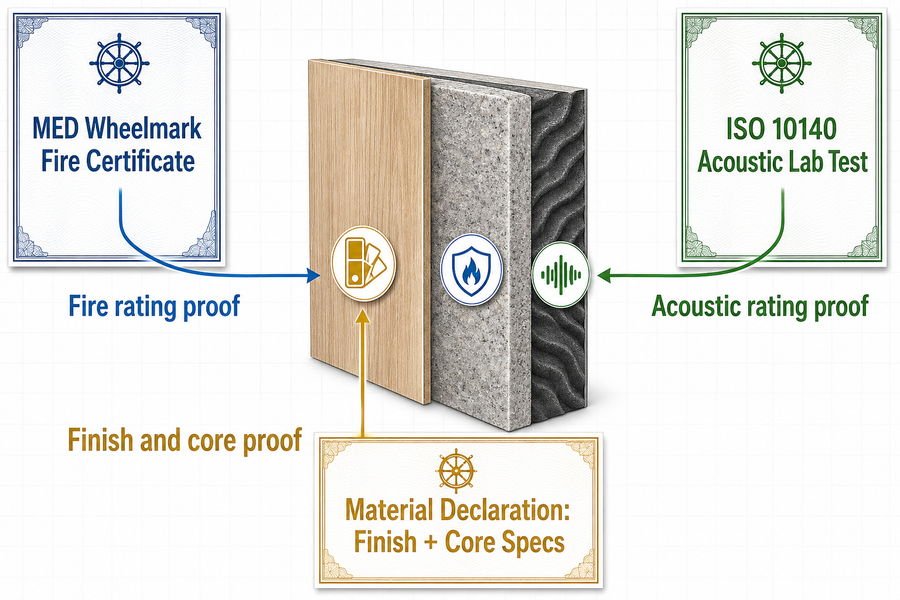
You cannot rely on a supplier's brochure. Shipyard surveyors only look at paper. If the documents are wrong, the panels will sit in the port while you lose money. You must collect all three of these documents before you pay the deposit.
Verifying the Type Approval Certificate and Material Declaration
The first document you need is the Type Approval Certificate (TAC). In Europe, we call this the MED Wheelmark5. This document proves the panel passes the strict fire safety rules. It shows the panel is rated for B-15 or B-0 class divisions6. You must check the expiration date on the TAC. If it is expired, the surveyor will reject the panels.
The second document is the material declaration. The TAC alone is not enough. The TAC covers a general product family. The material declaration tells you exactly what is inside your specific panel. It must list the thickness of the steel (usually 0.6mm), the exact density of the rockwool, and the specific brand of the decorative finish. If the material declaration does not match the actual panel you buy, the classification society will void your approval. I always compare the material declaration directly against my purchase order.
Understanding the ISO 10140 Acoustic Lab Test Report
The third document is the acoustic lab test report. Acoustics matter a lot for cabin privacy. The cruise ship industry is very strict about noise. The panel must be tested according to the ISO 10140 standard.7
When you read this report, look for the Sound Reduction Index, known as the Rw value8. For a standard marine accommodation panel, you want an Rw value of at least 33 dB. High-end cabins might require 45 dB. The acoustic report must specifically state that the panel tested had the exact same decorative layer that you are buying.
| Required Document | What It Proves | Key Value to Check |
|---|---|---|
| Type Approval Certificate (MED) | Fire rating and regulatory compliance | B-15 or B-0 rating, Valid Date |
| Material Declaration | Exact build of the purchased panel | Steel thickness, Rockwool density |
| ISO 10140 Acoustic Report | Sound reduction capability | Rw value (33 dB to 45 dB) |
Which Spec Gaps Cause Accommodation Panel Rejection During MED Wheelmark Verification?
You submitted your panel specs, but the Wheelmark surveyor said no. Missing small details in your paperwork wastes weeks of your time. Find out what you missed.
The three most common specification gaps causing accommodation panel rejection during MED Wheelmark verification are: mismatched material density between the tested sample and production batch, missing joint profile details in the drawings, and lacking traceability numbers printed on the actual panel surfaces.
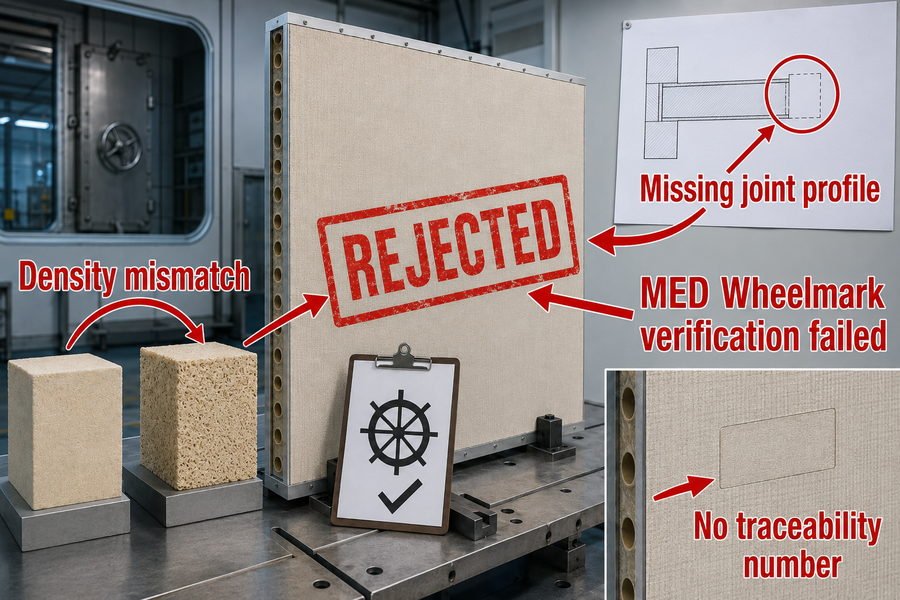
I have helped many clients fix rejection issues. Usually, the factory made a good panel, but the paperwork did not match the physical product perfectly. The MED Wheelmark system demands perfect matches.9 Here are the three gaps you must close.
Fixing Mismatched Material Density and Missing Joint Profiles
The first major gap is a mismatched material density. When a factory tests a panel for the Wheelmark, they send a perfect sample to the lab. Let us say that sample used rockwool with a density of 150 kg/m³. If you order panels for your project and the factory uses 120 kg/m³ rockwool to save money, the surveyor will notice. The production batch must match the tested sample exactly.10 I always ask the factory to weigh a panel on video before shipping to confirm the density matches the certificate.
The second gap involves missing joint profiles in the drawings. Panels do not stand alone; they connect to each other. The fire test includes the joint system.11 If your installation drawings show a 3mm spline joint, but the Wheelmark certificate is based on an overlapping joint, the surveyor will reject it. Your drawings must show the exact joint profile approved in the fire test report.
Ensuring Traceability Numbers on Panel Surfaces
The third gap is lacking traceability numbers on the actual panel surfaces. This is a very common mistake with factories in developing countries. The surveyor walks onto the ship, picks up a panel, and looks for a stamp.
Every single panel must have a printed label or stamp showing the manufacturer name, the batch number, and the Wheelmark logo.12 If the factory ships blank panels, the surveyor cannot prove those panels belong to the certificate. They will reject them on site. I always demand a photo of the traceability stamp on the actual production line before I authorize the final payment.
| Specification Gap | Surveyor Action | How to Prevent It |
|---|---|---|
| Rockwool Density Mismatch | Immediate rejection of batch | Weigh panels, compare to TAC |
| Unapproved Joint Profile | Halt installation process | Match shop drawings to fire test |
| Missing Traceability Stamp | Reject panels on site | Demand photos of labels before shipping |
How to Confirm a Finish Does Not Void the Fire or Acoustic Certification of an Accommodation Panel?
You want a custom wood finish, but it might ruin your safety rating. Do not let a thin vinyl layer destroy your whole project and cause a failed inspection.
To confirm a finish does not void the fire or acoustic certification of an accommodation panel, you must complete three checks: verify the finish thickness is under 0.6mm, confirm its calorific value is strictly below 45 MJ/m², and ensure the finish was applied during the original acoustic test.
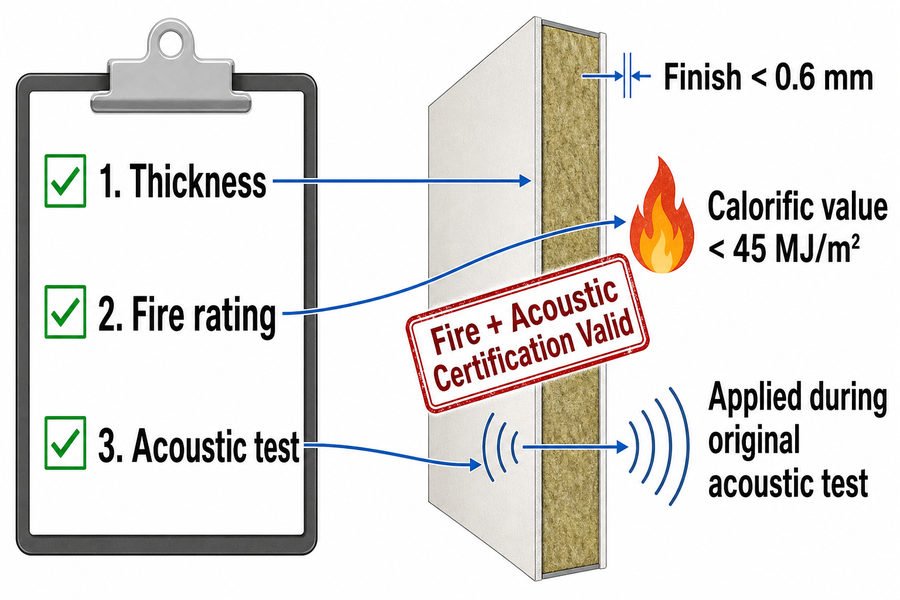
Many procurement officers think the decorative finish is just a sticker. They think it does not affect safety. That is wrong. The classification societies care deeply about the surface layer. If you change the finish, you can lose your certificate.13
Checking Finish Thickness and Calorific Value for Fire Safety
The first check is the finish thickness. The IMO FTP Code has strict rules about combustible veneers on B-class divisions. The decorative finish cannot be too thick. The maximum allowed thickness for a combustible veneer in accommodation spaces is generally 0.6mm.14 If your designer picks a heavy laminate that is 1.0mm thick, the panel will automatically lose its fire certification.
The second check is the calorific value. This measures how much energy the finish releases when it burns. According to SOLAS regulations, the calorific value of the finish must be kept below 45 MJ/m²15. You must ask the finish supplier for a test report showing this specific number. I once saw a beautiful glossy finish get rejected because its calorific value was 55 MJ/m². We had to tear it all down.
Ensuring the Finish Was Applied During the Acoustic Test
The third check involves the acoustic certification. Sound travels differently through different materials. If the factory tested a bare steel panel and got a 35 dB rating, you cannot assume the panel will still have a 35 dB rating after you glue a hard melamine laminate to it.
The added hard layer can change how the panel vibrates, sometimes making the acoustic performance worse.16 You must check the acoustic lab report. The report must state that the panel was tested with the specific decorative finish you plan to use. If the test was done on bare metal, you must ask the factory to run a new acoustic test, or you risk failing the noise inspection on the ship.
| Certification Check | Target Value / Requirement | Consequence of Failure |
|---|---|---|
| Finish Thickness | Maximum 0.6mm | Fails SOLAS B-15 fire standard |
| Calorific Value | Less than 45 MJ/m² | Creates extreme smoke hazard |
| Acoustic Test Condition | Tested with the final finish | Fails shipboard noise inspection |
Which Mismatches Between Mood Boards and Class Rules Trigger Accommodation Panel Re-Selection?
The designer made a beautiful mood board. The class surveyor threw it in the trash. Stop designers from picking illegal materials and wasting your budget.
The three mismatches between mood boards and class rules that trigger accommodation panel re-selection are: specifying solid wood veneers in escape routes, requiring high-gloss finishes that fail low flame-spread tests, and selecting heavy stone laminates that exceed the allowable cabin weight limits.
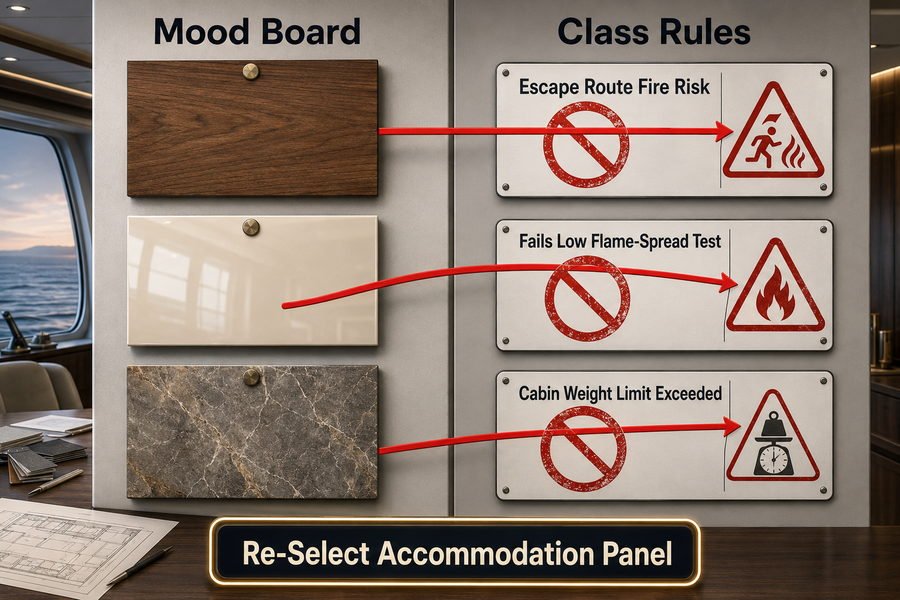
Designers love to make ships look like luxury hotels. But ships are not buildings. Ships have strict safety rules. As a procurement officer, you sit between the designer and the shipyard. You must spot these mismatches early. If you buy exactly what the designer wants without checking the rules, you will have to buy everything twice.
Rejecting Solid Wood Veneers and High-Gloss Finishes in Escape Routes
The first major mismatch is the use of solid wood veneers. Designers love the warm look of real wood. However, corridors and escape routes on ships have the strictest fire rules17. Solid wood burns fast and creates a lot of smoke18. If a designer puts solid wood on the mood board for a corridor, the class rules will reject it. You must suggest a PVC film that looks like wood but passes the IMO flame-spread tests.
The second mismatch is high-gloss finishes. Designers often want shiny, reflective walls in public spaces. The problem is that to get a high gloss, factories use thick plastic or heavy lacquer. These materials often fail the low flame-spread tests required by SOLAS19. When a designer asks for high gloss, I immediately check the manufacturer's flame-spread certification. Usually, I have to force the designer to accept a matte or semi-gloss finish to stay legal.
Preventing Heavy Stone Laminates Exceeding Weight Limits
The third mismatch involves weight. Designers sometimes want natural stone or heavy tile looks in the bathrooms or high-end cabins. They specify heavy stone laminates.
Ship weight is critical for stability and fuel efficiency. Standard marine accommodation panels weigh between 18 to 20 kg/m²20. If you glue a heavy stone laminate to the panel, the weight can jump to 30 kg/m². Marine engineers will reject this immediately because it ruins the ship's weight calculations. You must find a lightweight printed vinyl that mimics the look of stone, keeping the panel weight under 20 kg/m².
| Mood Board Specification | The Class Rule Conflict | The Compliant Solution |
|---|---|---|
| Solid Wood Veneer | Fails flame-spread in corridors | PVC wood-grain film |
| Thick High-Gloss Lacquer | Exceeds calorific value limits | Certified semi-gloss PVC film |
| Real Stone Laminate | Exceeds ship weight limits | Lightweight printed stone vinyl |
How to Compare a Combined Accommodation Panel Against Separate Decorative and Functional Layers?
Should you buy a ready-made panel or build it layer by layer? Making the wrong choice will cost you extra money and add weeks to your installation time.
When comparing a combined accommodation panel against separate decorative and functional layers, you must evaluate four factors: installation time (combined panels save 60% time), material cost, total system weight, and the ease of replacing damaged decorative surfaces in the future.
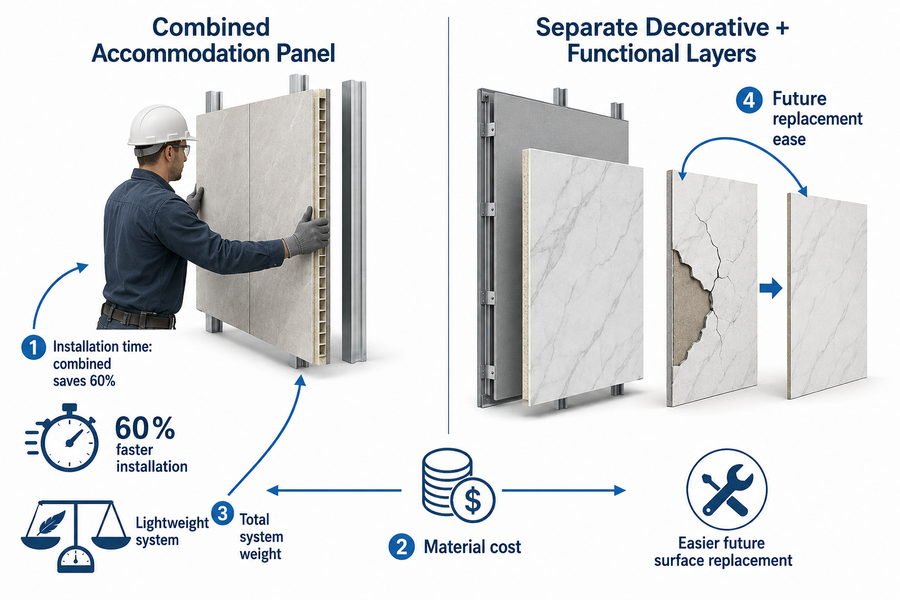
When you buy outfitting materials in Asia, factories will offer you two options. You can buy a "combined panel" where the steel, rockwool, and decorative PVC are glued together in the factory. Or, you can buy bare steel panels and glue the decorative layer on the ship. Both have pros and cons. You must look at the data to decide.
Evaluating Installation Time and Material Cost
The first factor is installation time. Combined panels are much faster to install. They arrive at the shipyard fully finished. Your workers just slide them into the floor tracks and snap them together. In my experience, using combined panels saves about 60% in cabin installation time21 compared to building separate layers.
The second factor is material cost. Buying bare metal panels and rolls of PVC film is cheaper at the factory level. However, you have to pay shipyard workers to apply the glue and smooth out the film. Shipyard labor is very expensive, especially in Europe or the US. The total cost of separate layers usually ends up being 20% higher22 because of the high labor costs.
Comparing Total System Weight and Replacement Ease
The third factor is total system weight. Combined sandwich panels are highly engineered. A standard 50mm combined panel weighs about 18 kg/m²23. If you use separate layers, you often need heavier steel frames to hold the bare rockwool before applying the cover sheets. This separate system can easily reach 25 kg/m²24.
The fourth factor is replacement ease. This is the only area where separate layers win. If a worker scratches a combined panel, you cannot fix it easily. You often have to remove the whole panel. If you use separate layers and the surface gets damaged, you can simply peel off the decorative skin and stick a new one on.
| Evaluation Factor | Combined Accommodation Panel | Separate Functional Layers |
|---|---|---|
| Installation Time | Fast (saves 60% labor time) | Slow (requires on-site gluing) |
| Total Cost | Lower (reduces expensive labor) | Higher (cheap materials, high labor) |
| System Weight | Light (approx. 18 kg/m²) | Heavy (approx. 25 kg/m²) |
| Replacement Ease | Difficult (must replace whole panel) | Easy (just replace the skin layer) |
Conclusion
By checking certifications, testing core materials, and strictly following SOLAS rules, you can buy beautiful marine accommodation panels from Asia that pass every inspection, speed up installation, and protect your profit margin.
-
"[PDF] RESOLUTION MSC.307(88) (adopted on 3 December 2010 ...", https://wwwcdn.imo.org/localresources/en/KnowledgeCentre/IndexofIMOResolutions/MSCResolutions/MSC.307(88).pdf. The IMO Fire Test Procedures Code identifies Part 5 as the test method for surface flammability of materials used in ships, providing the regulatory context for requiring a Part 5 report for decorative or exposed panel surfaces. Evidence role: definition; source type: institution. Supports: Marine interior panel surfaces should be supported by an IMO FTP Code Part 5 surface-flammability test report rather than a generic fire certificate.. Scope note: This supports the relevance of the Part 5 test but does not by itself verify that any specific supplier’s panel has passed it. ↩
-
"RESOLUTION MSC.307(88) (adopted on 3 December ...", https://wwwcdn.imo.org/localresources/en/KnowledgeCentre/IndexofIMOResolutions/MSCResolutions/MSC.307(88).pdf. SOLAS Chapter II-2 and the IMO FTP Code set requirements for low flame-spread characteristics of exposed interior surfaces and associated finishes in ship accommodation spaces, giving regulatory context for scrutinizing materials used in laminated panel construction. Evidence role: general_support; source type: institution. Supports: Materials used in marine panel construction, including adhesive layers when part of the finished assembly, should not compromise required low flame-spread performance.. Scope note: The source may address exposed surfaces and surface materials directly; it may not separately test every adhesive unless the adhesive is part of the tested panel assembly. ↩
-
"[PDF] RESOLUTION MSC.307(88) (adopted on 3 December 2010 ...", https://wwwcdn.imo.org/localresources/en/KnowledgeCentre/IndexofIMOResolutions/MSCResolutions/MSC.307(88).pdf. SOLAS fire-safety provisions limit the calorific value of combustible veneers and decorative finishes on certain ship bulkheads and ceilings, commonly cited as not exceeding 45 MJ per square metre, which supports the stated threshold for decorative finishes. Evidence role: statistic; source type: institution. Supports: Decorative finishes on ship bulkheads are subject to a calorific-value limit commonly stated as 45 MJ/m².. Scope note: The threshold applies within specified SOLAS contexts and spaces; applicability can vary with vessel type, location, and the exact construction being certified. ↩
-
"How to choose the right marine wall panels for marine interior ...", https://magellanmarinetech.com/how-choose-right-marine-wall-panels-for-marine-interior-projects/. SOLAS definitions for B-class divisions require construction from approved non-combustible materials, supporting the need for a non-combustible core in marine accommodation panels intended to form or line such divisions. Evidence role: definition; source type: institution. Supports: Marine accommodation panels intended for B-class fire divisions should use non-combustible core materials.. Scope note: This supports panels used as part of B-class divisions; other panel applications may be governed by different approval categories or assembly-level fire tests. ↩
-
"Directive 96/98/EC - Wikipedia", https://en.wikipedia.org/wiki/Directive_96/98/EC. The EU Marine Equipment Directive requires covered marine equipment placed on EU ships to meet applicable international testing standards and to bear the Wheelmark as evidence of conformity under the Directive. Evidence role: definition; source type: government. Supports: In Europe, the Type Approval Certificate for marine accommodation panels is commonly associated with MED Wheelmark conformity.. Scope note: This supports the regulatory meaning of the Wheelmark in Europe, but the specific validity of any individual panel certificate must be checked against the issuing notified body’s certificate. ↩
-
"What Do A-Class, B-Class, and C-Class Divisions Mean in Marine ...", https://magellanmarinetech.com/what-a-class-b-class-c-class-divisions-mean-in-marine-wall-ceiling-panels/. The IMO Fire Test Procedures Code and SOLAS framework define fire-resisting divisions such as B-class divisions, with B-0 and B-15 classifications based on insulation performance during standardized fire testing. Evidence role: definition; source type: institution. Supports: Marine accommodation panels may be certified as B-15 or B-0 class divisions under maritime fire-safety rules.. Scope note: This establishes the regulatory classification system; it does not verify that a particular supplier’s panel has achieved B-0 or B-15 approval. ↩
-
"Sound insulation dataset of 30 wooden and 8 concrete floors tested ...", https://pmc.ncbi.nlm.nih.gov/articles/PMC10365936/. ISO 10140 specifies laboratory methods for measuring the sound insulation of building elements, including airborne sound insulation, and is commonly used to generate comparable acoustic performance data such as sound reduction measurements. Evidence role: definition; source type: institution. Supports: An acoustic laboratory report for panels can be based on ISO 10140 testing methods.. Scope note: ISO 10140 is a laboratory measurement standard; project specifications or class rules determine whether it is mandatory for a particular shipbuilding contract. ↩
-
"Sound reduction index - Wikipedia", https://en.wikipedia.org/wiki/Sound_reduction_index. Acoustic standards such as ISO 717-1 define the weighted sound reduction index, Rw, as a single-number rating derived from frequency-dependent airborne sound insulation measurements. Evidence role: definition; source type: institution. Supports: The Rw value is a recognized single-number descriptor for sound reduction performance.. Scope note: This supports the meaning of Rw as an acoustic rating, but it does not establish a required minimum Rw for any specific vessel type or cabin class. ↩
-
"Directive 96/98/EC - Wikipedia", https://en.wikipedia.org/wiki/Directive_96/98/EC. Directive 2014/90/EU establishes that marine equipment bearing the Wheel Mark must conform to the approved type and applicable conformity-assessment procedure; this supports the need for correspondence between certified documentation and supplied equipment, although it does not use the phrase “perfect matches.” Evidence role: general_support; source type: government. Supports: The MED Wheelmark system requires the delivered product and its approval documentation to correspond closely.. Scope note: Contextual support: the legal source establishes conformity obligations but may not describe the practical inspection tolerance in the same wording as the article. ↩
-
"Which Fire Test Standards Apply to MED-Certified Marine ...", https://magellanmarinetech.com/which-fire-test-standards-apply-to-med-certified-marine-accommodation-panels/. Fire-test approval and classification records for marine construction products are based on the tested specimen’s documented construction and materials, including insulation characteristics; this supports the requirement that production panels remain within the approved construction, though the precise acceptable variation depends on the certificate and test standard. Evidence role: mechanism; source type: institution. Supports: A production batch using different insulation density from the tested sample may fall outside the approved Wheelmark/fire-test configuration.. Scope note: Contextual support: a test code or approval guideline can show that the certified design is tied to the tested specimen, but the exact density tolerance must be taken from the specific approval certificate or test report. ↩
-
"How Are Fire Ratings Verified for Marine Wall and Ceiling Panels?", https://magellanmarinetech.com/how-fire-ratings-verified-for-marine-wall-ceiling-panels/. Marine fire-resistance test procedures require the tested construction to represent the assembly as installed, including relevant details of joints and connections; this supports treating joint profiles as part of the approved fire-tested system, although the scope of approval is defined by the individual test report. Evidence role: mechanism; source type: institution. Supports: Panel joint profiles are part of the fire-tested assembly and must align with the approved test configuration.. Scope note: Contextual support: general fire-test standards support the importance of joints, but the specific approved joint profile must be verified in the panel’s own certificate or test report. ↩
-
"Directive 96/98/EC - Wikipedia", https://en.wikipedia.org/wiki/Directive_96/98/EC. Directive 2014/90/EU requires the Wheel Mark to be affixed visibly, legibly, and indelibly to marine equipment where possible, and requires manufacturer and type, batch, or serial identification information to accompany or appear on the product; this supports the traceability requirement, but the directive allows alternative placement where marking the product itself is not possible. Evidence role: definition; source type: government. Supports: Marine equipment subject to the MED needs visible conformity marking and traceability information linking the item to its manufacturer and batch or serial identification.. Scope note: The regulation may not require every item to bear all information directly on its surface in every case; exceptions can apply depending on product size, nature, packaging, or accompanying documentation. ↩
-
"What Does Class Society Type Approval Mean for Marine Wall and ...", https://magellanmarinetech.com/what-class-society-type-approval-mean-for-marine-wall-ceiling-panels/. A marine type-approval or classification rule source supports that fire and acoustic approvals are tied to the tested product configuration, including surface materials and construction details. Evidence role: general_support; source type: institution. Supports: Changing the decorative finish can invalidate or require reassessment of a panel’s certification.. Scope note: The exact consequence depends on the certificate wording, flag-state requirements, and the classification society’s approval process. ↩
-
"Are Marine Fire Divisions the Same as Marine Panel Ratings?", https://magellanmarinetech.com/are-marine-fire-divisions-same-as-marine-panel-ratings/. An IMO, flag-state, or classification-society fire-safety source should substantiate the stated combustible-veneer thickness limit for accommodation-space linings or B-class divisions. Evidence role: statistic; source type: institution. Supports: Combustible decorative veneers in accommodation spaces are subject to a maximum thickness limit, stated here as generally 0.6 mm.. Scope note: The cited limit should be checked against the relevant vessel type, space category, and rule edition, because veneer-thickness limits can vary by application. ↩
-
"[PDF] RESOLUTION MSC.307(88) (adopted on 3 December 2010 ...", https://wwwcdn.imo.org/localresources/en/KnowledgeCentre/IndexofIMOResolutions/MSCResolutions/MSC.307(88).pdf. SOLAS fire-protection provisions support that combustible veneers and similar surface finishes are subject to a calorific-value limit expressed per unit area, commonly cited as 45 MJ/m² for the thickness used. Evidence role: statistic; source type: institution. Supports: Decorative finishes used on relevant shipboard surfaces must meet a calorific-value limit of 45 MJ/m².. Scope note: This supports the regulatory threshold, not the rejection of any particular commercial finish without its test report and applicable approval context. ↩
-
"Sound transmission loss of double-walled sandwich cross-ply ... - PMC", https://pmc.ncbi.nlm.nih.gov/articles/PMC9534910/. Acoustics research on layered plates and building or ship partitions supports that adding bonded surface layers can alter mass, stiffness, damping, and resonance behavior, which can change measured sound-transmission performance. Evidence role: mechanism; source type: paper. Supports: Adding a hard decorative layer can change panel vibration behavior and may worsen acoustic performance.. Scope note: Such literature provides a physical mechanism and contextual support; it does not prove that every melamine or laminate finish will reduce performance in every panel design. ↩
-
"What Is the Purpose and Scope of the IMO FTP Code? - Magellan ...", https://magellanmarinetech.com/what-purpose-scope-of-imo-ftp-code/. SOLAS Chapter II-2 and the IMO Fire Test Procedures Code set fire-safety performance requirements for surface materials in accommodation spaces, service spaces, corridors, and stairway enclosures, including low flame-spread and smoke/toxicity criteria; this supports the claim that escape-route finishes are subject to especially stringent fire regulation, though product compliance still depends on the tested assembly and certificate. Evidence role: expert_consensus; source type: institution. Supports: Ship corridors and escape routes are subject to strict fire-safety rules for interior surface materials.. Scope note: The source supports the regulatory context, not the compliance status of any specific veneer, film, or panel product. ↩
-
"[PDF] Burning Rate of Solid Wood Measured in a Heat Release Rate ...", https://research.fs.usda.gov/download/treesearch/5952.pdf. Fire-safety research on wood combustion documents that untreated wood is combustible and can produce substantial smoke and heat release under fire conditions; this supports the general material-risk statement, although burn rate and smoke production vary by wood species, thickness, surface treatment, and test method. Evidence role: mechanism; source type: paper. Supports: Solid wood used as an interior finish can present flame-spread and smoke-production concerns.. Scope note: The evidence would be general fire-behavior evidence for wood, not direct proof that every solid wood veneer fails a particular marine certification test. ↩
-
"[PDF] RESOLUTION MSC.307(88) (adopted on 3 December 2010 ...", https://wwwcdn.imo.org/localresources/en/KnowledgeCentre/IndexofIMOResolutions/MSCResolutions/MSC.307(88).pdf. SOLAS Chapter II-2 and the IMO FTP Code require certain exposed interior surfaces on passenger and cargo ships to satisfy low flame-spread testing requirements; this supports the regulatory requirement referenced here, while not demonstrating that high-gloss lacquer or plastic finishes usually fail those tests. Evidence role: definition; source type: institution. Supports: SOLAS requires low flame-spread testing or certification for relevant ship interior surface materials.. Scope note: The source would establish the existence of SOLAS/FTP Code test requirements, not the failure rate of high-gloss finishes as a product category. ↩
-
"What Approval Differences Separate Marine Accommodation Panels ...", https://magellanmarinetech.com/what-approval-differences-separate-marine-accommodation-panels-from-standard-building-panels/. Classification-society type approvals or MED/IMO-compliant technical documentation for marine accommodation panels commonly list areal weights for specific panel constructions, which can be used to verify whether representative products fall near the stated 18–20 kg/m² range; such evidence is comparative and does not establish a universal industry standard. Evidence role: statistic; source type: institution. Supports: Representative marine accommodation panels can have areal weights around 18–20 kg/m².. Scope note: Panel weight varies by core material, skin thickness, fire rating, acoustic rating, and manufacturer, so the citation should be framed as representative product data rather than a fixed standard for all panels. ↩
-
"[PDF] The Productivity Problem in United States Shipbuilding - ROSA P", https://rosap.ntl.bts.gov/view/dot/11452/dot_11452_DS1.pdf. A peer-reviewed shipbuilding or modular outfitting study documenting labor-hour reductions from prefabricated accommodation panels would support the claim that factory-finished panels can materially reduce onboard cabin installation time. Evidence role: statistic; source type: paper. Supports: Combined panels save about 60% in cabin installation time compared to building separate layers.. Scope note: The source may support prefabrication-related labor savings generally rather than verifying the exact 60% figure for this specific panel system. ↩
-
"How to choose the right marine wall panels for marine interior ...", https://magellanmarinetech.com/how-choose-right-marine-wall-panels-for-marine-interior-projects/. An industry or academic cost analysis comparing prefabricated marine accommodation systems with onboard layered installation would support the assertion that lower material cost can be offset by higher yard labor costs. Evidence role: statistic; source type: research. Supports: Separate functional layers usually cost about 20% more overall because labor costs outweigh lower factory material prices.. Scope note: The evidence may show the direction and drivers of cost differences without confirming a universal 20% premium across regions and ship types. ↩
-
"How to choose the right marine wall panels for marine interior ...", https://magellanmarinetech.com/how-choose-right-marine-wall-panels-for-marine-interior-projects/. A technical specification from a classification-recognized testing body or marine accommodation panel standard showing mass per unit area for 50 mm steel-rockwool sandwich panels would substantiate the stated approximate panel weight. Evidence role: statistic; source type: institution. Supports: A standard 50 mm combined accommodation sandwich panel weighs about 18 kg/m².. Scope note: Panel weight varies with steel thickness, core density, facing materials, and fire rating, so the source would support this as a representative value rather than a universal standard. ↩
-
"What Is The Typical Range Of Weight Per Square Meter For Marine ...", https://magellanmarinetech.com/what-is-typical-range-of-weight-per-square-meter-for-marine-wall-panels/. A structural or marine outfitting reference giving typical weights for framed insulated wall assemblies with separate steel support and decorative coverings would support the comparison with lighter integrated sandwich panels. Evidence role: statistic; source type: research. Supports: A separate-layer system using additional framing and cover sheets can reach about 25 kg/m².. Scope note: The cited assembly weight may depend on framing spacing, sheet gauge, insulation density, and finish type, so it would contextualize rather than conclusively prove every separate-layer system reaches 25 kg/m². ↩