Buying marine panels without knowing fire standards wastes money and delays your shipyard projects. I will show you the exact rules you need to follow.
MED-certified marine accommodation panels must comply with three primary fire test standards under the IMO 2010 FTP Code: Part 1 for non-combustibility, Part 2 for smoke and toxicity, and Part 3 for A, B, and F class divisions.
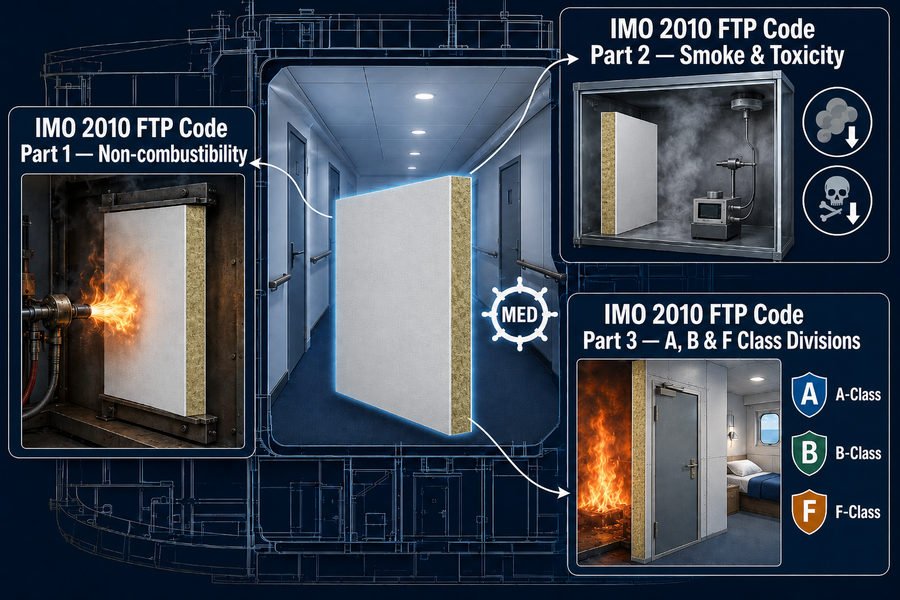
Knowing these three rules stops customs from rejecting your panels and keeps your European projects running on time. Let us look at how these tests work in the real world.
Which IMO FTP Code Parts Cover Fire Testing of A-60 Marine Accommodation Panels?
You install an A-60 panel, but the inspector rejects it. This happens when you miss the specific IMO FTP Code parts required for testing.
Testing A-60 marine accommodation panels requires strict compliance with three parts of the IMO 2010 FTP Code: Part 1 for non-combustibility of core materials, Part 2 for smoke and toxicity of surface finishes, and Part 3 for fire resistance testing for 60 minutes.
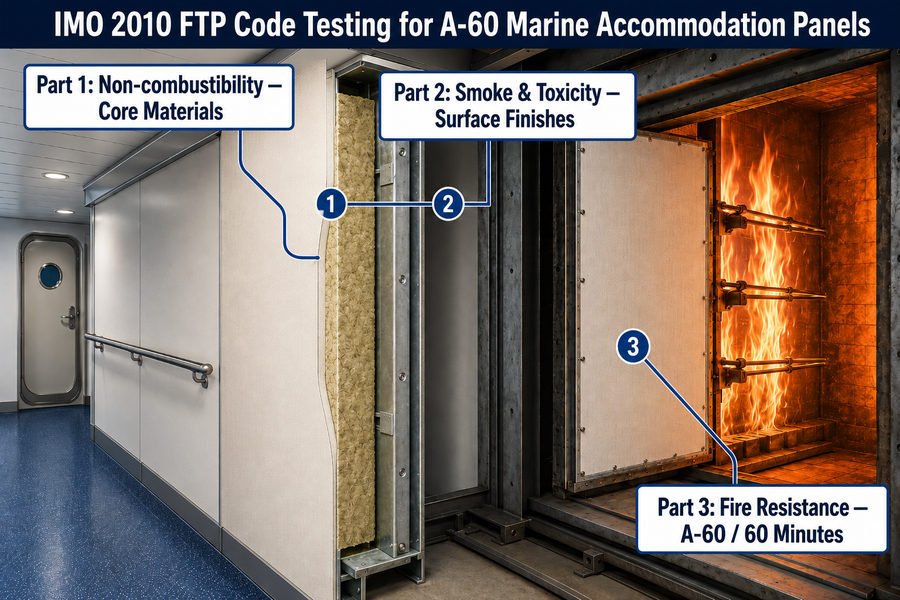
The IMO 2010 FTP Code1 is the rulebook for all marine fire safety. When my clients buy A-60 panels, they often ask me what these tests actually do. I always explain that the A-60 panel is a system. The core material, the surface, and the whole panel together must pass different tests. We must break this down into three parts.
IMO 2010 FTP Code Part 1 and Part 2 Material Requirements
First, the core material inside the panel must pass the Part 1 non-combustibility test2. The testing lab uses the ISO 1182 standard. They put a small piece of the rock wool core into a furnace heated to 750°C. They leave it there for 30 minutes. To pass, the rock wool must not lose more than 50% of its mass. Also, the temperature inside the furnace cannot rise more than 30°C. This proves the core will not add fuel to a fire.
Next, we look at the surface finish. Most panels have a PVC film or a painted surface. This surface must pass the Part 2 test3. This test checks the smoke and toxicity. If the surface burns, it cannot release thick black smoke or poisonous gas. Thick smoke makes people blind on the ship. Toxic gas kills people before the fire reaches them. I will explain the exact limits for this test in a later section.
IMO 2010 FTP Code Part 3 Fire Resistance Testing
Finally, the whole finished panel goes through the Part 3 test. This is the big fire resistance test. The lab builds a wall using the A-60 panels. They heat one side of the wall in a giant furnace. According to the ISO 834 standard fire curve, the furnace temperature reaches 945°C after 60 minutes.
During this 60 minutes, the panel must stop flames and smoke from passing through to the other side. Also, the unexposed side of the panel must stay cool. The average temperature on the safe side cannot rise more than 140°C above the starting temperature. If the room starts at 20°C, the safe side cannot go over 160°C. If the panel fails any of these three parts, it cannot be an A-60 panel.
| FTP Code Part | Test Purpose | Standard Used | Key Pass Criteria |
|---|---|---|---|
| Part 1 | Non-combustibility of core | ISO 1182 | Furnace temp 750°C, mass loss < 50% |
| Part 2 | Smoke and toxicity of surface | ISO 5659-2 | Low optical smoke density, safe gas limits |
| Part 3 | Fire resistance for 60 mins | ISO 834 curve | Unexposed side average temp rise < 140°C |
Does MED Wheel Mark for Marine Accommodation Panels Require IMO 2010 FTP Code Compliance?
You bought cheap panels with old certificates, and now the European shipyard refuses them. Old rules do not work anymore.
Yes, obtaining the MED Wheel Mark for marine accommodation panels absolutely requires full compliance with the IMO 2010 FTP Code, which enforces stricter testing limits, mandatory quality audits, and updated procedures compared to the older 1998 code.
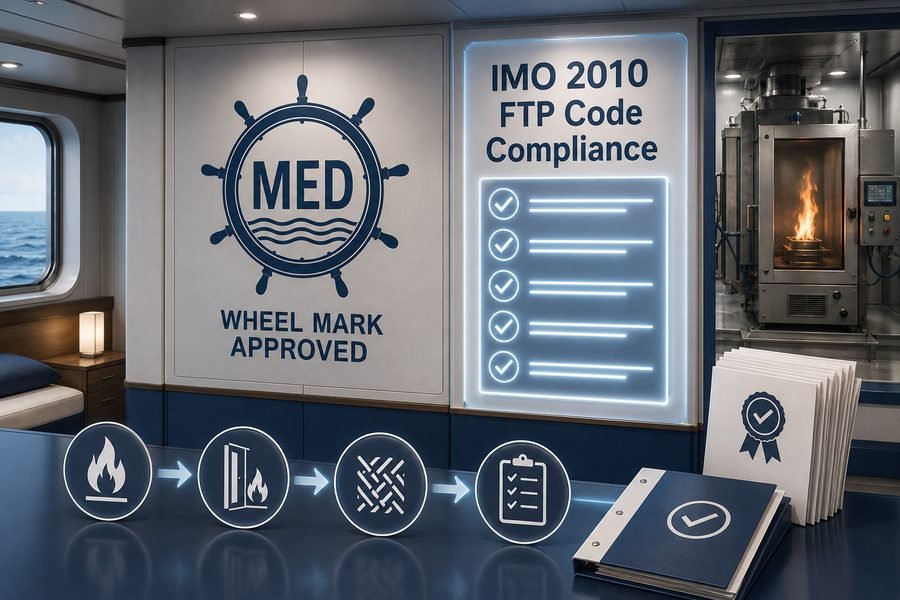
The Marine Equipment Directive (MED) Wheel Mark is the passport for marine products entering Europe. Many buyers from developing countries try to save money by using suppliers with outdated certificates. I see this mistake often. You must understand how the rules changed and what the Wheel Mark requires today.
Transition from 1998 to IMO 2010 FTP Code Standards
Before July 2012, suppliers used the 1998 FTP Code.4 But fires on ships still happened, so the International Maritime Organization (IMO) created the 2010 FTP Code. The MED 2014/90/EU directive now strictly demands the 2010 code.5 The new rules have stricter testing limits for materials. For example, the new code clearly defines how to test the adhesives inside the panel6. If a factory shows you a certificate tested under the 1998 code, it is useless for European shipyards. You cannot get a new MED Wheel Mark without testing everything again under the 2010 procedures.
Modules of MED Wheel Mark Certification and Quality Audits
The MED Wheel Mark process has two main parts. First is Module B. This is the Type Examination. You must send your panels to a certified lab, like DNV or RINA. They test the panels according to the IMO 2010 FTP Code. A Module B fire test for one panel type costs between $4,000 and $8,000.
But Module B is not enough. You also need Module D. Module D is the Production Quality Assurance. This means an inspector comes to your factory every year. They check your raw materials, your machines, and your quality control records. They make sure the panel you make today is exactly the same as the panel you tested for Module B. If your supplier fails this mandatory quality audit, they lose the Wheel Mark. Both Module B and Module D are required to print the Wheel Mark logo on the panel.7
| Certification Module | Description | Frequency | Estimated Cost |
|---|---|---|---|
| Module B | Type Test (Fire Test) | Once (Valid for 5 years) | $4,000 - $8,000 per type |
| Module D | Factory Quality Audit | Every 1 year | $2,000 - $3,000 per year |
| Old 1998 Code | Outdated fire test | No longer valid | N/A |
A-Class vs B-Class Fire Rating: What's the Difference for Marine Accommodation Panels?
Putting an A-Class panel where a B-Class is enough wastes thousands of dollars. Putting B-Class in an A-Class zone causes safety failures.
The primary differences between A-Class and B-Class marine accommodation panels lie in three areas: structural material (steel vs non-combustible material), fire resistance duration (60 minutes vs 30 minutes maximum), and unexposed side temperature insulation durations.
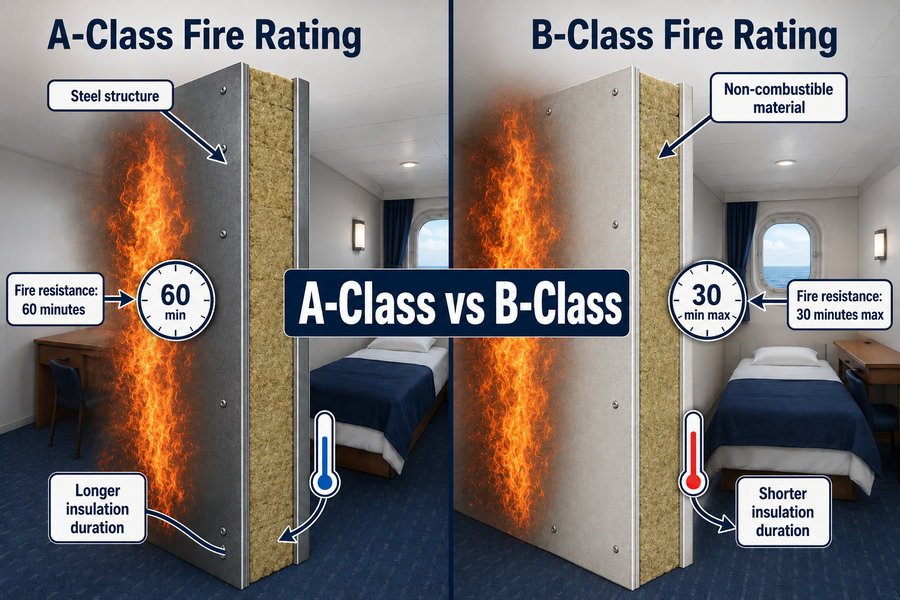
When you design a ship cabin, you need to buy the right panels. Shipyards divide the ship into different fire zones. High-risk areas need A-Class panels. Low-risk areas need B-Class panels. You must know the difference in materials, time durations, and temperature limits to make the right choice.
Structural Materials and Core Composition Differences
The biggest difference is the material. The IMO rules state that A-Class divisions must be made of steel or an equivalent strong material8. The outer skin of an A-Class panel is usually 0.6mm to 0.7mm galvanized steel. Because they use thick steel and heavy rock wool, A-Class panels are heavy. They usually weigh 15kg to 25kg per square meter. They are also thick, usually 50mm to 100mm.
B-Class panels do not require steel. They only require approved non-combustible materials.9 Many B-Class panels use a thinner steel skin or even aluminum, filled with a lighter rock wool core. B-Class panels are much lighter. They weigh about 12kg to 18kg per square meter. They are also thinner, usually 25mm to 50mm thick. Because B-Class panels use less material, they are cheaper.
Fire Resistance Durations and Temperature Limits
The second difference is the time they must block a fire. An A-Class panel must stop smoke and flames for 60 minutes. A B-Class panel only needs to stop smoke and flames for 30 minutes.10
The third difference is the temperature insulation duration. Both classes must limit the temperature rise on the safe side to a 140°C average.11 But the duration is different. For an A-60 panel, it must hold this temperature for 60 minutes. For a B-15 panel, it must hold the temperature for 15 minutes. For a B-0 panel, it does not need to hold the temperature at all; it only stops the flames. Knowing these values helps you check the test reports from your suppliers.
| Feature | A-Class Panels | B-Class Panels |
|---|---|---|
| Structural Material | Steel or equivalent | Non-combustible materials |
| Flame Block Time | 60 minutes | 30 minutes |
| Temp Limit (140°C rise) | A-60 = 60 mins, A-0 = 0 mins | B-15 = 15 mins, B-0 = 0 mins |
| Typical Weight | 15kg - 25kg / m² | 12kg - 18kg / m² |
| Typical Thickness | 50mm - 100mm | 25mm - 50mm |
How Are Smoke and Toxicity Tests Performed on MED-Certified Marine Accommodation Panels?
Toxic smoke kills people faster than fire on a ship. Failing smoke tests means your panels will never reach a shipyard.
Smoke and toxicity tests on MED-certified marine accommodation panels are performed according to IMO 2010 FTP Code Part 2, involving two stages: a smoke density test measuring optical obscurity, and a toxic gas analysis measuring specific concentrations of dangerous gases.
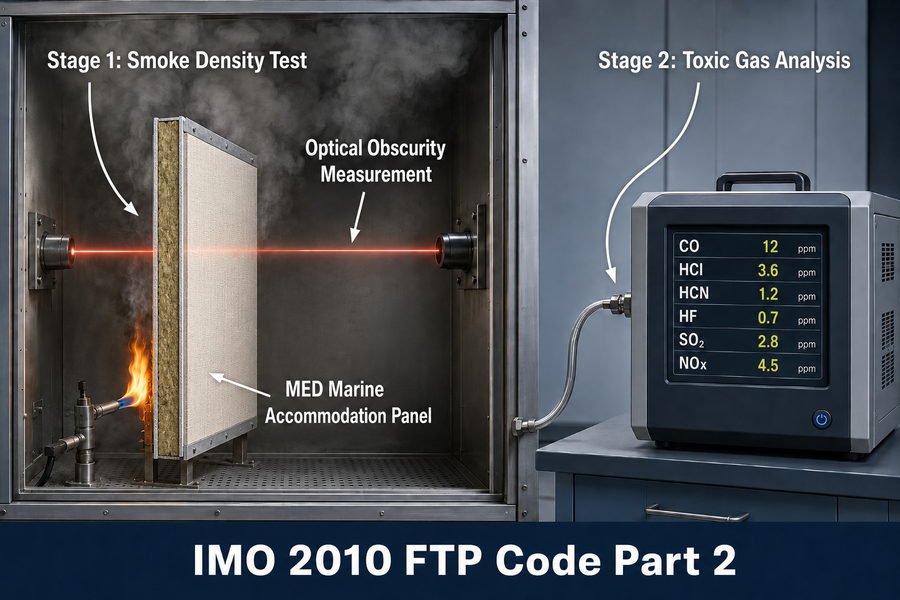
The surface finish of your panel makes the cabin look beautiful. But this PVC film or paint is usually plastic. When plastic burns, it creates smoke and poison. This is why the IMO 2010 FTP Code Part 2 test12 is so important. I always ask suppliers for this test report when buying panels with PVC finishes. We must look at the two stages of this test.
Optical Measurement of Smoke Density
The first stage is the smoke density test. The lab cuts a small sample of the surface finish. The sample is exactly 75mm by 75mm13. They put this sample inside a closed box called an ISO 5659-2 smoke chamber. Inside the box, a heater burns the sample. The heater uses a heat flux between 25 kW/m² and 50 kW/m².
As the sample burns, it fills the box with smoke. A light beam shines across the top of the box to a sensor. The thicker the smoke, the less light reaches the sensor. This measures the optical obscurity. The IMO rule gives a number for this. The maximum specific optical density (Ds) for surface materials cannot exceed 20014. If the number is 201, the panel fails.
Chemical Analysis of Toxic Gas Emissions
The second stage is the toxic gas analysis. While the sample burns in the box, the lab pulls out some of the smoke using a tube. They send this smoke into a machine that reads the chemical concentrations. The IMO limits are very strict.
For Carbon Monoxide (CO), the limit is 1450 ppm (parts per million). For Hydrogen Chloride (HCl), the limit is 600 ppm. For Hydrogen Cyanide (HCN), the limit is 140 ppm.15 If your panel uses cheap PVC film, the HCl level will go very high and fail the test. The rules say that any surface film thicker than 0.2mm usually requires this full test. I always tell my clients to buy high-quality low-smoke PVC films to pass this stage.
| Test Stage | Measurement Focus | Test Standard | IMO 2010 Limit |
|---|---|---|---|
| Smoke Density | Optical obscurity (light block) | ISO 5659-2 | Ds maximum 200 |
| Toxic Gas | Carbon Monoxide (CO) | FTIR Analysis | Max 1450 ppm |
| Toxic Gas | Hydrogen Chloride (HCl) | FTIR Analysis | Max 600 ppm |
| Toxic Gas | Hydrogen Cyanide (HCN) | FTIR Analysis | Max 140 ppm |
Are Non-Combustibility Tests Mandatory for All MED-Approved Marine Accommodation Panels?
You buy a panel thinking it is fully certified, but it burns during a spot check. This happens when core materials skip testing.
Yes, non-combustibility tests are strictly mandatory for all MED-approved marine accommodation panels, meaning both the main core material and any internal structural adhesives must independently pass the IMO 2010 FTP Code Part 1 furnace test.
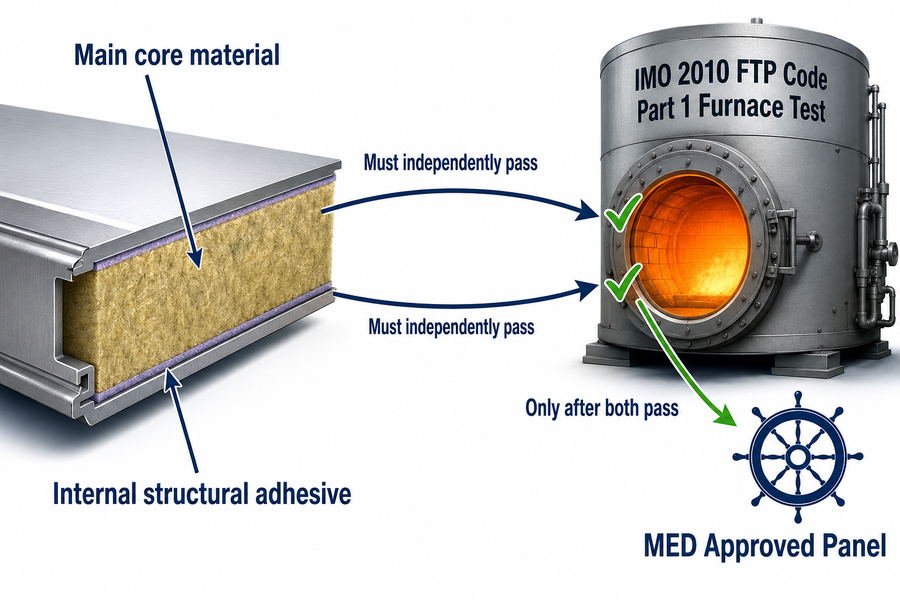
Every part of a marine panel matters. You cannot build a safe panel with bad materials inside. The IMO rules demand that we test the inside pieces before we build the whole panel.16 The non-combustibility test is the foundation of marine fire safety. Let us see how the main core material and the internal adhesives are tested.
Part 1 Testing Requirements for Core Materials
The main core of a marine panel is usually rock wool or ceramic wool. This core material must be non-combustible. The testing lab uses the ISO 1182 furnace test17. I explained this briefly before, but the details are important. They heat the furnace to exactly 750°C. They put a cylinder of the rock wool into the furnace for 30 minutes.
The lab checks three things. First, the material must not flame for more than 10 seconds. Second, the temperature inside the furnace cannot rise more than 30°C. Third, the weight of the rock wool must not decrease by more than 50%.18 High-quality rock wool passes this test easily. But cheap rock wool contains too much resin binder to hold its shape. When the resin burns, the temperature goes up, and the material fails the test.
Testing Requirements for Internal Adhesives
The rock wool does not stick to the steel skin by itself. Factories use internal structural adhesives. Usually, this is a special glue. This glue must also be safe. If you use normal glue, it will burn inside the panel and create pressure.
The IMO rules state that these adhesives must also be tested. If the factory uses a small amount of glue, they might test it using the Part 5 test for maximum calorific value. The adhesive cannot release too much heat energy when it burns. The limit is usually 45 MJ/m² for the total organic content.19 If a supplier tries to change to a cheaper glue, they break the rules. Every component inside the panel must prove it is safe.
| Material Component | Required Fire Test | Key Requirement | Limit / Standard |
|---|---|---|---|
| Rock Wool Core | Part 1 Non-combustibility | Furnace temp 750°C | Mass loss < 50% |
| Rock Wool Core | Part 1 Non-combustibility | Furnace temp 750°C | Temp rise < 30°C |
| Internal Adhesives | Part 5 Calorific Value | Low heat release | Max 45 MJ/m² |
Why Does an A-60 Marine Accommodation Panel Fail MED Recertification After Core Material Change?
You change to a cheaper rock wool supplier to save money. Then your A-60 MED certificate is revoked, freezing all your orders.
An A-60 marine accommodation panel fails MED recertification after a core material change because altering the core affects three critical certified factors: the non-combustibility baseline of the specific material, the overall thermal insulation performance, and the structural integrity.
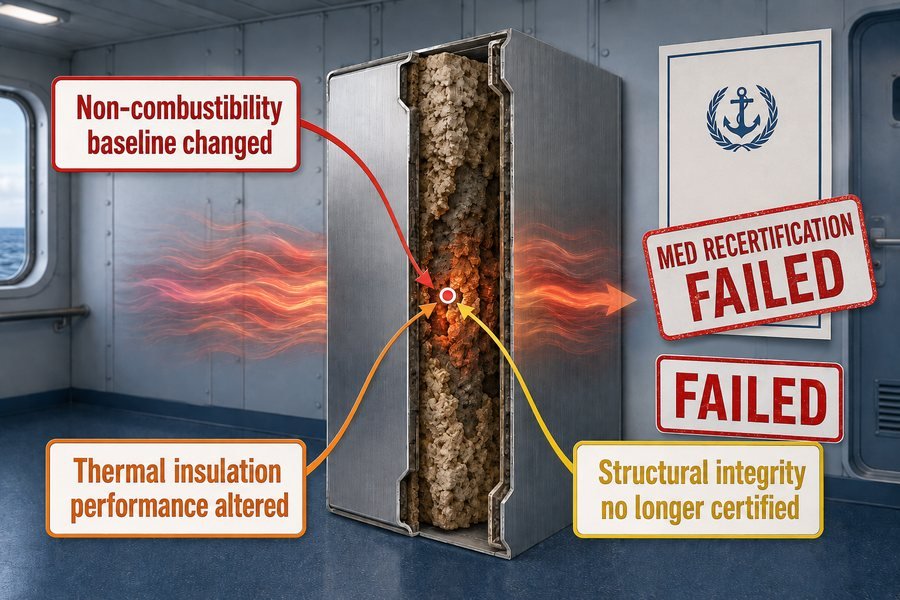
Factories always want to lower their costs. The rock wool inside the panel is a big part of the price. So, factories often want to buy rock wool from a new, cheaper brand. But doing this secretly is a huge mistake. The MED certificate is tied to the exact materials used in the first test.20 If you change the core, you must recertify. And very often, the new core fails the test.
Loss of Non-Combustibility Baseline Data
When a factory gets a Module B certificate, the report lists the specific brand and density of the rock wool. For example, it might say "Brand X Rock Wool, 120 kg/m³ density". This specific rock wool passed the Part 1 non-combustibility test21.
If the factory changes to "Brand Y Rock Wool", even if it is also 120 kg/m³, the chemical mix is different. Brand Y might use 5% resin binder, while Brand X used only 3%.22 This higher resin content means Brand Y fails the 750°C furnace test. Because the new core material fails the non-combustibility baseline data, the whole A-60 panel system fails.
Failures in Thermal Insulation and Structural Integrity
Even if the new rock wool passes Part 1, it can still fail the big 60-minute Part 3 fire test. The cheap rock wool might shrink when the furnace hits 945°C. If the rock wool shrinks, empty gaps form inside the panel. Heat moves through these gaps very fast. The unexposed side temperature will rise past the 140°C limit23 in only 40 or 50 minutes. This ruins the thermal insulation performance.
The new core can also ruin the structural integrity. If the cheap rock wool has short fibers, it splits apart easily. During the fire test, the steel skin might warp and pull away from the weak rock wool. The panel bends, smoke leaks out the sides, and the test fails. Retesting a panel costs around $5,000 and takes two to three months. It is never worth the risk to change materials blindly.
| Certified Factor Affected | Reason for Failure | Result in Fire Test | Cost to Retest |
|---|---|---|---|
| Non-combustibility Baseline | Higher resin content in new core | Fails ISO 1182 (750°C) | Part 1 fees |
| Thermal Insulation | New core shrinks at high heat | Safe side temp > 140°C rise | ~$5,000 |
| Structural Integrity | Weak fibers cause delamination | Panel bends, flames leak | ~$5,000 |
Conclusion
To succeed in marine projects, you must ensure your panels pass IMO 2010 FTP Code tests for non-combustibility, smoke density, and 60-minute fire resistance to maintain valid MED Wheel Mark certification.
-
"How Does IMO MSC.307(88) Apply To Marine Interior Panels?", https://magellanmarinetech.com/how-imo-msc-30788-apply-to-marine-interior-panels/. The IMO 2010 FTP Code, adopted by IMO Resolution MSC.307(88), provides internationally recognized fire test procedures used for SOLAS-regulated ship materials and constructions. Evidence role: definition; source type: institution. Supports: The IMO 2010 FTP Code is the rulebook for all marine fire safety.. Scope note: This supports the Code’s role in marine fire testing, but not the broader statement that it covers all aspects of marine fire safety. ↩
-
"[PDF] RESOLUTION MSC.307(88) (adopted on 3 December 2010 ...", https://wwwcdn.imo.org/localresources/en/KnowledgeCentre/IndexofIMOResolutions/MSCResolutions/MSC.307(88).pdf. Part 1 of the 2010 FTP Code sets out the non-combustibility test for marine materials and incorporates ISO 1182-type furnace testing, including criteria such as furnace temperature behavior and mass loss. Evidence role: mechanism; source type: institution. Supports: The core material inside the panel must pass the Part 1 non-combustibility test using ISO 1182, with limits such as 750°C furnace exposure, mass loss, and temperature-rise criteria.. Scope note: The source should be checked for the exact edition-specific thresholds, because summaries may omit details such as specimen dimensions or individual temperature criteria. ↩
-
"What Smoke Toxicity and Density Limits Must Marine Wall and ...", https://magellanmarinetech.com/what-smoke-toxicity-density-limits-must-marine-wall-ceiling-panels-meet/. Part 2 of the 2010 FTP Code addresses smoke and toxicity testing for surface materials and refers to smoke-density measurement methods such as ISO 5659-2 within the Code’s marine fire-testing framework. Evidence role: definition; source type: institution. Supports: The surface finish must pass the Part 2 test, which checks smoke and toxicity.. Scope note: This supports the purpose of the Part 2 test generally; exact gas concentration limits should be cited separately if listed later in the article. ↩
-
"How Does the IMO FTP Code Connect with Other Marine Fire Safety ...", https://magellanmarinetech.com/how-imo-ftp-code-connect-with-other-marine-fire-safety-frameworks/. IMO documentation on the Fire Test Procedures Code records the adoption of the 2010 FTP Code and its application from 1 July 2012, supporting the article’s chronology of the shift from the earlier FTP Code regime; it does not prove how every supplier handled certification before that date. Evidence role: historical_context; source type: institution. Supports: The applicable fire-test regime for marine products shifted from the earlier FTP Code framework to the 2010 FTP Code around July 2012.. Scope note: Supports the regulatory transition date, not the behavior of all suppliers. ↩
-
"How Do EU Rules Differ From IMO Standards for Marine Panels ...", https://magellanmarinetech.com/how-eu-rules-differ-from-imo-standards-for-marine-panels/. EU Marine Equipment Directive materials and related implementing regulations identify the international testing standards used for Wheel Mark conformity assessment, including IMO FTP Code requirements for relevant fire-protection equipment; this supports the regulatory basis for using the 2010 FTP Code, although the precise standard depends on the product category listed in the implementing regulation. Evidence role: general_support; source type: government. Supports: Current MED Wheel Mark approval for relevant fire-protection products is tied to the 2010 IMO FTP Code rather than obsolete FTP Code testing.. Scope note: Contextual support only; the applicable test standard must be checked against the specific MED item and current implementing regulation. ↩
-
"What Is the IMO FTP Code for Marine Interior Materials?", https://magellanmarinetech.com/what-imo-ftp-code-for-marine-interior-materials/. The IMO 2010 FTP Code contains detailed test procedures and specimen requirements for fire-test methods used on marine materials and assemblies, supporting the claim that the revised code specifies how components such as panel adhesives are assessed; this source would establish procedural coverage, not that every adhesive formulation requires a separate test in all cases. Evidence role: mechanism; source type: institution. Supports: The 2010 FTP Code includes more detailed procedures for testing materials and assemblies, including components within panels such as adhesives where relevant.. Scope note: The exact testing treatment of adhesives depends on the relevant FTP Code part and the construction of the submitted product. ↩
-
"What Is the Wheel Mark Certification Process for Marine ...", https://magellanmarinetech.com/what-wheel-mark-certification-process-for-marine-accommodation-panels/. Directive 2014/90/EU sets out conformity-assessment modules for marine equipment and links affixing the Wheel Mark to completion of the required conformity procedures, including EC type examination and production-quality assurance routes; this supports the role of Modules B and D, though the Directive also allows other module combinations for some equipment. Evidence role: definition; source type: government. Supports: A manufacturer may affix the MED Wheel Mark only after completing the applicable conformity-assessment procedures, commonly including Module B and a production-control module such as Module D for relevant products.. Scope note: The statement may be product-specific; MED conformity assessment can use other module combinations depending on the equipment and applicable implementing measure. ↩
-
"How Does the IMO FTP Code Govern Fire Testing Procedures for ...", https://magellanmarinetech.com/how-does-imo-ftp-code-govern-fire-testing-procedures-for-marine-panels/. SOLAS Chapter II-2 defines A-class divisions as divisions formed by bulkheads and decks constructed of steel or other equivalent material, supporting the stated material requirement. Evidence role: definition; source type: institution. Supports: A-Class divisions must be made of steel or an equivalent strong material.. ↩
-
"A.163(ES.IV).pdf", https://wwwcdn.imo.org/localresources/en/KnowledgeCentre/IndexofIMOResolutions/AssemblyDocuments/A.163(ES.IV).pdf. SOLAS Chapter II-2 defines B-class divisions as divisions constructed of approved non-combustible materials and does not require steel construction, supporting the distinction from A-class divisions. Evidence role: definition; source type: institution. Supports: B-Class panels do not require steel. They only require approved non-combustible materials.. ↩
-
"How Does the IMO FTP Code Govern Fire Testing Procedures for ...", https://magellanmarinetech.com/how-does-imo-ftp-code-govern-fire-testing-procedures-for-marine-panels/. SOLAS definitions state that A-class divisions prevent the passage of smoke and flame to the end of a one-hour standard fire test, while B-class divisions do so to the end of the first half-hour, supporting the stated duration contrast. Evidence role: definition; source type: institution. Supports: An A-Class panel must stop smoke and flames for 60 minutes, while a B-Class panel only needs to stop smoke and flames for 30 minutes.. Scope note: The source defines regulatory fire-test performance for divisions; it does not verify any individual manufacturer’s panel unless that panel has a valid test certificate. ↩
-
"Are Marine Fire Divisions the Same as Marine Panel Ratings?", https://magellanmarinetech.com/are-marine-fire-divisions-same-as-marine-panel-ratings/. SOLAS fire-division definitions use an average unexposed-side temperature-rise limit of 140°C above the original temperature for insulated A- and B-class ratings, supporting the stated insulation criterion. Evidence role: definition; source type: institution. Supports: Both classes must limit the temperature rise on the safe side to a 140°C average.. Scope note: The 140°C criterion applies for the specified rating period, and SOLAS also includes a maximum single-point temperature-rise limit that is not captured by this sentence. ↩
-
"RESOLUTION MSC.307(88) (adopted on 3 December ...", https://wwwcdn.imo.org/localresources/en/KnowledgeCentre/IndexofIMOResolutions/MSCResolutions/MSC.307(88).pdf. The IMO 2010 FTP Code, Part 2 establishes procedures for measuring smoke generation and toxicity of products used on ships, providing the regulatory context for applying this test to marine interior surface materials. Evidence role: definition; source type: institution. Supports: The IMO 2010 FTP Code Part 2 test is important for evaluating smoke and toxic emissions from PVC or painted panel finishes used in ship cabins.. Scope note: This supports the regulatory purpose of the test, but does not by itself verify that every PVC-finished panel must be tested. ↩
-
"[PDF] Toxicity Test Requirements and Performance Criteria for Passenger ...", https://railroads.dot.gov/sites/fra.dot.gov/files/2021-02/Toxicity%20Test%20and%20Performance%20Criteria.pdf. ISO 5659-2 specifies a smoke-density chamber method using small square specimens, commonly reported as 75 mm by 75 mm, for determining optical smoke production under defined radiant heat exposure. Evidence role: mechanism; source type: institution. Supports: The smoke-density test uses a 75 mm by 75 mm specimen placed in an ISO 5659-2 smoke chamber.. Scope note: ISO standards are usually paywalled, so accessible summaries may describe the method without reproducing the full normative text. ↩
-
"What Smoke Toxicity and Density Limits Must Marine Wall and ...", https://magellanmarinetech.com/what-smoke-toxicity-density-limits-must-marine-wall-ceiling-panels-meet/. IMO FTP Code Part 2 acceptance criteria state a maximum specific optical density limit for smoke produced by applicable surface materials, with the commonly cited threshold of Ds not exceeding 200. Evidence role: statistic; source type: institution. Supports: For surface materials evaluated under IMO FTP Code Part 2, the maximum specific optical density Ds limit is 200.. Scope note: The limit may depend on the material category and application, so the source should be checked against the exact product classification. ↩
-
"What Smoke Toxicity and Density Limits Must Marine Wall and ...", https://magellanmarinetech.com/what-smoke-toxicity-density-limits-must-marine-wall-ceiling-panels-meet/. IMO FTP Code Part 2 includes toxicity criteria for gases generated during smoke testing, including concentration limits for carbon monoxide, hydrogen chloride, and hydrogen cyanide used to assess compliance. Evidence role: statistic; source type: institution. Supports: The IMO smoke and toxicity test applies limits of 1450 ppm for CO, 600 ppm for HCl, and 140 ppm for HCN.. Scope note: The citation should confirm the values for the relevant material category because IMO toxicity limits can be listed alongside other gases and test conditions. ↩
-
"How Is the IMO FTP Code Structured into Annexes and Parts?", https://magellanmarinetech.com/how-is-imo-ftp-code-structured-into-annexes-parts/. The IMO SOLAS fire-safety framework and the IMO Fire Test Procedures Code require specified shipboard construction materials and assemblies to demonstrate fire performance through recognized tests before approval for use. Evidence role: general_support; source type: institution. Supports: IMO rules require materials or components used in marine fire-rated panels to be tested or approved before the finished panel is accepted.. Scope note: This supports the regulatory basis for pre-approval testing, but the exact test sequence for every internal panel component depends on the product type and flag/class approval route. ↩
-
"[PDF] RESOLUTION MSC.307(88) (adopted on 3 December 2010 ...", https://wwwcdn.imo.org/localresources/en/KnowledgeCentre/IndexofIMOResolutions/MSCResolutions/MSC.307(88).pdf. ISO 1182 and the IMO FTP Code Part 1 describe the non-combustibility furnace test used to assess whether building or shipboard materials contribute significantly to fire. Evidence role: definition; source type: institution. Supports: The non-combustibility of marine panel core materials is assessed using the ISO 1182 furnace test or its IMO FTP Code equivalent.. Scope note: A public summary may describe the method generally; the full ISO standard or IMO FTP Code should be checked for the exact procedural wording. ↩
-
"[PDF] RESOLUTION MSC.307(88) (adopted on 3 December 2010 ...", https://wwwcdn.imo.org/localresources/en/KnowledgeCentre/IndexofIMOResolutions/MSCResolutions/MSC.307(88).pdf. The IMO FTP Code Part 1 non-combustibility criteria specify limits for sustained flaming, furnace or specimen temperature rise, and mass loss when classifying a material as non-combustible. Evidence role: definition; source type: institution. Supports: A material passes the IMO non-combustibility test only if it stays within limits for flaming duration, temperature rise, and mass loss.. Scope note: The exact temperature-rise criterion may distinguish between furnace and specimen thermocouples in the standard, so the article should match the cited wording precisely. ↩
-
"[PDF] RESOLUTION MSC.556(108) (adopted on 23 May 2024 ...", https://wwwcdn.imo.org/localresources/en/KnowledgeCentre/IndexofIMOResolutions/MSCResolutions/MSC.556%28108%29.pdf. IMO/SOLAS fire-safety provisions and related FTP Code guidance include calorific-value limits for limited quantities of organic materials such as adhesives used with otherwise non-combustible marine constructions. Evidence role: statistic; source type: institution. Supports: Internal adhesives in marine panels may be subject to a maximum area-based calorific-value limit, commonly stated as 45 MJ/m² for organic content in relevant IMO/SOLAS contexts.. Scope note: The 45 MJ/m² value is context-specific and should be verified against the exact panel type, adhesive location, and applicable approval rule before being stated as a universal adhesive limit. ↩
-
"How Do MED Modules B and D Affect Marine Accommodation Panel ...", https://magellanmarinetech.com/how-med-modules-b-d-affect-marine-accommodation-panel-procurement/. The Marine Equipment Directive conformity-assessment framework, including Module B type examination, assesses a defined product type against applicable test standards and technical documentation; this supports that certified construction details and materials are part of the approved type. Evidence role: general_support; source type: government. Supports: A MED certificate applies to the specific product configuration and materials assessed during certification.. Scope note: The source may describe conformity-assessment obligations generally rather than the specific rock-wool substitution scenario. ↩
-
"[PDF] RESOLUTION MSC.307(88) (adopted on 3 December 2010 ...", https://wwwcdn.imo.org/localresources/en/KnowledgeCentre/IndexofIMOResolutions/MSCResolutions/MSC.307(88).pdf. The IMO FTP Code identifies the non-combustibility test for marine materials and references ISO 1182-type furnace testing as the basis for determining whether a material is non-combustible. Evidence role: definition; source type: institution. Supports: Marine fire-test approval includes a Part 1 non-combustibility test for relevant materials.. Scope note: This supports the existence and role of the non-combustibility test, not whether a particular commercial rock-wool product passes it. ↩
-
"[PDF] Noncombustibility of mineral wool and glass fiber insulation materials", https://nvlpubs.nist.gov/nistpubs/Legacy/RPT/nbsreport9988.pdf. Research and technical literature on mineral-wool insulation notes that organic binders are added to mineral fibres and that binder content can affect combustion-related properties, supporting the plausibility that different rock-wool formulations may behave differently in non-combustibility testing. Evidence role: mechanism; source type: paper. Supports: Differences in rock-wool binder content can affect non-combustibility or fire-test performance.. Scope note: The percentages in the article are illustrative; the source would support the mechanism rather than verify the stated Brand X or Brand Y values. ↩
-
"What Do A-Class, B-Class, and C-Class Divisions Mean in Marine ...", https://magellanmarinetech.com/what-a-class-b-class-c-class-divisions-mean-in-marine-wall-ceiling-panels/. The IMO FTP Code fire-resistance criteria for divisions include limits on the average temperature rise of the unexposed face, commonly 140°C above the initial temperature, which supports the stated insulation-performance threshold for A-class fire tests. Evidence role: definition; source type: institution. Supports: A-class marine fire-resistance tests use a 140°C unexposed-face temperature-rise criterion for insulation performance.. Scope note: This supports the temperature criterion; it does not prove that a specific substituted core would exceed the limit in 40 or 50 minutes. ↩