Shipboard fires are terrifying. If your interior panels release thick, toxic smoke, passengers cannot escape. Are your marine wall and ceiling panels legally compliant with international smoke limits?
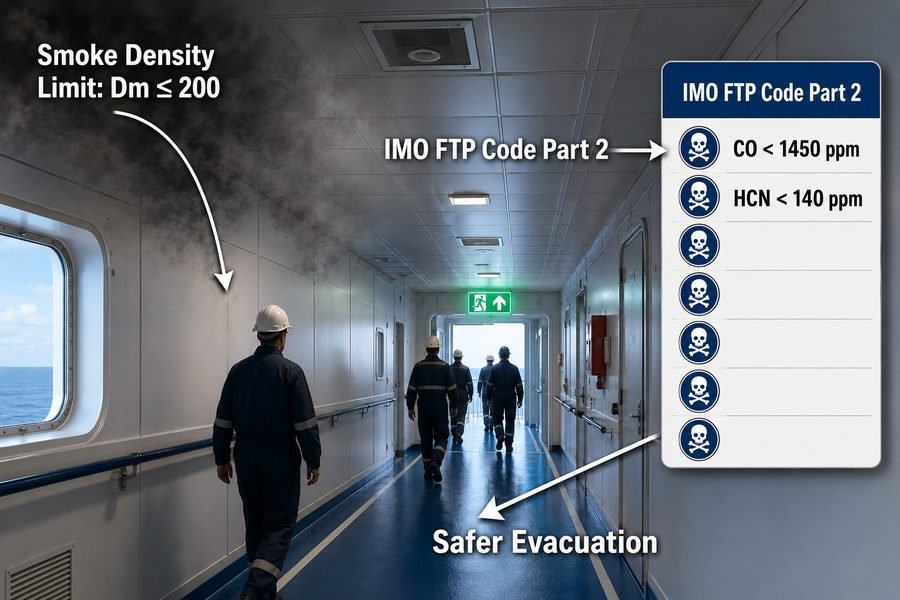
Under the IMO FTP Code Part 2, marine wall and ceiling panels must strictly limit both smoke density (maximum Dm of 200) and smoke toxicity. They must restrict emissions of seven deadly gases, including Carbon Monoxide (under 1450 ppm) and Hydrogen Cyanide (under 140 ppm), ensuring safe evacuation.
Let us look closely at the exact numbers and rules you need to know when buying these materials from Asian factories.
What Is the Dm Density Limit for Marine Wall Panels?
Buying cheap panels might save money today, but if they produce heavy smoke during a fire, you will fail inspections. Do you know the exact smoke density limits?
For marine wall panels, the maximum specific optical density (Dm) allowed by IMO FTP Code Part 2 is 200. This standard applies to both the surface materials and the core. The test measures how much the smoke blocks light, ensuring escape routes remain visible during an emergency.
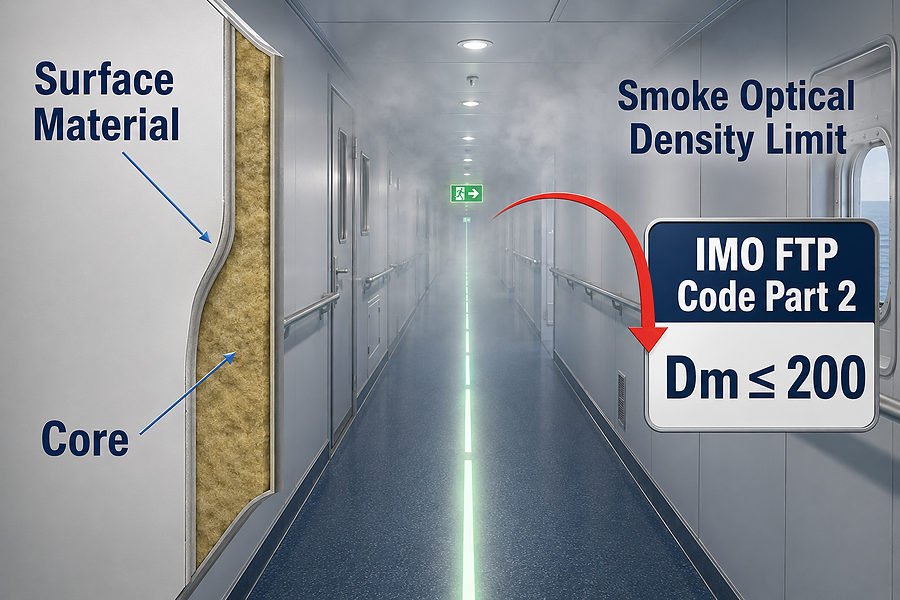
When I first started helping clients buy marine outfitting products in China, many buyers only asked about the fire rating, like B-15 or A-60. They forgot about smoke density. This is a big mistake. The IMO (International Maritime Organization) FTP Code Part 2 sets a hard limit on smoke density, known as Dm. For marine wall panels, the Dm value must never go over 200.1
Understanding Specific Optical Density (Dm) in Marine Panels
Specific optical density, or Dm, measures how much smoke blocks a beam of light. If the Dm number is high, the smoke is very thick. If the smoke is too thick, passengers and crew cannot see the exit signs or the doors. The IMO states that a Dm of 200 is the maximum safe limit. This means the panel might burn, but it will not create a completely dark room. I once worked with a factory that tried to sell wall panels with a Dm of 250. The price was very low, but I told my client to walk away. The shipyard would have tested them and rejected the whole container.
Application of Dm Limits to Surface and Core Materials
The rule does not just look at the PVC or metal on the outside. The Dm limit of 200 applies to the complete panel system.2 This includes the surface finish, the glue, and the inner core, like rockwool or aluminum honeycomb. Some suppliers use cheap glue that burns into thick black smoke. Even if the metal surface is good, the bad glue will make the Dm value fail the test.
| Component | Test Method | Maximum Dm Limit | Result of Failure |
|---|---|---|---|
| Surface Finish (PVC/PET) | IMO FTP Code Part 2 | 200 | Shipyard Rejection |
| Internal Core Material | IMO FTP Code Part 2 | 200 | Shipyard Rejection |
| Bonding Adhesive | IMO FTP Code Part 2 | 200 | Shipyard Rejection |
What Toxic Gas Limits Apply to Marine Ceiling Panels?
Toxic gas kills faster than flames in a ship fire. If your ceiling panels release poison, the shipyard will reject them entirely. What are the specific gas limits?
Marine ceiling panels must restrict the emission of seven specific toxic gases under the IMO FTP Code. The maximum parts per million (ppm) limits are: CO (1450), HCl (600), HF (600), NOx (350), HBr (600), HCN (140), and SO2 (120). All seven must pass simultaneously.
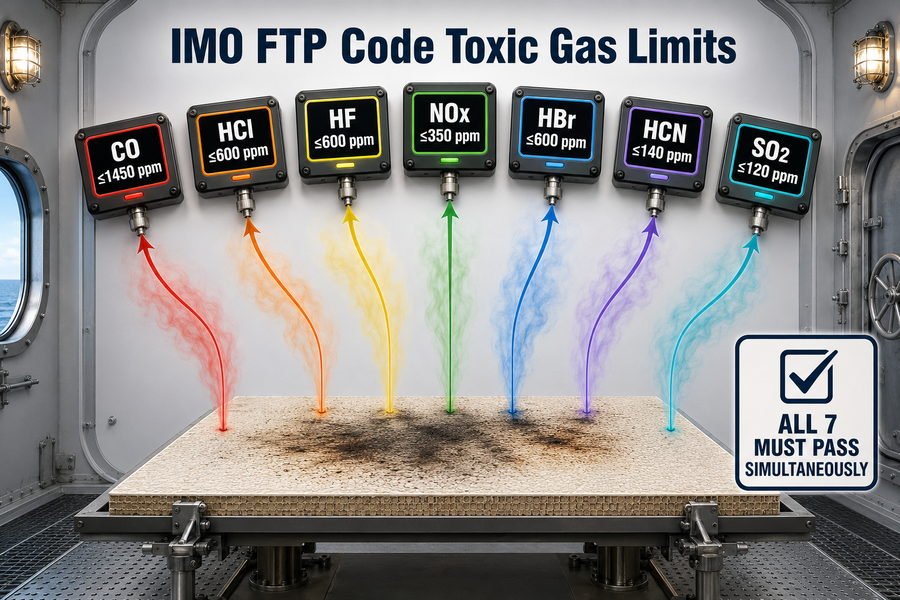
Many people think a fire only produces carbon dioxide. In reality, modern ship interior materials can release many hidden poisons when they get hot3. As a marine outfitting specialist, I always check the test reports to make sure the ceiling panels do not release these silent killers. The IMO FTP Code Part 2 strictly controls seven distinct toxic gases4. If a panel fails even one of these seven limits, the whole product fails5.
Breakdown of the Seven Toxic Gas Limits for Ceilings
You must know these exact numbers6 to check your supplier's test reports.
First, we have Carbon Monoxide (CO), which causes suffocation. The limit for CO is 1450 ppm.
Next, we have Hydrogen Cyanide (HCN), a very fast-acting poison often found in cheap adhesives. The limit for HCN is strictly 140 ppm.
Then, there are the acid gases, which mostly come from plastics or PVC finishes. Hydrogen Chloride (HCl) has a limit of 600 ppm. Hydrogen Fluoride (HF) also has a limit of 600 ppm. Hydrogen Bromide (HBr), often from fire retardant chemicals, is limited to 600 ppm as well.
Finally, we have Nitrogen Oxides (NOx) limited to 350 ppm, and Sulfur Dioxide (SO2) limited to 120 ppm. I always tell buyers that covering all seven gases is the only way to be legally safe.
Why Shipyards Reject Panels Over Minor Gas Limit Failures
Shipyards in Europe and the United States do not play games with these numbers. I remember a case where a buyer bought cheap ceiling panels from a new factory. The test report showed HF at 650 ppm, just 50 ppm over the limit. The shipyard inspector saw this and rejected the entire $40,000 order. You must ensure the lab report shows a clear pass for every single gas.
| Toxic Gas Name | Chemical Formula | IMO Maximum Limit (ppm) |
|---|---|---|
| Carbon Monoxide | CO | 1450 |
| Hydrogen Chloride | HCl | 600 |
| Hydrogen Fluoride | HF | 600 |
| Hydrogen Bromide | HBr | 600 |
| Nitrogen Oxides | NOx | 350 |
| Hydrogen Cyanide | HCN | 140 |
| Sulfur Dioxide | SO2 | 120 |
What Does FTP Code Part 2 Require for Marine Panel Smoke Testing?
Testing reports can be confusing. If you do not understand the testing process, you might accept fake certificates. What exactly does the official smoke test require?
IMO FTP Code Part 2 requires three key testing phases for marine panels: exposing samples to 25 kW/m2 radiant heat with a pilot flame, 25 kW/m2 without a flame, and 50 kW/m2 without a flame. Panels must pass toxic gas and smoke density limits in all three phases.
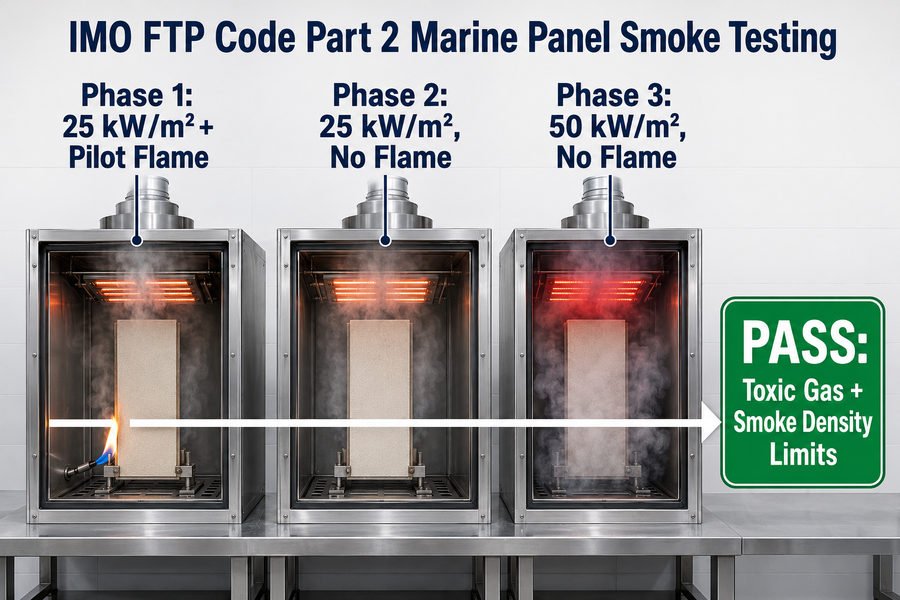
When you look at a marine test certificate from DNV or Lloyd's Register, you will see a lot of data. You need to know how the lab got that data. The lab does not just throw the panel into a fire. They use a very controlled machine to see how the panel reacts to different types of heat. The IMO FTP Code Part 2 dictates a very specific testing method that covers three distinct heat conditions.7 This ensures the panel is safe in both small smoldering fires and large, hot fires.
The Three Essential Radiant Heat Test Conditions
The lab puts a small piece of the marine panel into a sealed testing box.
First, they test it at 25 kW/m2 of radiant heat with a small pilot flame8 touching it. This copies a situation where a fire has just started and touches the wall.
Second, they test a new sample at 25 kW/m2 of radiant heat, but without any pilot flame. This shows what happens when the room is getting hot, but the flames have not reached the wall yet.
Third, they test it at a very high heat of 50 kW/m2 without a pilot flame. This copies a fully developed room fire. The panel must stay below the smoke density limit (Dm 2009) and the seven toxic gas limits during all three of these tests. If it fails one condition, it fails totally.
How Test Labs Measure Smoke Density and Toxicity
Inside the test box, a light beam shines from the top to the bottom. A sensor reads how much light makes it through the smoke. This gives us the Dm value.10 At the same time, a special tool called an FTIR gas analyzer pulls the smoke out and counts the exact parts per million (ppm) of the toxic gases. I always advise buyers to ask the factory for the full lab report, not just the front page, so they can see the results for all three heat conditions.
| Test Phase | Radiant Heat Level | Pilot Flame Present? | Purpose of the Test |
|---|---|---|---|
| Phase 1 | 25 kW/m2 | Yes | Simulates direct flame contact |
| Phase 2 | 25 kW/m2 | No | Simulates radiant heat from nearby fire |
| Phase 3 | 50 kW/m2 | No | Simulates high heat of a full room fire |
How Is VOF4 Reported on Marine Panel Smoke Certificates?
Many buyers only look at the final "pass" mark on a certificate. But ignoring the early stages of a fire is dangerous. How is early smoke measured?
VOF4 stands for Value of Optical Density at 4 minutes. On marine panel certificates, VOF4 is reported as a specific number. The IMO FTP Code requires that the VOF4 value must not exceed 200. This proves the panel does not release thick smoke immediately after catching fire.
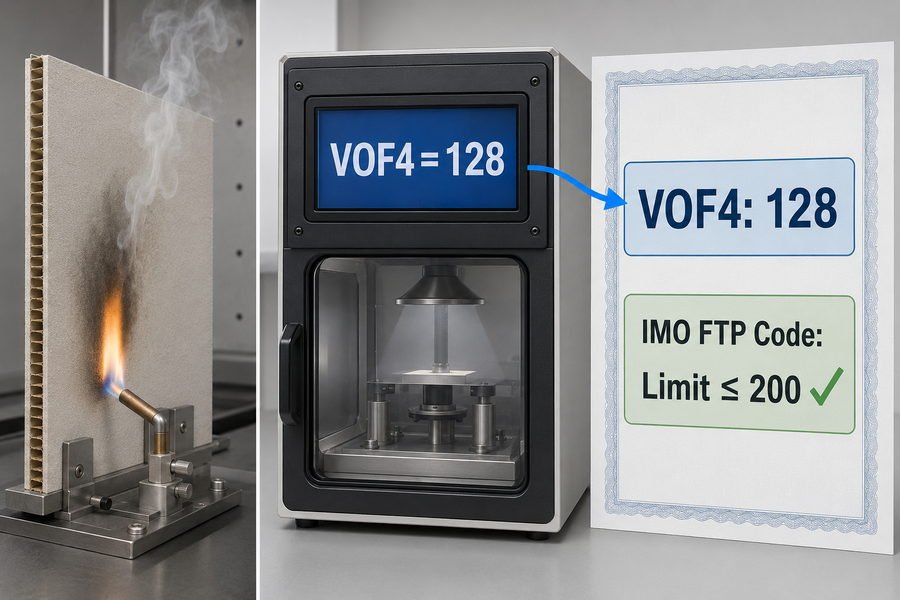
We already talked about the maximum smoke density, Dm. However, the timing of the smoke is just as important as the total amount. If a wall panel creates a huge black cloud of smoke in the first minute of a fire, people will be trapped before the alarms even finish ringing. This is why the IMO created the VOF4 measurement. I review these certificates weekly for my clients, and VOF4 is one of the first numbers I check.
The Meaning and Importance of the VOF4 Measurement
VOF4 means the Value of Optical Density at the 4-minute mark. Why four minutes? Because the first four minutes of a ship fire are the most critical for human escape11. The IMO FTP Code strictly requires that the VOF4 must be 200 or lower12. If a panel has a maximum Dm of 180 over the whole 20-minute test, but it hit 210 at the 3-minute mark, it fails the VOF4 rule. It means the panel burns too fast and releases smoke too quickly.
Locating and Reading VOF4 on Official Test Certificates
On a real test certificate from a lab like SGS or Far East Fire Testing Centre, VOF4 is reported clearly as a number. You will usually find it in a small table right next to the maximum Dm value. One time, a client asked me to check a report from a new supplier. The Dm was 150, which is great. But the VOF4 was 220. The supplier tried to hide this by only talking about the Dm. Because I knew to look for the VOF4, I saved my client from buying non-compliant panels.
| Smoke Measurement | Time Frame Evaluated | Maximum Allowed Value |
|---|---|---|
| VOF4 | The first 4 minutes of the test | 200 |
| Maximum Dm | The entire duration of the test | 200 |
Which Smoke Parameters Does Shipyard QA Verify on Delivery?
Your panels finally arrive at the shipyard. If the quality assurance team finds inconsistencies, they will block the installation. Which smoke data do they check first?
Upon delivery, Shipyard QA verifies three main smoke parameters: the Type Approval Certificate validity, the maximum Dm value (under 200), and the exact ppm values of the seven toxic gases. They match the batch numbers on the physical panels to the laboratory test reports to prevent fraud.
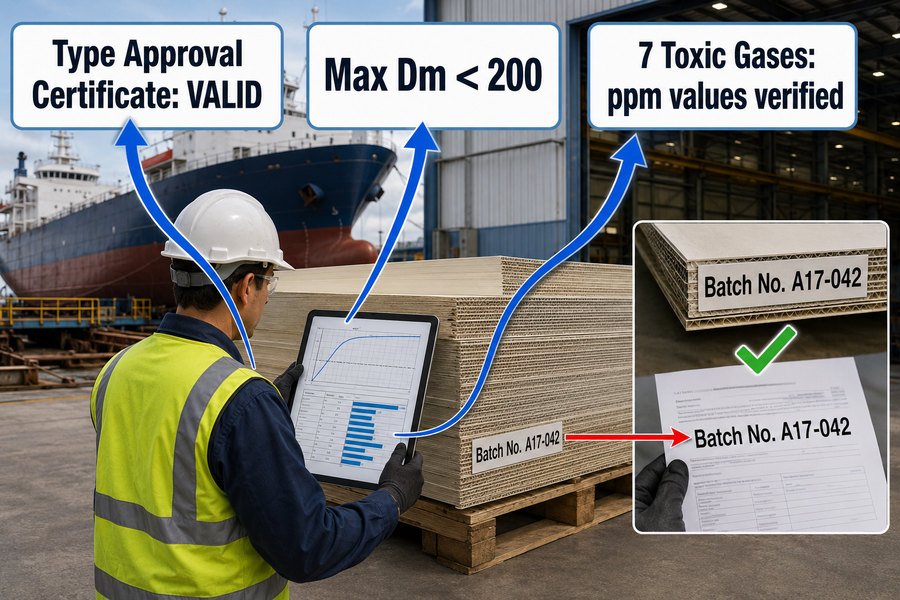
Getting the panels out of the factory in China or Vietnam is only half the battle. The real test happens when the container doors open at the shipyard in Europe or America. Shipyard Quality Assurance (QA) teams are very strict. They know that if the ship fails the final Coast Guard inspection13, millions of dollars are lost. As a marine outfitting specialist, I always prepare my clients for the shipyard QA process.
Document Verification for Type Approvals and Lab Reports
The very first thing the QA team does is ask for the paperwork. They will check the Type Approval Certificate (from DNV, ABS, or BV) to ensure it is valid and not expired. But they do not stop there. They will demand the full fire test lab report. They will manually check the maximum Dm value to confirm it is under 20014. They will then look down the list of the seven toxic gases to confirm the exact ppm values. They will check that CO is under 1450 ppm, HCN is under 140 ppm15, and the other five gases meet their specific limits.
Physical Batch Number Matching and Visual Inspection
After checking the paper limits, the QA inspector walks over to the actual wall and ceiling panels. They look at the sticker on the back of the panel. They match the production batch numbers on the physical panels directly to the numbers printed on the laboratory test reports. They do this to stop fraud. Some bad suppliers use high-quality materials for the lab test, but cheap, smoky materials for the mass production. If the batch numbers do not match perfectly, the shipyard QA will reject the whole delivery on the spot.
| QA Verification Step | What the Inspector Checks | Reason for Checking |
|---|---|---|
| Certificate Validity | Expiration dates and lab stamps | Ensures the approval is current and real |
| Parameter Review | Dm < 200 and all 7 gas ppm limits | Confirms the product meets IMO safety laws |
| Batch Matching | Stickers on panels vs. Lab report numbers | Prevents factory material bait-and-switch |
What HCN and CO Limits Apply to Burning Marine Panels?
Carbon Monoxide and Hydrogen Cyanide are the top killers in ship fires. If your panels use cheap adhesives, these gas levels will spike. What are the legal limits?
Under IMO FTP Code Part 2, burning marine panels must not exceed 1450 ppm for Carbon Monoxide (CO) and 140 ppm for Hydrogen Cyanide (HCN). These strict limits apply because CO causes rapid suffocation, while HCN, often released by cheap core adhesives, is highly poisonous even in small doses.
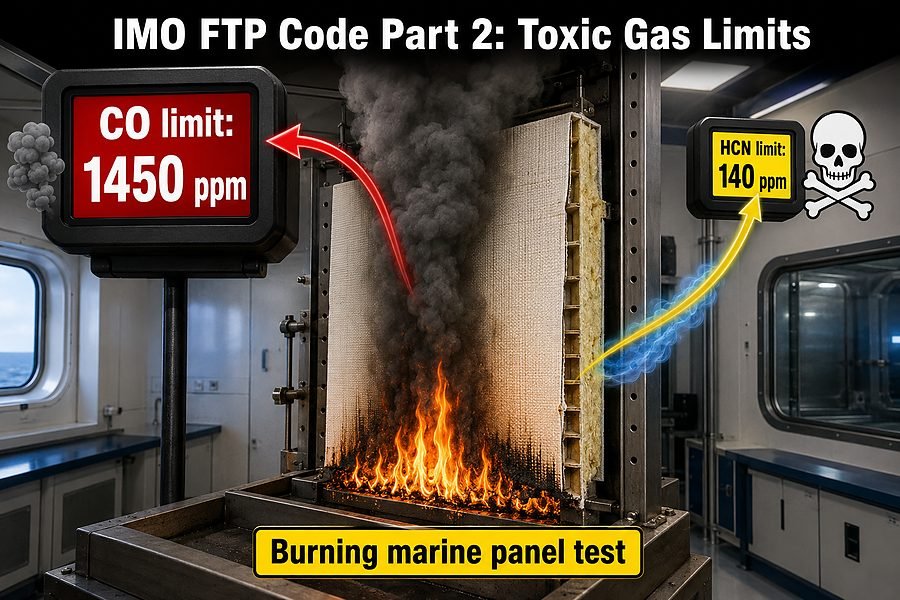
When we talk about toxic smoke, we are really talking about saving lives. Most people who die in fires do not die from the heat; they die from the gas. Among the seven gases tested by the IMO, Carbon Monoxide (CO) and Hydrogen Cyanide (HCN) are the most common and the most dangerous. You must understand the limits for these two gases to ensure your interior outfitting products are safe.
The Critical Carbon Monoxide (CO) Limit of 1450 ppm
Carbon Monoxide is a gas you cannot see or smell. It stops your blood from carrying oxygen. Under the IMO FTP Code Part 216, a burning marine panel must not release more than 1450 ppm of CO. Almost every material releases some CO when it burns, even wood and paper. The goal is not zero, but keeping it below 1450 ppm ensures that passengers have enough time to breathe while running down the corridor to the lifeboats. If a panel uses poor quality PVC film on the surface, the CO levels will shoot past 2000 ppm very quickly.
Managing Hydrogen Cyanide (HCN) Limits from Core Adhesives
Hydrogen Cyanide is much more toxic than CO. That is why the IMO limit for HCN is so low, strictly set at 140 ppm. HCN acts very fast and shuts down the body's cells. Where does HCN come from in a metal wall panel? It usually comes from the glue. To bind the steel sheet to the rockwool core, factories use special adhesives. Cheap polyurethane adhesives break down in high heat and release huge clouds of HCN gas.17 I always advise my clients to ask the supplier what brand of adhesive they use. Good quality glue keeps the HCN well below the 140 ppm limit.
| Toxic Gas | IMO Maximum Limit | Common Source in Panels | Danger to Humans |
|---|---|---|---|
| Carbon Monoxide (CO) | 1450 ppm | Surface PVC films, general burning | Suffocation, oxygen blocking |
| Hydrogen Cyanide (HCN) | 140 ppm | Core binding adhesives (glues) | Rapid cellular poisoning |
Conclusion
Ensuring your marine panels meet IMO FTP Code limits for Dm (200) and the seven toxic gases prevents tragedies and shipyard rejections. Always verify test reports closely when buying these crucial materials.
-
"[PDF] RESOLUTION MSC.307(88) (adopted on 3 December 2010 ...", https://wwwcdn.imo.org/localresources/en/KnowledgeCentre/IndexofIMOResolutions/MSCResolutions/MSC.307(88).pdf. The IMO 2010 FTP Code, annex 1, part 2, sets smoke-density criteria for shipboard materials tested under the Code and includes a maximum specific optical density threshold of 200 for relevant interior surface applications. Evidence role: expert_consensus; source type: institution. Supports: Marine wall panel materials subject to IMO FTP Code Part 2 smoke testing must meet a maximum smoke-density value of 200.. Scope note: The exact applicability depends on the material category and the vessel’s approval route under the FTP Code and flag/class requirements. ↩
-
"[PDF] RESOLUTION MSC.307(88) (adopted on 3 December 2010 ...", https://wwwcdn.imo.org/localresources/en/KnowledgeCentre/IndexofIMOResolutions/MSCResolutions/MSC.307(88).pdf. FTP Code and related smoke-density test procedures require test specimens to represent the material or assembly as used in service, so finishes, substrates, cores, and bonding layers can influence the measured smoke-density result for an approved panel system. Evidence role: mechanism; source type: institution. Supports: The smoke-density limit should be assessed on the representative complete marine panel system, not only on an isolated outer surface material.. Scope note: This supports the general principle of testing the installed or representative assembly; the exact components included depend on the submitted specimen construction and approval documentation. ↩
-
"[PDF] Combustion Products and Their Effects on Life Safety", https://tsapps.nist.gov/publication/get_pdf.cfm?pub_id=900093. Fire-safety literature on combustion products supports that burning or thermally decomposing polymers and interior materials can emit toxicants such as carbon monoxide, hydrogen cyanide, hydrogen halides, nitrogen oxides, and sulfur dioxide, depending on material chemistry and fire conditions. Evidence role: general_support; source type: paper. Supports: Modern ship interior materials can release multiple toxic gases when heated or burned.. Scope note: This supports the general mechanism of toxic fire effluent formation, not the toxicity profile of any specific ceiling panel. ↩
-
"[PDF] RESOLUTION MSC.307(88) (adopted on 3 December 2010 ...", https://wwwcdn.imo.org/localresources/en/KnowledgeCentre/IndexofIMOResolutions/MSCResolutions/MSC.307(88).pdf. The IMO Fire Test Procedures Code, Part 2, specifies a smoke and toxicity test for certain ship materials and lists concentration criteria for CO, HCl, HF, HBr, NOx, HCN, and SO2. Evidence role: definition; source type: institution. Supports: IMO FTP Code Part 2 controls seven toxic gases in smoke/toxicity testing.. Scope note: The source establishes the regulatory test framework and listed gases; applicability still depends on the product type and approval route. ↩
-
"What Is the Purpose and Scope of the IMO FTP Code? - Magellan ...", https://magellanmarinetech.com/what-purpose-scope-of-imo-ftp-code/. Marine equipment approval guidance for FTP Code testing treats the smoke/toxicity criteria as acceptance requirements, so exceeding a listed gas concentration would mean the tested material does not satisfy the Part 2 toxicity criterion. Evidence role: expert_consensus; source type: government. Supports: A ceiling panel that exceeds any one applicable FTP Code Part 2 toxic gas limit fails the relevant toxicity requirement.. Scope note: This supports the regulatory pass/fail logic for the tested specimen; actual purchasing rejection and remedial options may vary by flag administration, class society, and shipyard contract. ↩
-
"What Is the IMO FTP Code for Marine Interior Materials? - Magellan ...", https://magellanmarinetech.com/what-imo-ftp-code-for-marine-interior-materials/. The FTP Code Part 2 concentration criteria give maximum values of 1450 ppm for CO, 600 ppm for HCl, HF, and HBr, 350 ppm for NOx, 140 ppm for HCN, and 120 ppm for SO2 in the specified test conditions. Evidence role: statistic; source type: institution. Supports: The listed maximum ppm values for the seven toxic gases match the IMO FTP Code Part 2 criteria.. Scope note: These values are test acceptance criteria under the FTP Code method and should not be treated as general occupational exposure limits. ↩
-
"[PDF] RESOLUTION MSC.307(88) (adopted on 3 December 2010 ...", https://wwwcdn.imo.org/localresources/en/KnowledgeCentre/IndexofIMOResolutions/MSCResolutions/MSC.307(88).pdf. The IMO FTP Code, Part 2, specifies smoke and toxicity testing for shipboard materials using defined irradiance and pilot-flame exposure conditions. Evidence role: definition; source type: institution. Supports: IMO FTP Code Part 2 defines a controlled smoke and toxicity test method with three distinct heat-exposure conditions.. Scope note: The source supports the prescribed test framework; it does not by itself verify any particular panel’s certificate results. ↩
-
"[PDF] RESOLUTION MSC.307(88) (adopted on 3 December 2010 ...", https://wwwcdn.imo.org/localresources/en/KnowledgeCentre/IndexofIMOResolutions/MSCResolutions/MSC.307(88).pdf. Standard descriptions of the IMO FTP Code Part 2 smoke and toxicity procedure identify exposure conditions including 25 kW/m² with pilot flame, 25 kW/m² without pilot flame, and 50 kW/m² without pilot flame. Evidence role: general_support; source type: institution. Supports: The test includes 25 kW/m² with pilot flame, 25 kW/m² without pilot flame, and 50 kW/m² without pilot flame.. Scope note: This supports the listed laboratory exposure conditions, but the interpretation of each condition as a real fire scenario is a contextual engineering explanation. ↩
-
"[PDF] RESOLUTION MSC.307(88) (adopted on 3 December 2010 ...", https://wwwcdn.imo.org/localresources/en/KnowledgeCentre/IndexofIMOResolutions/MSCResolutions/MSC.307(88).pdf. The IMO FTP Code Part 2 acceptance criteria set a maximum specific optical density criterion and specify concentration limits for listed toxic gases measured during smoke and toxicity testing. Evidence role: expert_consensus; source type: institution. Supports: Marine panels tested under IMO FTP Code Part 2 must meet a smoke-density limit of Dm 200 and toxic gas limits to pass.. Scope note: The citation should be checked against the applicable edition and material category because acceptance criteria can depend on the regulatory context in which the test report is used. ↩
-
"[PDF] Interlaboratory evaluation of smoke density chamber", https://nvlpubs.nist.gov/nistpubs/Legacy/TN/nbstechnicalnote708.pdf. Smoke-density test methods such as ISO 5659-2 determine specific optical density by measuring the attenuation of a light beam through smoke generated in a closed chamber. Evidence role: mechanism; source type: paper. Supports: Smoke density Dm is measured by detecting how much light is transmitted through smoke in the test chamber.. Scope note: This supports the measurement principle; instrument geometry and calculation details should be verified against the exact apparatus used in the laboratory report. ↩
-
"Resolution A.1116(30) Adopted on 5 December 2017 ...", https://wwwcdn.imo.org/localresources/en/KnowledgeCentre/IndexofIMOResolutions/AssemblyDocuments/A.1116(30).pdf. Fire-safety engineering research links early smoke production to reduced available safe egress time through visibility loss, irritant or toxic exposure, and heat, which contextualizes why early-test smoke metrics are used for escape-safety assessment. Evidence role: mechanism; source type: paper. Supports: The early minutes of a ship fire are especially important for human escape because smoke development can quickly reduce tenability.. Scope note: Such sources can support the importance of early smoke development for egress, but may not prove that exactly four minutes is universally the most critical period for all ship fires. ↩
-
"[PDF] RESOLUTION MSC.307(88) (adopted on 3 December 2010 ...", https://wwwcdn.imo.org/localresources/en/KnowledgeCentre/IndexofIMOResolutions/MSCResolutions/MSC.307(88).pdf. The IMO 2010 FTP Code’s smoke and toxicity criteria specify a limit for VOF4 of not more than 200 for applicable tested materials, alongside a maximum specific optical density limit. Evidence role: general_support; source type: institution. Supports: The IMO FTP Code requires VOF4 to be 200 or lower.. Scope note: The limit applies within the relevant FTP Code test method and material categories, not necessarily to every shipboard component or certification context. ↩
-
"46 USC Subtitle II, Part B: Inspection and Regulation of Vessels", https://uscode.house.gov/view.xhtml?path=/prelim@title46/subtitle2/partB&edition=prelim. A Coast Guard or flag-state inspection source would support that vessels must satisfy statutory safety requirements before operation; this contextual support does not by itself quantify the financial loss from a failed inspection. Evidence role: general_support; source type: government. Supports: Shipyard QA is strict because failure at final Coast Guard inspection can prevent acceptance or operation of a vessel.. Scope note: Supports the existence and regulatory significance of final inspections, but not the specific claim that losses reach millions of dollars. ↩
-
"What Is the Purpose and Scope of the IMO FTP Code? - Magellan ...", https://magellanmarinetech.com/what-purpose-scope-of-imo-ftp-code/. The IMO Fire Test Procedures Code smoke and toxicity test provisions specify smoke-density evaluation using maximum specific optical density values, including limits applied to certain surface materials; this supports the threshold only for materials and applications covered by that test method. Evidence role: statistic; source type: institution. Supports: For relevant marine panel materials, QA may verify that the reported maximum Dm smoke-density value is below 200.. Scope note: The applicable Dm limit can depend on material category and installation context under the FTP Code, so the source should be checked against the exact panel use case. ↩
-
"What Is the Purpose and Scope of the IMO FTP Code? - Magellan ...", https://magellanmarinetech.com/what-purpose-scope-of-imo-ftp-code/. The IMO FTP Code Part 2 smoke and toxicity criteria list concentration limits for toxic combustion gases, including carbon monoxide and hydrogen cyanide; this supports the stated gas-limit values within the code’s specified test conditions. Evidence role: statistic; source type: institution. Supports: Marine fire-test lab reports may be checked against toxic gas limits such as CO below 1450 ppm and HCN below 140 ppm.. Scope note: The citation would support the regulatory test limits, not the accuracy of any supplier’s individual laboratory report. ↩
-
"What Is the Purpose and Scope of the IMO FTP Code? - Magellan ...", https://magellanmarinetech.com/what-purpose-scope-of-imo-ftp-code/. The IMO FTP Code Part 2 smoke and toxicity test specifies maximum gas concentrations for tested materials, including 1450 ppm for carbon monoxide and 140 ppm for hydrogen cyanide under the prescribed chamber method. Evidence role: definition; source type: institution. Supports: IMO FTP Code Part 2 sets maximum toxic gas concentration limits of 1450 ppm for CO and 140 ppm for HCN.. Scope note: This supports the regulatory thresholds, but it does not prove that any specific panel or adhesive formulation will meet them outside the standardized test conditions. ↩
-
"Cage Nanofillers' Influence on Fire Hazard and Toxic Gases Emitted ...", https://pmc.ncbi.nlm.nih.gov/articles/PMC10935312/. Combustion and thermal-decomposition studies of polyurethane materials identify hydrogen cyanide among the nitrogen-containing toxic products formed when polyurethane burns or decomposes at high temperature. Evidence role: mechanism; source type: paper. Supports: Polyurethane adhesives can generate hydrogen cyanide during high-temperature decomposition or combustion.. Scope note: This supports the chemical plausibility of HCN emissions from polyurethane-based adhesives, but the amount released depends on formulation, adhesive mass, oxygen availability, ventilation, and the specific fire-test conditions. ↩