Getting panel classifications wrong during an RFQ ruins shipyard budgets and delays deliveries. If you fail to verify A, B, or C-Class ratings, you face massive rework costs. Here is how I solve this.
To verify A/B/C-Class marine panel ratings in RFQs, buyers must check three critical elements: IMO FTP Code test reports for fire integrity, MED/USCG Type Approval Certificates for regulatory compliance, and detailed manufacturer datasheets confirming core density and surface flammability limits.
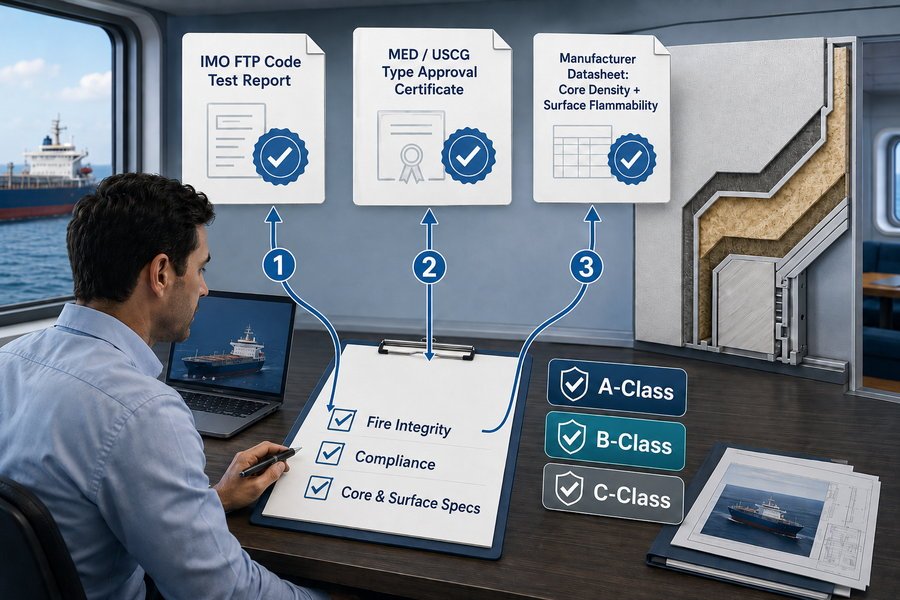
Missing a small detail on a piece of paper can force you to rip out an entire ship deck. Let me show you exactly what to look for when you review these quotes, so you never have to explain a failed inspection to a shipyard.
What Documents Prove A Marine Wall Panel's A-Class Division Rating?
Buying A-Class panels without the right papers is a huge risk. Port state control will reject your outfitting project if the fire ratings are not proven.
Three specific documents prove an A-Class marine wall panel rating: a valid Type Approval Certificate (like MED Module B), a Declaration of Conformity (MED Module D/E/F), and an IMO FTP Code Part 3 fire test report showing 60-minute structural integrity and temperature limits.
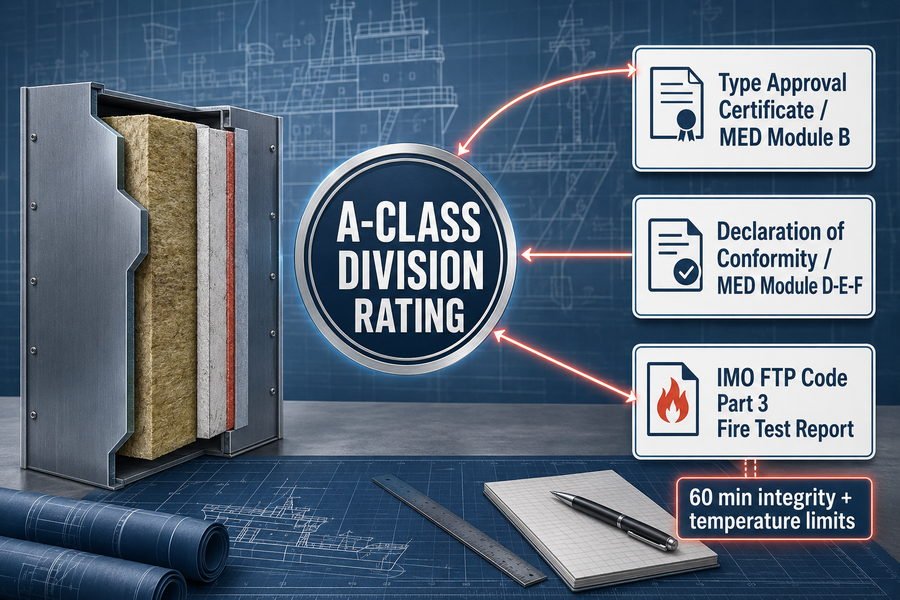
I remember my early days at the factory. We had a client who almost lost a big contract because they did not ask for the right papers. You cannot just trust a supplier who types "A-60" on their quote. You need solid proof.
Valid Type Approval Certificates for A-Class Panels
First, you must ask for the Type Approval Certificate (TAC). In Europe, this is the MED Module B certificate. The United States Coast Guard (USCG) issues a similar document1. This certificate proves the panel design meets the International Convention for the Safety of Life at Sea (SOLAS) rules. It confirms the panel is officially recognized for marine use.
Declaration of Conformity Requirements for Marine Panels
Second, you need the Declaration of Conformity. This is often called the MED Module D, E, or F certificate. The Module B only approves the product design. The Module D proves the factory's quality control system actually builds the panels to match that design every single day. I always check the expiry date on this document. If it is expired, the factory is not audited, and the panels are useless.
IMO FTP Code Fire Test Reports for A-Class Integrity
Third, you must request the IMO Fire Test Procedures (FTP) Code Part 3 test report. An A-Class panel must hold structural integrity for exactly 60 minutes during a standard fire test. A real A-60 panel limits the unexposed side temperature rise to 140°C on average and 180°C maximum for 60 minutes2. An A-30 panel limits this for 30 minutes. If the supplier cannot show you this exact test report from a respected lab like DNV or Lloyd's Register, do not buy from them.
| Document Type | What It Proves | Key Detail to Check |
|---|---|---|
| Type Approval (MED Module B) | Design complies with SOLAS | "A-60" or "A-30" rating explicitly listed |
| Declaration of Conformity (Module D) | Factory production quality | Valid expiration date and correct factory address |
| IMO FTP Code Test Report | Real fire performance | Max 180°C temperature rise at 60 minutes |
How Can A Specification Reviewer Spot A Misclassified B-Class Marine Panel Quote?
A supplier might quote you a cheap panel and call it B-Class. If you accept it without checking, the shipyard will fail the final fire safety survey.
To spot a misclassified B-Class marine panel quote, reviewers must verify three parameters: the core material density is below A-Class levels (typically 100-120 kg/m³), the panel thickness is 25mm to 50mm, and the test report shows 30-minute integrity with 15-minute temperature insulation for B-15.
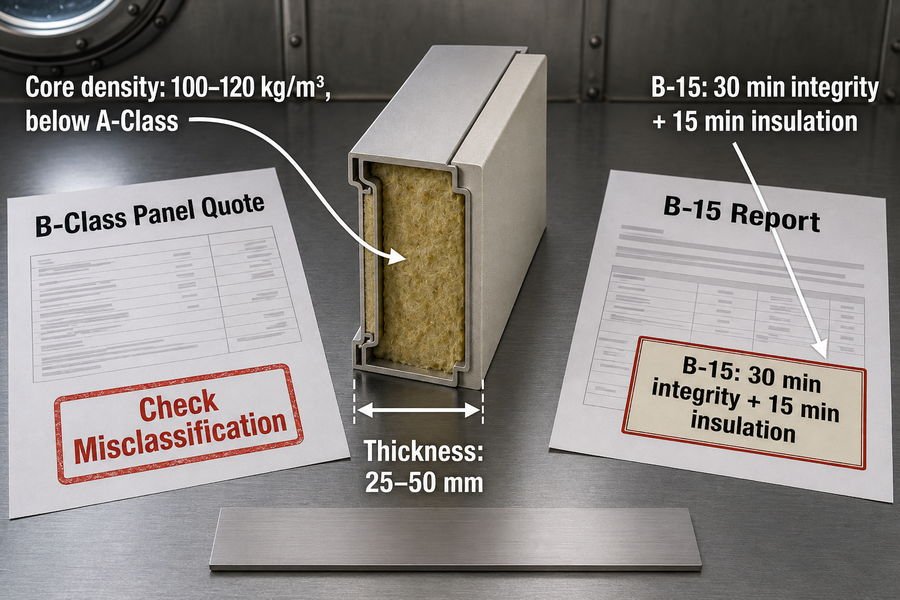
I see buyers make this mistake often. They look at the low price and ignore the technical details. A B-Class panel is used for cabin dividers. It does not need to be as strong as an A-Class panel, but it still has strict rules. If a quote looks too cheap, it is usually misclassified.
Identifying Incorrect Core Density in B-Class Quotes
First, look at the core density. A true B-15 marine panel usually uses rockwool with a density of 100 kg/m³ to 120 kg/m³3. If the quote shows a density of 80 kg/m³, it is likely a C-Class panel being sold as B-Class. The panel will not stop a fire effectively. You must check the rockwool density listed on the quote.
Checking Thickness Specifications for B-Class Panels
Second, check the panel thickness. Most standard B-15 wall panels are 50mm thick, though some high-tech versions are 25mm thick for B-0 ratings. If the quote lists a 15mm panel and claims B-15, that is a huge red flag. The physics do not add up. A panel that thin cannot hold enough rockwool to provide 15 minutes of temperature insulation.
Verifying the 30-Minute Fire Integrity Rule
Third, you must read the fire integrity values. Under SOLAS, a B-Class panel must maintain structural integrity for exactly 30 minutes4. This means flames cannot pass through it for half an hour. A B-15 panel must also keep the unexposed side temperature from rising more than 225°C for the first 15 minutes. If the supplier's test report only shows 15 minutes of structural integrity, it is not a B-Class panel. You must reject that quote immediately.
| Parameter | Correct B-15 Panel Spec | Misclassified Warning Sign |
|---|---|---|
| Rockwool Density | 100 kg/m³ to 120 kg/m³ | Under 80 kg/m³ |
| Panel Thickness | 25mm (B-0) to 50mm (B-15) | Under 25mm |
| Structural Integrity | 30 minutes | Under 30 minutes |
| Temperature Insulation | 15 minutes (Max 225°C rise) | Under 15 minutes |
Why Do A-0 Versus B-0 Marine Panel Mix-Ups Cause Shipyard Rework?
Confusing A-0 and B-0 ratings is a classic trap. If you install a B-0 panel where an A-0 is required, the inspectors will make you tear it all down.
A-0 and B-0 marine panel mix-ups cause costly rework because A-0 panels require 60 minutes of structural fire integrity and steel construction, while B-0 panels only provide 30 minutes of integrity and use lighter materials. Replacing them destroys surrounding outfitting, costing upwards of $500 per square meter.
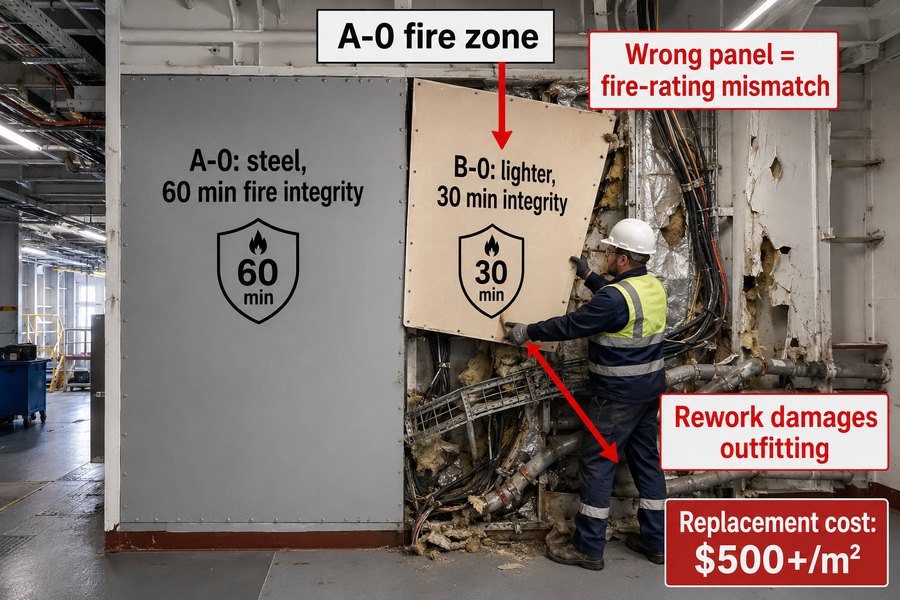
I helped a client in Europe last year who made this exact mistake. The buyer saw that both A-0 and B-0 mean "zero minutes of temperature insulation."5 Because of this, she bought the cheaper B-0 panels for a main machinery space bulkhead. The shipyard installed them, and the surveyor failed the entire deck.
The 60-Minute Versus 30-Minute Structural Integrity Difference
The first major reason for rework is the structural integrity difference. An A-0 panel must stop flames and smoke from passing through for a full 60 minutes.6 A B-0 panel is only tested to stop flames for 30 minutes.7 You cannot use a 30-minute wall where SOLAS demands a 60-minute wall. The surveyor will catch this immediately by looking at the stickers on the panels.
Material Construction Differences Between A-0 and B-0 Panels
The second reason is the material construction. To survive a 60-minute fire, A-0 divisions must be constructed of steel or an equivalent stiff material.8 B-0 panels are typically made of lighter galvanized steel sheets, usually 0.6mm or 0.7mm thick, with a lower-density mineral wool core. The B-0 panel will warp and collapse in an A-Class fire zone.
The Financial Cost of Marine Panel Rework
The third reason is the massive financial cost. If you mix them up, the rework is terrible. You do not just pull the panel out. You have to remove the ceiling profiles, disconnect the electrical cables, and destroy the joint profiles. A standard B-0 panel might cost $25 per square meter to buy. But ripping it out and installing the correct A-0 steel panel will cost you between $400 and $500 per square meter in labor and lost materials.
| Feature | A-0 Marine Panel | B-0 Marine Panel |
|---|---|---|
| Fire Integrity | 60 minutes (stops smoke/flames) | 30 minutes (stops flames) |
| Temperature Insulation | 0 minutes | 0 minutes |
| Base Material Requirement | Steel or equivalent | Incombustible materials (lighter steel) |
| Average Cost of Rework | $400 - $500 per sqm | N/A (if installed correctly) |
What Should Procurement Ask Suppliers To Confirm C-Class Marine Panel Classification?
C-Class panels do not have fire ratings, but you cannot just buy regular house walls. If you buy the wrong C-Class panels, they will fail safety checks.
To confirm C-Class marine panel classification, procurement must ask suppliers for two specific items: proof that the core materials are 100% non-combustible according to IMO FTP Code Part 1, and certificates showing low flame-spread surface characteristics according to IMO FTP Code Part 5.
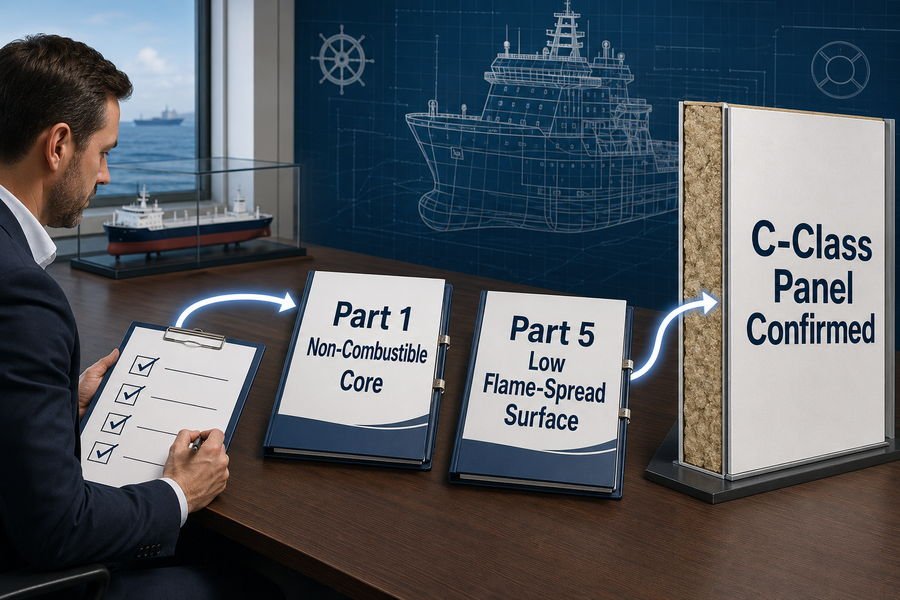
Many buyers think C-Class means "no rules." This is a dangerous mindset. C-Class panels are used in areas with very low fire risk, like open spaces or simple dividers within a single cabin. They do not need to stop fire or heat for any specific amount of time. But the IMO still regulates them carefully.
Requesting Proof of Non-Combustibility for C-Class Panels
First, you must ask the supplier for an IMO FTP Code Part 1 test report9. This test proves the core material is strictly non-combustible. The test places the material in a furnace at 750°C. If the material bursts into flames, or if the furnace temperature rises by more than 54°C, it fails. You must explicitly ask the supplier: "Can you provide the Part 1 non-combustibility certificate for the core?"
Verifying Low Flame-Spread Surface Characteristics
Second, you must ask for the IMO FTP Code Part 5 test report. Even if the inside of the panel is safe, the PVC film or painted surface on the outside must not spread fire quickly. The surface must have low flame-spread characteristics. If a fire touches the wall, the finish cannot act like fuel.
Furthermore, it must not produce excessive smoke or toxic gases, which is governed by Part 2 of the FTP Code10. If a supplier tells you, "It is C-Class, so we do not need marine certificates," walk away. They are trying to sell you cheap building materials meant for land use. Standard commercial drywall is cheap, but it will release toxic smoke in a ship fire.
| Procurement Question | Required IMO Standard | Acceptable Result |
|---|---|---|
| Is the core material non-combustible? | IMO FTP Code Part 1 | Passes 750°C furnace test |
| Does the surface finish resist fire spread? | IMO FTP Code Part 5 | Low flame-spread certified |
| Does the surface produce toxic smoke? | IMO FTP Code Part 2 | Meets gas emission limits |
How Does A QA Inspector Cross-Check A/B/C-Class Ratings On Marine Panel Datasheets?
A datasheet is just marketing unless you verify the numbers. If your QA inspector misses a mismatched spec, the bad panels will reach the shipyard.
A QA inspector cross-checks A/B/C-Class ratings on datasheets by matching three specific data points: confirming the stated fire class matches the actual MED certificate number, verifying the core density aligns with the approved test report limits, and ensuring the panel joint profile drawings match the certified laboratory design.
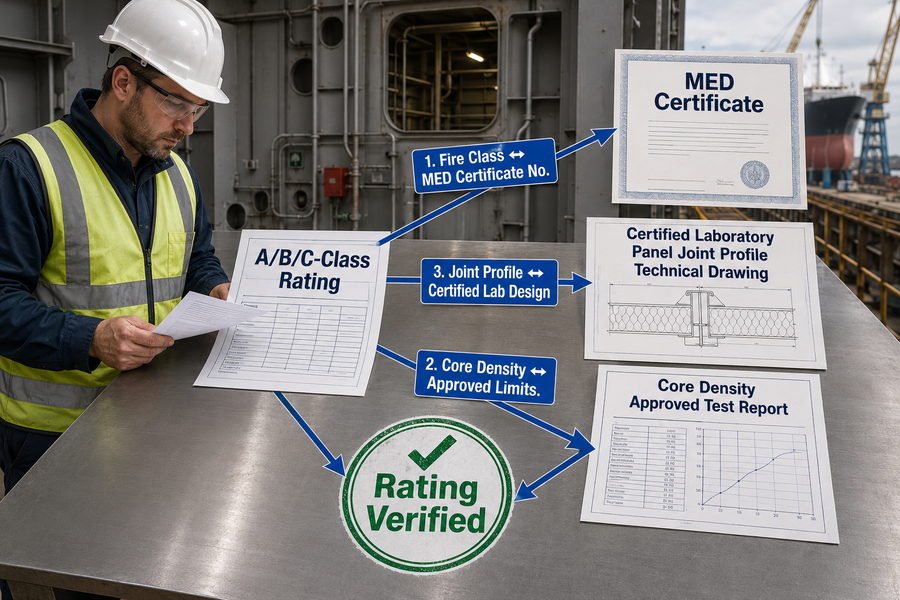
At Magellan Marine, our QA process is very strict. You cannot just read the title of the datasheet. Suppliers sometimes use one generic datasheet for all their products. A good inspector must dig into the numbers and cross-check them against the official lab reports11.
Matching Fire Class Claims to MED Certificate Numbers
First, the inspector must match the claimed fire class to the specific MED certificate number listed on the sheet. If the datasheet says "A-60 Wall Panel," there must be a valid certificate number12 next to it. You take that number, log into the DNV or USCG online database, and verify it. Sometimes, a supplier will put an A-30 certificate number on an A-60 datasheet by mistake.
Verifying Core Density Against Approved Test Limits
Second, the inspector must verify the core density. The fire test report states exactly what density was tested. If the lab tested a panel with 150 kg/m³ rockwool, the factory cannot sell you a panel with 120 kg/m³ rockwool and claim the same certificate. The inspector must check that the datasheet's density range perfectly matches the approved test limits.
Ensuring Joint Profile Drawings Match the Certified Design
Third, the inspector must check the joint profile drawings. Marine panels connect to each other using specific joints, like a spline joint or a tongue-and-groove joint. The fire will slip through the cracks if the joint is wrong. The inspector compares the drawing on the datasheet with the drawing in the official lab test report. If the factory changed the joint design to save metal, the fire rating is void13.
| Item on Datasheet | QA Inspector Cross-Check Source | What to Look For |
|---|---|---|
| Claimed Class (e.g., A-60) | MED/USCG Database | Status is "Active" and matches product name |
| Rockwool Density (e.g., 150 kg/m³) | IMO FTP Part 3 Test Report | Density must exactly match the tested sample |
| Panel Joint Design | Laboratory Drawing Annex | Tongue length and gap tolerance must be identical |
What Red Flags Signal A Marine Panel Supplier Is Mislabeling Division Class?
Dishonest suppliers will try to trick you to win the bid. If you do not spot their tricks early, you will pay for useless materials.
Four major red flags signal a supplier is mislabeling marine panel division classes: quoting B-Class weights for A-Class panels (under 18 kg/m²), offering only local lab tests instead of IACS approvals, providing certificates with mismatched factory addresses, and refusing to guarantee IMO FTP Code compliance in the contract.
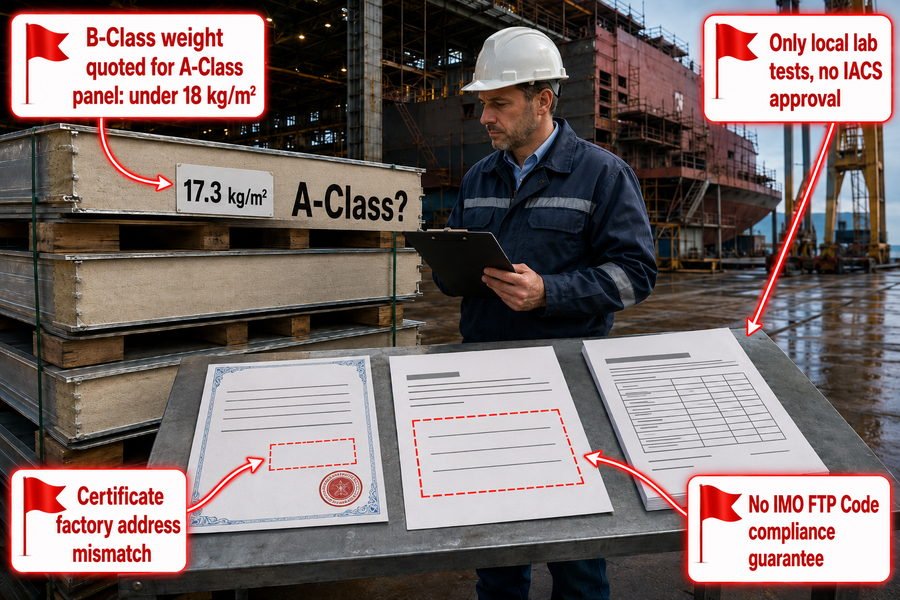
After years of dealing with factories, I have learned how to spot a bad supplier in five minutes. When you buy in Asia, finding a competitive price is important, but quality is everything. You have to look for red flags.
Spotting Unrealistic Weight Claims for A-Class Panels
The first major red flag is the panel weight. Steel and high-density rockwool are heavy. A genuine A-60 marine wall panel usually weighs between 18 kg/m² and 22 kg/m².14 If a supplier quotes you an A-60 panel that weighs 14 kg/m², they are lying. They are giving you a B-Class panel and putting an A-Class sticker on it.
Rejecting Local Lab Tests Over IACS Approvals
The second red flag involves the testing laboratory. Marine products must be approved by members of the International Association of Classification Societies (IACS), like ABS, DNV, or Lloyd's Register.15 If the supplier only gives you a fire test report from a local city fire department or a random commercial lab, it is not valid for ships.16
Identifying Mismatched Factory Addresses on Certificates
The third red flag is mismatched factory addresses. Sometimes a trading company will steal a certificate from a real factory. You must look at the address on the MED Module D certificate and compare it to the address on your proforma invoice. If they do not match, you are buying a mislabeled product from a middleman.
Refusal to Guarantee IMO FTP Code Compliance
The fourth red flag is contract refusal. I always put a clause in the purchase order: "Supplier guarantees full compliance with IMO FTP Code Part 317. Failure will result in a 100% refund." If the supplier refuses to sign this, they know their division class label is fake.
| Red Flag | What It Usually Means | Action to Take |
|---|---|---|
| Weight is under 18 kg/m² for A-60 | Core density is too low | Ask for the density spec sheet |
| Non-IACS laboratory test | Panel is not approved for ships | Demand a DNV, ABS, or LR certificate |
| Address mismatch on certificate | Supplier is a trader, not the maker | Request a formal authorization letter |
| Refuses IMO compliance clause | The product will fail inspection | Cancel the vendor immediately |
Conclusion
Verifying marine panel ratings protects your budget and your shipyard's timeline. Always check the IMO test reports, match the densities, and look out for weight discrepancies to ensure absolute safety.
-
"46 CFR Part 164 Subpart 164.136 -- Fire Doors - eCFR", https://www.ecfr.gov/current/title-46/chapter-I/subchapter-Q/part-164/subpart-164.136. USCG marine safety approval guidance and equipment approval databases document Coast Guard approval certificates for marine equipment; this supports the existence of a U.S. approval pathway analogous to EU type approval, though the procedures and legal basis differ from the MED system. Evidence role: general_support; source type: government. Supports: The United States Coast Guard issues approval documentation for marine equipment similar in purpose to European type approval.. Scope note: Analogous only at a high level; USCG approval is not identical to MED Module B. ↩
-
"What Is the Purpose and Scope of the IMO FTP Code? - Magellan ...", https://magellanmarinetech.com/what-purpose-scope-of-imo-ftp-code/. SOLAS Chapter II-2 and the IMO Fire Test Procedures Code define A-class divisions and insulation criteria, including limits on average and individual temperature rise on the unexposed face for the relevant rating period; this supports the stated A-60 temperature thresholds, subject to the exact test method and specimen configuration. Evidence role: mechanism; source type: institution. Supports: A real A-60 panel must meet the stated unexposed-side temperature-rise limits for 60 minutes under the applicable IMO fire test procedure.. Scope note: Supports the regulatory test criteria generally; individual panel compliance still depends on the specific tested construction and certified configuration. ↩
-
"How to choose the right marine wall panels for marine interior ...", https://magellanmarinetech.com/how-choose-right-marine-wall-panels-for-marine-interior-projects/. Classification-society type-approval certificates and technical approvals for certified B-15 marine wall panels commonly list mineral-wool or rockwool core densities in this approximate range, supporting its use as a typical specification benchmark. Evidence role: general_support; source type: institution. Supports: A true B-15 marine panel usually uses rockwool with a density of 100 kg/m³ to 120 kg/m³.. Scope note: This supports the range as a common certified configuration, not as a universal SOLAS requirement for every B-15 panel design. ↩
-
"[PDF] recommendation for fire test procedures for “a” and “b” class ...", https://wwwcdn.imo.org/localresources/en/KnowledgeCentre/IndexofIMOResolutions/AssemblyDocuments/A.163(ES.IV).pdf. SOLAS/IMO fire-test provisions define B-class divisions as divisions that prevent the passage of flame to the end of the first half-hour of the standard fire test, and B-15 divisions must also meet insulation temperature-rise limits for 15 minutes. Evidence role: definition; source type: institution. Supports: Under SOLAS, a B-Class panel must maintain structural integrity for exactly 30 minutes.. Scope note: The regulatory wording is usually framed as performance through the first half-hour, not as proof that failure occurs exactly at 30 minutes. ↩
-
"What Is the Purpose and Scope of the IMO FTP Code? - Magellan ...", https://magellanmarinetech.com/what-purpose-scope-of-imo-ftp-code/. The source defines the suffix “-0” in A-0 and B-0 fire divisions as indicating no required insulation period for limiting temperature rise during the standard fire test. Evidence role: definition; source type: government. Supports: Both A-0 and B-0 mean zero minutes of required temperature insulation.. ↩
-
"How Does the IMO FTP Code Connect with Other Marine Fire Safety ...", https://magellanmarinetech.com/how-imo-ftp-code-connect-with-other-marine-fire-safety-frameworks/. The source states that A-class divisions are required to prevent the passage of smoke and flame for 60 minutes in the standard fire test; this supports the integrity-duration requirement for an A-0 division. Evidence role: definition; source type: government. Supports: An A-0 panel must prevent passage of flames and smoke for 60 minutes.. Scope note: The source supports the class requirement generally; compliance of any specific panel still depends on its certified test approval. ↩
-
"[PDF] recommendation for fire test procedures for “a” and “b” class ...", https://wwwcdn.imo.org/localresources/en/KnowledgeCentre/IndexofIMOResolutions/AssemblyDocuments/A.163(ES.IV).pdf. The source defines B-class divisions as divisions constructed to prevent the passage of flame for the first 30 minutes of the standard fire test, supporting the stated B-0 integrity period. Evidence role: definition; source type: government. Supports: A B-0 panel is tested for 30 minutes of flame integrity.. Scope note: The definition concerns B-class fire integrity in general; individual B-0 panels require separate type approval to verify conformity. ↩
-
"[PDF] RESOLUTION MSC.307(88) (adopted on 3 December 2010 ...", https://wwwcdn.imo.org/localresources/en/KnowledgeCentre/IndexofIMOResolutions/MSCResolutions/MSC.307(88).pdf. The source specifies that A-class divisions are to be constructed of steel or other equivalent material, supporting the material requirement stated for A-0 divisions. Evidence role: definition; source type: government. Supports: A-0 divisions must be made of steel or an equivalent material.. Scope note: The source establishes the regulatory material category, not the detailed engineering design or thickness of a particular certified panel. ↩
-
"[PDF] RESOLUTION MSC.61(67) (adopted on 5 December 1996 ...", https://wwwcdn.imo.org/localresources/en/KnowledgeCentre/IndexofIMOResolutions/MSCResolutions/MSC.61(67).pdf. The IMO FTP Code identifies Part 1 as the non-combustibility test for relevant shipboard materials, providing the regulatory basis for requesting a Part 1 report for panel core materials. Evidence role: definition; source type: institution. Supports: Buyers should ask the supplier for an IMO FTP Code Part 1 test report to prove the panel core material is non-combustible.. Scope note: The source supports the applicable test category; it may not verify that any specific supplier’s panel has passed it. ↩
-
"History of SOLAS fire protection requirements", https://www.imo.org/en/OurWork/Safety/Pages/History-of-fire-protection-requirements.aspx. The IMO FTP Code lists Part 2 as the procedure for smoke and toxicity testing of materials used in ship construction, supporting the statement that smoke and toxic gas emissions are regulated separately from flame spread. Evidence role: definition; source type: institution. Supports: Surface materials used on marine panels must satisfy smoke and toxicity requirements governed by IMO FTP Code Part 2.. Scope note: This supports the regulatory test framework, not the emissions performance of any particular wall panel or surface finish. ↩
-
"[PDF] RESOLUTION MSC.307(88) (adopted on 3 December 2010 ...", https://wwwcdn.imo.org/localresources/en/KnowledgeCentre/IndexofIMOResolutions/MSCResolutions/MSC.307(88).pdf. The IMO Fire Test Procedures Code specifies standardized testing and reporting for fire-resisting divisions, providing context for why datasheet claims should be checked against laboratory test reports rather than marketing descriptions alone. Evidence role: expert_consensus; source type: institution. Supports: Inspectors should cross-check datasheet claims against official laboratory fire-test reports.. Scope note: The FTP Code establishes the testing framework; it does not directly address every supplier datasheet practice described in the article. ↩
-
"46 CFR Part 164 -- Materials - eCFR", https://www.ecfr.gov/current/title-46/chapter-I/subchapter-Q/part-164. European Marine Equipment Directive conformity-assessment records and U.S. Coast Guard approval listings identify approved marine equipment by certificate or approval numbers and product descriptions, supporting the practice of checking that a stated fire class is tied to a specific authorization record. Evidence role: general_support; source type: government. Supports: A datasheet claim such as “A-60 Wall Panel” should be traceable to a valid MED or USCG certificate or approval number.. Scope note: The source would support the need for traceable approval records, but not Magellan Marine’s internal QA procedure specifically. ↩
-
"[PDF] RESOLUTION MSC.307(88) (adopted on 3 December 2010 ...", https://wwwcdn.imo.org/localresources/en/KnowledgeCentre/IndexofIMOResolutions/MSCResolutions/MSC.307(88).pdf. Fire-resistance classifications are based on the tested assembly and its documented construction details; sources on fire-resisting divisions and classification rules support the principle that unapproved changes to joints or construction details can place a product outside the tested classification. Evidence role: general_support; source type: institution. Supports: Changing the certified joint design can invalidate reliance on the original fire rating.. Scope note: “Void” is a practical compliance conclusion; the formal effect of a design change depends on the certificate terms and the approving authority’s rules. ↩
-
"How to choose the right marine wall panels for marine interior ...", https://magellanmarinetech.com/how-choose-right-marine-wall-panels-for-marine-interior-projects/. Type-approval records or technical data sheets for A-60 marine wall panels commonly list mass per square metre and construction materials, providing contextual support for expected weight ranges used in procurement checks. Evidence role: general_support; source type: institution. Supports: A genuine A-60 marine wall panel usually weighs between 18 kg/m² and 22 kg/m².. Scope note: Weight varies by panel thickness, facing gauge, core density, and manufacturer, so a source may support a typical range rather than prove that every lighter panel is non-compliant. ↩
-
"How Does the IMO FTP Code Connect with Other Marine Fire Safety ...", https://magellanmarinetech.com/how-imo-ftp-code-connect-with-other-marine-fire-safety-frameworks/. IMO and classification-society materials explain that shipboard fire-safety equipment and materials are accepted through flag Administration approval or recognized organizations, many of which are IACS members; this supports the need for recognized marine approval rather than ordinary local testing. Evidence role: expert_consensus; source type: institution. Supports: Marine products used on ships require recognized marine approval, such as approval by a classification society or flag-recognized organization.. Scope note: The legal requirement is usually approval by the flag Administration or its recognized organization, not necessarily by an IACS member in every jurisdiction. ↩
-
"What Is the Purpose and Scope of the IMO FTP Code? - Magellan ...", https://magellanmarinetech.com/what-purpose-scope-of-imo-ftp-code/. The IMO FTP Code framework specifies standardized fire-test procedures and acceptance through maritime administrations or recognized approval bodies, supporting the distinction between marine approval and non-marine local fire testing. Evidence role: mechanism; source type: institution. Supports: A non-marine local fire-test report alone is generally insufficient evidence that a panel is approved for shipboard use.. Scope note: A local or commercial laboratory could be relevant if it is accredited and accepted by the flag Administration or approval body, so the support is for the approval pathway rather than a blanket rejection of every non-class lab report. ↩
-
"[PDF] RESOLUTION MSC.307(88) (adopted on 3 December 2010 ...", https://wwwcdn.imo.org/localresources/en/KnowledgeCentre/IndexofIMOResolutions/MSCResolutions/MSC.307(88).pdf. The IMO International Code for Application of Fire Test Procedures identifies Part 3 as the test procedure for A, B, and F class divisions, supporting its relevance to A-60 marine wall-panel compliance clauses. Evidence role: definition; source type: institution. Supports: IMO FTP Code Part 3 is the relevant fire-test procedure for A-class divisions such as A-60 wall panels.. Scope note: This supports the relevance of Part 3 to fire-division testing, but it does not by itself prove that a specific supplier’s product will pass inspection. ↩