Confused by marine fire ratings? Choosing the wrong panel wastes money and fails safety inspections. Let us break down A, B, and C-Class divisions for your shipyard projects.
Marine divisions classify panels by fire resistance under SOLAS. A-Class blocks fire and smoke for 60 minutes with strict temperature limits. B-Class stops flames for 30 minutes with lower temperature rules. C-Class offers no fire resistance. You need these exact classes to meet shipyard safety rules.
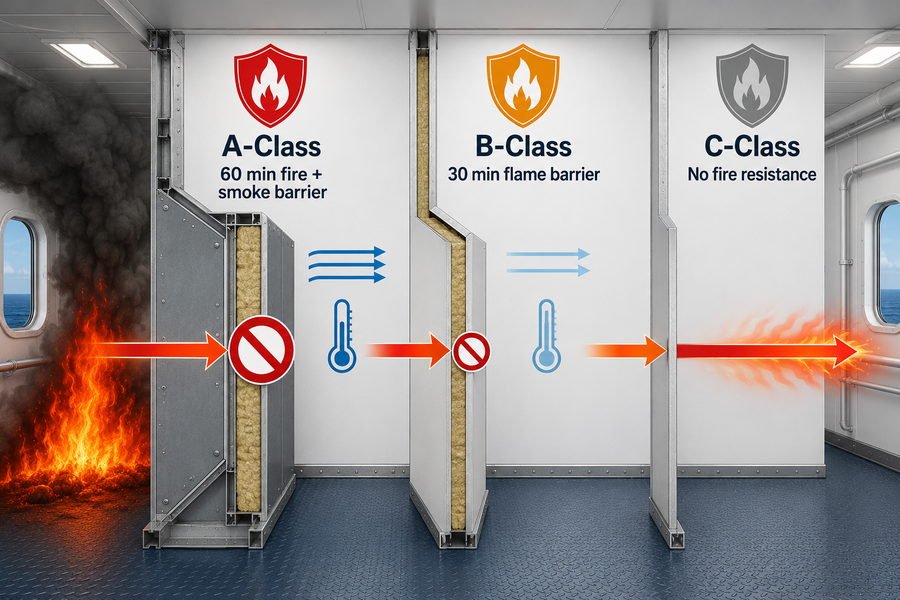
You cannot afford to guess when buying ship interior outfitting products. A mistake in the fire class leads to project delays and failed certifications from classification societies. We will now look closely at every class to help you control your costs and lead times.
What Defines an A-Class Marine Panel Division?
High-risk ship areas need maximum protection. Failing to install correct A-Class panels leads to immediate regulatory failure. Here is exactly what defines an A-Class boundary.
An A-Class division must prevent flame and smoke passage for 60 minutes. Built of steel or equivalent material, it is insulated with non-combustible materials like rockwool so the unexposed side stays below 140°C average or 180°C maximum temperature rise. This is mandatory under IMO FTP Code.
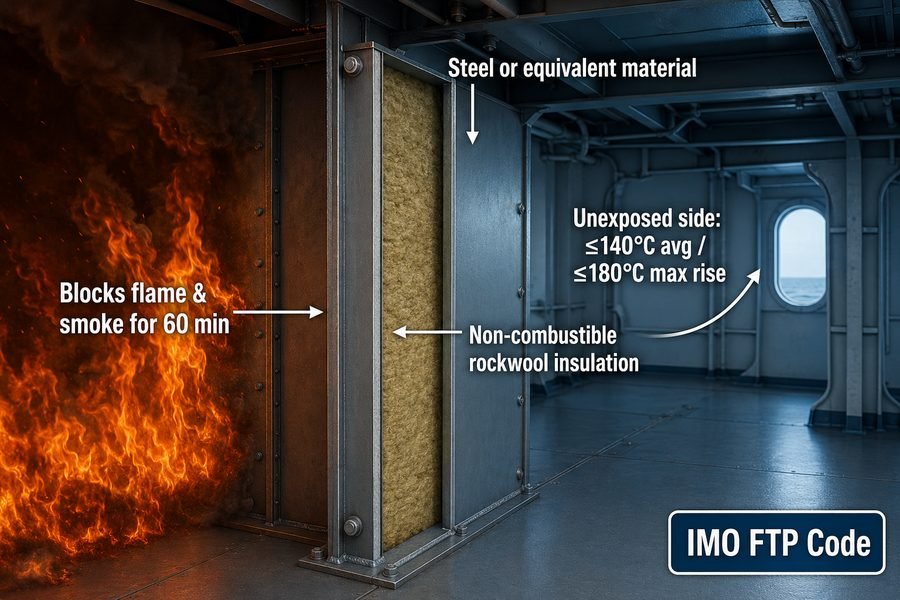
As a marine outfitting specialist at Magellan Marine, I often see buyers make costly errors with A-Class panels. They try to use cheaper materials, but marine safety rules are very strict. The International Maritime Organization (IMO) outlines these rules in the Fire Test Procedures (FTP) Code1. Let us break down exactly what makes a panel an A-Class division.
Structural Requirements for A-Class Marine Panels
An A-Class division is the strongest fire barrier on a ship. According to SOLAS Chapter II-2, these panels must block all flames and smoke from passing through for a full 60 minutes2. This is a hard rule. To achieve this, the core structure must be constructed of steel or an equivalent material3. You cannot use thin aluminum or basic composite plastics for the main structure.
Inside the steel skins, factories use non-combustible insulation. The most common material is high-density marine rockwool. The rockwool usually has a density between 100 kg/m³ and 150 kg/m³. This high density stops the fire from spreading. When you purchase these from suppliers in China or Vietnam, you must ask for the rockwool density certificate. If the density is too low, the panel will melt during the 60-minute fire test.
Temperature Rise Limits for A-Class Boundaries
Blocking flames is only the first job. An A-Class panel must also stop the heat. If a fire burns at 900°C on one side, the other side must stay cool enough so people can touch it and escape. The IMO FTP Code sets exact temperature limits. The average temperature of the unexposed side cannot rise more than 140°C above the original room temperature. Also, no single point on the panel can rise more than 180°C above the original temperature.4
To give you a clear view, I created this table based on standard SOLAS testing data:
| A-Class Requirement | Specific Value / Rule | Authoritative Source |
|---|---|---|
| Flame and Smoke Block Time | 60 minutes | SOLAS Chapter II-2 |
| Core Structural Material | Steel or equivalent | IMO FTP Code 2010 |
| Average Temperature Rise Limit | 140°C | IMO FTP Code 2010 |
| Maximum Point Temperature Rise | 180°C | IMO FTP Code 2010 |
| Common Insulation Used | Rockwool (100-150 kg/m³) | Marine Factory Standards |
When you order A-Class panels, always check these exact numbers. Do not just look at the price. A panel that fails the 140°C average temperature limit will fail the surveyor inspection, ruining your project timeline.
How Does a B-Class Marine Panel Division Differ From C-Class?
Paying for B-Class when C-Class works destroys your budget. But using C-Class where B-Class is required risks lives. Let us compare them clearly.
B-Class marine panels stop flames for 30 minutes and control temperature rise for 0 or 15 minutes. C-Class panels only use non-combustible materials but offer zero fire or smoke containment and have no temperature limits. B-Class protects corridors, while C-Class divides open spaces within the same fire zone.
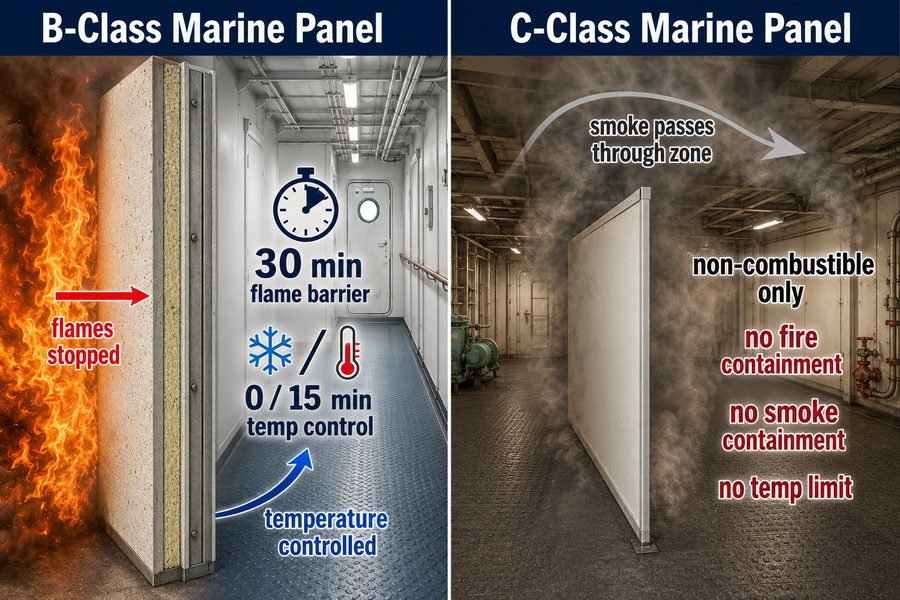
I talk to many procurement officers who want to save money. They ask me if they can replace B-Class panels with C-Class panels. The short answer is no, unless the ship's fire plan allows it. These two classes serve very different purposes in ship interior decoration.
Fire Containment Differences Between B-Class and C-Class Panels
The biggest difference is the time they stop a fire. A B-Class panel is tested to prevent the passage of flames for 30 minutes.5 This gives passengers half an hour to escape a burning cabin. A B-Class panel also has temperature control rules. It must keep the unexposed side from heating up too fast for either 0 minutes or 15 minutes6, depending on its specific grade.
On the other hand, C-Class panels offer zero minutes of fire containment. They do not stop smoke. They do not have any temperature rise limits. The only strict rule for a C-Class panel under SOLAS is that it must be made from non-combustible materials.7 It will not add fuel to a fire, but it will not protect the room next door.
Application Differences for B and C-Class in Shipyards
Because B-Class panels stop flames for 30 minutes, shipyards use them in critical areas. You must install B-Class panels to protect escape corridors, stairway enclosures, and borders between sleeping cabins8. These areas need time for people to run away safely.
C-Class panels are only used to divide open spaces within a zone that is already protected. For example, you use C-Class panels to separate a small bathroom inside a large cabin, or to divide a large dining room into two smaller sections.
Here is a cost and specification comparison to help your purchasing decisions:
| Feature | B-Class Panel | C-Class Panel |
|---|---|---|
| Flame Block Time | 30 minutes | 0 minutes |
| Smoke Protection | Yes | No |
| Temperature Control | 0 or 15 minutes | None |
| Typical Location | Corridors, between cabins | Inside cabins, interior dividers |
| Estimated Cost (Asia) | $25 to $35 per square meter | $15 to $22 per square meter |
If you buy a C-Class panel for $18 per square meter and install it in a corridor, the European surveyor will fail it. You will have to tear it down and buy the $30 B-Class panel. Always follow the exact differences.
Why Are A-Class Marine Panels Graded A-60, A-30, A-15, and A-0?
Not all A-Class zones have the same fire risk. Guessing the wrong grade causes massive budget overruns. Here is why the A-Class system uses four specific grades.
A-Class panels are graded A-60, A-30, A-15, and A-0 based on how many minutes they prevent the unexposed side's temperature from rising 140°C. All block flames for 60 minutes, but insulation thickness changes. A-60 provides 60 minutes of temperature control; A-0 provides zero minutes.
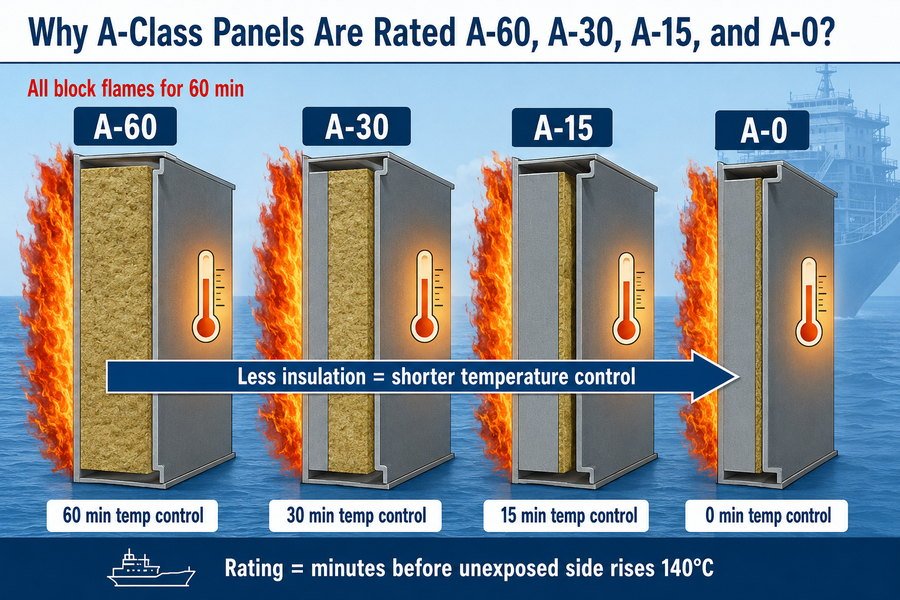
In the marine outfitting business, A-Class is not just one product. It is a family of four products. Many new buyers think A-60 means it blocks fire for 60 minutes, and A-30 means it blocks fire for 30 minutes. This is a very common mistake. Let me explain exactly how SOLAS rules divide these four grades.
Understanding the Temperature Limits of A-60, A-30, A-15, and A-0
Under IMO FTP Code, every single A-Class panel must block flames and smoke for 60 minutes.9 It does not matter if it is A-60 or A-0. The steel structure holds back the actual fire for a full hour. The difference between the grades is entirely about temperature insulation.
The number in the grade tells you exactly how many minutes the panel keeps the unexposed side below the 140°C average temperature rise limit.10
- An A-60 panel stops the heat from rising 140°C for 60 minutes.
- An A-30 panel stops the heat for 30 minutes.
- An A-15 panel stops the heat for 15 minutes.
- An A-0 panel stops flames for 60 minutes, but offers zero minutes of temperature protection. The unexposed side gets hot immediately.
Material Thickness and Costs for A-Class Grades
Because the grades have different temperature rules, factories change the rockwool insulation thickness inside the panel11. This affects your shipping volume and your product cost. An A-60 panel uses very thick, high-density rockwool. An A-0 panel might just be bare steel or use very thin insulation.
If you use A-60 everywhere to be safe, you will waste money and lose space inside the ship. You use A-60 near high-risk areas like the engine room.12 You use A-0 in low-risk boundaries where heat transfer is not a deadly threat.
Here is a breakdown of the four grades:
| Grade | Flame Block Time | Time Below 140°C Rise | Typical Panel Thickness | Est. Price (Asia) |
|---|---|---|---|---|
| A-60 | 60 minutes | 60 minutes | 50mm to 100mm | $40 - $55 / sqm |
| A-30 | 60 minutes | 30 minutes | 30mm to 50mm | $35 - $45 / sqm |
| A-15 | 60 minutes | 15 minutes | 25mm to 30mm | $30 - $40 / sqm |
| A-0 | 60 minutes | 0 minutes | Bare steel or <25mm | $25 - $35 / sqm |
You must read the shipyard specifications. If the drawing asks for A-15, buy A-15. Upgrading to A-60 adds extra weight, reduces cabin space, and hurts your project profit.
What Does B-15 Versus B-0 Mean for Marine Ceiling Panels?
Interior cabin walls look the same but perform differently. Mixing up B-15 and B-0 panels fails interior inspections. Let us clear up this exact difference.
B-15 and B-0 panels both stop flames for 30 minutes. B-15 panels also keep the unexposed side's temperature rise below 140°C for 15 minutes. B-0 panels provide zero minutes of temperature insulation. You use B-15 for critical corridor ceilings and B-0 between adjacent low-risk cabins.
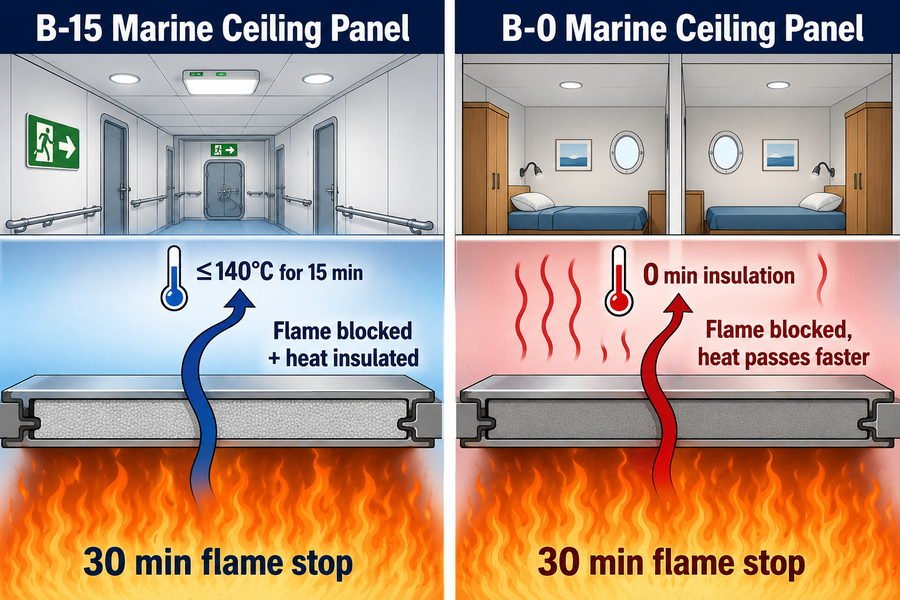
When you are buying ceilings for ship interior decoration, you will almost always buy B-Class panels. However, factories will ask you if you need B-15 or B-0. If you cannot communicate this clearly, you will receive the wrong product. Just like A-Class panels, the number relates to heat, not flames.
Temperature Control Variances in B-15 and B-0 Ceilings
By SOLAS regulations, both B-15 and B-0 marine ceiling panels will stop open flames and smoke from passing through for 30 minutes13. The core difference is the thermal insulation performance.
A B-15 ceiling panel has thicker rockwool inside. It ensures that the temperature on the safe side of the ceiling does not rise more than 140°C on average for a full 15 minutes14. This keeps the room above cool enough for people to escape.
A B-0 ceiling panel also blocks flames for 30 minutes, but it provides zero minutes of temperature protection15. The heat transfers through the metal quickly. This means the room on the other side will get very hot, very fast.
Where to Install B-15 versus B-0 Panels
Because B-15 panels protect against heat, shipyards install them in critical escape routes. If you are outfitting a corridor where passengers will run during an emergency, you must use B-15 ceilings.16 The cool ceiling prevents the corridor from becoming an oven.
You use B-0 ceilings in areas with lower risks. For example, if you are installing a ceiling between two standard passenger cabins that share the same fire zone, B-0 is usually accepted.
Here is a quick reference table for your procurement work:
| Specification | B-15 Ceiling Panel | B-0 Ceiling Panel |
|---|---|---|
| Flame Block Time | 30 minutes | 30 minutes |
| Temp Rise Below 140°C | 15 minutes | 0 minutes |
| Typical Location | Corridors, Escape routes | Between adjacent cabins |
| Core Material | Dense rockwool | Lighter rockwool or air gap |
| Weight impact | Heavier | Lighter |
When you negotiate prices with Asian suppliers, make sure they quote the correct type. A B-15 ceiling requires more material and costs more. Do not accept a B-0 panel quote if your project requires B-15 performance.
When Is C-Class Division Sufficient for Marine Interior Panels?
Over-engineering interiors wastes serious money. Knowing exactly when to use cheap C-Class panels saves your profit margin without breaking safety rules.
C-Class divisions are strictly sufficient when separating spaces within a single, continuous A-Class or B-Class enclosure that lacks high fire risks. They are used for interior bathroom walls, wardrobe partitions, or open lounge dividers. They must be non-combustible but have zero fire or smoke containment ratings.
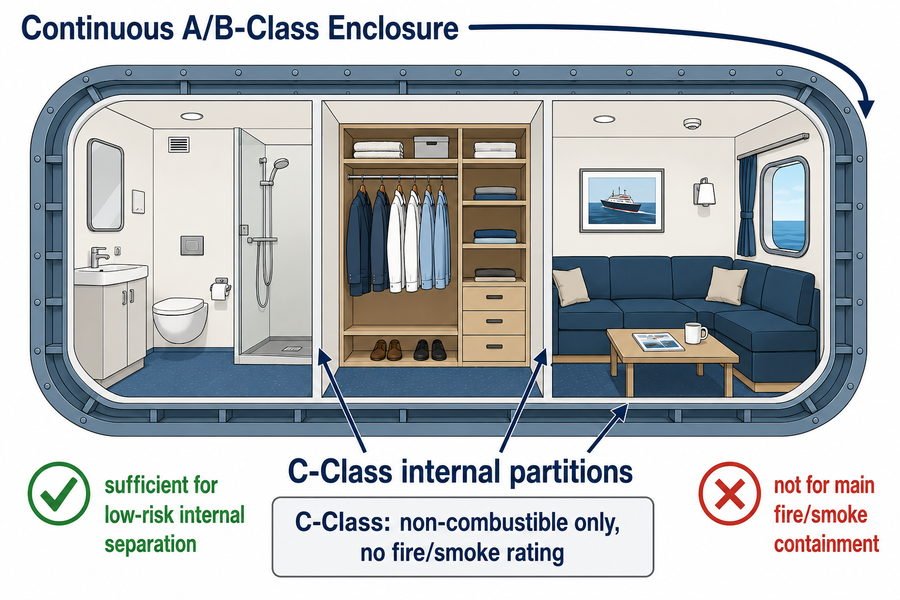
As a procurement officer, your goal is to find high-quality marine outfitting suppliers with low prices. The best way to lower your overall cost is to stop buying expensive fire-rated panels for areas that do not need them. C-Class panels are your best tool for saving money, as long as you know the rules.
Defining Allowable Zones for C-Class Marine Panels
SOLAS rules allow C-Class panels only in very specific situations17. You can use C-Class divisions when you are separating spaces that are already inside a safe, protected box. If you have a large cabin surrounded entirely by strong A-Class or B-Class walls, the walls inside that cabin can be C-Class.
Because C-Class panels offer zero fire containment and zero smoke containment18, they are perfect for low-risk interior dividers. You should use them for interior bathroom walls (wet units), wardrobe partitions, or dividers inside a large dining room. They do not need to stop a fire because the outer B-Class walls are already doing that job.
Material Specifications for Non-Combustible C-Class Panels
Even though C-Class panels have zero fire ratings, you cannot build them out of wood or standard plastic. SOLAS mandates that they must be made of non-combustible materials19. If a fire touches them, they must not add fuel to the flames or release toxic smoke.
Factories often use aluminum honeycomb, thin calcium silicate boards, or very light steel with air gaps to make C-Class panels. These materials are cheap, light, and easy to install.
Here is a table showing the best places to use C-Class panels to save your budget:
| Space to Divide | Required Class | Reason / Benefit |
|---|---|---|
| En-suite Bathroom Wall | C-Class | No fire risk inside; saves weight and money. |
| Wardrobe / Closet | C-Class | Just needs to hold clothes; requires thin panels. |
| Large Lounge Divider | C-Class | Decorative separation within one fire zone. |
| Cabin to Corridor | B-Class (Do NOT use C) | High risk; C-Class is illegal here. |
By utilizing C-Class panels correctly, you reduce the total weight of the ship and cut your material costs by nearly 40% in those specific areas20. Just ensure the shipyard's drawing allows it.
How Does a Shipyard Project Manager Read A/B/C-Class Labels on Marine Panel Drawings?
Misreading a ship's fire control plan leads to ordering the wrong panels. This ruins your lead time and budget. Here is how you read these labels correctly.
Shipyard managers read panel drawings by checking the Fire Control Plan. A-Class boundaries are thick red lines, B-Class boundaries are thin or dashed red lines, and C-Class boundaries are standard black lines. Symbols like "A-60" sit directly on the line to indicate the exact insulation requirement.
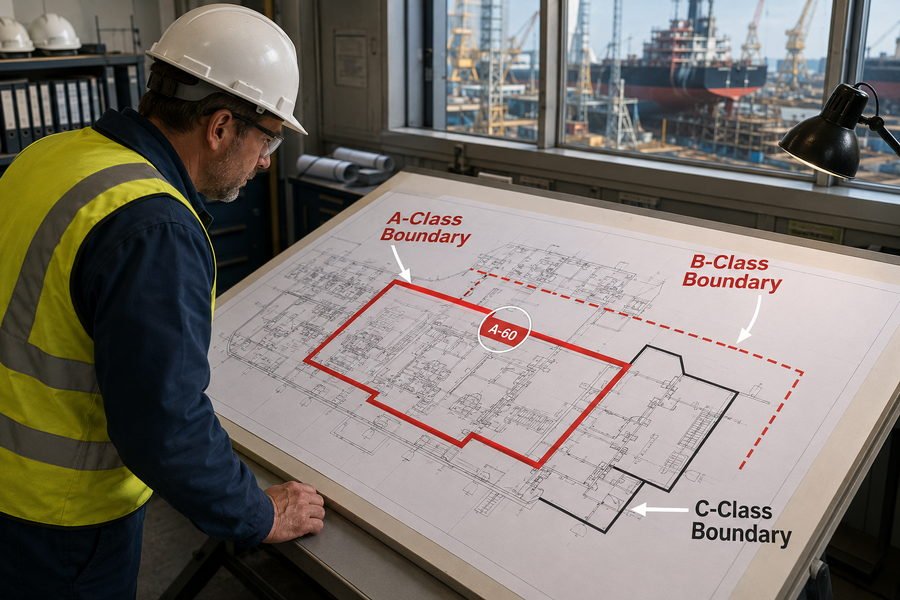
When you undertake interior decoration projects for large shipyards in Europe or the United States, they will send you a Fire Control Plan (FCP)21. If you cannot read this drawing, you cannot make an accurate purchasing list. I have helped many clients fix orders because they read the lines wrong.
Identifying Fire Class Line Types on Marine Drawings
Marine engineers use a universal visual language based on IMO Resolution A.952(23)22. When you look at the deck plan, you will see different types of lines. These lines tell you exactly what class of panel you need to buy.
A-Class boundaries23 are the most important. They are always drawn as thick red lines. When you see a thick red line separating the engine room from the accommodation area, you know you need heavy steel A-Class panels.
B-Class boundaries24 protect corridors and cabins. These are drawn as thin red lines or dashed red lines. C-Class boundaries are the least strict. They are usually drawn as standard thin black lines, showing basic partitions inside a cabin.
Interpreting Specific Rating Labels for Shipyard Orders
Just seeing a thick red line is not enough. You also need to know the specific grade, like A-60 or A-0. Engineers place text symbols directly on or next to the lines. You will see a box or text saying "A-60", "B-15", or "A-0".
When you prepare your material list for your suppliers in China, you must match the line length to the symbol. If you measure 50 meters of a dashed red line with a "B-15" symbol, you must order 50 linear meters of B-15 wall panels.
Here is a guide to help you translate shipyard drawings into your purchasing orders:
| Drawing Symbol / Line | Meaning | What You Must Order |
|---|---|---|
| Thick Red Line + "A-60" | Maximum fire boundary | A-60 rated panels (High density rockwool) |
| Thick Red Line + "A-0" | Fire block, no heat block | A-0 rated panels (Basic steel core) |
| Thin/Dashed Red Line + "B-15" | Corridor/Cabin boundary | B-15 rated panels (Moderate insulation) |
| Thin Black Line | Standard interior partition | C-Class panels (Non-combustible core) |
Teach your team to read these lines carefully. If you confuse a B-15 dashed red line with an A-15 thick red line, your budget will fail. Read the drawings, verify the lines, and send exact requirements to your Asian suppliers.
Conclusion
Understanding marine A, B, and C-Class divisions ensures you buy the right panels, meet SOLAS rules, and protect your shipyard's budget. Buy smart and build safe.
-
"[PDF] RESOLUTION MSC.307(88) (adopted on 3 December 2010 ...", https://wwwcdn.imo.org/localresources/en/KnowledgeCentre/IndexofIMOResolutions/MSCResolutions/MSC.307(88).pdf. IMO Resolution MSC.307(88), the 2010 FTP Code, sets out standardized fire-test methods and acceptance criteria used under SOLAS Chapter II-2 for fire safety materials and divisions on ships. Evidence role: definition; source type: institution. Supports: The IMO Fire Test Procedures Code outlines fire-testing rules relevant to A-Class marine panels.. ↩
-
"[PDF] recommendation for fire test procedures for “a” and “b” class ...", https://wwwcdn.imo.org/localresources/en/KnowledgeCentre/IndexofIMOResolutions/AssemblyDocuments/A.163(ES.IV).pdf. SOLAS Chapter II-2 defines A-class divisions as divisions formed by bulkheads and decks that prevent the passage of smoke and flame to the end of a one-hour standard fire test. Evidence role: definition; source type: institution. Supports: A-Class divisions must prevent flame and smoke passage for 60 minutes during the standard fire test.. ↩
-
"Are Marine Fire Divisions the Same as Marine Panel Ratings?", https://magellanmarinetech.com/are-marine-fire-divisions-same-as-marine-panel-ratings/. SOLAS Chapter II-2 describes A-class divisions as divisions constructed of steel or other equivalent material, establishing the structural-material requirement for this fire-resisting classification. Evidence role: definition; source type: institution. Supports: The main structure of an A-Class division must be steel or an equivalent material.. ↩
-
"[PDF] RESOLUTION MSC.307(88) (adopted on 3 December 2010 ...", https://wwwcdn.imo.org/localresources/en/KnowledgeCentre/IndexofIMOResolutions/MSCResolutions/MSC.307(88).pdf. SOLAS Chapter II-2 and the FTP Code specify that A-class divisions must be insulated so that the average temperature rise on the unexposed side does not exceed 140°C and the temperature rise at any one point does not exceed 180°C during the relevant fire-resistance period. Evidence role: mechanism; source type: institution. Supports: A-Class boundaries are subject to 140°C average and 180°C maximum unexposed-side temperature-rise limits.. Scope note: The limits are applied according to the specific A-class rating period, such as A-0, A-15, A-30, or A-60, rather than as a single universal insulation duration for every A-class product. ↩
-
"[PDF] recommendation for fire test procedures for “a” and “b” class ...", https://wwwcdn.imo.org/localresources/en/KnowledgeCentre/IndexofIMOResolutions/AssemblyDocuments/A.163(ES.IV).pdf. SOLAS Chapter II-2 defines “B” class divisions as divisions constructed to prevent the passage of flame to the end of the first half-hour of the standard fire test. Evidence role: definition; source type: institution. Supports: B-Class panels are required to resist flame passage for 30 minutes under the SOLAS fire-test definition.. Scope note: This supports the regulatory definition for SOLAS-rated divisions; an individual product still needs its own approval certificate. ↩
-
"What Is the Purpose and Scope of the IMO FTP Code? - Magellan ...", https://magellanmarinetech.com/what-purpose-scope-of-imo-ftp-code/. SOLAS and the IMO Fire Test Procedures Code classify B-class divisions by insulation performance, including B-15 and B-0 ratings based on temperature-rise criteria on the unexposed face during the standard fire test. Evidence role: definition; source type: institution. Supports: B-Class panel grades include B-15 and B-0 categories tied to temperature-rise limits on the unexposed side.. Scope note: The source supports the rating framework and temperature-rise criterion; it may not use the article’s simplified phrase “0 minutes of temperature control.” ↩
-
"[PDF] MSC.99(73) - International Maritime Organization", https://wwwcdn.imo.org/localresources/en/KnowledgeCentre/IndexofIMOResolutions/MSCResolutions/MSC.99(73).pdf. SOLAS Chapter II-2 defines “C” class divisions as divisions constructed of approved non-combustible materials and states that they need meet no requirements concerning the passage of smoke and flame or temperature rise. Evidence role: definition; source type: institution. Supports: C-Class divisions are defined primarily by non-combustible construction and are not assigned flame, smoke, or insulation-performance requirements under the SOLAS definition.. Scope note: This supports the SOLAS class definition; actual installation approval can still depend on the ship type, location, flag administration, and approved fire-control plan. ↩
-
"[PDF] RESOLUTION A.327(IX) adopted on 12 November 1975 ...", https://wwwcdn.imo.org/localresources/en/KnowledgeCentre/IndexofIMOResolutions/AssemblyDocuments/A.327(9).pdf. SOLAS Chapter II-2 Regulation 9 uses tables of minimum fire integrity for bulkheads and decks between accommodation, service, control, stairway, and corridor spaces, showing that these locations are subject to prescribed structural fire-protection ratings rather than discretionary decorative choices. Evidence role: general_support; source type: institution. Supports: Fire divisions around corridors, stairways, and cabin boundaries are governed by SOLAS structural fire-protection tables and cannot be freely downgraded to C-Class panels.. Scope note: The exact minimum rating varies by vessel type, adjacent space category, and approved fire-control plan, so the source supports the regulatory basis but not every simplified example in isolation. ↩
-
"What Is the Purpose and Scope of the IMO FTP Code? - Magellan ...", https://magellanmarinetech.com/what-purpose-scope-of-imo-ftp-code/. The IMO FTP Code/SOLAS definition of A-class divisions requires steel or equivalent divisions to prevent the passage of smoke and flame to the end of a one-hour standard fire test, supporting the 60-minute integrity requirement for A-class assemblies. Evidence role: definition; source type: institution. Supports: Every A-Class panel must block flames and smoke for 60 minutes under IMO FTP Code.. Scope note: The requirement applies to approved divisions as tested assemblies; an individual panel component is not automatically compliant unless certified in that assembly. ↩
-
"[PDF] RESOLUTION MSC.307(88) (adopted on 3 December 2010 ...", https://wwwcdn.imo.org/localresources/en/KnowledgeCentre/IndexofIMOResolutions/MSCResolutions/MSC.307(88).pdf. SOLAS/FTP Code criteria for A-class divisions classify A-60, A-30, A-15, and A-0 by the time during which the unexposed face remains below the specified temperature-rise limits, including the 140°C average rise criterion. Evidence role: definition; source type: institution. Supports: The number in an A-class grade corresponds to the minutes the unexposed side remains below the 140°C average temperature rise limit.. Scope note: The full criterion also includes a maximum temperature rise at any single point, so the 140°C average limit is only part of the insulation requirement. ↩
-
"How to choose the right marine wall panels for marine interior ...", https://magellanmarinetech.com/how-choose-right-marine-wall-panels-for-marine-interior-projects/. Fire-test and marine insulation literature describes mineral wool/rock wool thickness and density as variables that affect thermal insulation performance in fire-rated divisions, supporting the mechanism by which manufacturers vary insulation to meet different A-class ratings. Evidence role: mechanism; source type: paper. Supports: Factories change rockwool insulation thickness inside panels to meet different A-class temperature insulation rules.. Scope note: This supports the general engineering relationship between insulation design and fire rating; it does not verify the practices or specifications of any particular factory. ↩
-
"[PDF] RESOLUTION A.122(V) adopted on 25 October 1967 ...", https://wwwcdn.imo.org/localresources/en/KnowledgeCentre/IndexofIMOResolutions/AssemblyDocuments/A.122(5).pdf. SOLAS fire-protection provisions classify machinery spaces as higher fire-risk areas and prescribe fire-rated boundaries according to space categories and separation tables, providing regulatory context for using higher A-class divisions around engine or machinery spaces. Evidence role: general_support; source type: institution. Supports: A-60 is commonly used near high-risk areas such as engine rooms.. Scope note: Exact required ratings depend on vessel type, adjacent space category, flag administration interpretation, and the approved fire-control plan; the source gives context rather than a universal rule for every engine-room boundary. ↩
-
"[PDF] recommendation for fire test procedures for “a” and “b” class ...", https://wwwcdn.imo.org/localresources/en/KnowledgeCentre/IndexofIMOResolutions/AssemblyDocuments/A.163(ES.IV).pdf. The IMO fire-test framework for B-class divisions defines them as divisions constructed to prevent the passage of flame for the first half hour of the standard fire test, which supports the stated 30-minute flame-barrier function for both B-0 and B-15 classes. Evidence role: definition; source type: institution. Supports: SOLAS/IMO B-0 and B-15 ceiling panels are required to prevent flame passage for 30 minutes.. Scope note: The source supports the regulatory classification, not the performance of any specific manufacturer’s ceiling panel. ↩
-
"[PDF] RESOLUTION MSC.307(88) (adopted on 3 December 2010 ...", https://wwwcdn.imo.org/localresources/en/KnowledgeCentre/IndexofIMOResolutions/MSCResolutions/MSC.307(88).pdf. The IMO/SOLAS definition of B-class divisions states that the unexposed-side average temperature rise must not exceed 140°C above the original temperature during the specified insulation period; for a B-15 division, that period is 15 minutes. Evidence role: definition; source type: institution. Supports: A B-15 ceiling has a 15-minute insulation rating based on limiting average unexposed-side temperature rise to 140°C.. Scope note: The formal criterion is generally expressed as temperature rise above the initial temperature, and complete standards may also specify maximum single-point temperature limits. ↩
-
"[PDF] RESOLUTION A.754(18) adopted on 4 November 1993 ...", https://wwwcdn.imo.org/localresources/en/KnowledgeCentre/IndexofIMOResolutions/AssemblyDocuments/A.754(18).pdf. IMO/SOLAS fire division nomenclature uses the number after the class letter to indicate the insulation period in minutes, so B-0 denotes a B-class division with no rated insulation period beyond the fire-integrity requirement. Evidence role: definition; source type: institution. Supports: B-0 indicates zero minutes of rated thermal insulation performance while retaining the B-class flame-integrity requirement.. Scope note: This supports the meaning of the B-0 rating; actual heat transfer speed depends on panel construction, installation, and test conditions. ↩
-
"[PDF] resolution msc.27(61) - International Maritime Organization", https://wwwcdn.imo.org/localresources/en/KnowledgeCentre/IndexofIMOResolutions/MSCResolutions/MSC.27(61).pdf. SOLAS fire-safety construction tables and guidance identify corridors and escape routes as protected spaces subject to specified fire-integrity requirements, and in many passenger-ship arrangements the required boundary rating is B-15 or higher depending on adjacent spaces. Evidence role: general_support; source type: institution. Supports: Escape-route corridors often require B-15-rated boundaries under SOLAS-based fire-safety arrangements.. Scope note: The exact required rating depends on vessel type, space category, adjacent compartments, flag-state interpretation, and the approved fire-control plan; the source would support the regulatory context rather than every corridor case categorically. ↩
-
"[PDF] Supplement - International Maritime Organization", https://wwwcdn.imo.org/localresources/en/publications/Documents/Supplements/English/QF110E_122015.pdf. SOLAS chapter II-2, regulation 9 sets minimum fire-integrity requirements for bulkheads and decks by space category and defines C-class divisions, supporting the point that C-class panels are permissible only where the applicable fire-boundary tables allow them. Evidence role: expert_consensus; source type: institution. Supports: SOLAS rules allow C-Class panels only in very specific situations.. Scope note: The regulation establishes classification and placement requirements, but the permissibility of any specific installation depends on the vessel type, space category, flag administration, and approved fire-control drawings. ↩
-
"What Is the Purpose and Scope of the IMO FTP Code? - Magellan ...", https://magellanmarinetech.com/what-purpose-scope-of-imo-ftp-code/. SOLAS definitions distinguish C-class divisions from A- and B-class divisions by not assigning them a specified fire-resistance time, while requiring construction from approved non-combustible materials; this supports the claim that C-class panels do not provide rated fire containment in the way A- and B-class divisions do. Evidence role: definition; source type: institution. Supports: C-Class panels offer zero fire containment and zero smoke containment.. Scope note: SOLAS does not usually phrase the point as “zero smoke containment”; that wording should be supported only as an interpretation unless the cited source explicitly discusses smoke-tightness requirements. ↩
-
"Summary of SOLAS chapter II-2 - International Maritime Organization", https://www.imo.org/en/ourwork/safety/pages/summaryofsolaschapterii-2-default.aspx. SOLAS chapter II-2 defines C-class divisions as divisions constructed of approved non-combustible materials, supporting the requirement that C-class panels cannot be made from ordinary combustible materials. Evidence role: definition; source type: institution. Supports: SOLAS mandates that C-Class panels must be made of non-combustible materials.. ↩
-
"How to choose the right marine wall panels for marine interior ...", https://magellanmarinetech.com/how-choose-right-marine-wall-panels-for-marine-interior-projects/. Published studies or procurement analyses comparing lightweight non-fire-rated interior marine panels with fire-rated A- or B-class panels may provide contextual support that lower-specification interior divisions can reduce material cost, but the cited source should be used only if it reports a comparable percentage or cost model. Evidence role: statistic; source type: paper. Supports: Using C-Class panels correctly can cut material costs by nearly 40% in the specific areas where they are permitted.. Scope note: The exact “nearly 40%” figure is likely dependent on panel type, supplier, certification, installation labor, and project location; without a directly comparable cost study, the claim should be softened or qualified. ↩
-
"Summary of SOLAS chapter II-2 - International Maritime Organization", https://www.imo.org/en/ourwork/safety/pages/summaryofsolaschapterii-2-default.aspx. SOLAS fire-safety requirements describe fire control plans as shipboard plans that identify fire-control stations, fire sections, detection and alarm arrangements, and fire-extinguishing appliances, supporting the relevance of the FCP to interpreting fire-rated areas on a vessel. Evidence role: definition; source type: institution. Supports: Large shipyard interior-decoration projects use a Fire Control Plan as a key drawing for understanding fire-related requirements.. Scope note: This supports the regulatory purpose and contents of an FCP, but not the commercial practice that every European or U.S. shipyard sends it to decoration contractors. ↩
-
"[PDF] Resolution A.952(23) Adopted on 5 December 2003 (Agenda item ...", https://wwwcdn.imo.org/localresources/en/KnowledgeCentre/IndexofIMOResolutions/AssemblyDocuments/A.952(23).pdf. IMO Resolution A.952(23) provides graphical symbols for shipboard fire control plans, giving contextual support for the article’s statement that marine drawings use standardized visual symbols for fire-safety information. Evidence role: historical_context; source type: institution. Supports: Marine fire-control drawings use a standardized visual language based on IMO Resolution A.952(23).. Scope note: The resolution standardizes symbols for fire control plans; it may not prescribe every shipyard’s CAD color, line-weight, or procurement notation practice. ↩
-
"[PDF] RESOLUTION MSC.307(88) (adopted on 3 December 2010 ...", https://wwwcdn.imo.org/localresources/en/KnowledgeCentre/IndexofIMOResolutions/MSCResolutions/MSC.307(88).pdf. SOLAS defines A-class divisions as divisions formed by steel or equivalent material that prevent the passage of smoke and flame for one hour and, depending on rating, limit temperature rise for specified periods such as A-0 through A-60. Evidence role: definition; source type: institution. Supports: A-Class boundaries indicate high fire-resistance divisions and ratings such as A-60 or A-0.. Scope note: This supports the meaning of A-class fire divisions and ratings, but not the article’s specific purchasing instruction that all such boundaries require a particular panel construction. ↩
-
"What Is the Purpose and Scope of the IMO FTP Code?", https://magellanmarinetech.com/what-purpose-scope-of-imo-ftp-code/. SOLAS defines B-class divisions as divisions constructed to prevent flame passage for the first half hour and to meet insulation criteria for ratings such as B-0 and B-15, supporting the distinction between B-class and A-class fire divisions. Evidence role: definition; source type: institution. Supports: B-Class boundaries have distinct fire-resistance criteria and include ratings such as B-15.. Scope note: This supports the regulatory meaning of B-class ratings, but not the article’s generalized statement that they are always represented by thin or dashed red lines on every shipyard drawing. ↩