Buying marine panels overseas is risky if suppliers miss SOLAS updates. Your ship fails inspection, costing thousands in delays. Here is how I verify suppliers stay ahead of maritime laws.
Overseas buyers can verify a marine wall and ceiling panel supplier tracks SOLAS amendments by requesting their internal compliance update schedule, checking for valid MED (Marine Equipment Directive) Module B certificates issued within the last 12 months, and asking for a formal SOLAS amendment tracking statement.
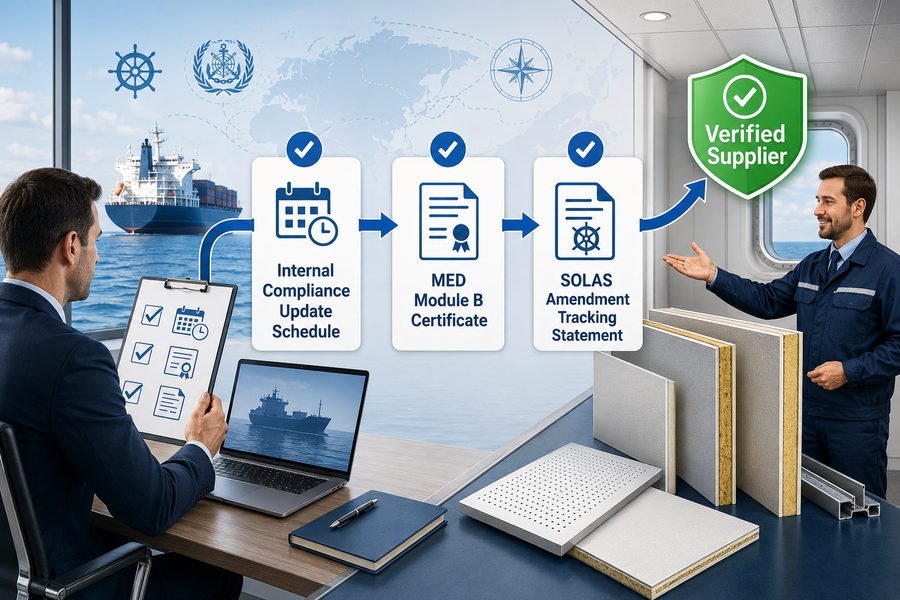
Ensuring your supplier is up-to-date with SOLAS is not just about paperwork; it is about ship safety. Let us look at the exact steps you must take to find a reliable factory that never misses a rule change, keeping your project moving forward without any stressful port detentions.
What Should Procurement Ask Marine Panel Suppliers About SOLAS Amendment Tracking?
Asking weak questions hides a supplier's compliance gaps. You might buy outdated panels, leading to project failure. Ask these precise questions to test if they truly follow IMO rules.
Procurement must ask three key questions: “What is your process for reviewing IMO Maritime Safety Committee (MSC) circulars?”, “Can you provide the latest FTP Code test reports for your B-15 panels?”, and “Who is your designated Class Society contact for certification renewals?” to ensure complete SOLAS tracking.
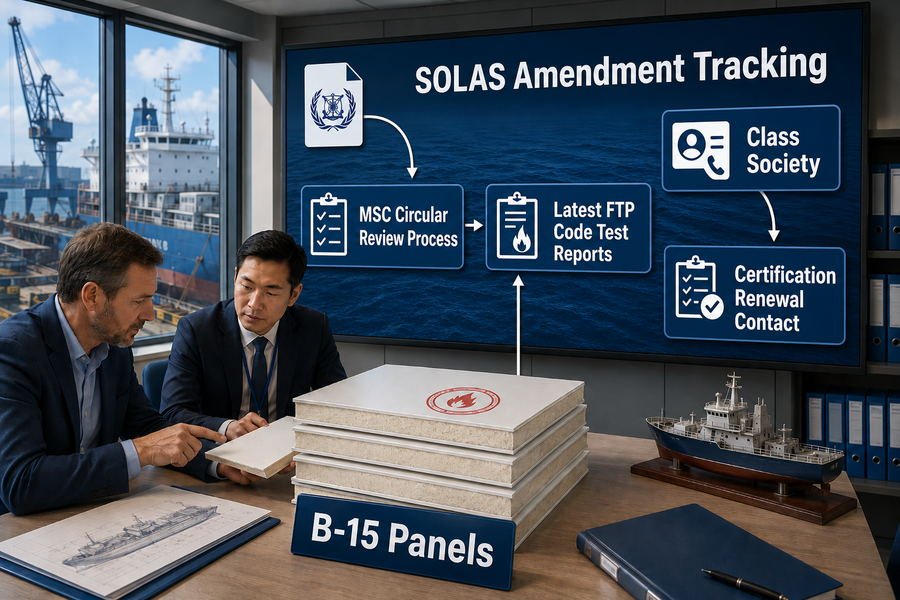
These three questions separate real marine outfitting factories from simple trading companies. Good suppliers have answers ready. Bad suppliers avoid these questions.
Question 1: Reviewing IMO Maritime Safety Committee (MSC) Circulars
You must ask the supplier how they read new IMO rules. The IMO changes the Safety of Life at Sea (SOLAS) rules often. They send these changes through MSC circulars1. A good supplier has an ISO 9001 quality system. This system tells their engineers when a new rule comes out. I always ask the factory manager to show me their rule-checking log. If they do not know what an MSC circular is, you should not buy from them.
Question 2: Providing the Latest FTP Code Test Reports for B-15 Panels
You must ask for real fire test reports. Do not just look at a short certificate. You need the full test report based on the 2010 FTP Code (IMO Resolution MSC.307(88)). For a B-15 marine wall panel, the test takes 30 minutes. The oven reaches about 840°C. The unexposed side of the panel must stay below an average temperature rise of 140°C for 15 minutes2. According to DNV rules, test reports are a key part of the approval process. If the factory cannot give you a report from the last 5 years, their products might be outdated.
Question 3: Identifying the Designated Class Society Contact
You need to know who checks the factory. Ask the supplier for the name and email of their contact at the classification society3. The classification society is the group that gives the safety certificate. Big groups include ABS, DNV, and Lloyd's Register. A real manufacturer talks to these inspectors every year. If the supplier refuses to give you a contact name, they might be using fake certificates.
| Procurement Question | Good Supplier Answer | Bad Supplier Answer |
|---|---|---|
| How do you review MSC circulars? | "Our ISO 9001 system alerts us. Here is our log." | "We just wait for the certificate to expire." |
| Can I see the 2010 FTP Code test report? | "Yes, here is the full 40-page SGS lab report." | "The certificate is enough. We cannot show the report." |
| Who is your Class Society contact? | "Mr. Smith at DNV, here is his direct email." | "That is a company secret." |
Which Red Flags Show a Marine Wall Panel Supplier Missed SOLAS Updates?
Missing red flags during vendor selection leads to disaster. Your imported panels will fail classification society checks. Look for these clear warning signs to reject outdated suppliers immediately.
Four critical red flags indicate missed SOLAS updates: expired Type Approval certificates (over 5 years old), references to the outdated 1998 FTP Code instead of the 2010 FTP Code, inability to show a recent factory audit report, and lacking low flame spread certifications for surface finishes.
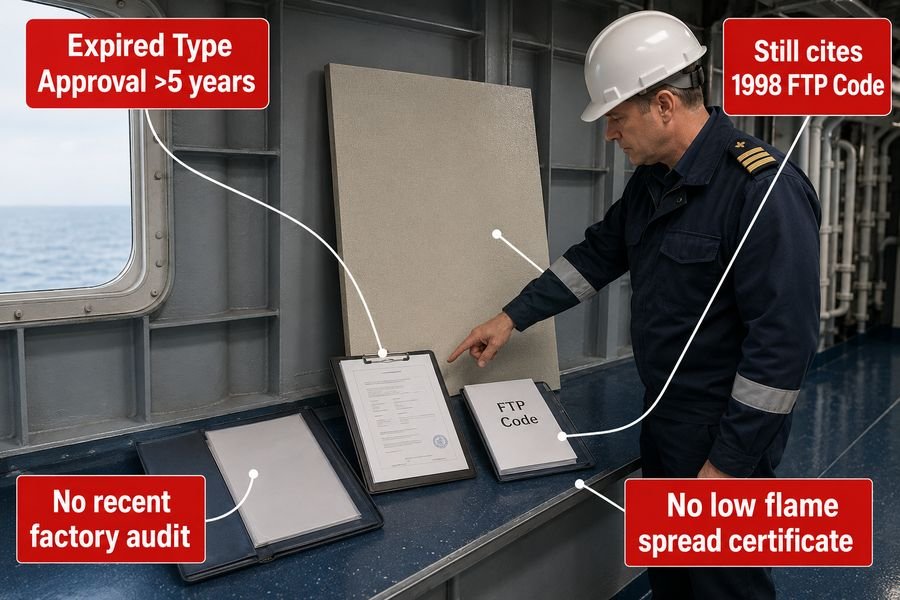
If you see even one of these red flags, stop the purchase. It is better to spend more time finding a good supplier than to buy bad materials that fail the final inspection.
Red Flag 1: Expired Type Approval Certificates Over 5 Years Old
The first thing you check is the date on the Type Approval certificate. According to the International Association of Classification Societies (IACS), a Type Approval certificate is only valid for a maximum of 60 months (5 years)4. If the certificate is older than 5 years, it is useless. The factory missed the renewal. This means they missed any SOLAS updates during that time. I always check the expiry date before I even look at the price.
Red Flag 2: Referencing the Outdated 1998 FTP Code
Look closely at the testing standard written on the certificate. If you see "1998 FTP Code", you must walk away. The IMO replaced this standard with the 2010 FTP Code (MSC.307(88)), which became mandatory for all ships built after July 20125. If a supplier still gives you 1998 papers in 2026, their product design is 14 years old. They do not track SOLAS amendments at all.
Red Flag 3: Inability to Show a Recent Factory Audit Report
Marine panel factories must pass an audit every 12 months6. This is called the MED Module D (Production Quality Assurance) audit. The class surveyor goes to the factory to make sure they build the panels exactly like the tested sample. If the supplier cannot show you an audit report from the last 12 months, it means no inspector has checked their factory. Their panels might be built with cheap, unapproved materials.
Red Flag 4: Lacking Low Flame Spread Certifications for Surface Finishes
A marine wall panel has a core and a surface finish, like PVC or melamine. SOLAS rules require the surface to have low flame spread characteristics7. According to ISO 1716 standards, the maximum gross calorific value for these finishes must not exceed 45 MJ/m2. If the supplier gives you a fire rating for the core but no certificate for the surface finish, they are failing SOLAS rules. A burning surface finish spreads fire fast, even if the core is safe.
| Compliance Document | Correct Current Standard | Warning Red Flag |
|---|---|---|
| Type Approval Certificate | Valid within the last 60 months | Expired or older than 5 years |
| Fire Test Standard | 2010 FTP Code (IMO MSC.307(88)) | 1998 FTP Code |
| Factory Audit Report | MED Module D within last 12 months | No recent audit or audit older than 1 year |
| Surface Finish Test | Low flame spread (max 45 MJ/m2) | No specific test for the decorative finish |
How Can Shipowners Confirm Marine Ceiling Panel Quotes Match the Latest SOLAS Rules?
A cheap quote often means outdated standards. You think you saved money, but replacing non-compliant ceilings costs double. Here is how to cross-check quotes against current maritime safety laws.
Shipowners can confirm quote compliance by verifying three details: the quote explicitly lists the current SOLAS Chapter II-2 regulations, includes the specific A-Class or B-Class fire rating (like B-0 or B-15), and prices in the latest non-combustibility tests required by IMO Resolution MSC.307(88).
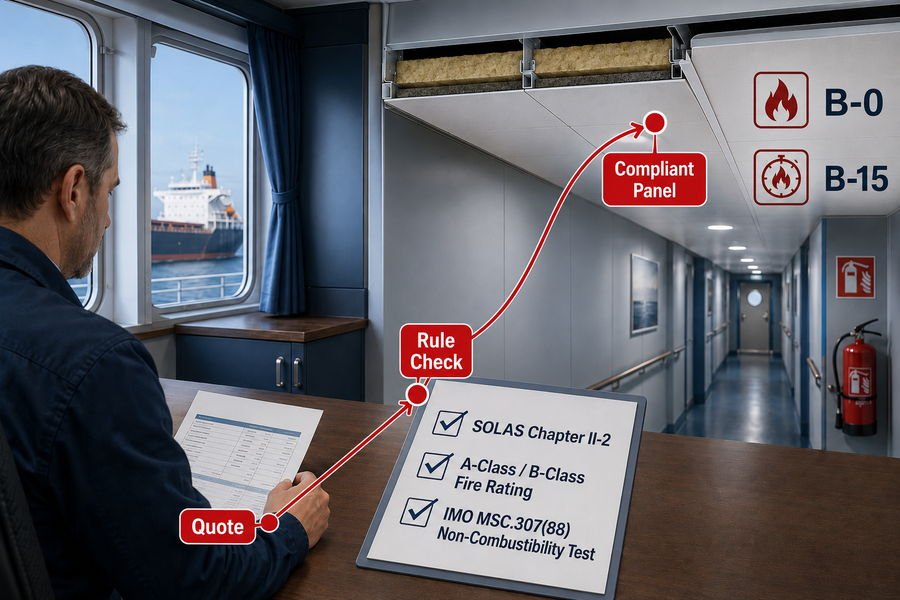
When I review a quote for a client, I never just look at the total dollar amount. I read the item descriptions carefully. The text on the quote tells you if the supplier knows the law.
Detail 1: Listing Current SOLAS Chapter II-28 Regulations on Quotes
The quote must mention SOLAS Chapter II-2. This is the chapter that covers fire protection, fire detection, and fire extinction. If the quote just says "marine ceiling panel," that is not good enough. It must say "Marine ceiling panel complying with SOLAS Chapter II-2." This writing binds the supplier to the maritime law. If the panel fails, you can use the quote to get your money back.
Detail 2: Specifying Exact A-Class and B-Class Fire Ratings
Every quote must show the exact fire rating. There are no general "fireproof" panels in the marine industry. SOLAS uses specific classes9. For ceilings, you usually see B-0 or B-15 ratings. A B-15 ceiling panel must stop flames for 15 minutes10. The unexposed side must stay below an average temperature rise of 140°C. If the quote lacks these exact B-0 or B-15 words, the supplier might give you a generic commercial board.
Detail 3: Pricing in Non-Combustibility Tests per IMO Resolution MSC.307(88)11
Building a panel to meet the 2010 FTP Code is not cheap. Testing a material for non-combustibility costs real money. According to pricing from global labs like SGS or Intertek, a proper marine fire test costs between $3,000 and $5,000 per panel type. Good suppliers add this cost into their product price. If a supplier quotes you a price that is 50% lower than everyone else, they probably skipped the IMO Resolution MSC.307(88) testing. Cheap prices usually mean fake compliance.
| Quote Checklist Item | What to Look For | Why It Matters |
|---|---|---|
| SOLAS Reference | Mentions "SOLAS Chapter II-2" | Proves the supplier knows marine laws. |
| Fire Rating Class | Lists exact rating like "B-15" or "B-0" | Stops suppliers from sending normal building boards. |
| Compliance Standard | Lists "IMO Resolution MSC.307(88)" | Ensures the core material passed the current fire test. |
Which Supplier Reply Proves Marine Wall Panel Docs Match Current SOLAS Rules?
Generic emails prove nothing. You ask about compliance, and they just say "yes." You need specific, document-backed replies to guarantee their wall panels meet today's strict fire safety codes.
A valid supplier reply proves compliance by attaching two items: a Declaration of Conformity (DoC) citing the exact latest IMO amendments, and a recent MED Module D production quality assurance certificate valid within the current year, proving continuous class surveyor oversight.
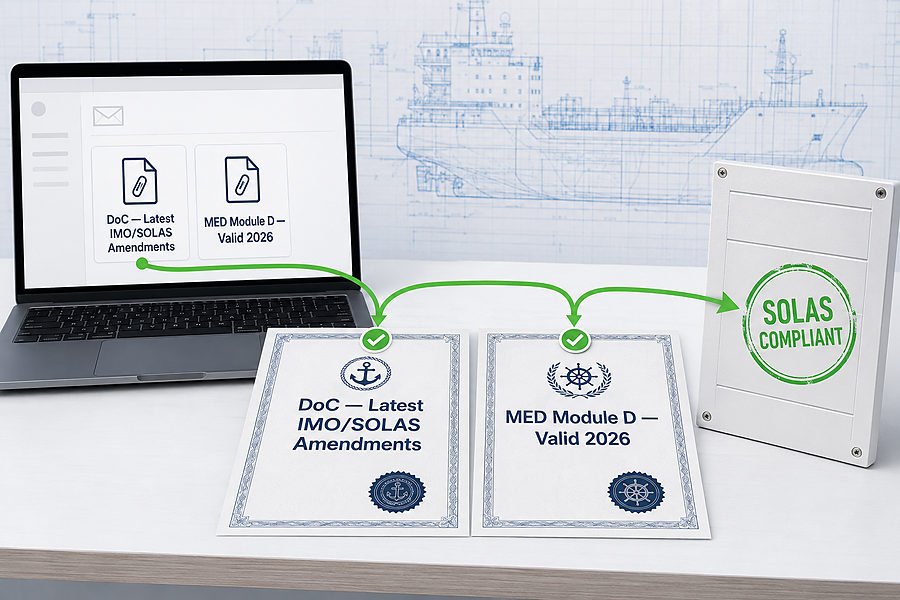
A fast reply does not mean a good reply. I always wait to see the attachments. If the attachments are missing or wrong, the supplier is wasting my time.
Proof 1: A Declaration of Conformity (DoC) Citing Latest IMO Amendments
The supplier must attach a Declaration of Conformity (DoC). This is a legal paper signed by the factory owner. It states that the product meets the law. But a basic DoC is not enough. The DoC must list the exact IMO amendments. For example, it should list IMO Res. MSC.307(88) and the specific European Directive, like 2014/90/EU. If the DoC does not list these specific codes, it is just an empty promise. The signature on the DoC makes the factory legally responsible for the panel's quality.
Proof 2: A Recent MED Module D Production Quality Assurance Certificate
The second attachment must be the MED Module D certificate. The Type Approval (Module B) only proves they made one good sample. The Module D certificate proves they make good panels every day12. The class society issues this certificate after they visit the factory. This certificate proves continuous oversight. It must be valid within the current year. If a supplier sends an email with a valid Module B but no Module D, they cannot legally sell panels for commercial ships. They only have half of the required paperwork.
| Document Required in Reply | What It Proves | Key Details to Check |
|---|---|---|
| Declaration of Conformity (DoC) | Legal responsibility of the factory | Must list IMO Res. MSC.307(88) and have a manager's signature. |
| MED Module D Certificate | Continuous quality in mass production | Must be valid for the current year, issued by an IACS member. |
Why Request a SOLAS Amendment Statement Before Placing Marine Panel Orders?
Skipping a formal compliance statement leaves you legally exposed. If panels fail inspection, you bear the total loss. Requesting this statement shifts the risk back to the manufacturer.
Requesting a SOLAS Amendment Statement before ordering legally binds the supplier to current standards, prevents costly 100% replacement of non-compliant installed panels, and provides necessary proof to port state control that due diligence was performed during the international procurement process.
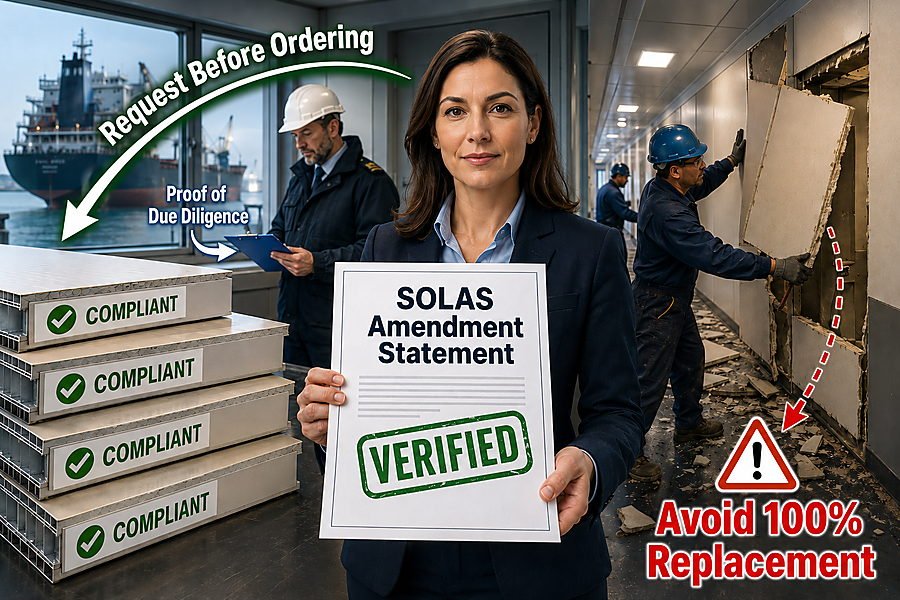
Do not pay the deposit until you have this statement. It takes the supplier ten minutes to sign it, but it saves you months of legal trouble if something goes wrong.
Benefit 1: Legally Binding the Supplier to Current Standards
A proforma invoice is just a bill. A SOLAS Amendment Statement is a contract. When the factory signs this paper, they promise their materials meet all current IMO rules13 up to the date of the order. If the rules changed last month, the factory must follow the new rules. If they send panels based on old rules, this signed statement gives you the legal power to reject the goods and demand a full refund.
Benefit 2: Preventing Costly Replacement of Installed Panels
If you install bad panels, the surveyor will find out during the ship's final survey14. You will have to tear out all the panels and buy new ones. This is very expensive. Removing and replacing 1,000 square meters of marine wall panels can cost more than $15,000 in labor alone, not counting the cost of buying new panels. Getting the signed statement first forces the supplier to double-check their own compliance before shipping, preventing this massive rework cost.
Benefit 3: Providing Proof of Due Diligence to Port State Control
Port State Control (PSC) officers check ships to ensure safety. If they find a problem, they can stop the ship from leaving the port. According to US Coast Guard data, PSC detention fines and delays can cost a ship operator $50,000 or more per day15. If a PSC officer questions your materials, showing them the factory's signed SOLAS statement proves you did your job. It shows due diligence. It proves you did not buy cheap, fake materials on purpose.
| Consequence of No Statement | Cost/Risk Impact | How the Statement Helps |
|---|---|---|
| Supplier sends old stock | High risk of failed survey | Forces supplier to check current rules before shipping. |
| Removing installed bad panels | $15,000+ in labor for 1000m2 | Stops bad panels from reaching the shipyard. |
| Port State Control detention | $50,000+ per day in delays | Proves due diligence to the PSC inspector. |
How Do Compliance Reviewers Compare Marine Panel Suppliers on SOLAS Update Speed?
Slow factories create project bottlenecks. While they wait for new certificates, your ship sits in the yard. Reviewers track update speeds to find proactive partners who save you time.
Compliance reviewers compare suppliers on SOLAS update speed by tracking three metrics: the number of days between an IMO rule change and the supplier's certificate renewal, the presence of an in-house R&D testing lab, and their history of proactive product upgrades before mandatory enforcement dates.
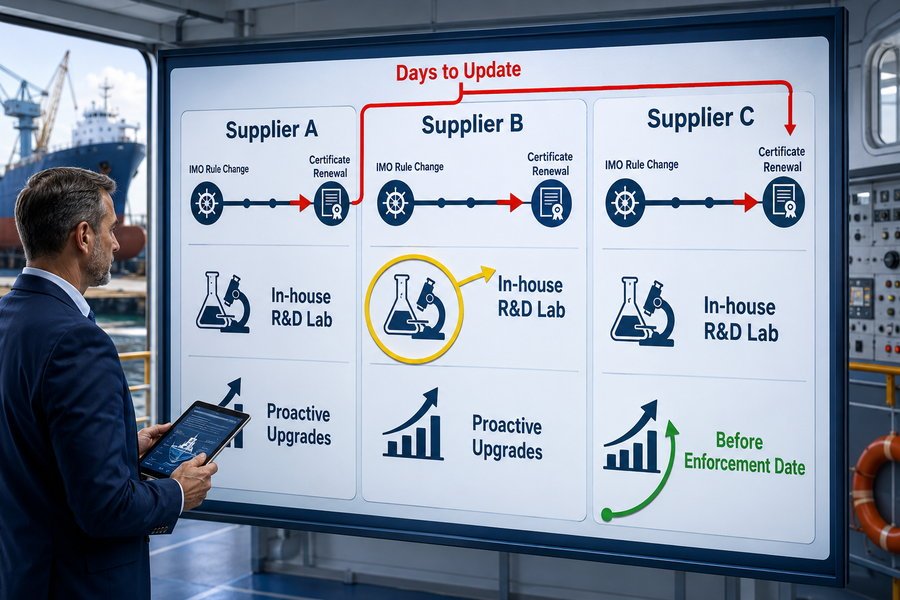
I always look for factories that move fast. The maritime industry changes rules slowly, but when a new rule hits, the best factories are already prepared.
Metric 1: Tracking Days Between IMO Rule Changes and Certificate Renewals
Good compliance reviewers count the days. When the IMO releases a new MSC circular, factories must update their certificates16. Testing a new panel design usually takes 3 to 6 months17. We look at the date the rule changed and the date on the supplier's new certificate. If a supplier updates their papers within 6 months, they are fast. If it takes them 2 years, they are too slow. Slow suppliers will delay your shipbuilding schedule because you cannot install panels without valid papers18.
Metric 2: The Presence of an In-House R&D Testing Lab
Speed comes from testing. A factory with its own fire testing oven is much faster than a factory that uses outside labs for every little change. Building an in-house R&D fire lab costs a factory $200,000 or more. But it speeds up their research by 50%. When I visit a factory, I always ask to see their test oven. If they have one, I know they can test new materials quickly and pass the official class society tests on the first try.
Metric 3: History of Proactive Product Upgrades Before Enforcement Dates
The best suppliers do not wait for the deadline. The IMO usually gives the industry a few years before a new rule becomes mandatory19. For example, a rule might be published in 2024 but enforced in 2026. Top-tier suppliers will upgrade their panels and get new certificates in 2025, a full year before the deadline. We review their history. Suppliers who upgrade proactively are safe partners. They ensure your ship will pass inspections even if the build takes longer than expected.
| Metric for Update Speed | Top-Tier Supplier Target | Poor Supplier Reality |
|---|---|---|
| Renewal Time after Rule Change | Within 3 to 6 months | Takes 1 to 2 years |
| In-House Fire Test Lab | Yes, they own testing equipment | No, they outsource all testing |
| Upgrade Timing | Upgrades 1 year before deadline | Waits until the exact deadline day |
Conclusion
Verifying your marine outfitting supplier's ability to track SOLAS amendments ensures safety, prevents costly port delays, and secures top-tier panels for your projects. Always ask for documented proof.
-
"Maritime Safety Committee, 103rd session (MSC 103)", https://www.imo.org/en/mediacentre/meetingsummaries/pages/msc-103rd-session.aspx. The IMO Maritime Safety Committee publishes MSC circulars and related instruments to disseminate safety guidance and interpretations for maritime regulation, while formal SOLAS amendments are generally adopted through MSC resolutions rather than circulars alone. Evidence role: mechanism; source type: institution. Supports: The supplier should understand IMO MSC circulars as part of tracking changes and guidance related to SOLAS requirements.. Scope note: This supports the regulatory-document mechanism but qualifies the article’s wording because circulars are not the only, or usual formal, vehicle for SOLAS amendments. ↩
-
"[PDF] RESOLUTION MSC.307(88) (adopted on 3 December 2010 ...", https://wwwcdn.imo.org/localresources/en/KnowledgeCentre/IndexofIMOResolutions/MSCResolutions/MSC.307(88).pdf. The 2010 IMO FTP Code specifies fire-resistance test criteria for divisions, including limits on temperature rise on the unexposed face; for B-class divisions, the insulation criterion is evaluated over the classification period such as 15 minutes for B-15. Evidence role: definition; source type: institution. Supports: A B-15 marine panel fire test requires the unexposed side to remain within specified temperature-rise limits for the B-15 classification period.. Scope note: The source can verify the FTP Code criterion, but individual panel compliance still depends on the specific accredited test report for that product configuration. ↩
-
"Ship classification society", https://en.wikipedia.org/wiki/Ship_classification_society. The International Association of Classification Societies describes classification societies as independent technical organizations that establish and verify compliance with ship and marine-equipment safety rules, including survey and certification functions under class or statutory authorization. Evidence role: definition; source type: institution. Supports: Classification societies are organizations that inspect, verify, and certify maritime safety compliance, with major examples including ABS, DNV, and Lloyd’s Register.. Scope note: This supports the general role of classification societies; the authority to issue a particular certificate depends on the flag administration, statutory delegation, and the product-approval scheme involved. ↩
-
"Frequency of Renewal Cycle for Indirect Air Carrier Security Programs", https://www.regulations.gov/document/TSA-2020-0002-0001. IACS procedural rules for type approval state that certificates issued under the scheme have a maximum validity period of five years, supporting the 60-month validity claim. Evidence role: definition; source type: institution. Supports: According to IACS, a Type Approval certificate is only valid for a maximum of 60 months, or 5 years.. Scope note: This supports IACS-type approval practice specifically; other flag-state or statutory approval schemes may have separate validity rules. ↩
-
"[PDF] RESOLUTION MSC.307(88) (adopted on 3 December 2010 ...", https://wwwcdn.imo.org/localresources/en/KnowledgeCentre/IndexofIMOResolutions/MSCResolutions/MSC.307(88).pdf. The IMO records that the 2010 FTP Code was adopted by resolution MSC.307(88) and became mandatory under SOLAS for applicable ships constructed on or after 1 July 2012, supporting the date and regulatory status stated here. Evidence role: historical_context; source type: institution. Supports: The IMO replaced the 1998 FTP Code with the 2010 FTP Code, MSC.307(88), mandatory for ships built after July 2012.. Scope note: This verifies the IMO adoption and mandatory application date; it does not independently prove that any individual supplier’s product design is obsolete. ↩
-
"Conformity Assessment of Medical Devices: An Overview from a ...", https://pmc.ncbi.nlm.nih.gov/articles/PMC12821529/. EU Marine Equipment Directive conformity-assessment provisions for Module D require notified-body surveillance of an approved production quality system, and MED guidance commonly treats this surveillance as annual, supporting the need for a recent audit record. Evidence role: general_support; source type: government. Supports: Marine panel factories using MED Module D production quality assurance are subject to recurring, typically annual, factory surveillance audits.. Scope note: The source may establish annual surveillance for MED Module D approvals rather than a universal rule for every marine panel factory worldwide. ↩
-
"What Is the Purpose and Scope of the IMO FTP Code? - Magellan ...", https://magellanmarinetech.com/what-purpose-scope-of-imo-ftp-code/. SOLAS chapter II-2 and the IMO FTP Code require specified exposed interior surfaces, including bulkhead and ceiling linings, to meet low flame-spread criteria, supporting the need for certification of decorative surface finishes. Evidence role: definition; source type: institution. Supports: SOLAS requires relevant marine panel surface finishes to have low flame spread characteristics.. Scope note: The exact applicability depends on the ship area, material use, and regulatory category; this source supports the general SOLAS/FTP Code requirement rather than every installation scenario. ↩
-
"Summary of SOLAS chapter II-2 - International Maritime Organization", https://www.imo.org/en/ourwork/safety/pages/summaryofsolaschapterii-2-default.aspx. The SOLAS Convention identifies Chapter II-2 as the chapter governing fire protection, fire detection, and fire extinction requirements for ships. Evidence role: definition; source type: institution. Supports: SOLAS Chapter II-2 covers fire protection, fire detection, and fire extinction.. ↩
-
"What Is the Purpose and Scope of the IMO FTP Code? - Magellan ...", https://magellanmarinetech.com/what-purpose-scope-of-imo-ftp-code/. SOLAS Chapter II-2 and the FTP Code use defined fire-resisting divisions, including A- and B-class divisions, rather than informal terms such as “fireproof.” Evidence role: definition; source type: institution. Supports: Marine fire-resistance requirements use defined A-class and B-class ratings rather than generic “fireproof” wording.. Scope note: This supports the regulatory classification framework, but it does not by itself prove that every supplier quote omitting the class is non-compliant. ↩
-
"Are Marine Fire Divisions the Same as Marine Panel Ratings?", https://magellanmarinetech.com/are-marine-fire-divisions-same-as-marine-panel-ratings/. Regulatory descriptions of B-class divisions state that they must prevent the passage of flame for the first half hour, while the “B-15” designation refers to meeting insulation temperature-rise limits for 15 minutes. Evidence role: definition; source type: government. Supports: B-15 ratings have defined flame-passage and insulation-temperature criteria under marine fire-test rules.. Scope note: The source may partially qualify the article’s wording, because B-15 does not simply mean flame stoppage for 15 minutes; flame-passage and insulation-time criteria are distinct. ↩
-
"[PDF] RESOLUTION MSC.307(88) (adopted on 3 December 2010 ...", https://wwwcdn.imo.org/localresources/en/KnowledgeCentre/IndexofIMOResolutions/MSCResolutions/MSC.307(88).pdf. IMO Resolution MSC.307(88) adopted the International Code for Application of Fire Test Procedures, 2010, commonly called the 2010 FTP Code, which specifies fire-test procedures used for marine materials and constructions. Evidence role: historical_context; source type: institution. Supports: IMO Resolution MSC.307(88) is the resolution adopting the 2010 FTP Code used for marine fire testing.. Scope note: This supports the identity and regulatory role of the resolution, but not the article’s separate claims about market pricing or supplier behavior. ↩
-
"Conformity Assessment of Medical Devices: An Overview from a ...", https://pmc.ncbi.nlm.nih.gov/articles/PMC12821529/. EU conformity-assessment rules describe Module B as EU-type examination and Module D as production quality assurance, under which a notified body assesses and surveils the manufacturer’s quality system for production, final inspection, and testing. Evidence role: mechanism; source type: government. Supports: A Module B certificate covers type examination, while Module D concerns ongoing production quality assurance and notified-body oversight.. Scope note: Module D supports ongoing production-quality assurance; it does not prove that every individual panel is defect-free. ↩
-
"Amendments to IMO instruments: upcoming and recent entry into ...", https://www.imo.org/en/About/Conventions/Pages/Amendments-to-IMO-instruments.aspx. IMO materials on SOLAS and its amendment process support that SOLAS requirements are maintained through amendments adopted by IMO and may change over time; this supports the need to verify the applicable standard at the time of purchase, but it does not verify any individual supplier’s compliance. Evidence role: historical_context; source type: institution. Supports: Suppliers should confirm that materials comply with the current IMO/SOLAS requirements applicable at the order date.. Scope note: Supports the existence and amendment of IMO/SOLAS rules, not the compliance status of specific marine panels. ↩
-
"Surveys, Verifications and Certification", https://www.imo.org/en/ourwork/msas/pages/surveysandcertification.aspx. IMO and classification-society guidance on statutory surveys supports that ship surveys assess compliance with SOLAS safety requirements before certificates are issued; this is contextual support because the exact inspection scope and whether non-compliant panels are discovered depend on the vessel, flag administration, and survey procedure. Evidence role: mechanism; source type: institution. Supports: Non-compliant marine wall panels can be identified during statutory or final ship surveys assessing SOLAS compliance.. Scope note: Does not guarantee that every non-compliant panel will be detected during a final survey. ↩
-
"Port State Control - International Maritime Organization", https://www.imo.org/en/ourwork/iiis/pages/port%20state%20control.aspx. Government or maritime-institution data on Port State Control detentions and delay costs can support the scale of financial exposure from detention; the figure should be treated as an illustrative estimate unless the cited source specifically reports a $50,000-per-day cost attributable to PSC detention. Evidence role: statistic; source type: government. Supports: Port State Control detention-related fines and delays can cost a ship operator $50,000 or more per day.. Scope note: Cost varies by vessel type, charter rate, cargo, port, and duration of detention. ↩
-
"Maritime Safety Committee - 110th session (MSC 110), 18-27 June ...", https://www.imo.org/en/mediacentre/meetingsummaries/pages/msc-110th-session.aspx. An IMO or flag-state source should show that changes to mandatory maritime safety requirements can require updated approval documentation or certification for affected materials and equipment; this supports the compliance premise but does not mean every MSC circular automatically triggers recertification. Evidence role: general_support; source type: government. Supports: When the IMO releases a new MSC circular, factories must update their certificates.. Scope note: Contextual support only: MSC circulars vary in legal effect, and recertification depends on whether the specific rule affects the product and approval scheme. ↩
-
"How to choose the right marine wall panels for marine interior ...", https://magellanmarinetech.com/how-choose-right-marine-wall-panels-for-marine-interior-projects/. A class-society, laboratory, or regulatory source on marine fire-test/type-approval procedures should document the typical sequence and duration of testing and certification for fire-rated marine panels; this would support the timeframe as an industry estimate rather than a universal rule. Evidence role: statistic; source type: institution. Supports: Testing a new panel design usually takes 3 to 6 months.. Scope note: Timeframes can vary substantially by test backlog, panel complexity, failed tests, and the certification body involved. ↩
-
"How to choose the right marine wall panels for marine interior ...", https://magellanmarinetech.com/how-choose-right-marine-wall-panels-for-marine-interior-projects/. A maritime administration, IMO, or class-society source should establish that fire-rated marine construction materials require valid approval or certification documentation for use on regulated vessels; this supports the installation-compliance claim, subject to the vessel type and applicable flag-state rules. Evidence role: definition; source type: government. Supports: Shipbuilders cannot install panels without valid certification papers.. Scope note: The requirement may differ by vessel class, flag state, route, and whether the panel falls under SOLAS, the FTP Code, or another approval regime. ↩
-
"Amendments to IMO instruments: upcoming and recent entry into ...", https://www.imo.org/en/About/Conventions/Pages/Amendments-to-IMO-instruments.aspx. An IMO source on the SOLAS amendment process and entry-into-force dates can show that adopted amendments commonly have a delayed implementation period before becoming mandatory; this supports the general timing pattern but not every individual IMO instrument. Evidence role: historical_context; source type: institution. Supports: The IMO usually gives the industry a few years before a new rule becomes mandatory.. Scope note: Implementation periods vary by convention, amendment, and transitional provisions, and some circulars are guidance rather than mandatory rules. ↩