Worried your ship interior project will miss the deadline? Unexpected SOLAS regulation changes often disrupt marine panel deliveries. Let us look at how these amendments impact your project timeline.
SOLAS amendments impact marine wall and ceiling panel delivery timelines by forcing design modifications, triggering mandatory 3-to-6-month recertification processes, causing factory production bottlenecks, and extending logistics by 2-to-4 weeks. Understanding these four factors helps buyers accurately adjust their procurement schedules.
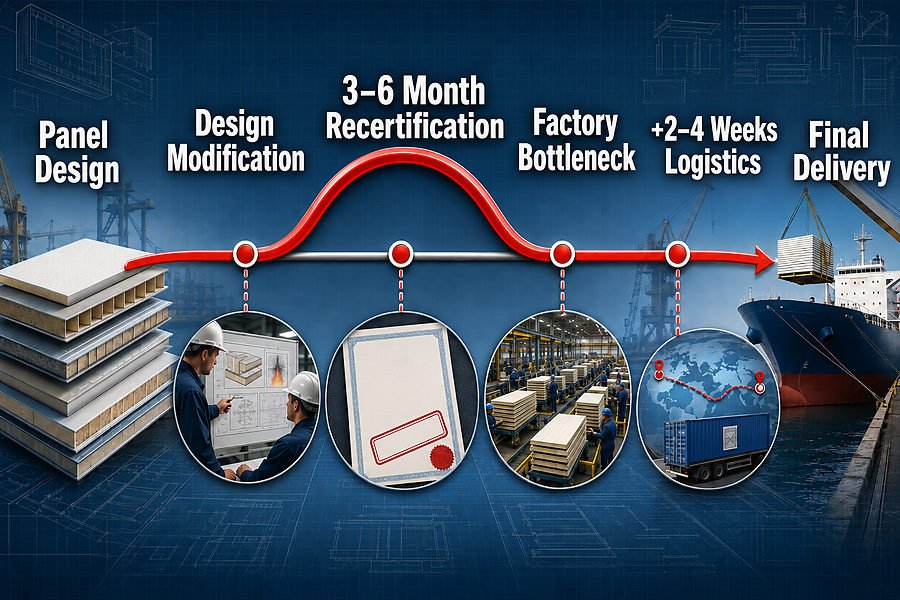
Dealing with delayed marine panels can hurt your shipyard reputation and eat up your profit margins. I have seen many buyers struggle with this issue, so let us break down why this happens and how you can take control of your delivery schedule.
Why Do Late SOLAS Updates Delay Marine Wall Panel Shipments?
Are your marine wall panels stuck in the factory? Sudden SOLAS updates cause massive shipment delays. You need to know the reasons to fix the problem.
Late SOLAS updates delay marine wall panel shipments due to three main reasons: mandatory redesigns of core insulation materials, new mandatory fire tests at MED-approved labs taking 8-to-12 weeks, and the need to reissue Type Approval Certificates, adding 2-to-4 weeks.
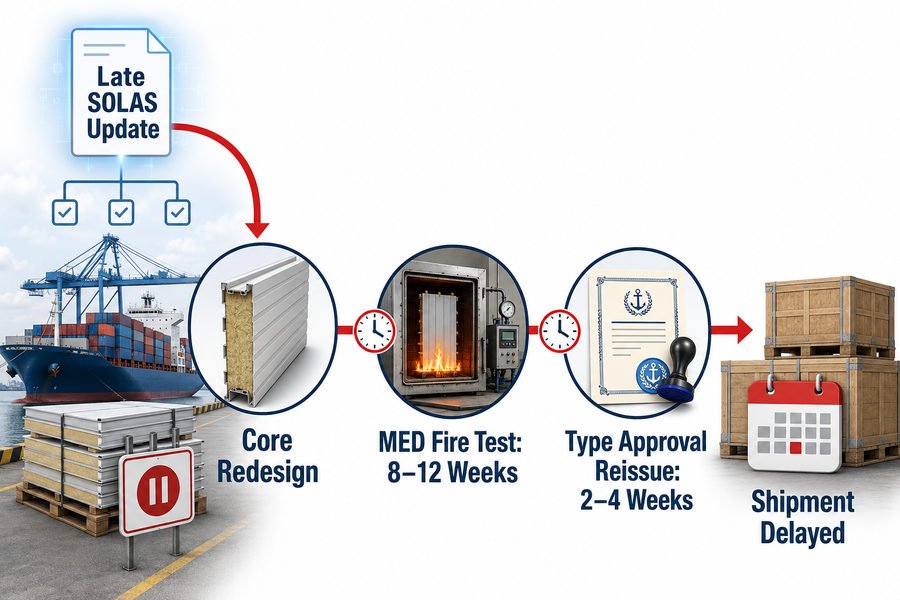
When I worked at the marine outfitting factory, I saw many orders stop completely because of late SOLAS updates1. A simple update from the International Maritime Organization (IMO) can freeze an entire production line. We must look at the three specific reasons that cause these costly shipment delays for your business.
Mandatory Redesigns of Core Insulation Materials After SOLAS Updates
The first reason for delays is the mandatory redesign of the core insulation materials. When a new SOLAS amendment focuses on fire safety2, factories must often change the Rockwool density inside the marine wall panels. For example, a rule change might require the Rockwool density to increase from 120 kg/m³ to 140 kg/m³ to pass the new heat transfer limits. This redesign process takes time. The factory engineers must update the AutoCAD drawings. Then, they must source the new high-density Rockwool from suppliers. This material change alone can stop production for 10 to 15 days because the factory has to wait for the new raw materials to arrive at their warehouse.
Executing New Mandatory Fire Tests at MED-Approved Labs
The second reason is the requirement for new fire tests. If the SOLAS update changes the core materials or the surface adhesives, the old test reports are no longer valid. The factory must send the newly designed panels to a Marine Equipment Directive (MED) approved laboratory. According to the IMO 2010 FTP Code3, a standard A-60 class fire test takes a long time to schedule and execute. The testing labs are often very busy. Booking a slot, running the burn test, and getting the official test data usually takes 8 to 12 weeks. During this time, the factory cannot mass-produce your panels because they do not know if the panels will pass the test.
The Process of Reissuing Type Approval Certificates
The third reason is the paperwork. After the panels pass the fire test at the lab, the factory cannot just ship the goods. They must send the test reports to a classification society, like DNV, ABS, or Lloyd's Register. The society will review the data to issue a new Type Approval Certificate (TAC). The review process by the classification society adds another 2 to 4 weeks to your timeline. Without this valid certificate, your panels cannot be installed on the ship.
| Delay Reason | Action Required by Factory | Estimated Time Added |
|---|---|---|
| Material Redesign | Update drawings and buy new Rockwool | 10 to 15 days |
| Fire Testing | Send panels to MED lab for IMO FTP test | 8 to 12 weeks |
| Certificate Reissue | Apply for new Type Approval from DNV/ABS | 2 to 4 weeks |
How Can Procurement Prevent SOLAS-Driven Rework From Missing Newbuild Deadlines?
Facing expensive rework on your ship interiors? Rework caused by SOLAS changes easily ruins newbuild deadlines. You must use smart procurement strategies to stop this.
Procurement can prevent SOLAS-driven rework from missing newbuild deadlines by taking three actions: locking in final technical drawings 6 months before rule enforcement, ordering panels with dual certifications, and adding a 15% to 20% time buffer to the standard 30-day production schedule.
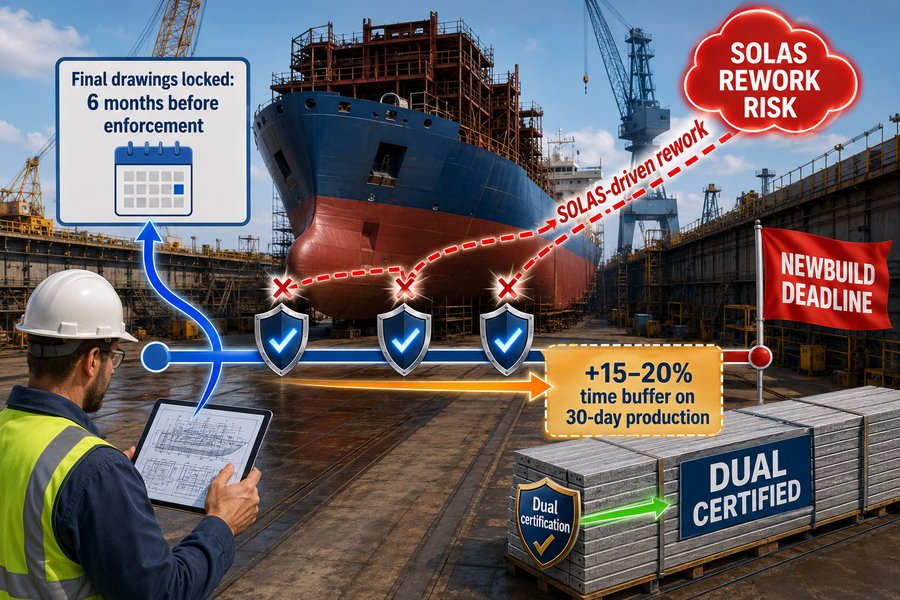
At Magellan Marine, my clients often ask me how to avoid rework when building a new ship. Rework means throwing away finished panels and starting over. This wastes money and destroys your schedule. As a buyer, you have the power to stop this before it happens. You just need to follow the three actions mentioned above. Let us look at each action in detail.
Locking in Final Technical Drawings 6 Months Before Rule Enforcement
The first action you must take is to lock your technical drawings early. Do not wait until the last minute. SOLAS amendments always have a strict enforcement date.4 For example, if a new fire safety rule becomes active on July 1, you must finish all your design approvals by January 1. This gives you a full 6 months of safety. By locking the drawings 6 months early, you make sure the Chinese or Vietnamese factory builds the panels under the current rules, or you give them enough time to adjust to the new rules. If you change drawings too close to the deadline, the factory will build the wrong panels, and you will have to pay for a complete rework.
Procuring Marine Panels with Dual Certifications
The second action is to buy panels that already meet multiple standards or future standards. We call this dual certification. Some advanced factories test their panels to meet both the old SOLAS rules and the upcoming new rules at the same time. When you are looking for suppliers, ask them if their Type Approval Certificates cover the newest IMO resolutions5. If you buy panels with dual certifications, you do not have to worry about the enforcement date. Even if your ship delivery is delayed and crosses into the new rule period, your panels will still be legal and valid. This completely eliminates the risk of rework.
Allocating a 15% to 20% Time Buffer for Production
The third action is to add a time buffer to your schedule. A normal production time for 1,000 square meters of marine wall panels is about 30 days.6 However, when a SOLAS transition is happening, factories get confused, and mistakes happen. You should add a 15% to 20% time buffer to that standard 30-day schedule. This means you should plan for 35 to 36 days of production. If the factory has to stop and check a new rule, this extra 5 to 6 days will save your newbuild deadline.
| Procurement Action | Purpose of the Action | Benefit to Shipyard Deadline |
|---|---|---|
| Lock Drawings Early | Avoid last-minute rule confusion | Secures 6 months of stable production |
| Buy Dual Certifications | Ensure compliance with old and new rules | Eliminates risk of forced rework |
| Add 15-20% Time Buffer | Absorb factory delays during transition | Protects the final newbuild delivery date |
What Lead Time Buffer Should Buyers Add for SOLAS-Driven Marine Panel Changes?
Do you often guess how much extra time you need? Guessing leads to failed delivery of marine ceiling panels. You need exact buffer times to stay safe.
Buyers should add specific lead time buffers for SOLAS-driven marine panel changes: add 4 weeks for minor hardware or profile updates, 8 to 12 weeks for core material density changes, and up to 16 weeks if the panel requires completely new IMO FTP Code fire testing.
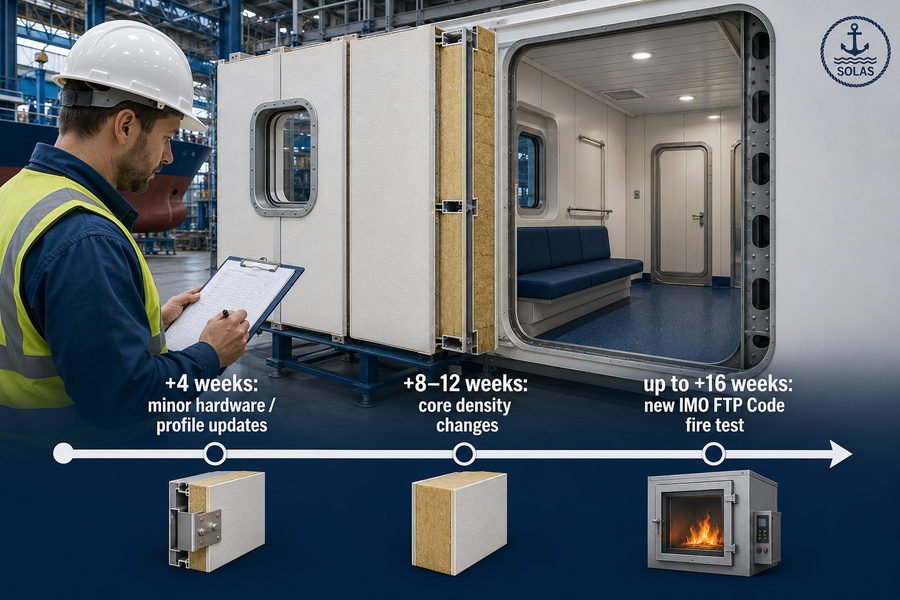
When you buy materials from Asia, time is your biggest risk. If the factory tells you the delivery takes 30 days, do not believe it during a SOLAS update year7. You must protect yourself by adding specific buffers based on what exactly needs to change on the panel. I will show you the exact weeks you need to add for the three different types of changes.
Adding 4 Weeks for Minor Panel Hardware or Profile Updates
Sometimes, a SOLAS amendment only requires small changes. For example, the rule might ask for a new type of joining profile between the ceiling panels, or a different kind of metal screw that resists heat better. These are minor hardware updates. For these small changes, you must add a 4-week buffer to your order. Why 4 weeks? The factory does not make these small metal parts themselves. They must order them from a sub-supplier. It takes the sub-supplier about 2 weeks to make the new parts, and another 2 weeks for the factory to test the assembly. If your normal lead time is 4 weeks, you must now plan for 8 weeks total.
Adding 8 to 12 Weeks for Core Material Density Changes
If the SOLAS rule changes the required fire rating, the factory will probably have to change the core material. This usually means putting heavier Rockwool inside the panel8. Changing the core material is a big deal. As I mentioned before, the factory has to buy new materials, but they also have to adjust their pressing machines. The glue might dry differently with denser Rockwool. For a core material change, you must add an 8 to 12-week buffer. This gives the factory time to do internal quality checks. If you push them to do it in 4 weeks, you will receive panels where the steel skin peels off the Rockwool because the glue did not set right9.
Adding 16 Weeks for Complete IMO FTP Code Fire Testing
The worst situation is when the panel needs a completely new fire test. If the SOLAS amendment requires the panel to pass a new section of the IMO 2010 FTP Code10, the factory has to start from zero. They must build a prototype, ship it to a lab, wait for the test, and wait for the classification society to issue the certificate. For this, you must add a 16-week buffer. Do not place the order and hope it will be fast. You must ask the factory if they have the new certificate. If they say they are "testing it now," you must push your shipyard installation date back by at least 16 weeks.
| Type of SOLAS Change | Panel Modification Required | Required Lead Time Buffer |
|---|---|---|
| Minor Update | Changing joining profiles or screws | Add 4 weeks |
| Moderate Update | Changing Rockwool density or glue | Add 8 to 12 weeks |
| Major Update | Completely new IMO FTP fire test | Add 16 weeks |
How Do Project Managers Handle Marine Ceiling Panel Spec Changes During SOLAS Transitions?
Are changing specifications driving you crazy? Managing marine ceiling panel specs during SOLAS transitions is very hard. You must manage this properly to avoid huge losses.
Project managers handle marine ceiling panel spec changes during SOLAS transitions using four steps: freezing design approvals 3 months early, prioritizing B-15 class panels first, communicating daily with the Chinese or Vietnamese factory, and conducting third-party inspections mid-production.
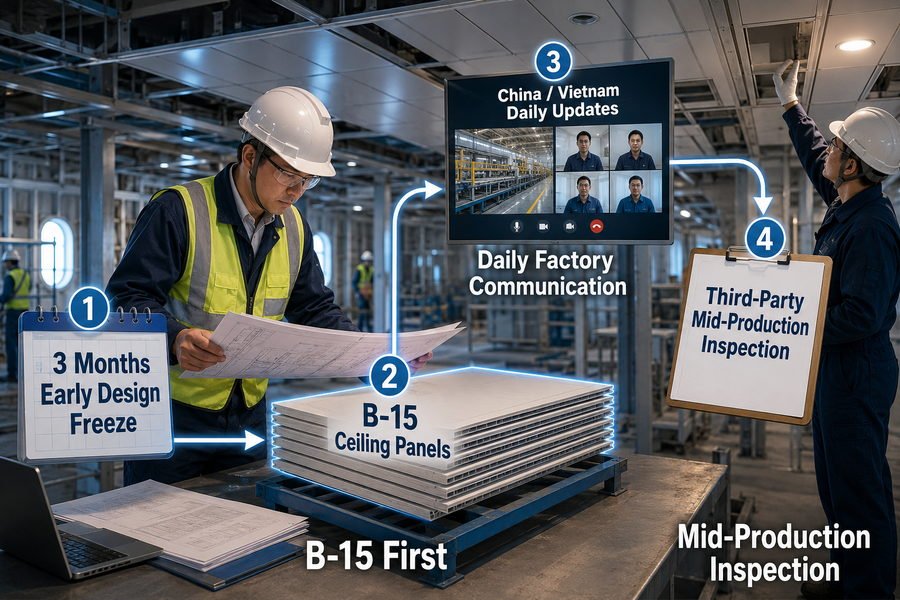
A project manager for ship interiors has a very stressful job. When SOLAS transitions happen, the rules change while the ship is still being built. The ceiling panels you ordered yesterday might be illegal tomorrow. I have helped many managers through this mess. To survive, you must use a strict management process. Let us break down the four steps you must take to handle specification changes successfully.
Freezing Design Approvals Early in the Project Cycle
The first step is to freeze the design approvals at least 3 months early11. A project manager cannot allow the shipowner or the architect to change the ceiling layout right before the SOLAS transition date. You must tell all parties that the design is frozen. If you change the size or the cut-outs of the ceiling panels late, the factory will have to check if the new sizes still pass the upcoming fire rules. This checking process will cause delays. By freezing the design early, you lock the specifications, and the factory can focus only on meeting the new safety rules, not chasing design changes.
Prioritizing the Production of B-15 Class Ceiling Panels
The second step is to change the order of production. On a ship, the ceiling panels are usually B-15 or B-0 fire class12. You should tell the factory to produce the B-15 class panels first. The B-15 panels are harder to make and face stricter SOLAS rules regarding heat transfer13. If there is a problem with the new specifications, it will happen with the B-15 panels. By making them first, you find the problems early. You have time to fix them. The B-0 panels are much easier to pass, so the factory can make them later without much risk.
Maintaining Daily Communication and Conducting Mid-Production Inspections
The third and fourth steps go together. You must communicate with the factory in China or Vietnam every single day. Do not just send an email and wait a week. You need daily updates on WhatsApp or WeChat to see if they understand the new SOLAS specs. Furthermore, you must arrange a third-party inspection mid-production. Do not wait until the panels are packed in the container. Hire a local inspector to check the first batch of panels right on the factory floor. They need to measure the Rockwool density and check the labels to ensure they match the new certificates14. This stops bad panels from being shipped to your country.
| Management Step | Action Taken by Project Manager | Reason for this Action |
|---|---|---|
| Step 1 | Freeze designs 3 months early | Stops late changes from delaying factory |
| Step 2 | Produce B-15 panels first | Identifies strict fire rule problems early |
| Step 3 | Daily factory communication | Ensures factory understands the new specs |
| Step 4 | Mid-production inspection | Catches rule violations before shipping |
Why Do Shipyards Reschedule Marine Wall Panel Installation When SOLAS Amendments Hit Mid-Project?
Has the shipyard suddenly changed your installation date? SOLAS amendments mid-project force shipyards to reschedule marine wall panel installation. You must understand their reasons.
Shipyards reschedule marine wall panel installation when SOLAS amendments hit mid-project due to three factors: mandatory re-routing of HVAC and electrical cables behind panels, waiting for updated class society approvals (taking 14 to 21 days), and prioritizing critical safety systems over interior outfitting.
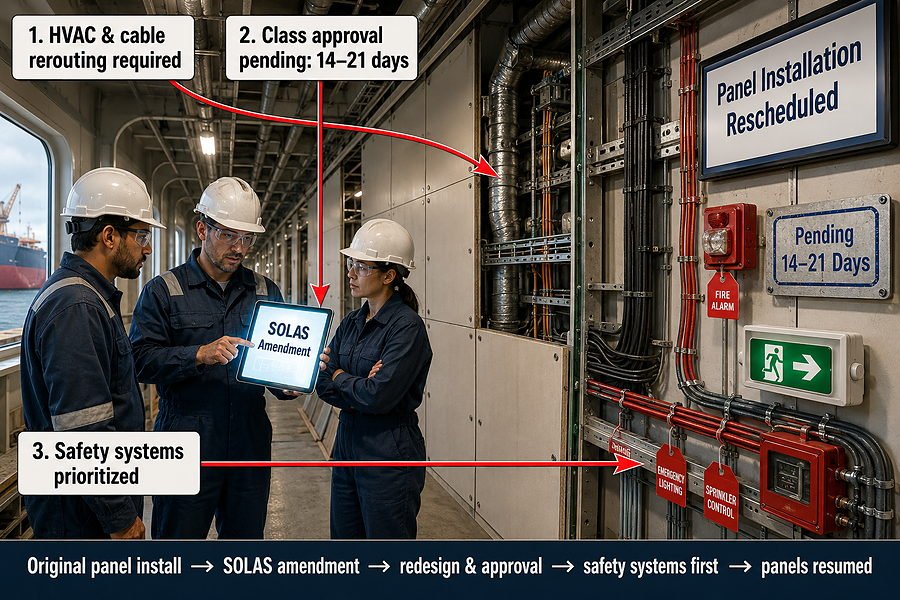
As a procurement officer, you buy the panels and deliver them to the shipyard. But sometimes, the shipyard says they cannot install them yet. Your containers just sit in the yard. This usually happens when a new SOLAS rule hits right in the middle of the shipbuilding project. The shipyard is not doing this to make you angry. They are doing this because they have no choice. Let us look at the three reasons why they must push your installation schedule back.
Mandatory Re-routing of HVAC and Electrical Cables Behind Wall Panels
The first reason is what happens behind the panels. Marine wall panels cover up the ship's pipes, HVAC ducts, and electrical cables. When a new SOLAS amendment is released, it often changes the rules for electrical cable separation or ventilation fire dampers15. The shipyard workers must rip out the old cables and re-route them to meet the new safety distances. They cannot install your beautiful wall panels until the ugly work behind them is finished and inspected. If the shipyard installs your panels too early, they will just have to break them down again to fix the cables.
Waiting for Updated Class Society Approvals for Mid-Project Changes
The second reason involves the classification society surveyors. When the shipyard changes the cables or the fire dampers because of the new SOLAS rules, they must call the DNV or ABS surveyor to inspect the changes16. The shipyard must submit new drawings for these systems.17 Waiting for the surveyor to come, inspect, and approve the changes usually takes 14 to 21 days.18 During these 2 to 3 weeks, all work in that cabin or corridor stops. The shipyard strictly forbids installing the interior wall panels until the surveyor signs the approval paper for the hidden systems.
Shipyards Prioritizing Critical Safety Systems Over Interior Outfitting
The third reason is about shipyard priorities. When a major rule change happens, the shipyard project manager must look at the whole ship. They must put their best workers on the most critical systems, like the engine room fire suppression or the lifeboats. Interior outfitting, like wall and ceiling panels, is considered low priority compared to the ship's main safety systems. The shipyard will move the installation team away from your cabins to go work on the critical areas. Your panel installation will be rescheduled to the end of the project, right before the ship is delivered.
| Rescheduling Factor | Action Happening at the Shipyard | Impact on Panel Installation |
|---|---|---|
| HVAC/Cable Re-routing | Workers are moving pipes and wires | Panels cannot be closed |
| Class Society Approval | Surveyor is reviewing the hidden changes | 14 to 21 day total work stop |
| Safety Prioritization | Workers moved to engine room/lifeboats | Interior outfitting pushed to the end |
How Can Procurement Coordinate Marine Panel Orders Across Overlapping SOLAS Amendment Dates?
Buying panels for ships built over several years? Overlapping SOLAS amendment dates create huge ordering confusion. You must coordinate orders to keep costs low.
Procurement coordinates marine panel orders across overlapping SOLAS amendment dates by using three methods: splitting orders into two distinct batches based on the ship's keel-laying date, standardizing on the strictest upcoming SOLAS rule, and negotiating flexible delivery contracts with the factory.
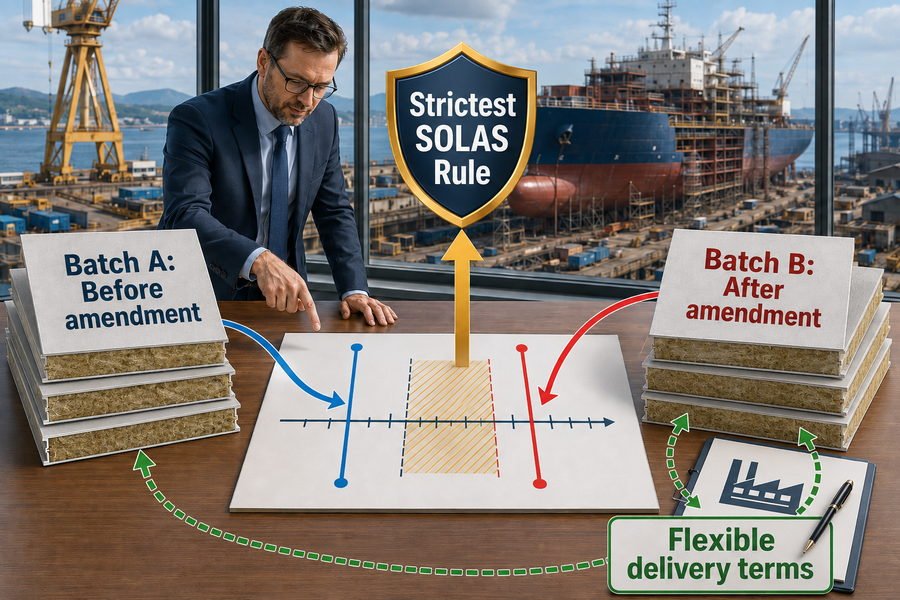
If your company decorates multiple ships for a shipyard over a three-year contract, you will definitely face overlapping SOLAS rules19. Ship 1 might fall under the old rules, but Ship 3 will fall under the new rules. If you order all the panels at once, you might buy the wrong things. You must be smart about how you place your purchase orders. Here are the three methods I teach my clients to handle this tricky situation.
Splitting Marine Panel Orders Based on Keel-Laying Dates
The first method is to split your orders. SOLAS rules are usually applied based on the date the ship's keel is laid20. You must look at the shipyard's master schedule. Find out exactly when the keel for each hull will be laid. If Hull A has a keel-laying date before the SOLAS amendment, you buy the old standard panels for Hull A. If Hull B has a date after the amendment, you create a completely separate purchase order for Hull B using the new standard. Do not mix them. By splitting the orders into two distinct batches, you ensure each ship gets exactly the legal materials it needs.
Standardizing Procurement on the Strictest Upcoming SOLAS Rule
The second method is easier but sometimes costs a little more. You simply standardize all your orders on the strictest upcoming rule. If a new, tougher fire rule starts next year, just ask the factory to produce all panels for all ships according to the new rule right now. The old ships will easily pass because the panels exceed the old requirements21. The new ships will pass because they meet the new requirements. This method saves you a lot of headache. You only have to manage one type of panel, one set of certificates, and one installation manual22.
Negotiating Flexible Delivery Contracts with Marine Outfitting Factories
The third method is to negotiate a smart contract. You must sit down with your supplier in Asia and explain the overlapping rules. You should negotiate a flexible delivery contract. This means you agree on the total quantity and the base price, but you add a clause that allows you to change the technical specifications for the later batches without a huge penalty. A good factory will agree to this if they know the schedule in advance. This protects your budget while allowing you to adapt to the new SOLAS rules when the time comes.
| Coordination Method | How to Do It | Main Advantage for Procurement |
|---|---|---|
| Split Orders by Keel Date | Make 2 POs based on keel-laying schedule | Exact compliance for each hull |
| Standardize on Strict Rule | Buy panels meeting future rules for all ships | Easiest to manage, no mixed stock |
| Flexible Delivery Contracts | Add a spec-change clause to the master contract | Protects budget while staying adaptable |
Conclusion
SOLAS amendments disrupt marine panel deliveries, but careful planning solves this problem. By adding specific time buffers, coordinating with factories, and locking designs early, you can keep your ship interior projects perfectly on schedule.
-
"[PDF] RESOLUTION A.534(13) - International Maritime Organization", https://wwwcdn.imo.org/localresources/en/KnowledgeCentre/IndexofIMOResolutions/Documents/A%20-%20Assembly/534(13).pdf. The International Maritime Organization describes SOLAS as the principal international convention setting minimum safety standards for ship construction, equipment, and operation, which provides the regulatory context for design changes following amendments. Evidence role: historical_context; source type: institution. Supports: Updates to SOLAS can affect ship equipment and construction requirements, creating compliance obligations for marine outfitting factories.. Scope note: This supports the regulatory importance of SOLAS updates generally, but it does not prove that a specific amendment froze this factory’s production line. ↩
-
"[PDF] RESOLUTION MSC.550(108) (adopted on 23 May 2024)", https://wwwcdn.imo.org/localresources/en/KnowledgeCentre/IndexofIMOResolutions/MSCResolutions/MSC.550%28108%29.pdf. SOLAS Chapter II-2 establishes fire-safety objectives and functional requirements for ships, including limits on fire growth, smoke generation, and the use of approved fire-resistant divisions and materials. Evidence role: mechanism; source type: institution. Supports: SOLAS fire-safety amendments can require manufacturers to reassess materials used in marine wall panels.. Scope note: This supports the regulatory mechanism behind fire-safety redesigns; it does not verify the article’s illustrative Rockwool density figures. ↩
-
"Fire testing laboratories - International Maritime Organization", https://www.imo.org/en/ourwork/safety/pages/firetestinglaboratories-default.aspx. The IMO 2010 Fire Test Procedures Code sets out standardized fire-test procedures used to evaluate materials and constructions for compliance with SOLAS fire-safety requirements, including tests relevant to fire-resisting divisions such as A-class divisions. Evidence role: definition; source type: institution. Supports: The IMO 2010 FTP Code governs fire testing for marine materials and assemblies used for SOLAS compliance.. Scope note: This supports the existence and function of the FTP Code, but not the article’s estimated laboratory scheduling duration of 8 to 12 weeks. ↩
-
"Amendments to IMO instruments: upcoming and recent entry into ...", https://www.imo.org/en/About/Conventions/Pages/Amendments-to-IMO-instruments.aspx. The IMO’s SOLAS materials describe amendments as entering into force on specified dates under the treaty amendment procedure, supporting the point that compliance is tied to formal effective dates. Evidence role: historical_context; source type: institution. Supports: SOLAS amendments have formal enforcement or entry-into-force dates that affect ship compliance planning.. Scope note: This supports the existence of formal entry-into-force dates, but not the article’s absolute wording that every operational requirement is enforced identically in all jurisdictions. ↩
-
"[PDF] ASSEMBLY 33rd session Agenda items 11 and 13 A 33/Res.1186 ...", https://wwwcdn.imo.org/localresources/en/OurWork/IIIS/Documents/A%2033-Res.1186%20-%20SURVEY%20GUIDELINES%20UNDER%20THE%20HARMONIZED%20SYSTEMOF%20SURVEY%20AND%20CERTIFICATION%20(HSSC),%202023%20(Secretary-General).pdf. IMO guidance and classification-society type-approval documentation show that marine equipment approvals are commonly linked to specified IMO instruments or resolutions, supporting the need to verify which regulatory standards a certificate covers. Evidence role: general_support; source type: institution. Supports: Buyers should verify whether marine panel Type Approval Certificates identify and cover the relevant current IMO resolutions.. Scope note: This provides contextual support for checking certificate scope; it does not prove that any particular supplier’s panels are approved under the newest resolutions. ↩
-
"How to choose the right marine wall panels for marine interior ...", https://magellanmarinetech.com/how-choose-right-marine-wall-panels-for-marine-interior-projects/. Shipbuilding and modular outfitting studies document that panelized construction lead times vary by production capacity, material availability, and yard workflow, providing context for estimating panel-production schedules. Evidence role: general_support; source type: paper. Supports: Production schedules for marine wall panels can be estimated based on production capacity, but the stated 30-day benchmark needs external evidence.. Scope note: This would support production-time estimation in general, but a precise 30-day figure for 1,000 square meters of marine wall panels would require manufacturer-neutral production data or a shipyard case study. ↩
-
"Amendments to IMO instruments: upcoming and recent entry into ...", https://www.imo.org/en/About/Conventions/Pages/Amendments-to-IMO-instruments.aspx. IMO documentation on SOLAS amendments explains that changes to the Convention are adopted and enter into force on scheduled dates, creating periods when ship equipment and materials may need to be checked against revised requirements; this provides contextual support for treating amendment years as higher compliance-planning risk. Evidence role: historical_context; source type: institution. Supports: SOLAS amendment years can create added procurement and compliance risk for shipbuilding materials.. Scope note: The source would support the regulatory-change context, not the article’s specific assertion that a quoted 30-day factory delivery time should be disregarded. ↩
-
"Determination of Thermal Properties of Mineral Wool Required for ...", https://pmc.ncbi.nlm.nih.gov/articles/PMC10488771/. Research on mineral-wool or rock-wool sandwich panels describes core density as a material parameter affecting fire resistance and thermal performance, supporting the article’s statement that a higher fire rating may require changes to the insulation core. Evidence role: mechanism; source type: paper. Supports: A fire-rating change may require changing the panel core material, such as using denser Rockwool.. Scope note: Such studies generally support the technical relevance of rock-wool density, but they may not prove that every SOLAS fire-rating change requires heavier Rockwool in this specific panel product. ↩
-
"[PDF] The Effects of Co-cured Versus Precured Carbon/Epoxy Face ...", https://ntrs.nasa.gov/api/citations/20220013168/downloads/2206_TM_Nettles.pdf. Engineering literature on sandwich panels identifies adhesive bonding between facings and the core as a critical failure point and describes delamination or face-core debonding when bonding or curing conditions are inadequate, supporting the mechanism described here. Evidence role: mechanism; source type: paper. Supports: Improper adhesive curing or bonding in steel-faced mineral-wool panels can lead to skin-to-core debonding or peeling.. Scope note: The source would support the general failure mechanism of adhesive debonding, not the article’s precise four-week production-warning scenario. ↩
-
"[PDF] RESOLUTION MSC.307(88) (adopted on 3 December 2010 ...", https://wwwcdn.imo.org/localresources/en/KnowledgeCentre/IndexofIMOResolutions/MSCResolutions/MSC.307(88).pdf. The IMO 2010 FTP Code establishes international fire-test procedures for materials and components used on ships under SOLAS fire-safety requirements, supporting the article’s claim that compliant panels may require formal fire testing under that Code. Evidence role: definition; source type: institution. Supports: A panel subject to new shipboard fire-safety requirements may need testing under the IMO 2010 FTP Code.. Scope note: The Code establishes the testing framework, but it does not by itself verify the article’s stated 16-week buffer for prototype testing, laboratory scheduling, and certification. ↩
-
"[PDF] Strategies to Reduce Cost Overruns and Schedule Delays in ...", https://scholarworks.waldenu.edu/cgi/viewcontent.cgi?article=5866&context=dissertations. Construction project-management literature links late design changes and change orders with schedule delay and cost growth, supporting the general rationale for an early design freeze. Evidence role: general_support; source type: paper. Supports: Freezing design approvals early helps reduce disruption from late specification changes.. Scope note: The cited evidence would support early design freeze as a risk-control practice, but it is unlikely to prove that three months is the universally correct cutoff for ship-interior projects. ↩
-
"What Is the Purpose and Scope of the IMO FTP Code?", https://magellanmarinetech.com/what-purpose-scope-of-imo-ftp-code/. SOLAS and the IMO Fire Test Procedures framework define B-class fire divisions and distinguish B-15 and B-0 by their tested fire-resistance performance. Evidence role: definition; source type: institution. Supports: B-15 and B-0 are recognized marine fire-class designations for ship interior divisions or ceiling systems.. Scope note: This would verify the regulatory meaning of the classes, not the article’s statement that these are the usual ceiling-panel classes on all ships. ↩
-
"A.163(ES.IV).pdf", https://wwwcdn.imo.org/localresources/en/KnowledgeCentre/IndexofIMOResolutions/AssemblyDocuments/A.163(ES.IV).pdf. IMO fire-test requirements distinguish B-15 from B-0 by specifying insulation performance for a defined period, which explains why B-15 involves a higher heat-transfer requirement than B-0. Evidence role: mechanism; source type: institution. Supports: B-15 panels face stricter heat-transfer performance requirements than B-0 panels.. Scope note: The source would support the regulatory distinction in heat-transfer performance, but not necessarily the manufacturing difficulty for every ceiling-panel design. ↩
-
"[PDF] RESOLUTION MSC.307(88) (adopted on 3 December 2010 ...", https://wwwcdn.imo.org/localresources/en/KnowledgeCentre/IndexofIMOResolutions/MSCResolutions/MSC.307(88).pdf. Marine fire-safety approval and conformity-assessment guidance generally requires products to match the tested and certified construction, including material specifications and identification markings. Evidence role: general_support; source type: institution. Supports: Mid-production inspection can verify that insulation materials and product labels conform to the certified fire-rated panel specification.. Scope note: This would support the inspection logic in general; the exact checks required may vary by certificate, flag administration, classification society, and product approval. ↩
-
"[PDF] RESOLUTION MSC.365(93) (adopted on 22 May 2014 ...", https://wwwcdn.imo.org/localresources/en/KnowledgeCentre/IndexofIMOResolutions/MSCResolutions/MSC.365(93).pdf. IMO SOLAS Chapter II-2 and associated fire-safety guidance establish requirements for shipboard fire protection, ventilation arrangements, fire dampers, and electrical-installation safety, supporting the claim that SOLAS changes can affect hidden HVAC and cable-routing work. Evidence role: general_support; source type: institution. Supports: SOLAS amendments can affect requirements for electrical cable separation and ventilation fire dampers during ship construction.. Scope note: This supports the regulatory relevance of these systems but does not prove that every SOLAS amendment changes cable separation or fire-damper rules. ↩
-
"History of SOLAS fire protection requirements", https://www.imo.org/en/OurWork/Safety/Pages/History-of-fire-protection-requirements.aspx. Classification society rules and survey procedures from organizations such as DNV and ABS describe surveyor verification of ship construction and alterations to classed systems, supporting the claim that mid-project changes may require class inspection. Evidence role: expert_consensus; source type: institution. Supports: Shipyards may need classification society surveyors to inspect changes made to ship systems during construction.. Scope note: The source would support the general inspection requirement, while the exact trigger for survey attendance depends on the vessel, system, class notation, and flag-state requirements. ↩
-
"[PDF] ABS Classification Plan - Woods Hole Oceanographic Institution", https://www.whoi.edu/cms/files/ABS_Classification_Plan_PDR_53623.pdf. Classification society plan-approval rules require drawings and technical documentation for relevant ship systems to be submitted for review, supporting the statement that system changes can require updated drawings. Evidence role: mechanism; source type: institution. Supports: Changes to class-relevant ship systems can require submission of updated drawings or technical documentation.. Scope note: This supports the approval mechanism in general; it does not establish that every cable or damper adjustment requires a full new drawing submission. ↩
-
"[PDF] Resolution A.1120(30) Adopted on 6 December 2017 SURVEY ...", https://wwwcdn.imo.org/localresources/en/KnowledgeCentre/IndexofIMOResolutions/AssemblyDocuments/A.1120(30).pdf. Published class-society service standards or shipbuilding project-control studies documenting plan-review and survey turnaround times of approximately two to three weeks would support the stated 14–21 day delay. Evidence role: statistic; source type: institution. Supports: Surveyor inspection and approval for mid-project changes commonly takes about 14 to 21 days.. Scope note: Turnaround time is highly context-dependent and may vary by class society, port, surveyor availability, project complexity, and whether approval is remote or on site. ↩
-
"Amendments to IMO instruments: upcoming and recent entry into ...", https://www.imo.org/en/About/Conventions/Pages/Amendments-to-IMO-instruments.aspx. IMO materials on SOLAS amendments indicate that convention requirements are periodically amended and commonly apply by construction or effective dates, which can create different regulatory baselines within a multi-vessel newbuild program. Evidence role: historical_context; source type: institution. Supports: A multi-ship contract over several years can involve different SOLAS requirements for different vessels.. Scope note: This supports the regulatory possibility of overlap; it does not prove that every three-year contract will necessarily encounter overlapping rules. ↩
-
"Circular Letter No.4204/Add.7 3 April 2020 To: ...", https://wwwcdn.imo.org/localresources/en/MediaCentre/HotTopics/Documents/Circular%20Letter%20No.4204-Add.7%20-%20Coronavirus.pdf. SOLAS regulatory texts and flag-state guidance commonly define a ship’s construction date by reference to when the keel is laid or when construction reaches an equivalent stage, supporting the use of keel-laying dates to determine applicable requirements. Evidence role: definition; source type: government. Supports: SOLAS applicability is often determined by the vessel construction date, commonly tied to keel laying or an equivalent construction stage.. Scope note: Specific applicability should still be checked against the exact SOLAS chapter, amendment, flag administration, and transitional provisions. ↩
-
"What Is the IMO FTP Code for Marine Interior Materials?", https://magellanmarinetech.com/what-imo-ftp-code-for-marine-interior-materials/. Fire-safety and marine-equipment approval regimes generally require materials to meet specified test standards and certification criteria; using materials certified to a later or more stringent standard may support compliance with earlier performance requirements where the relevant administration accepts equivalency or higher performance. Evidence role: general_support; source type: government. Supports: Panels built to stricter upcoming fire-safety requirements may satisfy older requirements if the approvals cover or exceed the older criteria.. Scope note: This is contextual support only; acceptance of newer-standard panels for an older vessel depends on the exact regulation, certificate scope, and flag or class approval. ↩
-
"[PDF] Product variety and manufacturing complexity in assembly systems ...", https://websites.umich.edu/~ykoren/uploads/Product_variety_and_manufacturing_complexity_in_assembly_lines.pdf. Supply-chain research on product variety and standardization finds that reducing the number of variants can lower coordination, inventory, documentation, and operational complexity, providing a general basis for standardizing marine panel procurement. Evidence role: mechanism; source type: paper. Supports: Standardizing panel specifications can reduce procurement and documentation complexity.. Scope note: The evidence supports the general procurement mechanism rather than proving savings for a specific shipyard, panel type, or SOLAS project. ↩