Dealing with shipyard inspectors rejecting your interior panels? Fire rating failures delay projects and cost thousands. Here is exactly how we verify panel fire ratings to pass every inspection.
Marine panel fire ratings are verified through three complete steps: conducting physical burn tests per IMO 2010 FTP Code, obtaining Type Approval Certificates from IACS classification societies like DNV or ABS, and undergoing continuous factory production audits to ensure the final product matches the tested prototype.
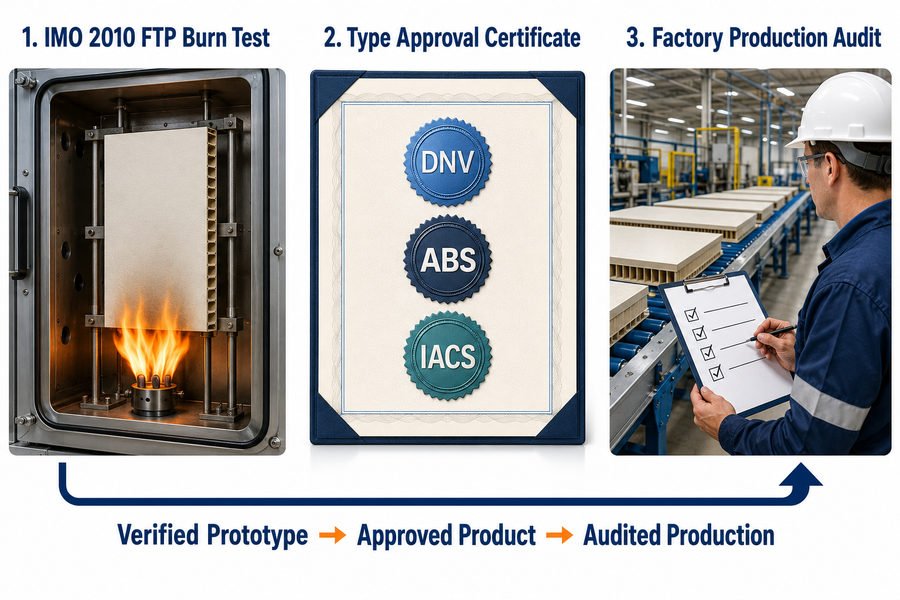
Understanding this three-step verification process is the only way to avoid buying fake panels. Let me break down the exact documents and checks you need.
Conducting Physical Burn Tests Per IMO 2010 FTP Code
When I first started in the marine outfitting factory, I learned that you cannot just guess a fire rating. The first step to verify a panel is the physical burn test. This test must follow the IMO 2010 FTP Code (Fire Test Procedures), specifically Part 3 for "A", "B" and "F" Class divisions1. For an A-60 wall panel, the laboratory places the panel in a giant furnace. The temperature inside the furnace follows a strict standard curve, reaching exactly 945°C (1,733°F) after 60 minutes2. The unexposed side of the panel must not rise more than 140°C on average above the original room temperature3. If it fails this physical test, it gets no rating. We always check that the test was done in a recognized, accredited laboratory. The cost for one of these furnace tests is usually between $10,000 and $15,000 USD, which is why small, unreliable factories try to fake them.
Obtaining Type Approvals and Factory Production Audits
Passing the burn test is only the beginning. The second step is obtaining a Type Approval Certificate (TAC) from a major IACS classification society. I always look for stamps from DNV, ABS, or Lloyd's Register. These societies review the lab test report and issue a certificate proving the panel design meets international SOLAS (Safety of Life at Sea) standards. The third step is the factory production audit. A surveyor visits the factory every year to make sure the panels being sold use the exact same materials as the panel that went into the furnace. If the factory changes the glue or uses cheaper rockwool, they lose their certification.
| Verification Step | Governing Body / Standard | Key Requirement | Frequency |
|---|---|---|---|
| Physical Burn Test | IMO 2010 FTP Code Part 3 | Pass furnace temperature limits | Once per product design |
| Type Approval Certificate | IACS (DNV, ABS, LR, etc.) | Verify lab results meet SOLAS | Renewed every 5 years |
| Factory Production Audit | Classification Society Surveyor | Confirm materials match prototype | Annually |
What Documents Prove a Marine Wall Panel's Fire Rating Is Real?
Afraid of buying panels with fake fire ratings? A wrong purchase ruins your project budget and schedule. These exact documents prove your wall panel meets the real fire standards.
A real marine wall panel fire rating is proven by four essential documents: a Type Approval Certificate (TAC), a detailed Fire Test Report from an accredited lab, a Declaration of Conformity (DoC), and a Material Safety Data Sheet (MSDS) specifying core material properties like rockwool density.
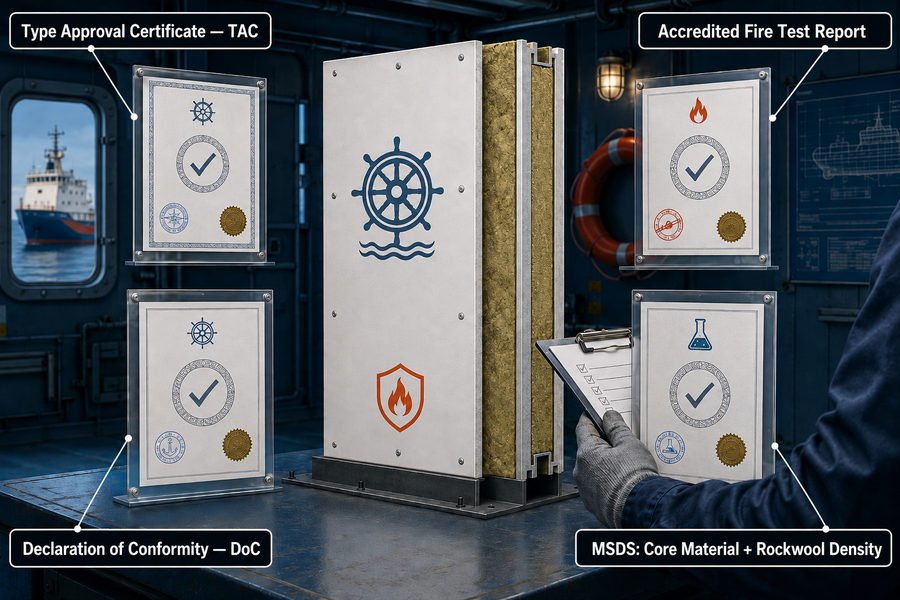
If a supplier cannot give you all four of these documents, you should walk away immediately. Let us look at what each document does.
The Role of the Type Approval Certificate and Fire Test Report
In my daily work, the first thing I ask a supplier for is the Type Approval Certificate (TAC)4. The TAC is the final proof from a class society (like ABS or Bureau Veritas) that the wall panel design is legal for ship use. It will clearly state if the panel is rated B-15 or A-60. However, the TAC alone is not enough. You must also ask for the detailed Fire Test Report from the accredited lab. I always read this report to see the exact conditions of the test. The test report shows the precise thickness of the steel and the exact brand of insulation used during the furnace test. If a supplier refuses to show you the 30-page Fire Test Report and only shows the 2-page TAC, they might be hiding something.
Checking the Declaration of Conformity and Material Safety Data Sheet
The third document is the Declaration of Conformity (DoC)5. This is a legal paper signed by the factory manager. By signing the DoC, the factory legally promises that the panels in your container are built exactly like the panels in the Fire Test Report. For European shipyard projects, this document is mandatory. Finally, you need the Material Safety Data Sheet (MSDS) for the core materials. The MSDS proves the physical properties of the materials used inside the panel. For a standard B-15 marine wall panel, the MSDS must show a rockwool core density of at least 120 kg/m³6. If the MSDS shows a density of only 80 kg/m³, the panel will fail a real fire.
| Required Document | Issued By | What It Proves | Why You Need It |
|---|---|---|---|
| Type Approval Certificate (TAC) | Class Society (e.g., DNV) | General SOLAS compliance | Required for ship registry |
| Fire Test Report | Accredited Fire Laboratory | Exact performance in furnace | Shows tested material specs |
| Declaration of Conformity (DoC) | Panel Manufacturer | Cargo matches the tested design | Legal liability protection |
| Material Safety Data Sheet (MSDS) | Material Supplier | Core material properties | Verifies rockwool density/safety |
Which Fire Test Certificates Must Accompany a Marine Ceiling Panel at Delivery?
Missing certificates at delivery will stop your shipyard installation. Without the right paperwork, the ceiling panels are useless. You must demand these specific certificates when your cargo arrives.
At delivery, every marine ceiling panel shipment must include three specific certificates: a valid Classification Society Type Approval Certificate, a MED Wheelmark Certificate (Modules B and D) for European projects, and a Batch-Specific Certificate of Quality (CoQ) linking the physical delivery to the approved test.
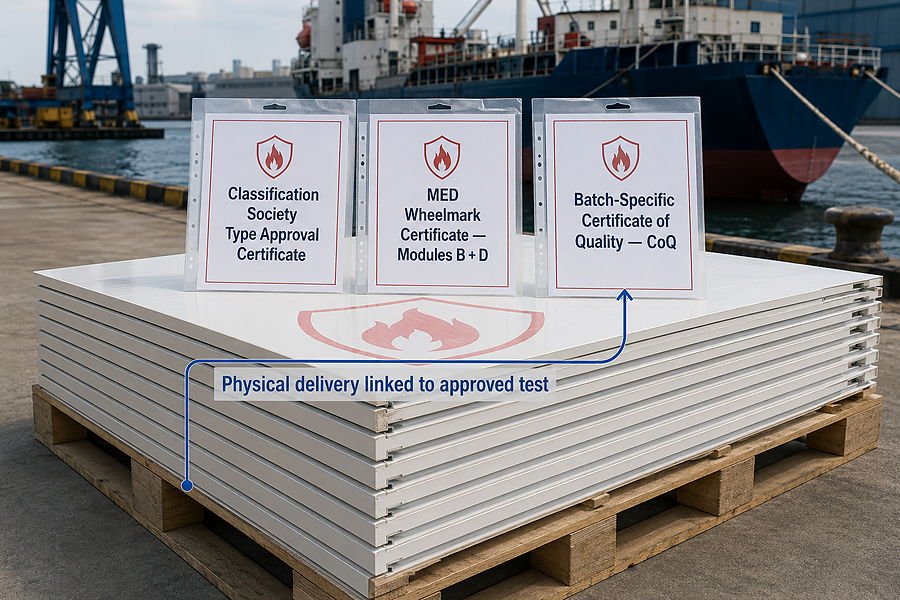
Do not wait until the container is open to ask for these papers. I will show you how to check these three certificates at delivery.
Checking the Classification Society Type Approval and MED Wheelmark
When the truck arrives at your warehouse, the paperwork packet must be complete. The first item is the valid Classification Society Type Approval Certificate. You must check the expiration date on this certificate. A Type Approval is usually valid for 5 years. If the certificate expired last month, the shipyard will reject the entire shipment of ceiling panels. The second certificate is the MED Wheelmark Certificate, which is absolutely required if you are decorating ships for European owners7. The Wheelmark consists of two parts: Module B (the product design approval) and Module D (the factory quality system approval). I have seen buyers purchase panels with a Module B certificate, only to find out the factory failed their Module D audit. You must have both modules valid at the time of delivery, or the European shipyard will not let you install the ceiling.
Verifying the Batch-Specific Certificate of Quality (CoQ)
The third certificate is often forgotten, but it is very important. This is the Batch-Specific Certificate of Quality (CoQ). The Type Approval and Wheelmark prove that the factory can make a good panel. The CoQ proves that your specific batch of panels is good. The CoQ is issued by the factory's quality control department. It lists your exact invoice number, the production date, and the specific quantity of ceiling panels delivered. It acts as the bridge connecting your physical cargo to the Type Approval.8 Without a batch-specific CoQ, the shipyard inspector can argue that the panels in the box are not the same panels listed on the Type Approval.
| Delivery Certificate | Critical Check Point | Consequence if Missing |
|---|---|---|
| Class Type Approval | Check the 5-year expiration date | Shipyard rejects the panels completely |
| MED Wheelmark (B & D) | Verify both Module B and D are active | Banned from European flag vessels |
| Batch-Specific CoQ | Match invoice number to cargo amount | Inspector cannot trace panels to factory |
How to Confirm a Marine Wall Panel Matches Its Fire Test Specimen?
Worried the factory changed materials after passing the fire test? Substituting cheap parts is a common trap. Here is how you check if your panel matches the original test.
To confirm a marine wall panel matches its fire test specimen, you must verify four physical parameters: the steel skin thickness (minimum 0.6mm), the rockwool core density (typically 120-150 kg/m³), the adhesive type used, and the overall panel joint design against the test drawings.
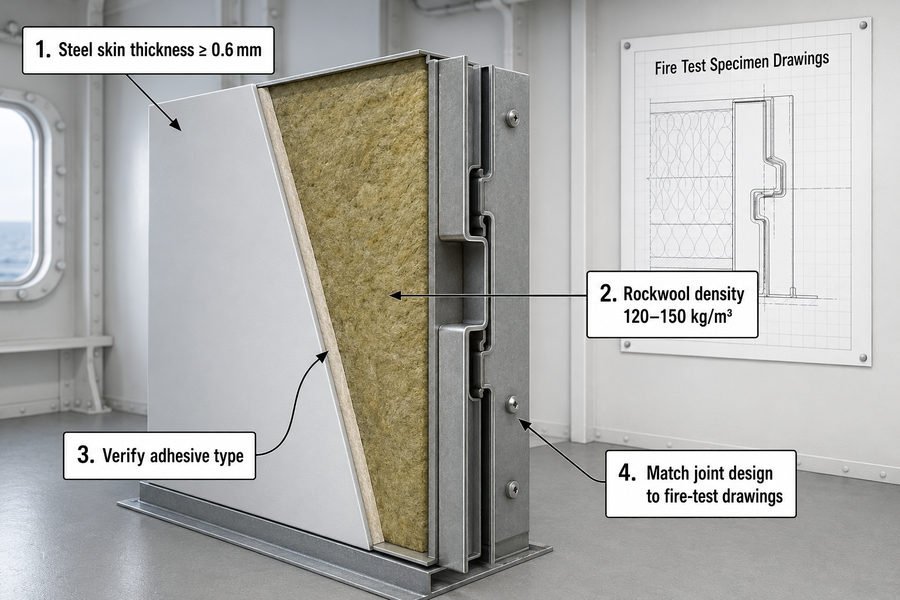
You cannot just trust the sticker on the panel. You need to pull out your tools and check these four physical parameters yourself.
Verifying Steel Skin Thickness and Rockwool Core Density
I always tell my clients to cut a sample panel open. The first physical parameter you must verify is the steel skin thickness. Grab a digital caliper and measure the metal sheet. According to most test specimens for B-15 and A-60 panels, the galvanized steel or aluminum zinc steel skin must be at least 0.6mm thick9. Some factories try to cheat by using 0.4mm steel to save money. This thin steel will warp too quickly in a fire. The second parameter is the rockwool core density. You can calculate this by weighing a specific volume of the core material. For standard marine wall panels, the test specimen usually uses rockwool with a density between 120 kg/m³ and 150 kg/m³10. If your calculation shows 100 kg/m³, the factory is cheating you. The fire rating is no longer valid because lighter rockwool burns through much faster.
Inspecting the Adhesive Type and Panel Joint Design
The third parameter is the adhesive type. You need to ask the factory for the brand and model of the glue they use to stick the steel to the rockwool. Then, compare this to the glue listed in the original fire test report11. It must be a non-combustible marine-grade adhesive. If they switched to a cheap commercial glue, it will release toxic smoke during a fire, failing SOLAS regulations. The fourth parameter is the panel joint design. Look at how two panels connect to each other. Is it a spline joint or a tongue-and-groove joint? Measure the depth of the insertion. The test specimen drawings will show exactly how deep the joint must be (usually around 15mm to 20mm). If the delivered panel has a shorter joint, fire and smoke will leak through the gap12 during an emergency.
| Physical Parameter | Standard Test Specimen Value | Tool Needed to Verify | Risk if Incorrect |
|---|---|---|---|
| Steel Skin Thickness | Minimum 0.6mm | Digital Caliper | Panel warps and collapses early |
| Rockwool Core Density | 120 kg/m³ to 150 kg/m³ | Scale and Tape Measure | Fails insulation temperature limits |
| Adhesive Type | Non-combustible, marine-grade | Visual check / MSDS match | Releases toxic smoke in fire |
| Panel Joint Design | 15mm - 20mm insertion depth | Tape Measure | Smoke and fire leak through gaps |
What Must a Valid Marine Ceiling Panel Fire Test Report Contain?
Staring at a 50-page test report and feeling lost? A fake or incomplete report will fail class inspection. You must find these exact data points inside the document.
A valid marine ceiling panel fire test report must contain five critical sections: the testing laboratory's IMO accreditation number, the exact temperature curve data over 60 minutes, thermocouple location diagrams, structural deflection measurements, and a clear pass/fail conclusion for integrity and insulation criteria.
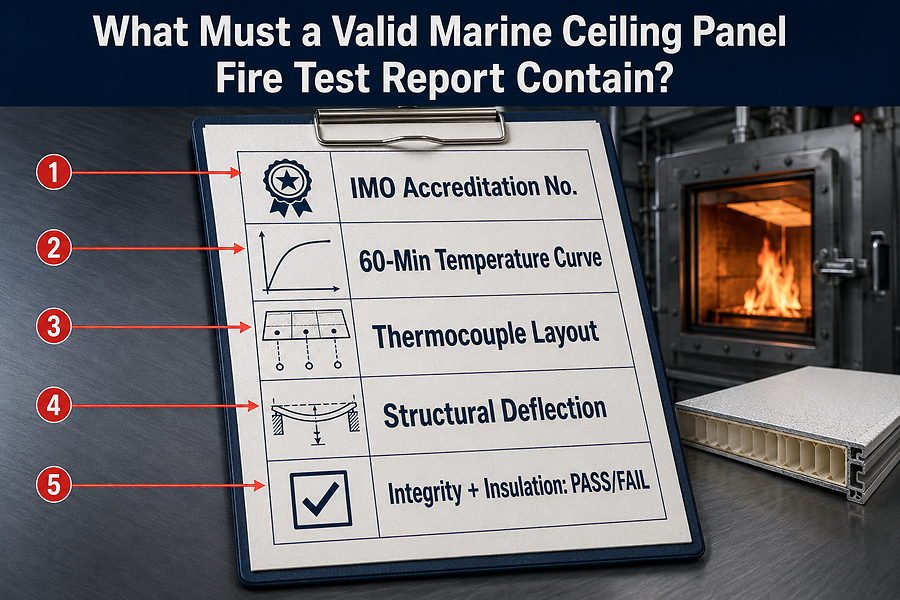
Shipyard surveyors will read this report line by line. I will explain how to read these five critical sections so you can spot errors early.
Identifying IMO Accreditation and Temperature Curve Data
The first section you must find is the testing laboratory's IMO accreditation number. Not every lab can test marine panels. The report must state clearly that the lab is approved by the International Maritime Organization to conduct FTP Code tests13. If this is missing, the report is useless. The second section is the exact temperature curve data. The report must include a graph showing the furnace temperature over a full 60 minutes. This curve must match the ISO 834 standard fire curve. At 30 minutes, the furnace should be at 842°C, and at 60 minutes, it should hit 945°C. I always check the data tables to ensure the furnace actually reached these temperatures. If the lab stopped the test early or the furnace was too cold, the test is invalid.
Reviewing Thermocouples, Deflection, and Final Conclusions
The third critical section is the thermocouple location diagram. Thermocouples are sensors placed on the unexposed side of the ceiling panel to measure heat transfer. The report must show a drawing of exactly where these sensors were placed. There must be sensors in the middle of the panel and right over the joints14, as joints are the weakest point. The fourth section is structural deflection measurements. As the ceiling panel gets hot, it will bend downwards. The report must record how many millimeters the panel deflected. If it bends too much, it could fall on passengers. Finally, the fifth section is the clear pass/fail conclusion. The report must explicitly state that the panel passed both the "integrity" criteria (no flames or thick smoke passed through) and the "insulation" criteria (the back side stayed cool enough)15.
| Report Section | What to Look For | Why Inspectors Check This |
|---|---|---|
| IMO Accreditation | Valid lab registration number | Ensures the lab has legal authority |
| Temperature Curve | Data reaching 945°C at 60 mins | Proves the fire was hot enough |
| Thermocouple Diagram | Sensors placed on panel joints | Ensures the weakest parts were measured |
| Deflection Data | Millimeters of downward bending | Proves the ceiling will not collapse |
| Pass/Fail Conclusion | Clear statement on integrity & insulation | Final proof of safety rating |
Why Do Some Marine Wall Panels Look Compliant but Lack Test Proof?
Ever found a panel that looks perfect but has no paperwork? Buying uncertified panels is a massive risk. Here are the hidden reasons why looking good is not enough.
Marine wall panels often lack test proof for three reasons: the factory buys uncertified raw materials to cut costs, the specific panel size or joint type was never tested, or the factory's previous Type Approval certificate expired and failed the mandatory renewal audit.
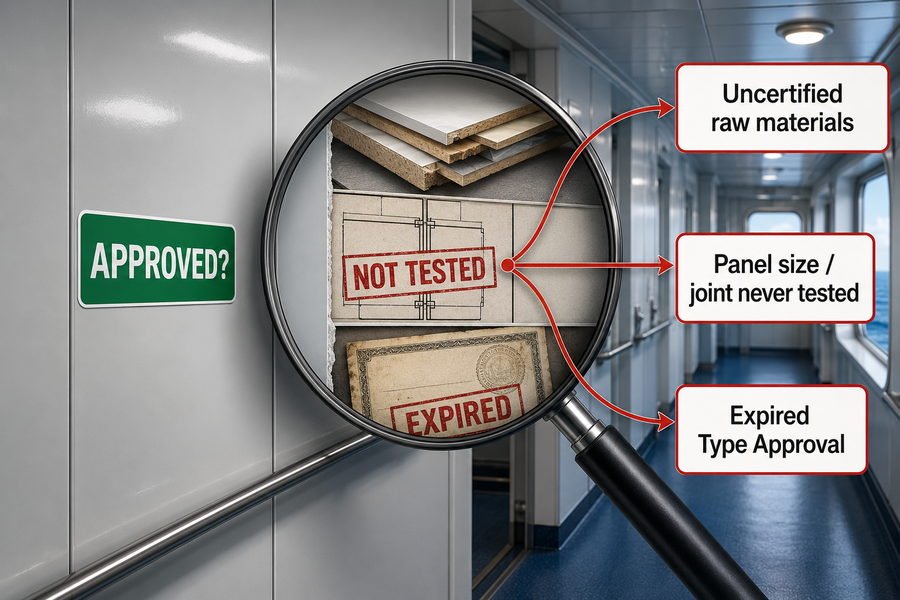
A good paint job can hide a lot of cheap materials. Let us uncover the three main reasons why a nice-looking panel has no proof.
The Risk of Uncertified Raw Materials in Marine Panels
In my experience, the number one reason a nice-looking wall panel lacks a fire certificate is that the factory buys uncertified raw materials to cut costs. On the outside, the panel is painted beautifully with a PVC film finish. But inside, they use cheap, construction-grade rockwool instead of marine-grade rockwool. Construction rockwool might only cost 300 RMB per cubic meter, while certified marine rockwool costs over 800 RMB per cubic meter. Because the factory knows their cheap rockwool will fail the IMO furnace test16, they simply never test it. They hope the buyer only cares about a low price and a nice surface finish. If you buy this, the panel will fail the shipyard inspection immediately.
Problems with Untested Panel Sizes and Expired Type Approvals
The second reason is that the specific panel size or joint type was never tested. A factory might have a real certificate for a 50mm thick panel with a standard joint. But if you order a custom 30mm thick panel or a special curved joint, that new design has no test proof. A certificate for a 50mm panel does not cover a 30mm panel.17 The third reason is an expired certificate. Every Type Approval expires after 5 years. To renew it, the factory must pass a strict audit and sometimes pay for a new furnace test. Many small factories do not want to spend the $10,000 USD to re-test. So, their certificate expires, but they keep producing the same panels. The panels look exactly the same as they did five years ago, but without the active certificate, they are legally useless for marine projects18.
| Reason for No Proof | Factory Motivation | Visual Appearance | Danger to Your Project |
|---|---|---|---|
| Uncertified Materials | Save money on rockwool/glue | Looks perfect outside | Fails real fire, rejected by Class |
| Untested Size/Joint | Avoid paying for custom tests | Looks like standard panel | Fails inspection, no legal coverage |
| Expired Certificate | Avoid 5-year renewal fees | Exact copy of old panels | Cannot be installed on new ships |
How to Request Fire Rating Evidence From a Marine Panel Supplier?
Tired of suppliers ignoring your requests for certificates? Vague emails only get you vague answers. This is the exact method to demand and receive proper fire rating evidence.
To effectively request fire rating evidence from a marine panel supplier, you must demand three specific items in your RFQ: the unredacted Type Approval Certificate, the full IMO FTP Code Part 3 test report, and the contact details of their quality control manager for verification.
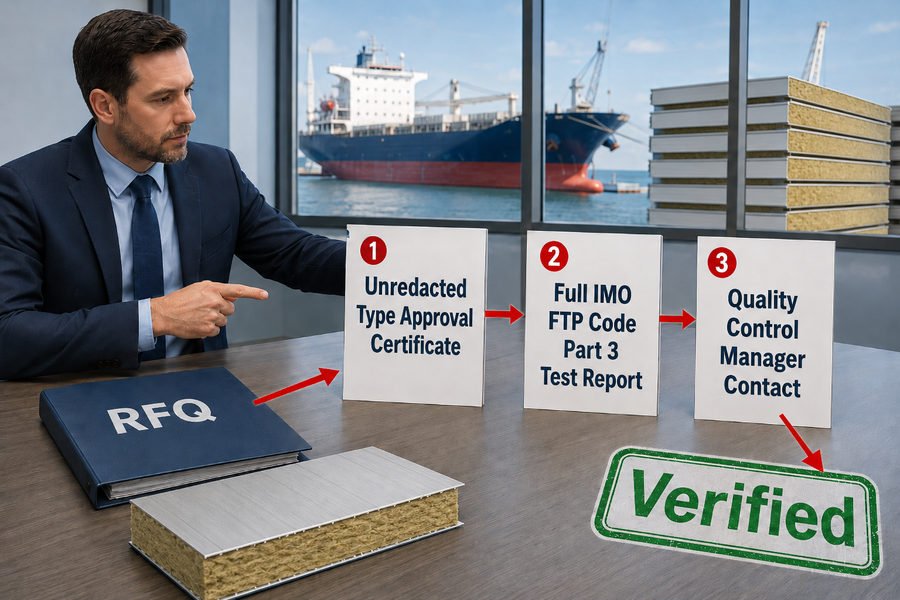
Changing how you ask for documents will change the quality of suppliers you attract. I will show you how to request these three items clearly.
Demanding the Unredacted Type Approval and Full Test Report
When I write an email to a new supplier, I do not just say "please send certificates." That is too vague. The first thing you must demand is the unredacted Type Approval Certificate. Many bad suppliers will send a certificate with the factory name or product model blurred out or covered in black lines. They do this because they are stealing someone else's certificate19. You must clearly state: "Send the full, original PDF of the Type Approval Certificate." The second item you must demand is the full IMO FTP Code Part 3 test report20. Do not accept a one-page summary. Tell them you need the complete 30-to-50-page document showing the temperature curves and material specifications. If they say the report is a "company secret," they are lying. Real factories gladly share this report with serious buyers to prove their quality.
Securing Quality Control Manager Contact Details for Verification
The third specific item you must request is the contact details of their quality control manager. I always write in my RFQ: "Please provide the direct phone number and email of your Quality Control Manager for document verification." A fake trading company will refuse to give you this, or they will just give you the sales person's number again. A real factory with a proper ISO 9001 quality system will have a dedicated QC manager. Once I get the contact details, I actually call them. I ask them specific questions about the rockwool density listed in the test report. If the QC manager can answer my technical questions easily, I know the fire rating evidence is real and the factory is trustworthy.
| Item to Demand in RFQ | What to Say in Your Email | Red Flag from Supplier |
|---|---|---|
| Unredacted Type Approval | "Send the original, clear PDF Type Approval." | Blurred names or missing dates |
| Full IMO Test Report | "Provide the complete Part 3 test report." | "It is a company secret." |
| QC Manager Contact | "Provide direct contact for the QC Manager." | Refusal to share non-sales contact |
Conclusion
Verifying marine panel fire ratings requires checking physical tests, matching delivery certificates, and confirming core materials. Always demand full documentation to ensure your shipyard projects pass inspection smoothly.
-
"[PDF] RESOLUTION MSC.307(88) (adopted on 3 December 2010 ...", https://wwwcdn.imo.org/localresources/en/KnowledgeCentre/IndexofIMOResolutions/MSCResolutions/MSC.307(88).pdf. The IMO 2010 FTP Code identifies Part 3 as the fire test procedure for A, B, and F class divisions used in ship construction fire-resistance assessments. Evidence role: definition; source type: institution. Supports: The relevant fire test for A, B, and F class marine divisions is specified in Part 3 of the IMO 2010 FTP Code.. ↩
-
"[PDF] RESOLUTION MSC.307(88) (adopted on 3 December 2010 ...", https://wwwcdn.imo.org/localresources/en/KnowledgeCentre/IndexofIMOResolutions/MSCResolutions/MSC.307(88).pdf. The standard time-temperature curve used for fire-resistance testing under IMO/ISO-style furnace procedures specifies a furnace temperature of about 945°C at 60 minutes. Evidence role: mechanism; source type: institution. Supports: The furnace temperature curve for the relevant fire test reaches approximately 945°C after 60 minutes.. Scope note: The source may describe the general standard fire curve rather than the full IMO Part 3 test protocol for a specific panel product. ↩
-
"[PDF] RESOLUTION MSC.307(88) (adopted on 3 December 2010 ...", https://wwwcdn.imo.org/localresources/en/KnowledgeCentre/IndexofIMOResolutions/MSCResolutions/MSC.307(88).pdf. The IMO fire-resistance criteria for class divisions include an insulation performance requirement limiting the average temperature rise on the unexposed face to 140°C above the initial temperature. Evidence role: mechanism; source type: institution. Supports: For an A-60 division, the unexposed side must remain within an average temperature-rise limit of 140°C above the initial temperature.. Scope note: The full pass/fail criteria may also include additional limits, such as maximum point temperature rise and integrity requirements, beyond the average-temperature criterion quoted here. ↩
-
"History of SOLAS fire protection requirements", https://www.imo.org/en/OurWork/Safety/Pages/History-of-fire-protection-requirements.aspx. A classification society type-approval certificate documents that a specified product design has been assessed against stated marine rules or statutory standards for the scope identified on the certificate. Evidence role: definition; source type: institution. Supports: The Type Approval Certificate is proof from a class society that a marine wall panel design is approved for ship use and states the relevant fire rating.. Scope note: The certificate supports compliance only for the listed product configuration, standards, validity period, and conditions of approval. ↩
-
"Directive 96/98/EC - Wikipedia", https://en.wikipedia.org/wiki/Directive_96/98/EC. Under EU marine equipment conformity-assessment rules, a declaration of conformity is the manufacturer’s formal statement that supplied equipment conforms to the applicable approved type and regulatory requirements. Evidence role: definition; source type: government. Supports: For European shipyard projects, a Declaration of Conformity functions as the manufacturer’s legal statement that supplied panels conform to the approved design.. Scope note: This supports EU-regulated marine equipment contexts; applicability to a particular wall panel depends on whether it falls within the relevant Marine Equipment Directive scope and project specifications. ↩
-
"How to choose the right marine wall panels for marine interior ...", https://magellanmarinetech.com/how-choose-right-marine-wall-panels-for-marine-interior-projects/. The IMO fire-test framework for B-class divisions is performance based and ties approval to the tested specimen construction, so any stated mineral-wool density requirement should be evidenced by the specific approved test report or certificate for that panel design. Evidence role: general_support; source type: institution. Supports: A B-15 marine wall panel’s core density must be verified against the tested and approved construction, and a claimed 120 kg/m³ requirement needs design-specific evidence.. Scope note: This does not establish 120 kg/m³ as a universal regulatory minimum; it supports the narrower point that density must match the tested and approved construction for the claimed rating. ↩
-
"Directive 96/98/EC - Wikipedia", https://en.wikipedia.org/wiki/Directive_96/98/EC. The EU Marine Equipment Directive establishes conformity-assessment and wheel-marking requirements for marine equipment placed on board EU-flagged ships, providing the regulatory basis for requiring Wheelmark certification in that context. Evidence role: definition; source type: government. Supports: MED Wheelmark certification is required for covered marine equipment installed on EU-regulated ships.. Scope note: The directive is tied primarily to EU-flagged ships and covered marine equipment, not simply to the nationality of the shipowner or all decorative work. ↩
-
"Testing and Labeling Pertaining to Product Certification", https://www.federalregister.gov/documents/2011/11/08/2011-27678/testing-and-labeling-pertaining-to-product-certification. Quality-management and conformity-assessment guidance emphasizes product identification and traceability through batch, lot, serial, or production records, which contextually supports the role of batch-specific documentation in linking delivered goods to approved production. Evidence role: mechanism; source type: institution. Supports: Batch-specific documentation helps connect delivered panels to the approved product and production records.. Scope note: General traceability standards support the principle, but a project specification or certifying-body rule would be needed to prove that a CoQ is mandatory for a specific shipyard inspection. ↩
-
"How to choose the right marine wall panels for marine interior ...", https://magellanmarinetech.com/how-choose-right-marine-wall-panels-for-marine-interior-projects/. An IMO FTP Code or type-approval source should show that fire-rated marine divisions are approved based on the tested specimen construction, including facing materials and dimensions; this would contextualize the stated 0.6 mm skin value as a tested-design requirement rather than a universal rule. Evidence role: general_support; source type: institution. Supports: B-15 and A-60 marine panel test specimens commonly specify steel or aluminum-zinc steel skins of at least 0.6 mm.. Scope note: Marine fire ratings are performance-based and tied to the approved test specimen, so a neutral source may not prove that 0.6 mm is mandatory for every B-15 or A-60 panel. ↩
-
"[PDF] RESOLUTION A.754(18) adopted on 4 November 1993 ...", https://wwwcdn.imo.org/localresources/en/KnowledgeCentre/IndexofIMOResolutions/AssemblyDocuments/A.754(18).pdf. A marine fire-test report, classification approval, or technical study should document the mineral wool density used in representative A- or B-class panel specimens; such evidence would support the stated density range only for those tested assemblies, not for all certified marine panels. Evidence role: general_support; source type: institution. Supports: Standard marine wall panel test specimens usually use rockwool core densities between 120 kg/m³ and 150 kg/m³.. Scope note: The acceptable density depends on the tested and approved panel design, so the range may be typical rather than universally required. ↩
-
"[PDF] RESOLUTION MSC.307(88) (adopted on 3 December 2010 ...", https://wwwcdn.imo.org/localresources/en/KnowledgeCentre/IndexofIMOResolutions/MSCResolutions/MSC.307(88).pdf. The IMO FTP Code describes fire-test approval as applying to the tested construction and materials of a specimen; this supports treating a change in adhesive as a construction change that may require evidence of equivalence or retesting. Evidence role: expert_consensus; source type: institution. Supports: The adhesive used in delivered panels should match the adhesive specified in the original fire test report for the approved panel assembly.. Scope note: The source would support the principle that tested materials must be controlled, but it may not specifically name adhesives for every panel design. ↩
-
"What Is the Purpose and Scope of the IMO FTP Code? - Magellan ...", https://magellanmarinetech.com/what-purpose-scope-of-imo-ftp-code/. Fire-resistance testing standards for marine divisions require the specimen to include representative joints and assess integrity against flame or hot-gas passage; this supports the concern that inadequately reproduced joints can compromise barrier performance. Evidence role: mechanism; source type: institution. Supports: If the delivered panel has a shorter or nonconforming joint than the tested design, fire and smoke may pass through the gap during a fire.. Scope note: The source would support the mechanism and testing principle, but the specific 15–20 mm insertion depth must come from the relevant panel’s test drawing or approval file. ↩
-
"What Is the IMO FTP Code for Marine Interior Materials?", https://magellanmarinetech.com/what-imo-ftp-code-for-marine-interior-materials/. The IMO FTP Code establishes standardized fire-test procedures for materials used on ships, but laboratory acceptance and approval are generally administered by flag Administrations or their recognized bodies rather than by IMO as a direct accreditor. Evidence role: expert_consensus; source type: institution. Supports: Marine panel fire-test reports should come from a laboratory authorized or accepted to conduct FTP Code tests.. Scope note: This supports the need for an authorized or accepted test laboratory, while also qualifying the article’s wording that implies direct IMO accreditation. ↩
-
"What Is the Purpose and Scope of the IMO FTP Code? - Magellan ...", https://magellanmarinetech.com/what-purpose-scope-of-imo-ftp-code/. Fire-resistance test procedures for ship divisions require unexposed-face thermocouples to be positioned at specified locations, including representative field areas and construction details such as joints, so that insulation performance is assessed across potential weak points. Evidence role: mechanism; source type: institution. Supports: Thermocouples should be placed to measure both central panel areas and joint details in marine ceiling-panel fire tests.. Scope note: Exact thermocouple number and placement can vary with the FTP Code part, specimen type, and test configuration. ↩
-
"[PDF] RESOLUTION MSC.307(88) (adopted on 3 December 2010 ...", https://wwwcdn.imo.org/localresources/en/KnowledgeCentre/IndexofIMOResolutions/MSCResolutions/MSC.307(88).pdf. The FTP Code and related fire-resistance testing standards distinguish integrity criteria, which concern the passage of flames or hot gases, from insulation criteria, which concern limiting temperature rise on the unexposed face of the tested division. Evidence role: definition; source type: institution. Supports: Marine fire-test conclusions should state whether the assembly satisfies both integrity and insulation criteria.. Scope note: The article’s phrase “thick smoke” is an informal simplification; standards typically define integrity using flaming, gaps, sustained ignition of cotton pads, or similar criteria rather than a general smoke description. ↩
-
"What Is the Purpose and Scope of the IMO FTP Code? - Magellan ...", https://magellanmarinetech.com/what-purpose-scope-of-imo-ftp-code/. The IMO Fire Test Procedures Code specifies standardized furnace-based fire-resistance testing methods for divisions and related marine construction materials used to demonstrate compliance with SOLAS fire-safety requirements. Evidence role: definition; source type: institution. Supports: Marine wall panels intended for shipboard use may need to pass an IMO-recognized furnace fire test rather than relying on appearance alone.. Scope note: This supports the existence and regulatory role of the test procedure, but it does not prove that any specific supplier’s rockwool would fail it. ↩
-
"How to Specify Marine Panel Surface Finishes in a Purchase Inquiry?", https://magellanmarinetech.com/how-specify-marine-panel-surface-finishes-in-purchase-inquiry/. Marine fire-test approvals are issued for tested constructions and defined approval ranges, so changes in thickness, joint design, or construction details may fall outside the scope of the original tested specimen. Evidence role: mechanism; source type: institution. Supports: A fire certificate for one tested panel configuration may not automatically apply to a thinner or otherwise modified configuration.. Scope note: The precise permitted variation depends on the test standard, approval body, and certificate wording; the source would establish the general rule rather than adjudicate a particular certificate. ↩
-
"History of SOLAS fire protection requirements", https://www.imo.org/en/OurWork/Safety/Pages/History-of-fire-protection-requirements.aspx. SOLAS and classification approval frameworks require specified shipboard materials and fire-protection components to have valid evidence of compliance before installation on classed or convention-regulated vessels. Evidence role: expert_consensus; source type: institution. Supports: Marine panels lacking an active approval certificate may be unacceptable for regulated shipbuilding projects.. Scope note: The legal consequence depends on vessel type, flag state, class rules, and the component’s safety function; the source would support the compliance requirement rather than every possible project outcome. ↩
-
"Fraudulent Certificates - International Maritime Organization", https://www.imo.org/en/OurWork/HumanElement/Pages/FraudulentCertificates.aspx. An official maritime or conformity-assessment source should document that falsified or misused certificates occur in maritime compliance contexts and that certificates should be checked against the issuing body’s records. Evidence role: case_reference; source type: institution. Supports: Blurred or altered certificate details can be a warning sign because certificates may be falsified, misused, or presented for products or entities other than those actually approved.. Scope note: Such a source can substantiate the risk of certificate misuse generally; it may not prove the motive or conduct of any individual supplier. ↩
-
"[PDF] RESOLUTION MSC.307(88) (adopted on 3 December 2010 ...", https://wwwcdn.imo.org/localresources/en/KnowledgeCentre/IndexofIMOResolutions/MSCResolutions/MSC.307(88).pdf. The IMO FTP Code describes the fire-test procedures for divisions and related marine materials, including test conditions and performance criteria; this supports requesting the underlying test report rather than relying only on a certificate summary. Evidence role: definition; source type: institution. Supports: A complete IMO FTP Code Part 3 test report is the relevant technical evidence for verifying the tested construction, conditions, and results behind a marine fire rating.. Scope note: The code establishes the testing framework but may not prescribe a fixed commercial report length or require suppliers to disclose the entire laboratory report to every buyer. ↩