You buy marine panels for non-EU ships but worry about class rules. The wrong certificate stops your project and costs money. Let us fix this problem today.
Class society approval for marine accommodation panels outside the EU depends on the flag state, requiring specific International Association of Classification Societies (IACS) certificates like ABS, DNV, or CCS, alongside National Maritime Authority mutual recognition agreements, to prove SOLAS fire safety compliance and pass Port State Control inspections.
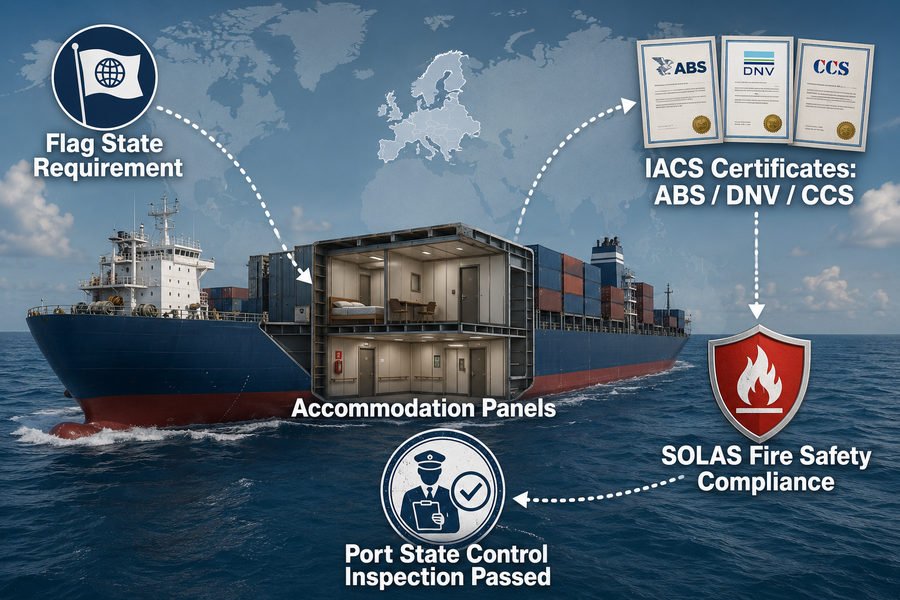
Navigating these marine certification rules feels very hard at first. But understanding these specific certificates saves you from delayed projects and angry shipyard customers, so you must read the details below.
Is CCS Approval Accepted for Marine Accommodation Panels on Panama or Liberia-Flagged Vessels?
You want to buy cheaper Chinese panels with CCS approval. But will Panama or Liberia reject them? A rejected panel ruins your schedule. Here is the truth.
Yes, China Classification Society (CCS) approval is fully accepted for marine accommodation panels on Panama and Liberia-flagged vessels because both registries officially authorize CCS as a Recognized Organization (RO) to issue statutory certificates on their behalf, provided the panels meet standard SOLAS Chapter II-2 fire safety requirements.
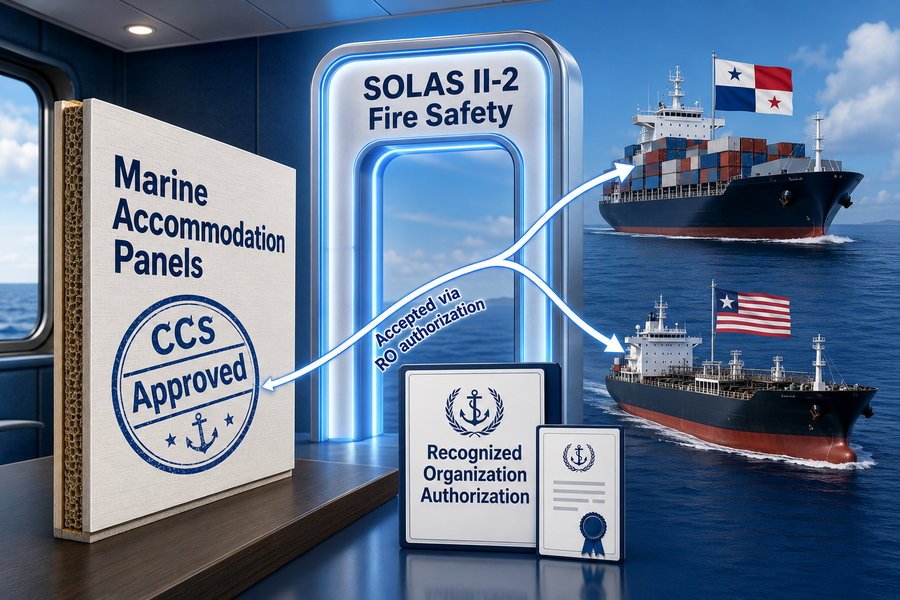
Panama Maritime Authority's Acceptance of CCS Approved Panels
I worked at a marine outfitting factory for many years. I saw many buyers from Asia worry about China Classification Society (CCS) certificates. Panama is the largest flag state in the world.1 According to Panama Circular MMC-136, the Panama Maritime Authority officially recognizes CCS as a Recognized Organization (RO). This means Panama fully accepts CCS certificates for marine accommodation panels. The marine wall panels and ceiling panels must simply meet standard SOLAS Chapter II-2 fire safety requirements2. You do not need to buy expensive European panels for these ships. A standard B-15 marine wall panel with CCS approval costs around $25 to $35 per square meter in China. An identical panel with European class approval might cost $45 to $60 per square meter. Buying CCS panels saves your interior decoration company a lot of money. The core materials and steel skins remain exactly the same quality. I always tell my clients at Magellan Marine to use CCS panels for Panama ships.
Liberian Registry's Recognition of CCS Fire Safety Certificates
Liberia is another huge flag state in the shipping industry. Based on Liberia Marine Operations Note 1-2023, the Liberian Registry also authorizes CCS as a Recognized Organization. Liberia completely accepts CCS fire safety certificates. This is great news for your daily procurement work. If you undertake a ship interior project for a Liberia-flagged bulk carrier, you can confidently source CCS-approved panels. I helped a client last year with a big project. We used CCS-approved marine ceiling panels for a Liberian oil tanker. The local inspector approved the installed panels without any delay. You only need to make sure the CCS certificate is currently valid. The factory must test the panels according to the latest fire codes. Both registries give you a clear path to use cost-effective materials without failing inspections.
| Flag State | Official Document | CCS Authorized as RO? | Accepts CCS Panel Certificates? | Estimated Cost of B-15 Panel (China) |
|---|---|---|---|---|
| Panama | Circular MMC-136 | Yes | Yes | $25 - $35 per sqm |
| Liberia | Marine Operations Note 1-2023 | Yes | Yes | $25 - $35 per sqm |
Which Class Approvals Are Required for Marine Accommodation Panels on USCG-Regulated Vessels?
Supplying panels to a US shipyard is profitable but strict. Using the wrong class certificate means the US Coast Guard blocks your panels. Know the exact rules.
Marine accommodation panels on USCG-regulated vessels require either a direct United States Coast Guard (USCG) Type Approval Certificate (Subchapter Q) or an MRA-recognized class approval from ABS, DNV, or Lloyd's Register, backed by testing at a USCG-accepted independent laboratory according to the FTP Code.
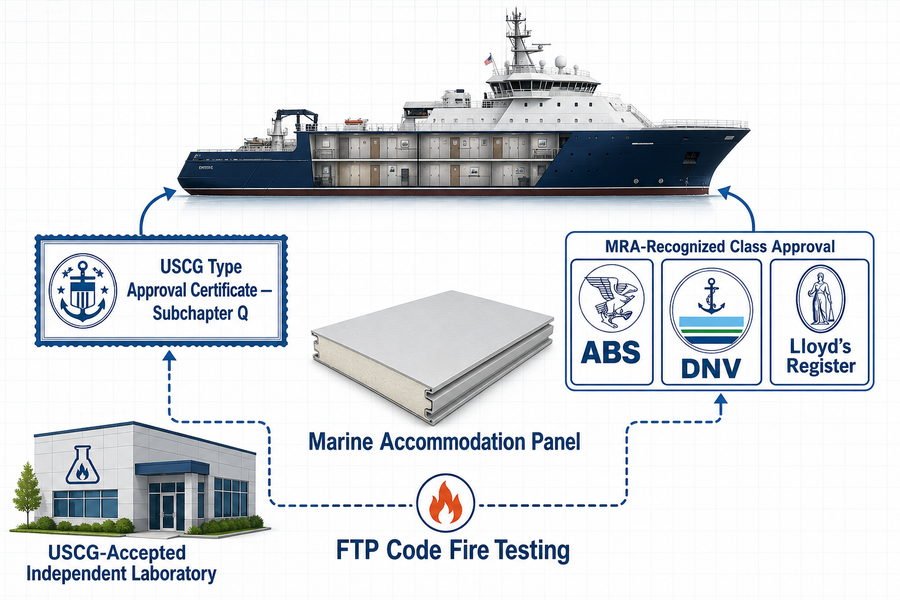
Direct USCG Subchapter Q Approval for Marine Accommodation Panels
The United States Coast Guard (USCG) enforces very strict fire safety rules. If you supply marine accommodation panels to a US shipyard, you must follow these rules perfectly. The best and most direct option is a United States Coast Guard (USCG) Type Approval Certificate. People in the industry also call this a Subchapter Q certificate3. To get this paper, the panel factory must send the marine accommodation panels to an independent laboratory4. The USCG must explicitly accept this laboratory. The laboratory tests the panels according to the Fire Test Procedures (FTP) Code. According to testing data from Southwest Research Institute, a single marine fire test costs about $10,000 to $15,0005. This high testing cost makes direct USCG approved panels more expensive for buyers. But this specific certificate guarantees smooth entry into the United States market.
Using ABS, DNV, and LR Approvals under USCG Mutual Recognition Agreements
You have a second, very useful option. You can use specific class approvals under a Mutual Recognition Agreement (MRA). The USCG has legal agreements with certain classification societies. Based on USCG Navigation and Vessel Inspection Circular (NVIC) 9-976, the USCG legally recognizes ABS, DNV, and Lloyd's Register (LR) for many marine fire safety items. If your marine wall panel has an ABS, DNV, or LR certificate, the USCG usually accepts it. However, the panel must still pass the FTP Code test at an accredited independent laboratory. This rule helps you avoid paying for a brand new USCG fire test. You can buy high-quality panels from developing countries with ABS or DNV certificates. You get competitive pricing and you still meet the USCG rules. I help many clients use this MRA path to lower their project costs.
| Approval Type | Issuing Authority | Testing Requirement | Average Test Cost | Best For |
|---|---|---|---|---|
| Subchapter Q | Direct USCG | USCG-accepted independent lab (FTP Code) | $10,000 - $15,000 | Direct US shipyard sales |
| MRA-Recognized | ABS, DNV, or LR | Accredited independent lab (FTP Code) | Included in class fee | Lowering procurement costs |
Does Lloyd's Register Approval Cover Marine Accommodation Panels on Worldwide Routes?
You paid a high price for Lloyd's Register panels. Do they actually guarantee worldwide acceptance? Failing a local inspection is a nightmare. Let us check.
Lloyd's Register (LR) approval covers marine accommodation panels on almost all worldwide routes because LR is an IACS founding member recognized by over 130 flag administrations, but local authorities may still demand a specific flag-state endorsement or supplementary MED Wheelmark for European port operations.
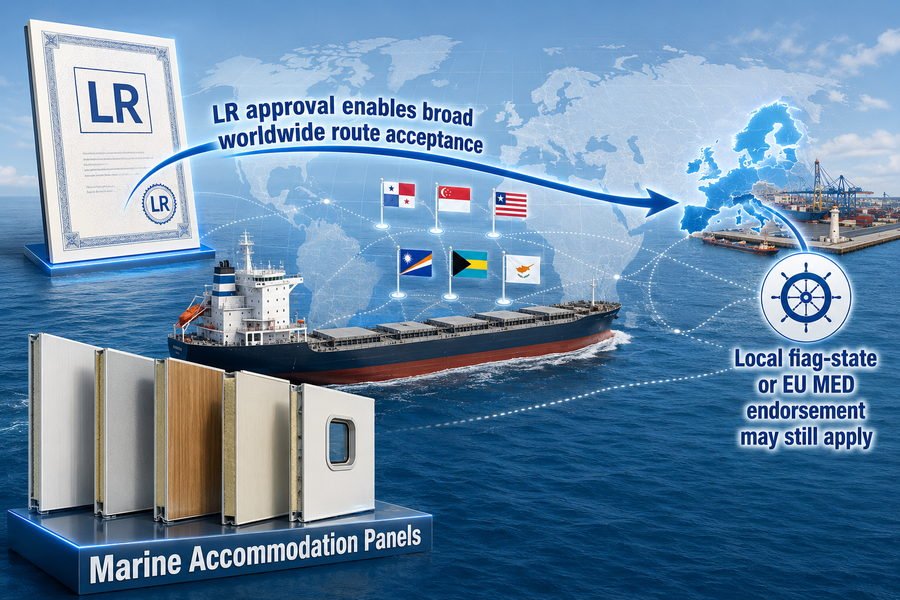
The 130 Flag Administrations Recognizing Lloyd's Register Panel Approvals
Lloyd's Register (LR) is a very famous classification society. It is a founding member of the International Association of Classification Societies (IACS)7. Based on official Lloyd's Register port state data, more than 130 flag administrations recognize LR certificates globally8. This massive number means LR approval covers marine accommodation panels on almost all worldwide routes. You can buy LR-approved marine ceiling panels and safely use them on ships traveling to Asia, Africa, South America, and the Middle East. This broad global acceptance gives you great peace of mind. Your interior decoration company can standardise its material purchases easily. You can buy one type of LR-approved panel and use it for five different international projects. When I was a factory employee, LR panels were our best sellers for export.
Limitations of Lloyd's Register Approvals in Specific Local Ports
LR approval is very powerful, but it is not pure magic. Local authorities can still make special demands during ship inspections9. Sometimes, a local port inspector asks for a specific flag-state endorsement. This is a special paper from the ship's flag country that officially validates the LR certificate. Also, if the ship operates strictly in European waters, the local port might demand a supplementary MED Wheelmark10. Even if you have a valid LR approval, a European inspector wants to see the Wheelmark logo on the panel. You must always ask the shipowner about the ship's final route before you order materials. A standard LR B-15 panel approval costs the factory around $5,000 for the design review. Make sure the shipyard customer accepts this exact certificate before you load the products into the shipping container.
| Route / Authority | Accepts Standard LR Approval? | Additional Requirement |
|---|---|---|
| Worldwide (130+ Flags) | Yes | None |
| Specific Flag States | Yes | Flag-state endorsement |
| European Port Operations | No | Supplementary MED Wheelmark |
How to Cross-Certify Marine Accommodation Panels Between ABS, DNV, and KR?
You bought DNV panels, but the shipowner wants ABS or KR. Paying for a whole new fire test hurts your budget. Cross-certification is the answer.
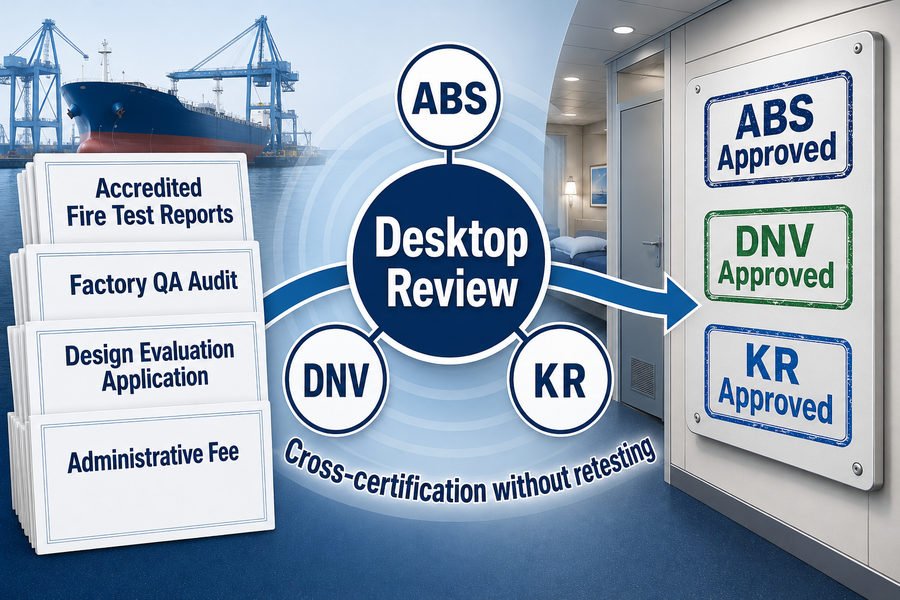
To cross-certify marine accommodation panels between ABS, DNV, and KR without retesting, you must submit the original accredited laboratory fire test reports, a quality assurance audit from your factory, a design evaluation application, and an administrative fee to the target class society for a desktop review.
Providing Original Fire Test Reports for ABS, DNV, or KR Review
Sometimes you buy a marine accommodation panel with DNV approval, but the interior project needs ABS or Korean Register (KR) approval. You do not need to burn a new panel in a laboratory to fix this. You can cross-certify the panels. First, you must get the original accredited laboratory fire test reports from the panel factory. The laboratory test must follow the standard IMO 2010 FTP Code11. You submit these raw test reports directly to the target class society. For example, you send the original DNV test report to ABS. ABS engineers will perform a desktop review of the papers. They check if the old test meets their specific society rules. This process saves a lot of time. A new physical fire test takes three to six months.12 A desktop review only takes three to four weeks.
Completing the Factory Quality Assurance Audit and Paying Evaluation Fees
The fire test report is not the only requirement for cross-certification. The new class society also wants to check the manufacturing factory. You must submit a recent quality assurance audit from your factory. ABS, DNV, or KR will usually send a surveyor to the factory. They check the production line for the marine wall panels to ensure consistent quality. You must also submit a formal design evaluation application to the target society. Finally, you must pay an administrative fee. According to standard IACS member fee schedules, a desktop review and certificate issuance costs between $1,500 and $3,000. This fee is much cheaper than paying $15,000 for a brand new physical fire test. Your delivery lead time becomes much shorter, and your project profit margin grows larger.
| Cross-Certification Step | Document / Action Required | Estimated Cost / Time |
|---|---|---|
| 1. Test Review | Original accredited laboratory fire test reports | 3 to 4 weeks |
| 2. Factory Check | Quality assurance audit from the factory | Included in society audit time |
| 3. Application | Design evaluation application | Minor paperwork time |
| 4. Payment | Administrative fee to target class society | $1,500 - $3,000 |
Are Class Type Approvals for Marine Accommodation Panels Mutually Recognized Under IACS?
You might think one IACS certificate covers everything automatically. This mistake leads to rejected deliveries. Let us clear up how mutual recognition actually works for panels.
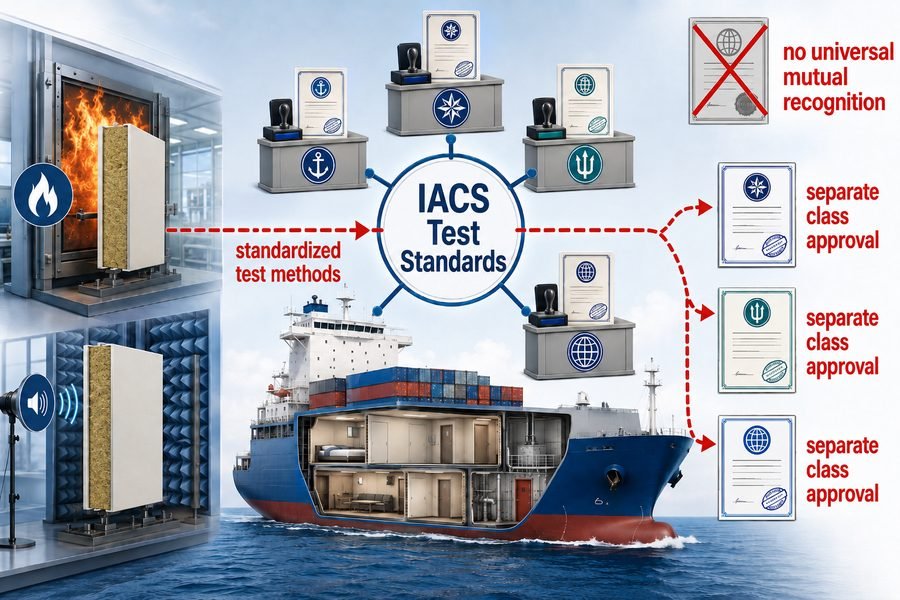
Class Type Approvals for marine accommodation panels are not universally mutually recognized under IACS; while the International Association of Classification Societies standardizes the test methods, each member society still requires its own separate design review and certificate issuance before approving the panels for its classed vessels.
Why IACS Standardizes Test Methods but Not Marine Panel Certificates
Many procurement officers think one IACS certificate equals all IACS certificates. This is a very big misunderstanding in the shipbuilding industry. The International Association of Classification Societies (IACS) creates Unified Requirements (UR).13 These important rules standardize the physical test methods. For example, all IACS members use the exact same furnace temperature curve to test a marine fire door or a marine wall panel14. But IACS does not mandate universal mutual recognition of the final certificate. An ABS Class Type Approval does not automatically become a DNV Class Type Approval. Each member society keeps its own legal authority. They trust the standardized test methods, but they strongly want to issue their own paper. I learned this lesson the hard way during my early factory days.
The Process of Individual Society Review for Marine Accommodation Panels
Because Class Type Approvals are not universally mutually recognized, each classification society requires its own separate design review. If you buy a marine accommodation panel with a CCS certificate, you cannot put it on an ABS-classed ship without getting ABS permission first. You must apply directly to ABS. ABS will perform its own separate design review of the CCS test data. After a successful review, ABS will then handle the certificate issuance. They give you a brand new ABS certificate. I always tell my clients at Magellan Marine to check the target ship's class before buying any materials. Do not ever assume mutual recognition exists automatically. Checking the ship's class first prevents massive delivery delays. It keeps your shipyard customer very happy and protects your money.
| Concept | Standardized by IACS? | Mutually Recognized Automatically? | Required Action by Buyer |
|---|---|---|---|
| Fire Test Methods | Yes (Unified Requirements) | N/A | Ensure factory uses IMO FTP Code |
| Class Type Approvals | No | No | Apply for separate design review |
| Certificate Issuance | No | No | Obtain certificate from target society |
Which Documents Prove Class Approval Validity for Marine Accommodation Panels at Port State Control?
The port inspector is on the ship. Missing one paper means the ship cannot leave. You must provide the exact correct documents to avoid fines.
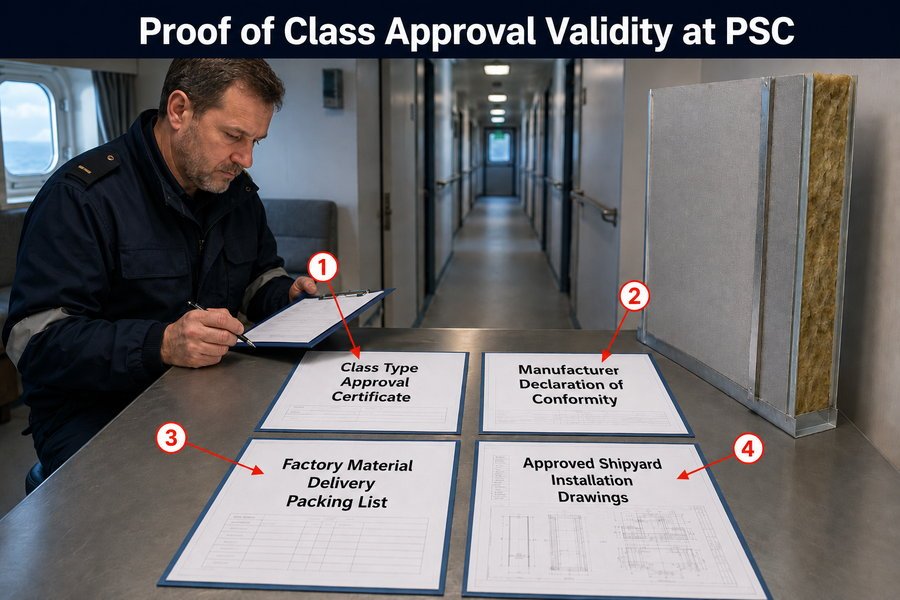
To prove class approval validity for marine accommodation panels at Port State Control, you must present the valid Class Type Approval Certificate, the manufacturer's Declaration of Conformity, the original factory material delivery packing list, and the approved shipyard installation drawings.
Valid Class Type Approval Certificate and Declaration of Conformity
Port State Control (PSC) inspections are very strict around the world. Based on IMO Resolution A.1155(32) Procedures for Port State Control15, marine inspectors check fire safety equipment very closely. To prove your marine accommodation panels have valid class approval, you must present the valid Class Type Approval Certificate16. This paper shows the overall product design is approved by the class society. But the certificate alone is not enough for the inspector. You must also provide the manufacturer's Declaration of Conformity. This specific document is a serious legal promise from the factory. It clearly states that the actual panels they shipped exactly match the approved design. Without this declaration, the port inspector will reject the installed panels immediately.
Factory Delivery Packing List and Approved Shipyard Installation Drawings
The port inspector also wants to track the exact materials used on the ship. You must show the original factory material delivery packing list. This packing list must show the specific batch numbers of the delivered marine accommodation panels. The batch numbers on the paper must match the printed labels on the panels inside the ship. Finally, you must present the approved shipyard installation drawings. The drawings show exactly where every A-60 or B-15 panel goes inside the cabins. The inspector compares the drawing to the real physical wall. If you have all four of these documents ready, the Port State Control inspection takes only a few hours. If you miss just one document, the ship could face many days of expensive delays17.
| Required Document | Issued By | Purpose at Port State Control |
|---|---|---|
| Valid Class Type Approval Certificate | Class Society | Proves the panel design meets fire safety rules |
| Declaration of Conformity | Manufacturer | Legal promise that shipped panels match the design |
| Factory Material Delivery Packing List | Manufacturer | Tracks batch numbers to physical panel labels |
| Approved Shipyard Installation Drawings | Shipyard | Shows correct placement of panels in the ship |
Conclusion
Understanding class approvals like CCS, ABS, and DNV ensures your marine accommodation panels pass inspections. Always check flag state rules, prepare exact documents, and save money using cross-certification.
-
"List of merchant navy capacity by country - Wikipedia", https://en.wikipedia.org/wiki/List_of_merchant_navy_capacity_by_country. UNCTAD fleet-registration statistics identify Panama as the leading flag state by registered deadweight tonnage, providing statistical context for its prominence in international shipping. Evidence role: statistic; source type: institution. Supports: Panama is the largest flag state in the world.. Scope note: The ranking may vary by metric, such as number of vessels versus deadweight tonnage, and by reporting year. ↩
-
"Summary of SOLAS chapter II-2 - International Maritime Organization", https://www.imo.org/en/ourwork/safety/pages/summaryofsolaschapterii-2-default.aspx. SOLAS Chapter II-2 establishes international requirements for fire protection, fire detection, and fire extinction on ships, including structural fire-protection principles relevant to accommodation spaces and division ratings. Evidence role: definition; source type: institution. Supports: Marine wall panels and ceiling panels for these ships must meet SOLAS Chapter II-2 fire safety requirements.. Scope note: SOLAS provides the regulatory framework; it does not by itself verify that any individual wall or ceiling panel model has passed the required fire tests or holds valid approval. ↩
-
"eCFR :: 46 CFR Chapter I Subchapter Q", https://www.ecfr.gov/current/title-46/chapter-I/subchapter-Q. 46 CFR Subchapter Q sets out Coast Guard regulations for equipment, construction, and materials, including approval requirements for specified marine products; this supports the use of “Subchapter Q” as the regulatory context for USCG product approval. Evidence role: definition; source type: government. Supports: A USCG Type Approval Certificate for marine accommodation panels is commonly tied to the Subchapter Q regulatory approval framework.. Scope note: The regulation establishes the approval framework, but the exact certificate category depends on the specific panel construction and intended vessel application. ↩
-
"46 CFR Part 159 Subpart 159.010 -- Independent Laboratory", https://www.ecfr.gov/current/title-46/chapter-I/subchapter-Q/part-159/subpart-159.010. USCG type-approval guidance and related regulations require testing by a Coast Guard-accepted independent laboratory for many approved marine materials and equipment, supporting the procedural claim that manufacturers must use an accepted laboratory. Evidence role: mechanism; source type: government. Supports: Marine accommodation panels submitted for direct USCG approval must be tested by a USCG-accepted independent laboratory.. Scope note: The exact laboratory acceptance and test program requirements vary by product approval category and should be checked against the applicable 46 CFR section. ↩
-
"SB 600 Senate Bill - INTRODUCED - CA.gov", ftp://ftp.leginfo.ca.gov/pub/03-04/bill/sen/sb_0551-0600/sb_600_bill_20030220_introduced.html. Published fee schedules or quotations from a recognized fire-testing laboratory such as Southwest Research Institute can document the approximate cost range for individual marine fire tests; such evidence supports the cost estimate as market-contextual rather than a fixed regulatory fee. Evidence role: statistic; source type: research. Supports: A single marine fire test can cost approximately $10,000 to $15,000.. Scope note: Testing prices are laboratory- and test-specific, and may change with specimen size, test standard, reporting needs, and certification scope. ↩
-
"Navigation and Vessel Inspection Circular No. 9-97. Guide to ...", https://rosap.ntl.bts.gov/view/dot/66363. USCG NVIC 9-97 describes Coast Guard policy for accepting certain classification-society approvals under mutual recognition arrangements, providing historical and procedural support for the claim that specified class approvals may be recognized for some marine safety items. Evidence role: historical_context; source type: government. Supports: The USCG has recognized certain ABS, DNV, and Lloyd’s Register approvals for some marine fire safety items under mutual recognition arrangements.. Scope note: NVIC recognition is not universal; applicability depends on the product category, the classification society, and whether the approval falls within the scope of the relevant agreement and current USCG policy. ↩
-
"International Association of Classification Societies - Wikipedia", https://en.wikipedia.org/wiki/International_Association_of_Classification_Societies. IACS historical materials identify Lloyd’s Register as one of the classification societies involved in the association’s establishment in 1968, supporting the statement that LR is a founding member. Evidence role: historical_context; source type: institution. Supports: Lloyd's Register is a founding member of the International Association of Classification Societies.. ↩
-
"RECOGNIZED ORGANIZATIONS", https://www.imo.org/en/OurWork/IIIS/Pages/Recognized-Organizations.aspx. Lloyd’s Register statutory-services information states that LR is authorized by more than 130 flag administrations, supporting the scale of flag-state recognition; this evidence concerns organizational authorization and does not prove acceptance of every product certificate in every port or route. Evidence role: statistic; source type: institution. Supports: More than 130 flag administrations recognize or authorize Lloyd's Register certificates globally.. Scope note: The likely source is LR’s own authorization data, so it supports the count but is not independent verification of every flag administration’s current acceptance practice. ↩
-
"RECOGNIZED ORGANIZATIONS", https://www.imo.org/en/OurWork/IIIS/Pages/Recognized-Organizations.aspx. IMO materials on recognized organizations and port State control explain that flag administrations authorize classification societies for statutory functions and that port inspections may examine compliance documentation, supporting the general mechanism by which additional documentation can be requested; this does not establish that any particular port will require a specific endorsement for LR panel approvals. Evidence role: mechanism; source type: institution. Supports: Local authorities may require additional documentation or conditions during ship inspections even when LR approval exists.. Scope note: The support is contextual: it explains the regulatory mechanism, not a universal rule for all local ports or all LR-approved panels. ↩
-
"Directive 96/98/EC - Wikipedia", https://en.wikipedia.org/wiki/Directive_96/98/EC. The EU Marine Equipment Directive requires covered marine equipment placed on board EU ships to meet MED conformity-assessment rules and bear the wheel mark, supporting the relevance of a supplementary MED Wheelmark for EU-regulated vessels; the directive does not mean that every ship merely operating in European waters must carry Wheelmark-approved panels. Evidence role: definition; source type: government. Supports: European regulatory contexts may require MED Wheelmark compliance in addition to LR approval.. Scope note: The claim should be framed carefully because MED obligations primarily attach to equipment on EU-flagged ships and covered equipment categories, not automatically to all vessels in European ports. ↩
-
"How Is the IMO FTP Code Structured into Annexes and Parts?", https://magellanmarinetech.com/how-is-imo-ftp-code-structured-into-annexes-parts/. The IMO 2010 FTP Code establishes international procedures for fire-test methods used to evaluate fire resistance, non-combustibility, smoke and toxicity, and surface flammability for materials and components used on ships. Evidence role: definition; source type: institution. Supports: The relevant marine fire test reports for accommodation panels should be based on the IMO 2010 FTP Code.. ↩
-
"[PDF] recommendation for fire test procedures for “a” and “b” class ...", https://wwwcdn.imo.org/localresources/en/KnowledgeCentre/IndexofIMOResolutions/AssemblyDocuments/A.163(ES.IV).pdf. Accredited fire-testing laboratories and marine certification guidance show that full-scale fire-test programs require scheduling, specimen preparation, testing, reporting, and approval review, which can extend project timelines substantially compared with document-only review. Evidence role: general_support; source type: research. Supports: A new physical marine fire test can take several months to complete.. Scope note: The source may support the multi-stage duration of fire testing but may not verify the exact three-to-six-month estimate for every laboratory or panel type. ↩
-
"International Association of Classification Societies - Wikipedia", https://en.wikipedia.org/wiki/International_Association_of_Classification_Societies. IACS describes Unified Requirements as technical resolutions adopted by member societies and implemented in their rules, supporting the statement that IACS develops URs for classification practice. Evidence role: definition; source type: institution. Supports: IACS creates Unified Requirements that are used by its member classification societies.. ↩
-
"[PDF] RESOLUTION MSC.307(88) (adopted on 3 December 2010 ...", https://wwwcdn.imo.org/localresources/en/KnowledgeCentre/IndexofIMOResolutions/MSCResolutions/MSC.307(88).pdf. The IMO FTP Code specifies standardized fire test procedures, including furnace temperature-time conditions for fire-resisting divisions; this supports the claim that marine fire doors and wall panels are tested against a common fire-test curve, although the source establishes the IMO test method rather than proving every individual IACS member’s implementation practice. Evidence role: mechanism; source type: institution. Supports: Marine fire doors and wall panels are tested using a standardized furnace temperature curve under the relevant marine fire test procedures.. Scope note: Contextual support: the IMO FTP Code defines the common testing procedure, but a separate class-society rule may be needed to show each IACS member’s direct adoption. ↩
-
"[PDF] A 32-Res.1155 - PROCEDURES FOR PORT STATE CONTROL ...", https://wwwcdn.imo.org/localresources/en/OurWork/IIIS/Documents/A%2032-Res.1155%20-%20PROCEDURES%20FOR%20PORT%20STATE%20CONTROL,%202021%20(Secretariat).pdf. IMO Resolution A.1155(32) sets out procedures for Port State Control inspections, including review of ship certificates and safety-related compliance under IMO instruments; this supports the relevance of fire-safety documentation during PSC inspections. Evidence role: historical_context; source type: institution. Supports: Port State Control inspections are conducted under IMO Resolution A.1155(32) and include scrutiny of safety-related compliance and documentation.. Scope note: The resolution supports PSC inspection scope generally, but it may not state that accommodation panels are checked in every inspection. ↩
-
"What Does Class Society Type Approval Mean for Marine Wall and ...", https://magellanmarinetech.com/what-class-society-type-approval-mean-for-marine-wall-ceiling-panels/. Class-society type approval schemes describe a Type Approval Certificate as evidence that a product type has been assessed against specified rules or standards and accepted for defined marine use; this supports the certificate’s design-approval function. Evidence role: definition; source type: institution. Supports: A valid Class Type Approval Certificate is used to show that the marine accommodation panel design has been approved by a class society.. Scope note: Type approval supports the product type or design, but it does not by itself prove that every delivered item or batch conforms. ↩
-
"[PDF] A 34-Res.1206 - PROCEDURES FOR PORT STATE CONTROL ...", https://wwwcdn.imo.org/localresources/en/OurWork/IIIS/Documents/A%2034-Res.1206%20-%20PROCEDURES%20FOR%20PORT%20STATE%20CONTROL,%202025%20(Secretariat).pdf. Port State Control guidance and annual reports state that ships with serious deficiencies or missing required certificates may be detained until deficiencies are rectified, providing contextual support for the risk of operational delay. Evidence role: general_support; source type: institution. Supports: Missing required documentation during PSC can result in detention or operational delay.. Scope note: Such sources support the possibility of detention or delay, but they do not prove that one missing accommodation-panel document will always cause a delay of many days. ↩