You buy wall panels that look perfect, but they fail during the first voyage. Wasting money on fake marine panels hurts your profit. You need real marine-grade materials.
A genuine marine accommodation panel is defined by four core aspects: stringent fire resistance ratings (B-0 to B-15), high-level acoustic insulation (up to 45 dB), structural vibration tolerance, and strict weight limits (usually 14-20 kg/m²), distinguishing it entirely from standard land-based architectural panels.
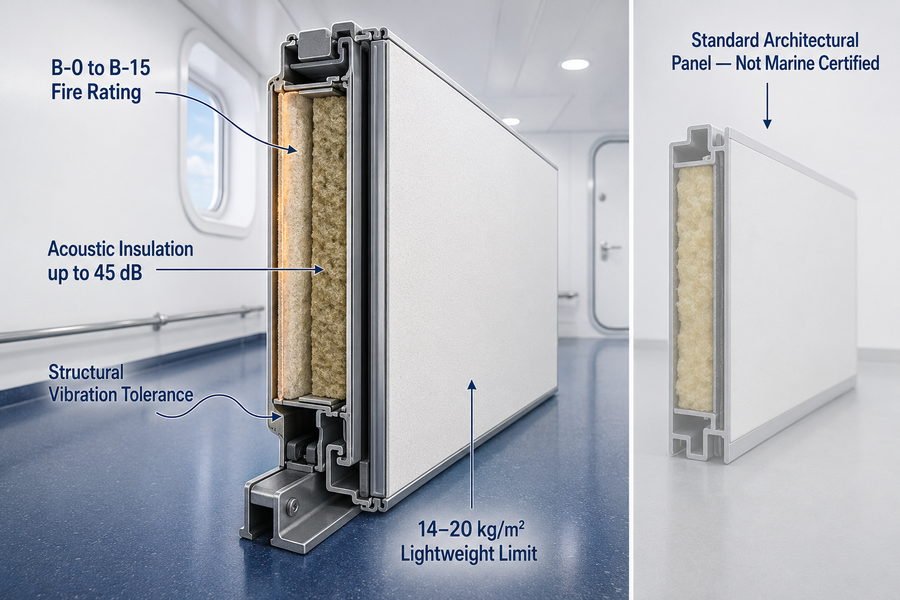
I see many buyers get confused by factory claims. Let me break down exactly what makes a panel ready for the sea.
Which Engineering Criteria Define A Marine Accommodation Panel?
Choosing the wrong panel specifications leads to project rejection by surveyors. It is frustrating to rework an entire cabin. Knowing the exact engineering criteria saves you time.
Marine accommodation panels must meet four strict engineering criteria: fire protection classes (B-0, B-15, or C-Class), noise reduction targets (typically 30 dB to 45 dB), weight restrictions (12 kg/m² to 20 kg/m²), and structural rigidity tests to survive continuous sea conditions.
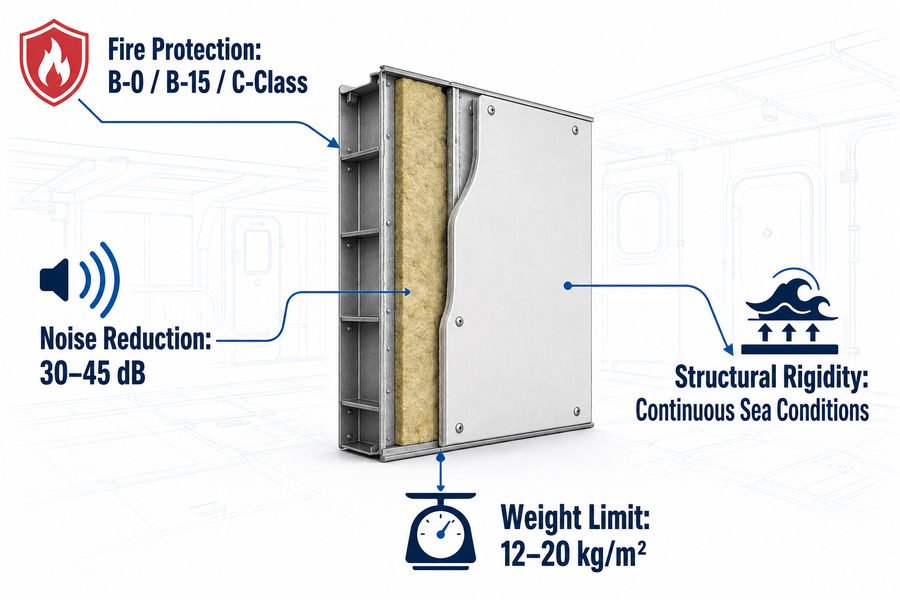
I remember my early days at the factory, testing wall panels every day. The International Maritime Organization (IMO) SOLAS regulations set very strict rules for ships.
Fire Protection Classes and Weight Restrictions for Marine Panels
First, we must look at fire protection classes. We supply B-15, B-0, or C-Class panels. A B-15 panel is a life-saver. It must stop smoke and flame for 30 minutes. It also must keep the unexposed side below 139°C for 15 minutes.1 This gives sailors time to escape. Second, we must consider weight restrictions. Ships cannot carry heavy walls because it burns more fuel and lowers stability.2 A standard 50mm thick composite rock wool panel usually weighs between 14 kg/m² and 18 kg/m². Keeping the weight low is a daily job for our factory engineers. We test different core densities constantly to find the best balance.
Noise Reduction and Structural Rigidity Targets for Ship Cabins
Third, we focus on noise reduction. The IMO Resolution A.468(XII) demands a maximum noise level of 60 dB in passenger cabins.3 To achieve this quiet space, marine panels must offer a sound reduction index (Rw) of 30 dB to 45 dB.4 We add thin acoustic damping sheets inside the rock wool to stop the sound. Fourth, we test for structural rigidity. Ships shake from heavy engine vibrations all day. Panels must survive constant shaking without falling apart. They use 0.6mm hot-dip galvanized steel skins on both sides to stay very rigid. The core and steel are glued with a special two-part polyurethane adhesive. If you miss any of these four criteria, the marine surveyor will fail your project. It is that simple.
| Engineering Criteria | Typical Value Range | Governing Authority / Source |
|---|---|---|
| Fire Protection | B-15, B-0, C-Class | IMO SOLAS Chapter II-2 |
| Panel Weight | 14 kg/m² to 20 kg/m² | Ship Design Specs |
| Noise Reduction (Rw) | 30 dB to 45 dB | IMO Res. A.468(XII) |
| Steel Skin Thickness | 0.6mm Galvanized Steel | Marine Industry Standard |
How Do Marine Accommodation Panels Resist Shipboard Corrosion?
Rust destroys cabin interiors fast in high-humidity salt air. Replacing corroded panels costs shipyards thousands of dollars. You need panels built to stop corrosion completely.
Marine panels resist corrosion through three specific methods: hot-dip galvanizing the steel skin (Z120 to Z275 coating), applying a PVC or PET protective surface film (150-micron thickness), and using non-hygroscopic core materials like marine-grade rock wool that do not absorb trapped moisture.
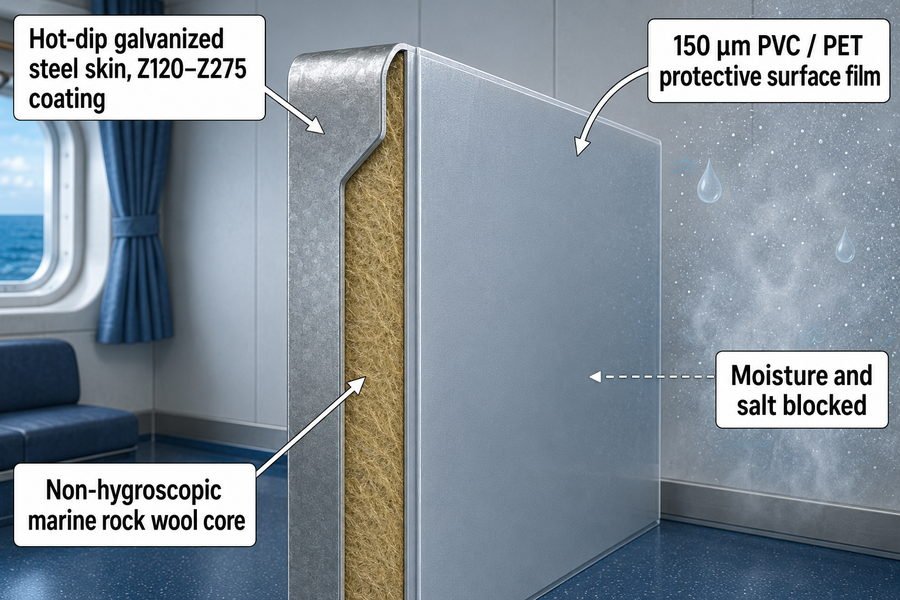
Ships live in harsh salt water environments. Salt air destroys bare metal quickly. At Magellan Marine, I often see cheap panels fail and rust in just a few months. We prevent this by using three specific methods.
Hot-Dip Galvanizing and Surface Films for Marine Panels
First, we rely on hot-dip galvanizing for the steel skins. According to ASTM A653 standards, the steel skin must have a Z120 to Z275 zinc coating5. This means there are 120 to 275 grams of zinc per square meter on the steel. The zinc sacrifices itself to protect the iron underneath.6 Second, we apply a heavy-duty surface film. We cover the steel with a PVC (Polyvinyl Chloride) or PET (Polyethylene Terephthalate) film. This plastic film is usually 150 microns thick. It acts as a final waterproof wall against humid sea air. Workers apply this film in a dust-free room using high heat so it never peels off.
Non-Hygroscopic Core Materials in Marine Panels
Third, we use non-hygroscopic core materials. Regular building materials hold water like a sponge. We never use them. Instead, we use marine-grade rock wool inside the panels. High-quality marine rock wool has a moisture absorption rate of less than 0.5% by volume, according to EN 1609 testing standards. Even if the cabin air gets very damp from the ocean, the inside of the panel stays completely dry. It will not rot or lose its shape. Using these three methods together is the only way to stop corrosion. Replacing rusty panels on a working ship costs a fortune, so buying the right anti-corrosion panels saves money in the long run.
| Corrosion Protection Layer | Specification / Value | Primary Function |
|---|---|---|
| Zinc Coating | Z120 to Z275 (ASTM A653) | Prevents base steel oxidation |
| Surface Film | 150-micron PVC/PET | Waterproof barrier against salt air |
| Core Material | <0.5% water absorption | Prevents internal rust and mold |
Why Must Marine Accommodation Panels Withstand Hull Deflection Loads?
A ship bends and twists on the ocean. Standard walls will crack or pop out of their tracks. You must understand hull deflection to avoid dangerous failures.
Marine panels withstand hull deflection loads because ships experience three main forces: hogging, sagging, and torsion. Panels absorb these forces through specialized floating U-profile base systems, interlocking tongue-and-groove joints (10mm to 15mm deep), and flexible silicone sealants that prevent buckling.
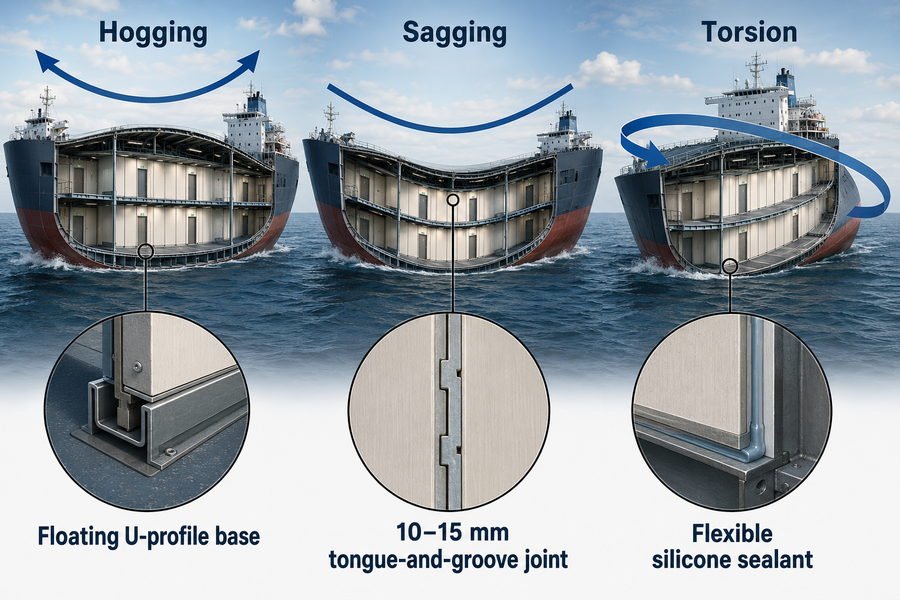
The sea is never perfectly flat. A large ship bends and moves constantly on the ocean waves. We call this movement hull deflection7. Ships face three very powerful forces.
Handling Hogging, Sagging, and Torsion Forces in Ships
Hogging happens when the middle of the ship bends up. Sagging happens when the middle bends down. Torsion happens when the ship twists side to side. If you bolt a rigid wall panel tightly to the floor and ceiling, the panel will break. First, we solve this by using floating U-profile base systems. We never screw the panel directly to the steel deck above. We leave a 15mm to 25mm free gap inside the top U-track. When the ship sags, the panel slides up and down inside the track smoothly without taking any weight.
Tongue-and-Groove Joints and Flexible Sealants for Hull Movement
Second, we design deep tongue-and-groove joints. The side edges of our panels lock into each other. The locking depth is usually 10mm to 15mm. This deep joint keeps the wall surface flat and strong, even when the ship twists sharply. Third, we use flexible sealants during installation. We fill edge gaps and joints with marine-grade silicone sealants. A good marine silicone can stretch up to 300% without breaking.8 It acts like a rubber band holding the room together. These three methods allow the room to move with the ship. Without these features, the panels would pop out of their tracks during a rough storm. I always tell buyers to check the joint depth before ordering.
| Deflection Management Feature | Size / Specification | Benefit During Storms |
|---|---|---|
| Floating U-Profile Gap | 15mm to 25mm clearance | Allows vertical ship sagging |
| Tongue-and-Groove Depth | 10mm to 15mm | Prevents panels from separating |
| Marine Silicone Sealant | 300% stretch capacity | Absorbs torsion and vibration |
Which Compliance Marks Distinguish Genuine Marine Accommodation Panels From Building Panels?
Customs or port state control will halt a ship if materials lack proper papers. Buying uncertified panels is a massive risk. You need the right compliance marks.
Genuine marine panels display three essential compliance marks: the MED Wheelmark for European market approval, specific Classification Society stamps (like DNV, ABS, or Lloyd's Register), and the USCG approval number, proving the panel passed rigorous IMO FTP Code fire testing.
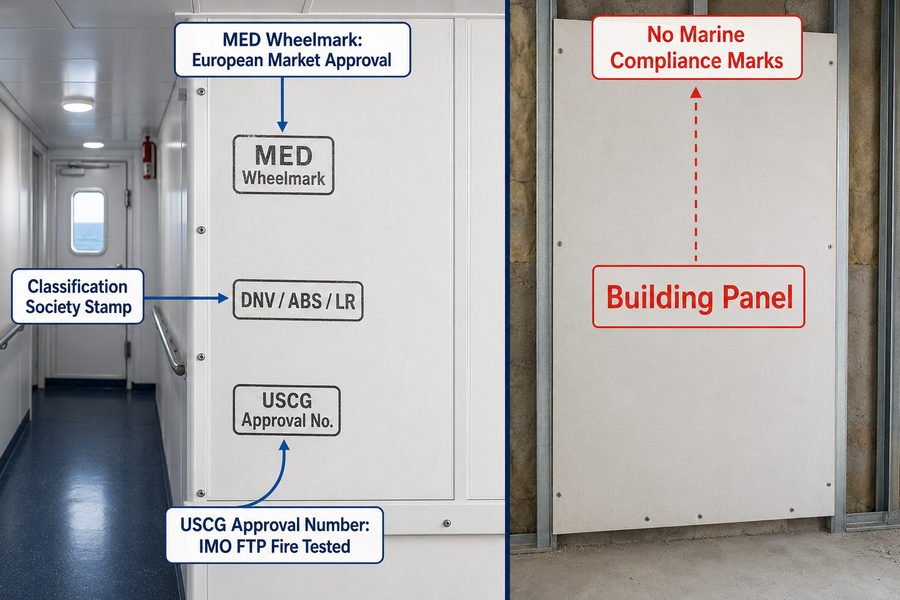
You simply cannot use land-based hotel walls on a ship. Many buyers ask me why marine panels have a higher price tag. The answer always comes down to life-saving testing and strict certification. Standard building panels have zero marine approval marks.
The Importance of MED Wheelmark and USCG Approvals
Genuine marine panels must show three essential compliance marks to be legal. First, they carry the MED Wheelmark. This is the Marine Equipment Directive mark9 for the European market. It proves the panel passed the rigorous IMO Fire Test Procedures (FTP) Code. If you fit out a ship going to Europe, you absolutely must have this Wheelmark printed on the product label. Second, panels need a USCG approval number. The United States Coast Guard sets very tough rules for fire safety. A USCG mark means the panel can legally enter United States waters. Many of my clients do projects for American shipyards, so this is critical.
Classification Society Stamps for Marine Panels
Third, marine panels need Classification Society stamps. You will see specific logos from groups like DNV (Det Norske Veritas), ABS (American Bureau of Shipping), or Lloyd's Register. A DNV Type Approval certificate means inspectors check the factory production line every year. They do not just test one sample. These three marks tell the port state control inspectors that the ship is safe to sail. Without them, the ship stays stuck in the port. I once saw a project delayed for weeks because the panels lacked proper DNV stamps, and the shipyard almost ripped out the entire cabin.
| Compliance Mark | Issuing Body / Market | What It Proves |
|---|---|---|
| MED Wheelmark | European Union | Complies with IMO FTP Code |
| USCG Approval | United States Coast Guard | Safe for US territorial waters |
| Type Approval | DNV, ABS, Lloyd's Register | Factory quality and product safety |
Why Do Marine Accommodation Panel Sizes Differ From Architectural Panels?
Standard building boards are too big to fit through ship hatches. Trying to cut them inside a tight cabin ruins the finish. Size matters in shipbuilding.
Marine panel sizes differ because they must pass through standard watertight doors (typically 600mm wide), fit low deck heights (often 2100mm to 2200mm), and reduce on-board cutting. Therefore, standard marine panels are manufactured at 550mm or 600mm widths instead of 1200mm.
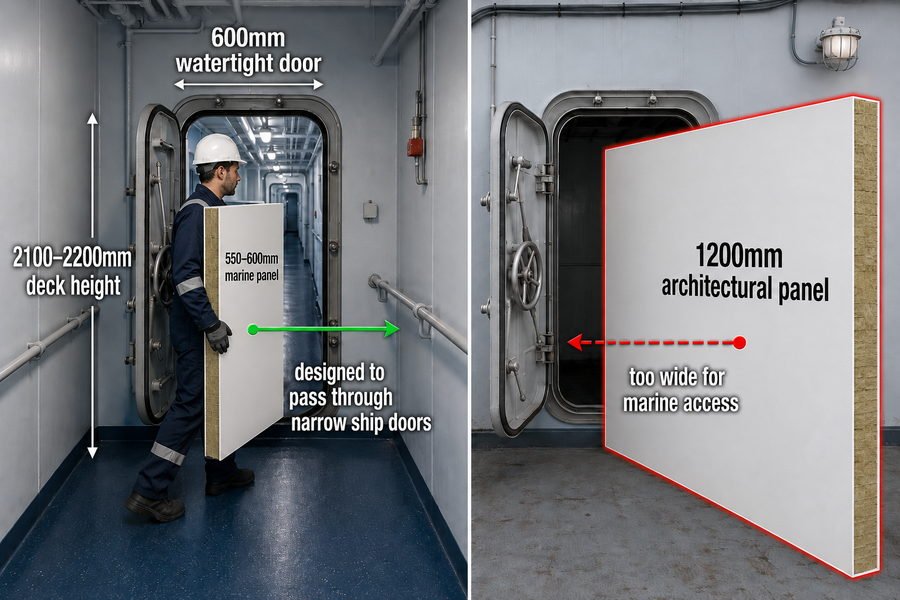
Land-based drywall comes in very big sheets. A normal house board is usually 1200mm wide and 2400mm high. You cannot use these big sizes on a ship. When I started working in the marine outfitting factory, I quickly learned why marine panel sizes are very specific.
Fitting Panels Through Standard Watertight Doors
First, all materials must pass through standard watertight doors. A ship's steel door is small and narrow. Most standard watertight doors have a clear opening of just 600mm by 1800mm.10 A 1200mm wide board will simply not fit through the door. Because of this access problem, marine panels are manufactured at 550mm or 600mm widths. Second, ships have very low deck heights. A standard ship cabin height is between 2100mm and 2200mm.11 We cut the panels to the exact required height in the factory before shipping them. This is very different from building a house where ceilings are high.
Low Deck Heights and Reducing On-Board Cutting
Third, we want to reduce on-board cutting to zero. Cutting metal panels inside a finished ship cabin creates loud noise, harmful dust, and ruins the neat PVC film edges. By keeping the width at a standard 600mm, workers just click them together quickly. The small size makes the panels easy to carry up steep ship stairs. Understanding these three size reasons will help you plan your material orders much better. Many new buyers make the mistake of asking for 1200mm panels to save on joints, but they end up paying massive labor costs just to move them inside the hull.
| Feature | Land-Based Architectural Panel | Genuine Marine Panel |
|---|---|---|
| Standard Width | 1200mm | 550mm or 600mm |
| Standard Height | 2400mm or more | 2100mm to 2200mm (Custom) |
| Installation Method | Cut to size on site | Pre-cut in factory, click together |
How Do Shipboard Installation Constraints Shape Marine Accommodation Panel Design?
Installing walls inside a metal box with thousands of wires is very hard. Slow installation delays the whole ship launch. Smart panel design solves this.
Shipboard constraints shape panel design by requiring built-in cable conduits (typically 25mm diameter) for hidden wiring, pre-cut inspection hatches for plumbing access, and a modular click-and-lock installation system that allows a two-person team to install without heavy lifting equipment.
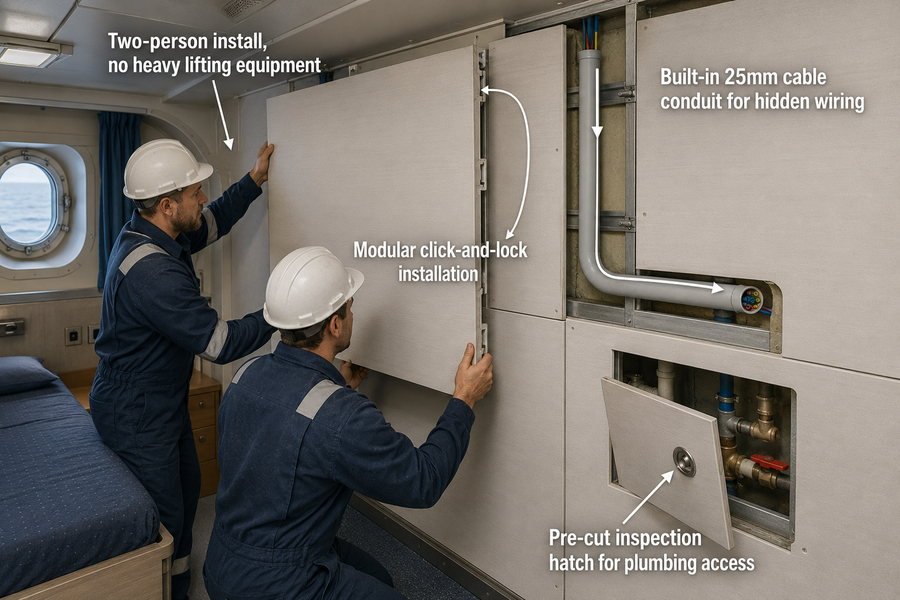
A ship cabin is a very crowded space. Behind every single wall, there are fresh water pipes, air conditioning ducts, and thousands of electric cables. Installing panels inside this tight metal box is difficult. Smart panel design solves these daily installation problems.
Built-In Cable Conduits and Pre-Cut Inspection Hatches
First, marine panels need built-in cable conduits. You cannot cut a hole through a B-15 rated fire panel to run a new wire.12 Doing that destroys the fire rating completely. So, we place 25mm or 30mm diameter empty PVC pipes inside the rock wool core during the factory manufacturing process. Electricians just drop their wires smoothly down these hidden pipes. Second, we design pre-cut inspection hatches. Ships need constant daily maintenance. We install small, flush-mounted steel doors on the panels. This allows the crew to reach hidden water valves or junction boxes without breaking the wall open.
The Modular Click-and-Lock Installation System
Third, we use a modular click-and-lock installation system. There is no space for forklifts or cranes inside a passenger cabin. Two normal workers must carry and fit every piece by hand. Our panels slide and lock together firmly without special tools. This simple system allows a two-person team to finish building a standard 10 square meter cabin in just one day.13 These three design features save shipyards thousands of hours in labor costs. I always advise procurement officers to ask for factory-installed cable pipes. It seems like a small detail, but the electrical team will thank you later.
| Installation Constraint | Marine Panel Design Solution | Impact on Project |
|---|---|---|
| Hidden wiring required | 25mm built-in PVC conduits | Protects B-15 fire rating |
| Constant plumbing checks | Pre-cut inspection hatches | Easy maintenance access |
| No heavy equipment allowed | Modular click-and-lock edges | Two workers can install quickly |
Conclusion
Genuine marine accommodation panels combine strict fire safety, corrosion resistance, specific sizes, and modular designs. Choosing certified products guarantees safe, fast, and compliant ship interior outfitting projects every time.
-
"[PDF] RESOLUTION MSC.307(88) (adopted on 3 December 2010 ...", https://wwwcdn.imo.org/localresources/en/KnowledgeCentre/IndexofIMOResolutions/MSCResolutions/MSC.307(88).pdf. The IMO fire-test framework defines B-class divisions by their ability to prevent flame passage during a 30-minute standard fire test and by temperature-rise limits for specified ratings such as B-15. Evidence role: definition; source type: institution. Supports: A B-15 panel must resist flame passage for 30 minutes and meet an insulation-temperature criterion for 15 minutes.. Scope note: The official criterion is commonly stated as a maximum average temperature rise of 140°C, so it may not support the article’s exact wording of “below 139°C.” ↩
-
"[PDF] RESOLUTION MSC.267(85) (adopted on 4 December 2008 ...", https://wwwcdn.imo.org/localresources/en/KnowledgeCentre/IndexofIMOResolutions/MSCResolutions/MSC.267(85).pdf. Naval-architecture references explain that added weight increases displacement and required propulsion power, while the location of added weight affects metacentric height and intact stability. Evidence role: mechanism; source type: education. Supports: Heavier ship structures can increase fuel use and adversely affect stability.. Scope note: This supports the general engineering mechanism, not a specific weight limit for marine wall panels. ↩
-
"RESOLUTION A.468(XII) adopted on 19 November 1981 ...", https://wwwcdn.imo.org/localresources/en/KnowledgeCentre/IndexofIMOResolutions/AssemblyDocuments/A.468(12).pdf. IMO Resolution A.468(XII), the Code on Noise Levels on Board Ships, sets recommended maximum A-weighted noise levels for ship accommodation spaces, including cabin limits around 60 dB(A). Evidence role: definition; source type: institution. Supports: IMO Resolution A.468(XII) sets a 60 dB noise limit for passenger or accommodation cabins.. Scope note: The resolution is historical guidance; later IMO noise-code requirements may apply depending on vessel type and construction date. ↩
-
"What are Marine Wall Panels?", https://magellanmarinetech.com/what-are-marine-wall-panels/. Acoustic standards and marine-accommodation studies use the weighted sound reduction index, Rw, as a single-number rating for airborne sound insulation, and published marine partition data commonly fall in the 30–45 dB range for cabin wall assemblies. Evidence role: general_support; source type: paper. Supports: Marine cabin panels commonly target an Rw of about 30–45 dB for airborne sound insulation.. Scope note: This would contextualize the stated design range; it would not by itself prove that every marine panel is required to meet 30–45 dB unless a class rule or project specification states so. ↩
-
"[PDF] Section 624— Noise Barriers - GDOT", https://www.dot.ga.gov/PartnerSmart/Business/Source/special_provisions/Special%20Provision/SP%20624%20Noise%20Barrier.pdf. ASTM A653/A653M defines zinc coating designations for hot-dip galvanized steel sheet in SI units, where Z-series designations correspond to specified coating mass values in grams per square meter; this supports the meaning of Z120–Z275 as coating-mass classes, but not that those classes are mandatory for every marine panel application. Evidence role: definition; source type: institution. Supports: ASTM A653 uses Z120 to Z275 as zinc coating mass designations for galvanized steel sheet, corresponding broadly to 120–275 g/m² coating classes.. Scope note: The standard defines coating designations and requirements for galvanized sheet; it does not independently establish that marine panels must use this range. ↩
-
"[PDF] Corrosion Protection of Steel Using Nonanomalous Ni-Zn-P Coatings", https://scholarcommons.sc.edu/cgi/viewcontent.cgi?article=1156&context=eche_facpub. Standard corrosion references explain that zinc coatings on steel provide galvanic, or sacrificial, protection because zinc corrodes preferentially to iron or steel; this supports the stated mechanism, although it does not quantify performance in a specific salt-water panel design. Evidence role: mechanism; source type: education. Supports: Zinc coatings protect underlying steel by acting sacrificially, corroding preferentially to the iron or steel substrate.. Scope note: The evidence supports the general electrochemical mechanism of galvanized steel protection, not the durability of the specific panels described in the article. ↩
-
"[PDF] The effects of ship load variations and seastate on hull girder ...", https://calhoun.nps.edu/bitstream/handle/10945/28149/effectsofshiploa00menn.pdf?sequence=1. Naval-architecture references describe a ship hull as a beam-like structure subject to wave-induced bending and twisting loads, commonly analyzed through hogging, sagging, and torsional deformation. Evidence role: definition; source type: education. Supports: Large ships bend and move on ocean waves, and this movement can be described as hull deflection involving hogging, sagging, and torsion.. Scope note: This supports the general concept of hull deflection and load types, not the specific panel-installation details in the article. ↩
-
"[PDF] Studies on the effect of movement during the cure on the mechanical ...", https://tsapps.nist.gov/publication/get_pdf.cfm?pub_id=860453. Technical materials literature and sealant standards report that cured silicone sealants can exhibit ultimate elongation values in the several-hundred-percent range, supporting the plausibility of a 300% stretch figure for suitable products. Evidence role: statistic; source type: paper. Supports: Some marine-grade or construction-grade silicone sealants can stretch up to about 300% before breaking.. Scope note: The exact elongation depends on the specific sealant formulation and test method, so the source would support the material-property range rather than every marine silicone product. ↩
-
"How Does the IMO FTP Code Govern Fire Testing Procedures for ...", https://magellanmarinetech.com/how-does-imo-ftp-code-govern-fire-testing-procedures-for-marine-panels/. The EU Marine Equipment Directive establishes the wheel mark as the conformity mark for marine equipment placed on board EU ships, and fire-safety items within its scope are assessed against international testing standards such as the IMO FTP Code. Evidence role: definition; source type: government. Supports: The MED Wheelmark is the Marine Equipment Directive mark for the European market and indicates compliant marine equipment.. Scope note: This supports the regulatory meaning of the Wheelmark in context; the exact requirement depends on the equipment category, vessel flag, and applicable implementing rules. ↩
-
"How to choose the right marine fire door for different ship ...", https://magellanmarinetech.com/how-to-choose-right-marine-fire-door-for-different-ship-compartments/. A shipbuilding or classification-society standard that lists common watertight-door clear-opening dimensions, including approximately 600 × 1800 mm, would support the claim that panel sizing is constrained by door access. Evidence role: general_support; source type: institution. Supports: Most standard watertight doors have a clear opening of just 600mm by 1800mm.. Scope note: Such a source may document common or standardized door sizes, but it may not prove that this dimension applies to most watertight doors across all vessel types. ↩
-
"46 CFR Part 190 Subpart 190.20 -- Accomodations for Officers ...", https://www.ecfr.gov/current/title-46/chapter-I/subchapter-U/part-190/subpart-190.20. An accommodation standard or maritime-labour reference describing typical or minimum shipboard headroom would support the contextual claim that ship cabins have constrained vertical dimensions compared with many land-based interiors. Evidence role: general_support; source type: institution. Supports: A standard ship cabin height is between 2100mm and 2200mm.. Scope note: Regulatory sources often state minimum headroom requirements rather than a universal standard cabin-height range of 2100–2200 mm. ↩
-
"[PDF] RESOLUTION MSC.307(88) (adopted on 3 December 2010 ...", https://wwwcdn.imo.org/localresources/en/KnowledgeCentre/IndexofIMOResolutions/MSCResolutions/MSC.307(88).pdf. IMO/SOLAS fire-safety rules and the FTP Code define B-class fire divisions and require penetrations through fire-resisting divisions to preserve the division’s fire integrity, supporting the claim that ad hoc cable openings can compromise a B-15 panel’s rating. Evidence role: expert_consensus; source type: institution. Supports: Cutting an unapproved hole through a B-15 rated marine fire panel to run wiring can compromise or invalidate the panel’s fire rating.. Scope note: The source would support the regulatory principle; it may not directly evaluate the specific panel construction described in the article. ↩
-
"[PDF] Investigating Productivity of Modular Buildings", https://oasis.library.unlv.edu/cgi/viewcontent.cgi?article=6125&context=thesesdissertations. Research on modularization and prefabricated outfitting in shipbuilding reports that moving work into standardized modules can reduce onboard installation time and labor compared with conventional sequential outfitting, providing contextual support for faster cabin-panel installation methods. Evidence role: general_support; source type: paper. Supports: A modular click-and-lock panel system can substantially reduce cabin installation time and labor requirements.. Scope note: Such evidence would not by itself verify the exact productivity figure of two workers completing a 10 m² cabin in one day; that figure would require project-specific time-study or production data. ↩