Buying panels for ship interiors can be confusing. Using cheap land building panels seems smart until the surveyor rejects them. I will show you the exact approval differences you must know.
Marine accommodation panels differ from standard building panels through three mandatory approvals: IMO FTP Code fire testing (not land standards), Classification Society Type Approval Certificates (like DNV or ABS), and Marine Equipment Directive (MED) Wheelmark certification, which guarantee safety in harsh offshore environments.
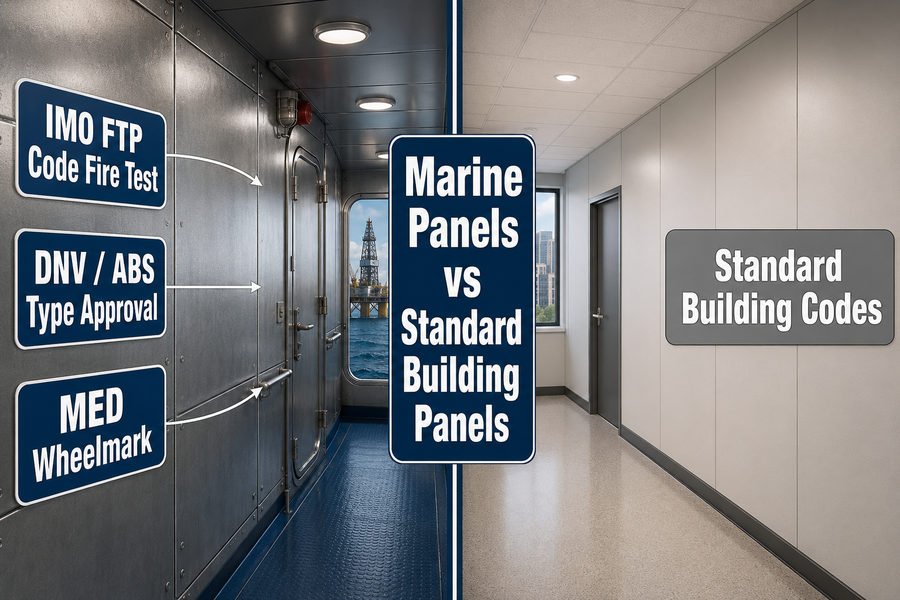
You might think a panel is just a panel, but the sea is an unforgiving place. I have seen many buyers make costly mistakes by ignoring these strict maritime rules. Let us look deeper at why these specific marine certificates matter and how they impact your purchasing process.
Why Are Land-Building Fire Test Reports Invalid for Marine Accommodation Panel Approval?
Land fire certificates like ASTM E84 look good on paper. But ship fires behave differently, leaving crews trapped. Here is why land tests fail at sea.
Land-building fire test reports are invalid for marine panels because they lack three critical IMO FTP Code requirements: testing for non-combustibility (Part 1), smoke and toxicity limits in confined spaces (Part 2), and A/B/C Class fire resistance ratings under prolonged hydrocarbon fires (Part 3).
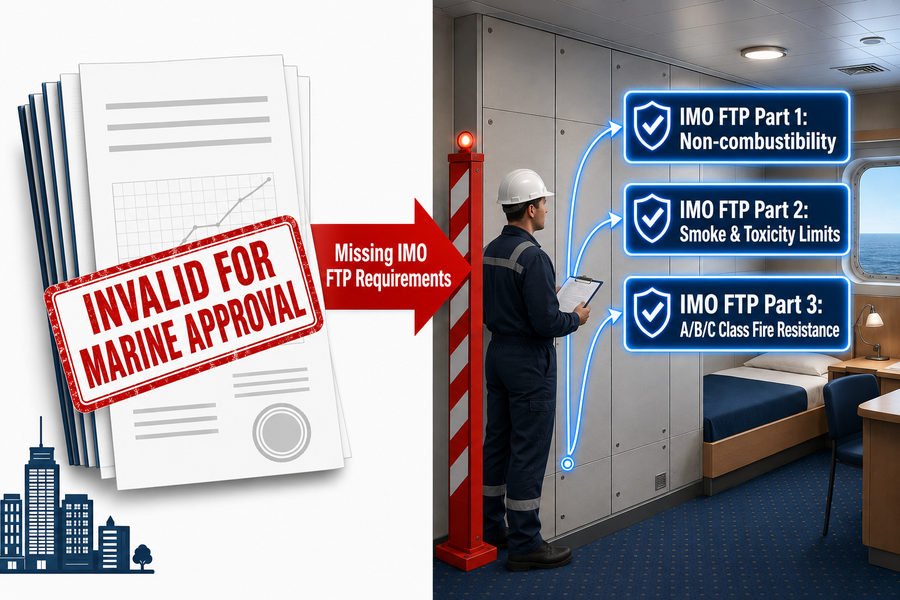
Many buyers show me fire certificates from their local land construction authorities. I always tell them these reports are useless for marine outfitting. A ship is a closed steel box. People cannot just walk out of a building when a fire starts. The International Maritime Organization (IMO) knows this. So, they created the Fire Test Procedures (FTP) Code1. Based on the 2010 IMO FTP Code, marine panels must pass three specific tests that land panels never face.
IMO FTP Code Part 1 Requirements for Non-Combustibility
The first requirement is non-combustibility. Land panels often use standard glues and thin steel. But marine panels must go through the IMO FTP Code Part 1 test. In this test, the core materials like rockwool are placed in a furnace at 750°C. The material must not flame up or raise the furnace temperature by more than 54°C2. Most ordinary building panels melt or catch fire at this heat.
IMO FTP Code Part 2 Smoke and Toxicity Limits
The second requirement focuses on smoke and toxicity. This is covered in Part 2 of the IMO FTP Code. On a ship, toxic smoke kills faster than the actual flames3. The PVC film and adhesives on a marine panel are tested in a closed chamber. They must not release high levels of dangerous gases like Carbon Monoxide (CO), Hydrogen Chloride (HCl), or Hydrogen Cyanide (HCN). A standard land panel might not burn quickly, but it often releases heavy black smoke that blinds the crew.
IMO FTP Code Part 3 Fire Resistance Ratings for Class A, B, and C
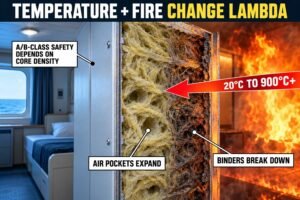
The third requirement tests the actual fire resistance time. This is Part 3 of the code. It defines the A, B, and C Class divisions. For example, a B-15 marine wall panel must stop flames and smoke for 30 minutes, and keep the unexposed side cool for 15 minutes4. The oven follows a standard marine heating curve, reaching nearly 900°C. Land panels use different time limits and heating curves that do not match the real conditions of a ship fire.
| Feature Tested | Land Building Standard (e.g., ASTM E84) | Marine Standard (2010 IMO FTP Code) |
|---|---|---|
| Non-Combustibility | Varies by local code, often lower heat | Tested at 750°C furnace (Part 1) |
| Smoke & Toxicity | Often measures only smoke density | Strict limits on CO, HCl, HCN gases (Part 2) |
| Fire Integrity | Hourly ratings based on wood/drywall fires | B-15 or A-60 ratings based on ship fires (Part 3) |
What Onboard Documentation Do Ordinary Construction Panels Lack?
Your panels arrive at the shipyard, but the paperwork is wrong. Delays start costing you money daily. Ordinary panels miss the documents ship surveyors demand.
Ordinary construction panels lack four essential onboard documents: a valid Type Approval Certificate (TAC) from a marine classification society, a Declaration of Conformity (DoC), an MED Wheelmark certificate for European vessels, and a detailed Material Traceability Record linking the finished panel to its raw materials.
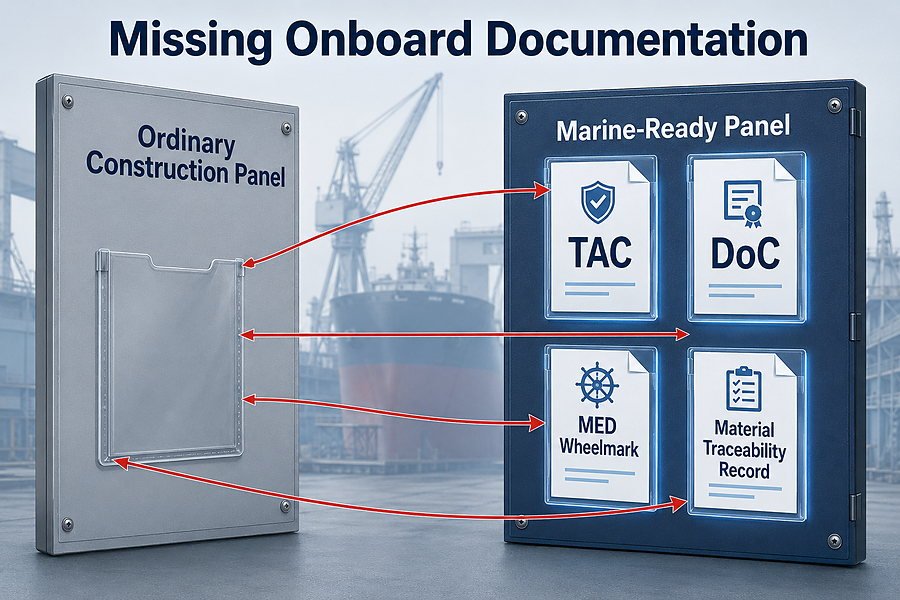
When you buy products for ship interiors, the physical panel is only half of what you pay for. The other half is the paperwork. I have worked with many procurement officers who bought cheap panels but could not get them onto the ship. Why? Because ordinary construction panels simply do not have the four critical documents that marine surveyors ask for before installation begins. Let us look at these four missing documents in detail.
The Role of the Type Approval Certificate (TAC) in Marine Projects
The first missing document is the Type Approval Certificate (TAC). Land panels do not have this. A TAC is issued by a recognized classification society, like DNV, ABS, or Lloyd's Register.5 This certificate proves that the panel design meets international marine rules. A TAC usually lasts for five years. The surveyor will check the TAC number against the panels you brought. If you only have a local building test report, the surveyor will stop your project immediately.
Why the Declaration of Conformity (DoC) and MED Wheelmark Are Essential
The second and third missing documents are the Declaration of Conformity (DoC) and the MED Wheelmark. If your project is for a European shipyard or a ship sailing in European waters, you must have the Wheelmark. This mark proves the panel meets the Marine Equipment Directive (MED) 2014/90/EU6. Along with the Wheelmark, the factory must give you a DoC. This document is a legal promise from the factory that the specific batch of panels matches the approved prototype. Standard building panel factories cannot provide a DoC or a Wheelmark.
The Importance of a Detailed Material Traceability Record
The fourth missing document is the Material Traceability Record. Marine rules require the factory to track every piece of material.7 If a surveyor asks, you must show exactly which batch of steel and which batch of rockwool went into cabin number 102. Ordinary construction panels are made in bulk. They do not track materials by cabin or by ship. This lack of a traceability record is a huge problem during the final onboard inspection.
| Required Document | Purpose for Marine Use | Do Ordinary Building Panels Have It? |
|---|---|---|
| Type Approval Certificate (TAC) | Proves design meets marine safety rules | No |
| Declaration of Conformity (DoC) | Legal document linking batch to approval | No |
| MED Wheelmark | Mandatory for European marine market | No |
| Material Traceability Record | Tracks raw materials to finished cabin | No |
Why Are Panels Without Marine Type Approval Refused at Onboard Inspection?
You installed standard panels to save money. Now the marine surveyor refuses to clear the ship. This happens because unapproved panels violate international maritime safety laws.
Surveyors refuse panels without marine Type Approval during onboard inspection for three reasons: they violate SOLAS Chapter II-2 safety regulations, they void the vessel's marine insurance coverage, and they fail to prove consistent quality control through mandatory factory production audits by classification societies.
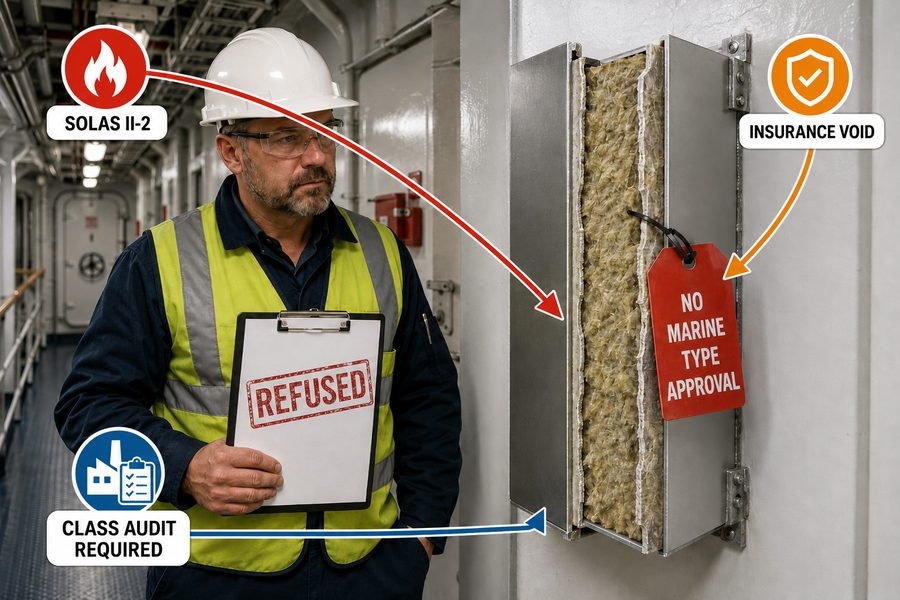
A ship surveyor has one main job. Their job is to keep the ship, the crew, and the passengers safe. When a surveyor walks onto your ship and sees panels without a marine Type Approval, they will reject the entire installation. I have seen buyers cry over this because the cost to fix it is huge. They do not reject the panels just to be difficult. They reject them for three very specific legal and financial reasons.
Violations of SOLAS Chapter II-2 Safety Regulations
The first reason for refusal is that unapproved panels violate the Safety of Life at Sea (SOLAS) convention. Specifically, SOLAS Chapter II-2 covers fire protection, fire detection, and fire extinction.8 This international law states clearly what fire ratings are required for different bulkheads9. If a panel does not have a marine Type Approval, there is no proof it meets SOLAS Chapter II-2. The surveyor cannot bend this rule. If they allow an unapproved panel, they are breaking international maritime law.
The Risk of Voided Marine Insurance Coverage
The second reason involves money and risk. Ships carry heavy marine insurance from Protection and Indemnity (P&I) Clubs. These insurance policies have strict terms. One of the main terms is that the ship must be built and maintained according to classification society rules10. If you install unapproved building panels, the ship is no longer in class. This means the insurance is voided. If a fire happens, the insurance company will not pay a single dollar. Surveyors know this, so they refuse the panels to protect the ship owner from massive financial ruin.
The Requirement for Factory Production Audits by Classification Societies
The third reason is about quality control. A Type Approval is not just a one-time fire test. To keep the certificate, the factory must pass regular production audits by the classification society. These are often called Module D or Module E audits under the MED rules. These audits prove the factory is making the 1,000th panel exactly like the 1st panel that passed the fire test. Ordinary construction panels do not undergo these strict marine factory audits. Because there is no proof of consistent quality, the surveyor must refuse them.
| Reason for Surveyor Refusal | Impact on the Ship Project |
|---|---|
| Breaks SOLAS Chapter II-2 Rules | Ship cannot get its passenger or cargo safety certificates. |
| Voids Marine Insurance | Owner takes on 100% financial risk for any fire damage. |
| Fails Factory Production Audits | Surveyor cannot trust the physical quality of the installed panels. |
What Hidden Costs Arise From Substituting Architectural Panels for Marine Accommodation Panels?
Architectural panels cost 30% less upfront. But when the ship goes into service, expenses explode. I will break down the massive hidden costs of this mistake.
Substituting architectural panels for marine panels creates four hidden costs: complete tear-out and replacement costs (ranging from $150 to $300 per square meter), daily shipyard delay penalties, increased marine insurance premiums, and rapid corrosion replacement due to a lack of marine-grade zinc coatings.
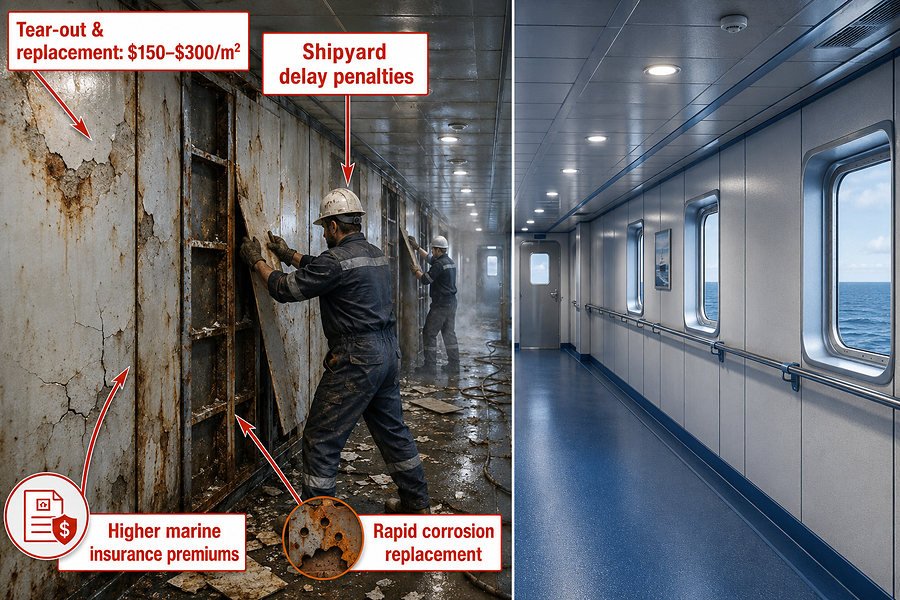
It is very tempting to look at the price tag of a land architectural panel and think you found a great deal. Some buyers in Asia buy these panels because the budget is tight. But my experience in marine outfitting shows that this cheap choice always costs more in the end. The initial savings are completely wiped out by four massive hidden costs that hit you during installation and operation. Let us break down these four financial disasters.
The Massive Expense of Complete Tear-Out and Replacement
The first hidden cost is the tear-out expense. When the marine surveyor rejects the architectural panels11, you cannot just leave them there. You must pay workers to tear down the entire interior. Then, you must buy real marine panels and pay to install them again. The cost for marine panel installation usually ranges from $150 to $300 per square meter12, depending on the country. You will have to pay this labor cost twice, plus the cost of throwing away the rejected building panels.
Daily Shipyard Delay Penalties and Increased Insurance Premiums
The second and third hidden costs are delay penalties and insurance hikes. Shipyards run on very tight schedules. If your unapproved panels cause a delay, the shipyard will charge you a daily penalty. These penalties can easily be $5,000 to $10,000 per day13. While you wait for the correct marine panels to arrive, you are losing money every hour. Also, if the ship is allowed to operate with "equivalent" non-standard materials under a special waiver, the marine insurance premiums will jump up significantly because the risk is higher.
Rapid Corrosion Issues Due to Insufficient Zinc Coatings
The fourth hidden cost happens if you somehow get the panels past the surveyor. This cost is rapid corrosion. The sea air is full of salt and moisture. Real marine accommodation panels use hot-dip galvanized steel with a heavy zinc coating. We normally require Z120 or even Z275 (which means 120 or 275 grams of zinc per square meter). Cheap architectural panels usually only have Z40 or Z60 zinc coatings. Within two years, the cheap panels will rust from the inside out.14 You will have to replace them long before the ship's normal refit cycle.
| Cost Category | Architectural Panel (Upfront Savings) | Actual Hidden Costs in Marine Use |
|---|---|---|
| Initial Material Price | Saves ~$5 to $10 per square meter | None (wiped out by later costs) |
| Tear-out and Re-installation | $0 upfront | $150 to $300 per square meter in labor |
| Shipyard Delay Penalties | $0 upfront | $5,000+ per day of delay |
| Corrosion Replacement | $0 upfront | Full replacement needed in 2 to 3 years due to low zinc (Z60) |
Why Do Marine Accommodation Panels Require Stricter Material Traceability Than Building Panels?
Building materials often change suppliers without notice. On a ship, one bad material batch causes a fatal fire. Strict traceability stops this danger at the source.
Marine panels require stricter material traceability than building panels to achieve three goals: proving the steel coil matches the mill test certificate, ensuring the rockwool core density meets the exact Type Approval specification (typically 120-150 kg/m³), and allowing instant recalls if a production batch fails.
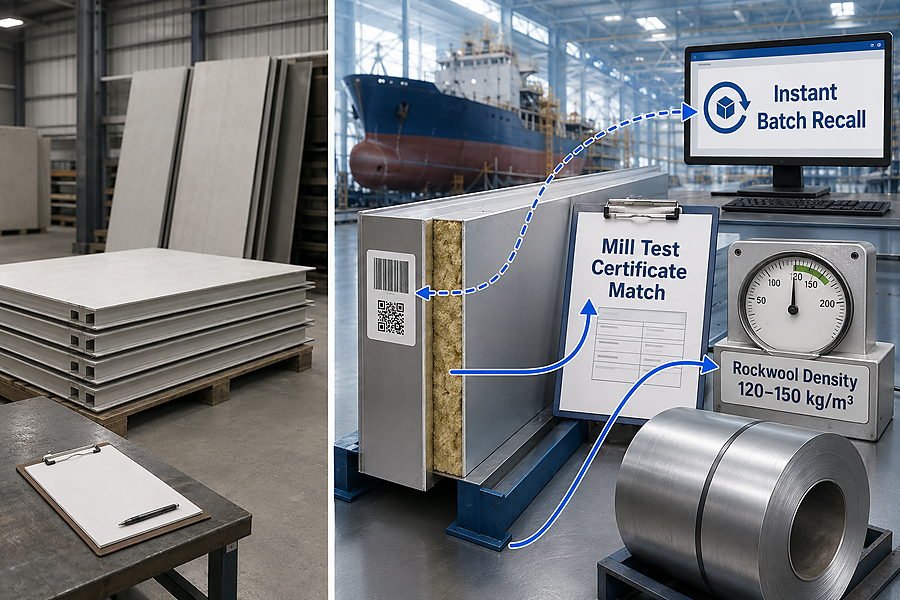
When I worked at the marine outfitting factory, we spent a lot of time on paperwork. Every raw material that came through the door had to be tagged and tracked. This is called material traceability15. Standard building panels do not do this. A land factory might use steel from three different suppliers in one day and mix them all together. In the marine industry, we cannot do that. We must trace every part of the panel to achieve three very important safety goals.
Matching the Steel Coil to the Mill Test Certificate
The first goal is tracking the steel. Every marine panel starts as a coil of galvanized steel. We must prove that the steel coil we use exactly matches the Mill Test Certificate (MTC) from the steel factory. The MTC shows the thickness, the chemical makeup, and the zinc coating level. If a marine wall panel needs 0.6mm steel, we must have the paperwork to prove that the specific panel in Cabin 205 was cut from a 0.6mm coil. Without this strict traceability, a factory could secretly use thinner 0.4mm steel to save money, making the panel weak.
Maintaining Rockwool Core Density to Meet Type Approval
The second goal is controlling the rockwool core density. This is the most important part of the fire rating. For a B-15 marine panel, the Type Approval certificate will state an exact rockwool density.16 This is typically between 120 and 150 kg/m³. If the density drops to 100 kg/m³, the panel will fail the fire test. Strict traceability means we record the density of every batch of rockwool before we glue it to the steel. The surveyor can look at our records and see that every panel has the correct density inside.
Enabling Instant Recalls for Failed Production Batches
The third goal is recall capability. Sometimes, things go wrong. An adhesive might not cure correctly, or a batch of rockwool might have a defect. Because of strict marine traceability, we know exactly which panels used that bad glue. We can tell the shipyard, "Do not install pallets number 12 to 15." We can instantly recall the bad batch.17 With ordinary building panels, you have no idea where the bad glue went, so you have to guess, putting the whole project at risk.
| Traceability Goal | Marine Panel Requirement | Why Building Panels Fail This |
|---|---|---|
| Steel Verification | Must match Mill Test Certificate exactly | Mixes steel coils from different, cheap sources |
| Core Density Check | Records kept for every rockwool batch (e.g. 150 kg/m³) | Density changes often based on market price |
| Defect Recall | Can isolate and recall a specific bad pallet | No batch numbers; impossible to track defects |
What Red Flags Reveal a Building-Grade Panel Sold as a Marine Accommodation Panel?
Some suppliers sell cheap building panels as marine grade. If you buy them, you lose money and ruin your reputation. Here are the warning signs.
Four red flags reveal a building-grade panel sold as marine: prices below $15 per square meter, the absence of an embossed MED Wheelmark, using generic ISO 9001 certificates instead of Marine Type Approvals, and a PVC surface film thickness below the marine standard of 150 microns.
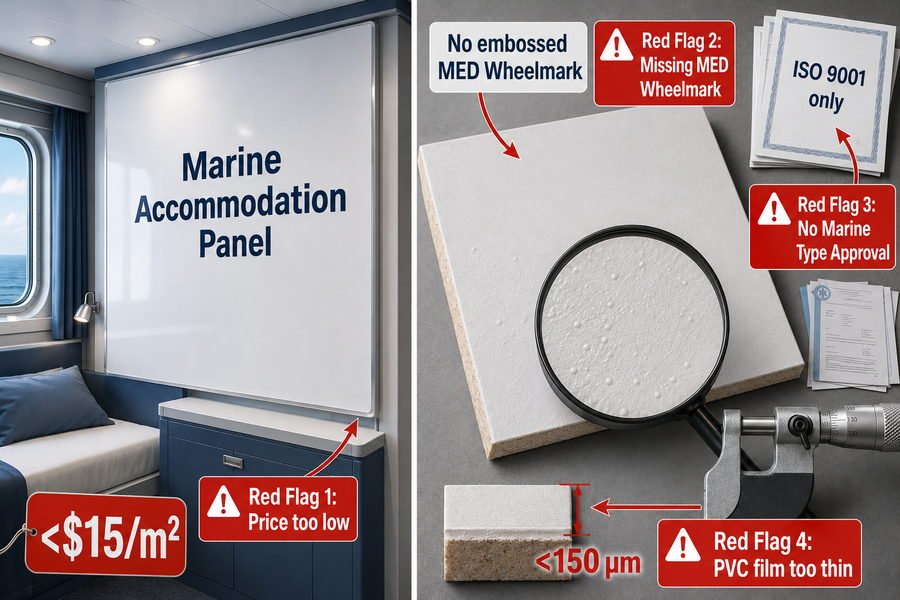
As a procurement officer buying from Asia, you will see many factories claiming to sell marine accommodation panels. Most are honest, but some try to trick you. They take a cheap building panel, put a fake label on it, and sell it to you. If you send this to a shipyard in Europe or the United States, you will be in deep trouble. I always tell my clients to look for four specific red flags before they transfer any money.
Spotting Red Flags in Panel Pricing and Certification
The first red flag is the price. High-quality marine interior outfitting products are not cheap to make. A real marine wall panel with correct fire ratings will generally cost more than $20 to $25 per square meter18. If a supplier offers you a panel for $12 or $14 per square meter, walk away. They are using cheap land-grade materials. The second red flag is the certificate they show you. A dishonest supplier will proudly show you a generic ISO 9001 certificate or a CE mark for construction. These are not Marine Type Approvals. You must ask for a certificate from DNV, ABS, or Lloyd's.
Identifying Missing Embossed MED Wheelmarks
The third red flag is the missing Wheelmark. If the supplier says the panel is MED approved, ask to see the physical mark. A real MED Wheelmark is not just a piece of paper. The factory must put an official Wheelmark label on the panel packaging, or print it directly on the product label with the notified body number and the year19. If the supplier cannot show you a clear, official Wheelmark label on their packing materials, they are selling you a standard building panel.
Checking PVC Surface Film Thickness for Marine Standards
The fourth red flag is the PVC film thickness. The decorative surface of the panel is covered in a PVC film. In land buildings, people do not bump into walls often. So, building panels use very thin PVC, around 80 to 100 microns. On a ship, the corridors are narrow, and luggage or equipment hits the walls daily. Real marine panels use a PVC film thickness of at least 150 microns to prevent scratches and tears.20 If the supplier tells you their PVC film is 100 microns, you are looking at a building-grade panel.
| Inspection Point | Authentic Marine Accommodation Panel | Red Flag (Building-Grade Panel) |
|---|---|---|
| Market Price | Typically >$20 per square meter | Dangerously cheap (<$15 per square meter) |
| Certificates | DNV, ABS, LR Type Approval | Generic ISO 9001 or Land CE Mark |
| MED Wheelmark | Printed/Labeled clearly with body number | No Wheelmark visible on packaging |
| PVC Film Thickness | 150 microns or thicker | 80 to 100 microns (scratches easily) |
Conclusion
Marine panels require strict IMO fire tests, marine-specific documents, rigid traceability, and Type Approvals to ensure safety at sea. Never risk your project by buying cheap land building panels.
-
"[PDF] RESOLUTION MSC.307(88) (adopted on 3 December 2010 ...", https://wwwcdn.imo.org/localresources/en/KnowledgeCentre/IndexofIMOResolutions/MSCResolutions/MSC.307(88).pdf. IMO Maritime Safety Committee Resolution MSC.307(88) adopted the International Code for Application of Fire Test Procedures, 2010, which prescribes fire-test methods used under SOLAS for ship materials and fire divisions. Evidence role: historical_context; source type: institution. Supports: The International Maritime Organization created the 2010 Fire Test Procedures Code as the relevant marine fire-testing framework.. Scope note: This supports the origin and regulatory scope of the FTP Code, but not the broader commercial judgment that local land-construction fire certificates are useless for all marine outfitting decisions. ↩
-
"[PDF] RESOLUTION MSC.307(88) (adopted on 3 December 2010 ...", https://wwwcdn.imo.org/localresources/en/KnowledgeCentre/IndexofIMOResolutions/MSCResolutions/MSC.307(88).pdf. The 2010 FTP Code Part 1 specifies a non-combustibility test using a furnace at approximately 750°C and applies acceptance criteria related to temperature rise, mass loss, and sustained flaming. Evidence role: definition; source type: institution. Supports: IMO FTP Code Part 1 tests non-combustibility in a high-temperature furnace and limits flaming and temperature rise.. Scope note: The source should be checked for the exact numerical acceptance threshold, because different summaries or editions may express the temperature-rise criterion differently from the article’s stated 54°C figure. ↩
-
"[PDF] Fire Conditions for Smoke Toxicity Measurement", https://tsapps.nist.gov/publication/get_pdf.cfm?pub_id=912940. Fire-safety research and government fire statistics identify smoke inhalation and toxic combustion gases, including carbon monoxide and irritant gases, as major immediate causes of death in enclosed fires, supporting the safety relevance of smoke-toxicity limits. Evidence role: expert_consensus; source type: government. Supports: Toxic smoke is a critical life-safety hazard in confined fire conditions.. Scope note: This is general fire-fatality evidence and does not prove that toxic smoke is faster than flames in every shipboard fire scenario. ↩
-
"Marine Aluminum Honeycomb Panels: Class B or Class C ...", https://magellanmarinetech.com/marine-aluminum-honeycomb-panels-class-b-class-c/. SOLAS and the 2010 FTP Code define B-class divisions by integrity during the first half-hour of the standard fire test, with B-15 divisions also meeting insulation temperature-rise criteria for 15 minutes. Evidence role: definition; source type: institution. Supports: A B-15 marine division has a 30-minute integrity requirement and a 15-minute insulation-temperature requirement under the marine fire-test framework.. Scope note: The Code uses technical integrity and insulation criteria rather than the colloquial phrase “stop flames and smoke”; actual compliance depends on the tested wall assembly, not on a panel label alone. ↩
-
"Ship classification society - Wikipedia", https://en.wikipedia.org/wiki/Ship_classification_society. Classification-society type approval schemes document that a product design has been reviewed against specified rules or standards and may be certified by organizations such as DNV, ABS, or Lloyd’s Register. Evidence role: definition; source type: institution. Supports: A Type Approval Certificate for marine products can be issued by recognized classification societies and indicates that the product design has been assessed against marine rules or standards.. Scope note: The source would support the general function of type approval, but the exact approval scope depends on the product, flag state, and applicable rule set. ↩
-
"How Do EU Rules Differ From IMO Standards for Marine Panels ...", https://magellanmarinetech.com/how-eu-rules-differ-from-imo-standards-for-marine-panels/. Directive 2014/90/EU establishes EU requirements for marine equipment placed on board EU ships and provides for conformity assessment and wheel-marking of compliant equipment. Evidence role: historical_context; source type: government. Supports: The MED Wheelmark is tied to compliance with the EU Marine Equipment Directive 2014/90/EU for applicable marine equipment.. Scope note: The directive applies to equipment within its scope on EU-flagged ships; it does not automatically cover every ship merely sailing in European waters. ↩
-
"[PDF] Standards in the Maritime Industry - Webb Institute", https://www.webb.edu/wp-content/uploads/2025/01/Standards-and-the-Maritime-Industry.pdf. Marine classification and quality-assurance rules commonly require material identification and traceability records for controlled components so that materials can be linked to certificates, batches, or production records. Evidence role: mechanism; source type: institution. Supports: Marine manufacturing rules and approval systems require traceability records that link materials to production and certification records.. Scope note: A source may support traceability requirements in marine manufacturing generally, but may not prove the article’s stronger cabin-level example for every steel and insulation batch unless a specific project specification requires it. ↩
-
"Summary of SOLAS chapter II-2 - International Maritime Organization", https://www.imo.org/en/ourwork/safety/pages/summaryofsolaschapterii-2-default.aspx. The International Maritime Organization describes SOLAS Chapter II-2 as addressing construction, fire protection, fire detection, and fire extinction requirements, supporting the article’s description of the chapter’s regulatory scope. Evidence role: definition; source type: institution. Supports: SOLAS Chapter II-2 covers fire protection, fire detection, and fire extinction.. Scope note: This supports the scope of SOLAS Chapter II-2, not whether any specific panel installation would be rejected. ↩
-
"Summary of SOLAS chapter II-2 - International Maritime Organization", https://www.imo.org/en/ourwork/safety/pages/summaryofsolaschapterii-2-default.aspx. SOLAS Chapter II-2, particularly the structural fire-protection provisions, sets fire-integrity requirements for bulkheads and decks according to space categories, supporting the claim that bulkhead fire ratings are regulated. Evidence role: general_support; source type: institution. Supports: SOLAS Chapter II-2 states what fire ratings are required for different bulkheads.. Scope note: The exact rating depends on vessel type, space category, flag administration, and applicable class interpretations. ↩
-
"[PDF] International Group of P&I Clubs - DOI.gov", https://www.doi.gov/sites/doi.gov/files/migrated/restoration/upload/Andrew-Bardot-Overview-of-International-Group-and-Clubs-1.pdf. P&I Club rules and maritime insurance guidance commonly require ships to maintain class and comply with statutory and classification requirements, supporting the link between insurance cover and classification compliance. Evidence role: general_support; source type: institution. Supports: Marine insurance terms often require a ship to be built and maintained according to classification society rules.. Scope note: This supports the general insurance-classification relationship; it does not prove that every unapproved panel automatically voids all insurance cover in every jurisdiction or policy. ↩
-
"How Does the IMO FTP Code Govern Fire Testing Procedures for ...", https://magellanmarinetech.com/how-does-imo-ftp-code-govern-fire-testing-procedures-for-marine-panels/. SOLAS fire-safety rules and the IMO Fire Test Procedures Code establish approval and testing requirements for materials used in ship accommodation and interior spaces, supporting the claim that non-approved architectural panels may be rejected during survey. Evidence role: general_support; source type: institution. Supports: A marine surveyor may reject architectural panels that lack required marine approvals.. Scope note: The source would support the regulatory basis for rejection, but the actual decision depends on the vessel type, flag state, class society, and panel documentation. ↩
-
"How to choose the right marine wall panels for marine interior ...", https://magellanmarinetech.com/how-choose-right-marine-wall-panels-for-marine-interior-projects/. Public ship-repair or marine-outfitting cost references can document typical labor rates and installed-cost estimates for interior accommodation work, providing contextual support for a per-square-meter installation-cost range. Evidence role: statistic; source type: government. Supports: Marine panel installation can cost about $150 to $300 per square meter depending on the country and project conditions.. Scope note: Such data would be location- and scope-dependent, so it would support the range as an order-of-magnitude estimate rather than a fixed global price. ↩
-
"52.211-11 Liquidated Damages-Supplies, Services, or Research ...", https://www.acquisition.gov/far/52.211-11. Public shipbuilding or ship-repair contracts that specify liquidated damages for late completion can show that daily delay charges may reach several thousand dollars per day. Evidence role: case_reference; source type: government. Supports: Shipyard delay penalties can be in the range of $5,000 to $10,000 per day.. Scope note: Contractual delay penalties vary widely by vessel, shipyard, and jurisdiction, so this would demonstrate plausibility rather than a universal penalty rate. ↩
-
"Atmospheric Corrosion of Different Steel Types in Urban and Marine ...", https://pmc.ncbi.nlm.nih.gov/articles/PMC11679332/. Corrosion studies and galvanizing standards show that marine atmospheres accelerate zinc loss and that thinner zinc coatings provide shorter corrosion protection for steel, supporting the mechanism behind faster rusting of low-coating panels. Evidence role: mechanism; source type: paper. Supports: Low-zinc architectural panels used in marine environments can corrode much faster than heavier-galvanized marine panels.. Scope note: The evidence would support accelerated corrosion risk, but an exact two-year failure period depends on coating quality, exposure, ventilation, maintenance, and panel construction. ↩
-
"[PDF] NIST IR 8536 Second Public Draft, Supply Chain Traceability", https://nvlpubs.nist.gov/nistpubs/ir/2025/NIST.IR.8536.2pd.pdf. A manufacturing traceability source can support the definition of material traceability as the ability to identify materials, batches, and processing history through production records. Evidence role: definition; source type: institution. Supports: Material traceability means tagging and tracking raw materials through production.. Scope note: This would support the general concept of traceability, not prove that every marine panel factory follows the same process. ↩
-
"[PDF] RESOLUTION MSC.307(88) (adopted on 3 December 2010 ...", https://wwwcdn.imo.org/localresources/en/KnowledgeCentre/IndexofIMOResolutions/MSCResolutions/MSC.307(88).pdf. A marine type-approval or IMO fire-test source can show that approved B-class fire divisions are certified based on a tested construction, including specified insulation materials and construction details such as mineral-wool type or density. Evidence role: mechanism; source type: institution. Supports: B-15 marine panel type approval depends on a tested panel construction that includes specified rockwool or mineral-wool core characteristics.. Scope note: Public certificates vary in how much construction detail they disclose; the source may demonstrate that approved constructions specify insulation characteristics without proving that all certificates list density in the same format. ↩
-
"Traceability Lot Code - FDA", https://www.fda.gov/food/food-safety-modernization-act-fsma/traceability-lot-code. A quality-management or regulatory guidance source can support that batch traceability enables affected products to be identified, isolated, and recalled when a defect is discovered. Evidence role: general_support; source type: government. Supports: Batch-level traceability helps manufacturers isolate and recall defective production lots.. Scope note: Such evidence would support the general recall function of traceability, not the claim that recall is literally instant or that ordinary building panels cannot be traced. ↩
-
"Which Marine Wall Panel Surface Finish Is Best for Ship Cabins?", https://magellanmarinetech.com/which-marine-wall-panel-surface-finish-best-for-ship-cabins/. An independent procurement dataset or market-price survey supports the stated price range by showing typical per-square-meter prices for fire-rated marine accommodation wall panels, while noting that prices vary by order size, core material, certification scope, and freight terms. Evidence role: statistic; source type: other. Supports: A real marine wall panel with correct fire ratings will generally cost more than $20 to $25 per square meter.. Scope note: Market pricing is volatile and may not establish a universal minimum price for all suppliers or regions. ↩
-
"Directive 96/98/EC - Wikipedia", https://en.wikipedia.org/wiki/Directive_96/98/EC. The EU Marine Equipment Directive and related guidance support that compliant marine equipment bears the Wheel Mark together with the notified body identification number and the year in which the mark is affixed; the source establishes the marking rule generally rather than confirming the status of any specific panel shipment. Evidence role: definition; source type: government. Supports: MED-approved equipment must display the Wheelmark with the notified body number and year on the product or associated marking.. Scope note: The rule applies to equipment within the Directive’s scope and does not independently verify a supplier’s claimed approval. ↩
-
"Marine Wall vs. Ceiling Panels: How Do Their Finishes Differ?", https://magellanmarinetech.com/marine-wall-vs-ceiling-panels-how-their-finishes-differ/. A technical specification or materials study supports that thicker PVC surface films improve abrasion and tear resistance and that 0.15 mm PVC facings are used in marine accommodation-panel applications; this supports the engineering rationale for the benchmark but may not establish it as a universal regulatory minimum. Evidence role: mechanism; source type: paper. Supports: Marine panels commonly use PVC film of at least 150 microns to improve resistance to scratches and tears.. Scope note: The 150-micron figure may be an industry specification rather than a requirement in marine safety regulations. ↩