Choosing the wrong panel finish leads to failed fire inspections. It causes high replacement costs and angers shipyard clients. Read this to find the best finishes for your projects.
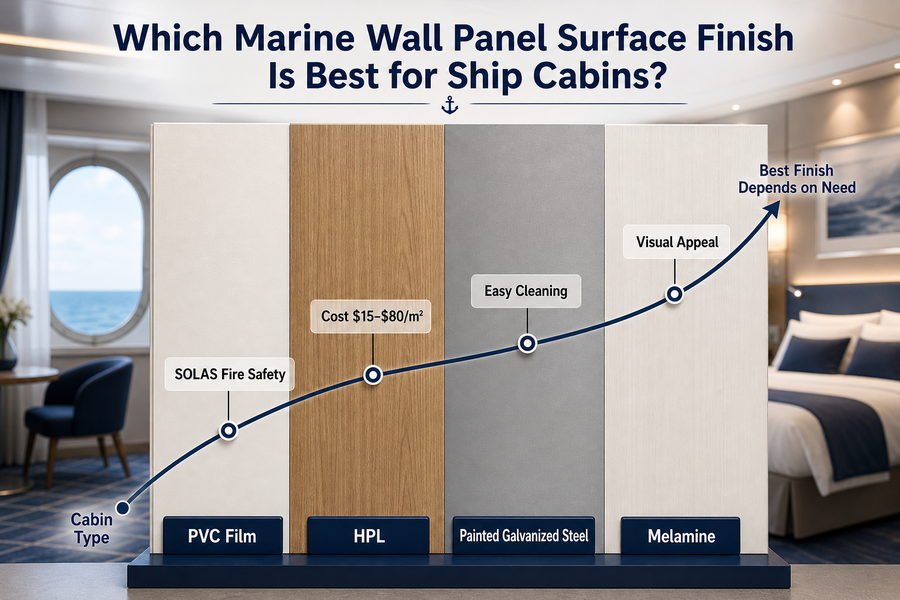
The best marine wall panel finishes include PVC film, High-Pressure Laminate (HPL), painted galvanized steel, and melamine. The ideal choice depends entirely on the cabin type, balancing SOLAS fire safety regulations, unit costs ranging from $15 to $80 per square meter, cleaning requirements, and expected visual appeal.
I spent years working in Asian marine outfitting factories. I know that picking the right surface finish is not just about making the cabin look nice. You need materials that pass strict European shipyard standards. At the same time, you must keep your purchase costs low to make a profit. Many buyers struggle to communicate with local sales teams. They worry about lead times and quality. Let us look at the best finishes for different parts of the ship. If you know these details, you can buy with confidence.
Which marine wall panel finish is suitable for passenger cabins?
Standard passenger cabins face high traffic and tight budgets. Picking a weak finish means constant repairs and unhappy shipowners. You need durability mixed with visual warmth to satisfy everyone.
For standard passenger cabins, PVC film and High-Pressure Laminate (HPL) are the most suitable finishes. Both options offer wide design choices, meet SOLAS B-15 fire ratings, and provide high scratch resistance at a moderate cost of $20 to $35 per square meter.
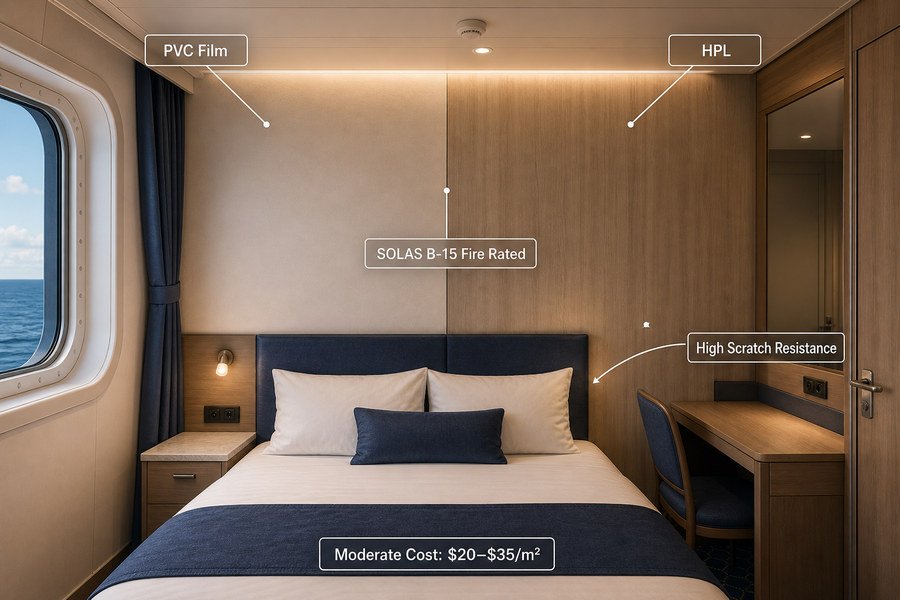
PVC Film Finish for Standard Passenger Cabins
PVC film is a very common choice for passenger cabins. In the factory, we bond a layer of PVC film onto a 0.6mm thick galvanized steel sheet. The film thickness is usually between 150 and 200 microns. This thickness is very important. Thin films will scratch easily during installation. When workers install the panels, they often bump them with tools. A 150-micron film resists these bumps well. This finish costs about $20 to $25 per square meter based on current quotes from major Asian suppliers. You get a great look for a low price. It also comes with the required MED wheelmark certification1. European shipyards always check for this mark. The PVC film can look like wood, stone, or solid colors. This makes it easy to match the design plans of the shipyard.
High-Pressure Laminate (HPL) Finish for Standard Passenger Cabins
High-Pressure Laminate, or HPL, is another great choice. It is a hard plastic layer bonded to the steel surface. The HPL layer is usually 0.7mm to 0.8mm thick. It costs slightly more than PVC film. The price is usually between $28 and $35 per square meter. However, HPL is much harder than PVC. It resists deep scratches very well. Passengers drag heavy bags against the walls. HPL panels survive this abuse. Like PVC, HPL passes the SOLAS B-15 fire tests2. Both PVC and HPL finishes give you a low-cost, high-quality result. You must buy these from suppliers who use good glue. If they use cheap glue, the finish will peel off in hot weather. I always advise buyers to check the glue specifications before ordering.
| Feature | PVC Film Finish | High-Pressure Laminate (HPL) |
|---|---|---|
| Cost per Square Meter | $20 - $25 | $28 - $35 |
| Surface Thickness | 150 - 200 microns | 0.7mm - 0.8mm |
| Scratch Resistance | Good | Excellent |
| SOLAS Fire Rating | B-15 or B-0 | B-15 or B-0 |
| Best Application | Cost-sensitive passenger cabins | High-traffic passenger cabins |
Which marine wall panel finish is suitable for crew cabins?
Crew cabins need practical materials. Wasting money on expensive finishes here hurts your total project margin. Yet, the material must still pass mandatory maritime fire safety tests without fail.
The most suitable marine wall panel finishes for crew quarters are painted galvanized steel and standard PVC film. These finishes prioritize strict function over luxury, easily meet A-Class and B-Class fire containment rules, and offer the lowest procurement costs, typically ranging from $15 to $22 per square meter.
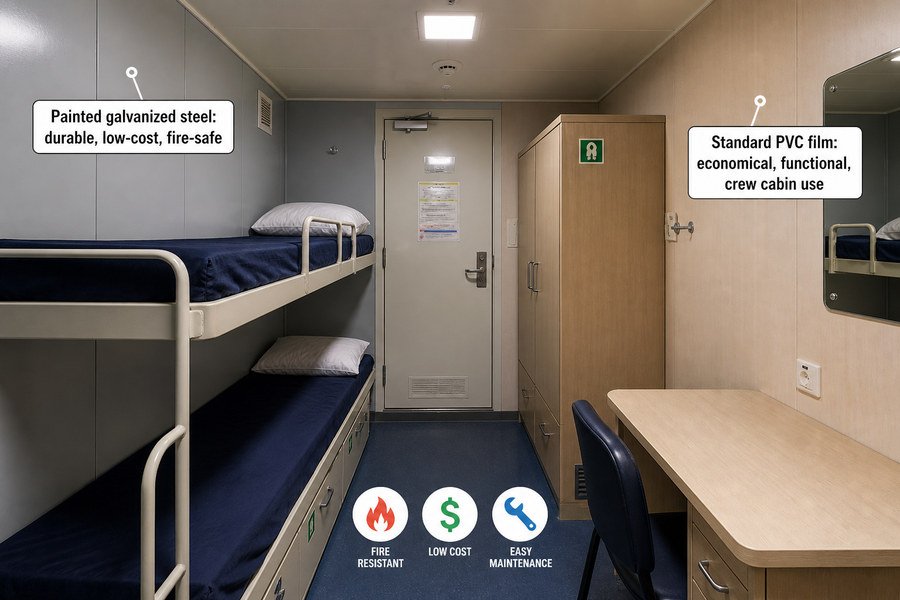
Painted Galvanized Steel Finishes for Crew Quarters
Crew cabins do not need luxury designs. They need tough, clean, and cheap walls. Painted galvanized steel is the best finish for this job. The factory uses a 0.6mm or 0.7mm steel sheet. They spray it with epoxy polyester powder paint. Then they bake it in an oven. The paint layer is very thin, usually 60 to 80 microns. This finish is very cheap. It costs only $15 to $18 per square meter. According to IMO FTP Code tests, painted steel adds almost no fuel to a fire3. It is very safe. The surface is smooth and hard. It does not scratch easily. It is also very easy to produce. This means the lead time is short. If you need panels fast, painted steel is a smart choice.
Standard PVC Film Finishes for Crew Quarters
Sometimes the shipyard wants the crew cabins to look a little warmer. In this case, standard PVC film is the right choice. You do not use expensive wood grain patterns. You use basic white, cream, or light grey colors. These basic colors cost less to make. The price is about $18 to $22 per square meter. Standard PVC film gives the room a softer feel than bare painted metal. Both painted steel and standard PVC film are excellent for crew areas. They keep your costs very low. They ship easily from factories in China or Vietnam. You can load many panels into one shipping container. This lowers your logistics costs. I have helped many buyers switch from HPL to painted steel in crew areas. They saved a lot of money and the shipyards were still happy.
| Finish Type | Visual Appearance | Cost per Square Meter | Fire Safety | Production Lead Time |
|---|---|---|---|---|
| Painted Galvanized Steel | Basic, industrial | $15 - $18 | Excellent (Non-combustible face) | Very Short (15-20 days) |
| Standard PVC Film | Soft, plain colors | $18 - $22 | Very Good (Low flame spread) | Short (20-25 days) |
Which marine wall panel finish is suitable for luxury cabins?
Luxury suites demand high-end aesthetics. Using basic materials ruins the luxury experience and risks losing major shipyard contracts. You must use premium, visually stunning surfaces to impress guests.
For luxury cabins, the most suitable marine wall panel finishes are metallic laminates, genuine wood veneers with fire-retardant backing, and custom-printed HPL. These premium materials provide a high-end hotel appearance, comply fully with IMO FTP Code standards, and generally cost between $45 and $80 per square meter.
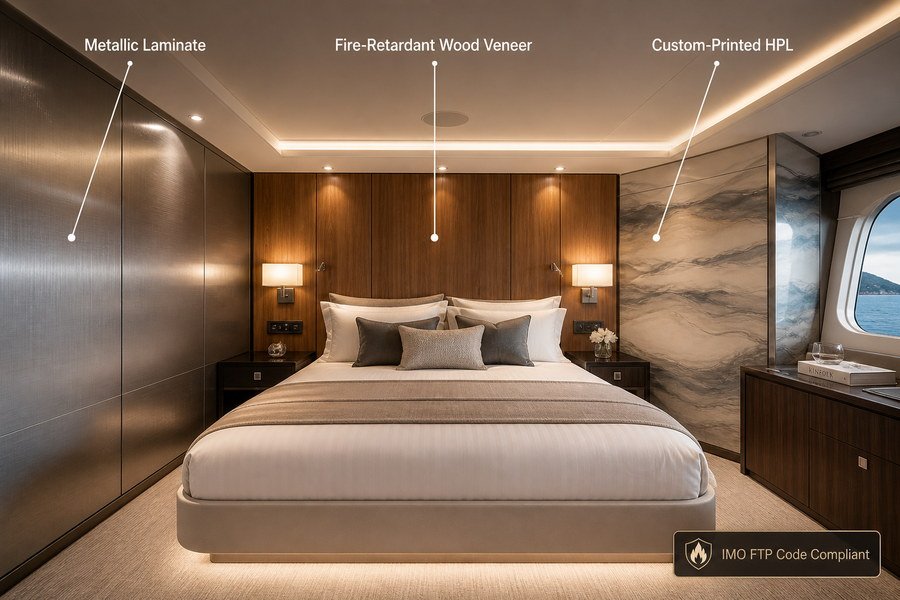
Metallic Laminates and Wood Veneers for Luxury Cabins
Luxury cabins on cruise ships must look like five-star hotels. Basic PVC film is not good enough here. You need premium finishes. One great option is metallic laminate. This finish uses real metal foils pressed into the surface. It shines beautifully under cabin lights. Another top choice is genuine wood veneer. Natural wood burns easily. So, the factory must use a special fire-retardant backing4. They bond the thin wood sheet to the fireproof core. This process takes a lot of time and skill. Because of this, the price is high. These finishes cost between $50 and $80 per square meter. However, European shipyards gladly pay this price for top suites. You must ask the supplier for very clear IMO fire test reports. Do not trust suppliers who cannot show you the English certificates.
Custom-Printed High-Pressure Laminate (HPL) for Luxury Cabins
Custom-printed HPL is the third amazing finish for luxury spaces. Shipyard designers often want unique artwork on the walls. With custom HPL, the factory prints any high-resolution image directly into the laminate paper before pressing it. You can have giant murals, unique marble patterns, or company logos. This finish costs about $45 to $65 per square meter. It gives you complete design freedom. All three of these finishes—metallic laminates, wood veneers, and custom HPL—meet the strict rules of the IMO FTP Code5. They have very low flame spread. I remember a project where the buyer used custom HPL for the VIP suites. The shipyard loved it so much they ordered more for the next ship. You just need to plan ahead. These custom finishes take 30 to 45 days to produce.
| Premium Finish | Visual Impact | Price Range (per sqm) | Production Time | Best Feature |
|---|---|---|---|---|
| Metallic Laminate | Modern, shiny, industrial chic | $50 - $75 | 30 days | Real metal appearance |
| Genuine Wood Veneer | Classic, warm, natural | $60 - $80 | 45 days | Authentic wood texture |
| Custom-Printed HPL | Unique, artistic, flexible | $45 - $65 | 30 - 40 days | Total design freedom |
Which marine wall panel finish is easy to clean in ship cabins?
Dirty walls upset passengers and increase crew labor. Finishes with deep textures trap dirt and grease fast. You need smooth surfaces that wipe clean with basic chemical detergents.
The easiest marine wall panel finishes to clean are smooth melamine, high-gloss High-Pressure Laminate (HPL), and epoxy-painted steel. These non-porous surfaces resist deep stains, withstand daily scrubbing with standard maritime alkaline cleaners (pH 9-11), and do not absorb moisture or cooking odors.
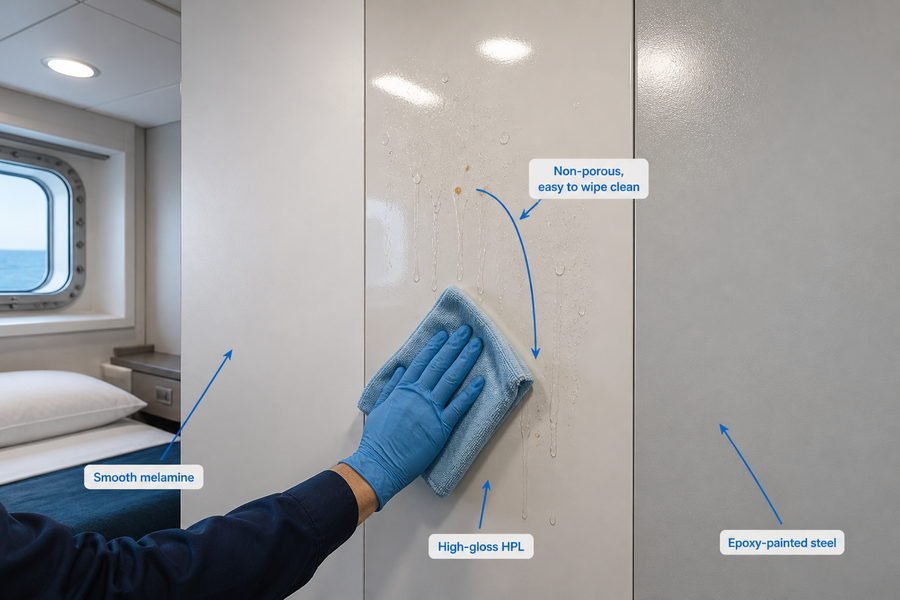
Melamine and High-Gloss HPL for Easy Cleaning
Cleaning cabins takes a lot of time. Ship owners want to reduce this time to save money. You must pick finishes that do not hold dirt. Smooth melamine is an excellent choice. Melamine is a hard resin surface.6 It is completely flat and non-porous. Dirt cannot hide inside it. High-gloss HPL is very similar. The high-gloss finish creates a mirror-like surface. Crew members can wipe off coffee stains or fingerprints with a simple wet cloth. These finishes are very strong against chemicals.7 Cleaning crews use alkaline cleaners with a pH level between 9 and 11. These chemicals can melt cheap plastics. But melamine and high-gloss HPL do not fade or melt. Both melamine and high-gloss HPL are ideal for dining areas and wet units. They cost around $25 to $35 per square meter.
Epoxy-Painted Steel Surfaces for Easy Cleaning
Epoxy-painted steel is the third surface that is very easy to clean. This finish is baked hard in the factory. It creates a sealed layer over the steel. Grease and oil wipe off instantly. I highly recommend painted steel for ship galleys and crew mess rooms. Painted steel is cheaper, costing about $15 to $18 per square meter. All three of these finishes—melamine, high-gloss HPL, and epoxy paint—save the ship owner money every single day. They require less soap and less scrubbing time. When you speak to European shipyards, you should tell them about the cleaning benefits. They care about maintenance costs very much. Just be careful with high-gloss HPL during shipping. It needs a good protective film. If the factory uses cheap film, the gloss surface might scratch inside the container.
| Surface Finish | Chemical Resistance | Ease of Cleaning | Best Location on Ship | Cost per sqm |
|---|---|---|---|---|
| Smooth Melamine | Very High | Excellent | Dining rooms, cabins | $25 - $30 |
| High-Gloss HPL | High | Excellent | Washrooms, feature walls | $30 - $35 |
| Epoxy-Painted Steel | Extremely High | Very Good | Galleys, engine control rooms | $15 - $18 |
Which marine wall panel finish offers good decorative effect for ship cabins?
Bland cabins make a ship feel like a hospital. A lack of design options limits your projects. You need highly customizable finish options to match exact shipyard plans.
To achieve a good decorative effect, PVC film and architectural High-Pressure Laminate (HPL) finishes are best. They provide thousands of visual options, including realistic wood grains, marble textures, and fabric patterns, allowing decorators to match any European shipyard interior design requirement seamlessly.
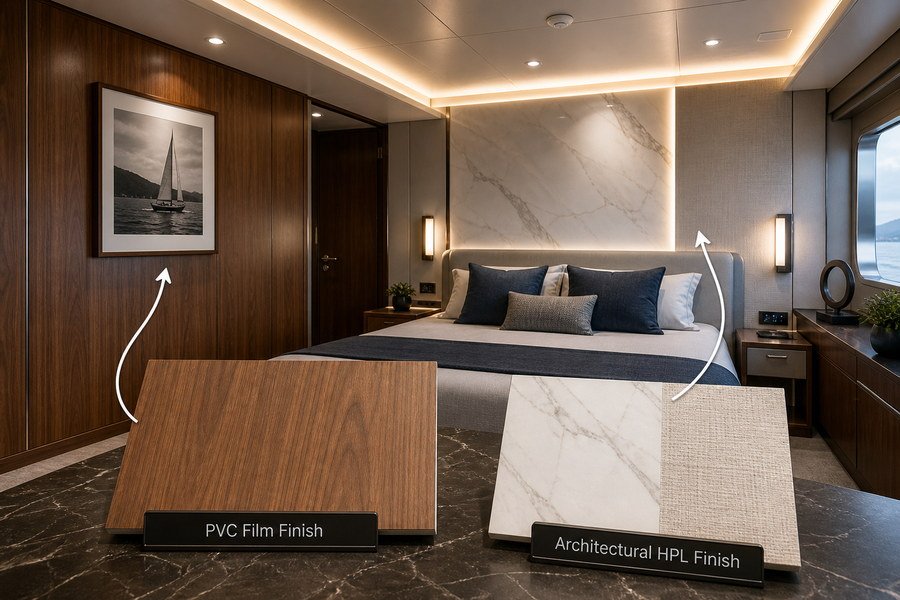
Decorative Options Using PVC Film Finishes
Designers love choices. When a shipyard gives you a 3D rendering of a cabin, you must find a material that looks exactly like the picture. PVC film finishes give you the most choices. Asian factories have huge catalogs of PVC films. You can find over a thousand different wood grains. They have light oak, dark walnut, and red cherry. They also have films that look and feel like real fabric. The technology is amazing now. The films have 3D textures. When you touch the wall, it feels like real wood grain. This makes the cabin look very expensive. But the cost is still only $20 to $25 per square meter. You can win big contracts because you can match any design perfectly. I always keep a box of PVC samples on my desk to show buyers the textures.
Decorative Options Using Architectural HPL Finishes
Architectural HPL is the other great choice for decoration. HPL also comes in hundreds of colors and patterns. HPL is especially good for stone and marble looks. Real stone is too heavy for ships. It also breaks during bad weather at sea. HPL panels with a marble print solve this problem. They look like real stone but are very light. Both PVC film and architectural HPL offer incredible decorative effects. They let you turn a boring steel box into a beautiful room. When you order these, make sure the factory gives you a color match guarantee. Sometimes the color in the catalog looks different from the real panel. I always ask the factory to send a small physical sample by air mail before they start mass production. This small step stops big arguments later.
| Decorative Finish | Best Visual Effects | Texture Quality | Price per sqm | Main Advantage |
|---|---|---|---|---|
| PVC Film | Wood grains, fabric looks | Very high (3D embossed) | $20 - $25 | Huge variety of patterns |
| Architectural HPL | Stone, marble, solid colors | High (smooth or matte) | $28 - $35 | Looks like real heavy stone |
Which marine wall panel finish balances cost and quality for ship cabins?
Budgets are always tight, but shipyards demand top quality. Overpaying destroys your profits, while cheaping out fails inspections. You must find the perfect middle ground material.
The marine wall panel finish that best balances cost and quality is standard PVC film on galvanized steel. It provides excellent durability, full MED certification, diverse aesthetic choices, and a stable procurement price of $18 to $25 per square meter from high-quality Asian manufacturing centers.
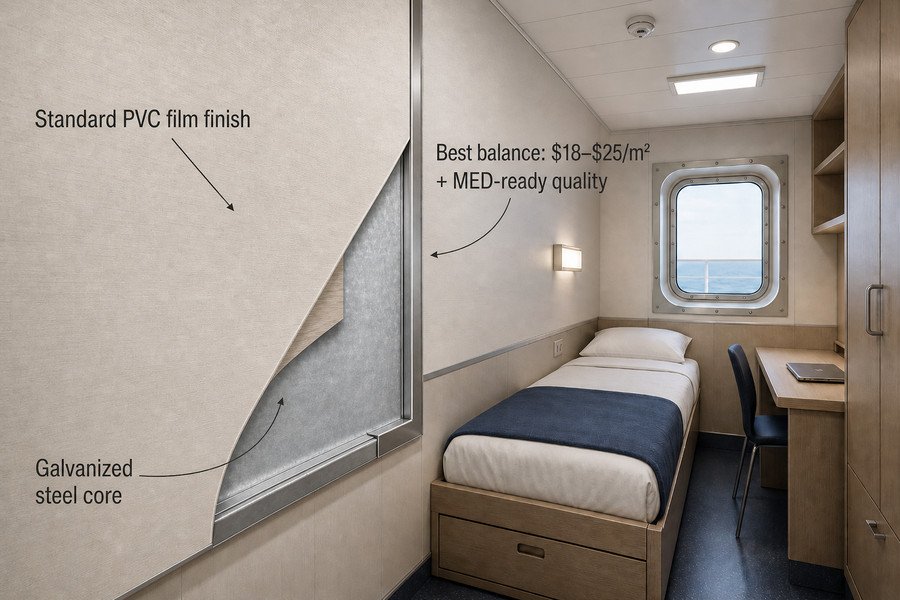
Cost Advantages of PVC Film on Galvanized Steel
You need to make money on your interior decoration projects. If you buy materials from Europe, the price is too high. If you buy bad materials, the shipyard will not pay you. The perfect balance is standard PVC film on galvanized steel. I have seen hundreds of ship projects. This finish is used in 80% of standard cabins.8 The price is very stable. It usually stays between $18 and $25 per square meter. This low price leaves a good profit margin for your company. The logistics are also very easy. Suppliers pack these panels very tightly on wooden pallets. A standard 20-foot shipping container can hold hundreds of square meters. This means your shipping cost per panel is very low.
Quality Assurance of Asian-Sourced PVC Film Panels
Even though the price is low, the quality is very high. The top factories in China and Vietnam use modern, automated machines. They apply the PVC film perfectly every time. There are no bubbles or weak spots. Most importantly, these panels pass all the hard fire tests. They hold the MED wheelmark. They also hold approvals from ABS, DNV, and Lloyd's Register. You get the safety of a premium product at a low cost. This balance of cost and quality is exactly what procurement officers need. You can show the certifications to the European shipyard managers. They will be happy. Then you can look at the low invoice price. You will be happy. Always choose suppliers who can talk to you clearly in English. Good communication prevents mistakes during the order process.
| Factor | PVC Film on Galvanized Steel | Benefit to Procurement Officer |
|---|---|---|
| Average Cost | $18 - $25 per sqm | High profit margin for projects |
| Fire Certifications | MED, ABS, DNV approved | Easy acceptance by strict shipyards |
| Aesthetic Range | Hundreds of patterns | Matches shipyard design files |
| Logistics | High container loading density | Low shipping cost per item |
Conclusion
Choosing the right marine wall panel finish ensures fire safety, meets tight budgets, and satisfies passengers. Always balance your specific cabin requirements with cost, certifications, and long-term surface durability.
-
"Directive 96/98/EC - Wikipedia", https://en.wikipedia.org/wiki/Directive_96/98/EC. European Union Marine Equipment Directive rules require covered marine equipment placed on board EU ships to meet applicable conformity-assessment procedures and to bear the wheel mark as evidence of conformity. Evidence role: general_support; source type: government. Supports: PVC film cabin finishes used in European shipbuilding require MED wheelmark certification and are checked by European shipyards.. Scope note: This supports the regulatory role of the MED wheel mark for covered equipment on EU ships, but it does not prove that every PVC-film cabin panel has certification or that every European shipyard checks it in the same way. ↩
-
"[PDF] RESOLUTION MSC.307(88) (adopted on 3 December 2010 ...", https://wwwcdn.imo.org/localresources/en/KnowledgeCentre/IndexofIMOResolutions/MSCResolutions/MSC.307(88).pdf. SOLAS and the IMO Fire Test Procedures framework define B-class fire divisions, including B-15 ratings, as tested fire-resisting constructions subject to specified insulation and flame-passage criteria. Evidence role: definition; source type: institution. Supports: PVC and HPL cabin finishes can be supplied as panels that pass SOLAS B-15 fire tests.. Scope note: This source would define the B-15 classification and testing context; it would not by itself prove that all PVC or HPL panel assemblies pass B-15 without product-specific type approval data. ↩
-
"Sub-Committee on Fire Protection (FP), 54th session: 12 to 16 April ...", https://www.imo.org/en/MediaCentre/MeetingSummaries/Pages/FP-54th-Session.aspx. The IMO FTP Code sets non-combustibility test criteria for ship materials, and steel substrates are generally treated as non-combustible in fire-performance assessment; this supports the claim that a painted steel face contributes little combustible load when the coating is thin. Evidence role: mechanism; source type: institution. Supports: According to IMO FTP Code tests, painted steel adds almost no fuel to a fire.. Scope note: The source would support the general fire-performance rationale, but it would not certify a specific painted galvanized steel panel without a product-specific FTP test report. ↩
-
"[PDF] RESOLUTION MSC.307(88) (adopted on 3 December 2010 ...", https://wwwcdn.imo.org/localresources/en/KnowledgeCentre/IndexofIMOResolutions/MSCResolutions/MSC.307(88).pdf. IMO/SOLAS fire-safety requirements for passenger ships use standardized fire-test criteria for interior surface materials and assemblies, providing the regulatory basis for using fire-retardant backings or approved cores behind combustible decorative veneers. Evidence role: general_support; source type: institution. Supports: Genuine wood veneer used in cruise-ship cabins requires a fire-retardant backing or approved core to satisfy marine fire-safety requirements.. Scope note: The source would establish the regulatory need for approved fire performance; it would not prove that one specific backing material or veneer product is compliant. ↩
-
"[PDF] RESOLUTION MSC.307(88) (adopted on 3 December 2010 ...", https://wwwcdn.imo.org/localresources/en/KnowledgeCentre/IndexofIMOResolutions/MSCResolutions/MSC.307(88).pdf. The IMO Fire Test Procedures Code sets internationally standardized test methods for shipboard materials, including tests for non-combustibility, surface flammability, smoke, and toxicity, supporting the article’s reference to formal fire-safety rules for cruise-ship interior finishes. Evidence role: definition; source type: institution. Supports: The IMO FTP Code imposes strict fire-test requirements relevant to cruise-ship interior finishes.. Scope note: This supports the existence and scope of the IMO FTP Code, not the claim that all listed finishes automatically meet it; product-specific certificates are still required. ↩
-
"Melamine - Wikipedia", https://en.wikipedia.org/wiki/Melamine. A materials encyclopedia describes melamine-formaldehyde as a hard thermosetting resin used in laminates, supporting the characterization of melamine as a hard resin surface. Evidence role: definition; source type: encyclopedia. Supports: Melamine is a hard resin surface used as a smooth, easy-clean finish.. Scope note: This supports the material identity and general hardness, not the absolute claim that every melamine finish is perfectly flat or entirely non-porous. ↩
-
"High-Pressure Decorative Laminates (HPDL) - NC State University", https://research.cnr.ncsu.edu/wptechservices/nema-ld3-laminate-testing/. A laminate standard or materials study documenting stain and chemical-resistance testing for melamine-faced boards and high-pressure laminates would support the claim that these finishes tolerate common cleaning chemicals. Evidence role: general_support; source type: institution. Supports: Melamine and high-gloss HPL have strong resistance to common cleaning chemicals.. Scope note: Such evidence would support general chemical resistance under specified test conditions, not prove resistance to every alkaline cleaner or every formulation used onboard ships. ↩
-
"How to Choose Surface Finishes for Marine Wall Panels and Ceiling ...", https://magellanmarinetech.com/how-choose-surface-finishes-for-marine-wall-ceiling-panels/. A maritime accommodation materials survey or ship-interior specification source would support the claim by documenting how commonly PVC-laminated galvanized steel panels are used in standard cabin interiors; unless the source reports the same percentage, it should be treated as contextual evidence rather than proof of the exact 80% figure. Evidence role: statistic; source type: research. Supports: PVC film on galvanized steel is used in a large share of standard ship cabins, specifically claimed as 80%.. Scope note: Likely difficult to verify without an industry survey or procurement dataset; general sources may support common use but not the exact percentage. ↩