Confused about choosing finishes for ship interiors? Picking the wrong surface wastes your budget and delays shipyard projects. Let me explain the exact differences clearly.
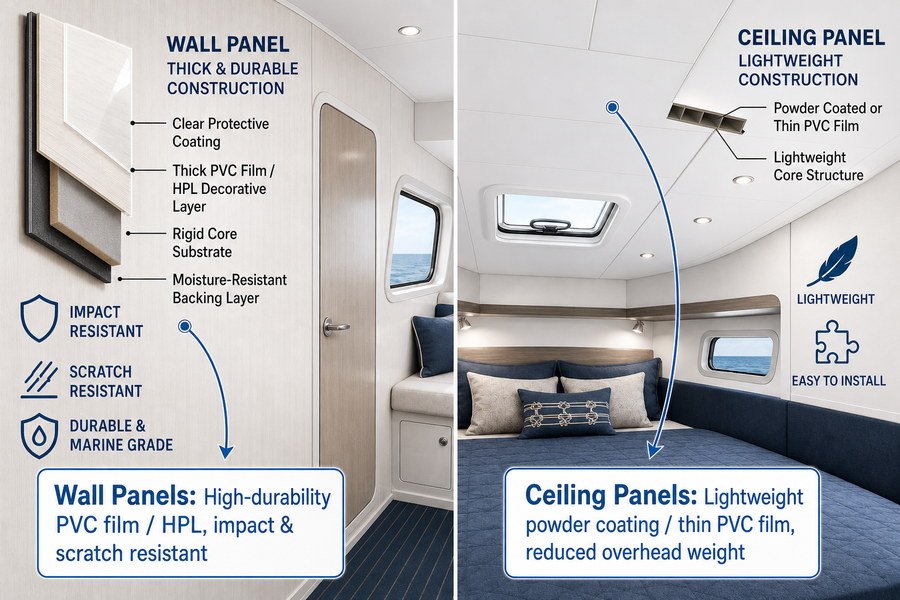
Marine wall panels and ceiling panels require different finishes due to their distinct functions. Wall panels need high-durability PVC films or high-pressure laminates (HPL) for impact and scratch resistance. Ceiling panels use lightweight powder coatings or thinner PVC films to reduce weight overhead and simplify overhead installation.
You might think any marine-grade finish works everywhere, but using the same material for both will lead to costly inspection failures. Let us look closer at the specific finish requirements.
What Finish Requirements Are Different For Marine Wall Panels And Ceiling Panels?
Struggling to meet shipyard specs for different cabin areas? Guessing the finish specs can cause failed marine surveys. Here are the exact requirement differences you must know.
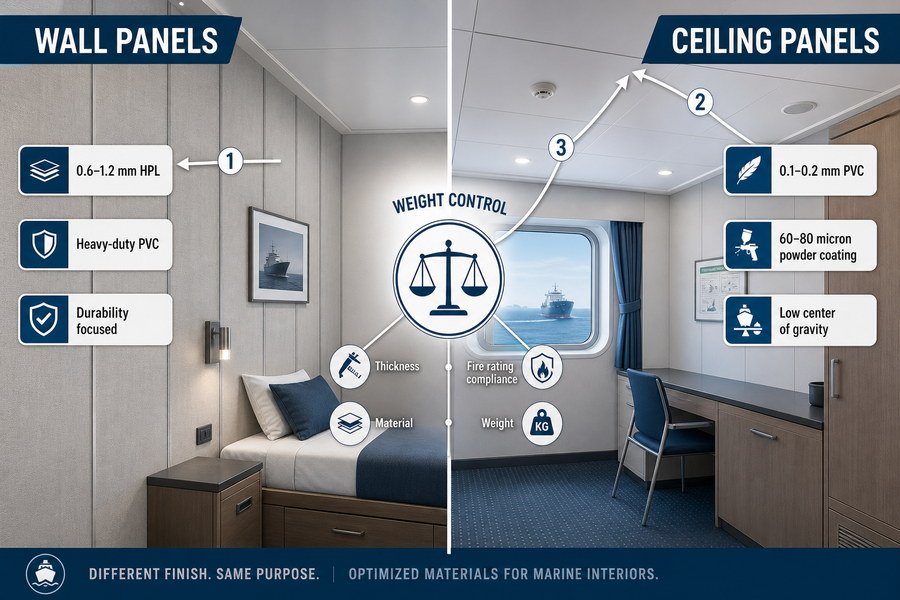
The finish requirements differ across four main areas: thickness, material type, fire rating compliance, and weight. Wall panels use 0.6mm-1.2mm HPL or heavy-duty PVC for durability. Ceiling panels strictly use lightweight 0.1mm-0.2mm PVC or 60-80 micron powder coatings to maintain a low center of gravity.
Knowing these four differences is the key to passing SOLAS inspections without overspending on materials you do not actually need.
Analyzing Thickness and Material Type for Marine Panels
When I buy marine panels from suppliers in Asia, the first thing I check is the thickness of the finish. Wall panels need a thick surface because they form the main structure of the cabin. I always recommend a High-Pressure Laminate (HPL) finish with a thickness of 0.6mm to 1.2mm. Sometimes, we use heavy-duty PVC films that are at least 0.3mm thick. These thick materials make the wall feel solid and high-quality. You must use these exact material types to ensure the wall can handle daily life on a ship.
On the other hand, ceiling panels do not need this thickness. When a shipyard in Europe asks me for ceiling panels, I provide materials with a thin PVC film of 0.1mm to 0.2mm. Alternatively, we use a powder coating that is only 60 to 80 microns thick. If you use a 0.8mm HPL on a ceiling panel, it is a huge waste of money. The material type must match the location. Do not mix them up.
Comparing Fire Rating Compliance and Weight Limits
Both wall and ceiling panels must pass the IMO FTP Code Part 5 for low flame spread1. This fire rating compliance is not optional. However, the weight limits are completely different. A marine wall panel finish can weigh between 1.5 and 2.0 kilograms per square meter. This is normal and accepted by naval architects. The heavy finish provides the needed fire protection for vertical spaces.
But for marine ceiling panels, weight is a critical issue. The surface finish for a ceiling must weigh less than 0.5 kilograms per square meter. If the finish is too heavy, the whole ceiling system will sag over time. It will also raise the center of gravity of the ship2. This causes safety problems. Therefore, you must strictly separate the finishes based on these four factors: thickness, material, fire safety, and weight.
| Requirement | Marine Wall Panel Finish | Marine Ceiling Panel Finish |
|---|---|---|
| Material Type | High-Pressure Laminate (HPL) or Heavy PVC | Thin PVC Film or Powder Coating |
| Finish Thickness | 0.6mm to 1.2mm (HPL), 0.3mm+ (PVC) | 0.1mm to 0.2mm (PVC), 60-80 microns (Powder) |
| Weight Limit | 1.5 to 2.0 kg per square meter | Less than 0.5 kg per square meter |
| Fire Rating | IMO FTP Code Part 5 compliant | IMO FTP Code Part 5 compliant |
Why Do Marine Wall Panels Need Better Scratch Resistance Than Ceiling Panels?
Do your cabin walls get scratched during shipyard installation? Replacing damaged panels eats up your profit margin quickly. Here is why wall panels demand extreme scratch resistance.
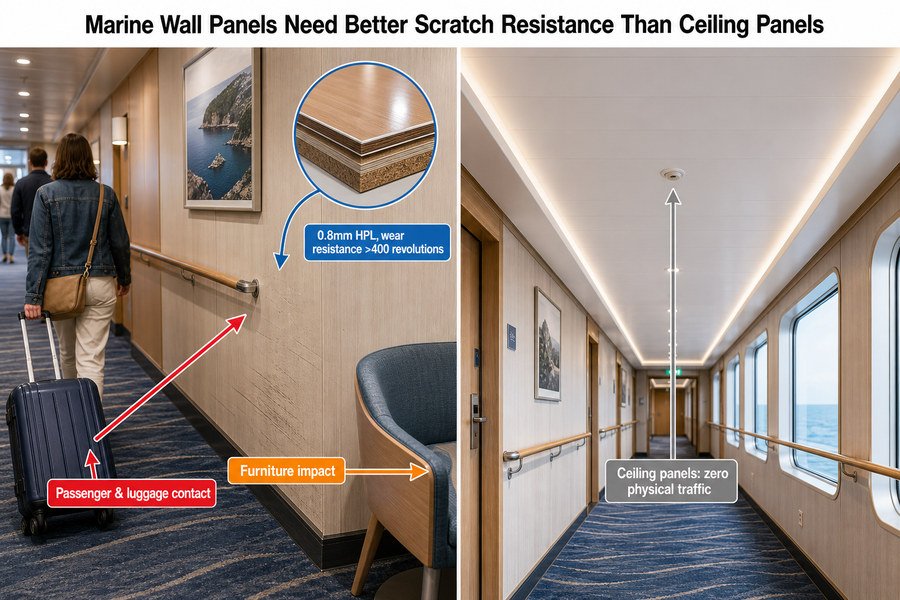
Marine wall panels need higher scratch resistance because they face constant physical contact from passengers, luggage, and moving furniture. They require hard-wearing finishes like 0.8mm High-Pressure Laminate (HPL) offering a wear resistance of over 400 revolutions, whereas ceiling panels face zero physical traffic and need minimal scratch protection.
If you buy a cheap wall finish without checking its wear resistance, you will end up paying double to fix it before the ship even sails. Let me break down the physical demands.
Daily Physical Contact and Impact on Marine Wall Panels
In a ship cabin, the walls are always in danger. Passengers lean against them. Room service carts bump into the corners. Heavy metal suitcases scrape along the corridor walls during boarding. Because of this constant physical contact, the finish must be extremely tough3. When I visit shipyards, I see the damage firsthand. A cheap wall panel finish will show deep white scratches within the first month of use.
Ceiling panels live a completely different life. They sit 2.1 to 2.2 meters above the floor. Nobody touches them. Furniture never hits them. Luggage never scrapes them. Because ceiling panels face zero physical traffic, paying extra money for scratch-resistant ceiling finishes is a bad business decision. You should spend your budget where the impact actually happens.
Wear Resistance Standards for Marine Surfaces
To prove that a wall finish is good enough, we look at real numbers. The standard test for scratch resistance is the Taber abrasion test, guided by the EN 438 standard. For a marine wall panel, the finish must survive over 400 revolutions on the testing machine before the pattern wears off. A high-quality 0.8mm HPL easily passes this test. It provides the hard-wearing finish that ship owners demand.
Ceiling finishes do not need to pass this strict test. A standard powder-coated ceiling panel only provides minimal scratch protection. It might wear off after just 50 revolutions on a testing machine. But this low number is perfectly fine. As long as the ceiling panel survives the initial installation process, it will never be scratched again.
| Feature | Marine Wall Panel Finish | Marine Ceiling Panel Finish |
|---|---|---|
| Traffic Exposure | High (Passengers, Carts, Luggage) | Zero (Out of reach) |
| Impact Risk | High (Daily bumps and scrapes) | Very Low (Only during installation) |
| Wear Resistance Standard | >400 revolutions (EN 438 standard) | Minimal requirement (<50 revolutions) |
| Required Finish Type | Hard-wearing 0.8mm HPL | Standard Powder Coating or Thin PVC |
Why Do Marine Ceiling Panels Need Lightweight Surface Finishes?
Is your ship's center of gravity getting too high? Heavy overhead materials cause serious stability problems for vessels. Lightweight ceiling finishes are the only safe solution.
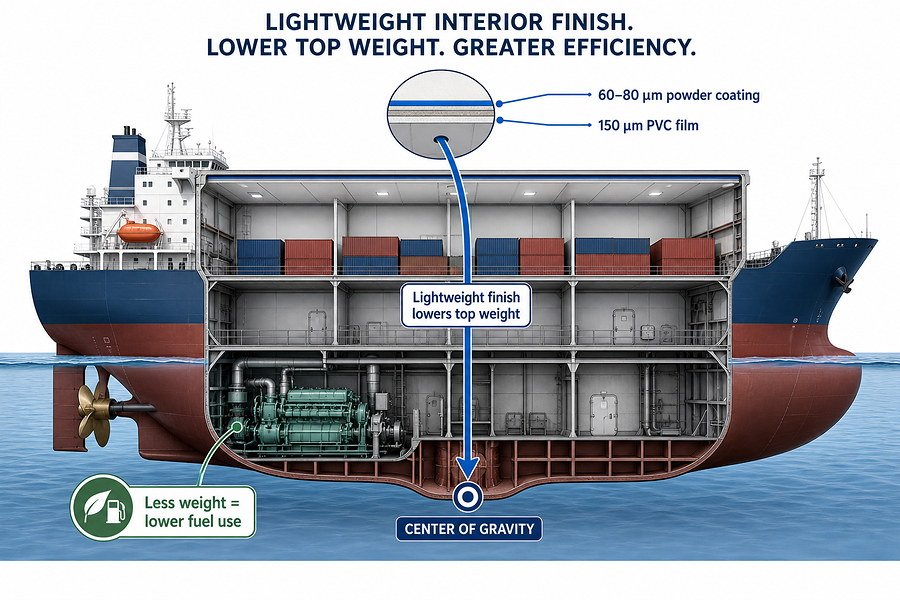
Marine ceiling panels must use lightweight surface finishes to lower the ship's center of gravity, improve vessel stability, and reduce the overall fuel consumption. Finishes are restricted to 60-80 micron powder coatings or 150-micron PVC films, adding less than 0.3 kg per square meter to the ceiling structure.
If you ignore the weight limits for overhead materials, the naval architects will reject your entire interior outfitting package. Let us look at the real numbers behind weight control.
The Impact of Ceiling Finish Weight on Ship Stability
Weight is the enemy of any ship. When you build a multi-deck cruise ship or a large commercial vessel, the weight at the top of the ship is very dangerous. Every extra kilogram added to the ceiling raises the ship's center of gravity.4 A high center of gravity ruins vessel stability. It makes the ship roll more in rough seas. This makes passengers sick and creates safety risks.
By using a lightweight surface finish on the ceiling panels, you directly solve this problem. A lighter ship also means lower overall fuel consumption. If you use a heavy 1.0mm HPL on the ceiling instead of a light paint, you could add 2,000 kilograms of useless weight to a single deck. The shipyard will never accept this mistake. This is why strict weight control is essential.
Specific Weight Restrictions for Marine Ceiling Finishes
To keep the ship safe, we follow specific weight rules. The metal core of the ceiling panel already has weight, so the finish must be as light as possible. As an outfitting specialist, I make sure the factory uses a 60-80 micron powder coating. This type of paint finish adds only 0.1 to 0.15 kilograms per square meter. It is incredibly light but still looks great.
If the client wants a wood pattern on the ceiling, we use a 150-micron PVC film. This thin plastic film adds less than 0.3 kg per square meter5 to the panel. Compare this to a wall panel finish that weighs up to 2.0 kg per square meter. The math is simple. You must restrict your ceiling finishes to these lightweight options to keep the total ship weight within the safe zone.
| Finish Type | Typical Thickness | Weight Added (per square meter) | Impact on Ship Stability |
|---|---|---|---|
| Powder Coating (Ceiling) | 60 - 80 microns | 0.10 - 0.15 kg | Excellent (Keeps center of gravity low) |
| Thin PVC Film (Ceiling) | 150 microns | 0.20 - 0.30 kg | Very Good (Safe for overhead use) |
| Thick PVC Film (Wall) | 300 microns | 0.40 - 0.60 kg | Poor (Too heavy for ceilings) |
| HPL (Wall) | 0.8 millimeters | 1.20 - 1.60 kg | Dangerous (Causes top-heavy stability issues) |
How Do Installation Conditions Affect Marine Wall Panel And Ceiling Panel Finishes?
Are your installation workers complaining about handling panels? Hard-to-install panels slow down the whole project schedule. The finish type directly changes how panels are cut and bent.
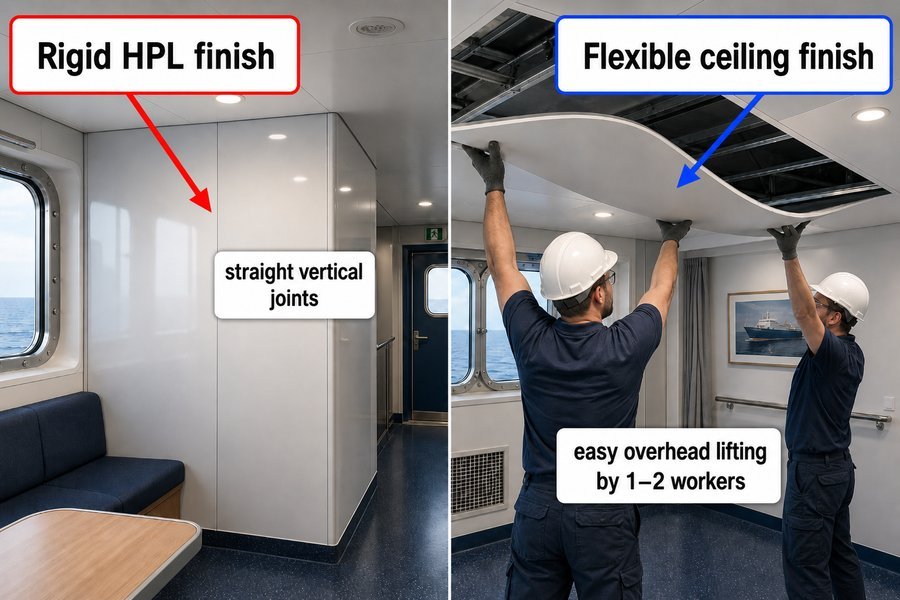
Installation conditions require wall panels to have rigid finishes like HPL for straight vertical joints, while ceiling panels need flexible finishes like thin PVC or powder coating. This flexibility allows ceiling panels to be easily bent into custom profiles and safely lifted overhead by just one or two workers.
You cannot install a heavy wall panel on the ceiling without risking the safety of the shipyard workers. Let me show you how finishes change the installation process.
Vertical Joint Requirements for Marine Wall Panels
Installing a wall panel is a very structured process. The panels stand up straight on the floor. Because the walls are flat and tall, the installation conditions demand rigid finishes. A strong High-Pressure Laminate (HPL) is perfect for this. When the workers put two wall panels together, they need to create clean, straight vertical joints. The hard HPL finish keeps the edges sharp and straight.
However, rigid finishes are hard to cut. Workers need special saws to cut an HPL panel without chipping the edge. The hard surface does not bend. If the wall has a curved corner, the workers must use special joining profiles instead of bending the panel itself. The finish forces the workers to use specific installation techniques to make the room look perfect.
Overhead Handling and Bending of Marine Ceiling Panels
Ceiling panel installation is much harder on the human body. The workers must stand on scaffolding and reach up. Therefore, the panels must be safely lifted overhead by just one or two workers. A standard ceiling panel is usually 300mm wide and up to 3000mm long. If it has a heavy wall finish, three workers would be needed to lift it safely. By using lightweight flexible finishes like thin PVC or powder coating, two workers can handle the job easily.
Furthermore, ceiling panels often need to curve around pipes or form special air vents. The thin PVC finish allows the metal panel to be easily bent into custom profiles at the factory. You can put a powder-coated panel into a bending machine, and the paint will not crack. If you try to bend a thick HPL wall panel, the finish will break instantly. Flexibility is a major requirement for ceiling finishes.
| Installation Factor | Marine Wall Panel (Rigid Finish) | Marine Ceiling Panel (Flexible Finish) |
|---|---|---|
| Handling Method | Pushed upright from the floor | Safely lifted overhead |
| Worker Requirement | Usually 2 workers per large panel | 1 or 2 workers per panel |
| Joining Style | Straight vertical joints with profiles | Overlapping or gap joints |
| Bending Capability | Cannot bend (Finish will crack) | Easily bent into custom profiles |
How Do Cleaning Requirements Differ Between Marine Wall Panels And Ceiling Panels?
Do your shipboard clients complain about dirty cabins? Hard-to-clean surfaces increase the daily work for the ship crew. You must pick finishes based on actual cleaning habits.
Cleaning requirements differ strictly by accessibility and dirt exposure. Wall panels face handprints and spills, requiring highly chemical-resistant finishes like melamine-faced HPL that withstand strong alkaline cleaners (pH 10-12). Ceiling panels only gather dust and smoke, needing only anti-static PVC or powder-coated finishes for simple dry wiping.
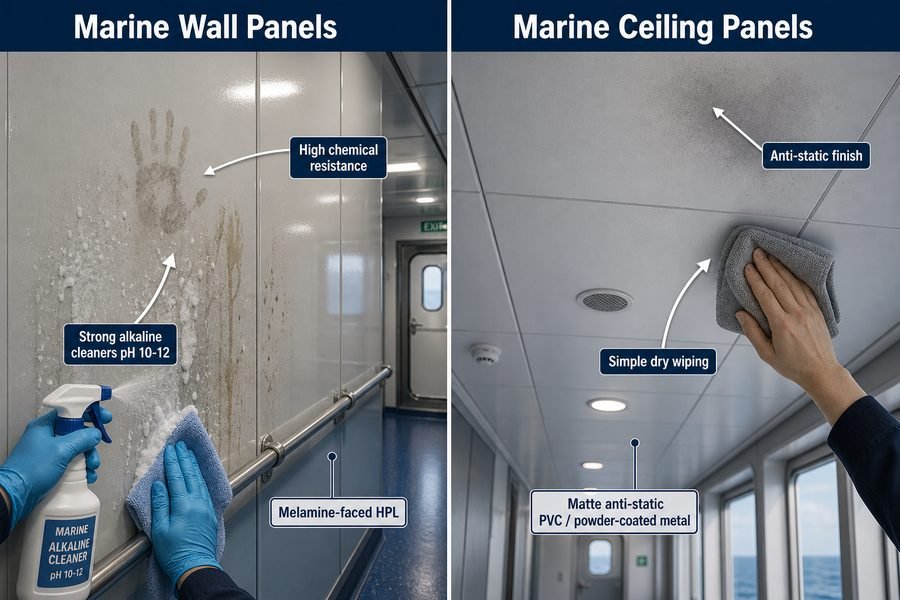
If you sell a wall panel with a finish that cannot handle bleach or strong cleaners, the crew will ruin the color in less than a month. Here is the breakdown of maintenance needs.
Handling Heavy Stains and Chemical Cleaners on Wall Panels
The walls inside a ship get dirty very fast. Because of their easy accessibility, wall panels suffer from high dirt exposure. Passengers leave oily handprints near the doors. People spill coffee and food on the walls in the dining areas. To clean this mess, the ship crew uses powerful cleaning chemicals.
This means the wall finishes must be highly chemical-resistant. I always advise my clients to use a melamine-faced HPL6 for public areas. This surface can withstand strong alkaline cleaners with a pH of 10 to 127. You can wipe an HPL surface with industrial bleach, and the color will not fade8. If you use a cheap finish, the strong cleaners will slowly eat the surface and make it look old and dull. Wall panels must survive aggressive wet cleaning every single day.
Managing Dust and Static on Marine Ceiling Panels
Ceiling panels face a totally different cleaning reality. Because they are out of reach, their dirt exposure is very limited. Nobody spills coffee on the ceiling. Instead, ceiling panels only gather dust from the air conditioning system and sometimes cigarette smoke in smoking lounges. The crew cleans the ceilings maybe once every six months.
For this reason, the cleaning requirements are very simple. The surface only needs an anti-static PVC or powder-coated finish. The anti-static property stops the dust from sticking to the metal9. When the crew does clean the ceiling, they usually perform a simple dry wiping with a microfiber cloth. They do not use heavy chemicals on the ceiling because the liquid would drip down on them. A simple, smooth finish is all you need for an easy-to-clean ceiling.
| Cleaning Factor | Marine Wall Panel Finish | Marine Ceiling Panel Finish |
|---|---|---|
| Dirt Exposure Type | Handprints, food spills, scuff marks | Airborne dust, HVAC dirt, smoke |
| Cleaning Frequency | Daily (Wet cleaning) | Every 6 to 12 months (Dry cleaning) |
| Chemical Resistance Needed | High (Must withstand pH 10-12 cleaners) | Low (Mostly mild soap or dry cloth) |
| Ideal Finish Feature | Chemical-resistant Melamine-faced HPL | Anti-static PVC or smooth powder coating |
How Should Marine Wall Panel Finishes Match Marine Ceiling Panel Finishes?
Does the cabin look ugly because the colors clash? A bad color match ruins the whole high-end feeling of your project. Proper finish matching is essential for visual harmony.
Marine wall and ceiling finishes should be matched using three methods: color coordination, gloss level alignment, and texture contrast. Designers typically use dark, wood-grain HPL on walls for warmth, and pair it with low-gloss (15-20 GU), solid white powder-coated ceilings to reflect light and make cabins feel taller.
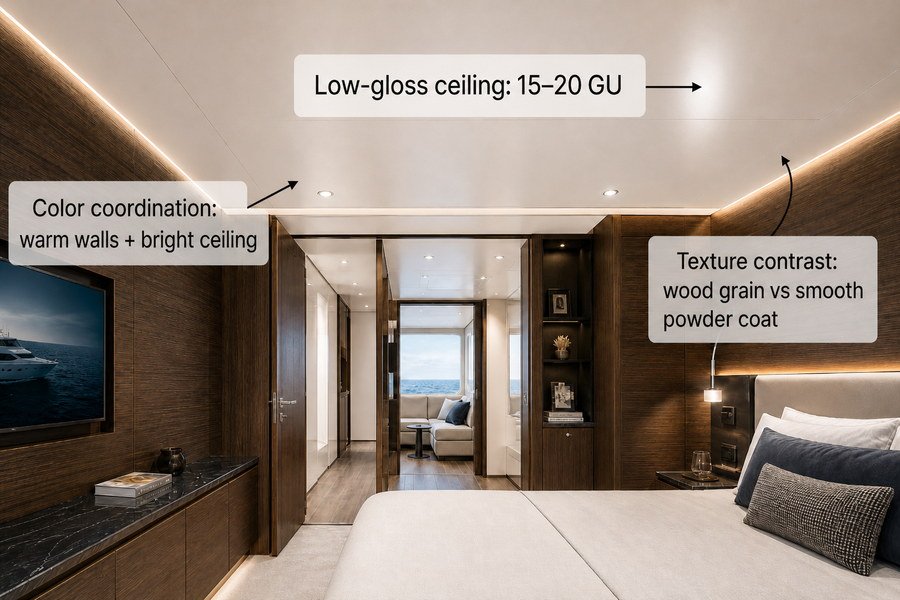
You do not need to use the exact same material to make the cabin look perfect. In fact, mixing them correctly saves money and looks better. Let me explain the matching rules.
Achieving Visual Harmony Through Color Coordination and Texture Contrast
When I talk to procurement officers buying for European shipyards, they care deeply about the final look. The first matching method is color coordination. You should never use the exact same color on the wall and the ceiling. It makes the cabin feel like a small box. Instead, designers use dark or medium colors on the walls.
The second method is texture contrast. You want the walls to feel rich and the ceiling to feel clean. We often use a wood-grain HPL on the walls. The wood pattern adds warmth10 and feels expensive to touch. To contrast this, we pair it with solid white powder-coated ceilings. The flat, smooth white ceiling provides a clean break from the busy wood pattern on the walls. This combination of dark walls and white ceilings makes the whole cabin feel much taller and more spacious.11
Controlling Light Reflection with Gloss Level Alignment
The third and most technical method is gloss level alignment. The lights in a ship cabin are installed in the ceiling. If the ceiling finish is too shiny, it will reflect the light bulbs and create a terrible glare12. It hurts the passengers' eyes. According to ISO 2813 measurement standards, we must control the gloss.
For marine ceilings, I always supply finishes with a low-gloss rating of 15 to 20 GU (Gloss Units). This matte finish absorbs the direct light and scatters it softly around the room to reflect light evenly. The wall panels can have a slightly higher gloss, maybe 30 to 40 GU, because the light does not hit them directly. By aligning these gloss levels correctly, you create a soft, comfortable environment without sharp reflections.
| Matching Method | Wall Panel Finish Recommendation | Ceiling Panel Finish Recommendation | Goal of the Match |
|---|---|---|---|
| Color Coordination | Dark tones, natural wood colors | Solid White, Light Grey, Beige | Makes the cabin feel taller and open |
| Texture Contrast | Wood-grain or fabric texture | Smooth, flat, solid surface | Creates a rich, high-end feeling |
| Gloss Level Alignment | Medium gloss (30 - 40 GU) | Low-gloss matte (15 - 20 GU) | Prevents glare and softly reflects light |
Conclusion
Understanding the exact differences in durability, weight, and cleaning needs between wall and ceiling finishes helps you buy smarter. Choose the right materials to satisfy shipyards and lower your costs.
-
"[PDF] RESOLUTION MSC.307(88) (adopted on 3 December 2010 ...", https://wwwcdn.imo.org/localresources/en/KnowledgeCentre/IndexofIMOResolutions/MSCResolutions/MSC.307(88).pdf. The International Maritime Organization’s FTP Code identifies Part 5 as the test method for surface flammability and low flame-spread characteristics of materials used on ships, supporting the article’s statement that marine wall and ceiling finishes are evaluated for low flame spread under this framework. Evidence role: definition; source type: institution. Supports: Marine wall and ceiling panel finishes must comply with IMO FTP Code Part 5 for low flame spread where the maritime fire-safety rules require such materials.. Scope note: The FTP Code establishes the test framework; applicability to a specific panel depends on vessel type, location, and the governing flag-state or classification requirements. ↩
-
"[PDF] Chapter 2 - Review of Intact Statical Stability", https://www.usna.edu/NAOE/_files/documents/Courses/EN455/EN455_Chapter2.pdf. Naval-architecture references explain that adding weight high in a vessel raises the vertical center of gravity and can reduce stability margins, supporting the mechanism behind the article’s warning about heavy ceiling finishes. Evidence role: mechanism; source type: education. Supports: Excessive weight in ceiling finishes can raise a ship’s center of gravity and create stability concerns.. Scope note: This supports the stability principle generally; it does not by itself verify the article’s specific ceiling-finish weight limit of less than 0.5 kg/m². ↩
-
"[PDF] RESOLUTION MSC.370(93) (adopted on 22 May 2014 ...", https://wwwcdn.imo.org/localresources/en/KnowledgeCentre/IndexofIMOResolutions/MSCResolutions/MSC.370(93).pdf. A marine or ship-accommodation materials standard or classification-society guidance can document that interior lining materials are assessed for durability and service suitability in addition to safety requirements. Evidence role: general_support; source type: institution. Supports: Marine wall panel finishes need high durability because cabin and corridor walls are exposed to repeated physical contact and impact.. Scope note: Such sources may establish durability expectations for marine interiors generally, but may not quantify passenger, luggage, or cart impacts in cabins specifically. ↩
-
"[PDF] COURSE OBJECTIVES CHAPTER 4 4. STABILITY", https://www.usna.edu/NAOE/_files/documents/Courses/EN400/02.04%20Chapter%204.pdf. Naval-architecture references explain that adding mass above a vessel’s existing center of gravity raises the combined center of gravity and can reduce metacentric height, a key measure of initial stability. Evidence role: mechanism; source type: education. Supports: Adding ceiling weight high in the ship raises the vessel’s center of gravity and can reduce stability.. ↩
-
"Polyvinyl chloride - Wikipedia", https://en.wikipedia.org/wiki/Polyvinyl_chloride. PVC density values reported in materials references, when multiplied by a 150 micrometre film thickness, yield a mass below about 0.3 kg/m², supporting the stated ceiling-film weight estimate. Evidence role: mechanism; source type: encyclopedia. Supports: A 150-micron PVC film can add less than 0.3 kg per square metre.. Scope note: The calculation assumes solid PVC film density; actual decorative films may vary with plasticizers, embossing, adhesive layers, and backing materials. ↩
-
"High Pressure Laminates with Antimicrobial Properties - PMC - NIH", https://pmc.ncbi.nlm.nih.gov/articles/PMC5456506/. Standards or technical literature on high-pressure decorative laminates describe HPL as a layered thermoset laminate with a melamine-resin surface and include tests for resistance to staining, heat, and surface wear. Evidence role: definition; source type: institution. Supports: Melamine-faced HPL is an appropriate finish category to discuss when chemical resistance and cleanability are required in public wall-panel areas.. Scope note: Such sources define HPL and its typical tested properties; they do not independently verify the performance of a specific product or installation. ↩
-
"[PDF] CWC 121: Alkaline Solution (pH≥12 - OSTI", https://www.osti.gov/servlets/purl/1864924. A source on institutional cleaning chemistry or cleaning-product pH ranges can document that many heavy-duty alkaline cleaners fall around pH 10–12 and are used for removing oils, soils, and food residues. Evidence role: general_support; source type: government. Supports: Marine wall panel finishes may need to tolerate strong alkaline cleaners with a pH of 10 to 12.. Scope note: This would support the plausibility of the pH range for heavy-duty cleaners, not prove that every ship uses cleaners in this range. ↩
-
"High Pressure Laminates with Antimicrobial Properties - PMC - NIH", https://pmc.ncbi.nlm.nih.gov/articles/PMC5456506/. A laminate standard or peer-reviewed materials source can support that HPL surfaces are commonly evaluated for resistance to staining and household chemicals, including bleaching agents, under controlled exposure conditions. Evidence role: mechanism; source type: institution. Supports: HPL color stability and surface appearance may be resistant to bleach exposure when tested under defined conditions.. Scope note: The evidence would support tested chemical resistance under specified conditions; it would not justify an unlimited claim that color will never fade after repeated industrial bleach exposure. ↩
-
"Progress in Studies of Surface Nanotextures and Coatings with ...", https://pmc.ncbi.nlm.nih.gov/articles/PMC9612287/. Research on electrostatic particle deposition explains that electrostatic charge can increase adhesion of airborne particles to surfaces, and antistatic treatments reduce charge accumulation that contributes to dust attraction. Evidence role: mechanism; source type: paper. Supports: Antistatic ceiling finishes can reduce dust adhesion by limiting electrostatic attraction between particles and surfaces.. Scope note: This supports the physical mechanism of reduced dust attraction; it does not prove that a specific marine ceiling finish will remain dust-free in service. ↩
-
"Effect of changes in surface visual properties of heat-treated ...", https://bioresources.cnr.ncsu.edu/resources/effect-of-changes-in-surface-visual-properties-of-heat-treated-wood-on-the-psychological-preference/. Research on wood use in interiors reports that visible wood surfaces are commonly associated with perceived warmth, naturalness, and comfort, supporting the material-perception claim in a general interior-design context. Evidence role: general_support; source type: paper. Supports: Wood-grain wall panels can make an interior feel warmer.. Scope note: The evidence would support perceived warmth broadly, but not the stronger claim that the surface feels expensive to touch. ↩
-
"Which Attribute of Ceiling Color Influences Perceived Room Height?", https://pubmed.ncbi.nlm.nih.gov/30067403/. Studies of interior color and surface brightness indicate that ceiling brightness and room-surface luminance can influence perceived height and spaciousness, which contextually supports the use of a lighter ceiling to increase apparent openness. Evidence role: general_support; source type: paper. Supports: A lighter ceiling paired with contrasting walls can make a room feel taller or more open.. Scope note: Such evidence would not directly prove that dark walls plus white ceilings always enlarge perceived space in ship cabins; it mainly supports the perceptual role of ceiling lightness and luminance contrast. ↩
-
"[PDF] Topic 8: Lighting & Reflection models", https://www.dgp.toronto.edu/~karan/courses/418/slides/lecture7.compressed.pdf. Lighting-design and visual-ergonomics sources describe reflected glare as discomfort or reduced visibility caused by specular reflections from glossy surfaces, supporting the mechanism by which a shiny ceiling finish could produce glare from luminaires. Evidence role: mechanism; source type: institution. Supports: A shiny ceiling surface can reflect luminaires and create glare.. Scope note: The evidence would be general to interior lighting and glossy surfaces, not a direct test of the specific ceiling finish or cabin layout described. ↩