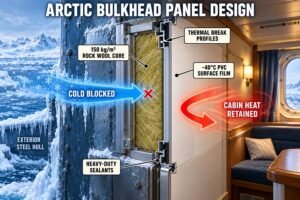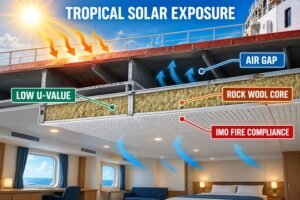
Selecting the right finish for marine panels can be tricky. Poor choices lead to failed fire inspections and unhappy clients. Let me show you how to pick the perfect finish.
Choosing the right marine panel finish requires evaluating ship areas, project budget, maintenance needs, design style, and durability. By balancing these five factors, you ensure compliance with IMO regulations while keeping costs low and meeting the exact visual demands of European and American shipyard projects.
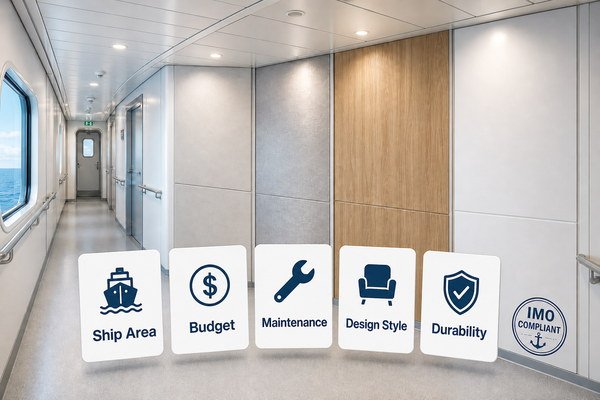
We face these choices every day in marine outfitting. Let us break down exactly how to make the best decision for each aspect of your project.
How to choose marine wall panel finishes for different ship areas?
Different rooms on a ship face different daily challenges. If you use the wrong finish in a wet area, it will peel fast. Here is how to match them.
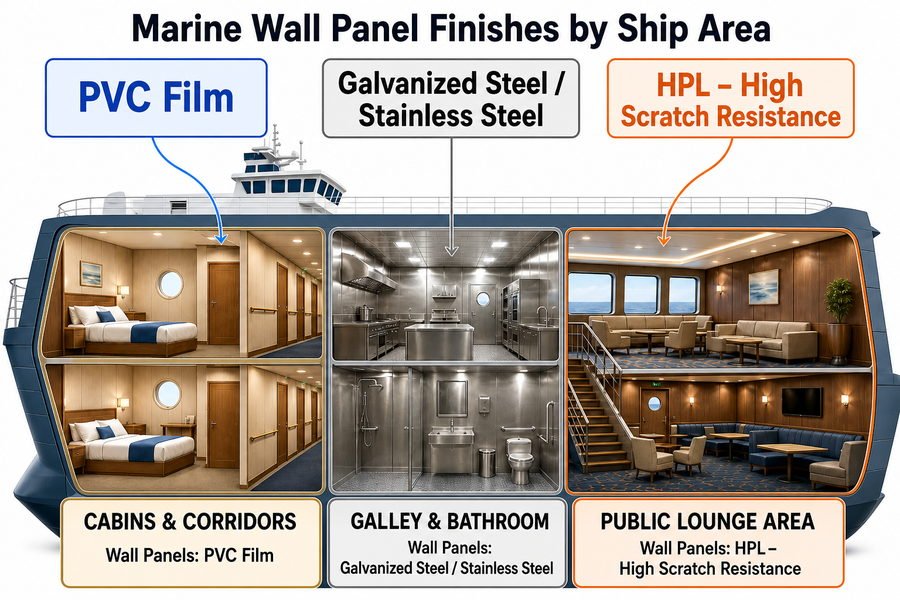
For marine wall panel finishes, choose PVC film for cabins and corridors, galvanized steel or stainless steel for wet spaces like galleys and bathrooms, and hard plastic laminate (HPL) for public areas requiring high scratch resistance, covering all standard ship interior zones.
Selecting PVC Film for Cabins and Corridors
When we outfit a standard crew cabin or an inside corridor, PVC film is the best choice. PVC film handles dry environments perfectly. According to standard marine interior factory data, a PVC film thickness of 0.15mm to 0.20mm is ideal. It provides a soft touch and good looks. More importantly, it meets the strict IMO FTP Code Part 5 test for low flame spread. I remember working with a shipyard in Europe. We used 0.15mm PVC on all cabin walls. It passed all fire tests and saved the client a lot of money compared to heavier finishes.
Applying Stainless Steel and Galvanized Finishes in Wet Spaces
Wet spaces like galleys, public bathrooms, and laundry rooms are tough environments. Water and steam will quickly destroy basic PVC film1. For these areas, we must use stainless steel or galvanized steel with baked paint. In galleys, I always recommend SUS304 or SUS316L stainless steel. The steel thickness should be 0.5mm to 0.6mm. This thickness prevents rust and stays clean. For normal public bathrooms, galvanized steel with a 0.6mm thickness and a strong baked paint finish works very well and costs less than stainless steel.
Using Hard Plastic Laminate (HPL) in Public Areas
Public spaces on a ship, such as large dining rooms, lounges, and reception areas, face a lot of daily foot traffic. Passengers will bump into walls with bags and chairs. For these spots, Hard Plastic Laminate, also known as HPL, is the top choice. HPL finishes usually have a thickness between 0.8mm and 1.0mm. This material offers very high scratch resistance. I always tell my clients that spending a bit more on HPL for public areas will stop them from needing to replace scratched panels every two years.
| Ship Area | Recommended Finish | Material Thickness | Primary Benefit |
|---|---|---|---|
| Cabins & Corridors | PVC Film | 0.15mm - 0.20mm | Cost-effective, low flame spread |
| Galleys & Bathrooms | Stainless / Galvanized Steel | 0.5mm - 0.6mm | Waterproof, rust prevention |
| Public Lounges | Hard Plastic Laminate (HPL) | 0.8mm - 1.0mm | High scratch resistance |
How to choose marine ceiling panel finishes for different ship areas?
Ceilings are hard to reach and clean. A bad finish here collects dust and looks terrible over time. Let us look at the best ceiling finish options.
Marine ceiling panel finishes include powder-coated steel for standard cabins, PVC-laminated finishes for decorative public spaces, and perforated finishes with sound-absorbing fleece for engine control rooms and noisy areas, fulfilling all structural and acoustic requirements across the ship.
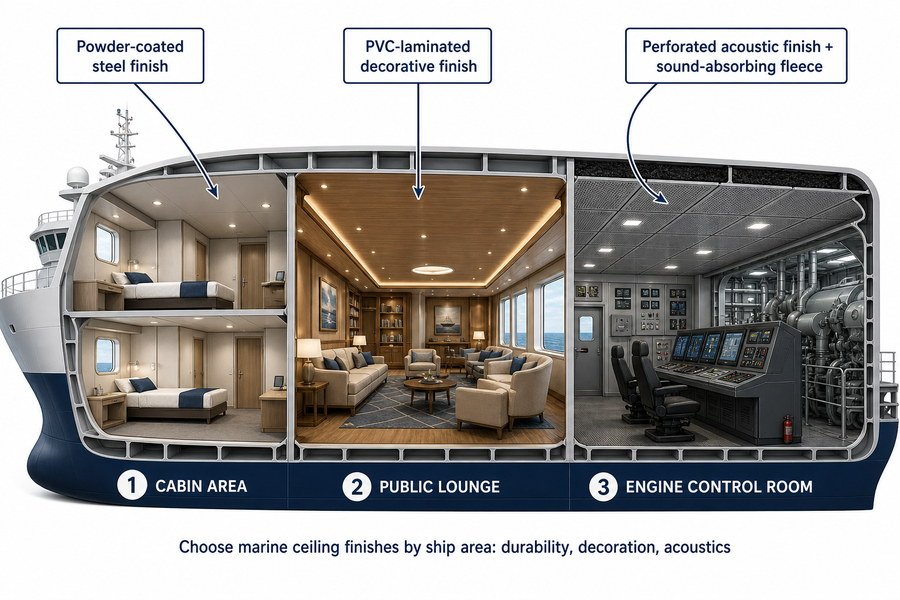
Implementing Powder-Coated Steel for Standard Cabins
For standard crew and passenger cabins, powder-coated steel is the most common ceiling finish. It is simple, cheap, and does the job well. The paint thickness on these panels should be between 40 and 60 microns, which follows the ISO 2808 standard. This thickness ensures the paint will not peel off due to the ship's vibration. Powder-coated surfaces are also very easy to wipe clean. I often help buyers choose this finish because it keeps the overall project cost low while passing all necessary marine class approvals.
Utilizing PVC-Laminated Finishes for Public Spaces
When we move to public spaces like dining halls or cinemas, plain white powder coating might look too boring. In these areas, we use PVC-laminated finishes on the ceiling panels. This allows the ceiling to match the wall panels perfectly. We use the same 0.15mm thick PVC film. This film can have wood patterns or fabric patterns. Using PVC finishes on the ceiling makes the room look much more expensive and helps European shipyards meet their high-end design goals.
Installing Perforated Finishes for Noise Reduction
Engine control rooms and technical spaces have a big problem: noise. Loud engines can harm the crew's hearing and make work difficult. For these areas, we must use perforated finishes. The metal ceiling panel is punched with tiny holes. The standard perforation rate is between 15% and 25% of the panel surface. Behind this perforated metal, we add a layer of sound-absorbing fleece or glass wool. This design traps the sound waves and lowers the noise level in the room significantly.2
| Ceiling Area | Recommended Finish | Technical Specification | Acoustic Feature |
|---|---|---|---|
| Standard Cabins | Powder-Coated Steel | 40 - 60 microns thick | Standard reflection |
| Public Spaces | PVC-Laminated | 0.15mm film thickness | Matches wall decor |
| Engine Rooms | Perforated Metal | 15% - 25% hole rate | Absorbs engine noise |
How to select marine panel finishes based on project budget?
Keeping costs down is vital when buying from Asia for Western shipyards. Overspending ruins your profit margin. Here is how to match finishes to your exact budget.
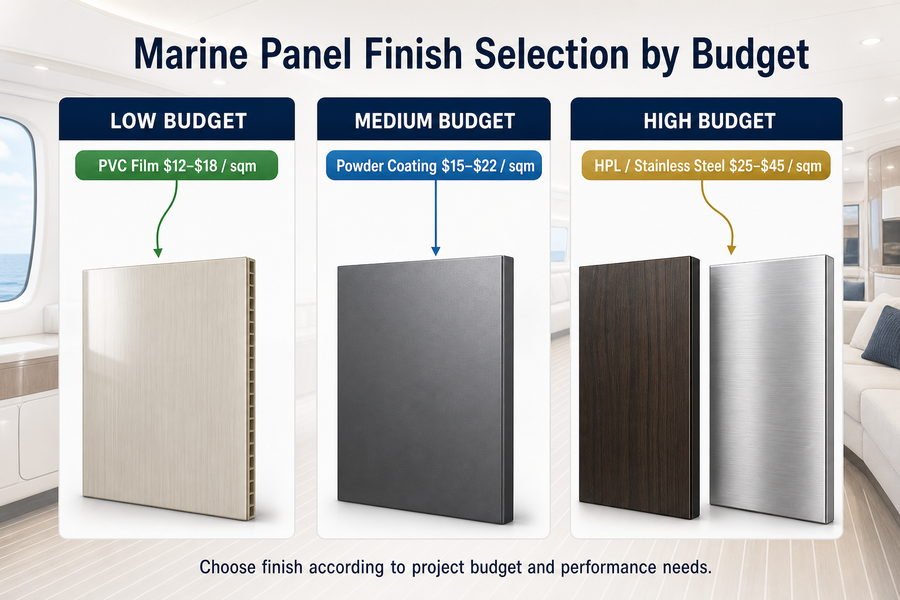
Based on project budgets, marine panel finishes range from economical PVC film ($12-$18 per sqm), mid-range powder coating ($15-$22 per sqm), to premium Hard Plastic Laminate (HPL) and stainless steel ($25-$45 per sqm), ensuring a valid option for low, medium, and high-budget projects.
Maximizing ROI with Economical PVC Film and Powder Coating
When you win an interior decoration project for a shipyard, keeping your costs under control is your main goal. Economical PVC film is your best friend here. Based on average prices from top factories in China and Vietnam in 2024, PVC film finishes cost about $12 to $18 per square meter. This is the lowest price you will find for certified marine panels. You get a good look without spending all your budget. If you have a slightly larger budget, powder-coated finishes are a safe middle ground. The cost for powder-coated steel panels is usually between $15 and $22 per square meter. This small price increase gives you a finish that lasts longer and is easier to clean than basic PVC. I always suggest powder coating for projects where the shipyard wants a balance between low price and a long lifespan. It is very reliable and rarely causes quality complaints from the final shipowner.
Investing in Premium HPL and Stainless Steel for High-End Budgets
High-end cruise ships or luxury workboats have much bigger budgets. For these projects, European shipyards will reject cheap PVC film. You must invest in premium Hard Plastic Laminate (HPL) and stainless steel. HPL panels usually cost between $25 and $35 per square meter. Stainless steel finishes are the most expensive, ranging from $35 to $45 per square meter. Even though the price is high, these materials offer the best quality and look. Buying these premium finishes from reliable factories in Asia still saves you a lot compared to buying them locally in Europe. You just need to make sure the Asian factory has valid MED (Marine Equipment Directive) certificates for the European market.
| Budget Category | Finish Material | Estimated Cost per Sqm | Best Project Type |
|---|---|---|---|
| Low Budget | PVC Film | $12 - $18 | Cargo ships, basic workboats |
| Medium Budget | Powder Coating | $15 - $22 | Standard commercial vessels |
| High Budget | HPL / Stainless Steel | $25 - $45 | Cruise ships, luxury yachts |
How to select marine panel finishes based on maintenance needs?
Ship crews hate cleaning difficult surfaces. Finishes that trap dirt will cause complaints from shipowners. Let us choose finishes that are easy to maintain.
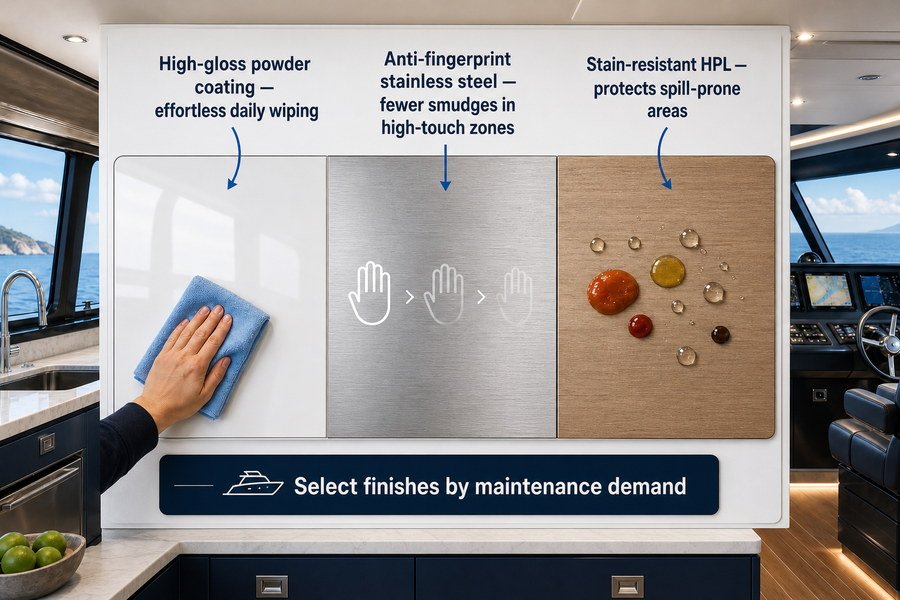
To meet maintenance needs, select high-gloss powder coating for effortless daily wiping, anti-fingerprint stainless steel to reduce smudges in high-touch zones, and stain-resistant HPL for areas prone to food and chemical spills, covering the entire spectrum of low-to-high maintenance environments.
Simplifying Daily Cleaning with High-Gloss Powder Coating
Ship crews are always busy, and they do not have hours to scrub walls. High-gloss powder coating makes daily cleaning very fast. The smooth surface does not hold dirt or grease easily. A standard high-gloss finish reflects light and usually has a gloss level of 70% to 80%3. When dust settles on it, the crew can simply wipe it away with a damp cloth in seconds. I recommend this finish for standard cabins and hallways to keep the maintenance staff happy and reduce labor costs.
Reducing Smudges with Anti-Fingerprint Stainless Steel
In high-touch zones like galley doors or public bathroom entrances, regular stainless steel shows fingerprints very badly. It looks dirty just minutes after someone touches it. To fix this, you should select anti-fingerprint stainless steel. This finish has a special clear nano-coating applied at the factory. This coating blocks oil from human skin. It reduces the time needed to clean smudges by almost 50%4. It costs a little more upfront, but the shipowner saves money on cleaning chemicals and labor over the life of the ship.
Managing Spills with Stain-Resistant HPL
Galleys, medical rooms, and laboratories face the risk of harsh chemical and food spills. Lemon juice, hot oil, or cleaning acids will ruin normal PVC film. In these areas, you must use stain-resistant HPL. Hard Plastic Laminate is treated to resist mild acids and alkalis5. If coffee or hot oil spills on it, the liquid stays on the surface and does not sink in. The crew can wipe it off easily without leaving a dark stain, keeping the room looking brand new for years.
| Maintenance Need | Recommended Finish | Cleaning Action | Benefit to Crew |
|---|---|---|---|
| Dust & Light Dirt | High-Gloss Powder Coating | Quick damp cloth wipe | Saves daily labor time |
| Fingerprints & Oils | Anti-Fingerprint Stainless | Dry wipe or mild soap | Keeps high-traffic areas neat |
| Chemical & Food Spills | Stain-Resistant HPL | Standard chemical wipe | Prevents permanent staining |
How to select marine panel finishes based on interior design style?
Western shipyards expect modern, good-looking interiors. If your finishes look cheap, they will reject your work. Here is how to hit the right style.
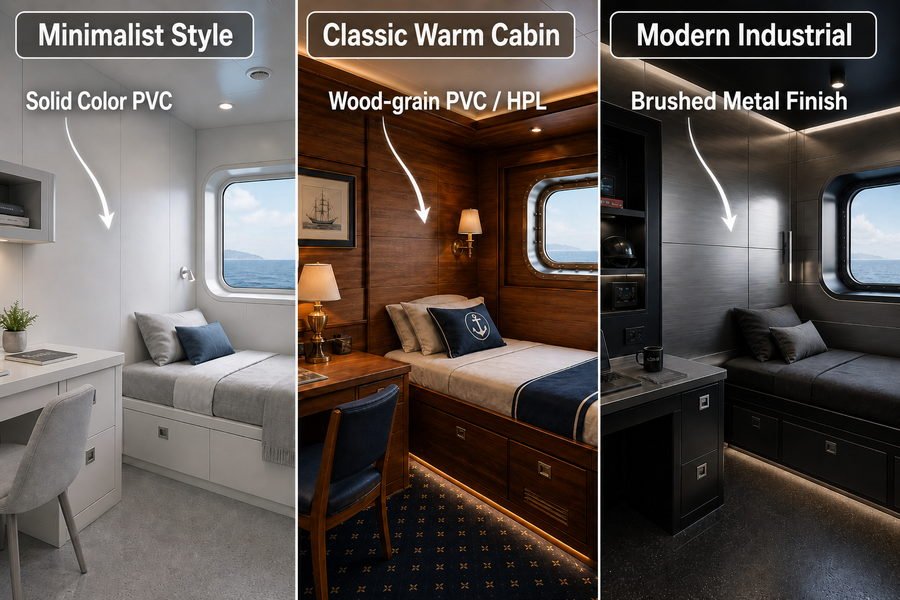
Marine panel finishes match interior design styles by offering solid color PVC for minimalist looks, wood-grain PVC and HPL for classic warm cabins, and brushed metal finishes for modern industrial aesthetic designs, providing full styling flexibility for modern shipbuilding standards.
Creating Minimalist Looks with Solid Color PVC
Many modern ships, especially workboats and offshore platforms, prefer a clean and simple look. Minimalist designs make small cabins feel larger and brighter.6 To achieve this, we use solid color PVC finishes. The most popular choices are standard white, known as RAL 9010, and light grey, known as RAL 7035. These solid colors reflect the ceiling lights well and create a neat, professional space. When European shipyards ask for a modern, functional cabin, solid color PVC is always my first recommendation.
Achieving Warmth with Wood-Grain Finishes
Passenger ships and luxury yachts need to feel like home. A cold, white metal wall will make passengers feel uncomfortable. To achieve a warm, classic style, we use wood-grain finishes. You can get wood-grain patterns in both PVC film and HPL. Popular patterns include Oak, Cherry, and Walnut. These finishes give the cabin a luxury cruise feel without the weight and fire risk of real wood7. I have seen many Asian factories produce wood-grain HPL that looks exactly like real timber, pleasing even the strictest Western designers.
Delivering Modern Industrial Styles with Brushed Metal
In areas like show galleys, bars, or technical spaces, a modern industrial aesthetic is very popular. This style looks tough, clean, and highly professional. We deliver this look using brushed metal finishes. The most common choice is a No. 4 brushed stainless steel finish. It has fine, straight lines that catch the light beautifully. It gives the room a heavy-duty, expensive look. It perfectly fits the modern design trends that many American and European ship interior decoration companies look for today.
| Design Style | Material Choice | Popular Color / Pattern | Ideal Location |
|---|---|---|---|
| Minimalist | Solid Color PVC | RAL 9010 (White), RAL 7035 (Grey) | Workboat Cabins |
| Classic Warmth | Wood-Grain PVC / HPL | Oak, Cherry, Walnut | Passenger Cabins |
| Modern Industrial | Brushed Metal | No. 4 Stainless Steel | Bars & Galleys |
How to select marine panel finishes based on durability requirements?
Ships vibrate constantly, and passengers bump into walls. Weak finishes will scratch and break quickly. Let us secure long-lasting durability.
Selecting marine panel finishes for durability involves using 0.15mm PVC film for low-impact zones, 40-micron powder coating for medium-impact ceilings, and 0.8mm HPL or 0.6mm steel plates for high-impact corridors, ensuring comprehensive protection against all levels of mechanical wear and tear.
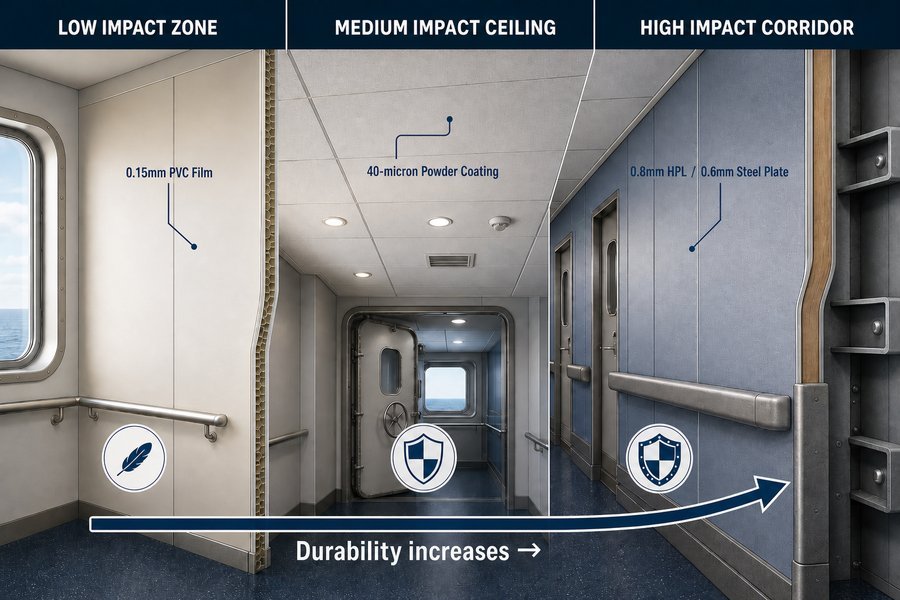
Specifying 0.15mm PVC Film for Low-Impact Zones
When we talk about durability, we must look at how much physical impact a wall will take. In a normal sleeping cabin, the impact is very low. People just sleep and rest there. For these low-impact zones, 0.15mm PVC film is perfectly fine8. It will not break or scratch under normal, gentle use. From my experience, a good quality 0.15mm PVC film applied correctly in a factory can easily last 10 to 15 years in a crew cabin without needing any repairs.
Utilizing 40-Micron Powder Coating for Medium-Impact Ceilings
Ceilings face a different kind of wear and tear. People do not bump into ceilings, but ceilings suffer from constant ship vibration. A weak finish will crack and drop flakes on the floor. For medium-impact ceilings, we utilize a 40-micron powder coating. This thickness is flexible enough to bend slightly with the metal when the ship's engine vibrates. It passes standard vibration tests, like the IEC 60068-2-6 standard, ensuring the paint stays stuck to the metal panel through heavy sea storms.
Deploying 0.8mm HPL and 0.6mm Steel for High-Impact Corridors
Ship corridors are high-impact zones. Passengers drag heavy suitcases that hit the walls constantly. Carts carrying food or laundry will also crash into the panels. We must deploy strong materials here. I always specify 0.8mm HPL or 0.6mm steel plates for these areas. HPL has a Shore D hardness of over 709, which means it resists deep scratches from sharp luggage edges. Steel plates will not dent easily when a heavy cart hits them. This keeps the ship's most busy areas looking good.
| Durability Requirement | Impact Source | Recommended Material | Technical Defense |
|---|---|---|---|
| Low Impact | Human touch | 0.15mm PVC Film | Lasts 10-15 years with gentle use |
| Medium Impact | Ship vibration | 40-Micron Powder Coating | Flexible paint avoids cracking |
| High Impact | Luggage & Carts | 0.8mm HPL / 0.6mm Steel | Hardness resists deep scratches |
Conclusion
Choosing the correct marine panel finishes saves money and satisfies strict shipyard clients. Match the finish to the area, budget, style, and durability to ensure project success every time.
-
"Rapid Detection of Plasticizer Migration From UV‐Aged PVC Films ...", https://pmc.ncbi.nlm.nih.gov/articles/PMC12911472/. Materials research on plasticized PVC indicates that heat, moisture, and water-vapor exposure can accelerate plasticizer migration and related changes in flexibility and surface performance, providing a mechanism for caution in hot, wet interior spaces. Evidence role: mechanism; source type: paper. Supports: Basic PVC film may perform poorly in hot, wet, steam-exposed ship spaces.. Scope note: This is contextual support for degradation risk; it does not establish that all PVC films are quickly destroyed in every wet-space application. ↩
-
"Enhanced Low-Frequency Sound Absorption of a Porous Layer ...", https://pmc.ncbi.nlm.nih.gov/articles/PMC8777819/. Acoustics literature explains that perforated metal facings backed by porous absorbers such as mineral wool or glass wool can increase sound absorption by allowing sound energy to enter the backing material, where it is dissipated as heat through viscous and thermal losses. Evidence role: mechanism; source type: paper. Supports: A perforated metal ceiling backed with sound-absorbing fleece or glass wool traps sound waves and lowers the room noise level significantly.. Scope note: The source would support the acoustic mechanism, while the actual noise reduction depends on perforation geometry, cavity depth, absorber density, installation details, and the room’s sound field. ↩
-
"[PDF] Specular Gloss - National Institute of Standards and Technology", https://tsapps.nist.gov/publication/get_pdf.cfm?pub_id=841838. A coating-standards or powder-coating technical source should support that gloss is measured by specular reflection and that high-gloss powder finishes are commonly specified in this approximate range under defined measurement geometry. Evidence role: definition; source type: other. Supports: A standard high-gloss powder coating finish usually has a gloss level of 70% to 80%.. Scope note: Gloss percentages or gloss units depend on the measurement angle, coating system, and manufacturer specification, so the source would contextualize rather than universally prove the exact range. ↩
-
"Cleanability of soiled stainless steel as studied by atomic force ...", https://pubmed.ncbi.nlm.nih.gov/11198446/. An independent test report or peer-reviewed study should document measured reductions in fingerprint visibility or cleaning effort for anti-fingerprint or oleophobic stainless-steel coatings compared with untreated stainless steel. Evidence role: statistic; source type: research. Supports: Anti-fingerprint stainless steel can reduce smudge-cleaning time by nearly 50% compared with regular stainless steel.. Scope note: A 50% reduction would be condition-specific and may vary with touch frequency, detergent, wiping method, and the particular coating formulation. ↩
-
"CHEMICAL COMPATIBILITY CHART", https://www.wisconsin.edu/ehs/download/Fisher-Scientific-Chemical-Compatibility-Chart.pdf. High-pressure laminate standards or technical literature should support that specified HPL grades are tested for resistance to staining and certain household or laboratory chemicals, including mild acids and alkalis, under controlled exposure conditions. Evidence role: general_support; source type: institution. Supports: Stain-resistant HPL can resist mild acids and alkalis in spill-prone areas.. Scope note: Chemical resistance depends on HPL grade, surface finish, concentration, exposure time, and temperature; the evidence would not guarantee resistance to all cleaning acids or harsh chemicals. ↩
-
"Which Attribute of Ceiling Color Influences Perceived Room Height?", https://pubmed.ncbi.nlm.nih.gov/30067403/. Research on interior color and visual perception indicates that lighter, higher-luminance surfaces can increase perceived brightness and may contribute to a greater sense of spaciousness in enclosed rooms. Evidence role: mechanism; source type: paper. Supports: Minimalist, light-colored cabin designs can make small spaces feel brighter and more spacious.. Scope note: Most studies address rooms or built interiors generally rather than ship cabins specifically. ↩
-
"Summary of SOLAS chapter II-2 - International Maritime Organization", https://www.imo.org/en/ourwork/safety/pages/summaryofsolaschapterii-2-default.aspx. IMO and SOLAS fire-safety requirements for passenger and accommodation spaces regulate combustible materials and require tested low-flame-spread interior surfaces, providing context for why marine-certified decorative laminates or films may be selected instead of solid timber. Evidence role: general_support; source type: institution. Supports: Marine interiors often avoid untreated or uncertified real wood because combustible materials and surface fire behavior are regulated, and certified decorative finishes can help address those constraints.. Scope note: Such regulations do not prove that every wood-grain PVC or HPL product is lighter or safer than wood; performance depends on the certified product, substrate, and installation. ↩
-
"What are Marine Wall Panels?", https://magellanmarinetech.com/what-are-marine-wall-panels/. A materials data source or standards-based marine-interior reference can support that thin PVC films are used as decorative/protective surface layers in low-wear interior applications. Evidence role: general_support; source type: institution. Supports: 0.15mm PVC film is suitable for low-impact sleeping-cabin wall zones.. Scope note: Such a source would support suitability in principle, but would not by itself prove that every 0.15 mm PVC film performs adequately in all crew-cabin conditions. ↩
-
"High Pressure Laminates with Antimicrobial Properties - PMC - NIH", https://pmc.ncbi.nlm.nih.gov/articles/PMC5456506/. Technical literature on high-pressure laminate can support that HPL surfaces commonly exhibit high Shore D hardness and abrasion resistance, properties associated with resistance to scratching in interior surfacing applications. Evidence role: mechanism; source type: paper. Supports: HPL has Shore D hardness above 70 and therefore resists deep scratches from sharp luggage edges.. Scope note: Hardness values vary by resin formulation, overlay, and test method, so the source should be treated as support for typical HPL performance rather than proof for every 0.8 mm HPL product. ↩