Are you struggling to balance cost and quality for ship interiors? Choosing the wrong finish ruins the budget and fails IMO fire tests. Let us fix this problem together.
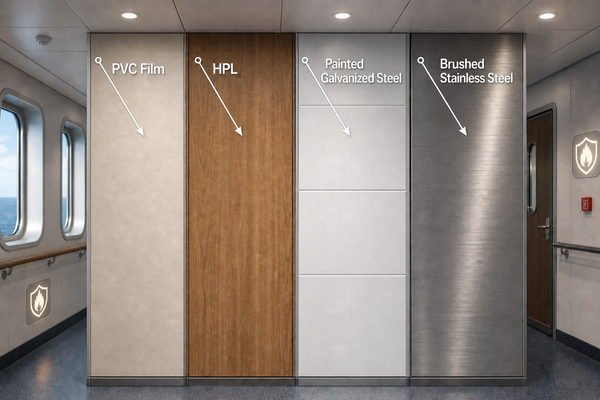
Marine wall and ceiling panels utilize four main surface finishes to meet SOLAS fire safety and aesthetic requirements: Polyvinyl Chloride (PVC) film, High-Pressure Laminate (HPL), painted galvanized steel, and bare or brushed stainless steel. Each offers distinct price points, fire ratings, and visual designs for different ship areas.
I have seen many buyers waste money on the wrong materials in Asian factories. Let me show you exactly what options you have, so you can buy high-quality products without paying premium prices.
What are the common surface finishes for marine wall panels?
Sick of wall panels that look cheap or peel off? Picking the wrong finish causes delays and unhappy shipyard clients. Here is what you need to know.
The four common surface finishes for marine wall panels are PVC film (cost-effective, diverse patterns), HPL (highly durable, scratch-resistant), painted steel (budget-friendly, easy to clean), and stainless steel (maximum corrosion resistance, food-safe). All must comply with IMO FTP Code Part 5 for low flame spread.
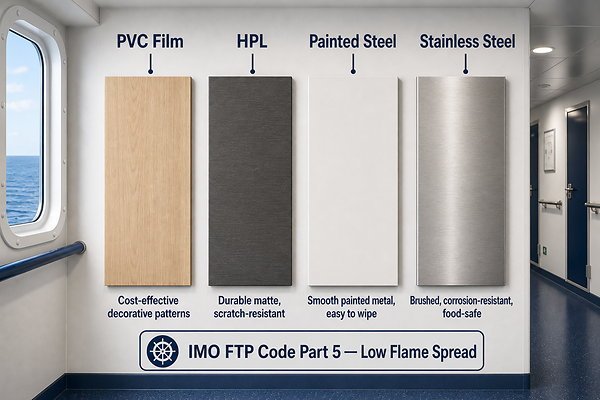
When you buy marine wall panels from China or Vietnam, you must know your project requirements. Shipyards in Europe and the United States are very strict. They will check the certificates and the surface quality. If you buy the wrong type, they will reject the whole batch. I worked in a marine outfitting factory for years. I saw this happen many times. Let us look at the four main types of finishes you will encounter.
Detailed Breakdown of PVC and HPL Finishes for Marine Wall Panels
PVC film is the most popular choice for standard cabins. It is cheap and looks good. The factory glues a thin plastic film onto a galvanized steel sheet. You can get a wood look, a marble look, or simple solid colors. The cost is usually around $8 to $15 per square meter, according to recent factory pricing in Asia. However, PVC can scratch if you are not careful.
If you need something stronger, you must use HPL. HPL stands for High-Pressure Laminate. It is a thick, hard plastic layer. It is very hard to scratch.1 We use HPL wall panels in public spaces, corridors, and lounges. Shipyards love HPL because it lasts a long time. It costs more, usually $15 to $30 per square meter. It also adds weight to the panel. Both PVC and HPL must pass the IMO FTP Code Part 5 test for low flame spread.2 If the supplier cannot show you this certificate, do not buy from them.
Detailed Breakdown of Painted and Stainless Steel Finishes for Marine Wall Panels
Painted steel is the simplest finish. The factory sprays paint directly onto the steel. This is very cheap, costing about $6 to $10 per square meter. It is not very beautiful. We mostly use painted panels in crew areas, storage rooms, or behind machinery. It is easy to wash and has great fire resistance.
Finally, we have stainless steel finishes. This is not a coating. The panel surface is made of real stainless steel. It is very expensive. Expect to pay $25 to $50 per square meter. We only use this in kitchens, pantries, and hospital rooms on the ship. It stops rust completely. It also meets the strict health rules of the US Public Health Service (USPHS).
| Surface Finish Type | Best Application Area | Estimated Cost per SQM | Durability Level |
|---|---|---|---|
| PVC Film | Passenger cabins, crew cabins | $8 - $15 | Medium |
| HPL (Laminate) | Corridors, public lounges | $15 - $30 | High |
| Painted Steel | Storage rooms, engine rooms | $6 - $10 | Medium |
| Stainless Steel | Galleys, medical rooms | $25 - $50 | Very High |
What are the common surface finishes for marine ceiling panels?
Do your ceiling panels rust quickly in humid sea air? A bad ceiling finish causes maintenance nightmares and safety risks. Let us explore the right choices.
Marine ceiling panels typically use three surface finishes: PVC film (lightweight, matches walls), painted galvanized steel or aluminum (most common, highly fire-resistant, cost-effective), and brushed stainless steel (used exclusively in galleys and wet rooms). These ensure compliance with continuous Class B or Class C ceiling fire ratings.
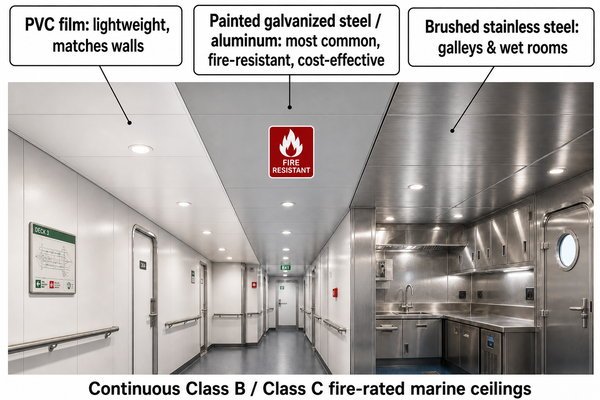
Ceiling panels are different from wall panels. People do not touch the ceiling. Therefore, scratch resistance is not the most important thing. Weight is very important. Ships need light ceilings. Fire resistance is also very critical to stop fires from spreading between decks. Based on my experience at Magellan Marine, you only need to focus on three main finishes for ceilings.
Analyzing Painted Steel and Aluminum Finishes for Marine Ceilings
Painted finishes are the kings of marine ceilings. Almost 80% of the ships I worked on used painted ceilings. Factories use prepainted galvanized steel or prepainted aluminum. Aluminum is much lighter but costs a bit more. The paint is usually a white or off-white polyester coating. It reflects light well and makes cabins look bright.
According to marine interior market data, painted steel ceilings cost around $7 to $12 per square meter. They are very safe. They easily pass the SOLAS requirements for Class B-0 or Class C fire ratings3 because paint adds very little fire load. The paint thickness is only about 20 to 25 microns. This means it will not create thick smoke if a fire starts. When buying from Asian suppliers, always check the paint thickness gauge during factory inspections.
Analyzing PVC Film and Stainless Steel Finishes for Marine Ceilings
Sometimes, the ship owner wants the ceiling to match the wall perfectly. In this case, we use PVC film on the ceiling panels. It works exactly like the wall panels. We use a white or patterned film. You must be careful here. The PVC film adds weight and a higher fire load. Ensure the supplier has specific IMO certificates for PVC-coated ceilings.
We also use stainless steel for ceilings. We only put stainless steel ceilings in the ship's galley (kitchen) or wet rooms. Steam from cooking will destroy paint and peel PVC. Stainless steel ignores steam4. It costs $30 to $60 per square meter for ceiling profiles. It is heavy and hard to cut. You must tell your installation team to use special cutting blades. Do not use HPL for ceilings. HPL is too heavy and will make the ceiling system fail the vibration tests.
| Ceiling Finish | Key Advantage | Main Disadvantage | Primary Use Location |
|---|---|---|---|
| Painted Steel / Aluminum | Cheap, lightweight, fire-safe | Basic appearance | Standard cabins, corridors |
| PVC Film | Matches wall patterns | Higher fire load | Luxury cabins, public spaces |
| Stainless Steel | 100% steam and rust proof | High cost, heavy weight | Galleys, laundry rooms |
What is PVC film finish for marine wall panels and ceiling panels?
Worried about high costs for wood-look cabins? Real wood is a fire hazard and expensive. PVC film solves this problem perfectly.
PVC (Polyvinyl Chloride) film is a decorative layer, typically 0.12mm to 0.16mm thick, heat-laminated onto galvanized steel or aluminum sheets. It offers thousands of colors and wood-grain patterns, costs around $8 to $15 per square meter, and strictly complies with IMO low flame spread requirements.
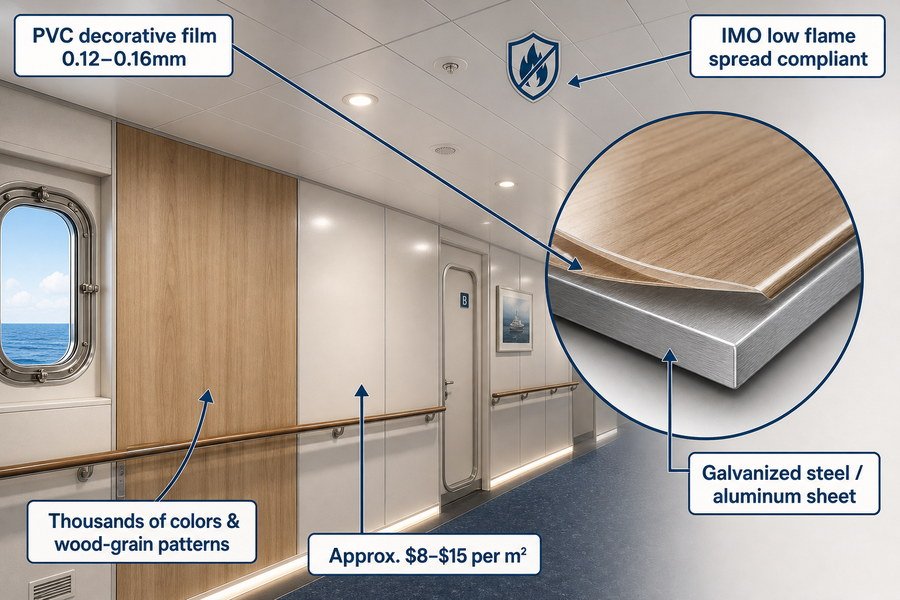
PVC film is the bread and butter of the marine interior decoration business. Most of the cargo ships, tankers, and offshore platforms use PVC film finishes. It gives you the best balance between looking good and saving money. When you quote European shipyards, they will almost always expect standard PVC finishes for the crew cabins. Let me explain the technical details and how to buy it safely.
Technical Specifications of PVC Film Finishes
The PVC film is not just cheap plastic. It is a special fire-retardant material. Standard commercial PVC burns quickly and makes toxic black smoke. Marine-grade PVC film has special chemicals inside to stop the fire. According to IMO regulations, the calorific value of the surface material must not exceed 45 MJ/m²5. Good marine PVC film stays well below this limit.
The thickness is a key factor. Most factories use films that are 0.12mm, 0.14mm, or 0.16mm thick. I always recommend 0.16mm for my clients. It is thicker and hides the small bumps on the steel sheet underneath. If you use 0.12mm film, the panel might look wavy under strong cabin lights. The factory applies glue to the steel, heats it up, and presses the film onto the metal using heavy rollers. This process must be done in a dust-free room. If dust gets under the film, you will see ugly pimples on the finished panel.
Sourcing and Quality Control for PVC Film Finishes
When you look for suppliers in China or Vietnam, you must ask about their PVC film brand. Good factories buy film from famous brands in Korea or Japan, like LG or Hanwha. These brands have very stable colors. If you buy cheap local film, batch A might be light brown, and batch B might be dark brown. This color difference will ruin your project.
You also need to test the adhesion. When you visit the factory, take a coin and scratch the edge of the panel. If the PVC film peels off easily, the glue is bad or the heating process was wrong. Do not buy from them. A good PVC film finish should be impossible to peel by hand once it cools down.
| PVC Film Specification | Standard Value / Requirement | Impact on Project |
|---|---|---|
| Thickness | 0.12mm - 0.16mm | 0.16mm hides steel defects better6 |
| Fire Rating standard | IMO FTP Code Part 5 | Fails inspection if not passed |
| Calorific Value | Less than 45 MJ/m² | Ensures low smoke and flame |
| Glue Application | Hot melt PUR glue | Prevents peeling in hot climates |
What is HPL finish for marine wall panels and ceiling panels?
Are public areas on your ship getting scratched too fast? Standard films cannot survive heavy foot traffic. HPL is the strong answer you need.
HPL (High-Pressure Laminate) is a robust finish made of resin-impregnated kraft paper cured under high heat. It is usually 0.7mm to 1.0mm thick, costs $15 to $30 per square meter, and provides exceptional scratch, impact, and heat resistance for heavy-traffic marine areas like corridors and lounges.
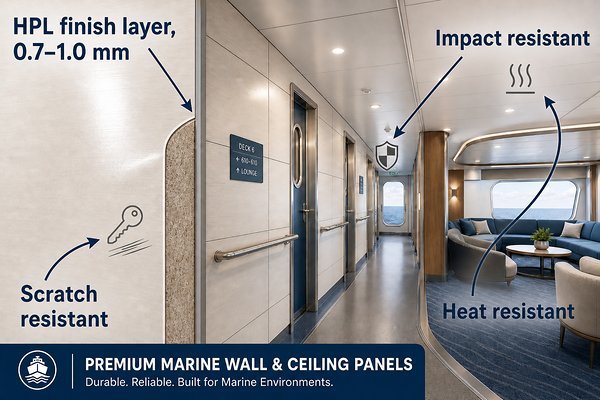
If you are outfitting a passenger ferry, a cruise ship, or the busy corridors of a large commercial vessel, PVC film will fail. People carry heavy bags, carts hit the walls, and the surface gets destroyed quickly. This is where HPL steps in. I learned about the power of HPL when a client complained about broken panels in a ship's dining room. We switched them to HPL, and the problem vanished forever.
Material Composition and Production of HPL Finishes
HPL is an incredible material. It stands for High-Pressure Laminate. It is not a plastic film. It is made of many layers of special paper. The bottom layers are kraft paper soaked in phenolic resin. The top layer is decorative paper soaked in melamine resin.7 The factory puts these layers into a massive press machine. They apply high heat (around 140°C) and extreme pressure (about 1000 psi).8
This process cooks the layers together into one solid, hard sheet. For marine use, this HPL sheet is usually 0.7mm, 0.8mm, or 1.0mm thick. The marine panel factory then glues this hard HPL sheet onto the galvanized steel skin of the wall panel. Because HPL is rigid, the gluing process is harder than with PVC film. The factory must use very strong, specialized marine adhesives to make sure the HPL does not detach from the steel when the ship vibrates.
Cost Analysis and Application Areas for HPL Finishes
The strength of HPL comes with a higher price. While PVC panels might cost you $15 per square meter overall, a good HPL panel will cost $25 to $40 per square meter in total. You must plan your budget carefully. You do not need HPL everywhere. You only need it in high-traffic zones.
I advise my clients to use HPL in stairways, long corridors, mess rooms, and public lobbies. Because the melamine surface is so hard, it is very easy to clean. Ink, coffee, and oil wipe off easily. However, HPL is brittle before it is glued to the steel. When handling HPL panels during installation, your workers must be careful not to drop them on the corners, or the laminate will chip. When sourcing in Asia, ask the supplier if they use famous HPL brands like Formica or Wilsonart, as they have the best marine fire certificates.
| Feature Comparison | PVC Film Finish | HPL (High-Pressure Laminate) Finish |
|---|---|---|
| Core Material | Soft plastic | Resin-soaked kraft paper |
| Thickness | 0.12mm to 0.16mm | 0.7mm to 1.0mm |
| Scratch Resistance | Low to Medium | Extremely High |
| Cost (Finish Only) | $8 - $15 / SQM | $15 - $30 / SQM |
| Corner Chipping Risk | None (it stretches) | High (it is rigid) |
What is painted steel finish for marine wall panels and ceiling panels?
Need a clean look on a very tight budget? Complex finishes cost too much for basic crew areas. Painted steel is your simple, cheap solution.
Painted steel finish involves coating galvanized steel sheets with polyester or epoxy paint, typically 20 to 25 microns thick. It costs $6 to $10 per square meter, offers high fire resistance (A-Class compliant), and provides a clean, washable surface ideal for crew cabins, stores, and machinery spaces.
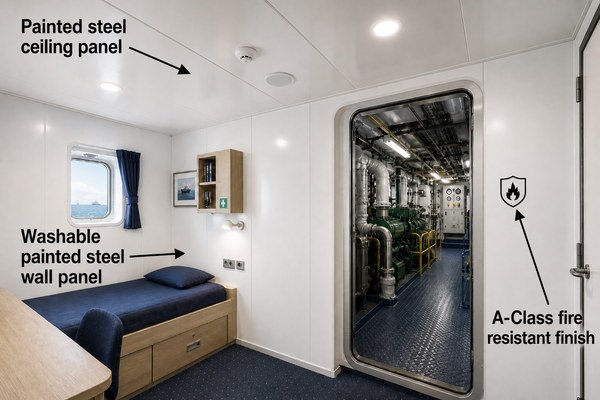
Sometimes, function is more important than beauty. When a shipyard is building a workboat, a tugboat, or finishing the engine control rooms of a large cargo ship, they do not care about wood-grain patterns. They want clean walls, low prices, and high safety. Painted steel is the perfect choice for these tough environments. Let us break down how it works and what to look for.
Coating Technology and Specs for Painted Steel Finishes
The process starts with a high-quality galvanized steel coil. The galvanization (zinc coating) stops the steel from rusting.9 Then, the steel factory applies a paint system. For marine interiors, this is usually a coil-coating process. The paint is baked onto the metal in a continuous line before the metal is cut and shaped into panels.
The paint type is very important. Most standard marine panels use a polyester-based paint. It provides a good balance of flexibility and toughness. The total paint thickness is usually very thin, about 20 to 25 microns (µm). This thin layer is critical for fire safety. Because there is so little paint, it cannot burn easily or create dangerous smoke. Some specialized rooms require epoxy paint finishes because epoxy resists harsh cleaning chemicals better than polyester10. Always check the paint thickness. If a factory paints the panels by hand after making them, the paint might be too thick and fail the IMO fire tests.
Economic Benefits of Painted Steel Finishes in Shipyards
Using painted steel panels saves a massive amount of money. The raw material cost is very low, usually around $6 to $10 per square meter just for the skin. This allows Asian suppliers to offer very competitive prices to European and US shipyards.
Furthermore, painted panels are easier to handle. If a worker scratches a painted panel during installation, you can sometimes touch it up with matching liquid paint. You cannot do that with PVC film or HPL. I always advise procurement officers to buy a few cans of matching touch-up paint from the supplier. It saves you from throwing away slightly damaged panels. Painted finishes are typically bright white or light grey (like RAL 9010 or RAL 7035). This color makes small, dark ship cabins feel much larger and reduces the need for strong electric lighting.
| Paint Specification | Detail for Marine Panels | Benefit to Buyer |
|---|---|---|
| Paint Type | Polyester or Epoxy | Easy to clean, chemical resistant |
| Paint Thickness | 20 to 25 microns | Passes IMO fire/smoke tests easily |
| Base Metal | Hot-dip galvanized steel | Prevents deep rust if scratched |
| Standard Colors | RAL 9010 (White), RAL 7035 (Grey) | High light reflection, standard pricing |
What is stainless steel finish for marine wall panels and ceiling panels?
Do your galley walls fail health inspections due to rust? Saltwater and food acids destroy normal steel. Stainless steel stops this completely.
Stainless steel finish utilizes bare marine-grade alloys, primarily SUS304 or SUS316, in brushed or mirror textures. Costing $25 to $50 per square meter, it requires no decorative coating, offering ultimate corrosion resistance and hygiene for galleys, pantries, and medical rooms complying with USPHS standards.
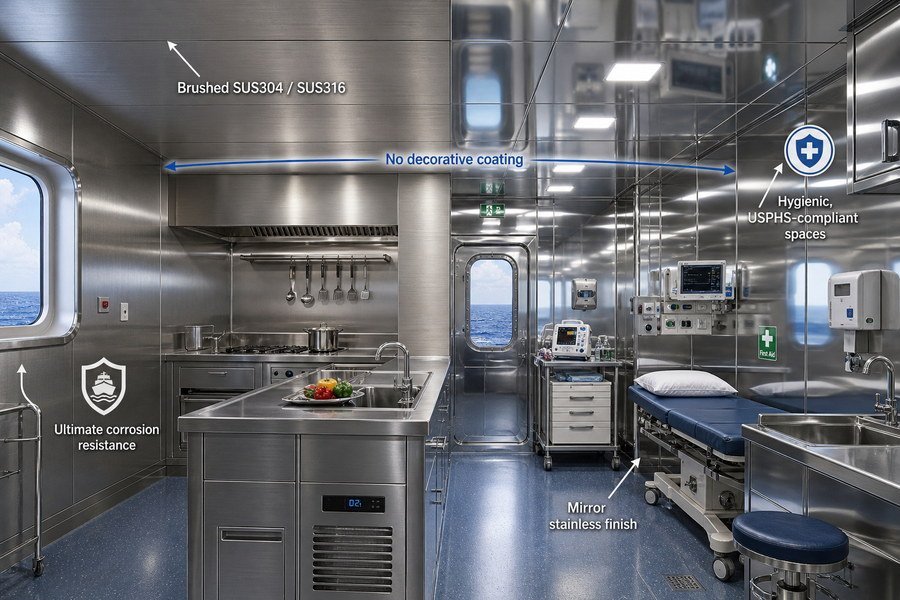
When you enter a ship's kitchen, you enter a war zone for materials. Boiling water creates constant steam. Chefs use acidic tomato sauce and salty brine. Cleaners use harsh chemical foams. PVC film will melt. Paint will blister. HPL will warp. You have exactly one choice for these extreme areas: real stainless steel. Let me guide you on how to buy the right grade so your shipyard clients do not suffer from rust later.
Choosing Between SUS304 and SUS316 Stainless Steel Finishes
There are two main grades of stainless steel used for marine wall and ceiling panels: SUS304 and SUS316.
SUS304 is the standard commercial grade. It contains chromium and nickel. It is very strong and resists normal water and food acids very well. Most ship galleys and pantries use SUS304. It costs about $25 to $35 per square meter. However, SUS304 has a weakness: warm salt water.
If the room is exposed to direct sea spray, or if it is a special chemical storage room, you must upgrade to SUS316. SUS316 contains an extra element called molybdenum.11 This makes it almost immune to salt corrosion. It is the true "marine grade" stainless steel. It is more expensive, costing $40 to $50 per square meter. I have seen buyers try to save money by using SUS304 in wet rooms near the weather deck. Six months later, the panels had brown rust spots. Never compromise on the grade.
Hygiene and Maintenance of Stainless Steel Finishes
The surface texture of the stainless steel is also important. The most common finish is called "Hairline" or "Brushed" (often called No. 4 finish). It has tiny, parallel scratches that hide fingerprints and daily wear. Sometimes, hospitals on ships require a "Mirror" finish (No. 8). It is perfectly smooth and reflects like glass. This leaves no place for bacteria to hide.
Stainless steel panels are mandatory for compliance with US Public Health Service (USPHS) rules for cruise ships.12 They are incredibly easy to sanitize. You can blast them with hot steam or strong bleach, and they will not degrade. Keep in mind that stainless steel is heavy. A standard 0.6mm thick stainless steel skin weighs more than a 0.6mm painted galvanized steel skin.13 Ensure your installation profiles are strong enough to carry the extra weight.
| Stainless Steel Grade | Key Alloying Element | Best Application Environment | Cost Estimate |
|---|---|---|---|
| SUS304 | Chromium, Nickel | Internal galleys, dry pantries | $25 - $35 / SQM |
| SUS316 | Adds Molybdenum | Wet rooms, exposed areas, hospitals | $40 - $50 / SQM |
| Surface Texture | Hairline (Brushed) | General high-use areas | Standard price |
| Surface Texture | Mirror (Polished) | Sterile medical environments | Premium price |
Conclusion
Choosing the right surface finish balances your budget, design, and IMO safety rules. Whether using PVC, HPL, painted, or stainless steel, always verify supplier certificates to ensure project success.
-
"High Pressure Laminates with Antimicrobial Properties - PMC - NIH", https://pmc.ncbi.nlm.nih.gov/articles/PMC5456506/. A materials standard or technical reference should support that high-pressure laminate surfaces are commonly evaluated for abrasion, wear, and scratch resistance, which explains their use in higher-traffic interiors. Evidence role: mechanism; source type: paper. Supports: HPL has higher scratch or abrasion resistance than softer decorative films, making it suitable for public spaces and corridors.. Scope note: This supports HPL as generally scratch- and abrasion-resistant, but does not prove that every marine-grade HPL product is equally difficult to scratch. ↩
-
"[PDF] RESOLUTION MSC.307(88) (adopted on 3 December 2010 ...", https://wwwcdn.imo.org/localresources/en/KnowledgeCentre/IndexofIMOResolutions/MSCResolutions/MSC.307(88).pdf. The IMO Fire Test Procedures Code Part 5 specifies the test method for surface flammability and low flame-spread characteristics of materials used on ships. Evidence role: general_support; source type: institution. Supports: Marine wall panel surface finishes may need documented compliance with IMO FTP Code Part 5 for low flame spread.. Scope note: The source supports the regulatory test context; applicability to a specific PVC or HPL panel depends on the vessel type, installation location, flag-state approval, and product certificate. ↩
-
"[PDF] RESOLUTION MSC.307(88) (adopted on 3 December 2010 ...", https://wwwcdn.imo.org/localresources/en/KnowledgeCentre/IndexofIMOResolutions/MSCResolutions/MSC.307(88).pdf. IMO/SOLAS and FTP Code materials describe the fire-test framework for Class B and Class C divisions in ship interiors; such sources can support the relevance of these classifications, but they do not by themselves prove that any particular painted ceiling product passes without product-specific test certification. Evidence role: definition; source type: institution. Supports: Painted steel or aluminum marine ceiling systems are evaluated against SOLAS Class B-0 or Class C fire-rating requirements.. Scope note: Direct compliance requires an IMO/MED or flag-state-recognized certificate for the exact ceiling assembly, not only the finish material. ↩
-
"[PDF] Corrosion of Borated Stainless Steel in Water and Humid Air.", https://www.nrc.gov/docs/ML1129/ML112920913.pdf. Materials-engineering references on stainless steel corrosion resistance can support the use of stainless steel in humid or steam-exposed service because chromium-rich passive films improve resistance to oxidation and corrosion; the wording should be understood as practical resistance, not immunity under all marine or chloride conditions. Evidence role: mechanism; source type: education. Supports: Stainless steel is more suitable than painted or PVC-coated finishes for humid, steam-exposed shipboard areas such as galleys and wet rooms.. Scope note: Stainless steel can still corrode in chloride-rich, poorly maintained, or crevice-prone environments, so the source would not support an absolute claim of being rust-proof. ↩
-
"[PDF] RESOLUTION MSC.307(88) (adopted on 3 December 2010 ...", https://wwwcdn.imo.org/localresources/en/KnowledgeCentre/IndexofIMOResolutions/MSCResolutions/MSC.307(88).pdf. The IMO FTP Code requirements for surface materials specify limits on surface flammability and related fire-performance parameters, including calorific-value limits used in marine interior approval contexts. Evidence role: definition; source type: institution. Supports: IMO rules set a calorific-value limit for certain marine surface materials, stated here as 45 MJ/m².. Scope note: The cited IMO or class-society source should be checked for the exact clause and applicability, because requirements can vary by vessel area, material category, and approval pathway. ↩
-
"The macroscopic delamination of thin films from elastic substrates", https://pmc.ncbi.nlm.nih.gov/articles/PMC2708712/. Coating and lamination literature describes substrate telegraphing, in which surface roughness or defects remain visible through thin films; increased film thickness can reduce the visual prominence of underlying irregularities. Evidence role: mechanism; source type: research. Supports: A thicker PVC film can better mask minor defects in the steel substrate than a thinner film.. Scope note: This is contextual support for the thickness principle and may not directly establish that 0.16 mm is the optimal thickness for every PVC-laminated marine steel panel. ↩
-
"Melamine resin - Wikipedia", https://en.wikipedia.org/wiki/Melamine_resin. A materials reference on high-pressure decorative laminate supports that HPL is typically built from phenolic-resin-impregnated kraft paper layers with a melamine-resin-impregnated decorative surface layer. Evidence role: definition; source type: encyclopedia. Supports: HPL is composed of layered kraft and decorative papers impregnated with phenolic and melamine resins.. ↩
-
"[PDF] General Guide Lines for Hot Pressing Veneer and HPL With PVA ...", https://downloads.regulations.gov/EPA-HQ-OPPT-2016-0461-0115/content.pdf. A technical source on HPL manufacturing supports that high-pressure laminates are consolidated under elevated temperature and pressure in ranges comparable to about 140°C and 1000 psi. Evidence role: mechanism; source type: research. Supports: HPL production uses high heat and high pressure, approximately in the range stated in the article.. Scope note: Exact press temperature, pressure, and dwell time vary by laminate grade, thickness, resin system, and manufacturer. ↩
-
"[PDF] Corrosion Protection - User pages", https://user.engineering.uiowa.edu/~swan/courses/53086/Corrosion_Protection.pdf. A corrosion-engineering source should support that zinc galvanizing protects steel by providing a barrier and sacrificial cathodic protection, reducing corrosion of the underlying steel. Evidence role: mechanism; source type: education. Supports: Galvanized zinc coating helps prevent steel from rusting.. Scope note: This supports the corrosion-protection mechanism generally; the durability of a specific marine panel also depends on zinc coating mass, environment, scratches, and maintenance. ↩
-
"Coatings from epoxidized (polyurethane-polyester) resin system", https://www.academia.edu/7991440/Coatings_from_epoxidized_polyurethane_polyester_resin_system. A coatings or materials-science source should support that epoxy coatings are commonly selected for strong chemical resistance, including resistance to many cleaning agents, compared with more general-purpose polyester coatings. Evidence role: expert_consensus; source type: paper. Supports: Epoxy paint finishes can offer better resistance to harsh cleaning chemicals than polyester-based paints.. Scope note: Chemical resistance varies by resin formulation, curing, exposure time, temperature, and the specific cleaning chemicals used; comparative performance should be verified with the coating supplier’s test data. ↩
-
"Study of the Corrosion Resistance of Type 304L and 316 Austenitic ...", https://www.academia.edu/33778701/Study_of_the_Corrosion_Resistance_of_Type_304L_and_316_Austenitic_Stainless_Steels_in_Acid_Chloride_Solution. Materials references describe Type 316 stainless steel as a chromium-nickel austenitic stainless steel with added molybdenum, which improves resistance to pitting and crevice corrosion in chloride-containing environments compared with Type 304. Evidence role: mechanism; source type: education. Supports: SUS316 contains molybdenum, and molybdenum improves chloride corrosion resistance relative to SUS304.. Scope note: The evidence supports improved chloride resistance, but not the stronger wording that SUS316 is “almost immune” to salt corrosion under all exposure conditions. ↩
-
"[PDF] 2025 Construction Standards | Vessel Sanitation Program - CDC", https://www.cdc.gov/vessel-sanitation/media/pdfs/2025/06/2025_VSP_Construction_Standards-508.pdf. The U.S. CDC Vessel Sanitation Program construction guidance requires food-service and related cruise-ship surfaces to be durable, nonabsorbent, corrosion-resistant, and easily cleanable; stainless steel is commonly listed as a material meeting these sanitary surface requirements. Evidence role: case_reference; source type: government. Supports: Cruise-ship sanitary rules require durable, corrosion-resistant, cleanable surfaces, for which stainless steel is an accepted material.. Scope note: This supports the regulatory basis for corrosion-resistant, cleanable surfaces on cruise ships; it may not prove that stainless steel panels are mandatory in every room or application. ↩
-
"[PDF] Material Overview • ANSI", https://www.purdue.edu/bidc/wp-content/uploads/2021/08/ISOGrade.pdf. Engineering material-property tables give typical densities of austenitic stainless steel at about 8.0 g/cm³ and carbon/galvanized steel at about 7.85 g/cm³, indicating that stainless sheet of the same thickness is slightly heavier before accounting for coating differences. Evidence role: statistic; source type: education. Supports: A stainless steel sheet of equal thickness is generally slightly heavier than a comparable galvanized steel sheet.. Scope note: The weight difference for finished panels depends on the exact alloy, coating mass, paint system, adhesives, and backing materials. ↩