Frightened of failing class inspections? Rejections cause massive delays and kill your profit. I will show you how to guarantee your panels pass plan approval every single time.
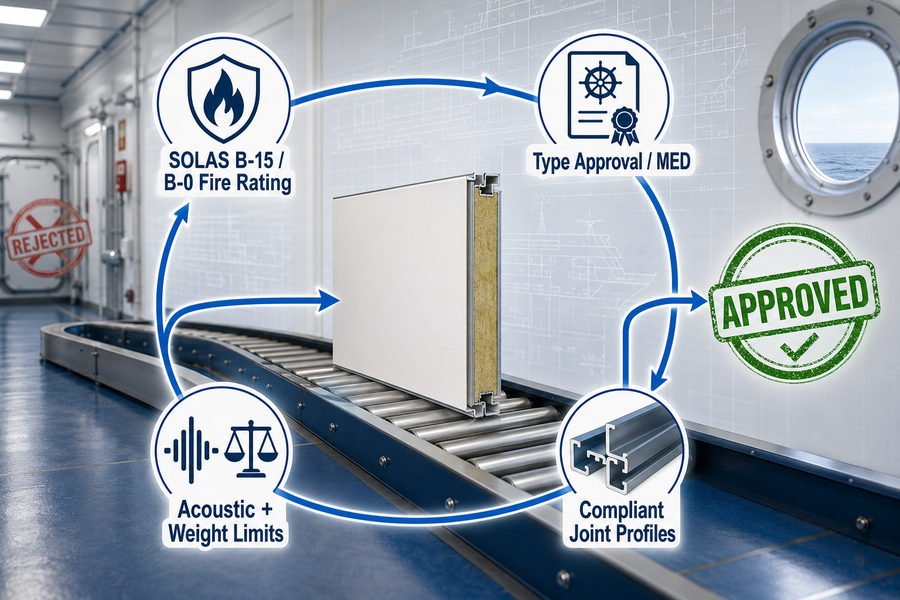
Avoiding panel rejection requires a holistic approach: strictly matching SOLAS fire ratings (B-15/B-0), ensuring complete Type Approval certification (like MED Wheelmark), adhering to strict acoustic and weight limits, and using compliant joint profiles. Mastering these four elements ensures seamless class approval.
Many procurement officers struggle when surveyors reject panels on site. Let us break down the exact steps to prevent this headache from happening to your projects.
What Specification Mistakes Cause Marine Accommodation Panel Rejection at Newbuild Plan Approval?
Specifying panels seems simple until the surveyor stamps your drawing with "Rejected." Avoid these common errors to save your project from costly delays and purchasing headaches.
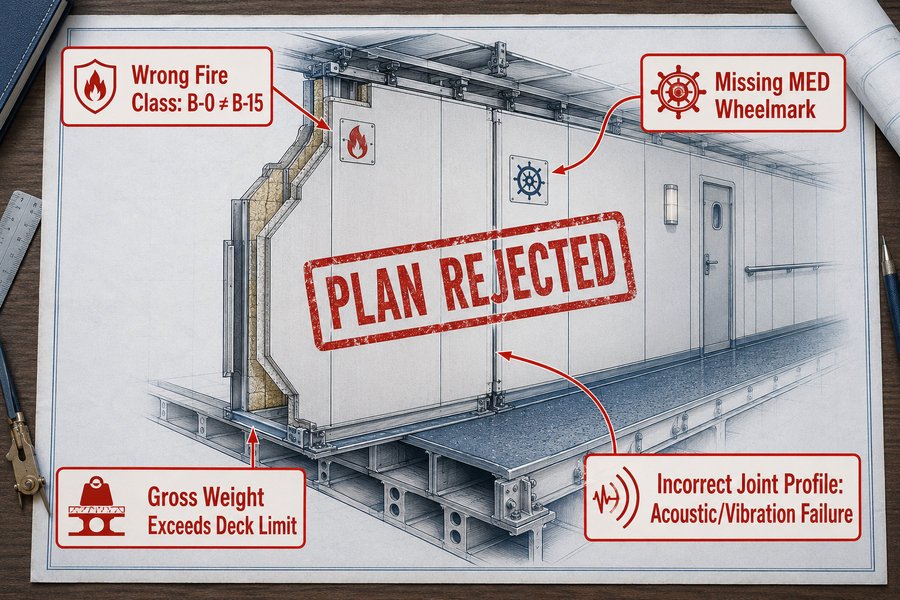
Four major specification mistakes cause plan rejection: selecting the wrong fire class (like B-0 instead of B-15), missing the MED wheelmark certification, exceeding gross weight limits for the deck structure, and proposing incorrect joint profiles that fail acoustic vibration tests.
Incorrect Fire Ratings and Missing Certifications for Marine Panels
In my early days working at the marine outfitting factory, I saw many buyers make a huge mistake. They would select a B-0 marine wall panel when the shipyard drawing clearly required a B-15 fire rating. This first mistake is deadly for plan approval. According to SOLAS Chapter II-2 regulations, a B-15 panel must block flame and limit heat transfer for at least 15 minutes1. A B-0 panel only blocks flame, not the heat. When the class surveyor checks the drawing, they will reject a B-0 panel immediately if a B-15 is required.
The second major mistake is missing the MED wheelmark certification2. If the ship you are decorating sails in European waters, the interior materials must have this specific mark. Without it, the class surveyor will not approve the plan. It does not matter if the panel looks high quality. The paperwork must match the rules. I always tell my clients to check the certificates closely before paying any deposit.
Exceeding Weight Limits and Using Incorrect Joint Profiles
The third mistake is exceeding the gross weight limits for the ship structure. Standard marine accommodation panels usually weigh between 15 and 20 kilograms per square meter. I once had a client who bought cheap panels weighing 25 kilograms per square meter. The naval architect rejected the plan instantly. The extra weight ruined the stability calculations of the ship3. You must check the weight specs carefully before you order.
The fourth mistake involves using incorrect joint profiles. Marine panels use specific tongue and groove shapes or special metal splines to connect to each other. If you use the wrong joint profile, the wall will fail the acoustic tests. Ship engines vibrate heavily. A bad joint allows loud noise to pass right through the cabin walls.4 A good marine wall panel must block at least 35 decibels of noise based on the IMO FTP Code test standards. You must cover all four of these areas to pass the plan approval phase without trouble.
| Specification Error | Requirement Standard | Typical Consequence of Failure |
|---|---|---|
| Wrong Fire Class (e.g., B-0 for B-15) | SOLAS Chapter II-2 | Immediate drawing rejection by naval architect. |
| Missing MED Wheelmark | EU Marine Equipment Directive | Banned from use on EU-flagged vessels. |
| Exceeding Weight Limits | Ship Stability Plan | Panel removal ordered due to center of gravity issues. |
| Incorrect Joint Profiles | IMO FTP Code Acoustic Rules | Fails shipboard noise test, causing rework. |
How Much Schedule Delay Comes From Swapping Building Panels for Marine Accommodation Panels Mid-Project?
Did you order commercial building panels by mistake? The schedule impact will destroy your delivery date and your profit margins if you get caught mid-project.
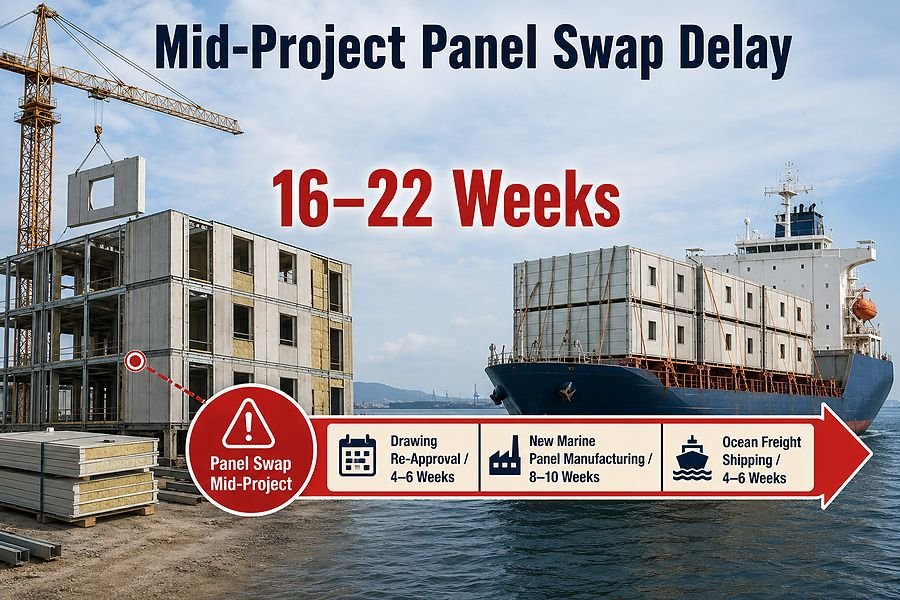
Swapping unapproved building panels for marine panels mid-project causes a 16 to 22-week delay. This exact timeline includes 4 to 6 weeks for drawing re-approval, 8 to 10 weeks for new panel manufacturing, and 4 to 6 weeks for ocean freight shipping.
Time Lost to Drawing Re-Approval and Manufacturing
When a surveyor finds out you used standard commercial building panels instead of approved marine panels, they will stop your work. I have helped many clients fix this exact disaster. You have to remove the wrong panels and start over. The delay is huge. The first part of the delay is drawing re-approval. You must submit new layout plans to the classification society using the correct marine panel specs.5 Based on current IACS processing times, this drawing re-approval takes 4 to 6 weeks6. You cannot start building until they stamp the paper.
The second part of the delay is the manufacturing time for the new panels. High-quality marine wall panels and marine ceiling panels are not sitting in a warehouse. Factories make them to order based on your exact cabin sizes.7 A good factory in China or Vietnam needs 8 to 10 weeks to buy the raw rockwool, press the steel plates, and cut the panels to your custom lengths. If you push them to go faster, the quality will drop, and the surveyor will just reject them again. You must plan for this full manufacturing window.
Delays from Ocean Shipping and Port Logistics
The third part of the delay comes from ocean freight shipping. You are buying from developing countries in Asia, but the shipyard is likely in Europe or the United States. Ocean freight takes a long time. Right now, shipping a container from Shanghai to Rotterdam takes about 4 to 6 weeks. This includes the time needed for customs clearance at both ports.
When you add these steps together, you face a total delay of 16 to 22 weeks. That is four to five months of lost time. Shipyards charge massive penalties for late delivery. I know one project where the delay penalty was $5,000 per day. Swapping panels mid-project is a financial disaster. You must buy the correct marine panels from the very beginning.
| Delay Phase | Minimum Time (Weeks) | Maximum Time (Weeks) | Reason for Delay |
|---|---|---|---|
| Drawing Re-approval | 4 | 6 | Class society reviews new technical data. |
| Manufacturing | 8 | 10 | Custom cutting and gluing of raw materials. |
| Ocean Freight | 4 | 6 | Container transit from Asia to Europe/US. |
| Total Delay | 16 | 22 | Project halted until materials arrive. |
How to Pre-Screen a Marine Accommodation Panel Supplier Before Placing an Order?
Finding a cheap supplier in Asia is easy, but finding a reliable one is hard. Protect your interior project by screening them properly first.
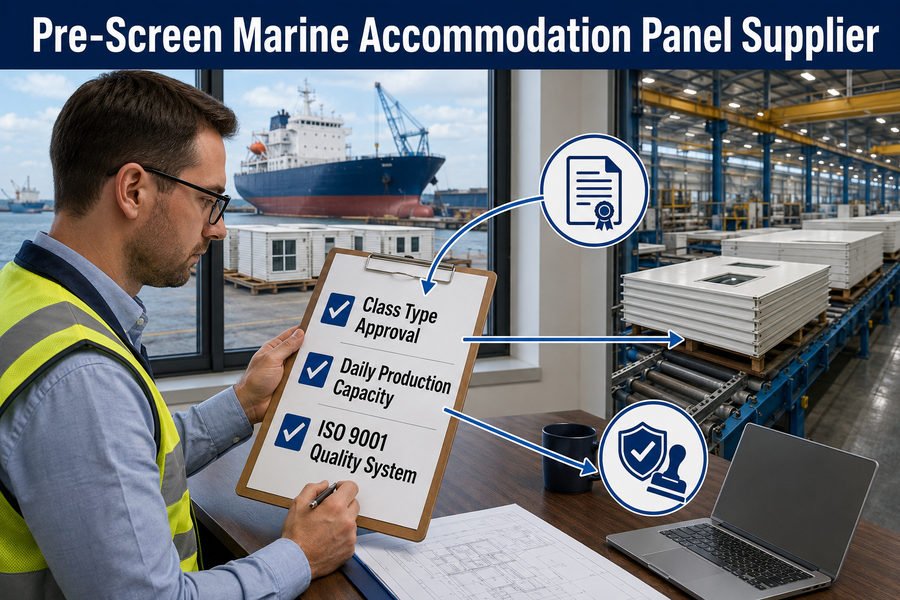
Pre-screen suppliers by verifying their valid Class Type Approvals directly with IACS societies, auditing their daily production capacity to ensure they meet your timeline, and checking their ISO 9001 factory quality management systems to guarantee consistent batch quality across your entire order.
Verifying Valid IACS Class Type Approvals
The most critical step in finding a good supplier is checking their paperwork. Do not just look at their website. I always ask the sales team to send me their latest Class Type Approval certificates. The most common IACS societies are DNV, ABS, and Lloyd's Register8. You must verify these three things on the certificate. First, check the expiration date. A certificate is usually valid for five years. Second, check the product name. It must match the marine wall panel or marine fire door you want to buy. Third, check the fire rating.
You must not trust the PDF file alone. I always go to the DNV or ABS official website and type in the certificate number. This proves the certificate is real and not faked by the supplier. If a supplier cannot provide a valid, verifiable Type Approval certificate, you must walk away immediately. They cannot sell products for marine outfitting.
Auditing Production Capacity and Quality Systems
After you verify the certificates, you must audit their daily production capacity. A large shipyard project might need 10,000 square meters of marine ceiling panels. You need to know exactly how many square meters the factory can make in one day. A good factory can produce 800 to 1,000 square meters daily using automated lines. If a supplier only makes 200 square meters a day, they will delay your project. You must ask them for video proof of their production lines.
Finally, you must check their ISO 9001 quality management systems. Marine panels require consistent quality. The glue used inside the panel must spread evenly. The steel skin must not have scratches. An ISO 9001 certificate proves the factory has rules for checking quality during every shift. I always ask the supplier to send me their latest internal quality inspection report for a recent batch. This shows me they actually test their products before putting them in a shipping container. By verifying approvals, capacity, and quality systems, you will find a supplier you can trust.
| Pre-Screening Step | What to Request from Supplier | How to Verify the Information |
|---|---|---|
| Verify Class Approvals | Type Approval Certificate PDF | Check certificate number on IACS website. |
| Audit Production Capacity | Daily output numbers and factory videos | Compare stated output against your deadline. |
| Check Quality Systems | ISO 9001 Certificate and QA reports | Review internal test data for glue and steel. |
What Documentation Proves a Panel Is Approved for Marine Accommodation Spaces?
Without the right paperwork, the best panel in the world is useless to a shipyard. You must secure these specific documents before the panels leave the factory.
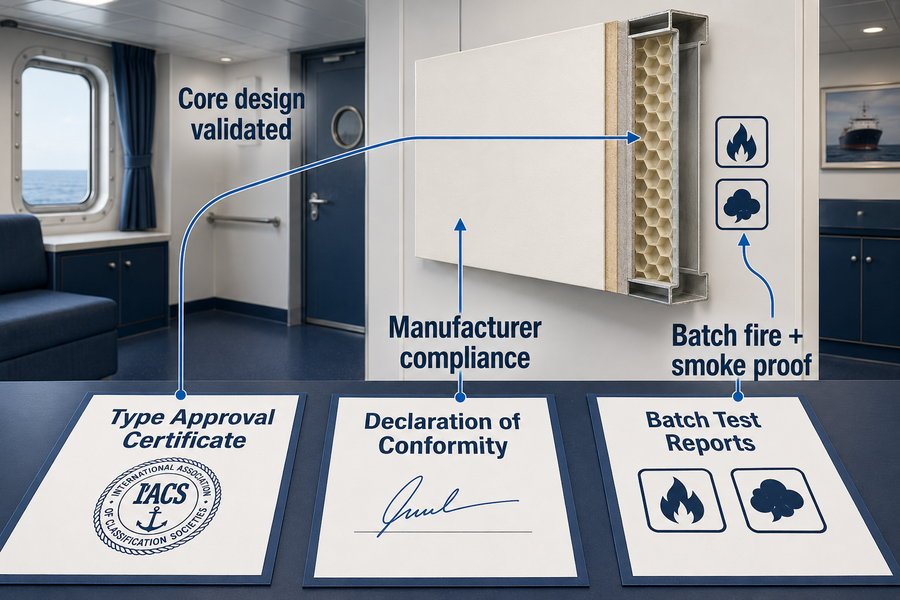
Three core documents prove marine approval: the Type Approval Certificate from an IACS class society (validating the core design), the Declaration of Conformity (DoC) from the manufacturer, and the specific batch Test Reports proving fire resistance and low smoke toxicity.
The Importance of Type Approval Certificates
The most important document you need is the Type Approval Certificate. This is not a standard factory paper. An official IACS class society, like Lloyd's Register or ABS, issues this document.9 The certificate proves that the fundamental design of the panel meets the rules. The class society tests the rockwool density, the steel thickness, and the glue type. If the design passes, they issue the certificate.
When you buy panels, you must get a copy of this certificate. The surveyor at the shipyard will check it first. The certificate clearly states if the panel is rated for B-15, B-0, or C-class spaces10. It also lists the exact thickness allowed. For example, a standard B-15 marine wall panel is exactly 50 millimeters thick. If the certificate says 50 millimeters, but your panel is 45 millimeters, the surveyor will reject the whole shipment. You must match the physical panel to this certificate perfectly.
Declaration of Conformity and Batch Test Reports
The second required document is the Declaration of Conformity, often called the DoC. The factory manager signs this document. By signing it, the factory legally promises that the panels they built for you exactly match the design approved in the Type Approval Certificate. For European projects, this DoC is linked to the MED Wheelmark.11 Without the signed DoC, customs might stop your container at the port.
The third set of documents are the batch Test Reports. Even with a Type Approval, you need proof that your specific batch is safe. The factory must provide reports showing the materials pass the IMO FTP Code. These tests prove two things. First, they prove fire resistance. Second, they prove low smoke toxicity. If a fire starts, the paint and glue on the panel must not release dark, poisonous smoke. People on ships die from toxic smoke more often than fire.12 The Test Reports prove your panels are safe to breathe around during an emergency. You must collect all three documents to pass your final inspections.
| Required Document | Issued By | Purpose for Plan Approval |
|---|---|---|
| Type Approval Certificate | IACS Class Society (e.g., DNV, ABS) | Proves the base design meets SOLAS rules. |
| Declaration of Conformity | Product Manufacturer | Legally binds the batch to the approved design. |
| Batch Test Reports | Certified Testing Laboratory | Proves specific fire resistance and low toxicity. |
Why Do Substituted Architectural Ceiling Panels Fail Onboard Acceptance Testing?
Using normal building ceilings to save money is a trap. They will fail the final shipboard tests, forcing you to rip them out and lose money.
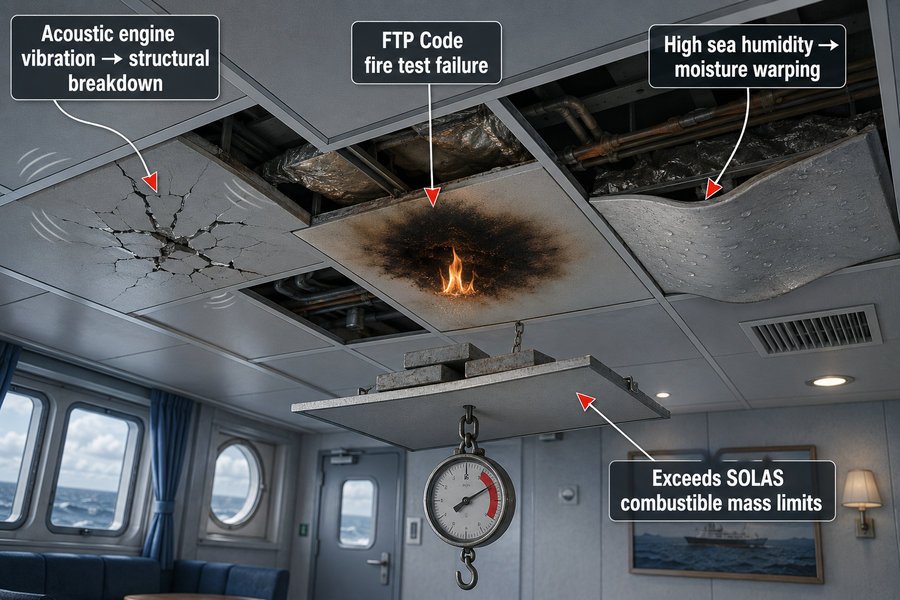
Architectural ceilings fail onboard testing due to four reasons: structural breakdown under acoustic engine vibrations, failing the stringent FTP Code fire tests, severe moisture warping from high sea humidity, and exceeding SOLAS combustible mass limits for cabin outfitting.
Failure from Vibration Breakdown and FTP Fire Tests
Many buyers try to use standard architectural ceilings from land-based buildings inside ships. This always ends in failure. The first reason they fail is structural breakdown from acoustic engine vibrations13. Ships shake constantly. A marine ceiling panel is built with strong locking clips to handle this heavy shaking. Standard building ceilings just sit on a weak grid. When the ship engine runs during the sea trial, the building ceilings will rattle loudly and eventually fall down. The surveyor will fail your project for this safety hazard.
The second reason they fail is the fire test. Land-based building panels use standard fire codes. Marine panels must pass the strict IMO FTP Code14. A standard office ceiling panel often uses cheap foam or basic fiberglass. These materials burn too quickly on a ship. When a fire happens at sea, you cannot run outside. The ceiling must contain the fire. Architectural panels will melt or burn, failing the surveyor's inspection.
Moisture Warping and Combustible Mass Limits
The third reason architectural ceilings fail is severe moisture warping. The air on a ship is full of salt and high humidity15. Standard office ceilings are often made of pressed paper or basic gypsum. When exposed to ocean air, these materials soak up water like a sponge. Within a few weeks, the panels will sag, warp, and grow mold. Marine panels use galvanized steel or aluminum skins to block moisture completely. The surveyor will notice warped panels and force you to replace them.
The fourth reason is exceeding SOLAS combustible mass limits16. The rules for ships strictly limit how much flammable material you can put in one cabin. This is called the combustible mass limit. Standard architectural panels have thick layers of flammable paint or decorative PVC film. Marine panels limit this film to a maximum thickness of 1.5 millimeters. If you use building panels, you add too much fuel to the room. The surveyor calculates the total combustible mass. If it is too high, the room fails the test. You must use true marine panels to avoid all four of these failures.
| Failure Reason | Ship Environment Stress | Result During Surveyor Inspection |
|---|---|---|
| Vibration Breakdown | Engine shaking and sea waves | Panels rattle or fall, failing safety checks. |
| Failing FTP Fire Tests | Strict maritime fire codes | Material burns too fast, failing heat limits. |
| Moisture Warping | High salt and humidity at sea | Panels sag and deform, failing visual checks. |
| Combustible Mass Limits | Strict SOLAS fuel load limits | Too much flammable material, room rejected. |
Conclusion
Passing class inspection requires strict certification, correct specs, and the right supplier. Avoid commercial substitutes, demand proper paperwork, and your interior outfitting projects will succeed without costly delays.
-
"Summary of SOLAS chapter II-2 - International Maritime Organization", https://www.imo.org/en/ourwork/safety/pages/summaryofsolaschapterii-2-default.aspx. SOLAS Chapter II-2 and the IMO Fire Test Procedures Code define B-class divisions by flame integrity and insulation performance, with B-15 indicating a 15-minute insulation period under the prescribed fire test. Evidence role: definition; source type: institution. Supports: A B-15 marine panel must resist flame passage and meet a 15-minute insulation criterion.. ↩
-
"How to Avoid Confusing Class Society Approval With MED Wheel ...", https://magellanmarinetech.com/how-avoid-confusing-class-society-approval-with-med-wheel-mark-when-sourcing-marine-accommodation-panels/. The EU Marine Equipment Directive establishes conformity assessment and wheel-marking requirements for covered marine equipment placed on board EU-flagged ships, including fire-protection and certain accommodation-related materials where listed in the implementing acts. Evidence role: definition; source type: government. Supports: Marine equipment covered by the EU Marine Equipment Directive requires MED wheelmark conformity marking for use on EU-flagged ships.. Scope note: This supports the regulatory role of the MED wheelmark for EU-flagged vessels; it does not prove that every interior panel on any vessel merely sailing in European waters must carry the mark. ↩
-
"46 CFR Part 170 -- Stability Requirements for All Inspected Vessels", https://www.ecfr.gov/current/title-46/chapter-I/subchapter-S/part-170. Ship stability guidance from maritime authorities explains that added weight and its vertical or longitudinal position affect displacement, centre of gravity, trim, and stability calculations. Evidence role: mechanism; source type: government. Supports: Excessive panel weight can affect ship stability calculations through changes in weight distribution and centre of gravity.. Scope note: This provides the naval-architecture basis for the claim; it does not verify the specific anecdote about a 25 kg/m² panel order being rejected. ↩
-
"How to choose the right marine wall panels for marine interior ...", https://magellanmarinetech.com/how-choose-right-marine-wall-panels-for-marine-interior-projects/. Building and marine-acoustics literature describes joints, gaps, and structural connections as common flanking or leakage paths that reduce the effective airborne sound insulation of partition systems. Evidence role: mechanism; source type: research. Supports: Incorrect or poorly sealed panel joints can reduce acoustic isolation by allowing airborne or structure-borne sound transmission through wall assemblies.. Scope note: This supports the acoustic mechanism in general; the actual sound reduction of a specific marine panel joint depends on the tested assembly and installation details. ↩
-
"What Does Class Society Type Approval Mean for Marine Wall and ...", https://magellanmarinetech.com/what-class-society-type-approval-mean-for-marine-wall-ceiling-panels/. Classification-society rules and plan-approval guidance describe the submission and review of vessel drawings and technical documentation before installation or acceptance of regulated ship materials and arrangements. Evidence role: expert_consensus; source type: institution. Supports: New layout plans and marine panel specifications must be submitted to a classification society for review when non-approved panels are replaced.. Scope note: This supports the need for class review in general; the exact documents required depend on vessel type, flag, notation, and the relevant classification society. ↩
-
"[PDF] maritime administration guideline specifications for merchant ship ...", https://www.maritime.dot.gov/sites/marad.dot.gov/files/docs/ports/national-maritime-resource-and-education-center/9221/nmrec-maradguidelinespecs-nov1995.pdf. Classification-society plan-approval services describe formal review cycles for technical drawings, but published timelines vary by society, submission completeness, project complexity, and review priority. Evidence role: general_support; source type: institution. Supports: Drawing re-approval by a classification society can take 4 to 6 weeks.. Scope note: A neutral source may support that plan review can take multiple weeks, but it may not directly verify a universal 4-to-6-week IACS processing time because IACS does not act as the plan-approval body for individual projects. ↩
-
"Marine Wall Panel | Reliable Ship Components for Global Buyers", https://magellanmarinetech.com/marine-wall-panel/. Marine accommodation and outfitting references describe wall and ceiling panels as modular systems produced or cut to project-specific dimensions for vessel interiors. Evidence role: mechanism; source type: institution. Supports: Marine wall and ceiling panels are commonly manufactured or cut to order according to vessel cabin dimensions.. Scope note: This supports the custom-dimension nature of marine accommodation panels; it does not by itself establish a specific supplier lead time. ↩
-
"International Association of Classification Societies - Wikipedia", https://en.wikipedia.org/wiki/International_Association_of_Classification_Societies. The International Association of Classification Societies identifies DNV, ABS, and Lloyd’s Register as member classification societies, supporting their relevance as recognized marine classification bodies. Evidence role: definition; source type: institution. Supports: The most common IACS societies are DNV, ABS, and Lloyd's Register.. Scope note: This supports their status as IACS members, not that they are the only or universally most common societies for every product category or region. ↩
-
"American Bureau of Shipping - Wikipedia", https://en.wikipedia.org/wiki/American_Bureau_of_Shipping. IACS explains that classification societies establish and verify compliance with technical rules for ship construction and equipment, providing context for why class-issued type approval certificates are used in marine procurement. Evidence role: expert_consensus; source type: institution. Supports: IACS class societies such as Lloyd's Register or ABS issue type approval documentation for marine products.. Scope note: This supports the role of classification societies generally; the exact issuing process can vary by flag administration, product type, and certification scheme. ↩
-
"What Do A-Class, B-Class, and C-Class Divisions Mean in Marine ...", https://magellanmarinetech.com/what-a-class-b-class-c-class-divisions-mean-in-marine-wall-ceiling-panels/. SOLAS and the IMO Fire Test Procedures framework define fire divisions such as A, B, and C class and specify performance criteria for ratings including B-0 and B-15. Evidence role: definition; source type: institution. Supports: Marine panel certificates identify fire-class ratings such as B-15, B-0, or C-class according to IMO/SOLAS fire division terminology.. Scope note: The source would define the rating system; it may not confirm the rating assigned to any particular panel product. ↩
-
"Directive 96/98/EC", https://en.wikipedia.org/wiki/Directive_96/98/EC. The EU Marine Equipment Directive requires approved marine equipment to be accompanied by conformity documentation and marked with the Wheelmark when it complies with applicable MED assessment procedures. Evidence role: definition; source type: government. Supports: For European marine equipment, the Declaration of Conformity is connected to MED Wheelmark compliance.. Scope note: This supports the EU regulatory link between conformity assessment and the Wheelmark; project-specific documentation requirements may depend on the equipment category and notified body route. ↩
-
"fire in crew accommodation and death of", https://wwwcdn.imo.org/localresources/en/OurWork/IIIS/Documents/Lessons%20learned%20English/j%20FSI%2020.pdf. Maritime fire-safety literature identifies smoke inhalation and toxic combustion gases as major causes of injury and death in fires, supporting the article’s emphasis on smoke toxicity testing for shipboard materials. Evidence role: statistic; source type: paper. Supports: Toxic smoke is a major, and often greater, lethal hazard than direct flame exposure in shipboard fires.. Scope note: A source may support the broader fire-safety pattern or maritime context without proving the exact comparative wording for all shipboard fire deaths. ↩
-
"How to choose the right marine wall panels for marine interior ...", https://magellanmarinetech.com/how-choose-right-marine-wall-panels-for-marine-interior-projects/. A ship-vibration reference from a classification society or naval-engineering source can document that propulsion machinery and wave loading are common excitation sources for onboard vibration, providing context for why ceiling assemblies in ships require vibration-resistant installation details. Evidence role: mechanism; source type: institution. Supports: Ship engine and sea-induced vibrations can cause structural or installation problems for non-marine ceiling systems.. Scope note: This would support the vibration mechanism generally, but not prove that every land-based ceiling will fail or fall during sea trials. ↩
-
"How Does the IMO FTP Code Govern Fire Testing Procedures for ...", https://magellanmarinetech.com/how-does-imo-ftp-code-govern-fire-testing-procedures-for-marine-panels/. The International Maritime Organization's Fire Test Procedures Code specifies standardized fire-test methods used to assess materials and assemblies on ships, including surface flammability and fire-resistance-related requirements for shipboard applications. Evidence role: definition; source type: institution. Supports: Marine ceiling materials are subject to IMO FTP Code fire-test procedures rather than ordinary land-building fire codes alone.. Scope note: The code establishes required test procedures, but the exact pass/fail applicability depends on vessel type, location, and the relevant SOLAS regulation. ↩
-
"Resource Degradation and Corrosions - National Marine Sanctuaries", https://sanctuaries.noaa.gov/science/assessment/monitor/resource-degradation-corrosion.html. Marine-environment and building-material sources can show that high humidity and salt-laden air accelerate moisture exposure and material degradation, while gypsum- or paper-faced products are vulnerable to moisture-related sagging, deformation, and mold growth when not designed for wet or humid service. Evidence role: mechanism; source type: government. Supports: Salt-laden, humid marine air can contribute to moisture damage, warping, and mold risk in standard interior ceiling materials.. Scope note: This supports the environmental risk and material vulnerability in general, not a universal timeline such as failure within a few weeks. ↩
-
"Summary of SOLAS chapter II-2 - International Maritime Organization", https://www.imo.org/en/ourwork/safety/pages/summaryofsolaschapterii-2-default.aspx. SOLAS Chapter II-2 and related IMO fire-safety guidance restrict combustible materials and require fire-performance controls for accommodation and service spaces, supporting the general claim that ship interiors are regulated for combustible fuel load and flame-spread risk. Evidence role: expert_consensus; source type: institution. Supports: Ship interior materials are subject to SOLAS/IMO limits or controls on combustible content and fire load.. Scope note: The source may support combustible-material restrictions generally; project-specific combustible-mass calculations and any 1.5 mm film limit must be verified against the applicable flag-state or classification requirements. ↩