You need panels for a European shipyard, but the factory only shows a DNV certificate. Are you buying the right thing? Mixing up these two approvals causes costly project delays.
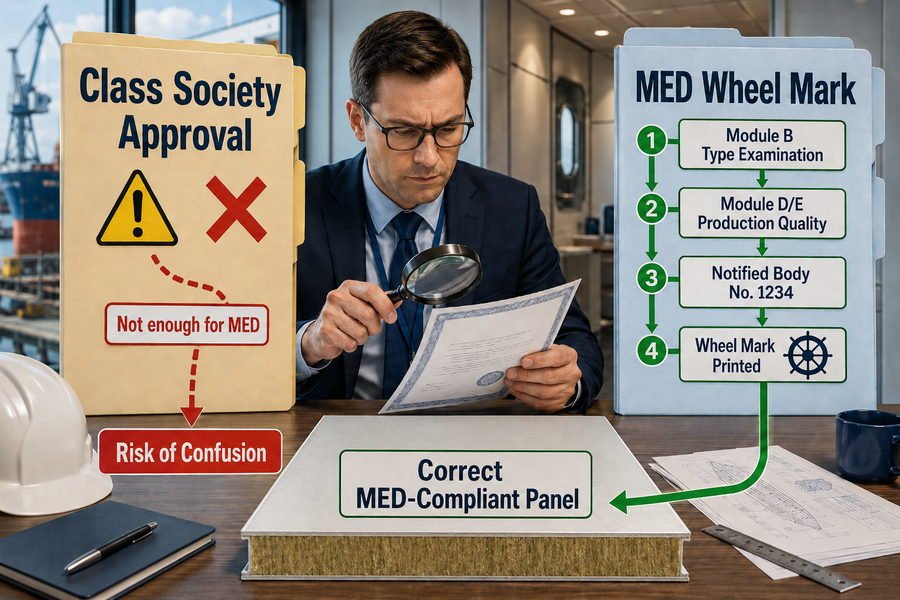
To avoid confusing Class Society Approval with MED Wheel Mark when sourcing marine accommodation panels, you must verify both Module B (Type Examination) and Module D or E (Production Quality) certificates, check for the Notified Body number, and ensure the Wheel Mark logo is explicitly printed on the documents.
Let me break down exactly how you can check these documents so you never buy the wrong panels again.
What Document Confirms True MED Wheel Mark Compliance Beyond a DNV or BV Certificate for Marine Accommodation Panels?
A DNV certificate alone does not mean the panel is MED approved. Relying on a single Class certificate can lead to rejected panels at the shipyard.
True MED Wheel Mark compliance requires two mandatory documents: a valid EC Type Examination Certificate (Module B) verifying the panel design, and a Quality Assurance Certificate (Module D, E, or F) verifying the factory production process. A standard Class Type Approval certificate only covers the society's specific rules.
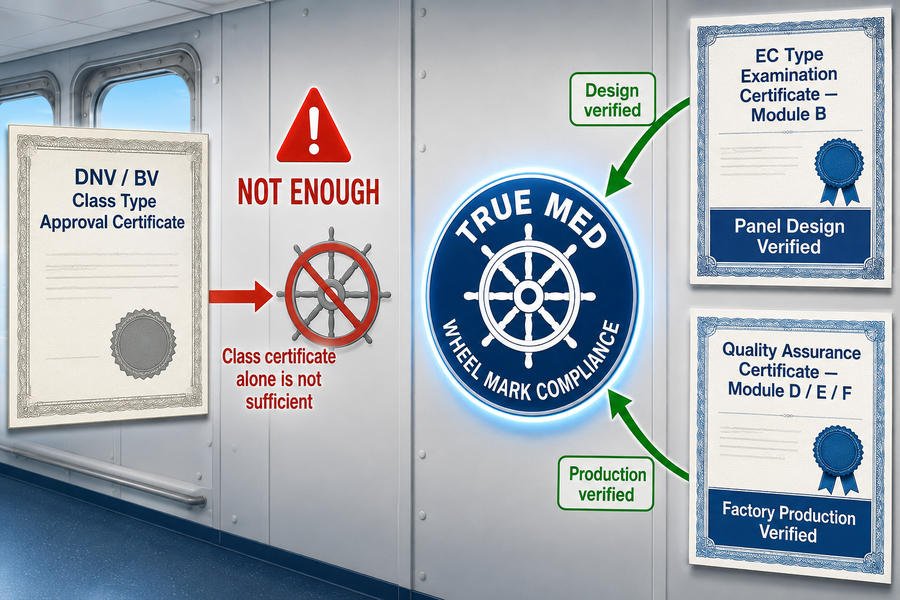
Understanding the difference between these two modules is the first step to safe purchasing. Let me explain the exact documents you need to ask your supplier for.
EC Type Examination Certificate (Module B) for Panel Design
The Module B certificate proves that the marine accommodation panel design meets the strict fire safety rules of the European Union. According to the Marine Equipment Directive (MED) 2014/90/EU, the panel must pass fire tests at an authorized laboratory. The lab tests the panel using the IMO 2010 FTP Code standard.1 During the test, the panel must withstand temperatures up to 945°C for 60 minutes to achieve an A-60 rating2. Getting this Module B certificate is not cheap for the factory. A standard fire test at an authorized lab, like the Far East Fire Testing Centre, costs between $3,000 and $5,000 per panel type. When I review a supplier, I always ask for this document first. If they only give you a general Class Type Approval from DNV or BV, the panel design has not been legally approved for European flagged ships.
Quality Assurance Certificate (Module D, E, or F) for Panel Production
Having a good design is not enough. The factory must also prove they can manufacture the panels consistently. This is where the Quality Assurance Certificate comes in. Module D covers the production quality assurance. Module E covers product quality assurance. Module F covers specific product verification. Most reliable factories use Module D. To get Module D, a Notified Body must audit the factory every year. This audit costs the factory around $4,000 to $6,000 annually. You must check that the factory has a valid Module D certificate that matches the Module B certificate. You cannot legally use the Wheel Mark without both documents.3 Standard Class Type Approvals do not require this strict, EU-mandated factory audit system.
| Certificate Type | Legal Scope | Required for EU Ships? | Typical Cost for Factory |
|---|---|---|---|
| EC Type Examination (Module B) | Proves panel design meets EU standards | Yes | $3,000 - $5,000 per design test |
| Quality Assurance (Module D/E/F) | Proves factory production consistency | Yes | $4,000 - $6,000 annual audit |
| Class Type Approval | Proves panel meets private Class rules | No | $1,500 - $2,500 one-time fee |
What Are Common Specification Mistakes Between MED and Class Approval in Marine Accommodation Panel Tenders?
Reading a tender quickly can cost you your profit. Buyers often misread the fine print and buy panels that do not meet the legal requirements.
The three most common specification mistakes in marine accommodation panel tenders are: assuming any IACS member certificate equals MED approval, failing to notice the specific directive version (like 2014/90/EU), and confusing the commercial term "approved for marine use" with strict EU statutory requirements.
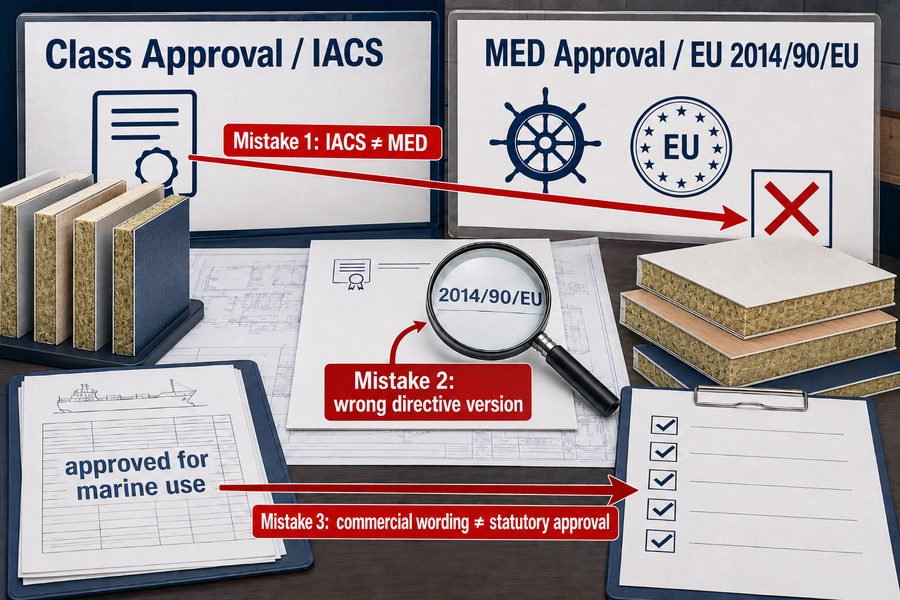
These simple mistakes happen every day in our industry. I will show you how to read the tender carefully to spot these traps.
Assuming Any IACS Member Certificate Equals MED Approval
Many buyers see a certificate from an International Association of Classification Societies (IACS) member, like DNV, Lloyd's Register (LR), or Bureau Veritas (BV), and think the job is done. This is a huge mistake. IACS members act in two different roles.4 Sometimes they act as a private classification society. Sometimes they act as a Notified Body for the European Union. A standard DNV Class Approval certificate only means the panel meets DNV's private rules. It does not mean the panel has MED approval.5 I have seen buyers purchase 5,000 square meters of wall panels based on a standard ABS certificate, only to find out the European shipyard required the MED Wheel Mark.
Failing to Notice the Specific EU Directive Version
Tenders often list specific legal directives. The current Marine Equipment Directive is 2014/90/EU.6 Older tenders or outdated factory documents might list the old directive, 96/98/EC. If you buy panels certified under the old directive, the shipyard will reject them. The testing standards change. For example, the IMO 2010 FTP Code replaced older fire test standards.7 You must check the tender document word by word. If the tender asks for 2014/90/EU, you must force the supplier to show a certificate with exactly that number printed on it.
Confusing "Approved for Marine Use" with EU Statutory Requirements
Suppliers in Asia often tell buyers their panels are "approved for marine use." This is a commercial marketing term. It has no legal meaning. The tender from a European shipyard relies on statutory requirements based on SOLAS (Safety of Life at Sea) Chapter II-2. When the tender specifies MED Wheel Mark, it demands a legal statutory compliance document. You must ignore marketing phrases. You must look for the exact legal terms.
| Tender Wording | Buyer Assumption (Mistake) | Real Meaning |
|---|---|---|
| "DNV Approved" | Panel has Wheel Mark | Panel only meets DNV private rules |
| "Complies with 96/98/EC" | Panel is ready for current ships | Panel has an outdated, invalid certificate |
| "Marine Grade Panels" | Panel is fully certified | Panel is just a marketing term, no legal proof |
How to Tell If a Marine Accommodation Panel Test Report Covers MED or Only Class Scope?
A test report is a long document filled with technical data. If you only look at the pass or fail mark, you might miss the actual scope.
To tell if a marine accommodation panel test report covers MED or only Class scope, you must check the "Test Standard" section for IMO 2010 FTP Code, look for the "Notified Body" designation of the testing laboratory, and verify the report explicitly states compliance with the Marine Equipment Directive.
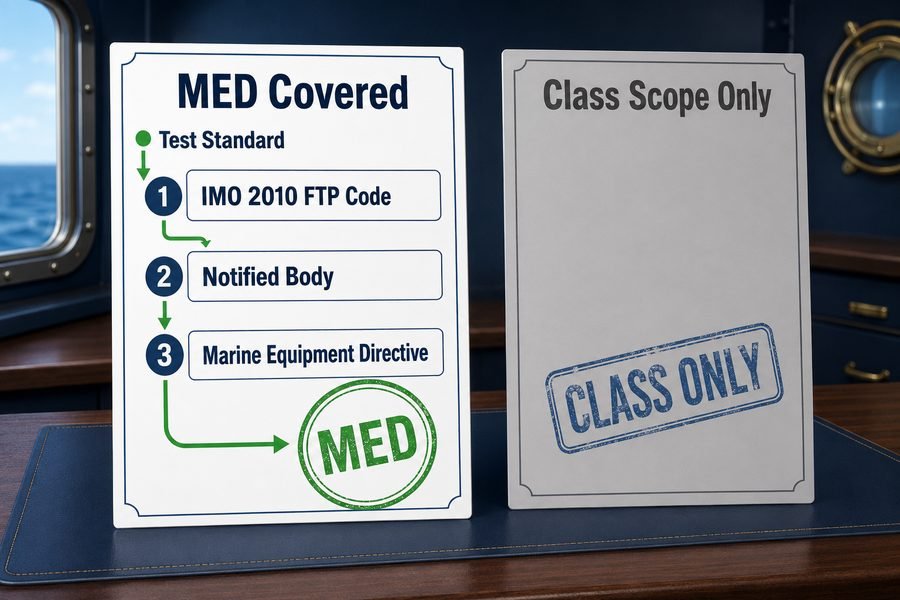
Knowing where to look on a 50-page test report saves you hours of stress. Let me guide you to the exact pages and lines you must check.
Checking the Test Standard Section for IMO 2010 FTP Code
Open the test report and go to the second or third page. Look for a section called "Test Standard" or "Reference Documents." If the panel is for MED, this section must explicitly list the IMO 2010 FTP Code (IMO Resolution MSC.307(88)). The MED requires this specific testing code for fire-rated accommodation panels.8 If the report lists a local national standard, like Chinese GB standards, the report does not cover MED scope. The temperature curves are different. The IMO standard requires the furnace temperature to reach 842°C at 30 minutes and 945°C at 60 minutes.9 Local standards might use lower temperatures. You must confirm the exact IMO code is printed.
Finding the Notified Body Designation of the Testing Laboratory
Not all laboratories can issue MED test reports. The European Union must authorize the laboratory. We call an authorized lab a "Notified Body."10 You need to look at the top of the test report for the laboratory's name and its 4-digit Notified Body number. For example, the Danish Institute of Fire and Security Technology (DBI) is a Notified Body. If the laboratory is just a local commercial testing center without EU authorization, their test report can only be used for local Class approval, not for MED.
Verifying the Explicit Statement of Marine Equipment Directive Compliance
The easiest way to check the scope is to read the conclusion of the test report. The laboratory will write a summary. A report for MED will include a clear sentence stating: "The test results demonstrate compliance with the requirements of the Marine Equipment Directive 2014/90/EU." If the report only says "The panel passes the fire test," it is likely only for Class scope. You must hunt for the specific mention of the directive.
| Verification Step | Location in Test Report | What to Look For |
|---|---|---|
| Check Test Standard | Pages 2-3 | "IMO 2010 FTP Code" or "MSC.307(88)" |
| Check Laboratory Status | Header/Footer | 4-digit Notified Body Number |
| Check Conclusion | Last Page | "Marine Equipment Directive 2014/90/EU" |
Does a Notified Body Number on a Marine Accommodation Panel Certificate Mean MED or Class Approval?
You see a four-digit number next to a logo and feel safe. But does that number actually guarantee you have the right European approval?
A four-digit Notified Body (NB) number on a marine accommodation panel certificate strictly means MED (Marine Equipment Directive) approval, as only bodies authorized by the European Commission use these numbers. Standard Class Society approvals do not use Notified Body numbers because they are private rules, not EU laws.
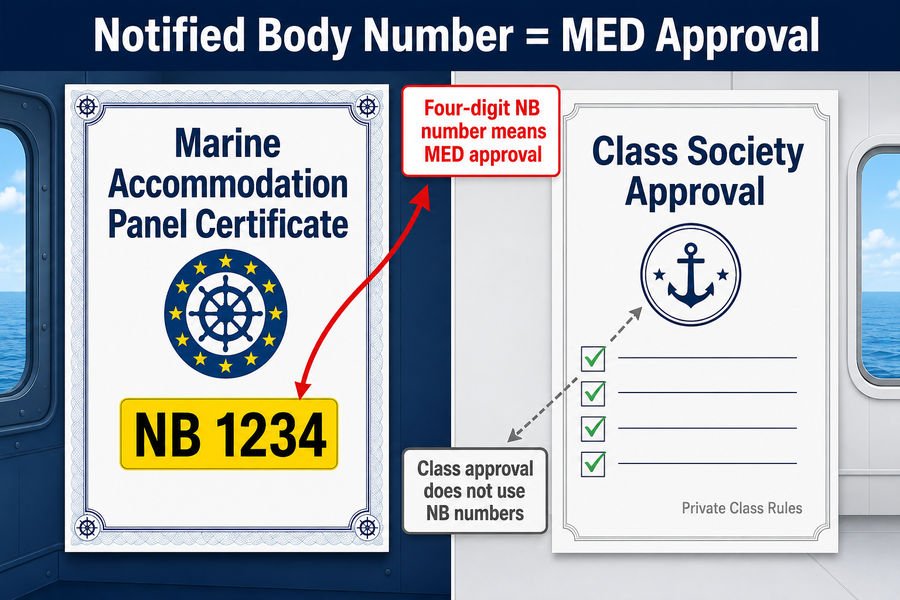
The number is the ultimate proof, but you need to know how to verify it. I will explain how to check this number online.
The Meaning of the Four-Digit Notified Body Number
When you see a Wheel Mark symbol on a certificate or a panel label, it always has a four-digit number next to it or below it. This is the Notified Body (NB) number. The European Commission assigns this unique number.11 It proves the organization has the legal right to audit and approve marine equipment for European ships. For example, DNV AS has the NB number 0575. Bureau Veritas (BV) has the NB number 0062. Lloyd's Register Verification Ltd uses 0038. You can verify these numbers on the official European Commission NANDO database. If the certificate has this 4-digit number linked with the Wheel Mark, you are holding a MED approval document.
Why Standard Class Society Approvals Do Not Use NB Numbers
Standard Class Society approvals are completely different. A Classification Society writes its own private rules for building safe ships.12 When a panel passes these private rules, the society issues a Class Type Approval. Because this is a private agreement between the shipyard, the shipowner, and the Class Society, the European Union is not involved. Therefore, the European Commission does not assign a Notified Body number for this process. If you look at a standard ABS or RINA Class Type Approval certificate for a wall panel, you will see their company logo, but you will never see a 4-digit EU Notified Body number. The absence of this number tells you immediately that the panel does not have MED Wheel Mark approval.
| Certifying Organization | Role | Number Displayed on Certificate | Indicates |
|---|---|---|---|
| DNV AS | EU Notified Body | 0575 | MED Wheel Mark Approval |
| Bureau Veritas | EU Notified Body | 0062 | MED Wheel Mark Approval |
| Any Class Society | Private Surveyor | No 4-digit number | Standard Class Approval only |
Why Is the Wheel Mark Symbol Missing on a Class-Approved Marine Accommodation Panel Datasheet?
You receive a nice technical datasheet from a factory, but the famous Wheel Mark is nowhere to be found. Is it just a printing error?
The Wheel Mark symbol is missing on a Class-approved marine accommodation panel datasheet because the product has not passed the specific EU statutory requirements, the factory lacks a Module D quality audit, or the product is intended for non-EU flagged vessels governed only by standard Class rules.
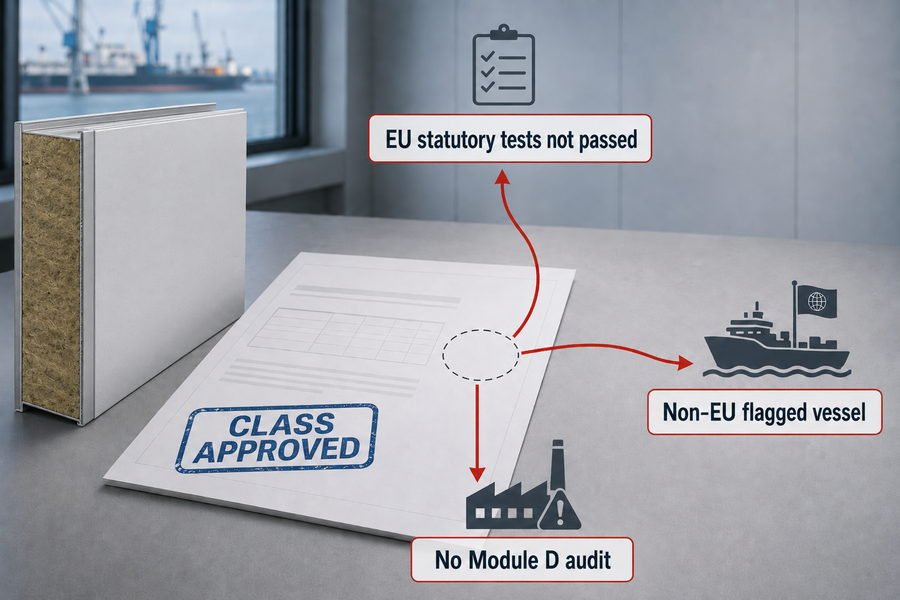
Do not let a factory tell you they just forgot to print the logo. Let us look at the real reasons behind the missing Wheel Mark.
Failing to Pass EU Statutory Requirements
The most common reason the Wheel Mark is missing is simply that the panel failed the tests. The EU statutory requirements under MED are very strict. The panel must pass toxicity tests, smoke generation tests, and non-combustibility tests13. If a panel uses a cheap glue, it might pass a basic fire test for a local Class rule, but it will fail the MED smoke toxicity test. The factory cannot legally put the Wheel Mark on their datasheet because they do not have the Module B certificate14. They will only show you the Class approval they managed to get.
The Factory Lacking a Module D Quality Audit
Sometimes, a factory has a good panel design and gets the Module B certificate. But you still do not see the Wheel Mark on their datasheet. Why? Because they refused to pay for the Module D quality audit. The Wheel Mark symbol requires both Module B and Module D. Many small factories in Asia want to save the $4,000 to $6,000 annual audit fee. Without the Module D audit, the Notified Body forbids them from printing the Wheel Mark logo on their products or marketing materials. They are restricted to selling the panels as standard Class-approved items.
Products Intended for Non-EU Flagged Vessels
Factories produce different grades of panels for different markets. If a shipyard is building a domestic river cruise ship in China or a cargo vessel flagged in Panama, the law does not require MED Wheel Mark panels. The shipyard only requires standard Class approval to keep costs down. A Class-approved panel might cost $15 per square meter, while a MED-approved panel costs $25 per square meter. The factory creates a separate datasheet for this cheaper product line. The Wheel Mark is missing because the product targets a completely different, lower-budget market.
| Reason for Missing Wheel Mark | Factory Action | Result for Buyer |
|---|---|---|
| Failed EU Tests | Uses cheaper materials | Panel fails smoke/toxicity standards |
| Skipped Module D Audit | Saves annual audit fees | Panel legally barred from using logo |
| Targeted for Non-EU Ships | Lowers production costs | Panel only suitable for domestic/Class ships |
What Risks Come From Supplying Class-Approved Marine Accommodation Panels Where MED Is Specified?
You think the panels look the same and the price is good. But sending the wrong panels to Europe will destroy your business.
Supplying Class-approved marine accommodation panels where MED is specified carries three major risks: immediate rejection by the shipyard Port State Control, financial penalties including full replacement costs and project delay fees, and permanent blacklisting of your company by the shipyard and the European shipowner.
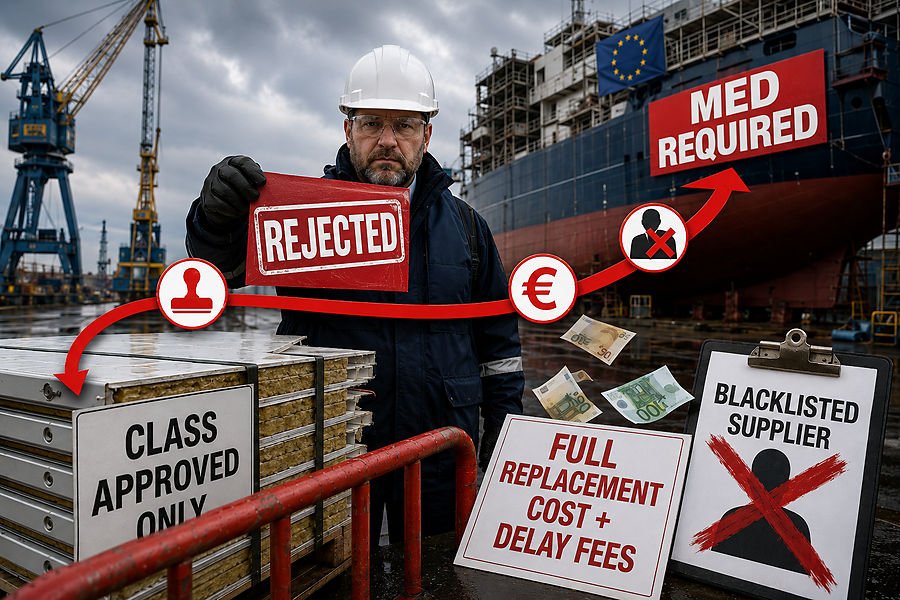
The money you save on cheaper panels is nothing compared to the penalties you will pay. I have seen this happen, and I want to protect you from it.
Immediate Rejection by Port State Control or Shipyard Surveyors
When your shipping container arrives at the European shipyard, the first thing the shipyard surveyor does is inspect the panel labels. If the tender specified MED, the surveyor looks for the Wheel Mark and the Notified Body number15 on every single panel. If they only see a standard Class approval sticker, they reject the entire shipment immediately. Furthermore, if the shipyard accidentally installs them, the Port State Control inspector will find out before the ship launches. Under EU law, Port State Control has the ultimate authority16. They will halt the ship's delivery until every uncertified panel is torn out and replaced. The rejection rate is 100% when statutory documents are missing.17
Financial Penalties Involving Replacement and Delay Fees
The financial disaster starts the moment the panels are rejected. You do not just lose the money you paid to the factory. The shipyard will force you to pay for the urgent airfreight of new, correct MED panels from another supplier. If the ship delivery is delayed because the shipyard has to tear out your wrong panels, the delay penalties are massive. A typical shipyard contract includes delay fees ranging from $10,000 to $50,000 per day18. One mistake with panel certificates can wipe out your entire company's cash flow for the year.
Permanent Blacklisting by Shipyards and Shipowners
The shipping industry is a very small circle. If you cause a delay in Europe because you tried to sneak in Class-approved panels instead of MED panels, the news spreads fast. The shipyard will place your company on their permanent blacklist. The European shipowner will ban your products from all their future vessels. You will lose the ability to bid on high-profit interior decoration projects. Trust takes years to build and one bad container to destroy.
| Risk Category | Consequence | Financial Impact |
|---|---|---|
| Surveyor Rejection | Cargo refused at dock | Total loss of cargo value |
| Delay Penalties | Shipyard applies contract fines | $10,000 - $50,000 per day |
| Blacklisting | Banned from future tenders | Complete loss of future revenue |
Conclusion
Do not risk your project by confusing Class approval with the MED Wheel Mark. Always check the Module B and D certificates to ensure your marine panels meet European shipyard standards.
-
"How to Avoid EU Rejection of Marine Accommodation Panels for ...", https://magellanmarinetech.com/how-avoid-eu-rejection-marine-accommodation-panels-for-med-non-compliance/. Directive 2014/90/EU establishes EU conformity-assessment requirements for marine equipment placed on EU ships, while MED implementing acts identify the IMO 2010 FTP Code as the fire-test standard for relevant fire-protection materials. Evidence role: general_support; source type: government. Supports: Marine accommodation panels subject to MED approval must be assessed under EU marine-equipment rules and tested against the IMO 2010 FTP Code by an authorized body.. Scope note: This supports the regulatory framework and referenced test standard; it does not verify that any particular panel has passed the tests. ↩
-
"Are Marine Fire Divisions the Same as Marine Panel Ratings?", https://magellanmarinetech.com/are-marine-fire-divisions-same-as-marine-panel-ratings/. The IMO FTP Code fire-resistance test for A-class divisions uses the standard time-temperature furnace curve and A-60 classification requires a 60-minute fire-resistance exposure with specified insulation and integrity criteria. Evidence role: definition; source type: institution. Supports: An A-60 marine fire rating is based on a 60-minute standard fire-resistance test whose furnace curve reaches roughly 945°C at 60 minutes.. Scope note: The cited standard supports the A-60 test conditions and classification criteria; wording such as “withstand 945°C” should be interpreted as exposure to the standard furnace curve, not necessarily a uniform material temperature. ↩
-
"How to Avoid EU Rejection of Marine Accommodation Panels for ...", https://magellanmarinetech.com/how-avoid-eu-rejection-marine-accommodation-panels-for-med-non-compliance/. The Marine Equipment Directive requires the wheel mark to be affixed only to equipment that has undergone the applicable conformity-assessment procedures and is covered by the required EU declaration and certification route, commonly involving type examination plus production or product verification modules for listed equipment. Evidence role: expert_consensus; source type: government. Supports: A manufacturer cannot lawfully apply the MED wheel mark unless the equipment has completed the required MED conformity-assessment procedure, typically including Module B and a production/product assurance or verification module where required.. Scope note: This supports the general legal condition for using the wheel mark; the exact required certificate set depends on the specific MED item and the conformity modules listed in the current implementing regulation. ↩
-
"RECOGNIZED ORGANIZATIONS", https://www.imo.org/en/OurWork/IIIS/Pages/Recognized-Organizations.aspx. An institutional source explaining that classification societies may provide private classification services and may also perform statutory or conformity-assessment work when authorized would support the distinction between these roles; it would not prove the legal status of any particular certificate. Evidence role: definition; source type: institution. Supports: IACS members can act both as private classification societies and, when designated, as EU Notified Bodies or statutory conformity-assessment organizations.. Scope note: The support is contextual because authorization varies by society, flag state, EU member state, equipment category, and certificate type. ↩
-
"How to Avoid EU Rejection of Marine Accommodation Panels for ...", https://magellanmarinetech.com/how-avoid-eu-rejection-marine-accommodation-panels-for-med-non-compliance/. An EU Marine Equipment Directive source describing MED conformity assessment, Notified Body certification, and Wheel Mark requirements would support the point that marine equipment approval under MED is a distinct statutory process, not automatically created by a private class approval; it would not assess any specific DNV, LR, BV, or ABS certificate. Evidence role: definition; source type: institution. Supports: A standard class approval certificate does not automatically constitute Marine Equipment Directive approval.. Scope note: The source would establish the MED approval framework generally, rather than directly comparing every form of class approval certificate with MED certificates. ↩
-
"Directive 96/98/EC - Wikipedia", https://en.wikipedia.org/wiki/Directive_96/98/EC. The text of Directive 2014/90/EU and its EUR-Lex legislative history support that Directive 2014/90/EU is the EU Marine Equipment Directive and that it replaced Directive 96/98/EC; this does not by itself determine whether a particular legacy certificate remains acceptable for a specific vessel or tender. Evidence role: historical_context; source type: government. Supports: The current EU Marine Equipment Directive is 2014/90/EU, replacing the older 96/98/EC framework.. Scope note: Certificate validity may also depend on transition provisions, implementing acts, equipment category, and the tender’s contractual wording. ↩
-
"[PDF] RESOLUTION MSC.307(88) (adopted on 3 December 2010 ...", https://wwwcdn.imo.org/localresources/en/KnowledgeCentre/IndexofIMOResolutions/MSCResolutions/MSC.307(88).pdf. An IMO source on the 2010 FTP Code would support that the International Code for Application of Fire Test Procedures, 2010 updated the fire-test procedures used under SOLAS; the source would provide regulatory context but may not address the acceptance of every panel certificate in a particular shipyard tender. Evidence role: historical_context; source type: institution. Supports: The IMO 2010 FTP Code superseded older fire-test procedure standards used for marine fire-safety approvals.. Scope note: Application to a specific wall-panel order depends on the applicable MED item, test module, certificate date, and tender requirements. ↩
-
"What EU Market Requirements Apply to Marine Accommodation ...", https://magellanmarinetech.com/what-eu-market-requirements-apply-to-marine-accommodation-panels/. The Marine Equipment Directive framework and its implementing acts list testing standards for covered marine equipment; this source supports that MED fire-safety approvals are tied to specified IMO FTP Code test procedures, though the exact applicability depends on the item’s MED category and module. Evidence role: general_support; source type: government. Supports: The Marine Equipment Directive requires the IMO 2010 FTP Code for fire-rated accommodation panels within MED scope.. Scope note: Contextual support only; the source must be checked against the specific MED item category for accommodation panels. ↩
-
"What Does Fire Rating Duration Mean for Marine Wall and Ceiling ...", https://magellanmarinetech.com/what-fire-rating-duration-mean-for-marine-wall-ceiling-panels/. The IMO 2010 FTP Code specifies the standard time–temperature curve for fire-resistance tests, including furnace temperature values at defined time points; this supports the cited 30-minute and 60-minute temperature benchmarks. Evidence role: statistic; source type: institution. Supports: The IMO 2010 FTP Code requires furnace temperatures of 842°C at 30 minutes and 945°C at 60 minutes.. ↩
-
"Conformity Assessment of Medical Devices: An Overview from a ...", https://pmc.ncbi.nlm.nih.gov/articles/PMC12821529/. EU guidance on conformity assessment explains that a notified body is an organization designated by an EU member state to assess conformity for specified legislation; this supports the statement that MED conformity assessment must be performed by authorized bodies, subject to the body’s notified scope. Evidence role: definition; source type: government. Supports: A laboratory issuing MED-related conformity assessment must be an EU-designated notified body for the relevant scope.. Scope note: The source defines and contextualizes notified bodies generally; the individual laboratory’s MED scope must be verified separately in the EU NANDO database. ↩
-
"Notified body - Wikipedia", https://en.wikipedia.org/wiki/Notified_body. The European Commission’s NANDO database identifies notified bodies by official identification numbers and lists their notified scope under EU legislation such as the Marine Equipment Directive. Evidence role: definition; source type: government. Supports: The four-digit Notified Body number associated with the Wheel Mark is assigned by the European Commission and can be verified through official EU records.. Scope note: NANDO verifies a body’s notification and scope, but it does not by itself authenticate a specific certificate. ↩
-
"Ship classification society - Wikipedia", https://en.wikipedia.org/wiki/Ship_classification_society. The International Association of Classification Societies describes classification as the development and application of technical rules and standards for ships and offshore structures, supporting the distinction between class rules and statutory EU conformity assessment. Evidence role: definition; source type: institution. Supports: Classification society approvals are based on classification rules developed and applied by the societies, distinct from EU Marine Equipment Directive notification.. Scope note: This supports the general nature of classification society rules, but does not prove that every individual class type approval certificate lacks an EU Notified Body number. ↩
-
"What Smoke Toxicity and Density Limits Must Marine Wall and ...", https://magellanmarinetech.com/what-smoke-toxicity-density-limits-must-marine-wall-ceiling-panels-meet/. EU Marine Equipment Directive implementing measures and the IMO Fire Test Procedures Code identify fire-performance testing, including non-combustibility and smoke/toxicity assessments, as relevant conformity criteria for certain marine fire-protection and surface materials. Evidence role: definition; source type: government. Supports: The panel must pass toxicity tests, smoke generation tests, and non-combustibility tests under MED-related requirements.. Scope note: The source would support the regulatory test categories generally, but it may not verify that every panel type in the article is subject to all three tests. ↩
-
"What Is the Wheel Mark Certification Process for Marine ...", https://magellanmarinetech.com/what-wheel-mark-certification-process-for-marine-accommodation-panels/. Directive 2014/90/EU and its conformity-assessment annexes describe Module B as EU-type examination for marine equipment, supporting the point that a product lacking this certification cannot rely on that route for MED conformity marking. Evidence role: mechanism; source type: government. Supports: A factory cannot legally put the Wheel Mark on its datasheet if it does not have the required Module B certification for the product.. Scope note: The source would explain the certification mechanism, not prove that any particular factory lacks a Module B certificate. ↩
-
"Directive 96/98/EC - Wikipedia", https://en.wikipedia.org/wiki/Directive_96/98/EC. Directive 2014/90/EU and related EU guidance establish that compliant marine equipment is identified by the wheel mark and, where applicable, the notified body identification number, supporting the claim that MED-specified panels are checked for these markings. Evidence role: definition; source type: government. Supports: MED-compliant marine panels should carry the Wheel Mark and Notified Body number when required by the Marine Equipment Directive.. ↩
-
"Port State Control", https://www.imo.org/en/ourwork/iiis/pages/port%20state%20control.aspx. EU port State control rules authorize inspectors to examine ship certificates, inspect equipment, and require corrective action or detention for serious deficiencies, supporting the general claim that Port State Control can prevent a non-compliant ship from proceeding. Evidence role: general_support; source type: government. Supports: Port State Control inspectors can enforce compliance by inspecting ships and requiring corrective action, including detention in serious cases.. Scope note: This supports Port State Control enforcement powers generally, but does not prove that every MED labeling defect will halt delivery in every case. ↩
-
"[PDF] A 34-Res.1206 - PROCEDURES FOR PORT STATE CONTROL ...", https://wwwcdn.imo.org/localresources/en/OurWork/IIIS/Documents/A%2034-Res.1206%20-%20PROCEDURES%20FOR%20PORT%20STATE%20CONTROL,%202025%20(Secretariat).pdf. Port State Control and maritime compliance guidance identify missing or invalid statutory certificates as deficiencies that can trigger further inspection or detention, providing contextual support for the seriousness of missing documents. Evidence role: general_support; source type: institution. Supports: Missing statutory documents are treated as serious deficiencies in maritime inspection and can lead to rejection, corrective action, or detention.. Scope note: This does not substantiate a literal 100% rejection rate; a source is likely to support the risk of rejection or detention rather than a universal statistic. ↩
-
"Permissible delay in shipbuilding contracts: analysis of grounds and ...", https://www.academia.edu/129232450/Permissible_delay_in_shipbuilding_contracts_analysis_of_grounds_and_procedures_for_extending_the_vessel_delivery_date_by_contractor. Academic and legal discussions of shipbuilding contracts describe liquidated damages for late delivery as commonly calculated on a per-day basis, supporting the claim that delivery delays can create substantial daily financial exposure. Evidence role: general_support; source type: paper. Supports: Shipbuilding contracts often include daily liquidated damages or delay penalties for late delivery, which can create significant costs.. Scope note: The source may support the mechanism of daily delay damages but may not verify this exact dollar range across all shipyard contracts. ↩