Confused about panel certifications? Buying the wrong approved panels delays your project and wastes money. I will show you exactly when you need the MED Wheel Mark.
The MED Wheel Mark is mandatory for EU-flagged vessels and passenger ships under EU regulations, while Class Society Approval (like DNV or ABS) is sufficient for non-EU cargo ships and non-commercial yachts. Choosing the right certification depends strictly on the vessel's flag state, vessel type, and operating region.
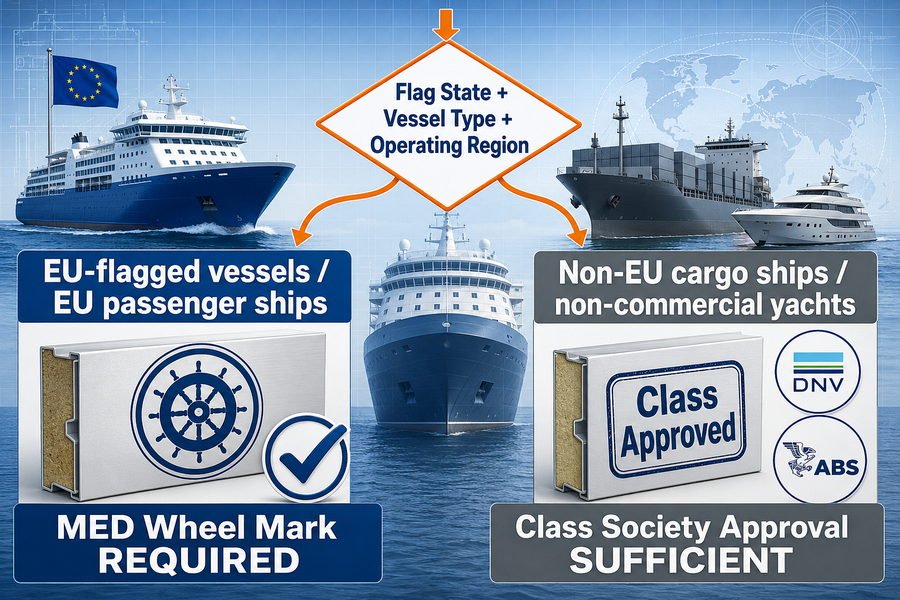
Let us break down these rules so you can buy the right marine accommodation panels for your shipyard clients without facing rejection from inspectors.
Do Non-EU Flagged Vessels Calling EU Ports Need MED-Certified Marine Accommodation Panels?
Are you supplying panels for a foreign ship entering Europe? Fearing Port State Control detentions is stressful. Here is the clear rule on whether MED is necessary.
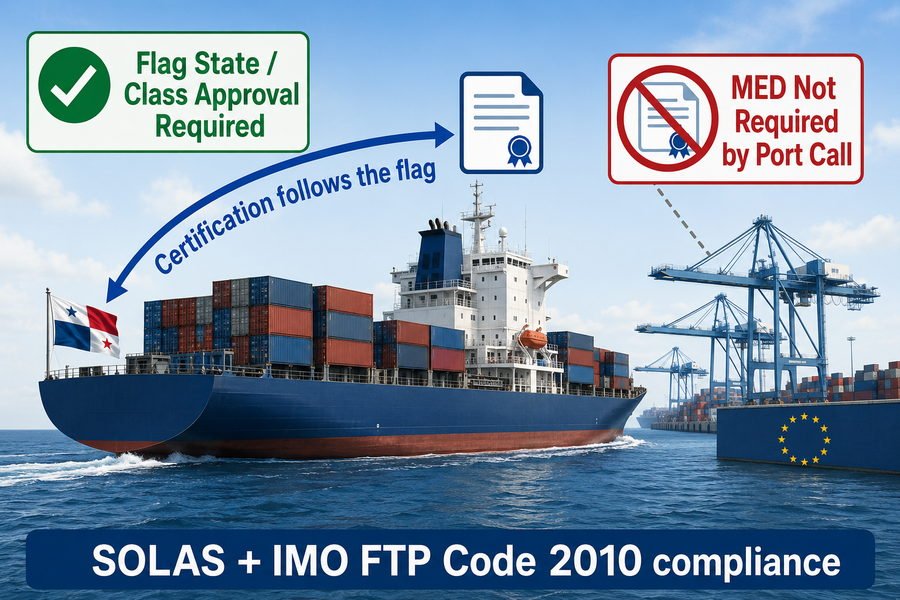
Non-EU flagged vessels calling EU ports do not require MED-certified marine accommodation panels. They only need approval from their respective flag state or a recognized Class Society compliant with SOLAS and the IMO FTP Code 2010. MED is strictly tied to the flag, not the destination port.
The Role of Flag State Jurisdiction in Marine Panel Certification
When I first started supplying marine wall panels from Asia to European shipyards, I worried about ships getting stopped in Rotterdam or Hamburg. I quickly learned that the flag state dictates the rules1. If a vessel flies the flag of Panama or Liberia, it follows the rules of Panama or Liberia. These countries authorize International Association of Classification Societies (IACS) members to issue approvals on their behalf2. You only need a standard Type Approval Certificate from a society like ABS, DNV, or Lloyd's Register. The MED Directive 2014/90/EU does not apply to these ships3. Because MED certification often adds 15% to 20% to the product cost, you can save a lot of money for your clients by simply buying Class-approved panels for non-EU vessels. The panels still pass the same fire tests, but you skip the European administrative fees.
Port State Control (PSC) Inspection Criteria for Marine Accommodation Panels
You might wonder what Port State Control (PSC) inspectors look for when the ship arrives in Europe. Under the Paris MoU, PSC inspectors check for compliance with international conventions like SOLAS Chapter II-2, not local European directives. They will look at the ship's safety certificates. If the marine accommodation panels meet the IMO FTP Code 2010 fire test standards (for example, keeping the unexposed side below 140°C during a 60-minute fire for A-604), the PSC inspector will approve them. I always tell my buyers to provide clear, valid Class Society Type Approval certificates to the shipyard. This ensures smooth inspections at the port without needing the Wheel Mark.
| Certification Aspect | Non-EU Flag Calling EU Port | EU Flag Vessel |
|---|---|---|
| Governing Law | SOLAS / Flag State Rules | Marine Equipment Directive 2014/90/EU |
| Panel Certification Required | IACS Class Society Approval | MED Wheel Mark |
| Fire Test Standard | IMO FTP Code 2010 | IMO FTP Code 2010 |
| PSC Inspection Focus | International Safety Compliance | Strict MED Compliance |
Do Sub-24m Newbuild Yachts Need MED or Just Class Approval for Marine Accommodation Panels?
Outfitting a luxury yacht under 24 meters? Overpaying for heavy MED panels ruins your budget. You must know the exact boundary for yacht regulations.
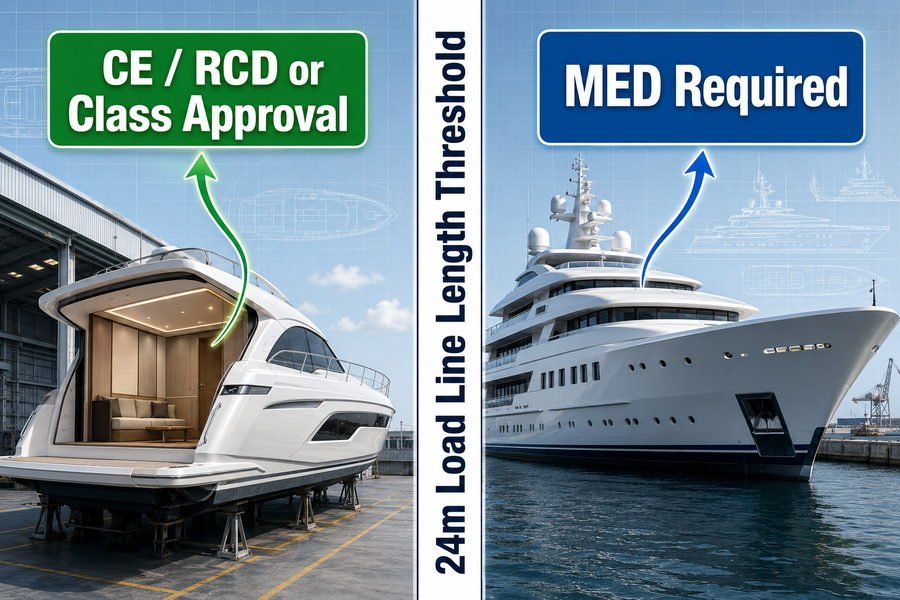
Sub-24m newbuild yachts do not require MED-certified marine accommodation panels. Because they fall outside SOLAS conventions, they only need CE marking under the Recreational Craft Directive (RCD) or local Class Society approval. MED requirements only apply to commercial vessels and superyachts exceeding 24 meters in load line length.
Regulatory Boundaries for Sub-24m Recreational Vessels
The 24-meter mark is a hard line in the maritime industry. Sub-24m yachts (less than 78.7 feet) are classified as recreational craft.5 They do not fall under the strict SOLAS (Safety of Life at Sea) conventions.6 Therefore, they do not need MED Wheel Mark products. Instead, they operate under the Recreational Craft Directive (RCD) 2013/53/EU if they are sold in Europe.7 For the interior decoration of these small yachts, you can use standard marine plywood or lightweight honeycomb panels with basic fire retardant treatments. You can rely on a local Class Society approval or even standard CE marking. Using MED-certified A-Class panels on a 20-meter yacht is a bad idea. They are too heavy, usually weighing around 18 to 22 kg per square meter, which slows the boat down and wastes your purchasing budget.
Cost Implications of Choosing Class Approval Over MED for Small Yachts
I have helped many procurement officers fix their budgets by switching from MED to standard Class approvals for small yachts. An MED-certified B-15 wall panel might cost you $35 to $45 per square meter from a Chinese factory. A standard Class-approved fire-retardant panel with CE marking might only cost $20 to $28 per square meter. By understanding this rule, you can lower your costs by almost 40%. For superyachts over 24 meters in load line length, the rules change. Large yachts that carry more than 12 passengers must follow the Passenger Yacht Code (PYC) or SOLAS8, which means you must buy MED-certified panels if they fly an EU flag. Always check the exact length and passenger capacity with the shipyard before you place an order.
| Vessel Category | Panel Certification Requirement | Typical Panel Weight | Estimated Cost (per sqm) |
|---|---|---|---|
| Sub-24m Yacht (Private) | CE Mark / Basic Class Approval | 10 - 15 kg | $20 - $28 |
| >24m Yacht (Commercial/EU) | MED Wheel Mark | 18 - 25 kg | $35 - $45 |
| >24m Yacht (Non-EU) | IACS Class Society Approval | 18 - 25 kg | $30 - $40 |
Are Class Society Fire Test Reports Enough for A-60 Marine Accommodation Panels Without MED Module D?
Have a valid fire test report but no Module D? Factory audits are expensive and take time. Discover if you can skip Module D.
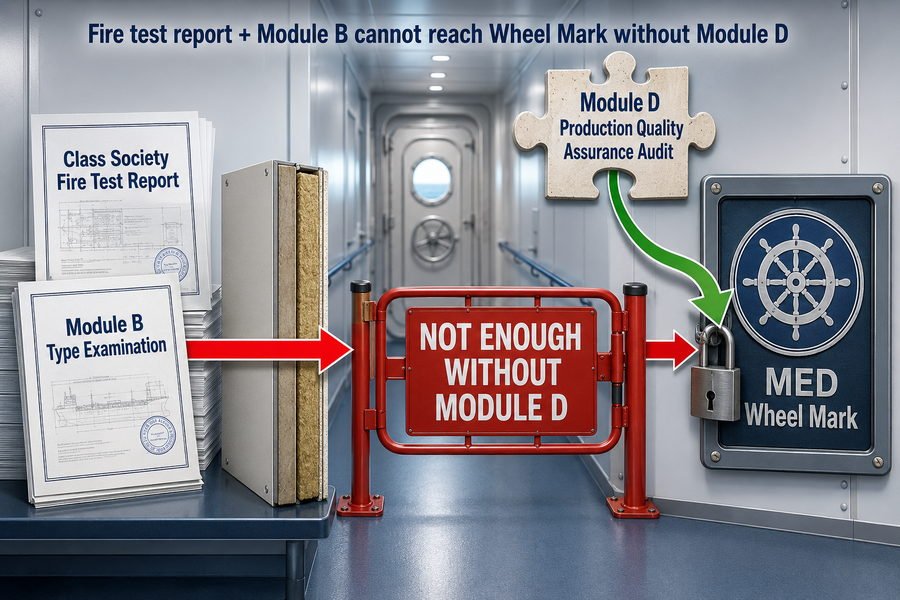
Class Society fire test reports are never enough for MED certification of A-60 marine accommodation panels. MED compliance strictly requires both Module B (Type Examination of the fire test) and Module D (Production Quality Assurance audit). Without Module D, the panel cannot legally receive the Wheel Mark.
Understanding the Difference Between Module B and Module D
Many buyers think a good fire test report means the panel is certified. This is a very common mistake. When a factory burns a panel in a furnace at 945°C for 60 minutes9, they get a fire test report. Under the MED system, an approved body reviews this report and issues a Module B certificate. Module B proves the design is safe. However, Module B is not enough. You also need Module D. Module D is a strict audit of the factory's production quality system, similar to ISO 9001 but focused on marine safety. The auditor checks if the factory can produce thousands of panels that match the exact quality of the single panel that passed the fire test. You must have both Module B and Module D to print the Wheel Mark on the product label.10
Risks of Supplying A-60 Panels Without Complete MED Documentation
If you buy an A-60 marine accommodation panel from an Asian supplier who only has a fire test report or only a Module B certificate, you face massive risks. When the panels arrive at the shipyard in Europe, the site surveyor will ask for the Declaration of Conformity. This document requires the Module D certificate number. Without it, the shipyard will reject the goods. You will have to pay for return shipping or scrap the materials, destroying your profit margin. A proper Module D audit costs a factory between $4,000 and $6,000 every year. Some small factories try to save money by skipping it. As a procurement officer, you must always ask the supplier for both certificates before you pay the deposit.
| MED Requirement | What It Means | Is It Required for Wheel Mark? |
|---|---|---|
| Fire Test Report | Proof of passing IMO FTP Code 2010 test | No (Used to get Module B) |
| Module B Certificate | EC Type Examination (Design Approval) | Yes |
| Module D Certificate | Production Quality Assurance (Factory Audit) | Yes |
| Declaration of Conformity | Factory statement linking B and D | Yes |
Do EU-Flagged Ferry Retrofits Require MED-Certified Marine Accommodation Panels?
Replacing panels on an old passenger ferry? Using the wrong replacement parts will fail the safety inspection. Here is what EU law demands.
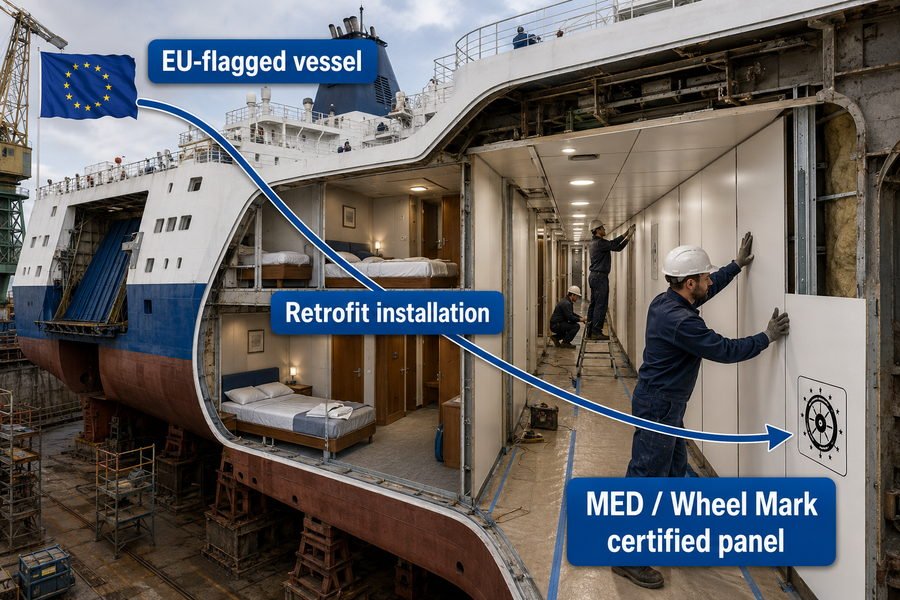
EU-flagged ferry retrofits absolutely require MED-certified marine accommodation panels. Under the Marine Equipment Directive 2014/90/EU, any new safety equipment or fire-rated panels installed on an EU-flagged vessel, whether for newbuilds or retrofits, must carry the Wheel Mark, regardless of the vessel's original build date.
The Retrofit Mandate Under Marine Equipment Directive 2014/90/EU
Retrofitting an old ship does not mean you can use old rules. I have worked on several passenger ferry refurbishment projects in Greece and Italy. The Marine Equipment Directive 2014/90/EU is very clear. If you install new marine accommodation panels, ceilings, or fire doors on an EU-flagged ship today, those new items must comply with today's MED standards11. It does not matter if the ferry was built 30 years ago. When you replace a damaged B-15 cabin partition, the new partition must have a valid Wheel Mark12. The maritime authorities want to slowly upgrade the safety of the entire fleet. If you try to use standard Class-approved panels for an EU ferry retrofit, the local marine surveyor will force you to rip them out.
Sourcing Strategies for EU Ferry Refurbishment Projects
Finding suppliers for these retrofits is tough. You need high quality, low prices, and full MED certification. Many buyers struggle to find good factories in China or Vietnam that hold valid MED certificates for decorative panels. To succeed, you should ask the factory for their current Module D certificate13 right away. Check the expiration date. A good strategy is to partner with a mid-sized factory that specializes in marine interiors rather than a massive general building materials factory. These specialized factories understand the IMO FTP Code 201014. By sourcing MED-certified panels from Asia, you can often secure a price of $40 to $50 per square meter, compared to $80 to $100 per square meter from European manufacturers. This creates a great profit margin for your interior decoration business.
| Project Type | Vessel Flag | Panel Certification Required | Panel Cost Source Estimate |
|---|---|---|---|
| Ferry Newbuild | EU Flag (e.g., Italy, Greece) | MED Wheel Mark | $40 - $100/sqm |
| Ferry Retrofit | EU Flag | MED Wheel Mark | $40 - $100/sqm |
| Ferry Retrofit | Non-EU Flag (e.g., Bahamas) | Class Society Approval | $30 - $80/sqm |
Do Cargo Ship Marine Accommodation Panels Fall Under MED or Class Society Approval?
Buying panels for a standard bulk carrier? Navigating cargo ship rules is confusing and time-consuming. Let us clarify the exact certification route.
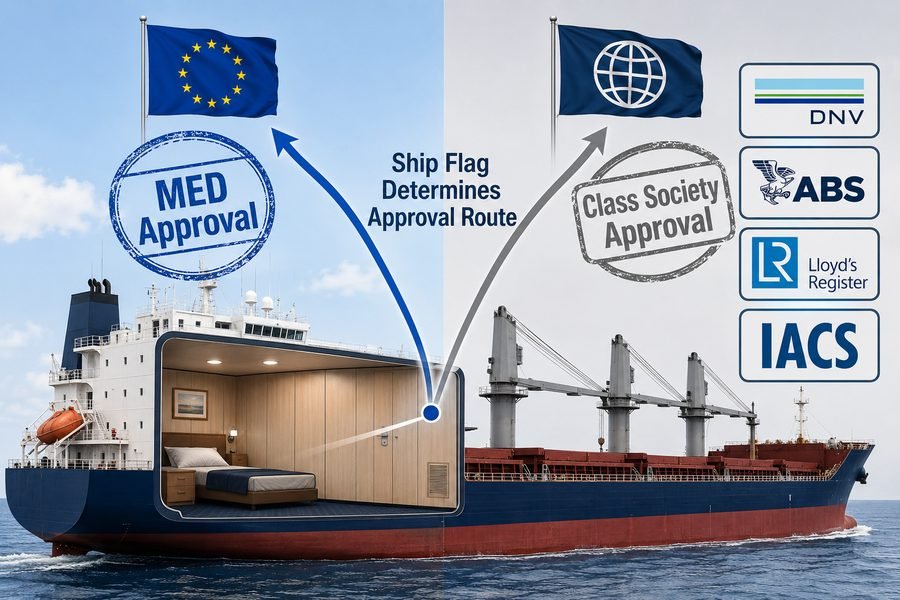
Cargo ship marine accommodation panels fall under MED if the ship flies an EU flag, but require only Class Society Approval if flying a non-EU flag. For non-EU flags, approvals from IACS members like DNV, ABS, or Lloyd's Register confirming SOLAS compliance are fully sufficient for cargo vessels.
Certification Requirements for EU-Flagged Cargo Vessels
A cargo ship is not a passenger ship, but the flag state rule still applies. If a bulk carrier or container ship flies the flag of an EU member state, such as Malta or Cyprus, it must strictly follow the Marine Equipment Directive15. Every fire-rated bulkhead, ceiling panel, and marine fire door inside the accommodation block must carry the MED Wheel Mark. I always remind buyers to look at the ship's registry. Even if the ship only carries grain and has a crew of 20 people, the EU flag demands the highest certification level. You must procure A-Class and B-Class panels that have passed the IMO FTP Code 2010 and hold both Module B and Module D certificates.
Utilizing IACS Class Approvals for Non-EU Cargo Ships
Most of the world's cargo ships fly flags of convenience, such as Panama, Liberia, or the Marshall Islands. This is where you can make your purchasing process much easier. These non-EU flags do not require MED certification. Instead, they rely on International Association of Classification Societies (IACS) members. If the shipyard uses DNV as their class society, you just need marine accommodation panels with a DNV Type Approval Certificate. If the yard uses ABS, you buy ABS-approved panels. This gives you more factory options in Asia because many excellent factories have Class approvals but do not pay for MED audits. You get the exact same physical fire safety—a rockwool core panel with PVC film—but at a better price and with a shorter lead time.
| Cargo Ship Flag State | Classification Society | Required Panel Certification |
|---|---|---|
| Malta (EU) | DNV | MED Wheel Mark |
| Cyprus (EU) | Lloyd's Register (LR) | MED Wheel Mark |
| Panama (Non-EU) | ABS | ABS Type Approval Certificate |
| Liberia (Non-EU) | Bureau Veritas (BV) | BV Type Approval Certificate |
What Documentation Differs Between MED and Class Approval Routes for Marine Accommodation Panels?
Lost in a mountain of paperwork? Missing a single certificate stops your payment from the shipyard. Here is the exact document checklist.
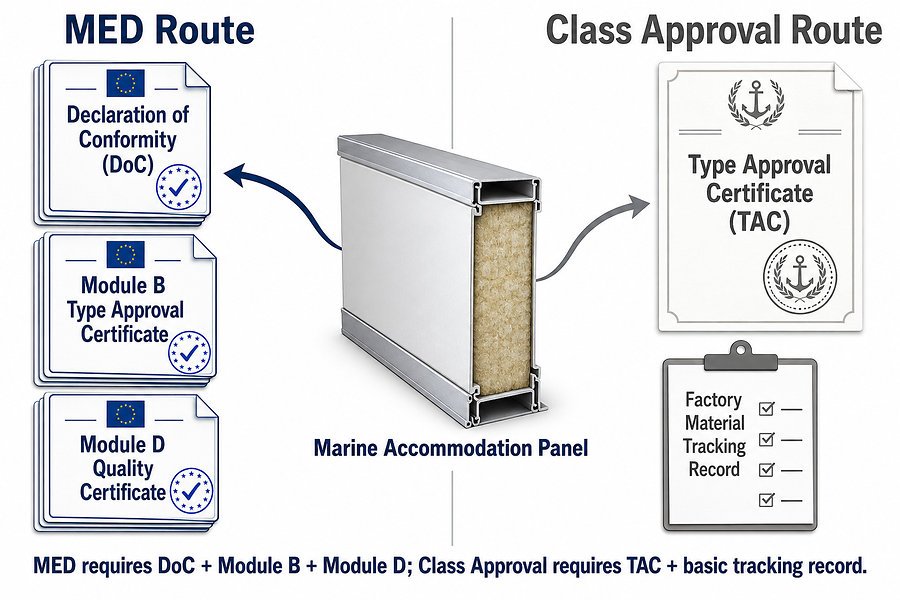
The documentation difference is distinct: MED routes require a Declaration of Conformity (DoC), a Module B Type Approval certificate, and a valid Module D Quality certificate. Class Approval routes only require a singular Type Approval Certificate (TAC) from the specific society and a basic factory material tracking record.
Essential Documentation for the MED Wheel Mark Route
When you deliver MED-certified marine accommodation panels to a shipyard in Europe or the United States, the paperwork is heavy. First, you must provide the Module B Type Approval certificate. This shows the panel design passed the fire test. Second, you must provide the Module D Quality certificate, proving the factory is audited. Third, and most importantly, you must provide a Declaration of Conformity (DoC). The DoC is a legal document signed by the factory stating that the specific batch of panels belongs to the approved design. The DoC must list the Module B and Module D certificate numbers. Finally, the panels themselves must have a physical label showing the Wheel Mark logo, the Notified Body number, and the year of production16. If any of these four elements are missing, the surveyor will stop your installation.
Standard Paperwork Required for IACS Class Society Approvals
The Class Approval route is much simpler and faster. If you are supplying panels to a non-EU vessel approved by ABS or DNV, you generally only need to provide a single document: the Type Approval Certificate (TAC)17. The TAC proves that the class society has tested the product and approved the factory's basic quality system. You do not need a separate Module D certificate or a formal Declaration of Conformity. The factory simply provides a standard commercial invoice, a packing list, and a basic factory material tracking record or Certificate of Quality to show the goods match the TAC. This simple paperwork reduces administrative delays and allows you to communicate with Asian sales teams much more easily.
| Document Type | Required for MED Route | Required for Class Route |
|---|---|---|
| Type Approval Certificate (TAC) / Module B | Yes | Yes |
| Factory Audit Certificate / Module D | Yes | No (Built into TAC process) |
| Declaration of Conformity (DoC) | Yes | No |
| Physical Wheel Mark Label | Yes | No (Standard factory label is fine) |
Conclusion
Understanding vessel flags and types dictates whether you buy MED or Class-approved panels. Make the right choice to save money, avoid delays, and keep your shipyard clients happy.
-
"Flag State implementation - International Maritime Organization", https://www.imo.org/en/OurWork/Safety/Pages/FlagStateImplementation.aspx. UNCLOS and IMO materials describe the flag state as having primary jurisdiction and control over ships entitled to fly its flag, supporting the article’s general statement about flag-state responsibility for vessel compliance. Evidence role: definition; source type: institution. Supports: A ship’s applicable safety and certification regime is primarily determined by its flag state.. Scope note: This supports the jurisdictional principle; it does not by itself determine every equipment-certification requirement in a port-state inspection. ↩
-
"RECOGNIZED ORGANIZATIONS", https://www.imo.org/en/OurWork/IIIS/Pages/Recognized-Organizations.aspx. IMO guidance on recognized organizations and flag-administration delegation explains that governments may authorize classification societies or other recognized organizations to conduct statutory surveys and issue certificates on their behalf. Evidence role: mechanism; source type: institution. Supports: Flag states may delegate approval and certification functions to classification societies, including IACS members.. Scope note: The source would support the delegation mechanism generally; specific authorization must still be verified against the relevant flag administration’s current list of recognized organizations. ↩
-
"Directive 96/98/EC - Wikipedia", https://en.wikipedia.org/wiki/Directive_96/98/EC. Directive 2014/90/EU defines its scope by reference to marine equipment placed on board EU ships, supporting the distinction between EU-flagged vessels and non-EU-flagged vessels for MED certification purposes. Evidence role: definition; source type: government. Supports: The Marine Equipment Directive applies to equipment for EU ships rather than automatically to all non-EU-flagged ships calling at EU ports.. Scope note: This supports the directive’s stated scope; port entry, contractual requirements, or other national rules may still impose separate documentation expectations in particular cases. ↩
-
"How Are Integrity and Insulation Judged in Marine Panel Fire Tests?", https://magellanmarinetech.com/how-integrity-insulation-judged-in-marine-panel-fire-tests/. The IMO FTP Code and SOLAS fire-test criteria for A-class divisions specify a 60-minute fire-resistance period for A-60 divisions and temperature-rise limits on the unexposed face, supporting the article’s technical description of the A-60 performance criterion. Evidence role: mechanism; source type: institution. Supports: A-60 marine panel fire testing includes a 60-minute exposure and limits on the temperature rise of the unexposed side.. Scope note: The exact criterion includes both average and maximum temperature-rise limits; a source should be checked for the full wording before relying on a simplified temperature statement. ↩
-
"Recreational Craft Directive - Wikipedia", https://en.wikipedia.org/wiki/Recreational_Craft_Directive. Directive 2013/53/EU defines recreational craft by intended sporting or leisure use and covers craft with hull lengths from 2.5 to 24 metres, providing the regulatory context for the 24-metre threshold. Evidence role: definition; source type: government. Supports: Sub-24m yachts are treated as recreational craft in the relevant European regulatory framework.. Scope note: The Directive does not classify every vessel below 24 metres as recreational; use, design, and exclusions also matter. ↩
-
"International Convention for the Safety of Life at Sea (SOLAS), 1974", https://www.imo.org/en/about/conventions/pages/international-convention-for-the-safety-of-life-at-sea-(solas),-1974.aspx. The SOLAS Convention generally applies to ships on international voyages but excludes categories such as cargo ships under 500 gross tonnage and pleasure yachts not engaged in trade, supporting the statement that many small private recreational yachts fall outside SOLAS. Evidence role: definition; source type: institution. Supports: Many sub-24m recreational yachts do not fall under SOLAS requirements.. Scope note: SOLAS applicability depends on voyage, tonnage, flag-state implementation, and commercial use; the source does not create a blanket exemption for all sub-24-metre yachts. ↩
-
"Recreational Craft Directive", https://en.wikipedia.org/wiki/Recreational_Craft_Directive. Directive 2013/53/EU sets harmonised EU requirements for recreational craft and personal watercraft placed on the Union market, including design, construction, and conformity-assessment obligations. Evidence role: historical_context; source type: government. Supports: Recreational craft sold in Europe operate under the Recreational Craft Directive 2013/53/EU.. Scope note: The Directive’s application depends on product scope and market placement; it does not by itself resolve all flag-state or operational requirements. ↩
-
"Passenger ships - International Maritime Organization", https://www.imo.org/en/OurWork/Safety/Pages/PassengerShips.aspx. Passenger-ship rules commonly use the carriage of more than 12 passengers as the threshold for passenger-vessel treatment, while the Passenger Yacht Code was developed for yachts carrying 13 to 36 passengers, giving regulatory context to the article’s distinction. Evidence role: definition; source type: institution. Supports: Large yachts carrying more than 12 passengers may be subject to PYC or SOLAS-type passenger-vessel requirements.. Scope note: The applicable regime varies by flag state, size, tonnage, voyage area, and commercial status; the source may support the threshold but not every compliance outcome described in the article. ↩
-
"How Does the IMO FTP Code Connect with Other Marine Fire Safety ...", https://magellanmarinetech.com/how-imo-ftp-code-connect-with-other-marine-fire-safety-frameworks/. The IMO FTP Code fire-resistance procedure for A-class divisions follows a standard time-temperature curve that reaches approximately 945°C at 60 minutes, and A-60 classifications are evaluated over a 60-minute exposure with insulation criteria. Evidence role: definition; source type: institution. Supports: An A-60 marine panel fire test involves exposure to about 945°C for 60 minutes.. Scope note: This supports the temperature-duration basis of the A-60 test, but not the administrative claim that any factory furnace test automatically produces an accepted MED fire test report. ↩
-
"What Is the Wheel Mark Certification Process for Marine ...", https://magellanmarinetech.com/what-wheel-mark-certification-process-for-marine-accommodation-panels/. The Marine Equipment Directive requires the wheel mark to be affixed only after the required conformity assessment and declaration of conformity; its conformity-assessment scheme uses EC type-examination under Module B together with a production conformity module such as Module D for production-quality assurance. Evidence role: general_support; source type: government. Supports: A product cannot legitimately carry the MED wheel mark based only on a fire test report or Module B design approval; production conformity assessment such as Module D is also required for the B+D route.. Scope note: This supports the B+D route described in the article, but some MED equipment entries may allow other production modules, such as Module E or Module F, instead of Module D. ↩
-
"How to Avoid EU Rejection of Marine Accommodation Panels for ...", https://magellanmarinetech.com/how-avoid-eu-rejection-marine-accommodation-panels-for-med-non-compliance/. Directive 2014/90/EU establishes that marine equipment placed on board EU ships must comply with the applicable international instruments and conformity-assessment requirements in force for that equipment. Evidence role: general_support; source type: government. Supports: Newly installed marine accommodation panels, ceilings, or fire doors on an EU-flagged ship must comply with current MED requirements.. Scope note: The Directive supports the general obligation for equipment placed on board EU-flagged ships, but a specific retrofit case may also depend on the product category, installation date, and flag-state interpretation. ↩
-
"What Is the Wheel Mark Certification Process for Marine ...", https://magellanmarinetech.com/what-wheel-mark-certification-process-for-marine-accommodation-panels/. The Marine Equipment Directive requires compliant marine equipment covered by the Directive to bear the wheel mark after the relevant conformity-assessment procedure, indicating conformity with applicable EU marine-equipment rules. Evidence role: definition; source type: government. Supports: A replacement B-15 cabin partition installed on an EU-flagged ship should have valid Wheel Mark certification if it falls within the relevant MED equipment categories.. Scope note: This supports the role of the wheel mark generally; whether a specific B-15 partition is covered depends on the current MED implementing regulation and product classification. ↩
-
"How to Avoid EU Rejection of Marine Accommodation Panels for ...", https://magellanmarinetech.com/how-avoid-eu-rejection-marine-accommodation-panels-for-med-non-compliance/. Annex II of Directive 2014/90/EU describes Module D as production-quality assurance, one of the conformity-assessment modules used for marine equipment after type examination. Evidence role: definition; source type: government. Supports: Requesting a current Module D certificate is relevant because Module D is part of the MED conformity-assessment system for production quality assurance.. Scope note: The source explains what Module D means under the MED framework; it does not by itself prove that any individual supplier’s certificate is valid or current. ↩
-
"[PDF] RESOLUTION MSC.307(88) (adopted on 3 December 2010 ...", https://wwwcdn.imo.org/localresources/en/KnowledgeCentre/IndexofIMOResolutions/MSCResolutions/MSC.307(88).pdf. The International Maritime Organization’s 2010 FTP Code provides the international fire-test procedures used to assess the fire performance of materials and components on ships, including fire-resisting divisions and surface materials. Evidence role: mechanism; source type: institution. Supports: Marine interior suppliers working on MED-certified panels need to understand the IMO FTP Code 2010 because it defines key fire-test procedures for shipboard materials and assemblies.. Scope note: This supports the relevance of the FTP Code to marine interior fire testing; the exact test parts applicable depend on the product type and MED implementing regulation. ↩
-
"How to Avoid EU Rejection of Marine Accommodation Panels for ...", https://magellanmarinetech.com/how-avoid-eu-rejection-marine-accommodation-panels-for-med-non-compliance/. Directive 2014/90/EU establishes that marine equipment placed on board EU-flagged ships and covered by applicable international instruments must undergo the prescribed conformity assessment and bear the wheel mark as evidence of conformity. Evidence role: general_support; source type: government. Supports: EU-flagged cargo vessels must comply with the Marine Equipment Directive for covered marine equipment.. Scope note: This supports the EU-flag compliance framework; whether each specific bulkhead, ceiling panel, or fire door is covered should be verified against the current MED implementing regulation and product list. ↩
-
"What Is the Wheel Mark Certification Process for Marine ...", https://magellanmarinetech.com/what-wheel-mark-certification-process-for-marine-accommodation-panels/. Directive 2014/90/EU requires compliant marine equipment to bear the wheel mark, and its provisions on marking require the notified-body identification number and the year in which the mark is affixed where relevant. Evidence role: definition; source type: government. Supports: MED-certified panels must carry a physical Wheel Mark label showing the wheel mark, notified body number, and production or affixing year.. Scope note: This supports the MED marking elements in general; product-specific placement and format may be further detailed in implementing acts or notified-body guidance. ↩
-
"Ship classification society - Wikipedia", https://en.wikipedia.org/wiki/Ship_classification_society. Classification-society type-approval program documents describe the Type Approval Certificate as evidence that a product design has been evaluated for specified rules or standards and that manufacturing controls are reviewed as part of the approval process. Evidence role: general_support; source type: institution. Supports: For ABS or DNV class approval routes, the Type Approval Certificate is generally the central document used to show product approval and basic manufacturing-quality review.. Scope note: This is contextual support for class-society approval practice; actual document requirements can vary by flag administration, class notation, project specification, and surveyor instructions. ↩