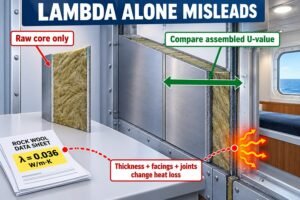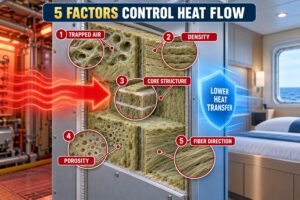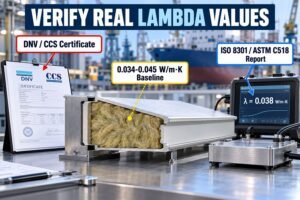
Struggling to decode fire test reports? Failing to understand integrity and insulation leads to rejected panels and costly shipyard delays. Let me show you how these tests actually work.
Integrity and insulation in marine panel fire tests, governed by the IMO FTP Code, are judged by two full criteria: integrity measures the blockage of flames and hot gases, while insulation measures the prevention of dangerous temperature rises on the unexposed side of the panel.
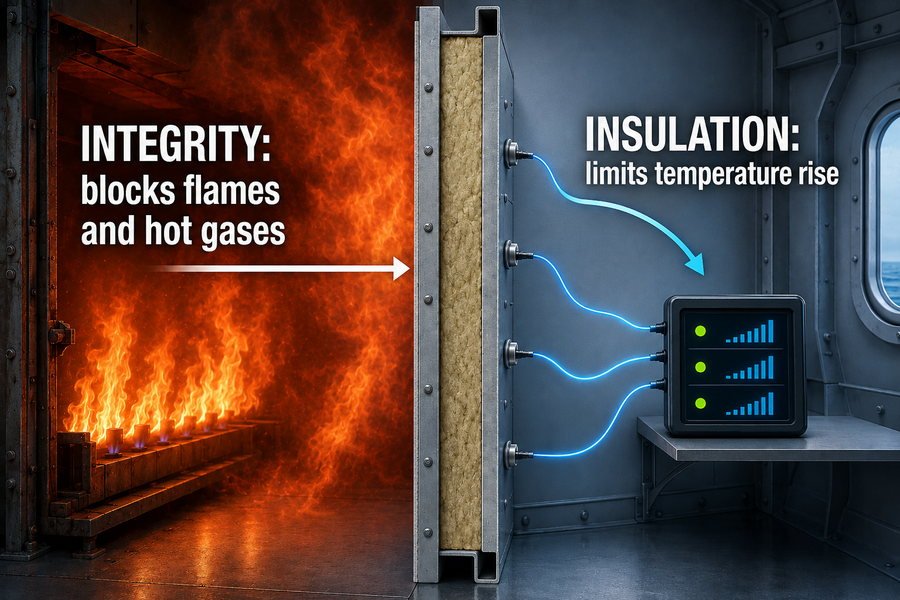
Let us break down these two critical factors so you can buy your next batch of marine outfitting materials with total confidence.
What Defines Integrity Failure in a Marine Wall Panel Fire Test?
Are your wall panels failing inspections? A breach in fire integrity puts the whole ship at risk. Here is exactly what triggers an integrity failure during testing.
According to the IMO 2010 FTP Code, marine wall panel integrity failure occurs through three complete criteria: a cotton wool pad ignites, sustained flaming lasts over 10 seconds on the unexposed side, or gap gauges of 6mm or 25mm penetrate the panel joints.
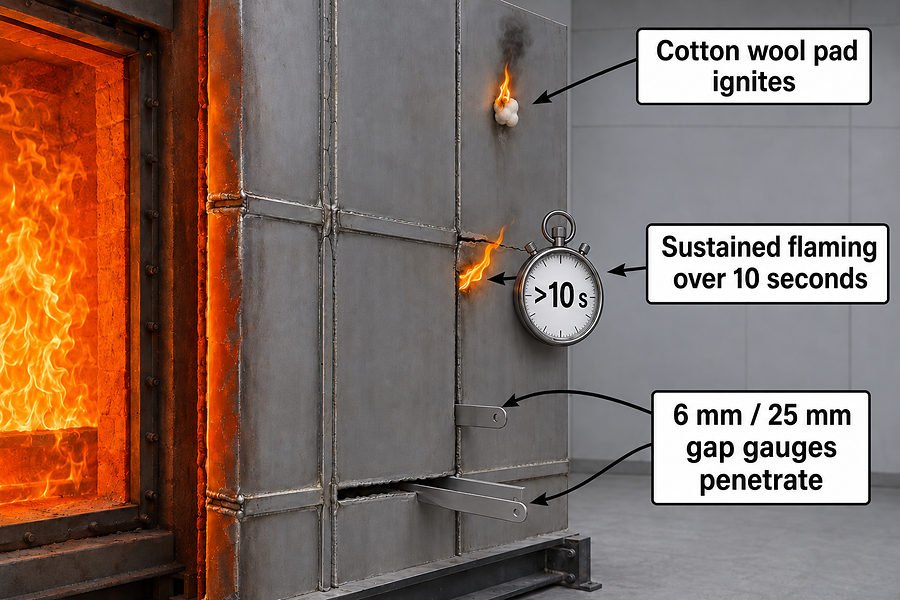
Cotton Pad Ignition Criterion for Panel Integrity
When I worked at the marine outfitting factory, I watched many fire tests. The testing lab places a panel in a furnace. The furnace heats up to about 945°C for an A-60 test.1 The unexposed side of the panel faces the room. The lab technicians use a special cotton wool pad. They hold this pad against any glowing or hot spots on the unexposed side of the panel for up to 30 seconds. If the hot gases passing through the panel cause this cotton pad to ignite and burn, the panel fails the integrity test immediately.2 This rule ensures that no invisible hot gases can start a secondary fire in the next cabin. You must buy panels with high-quality steel skins that do not crack under extreme heat.
Sustained Flaming and Gap Gauge Penetration Rules
The testing standard also looks for direct flames and physical gaps. I remember a test where a panel warped under the high heat. This warping created a gap between two joined panels. The lab technician used a 6mm steel gap gauge. The rule states that if a 6mm gap gauge can enter the gap and move along the joint for 150mm, the panel fails the integrity test.3 There is also a larger gauge. If a 25mm gap gauge penetrates through the panel at any single point, the panel fails. Finally, the lab watches for actual fire. If any flaming occurs on the unexposed side and lasts for more than 10 continuous seconds, the panel fails.4 I always tell my clients to check the joint designs of the panels. A good tongue-and-groove joint prevents these gaps from forming.
| Integrity Failure Criterion | Specific Measurement | IMO 2010 FTP Code Reference |
|---|---|---|
| Cotton Pad Ignition | Ignites within 30 seconds of application | Part 3, Appendix 1 |
| Sustained Flaming | Continuous flaming > 10 seconds | Part 3, Appendix 1 |
| Small Gap Penetration | 6mm gauge penetrates and moves 150mm | Part 3, Appendix 1 |
| Large Gap Penetration | 25mm gauge penetrates at any point | Part 3, Appendix 1 |
What Temperature Rise Triggers Insulation Failure on a Marine Ceiling Panel?
Worried about heat transfer above passenger cabins? Excessive heat causes secondary fires. Knowing the exact temperature limits helps you select the right rockwool density for ceiling panels.
Under IMO standards, marine ceiling panel insulation fails based on two complete criteria: the average temperature on the unexposed side rises more than 140°C above the initial temperature, or the maximum temperature at any single point rises more than 180°C (or 225°C at joints).
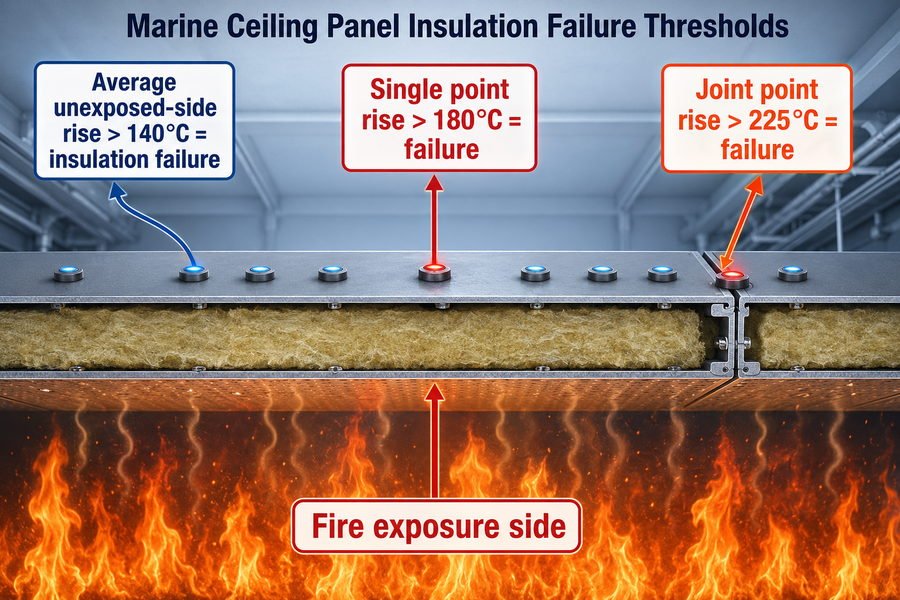
Average Temperature Rise Limits for Insulation
Insulation testing is all about measuring heat transfer. During my early days in the shipbuilding industry, I learned how strict the IMO 2010 FTP Code is about temperature. Before the fire test starts, the lab records the initial room temperature. Let us say the room is 20°C. The lab attaches five thermocouples5 to the unexposed side of the ceiling panel. One goes in the center, and four go in the quarters. The test begins. The lab records the temperatures continuously. To pass the insulation test, the average temperature of these five points cannot rise more than 140°C above the initial temperature6. In our example, the average temperature must stay below 160°C. If the average hits 161°C at minute 58 of a 60-minute test, the panel fails the A-60 insulation rating. This is why the density of the rockwool inside the panel is so important. Low-density rockwool lets heat pass through too quickly.
Maximum Single Point Temperature Rise on Panels
Average temperature is not the only rule. Localized hot spots are very dangerous. Sometimes, four points on the panel stay cool, but one point gets very hot. The IMO standard covers this. The lab places extra thermocouples on any suspected weak points, like joints or stiffeners. If the temperature at any single point on the flat surface of the panel rises more than 180°C above the starting temperature, the panel fails. The rules give a little extra room for the joints. At the joints where two panels meet, the temperature can rise up to 225°C above the starting temperature7. If it crosses that 225°C limit, the panel fails the insulation test. I have seen panels pass the average test easily but fail because one bad joint let too much heat through.
| Temperature Measurement Type | Maximum Allowed Rise | Location on Panel |
|---|---|---|
| Average Temperature | 140°C above initial | 5 standard surface points |
| Maximum Single Point (Surface) | 180°C above initial | Any point on flat surface |
| Maximum Single Point (Joint) | 225°C above initial | Panel joints or connections |
Why Do Marine Wall Panels Pass Integrity but Fail Insulation?
Have you seen a panel hold back flames but fail the test anyway? This frustrating mismatch wastes your purchasing budget. Let us explore the real reasons behind this.
Marine wall panels pass integrity but fail insulation due to three main causes: inadequate rockwool core density, thermal bridging through internal steel profiles, and poor joint design that allows localized heat transfer even when flames do not pass through the panel gap.
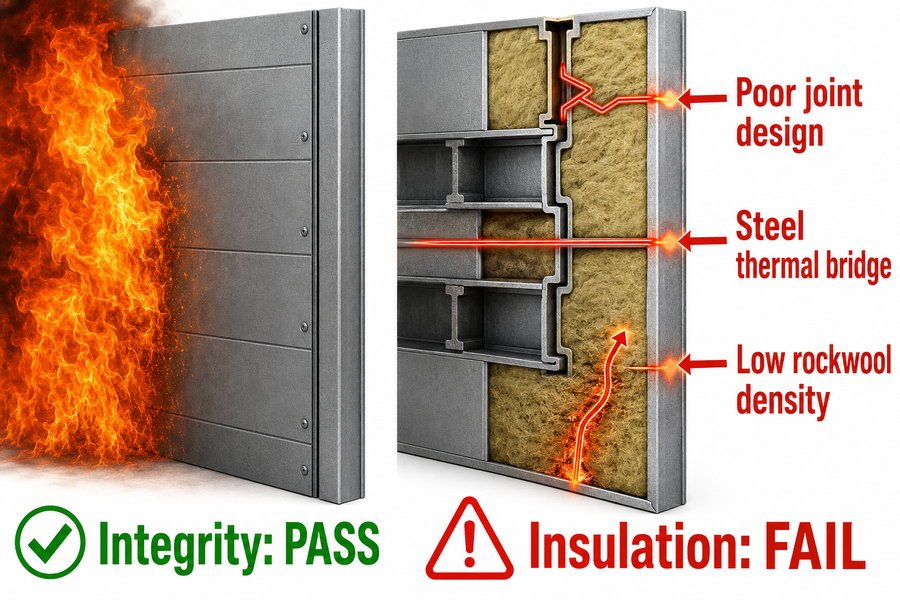
Impact of Inadequate Rockwool Density on Insulation
I get many emails from buyers who do not understand why their A-60 panels failed the insulation test8. The panel did not let any flames through, so it passed the integrity part perfectly. But it got too hot on the back. The number one reason is the rockwool core density. Rockwool slows down heat. For an A-60 wall panel, you usually need a rockwool density of at least 120 kg/m³9. Some factories try to save money. They use rockwool with a density of 100 kg/m³ or even 80 kg/m³. This cheaper rockwool has more air pockets. Heat travels through it much faster. The panel blocks the fire, but the temperature on the unexposed side quickly shoots past the 140°C average limit10. You must always confirm the rockwool density with your supplier before you buy.
Thermal Bridging and Joint Design Flaws in Marine Panels
The second reason is thermal bridging. Marine panels use steel skins and steel internal frames to hold the rockwool. Steel is an excellent conductor of heat11. If the internal steel parts touch both the hot side and the cool side of the panel, the heat travels right along the steel. We call this a thermal bridge. The rockwool does its job, but the steel bypasses it. The single-point temperature on the unexposed side will spike above the 180°C limit. The third reason is poor joint design. When two panels connect, there is less insulation at that specific spot. A bad joint might fit tightly enough to block flames and pass the integrity gap gauge test. However, the lack of thick insulation at the seam allows the temperature to exceed the 225°C limit for joints. I always recommend panels with a broken thermal bridge design.
| Failure Cause | Effect on Integrity Test | Effect on Insulation Test |
|---|---|---|
| Low Density Rockwool (<100 kg/m³) | Passes (Blocks flames) | Fails (High average temp >140°C) |
| Severe Thermal Bridging | Passes (Steel holds shape) | Fails (Hot spots >180°C) |
| Poor Insulated Joints | Passes (Gaps < 6mm) | Fails (Joint temp >225°C) |
How to Read Integrity vs Insulation Results in a Marine Panel Test Report?
Staring at a complex lab report? Misreading test data means buying non-compliant panels. I will show you how to easily extract the exact integrity and insulation data.
To read a marine panel test report correctly, you must verify four complete details: the testing standard (IMO 2010 FTP Code), the stated integrity duration (E rating), the insulation duration (I rating), and the final classification like A-60 or B-15.
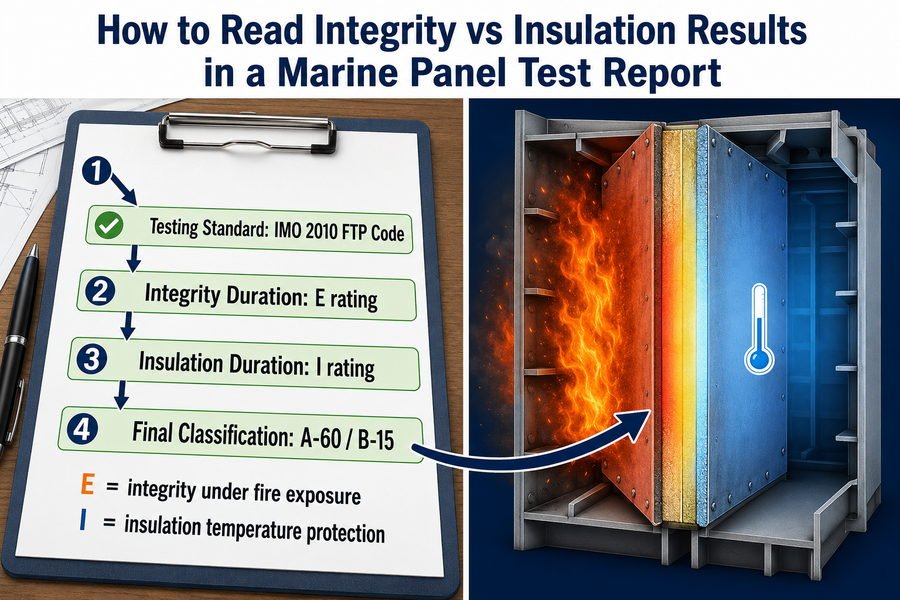
Identifying the Testing Standard and Classification
When a supplier sends you a test report, do not just look at the big letters. I have seen buyers purchase panels with outdated certificates. First, you must check the testing standard. It must say "IMO 2010 FTP Code Part 312". If it says IMO 1998 FTP Code, the certificate is old and might not be valid for new shipyard projects. Next, look at the final classification. Marine panels are grouped into A-Class and B-Class. You will see ratings like A-60, A-30, A-15, A-0, B-15, or B-0. The letter tells you the type of bulkhead. The number tells you the time in minutes for the insulation requirement. For example, an A-60 panel means it holds its insulation for 60 minutes.
Locating Specific Integrity and Insulation Durations
Now you need to find the specific test durations inside the report. Look for a section often called "Test Results" or "Observations". You will see two key measurements. The first is Integrity (often marked as 'E' in some land-based standards, but IMO just calls it Integrity). For any A-Class panel, the integrity must hold for 60 minutes. Even an A-0 panel must pass 60 minutes of integrity testing. For a B-Class panel, the integrity must hold for 30 minutes.13 The second measurement is Insulation (often marked as 'I'). The report will list the exact minute the panel failed the temperature limits. If a panel reached a 140°C average rise at 64 minutes, it passed the A-60 insulation requirement. If it reached the limit at 45 minutes, it only qualifies for A-30. You must read these exact minute markers to know the real quality of the panel.
| Final IMO Classification | Required Integrity Duration | Required Insulation Duration |
|---|---|---|
| A-60 Class | 60 Minutes | 60 Minutes |
| A-0 Class | 60 Minutes | 0 Minutes |
| B-15 Class | 30 Minutes | 15 Minutes |
| B-0 Class | 30 Minutes | 0 Minutes |
Which Matters More for Marine Ceiling Panels in Accommodation Zones, Integrity or Insulation?
Unsure where to spend your budget? Getting this wrong can risk lives in passenger areas. Let us look at whether integrity or insulation takes priority in accommodations.
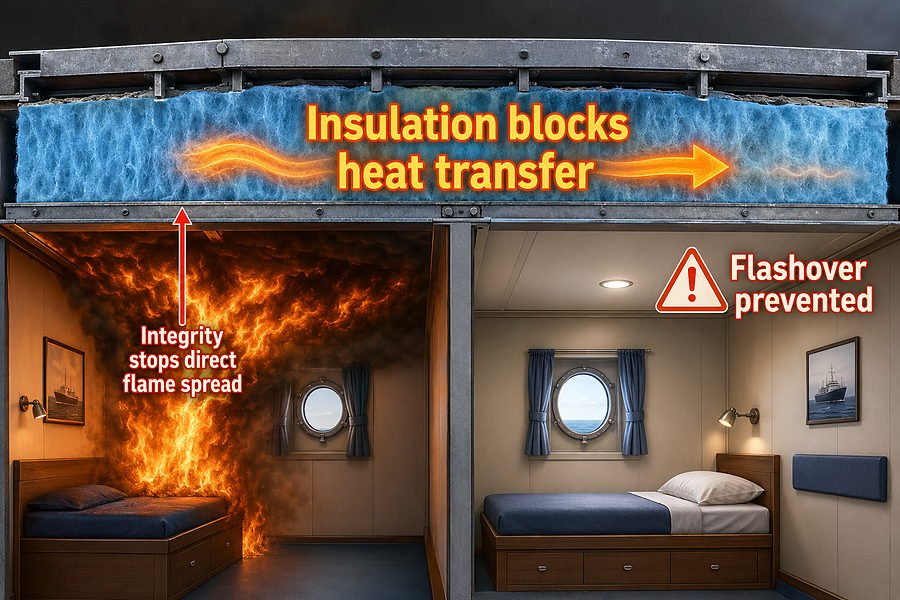
For marine ceiling panels in accommodation zones, both are legally required, but insulation matters most for life safety because it prevents flashover fires in adjacent cabins, while integrity is the baseline requirement to stop direct flame spread between the ship compartments.
The Baseline Role of Integrity in Compartment Safety
When I plan a project for passenger ships, the accommodation zone is the most strict area. The IMO SOLAS regulations dictate exactly what panels to use.14 Integrity is the absolute baseline. If a fire starts in one cabin, the ceiling panel must stop the actual flames from reaching the deck above. If flames break through, the fire spreads rapidly through the ship's structure. For B-Class ceilings, which are common inside cabins, the integrity must last for 30 minutes.15 This gives passengers time to evacuate the immediate area. You cannot compromise on integrity. A panel that fails integrity is useless, even if it has thick rockwool. However, passing integrity alone is not enough to keep people safe in the next room.
Why Insulation Prevents Secondary Fires in Accommodations
Insulation is actually the critical life-saving factor in accommodation zones. Imagine a fire in Cabin A. The ceiling panel has perfect integrity. No flames pass through. But the panel has zero insulation (like a B-0 rating). The steel on the unexposed side gets extremely hot, reaching over 400°C.16 In the cabin above, this intense heat radiates into the room. Furniture, carpets, or curtains touching the deck can suddenly catch fire just from the heat. We call this a flashover fire. This is why insulation matters more for containing the danger. By using a B-15 ceiling panel, you ensure the temperature on the unexposed side stays safe for at least 15 minutes.17 This prevents secondary fires and protects the evacuation routes. You must always check the fire plan of the ship to buy the exact insulation rating the shipyard requires.
| Safety Factor | Primary Function in Accommodations | Risk if Failed |
|---|---|---|
| Integrity Requirement | Stops direct flame and smoke spread | Fire enters adjacent rooms |
| Insulation Requirement | Stops severe heat transfer | Flashover fire in next room |
| B-15 Ceiling Application | Provides 30m integrity / 15m insulation | Protects escape routes |
How to Compare Integrity and Insulation Data Across Marine Wall Panel Offers?
Drowning in supplier quotes? Comparing offers without looking at the raw test data costs you money. Here is a simple way to evaluate multiple suppliers effectively.
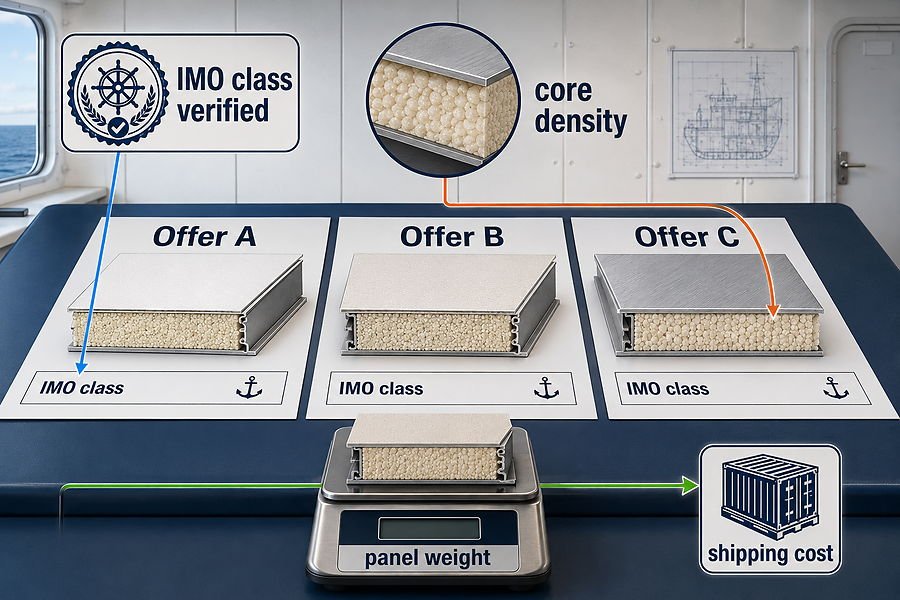
To compare marine wall panel offers, you must evaluate three complete factors: verify the official IMO certification for identical classes, compare the exact core material densities that drive the insulation, and check the panel weights to balance fire safety with shipping costs.
Verifying Identical Fire Classes and Certifications
I help many buyers compare quotes from different factories in Asia. The first rule is to make sure you are comparing the same products. Supplier A might quote $35 per square meter. Supplier B might quote $50 per square meter. Before you look at the price, look at the certificate. Are they both offering an A-60 panel? Sometimes a cheap quote is actually for an A-0 panel. An A-0 panel has 60 minutes of integrity but zero insulation.18 It is much cheaper to make. You must ask both suppliers for their EC Type Examination Certificate (Module B). Check the validity dates. Check the lab that issued it. DNV, ABS, or Lloyd's Register are top-tier labs.18 If Supplier A has a valid DNV certificate for A-60 and Supplier B has an expired certificate, Supplier B is useless to you.
Comparing Core Densities and Panel Weights
Once you confirm both suppliers offer valid A-60 panels with full integrity and insulation data, you must compare the physical specs. The core density controls the insulation quality. Ask for the rockwool density. Supplier A might use 120 kg/m³ rockwool. Supplier B might use 140 kg/m³ rockwool. Higher density usually means better insulation, but it also adds weight.19 You must compare the total weight per square meter. An A-60 panel typically weighs between 17 kg/m² and 20 kg/m². If Supplier B's panel weighs 22 kg/m², it will cost you much more in sea freight. It will also add unwanted weight to the ship. A great supplier balances high insulation performance with a lower total weight by using smarter joint designs instead of just adding heavy rockwool. Compare the price, density, and weight together to make the best purchasing decision.
| Comparison Metric | Why It Matters for Fire Tests | Typical Value for A-60 Panel |
|---|---|---|
| IMO Fire Class | Ensures correct integrity/insulation time | A-60 (60m E / 60m I) |
| Rockwool Density | Dictates heat transfer speed (Insulation) | 120 kg/m³ to 150 kg/m³ |
| Panel Weight | Impacts shipping cost and ship payload | 17 kg/m² to 20 kg/m² |
| Price per Sqm | Measures commercial value | $45 to $65 USD |
Conclusion
Mastering integrity and insulation criteria helps you avoid bad suppliers, save money, and ensure shipyard compliance. Use these tips to buy high-quality marine panels with total confidence every time.
-
"[PDF] RESOLUTION MSC.61(67) (adopted on 5 December 1996 ...", https://wwwcdn.imo.org/localresources/en/KnowledgeCentre/IndexofIMOResolutions/MSCResolutions/MSC.61(67).pdf. The IMO 2010 FTP Code time-temperature curve for fire-resisting divisions reaches approximately 945°C at 60 minutes, providing the basis for the stated A-60 furnace exposure temperature. Evidence role: definition; source type: institution. Supports: An A-60 marine fire test exposes the panel to a furnace temperature of about 945°C.. Scope note: This supports the furnace temperature at the 60-minute point of the standard curve; actual furnace readings may vary within permitted test tolerances. ↩
-
"Are Marine Fire Divisions the Same as Marine Panel Ratings?", https://magellanmarinetech.com/are-marine-fire-divisions-same-as-marine-panel-ratings/. The IMO 2010 FTP Code describes integrity failure by cotton-wool-pad ignition during fire-resistance testing of divisions, indicating that ignition of the pad on the unexposed face is a failure criterion. Evidence role: definition; source type: institution. Supports: Cotton pad ignition on the unexposed side is an integrity failure criterion in the marine fire-resistance test.. Scope note: The source defines the standardized test criterion; it does not independently prove the mechanism of hot-gas leakage in every panel design. ↩
-
"[PDF] RESOLUTION MSC.307(88) (adopted on 3 December 2010 ...", https://wwwcdn.imo.org/localresources/en/KnowledgeCentre/IndexofIMOResolutions/MSCResolutions/MSC.307(88).pdf. The IMO 2010 FTP Code specifies loss of integrity where a 6 mm gap gauge can penetrate an opening and be moved for a prescribed distance, including the 150 mm movement criterion. Evidence role: definition; source type: institution. Supports: A 6 mm gap gauge penetrating and moving 150 mm along a joint is an integrity failure condition.. Scope note: This supports the standardized gauge criterion; interpretation can depend on the exact specimen configuration and test laboratory procedure. ↩
-
"[PDF] RESOLUTION MSC.307(88) (adopted on 3 December 2010 ...", https://wwwcdn.imo.org/localresources/en/KnowledgeCentre/IndexofIMOResolutions/MSCResolutions/MSC.307(88).pdf. The IMO 2010 FTP Code identifies sustained flaming on the unexposed face for longer than 10 seconds as a loss-of-integrity criterion in fire-resistance testing. Evidence role: definition; source type: institution. Supports: Continuous flaming on the unexposed side for more than 10 seconds is an integrity failure criterion.. Scope note: The citation supports the test criterion itself, not the broader performance of any particular commercial panel system. ↩
-
"[PDF] RESOLUTION MSC.307(88) (adopted on 3 December 2010 ...", https://wwwcdn.imo.org/localresources/en/KnowledgeCentre/IndexofIMOResolutions/MSCResolutions/MSC.307(88).pdf. The FTP Code’s fire-resisting division procedure describes measuring unexposed-face temperatures with thermocouples and using specified measurement points to determine the mean temperature rise. Evidence role: mechanism; source type: institution. Supports: The insulation test uses thermocouples on the unexposed side of the panel to measure temperature rise during the fire test.. Scope note: The exact number and placement of thermocouples can depend on the specimen type and detailed code figures, so the source should be checked against the specific ceiling-panel configuration described. ↩
-
"What Is the Purpose and Scope of the IMO FTP Code? - Magellan ...", https://magellanmarinetech.com/what-purpose-scope-of-imo-ftp-code/. The FTP Code criterion for fire-resisting divisions states that the average temperature rise on the unexposed face must not exceed 140°C above the initial temperature for the relevant insulation classification period. Evidence role: general_support; source type: institution. Supports: For the insulation criterion, the average unexposed-face temperature rise is limited to 140°C above the initial temperature.. Scope note: This verifies the temperature-rise threshold; the separate example of a 60-minute A-60 failure at minute 58 is an application of the rule rather than a directly documented case. ↩
-
"[PDF] RESOLUTION MSC.307(88) (adopted on 3 December 2010 ...", https://wwwcdn.imo.org/localresources/en/KnowledgeCentre/IndexofIMOResolutions/MSCResolutions/MSC.307(88).pdf. The FTP Code insulation criteria distinguish between general unexposed-face temperature limits and higher permitted temperature rises at joints or connections, including a 225°C limit for joint locations. Evidence role: general_support; source type: institution. Supports: Panel joints or connections have a higher single-point temperature-rise limit of 225°C above the initial temperature.. Scope note: This supports the stated numerical joint limit, but not the author’s anecdotal observation that particular panels failed because of a bad joint. ↩
-
"What Is the Purpose and Scope of the IMO FTP Code? - Magellan ...", https://magellanmarinetech.com/what-purpose-scope-of-imo-ftp-code/. The IMO FTP Code describes A-class division fire tests as including both integrity and insulation performance criteria, so a panel may resist flame passage while still failing temperature-rise requirements. Evidence role: definition; source type: institution. Supports: A-60 panels can pass integrity requirements yet fail the insulation portion of the fire test.. Scope note: This supports the testing framework generally; the result for any individual panel depends on the certified test specimen and test report. ↩
-
"Determination of Thermal Properties of Mineral Wool Required for ...", https://pmc.ncbi.nlm.nih.gov/articles/PMC10488771/. Fire-test reports and technical studies of mineral-wool-filled steel sandwich panels show that insulation performance is commonly evaluated with specified mineral wool densities, providing context for why density is treated as a critical design variable. Evidence role: general_support; source type: paper. Supports: For an A-60 wall panel, rockwool density is commonly treated as a key parameter, and the article claims a typical minimum of 120 kg/m³.. Scope note: A neutral source may support density as an important variable, but a universal minimum of 120 kg/m³ may require a specific tested system, approval certificate, or classification-society rule rather than a general standard. ↩
-
"[PDF] RESOLUTION A.754(18) adopted on 4 November 1993 ...", https://wwwcdn.imo.org/localresources/en/KnowledgeCentre/IndexofIMOResolutions/AssemblyDocuments/A.754(18).pdf. The IMO fire-test procedure for A-class divisions specifies that the average temperature rise on the unexposed face must not exceed 140°C above the initial temperature during the required classification period. Evidence role: definition; source type: institution. Supports: A-60 insulation performance is judged against a 140°C average unexposed-side temperature-rise limit.. Scope note: The cited limit is a test criterion; it does not by itself identify low-density rockwool as the cause of failure. ↩
-
"Determination of Thermal Properties of Mineral Wool Required for ...", https://pmc.ncbi.nlm.nih.gov/articles/PMC10488771/. Engineering reference data list the thermal conductivity of steel as far higher than that of mineral wool insulation, supporting the mechanism by which continuous steel members can conduct heat through an insulated panel. Evidence role: mechanism; source type: education. Supports: Steel conducts heat much more readily than rockwool, making thermal bridging plausible in marine panels.. Scope note: Thermal conductivity values alone do not quantify the temperature rise in a particular panel design; geometry and test conditions also matter. ↩
-
"[PDF] RESOLUTION MSC.307(88) (adopted on 3 December 2010 ...", https://wwwcdn.imo.org/localresources/en/KnowledgeCentre/IndexofIMOResolutions/MSCResolutions/MSC.307(88).pdf. The 2010 FTP Code, adopted by IMO Resolution MSC.307(88), sets out fire-test procedures for fire-resisting divisions in Part 3 and provides the regulatory context for using this designation on marine panel test reports. Evidence role: definition; source type: institution. Supports: Supplier test reports for marine panels should identify the applicable testing standard as IMO 2010 FTP Code Part 3.. Scope note: This supports the relevant current IMO test framework, but project-specific validity still depends on flag-state, class-society, and contract requirements. ↩
-
"What Is the Purpose and Scope of the IMO FTP Code?", https://magellanmarinetech.com/what-purpose-scope-of-imo-ftp-code/. SOLAS/FTP Code definitions of A-class and B-class divisions specify that A-class divisions prevent smoke and flame passage for one hour, while B-class divisions do so for the first half hour, establishing the integrity durations used for these classifications. Evidence role: definition; source type: institution. Supports: A-class marine panels require 60 minutes of integrity performance, including A-0, while B-class panels require 30 minutes.. Scope note: This supports the regulatory classification rule; it does not verify that any individual manufacturer’s panel achieved the stated duration in a specific test. ↩
-
"Summary of SOLAS chapter II-2 - International Maritime Organization", https://www.imo.org/en/ourwork/safety/pages/summaryofsolaschapterii-2-default.aspx. IMO SOLAS Chapter II-2 and the associated Fire Test Procedures Code establish fire-safety requirements and approval test methods for ship divisions and materials used in accommodation and service spaces. Evidence role: expert_consensus; source type: institution. Supports: IMO SOLAS regulations govern the fire-performance requirements for panels used in passenger-ship accommodation areas.. Scope note: SOLAS generally specifies required fire-performance standards and approval procedures rather than naming specific commercial panel products. ↩
-
"[PDF] recommendation for fire test procedures for “a” and “b” class ...", https://wwwcdn.imo.org/localresources/en/KnowledgeCentre/IndexofIMOResolutions/AssemblyDocuments/A.163(ES.IV).pdf. The SOLAS/FTP Code definition of B-class divisions requires construction that prevents the passage of flame for the first half hour of the standard fire test. Evidence role: definition; source type: institution. Supports: B-class ceiling divisions must maintain integrity against flame passage for 30 minutes.. Scope note: This directly supports the 30-minute integrity criterion, but separate ship design rules or fire-control plans may determine where B-class ceilings are required on a particular vessel. ↩
-
"[PDF] RESOLUTION A.754(18) adopted on 4 November 1993 ...", https://wwwcdn.imo.org/localresources/en/KnowledgeCentre/IndexofIMOResolutions/AssemblyDocuments/A.754(18).pdf. Fire-resistance and heat-transfer studies of unprotected steel show that steel exposed to standard fire conditions can reach several hundred degrees Celsius within short time periods, illustrating why insulation is needed to limit heat transmission through metal divisions. Evidence role: mechanism; source type: paper. Supports: An uninsulated or poorly insulated steel division can transmit enough heat for the unexposed side to reach several hundred degrees Celsius.. Scope note: Such studies support the thermal mechanism and approximate temperature range, but the exact unexposed-face temperature depends on panel geometry, fire curve, boundary conditions, and the tested assembly. ↩
-
"What Is the Purpose and Scope of the IMO FTP Code? - Magellan ...", https://magellanmarinetech.com/what-purpose-scope-of-imo-ftp-code/. Under the SOLAS/FTP Code classification system, a B-15 division must satisfy the B-class integrity requirement and meet insulation criteria limiting the average and maximum temperature rise on the unexposed face for 15 minutes in the standard fire test. Evidence role: definition; source type: institution. Supports: A B-15 ceiling panel is classified to limit unexposed-side temperature rise for 15 minutes while maintaining B-class integrity.. Scope note: The test classification demonstrates performance under standardized furnace conditions; actual shipboard temperatures may vary with installation details and fire severity. ↩
-
"International Association of Classification Societies - Wikipedia", https://en.wikipedia.org/wiki/International_Association_of_Classification_Societies. International Association of Classification Societies and EU notified-body records identify DNV, ABS, and Lloyd’s Register as major recognized classification or conformity-assessment organizations in the maritime sector, supporting their relevance for marine equipment certification checks. Evidence role: general_support; source type: institution. Supports: DNV, ABS, or Lloyd's Register are credible recognized organizations for marine certification checks.. Scope note: Such sources establish recognition and institutional role, but they do not objectively rank these bodies as “top-tier” or validate any specific certificate. ↩ ↩
-
"Determination of Thermal Properties of Mineral Wool Required for ...", https://pmc.ncbi.nlm.nih.gov/articles/PMC10488771/. Research on mineral-wool insulation reports that bulk density affects thermal conductivity and thermal resistance, while density also directly increases material mass per unit volume, supporting density and weight as linked design variables. Evidence role: mechanism; source type: paper. Supports: Higher rockwool density usually improves insulation performance but increases panel weight.. Scope note: The relationship is material- and design-dependent; higher density does not guarantee better insulation in every panel because fiber structure, temperature, binders, joints, and facings also affect heat transfer. ↩