Buying uncertified marine panels can delay your ship delivery by months. You lose money and face angry clients. I will show you why class approval solves these headaches.
Marine wall and ceiling panels need class society approval to verify compliance with mandatory IMO SOLAS fire safety, acoustic, and structural standards. Approval ensures panels pass non-combustibility and fire resistance tests, granting legal authorization for shipyard installation and maritime operations.
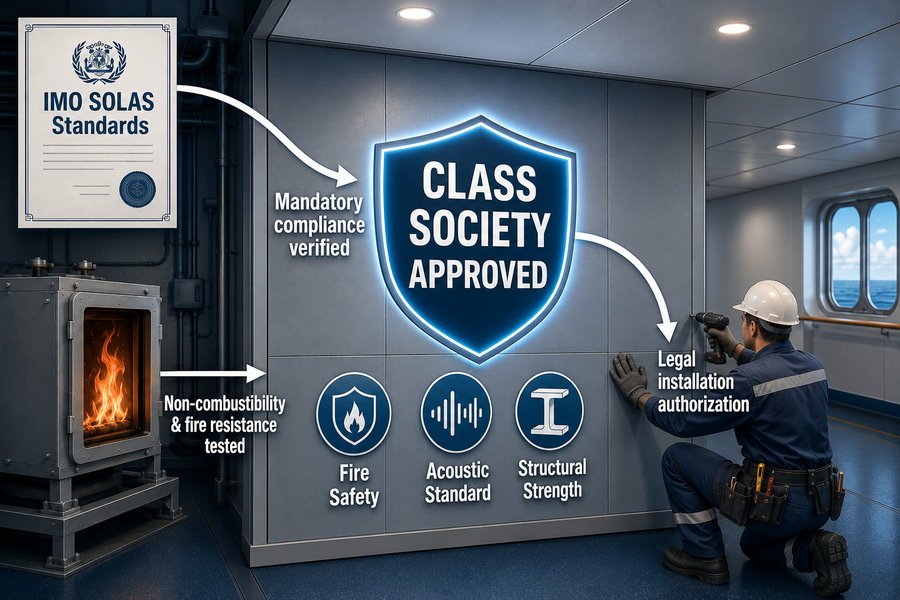
You might wonder what exactly these societies do during the approval process. Let us look closely at their actual role in testing these panels.
What Role Do Class Societies Play in Marine Wall and Ceiling Panel Approval?
Dealing with fake test reports can ruin your outfitting project. You need proof the panels actually work. Class societies step in as the strict, independent judges you need.
Class societies play three main roles: they review engineering drawings, witness physical fire tests according to the IMO FTP Code, and conduct annual factory audits to ensure consistent manufacturing quality for A, B, and C class marine wall and ceiling panels.
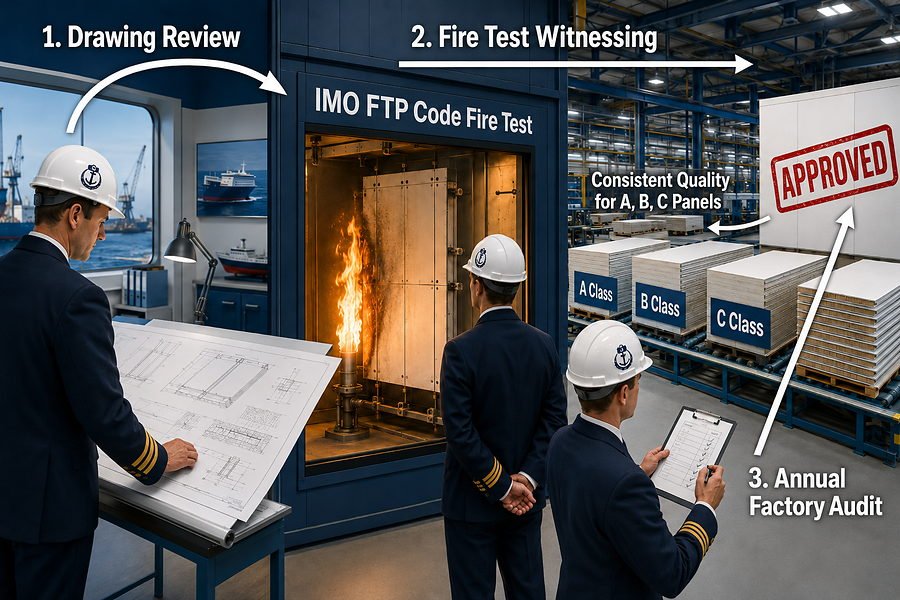
Understanding their role is just the start. Let us dig deeper into the specific tests they witness and the factory audits they perform to keep quality high.
Based on my years at Magellan Marine and my early days in the factory, I know exactly how class societies work. They do not just hand out certificates. They act as a strict barrier to keep bad products off ships. I will explain the three main roles I mentioned earlier.
Class Society Role in Drawing Reviews and Fire Testing
First, class societies review engineering drawings. Before we build any panel, we must send the CAD drawings to societies like DNV or ABS. They check the thickness of the steel skin, usually 0.6 mm, and the density of the rockwool core, typically 120 kg/m³. They make sure the design meets the basic rules before testing begins.
Second, they witness physical fire tests. This is the hardest part. The test follows the IMO 2010 FTP Code Part 31. The class surveyor goes to an approved fire laboratory. We place the B-15 marine wall panel into a huge furnace. The surveyor watches the temperature rise. For a B-Class panel, the furnace reaches 842°C in 30 minutes2. The surveyor checks the unexposed side of the panel. The temperature on the safe side must not rise more than 140°C on average3. If smoke or flames pass through the panel joints, the surveyor fails the product. They document everything to prove the panel stops fire.
Class Society Role in Annual Factory Audits
Third, they conduct annual factory audits4. A test only proves one panel is good. The class society needs to know every panel is good. Once a year, a surveyor visits our factory. They check our raw material purchase records. They verify that we still buy the exact fire-rated glue we used during the fire test. They inspect our pressing machines and worker training records. If our quality system is bad, they cancel the certificate.
| Class Society Role | Action Taken by Surveyor | Purpose of Action | Frequency |
|---|---|---|---|
| Drawing Review | Check steel thickness and rockwool density | Ensure design meets IMO basic rules | Once per new product |
| Fire Test Witnessing | Monitor furnace at 842°C for 30 minutes | Prove panel stops fire and heat | Once every 5 years |
| Factory Quality Audit | Inspect raw materials and pressing machines | Ensure consistent daily production | Annually |
Why Do Shipyards Require Class Certificates for Marine Panels?
A shipyard rejecting your panel delivery is a nightmare. This wastes time and ruins your profit margin. Shipyards demand class certificates to avoid massive legal and financial risks.
Shipyards require class certificates for marine panels for four reasons: to meet international maritime law, to secure ship hull insurance, to pass port state control inspections, and to streamline vessel delivery by preventing costly removal of uncertified cabin partitions.
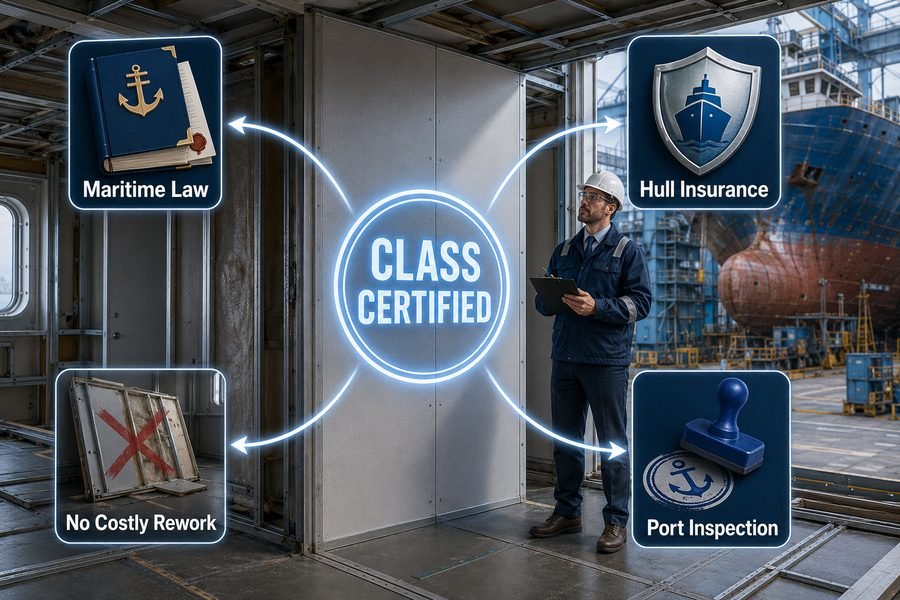
Knowing why shipyards demand these documents helps you prepare better. Let us break down the legal and insurance pressures shipyards face regarding marine panel certificates.
Shipyards do not ask for class certificates just to make your life hard. They ask because they have no choice. I talk to shipyard engineers every week. They have strict rules they must follow. I will explain the four reasons shipyards demand these certificates.
Fulfilling SOLAS Laws and Securing Ship Insurance
First, shipyards must meet international maritime law. The Safety of Life at Sea (SOLAS) convention, Chapter II-2, is the global law for ship fire safety. SOLAS demands that all passenger and cargo ships use certified fire-resistant materials.5 The shipyard cannot break this law. The class certificate is the only legal proof that the marine panel meets SOLAS rules.6
Second, shipyards need to secure ship hull insurance. When a shipyard builds a $50 million vessel, they buy builder's risk insurance. Insurance companies are very strict. They will not cover a ship built with uncertified materials. If the shipyard installs unapproved B-15 ceiling panels, the insurance company will cancel the policy.
Passing Inspections and Preventing Costly Reworks
Third, shipyards must pass port state control inspections. Before a ship leaves the dock, government inspectors check the ship. If they find marine wall panels without valid class type approval certificates, they will detain the ship.7 The shipyard will face heavy fines.
Fourth, shipyards want to streamline vessel delivery and prevent reworks. Removing and replacing uncertified panels is very expensive. In European shipyards, outfitting labor costs around $80 to $120 per hour.8 If they install 1,000 square meters of uncertified panels, tearing them down and reinstalling new ones will cost hundreds of thousands of dollars. The shipyard demands certificates upfront to guarantee they only do the work once.
| Shipyard Requirement | Reason for Requirement | Consequence of Missing Certificate | Financial Impact |
|---|---|---|---|
| Maritime Law (SOLAS) | Must follow Chapter II-2 rules | Ship cannot be legally registered | Total project failure |
| Ship Hull Insurance | Mitigate fire risk during build | Insurance policy is cancelled | Uninsured $50M asset |
| Port State Control | Government safety inspection | Ship is detained at the port | $20,000+ daily fines |
| Prevent Reworks | Avoid removing bad partitions | Must tear down and rebuild cabins | $80-$120/hour in labor |
How Does Class Approval Boost Marine Panel Supplier Credibility?
Competing on price alone attracts bad buyers. You struggle to win large European projects. Having class approval instantly marks you as a premium, reliable supplier in a tough market.
Class approval boosts marine panel supplier credibility by proving technical competence, demonstrating financial stability to afford certification costs, validating strict factory quality control systems, and showing a long-term commitment to the global shipbuilding market, building deep buyer trust.
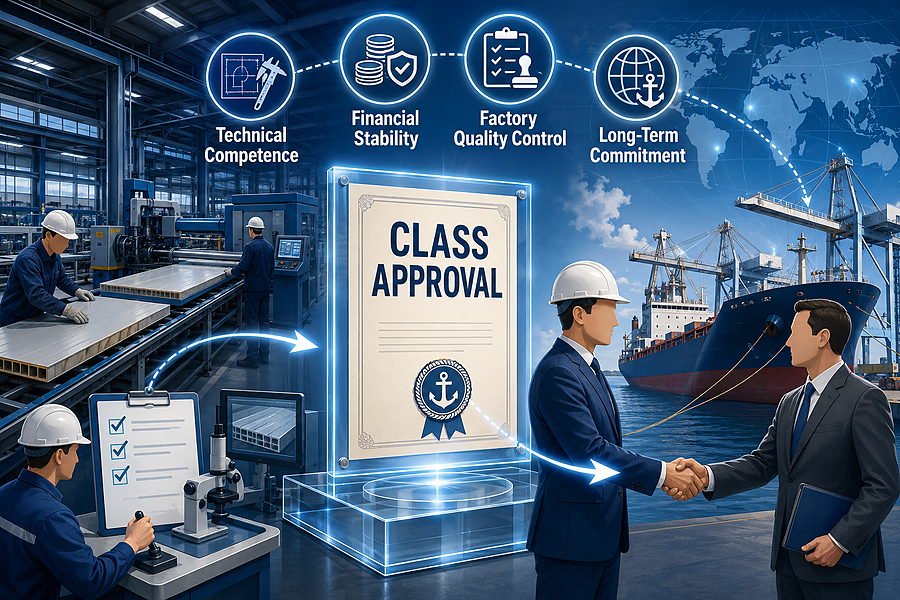
A piece of paper changes how buyers see you. Let us see how the investment in certification transforms a supplier's reputation and business opportunities.
When procurement officers from other countries look for suppliers in Asia, they are very careful. They cannot visit every factory. They need a way to filter good factories from bad ones. I have seen how having a DNV or ABS certificate changes a buyer's attitude completely. I will cover the four ways class approval boosts credibility.
Proving Technical Competence and Financial Stability
First, it proves technical competence. Making a standard metal box is easy. Making a B-15 marine wall panel that stops an 842°C fire for 30 minutes9 without the steel warping and breaking is hard. When a supplier has a class certificate, it tells the buyer that the supplier's engineers know how to manage thermal expansion and core structural integrity.
Second, it demonstrates financial stability. Class testing is not cheap.10 When I arrange tests for Magellan Marine, a single DNV Type Approval certificate for a fire door or wall panel costs between $10,000 and $20,000. Small, unstable workshops do not have this kind of money. When a buyer sees your certificates, they know you have strong cash flow and will not go bankrupt during their project.
Validating Quality Systems and Market Commitment
Third, it validates strict factory quality control systems. As I mentioned before, class societies audit the factory every year. Buyers know this. They know that if you hold a valid certificate, a strict third-party surveyor is checking your glue, steel, and rockwool regularly. This gives the buyer confidence in your daily production.
Fourth, it shows a long-term commitment to the global market. Certificates expire every 5 years and must be renewed. A supplier who keeps their certificates updated is serious about the marine outfitting industry. Procurement officers from interior decoration companies want long-term partners, not factories that will disappear next year.
| Credibility Factor | How Class Approval Proves It | Buyer Perception |
|---|---|---|
| Technical Competence | Panel passed 842°C fire test | Supplier has high engineering skill |
| Financial Stability | Supplier paid $10,000+ for test | Factory is financially strong |
| Quality Control | Passed annual class society audit | Production is stable and reliable |
| Market Commitment | Renews certificate every 5 years | Reliable long-term business partner |
Why Do Shipowners Prefer Class-Approved Marine Ceiling Panels?
Shipowners hate high maintenance costs and fire hazards. Cheap ceiling panels break easily and endanger lives. Class-approved panels give shipowners peace of mind and long-term savings.
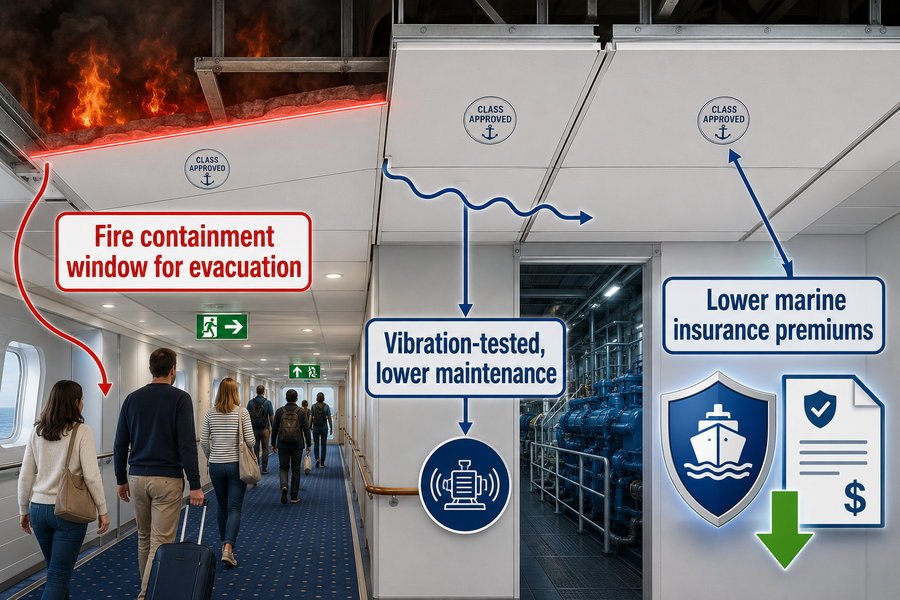
Shipowners prefer class-approved marine ceiling panels for three critical reasons: they guarantee a specific fire containment window for passenger evacuation, reduce long-term maintenance costs by meeting strict vibration standards, and ensure lower marine insurance premiums from global P&I clubs.
The people who own the ships look at long-term value. Let us analyze the specific safety and financial benefits shipowners get from certified ceiling panels.
Shipowners are the final users of the vessel. They care about two things: keeping the ship safe and making money. When a shipowner specifies materials for a new vessel, they strictly demand class-approved ceiling panels. Based on my direct discussions with fleet managers, I will explain the three critical reasons why.
Guaranteeing Evacuation Times and Reducing Maintenance
First, approved panels guarantee a specific fire containment window for passenger evacuation. A fire at sea is a shipowner's worst fear. If a fire starts in a cabin, the B-15 ceiling panel must block the fire from reaching the deck above for exactly 15 minutes of insulation and 30 minutes of integrity11. This specific window gives the crew time to put out the fire or evacuate passengers.12 Unapproved panels might collapse in 3 minutes, causing a disaster.
Second, they reduce long-term maintenance costs by meeting strict vibration standards. A ship engine creates constant vibration. Cheap ceiling panels will rattle, crack, and drop dust. Class-approved ceiling panels are designed to handle ship vibrations ranging from 5Hz to 50Hz13. The connecting profiles and hooks are tested for strength. Shipowners plan to use a ship for 20 to 25 years. Certified panels stay tight and quiet, saving the owner thousands of dollars in repair costs over the ship's life.
Lowering Marine Insurance Premiums
Third, approved panels ensure lower marine insurance premiums. Shipowners must buy Protection and Indemnity (P&I) insurance to cover liabilities like passenger injuries or cargo damage. P&I clubs assess the risk of the ship. If the shipowner uses high-quality, DNV or ABS approved marine outfitting materials, the ship is considered low risk. The P&I club will lower the annual insurance premium. Over 20 years, this saves the shipowner a massive amount of money.
| Shipowner Benefit | Technical Reason | Long-Term Advantage |
|---|---|---|
| Safe Evacuation | Provides 15-30 mins of fire resistance | Saves lives during ship fires |
| Low Maintenance | Withstands 5Hz to 50Hz engine vibration | Avoids costly cabin repairs |
| Lower P&I Premium | Reduces overall vessel risk profile | Saves money on annual insurance |
How Does Class Approval Impact Marine Panel Project Acceptance?
Waiting months for project payment hurts your cash flow. Disputes over panel quality cause these delays. Class approval acts as the ultimate green light for project handover and payment.
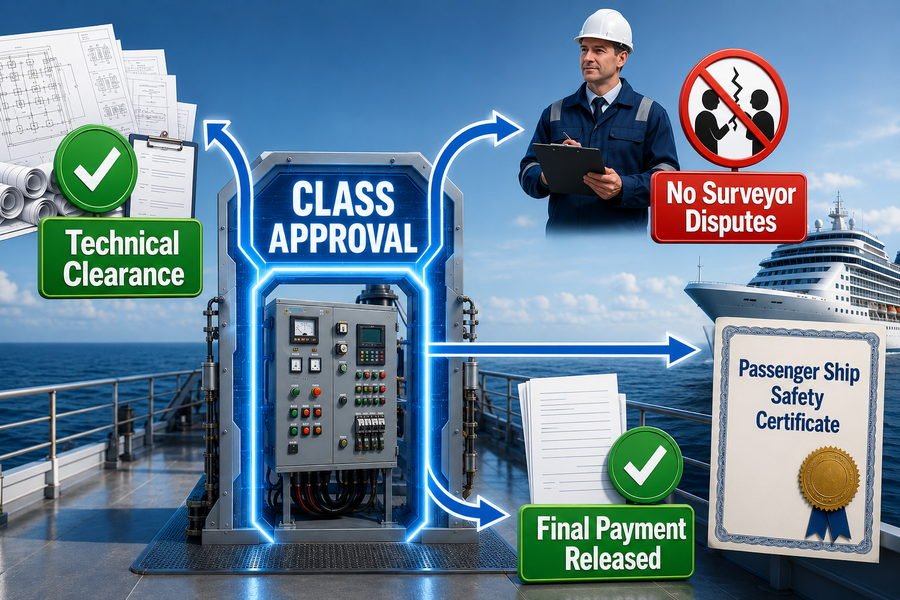
Class approval impacts marine panel project acceptance in four ways: it provides objective proof for technical clearance, prevents on-site surveyor disputes, accelerates the release of final milestone payments, and simplifies the issuance of the final Passenger Ship Safety Certificate.
Getting the panels on the ship is not the end; getting paid is. Let us look at how these certificates speed up the final project acceptance phase.
When an interior decoration company finishes outfitting a ship cabin, the project manager needs the shipyard and the shipowner to accept the work. This acceptance phase can be very painful if you do not have the right documents. I have helped many clients organize their paperwork to ensure smooth acceptance. I will detail the four ways class approval impacts this process.
Accelerating Technical Clearance and Preventing Disputes
First, it provides objective proof for technical clearance. When the shipyard inspector walks into the cabin, they will check the walls and ceilings. If you hand them a valid Lloyd's Register certificate matching the labels on the panels, the technical clearance is immediate. They check the serial numbers and sign the paper.
Second, it prevents on-site surveyor disputes. Sometimes, a local surveyor might question the thickness of a panel or the type of joint used. If you use uncertified panels, you will argue for days. But if you have a class certificate, the argument stops. The certificate clearly states the approved drawings and specs. The local surveyor cannot argue with the official class society type approval.
Speeding Up Payments and Final Vessel Certification
Third, it accelerates the release of final milestone payments. Most marine outfitting contracts hold back 10% to 20% of the money until final acceptance14. For a $200,000 panel order, that means $40,000 is stuck. Because the class certificate guarantees technical clearance, the project is accepted faster, and the bank transfers your final payment without delay.
Fourth, it simplifies the issuance of the Passenger Ship Safety Certificate (PSSC). A passenger ship cannot legally carry people without a PSSC15. The flag state issues this certificate only after verifying that all fire zones use class-approved materials. Providing your panel certificates helps the shipyard get the PSSC quickly, making you a very valuable supplier.
| Acceptance Impact | Action on Site | Benefit to Supplier |
|---|---|---|
| Technical Clearance | Inspector verifies labels match certificate | Fast project handover |
| Dispute Prevention | Certificate overrides local surveyor doubts | Saves days of arguments |
| Milestone Payments | Shipyard signs off on completion | Releases final 10%-20% funds |
| PSSC Issuance | Proves fire zone compliance | Makes shipyard happy with you |
What Risks Come From Sourcing Marine Panels Without Class Approval?
Buying cheap, uncertified panels seems smart until the ship gets detained. You face massive fines and a ruined reputation. The risks of uncertified panels easily outweigh any initial savings.
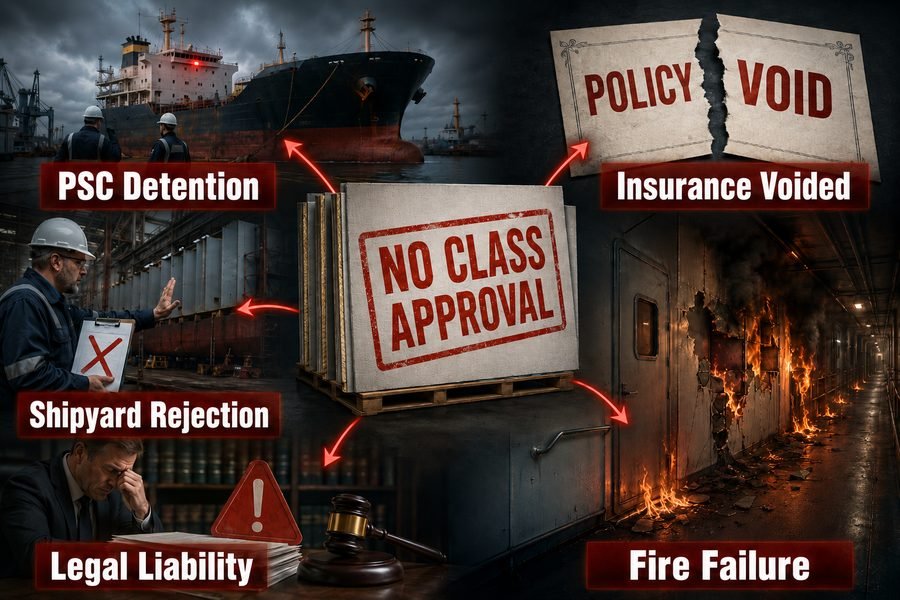
Sourcing marine panels without class approval carries five major risks: total rejection by the shipyard, illegal vessel detention by Port State Control, voided marine insurance policies, complete failure to contain ship fires, and severe legal liability for the procurement company.
Skipping certification is a gamble you will lose. Let us break down the exact legal, financial, and physical disasters that happen when you buy unapproved panels.
Sometimes, buyers want to save money and ask me if they can use standard commercial panels instead of class-approved marine panels16. I always tell them no. The marine industry does not forgive mistakes. I have seen companies go bankrupt because they tried to cheat the rules. I will explain the five major risks of using uncertified panels.
Shipyard Rejection, Vessel Detentions, and Voided Insurance
First, you face total rejection by the shipyard. When the shipping containers arrive, shipyard quality control will check the documents. If there is no class certificate, they will not let the truck enter the yard. You will have to pay for return shipping and buy new panels.
Second, you risk illegal vessel detention by Port State Control (PSC). If uncertified panels somehow get installed, a PSC inspector at a port like Rotterdam or Singapore will find them. They will detain the ship.17 A detained cargo ship costs the owner $20,000 to $30,000 every single day in lost charter rates. The owner will sue you for this money.
Third, you risk voided marine insurance policies18. If a fire breaks out, the insurance investigator will check the cabin materials. If they find uncertified wall panels, they will declare the insurance policy void. The shipowner will get zero money for the burned ship.
Fire Failures and Severe Legal Liabilities
Fourth, there is a complete failure to contain ship fires. Standard panels use cheap glue and standard fiberglass. In an 800°C fire, standard panels melt and release toxic black smoke19 in just 2 minutes. People will die because they cannot breathe or escape.
Fifth, you face severe legal liability. If people die because you bought uncertified panels, maritime courts will investigate. The procurement officer and the decoration company will face criminal charges and massive lawsuits. Saving a few dollars on panels is never worth going to prison.
| Risk Category | Specific Event | Financial / Legal Consequence |
|---|---|---|
| Shipyard Rejection | Panels stopped at yard gate | Cost of buying panels twice |
| PSC Detention | Ship stopped at international port | $20,000+ daily fines and losses |
| Voided Insurance | Investigator finds uncertified panels | Total loss of vessel value |
| Fire Failure | Panels melt and release toxic smoke | Loss of human life |
| Legal Liability | Courts investigate fire cause | Criminal charges and lawsuits |
Conclusion
Class approval is not just paper. It guarantees safety, ensures legal compliance, and secures your payments. Always demand valid class certificates when buying marine wall and ceiling panels.
-
"[PDF] RESOLUTION MSC.307(88) (adopted on 3 December 2010 ...", https://wwwcdn.imo.org/localresources/en/KnowledgeCentre/IndexofIMOResolutions/MSCResolutions/MSC.307(88).pdf. The IMO 2010 FTP Code identifies Part 3 as the test procedure for A-, B-, and F-class divisions, providing the regulatory context for fire testing marine wall and ceiling assemblies. Evidence role: definition; source type: institution. Supports: B-15 marine wall panels are tested under the IMO 2010 FTP Code Part 3.. Scope note: This supports the applicable test framework, not the performance of any specific manufacturer’s panel. ↩
-
"What Is the Purpose and Scope of the IMO FTP Code? - Magellan ...", https://magellanmarinetech.com/what-purpose-scope-of-imo-ftp-code/. The standard fire exposure curve used for IMO FTP Code division tests corresponds to the ISO 834 time-temperature relationship, under which the furnace temperature is approximately 842 °C at 30 minutes. Evidence role: mechanism; source type: institution. Supports: For a B-Class marine panel fire test, the furnace temperature reaches about 842°C after 30 minutes.. Scope note: The value derives from the prescribed furnace curve; actual laboratory readings may vary within permitted tolerances. ↩
-
"[PDF] RESOLUTION MSC.307(88) (adopted on 3 December 2010 ...", https://wwwcdn.imo.org/localresources/en/KnowledgeCentre/IndexofIMOResolutions/MSCResolutions/MSC.307(88).pdf. The IMO FTP Code insulation criterion for class divisions limits the average temperature rise on the unexposed face to 140 °C above the initial temperature during the relevant test period. Evidence role: definition; source type: institution. Supports: The safe side of the tested panel must not exceed an average temperature rise of 140°C.. Scope note: The criterion must be applied together with the specific class duration and other requirements, such as maximum point temperature and integrity criteria. ↩
-
"46 CFR Part 159 -- Approval of Equipment and Materials - eCFR", https://www.ecfr.gov/current/title-46/chapter-I/subchapter-Q/part-159. Marine equipment type-approval and product-certification schemes commonly require periodic surveillance of manufacturing sites to verify that production remains consistent with the approved design and tested specimen. Evidence role: general_support; source type: government. Supports: Class societies or approval bodies carry out recurring factory audits to ensure ongoing production consistency.. Scope note: The exact audit interval and consequences vary by flag administration, certification scheme, and class society procedure; the source should be used as contextual support rather than proof of a universal annual rule. ↩
-
"What Is the Purpose and Scope of the IMO FTP Code? - Magellan ...", https://magellanmarinetech.com/what-purpose-scope-of-imo-ftp-code/. SOLAS Chapter II-2 and the IMO Fire Test Procedures Code establish fire-safety requirements for ship construction materials and require prescribed fire-test evidence for materials used in regulated divisions and spaces. Evidence role: definition; source type: institution. Supports: SOLAS requires regulated ships to use fire-resistant materials that have been tested or certified under recognized fire-safety procedures.. Scope note: The source supports the regulatory framework for fire-tested materials, but the exact certification route can vary by vessel type, flag state, and class society rules. ↩
-
"History of SOLAS fire protection requirements", https://www.imo.org/en/OurWork/Safety/Pages/History-of-fire-protection-requirements.aspx. Classification-society and flag-state guidance on marine equipment approval describes type-approval certificates as documentary evidence that specified products have been assessed against applicable IMO/SOLAS fire-test standards. Evidence role: definition; source type: institution. Supports: A class or type-approval certificate functions as formal evidence that a marine panel has been assessed for compliance with applicable SOLAS-related requirements.. Scope note: This supports the role of type approval as evidence of compliance, but 'only legal proof' may be too absolute because acceptance can depend on flag administration procedures and statutory certification arrangements. ↩
-
"[PDF] PROCEDURES FOR PORT STATE CONTROL, 2023", https://wwwcdn.imo.org/localresources/en/OurWork/IIIS/Documents/A%2033-Res.1185%20-%20PROCEDURES%20FOR%20PORT%20STATE%20CONTROL,%202023%20(Secretariat)%20(1).pdf. Port State Control guidance and annual detention reports identify deficiencies in fire safety, certificates, and approved arrangements as grounds that can lead to detention when they create a serious safety or compliance risk. Evidence role: general_support; source type: government. Supports: Port State Control authorities can detain vessels for serious deficiencies involving fire-safety arrangements or missing/invalid approval documentation.. Scope note: The evidence is likely to support detention for serious fire-safety or certification deficiencies generally, not prove that every missing wall-panel certificate automatically results in detention. ↩
-
"Full Report: Why data matters for shipbuilding industrial policy - OECD", https://www.oecd.org/en/publications/why-data-matters-for-shipbuilding-industrial-policy_9ab37ecb-en/full-report.html. European labor-cost statistics for manufacturing and transport-equipment sectors provide benchmark hourly labor-cost ranges that can contextualize high shipyard outfitting costs in Europe. Evidence role: statistic; source type: government. Supports: European shipyard outfitting labor can be costly, with hourly labor benchmarks plausibly falling in a high industrial-services range.. Scope note: Sector-level labor statistics may not directly measure marine outfitting labor, and rates vary substantially by country, contract type, and whether overhead is included. ↩
-
"What Is the Purpose and Scope of the IMO FTP Code?", https://magellanmarinetech.com/what-purpose-scope-of-imo-ftp-code/. The IMO FTP Code sets out the standard fire-test exposure and B-class division criteria; the standard time-temperature curve reaches approximately 842°C at 30 minutes, while B-class integrity is assessed over 30 minutes and B-15 insulation performance over 15 minutes. Evidence role: definition; source type: institution. Supports: A B-15 marine wall panel is evaluated under a demanding standardized fire-test regime involving high temperatures and timed integrity/insulation criteria.. Scope note: This supports the regulatory fire-test context, not the performance of any specific supplier’s wall panel or the claim about steel warping. ↩
-
"What Are Marine Fire Doors?", https://magellanmarinetech.com/what-are-marine-fire-doors/. Published type-approval and fire-test fee schedules show that marine product certification can involve application, document-review, audit, and laboratory-testing fees, making approval a material supplier expense. Evidence role: general_support; source type: institution. Supports: Marine class testing and type approval can be expensive for suppliers.. Scope note: This contextualizes the cost burden but may not verify the author’s specific $10,000–$20,000 DNV example or prove that certificate holders are financially stable. ↩
-
"[PDF] RESOLUTION A.754(18) adopted on 4 November 1993 ...", https://wwwcdn.imo.org/localresources/en/KnowledgeCentre/IndexofIMOResolutions/AssemblyDocuments/A.754(18).pdf. The IMO/SOLAS fire-test framework for ‘B’ class divisions defines a 30-minute flame-passage integrity criterion, while the B-15 rating denotes an insulation performance period of 15 minutes under the prescribed test conditions. Evidence role: definition; source type: institution. Supports: A B-15 ceiling panel is expected to provide 15 minutes of insulation and 30 minutes of integrity in the relevant marine fire test classification.. Scope note: This supports the rating definition under standardized test conditions, not the performance of any specific installed ceiling system. ↩
-
"Summary of SOLAS chapter II-2 - International Maritime Organization", https://www.imo.org/en/ourwork/safety/pages/summaryofsolaschapterii-2-default.aspx. SOLAS fire-protection requirements for passenger ships are based on containment, detection, and escape principles intended to preserve evacuation and firefighting opportunities during a fire at sea. Evidence role: mechanism; source type: institution. Supports: Rated fire-containment periods help preserve time for crew firefighting and passenger evacuation.. Scope note: This is contextual support for why rated fire divisions matter; it does not prove that 15 minutes is sufficient in every vessel layout or emergency scenario. ↩
-
"46 CFR 162.050-37 -- Vibration test. - eCFR", https://www.ecfr.gov/current/title-46/chapter-I/subchapter-Q/part-162/subpart-162.050/section-162.050-37. Marine classification and equipment-test standards commonly specify vibration test regimes over low-frequency ranges, including approximately 5–50 Hz, to assess whether shipboard equipment and fittings can withstand operational vibration. Evidence role: mechanism; source type: institution. Supports: Marine ceiling-panel assemblies may be evaluated against vibration conditions in the 5 Hz to 50 Hz range.. Scope note: This supports the relevance of the frequency range in marine testing generally; a specific ceiling-panel product may be tested under a different standard or range depending on class notation and installation. ↩
-
"Retainage - eXpendit - FMX - Texas.gov", https://fmx.cpa.texas.gov/fm/pubs/purchase/misc/index.php?section=pay&page=retainage. Retainage or retention clauses in construction and shipbuilding-style project contracts commonly defer a portion of payment until completion, acceptance, or correction of defects; published guidance often discusses retention percentages around 5–10%, with higher figures depending on contract terms and risk allocation. Evidence role: general_support; source type: government. Supports: Marine outfitting contracts may withhold a portion of payment until final acceptance, and the stated 10–20% range needs support.. Scope note: Support is likely contextual because retention percentages vary by jurisdiction, project type, and negotiated contract; a source may not confirm that most marine outfitting contracts specifically retain 10–20%. ↩
-
"Safety and environmental standards on passenger ships", https://www.imo.org/en/MediaCentre/HotTopics/Pages/passengership-default.aspx. Under SOLAS certification requirements, passenger ships engaged on international voyages must carry a Passenger Ship Safety Certificate issued by or on behalf of the flag Administration after the required surveys. Evidence role: definition; source type: institution. Supports: A qualifying passenger ship must have a Passenger Ship Safety Certificate before carrying passengers on applicable voyages.. Scope note: The requirement depends on the ship’s trade, size, flag, and voyage category; domestic passenger vessels may be governed by national rules rather than SOLAS certification. ↩
-
"What Is the Purpose and Scope of the IMO FTP Code? - Magellan ...", https://magellanmarinetech.com/what-purpose-scope-of-imo-ftp-code/. SOLAS chapter II-2 and the IMO Fire Test Procedures Code establish fire-test and approval requirements for certain shipboard materials, providing the regulatory context for using approved marine interior panels rather than ordinary commercial products. Evidence role: definition; source type: institution. Supports: Marine panels used in ship interiors may need class or regulatory approval rather than ordinary commercial certification.. Scope note: This supports the need for approved materials in regulated ship applications, but the exact certification route depends on vessel type, flag state, class society, and installation location. ↩
-
"Port State Control - International Maritime Organization", https://www.imo.org/en/ourwork/iiis/pages/port%20state%20control.aspx. Port State Control regimes such as the Paris MoU identify serious safety and statutory deficiencies as grounds for vessel detention, which supports the general risk that non-compliant fire-safety materials could contribute to detention. Evidence role: general_support; source type: institution. Supports: A vessel with serious safety or certification deficiencies can be detained by Port State Control.. Scope note: The source would not prove that every uncertified panel automatically causes detention; detention depends on inspection findings, severity, documentation, and applicable conventions. ↩
-
"[PDF] applying the knowing neglect standard in time hull insurance", https://digitalcommons.mainelaw.maine.edu/cgi/viewcontent.cgi?article=1889&context=mlr. Marine insurance law and policy conditions commonly link coverage to seaworthiness, warranties, and regulatory compliance, supporting the claim that non-compliant ship materials may jeopardize recovery after a casualty. Evidence role: general_support; source type: government. Supports: Use of non-compliant materials can create a risk that marine insurance coverage will be denied or limited after a fire.. Scope note: Whether coverage is voided, suspended, reduced, or preserved depends on the governing law, policy wording, causation, disclosure, and the facts of the loss. ↩
-
"What Is the IMO FTP Code for Marine Interior Materials?", https://magellanmarinetech.com/what-imo-ftp-code-for-marine-interior-materials/. The IMO Fire Test Procedures Code includes smoke and toxicity testing for shipboard materials, reflecting the recognized fire-safety concern that burning interior materials can produce dense smoke and toxic gases in enclosed ship spaces. Evidence role: mechanism; source type: institution. Supports: Non-approved interior panels may pose a fire-safety risk because burning materials can emit smoke and toxic gases.. Scope note: This supports the general smoke-toxicity hazard, but it does not verify the article’s specific timing, temperature, or performance claims for all standard panels. ↩