Buying marine panels is risky. A fire at sea is deadly, and toxic smoke kills faster than flames. You must verify supplier smoke claims to protect crews.
To verify smoke toxicity and density claims, overseas buyers must scrutinize MED Type Approval certificates, cross-check IMO FTP Code Part 2 laboratory test reports, demand batch-specific production data, and directly contact issuing classification societies to confirm document authenticity and continuous factory quality control.
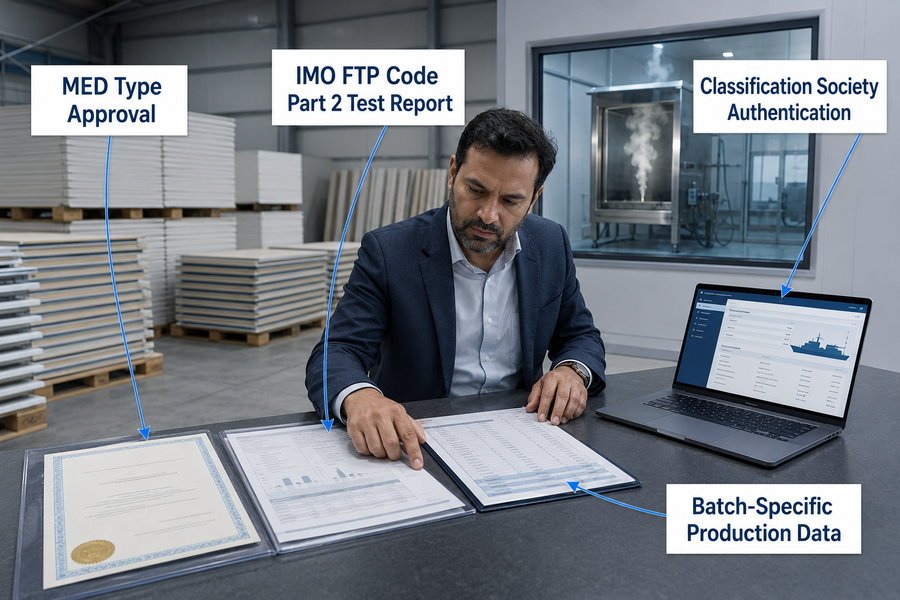
Let's break down exactly how you can check these documents and stop bad suppliers from ruining your ship interior projects.
How Can Shipowners Detect Fake Low-Smoke Panel Certificates?
Fake certificates are everywhere in Asian supply chains. Installing panels with fake smoke ratings risks failed inspections and massive refit costs. You need a reliable method to spot forgeries quickly.
Shipowners can detect fake low-smoke certificates by checking for mismatched IMO FTP Code standards, verifying the QR code or watermark, emailing the classification society directly, and looking for altered dates or missing factory audit stamps on the Module D quality assurance documents.
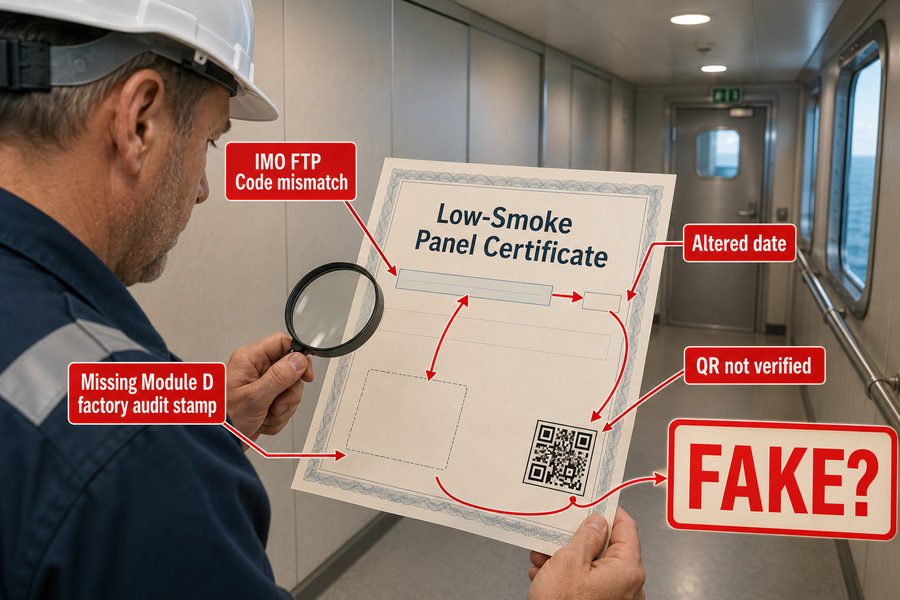
I see many buyers get fooled by a nice-looking PDF. At Magellan Marine, I always tell my clients that a piece of paper is not enough. You must actively dig into the details. If you just accept the first document the sales rep sends you, you take on all the risk. I will show you how to pull apart these documents and find the lies. You need to check the standards, look at the physical security marks, contact the issuers, and review the audit stamps. Do not skip any of these four steps.
Analyzing Document Structure for Mismatched IMO Standards
The first thing you must do is look at the testing standard listed on the certificate. Marine wall panels, ceiling panels, and marine fire doors must pass the IMO 2010 FTP Code.1 Specifically, smoke and toxicity are covered under Part 2 of this code2. I often see fake certificates that list Part 3 (which is for A-Class divisions) or Part 5 (which is for surface flammability)3 as proof of low smoke. This is a complete mismatch. A real certificate will explicitly state "IMO 2010 FTP Code Part 2". If the standard is wrong, the certificate is fake. You do not need to look any further.
Verifying Authenticity with Classification Societies and Audits
Next, you must check the security features. Look for a valid QR code or a digital watermark. Scan the QR code with your phone. It should take you directly to the official website of DNV, ABS, or Lloyd's Register. If it takes you to a dead link or a weird website, it is fake. After that, you must email the classification society directly. Send them the certificate number. They usually reply within 48 hours to confirm if it is real. Finally, you must look at the Module D quality assurance document. This document proves the factory is audited every year. You must look for the latest factory audit stamps and check for altered expiration dates. Fakers often use Photoshop to change the year from 2022 to 2025. Look closely at the font size and color around the dates.
| Inspection Method | What to Look For | What Indicates a Fake |
|---|---|---|
| Standard Match | IMO 2010 FTP Code Part 2 | Says Part 3 or Part 5 instead |
| Digital Security | QR Code or Watermark | Dead link or blurry pixelated logo |
| Direct Verification | Email to Classification Society | No record of the certificate number |
| Audit Stamps | Module D Annual Stamp | Dates look altered, mismatched fonts |
Which Labs Issue Trusted Marine Panel Smoke Reports?
Not all testing labs are equal. If your supplier uses an unapproved local lab, port state control will reject your panels, delaying your entire shipbuilding schedule.
Trusted marine panel smoke reports are issued exclusively by IMO-recognized, ILAC-accredited, and IACS-approved independent laboratories. The most globally trusted facilities include Exova Warringtonfire, Far East Fire Testing Centre (FEFTC), DIFT, and RISE Research Institutes of Sweden, which perform strict FTP Code Part 2 tests.
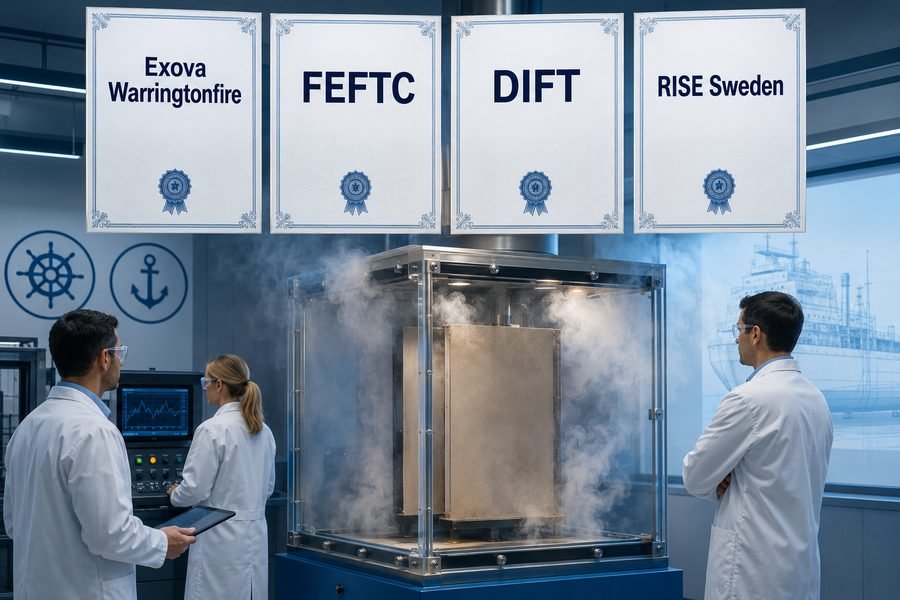
When I worked at the marine outfitting factory, we spent a lot of money to test our products at the right labs. Cheap factories use cheap, unapproved labs. You cannot trust a report from a lab that no one has ever heard of. To keep your project safe, you must know what makes a lab qualified and recognize the names of the trusted facilities. The four types of labs I listed are the only ones you should accept. I will explain exactly why these accreditations matter and detail the top facilities you should look for on the test reports.
The Role of IMO, ILAC, and IACS Accredited Laboratories
A lab cannot just decide to test marine panels. They must have strict approvals. First, the lab must be recognized by the International Maritime Organization (IMO)4. This means their testing machines meet global shipping standards. Second, they must have ILAC (International Laboratory Accreditation Cooperation) accreditation5. This ensures the lab's management and calibration are perfect. Finally, they must be approved by IACS (International Association of Classification Societies) members, like DNV or Bureau Veritas6. If a lab does not have all three of these approvals, their test report is useless to you. Shipowners will not accept it. I always check the lab's credentials before I even read the test results.
Recognizing Globally Trusted Marine Fire Testing Facilities
Over the years, a few labs have built the best reputations in the marine industry. When you see their names on a report, you can feel safe. Exova Warringtonfire in the UK is very famous. They are strict and accurate. In Asia, the Far East Fire Testing Centre (FEFTC) in China is widely used by high-quality factories. DIFT (Danish Institute of Fire and Security Technology) and RISE Research Institutes of Sweden are also top choices in Europe. These labs test the panels in a closed chamber. They burn the panel and measure the toxic gases. According to the IMO source, they check for Carbon Monoxide (CO), which must be under 1450 ppm, and Hydrogen Chloride (HCl), which must be under 600 ppm7. These trusted labs will never fake these numbers.
| Trusted Laboratory | Region | Key Accreditations | Typical Testing Focus |
|---|---|---|---|
| Exova Warringtonfire | Europe (UK) | IMO, ILAC, IACS | High-end marine fire doors and panels |
| FEFTC | Asia (China) | IMO, ILAC, IACS | Asian marine outfitting exports |
| DIFT | Europe (Denmark) | IMO, ILAC, IACS | Scandinavian shipbuilding standards |
| RISE | Europe (Sweden) | IMO, ILAC, IACS | Advanced composite materials |
What Proves Genuine Smoke Density Compliance on a Test Report?
Reading a test report is confusing. If you just look at the "Pass" stamp without checking the actual test data, you might accept panels that barely meet safety margins.
Genuine smoke density compliance is proven by locating the maximum specific optical density value under 200, verifying the exact 25kW/m² radiant heat test conditions, checking the panel thickness matches your order, and ensuring the report explicitly states compliance with IMO 2010 FTP Code Part 2.
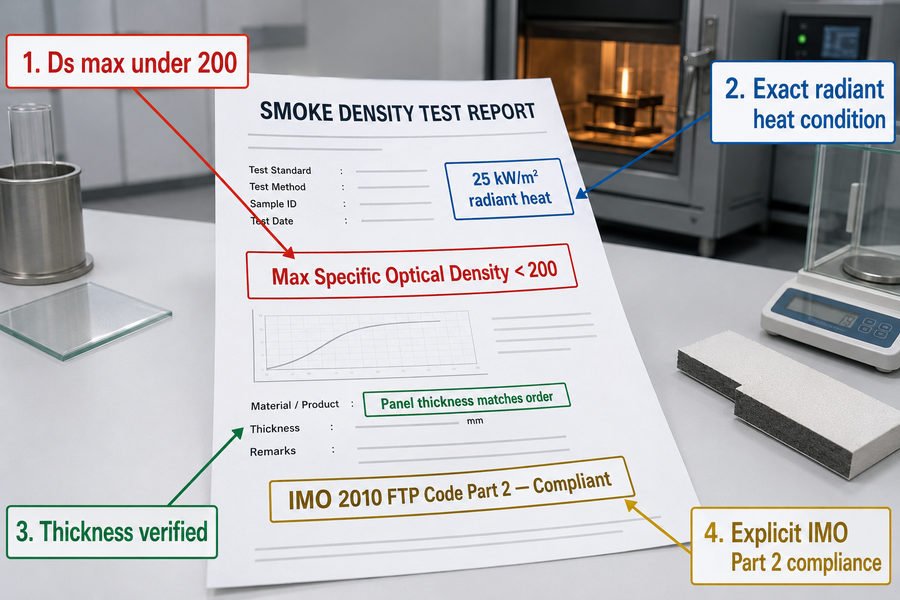
I review these reports every week. A supplier will send a 20-page PDF and point to the word "Pass" on the last page. But the details are in the middle of the report. You must read the data yourself. You need to verify four specific things: the optical density number, the heat conditions, the thickness, and the standard code. If you miss even one of these, you might buy a bad batch of marine ceiling panels. Let me explain exactly how to find and understand these four data points.
Locating and Understanding the Maximum Specific Optical Density
The most important number on a smoke test report is the Maximum Specific Optical Density. The report will call this "Dm". This number tells you how thick the smoke gets when the panel burns. Thick smoke blinds the crew, so they cannot find the exit doors. According to the IMO 2010 FTP Code, the Dm value for wall linings and ceiling panels must be less than or equal to 2008. You must find this exact number on the test data chart. If the report says the Dm is 195, it passes, but it is very close to failing. If the Dm is 50, that is excellent. You must read this number to know the real quality of the PVC surface film.
Verifying Test Conditions, Thickness, and Standards
Next, you must check how they tested the panel. The lab must test it under an exact radiant heat of 25kW/m²9. The report will show tests done with a pilot flame and without a pilot flame10. Both must pass. Then, you must check the thickness. If you order a 50mm rockwool panel, the test report must say they tested a 50mm panel. Some tricky suppliers test a thin 25mm panel to get less smoke, but sell you a 50mm panel. This is a trick. Finally, look at the conclusion paragraph. It must explicitly say the product complies with the "IMO 2010 FTP Code Part 2". Do not accept vague statements like "meets marine standards."
| Critical Data Point | Required Value / Condition | Why It Matters |
|---|---|---|
| Maximum Optical Density (Dm) | ≤ 200 | Proves smoke will not blind the crew |
| Radiant Heat Level | 25kW/m² | Ensures test matches standard fire heat |
| Panel Thickness | Must match your purchase order | Thicker panels have more glue and more smoke |
| Standard Reference | IMO 2010 FTP Code Part 2 | Legal proof of maritime compliance |
Why Do Designers Request Batch-Specific Smoke Test Data?
A five-year-old certificate does not guarantee today's panel quality. Suppliers often change raw materials to save money, turning a previously safe panel into a toxic smoke hazard.
Designers request batch-specific smoke test data because it proves the factory has not secretly substituted cheaper adhesives, confirms current production matches the original prototype, ensures ongoing Module D quality assurance compliance, and provides legal liability protection for the shipyard in case of a fire.
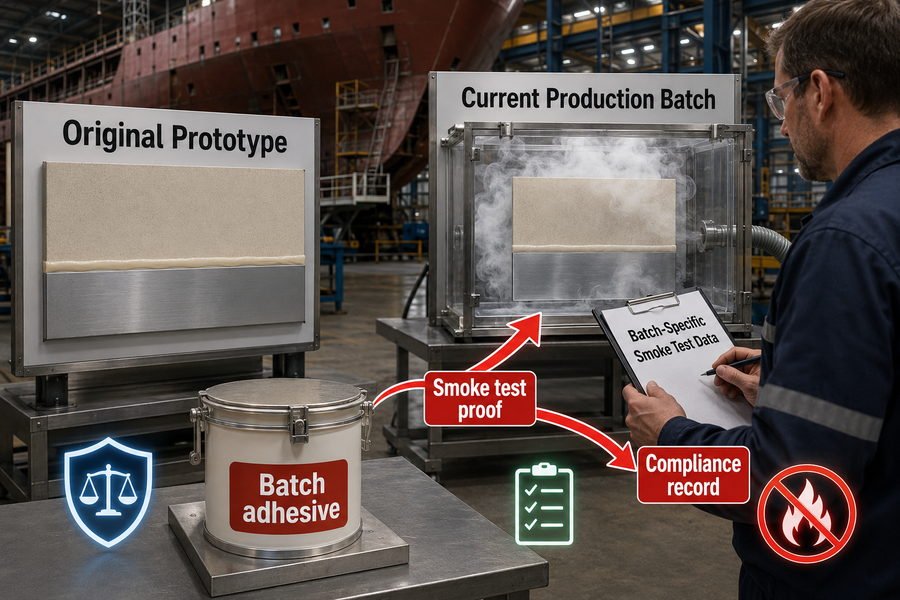
When I help clients buy from developing countries, this is the biggest problem we face. The factory passes the test in 2022. They get a certificate valid for five years. Then, in 2024, they start using cheap materials to increase profits. The certificate looks good, but the new panels are dangerous. This is why smart designers ask for batch-specific data. It checks the adhesives, the prototype match, the quality system, and protects the shipyard. You must demand this data for every major order. I will explain how cheap changes ruin the panels and why this data saves you.
Preventing Unapproved Changes to Adhesives and Core Materials
Marine panels are made of steel, rockwool, PVC film, and glue. The steel and rockwool do not create smoke. The smoke comes from the PVC film and the glue.11 Good fire-retardant glue is expensive. Sometimes, a factory will switch to a cheaper glue to save about $0.50 per square meter. This cheap glue burns fast and creates thick, toxic black smoke12. Batch-specific testing catches this trick. It forces the factory to prove that the panels they made today use the exact same glue and PVC film as the original prototype that passed the big lab test. Without batch testing, you have no idea what is inside your panels.
Maintaining Module D Quality Assurance and Legal Protection
The shipping industry relies on the Module D quality assurance system. This system says the factory must test their own products regularly13. If a designer asks for batch data, they are checking if the factory actually follows Module D. If the factory cannot provide recent test logs, they are breaking the rules. Also, designers need legal protection. If a ship catches fire and people die from toxic smoke, investigators will look at the paperwork. If the shipyard only has a five-year-old certificate, they look bad. But if they have batch-specific test data from the exact month the ship was built, it proves they did their job to keep the ship safe.
| Reason for Batch Data | Benefit to Buyer | Risk if Ignored |
|---|---|---|
| Adhesives Check | Ensures fire-retardant glue is used | Factory uses cheap glue, causing toxic smoke |
| Prototype Match | Confirms current quality matches past quality | You buy a completely different, unsafe product |
| Module D Audit | Proves factory tests its own production | Factory has no quality control system |
| Legal Protection | Defends shipyard in a fire investigation | Major lawsuits and liability for the buyer |
How Can Procurement Audit a Supplier's Smoke Test History?
Trusting a supplier's sales pitch is dangerous. If you do not audit their test history, you might partner with a factory that constantly fails safety audits behind closed doors.
Procurement can audit a supplier's smoke test history by requesting the last three years of Module D audit reports, demanding internal factory batch testing logs, checking the European MED database for revoked approvals, and hiring third-party marine surveyors to conduct unannounced factory document inspections.
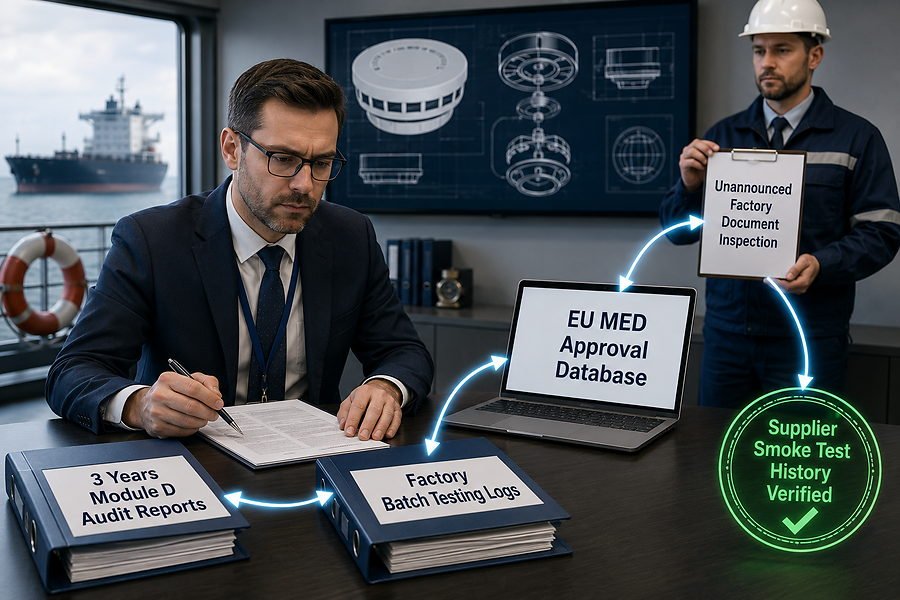
Procurement officers have a hard job. You need low prices, but you cannot sacrifice safety. I always advise buyers to stop looking at the shiny product samples and start looking at the boring factory records. A good factory has a clear history of testing. A bad factory hides things. You must take four steps to audit them properly. You need to get the old Module D reports, read their daily testing logs, check the official database, and send someone to the factory. If you do this, you will weed out the bad suppliers very fast. Here is how you execute this audit process.
Reviewing Module D Audit Reports and Internal Factory Logs
First, ask the sales rep for the last three years of their Module D annual audit reports. A classification society surveyor writes these reports every year. You must read the "Non-Conformities14" section. This shows you every mistake the factory made. If they have many major non-conformities related to fire safety, walk away. Next, demand to see their internal factory batch testing logs. A good factory has a small testing machine. They should test a small sample for every 1000 panels they make. Ask for the logs from last month. If the logs are empty, or if every single number is exactly the same, they are fake. Real tests have small variations15.
Utilizing the MED Database and Third-Party Marine Surveyors
You do not have to rely only on the factory's documents. You can check the European Marine Equipment Directive (MED) database online. This is known as the MarED database16. You can type in the factory's name. It will show you if their approvals are active, expired, or revoked. If an approval was revoked, it means they failed a major test. Finally, if you are buying a large amount of marine wall panels, hire a third-party marine surveyor. You can hire a local surveyor in China or Vietnam for about $500 to $800 a day. Tell them to go to the factory unannounced and inspect the smoke test documents. The factory cannot hide the truth from a trained surveyor.
| Audit Action | Source of Information | Expected Cost |
|---|---|---|
| 3-Year Module D Review | Supplier's Quality Department | Free |
| Internal Log Check | Factory Production Records | Free |
| MarED Database Search | Official European Web Portal | Free |
| Unannounced Inspection | Third-Party Marine Surveyor | $500 - $800 per day |
What Smoke Performance Questions Should Buyers Ask Suppliers?
Weak questions get weak answers. If you do not ask highly specific technical questions, bad suppliers will easily hide their poor smoke performance behind vague promises.
Buyers should ask suppliers for the exact toxic gas ppm values from their last test, which specific PVC film brand was used, how often they recalibrate their internal smoke density chamber, and whether they will accept a contract clause requiring pre-shipment third-party smoke testing.
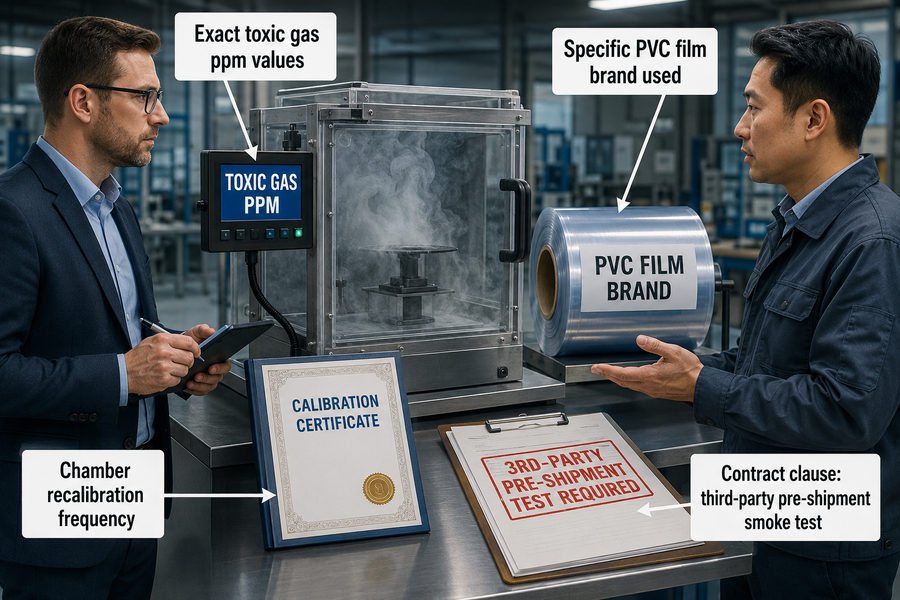
When you talk to a sales rep, they will always say, "Our quality is very good, do not worry." This means nothing. At Magellan Marine, I teach buyers to take control of the conversation. You must ask hard, technical questions. If the sales rep gets confused or refuses to answer, you know they are hiding something. I use a list of four specific questions. You must ask about the gas numbers, the raw material brands, their machine calibration, and their willingness to accept a testing contract. These questions separate the real manufacturers from the traders and the liars.
Asking About Toxic Gas Values and PVC Film Brands
Do not ask, "Does your panel pass the smoke test?" Instead, ask, "What were the exact Carbon Monoxide and Hydrogen Chloride ppm values on your last Part 2 test?17" A real factory engineer knows these numbers. They should quickly answer something like, "Our CO is usually around 800 ppm, well below the 1450 ppm limit18." Next, ask about the surface finish. Ask, "Which specific brand of PVC film do you use, and what is the thickness?" The smoke comes from this film.19 High-quality marine PVC film is usually 0.15mm to 0.20mm thick and comes from known brands. If they say, "We just buy it from the local market," their smoke performance will be completely unstable.
Questioning Equipment Calibration and Pre-Shipment Testing
You also need to check how the factory manages their own equipment. Ask them, "How often do you recalibrate your internal smoke density testing chamber?" They must calibrate it at least once a year using a standard reference material20. If they do not know what calibration is, their internal tests are worthless. Finally, hit them with the hardest question. Ask, "Will you accept a contract clause that requires a random sample to pass a third-party smoke test before we pay the final 70% balance?" A good test costs about $1,500. You can offer to pay for the test if it passes. If the factory refuses this clause, it means they know their current batch will fail. Do not buy from them.
| Key Buyer Question | Good Supplier Answer | Bad Supplier Answer |
|---|---|---|
| Exact toxic gas ppm values? | Gives specific numbers (e.g., CO at 800 ppm) | "We pass the standard, it is fine." |
| Specific PVC film brand? | Names the brand and exact thickness | "We buy from various local suppliers." |
| Internal chamber calibration? | "Annually, by an outside agency." | "We just use the machine, no calibration needed." |
| Pre-shipment third-party test? | "Yes, we agree to the contract clause." | "No, our certificate is already enough." |
Conclusion
Verifying smoke toxicity requires checking original test reports, matching standards, demanding batch data, and asking hard questions. Follow these steps to ensure you buy safe, compliant marine panels every time.
-
"[PDF] RESOLUTION MSC.307(88) (adopted on 3 December 2010 ...", https://wwwcdn.imo.org/localresources/en/KnowledgeCentre/IndexofIMOResolutions/MSCResolutions/MSC.307(88).pdf. The IMO Fire Test Procedures Code sets internationally recognized fire-test procedures used for materials and components on ships under SOLAS; this supports the need to check marine fire-safety certificates against the relevant FTP Code requirement, though the exact applicability depends on vessel type, flag-state rules, and product use. Evidence role: expert_consensus; source type: institution. Supports: Marine wall panels, ceiling panels, and marine fire doors must be assessed against the IMO 2010 FTP Code where shipboard fire-safety rules apply.. Scope note: Contextual support only; it does not prove that every listed product in every installation must pass the same test part. ↩
-
"[PDF] RESOLUTION MSC.307(88) (adopted on 3 December 2010 ...", https://wwwcdn.imo.org/localresources/en/KnowledgeCentre/IndexofIMOResolutions/MSCResolutions/MSC.307(88).pdf. The 2010 FTP Code identifies Part 2 as the test for smoke and toxicity, supporting the article’s statement that low-smoke and toxicity claims should be checked against Part 2 specifically. Evidence role: definition; source type: institution. Supports: Smoke and toxicity testing under the IMO 2010 FTP Code is covered by Part 2.. ↩
-
"RESOLUTION MSC.307(88) (adopted on 3 December ...", https://wwwcdn.imo.org/localresources/en/KnowledgeCentre/IndexofIMOResolutions/MSCResolutions/MSC.307(88).pdf. The 2010 FTP Code lists Part 3 for tests of A, B, and F class divisions and Part 5 for surface flammability testing, supporting the distinction between these tests and Part 2 smoke-and-toxicity testing. Evidence role: definition; source type: institution. Supports: IMO FTP Code Part 3 concerns fire-resisting divisions, while Part 5 concerns surface flammability rather than smoke and toxicity.. Scope note: This supports the code-part distinction, not the separate conclusion that every certificate using the wrong part is intentionally fraudulent. ↩
-
"Fire testing laboratories - International Maritime Organization", https://www.imo.org/en/ourwork/safety/pages/firetestinglaboratories-default.aspx. The IMO Fire Test Procedures Code establishes standardized fire-test methods for marine materials and requires tests to be conducted under procedures accepted by flag Administrations, providing context for why laboratory recognition matters in marine fire testing. Evidence role: definition; source type: institution. Supports: Marine panel fire testing should be performed by laboratories recognized or accepted under IMO-related fire-test procedures.. Scope note: This supports the need for recognized or administration-accepted testing under IMO procedures, but it may not prove that IMO directly recognizes individual laboratories. ↩
-
"Joint ISO-ILAC-IAF Communique on 17025 | NIST", https://www.nist.gov/nvlap/joint-iso-ilac-iaf-communique-17025. ILAC describes mutual recognition arrangements for accredited testing laboratories, typically based on ISO/IEC 17025, which addresses laboratory competence, quality systems, calibration, and technical validity of test results. Evidence role: expert_consensus; source type: institution. Supports: ILAC accreditation is relevant to the reliability and competence of laboratories issuing test reports.. Scope note: This supports ILAC accreditation as an indicator of laboratory competence, but it does not show that accreditation makes calibration or management “perfect.” ↩
-
"Approval of Classification Societies - Federal Register", https://www.federalregister.gov/documents/2012/08/09/2012-19376/approval-of-classification-societies. IACS explains that classification societies establish and apply technical rules for ships and offshore structures, while member societies may approve materials, products, or testing evidence within class and statutory certification processes. Evidence role: historical_context; source type: institution. Supports: Approval or acceptance by IACS member classification societies can be relevant to marine product certification and shipowner acceptance.. Scope note: This provides context for why class-society acceptance can matter, but it does not demonstrate that every marine panel test report must be approved by an IACS member in all jurisdictions. ↩
-
"What Is the IMO FTP Code for Marine Interior Materials?", https://magellanmarinetech.com/what-imo-ftp-code-for-marine-interior-materials/. The IMO FTP Code smoke and toxicity test criteria list maximum average gas concentrations for combustion products, including carbon monoxide and hydrogen chloride, which can be used to verify the stated threshold values for marine material fire testing. Evidence role: statistic; source type: institution. Supports: IMO marine fire testing includes toxicity limits for gases such as carbon monoxide and hydrogen chloride, including the cited ppm thresholds.. Scope note: The thresholds apply to the specified IMO FTP Code test method and acceptance criteria, not necessarily to all marine fire tests or all product categories. ↩
-
"What Is the Purpose and Scope of the IMO FTP Code? - Magellan ...", https://magellanmarinetech.com/what-purpose-scope-of-imo-ftp-code/. The IMO 2010 FTP Code Part 2 sets smoke and toxicity test criteria for materials such as bulkhead, wall, and ceiling linings, including a maximum specific optical density criterion of Dm ≤ 200 for applicable surface materials. Evidence role: expert_consensus; source type: institution. Supports: Under the IMO 2010 FTP Code Part 2, the Dm value for applicable wall linings and ceiling panels must be no greater than 200.. Scope note: The precise applicability depends on the material category and installation use covered by the certificate or test report. ↩
-
"[PDF] RESOLUTION MSC.307(88) (adopted on 3 December 2010 ...", https://wwwcdn.imo.org/localresources/en/KnowledgeCentre/IndexofIMOResolutions/MSCResolutions/MSC.307(88).pdf. Smoke-generation test standards used by the IMO FTP Code specify exposure of specimens to a radiant heat flux of 25 kW/m², establishing the heat condition under which the reported smoke-density values are measured. Evidence role: mechanism; source type: institution. Supports: The relevant smoke test for these marine panel materials is conducted at a radiant heat flux of 25 kW/m².. Scope note: This supports the standard test exposure condition; individual reports may include additional conditions depending on the material and test protocol. ↩
-
"[PDF] RESOLUTION MSC.307(88) (adopted on 3 December 2010 ...", https://wwwcdn.imo.org/localresources/en/KnowledgeCentre/IndexofIMOResolutions/MSCResolutions/MSC.307(88).pdf. The IMO FTP Code smoke and toxicity procedure references smoke-density testing in both flaming and non-flaming exposure modes, commonly represented by tests with and without a pilot flame. Evidence role: mechanism; source type: institution. Supports: Relevant marine smoke testing may require results for both pilot-flame and no-pilot-flame conditions.. Scope note: This supports the existence of both test modes; whether both are required for a given product depends on the applicable FTP Code material category and approval scope. ↩
-
"[PDF] Smoke and gases produced by burning aircraft interior materials", https://nvlpubs.nist.gov/nistpubs/Legacy/BSS/nbsbuildingscience18.pdf. Fire science literature distinguishes non-combustible inorganic materials such as steel and mineral wool from organic polymers and adhesives, which can contribute smoke and toxic combustion products during fire exposure. Evidence role: mechanism; source type: paper. Supports: In marine panels, smoke risk is more likely to come from combustible polymer films and adhesives than from steel or mineral wool.. Scope note: This supports the material mechanism generally; smoke generation depends on the exact formulation, mass, and fire conditions of the panel components. ↩
-
"Analysis of Flammability and Smoke Emission of Plastic Materials ...", https://pmc.ncbi.nlm.nih.gov/articles/PMC10054394/. Studies of polymeric adhesives and PVC-containing materials show that combustible organic binders can increase heat release, smoke production, and toxic gas generation when exposed to fire. Evidence role: mechanism; source type: paper. Supports: Substituting lower-performing combustible adhesives can increase burning, smoke, and toxicity risks in panels.. Scope note: The source would support the general fire-risk mechanism, not the article’s specific cost-saving scenario or every adhesive formulation. ↩
-
"[PDF] Inspection of Medical Manufacturers - 7382.850 - FDA", https://www.fda.gov/media/80195/download. Module D production-quality-assurance provisions require the manufacturer to operate an approved quality system covering manufacture, final product inspection, and testing, with surveillance by a notified body. Evidence role: definition; source type: government. Supports: Under Module D, manufacturers must maintain quality-assurance processes that include product inspection and testing.. Scope note: The exact frequency and records required may depend on the applicable certificate, quality plan, product standard, and notified-body requirements. ↩
-
"Nonconformity (quality) - Wikipedia", https://en.wikipedia.org/wiki/Nonconformity_(quality). Quality-management standards define a nonconformity as non-fulfilment of a specified requirement, which explains why audit nonconformity records are used to identify documented failures in a supplier’s quality system. Evidence role: definition; source type: institution. Supports: The non-conformities section of an audit report documents failures to meet applicable requirements.. Scope note: The definition establishes the meaning of the term, but it does not indicate how severe any particular factory’s nonconformities are. ↩
-
"[PDF] Simple Guide for Evaluating and Expressing the Uncertainty of NIST ...", https://nvlpubs.nist.gov/nistpubs/TechnicalNotes/NIST.TN.1900.pdf. Measurement-science guidance from NIST explains that repeated measurements normally show variability because of random effects and measurement uncertainty, supporting the expectation that genuine batch-test records will not be perfectly identical across repeated tests. Evidence role: mechanism; source type: government. Supports: Repeated factory tests should generally show some variation rather than identical values in every entry.. Scope note: This supports the general measurement principle, not a universal fraud rule for every factory log or test method. ↩
-
"Directive 96/98/EC - Wikipedia", https://en.wikipedia.org/wiki/Directive_96/98/EC. The MarED database is an official European database for marine equipment certificates under the Marine Equipment Directive, allowing users to search certificate information and approval status for listed equipment and manufacturers. Evidence role: case_reference; source type: government. Supports: Procurement staff can use the MarED database to check whether a supplier’s MED approvals are listed and current.. Scope note: Database fields and public search functions may change, and the database confirms certificate status rather than independently proving product performance. ↩
-
"[PDF] RESOLUTION MSC.399(95) (adopted on 5 June 2015 ...", https://wwwcdn.imo.org/localresources/en/KnowledgeCentre/IndexofIMOResolutions/MSCResolutions/MSC.399(95).pdf. The IMO Fire Test Procedures Code, Part 2, specifies smoke and toxicity testing for shipboard materials and includes measurement of gases such as carbon monoxide and hydrogen chloride; this supports asking for gas-specific test results, though it does not prove that every supplier representative will personally know the figures. Evidence role: definition; source type: institution. Supports: Part 2 smoke/toxicity testing includes specific toxic gas measurements such as carbon monoxide and hydrogen chloride.. Scope note: Supports the relevance of CO and HCl values in the test method, but not the behavioral claim about supplier knowledge. ↩
-
"Why Do Smoke Toxicity and Density Matter for Marine Wall and ...", https://magellanmarinetech.com/why-smoke-toxicity-and-density-matter-for-marine-wall-ceiling-panels/. The IMO FTP Code Part 2 toxicity criteria list maximum allowable gas concentrations for tested materials, including a carbon monoxide limit; this supports the numerical benchmark if the cited edition confirms 1450 ppm, while applicability depends on the specific material category and regulatory context. Evidence role: statistic; source type: institution. Supports: The referenced smoke/toxicity standard contains a carbon monoxide concentration limit around the stated value.. Scope note: The limit should be verified against the applicable FTP Code edition and the material’s required shipboard application. ↩
-
"[PDF] Toxicity of the pyrolysis and combustion of poly(vinyl chlorides)", https://www.govinfo.gov/content/pkg/GOVPUB-C13-1216c17eb433dd191ff5df1d55a1c900/pdf/GOVPUB-C13-1216c17eb433dd191ff5df1d55a1c900.pdf. Studies of PVC thermal decomposition and combustion show that PVC-containing layers can release smoke and toxic gases, including hydrogen chloride; this supports the mechanism that a PVC surface film can materially affect smoke performance, but it does not quantify the film’s contribution in a specific panel construction. Evidence role: mechanism; source type: paper. Supports: PVC film can be a significant source of smoke and toxic gas emissions during fire testing.. Scope note: Contextual support only; actual smoke contribution depends on the panel core, adhesive, film formulation, thickness, and test conditions. ↩
-
"[PDF] Standard Reference Material 1006c", https://tsapps.nist.gov/srmext/certificates/archives/1006c.pdf. Laboratory quality standards such as ISO/IEC 17025 require testing equipment to be calibrated and checked with traceable references where measurement validity depends on the equipment; this supports the need for documented calibration, although a fixed annual interval may be a laboratory policy or method-specific requirement rather than a universal rule. Evidence role: expert_consensus; source type: institution. Supports: Internal smoke-density testing equipment should be subject to documented calibration using traceable reference materials or equivalent checks.. Scope note: Supports calibration and traceability in principle; the “at least once a year” frequency needs confirmation from the relevant smoke-density test method or accreditation procedure. ↩