Are you confused by marine certifications? Buying uncertified panels can cause massive shipyard delays and financial loss. Here is exactly what class society type approval means for your marine wall and ceiling panels.
Class society type approval means a marine wall or ceiling panel design has been tested and verified to meet international maritime safety standards, specifically SOLAS and the FTP Code. It proves the manufacturer can consistently produce panels that prevent fire spread, restrict smoke, and maintain structural integrity onboard.
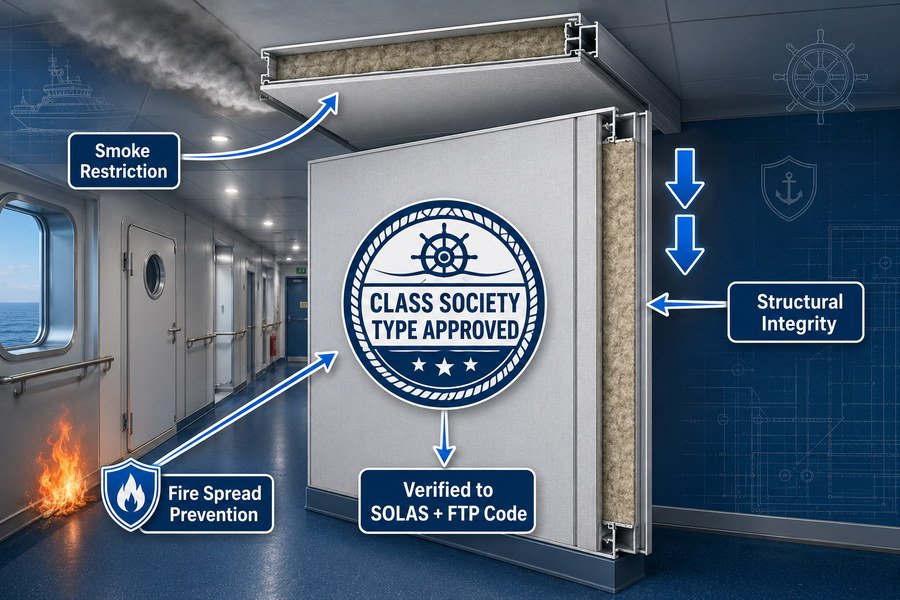
When you buy marine outfitting products in Asia, understanding these certificates helps you control lead times and avoid expensive rejection by local class surveyors. I want to share my experience from Magellan Marine to break down what this means for your procurement process.
What Is a Class Type Approval Certificate for Marine Wall and Ceiling Panels?
Are you buying marine interior panels without knowing their true certification status? You risk huge financial losses if the shipyard rejects them. Let us look at what this certificate actually is.
A Class Type Approval Certificate is an official document proving a marine wall or ceiling panel design complies with the IMO 2010 FTP Code. It verifies three specific capabilities: structural fire protection ratings (B-0, B-15, C-Class), low flame spread characteristics, and non-combustible core material properties.
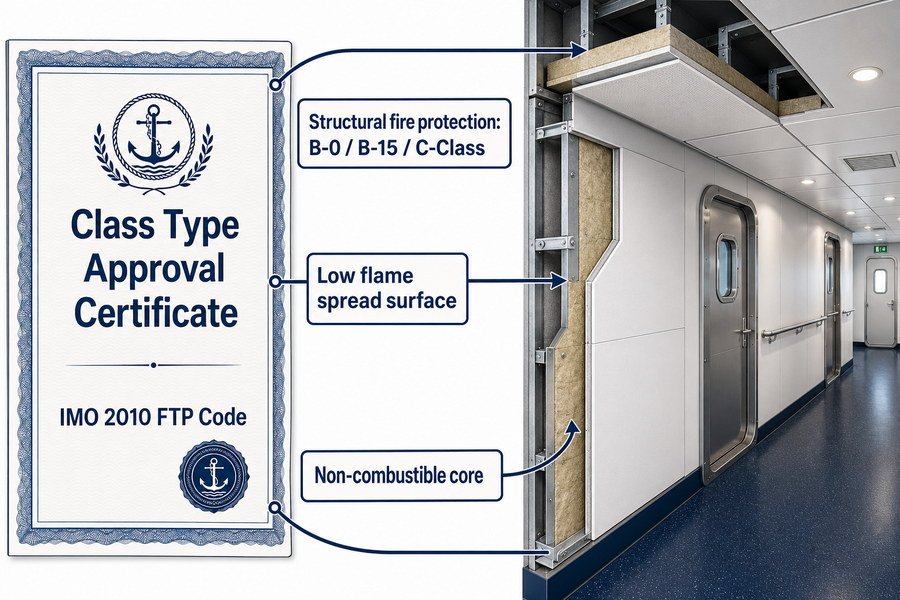
The marine outfitting industry relies on strict rules to keep ships safe. A Class Type Approval Certificate is your proof that a factory can make safe products. As a procurement officer, you must understand the three specific capabilities this document verifies. I will explain each one clearly.
Structural Fire Protection Ratings for Marine Wall Panels
The first capability verified by the certificate is the structural fire protection rating. Marine panels are classified into fire ratings like B-0, B-15, and C-Class. A B-Class panel must stop flames from passing through for 30 minutes.1 The number after the "B" tells you how long the panel stops heat transfer. For a B-15 marine wall panel, the unexposed side temperature must not rise more than 139°C on average, or 225°C at any single point, for 15 minutes.2 The source for these specific temperature limits is Part 3 of the IMO 2010 FTP Code. A B-0 panel stops flames for 30 minutes but has no heat insulation requirement. C-Class panels do not need to stop fire or heat, but they must use non-combustible materials. You must match the fire rating to the shipyard's project drawings.
Low Flame Spread and Non-Combustible Core Requirements
The second and third capabilities are low flame spread characteristics and non-combustible core material properties. If a fire starts in a cabin, the surface of the wall panel must not catch fire easily or create thick toxic smoke. The certificate proves the PVC film or painted surface meets the low flame spread rules from Part 5 of the IMO 2010 FTP Code. The third capability is the non-combustible core. The rockwool or aluminum honeycomb inside the panel must not burn. Part 1 of the IMO 2010 FTP Code defines non-combustible materials. The test laboratory puts the core material into a furnace at 750°C. If it burns or loses too much weight, it fails.3
| Capability Verified by Certificate | IMO Standard Source | Specific Value or Requirement |
|---|---|---|
| Structural Fire Protection Rating | IMO 2010 FTP Code Part 3 | B-15: Max avg temp rise 139°C for 15 mins |
| Low Flame Spread Characteristics | IMO 2010 FTP Code Part 5 | Limits on smoke toxicity and surface burning |
| Non-Combustible Core Property | IMO 2010 FTP Code Part 1 | Withstands 750°C furnace without burning |
What Is the Difference Between Type Approval and a Project-Specific Class Certificate for Marine Ceiling Panels?
Are you paying too much for unnecessary single-project certifications? Or worse, relying on a general certificate when the surveyor demands a specific one? Here is the difference between the two types.
Type Approval covers a standard panel design for multiple ships over a five-year validity period, lowering costs. A Project-Specific Class Certificate (or Unit Certification) applies only to a single vessel's specific batch of panels, requiring an individual surveyor inspection at the factory before that exact shipment leaves.
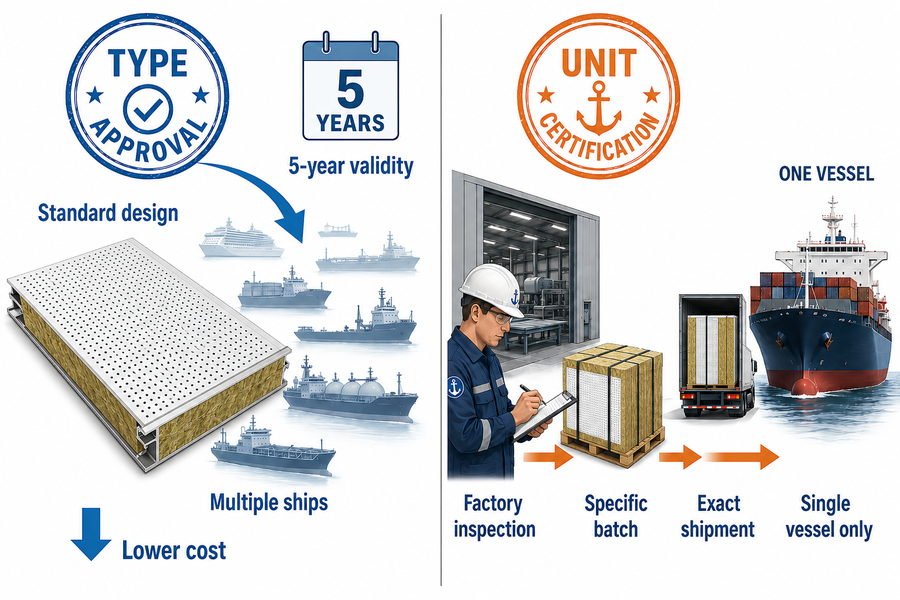
Many buyers get confused when a shipyard asks for a class certificate. They do not know if they need a general approval or a specific one. This choice affects your price and your lead time. I will break down the differences based on the standard design coverage, validity period, cost, and inspection rules.
Type Approval for Mass Marine Panel Production
Type Approval is the most common document. It covers a standard marine ceiling panel design for multiple ships. Because it covers mass production, factories use it to lower costs for buyers. A factory tests one sample panel at a laboratory. If it passes, the class society gives a certificate. This certificate has a five-year validity period. The factory pays a one-time fee to the class society. Based on typical fee structures from DNV or ABS, this initial fire test and approval process costs between $5,000 and $15,000. For the next five years, the factory can sell this exact panel design to hundreds of ships without paying for a new test every time. This means lower prices and faster delivery for you.
Project-Specific Certification for Individual Ships
A Project-Specific Class Certificate, also called Unit Certification, is very different. It applies only to a single vessel's specific batch of marine ceiling panels. Some ship owners demand this extra level of safety. For this certificate, a local class surveyor must come to the factory in China or Vietnam. They require an individual surveyor inspection before that exact shipment leaves the factory.4 The surveyor checks the materials and watches the production. This takes extra time. You also have to pay for the surveyor's daily rate and travel costs. According to standard class society billing, a surveyor visit costs about $800 to $2,000 per day. This makes the panels more expensive and increases your lead time.
| Feature of Certification | Type Approval | Project-Specific Class Certificate |
|---|---|---|
| Scope of Coverage | Standard panel design for multiple ships | Single vessel's specific batch of panels |
| Validity Period | Five years | Only valid for the specific shipped batch |
| Factory Inspection | Annual factory audit | Individual surveyor inspection per batch |
| Typical Cost Impact | Low (cost shared across many orders) | High ($800 to $2,000 extra per visit) |
Which Class Societies Issue Type Approval for Marine Wall Panels?
Are you worried that your chosen supplier's certificate will not be accepted in Europe or the US? Choosing the wrong class society wastes time and money. Here are the approved issuers.
The twelve member societies of the International Association of Classification Societies (IACS) issue Type Approvals for marine wall panels. The most globally recognized and utilized societies for interior outfitting include DNV, ABS, Lloyd’s Register (LR), Bureau Veritas (BV), RINA, and ClassNK, covering the full spectrum of marine compliance.
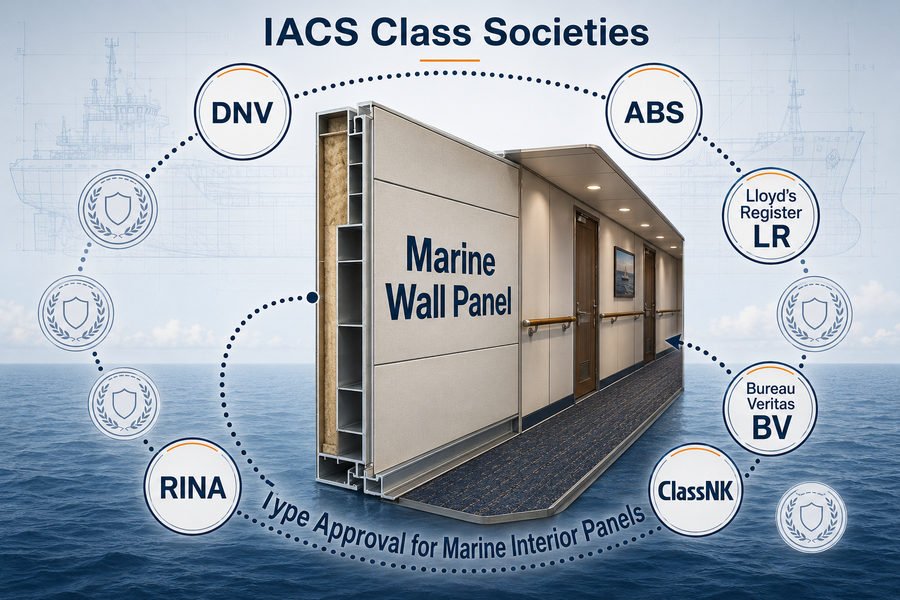
When you source marine wall panels from Asia, the factory will show you their certificates. But not all certificates have the same power. You need to know which class societies the global shipyards accept. I will explain the role of IACS and list the main societies you will see in the market.
The Role of IACS in Marine Panel Certification
The International Association of Classification Societies (IACS) is the most important group in ship safety. The twelve member societies of IACS5 issue the Type Approvals you need. According to 2023 data from IACS, their members classify over 90% of the world's commercial cargo tonnage6. If a factory gives you a certificate from a small, non-IACS local organization, a big shipyard in Europe or the United States will probably reject it. I always tell my clients to only buy marine wall panels that have approval from an IACS member. This ensures the safety tests followed the strict IMO FTP Code rules7 properly.
Global Class Societies for Marine Interior Outfitting
Inside IACS, there are specific societies that are very common for marine interior outfitting. The most globally recognized and utilized societies include DNV (headquartered in Norway), ABS (headquartered in the US), Lloyd’s Register or LR (headquartered in the UK), Bureau Veritas or BV (headquartered in France), RINA (headquartered in Italy), and ClassNK (headquartered in Japan). Together, these organizations cover the full spectrum of marine compliance. If your customer is building a ship under DNV rules, it is best to buy panels with a DNV Type Approval. However, because of the Marine Equipment Directive (MED) in Europe, an MED "Wheelmark" certificate issued by DNV is often accepted by LR or BV for ships flagged in European countries8.
| Class Society Name | Abbreviation | Headquarter Location | Common Global Acceptance |
|---|---|---|---|
| Det Norske Veritas | DNV | Norway | Very high, especially in Europe |
| American Bureau of Shipping | ABS | United States | Very high, especially in the Americas |
| Lloyd’s Register | LR | United Kingdom | Very high globally |
| Bureau Veritas | BV | France | Very high globally |
| RINA | RINA | Italy | High, strong in cruise ships |
| Nippon Kaiji Kyokai | ClassNK | Japan | High, very strong in Asia |
What Parameters Does a Marine Wall Panel Type Approval Certificate Define?
Do you think a certificate covers every panel a factory makes? Assuming this can lead to disastrous procurement mistakes. You must read the specific parameters on the document.
A marine wall panel Type Approval Certificate defines five strict parameters: the exact fire rating (like B-15), maximum panel thickness and width, approved core material density, permissible surface finishes (like PVC film thickness), and the specific joint and profile assembly methods used during the official fire test.
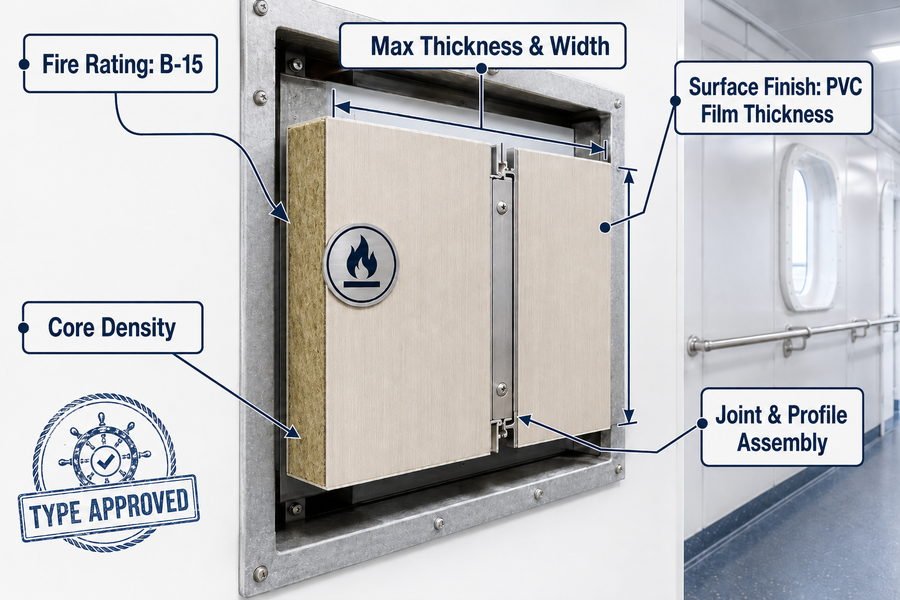
A Type Approval certificate is not a general permission slip. It is a very specific technical document. When you review a supplier's certificate, you cannot just look at the stamp. You must read the five strict parameters it defines. I will explain each of these five parameters so you know exactly what to check.
Fire Rating, Dimensions, and Core Density Limits for Marine Panels
The first parameter is the exact fire rating. The certificate will state clearly if the panel is B-15, B-0, or C-Class9. The second parameter defines the dimensions. It lists the maximum panel thickness and width allowed. For example, if the certificate says the B-15 panel has a thickness of 50mm, you cannot use this certificate to sell a 25mm panel. The third parameter is the approved core material density. The core material, usually rockwool, must have a specific weight to block heat. According to IMO rules, the certificate will specify a density range10. A common rockwool density for a B-15 marine wall panel is 120 kg/m3 to 140 kg/m3. The factory must use rockwool within this exact density range.
Surface Finishes and Assembly Methods in Marine Panel Certificates
The fourth parameter covers permissible surface finishes. Marine panels have decorative surfaces, like PVC film or galvanized steel. The certificate defines the maximum thickness and the heat value of this finish. The IMO FTP Code Part 5 states that the calorific value of combustible surface materials must not exceed 45 MJ/m211. A typical certificate will say the PVC film thickness cannot be more than 0.15mm or 0.20mm. The fifth parameter is the specific joint and profile assembly methods. Panels connect to each other using joints, like a tongue-and-groove system or a separate steel spline. The certificate shows the exact joint system used during the official fire test. You must use the exact same joint design on the real ship12.
| Type Approval Parameter | What It Defines | Example Value or Limit |
|---|---|---|
| Exact Fire Rating | The level of fire protection | B-15 |
| Panel Dimensions | Maximum size allowed by test | 50mm thickness, 600mm width |
| Core Material Density | Weight of the insulation | Rockwool at 120 kg/m3 |
| Permissible Surface Finishes | Rules for decorative layers | PVC film maximum 0.15mm thick |
| Joint and Assembly Methods | How the panels connect | Steel spline joint system |
Does One Type Approval Cover All Sizes and Core Variants of Marine Panels?
Are you ordering a custom 100mm thick panel because the factory has a 50mm panel certificate? The shipyard will likely reject it. Approvals have strict boundaries.
No, one Type Approval does not cover all sizes and core variants. The certificate strictly limits production to the tested panel thickness, a maximum core density range, specific joint systems, and surface coverings. Any deviation in size, core material, or assembly requires a new fire test and certificate.
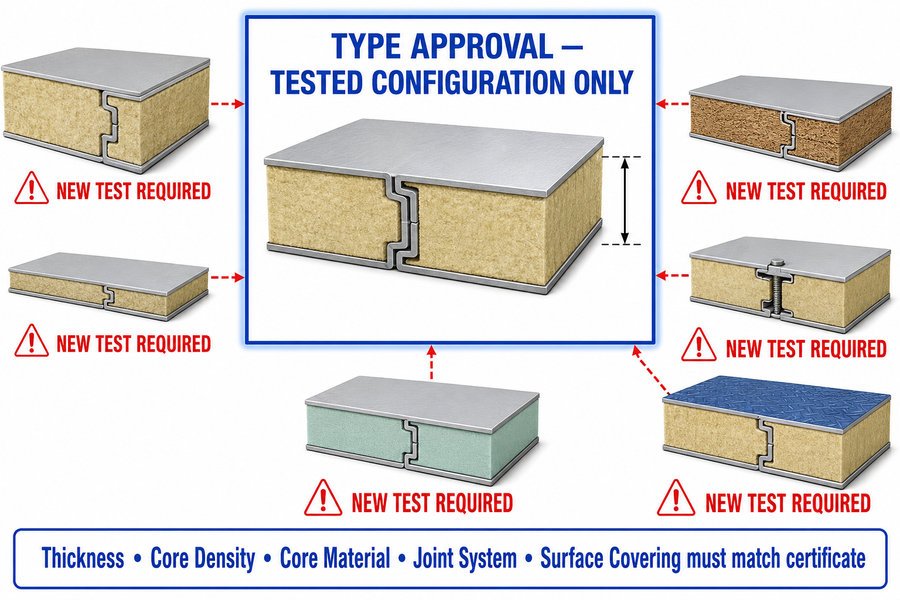
I often see buyers make a big mistake. They think a factory with one B-15 certificate can make any B-15 panel they want. This is wrong. The rules are very strict about changes. I will explain why you cannot change the four specific limits: panel thickness, core density range, joint systems, and surface coverings.
Impact of Altering Marine Panel Dimensions and Core Density
The certificate strictly limits production to the tested panel thickness.13 If a factory tests a 50mm thick panel, they get a certificate for a 50mm panel. If you ask them to make a 30mm thick panel, you cannot use the 50mm certificate. A thinner panel has less insulation. It will heat up faster in a fire. The IMO FTP Code Part 3 rules do not allow you to guess if a thinner panel is safe. You also cannot change the core density outside the maximum core density range.14 If the certificate says the rockwool must be 120 kg/m3, you cannot use cheaper 80 kg/m3 rockwool. Lighter rockwool blocks less heat. Any deviation in size or core material requires a new fire test and certificate.
Changes to Joint Systems and Surface Coverings of Marine Panels
You also cannot change the specific joint systems. The joint is the weakest point in a fire.15 If the fire test used a 1.0mm thick steel spline to connect the panels, the factory must use a 1.0mm steel spline in production. If they change to a thinner 0.6mm steel spline to save money, the fire might break through the joint. The certificate becomes invalid. Finally, you cannot ignore the rules for surface coverings. If the factory gets approval for a painted steel surface, they cannot suddenly put a thick vinyl cover on the panel without a new test. The vinyl might create toxic smoke.16 All these changes mean the factory must spend money on a new test.
| Panel Element | Rule for Type Approval Coverage | Reason for the Rule |
|---|---|---|
| Panel Thickness | Must match the tested thickness exactly | Thinner panels transfer heat much faster |
| Core Density Range | Must stay within the certified range | Lower density rockwool fails heat tests |
| Joint Systems | Must use the exact tested connection | Joints are weak points where fire escapes |
| Surface Coverings | Must match approved material and thickness | Different covers create toxic smoke in fires |
Are Type-Approved Marine Ceiling Panels Auto-Accepted by Class Surveyors Onboard?
You bought type-approved ceiling panels, shipped them to the yard, but the local surveyor still stopped the installation. Why did this happen? Type approval is not an automatic pass.
Type-approved marine ceiling panels are not automatically accepted onboard. The local class surveyor must verify four things: the Type Approval is currently valid, the physical panel matches the certificate's drawings, the installation follows the approved manual exactly, and there is no transit damage compromising the panel's fire integrity.
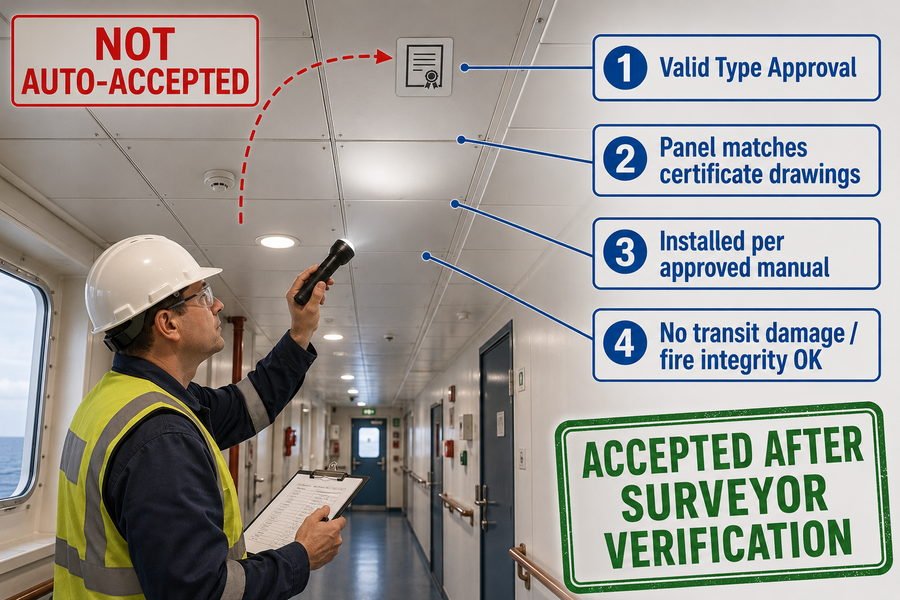
Buying certified products is only the first step. The real test happens at the shipyard. The local class surveyor has the final power to accept or reject your materials. To avoid problems, you must understand the four things the surveyor will verify onboard the ship. I will guide you through these four critical checks.
Verification of Certificate Validity and Marine Panel Drawings
First, the local class surveyor must verify the Type Approval is currently valid. Type Approvals expire after five years. If the certificate expired while the panels were on the ship from China to Europe, the surveyor will reject them. You must check the expiration date before you buy. Second, the surveyor will check that the physical panel matches the certificate's drawings. The certificate includes detailed cross-section drawings. The surveyor will measure the steel thickness and the core density of the panels at the shipyard. If the drawing says the steel skin is 0.6mm thick, but the real panel is only 0.4mm thick, the surveyor will stop the work. The physical product must match the paper exactly.
Inspection of Marine Panel Installation and Transit Condition
Third, the surveyor must confirm the installation follows the approved manual exactly17. Every Type Approval comes with an installation manual. It shows exactly how to place the screws and how big the gaps can be. According to standard marine installation guidelines, the gap tolerance between ceiling panels is usually around 3mm to 5mm maximum. If the shipyard workers leave a 10mm gap, fire can pass through. The surveyor will reject bad installation, even if the panel is good. Fourth, the surveyor checks that there is no transit damage compromising the panel's fire integrity. If panels get crushed during shipping, the joints will not fit together tightly. Damaged panels lose their B-15 rating18 and must be thrown away.
| Surveyor Onboard Check | What the Surveyor Looks For | Action if the Check Fails |
|---|---|---|
| Certificate Validity | Is the 5-year certificate still active today? | Complete rejection of panels |
| Drawing Match | Do physical thickness and density match the drawings? | Complete rejection of panels |
| Installation Manual | Are gap tolerances (e.g., 3mm-5mm) and screws correct? | Shipyard must reinstall the panels |
| Transit Damage | Are panel edges bent or rockwool exposed? | Damaged panels must be replaced |
Conclusion
Understanding class society type approvals for marine panels ensures you buy compliant products, avoid local surveyor rejections, and secure cost-effective, high-quality outfitting materials for your global shipyard decoration projects.
-
"What Is the Purpose and Scope of the IMO FTP Code? - Magellan ...", https://magellanmarinetech.com/what-purpose-scope-of-imo-ftp-code/. The IMO 2010 FTP Code, Part 3, defines B-class divisions as preventing the passage of flame to the end of the first half-hour standard fire test, supporting the stated 30-minute flame-resistance requirement. Evidence role: definition; source type: institution. Supports: A B-Class marine panel must prevent flame passage for 30 minutes during the standard fire test.. ↩
-
"[PDF] RESOLUTION MSC.307(88) (adopted on 3 December 2010 ...", https://wwwcdn.imo.org/localresources/en/KnowledgeCentre/IndexofIMOResolutions/MSCResolutions/MSC.307(88).pdf. The IMO 2010 FTP Code, Part 3, specifies insulation criteria for B-class divisions, including limits on average and maximum temperature rise on the unexposed face for the rated period, which directly supports the stated B-15 thresholds. Evidence role: definition; source type: institution. Supports: A B-15 marine wall panel must meet the stated unexposed-face temperature-rise limits for 15 minutes.. ↩
-
"[PDF] RESOLUTION MSC.307(88) (adopted on 3 December 2010 ...", https://wwwcdn.imo.org/localresources/en/KnowledgeCentre/IndexofIMOResolutions/MSCResolutions/MSC.307(88).pdf. The IMO 2010 FTP Code, Part 1, uses a non-combustibility test involving exposure of material specimens in a furnace at about 750°C and evaluates criteria including flaming and mass loss, supporting the described test mechanism. Evidence role: mechanism; source type: institution. Supports: Non-combustible marine panel core materials are tested in a 750°C furnace and can fail based on burning behavior or excessive mass loss.. Scope note: This supports the general test method; the exact pass/fail thresholds should be checked against the current applicable edition and any flag-state or class-society implementation notes. ↩
-
"46 CFR Part 2 -- Vessel Inspections - eCFR", https://www.ecfr.gov/current/title-46/chapter-I/subchapter-A/part-2. Class-society rules for product or unit certification describe surveyor attendance, inspection, and verification for specific items or batches, supporting the claim that project-specific certification can require inspection of the shipment before release. Evidence role: mechanism; source type: institution. Supports: Project-specific class certification requires an individual surveyor inspection before the specific shipment leaves the factory.. Scope note: The exact timing and extent of surveyor attendance may vary by class society, product type, and the vessel owner’s specification. ↩
-
"International Association of Classification Societies - Wikipedia", https://en.wikipedia.org/wiki/International_Association_of_Classification_Societies. The IACS membership list identifies twelve member classification societies, supporting the article’s description of the current IACS member base. Evidence role: definition; source type: institution. Supports: IACS has twelve member societies.. Scope note: The source verifies membership count and names; it does not by itself prove that every shipyard accepts every member’s approvals for every product type. ↩
-
"International Association of Classification Societies - Wikipedia", https://en.wikipedia.org/wiki/International_Association_of_Classification_Societies. IACS states that its member societies collectively class more than 90% of the world’s cargo-carrying tonnage, supporting the scale of IACS influence in commercial shipping classification. Evidence role: statistic; source type: institution. Supports: IACS members classify over 90% of the world's commercial cargo tonnage.. ↩
-
"What Is the IMO FTP Code for Marine Interior Materials?", https://magellanmarinetech.com/what-imo-ftp-code-for-marine-interior-materials/. IMO materials describe the International Code for Application of Fire Test Procedures as the framework for fire-test procedures used to assess materials and products required by SOLAS, supporting the connection between marine interior materials and FTP Code testing. Evidence role: mechanism; source type: institution. Supports: Marine wall panel safety tests are expected to follow IMO FTP Code fire-test procedures.. Scope note: This supports the regulatory testing framework generally; whether a specific wall panel certificate follows the FTP Code depends on the certificate and test reports. ↩
-
"Directive 96/98/EC - Wikipedia", https://en.wikipedia.org/wiki/Directive_96/98/EC. EU Marine Equipment Directive materials state that compliant marine equipment bears the Wheel Mark and may be placed on board EU-flagged ships when conformity assessment has been completed by a notified body, supporting the article’s point about cross-recognition within the EU marine-equipment regime. Evidence role: general_support; source type: government. Supports: An MED Wheelmark certificate can support acceptance of marine equipment on ships flagged in European countries, even when class societies differ.. Scope note: This supports acceptance within the scope of the EU Marine Equipment Directive; it does not prove that LR or BV will accept every DNV-issued certificate in all project or flag-state circumstances. ↩
-
"What Do A-Class, B-Class, and C-Class Divisions Mean in Marine ...", https://magellanmarinetech.com/what-a-class-b-class-c-class-divisions-mean-in-marine-wall-ceiling-panels/. The IMO fire-test framework and SOLAS terminology define B-class divisions by fire-resistance intervals such as B-0 and B-15, and distinguish C-class constructions from insulated fire-resisting divisions. Evidence role: definition; source type: institution. Supports: Marine panel certificates identify exact fire-rating classifications such as B-15, B-0, or C-Class.. Scope note: This supports the regulatory meaning of the class labels, not the validity of any particular supplier certificate. ↩
-
"What Is the IMO FTP Code for Marine Interior Materials?", https://magellanmarinetech.com/what-imo-ftp-code-for-marine-interior-materials/. IMO fire-test and approval documentation for ship divisions requires the tested construction and insulating materials to be described, which provides the basis for recording material properties such as insulation density in approval documents. Evidence role: general_support; source type: institution. Supports: Marine panel approval documentation should specify the approved density range for the core insulation material.. Scope note: The source may support the need to document the tested construction generally; the exact presentation as a “density range” can vary by administration or classification society certificate format. ↩
-
"What Is the Purpose and Scope of the IMO FTP Code? - Magellan ...", https://magellanmarinetech.com/what-purpose-scope-of-imo-ftp-code/. IMO FTP Code Part 5 sets criteria for surface flammability of bulkhead, ceiling, and deck finish materials, including the 45 MJ/m² limit for the gross calorific value of combustible surface materials. Evidence role: statistic; source type: institution. Supports: The IMO FTP Code Part 5 limits the calorific value of combustible surface materials to 45 MJ/m².. ↩
-
"[PDF] RESOLUTION MSC.307(88) (adopted on 3 December 2010 ...", https://wwwcdn.imo.org/localresources/en/KnowledgeCentre/IndexofIMOResolutions/MSCResolutions/MSC.307(88).pdf. IMO fire-test procedures tie approval of fire-resisting divisions to the tested construction, including joints and assembly details, so shipboard installations are expected to follow the approved arrangement. Evidence role: mechanism; source type: institution. Supports: The joint and profile assembly used on board should match the joint system covered by the fire-tested and approved panel design.. Scope note: This supports the principle that approvals are construction-specific; individual administrations or classification societies may define acceptable minor variations through separate approval conditions. ↩
-
"Are Marine Fire Divisions the Same as Marine Panel Ratings?", https://magellanmarinetech.com/are-marine-fire-divisions-same-as-marine-panel-ratings/. The IMO FTP Code Part 3 defines fire-resistance testing for A-, B-, and F-class divisions using specified test specimens, supporting that approval is tied to the tested construction and dimensions rather than to an unrestricted panel family. Evidence role: general_support; source type: institution. Supports: A B-15 certificate covers the tested panel thickness and should not be applied automatically to a different thickness.. Scope note: This supports the approval principle but may not state the exact certificate wording used by a particular flag administration or notified body. ↩
-
"How to choose the right fire class for marine wall panels?", https://magellanmarinetech.com/how-choose-right-marine-wall-panels-for-marine-interior-projects/. Marine fire-test and type-approval procedures treat the tested specimen’s materials and construction as the basis for approval, supporting that insulation core properties such as density must remain within the approved specification. Evidence role: general_support; source type: institution. Supports: Core density changes outside the certified range are not covered by the original B-15 approval.. Scope note: The source would support the need to match approved material specifications, but it may not prove the specific performance difference between 120 kg/m3 and 80 kg/m3 rockwool. ↩
-
"How Are Integrity and Insulation Judged in Marine Panel Fire Tests?", https://magellanmarinetech.com/how-integrity-insulation-judged-in-marine-panel-fire-tests/. Fire-resistance testing literature identifies joints, seams, and penetrations in compartment barriers as critical locations for loss of integrity, supporting the concern that altered panel joints can govern fire performance. Evidence role: mechanism; source type: paper. Supports: Panel joint systems are critical to fire integrity and changing the tested joint can undermine B-15 performance.. Scope note: This is contextual support for joint vulnerability in fire barriers generally and may not rank every marine panel joint as the single weakest point. ↩
-
"[PDF] RESOLUTION MSC.307(88) (adopted on 3 December 2010 ...", https://wwwcdn.imo.org/localresources/en/KnowledgeCentre/IndexofIMOResolutions/MSCResolutions/MSC.307(88).pdf. Research on polyvinyl chloride combustion and IMO smoke-and-toxicity testing requirements for marine surface materials supports that alternative coverings can change smoke and toxic gas hazards during fire exposure. Evidence role: mechanism; source type: paper. Supports: Changing an approved painted steel surface to a vinyl covering can introduce different smoke and toxicity behavior, requiring separate evaluation.. Scope note: This supports the hazard rationale for retesting surface coverings, but it does not establish that every vinyl covering will exceed marine toxicity limits. ↩
-
"How to choose the right fire class for marine wall panels?", https://magellanmarinetech.com/how-choose-right-marine-wall-panels-for-marine-interior-projects/. Fire-rated marine divisions are approved as tested assemblies, and classification/FTP Code guidance treats installation details and approved arrangements as part of maintaining the certified fire-performance rating. Evidence role: mechanism; source type: institution. Supports: Approved marine panels must be installed according to the approved manual or arrangement to maintain their certified performance.. Scope note: This supports the need to follow approved installation arrangements, but individual screw spacing or gap limits must be verified in the specific product approval or installation manual. ↩
-
"Are Marine Fire Divisions the Same as Marine Panel Ratings?", https://magellanmarinetech.com/are-marine-fire-divisions-same-as-marine-panel-ratings/. SOLAS and the IMO Fire Test Procedures Code define B-class divisions by tested integrity and insulation performance; damage to panel edges, joints, or insulation can compromise the tested assembly on which a B-15 rating depends. Evidence role: mechanism; source type: institution. Supports: Damage to a B-15 marine panel can compromise the fire integrity needed for its certified rating.. Scope note: The source would support the principle that the rating depends on intact tested construction, but it may not state that every damaged panel automatically loses certification in all circumstances. ↩